




Abstract
English achievement prediction is vital for improving the efficiency of English teaching by addressing the specific needs of students as early as possible. However, traditional English achievement prediction models are not good at the accuracy. Hence, a data-driven and AI-driven achievement prediction model is required to solve this problem. Recently, the increasing popularity of Multiple Layer Perception (MLP) and Gray Wolf Optimizer (GWO) has provided new methods for accurate prediction of students’ achievement. In terms of influencing factors, most scholars agree that learning motivation can mediate students’ learning achievement through different factors including self-efficacy and learning strategies. This paper aims to use a data-driven research schema via the questionnaire of Students’ Motivation Toward English Learning (SMTEL) and adopts an AI-driven model by Gray Wolf Optimizer-based Multiple Layer Perceptron (GWO-MLP) to predict English learning achievement with different learning motivations. Specifically, the research questions focus on (1) how the major motivational factors influence English learning achievement; (2) what the accuracy of the proposed GWO-MLP model for English achievement prediction is. The Wilcoxon signed rank test is adopted to compare GWO-MLP to other traditional and AI-driven prediction models. For the first question, the findings reveal that self-efficacy is the most influencing factor, and English learning value comes next, while performance goal exerts minimal impact on learners’ English achievement. For the second question, the results indicate that the proposed GWO-MLP model can predict English learning achievement more accurately and efficiently. Some suggestions have been recommended at the end of this research.
Introduction
During the past decades, many attempts have been made to investigate the relationship between motivation and English achievement from multiple perspectives. Studies have shown that motivation is critical in enhancing language acquisition and achievement in different subjects (Drissi et al., 2024; Guo et al., 2023; Hidayatullah & Csíkos, 2024; Myint & Robnett, 2024). Specifically, learners’ beliefs (Mulualem et al., 2022), self-efficacy (Teng et al., 2023; Wu et al., 2020), goals (Feng & Li, 2024; Y. Zhang et al., 2023), learning strategies (Habók et al., 2022) and learning environment (Alsadoon et al., 2022; Ferdinand et al., 2024) are important mediating factors of learners’ motivation and they have been identified as significant individual difference variables in analyzing English achievement. In spite of this, few studies rank the influence of various influencing factors of English motivation with an integrated questionnaire to find out targeted teaching suggestions on second language learning.
Recently, there has been a growing interest in achievement prediction, because it can provide a large amount of statistics, thereby enabling data-driven decision making (Bujang et al., 2021; Roslan & Chen, 2023). Data-driven decision-making refers to extracting valuable information through data collection and analysis (Zito et al., 2025). It is particularly necessary in education, where the need to support data-driven decision-making has leveraged the development of new methods and algorithms, aiming to support educators in making optimal decisions about language teaching and learning. Consequently, it is essential to compare different English achievement prediction models to predict students’ achievement accurately so that individualized evaluation and feedback can be provided.
Researchers have compared the influence and predictive power of different factors that may affect learning motivation by using distinctive research methods. Previous studies initially used traditional methods such as Linear Regression (Muttaqin & Chuang, 2022; Santosa & Chrismanto, 2017), Structural Equation Modeling (SEM; Zhao & Wang, 2023), Decision Tree (Orji & Vassileva, 2023), Support Vector Machines (SVM; Chui et al., 2020), and Ensemble Learning (Keser & Aghalarova, 2022). Recently, data-driven and AI-driven models have become the hottest research methods, since accuracy can be improved greatly, thus it is widely used in prediction fields (Güven & Şimşir, 2020). AI-driven methods, including neural networks and meta-heuristic computing, have been widely used in predicting student achievement. Multi-Layer Perceptron (MLP) is a deep and efficient neural network, and it is composed of several layers: an input layer, an output layer and zero, one or more hidden layers between them (D. Li et al., 2019). However, MLP has its limitations on complex problem optimization (Naskath et al., 2023). Hence, it is necessary to try different algorithms to optimize MLP, and meta-heuristic algorithms are suitable methods for complex optimization problems. Specifically, meta-heuristic algorithms include Particle Swarm Optimization (PSO; Gad, 2022; D. Wang et al., 2018), and Ant Colony Optimization (ACO; Gad, 2022; Y. Wang & Han, 2021). Among them, Gray Wolf Optimizer (GWO) has gained enormous attention (Song et al., 2022).
GWO was proposed by Mirjalili et al. (2014), and is characterized by its simple structure, few parameters, easy implementation, and strong convergence performance. GWO has achieved great success in many fields (Águila-León et al., 2024; Ghalambaz et al., 2021; Xu et al., 2024), such as function optimization (X. Zhang et al., 2020), feature selection (Fan et al., 2023), and parameter optimization (Diab et al., 2022). In addition, GWO can accelerate the convergence speed when facing complex problems. Therefore, GWO is adopted to overcome the shortcomings of MLP. Currently, the Gray Wolf Optimizer-based Multi-Layer Perceptron (GWO-MLP) model has limited application in English achievement prediction with different learning motivations. Achievement prediction is a typical nonlinear problem, which is affected by many complex factors (Feng & Li, 2024; Zeynali et al., 2019). Simple linear regression methods fall short in fully capturing the interaction among these multiple factors, resulting in inaccurate and unstable prediction results (G. Wang & Ren, 2024). GWO can effectively address the high-dimensional, nonlinear, and many local minima problems involved in grade prediction by optimizing the parameters of the prediction model (Geng et al., 2025). By optimizing the topology and parameters of MLP through GWO (Ali et al., 2024), the proposed GWO-MLP model is more adapted to the nonlinear characteristics of grade prediction, and thus provides more accurate prediction results under the influence of multiple factors.
Existing research shows that English learning motivation is the key to students’ achievement, MLP is a useful tool for achievement prediction with some limitations (Champati et al., 2023), and GWO has its advantages but minimal application in English learning motivation. Given these limitations, the significance of this study lies in its potential to provide insights into second language learning with data-driven and AI-driven approaches, and thus facilitates the decision-making of learning strategies. To achieve this purpose, this paper is divided into the following parts. Firstly, this paper will use GWO to optimize MLP for constructing the GWO-MLP model. Secondly, the questionnaire of Students’ Motivation Toward English Learning (SMTEL) will be adopted. And then this paper will predict students’ English achievement with the data collected from the SMTEL questionnaire. Lastly, the collected data will be classified into the training data and testing data to confirm the accuracy of the proposed GWO-MLP model.
Literature Review
Prediction Methods of English Achievement
Previous research has generally adopted standardized tests, for example, International English Language Testing System (IELTS), Test Of English as a Foreign Language (TOEFL), and National College Entrance Examination (NCEE) as the prediction approaches for academic achievement (Daller & Wang, 2016; Schoepp & Garinger, 2016). However, previous studies on the English achievement of students indicate that standardized language tests demonstrate low predictive power for their later achievement (Bergbauer et al., 2024). That is to say, it is inadequate to reliably predict students’ academic achievement with standardized language tests.
As for achievement prediction methods, many other approaches have been widely adopted. First of all, different researchers have focused on traditional methods such as Linear Regression (Mai et al., 2023), Structural Equation Modeling (SEM; Karbakhsh & Ahmadi Safa, 2020), and Decision Tree (Villarrasa-Sapiña et al., 2024). Compared with the above traditional methods, some AI-driven prediction models such as Support Vector Machines, Ensemble Learning and Artificial Neural Network (ANN) have appeared, and their advantages have been confirmed (Baashar et al., 2022; Huang et al., 2023; Keser & Aghalarova, 2022). What’s more, some experts have compared ANN with traditional approaches such as Decision Tree and Linear Regression to conclude that the performance of ANN was the best among AI-driven prediction models (Hu, 2022; King et al., 2024; G. Li & Gao, 2022). Moreover, among different neural network models, MLP is widely adopted since it is a powerful prediction model, which applies a supervised training procedure using examples of data with known labels (Abu Doush et al., 2023). However, setting optimal weights and biases is a challenging problem for MLP (Ali et al., 2024). Consequently, there seems to be clear value in exploring students’ achievement prediction with new approaches.
The extant literature shows that accurate prediction cannot be achieved merely through standardized tests. In addition, the results of traditional methods such as Linear Regression were compared with MLP, and it was found that MLP is more effective in achievement prediction. However, there is a research gap for the improvement of MLP. In other words, it is necessary to optimize MLP to improve the prediction efficiency.
Learning Motivation
Learning motivation is a widely studied issue in English language learning investigations, and it has caught relatively substantial research attention around the world. There is no standard definition for learning motivation. Nevertheless, it has been defined by several scholars from multiple perspectives. Gardner (1985: 10) defined motivation as “the extent to which the individual works or strives to learn the language because of a desire to do so and the satisfaction experienced in this activity.” This explanation focuses on the internal drive, desire, and the sense of satisfaction in achieving personal goals. Similarly, Csizer and Dornyei (2005: 20) noticed the inspirational role of motivation and characterized it as “a concept that explains why people behave as they do rather than how successful their behavior will be.” In other words, learning motivation can indirectly influence learning achievement by mediating students’ learning behaviors. From the above, the research highlighted the relationship between learning motivation and students’ learning achievement. While Oga-Baldwin and Fryer (2020) further complemented that students’ learning motivation is dynamic, and it is regulated by a continuum of reasons for action, spanning from controlled to autonomous. Furthermore, some scholars tried to figure out the influencing factors of learning motivation. And recent studies have proved the impact of factors such as prior language proficiency (H. Wang et al., 2023) and learning anxiety (Q. Li et al., 2021) on learning motivation. Given the mediating role of learning motivation on learning behaviors and its influencing factors, English learning motivation will be understood as what encourages or drives learners to freely devote their time to English learning in this study.
Later, scholars pay attention to individual variables that may affect students’ learning achievement, such as gender (Rodríguez et al., 2019), individual differences (Tam et al., 2021), cultural background (Eccles & Wigfield, 2020; Lou & A. Noels, 2021), and different learning environments (Daniel et al., 2024; Purnadewi et al., 2023). Some other research tries to discuss the potential factors of motivation that may influence learning achievement in an integrative way. Expectancy-Value Theory (EVT) is one of the most imperative theories about motivation, which regards the expectancy of success as well as the value of tasks as the main reasons for motivation (Q. Wang & Xue, 2022). Nevertheless, EVT does not provide a satisfactory illustration of why learners have the expectancy of success and why they find a task valuable (Dörnyei, 1998). Namely, more theories are needed to explore the reasons for motivation. Researchers attempt to solve this problem from various points of view. Attribution Theory (Weiner, 1985) finds that attributions such as efforts, ability, and task difficulties can influence students’ future behaviors. Goal Orientation Theory (Dweck, 1986) believes that the goal is an important influencing factor of learners’ motivation. Learners with performance goal focus more on learning outcomes, while those with mastery goals pay attention to learning content (Fishman, 2014). The above studies concern the motivation for general purposes, while other research focuses on motivation in second and foreign language learning. Gardner (1985) proposed the Socio-Educational Model, holding the idea that motivational intensity, learning desire and learning attitudes are three components of learning motivation. To integrate the results of other research areas, Tremblay and Gardner (1995) expanded the Socio-Educational model with some other psychological variables, as shown in Figure 1.

The motivation model of Tremblay and Gardner (1995).
In the proposed model, learning achievement can be influenced by motivational behaviors, which are caused by goal salience, valence, self-efficacy, and adaptive attributions affected by French language dominance. In Tremblay and Gardner’s view (1995), goal salience represents the importance of a certain goal for learners, and it is characterized by the specificity and the frequency of the goal. Valence is a kind of subjective value, which refers to the desire and attractiveness of individuals toward the task. Self-efficacy refers to a belief that one can achieve what one sets out to do. Adaptive attributions refer to those that associate learning outcomes with controllable causes (Fishman & Husman, 2017). In other words, if individuals attribute their success or failure to controllable factors such as the learning strategy, they are more likely to take actions to improve their achievements. This expanded model is conducted based on an empirical study in the French-dominant environment (a second language learning environment), but it is suitable for English language learning because of the similar context of research subjects between Tremblay and Gardner’s experiment and ours. Specifically, in Tremblay and Gardner’s study (1995), French is the second language of the participants, while English is the second language of the participants in this study.
In short, all the research tries to perfect their understanding of learning motivation by integrating as many influencing factors of motivation as possible, whereas the expanded model proposed by Tremblay and Gardner (1995) can incorporate as many influencing factors of motivation as possible. However, it is impossible to conduct an experiment to test all the motivational factors involved in learning achievement. Given this limitation, and guided by the theoretical framework established by Tremblay and Gardner (1995), we choose self-efficacy, learning strategy, English learning value, performance goal, achievement goal, and learning environment to confirm the degree to which students’ learning achievement can be influenced by these factors.
Research Gaps
Various methods have been used in achievement prediction, and MLP is one of the most popular AI-driven models among them (Tong & Li, 2025). In spite of this, MLP still has some limitations (Abu Doush et al., 2023; Ali et al., 2024). Therefore, the optimization of MLP is urgent to improve the accuracy of achievement prediction, which means the parameter optimization of MLP is critical, and it is urgent to use GWO to optimize MLP.
Currently, scholars design and conduct a lot of studies on motivation (Daniel et al., 2024; H. Wang et al., 2023), but in these studies, the focus is on what motivates students’ learning and which model can explain students’ learning motivation as much as possible, while the extent to which learning motivation influences students’ achievement is seldom studied. And this encourages researchers to explore the influence of motivational factors on students’ achievement. Therefore, based on studies on achievement prediction and learning motivation, this study will be an exploration on the use of GWO to optimize MLP, and the integration of learning motivation into achievement prediction. In other words, this paper will build an achievement prediction model for English learning with different learning motivations.
Methodology
Research Questions
English achievement prediction can provide informative feedback for educational practitioners, but it can be influenced by multiple factors easily. Therefore, accurate English achievement prediction methods become an immediate focus. This research will be conducted through a questionnaire survey, and the collected data will be put into the proposed GWO-MLP model so that the following two questions will be answered:
(1) To what extent do different motivational factors affect English learning achievement?
(2) What is the accuracy of the adopted GWO-MLP model for English achievement prediction?
Participants
Considering the research purposes, a total of 466 undergraduate English as Foreign Language (EFL) learners are selected as the research subjects from several public universities in China. Essentially, all the participants are chosen by using the hierarchical sampling method, that is, randomly selecting samples from the first, second, and third years of college in the predetermined proportions. They are clear about the research purpose and actively participate in this research. Additionally, they have received a 9-year compulsory English education before participating in the study, but they have different learning motivations.
Instrument
The chosen factors are measured according to the questionnaire developed by Tuan et al. (2005), which is used to investigate students’ motivation in the area of science learning. According to the Program for International Student Assessment (PISA) 2015 Assessment and Analytical Framework created by the Organization for Economic Co-operation and Development (OECD; 2017), learners are required to obtain similar qualities in both science and English learning, such as scientific and logical explanation of a phenomenon with conclusive evidence. Therefore, the questionnaire of Students’ Motivation Toward Science Learning (SMTSL) can be transferred into the area of English learning.
Implicated by the SMTSL questionnaire, the factors including self-efficacy, learning strategy, English learning value, performance goal, achievement goal, and learning environment are incorporated in the SMTEL questionnaire, and they are defined as follows. Self-efficacy has the same meaning in both the SMTEL questionnaire and the proposed model by Tremblay and Gardner (1995), which refers to a belief that one can achieve what one sets out to do. In a sense, it is self-confidence in specific situations (Bandura, 1977). Learning strategy can be defined as students’ learning methods that are intended to influence learners’ information processing (Mayer, 1988). Namely, it is controllable and can be changed. Thus, the learning strategy can be regarded as an adaptive attribution. Performance goal refers to students’ goals of competing with other students and getting attention from the teacher in this paper, while achievement goal represents students’ attention to the learning content and their learning competence (Tuan et al., 2005). And these goal-related concepts are the embodiment of goal salience. English learning value is in line with valence, referring to whether or not students can perceive the value of the English learning they engage in. Learning environment stimulation includes all the external factors that influence students’ motivation in English learning, and it is the focus of the second language dominant environment.
Similar to the SMTSL questionnaire, the SMTEL questionnaire comprises two parts. The first part is the basic information about the students’ identity and their English scores in NCEE. The second part is 34 items rated on a 5-point Likert scale ranging from 1 (strongly agree) to 5 (strongly disagree). The total score of the English tests in NCEE is 150, and 90 is set as the passing score. And the items of the SMTEL questionnaire (Supplemental Appendix I) are divided into six dimensions, with seven items on self-efficacy (e.g., I am sure that I can do well on English tests.), eight items on learning strategy (e.g., When learning new English language points, I attempt to understand them.), five items on English learning value (e.g., I think that learning English is important because I can use it in my daily life.), four items on performance goal (e.g., I participate in English courses to get a good grade.), five items on achievement goal (e.g., During a English course, I feel most fulfilled when the teacher accepts my ideas.), and five items on Learning environment stimulation (e.g., I am willing to participate in this English course because the content is exciting and changeable.). What’s more, the global score of each part is the sum of the answers to each of the items. Specifically, with respect to each dimension, the higher scores that students get, the more significance the dimension has. In spite of the similar structure, some items of the SMTSL questionnaire are modified to fit the context of English learning. For example, items 18 and 19 are modified according to the importance of English learning, as shown in Examples 1 and 2.
Example 1 (item 18): “In English, I think that it is important to learn to express myself in English.”
Example 2 (item 19): “In English, I think that it is important to learn to get English information.”
To ensure content validity, this questionnaire was assessed by 7 judges with experience of 10 years or more in the field of second language acquisition. At this stage, each item was evaluated with two indicators: appropriateness of the questions and clarity of each item. A 4-point Likert scale ranging from 1 (strongly disagree) to 4 (strongly agree) was used. Based on their identification of any deficiencies in this questionnaire, the judges were asked to make suggestions to improve the quality of each item.
And then, Content Validity Ratio (CVR) and Content Validity Index (CVI) were used to assess the content validity. CVR should be in the range of −1 to +1. If the value is close to +1, it indicates that experts agree that the item is very important in content validity (Lawshe, 1975). Once the CVR was obtained for each item, CVI was followed. To ensure adequate content validity, the value of CVI among seven experts should be more than 0.83 (Lynn, 1986). For the SMTEL questionnaire, the CVI of each item ranges from 0.846 to 1, and the CVR is 0.878, which means the questionnaire has good content validity, and the validity and reliability of the questionnaire can be further measured.
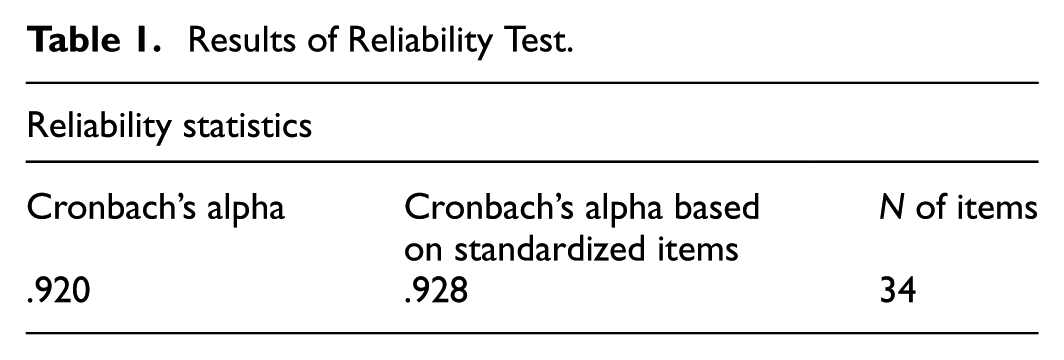
To clarify the reliability and validity of the SMTEL questionnaire, a pilot test was conducted with 100 participants. And then the data were analyzed through SPSS 27.0, as shown in Tables 1 and 2. Table 1 provides the Cronbach’s alpha value of the SMTEL questionnaire, which was .928 > .9, implying good reliability (Nunnally, 1978). Additionally, as Table 2 shows, the KMO value of 0.85 exceeds the recommended threshold of 0.6 (Tabachnick & Fidell, 2019), which means that there are common factors among the variables, so it is suitable to do the factor analysis of the questionnaire. What’s more, the p-value indicates that the items of the SMTEL questionnaire are strongly correlated (p < .05), implying good validity.
Results of Reliability Test.
Results of Validity Test.

Statistical Methods
When it comes to the statistical methods, the proposed GWO-MLP model is applied based on the Gray Wolf Optimizer and Multiple Layer Perception. These statistical methods are introduced in the following parts.
Gray Wolf Optimizer
Gray Wolf Optimizer (GWO) is a novel nature-inspired computing algorithm that searches the solution space based on the formulation of the social construction on gray wolves (Nadimi-Shahraki et al., 2024; M. Yu et al., 2024), which are divided into four levels (α, β, δ, ω wolves) according to the social hierarchy as shown in Figure 2, and their behaviors can be divided into three stages: encircling, hunting, and attacking prey (Mirjalili et al., 2014).

Hierarchy level and social construction of GWO (Mirjalili et al., 2014).
Encircling prey means gray wolves limit the range of activities by encircling prey, which can be computed by Equations 1 and 2.


where D is the distance between different wolves, X(t + 1) is the position of the wolf, Xprey(t) is the position of the prey. A and C are the coefficient vectors that change with each iteration, and these parameters can be computed by Equations 3 and 4.


where a refers to a constant, and it decreases linearly from 2 to 0, and r1 and r2 are random vectors between [0,1].
Hunting prey refers to gradually approaching and exhausting prey through continuous encirclement, and the generated position of wolves can be computed by Equations 5 and 6.
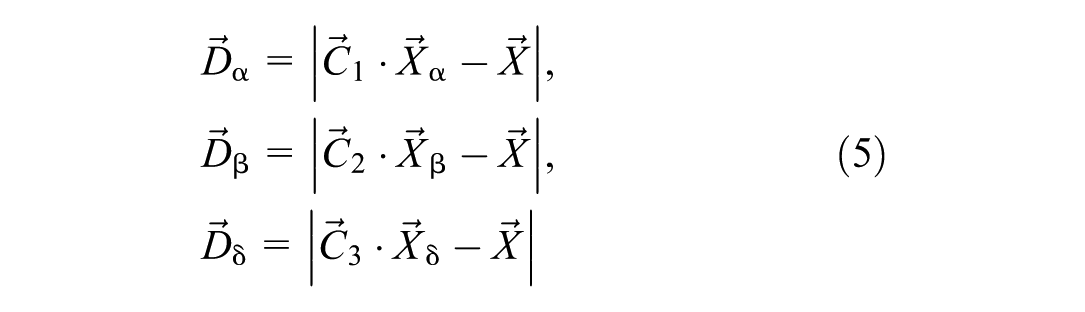

where
Attacking prey indicates that using these above positions of X1, X2 and X3 can generate the next generation of all wolves for attacking the prey with Equation 7.

Multiple Layer Perception
Multiple Layer Perceptron (MLP) is a feedforward neural network that is widely used in classification, regression, and other supervised learning tasks (D. Li et al., 2019). It is one of the novel neural network models with good performance, especially suitable for dealing with non-linear prediction problems. MLP can handle both linear and nonlinear problems (Naskath et al., 2023), and the addition of hidden layers makes it a deep neural network for solving more complex problems. MLP is widely used in various tasks such as image classification (Sun et al., 2023), speech recognition (Abbaskhah et al., 2023), text classification (Duarte & Berton, 2023), etc. MLP consists of at least three layers: an input layer, one or more hidden layers, and an output layer (Agbasi & Egbueri, 2024). Each layer consists of a set of neurons (nodes), each of which is connected to all neurons in the next layer. And the basic architecture of MLP is shown in Figure 3 (Naskath et al., 2023).

Architecture of multiple layer perceptron.
The input layer is responsible for receiving input from external data. Each neuron represents an input feature. Thus, the number of neurons in the input layer is equal to the number of input features. The input layer receives the eigenvector X and passes it to the neurons of the first hidden layer. The neurons of each hidden layer apply weighted summation to the input data, and then calculate the output through the activation function with Equation 8:

Additionally, wij refers to the weight of the neuron of the input layer to the neuron of the hidden layer, and bj is the bias of the neuron in the hidden layer.
The hidden layer is located between the input layer and the output layer, and usually contains one or more layers. Each hidden layer neuron receives the input of the previous layer by weighted summation, and then performs a nonlinear transformation through activation functions, such as Sigmoid, ReLU, etc. The number of hidden layers and the number of neurons in each layer are important factors affecting the performance of MLP, and usually need to be tuned according to specific problems. And the output of the hidden neurons is calculated in the following way with Equation 9, in which wjk and bk represent the neuron’s weight and bias respectively.

The output layer produces results according to the task types. On classification problems, each neuron in the output layer represents a category, and the output probability value is usually normalized by the Softmax function; on regression problems, the output layer usually has only one neuron and directly outputs a continuous value.
In the traditional MLP, the data are only transferred in a forward direction from the input layers, through the hidden layers, and to the output layers.
GWO-MLP
GWO-MLP contains three parts: input, operation, and output layer. The input layer is the six factors of the SMTEL questionnaire, the hidden layer is the abstract features learned from the input layer, and the output layer is the prediction outcomes. The training stops when a specified termination condition is met, such as reaching a certain number of iterations. If the termination condition is met, the training procedure will be stopped. The workflow of the proposed GWO-MLP is shown in Figure 4.
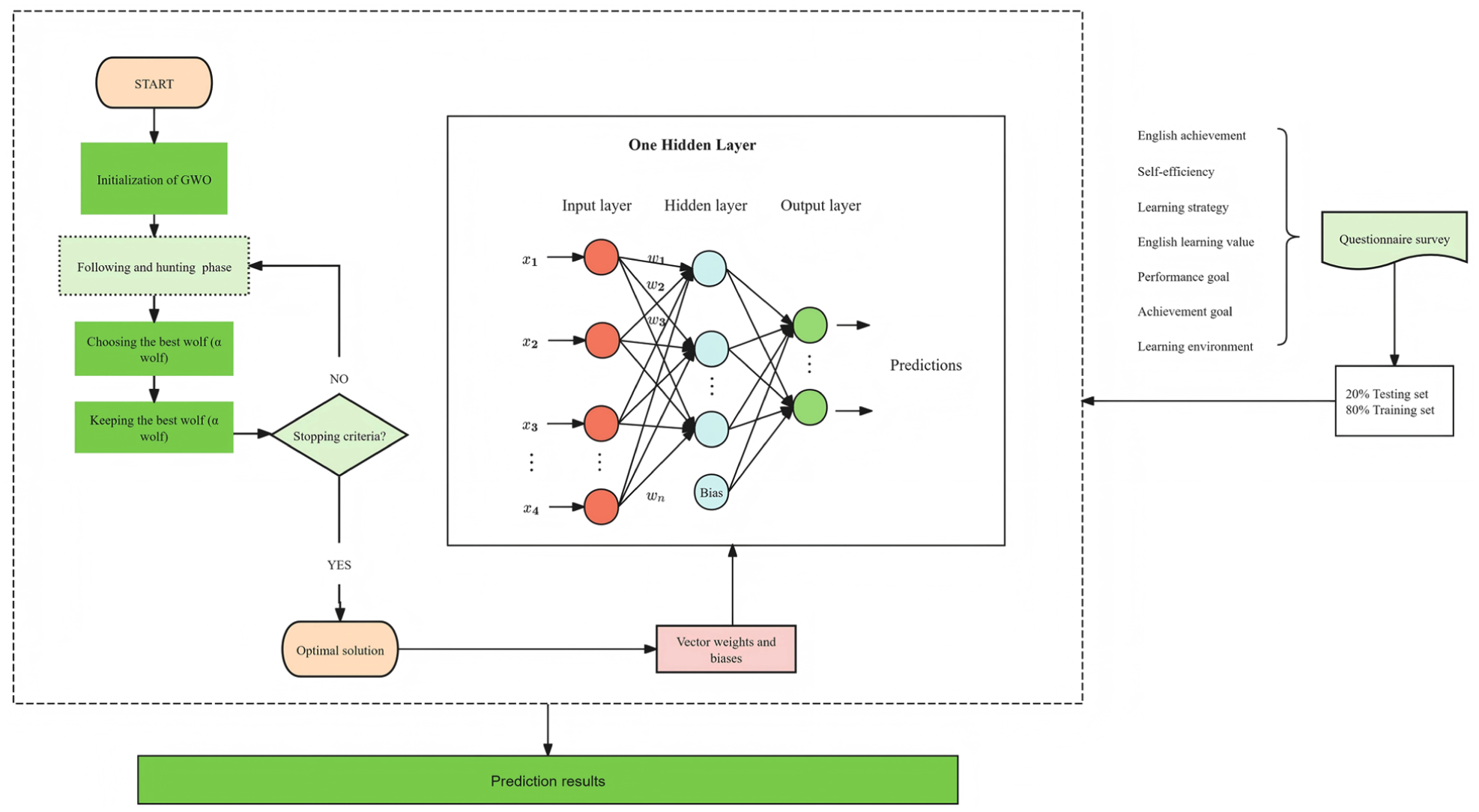
Workflow of GWO-MLP model.
Research Procedures
In order to answer the above two research questions, the research procedure includes the SMTEL questionnaire survey, data pre-processing, and model setting.
Step 1: SMTEL Questionnaire Survey
During the survey, the SMTEL questionnaire was handed out randomly to students who had participated in NCEE. Of the 500 questionnaires, 34 were not completely answered, and thus, they were excluded, leaving 466 valid questionnaires.
Step 2: Data Pre-processing
The remaining 466 samples were collected in Excel and students’ scores were divided into several parts, which means students were scored under 90 and the other 6 passing parts and then coded as “1=‘<90’,”“2=‘91-100’,”“3=‘101-110’,”“4=‘111-120’,”“5=‘121-130’,”“6=‘131-140’,”“7=‘141-150’.” Besides, the six dimensions of the SMTEL questionnaire were regarded as the attributes of GWO (Table 3), which are the input of the prediction model. To address the issue of varying scales among different features, data standardization was performed to center the distribution around zero and mean with a standard deviation of one, making it more suitable for data analysis. In this paper, the data set was split into 80% for training and 20% for testing. Moreover, the experiment codes are executed in the Matlab environment under the Windows 10 operating system, all simulations on a computer with Intel Core (™) i3-6100 CPU @ 3.70 GHz, and its memory is 8 GB.
Attribute Information for Students’ English Achievement Data Set.

Step 3: Model Setting
Although MLP is efficient, the involvement of too many parameters leads to local minimal values (Naskath et al., 2023). And this problem can be solved by GWO due to its capability to keep balance between its global and local search (Yu et al., 2024). To validate the effectiveness of the proposed GWO-MLP model on SMTEL, both traditional and AI-driven prediction models are used.
In this study, the process of model setting includes normalization processing, determination of input, output, and hidden layers, training parameter setting, network model construction, selection of activation function, etc. After producing the achievement prediction results, the predictive power of GWO-MLP will be compared with Particle Swarm Optimization-based MLP (PSO-MLP), Genetic Algorithm-based MLP (GA-MLP), Sine Cosine Algorithm-based MLP (SCA-MLP), Differential Evolution-based MLP (DE-MLP), and Tree-Seed Algorithm-based MLP (TSA-MLP).
In detail, PSO is a meta-heuristic technique that solves problems by simulating the social behavior of birds within the flock to attain the target of food (Jain et al., 2022), and the constant parameter of PSO can be set as follows:
c1 = 2; (c1 refers to the individual acceleration constant)
c2 = 2; (c2 refers to the individual acceleration constant)
w = 0.9; (w refers to the inertia weight)
vmax = 1.2; (vmax refers to the maximum velocity of the particle)
GA serves as an optimization tool which generates the optimal solution from the possible solution domain using the fitness (objective) function and constraints, classified into optimization of single objective function and multi-objective function (Garud et al., 2021), and the constant parameter of GA can be set as follows:
CrossoverRate = 0.7
MutationRate = 0.2
SelectionRate = 0.7
SCA is characterized by dealing with the complicated relationship between multiple dependent and independent variables simultaneously (Duan et al., 2021).
DE is a stochastic search method that starts with a set of chromosomes (decision vectors), with each chromosome consisting of a set of genes (decision variables). The chromosomes of a generation use mutation, crossover, and greedy selection operations repeatedly to move the population toward the next generations until a near-optimal solution is achieved (Panigrahi & Behera, 2020). Its constant parameter can be set as follows:
Scale Factor (SF) = 0.5
CrossoverRate (CR) = 0.1
TSA is a heuristic method that simulates the evolutionary behavior between trees and seeds (Jiang et al., 2022). The entire evolutionary process is optimized through seed generation and tree update strategies, which are balanced by search trends. And the constant parameter of the search trends can be set as 0.1.
Results and Discussion
The Influence of Motivational Factors on Students’ English Learning Achievements
For the first question, we conclude the importance of influencing factors based on the percentage of the average score in each dimension and the ANOVA effect sizes. Table 4 presents the ANOVA effect sizes, which are measured through Eta Squared (η2). According to the criteria set by Cohen (1988), an η2 value greater than .138 indicates a large effect size, one greater than .01 indicates a small effect size, while an η2 value between .059 and .138 suggests a medium effect size. It can be seen from Table 4 that self-efficacy (p = .000 < .05; η2 = .247 > .138), learning strategy (p = .000 < .05; η2 = .079 > .059), and English learning value (p = .000 < .05; η2 = .085 > .059) have a significant influence on students’ learning achievement. But the p-value and the effect sizes of performance goal and achievement goal indicate that they are not statistically significant (p > .05, η2 < .059). Namely, among these six factors, self-efficacy is the largest influencing factor (η2 = .247) that drives students to get high scores, English learning value is the second most important factor, and learning strategy comes next.
The ANOVA Effect Sizes.

Table 5 presents the percentage of average scores in each dimension. As shown in Table 5, students scoring less than 90 get higher marks in almost every dimension except for performance goal. Particularly, it is in self-efficacy that they get the highest average score (66.37% ± 6.86%). However, for students who score from 91 to 140, they get a higher average score in performance goal and self-efficacy than in other dimensions. Apart from this, for other students whose scores are between 141 and 150, it is in the learning environment that they get the highest average score (60.89% ± 18.95%).
Percentage of Average Score in Each Dimension.

According to Tables 4 and 5, the overall impact of the six factors can be found. However, the influence of each factor on students with different levels of English achievement needs to be further explored. The study was conducted through a questionnaire survey based on the motivational framework of Tremblay and Gardner (1995; as shown in Figure 1) to collect data on students’ English learning motivation to further discuss the extent to which different motivational factors affect English learning achievement.
Example 3 (item 16): “I believe that it is important to learn English because I can use it in my daily life.”
Example 4 (item 13): “I will try to find out the reason if I make mistakes in my English learning.” (enquiry-based strategies)
Given the effects on students’ English achievement,
What’s more, as shown in Table 5, students scoring between 101 and 110 get higher scores in the aspects of performance goal (61.42% ± 12.17%) and low-scoring students (≤90) get higher scores in the aspect of achievement goal (average score = 51.49% ± 14.8%). In other words, performance goal has minimal influence on students scoring between 101 and 110, and achievement goal is of the least importance for low-scoring students (≤90). On the one hand, the contributor to students’ (101–110) disagreement with performance goal may be that those students lack teachers’ attention. Based on the motivational framework of Tremblay and Gardner (1995), goal salience is featured by goal frequency and goal specificity. High expectations of teachers can facilitate students’ achievement (Bergold & Steinmayr, 2023; Z. Li et al., 2024), and teachers’ support is related to learners’ achievement through the mediating role of students’ goal setting (Q. Liu, Du, & Lu, 2023). Namely, teachers’ attention is of great importance for students of different achievements. However, teachers may focus more on high-scoring students and low-scoring students than on students in the middle (101–110). Therefore, less attention from teachers causes students to lack strong goal orientation and be featured by the low frequency of their goals. On the other hand, the reason for low-scoring students’ disagreement with the achievement goal is that high-scoring students and low-scoring students differ in learning satisfaction because of their discrepancy in English achievement. High-scoring students gain more successful learning experiences than those of low-scoring students, thus they are more likely to gain high satisfaction with English learning. Given that achievement goal has a strong correlation with learning satisfaction (Yu, Kreijkes, & Salmela-Aro, 2023), it is understandable that achievement goal performs with limited effectiveness in facilitating low-scoring students (≤90).
The Accuracy of the GWO-MLP Model
Based on the questionnaire results, this study will answer the second research question which focuses on the prediction results of the proposed GWO-MLP model to verify its efficiency. In order to validate the advantages of GWO-MLP, we compare the GWO-MLP model with PSO-MLP, GA-MLP, DE-MLP, SCA-MLP, and TSA-MLP.
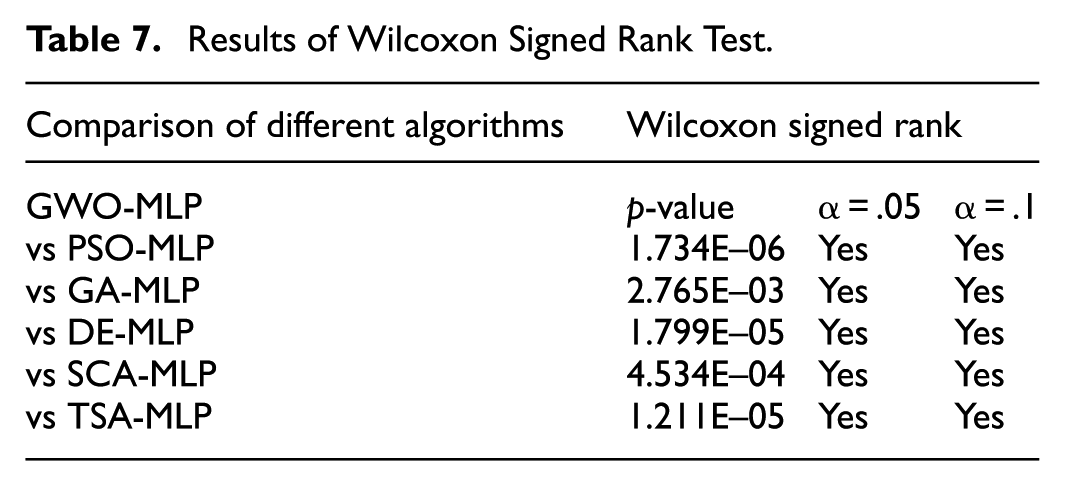
Table 6 depicts the results of different optimizers combined with MLP. Among them, the mean error (Mean) and the standard deviation (Std.) of GWO-MLP are the lowest, which indicates that GWO-MLP has the least errors and the model value of GWO-MLP is closest to the actual value. To compare GWO-MLP with other optimization algorithms more clearly, the Wilcoxon signed rank test was used. As illustrated in Table 7, GWO-MLP is significantly different from PSO-MLP, GA-MLP, DE-MLP, SCA-MLP, and TSA-MLP (p < .05).
Comparison of Different Optimization Algorithms Based on MLP.

Results of Wilcoxon Signed Rank Test.
From Figures 5 and 6, it can be seen that GWO-MLP significantly outperforms the other models in terms of the test error and fitness stability. Besides, GWO-MLP has less fluctuation and a more concentrated median, which confirms its effectiveness and application. On the contrary, GA-MLP and PSO-MLP exhibit larger mean errors and variance. The medians of DE-MLP and TSA-MLP are acceptable, and the tails of their distributions are elongated, indicating their inefficiency in robustness. All these indicate that these methods tend to address the potential issues of premature convergence during model construction. Overall, GWO-MLP presents not only low errors but also high robustness, which verifies the effectiveness of the GWO in guiding the parameter optimization process of MLP.
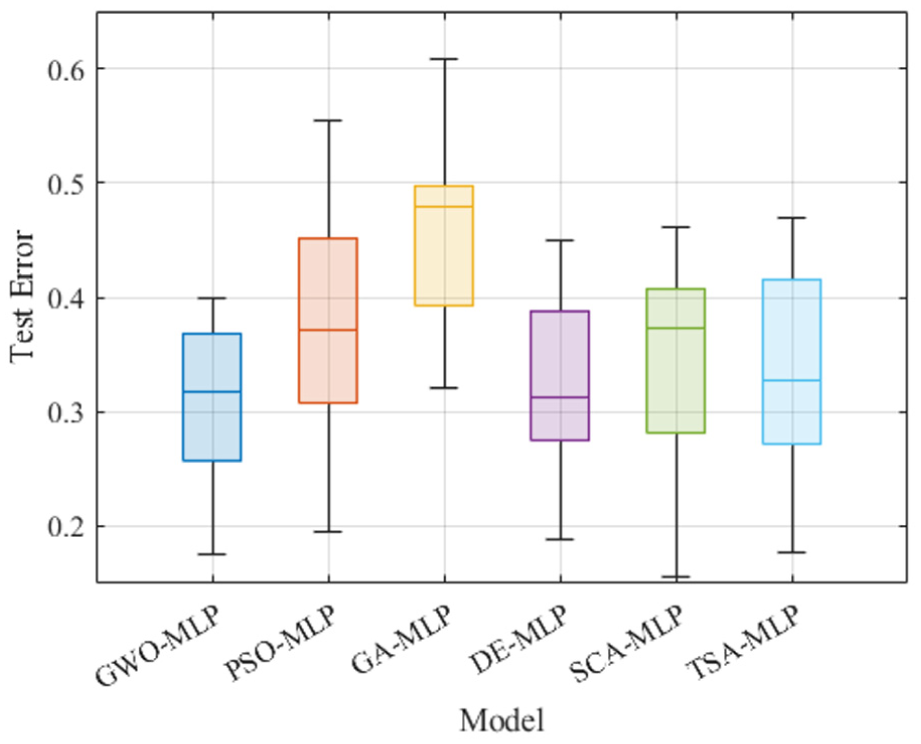
Test error distribution.
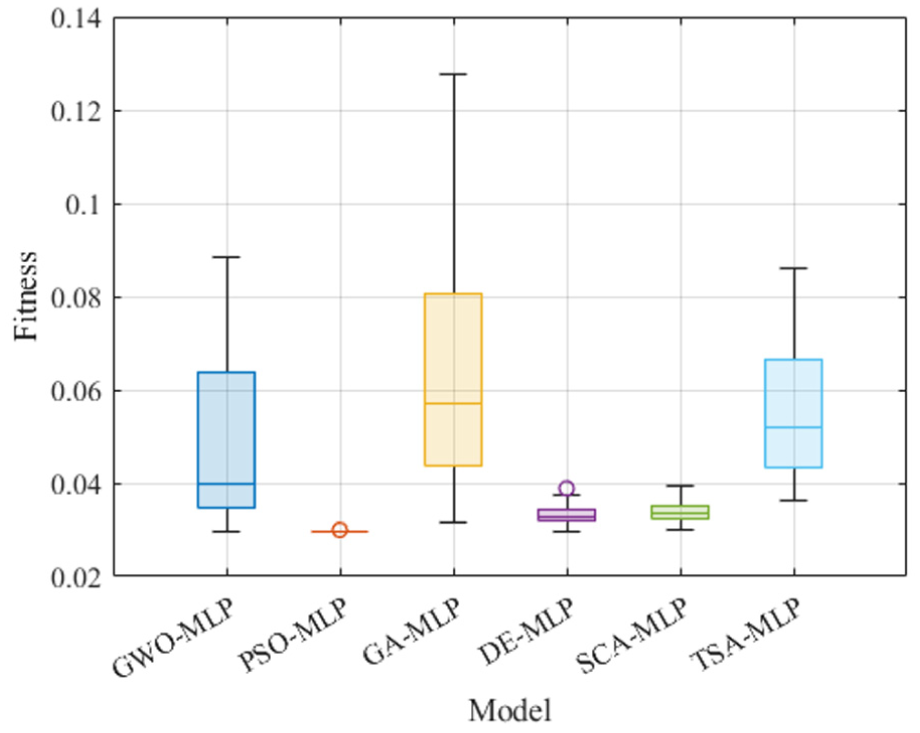
Fitness performance.
In order to further evaluate the convergence behavior of different optimization algorithms during MLP training, the convergence curve is shown in Figure 7. In contrast, other methods show premature convergence and local minimal value, with moderate convergence speed and limited optimization potential in the later stages. It can be observed that GWO-MLP performs the best in terms of convergence speed and stability. Moreover, the overall curve of GWO-MLP exhibits minimal fluctuations, which suggests that its search path is of high stability in terms of convergence.

Convergence curve.
Suggestions
The findings in this study have long-run implications for second language learning and teaching. Tables 6 and 7 demonstrate that the proposed GWO-MLP model has more accurate predictive power. In light of the importance of making a fast, accurate, and early assessment of different students’ achievements in educational systems (Kurilovas, 2020), it is prominent and necessary to use GWO-MLP in the teaching and learning process.
In particular, educational practitioners can design or adapt a questionnaire to investigate variables that affect students’ learning achievement. Next, after the analysis of students’ achievement and finding the key influencing factors, teachers can use GWO-MLP to predict students’ English learning achievement, and then refine their teaching strategies and lesson plans based on the prediction results. Last, students’ achievement and educational quality can be improved gradually under the continual assessment and adjustment of teaching strategies. According to the results of this study, teachers can use the following strategies to foster the motivation of students with different English levels and then promote their English achievement.
Suggestion 1: Achievement Goals Can be Focused Through Meaningful Activities
According to the research result (see Table 4), students do not concentrate on the achievement goal (η2 = .016). Students’ focus on the achievement goal means they care more about learning content. In order to drive successful learning with students’ attention on learning content, teachers are advised to arrange challenging tasks and meaningful activities that are within students’ current abilities and related to their real-life experience. It is also recommended to provide a chance to finish an outcome so that students can be satisfied with English learning and explore English knowledge autonomously.
For example, when learning “simple present and present progressive tense” in an English grammar course, rather than using teacher-centered deductive methods, it is advisable to use some activities based on their life experience such as writing a one-sentence description of a classmate without naming the person, reading the sentence aloud and then having other students try to guess who is being described. Such an activity related to students’ real-life experience can motivate students to focus on learning content, thus, students’ learning motivation can be improved through the achievement goal. Taking another example, when learning relative clauses in English grammar, we can divide students into different groups and use “Are you the one” or “Is it the one” activities to make students better understand the function of relative clauses. Specifically, while doing “Are you the one” or “Is it the one” activities, students first need to finish a chart with verb phrases (see Table 8), and then students should form some questions from the prompts using the sentence structures “Are you the one who…” or “Is it a book which.…” The first student who gets three names in a row wins.
Materials Used in “Are You the One” or “Is It the One” Activities.

Suggestion 2: Self-Efficacy Can be Improved With Informative Feedback
Table 4 presents that self-efficacy is the factor that deeply influences learners’ achievement (η2 = .247). While it has been investigated that corrective feedback is effective in students’ second language acquisition, both teachers and students are positive about feedback efficacy and necessity (Nassaji, 2017). Specifically, after low-scoring students attempt to use learned language, teachers are suggested to provide explicit correction with metalinguistic feedback or use recasts to replace students’ answers with correct forms. For example, in order to help students understand their mistakes better, teachers can use the following method:
Example 3:
S’s expression: Lily always agree that e-book is better than paper book.
T’s feedback 1: Pay attention that “Lily” is the third person and verbs should change into the third person singular form. (Metalinguistic feedback)
T’s feedback 2: Lily always agrees that e-book is better than paper book. (Recast)
In addition to oral corrective feedback, other nonverbal feedback can also be used to support and encourage students’ efforts. Firstly, teachers need to provide high-guidance written feedback to their students, such as marking out students’ grammatical mistakes and unreasonable logic rather than just writing “great, good, or seen” (Taylor et al., 2020). Secondly, teachers can use formative assessments to document students’ performance, using portfolios as a means to demonstrate their progress and improvement.
Suggestion 3: Learning Strategies Can be Expanded Through Collaborative Work
It is known from Tables 4 and 5 that the learning strategy is an essential factor for almost all the students (η2 = .079), and students scoring less than 90 cannot use learning strategies flexibly (average score = 45.96% ± 13.72%). Peer-assisted learning can be an effective method and complementary to teacher-centered learning (Carson et al., 2024). Therefore, teachers could carefully observe and select peer work so that peer scaffolding effects can be achieved. For example, high-scoring students and low-scoring students can be arranged as deskmates so that high-scoring students can support low-scoring students. At the same time, they can focus more on the comprehension and mastery of English knowledge. Eventually, this can be mutually beneficial for students at both levels
Taking an English listening course as an example, in the cooperative approach, firstly, students’ seats can be arranged in a semicircle, which can enhance their engagement in cooperative learning activities (Yang et al., 2022). Secondly, students can work in pairs or groups to activate their background knowledge before the first listening, and after their independent listening, students can check with each other and find their common problems. Hence, their problems can be solved through the second listening.
What’s more, Jigsaw-based cooperative learning is recommended (Garcia, 2021). The jigsaw classroom can be designed in the following way: first, students are divided into small groups of 4 to 5 members, and the materials are divided into different parts. Second, each group is responsible for discussing and explaining one material so that all students can understand the whole material. During a jigsaw classroom, students can expand their learning strategies through group work.
Suggestion 4: English Learning Value Can be Enhanced With Various Teaching Strategies
Table 4 illustrates that English learning value is another imperative influencing factor for students, especially for low-scoring students (≤90). Therefore, different teaching strategies could be used to construct a learning-conducive environment, so that students’ English learning value can be improved. It is efficient to apply technology-integrated teaching strategies such as gamification and immersive virtual reality (VR), because they can enhance students’ English learning through immersion and interactivity (Nieto-Escamez & Roldán-Tapia, 2021; Petersen et al., 2022; Pirker & Dengel, 2021), and ChatGPT can work as a support for learners’ English skills (Levine et al., 2025).
For example, teachers can apply the digital human in English teaching to attract students and provide more opportunities for students to interact with it, so that students’ perception of English learning can be changed. Alternatively, it is helpful to integrate VR into English language teaching (Yan et al., 2024). Specifically, teachers can motivate students to finish communicative tasks in virtual contexts with VR, such as encouraging students to apply for visas at the international airport. If students are unclear about this task, then teachers can guide students to solve problems in the following classes. Thus, it is encouraging for teachers to embrace new technologies in English teaching to arouse and improve students’ learning value.
Suggestion 5: More Educational Data is Required to Maximize the Function of GWO-MLP
According to Figures 5 and 6, it can be confirmed that GWO-MLP exhibits accurate prediction results. As a data-driven algorithm, the performance of GWO-MLP can influence teachers’ decision-making. Teachers can use the prediction results of GWO-MLP to tailor instruction for students.
Specifically, teachers can collect more data about students’ learning motivation. With these data, GWO-MLP can improve its capability to identify the features of students in different levels of academic achievement, and then predict future achievement and challenges for individuals based on their historical data. Thus, teachers can use the prediction results of GWO-MLP to help students solve problems faced in their learning.
Conclusions
Motivation is necessary for successful language learning, but learners may not be very motivated by all the variables of motivation. It has been found that self-efficacy, learning strategies, English learning value, performance goal, achievement goal, and learning environment stimulation can affect students’ learning motivation, which subsequently mediates students’ English achievement. Distinguished from extant studies that focus on exploring and demonstrating the influencing factors of learning motivation, this study aims to investigate the extent to which learners are influenced by their motivation and detect the predictive power of GWO-MLP. Therefore, this paper uses a data-driven approach and makes a comparison of six factors of the SMTEL questionnaire to verify the predictive power of the AI-driven model with GWO-MLP. Based on the research findings, some conclusions are drawn as follows:
Generally speaking, based on the 466 questionnaire results, we found evidence that all the six factors can affect students’ learning achievement. Among six factors, self-efficacy is the most important influencing factor, and English learning value comes next, while performance goal exerts minimal impact on learners’ English achievement. Regarding the prediction results of GWO-MLP, it can be concluded that GWO-MLP is more accurate than other optimization algorithms. Moreover, five suggestions have been provided for L2 teaching and learning. First, achievement goals can be focused through meaningful activities. Second, self-efficacy can be improved with informative feedback. Third, learning strategies can be expanded through collaborative work. Fourth, English learning value can be enhanced with various teaching strategies. Last, more educational data is required to maximize the function of GWO-MLP.
However, this study has several limitations that need to be considered. First, the existing proposed GWO-MLP model demonstrates its limitation in solving data with characteristics such as non-structured, sparse, and multi-modal. In other words, it’s hard for teachers to predict students’ achievement with GWO-MLP through the input materials in video and audio formats. Second, this study could not include students in all contexts to testify to the accuracy of GWO-MLP.
In light of this, some future research is suggested. First, further studies can focus on the model construction so that multi-modal information can be regarded as the input. Second, testing the model with different learner groups can prove the accuracy of GWO-MLP and identify the influencing factors in different educational contexts. Third, to enrich the research with more qualitative methods, additional variables that influence students’ motivation can be incorporated to enhance the comprehensiveness of the analysis.
Supplemental Material
sj-docx-1-sgo-10.1177_21582440251405323 – Supplemental material for GWO-MLP Based Achievement Prediction Model for English Learning With Different Learning Motivations
Supplemental material, sj-docx-1-sgo-10.1177_21582440251405323 for GWO-MLP Based Achievement Prediction Model for English Learning With Different Learning Motivations by Huan Wang, Xiaoyi Ge and Jianhua Jiang in SAGE Open
Footnotes
Acknowledgements
We gratefully acknowledge the financial support provided by the Planning Fund for Humanities and Social Sciences Research, Ministry of Education (No. 25YJA740033), the Social Science Fund of Jilin Province (No. 2025B119), and the Fund of the Jilin Association for Higher Education (No. JGJX24C045). Furthermore, we are grateful to the participants who willingly participated in the questionnaire survey.

Ethical Considerations
This study was approved by the Ethics Committee at School of Management Science and Information Engineering, Jilin University of Finance and Economics on December 21, 2024.
Consent to Participate
Participants were informed about the purpose of the study. Written informed consent was obtained from all participants after they completed the questionnaire. The study was conducted in accordance with the Helsinki declaration and the ethical standards of Ethics Committee at School of Management Science and Information Engineering, Jilin University of Finance and Economics.
Author Contributions
Funding
The authors disclosed receipt of the following financial support for the research, authorship, and/or publication of this article: The authors thank the financial support from the Planning Fund for Humanities and Social Sciences Research, Ministry of Education (No. 25YJA740033), the Social Science Fund of Jilin Province (No. 2025B119), and the Fund of the Jilin Association for Higher Education (No. JGJX24C045).
Declaration of Conflicting Interests
The authors declared no potential conflicts of interest with respect to the research, authorship, and/or publication of this article.
Studies Involving Animal Subjects
Generated Statement: No animal studies are presented in this manuscript.
Studies Involving Human Subjects
Generated Statement: No human studies are presented in this manuscript.
Data Availability Statement
Data sharing not applicable to this article as no datasets were generated or analyzed during the current study.
Supplemental Material
Supplemental material for this article is available online.
References
Supplementary Material
Please find the following supplemental material available below.
For Open Access articles published under a Creative Commons License, all supplemental material carries the same license as the article it is associated with.
For non-Open Access articles published, all supplemental material carries a non-exclusive license, and permission requests for re-use of supplemental material or any part of supplemental material shall be sent directly to the copyright owner as specified in the copyright notice associated with the article.
