



Abstract
Over the last decade, scholarship on pro-environmental behaviour (PEB) and sustainable consumer behaviour (SCB) has expanded rapidly, yet a holistic map of their intellectual structure has been missing. Drawing on 744 peer-reviewed articles indexed in the Web of Science Core Collection (2008-May 2024), this study applies the Bibliometric–Systematic Literature Review (B-SLR) framework and VOSviewer techniques—co-citation, bibliographic coupling and keyword co-occurrence—to illuminate how the field has evolved, who drives it, and where the next frontiers lie. Results reveal a near-exponential publication trajectory after 2019 and a moderate concentration of output in a handful of interdisciplinary journals (e.g., Journal of Cleaner Production, Sustainability). Although the United States and China lead in volume, England achieves the highest citation efficiency, underscoring unequal global influence. Eight keyword clusters emerge, ranging from multilevel drivers of everyday green action and values identity research to systems-level policy engagement, ethical/anti-consumption and household energy technology adoption. Co-authorship and country networks expose fragmented collaboration, with prominent gatekeepers but limited integration across regions and theoretical silos. Synthesising these patterns, the paper highlights three urgent research avenues: integrating motivational theories across the adoption–continuance cycle; contextualising SCB continuity in low and middle income settings; and embedding fine-grained behavioural parameters into socio-technical transition models. By providing the first science mapping analysis that bridges PEB and SCB, the study offers a consolidated knowledge base, identifies under-examined themes, such as post-purchase behaviour and collective efficacy, and proposes actionable recommendations for researchers, policymakers, and environmental advocates aiming to foster more inclusive and durable pathways to sustainability.
Introduction and Research Aim
Over time, the rapid growth of industry has adversely affected the natural environment as ecological problems have intensified (Sun et al., 2024). The global economy has likewise suffered from environmental vulnerabilities such as deforestation, drought, pollution, and resource depletion, primarily because of the damage inflicted on landscape, animals and human health (Otto et al., 2023). Industrial chemicals have imposed significant ecological pressures, producing far-reaching consequences for human functioning and overall well-being (Sun et al., 2024). Environmental pollution has led to a range of harmful health impacts, including respiratory ailments and disorders of the cardiovascular and nervous systems (Sahoo & Sharma, 2023). In addition, climate change has facilitated the penetration of industrial waste into human respiratory and circulatory systems, exacerbating these health problems (Rios et al., 2023). The health consequences arising from the overconsumption of natural resources have prompted stakeholders to prioritise environmental conservation and adopt sustainable development practices (Mohsin et al., 2022).
The precise meaning of sustainable consumer behaviour remains contested (Han, 2021). Within the field of environmental behaviour, terms such as “ecological behaviour” (Kaiser et al., 1999), “green behaviour” (Zou & Chan, 2019), “environmentally sustainable behaviour” (Cheng et al., 2011), and “environmentally responsible behaviour” (Berger & Corbin, 1992) are frequently used interchangeably to describe human actions that benefit the environment (Han, 2021; Larson et al., 2015). According to Cottrell and Graefe (1997), environmentally responsible behaviour encompasses a person’s ecological knowledge, understanding, and commitment to environmental preservation. Hartig et al. (2001) add that an individual’s ecological behaviour reflects their perspectives on environmental degradation and the impact of human activity on the environment.
Previous research indicates that pro-environmental behaviour (PEB) encompasses any conduct that enhances environmental quality (Han, 2021; Larson et al., 2015; Steg & Vlek, 2009). Kollmuss and Agyeman (2002) define PEB as actions undertaken with the explicit intention of reducing the negative consequences of one’s activities on the infrastructure and environment. By practicing pro-environmental behaviours, consumers may reduce the breadth and variety of environmental challenges (Rosenthal & Ho, 2020). Because environmental conservation and consumer behaviour are closely linked, consumers are becoming more aware of pressing climate issues (Kautish & Sharma, 2019).
Low and MacMillan (1988) argued that periodically assessing the progress of a body of literature and identifying novel avenues and obstacles for the future is beneficial. Nevertheless, conventional evaluation techniques in pro-environmental behaviours (PEB) and sustainable consumer behaviours (SCB) remain prevalent. Such conventional reviews are often described as qualitative or narrative evaluation. Researchers have sometimes applied these narrative methods without appropriate parameters, rendering the findings invalid (Pahlevan-Sharif et al., 2019). A narrative review requires that authors meticulously examine all data records and rely exclusively on their own judgement and vision (Kraus et al., 2020). This manual procedure is subjective and potentially prone to bias (Hodgkinson & Ford, 2014).
By contrast, a bibliometric literature evaluation method facilitates the examination of large datasets gathered from a research domain (Weingart, 2005). Bibliometric techniques enable researchers to leverage computational tools for data analysis, resulting in a faster, more convenient and more efficient process (Zhang et al., 2021). Moreover, they allow the visualisation of research data through maps and graphs—something that is difficult to achieve with traditional methods (Pandey et al., 2020). Although bibliometric offers a broader overview, it may lack the depth of a detailed conventional literature review; accordingly, the two approaches are complementary rather than contradictory (Zhang et al., 2021).
Web of Science (WoS) data show a substantial increase in publications on PEB and SCB from 2008 to May 2024, indicating growing academic interested in these areas. However, delving deeply into the literature can become challenging and repetitive if researchers focus solely on categories linked to individual characteristics, psychological variables, and content areas (Vrontis et al., 2021).
Over the past 15 years, scholars have begun to consolidate knowledge on sustainable consumer behaviour (SCB) and pro-environmental behaviour (PEB). Classic narrative reviews mapped motivational antecedents within single theoretical silos (e.g., Theory of Planned Behaviour or Value–Belief–Norm syntheses) but offered little cross-theory integration. More recent systematic efforts have advanced the agenda—Elhoushy and Jang (2023) theorise the post-adoption “SCB continuity” loop; Elhoushy and Lanzini (2021) highlight culture-specific drivers in the Middle East and North Africa; and Florence et al. (2022) test message framing synergies—yet these studies remain confined to discrete stages or regions and rely on highly heterogeneous samples. Methodological assessments likewise highlight that most environmental meta-studies are qualitative and hence vulnerable to selection bias or reviewer subjectivity. In addition, it seems that no research has yet established the specific theme clusters connected to PEB and SCB. We conducted this research to fill a gap in the existing literature. It utilised bibliometric methods to offer a novel approach for visualising the conceptual structure and examining the current research directions in PEB and SCB. Additionally, it identified emerging trends in this field. The research seeks to accomplish the following objectives: Identify co-citation clusters and bibliographic coupling clusters, and then visualise probable future paths by comparing the outcomes of these two investigations. Analyse the co-occurrence clusters PEB and SCB to uncover underlying topic material for future research options.
This study conducted a bibliometric literature evaluation of sustainable consumer behaviour and pro-environmental behaviour, taking into account the factors outlined above. To the best of the authors’ knowledge, this is the first study to apply a bibliometric evaluation within this scientific field. The following research questions were posed:
Over the past two decades, scholarship has shown that individuals’ sustainable actions are seldom the product of single-factor stimuli; instead, they arise from the dynamic interplay of intrapersonal motives, social norms and contextual affordances (Ryan & Deci, 2020; Wigfield, 1994). Motivation theories therefore represent a critical yet under-integrated lens in PEB/SCB research. By clarifying why—and under which psychological conditions—actors adopt or resist sustainable practices, motivation theory endows bibliometric mapping with deeper explanatory power. The present study complements earlier narrative reviews by explicitly embedding established motivation frameworks into a science mapping approach.
The remainder of the study is organised as follows. Section 2 (literature review) outlines a conceptual framework for SCB, PEB and the bibliometric approach. Sections 3 and 4 describe the research methodology and present a comprehensive analysis of the results, respectively. Section 5 concludes with discussion, notes specific limitations and offers recommendations for future research.
Literature Review
Sustainable Consumer Behaviours
The research stream under consideration examines diverse aspects of sustainable consumer behaviour, such as self-perceived greenness (Amel et al., 2009), awareness and responsiveness to sustainability practices (Barber & Deale, 2014), intentions to make green purchases (Daniel et al., 2023), socially and frugally conscious purchasing (Dhandra, 2019) and intentions to act on climate change (Wamsler & Brink, 2018). A common anti-consumption mindset is embodied in voluntary simplicity, particularly in the desire to reduce overall consumption levels (Iyer & Muncy, 2009). Ethically orientated consumer behaviour refers to purchase decisions made with ethical considerations in mind—especially environmental issues such as recycling (Sudbury-Riley & Kohlbacher, 2016).
Contemporary scholarship offers several complementary conceptualisations of sustainable consumer behaviour (SCB). Biswas and Roy (2015) characterise SCB as a pattern of restrained utilisation of natural resources, lifestyle changes and preference for environmentally friendly products that satisfy present needs while safeguarding those of future generations. Because such consumption necessitates lifestyle modification, it is deeply embedded in personal values and the broader social context. Consequently, peer-group norms, market communications and the availability of competitively priced green alternatives exert substantial influence over purchasing decisions. Martinez et al. (2015) emphasise consumer’s everyday concern for the environmental repercussions of their choices, arguing that this awareness critically shapes evaluations of products and services. Similarly, Leary et al. (2014) defines SCB as behaviour that fulfils the requirements of the current generation without compromising the environment’s capacity to meet those of future generations. Collectively, these definitions converge on the notion that SCB entails both individual value orientation and structural market conditions that together guide consumers towards more responsible patterns of acquisition and use (Nguyen & Tran, 2025b).
Elhoushy and Jang’s (2023) systematic review of 87 papers redirects the conversation from why consumers adopt green practices to how they sustain them, introducing the construct of “SCB continuity”: a post-adoption triad in which value-laden cognitive appraisals trigger positive emotions (satisfaction, trust, confidence) that, in turn, foster habits, advocacy and spillover—creating a self-reinforcing loop that demands longitudinal, mixed-method validation. Taking a cultural lens, Elhoushy and Lanzini (2021) scan 71 studies across the Middle East and North Africa and reveal a research landscape still wedded to rational-choice models; they show that environmental values and religiosity are robust drivers, whereas habits and demographics rarely matter—exposing both an empirical void in much of the region and a theoretical over-reliance on Western frameworks . Finally, Florence et al.’s (2022) PRISMA review of 108 message framing experiments finds that single positive/negative, abstract/concrete or self/other frames yield inconsistent effects, whereas pairing two congruent frames is more reliably persuasive; yet fewer than 3% of studies test multi-frame synergies across cultures or track behaviour over time, urging longitudinal, cross-cultural designs that integrate framing into broader social marketing mixes. Together, these three reviews argue that lasting sustainable consumption will be understood only when scholars weave post-adoption psychology, culturally grounded motives and integrated communication strategies into the same research fabric (Table 1).
Previous Systematic Reviews of Sustainable Consumer Behaviours.

Pro-Environmental Behaviours
According to Steg and Vlek (2009), pro-environmental behaviour comprises actions undertaken by individuals or groups that do not directly or indirectly harm the environment. Such behaviours are shaped by a number of variables (Blok et al., 2015; Juvan & Dolnicar, 2017). Empirical studies highlight several key motivators, including emotions and convictions (de Miranda Coelho et al., 2016), environmental awareness (Lin & Niu, 2018) and personal life beliefs (Farrow et al., 2017).
Mi et al. (2020) classify pro-environmental behaviours (PEBs) into two domains: the private and the public spheres. Private-sphere PEBs include everyday practices such as recycling, conserving water and electricity and sorting waste—activities carried out in households and workplaces that have a direct impact on environmental conservation. Public-sphere PEBs, by contrast, encompass deliberate efforts to advocate for environmental laws, policies and programmes intended to influence social or political organisations; they therefore promote environmental conservation indirectly.
Vicente et al. (2021) examine factors influencing willingness to pay (WTP) for environmental quality, focusing on pro-environmental behaviour, perceived behavioural control and environmental activism and find that these relationships are moderated by education level.
Concari et al.’s (2020) review of 699 waste management papers shows that the field relies heavily on the Theory of Planned Behaviour (TPB), the Norm Activation Model (NAM) and related rational choice frameworks, yet rarely evaluates institutional interventions—leaving the disposal stage under-theorised . Bamberg and Möser’s (2007) meta-analysis of 57 samples confirms that intentions—jointly shaped by attitude, perceived control and moral norm—remain the most proximal predictor of pro-environmental behaviour, although their integrated TPB-NAM model explains less than half of the variance, signalling the need for additional mediators and longitudinal causal tests. Turning to identity, Udall et al.’s (2021) synthesis of 104 studies reports a medium overall identity–behaviour link—stronger for individual than group identities—and shows that the relationship is moderated by identity–behaviour alignment; however, the evidence base is dominated by self-reports and cross-sectional designs. Finally, Nguyen-Van et al.’s (2021) analysis of 125 intervention studies identifies internalised social influence, dense network connections and institutional trust as the most reliable social incentives, whereas leadership and sheer network size yield weaker or inconsistent effects. Collectively, these findings suggest that enduring sustainability practices will be better explained when identity salience, moral-norm activation and network-based incentives are integrated into longitudinal, evaluative designs—especially in the under-studied waste disposal phase where contextual interventions remain poorly understood (Table 2).
Previous Systematic Reviews of Pro-Environmental Behaviours.
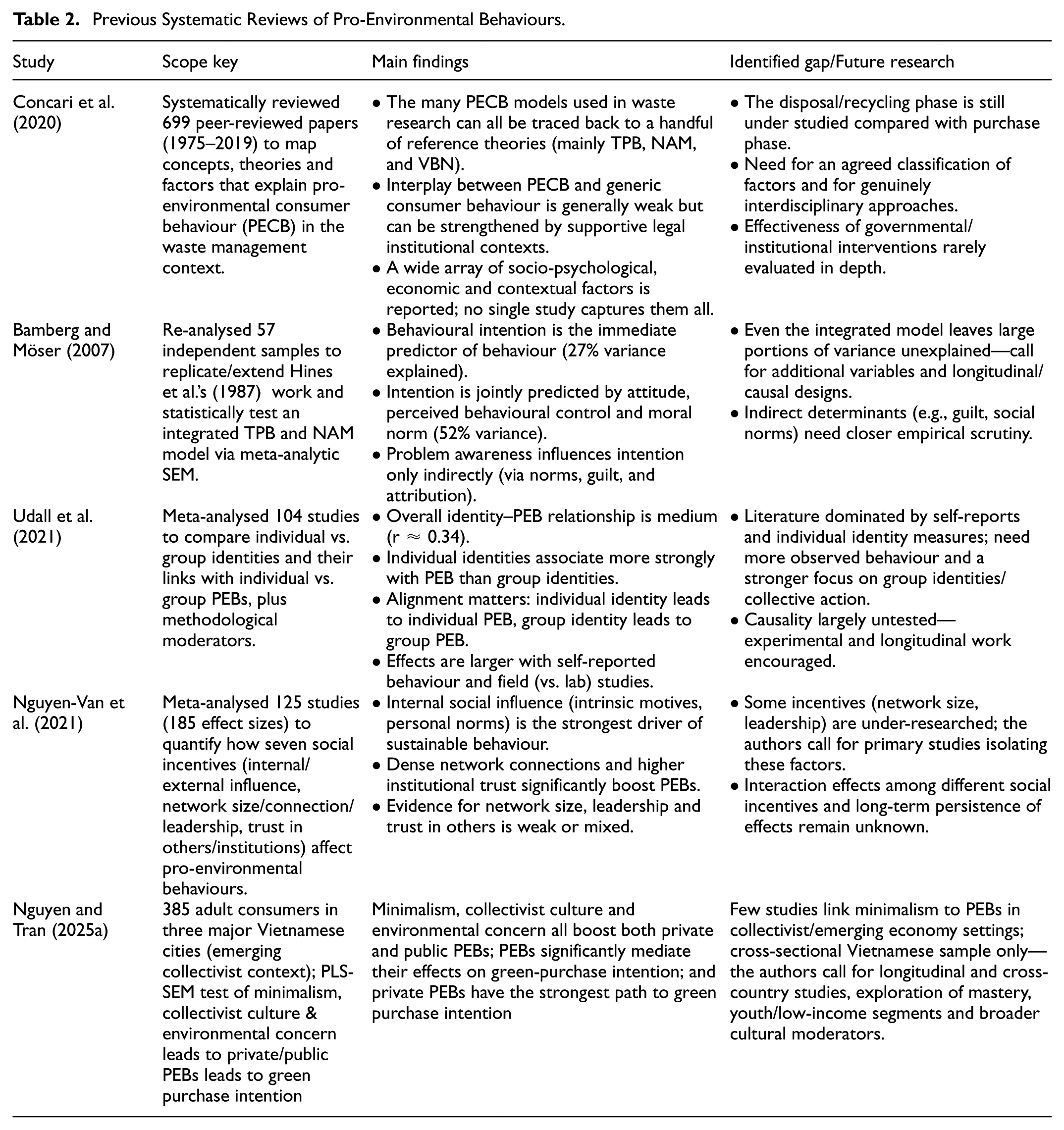
The study by Nguyen and Tran (2025a) provides the first empirical test of how a minimalist lifestyle, collectivist cultural orientation and environmental concern jointly shape green purchase intention (GPI) in an emerging economy setting. All three antecedents significantly enhance both private and public PEBs. In turn, private PEBs exert a markedly stronger influence on GPI than public PEBs, underscoring the primacy of individual-level sustainability practices in collectivist contexts. By positioning minimalism as a lifestyle antecedent rather than an outcome and by disaggregating PEBs into private and public spheres, the research fills two gaps identified in prior green consumption literature and extends theoretical debates on value–behaviour alignment in collectivist cultures. Its findings also offer actionable guidance for policymakers and marketers aiming to foster sustainable consumption through culturally tailored minimalist appeals.
Sustainable Consumer Behaviours and Pro-Environmental Behaviours Research
Although pro-environmental behaviour (PEB) and sustainable consumer behaviour (SCB) are often used interchangeably in the literature, they occupy partially overlapping—yet analytically distinct—territories. PEB is an umbrella construct originating largely in environmental psychology and sociology; it encompasses any private- or public-sphere act that is intentionally aimed at minimising ecological harm or enhancing environmental quality (Steg & Vlek, 2009; Stern, 2000). SCB, by contrast, is rooted in marketing and consumer research traditions; it narrows the focus to marketplace decisions across the purchase–use–disposal cycle that explicitly weigh intergenerational equity and resource stewardship (Biswas & Roy, 2015; Martinez et al., 2015). Put differently, all SCB is pro-environmental, but not all PEB is consumer-oriented: voting for a green party or lobbying for climate policy are PEBs with no direct consumption component. Clarifying these boundaries is critical because each stream privileges different explanatory mechanisms—norm activation and moral obligation in PEB versus value-attitude-behaviour consistency and message framing in SCB—yet recent work shows that integrating them can yield more comprehensive models of sustainable action (e.g., identity-based extensions of the Theory of Planned Behaviour). Table 3 synthesises the core distinctions and points of intersection to guide subsequent theorising and measurement.
Conceptual Distinctions and Intersections Between Pro-Environmental Behaviour (PEB) and Sustainable Consumer Behaviour (SCB).

Nittala and Moturu (2023) shift the focus from green product adoption to what happens after the checkout: analysing 660 Indian consumers, they find that comfort in everyday use, satisfaction with product performance and three disposal-stage factors (eco-conscience, eco-responsibility, and disposal challenges) are the strongest levers of overall green consumer behaviour, underlining the need for theory and measurement that capture the full post-purchase journey. Park and Ha’s (2012) U.S. survey takes a comparative tack, showing that self-identified sustainable shoppers exhibit higher cognitive attitudes and stronger social and personal norm activation than “apathetic” shoppers, with cognitive—as opposed to affective—attitude emerging as the critical predictor of recycling intention; their reliance on self-reports, however, leaves open how these attitudinal advantages translate into observed behaviour. Extending the lens to Chinese university students, Zeng et al. (2023) demonstrate that environmental knowledge and risk perception fuel environmental concern, which, moderated by pro-environmental attitudes, propels both everyday pro-environmental acts and wider sustainable consumption choices—yet the authors note the absence of longitudinal and multi-country tests of this knowledge risk concern chain. Taken together, these three studies signal a research frontier that moves beyond generic “green intentions” towards culturally situated examinations of post-purchase routines, normative climates and the cognitive risk underpinnings of sustainable consumption—calling for longitudinal, behaviour tracking designs that can reconcile cross-stage drivers with cross-cultural variation (Table 4).
Previous Research of Sustainable Consumer Behaviours and Pro-Environmental Behaviours.

Theoretical Foundations: Motivation Perspectives on PEB and SCB
According to Self-determination Theory (SDT), sustainable action flourishes when autonomy, competence, and relatedness needs are met (Deci & Ryan, 2008). Private-sphere PEBs—such as voluntary energy reduction—often reflect intrinsic regulation, whereas public-sphere activism may hinge on identified or integrated regulation, pointing to policy levers that boost perceived autonomy and communal efficacy.
Expectancy-Value Theory (EVT) posits that behaviour is a multiplicative function of success expectancies and task value (Wigfield & Eccles, 2000). Bibliometric clusters reveal that high-value constructs—for example, “ethical consumption,”“climate policy”—percolate through citation networks, suggesting that perceived importance drives scholarly as well as consumer attention.
In Goal Orientation Theory (Dweck, 1986), mastery-approach goals predict experimentation with low-carbon lifestyles, whereas performance-avoidance goals (e.g., fear of social disapproval) may inhibit public-sphere engagement. Bibliographic coupling shows a nascent but growing intersection of mastery framing with circular economy studies.
Bibliometrics
According to Pritchard (1969), bibliometrics is the study of bibliographic data through statistical and mathematical techniques. Osareh (1996) and Okubo (1997) describe it as an analytical tool that offers precise methods for assessing databases of scientific articles. Compared with a systematic literature review, this approach significantly reduces author bias (Minkman et al., 2007). Its chief advantage is that it couples qualitative appraisal with rigorous quantitative analysis (Zupic & Čater, 2015). By adopting a quantitative lens, bibliometric methods enable authors systematically to clarify and evaluate scientific information, thereby enhancing overall review quality (Binh Nguyen et al., 2023). Document assessors likewise benefit: the technique guides researchers to the most relevant publications while minimising subjectivity (Zupic & Čater, 2015).
Bibliometric processes include co-citation analysis, bibliographic coupling and assessments of co-authorship or co-keywords (Van Eck & Waltman, 2014). This study employs two principal techniques: co-citation and co-keyword analysis. In co-citation analysis, the relationships among publications that cite the same document are examined, and the frequency with which articles are cited together is evaluated (Benckendorff & Zehrer, 2013; Zupic & Čater, 2015). Mapping these links helps reveal the scientific foundations of a topic.
Co-keyword analysis, by contrast, measures how often particular terms co-occur in scholarly works (Whittaker, 1989) and generates visual maps of their relationships (Callon et al., 1991). Such maps effectively identify themes, trends and shifts within the focal research domain (Callon et al., 1991).
Recent studies illustrate the breadth of bibliometric applications. Senyapar et al. (2023) analyses electric vehicles (EVs) adoption in Turkey, combining bibliometric and thematic techniques to expose research gaps, supply industry insights and suggest strategies to accelerate EVs uptake. Furthermore, Yu et al. (2021) apply knowledge mapping and bibliometric to 159 papers on pro-environmental behaviour of tourists (PEBT), charting motivational drivers, measurement approaches, key knowledge clusters, regional hubs and emerging directions. Furthermore, Salam and Senin (2022) provide a bibliometric review of the literature on inventive behaviour from 1961 to 2019, highlighting significant trends, well-known authors, and novel ideas—in particular, the importance of organisational dedication, leadership, and information sharing as drivers of innovation.
Methodology
Source of Data
We adopted the Bibliometric–Systematic Literature Review (B-SLR) framework proposed by Marzi et al. (2025) to ensure methodological rigour and procedural transparency (Figure 1).
Step 1—Formulation of the research question and study boundaries. An initial scoping review revealed a substantive gap at the nexus of sustainable consumer behaviour and pro-environmental behaviour. Accordingly, we articulated the guiding research question—How has the scholarly literature addressed the relationship between sustainable consumer behaviours and pro-environmental behaviours?—and imposed two inclusion criteria: (i) peer-reviewed journal articles and (ii) publications in English.
Step 2—Search-query specification. Following B-SLR protocols, we executed a focused yet comprehensive search in the Web of Science (WoS) Core Collection. The query string “sustainable consumer behaviours AND pro-environmental behaviours” was applied across all fields to maximise conceptual precision while minimising irrelevant retrieval.
Step 3—Database selection. The WoS Core Collection was selected as the exclusive data source because of its long-established citation accuracy, selective journal curation and extensive historical depth—features that are particularly advantageous for longitudinal bibliometric analyses. Although Scopus provides wider coverage for post-1995 publications, its relatively shallow citation back file constrains retrospective investigations. PubMed, essential for biomedical research, offers limited coverage of the psychological and management journals central to the present review, while Google Scholar’s opaque indexing practices and high incidence of duplicate records undermine reproducibility. In contrast, WoS supplies well-structured metadata (e.g., cited references, author affiliations) that integrate seamlessly with bibliometric software such as VOSviewer, CiteSpace and Bibliometrix, thereby facilitating co-citation, bibliographic coupling, and keyword-co-occurrence analyses (Zupic & Čater, 2015). This alignment with the B-SLR framework reinforces the reliability and replicability of the resulting dataset.
Step 4—Data screening and cross-checking. The initial Web of Science extraction comprised 826 records. A preliminary quality screen, guided by pre-specified exclusion criteria, removed 82 items. Specifically, book chapters, conference proceedings, early-access articles, editorials, and non-English publications were excluded because they are not peer-reviewed journal outputs and would introduce heterogeneity in scholarly rigour. The resulting corpus of 744 peer-reviewed journal articles in English conforms to best practice standards for bibliometric reviews and was advanced to the eligibility assessment phase.
Step 5—Data cleaning and export. Each of the 744 remaining records was subjected to an eligibility review to verify substantive relevance to the sustainable consumer behaviour and pro-environmental behaviour nexus. Abstracts were examined to ensure that every study explicitly engaged with both constructs; no additional exclusions were required, indicating high topical coherence. The final dataset therefore consists of 744 peer-reviewed journal articles published between 2008 and May 2024. Records were exported in Web of Science plain-text format and imported into VOSviewer for subsequent bibliometric processing and visualisation.
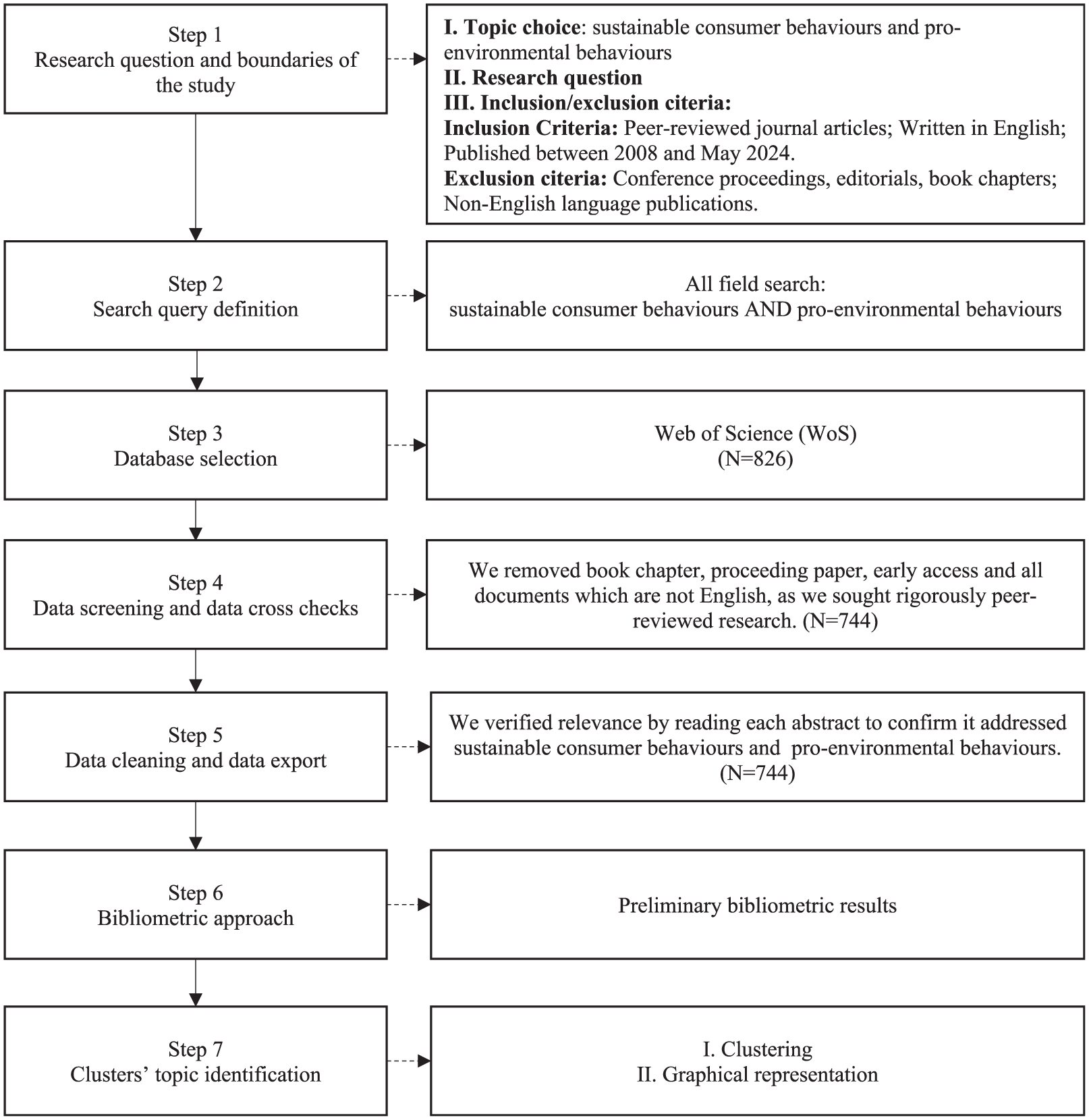
Workflow of the Bibliometric analysis.
Bibliometric Tools and Parameters
VOSviewer is a software application designed to generate and depict bibliometric networks comprising publications, researchers and journals. It offers text mining capabilities for co-occurrence analysis and can pinpoint research hotspots, emerging patterns and underlying intellectual structures. Network attributes—including authors, institutions, countries, keywords and subject categories—can all be examined with VOSviewer, which also streamlines data processing by converting Web of Science (WoS) textual files into an executable format.
To reinforce methodological rigour, co-occurrence mapping was triangulated with three complementary techniques: co-citation analysis, bibliographic coupling, and co-authorship network analysis. Co-citation analysis illuminates the evolution of intellectual clusters by tracking how often two sources are cited together, whereas bibliographic coupling gauges the cognitive proximity of publications through the extent of their shared reference lists. Co-occurrence analysis, in turn, captures thematic convergence and divergence over time. Because no single approach is universally optimal, combining these methods provides a multifaceted evidential base that enables researchers to derive nuanced insights. Specifically, triangulation (i) leverages large, peer-reviewed datasets to generate statistically robust depictions of scholarly communication; (ii) produces visualisations that readily highlight influential authors, seminal publications, and salient research domains, thereby clarifying the field’s boundaries and internal architecture; and (iii) uncovers latent relationships that often elude purely qualitative reviews, thereby enhancing explanatory power.
For the present study, all 744 Web of Science records were imported into VOSviewer. To maximise interpretability and minimise visual clutter, we applied the following inclusion thresholds: (i) authors entered the co-authorship network only if they had published at least five documents; (ii) authors were retained in the co-citation matrix if they had accrued a minimum of 20 citations within the dataset; and (iii) countries appeared in the collaboration network provided they contributed no fewer than five documents. These cut-offs, consistent with prior recommendations for emphasising substantive clusters while suppressing noise, yielded a clear and analytically tractable set of visualisations.
Results
Number of Publications by Year
Figure 2 charts the annual volume of publications addressing the nexus between sustainable consumer behaviour and pro-environmental behaviour from 2008 through May 2024 and reveals a marked, though non-linear, upward trajectory. During the emergent stage (2008–2014), the field remained nascent, with yearly outputs confined to single digits until 2013 and only modestly reaching 20 articles in 2014. A consolidation phase followed from 2015 to 2019, characterised by steady linear expansion: publication counts rose from 24 in 2015 to 54 in 2019, roughly doubling every 3 years as the topic gained academic legitimacy and began to appear more frequently in specialised journal issues.

Number of publications over years of sustainable consumer behaviours and pro-environmental behaviours.
The pattern shifted decisively after 2019, inaugurating an acceleration phase in which the literature grew at an almost exponential rate. Output increased by 50% between 2019 (54 articles) and 2020 (81 articles) and continued to surge to 91 in 2021, 121 in 2022 and a peak of 144 in 2023. This growth coincides with intensified global attention to climate action—such as the dissemination of IPCC special reports and the mainstreaming of the UN Sustainable Development Goals—suggesting strong extrinsic drivers of scholarly engagement. Although the partial count for 2024 stands at 63 articles (January–May), a simple annualisation indicates that the field is on course to surpass the 2023 record, implying that the apparent decline is merely an artefact of incomplete data collection.
Taken together, the figure substantiates rapid knowledge accumulation and highlights the transition of the research area from exploratory beginnings to a mature, rapidly evolving domain. If recent growth rates persist, a saturation point may soon be reached, at which qualitative depth—through longitudinal, cross-cultural and intervention studies—could become more critical than further volumetric expansion for advancing theoretical and practical insights.
Source of Publication
Table 5 profiles the 10 most prolific source journals in the corpus and highlights both their volumetric contribution and citation influence. Collectively, these outlets account for 265 of the 744 articles retrieved (35.6%), confirming that publication activity in the field is moderately concentrated within a limited set of journals. Sustainability leads in output with 84 papers (11.3%), yet the Journal of Cleaner Production—second in volume at 59 articles—exerts the greatest intellectual impact, amassing 3755 citations, or nearly 41% of the 9052 citations attributable to the top-10 set. Citation efficiency (citations per article) further accentuates these disparities: Business Strategy and the Environment (≈66.3 citations/article) and the Journal of Cleaner Production (≈63.6 citations/article) display the highest influence per article, whereas Energies (≈9.5 citations/article) and Sustainability (≈16.0 citations/article) register more modest returns despite substantial output.
Top 10 Journals of Sustainable Consumer Behaviours and Pro-Environmental Behaviours.

Disciplinary provenance underscores the field’s interdisciplinary character. Approximately half of the listed journals (Sustainability, Journal of Cleaner Production, Sustainable Production and Consumption, Energies, Business Strategy and the Environment and Sustainable Development) originate from environmental science and sustainability domains, whereas the remainder—Journal of Sustainable Tourism, International Journal of Consumer Studies, Journal of Consumer Behaviour and Journal of Business Research—are rooted in tourism, consumer research, and business studies. This blend signals an ongoing convergence between environmental stewardship and consumer/marketing scholarship. Moreover, the dominance of open access (Sustainability) suggests that accessibility may be catalysing citation uptake, thereby accelerating knowledge diffusion. Taken together, the table indicates that while publication venues are diversified, scholarly influence is skewed towards a subset of high-impact journals that bridge environmental management and consumer behaviour. Future researchers seeking maximal visibility and academic traction may therefore prioritise these interdisciplinary outlets, particularly those demonstrating strong citation efficiencies.
Author and Co-authorship Analysis
The collaboration map was created in VOSviewer 1.6.20 using the association strength algorithm with full counting, resolution = 1.00 and minimum cluster size = 1. Only documents from an author that appeared at least five times in the corpus were retained (threshold = 5; Figure 3). The largest and only fully interconnected component (Cluster 1, shown in red) comprises four UK-affiliated marketing researchers—Janine Dermody, Nicole Koenig-Lewis, Anita Lifen Zhao and Stuart Hanmer-Lloyd—whose reciprocal links indicate an established, intra-institutional collaboration focused on pro-environmental consumer decision-making. A much smaller dyadic cluster (Cluster 2, green) connects Kamran Khan and Irfan Hameed, whose joint work centres on energy conservation behaviour in emerging economies.

Author collaboration network analysis in sustainable consumer behaviours and pro-environmental behaviours.
All remaining authors appear as single-node clusters, underscoring limited cross-author coordination at the high productivity threshold. Noteworthy isolates include John Thøgersen (orange), a seminal Danish scholar on green consumption; Hyesup Han (purple), known for eco-hospitality research in South Korea; Naz Onel (cyan), who investigates sustainable retailing in North America and Europe; Myriam Ertz (olive), prominent in circular economy studies; and Cong Doanh Duong (blue), active in sustainable entrepreneurship within Southeast Asia. Their absence of qualifying co-authors suggests that, although these individuals are central thought leaders, their collaborations tend to involve partners with fewer than five publications, falling below the inclusion cut-off.
Network level metrics (visual density, sparse linkage, and the dominance of isolates) point to a field that remains decentralised and only loosely coordinated across national or disciplinary lines. This fragmentation may limit knowledge integration and methodological convergence. Accordingly, future research could benefit from fostering multinational, interdisciplinary teams—particularly bridging the isolated but highly cited authors—to enhance theoretical synthesis and accelerate diffusion of best practices in sustainable consumer and pro-environmental behaviour studies.
Affiliation Analysis
Table 6 delineates the institutional landscape of research on sustainable consumer and pro-environmental behaviours and discloses a moderately concentrated pattern of scholarly production and influence. Aarhus University leads in volume with 15 articles (436 citations), reflecting the pivotal role of its Behavioural Science research group and, in particular, the work of John Thøgersen. However, the University of Surrey, although second in output (12 publications), registers the greatest intellectual impact at 728 citations—yielding approximately 61 citations per publication and signalling the high visibility of its environmental psychology and marketing scholarship. Sejong University likewise exhibits exceptional citation efficiency (≈76 citations per article), despite a smaller absolute volume (7 papers), underscoring the resonance of its contributions within the field.
Top 10 Organisations With Largest Number of Publications in Sustainable Consumer Behaviours and Pro-Environmental Behaviours.

Geographically, the United Kingdom dominates the top tier, accounting for three institutions (Surrey, Oxford Brookes, and Cardiff) and one-third of the listed publications, while continental Europe is represented by Denmark (Aarhus) and Switzerland (Swiss Federal Institute of Technology). Emerging economy universities—National Economics University (Vietnam), North-West University and the University of Johannesburg (South Africa), and Universiti Putra Malaysia—contribute substantively to output (36 papers in aggregate) yet attract comparatively modest citation counts (82–161), suggesting regional knowledge production that has not yet achieved commensurate global diffusion. Overall, the table reveals that institutional influence is uneven: a small cluster of European and East Asian universities combines high productivity with pronounced citation impact, whereas institutions from the Global South remain under-recognised, pointing to opportunities for amplified international collaboration and citation bridging in future research agendas.
Country/Region Analysis
Networks of countries were created in VOSviewer 1.6.20 using the association-strength algorithm with full counting, resolution = 1.00 and minimum cluster size = 1. Only documents of a country that appeared at least five times in the corpus were retained (threshold = 5).
Table 7 highlights a geographically diverse yet uneven in impact distribution of scholarship on sustainable consumer and pro-environmental behaviours. The United States and the People’s Republic of China dominate in sheer volume, contributing 103 and 102 articles, respectively; together they account for roughly one quarter of the global corpus. However, England, despite ranking third in output (94 articles), records the highest citation count (4,703) and the strongest citation efficiency—approximately 50 citations per publication, more than double the dataset’s average. Similarly, Canada achieves a notable impact to volume ratio (≈47 citations per article) with a comparatively modest output of 40 papers. In contrast, high-volume producers such as the United States and Australia (61 articles) yield more moderate citation returns (≈24 citations per paper), suggesting that productivity does not uniformly translate into influence.
Top 10 Countries/Regions With Most Publications in Sustainable Consumer Behaviours and Pro-Environmental Behaviours.

Continental Europe is well represented by Germany, the Netherlands and Italy, each combining mid-tier productivity with solid citation performance (≈33–34 citations per article). By comparison, emerging economy contributors—India (37 articles) and Malaysia (35 articles)—exhibit lower citation visibility (≤14 citations per article), indicating that their research, though expanding, has yet to achieve commensurate global resonance. Overall, the table reveals an ecosystem in which scholarly influence is concentrated in a small group of Western countries and China, underscoring both the need for broader international collaboration and the opportunity for under-represented regions to enhance the global diffusion and impact of their work.
Figure 4 visualises the country collaboration in research on sustainable consumer and pro-environmental behaviours. Nodes represent countries, links denote at least one co-authored paper and colours indicate modularity-based clusters. Four salient observations emerge.

Country collaboration network analysis in sustainable consumer behaviours and pro-environmental behaviours.
The United States (largest red node) and the People’s Republic of China (largest green node) occupy central, high-degree positions, reflecting both their prolific output and extensive bilateral ties. Each maintains dense linkages with geographically and linguistically proximate partners as well as with one another, underscoring their role as global knowledge brokers rather than purely regional leaders.
The first and largest cluster comprises mainly Western European and North American countries—most prominently the United States, England, Germany, the Netherlands and Italy. Node sizes and link densities indicate both high publication volumes and long-standing reciprocal collaboration channels across this bloc. These countries form the intellectual and methodological core of the network, functioning as gatekeepers through which much of the global scholarship on sustainable consumer and pro-environmental behaviour is exchanged. Their tightly knit ties suggest mature research infrastructures, frequent joint funding schemes (e.g., EU Framework Programmes) and well-established author mobility, all of which facilitate rapid diffusion of theoretical and empirical advances.
The second cluster unites countries spanning East, South and Southeast Asia as well as parts of the Middle East. It is anchored by the People’s Republic of China—by far the largest node inside the group—together with India, Malaysia and Pakistan. The star like structure radiating from China underscores its gatekeeping role: many peripheral nodes connect to the broader network primarily through bilateral collaborations with Chinese institutions. While internal cohesion is lower than in Cluster 1, growth in publication counts and the widening spread of links signal a rapidly consolidating regional hub that is increasingly feeding Global South perspectives into the mainstream literature.
A cross-hemispheric “bridge” cluster links six geographically dispersed countries: South Africa, Norway, Thailand, Israel, Finland and New Zealand. Although modest in size, its strategic importance lies in brokerage. Countries such as South Africa and Thailand channel emerging economy insights, whereas Norway and Finland transmit Nordic methodological traditions and Israel and New Zealand contribute high-income, innovation-oriented expertise. The resulting web of moderate, cross-cluster ties connects otherwise distant regions, enhancing epistemic diversity and facilitating the circulation of research designs and policy lessons between the dominant red and green blocs.
Japan stands alone as the sole member of the purple cluster. Its isolated node status reflects a distinctive national research capacity that is highly productive yet routed mainly through bilateral collaborations with leading red cluster countries (notably the United States and Germany) and, to a lesser extent, China. The absence of extensive multilateral links suggests that Japan’s contributions, while influential, remain channelled through a few major partnerships rather than embedded in broader regional networks—an organisational pattern that could limit cross-regional knowledge spillovers unless new consortium-based projects are fostered.
The final cluster consists of a small Eastern Europe triad—Poland, Lithuania and Croatia—situated at the periphery of the global map. These countries exhibit weak internal connectivity and relatively sparse outward links, indicating an early stage of integration into the international discourse on sustainable consumer and pro-environmental behaviour. Targeted collaboration initiatives, such as EU twinning schemes or Horizon Europe partnerships, could bolster their participation, diversify the empirical settings represented in the literature and ultimately strengthen the overall resilience and inclusivity of the research field.
Co-Citation Analysis
Co-citation networks were created in VOSviewer 1.6.20 using the association strength algorithm with full counting, resolution = 1.00 and minimum cluster size = 1. Only citations of an author that appeared at least 20 times in the corpus were retained (threshold = 20). With 606 citations overall, Icek Ajzen is the most frequently cited scholar in sustainable consumer behaviour and pro-environmental behaviours research, followed by Paul C. Stern with 468 citations; several other authors also make substantial contributions to the field. Figure 5 displays these leading authors and clarifies the key terms characterising each cluster. Thus, while Stern’s work anchors the Theory of Environmentally Significant Behaviour, Ajzen’s publications remain pivotal to the Theory of Planned Behaviour domain.
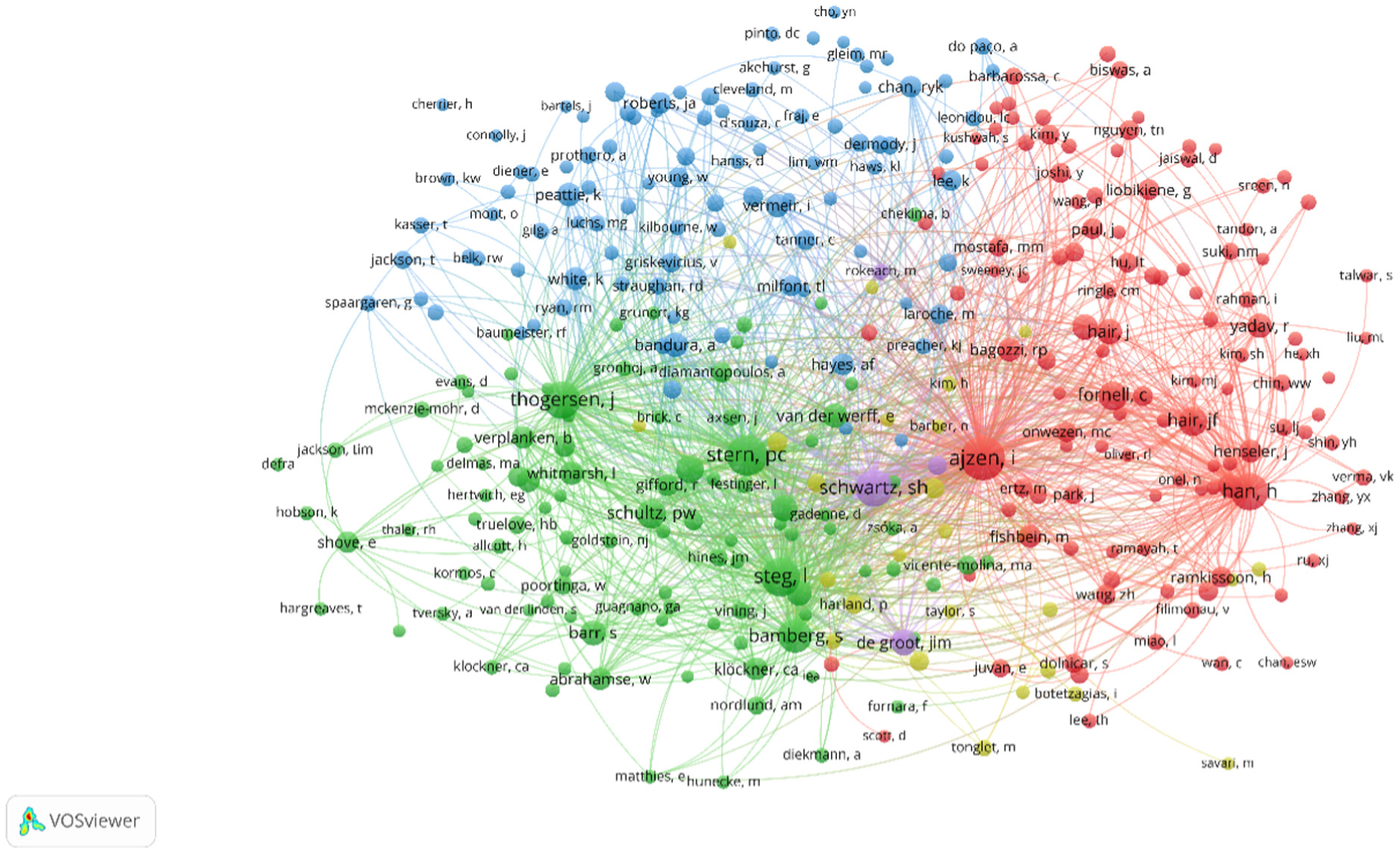
Cited author co-citation clustered analysis.
Applying the same procedure in VOSviewer but switching the node type to “Reference” identified the most highly cited articles. Table 8 shows that Ajzen’s works exert exceptional influence: within the dataset of 744 papers, his 1991 paper “The Theory of Planned Behaviour” is cited 278 times (37.4% of all records), underscoring its foundational role. Ajzen posits that behaviours is driven by intentions, which in turn reflects attitudes, subjective norms and perceived behavioural control—mechanisms that help explain how pro-environmental actions foster sustainable consumption.
Top 10 Authors and Articles Cited in PEB/SCB.

By contrast, Stern’s seminal contributions to the Theory of Environmentally Significant Behaviour provide a comprehensive framework that classifies environmentally significant actions, explores their antecedents, and integrates value-belief-norm theory to explain moral drivers of change. Other influential works repeatedly cited across the corpus include Steg and Vlek’s (2009) integrative review of pro-environmental behaviours, Kollmuss and Agyeman’s (2002) analysis of obstacles to such behaviour and Bamberg and Möser’s (2007) meta-analysis of psychosocial determinants. Collectively, these citations delineate the field’s intellectual foundations and highlight the complementary roles of motivational, normative and contextual explanations in advancing both pro-environmental and sustainable consumer behaviour research.
Hotspot Analysis
A research paper’s keywords provide a concise synopsis of its core themes. Word co-occurrence and intensity analyses help identify research frontiers and hotspots within a field. Accordingly, we mapped keyword co-occurrence in sustainable consumer behaviours and pro-environmental behaviours studies in VOSviewer 1.6.20 using the association strength algorithm with full counting, resolution = 1.00 and minimum cluster size = 1. Only keywords that appeared at least five times in the corpus were retained (threshold = 5), applying a minimum frequency of five.
Figure 6 shows that, although impact, strategy, and viewpoint are drawing researchers’ attention, performance and management remain the most prominent focal points. The resulting network comprises 318 nodes and 11,108 links, with a total link strength of 23,702—evidence of numerous, albeit sometimes loosely connected, associations among terms.

Co-occurrence analysis of keywords.
Keywords were ranked by both frequency and total link strength; the ten highest in each category are listed in Table 9. Total link strength represents the sum of an individual node’s link strengths across all its connections. In this dataset, a higher frequency of co-occurrence generally implies a stronger correlation, underlining the importance of specific keywords in bridging research topics.
Top 10 Keywords According to Frequency and Centrality.

Table 9 reveals a notable discrepancy between rankings by frequency and by total link strength. Pro-environmental behaviour and sustainable consumption are the most frequent terms (327 and 207 occurrences, respectively), followed by planned behaviour (195), attitudes (187), consumption (136), and determinants (132). By contrast, pro-environmental behaviour registers the highest total link strength (2,529). Other keywords—planned behaviour, sustainable consumption, attitudes, determinants, consumption, consumers, values, green and sustainability—show total link strength values ranging from 1,671 to 720. These figures highlight the most frequently discussed terms and their substantial connections to diverse concepts within the field. Finally, semantically related keywords such as sustainable consumption, consumption, and consumers indicate that consumption is particularly salient in this dataset relative to other themes.
Based on Figure 6 and co-occurrence of keywords analysed, VOSviewer enabled further interpretation of the information into clusters. Table 10 gives main theme of these clusters.
The Details of Keywords in Clusters.

Cluster 1—Multilevel Drivers of Everyday Green Action
This is the largest and most conceptually eclectic cluster, anchored by the keywords “pro-environmental behaviour,”“sustainable consumer behavior,”“attitudes” and “determinants..” It aggregates work that investigates how psychological dispositions (e.g., environmental concern, moral obligation), social influences (descriptive and injunctive norms), and contextual moderators (infrastructure, pricing, policy incentives) converge to shape routine green acts such as recycling, water conservation and low-carbon purchasing. Theoretical scaffolding is typically provided by the Theory of Planned Behaviour (TPB) and Value-Belief-Norm (VBN) models, while empirical studies span household, workplace and leisure domains. The breadth of this cluster explains its high betweenness centrality: it functions as the conceptual hinge connecting the more specialised clusters that follow.
Cluster 2—Systems Thinking & Climate-Policy Engagement
Key terms—“climate change,”“environmental policy,”“policy,”“industry,”“drivers” and “governance”—signal a shift from the micro level to systemic perspectives. Research here interrogates how regulatory frameworks, economic instruments and community-level interventions enable or constrain pro-environmental conduct. Life-cycle assessment, ecological footprint accounting and socio-technical transition theory feature prominently, underscoring the ambition to integrate individual behaviour with macro-level decarbonisation pathways and circular economy goals. Methodologically, large-scale surveys and multi-stakeholder Delphi studies dominate, reflecting the need to triangulate citizen preferences, policy capacities and market signals.
Cluster 3—Values, Identity & Moral Cognition
This cluster concentrates on intrapersonal antecedents—“values,”“personal values,”“environmental self-identity,”“beliefs,”“perceived value,”“intrinsic motivation” Studies typically deploy Schwartz’s value taxonomy, VBN extensions or identity-based motivation theory to explain why people internalise environmental stewardship as a core element of the self. Experimental designs manipulating value salience, as well as longitudinal panel data tracking identity change, are increasingly common. The cluster’s intellectual payoff lies in demonstrating that durable behaviour change hinges less on situational cues and more on deeply held moral and self-definitional commitments.
Cluster 4—Green Marketing Communication & Persuasion
Dominated by “market,”“message framing,”“segmentation,”“communication,”“social media” and “fair trade,” this cluster analyses how firms and policymakers craft persuasive appeals that translate sustainability intent into marketplace action. Dual-process persuasion models (e.g., ELM) and construal level theory are applied to test whether abstract versus concrete, gain versus loss framed or individual versus collective referent messages move the behavioural needle. Recent work also tackles greenwashing and the credibility gap, signalling a maturing critique of marketing’s double-edged role in sustainable consumption.
Cluster 5—Ethical Consumption, Anti-Consumption & Sharing Economies
Keywords such as “ethical consumption,”“anti-consumption,”“sharing economy,”“circular economy,”“ethics” and “voluntary simplicity” mark this sociologically inflected cluster. It explores consumption reduction, product-service substitution (e.g., car sharing) and moral purchasing (fair trade, cruelty-free). Social-practice theory and identity-signalling perspectives dominate, revealing how lifestyle politics and status signalling intersect with genuine ecological concern. The cluster also problematises rebound effects and guilt compensation, flagging the need for nuanced metrics that move beyond binary “green/not green” labels.
Cluster 6—Household Energy Technology Adoption
Here the focus narrows to technology-specific behaviours: “energy efficiency,”“technology,”“renewable energy,”“adoption,”“energy,”“households.” Diffusion of innovation models and Unified Theory of Acceptance and Use of Technology (UTAUT) variants are commonly employed to predict uptake of solar PV, smart meters and electric vehicles. Socio-demographic segmentation reveals that cost–benefit perceptions, technological self-efficacy and social endorsements jointly shape adoption trajectories. Emerging sub-themes include AI-enabled demand response and the equity implications of energy transitions.
Cluster 7—Norms, Values & Self-Identity Alignment
Although conceptually adjacent to Cluster 3, this node set—“norm,”“norm activation theory,”“self-identity,”“collectivism”—examines interaction effects among social and personal motivational forces. Research probes when alignment (e.g., strong green self-identity and supportive social norms) produces behavioural synergies and when mis-alignment triggers compensatory mechanisms such as moral licencing or negative spillover. Advanced statistical tools—multilevel modelling, response surface analysis—are used to unpack these nuanced interactions.
Cluster 8—Sustainable Product Choice & Organic Food Consumption
Finally, this consumer decision making cluster is defined by “purchase,”“organic food,”“knowledge” and “trust.” The literature interrogates how product specific cues (labels, certifications), sensory expectations, and credence attributes translate into willingness to pay. Hybrid choice models and discrete choice experiments quantify trade-offs among taste, ethics and price. A nascent line of inquiry links mindful consumption and health motivation spillovers, suggesting fertile ground for integrating well-being outcomes into classic utility frameworks.
Connecting Themes to the Broader PEB/SCB Literature
The eight keyword clusters do more than catalogue topical silos; they mirror—and can therefore enrich—ongoing theoretical debates in the wider PEB/SCB canon. Cluster 1’s focus on multilevel drivers of everyday green action maps neatly onto the long-standing “attitude-behaviour gap” discourse, suggesting that the field is now mature enough to move beyond documenting gaps towards testing multi-level interventions that span psychological, social and infrastructural levers. Cluster 3’s emphasis on values and identity dovetails with recent calls to foreground self-transcendent motives and moral emotions in sustainability research, implying that future models should treat identity salience as both a mediator and a potential moderator of policy nudges.
Likewise, Cluster 5’s blend of ethical consumption, sharing, and voluntary simplicity resonates with the burgeoning literature on sufficiency and degrowth, highlighting opportunities to integrate anti-consumption insights into mainstream consumer behaviour frameworks. Finally, Cluster 6’s technology adoption lens aligns with studies that conceptualise households as prosumers in energy transition research, pointing to a fruitful cross-pollination between PEB scholars and energy systems analysts. By situating each emergent theme within these broader debates, the co-occurrence map clarifies how micro-level investigations can cumulatively advance macro-level sustainability transitions.
Evolution Trend Analysis
Figure 7 illustrates the keyword network based on the average year of keyword appearance. Before 2019, terms related to the development of decision support systems were cited most frequently within studies of pro-environmental and sustainable consumer behaviour. During this early phase, the keywords were largely generic, concentrating on consumer behaviour, motivation and climate change. The phrase sustainable consumption did not gain substantial prominence until 2020, at which point it became a central research focus and was soon accompanied by environmental impact concerns. Recent work has shifted towards attitudes, values, environmental knowledge and value orientations. From early 2021, scholars began analysing pro-environmental behaviours within specific domains, while green purchase intention, Generation Z and mindfulness have emerged as prominent themes since 2022.

Timezone view of popular keywords.
Conclusion and Discussion
This bibliometric analysis offers a comprehensive examination of the evolution, current status and future prospects of research on pro-environmental behaviours (PEB) and sustainable consumer behaviours (SCB). Drawing on a dataset of 744 peer-reviewed publications (2008–2024), the study identifies a marked surge in scholarly attention—especially over the past decade—reflecting growing global recognition of the pivotal role that individual and collective actions play in addressing environmental challenges such as climate change, resource depletion and environmental deterioration.
Prominent scholars, influential works and leading institutions have shaped the field’s intellectual foundations, providing valuable insights into its core concepts. Emerging research areas include the psychological and socio-cultural drivers of sustainable behaviours, the influence of values and norms on consumer choices and the effectiveness of marketing and communication strategies for promoting sustainable consumption. These trends underscore both the multifaceted nature of PEB and SCB and the field’s interdisciplinary character.
The analysis also reveals an increasing tendency towards international collaboration, with substantial contributions from researchers across diverse regions. A global perspective is essential for understanding the cultural, economic, and policy contexts that shape sustainable behaviours and for devising strategies that can be effectively implemented across settings.
Implications
The expanding body of PEB and SCB literature signals growing scholarly momentum and highlights the field’s importance in tackling global environmental issues. Mapping key contributors and research themes provides a roadmap for future inquiry, pinpointing under-explored topics and opportunities for interdisciplinary collaboration.
A central finding is the decisive influence of psychological, social and cultural factors on PEB and SCB. Deeper investigation of underlying motives, values and beliefs—especially those that vary across contexts—will be crucial to designing interventions that effectively foster sustainable habits. Understanding how social norms and cultural values shape consumption can facilitate more targeted, culturally sensitive approaches.
The study also underscores the critical role of communication and marketing in promoting sustainable consumption. Future research should continue to explore messaging strategies, market segmentation and branding initiatives, particularly within the rapidly evolving digital landscape and the growing influence of social media on consumer attitudes and behaviour.
Moreover, the upward trend in international collaboration is encouraging and should be further cultivated. Cross-regional partnerships can enrich understanding of global drivers of sustainable behaviour and support policy solutions adaptable to diverse cultural and economic contexts—an imperative given the worldwide nature of environmental challenges.
In sum, this bibliometric analysis delineates the research terrain of pro-environmental behaviours and sustainable consumer behaviours, highlighting substantial progress while identifying remaining challenges and opportunities. By charting influential contributors, emergent themes and collaboration patterns, the study provides actionable insights for scholars, policymakers and practitioners committed to advancing sustainable behaviour and confronting global environmental concerns. Continued expansion and diversification of research in this area will be vital to developing effective strategies that support a worldwide transition towards a more sustainable future.
Our bibliometric map confirms that five countries—the United States, China, the United Kingdom, Italy and Australia—generate more than 70% of all publications in the corpus; this mirrors wider science system patterns, with high and upper middle income economies together accounting for 90% of global science and engineering articles, while lower middle income economies produce only 9% (National Center for Science and Engineering Statistics, 2020). Three structural forces explain the skew. First, spending power: R&D intensity in the OECD area has stabilised at about 2.7% of GDP, whereas most low income countries invest below 0.5%, constraining laboratory, survey and graduate training capacity (Organisation for Economic Co-operation and Development, 2025). Second, infrastructure and network centrality: dense clusters of world class universities in Boston, London, Milan and Beijing lower transaction costs for large multi-country projects. Third, policy pull-effects: flagship programmes such as the EU Green Deal, the U.S. Inflation Reduction Act and China’s Five-Year Plan earmark dedicated grant lines for behavioural change studies, creating a predictable market for scholarship. For low resource settings these dynamics can render mainstream theories less predictive—because they are calibrated on affluent, individualistic societies—and can exclude local insights from global policy conversations.
Research hubs serve as policy laboratories that convert academic findings into regulatory instruments and pilot programmes. In the United States, the Environmental Protection Agency’s behavioural and economic incentive programmes translate social-science evidence into eco-labelling, cap-and-trade schemes and low-income energy incentives, many of which later diffuse to state and municipal levels (U.S. Environmental Protection Agency, 2024). China’s “Ecological Civilization” agenda plays a similar role at scale: academic studies on soil erosion underpinned the Loess Plateau “Grain-to-Green” project, which has lifted vegetative cover by roughly 25% while sharply reducing dust-storm frequency, providing a replicable template for arid-zone restoration (Davidson, 2025). These hubs thus generate prototypes—market instruments in the U.S. and landscape-level ecological engineering in China—that shape global norms and donor guidelines, even when those models require adaptation for poorer jurisdictions.
The research makes a valuable contribution to academics by offering a theoretical synthesis that clusters related PEB/SCB topics and by identifying two promising avenues for future inquiry through bibliographic coupling, co-citation and co-occurrence analyses. These insights will benefit scholars investigating PEB and SCB. As one of the first studies to apply bibliometric techniques to these subjects, it delivers a comprehensive overview of the existing literature while highlighting novel and expansive research opportunities in the PEB and SCB domain.
To avoid importing ill-fitting models from the dominant hubs, policymakers in low-resource settings should localise behavioural frameworks by incorporating collective efficacy beliefs, price sensitivity and infrastructure constraints into the Theory of Planned Behaviour or Value-Belief-Norm interventions. Governments and NGOs should earmark at least 10% of project budgets for co-creation workshops with community organisations, ensuring that interventions align with informal markets and cultural norms. Donor agencies can accelerate learning spillovers by mandating open access to survey instruments, code and anonymised microdata as a condition of grant funding, thereby lowering replication costs for cash-strapped researchers. Finally, “policy sandbox” exchanges—pairing a high-capacity city such as Melbourne with a peer like Bandung—allow rapid, adaptive testing of green consumption incentives under real-world constraints.
A four-pronged strategy can close the participation gap. (1) North–South equity clauses: large programmes (e.g., Horizon Europe, NSF) should require shared first authorship or split budget lines that give Southern partners control over research questions and funds. (2) South–South networks: consortia such as the African Research Universities Alliance can create thematic clusters on sufficiency lifestyles, informal repair economies and circular economy entrepreneurship, building intellectual capital independent of Northern agendas. (3) Regional data trusts: ASEAN, ECOWAS and Mercosur secretariats can host open “green behaviour” micro-data repositories—standardised surveys translated into local languages—to facilitate meta-analysis and evidence-based policy (Ullah et al., 2024). (4) Language bridge incentives: leading journals should waive article processing charges and provide professional translation for manuscripts originating in low-income countries, directly addressing the English language gatekeeping documented above. Together these measures would diversify the empirical base, enrich theory testing across contexts and accelerate the design of context appropriate sustainability policies.
Drawing together the co-citation and bibliographic coupling maps, three prospective research trajectories emerge. (1) Integrating motivational silos. The co-citation clusters anchored in Ajzen’s Theory of Planned Behaviour and Stern’s Value-Belief-Norm framework rarely intersect in the bibliographic coupling network, indicating that scholars still test rival, rather than complementary, explanations of sustainable behaviour. Future work should model how rational choice, value-driven, and identity-based mechanisms operate jointly and sequentially across the adoption–continuity cycle. Longitudinal panel designs or Bayesian model averaging approaches would be especially valuable for adjudicating between alternative causal paths. (2) Contextualising “continuance” beyond affluent settings. A distinct bibliographic-coupling community has begun to recast sustainable consumer behaviour as a post-adoption phenomenon (Elhoushy & Jang, 2023). Few of those studies, however, appear in the Global South clusters revealed by the country collaboration map. Comparative, multi-site projects that track the durability—and rebound effects—of green routines in low and middle income economies are needed to generalise (or boundary-test) SCB theory. (3) Linking micro-level psychology to meso-level transition studies. Publications that couple to socio-technical transition and circular economy journals form a peripheral, weakly connected island in the bibliographic network, suggesting a missed opportunity for behavioural scholars to inform system-level decarbonisation scenarios. Embedding fine-grained behavioural parameters (e.g., habit decay rates, spillover coefficients) into agent-based or integrated-assessment models would close this gap and help quantify the contribution of individual action to net-zero pathways.
Limitations and Future Research
Several methodological constraints delimit the generalisability of our findings. First, relying solely on the Web of Science Core Collection introduces database bias: WoS under-indexes management, sociology, and regional journals relative to Scopus and omits most book chapters and policy reports where formative PEB/SCB work often appears. Although WoS’s citation accuracy justified its selection, future meta-analyses should triangulate WoS with Scopus and, where feasible, Google Scholar or Dimensions to capture grey literature and non-English outputs.
Second, our search string and field tag choices (sustainable consumer behaviours AND pro-environmental behaviours searched across all fields) privilege studies that adopt those exact phrases. Seminal papers that employ cognate terms such as “ecological behaviour” or “green consumerism” may therefore be under-represented. Expanding queries iteratively with synonym lists, wildcards and thesaurus-based approaches could mitigate this selective retrieval effect.
Third, the time window (2008–May 2024) and document type filters (peer-reviewed journal articles only) risk truncating the historical lineage of the field and excluding conference papers that often herald conceptual breakthroughs. While these screens enhanced rigour, they also bias the corpus towards mature, English-language scholarship from well-resourced institutions. Subsequent studies might adopt a staggered sampling frame or weighted inclusion criteria to surface pioneering but less cited contributions.
Finally, threshold settings in VOSviewer (e.g., ≥20 citations for co-citation, ≥5 publications for authorship) inevitably shape network topology. Sensitivity checks using alternative cut-offs—and complementary visual analytics platforms such as CiteSpace or Bibliometrix—would test the robustness of the structural patterns reported here. Addressing these limitations will not only widen the empirical base but also sharpen future theorising on how sustainable consumption and pro-environmental behaviour co-evolve across contexts.
In fact, both PEB and SCB are intricate, multidimensional topics that often yield inconsistent—sometimes even contradictory—findings when examined from different perspectives. Consequently, it is essential to foster research that brings together experts from diverse disciplines, institutions and geographic or cultural contexts, thereby enabling a more comprehensive understanding of the subject. Such collaboration will facilitate deeper investigation and discussion of the topic.
In summary, our bibliometric study accurately captures the current state of development in the PEB and SCB research field by visualising emerging trends and currently focal issues. It also identifies the field’s knowledge base and delineates promising avenues for future inquiry.
Footnotes

Ethical Considerations
There are no human participants in this article and informed consent is not required.
Author Contributions
Khanh Huy Nguyen: Conceptualisation, Methodology, Software, Formal analysis, Investigation, Resources, Data Curation, Writing—Original Draft, Visualisation. Mai Dong Tran: Validation, Writing—Review & Editing, Supervision, Project administration.
Funding
The authors disclosed receipt of the following financial support for the research, authorship, and/or publication of this article: This research is funded by University of Economics Ho Chi Minh City, Vietnam (UEH).
Declaration of Conflicting Interests
The authors declared no potential conflicts of interest with respect to the research, authorship, and/or publication of this article.
Data Availability Statement
The authors confirm that the data supporting the findings of this study are available within the article or its supplementary materials.