




Abstract
Despite the notable increase in women’s enrollment in education, a significant gender gap persists in science, technology, engineering, and mathematics (STEM) disciplines. This imbalance poses challenges in achieving the Sustainable Development Goals (SDGs) by 2030. While research on the relationship between gender and STEM has been growing, the scientific mapping of the structure and development of the field is yet to be explored. By analyzing 2903 metadata retracted from Scopus and WoS, this paper demonstrates the significant increase in research on gender and STEM over the past decade, with approximately half of the articles published between 2020 and 2022, indicating a surge in interest and focus on STEM and gender in recent years. The United States remains a leading country in research and publications, followed by the United Kingdom, Spain, and Australia. Noteworthy contributions from China, Iran, India, and Turkey are also observed. However, despite the increase in international collaboration between countries, the collaboration between authors occurs within the same institutions or the same countries with limited partnerships with authors from other states. Increasing such collaboration in research on gender and STEM may bring positive outcomes for policy and practice to reduce the gender gap in STEM disciplines globally. Researchers should also continue exploring emerging topics on gender and STEM, particularly from a sociological perspective, and adapt their research to address evolving needs and challenges in promoting gender equality in STEM.
Introduction
For the past few decades, gender equality in science, technology, engineering, and mathematics (STEM) has been given serious attention by the international community and researchers. Addressing gender inequality in STEM disciplines has also become one of the important agendas of the Sustainable Development Goals (SDGs), including SDG 4 (Education) and SDG 5 (Gender Equality). UN Women (2020) argues that giving women equal opportunities to develop and succeed in STEM careers supports reducing the gender pay gap, improves women’s economic security, and provides a diverse and talented workforce that helps to avert discrimination and prejudices in these fields and in the goods and services they produce. However, according to UNESCO (2017), there is still a large gap, with only 35% enrolled female students majoring in STEM disciplines. UNESCO (2017) also reports that only 17 women have won Nobel Prizes in physics, chemistry, or medicine compared to 572 men. Rapid digitalization and the introduction of high-paying tech jobs reinforce gender inequality in STEM (UN Women, 2020). Thus, the underrepresentation of females in STEM disciplines has become an internationally recognized challenge, attracting the growing attention of global research and scholarly publications.
Using a bibliometric approach, this paper offers a comprehensive analysis of trends and developments in academic research and publications in gender and STEM. According to Glanzel (2003), bibliometric analysis is a method that uses statistical and mathematical tools for research management and science policy. The application of these methods allows to capture the development and evolution of knowledge in a particular area of research. It is used by academics and researchers to explore various aspects of scientific knowledge, including the dynamics and emerging trends in academic research output, country’s collaboration patterns, leading countries and journals, and the overall structure of knowledge in a specific field (Donthu et al., 2022; Kokol et al., 2021; Verma & Gustafsson, 2020). Bibliometric analysis can also evaluate the scholarly output of a researcher, group of researchers, or institutions (Yu et al., 2014) and offers a unique perspective for understanding the academic literature and the evolution of knowledge (Kokol et al., 2021). Thus, continuously growing diverse literature on gender and STEM allows the possibility of exploring scientific scholarly production and filling the knowledge gap on development and emerging trends in the field.
Meanwhile, the literature on gender and STEM identifies several barriers for females to enroll, major, and pursue careers in STEM (Bloodhart et al., 2020; Burke & Mattis, 2007; Chan, 2022; Clark Blickenstaff, 2005). Scholars frequently refer to the phenomenon of women’s attrition from education and careers in STEM fields as “the leaky pipeline” (Burke & Mattis, 2007; Clark Blickenstaff, 2005), which aims to capture the various points at which women experience attrition or “leaks” as women advance through the pipeline (Burke & Mattis, 2007; Clark Blickenstaff, 2005). The issue originates during early childhood and late adolescence when girls are not consistently encouraged by teachers and parents to participate in STEM and subsequently pursue STEM majors in universities (Burke & Mattis, 2007; Chowdhury et al., 2022; Clark Blickenstaff, 2005; Goy et al., 2017; Halai, 2007; Lavy, 2008). In addition, women’s and girls’ interests in STEM are significantly influenced by social and cultural norms, gendered expectations, and their upbringing (Almukhambetova, 2025; Chowdhury et al., 2022; CohenMiller et al., 2021). The manner in which boys and girls are raised, along with the interactions they have with parents, teachers, and friends, can also discourage women and girls from participating in STEM subjects (Halai, 2007, 2010; Lavy, 2008; Mendick, 2005; Muntoni & Retelsdorf, 2018; Riegle-Crumb & Humphries, 2012; Tiedemann, 2002). Moreover, several studies have indicated that women do not choose STEM careers and majors due to the presence of implicit gendered bias (Chan, 2022; Chowdhury et al., 2022; Goy et al., 2017; Piatek-Jimenez et al., 2018) arising from the association of STEM fields with masculinity and the perception that STEM fields as male-dominated disciplines (Epstein et al., 2010; Mendick, 2005). In higher education, the gender disparity in STEM degrees is primarily attributed to factors such as a cold and unfriendly environment in classes, an excessively rigorous curriculum, and the perpetuation of gender stereotypes that undermine female students’ self-efficacy and sense of belonging to STEM programs (AAUW, 2010; Mejía-Rodríguez et al., 2021; Ortiz-Martínez et al., 2023). Furthermore, women in STEM face limited access to research grants compared to their male counterparts and are vastly underrepresented as researchers, constituting only around 33.3% of all researchers and only 12% of academics globally (United Nations [UN], 2023). United Nations also reported that some female researchers’ work is significantly underrepresented in high-profile journals, and they have shorter and less well-paid careers in STEM (UN, 2023).
Over the past years, there has been a substantial increase in interest in different patterns of publications and research focused on the intersection of gender and STEM. For instance, Zhan et al. (2022) analyzed the global landscapes of research on STEM education, while Su and Yang (2023) focused on exploring STEM in Early Childhood Education. Mumu et al. (2022) analyzed gender diversity in corporate governance, while Ruggieri et al. (2021) conducted a bibliometric analysis of the Italian National Research Council’s gender productivity. More recently, Radević and Milovanović (2023) conducted a bibliometric analysis of current trends in math anxiety; however, none of the previous studies focused on bibliometric analysis of gender and STEM research, specifically exploring the growth of publications, patterns of publication output, leading countries on gender and STEM research publications, leading institutions and authors, scientific collaboration dynamics as well as the conceptual structure of the fields in relation to keywords and topical foci.
To fill this gap in the literature, this paper aims to provide a comprehensive analysis of scholarly structure, trends, and development of gender and STEM disciplines. More specifically, this paper aims to address the following research questions:
How has the literature on gender and STEM grown over time?
What countries, institutions, and authors lead in research and publications on gender and STEM?
What are the most cited publications in the field?
What is the extent of collaboration between countries and authors on gender and STEM research?
What is the conceptual structure of the field related to keywords and topical foci of research on gender and STEM?
The paper starts with a literature review on gender and STEM, followed by an outline of the methodology employed. Subsequently, the findings are presented, covering the annual scientific production, leading countries in gender and STEM research, their publication output, leading institutions and authors, collaboration networks between countries and researchers, most frequent keywords, and co-occurrence network. In addition, we provide a thematic analysis of research output over the analyzed period. Finally, the paper summarizes the key insights and offers concluding thoughts.
Literature Review
Conceptualizing Gender and STEM
For the past decade, significant empirical research has focused on understanding the influences that shape women’s experiences in STEM education and professions (Epstein et al., 2010; Goy et al., 2017; Lavy, 2008; Mendick, 2005). As mentioned earlier, the “leaky pipeline” phenomenon, supported by extensive research, demonstrates that women tend to systematically abandon their educational and professional paths in STEM starting from their schooling years and continuing to their mid-career stages (Brake, 2017; Mejía-Rodríguez et al., 2021). This analogy effectively captures the persistent pattern of women dropping out of the STEM pipeline compared to their male counterparts. Numerous studies have highlighted a range of factors that influence the gendered pattern of progression of women’s departure from STEM fields in both educational settings and future professions. Such factors include cultural norms and expectations placed on women, gender bias and stereotypes, the perceived masculine nature of STEM disciplines, the influence and expectations of teachers and parents, the lack of role models for women in STEM, and the gendered nature of higher education and academia. In the following sections, we will delve deeper into these factors.
Cultural Norms, Expectations, and Gender Bias in STEM
Previous studies have found that women are often perceived as less capable and weaker in science subjects, while men are seen as more powerful, helpful, and self-orienting (Meier & Diefenbach, 2020). These perceptions contribute to the challenges faced by women in entering and persisting in their STEM careers, as social, cultural, and gender norms imposed by their peers, families, teachers, and communities hinder their progress. The underrepresentation of women in STEM is strongly linked to gendered stereotypes and bias, which mainly dictate that women should be the primary caretakers of the home. These cultural norms and gender stereotypes create both individual and institutional barriers to STEM education and career choices (Chan, 2022; Chowdhury et al., 2022; CohenMiller et al., 2021; Ijagbemi et al., 2017; Taasoobshirazi et al., 2019). The persisting patriarchal perception of gender roles, coupled with the gendered distribution of labor, continues to diminish women’s interest and pursuit of STEM (CohenMiller et al., 2021). Another important factor influencing the choice of STEM-related fields for girls is the correlation between lower performance in STEM-related subjects and the involvement of girls in household responsibilities compared to boys (Almukhambetova, 2025). This ongoing gendered division of labor can significantly hinder women’s advancement and participation in various spheres, including STEM fields. Multiple researchers have also concluded that patriarchy remains deeply entrenched in society, perpetuating the perception that women should primarily fulfill the role of caretakers of children and families (Bannikova & Kemmet, 2019; Rudenko et al., 2022). This expectation places a double and even triple burden on women, as they are expected to balance their domestic responsibilities alongside their professional endeavors (Bannikova & Kemmet, 2019; Rudenko et al., 2022). Research conducted in Tanzania, for instance, has highlighted household responsibilities as a significant factor contributing to the under-representation of African women in STEM fields (Matete, 2022). The study reveals that sociocultural and psychological factors significantly influence women’s enrollment in STEM fields (Matete, 2022). Likewise, in Asia, the significant under-representation and lack of retention of women in STEM fields can be attributed to cultural and social contexts where some women are still seen as less capable in STEM and are expected to take care of their families (Baruah, 2022; Chowdhury et al., 2022; Lee et al., 2018; Wahono et al., 2020). In addition, researchers have found that individuals from diverse ethnic and social backgrounds have reported family commitments along with financial difficulties as significant barriers that hinder their pursuit of STEM careers or studies (Radmehr et al., 2022). Similarly, in Africa, research conducted by UNESCO (2017) has revealed a lack of sufficient laboratories to cultivate school children’s interest in STEM disciplines. These factors contribute to the underrepresentation of women and certain ethnic groups in STEM and create additional obstacles in their STEM education and career pathways.
School Experiences: Masculine Nature of STEM, and Teachers and Parental Influence
Scholars often argue that STEM is perceived as “masculine” and that “doing mathematics,” for example, is akin to “doing masculinity” (Mendick, 2005). The portrayal of science and scientists in various media, including educational settings and textbooks, has been identified as a contributing factor to the under-representation of girls in STEM fields (Durrani et al., 2022; Namatende-Sakwa, 2019; UNESCO, 2017). According to Epstein et al. (2010), mathematical choices in schools in England are strongly linked to the social, cultural, and educational construction of the gender binary terms, such as feminine/masculine, creating a barrier for girls and women to identify as being “good at maths” (p. 204). Students’ narratives and discourses in this research demonstrated that students perceive mathematics as masculine, creating barriers for girls to feel comfortable being good at it. Moreover, research shows that female students perceive STEM as academically superior (UNESCO, 2017). As a result, girls’ academic achievement is negatively impacted, and they choose the subjects they think are less demanding (Genoways, 2017). Moreover, girls are often discouraged by their teachers from pursuing math, physics, or other traditionally male-dominated disciplines, while boys are often encouraged to pursue careers in STEM-related fields (Genoways, 2017; Halai, 2010; UNESCO, 2017).
In addition, studies have also indicated that teachers often display gender biases that could potentially dissuade girls with a genuine interest in STEM fields. For instance, research has revealed that high school teachers tend to underestimate female students’ mathematical capabilities, while male students’ abilities are often overrated. Previous studies have also shown that teachers consider math to be more difficult for girls and hold the belief that girls are less talented in the subject, even when their performance is on par with boys (Lavy, 2008; Muntoni & Retelsdorf, 2018; Riegle-Crumb & Humphries, 2012; Tiedemann, 2002). Thus, teachers’ perceptions of gender and gender norms affect teachers’ expectations (Muntoni & Retelsdorf, 2018), behavior (Lavy, 2008), and practices. Often, teachers’ beliefs and gender stereotypes influence their evaluations of students in general (Copur-Gencturk et al., 2023; Durrani & Kataeva, 2025; Halai, 2010; Lavy, 2008; Lavy & Sand, 2018) and within specific subjects in STEM (Muntoni & Retelsdorf, 2018). For instance, physics teachers attribute girls’ achievement to their persistence in studies, while boys’ achievement is recognized as natural (Francis et al., 2017). Most often, girls are expected to be calm and well-behaved and choose the subjects that are in line with these expectations. Often, teachers are unaware of how their gendered expectations and biases shape students’ academic interests (Sáinz et al., 2021).
Likewise, parental perception of gender and expectations of what men and women should do also significantly influence young girls’ choices of majors and future careers (Almukhambetova, 2025; Ikkatai et al., 2019; Zhan et al., 2023). For instance, Japanese parents with egalitarian gender role attitudes were found to be positive toward their daughters’ choices to pursue STEM; however, some parents felt strongly about some of the STEM disciplines being unsuitable for women (e.g., engineering; Ikkatai et al., 2019), while parental influence in girls’ pursuit in STEM in Spain demonstrated that girls more likely pursue STEM and experimental studies (Sáinz & Müller, 2017). Thus, the importance of families’ understanding of gender and how this understanding may positively impact young girls’ interest and passion for STEM may lead to girls’ interest in STEM fields.
Higher Education and the Gendered Nature of Academia and STEM Employment
A plethora of literature demonstrates that even though girls and boys take math and science courses in approximately equal numbers, and about as many girls as boys leave high school prepared to pursue science and engineering majors in college, fewer women than men pursue STEM majors in universities (AAUW, 2010; Goy et al., 2017; Ortiz-Martínez et al., 2023; Radmehr et al., 2022). Among first-year college students, for example, women are much less likely than men to intend to major in STEM (AAUW, 2010; Kelley & Bryan, 2016; Vooren et al., 2022). By graduation, men outnumber women in nearly every science and engineering field, and in some, such as physics, engineering, and computer science, the difference is dramatic, with women earning only 20% of bachelor’s degrees (AAUW, 2010; Kelley & Bryan, 2016). The representation of women in science and engineering declines further at the graduate level and in the future transition to the workplace (AAUW, 2010; Vooren et al., 2022). Women faculty are severely under-represented in Computing and Engineering, while high position ranks are occupied mainly by male faculty members in higher education (Berdousis & Kordaki, 2016; Convertino, 2019; Kataeva, 2022; Kelley & Bryan, 2016). Ding et al. (2021) argue that there is a significant discrepancy in the engineering field, particularly in terms of research productivity and publication. Their research suggests that men tend to produce more research and publish research articles, while women appear to teach and mentor students more than their male counterparts. Goy et al. (2017) attribute the lack of diversity of women in engineering to the low recruitment of women into the field at the entry point. Furthermore, several studies have indicated that female scientists remain at a disadvantage when it comes to representation on scientific boards compared to men (Hanson & Krywult-Albańska, 2020). Likewise, Cidlinská (2018) highlights the scarcity of role models for young female researchers, noting the importance of having role models who have successfully navigated the demands of their workload while managing family responsibilities or maintaining work-life balance. Similarly, Main et al. (2022) concluded that despite an increasing number of female students pursuing PhD in STEM, there remains a lack of women in leadership positions. Their research suggests that early career management training for Ph.D. students can significantly benefit women and enhance their chances of attaining leadership positions. Overall, women in STEM experience a chilly climate and feel excluded by their male counterparts, who tend to form friendships and social circles predominantly among themselves (Cyr et al., 2021; Kataeva, 2022). Women also tend not to engage with their male colleagues because of their biased attitudes toward women. Some men may be limited in their socialization with women because of structurally and institutionally gendered status differences (Kataeva, 2022).
Methodology
For the past decade, bibliometric analysis has gained popularity in academic research and publications, allowing a comprehensive analysis of research trends and developments in a particular field (Donthu et al., 2022). The rapid advancement of data mining and visualization technologies has allowed the utilization of software programs for the analysis of extensive data, and the presentation of outcomes has become feasible (Donthu et al., 2022). In addition, bibliometric analysis provides a distinctive viewpoint for comprehending the scholarly record and the development of knowledge (Kokol et al., 2021). Our goal is to draw from this rich historical heritage and offer fresh perspectives on the dynamics of knowledge growth by utilizing bibliometric techniques (Kokol et al., 2021).
In this study, a bibliometric methodology was employed to identify the structure and development of research and publications related to gender and STEM. This approach included both performance investigation and science mapping. The assessment of performance examined the contributions made by researchers, employing key performance indicators like the number of publications and citations within the gender and STEM domain. Simultaneously, science mapping was employed to dissect the interrelationships among researchers, analyzing intellectual exchanges and structural collaborations among them. This method included the examination of citations, collaborative endeavors, co-authorship patterns, keyword application, and thematic emphases. The Scopus and WoS databases were selected based on their status as the most extensive repositories (Pranckutė, 2021). Additionally, despite their limitations, these databases incorporate significant contributions within the realm of scientometric and bibliometric research found in prominent scholarly journals across the globe (Donthu et al., 2022).
In addition, in a study conducted by Echchakoui (2020), it was observed that only a limited number of research investigations combine search outcomes from both Scopus and WoS, and this is often done without providing a clear description of the procedure of how authors merge and remove duplicates. The process of combining and eliminating duplicate entries entails several stages and typically relies on easily accessible software applications such as R Studio, Bibliometrix, and Microsoft Excel. Initially, we converted raw data from WoS and Scopus databases into “.bib” file formats. Then, the files from both database searches were transformed into Bibliometrix format using the Bibliometrix package in R Studio. We specifically employed the “biblioshiny()” command, which offers a user-friendly web interface. The procedure remains consistent for each file: uploading the “.bib” file into Bibliometrix. After these steps, two Excel files are generated, each featuring identical tag fields in rows. The final step involves merging the datasets, which are now in the same format, and eliminating duplicate entries. By executing these procedures, a single Excel file is produced that contains the findings from both Scopus and WoS searches, and this file can subsequently be loaded into Bibliometrix for bibliometric analysis.
Search Strategy
Figure 1 illustrates the undertaken search process. Initially, a search query of [“STEM” AND “gender”] was executed, yielding a total of 9,182 publications in Scopus and 6,736 publications in WoS. To streamline the dataset, the search was then narrowed down to include only articles within the Scopus and WoS categories and limited to specific years of 2013 to 2022 due to initial analysis that demonstrated less than 100 articles published before 2013. Thus, the research team decided to narrow down the performed analysis and investigate the results only for the past 10 years. The R-systems program retained a final count of 2,903 publications by removing duplicate entries and data refinement. Each bibliographic entry encompasses information such as author, institution, abstract, category, research topics, year of publication, and references.

Search strategy. *Scopus (Social Sciences, Arts and Humanities). WoS (Education Educational Research, Education Scientific Disciplines, Psychology Educational, Sociology, Women S Studies, Social Sciences Interdisciplinary, Management, Social Issues, Communication, Family Studies, Linguistics, Political Science, Language Linguistics, Education Special, Behavioral Sciences, History Philosophy Of Science, Cultural Studies, Demography, Humanities Multidisciplinary, Ethics, History, Urban Studies, History Of Social Sciences, Religion, Literature, Social Sciences Mathematical Methods, Art, Asian Studies).
Limitations of the Study
Although both WoS and Scopus are widely used in the bibliometric analysis as well as for university ranking and an indication of research productivity, both these platforms are structurally biased against research produced in non-Western countries, non-English language research, and research from the arts, humanities, and social sciences (Kataeva et al., 2023; Pranckutė, 2021; Tennant, 2020). In addition, not all universities and colleges across the globe have access to Scopus and WoS. Thus, the bibliometric analysis using these two databases does not recognize the whole development of research focusing on gender and STEM, particularly research produced in non-English languages, as well as publications that are not included in Scopus or WoS databases. Another limitation stems from the consolidation of the data. Merging information from both Scopus and Web of Science (WoS) leads to the omission of specific data points because of inconsistencies in their categorization systems. As a result, the R Studio program, employed for merging, eliminates variables not present in both databases. Consequently, this constraint impedes the analysis of funding patterns offered by previous studies (Durrani & Ozawa, 2024; Kokol et al., 2021). For future investigations, it is suggested to concentrate on a single database, if analyzing funding patterns is a key objective, as this approach enhances consistency and enables more effective use of bibliometric methodologies.
Results and Discussions
Growth of Publications in Gender and STEM Based on Scopus and WoS
Table 1 presents key data pertaining to the sources, annual growth rate, citation information, references, author details, keywords, and author collaborations. While choosing the main keywords “Gender” and “STEM,” the Scopus and WoS databases offered us papers that were produced starting in 2013. While the main dataset covers publications from 2013 to 2022, it is essential to note that Table 1 incorporates preprint publications up to 2023.
Main Information.
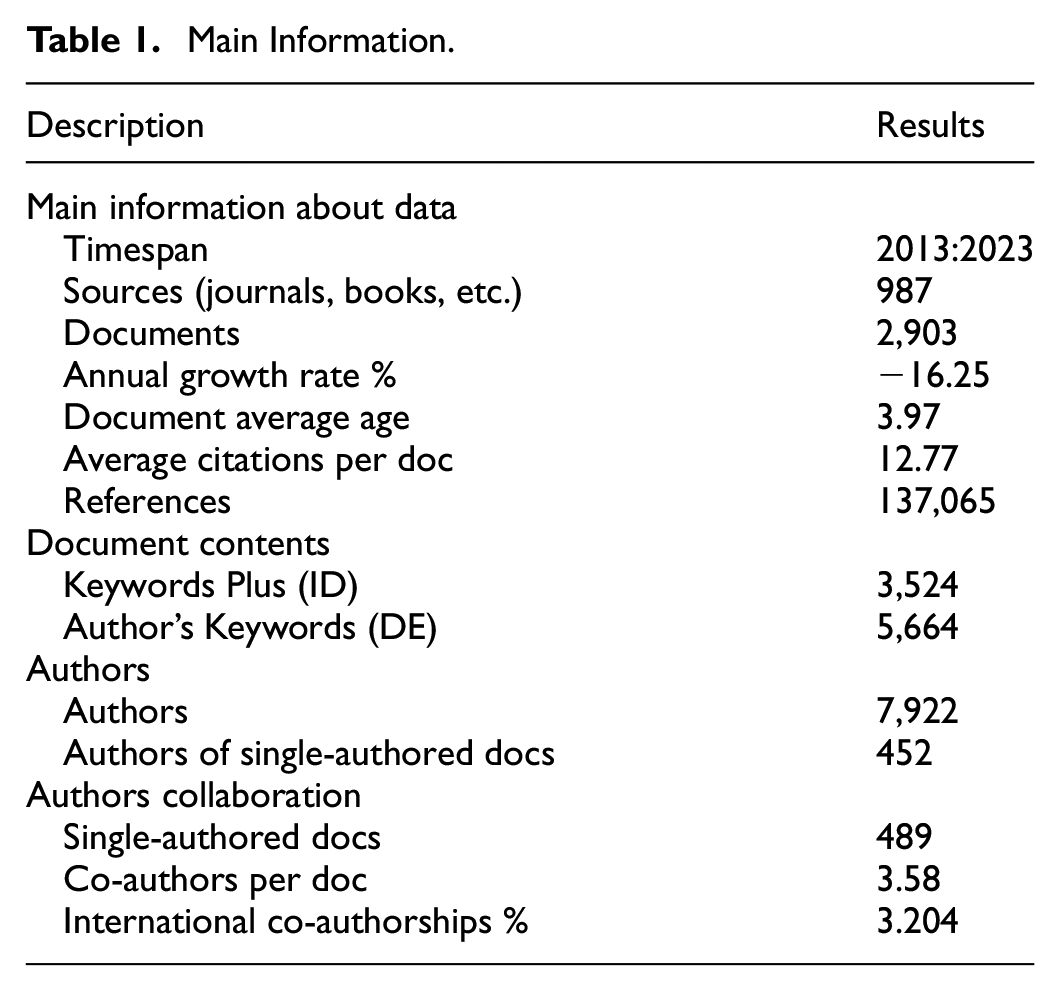
Figure 2 shows the chronological distribution of publications from 2013 to 2022. The figure reveals that approximately 50% of the articles were published between 2020 and 2022, indicating a surge in interest and focus in STEM and gender research in recent years, as indicated in Scopus and WoS. The overall growth of publications is characterized by a gradual increase. In the initial stage (2013–2016), the number of publications exhibited slow growth, averaging less than 35 publications per year. The subsequent stage (2017–2022) witnessed a rapid increase, culminating in a peak of 586 publications in 2022. The increase might also relate to the Web of Sciences Emerging Science Citation Index (ESCI) launch in late 2015. Given that this study’s data extends up to 2022, it is anticipated that the number of publications and citations in the field of STEM and gender studies will continue to elevate in 2023.

Annual scientific production in gender and STEM.
Leading Countries in Gender and STEM Publications Based on Scopus and WoS
Tables 2 and 3, and Figure 3 show the distribution of STEM publications among the leading countries by annual volume of publications. The findings show that more than 70% of the publications were published by scholars from the United States. Also, the leading countries that took part in STEM and gender were the United Kingdom (180), Spain (153), and Australia (140). Since 2013, countries such as Germany, China, and Canada have conducted relevant studies, publishing 135, 124, and 108 papers, respectively. Noteworthy, despite the underrepresentation of Global South in publications indexed by Scopus and WoS (Kataeva et al., 2023, 2024; Pranckutė, 2021; Tennant, 2020), the representation of China, Iran, Turkey and India in publications on gender and STEM is significant. These countries are listed among the 15 leading countries in research publications on gender and STEM fields.
Country Productivity on Gender and STEM.
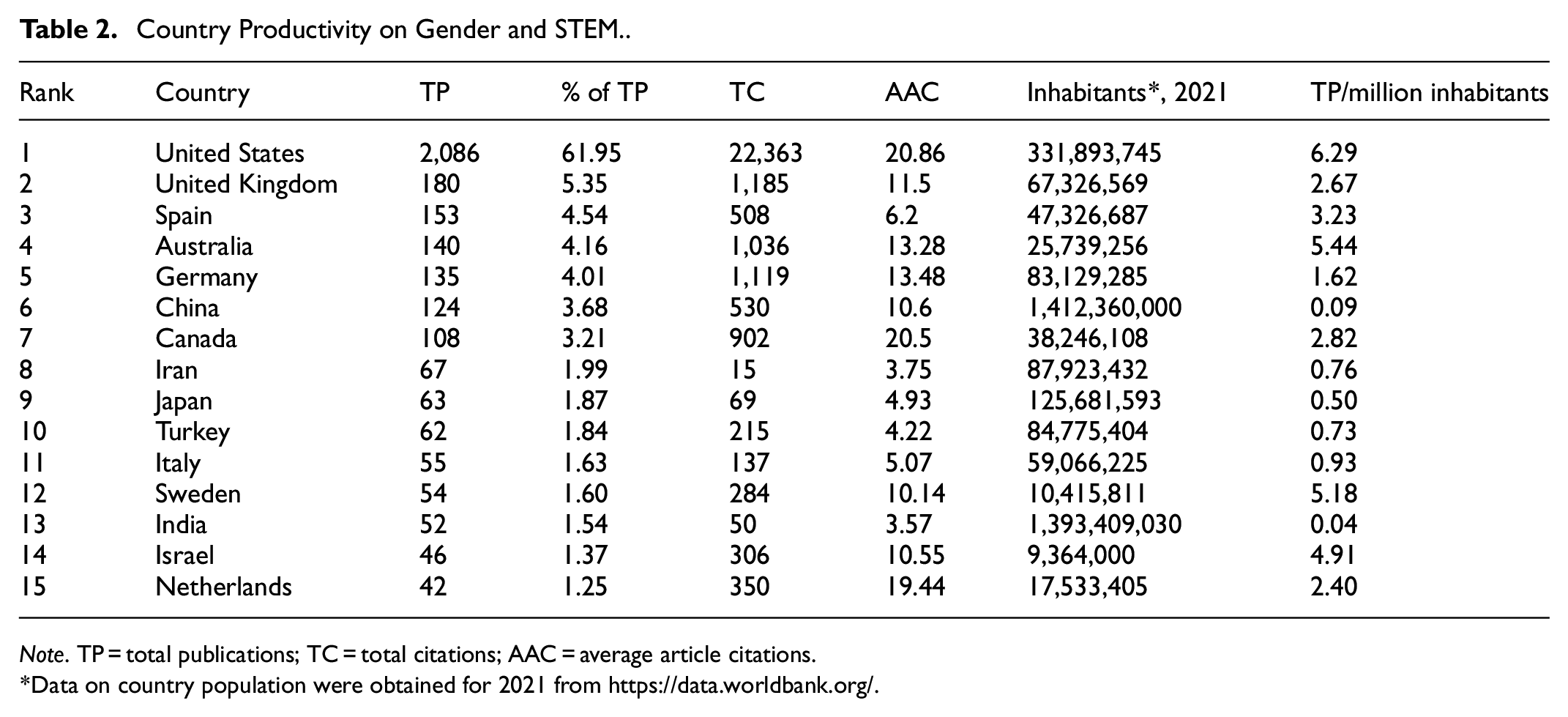
Note. TP = total publications; TC = total citations; AAC = average article citations.
Data on country population were obtained for 2021 from https://data.worldbank.org/.
Country Productivity on Gender and STEM During 2020–2022.
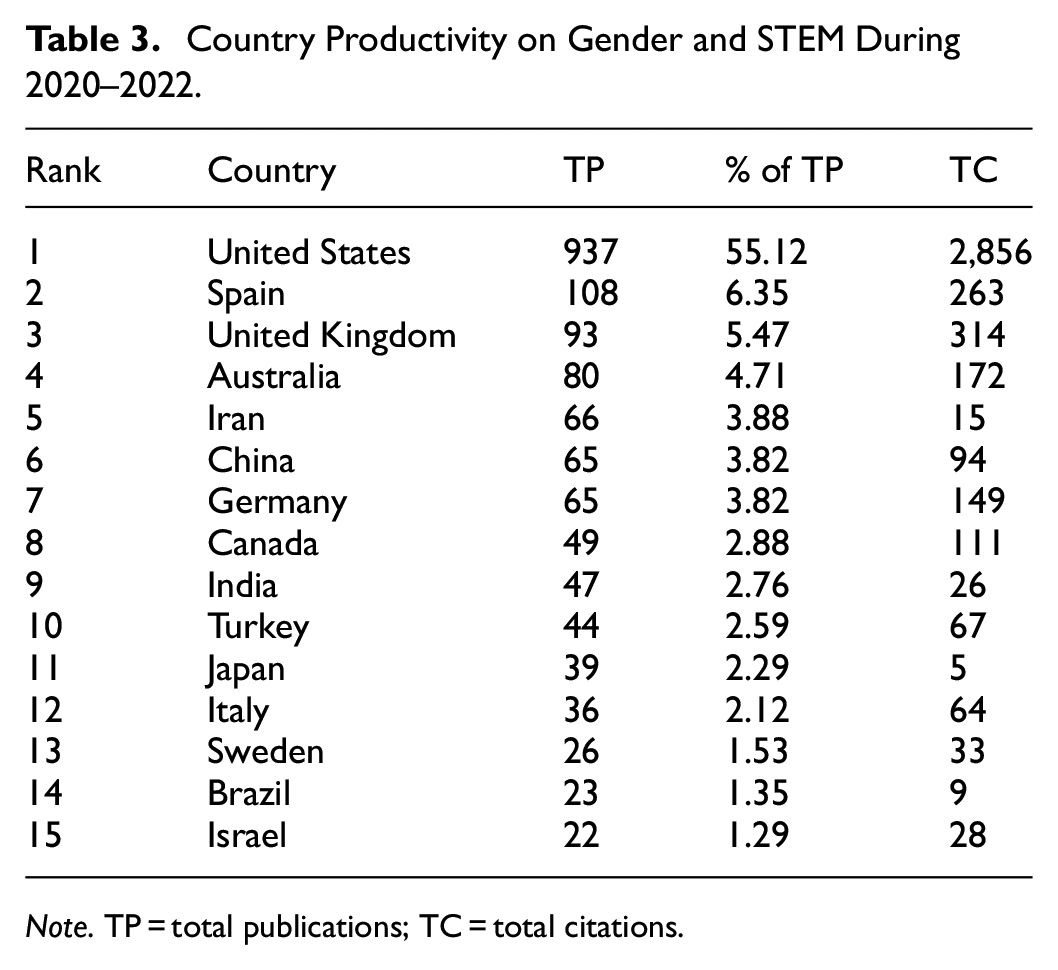
Note. TP = total publications; TC = total citations.

Countries’ production over time.
In order to analyze deeply the growth of publications between 2020 and 2022, we conducted additional analysis to investigate country-specific productivity. The United States remained a leading country; however, Spain moved ahead of the United Kingdom between 2020 and 2022 (Table 3).
International Collaboration in Gender and STEM Research and Publications
Figure 4 presents a visual map depicting the international cooperation network among countries in the realm of STEM and gender research. The connections between each data point represent collaborative partnerships between countries. Notably, developed nations exhibit robust interconnections, indicating extensive cooperative relationships in the field of STEM and gender. The figure highlights the United States as a central hub within this network, fostering close collaborations with numerous countries, including those demonstrating heightened activity in STEM and gender research such as the United Kingdom, Spain, Germany, China, Canada, and Australia.

Collaboration world map.
Leading Institutions, Prolific Journals, and Authorship Patterns in Gender and STEM
Table 4 demonstrates the leading institutions on STEM and gender research, with the majority of publications produced by US universities. Consequently, the University of California leads the publications patterns followed by Arizona State University, Florida International University and University of Maryland.
Leading Institutions on Gender and STEM.

Note. TP = total publications.
Table 5 and Figure 5 demonstrate the international journals with more than 26 published papers from 2013 to 2022. The most prolific publication source is PLoS ONE Journal, which includes 114 publications and 1,271 citations, followed by the International Journal of STEM Education, International Journal of Science Education, and Journal of Women and Minorities in Science and Engineering. The dynamic of publications demonstrates the gradual rise of the leading journals. Unsurprisingly, the analysis reveals that leading journals are those that publish in the English language.
Leading Sources on Gender and STEM.

Note. TP = total publications; TC = total citations; IF = impact factor. Data on impact factor were obtained for 2022 from https://wos-journal.info/.

Source dynamics on gender and STEM.
Table 6 and Figure 6 disclose crucial data concerning important information regarding the leading authors with the highest number of published works related to STEM and gender. The most published authors were Hazari, Z., Schunn, C., Brownell, S., and Potvin, G., with 19, 17, 16, and 16 publications, respectively.
Leading Authors on Gender and STEM.
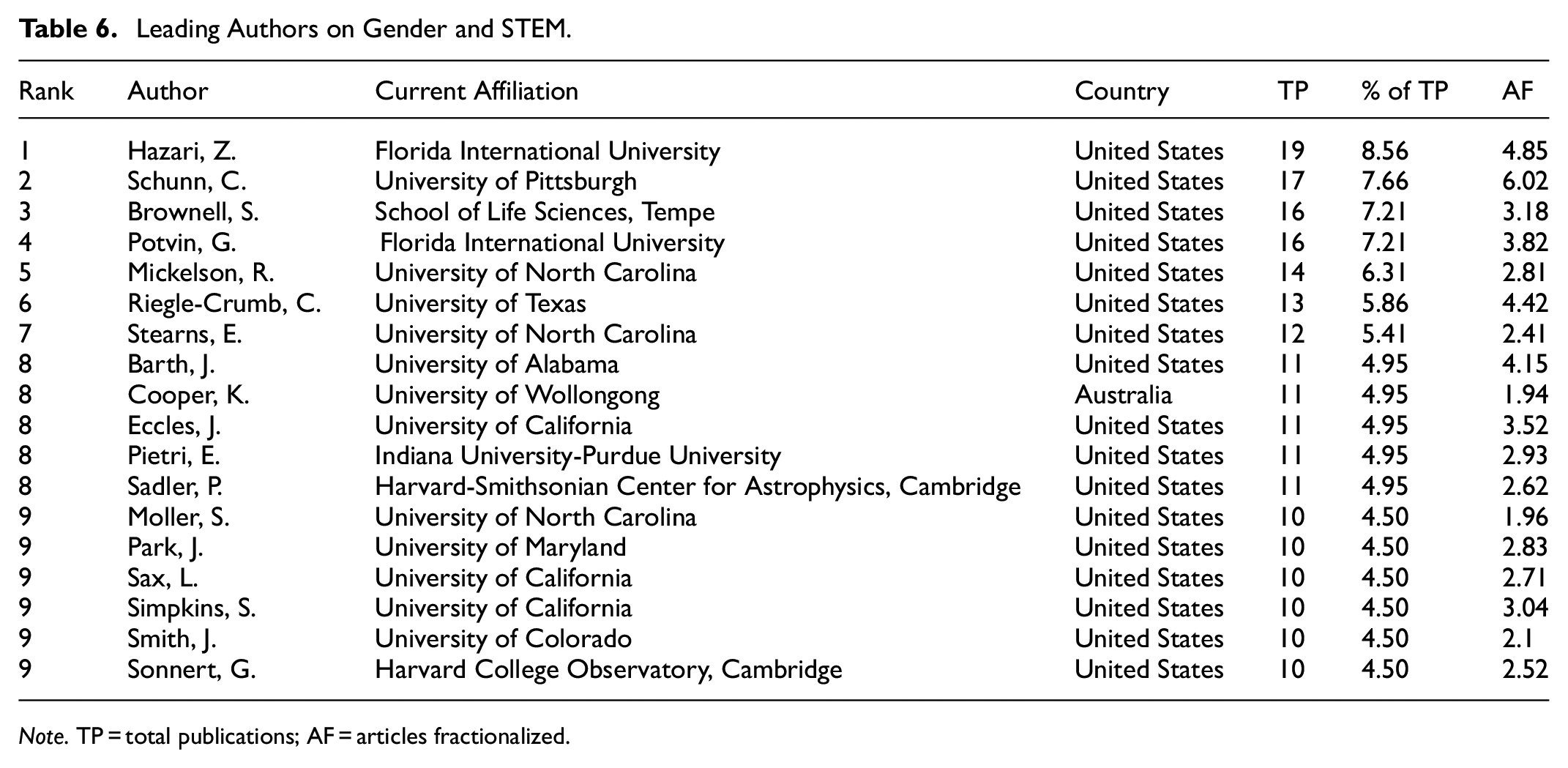
Note. TP = total publications; AF = articles fractionalized.

Authors’ production over time.
Figure 7 illustrates the authors’ collaboration network, revealing the presence of 13 distinct groups of authors who collaborate on the topic, with three research groups emerging as the most prolific in terms of publications. It is evident that authors primarily collaborate with other researchers associated with the same organizations or within the same countries. This network of collaborations showcases the interconnectedness and knowledge sharing within the research community.

Authors’ collaboration network.
Table 7 shows the leading publications with the higher number of citations on STEM and gender. Notably, the top-ranked paper by Leslie et al. (2015) examines the role of expectations of brilliance in shaping gender distributions across academic disciplines, highlighting the pervasive influence of stereotypes in academia. Other significant contributions include studies on the green-feminine stereotype and its impact on sustainable consumption (Brough et al., 2016), efforts to broaden the participation of girls and women in STEM careers (Dasgupta & Stout, 2014), and historical comparisons of gender inequality in scientific careers (Huang et al., 2020). These publications address various aspects of gender disparities in STEM, including teacher expectations (Gershenson et al., 2016), interventions to mitigate gender biases in engineering (Walton et al., 2015), and stereotypes undermining girls’ interest in computer science (Master et al., 2016). Additionally, the table includes studies on the persistence and success of women of color in STEM higher education (Ong et al., 2018), the influence of a sense of belonging on STEM major decisions (Rainey et al., 2018), and hiring preferences in STEM tenure track positions (Williams & Ceci, 2015).
Top Publications on Gender and STEM.

Bibliometric Analysis of Keywords
Figure 8 displays the most frequent keywords. The figure shows the frequency of words appearing in the articles’ keywords in descending order: “Gender,”“Female,”“Male,”“Human,”“Science,” and “Students.”

Most frequent words in gender and STEM research.
Figure 9A represents trending topics on Gender and STEM. The analysis reveals a chronological evolution of the topics discussed in the publications. Initially, the focus was on utilizing psychological theory and social change as frameworks. Over time, the discourse expanded to encompass themes such as “human,”“male,”“female,”“students,”“science,” and “gender.” More recently, the prominent terms within the publications have evolved to include “color,”“stem,”“technology,”“efficacy,”“men,” and “undergraduate.”

(A) Trend in topics on gender and STEM. (B) Trend in topics on gender and STEM during 2020–2023.
Figure 9B showcases the changing trends in topics on gender and STEM research over the past 2 years (2020–2022), emphasizing “race,”“engineering education,” and “mathematics” in addition to “gender.”
Figure 10 represents the co-occurrence analysis of all keywords in the dataset. The figure demonstrates the network map of the trend topics according to the Keywords Plus. The selected keywords include the top 50 words, incorporating terms such as “gender,”“female,”“male,”“human,”“science,”“mathematics,” and “students.” This analysis shows that most research and publications on gender and STEM are produced within education and educational psychology.

Co-occurrence network.
Following the content analysis offered by Završnik et al. (2024), Table 8 provides a comprehensive overview of representative keywords and themes. Our content analysis resulted in four themes and eight categories. In the red cluster (n = 16) the focus revolves around disparities and factors influencing the participation, experiences, and outcomes of students in STEM fields, emphasizing the complex interplay between gender, race, motivation, identity, and socio-cultural factors within educational environments. The blue cluster (n = 13) contains keywords related to the experiences, performance, and attitudes of women in STEM, highlighting the impact of societal perceptions, self-efficacy beliefs, and educational experiences on women’s choices, persistence, and performance in STEM disciplines. In the purple cluster (n = 18) attention is directed toward gender and sex-related factors in human studies, exploring perceptions, stereotypes, and behaviors associated with gender identity and sex differences across various age groups and contexts. Finally, the green cluster (n = 3) explores various aspects of STEM education and professional development, particularly within the context of engineering, aiming to contribute to the advancement of educational practices and workforce development initiatives in STEM fields.
Representative Keywords Plus, and Categories and Themes Identified in Gender and STEM Research.

Analyzing the Impact of Socio-Cultural Background and Other Social Markers
As mentioned earlier, cultural norms and gendered stereotypes create significant challenges for women, both at the individual and institutional levels, hindering women’s access to STEM education and career opportunities (Chan, 2022; Chowdhury et al., 2022; CohenMiller et al., 2021; Ijagbemi et al., 2017; Taasoobshirazi et al., 2019). The underrepresentation of women in STEM fields is closely associated with entrenched gender stereotypes and biases, particularly the societal expectation that women should focus on domestic space and fulfilling caregiving roles. For example, within Asian contexts, the notable underrepresentation and low retention of women in STEM disciplines are linked to cultural and societal norms that perceive some women as less capable in STEM and expect them to prioritize family responsibilities (Baruah, 2022; Chowdhury et al., 2022; Lee et al., 2018; Wahono et al., 2020). Furthermore, studies indicate that individuals from various racial, ethnic and socioeconomic backgrounds experience financial constraints as significant obstacles impeding their pursuit of STEM careers or studies (Radmehr et al., 2022).
Psychological Impact on Women’s Experiences and Their Persistence and Performance in STEM
Previous research demonstrates that the gender disparity in STEM is also attributed to factors such as a cold and unfriendly environment in classes and the continuation of gender stereotypes that undermine female students’ self-efficacy and sense of belonging to STEM programs (AAUW, 2010; Mejía-Rodríguez et al., 2021; Ortiz-Martínez et al., 2023). Negative stereotypes diminish women’s self-assessment, doubt their abilities in STEM fields and impact their performance, thereby undermining their educational and career aspirations in STEM (AAUW, 2010). In addition, the research conducted by Reidy and Wood (2024) illustrates that women in STEM majors experienced higher levels of anxiety and depression compared to non-STEM majors.
Behaviorial Differences Between Sexes and Associated Stereotypes
As mentioned earlier, STEM fields are viewed as “masculine,” (Mendick, 2005) and female students often regard STEM subjects as academically superior (UNESCO, 2017), leading to a negative impact on girls’ academic performance as they tend to opt for subjects perceived as less demanding (Genoways, 2017). Furthermore, girls frequently encounter discouragement from their teachers when considering math, physics, or other fields traditionally dominated by males, while boys are often encouraged to pursue careers in STEM-related disciplines (Genoways, 2017; Halai, 2010; UNESCO, 2017).
STEM Education and Professional Development
Countries around the world call for national reform initiatives advocating for the advancement of integrated STEM curricula (Ring et al., 2017; Shernoff et al., 2017). Alongside this emphasis on enhancing STEM curricula, there is also a necessity for the professional development of teachers and educators regarding the STEM curricula (Ring et al., 2017; Shernoff et al., 2017).
Overall, the thematic analysis of keywords illustrates a wide range of research and publication topics on gender and STEM disciplines focusing on the sociocultural background, race, ethnicity, psychological impact of stereotyping in STEM, as well as integration of gender into STEM curricula and professional development of teachers and educators.
Conclusion and Study Implications
Despite the significant increase in girls’ enrollment in schools and universities, there remains a large gap in the number of female students pursuing STEM fields. This gender inequality has garnered attention from researchers, resulting in numerous publications over the past decade. To capture the progress and trends in academic research and publications on gender and STEM, we conducted a bibliometric analysis of 2,903 documents extracted from the two databases of Scopus and WoS. Our findings reveal a significant growth in literature during the past decade, with a particularly significant increase observed between 2020 and 2022.
The analysis demonstrated that the United States remains a leading country in research and publications on gender and STEM, followed by the United Kingdom, Spain, and Australia due to the predominance of English language journals in Scopus and Web of Science. Despite the underrepresentation of the Global South in knowledge production and publications in Scopus and WoS, specifically, the contribution of China, Iran, India, and Turkey appears significant, demonstrating the vitality of research and knowledge production on gender and STEM globally. However, research on gender and STEM is still mostly published in English language journals, according to our findings based on Scopus and WoS. The analysis also indicates a growing trend of international collaboration among countries, with the United States serving as a central core within this collaborative network. Nevertheless, collaboration between authors occurs mainly within the same institutions or their respective countries, while international collaboration remains limited. Increasing international collaboration in research on gender and STEM may bring positive outcomes for policy and practice, helpinge reduce the gender gap in STEM disciplines globally.
Furthermore, the most frequently used keywords in the publications include “gender,”“female,” and “male,” followed by “human,”“science,” and “students.” The trending topics of interest in gender and STEM have evolved over time. The focus has moved from psychological theory and social change to studying issues around students, science, color, technology, men, efficacy, race, engineering education, and mathematics. Overall, the majority of publications on gender and STEM are produced in the fields of education and educational psychology. Moreover, given that this study’s data extends up to 2022, we anticipate that the number of publications and citations in the field of STEM and gender continue to rise in 2023.
The study findings have several implications. Firstly, the under-representation of girls in STEM subjects calls for targeted efforts to encourage and support their interest and participation. Secondly, the significant growth in gender and STEM literature between 2020 and 2022 shows increasing recognition of the importance of this topic. This attention can help raise awareness of gender inequalities in STEM and contribute to policy and practice development. Thirdly, the dominance of Global North countries, including the United States, United Kingdom, Spain, and Australia, in research on gender and STEM highlights the need for greater representation and collaboration from Global South countries. While China, Iran, India, and Turkey make significant contributions, more diverse perspectives and voices are still needed. This discrepancy emphasizes the necessity of additional investigation and funding for STEM research projects in Global South in order to promote a more varied and inclusive global research environment.
Fourthly, the fact that most research on gender and STEM is published in English language journals suggests a potential language barrier for non-English speaking researchers. Efforts should be made to translate and disseminate research findings in multiple languages for broader access. Fifthly, the growing trend of international collaboration, with the United States at the center, offers the potential for knowledge sharing and best practice exchange. However, more transnational collaboration is needed to address the global gender gap in STEM. Lastly, the evolving focus of research in this field reflects its dynamic nature. Researchers should continue exploring emerging topics, particularly from a sociological perspective, and adapt their research to address evolving needs and challenges in promoting gender equality in STEM.
Footnotes
Acknowledgements
This study is a part of the research project on “Policy enactment of mainstreaming gender equality in higher education in Kazakhstan” supported by Nazarbayev University, Kazakhstan under Collaborative Research Program (No. 021220CRP1222). The authors want to thank team members Dr. Aray Rakhimzhanova and Aliya Olzhayeva for their continuous contribution to the project.
We also want to thank editors and anonymous reviewers for their insightful comments and feedback.

Ethical Considerations
This research does not involve human subjects.
Author Contributions
ZK: Conceptualization; Data curation; Formal analysis; Funding acquisition; Investigation; Methodology; Project administration; Resources; Supervision; Validation; Visualization; Writing—original draft; Writing—review & editing. ND: Conceptualization; Data curation; Formal analysis; Funding acquisition; Investigation; Methodology; Resources; Validation; Visualization; Writing—review & editing. ZI: Data curation; Formal analysis; Investigation; Methodology; Resources; Validation; Visualization; Writing—review & editing. VR: Formal analysis; Methodology; Validation; Writing—review & editing.
Funding
The author(s) disclosed receipt of the following financial support for the research, authorship, and/or publication of this article: This study was supported by Nazarbayev University, Kazakhstan under Collaborative Research Program (No. 021220CRP1222).
Declaration of Conflicting Interests
The author(s) declared no potential conflicts of interest with respect to the research, authorship, and/or publication of this article.
Data Availability Statement
The datasets used and analyzed during the current study are available from the corresponding author on reasonable request