




Abstract
Green credit has a profound and multifaceted impact on the digital economy. As a key driver, it provides financial support, fosters innovation, stimulates green investment, and enhances environmental sustainability. Using provincial data from China, this study applies fixed-effects, moderation-effect, and threshold-effect models to explore the relationship between green credit and the digital economy. The findings reveal that (1) green credit significantly boosts digital economic growth. Even after addressing endogeneity concerns, its positive influence remains strong. (2) Marketization conditions shape this relationship, with product market development weakening the effect while factor market development strengthens it. (3) Within a marketization framework, green credit drives digital economic expansion, with moderate marketization maximizing its effectiveness. These insights contribute to the high-quality development of regional digital economies.
Introduction
Governments worldwide recognize the digital economy as a key driver of economic growth and global competitiveness, adopting policies to accelerate its development (Niu et al., 2024). The digital economy optimizes resource allocation, boosts productivity, transforms traditional industries, and fosters the growth of emerging sectors (Zhao et al., 2024). Moreover, it drives innovation through big data and advanced analytics, giving rise to novel business models and service strategies (Li et al., 2024; Shan et al., 2023). Digital technologies improve the efficiency and transparency of public services, enabling smart cities, intelligent transportation, and digital healthcare, thereby enhancing overall quality of life (De Pablos, 2023; Jieutsa et al., 2024). These advancements in public administration and governance foster social cohesion and strengthen a country’s competitive standing in the global economy. As a result, the digital economy has emerged as a pivotal force driving economic growth, shaping both China’s economy and the global landscape.
In the fast-changing digital economy, rigorous academic research is essential. The digital economy has given rise to new economic phenomena and challenges, driving scholars to develop a theoretical framework adapted to the modern era (Niu et al., 2024). This framework offers theoretical foundations and empirical evidence to help governments craft effective policies. Furthermore, academic research drives digital technology advancements, uncovering its potential and broad applications across diverse sectors (Glotova et al., 2022; Kartskhiya et al., 2020; Kyzovleva et al., 2021). It also examines the digital economy’s impact on societal issues such as employment, privacy protection, and income distribution, offering strategies to mitigate these challenges (Liu et al., 2023; Sun et al., 2024). Comparative studies of digital economy development across countries generate valuable insights, enabling nations to refine their own strategies and promote sustainable socio-economic progress (Volodin et al., 2021).
Green credit refers to financial services offered by institutions to support environmentally sustainable projects. Its goal is to balance environmental protection and economic growth by financing low-carbon, high-efficiency initiatives (Gu et al., 2024). Green credit promotes sustainable technological advancements, enhances resource allocation efficiency, spurs innovation and entrepreneurship, and optimizes industrial structures, thereby accelerating the digital economy. Therefore, examining the influence of green credit on the digital economy is crucial. However, academic research in this field remains scarce, and the development of green credit differs significantly across varying degrees of marketization. These disparities influence the effectiveness of green credit in driving the digital economy, underscoring the need for further research.
This study constructs a unified research framework that links green credit and the digital economy, examining its impact and the moderating role of marketization. It explores the following key questions: (1) To what extent does green credit drive digital economic growth across China’s provinces? (2) How does marketization shape the relationship between green credit and digital economic growth? (3) Does marketization exhibit a threshold effect in moderating green credit’s impact on digital economic growth?
Marginal contributions: The key contributions of this paper can be summarized as follows: (1) This study integrates green credit and the digital economy into a unified framework to analyze the impact of green credit, offering a more comprehensive explanation of digital economic growth. (2) By incorporating marketization into this framework, the study uncovers its moderating role in the relationship between green credit and the digital economy, deepening the understanding of how green finance, particularly green credit, influences digital economic growth. (3) By integrating the threshold effect, this study examines the boundary conditions of marketization’s influence on green credit-driven digital economic growth, providing a holistic perspective on how marketization amplifies green credit’s role in the digital economy.
This article is structured as follows: Section “Theoretical Background and Hypotheses” outlines the research hypotheses, section “Model Construction and Research Design” details the methodology and research design, section “Empirical Analysis” conducts the empirical analysis, and section “Research Conclusions and Policy Implications” concludes with discussions and policy recommendations based on the findings.
Theoretical Background and Hypotheses
Direct Effects
Green credit drives digital economic growth through multiple channels, including green technology innovation, efficient resource allocation, industrial upgrading, corporate social responsibility, policy and regulatory support, and the acceleration of digital technology adoption (Hou et al., 2023; Wu, Xue, et al., 2024). By providing financial support for eco-friendly and high-efficiency digital economy projects, green credit facilitates the integration of big data and the Internet of Things into energy management and pollution monitoring (Wu, Zhou, & Chen, 2024). This improves resource efficiency and mitigates environmental pollution. Green credit channels investment into low-carbon, energy-efficient, and eco-friendly industries, facilitating the green transformation of traditional industries and fostering the growth of emerging sectors. It also incentivizes companies to fulfill social responsibilities and prioritize environmental sustainability (Zhao et al., 2024). Green credit policies enable governments and financial institutions to reduce corporate financing costs and encourage participation in green economic initiatives, thereby accelerating the adoption of smart cities, smart agriculture, and smart transportation (Lin et al., 2024). This comprehensive approach fosters a sustainable digital economy, supporting the study’s first research hypothesis.
Moderation Effect
The level of marketization plays a crucial role in determining how green credit drives high-quality development in the digital economy (He et al., 2023). Specifically, higher marketization enhances resource allocation efficiency and increases financial market transparency and competitiveness (Li et al., 2024). In this context, green credit, as a mechanism for promoting environmental protection and sustainable development, becomes even more effective (Xie et al., 2019). In highly marketized environments, financial institutions place greater emphasis on Environmental, Social, and Governance (ESG) standards and are more likely to channel resources into green projects. This approach not only mitigates environmental risks in the digital economy but also drives technological innovation, fostering structural optimization and high-quality economic development. Therefore, higher marketization amplifies the positive effects of green credit and fosters sustainable digital economic growth, forming the study’s second research hypothesis.
Threshold Effect
The effectiveness of green credit in fostering the digital economy is largely shaped by the degree of marketization, which dictates its facilitative role. A higher level of marketization creates a strong foundation for green credit implementation, enhancing resource allocation and ensuring efficient capital flows, thereby stimulating digital economic growth (Deng et al., 2023). Conversely, in less marketized environments, green credit’s effectiveness is constrained: enterprises face financing difficulties, resource allocation becomes inefficient, and market participants exhibit sluggish policy responses (Su et al., 2022). As a result, green credit’s impact remains limited, hindering the overall advancement of the digital economy. Therefore, marketization plays a critical role in shaping the relationship between green credit and the digital economy, as its varying levels significantly influence green credit’s effectiveness and developmental trajectory. This finding supports the study’s third research hypothesis.
Model Construction and Research Design
Data Source
According to the research plan, 30 provinces will be selected as study subjects for the period 2010 to 2021. The data will primarily be sourced from the China Statistical Yearbook and the official statistical bureau websites of each province, covering the years 2011 to 2022.
Index Selection
Dependent variable: This study defines the digital economy as comprising not only fundamental infrastructure and digital industries but also the external environment that facilitates its development. Adhering to the principles of scientific rigor, representativeness, and data accessibility, this study constructs an evaluation index system for digital economy development, emphasizing three key dimensions: digital infrastructure, digital industry growth, and the digital economic environment. Digital infrastructure provides the foundational support necessary for the digital economy’s operation and expansion; digital industry development constitutes its core economic structure; and the digital economic environment serves as a platform that fosters overall growth, playing a crucial role in advancing the digital economy (He et al., 2023). Detailed indicator descriptions are presented in Table 1.
Evaluation Index System for the Level of Digital Economy Development.

Explanatory variable: Green credit- this article measures green credit using (1—the ratio of interest expenses of the six major energy-intensive industries to total industrial interest expenses; Deng et al., 2023; Xie et al., 2019).
Moderation variables/threshold variable—degree of marketization (MD): To objectively quantify marketization, this research uses the China Provincial Marketization Index, developed by Professor Fan Gang, to assess its level.
Control variables: The control variables encompass Industrial structure upgrading (ISU), economic development level (PGDP), urbanization (URB), and foreign direct investment (FDI). Relevant indicators are shown in Figure 1.

Control variable set.
Modelling
(1) Fixed effects model: To verify the impact of GL on the GEC, a dual fixed effects model was established.

In this context, i represents provinces and cities, t denotes years, and GEC and GL refer to the digital economy and green credit in province iii during year ttt, respectively. The variable X includes control variables, while C denotes the constant term. The symbol ζ captures individual effects, while θ accounts for time effects. Finally, v represents the disturbance term.
(2) Moderation effect model: Introducing the moderation effect model, where the degree of marketization serves as the moderating variable, this study examines how green credit (GL) influences the digital economy (GEC) through a moderation mechanism. The corresponding model is formulated as follows:

Here, M denotes the moderating variable, the degree of marketization, while the remaining terms are consistent with Formula 1.
(3) Threshold regression model: The effect of green credit (GL) on the digital economy (GEC) may vary across different stages of marketization development (MD). Therefore, this study applies a threshold panel model to identify the threshold value of MD. This approach enables the estimation of variations in GL’s effect on GEC across different MD levels.

In detail, MD is the threshold variable.
Empirical Analysis
Direct Effects
Correlation and multicollinearity analysis: To mitigate potential biases in research findings due to severe multicollinearity, correlation and multicollinearity tests were conducted, with results presented in Table 2. The results indicate a moderate correlation among variables. Further verification using the Variance Inflation Factor (VIF) confirms that all variables have VIF values below 5. Therefore, multicollinearity is not a significant concern, ensuring the validity of the regression analysis.
Correlation Analysis.

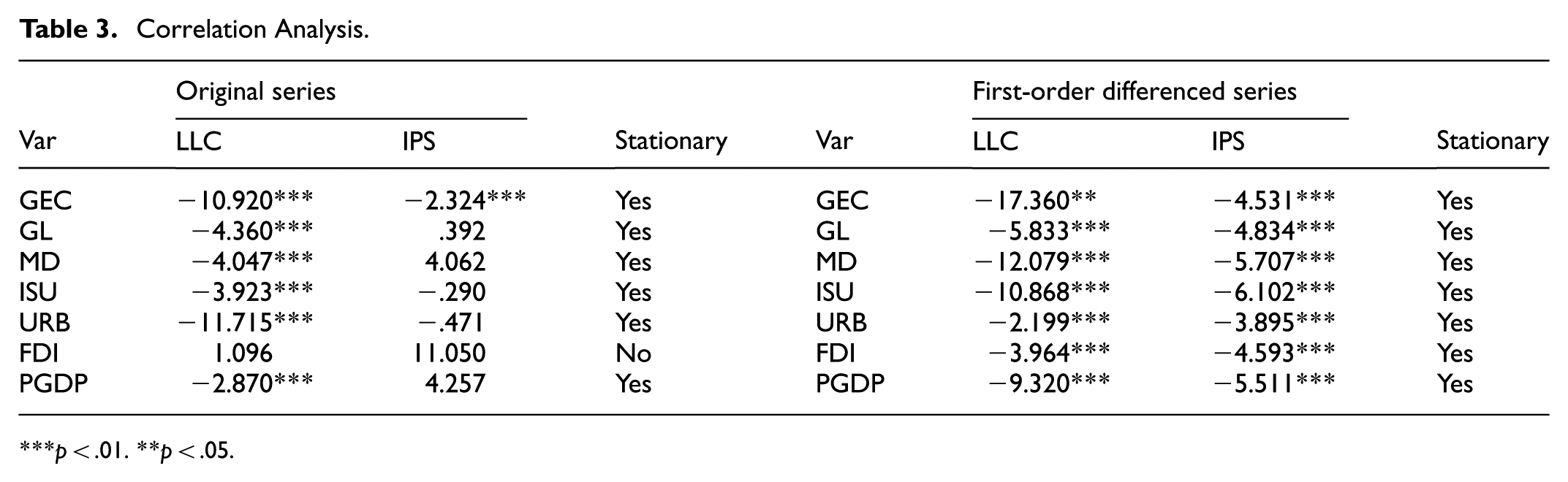
Unit root test: Before performing regression modeling on panel data, ensuring data stationarity and eliminating white noise is essential to prevent spurious regression. Therefore, unit root tests are performed on the variables. This study employs both the LLC and IPS tests to assess unit roots in the variable sequences. The results are presented in Table 3.
Correlation Analysis.
p < .01. **p < .05.
As presented in Table 3, unit root tests on the original series reveal that all variables achieve stationarity after first-order differencing. This confirms that all variables are integrated of order one.
The cointegration test: For two time series variables to exhibit potential cointegration, they must share the same order of integration, as this is a prerequisite for cointegration. If the sequences attain the same order of integration after differencing, further cointegration tests are required to verify the existence of a long-term cointegration relationship. To enhance robustness and reliability, this study applies three cointegration tests: the Pedroni, Westerlund, and Kao tests. As shown in Table 4, all test statistics reject the null hypothesis of no cointegration, confirming a significant long-term cointegration relationship among variables with the same order of integration.
Cointegration Test.

Direct effects: As shown in Table 5, after controlling for time and provincial effects, the impact of green credit (GL) on the digital economy (GEC) is .057 and is statistically significant at the 5% level. Furthermore, when controlling for either time or provincial effects separately, the results consistently validate the positive influence of GL on GEC. This can be attributed to green credit’s role as an innovative financial instrument that facilitates digital economic growth through financial support, policy incentives, and risk mitigation. As green credit policies advance and digital technologies evolve, its role in the digital economy will become increasingly significant. Governments and financial institutions should strengthen collaboration to jointly foster the sustainable development of the digital economy.
Analysis of Direct Effects.

p < .01. **p < .05. *p < .1.
Endogeneity Test
Bidirectional causality and omitted variables may introduce endogeneity in the analysis of green credit’s impact on digital economy development, potentially biasing the results and undermining the validity of the conclusions. To enhance the robustness of the findings, further endogeneity analysis is required. Given that system GMM (SYS-GMM) mitigates the weak instrument problem in difference GMM (DIF-GMM), this study employs SYS-GMM, using the lagged digital economy as an instrumental variable to address endogeneity between green credit and digital economy development. To control for endogeneity arising from omitted variables, the lagged green credit is included as an explanatory variable in the model, capturing the dynamic characteristics of the digital economy and minimizing estimation bias.
As shown in Table 6, the path coefficient of the one-period lagged digital economy (L.GEC) is significantly positive, reinforcing the validity of the findings and highlighting an accumulation effect in the digital economy across Chinese provinces and cities. Thus, SYS-GMM is appropriate for further endogeneity testing. The SYS-GMM regression results indicate that AR(2) is not statistically significant, suggesting no autocorrelation in the second-order sequence of random error terms. The Sargan test validates the appropriateness of the instruments used in SYS-GMM, confirming the reliability of the regression results. The results are reported in Table 6. Table 6 also reports a path coefficient of .126 for green credit’s impact on the digital economy, which is statistically significant at the 1% level, further validating green credit’s positive role in fostering digital economic growth. This finding indicates that even after addressing endogeneity concerns, green credit remains a significant driver of digital economic growth, further reinforcing its positive impact.
Endogeneity Test.

p < .01. **p < .05.
Moderation Effect Analysis
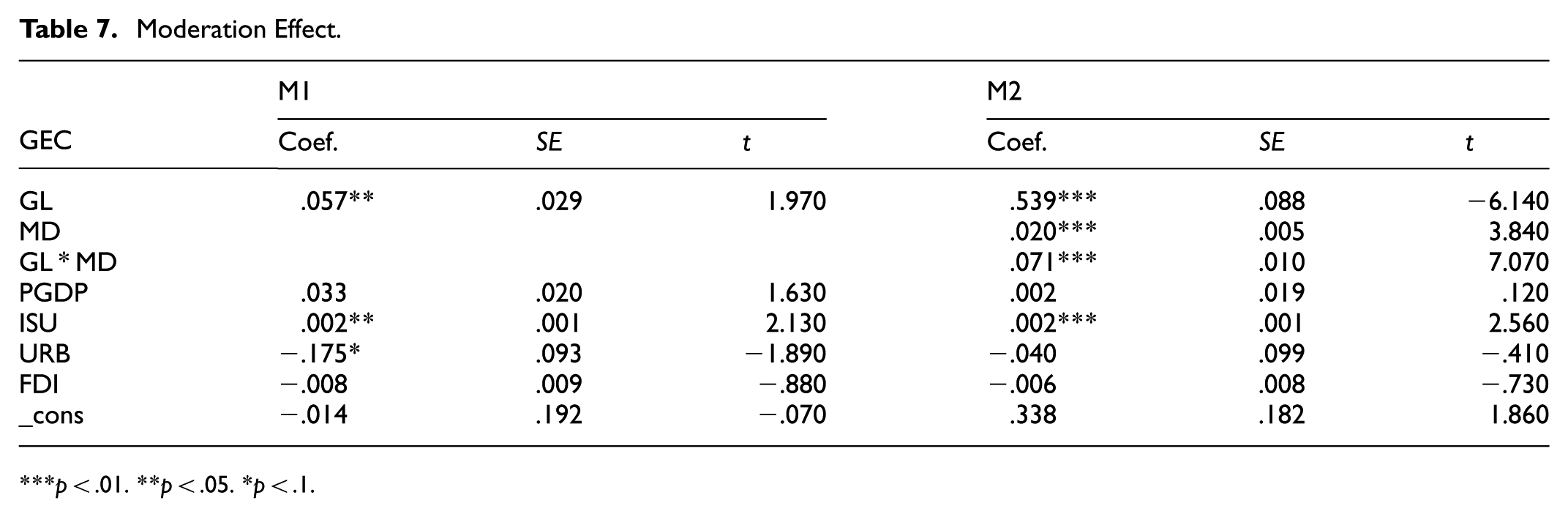
This study confirms that green credit facilitates digital economic growth. Marketization refers to the extent to which market mechanisms shape economic activities within a country or region, particularly in determining resource allocation. Marketization enhances resource allocation efficiency, increases enterprise autonomy, fosters market competition, reduces government intervention, strengthens the financial system, and improves information transparency, thereby positively moderating the development of green credit. In turn, this process further accelerates digital economic growth. Therefore, this study incorporates marketization as a moderating variable, examining its role in shaping the impact of green credit on digital economic growth. The regression results are reported in Table 7.
Moderation Effect.
p < .01. **p < .05. *p < .1.
Building on the baseline regression model, this article integrates moderating variables and interaction terms. The regression results are displayed in Table 7 M2.The main emphasis of the moderation effect is the regression coefficient of the interaction term GL * MD. The results indicate that the coefficient for this interaction term is .071 and is significant at the 1% level. This implies that the degree of marketization positively moderates the relationship between green credit and the digital economy. This finding supports hypothesis H2, which asserts that in provinces and cities with higher levels of marketization, green credit exerts a more substantial promotional effect on the digital economy.
Threshold Effects
Validation of the Moderating Effect of Marketization on the Relationship Between Green Credit and Digital Economic Growth
It has been confirmed that marketization moderates the impact of green credit on digital economic growth. However, marketization varies across time and regions, resulting in substantial differences in its moderating effect. This variability implies that marketization does not consistently exert a positive moderating effect on the relationship between green credit and digital economic growth across all time periods and regions. Therefore, from a theoretical perspective, the positive moderating effect of marketization is expected to have specific boundary values. Based on this premise, this study employs marketization as a threshold variable to examine the threshold effect and critical threshold of green credit in promoting digital economic growth. The regression results are reported in Table 8.
Threshold Value.

p < .01.
As shown in Table 8, the F-statistic for the single threshold test is 91.460, rejecting the null hypothesis at the 1% significance level and confirming the presence of a single threshold. For the double threshold test, the F-statistic is 42.120, which fails to meet the significance threshold, indicating that the null hypothesis cannot be rejected. Therefore, the results confirm the existence of a single threshold for marketization in moderating the impact of green credit on digital economic growth.
Figure 2 presents the threshold parameter for regression Equation 4, as determined by the LR test. The estimated threshold value is 10.335, with a confidence interval of [10.104, 10.430]. The presence of a single threshold within the sample confirms its statistical validity and reliability.

Likelihood ratio test for the threshold value of MD.
To further assess the effectiveness of the marketization threshold effect, this study employs GEC as the dependent variable, GL as the primary explanatory variable, and MD as the threshold variable. The threshold regression results are presented in Table 9.
Threshold Regression Analysis.

The panel threshold regression results in Table 9 indicate the presence of a single threshold within the sample range. When marketization exceeds 10.335, the effect of green credit on digital economic growth increases from .154 to .225, a statistically significant change. This can be attributed to higher marketization, which strengthens the role of green credit in digital economic development by improving resource allocation efficiency, accelerating technological innovation, facilitating data-driven decision-making, aligning with market demands and social recognition, expanding financing channels, and refining policy and regulatory frameworks. These factors enable green credit to play a more effective role in fostering digital economic growth.
Expanded Analysis
Marketization consists of multiple components. To further elucidate the mechanisms through which marketization influences the role of green credit in fostering digital economic growth, this study decomposes marketization into two dimensions: product market development and factor market expansion, and conducts an in-depth analysis of the preceding conclusions.
Moderation effect analysis 1: Development level of the product market: This section extends the baseline regression model by introducing moderating variables and interaction terms, replacing the moderating variable with the development level of the product market. The regression results are presented in Table 10 M3. The key indicator of the moderation effect is the regression coefficient of the interaction term GL × CPMGL\times CPMGL × CPM. The results indicate that the coefficient of this interaction term is −.012 and is statistically significant at the 1% level. This suggests that the development level of the product market significantly moderates the relationship between green credit and digital economic growth, but its effect is negative.
Moderation Effect.

p < .01. **p < .05. *p < .1.
Moderation effect analysis 2: Development level of the factor market: Expanding upon the baseline regression model, this section incorporates moderating variables and interaction terms, substituting the moderating variable with the development status of the factor market. The regression results are presented in Table 10 M4. The key indicator of the moderation effect is the regression coefficient of the interaction term GL × YSMGL\times YSMGL × YSM. The results show that the coefficient of this interaction term is .029 and is statistically significant at the 1% level. This suggests that the development level of the factor market strengthens the positive relationship between green credit and digital economic growth.
Threshold value: As shown in Table 11, the F-statistic for the single threshold test is 94.830, rejecting the null hypothesis at the 1% significance level and confirming the presence of a single threshold. In the double threshold test, the F-statistic is 25.340, which fails to reach statistical significance, indicating that the null hypothesis cannot be rejected. Therefore, the results confirm the existence of a single threshold for CPM in moderating the impact of green credit on digital economic growth. Figure 3 presents the threshold parameter for the regression equation, as determined by the LR test. The estimated threshold value is 8.632, with a confidence interval of [8.442, 8.636]. The presence of a single threshold within the sample confirms its statistical validity and reliability. Likewise, the development level of the factor market is also found to exhibit a single threshold.
Threshold Value.

p < .01.

Likelihood ratio test for the threshold value.
This study employs the development levels of the product market (CPM) and the factor market (YSM) as threshold variables to perform a threshold regression analysis. The regression results are presented in Table 9 M4 and Table 10 M5.
Threshold effects 1: CPM: As shown in the panel threshold regression results in Table 12 M4, when the development level of the product market exceeds 8.632, the effect of green credit on digital economic growth declines from .187 to .148 and remains statistically significant. This finding implies that once product market development exceeds a certain threshold, the positive effect of green credit on digital economic growth may weaken due to factors such as market saturation, resource misallocation, intensified competition, information asymmetry, and policy and regulatory constraints, thereby diminishing its overall impact.
Threshold Regression Analysis.

p < .01. *p < .1.
Threshold Effects 2: YSM: CPM: As shown in the panel threshold regression results in Table 12 M5, when the development level of the factor market exceeds 4.972, the effect of green credit on digital economic growth increases from .087 to .201 and remains statistically significant. This finding suggests that once factor market development surpasses a certain threshold, enhancements in resource allocation efficiency, innovation capacity, information transparency, financing accessibility, and policy support significantly strengthen the effect of green credit on digital economic growth. This demonstrates that advancing factor market development can amplify the positive impact of green credit and further accelerate digital economic growth.
Research Conclusions and Policy Implications
Research Conclusion
To examine the impact of green credit on the digital economy, this study utilizes provincial data from China spanning the period 2010 to 2021. Employing a fixed effects model, this study investigates the influence of green credit on digital economic growth. Additionally, threshold models and moderation effect models are incorporated to explore the boundary conditions and moderation mechanisms of green credit’s impact on digital economic growth. The findings indicate that:
Direct effect: Green credit plays a crucial role in driving digital economic development. Even after accounting for endogenous effects, this positive impact remains robust. Unlike traditional studies that primarily explore the impact of green credit on environmental protection (Su et al., 2022; Wu, Xue, et al., 2024)and conventional economic growth (Lei et al., 2021), this study is the first to extend the analysis to the digital economy. It identifies the mechanism through which green credit, as an external financial instrument, fosters digital economic growth. This not only expands the theoretical framework of green credit but also enriches the theoretical foundation of digital economic development. By addressing endogenous effects, this study offers new methodological insights and provides valuable policy implications for policymakers and financial institutions.
Moderating effect: Green credit plays a crucial role in market regulation while fostering digital economic growth. Further analysis indicates that product market development negatively moderates the impact of green credit on the digital economy, whereas factor market development positively moderates this relationship. Unlike existing research that primarily examines the impact of green credit on environmental protection (Bie et al., 2023) and traditional economic growth (Su et al., 2022), this study innovatively explores the moderating role of market development in the relationship between green credit and digital economic growth. This finding enriches the theoretical frameworks of both green credit and digital economic development. Specifically, product market development weakens the positive effect of green credit on digital economic growth, whereas factor market development strengthens this impact. This finding not only refines the theoretical framework of green credit and digital economic development but also offers targeted policy recommendations. Different market environments require distinct strategies to optimize the effectiveness of green credit. This comprehensive and in-depth analysis contributes significantly to both theoretical advancements and practical applications.
Threshold effect: Under market regulation, the impact of green credit on the digital economy exhibits a distinct threshold effect, further amplifying its influence. Unlike previous studies that primarily examine the impact of green credit on environmental protection and traditional economic growth, this study innovatively uncovers the threshold effect of market development in facilitating digital economic growth. It highlights differences in threshold effects between product marketization and factor marketization (Wu, Zhou, & Chen, 2024). This study not only refines the theoretical framework of green credit and digital economic development but also offers valuable practical insights for policymakers. Policymakers can implement targeted strategies tailored to market development conditions to maximize the effectiveness of green credit in fostering digital economic growth.
Research Limitations
While this study has made substantial progress in uncovering the mechanisms through which green credit fosters digital economic growth and its regulatory effects in the market, certain limitations remain, and require further investigation.
First, data limitations may impact the generalizability of the findings. This study primarily relies on data from specific countries or regions. Given the substantial variations in economic development levels, financial market structures, and policy environments across countries and regions, the applicability of the findings to other contexts may be constrained. Future studies could incorporate cross-country or multi-regional data to validate the findings, thereby improving the generalizability of the conclusions.
Second, methodological limitations should be acknowledged. Although this study applies various statistical methods and econometric models to address endogeneity, unobserved endogenous factors or latent variables may still exist, potentially influencing the results. Future studies could incorporate more advanced econometric techniques or adopt experimental designs to further validate the robustness of the findings.
Additionally, the complexity of market regulation mechanisms remains insufficiently explored. This study primarily examines how product market and factor market development influence the role of green credit in promoting digital economic growth. However, market regulation mechanisms may encompass additional dimensions, such as financial market development, policy environment stability, and support for technological innovation. Future studies could incorporate additional market regulatory factors to develop a more comprehensive analytical framework.
Policy Implications
Strengthening green credit support and refining market regulation mechanisms: Governments should incentivize financial institutions to expand credit support for green projects and enterprises, particularly those in the digital economy, through fiscal subsidies and tax incentives that encourage banks to issue green loans. At the same time, it is essential to develop and refine market regulation policies for green credit to optimize credit resource allocation, ensuring that funds are directed towards environmentally sustainable and high-tech enterprises and projects through market-driven mechanisms.
Enhancing coordination between product and factor markets: While promoting green credit, it is essential to strengthen the development of factor markets (e.g., labor and capital markets) to reduce excessive reliance on product market growth. The government should implement supportive and reform-oriented policies to foster the healthy development of factor markets, thereby enhancing their positive regulatory role in green credit.
Establishing green credit thresholds and evaluation mechanisms, and strengthening policy promotion: Establish green credit thresholds and develop rigorous evaluation standards and regulatory mechanisms to ensure that green credit is effectively allocated to environmental protection and digital economic development. Introduce third-party evaluation agencies to conduct independent reviews and assessments. Meanwhile, the government should leverage multiple channels to promote green credit policies, increase public and corporate awareness and acceptance, and organize training and educational initiatives to enhance enterprise and financial institution participation.
Footnotes

Funding
The authors received support from the National Social Science Fund of China (Grant No. 24GBL207) and the Shanghai Philosophy and Social Science Fund (Grant No. 2024EGL018).
Declaration of Conflicting Interests
The authors declared no potential conflicts of interest with respect to the research, authorship, and/or publication of this article.
Data Availability Statement
The data that support the findings of this study are available from the corresponding author upon reasonable request.