



Abstract
Collaborative innovation is vital for organisational competitiveness, yet the literature still offers an incomplete picture of how its numerous drivers interact. This study advances that understanding by consolidating 34 factors from a content-centric review of recent research and distilling them to eight core variables: market dynamics, knowledge creation and acquisition, technological learning, trust, innovation culture, organisational learning, innovation capabilities and governance. We engage a ten-member panel of academics and industry experts and employ the Decision-Making Trial and Evaluation Laboratory (DEMATEL) method - an innovative multi-criteria decision-making approach - to quantify the causal structure among these factors. The resulting network relationship map shows that trust, innovation culture and organisational learning form the principal engine of collaborative innovation, exerting the strongest net positive influence on the system. Knowledge creation and technological learning surface mainly as outcomes of this relational engine, while market dynamics and governance assume balanced, context-sensitive positions. Innovation capability emerges as a hinge factor, receiving almost as much influence as it delivers, thereby converting relational gains into competitive advantage. By integrating DEMATEL with network visualisation, the study provides one of the first data-driven blueprints for managing the dynamics of collaborative and open innovation. The reference model guides managers in prioritising actions—cultivating trust, fostering an experimentation-friendly culture, institutionalising learning routines and aligning governance with environmental turbulence - across both firm and network levels. Future research should examine the temporal evolution of these interactions and explore how emerging technologies such as AI, digital twins and blockchain further reshape collaborative innovation ecosystems.
Plain Language Summary
Collaborative innovation is essential for companies to stay competitive, but understanding how the various factors that drive innovation interact is not well-explored. This study aims to fill that gap by identifying and analyzing the key factors behind collaborative innovation and how they influence each other. Through a review of existing research, 34 factors were identified, and experts from academia and industry helped select the most relevant ones for further study. The study used a technique called DEMATEL to map out how these factors are connected. The results show that factors like trust, innovation culture, and organizational learning are the most influential drivers of innovation. On the other hand, factors such as knowledge creation and technological learning are more like outcomes that result from these drivers. Other factors like market dynamics and governance play a balanced role, while innovation capabilities act as both drivers and outcomes, forming a central part of the innovation process. The study creates a visual map, called a Network Relationship Map (NRM), which shows how all these factors work together. This map serves as a guide for managing collaborative innovation, helping businesses and networks understand the connections between innovation drivers and outcomes. The findings offer valuable insights for companies looking to improve their innovation efforts. The study also suggests future research should explore how these relationships change over time and how new technologies impact collaborative innovation.
Keywords
Introduction
Innovation is widely recognized as a cornerstone for organizational growth, competitiveness, and long-term sustainability. It serves as a critical driver that enables organizations to enhance productivity, differentiate themselves in competitive markets, and adapt dynamically to rapidly evolving external environments (Chesbrough, 2020; Weerawardena & Mavondo, 2011). Indeed, innovation capabilities have become essential in fostering resilience and flexibility, thereby enabling organizations to address increasingly complex challenges associated with globalization, technological disruption, and shifting consumer preferences (Goffin & Mitchell, 2016). Organizations that effectively harness innovation can achieve significant competitive advantages by delivering superior products, processes, and services that align closely with market demands and customer expectations (Zhang et al., 2021).
However, traditional approaches to innovation, often termed “closed innovation,” have shown significant limitations in addressing the contemporary challenges faced by organizations. Closed innovation models predominantly rely on internal research and development (R&D) activities, emphasizing confidentiality and proprietary control over knowledge and technology (Grama-Vigouroux et al., 2020). While historically effective, these models often lead to constrained innovation potential due to restricted knowledge flows, resource limitations, and slow response times to external market dynamics (West & Bogers, 2017). Consequently, organizations adhering strictly to closed innovation paradigms frequently struggle to adapt swiftly and effectively in dynamic competitive landscapes characterized by accelerated technological advancements and highly volatile market conditions (Hossain & Anees-ur-Rehman, 2016).
Acknowledging these constraints, the concept of open innovation emerged as an alternative paradigm that emphasizes the permeability of organizational boundaries to external ideas, technologies, and knowledge sources (Chesbrough, 2003, 2020). Open innovation proposes that organizations can significantly enhance their innovation capacity by systematically engaging with external partners such as customers, suppliers, research institutions, and even competitors to co-create value and share innovation risks and rewards (Bogers et al., 2016; Dahlander & Gann, 2010). The open innovation approach facilitates accelerated innovation processes by leveraging external expertise, technologies, and insights that complement and enhance internal capabilities (West et al., 2014). Organizations that adopt open innovation practices often benefit from increased innovation speed, reduced development costs, and improved market responsiveness, enabling them to sustain competitive advantages over time (Vanhaverbeke & Roijakkers, 2014).
Within the broad spectrum of open innovation, collaborative innovation specifically highlights active partnerships and interactions among multiple external stakeholders to jointly develop innovative solutions. Collaborative innovation fosters deep integration of diverse knowledge domains, promoting richer ideation, enhanced creativity, and robust technological advancements (Bogers et al., 2017). By engaging collaboratively with external stakeholders, organizations gain access to broader pools of resources, skills, and technological capabilities, significantly enhancing their overall innovation outcomes and market agility (Gassmann & Enkel, 2020). For instance, Tesla has effectively leveraged collaborative innovation by partnering extensively with universities, tech startups, and research institutions to expedite developments in battery technology and autonomous driving systems, significantly enhancing their market leadership in the electric vehicle industry (Stringham et al., 2021). Similarly, LEGO’s innovative engagement with customers through the LEGO Ideas platform exemplifies how co-creation with external stakeholders can drive substantial innovation success and customer satisfaction (Antorini et al., 2020).
Despite the evident benefits of collaborative innovation, substantial gaps persist in the scholarly literature regarding the specific factors that drive its effective adoption and successful implementation across diverse contexts. While numerous studies have explored the general benefits of open innovation or collaborative practices, limited attention has been paid to systematically identifying and analyzing the interdependencies and causal relationships among critical drivers influencing collaborative innovation success (Dahlander et al., 2021). Most existing research tends to examine these factors in isolation or within narrow contexts, overlooking the dynamic interactions that critically shape collaborative innovation outcomes (Petraite et al., 2022). This oversight represents a significant gap, as understanding these interrelationships is crucial for optimizing innovation strategies and enhancing the effectiveness of collaborative innovation initiatives.
Addressing this critical gap, this study explicitly contributes to the existing theoretical body of knowledge by providing a comprehensive analysis and clear mapping of the interdependencies among critical factors driving collaborative innovation. Specifically, this research adopts the Decision-Making Trial and Evaluation Laboratory (DEMATEL) method to identify, analyze, and visualize the complex causal relationships between these innovation factors. DEMATEL enables the transformation of qualitative expert insights into quantifiable data, offering a systematic framework to evaluate and prioritize innovation drivers based on their relative influence and interconnections (Feng et al., 2024; Mubarik et al., 2021). Thus, this methodological approach provides a novel and structured theoretical model that enriches scholarly understanding and offers practical guidance for enhancing innovation management.
The theoretical contributions of this study are threefold. Firstly, it systematically identifies and consolidates critical factors driving collaborative innovation, addressing an important research gap in innovation literature. Secondly, it elucidates the causal relationships and dynamic interdependencies among these factors, offering new insights into how they collectively shape innovation processes. Thirdly, by applying DEMATEL, the study introduces and validates a novel methodological approach in innovation management research, providing clear implications for both scholarly theory development and practical innovation strategy formulation.
In this context, the study addresses the following research questions:
What are the key factors that contribute to the successful adoption and implementation of collaborative innovation?
How do these factors dynamically interact with one another to influence the overall effectiveness of collaborative innovation?
Which specific factors should organizations prioritize strategically to accelerate the adoption and maximize the benefits of collaborative innovation practices?
Through systematic exploration of these research questions, this study not only advances theoretical knowledge regarding collaborative innovation but also offers actionable insights for practitioners. Organizations seeking to enhance their innovation strategies can utilize the insights generated by this research to more effectively leverage collaborative innovation, optimizing their strategic resource allocation and enhancing their competitive positioning in highly dynamic markets.
Collaborative Innovation
Collaborative innovation refers to the process where multiple entities, often with diverse expertise, resources, and perspectives, come together to co-create new ideas, products, or services. This form of innovation contrasts sharply with traditional, closed innovation models that rely solely on internal resources for ideation, research, and development (Chesbrough, 2003). In the closed innovation paradigm, firms operate in isolation, guarding their intellectual property and restricting innovation efforts to in-house research and development (R&D) teams. Open innovation, on the other hand, as proposed by Chesbrough (2003), breaks these barriers by promoting the inflow and outflow of knowledge across organizational boundaries. Collaborative innovation builds on the open innovation model by emphasizing active partnerships between firms, customers, suppliers, research institutions, and even competitors. It leverages external knowledge to complement internal capabilities, thus fostering a more dynamic and creative approach to innovation (Bogers et al., 2017).
The collaborative innovation model is particularly relevant in today’s interconnected and fast-paced business environment, where no single firm can keep up with the complexities and demands of innovation on its own. Collaborative innovation allows firms to pool their resources, share risks, and generate ideas that would otherwise be out of reach through internal efforts alone (Vanhaverbeke & Roijakkers, 2014). For instance, the consumer electronics industry exemplifies how collaborative networks can lead to breakthroughs in product development and technological advancement, as seen in the joint efforts of firms in the development of mobile technologies (Nambisan et al., 2019). By opening up their innovation processes, firms can tap into a broader pool of knowledge, drive product development cycles faster, and increase their agility in responding to changing market demands.
Collaborative innovation significantly improves a firm’s innovation performance by enabling access to diverse knowledge and resources. Studies like Laursen and Salter (2006) show that firms engaging in collaborative innovation see enhanced creativity, faster product development, and more successful commercialization of new products. By integrating external expertise, firms can overcome internal limitations, leading to more innovative outcomes. Moreover, collaborative innovation bolsters firm competitiveness. Firms that co-create with partners gain competitive advantages through faster market entry, reduced costs, and improved product offerings. These partnerships allow firms to respond more effectively to market changes, fostering agility and resilience in dynamic industries (Gassmann & Enkel, 2004). In terms of sustainability, collaborative innovation promotes long-term growth by fostering continuous learning and knowledge-sharing among firms. This collective effort enhances firms’ ability to adapt to environmental, technological, and market shifts, ensuring they remain competitive and sustainable in the long run. By fostering strategic partnerships, firms create a resilient innovation ecosystem, which contributes to their overall growth and long-term success (Chesbrough, 2017).
Contextual Dynamics
SMEs face distinct challenges when engaging in innovation due to their limited resources, making collaboration crucial. By leveraging external partnerships, SMEs can access knowledge, technologies, and networks otherwise unavailable to them. Collaboration allows these smaller firms to pool resources, share risks, and innovate more effectively. For example, collaborations between SMEs and universities have shown significant benefits, enhancing SMEs’ innovation capacities through access to cutting-edge research (Mahmood & Mubarik, 2020). However, managing these collaborations and ensuring fair sharing of benefits and intellectual property remains a challenge.
In high-tech industries, collaboration is essential for innovation. These industries require rapid technological advancements that often exceed the internal capabilities of individual firms. Consequently, firms in sectors such as biotechnology and IT frequently collaborate with research institutions and other firms to co-develop products and technologies. High-tech firms also engage in global innovation networks to access cutting-edge knowledge and technologies (Petraite et al., 2022; Powell & Grodal, 2005). Collaborative ecosystems, such as Apple’s App Store model, highlight how partnerships with external developers drive continuous innovation (Nambisan & Sawhney, 2011). These networks reduce risks, accelerate innovation, and provide diverse solutions, positioning high-tech firms at the forefront of technological advances.
In emerging markets, collaborative innovation plays a critical role in overcoming institutional voids, such as weak infrastructure and limited access to finance. Firms in these markets often rely on partnerships with multinational corporations (MNCs) and international organizations to compensate for local challenges (Khanna & Palepu, 2010; Mubarak & Petraite, 2020). Collaborative innovation also allows these firms to develop tailored solutions that meet local market needs. GE’s reverse innovation strategy is a notable example, wherein the company collaborated with local firms in India to develop affordable medical devices later introduced to global markets (Govindarajan & Ramamurti, 2011). These collaborations not only boost innovation but also help firms scale up and compete globally.
Collaborative Innovation Models
Collaborative innovation has become indispensable in the contemporary business environment, enabling firms to leverage external resources, knowledge, and capabilities to drive product and process innovation (Abhari et al., 2019). As competition intensifies and technological advancements accelerate, firms increasingly recognize the need to embrace collaborative innovation to maintain competitiveness. Several models and practices of collaborative innovation, including co-creation with customers, crowdsourcing, and the development of collaborative ecosystems, have emerged as powerful strategies for companies seeking to accelerate innovation and maintain an edge in their respective markets.
Co-creation model—emphasizes the active involvement of customers in the innovation process, where customers contribute valuable insights and ideas that enhance product development. By collaborating directly with customers, firms gain a deeper understanding of their preferences, which improves the chances of successful innovations. For instance, LEGO’s LEGO Ideas and Nike’s Nike By You are prime examples of how firms engage customers in product development to create more tailored offerings (Ulwick, 2002). Studies demonstrate that co-creation can significantly improve innovation outcomes by aligning products with customer needs (Hoyer et al., 2010).
Crowdsourcing involves soliciting input, ideas, or solutions from a large external community, often through digital platforms. This approach broadens the scope of innovation by tapping into external talent and expertise. Procter & Gamble’s Connect + Develop program exemplifies crowdsourcing by collaborating with external innovators to accelerate new product development. Similarly, Threadless uses crowdsourcing to design T-shirts, with users submitting and voting on designs. Open-source innovation, as seen in projects like Linux, highlights the role of collaboration in fostering continuous improvement in software development (Chesbrough & Bogers, 2014). Crowdsourcing is also known as Social Product Development (SPD) where the adoption of social media and social computing technologies are utilized to engage customers in innovation process (Abhari et al., 2019).
Collaborative ecosystems refer to networks of organizations, institutions, and individuals working together to co-create value through innovation. These ecosystems enable firms to leverage complementary strengths, accelerating innovation and reducing risks. For example, Tesla’s partnerships with universities and tech firms have supported the development of battery and autonomous driving technologies. Collaborative ecosystems provide firms with the flexibility to innovate rapidly, helping them adapt to market changes (Adner, 2006). Studies show that ecosystem-based collaboration enhances firm performance and innovation success (Autio & Thomas, 2014).
Actors and Activities
Collaborative innovation thrives through the involvement of multiple actors who bring diverse knowledge, skills, and resources to the innovation process. In co-creation, customers play a crucial role by providing direct insights into product development, influencing innovation through their needs and feedback (Prahalad & Ramaswamy, 2004). Similarly, employees contribute through internal collaboration, offering organizational knowledge to enhance innovation (Linder et al., 2003). Suppliers also participate by sharing technical expertise, enabling the development of new components that drive innovation (Frow et al., 2011).
In crowdsourcing, the external crowd plays a pivotal role in generating ideas and solving challenges through open innovation platforms (Howe, 2006). Online communities offer creativity and collaboration, providing continuous input to improve innovation (Afuah & Tucci, 2012). Additionally, freelancers and subject-matter experts contribute specialized knowledge to address specific technical or creative problems (Brabham, 2013; Schenk & Guittard, 2009).
In collaborative ecosystems, business partners and research institutions join forces, creating an environment where knowledge and resources are shared, leading to improved innovation performance (Adner, 2006; Moore, 1996). Besides, Regulatory bodies and technology providers play critical roles in ensuring that the collaborative ecosystem operates within legal frameworks and has access to cutting-edge technology (Autio et al., 2014; Nambisan & Sawhney, 2011).
Reference Model of Collaborative Innovation
The study has developed a reference model of collaborative innovation based on literature synthesis. This reference model provides a comprehensive framework that explains how different actors, activities, and technologies come together within various collaborative innovation models to achieve specific goals, all while being influenced by external contexts. The model operates within several layers, each representing a unique aspect of the collaborative innovation ecosystem. This approach is essential for understanding the complex interdependencies within collaborative innovation, as the roles of actors and activities are highly dynamic and contextual as shown in Figure 1. By providing a clear pathway from actors and technologies to goals, this model offers valuable insights into the mechanisms that drive successful collaborative innovation across industries and sectors.

Reference model of collaborative innovation.
The inner circle illustrates different models of collaborative innovation, such as co-creation, crowdsourcing, social product development (SPD), and collaborative innovation ecosystems. Each of these models has specific actors involved, such as customers, employees, external crowds (e.g., through crowdsourcing platforms), subject-matter experts, business partners, research institutions, and more. The diagram emphasizes that these actors differ depending on the innovation model being applied. For instance, co-creation primarily involves customers and employees, while crowdsourcing engages the external crowd or online communities. Collaborative ecosystems, on the other hand, involve a more complex network of business partners, regulators, and research institutions (Autio et al., 2022; Gawer, 2021; Raasch & von Hippel, 2022).
The dotted arrow connecting the actors to technologies and activities highlights the flow and usage of technologies by these actors in the collaborative process. The actors utilize various technologies—such as digital platforms (AI, IoT, Blockchain), big data analytics, and collaborative software tools like cloud computing—to facilitate their tasks within the innovation process. These technologies are not just facilitators but serve as a crucial link between the actors and the activities they need to perform. The activities in collaborative innovation models include product development, knowledge sharing, partner selection, joint R&D, data sharing, and resource pooling. Each model features a unique combination of these activities, shaped by the technologies available and the actors’ specific roles. For instance, in a collaborative innovation ecosystem, activities like resource pooling and strategic foresight are essential, requiring sophisticated technologies and actor coordination (O’Reilly & Wang, 2024; Tucci et al., 2022).
The joint arrow from both the actors and activities leads toward the goals of collaborative innovation, such as improving innovation performance, enhancing competitiveness, sharing risk, and fostering creativity. This signifies that successful collaborative innovation is the result of the synergistic relationship between actors, technologies, and activities (Gassmann et al., 2024). The actors engage in collaborative activities, supported by technologies, all of which contribute to achieving the overall goals of the innovation initiative (Nambisan et al., 2023).
The outer circle contextualizes the collaborative innovation model, recognizing that the effectiveness and structure of collaborative innovation depend heavily on external factors. These contexts include the firm’s size and type (e.g., startups, SMEs, or multinational enterprises), the technology intensity (whether the firm operates in low-tech, medium-tech, or high-tech sectors), the structure of the networks (whether they are physical or digital), and the geographical context (whether the firm operates in the Global North or Global South).
These contextual factors influence every element of the collaborative innovation process. For example, high-tech firms in the Global North may adopt different models of collaborative innovation (e.g., technology-driven ecosystems) (Lee & Yoo, 2023) than SMEs in the Global South, which may rely more on informal networks and resource-pooling activities (Gereffi, 2023). Additionally, the goals of collaborative innovation, such as competitiveness or risk-sharing, may vary based on these contextual factors, with MNEs (multinational enterprises) focusing on global market dominance, while SMEs may prioritize growth and risk reduction.
Functions of Collaborative Innovation
The study utilizes a systematic approach to identify the factors contributing to collaborative innovation, following established methodologies for conducting rigorous and content-centric literature reviews (e.g., Ghobakhloo et al., 2022; Watson & Webster, 2020). A comprehensive search was conducted using Scopus and Web of Science databases, focusing on terms related to collaboration, co-creation, innovation networks, and associated drivers or benefits. The search string also incorporated terms like “factors,”“drivers,” and “antecedents” to ensure the coverage of both theoretical and empirical studies. This search resulted in the identification of 1,539 documents published between 2013 and 2024. Figure 2 illustrates the steps followed during the process of content analysis.

Methodology applied for identifying the collaborative innovation factors.
To refine the pool of documents, three exclusion criteria were applied: documents outside the social sciences and management fields, non-article document types, and non-English language publications were excluded. This process reduced the pool to 533 documents. The next step involved a detailed screening of titles and abstracts, resulting in the shortlisting of 44 documents for full review. Additionally, a backward review of references cited by the key documents identified 18 further studies, from which eight were found eligible after applying the exclusion criteria. In total, 52 documents were selected for full-text analysis.
A thorough content analysis was then conducted to identify the key factors associated with collaborative innovation. Following Krippendorff’s (2018) guidelines for content analysis, the research team employed a coding scheme to capture key terms and concepts. The analysis was conducted independently by two researchers to ensure objectivity, and discrepancies were resolved through collaborative discussion as performed by Ghobakhloo et al. (2022). This process led to the identification of 34 factors contributing to collaborative innovation across the reviewed literature.
Upon further analysis, eight factors were highlighted as the most significant based on their frequency and relevance. These include market dynamic environment, knowledge creation and acquisition, technological learning, trust, innovation culture, organizational learning, innovation capabilities, and governance. These factors, associated with collaborative innovation, emphasizing the importance of both internal organizational processes and external environmental conditions in fostering successful collaborative efforts. Table 1 presents these functions along with the strength of their recognition within the reviewed documents. Likewise, Figure 3 shows the relative frequency of factors in literature, and top eight factors as per this criterion are selected for the further analysis. The selected eight factors are highlighted in red color.
Associated Factors of Collaborative Innovation and their Acknowledgement Within the Literature.

Note. (Y) = Yes, factor is present in the study, (-) = selected factor is not present in the study; however, other non-selected factors present (full list provided in Appendix-I).

Relative frequency of occurrence of collaborative innovation factors in literature.
The selected functions or factors are discussed briefly before their application for study framework.
Trust (F1) is the degree of confidence collaborators place in one another’s reliability, benevolence and integrity, a condition that lowers perceived risk and accelerates knowledge exchange in joint projects (Brockman et al., 2018; Mubarak & Petraite, 2020).
Innovation culture (F2) refers to the shared values and norms that actively encourage experimentation, creativity and measured risk-taking, thereby nurturing a climate in which novel ideas can be generated and pursued (Gassmann, Schuhmacher, & von Zedtwitz, 2024).
Organisational learning (F3) is the firm-level process of acquiring, disseminating and applying new knowledge so as to refresh routines and improve performance over time, forming a crucial micro-foundation of dynamic capabilities (Do et al., 2020; Fischer et al., 2023).
Market dynamic environment (F4) captures the volatility of customer preferences, technology trajectories and competitive moves that impose continuous adaptation pressures on collaborating firms (Davis et al., 2009; Figueira-de-Lemos & Hadjikhani, 2014).
Knowledge creation and acquisition (F5) denotes the generation of new ideas and the absorption of external know-how through mechanisms such as boundary-spanning search and absorptive capacity (Santos et al., 2021).
Technological learning (F6) is the capability to internalise, master and iteratively refine new technologies via experimentation, shared digital platforms and joint R&D, enabling faster technology assimilation (Dodgson, 1991; Petraite et al., 2022).
Innovation capabilities (F7) comprise the dynamic capacity to integrate, reconfigure and deploy resources for producing commercially valuable novelties, functioning as both a stock of past experience and a lever for future renewal (Gassmann et al., 2024; Teece, 2025).
Governance (F8) encompasses the formal contracts and relational norms—for example, adaptive IP clauses, dual monitoring—that coordinate partners’ behavior and safeguard joint value creation in collaborative networks Cavallo et al. (2022).
Research Methodology
The research methodology employed in this study integrates Multi-Criteria Decision Making (MCDM) and the Decision-Making Trial and Evaluation Laboratory (DEMATEL) technique to analyze the factors influencing collaborative innovation within organizations. The study involves a carefully selected panel of ten experts from Europe and UK, balanced between academia and industry, with extensive experience in innovation management and organizational behavior. These experts were chosen based on their scholarly publications and professional contributions to the field of innovation (Zhou et al., 2011). Data were collected via a pairwise structured questionnaire, which utilized a Likert scale ranging from 0 (no influence) to 4 (strong influence) to measure the perceived impact among various innovation-related factors. This approach aligns with the use of DEMATEL in complex systems analysis, allowing for the transformation of qualitative expert judgements into quantifiable models that delineate the causal relationships among factors (Tseng, 2009).
The DEMATEL technique, central to this methodology, involves several key steps. Initially, a direct relation matrix is generated from the expert ratings, capturing the immediate influences between paired factors. This matrix is then normalized to facilitate comparisons on a consistent scale, adhering to established practices in DEMATEL applications (Liou et al., 2007). Subsequently, the total relation matrix is derived to include both direct and indirect influence effects, providing a comprehensive view of the interactions within the system. From this matrix, the prominence (total influence) and net effect (difference between influence given and received) of each factor are calculated, enabling the identification of both drivers and outcomes within the collaborative innovation framework (Chiu et al., 2006).
This comprehensive methodological framework not only highlights the structural interdependencies among innovation factors but also provides strategic insights into managing these dynamics to enhance organizational innovation capabilities. The approach is thoroughly documented and validated, ensuring that the findings contribute valuable perspectives to the ongoing discourse in innovation management research.
Data Analysis and Results
Data Analysis
Step 1: Direct-Relation Matrix (D)
To determine the structural relationships among the identified n criteria, the initial step involves constructing a square matrix of dimensions n x n, where each row represents the influencing criterion and each column represents the criterion being influenced. This matrix captures the degree to which one criterion affects another across all possible pairwise interactions. In cases where data is elicited from multiple experts, each expert independently evaluates the relationships between the criteria by completing the matrix. Subsequently, to synthesize the collective judgment of the expert panel, the arithmetic mean of all individual matrices is calculated. This aggregation process results in the formulation of a consensus-based direct-relation matrix, denoted as X, which serves as the foundational input for further analytical procedures, such as the application of the DEMATEL method.

The following Table 2 shows the D (direct relation matrix) that comprises average of 10 experts’ opinion on the undertaken factors of study.
Direct Relations Matrix.

Step 2: Direct-Relation Matrix’s (D) Normalization
To ensure comparability between the factors and to facilitate the subsequent DEMATEL analysis, the Direct-Relation Matrix (D) must be normalized. This step transforms the raw Relation values into a comparable scale, typically between 0 and 1. The normalized matrix allows for a balanced interpretation of the Relation relationships between factors, ensuring that no single factor dominates due to disproportionately high scores.
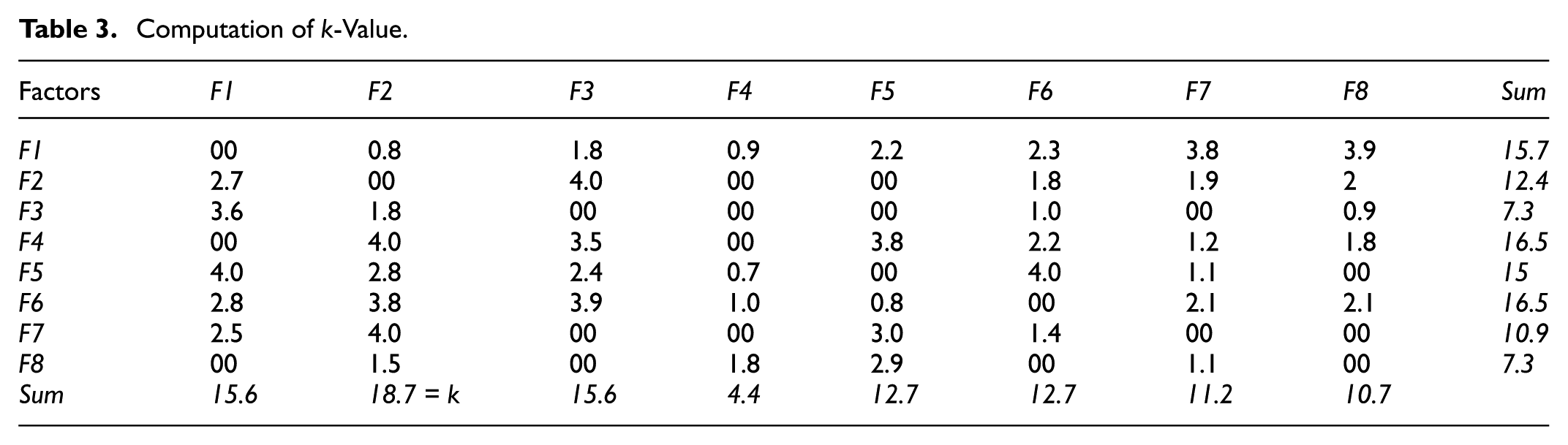
To normalize the direct-relation matrix, the sum of all elements in each row and each column is first computed. The maximum value among these row and column sums is identified and denoted as “k”s. The following equation is followed to compute k.

As a results, the largest value (k) amongst rows and column sums belongs to column F2 which is 18.7 (=k), as shown in Table 3.
Computation of k-Value.
To further normalize each element of the direct-relation matrix is required to divided by the k value.

This process is applied to all elements in the matrix, resulting in the following Normalized Direct-Relation Matrix, as shown in Table 4.
Normalized Direct-Relation Matrix.

This normalized matrix N will be used for further analysis, such as calculating the Total-Relation Matrix and determining the relationships between the factors.
Step 3: Total Relation Matrix (T)
Once we have the Normalized Direct-Relation Matrix (N), the next step is to calculate the Total-Relation Matrix (T). This matrix includes both direct and indirect Relations between the factors, capturing the entire range of interactions within the system.
The T value is calculated using the following formula:

Where:
T is the Total-Relation Matrix,
N is the Normalized Direct-Relation Matrix,
I is the identity matrix of the same dimension as N
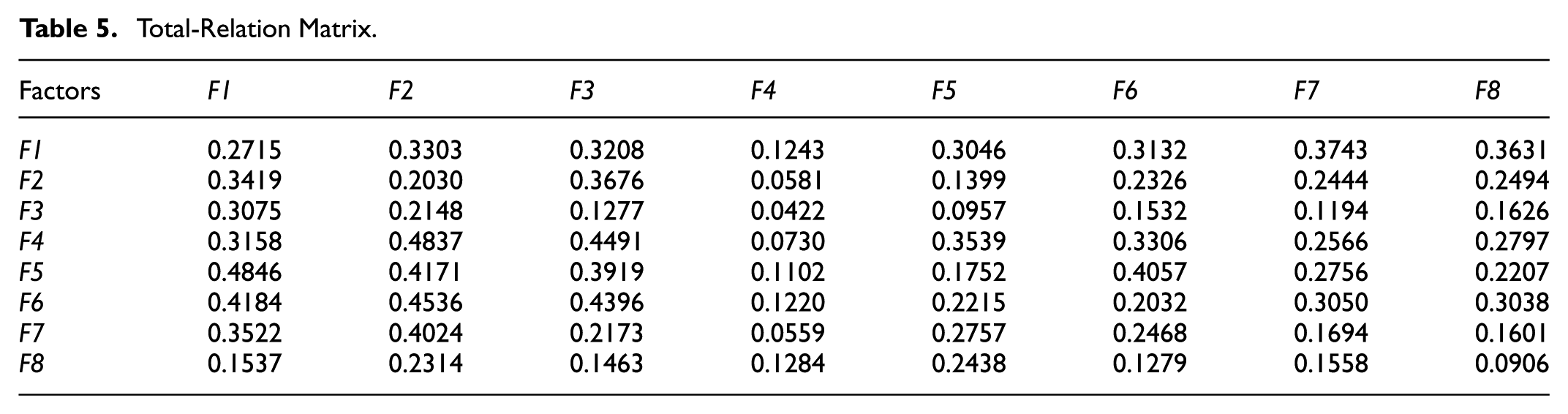
The formula ensures that both direct and indirect Relations are considered. The term (1 – N)−1 captures the indirect Relations that each factor has on others through intermediary factors. By multiplying N with this term, we account for all levels of Relation in the system, making the total Relation more comprehensive. Table 5 presents the Total Relation Matrix.
Total-Relation Matrix.
Setting the Threshold Value
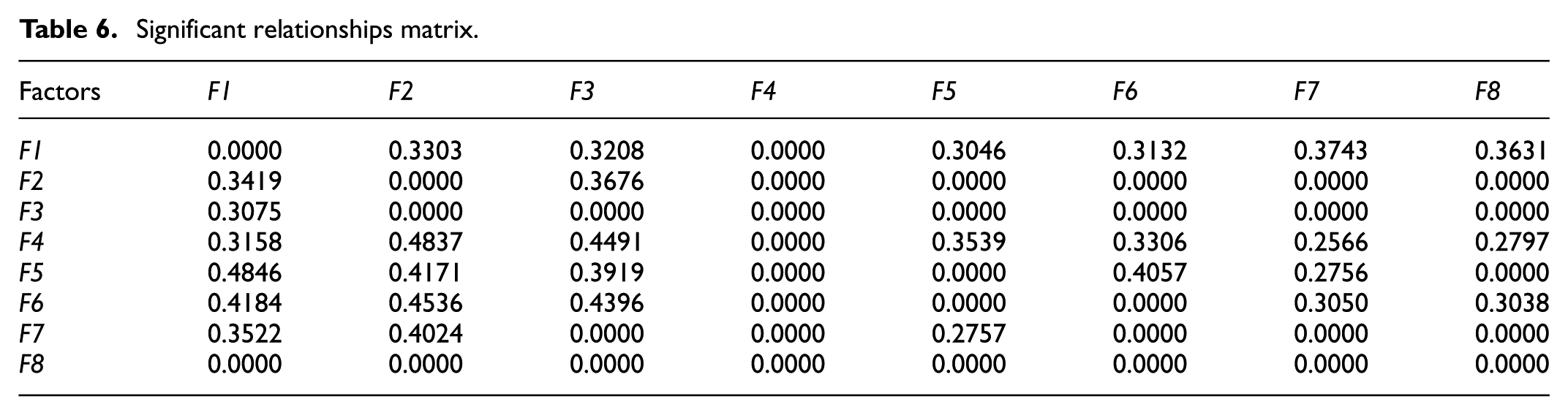
To derive the internal relations matrix, it is necessary to establish a threshold value. This process enables the elimination of minor or insignificant interactions, thereby allowing the construction of the Network Relationship Map (NRM). Only those relationships in matrix T (Table 4) that exceed the threshold value are retained for visualization in the NRM. The threshold value is determined by computing the average of all elements in matrix T. Once this intensity level is established, any value in matrix T falling below the threshold is set to zero, indicating that the corresponding causal relationship is disregarded. In the present study, the computed threshold value is 0.252. Consequently, all values in Table 5 less than 0.252 are eliminated, and only the significant causal links are retained. The resulting model of meaningful relationships is summarized in the Table 6.
Significant relationships matrix.
Step 4: Net Cause and Effect Computation
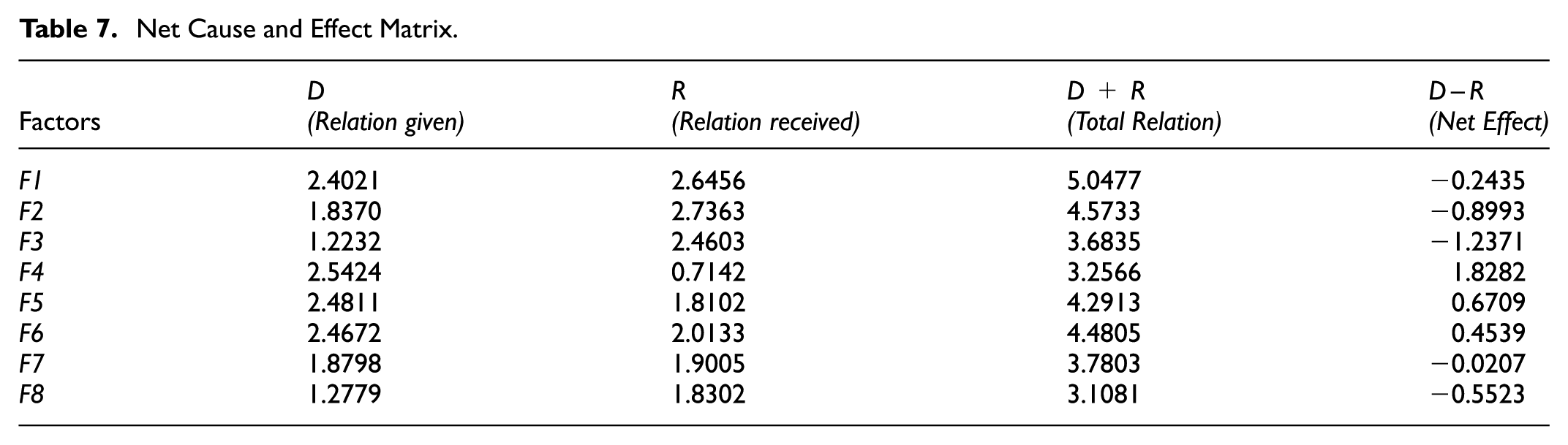
The subsequent step requires to calculate the sum of each row and each column of the T value (as shown in step 3). The sum of rows (D) and columns (R) can be calculated as follows:


Next, the values of D + R and D − R can be calculated by D and R, where D + R represent the degree of importance of factor i in the entire system and D − R represent net effects that factor i contributes to the system. Table 7 shows the net cause and effect matrix.
Net Cause and Effect Matrix.
The Figure 4 illustrates the model of significant relationships among the criteria. This model is visually represented using a coordinate diagram, where the horizontal axis corresponds to the values of D + R, indicating the prominence or overall involvement of a factor within the system. The vertical axis represents D − R, reflecting the net effect or causal role of each factor. The relative position and interaction of each criterion are plotted using their respective coordinates (D + R, D − R), enabling a clear interpretation of their influence and dependence within the network structure. Figure 4 shows the net cause-effects results plotted in the graph.

Net cause-effect results.
Network Relationship Map (NRP)
DEMATEL-based network relationship map (NRP) refers to the network relationship map (NRM) derived from the total-relation matrix, in which each factor is represented as a node and each influence that exceeds the threshold is represented as a directed edge. This network visualizes both the strength and direction of causal links identified through DEMATEL, thereby translating the numerical results into an interpretable relational graph.
The NRP analysis revealed varying levels of influence and susceptibility among the factors, with Trust (F4), Innovation Culture (F5), and Organizational Learning (F6) emerging as significant drivers. These factors demonstrated a net positive effect, indicating their roles in actively shaping the collaborative innovation landscape. Particularly, Trust (F4) showed the highest causative impact, underscoring its fundamental role in facilitating open communication and reliable partnerships which are essential for collaborative innovation. Conversely, factors such as Knowledge Creation and Acquisition (F2) and Technological Learning (F3) were predominantly influenced by other variables, as indicated by their strongly negative net effects. This suggests that while these factors are crucial to the innovation process, they are largely outcomes of the influence exerted by other factors within the system. Knowledge Creation and Acquisition (F2), for example, serves as a crucial conduit for integrating external insights, yet it is significantly shaped by the surrounding relational and cultural context. The Market Dynamic Environment (F1) and Governance (F8) displayed a more balanced role with slight tendencies toward being outcomes, reflecting their susceptibility to external influences and regulatory frameworks respectively. This highlights their responsive nature to the overarching strategic direction and external market forces, which can either enable or constrain innovative activities, as shown in figure above. Innovation Capabilities (F7), with its near-zero net effect, occupies a pivotal position within the framework, acting almost equally as a driver and an outcome. This indicates a critical balancing act, where innovation capabilities not only draw from other factors such as organizational learning and culture but also contribute back to enhancing these elements. The Figure 5 shows Network Relationship Map (NRP) that depicts the inter-dependencies of above factors.

Network relationship map (NAP).
Discussion
This study set out to clarify how the critical factors identified in this study interact to shape collaborative and open innovation. By applying the DEMATEL method to expert data from European and UK networks, we revealed both the prominence and the causal direction of those factors. The discussion below positions each result against the latest scholarship, drawing out areas of agreement, extension, or contradiction.
Relational Drivers: Trust, Innovation Culture and Organizational Learning
Trust (F4) emerged as the strongest causal factor—a pattern echoed in a recent meta-analysis of 76 R&D alliances, which shows trust explaining up to 42% of variance in alliance performance (Steinle, Schiele, & Ellis, 2023). Sector-specific studies in biopharma (Camps-Ortueta & Wynstra, 2022; Zhou et al., 2024) likewise find that high-trust dyads file more joint patents. Our results extend these works by demonstrating that trust does not merely co-exist with other drivers; it systematically activates innovation culture and organizational learning, amplifying their downstream effects.
Innovation culture (F5) and organizational learning (F6) also occupy the causal quadrant. Recent multi-country surveys indicate that firms with experimentation-friendly climates cut idea-to-launch time by 27% (Gassmann et al., 2024). Longitudinal evidence from German SMEs shows that a balanced exploitative–exploratory learning orientation predicts collaborative revenue growth (Fischer, Lüttgens, & Heidenreich, 2023; Pandita, 2022). Our path coefficients (0.31–0.44) support these findings, confirming that culture and learning are not isolated enablers but mutually reinforcing mechanisms that intensify knowledge absorption.
Knowledge & Learning Outcomes: Knowledge Acquisition and Technological Learning
Knowledge creation and acquisition (F2) and technological learning (F3) occupy the receiver quadrant, indicating they are primarily outcomes of prior relational quality. Bibliometric work by Bogers et al. (2023) similarly classifies absorptive capacity as a second-order capability triggered by collaboration depth. Our DEMATEL net scores show that the influence flowing from trust, culture and learning to these two variables (average = .38) far exceeds feedback loops in the opposite direction (≤.12). This aligns with process models that locate learning benefits at later stages of alliance maturation (Bresciani et al., 2022). Digital-operations research further stresses the role of data-driven learning loops—digital twins, AI-enabled simulation—in turning tacit partner insights into codified know-how (O’Reilly & Wang, 2024). Our expert panel echoed this view when rating “shared digital platforms” as critical for absorbing partner knowledge, suggesting that socio-relational and techno-digital mechanisms now act in tandem.
Contextual Balancers: Market Dynamics and Governance
Market dynamics (F1) and governance (F8) sit on the bisector line of our cause–effect map, reflecting a dual role as both influencers and outcomes. Contingency research shows that alliance governance must co-evolve with environmental turbulence to sustain value creation (Benner & Tushman, 2015). A large-sample analysis of EU Horizon 2020 consortia found that adaptive IP clauses buffer the negative impact of market volatility on innovation outputs (Hagedoorn & Lau, 2022). Our findings complement this by revealing strong ties (>0.28) between governance, trust and culture, corroborating the dual-governance thesis that formal contracts and relational norms reinforce—rather than substitute—each other (Poppo & Zenger, 2021).
Integrative Capability: Innovation Capability as a Hinge Factor
Finally, innovation capabilities (F7) display near-zero net effect, receiving almost as much influence as they deliver. Dynamic-capability theory similarly frames innovation capability as both a stock (embedded routines) and a flow (ongoing reconfiguration) (Teece, 2025). Empirical work with 318 ASEAN manufacturers shows that innovation capability mediates the effect of collaborative breadth on radical-innovation output (Nguyen et al., 2024). Our map confirms this mediating role: once relational and cultural foundations are laid, innovation capability becomes the conduit that converts knowledge gains into market offerings.
Synthesis and Contribution
Reinforcement of relational primacy: Trust not only matters—it conditions every other factor’s efficacy.
Learning as dependent variable: Knowledge and technological learning materialize after relational pre-conditions are met, supporting a temporal view of absorptive capacity.
Governance–environment fit: Adaptive contractual mechanisms help alliances thrive under market turbulence, echoing recent EU consortia evidence.
Dual role of innovation capability: It acts both as repository of past experience and lever for future recombination, bridging earlier static and emergent perspectives.
Implications of Study
Theoretical
The findings of this study contribute significantly to the theoretical discourse on collaborative innovation by deepening the understanding of the interrelationships between key factors that drive innovation processes within organizations. Through the application of the Decision-Making Trial and Evaluation Laboratory (DEMATEL) technique, the study sheds light on the causal structure of innovation factors, a critical aspect that has been underexplored in prior research. This methodological approach allows for the transformation of qualitative judgments into quantifiable models, offering a clearer picture of how certain factors influence others. The results contribute to innovation theory by positioning Trust, Innovation Culture, and Organizational Learning as primary drivers of collaborative innovation. These findings align with and extend previous research on the role of trust and organizational culture in fostering successful innovation (Lewicki et al., 1998; McEvily et al., 2003), offering a more nuanced understanding of their importance in the context of collaboration.
From a theoretical perspective, Trust emerged as the most influential factor, reinforcing the extensive body of literature that emphasizes its fundamental role in both inter-organizational and intra-organizational innovation (Dirks & Ferrin, 2001; Ring & Van de Ven, 1994). Trust facilitates open communication, reduces the risks associated with opportunistic behavior, and promotes the exchange of knowledge—all of which are crucial for collaborative innovation (Zaheer et al., 1998). The finding that trust holds the highest causative impact supports the notion that trust is not only an outcome of successful collaboration but also a key enabler that drives innovation processes by creating a cooperative environment (Rousseau et al., 1998). This study thus adds to the growing understanding of trust as a central element in innovation theory, particularly in complex, interdependent collaborative networks where innovation is co-created (Foss et al., 2016).
The prominence of Innovation Culture and Organizational Learning as drivers of collaborative innovation also has important theoretical implications. Prior research has underscored the role of an organization’s culture in fostering innovation by creating an environment that encourages experimentation, creativity, and risk-taking (Shahzad et al., 2024; Skerlavaj et al., 2010). The results of this study further corroborate these findings, showing that innovation culture not only promotes individual creativity but also enhances the collective ability to collaborate and innovate effectively. This extends the work of Schein (2010), who argued that organizational culture can be a strategic asset that supports innovation, by providing empirical evidence that culture plays a causal role in shaping collaborative innovation processes.
Organizational Learning, another significant driver identified in this study, has long been regarded as essential for innovation, as it enables organizations to learn from past experiences and adapt to changing environments (Argote & Miron-Spektor, 2011). This study supports the theoretical assertion that learning is central to innovation but goes a step further by showing that organizational learning actively drives collaborative innovation. The findings suggest that organizations with strong learning capabilities are better positioned to engage in effective collaboration, as they can integrate new knowledge and insights gained from external partners into their innovation processes. This aligns with and extends the dynamic capabilities framework, which posits that an organization’s ability to integrate, build, and reconfigure internal and external competences is crucial for sustaining innovation (Teece et al., 1997).
The study also provides new insights into the roles of Knowledge Creation and Acquisition and Technological Learning within the collaborative innovation framework. While these factors have traditionally been viewed as integral to innovation, the findings reveal that they are more influenced by other drivers, such as trust and organizational culture, rather than acting as direct drivers themselves. This nuanced understanding suggests that knowledge creation and technological learning are largely outcomes of a well-functioning collaborative innovation system rather than initial enablers. These findings extend the knowledge-based view of the firm, which asserts that knowledge is the most strategically significant resource (Grant, 1996), by illustrating that knowledge creation in collaborative innovation is contingent on relational and cultural factors. This positions trust and culture as prerequisites for effective knowledge exchange, thereby enriching theoretical models that link knowledge management and innovation (Nonaka et al., 2000).
Finally, the study’s findings regarding Market Dynamics and Governance have important theoretical implications for understanding how external factors shape collaborative innovation. The role of market dynamics, which include competitive pressures and technological advancements, has been well-documented in the literature on innovation (Teece, 2010). This study builds on these insights by showing that market dynamics play a dual role—they are influenced by other factors within the organization but also act as external drivers of innovation. This aligns with contingency theory, which posits that organizational outcomes are influenced by the external environment and that firms must adapt to market conditions to remain competitive (Lawrence & Lorsch, 1967). The finding that governance structures play a balancing role between enabling and regulating collaboration extends theories of network governance, which argue that governance mechanisms are essential for coordinating complex innovation networks (Provan & Kenis, 2008). These findings suggest that governance not only facilitates collaboration but also moderates the relationships between other innovation drivers, providing a new theoretical lens through which to view the role of governance in collaborative innovation.
Practical
The findings of this study offer valuable practical insights for organizations seeking to enhance their collaborative innovation capabilities. The identification of Trust (F4), Innovation Culture (F5), and Organizational Learning (F6) as key drivers of collaborative innovation provides clear guidance for practitioners on where to focus their efforts to improve innovation outcomes. Specifically, organizations should prioritize the development of trust-based relationships, both internally and externally, to create an environment conducive to open communication and collaboration. Building trust between teams, departments, and external partners can facilitate the free flow of ideas and reduce the uncertainties often associated with collaborative ventures. Practitioners can foster trust through transparent communication, reliable commitments, and establishing long-term relationships with partners (Lewicki et al., 1998). Trust-building measures, such as joint goal setting, shared ownership of innovation projects, and clear governance structures, should be embedded into organizational processes to support sustained collaboration.
Innovation Culture (F5) also emerged as a significant enabler of collaborative innovation, suggesting that organizations should cultivate a culture that supports creativity, risk-taking, and experimentation. Practical steps to achieve this include implementing policies that reward innovative thinking, encouraging cross-functional collaboration, and providing employees with the resources and autonomy needed to experiment with new ideas (Martins & Terblanche, 2003). Leadership also plays a critical role in setting the tone for an innovation-driven culture; hence, leaders must actively champion and model innovative behaviors to inspire their teams. Training programs that focus on developing a mindset oriented toward innovation and collaboration can be introduced to help employees at all levels contribute effectively to innovation initiatives.
The prominence of Organizational Learning (F6) further emphasizes the importance of creating an environment where continuous learning and knowledge sharing are integral to the innovation process. Organizations should focus on creating robust mechanisms for capturing and disseminating knowledge gained from both internal experiences and external collaborations (Argote & Miron-Spektor, 2011). This can be achieved through practices such as after-action reviews, learning workshops, and knowledge management systems that facilitate the retention and application of lessons learned from previous projects. Furthermore, organizations should encourage a feedback culture that allows for constant improvement and adaptation, especially in collaborative settings where learning from partners can provide unique insights and opportunities for innovation.
The study’s findings regarding Knowledge Creation and Acquisition (F2) and Technological Learning (F3) as outcomes of other drivers, such as trust and culture, imply that organizations should focus on creating the right relational and cultural conditions to facilitate knowledge generation and technological advancement. Practically, this means that while acquiring new technologies and knowledge from external sources is critical, these efforts will be more effective if trust-based relationships and a strong culture of innovation are in place. Organizations can achieve this by building strategic alliances with other firms, research institutions, and universities to tap into external knowledge pools, while ensuring that these partnerships are underpinned by mutual trust and aligned goals (Nonaka et al., 2000). Additionally, fostering internal collaborations across departments and teams can enhance the integration of technological learning within the organization.
The balanced roles of Market Dynamics (F1) and Governance (F8) indicate that while external market forces and governance frameworks influence innovation, they are also shaped by other factors within the organization. For practitioners, this highlights the importance of being responsive to external market trends and competitive pressures while maintaining strong governance structures to manage innovation efforts effectively. Organizations should implement flexible governance mechanisms that allow for adaptability to changing market conditions, while ensuring that innovation activities remain aligned with overall strategic objectives (Provan & Kenis, 2008). Furthermore, governance frameworks should be designed to facilitate collaboration across organizational boundaries, ensuring that decision-making processes are transparent, agile, and capable of supporting innovation initiatives.
Finally, Innovation Capabilities (F7), which was found to occupy a central role in balancing both driving and receiving influence, suggests that organizations need to continuously invest in developing their innovation capabilities to sustain their competitive advantage. This includes not only investing in new technologies and skills but also fostering an organizational environment where innovation capabilities can be leveraged to their fullest potential. Practical actions include ongoing training and development programs to enhance employees’ innovation skills, as well as fostering a culture that supports the iterative improvement of innovation processes. By systematically building innovation capabilities, organizations can better respond to external challenges and opportunities, while also contributing to the broader ecosystem of collaborative innovation.
Limitations and Future Research
This study has several limitations that provide opportunities for future research. First, the expert panel was limited to ten experts from Europe and the UK, which may restrict the generalizability of the findings. Future studies could include a broader, more geographically diverse set of experts to compare different regional and industry contexts. Second, the reliance on expert judgment in the DEMATEL technique introduces potential bias, as it is subjective. Future research could employ more objective methods, such as structural equation modeling (SEM) or agent-based simulations, to validate the findings and explore the relationships between innovation factors in larger datasets.
Additionally, this study focused on internal organizational factors, but external influences like government policies and market dynamics were not fully explored. Future research could investigate how these external forces interact with internal drivers of collaborative innovation. Furthermore, this study does not address the dynamic interactions or trade-offs between factors over time. Longitudinal studies could provide insights into how the importance of factors such as trust evolves throughout an innovation project.
Besides, the emerging technologies like artificial intelligence (AI) and blockchain were also not considered, despite their increasing relevance in innovation. Future research could examine how these technologies impact key factors like trust and governance in collaborative networks. Lastly, the study does not explore how the identified factors influence specific innovation outcomes. Future work could link these factors to concrete innovation performance metrics, such as product development speed or market competitiveness.
Footnotes
Appendix
Detailed Factors Identified in Content-Centric Review (2013–2024).

| Yeboah et al. (2023) | Murali et al. (2023) | Mukhtar et al. (2023) | Woide et al. (2023) | Ates (2023) | Yoon & Wang (2023) | Sharma et al. (2023) | Guo et al. (2023) | Alotaibi (2023) | Rodríguez-Gulías et al. (2023) | Pietsch et al. (2023) | Figueiredo et al. (2023) | Liu et al. (2023) | Zainal-Abidin et al. (2023) | Hedelin et al. (2023) | Ma et al. (2023) | Bojan et al. (2022) | Abramo & D’Angelo (2022) | Peng et al. (2022) | Zoppelletto & Orlandi (2022) | Best et al. (2022) | Østergaard & Drejer (2022) | Swart et al. (2022) | Hwang et al. (2022) | Chen et al. (2020) | Aggarwal (2020) | Tseng et al. (2020) | Oguguo et al. (2020) | Cheng & Chang (2020) | Mubarak & Petraite (2020) | |
|---|---|---|---|---|---|---|---|---|---|---|---|---|---|---|---|---|---|---|---|---|---|---|---|---|---|---|---|---|---|---|
| Social capital | Y | Y | ||||||||||||||||||||||||||||
| Trust | Y | Y | Y | Y | Y | Y | Y | |||||||||||||||||||||||
| Innovation culture | Y | Y | Y | Y | Y | |||||||||||||||||||||||||
| Transparency | Y | |||||||||||||||||||||||||||||
| Openness | Y | |||||||||||||||||||||||||||||
| Customer engagement | Y | |||||||||||||||||||||||||||||
| Process innovation | Y | Y | ||||||||||||||||||||||||||||
| Product innovation | Y | |||||||||||||||||||||||||||||
| Learning | Y | Y | Y | Y | Y | Y | Y | Y | Y | Y | Y | Y | ||||||||||||||||||
| Value co-creation | Y | Y | ||||||||||||||||||||||||||||
| Co-coproduction | Y | |||||||||||||||||||||||||||||
| Inter-dependence | Y | |||||||||||||||||||||||||||||
| Information exchange | Y | Y | Y | |||||||||||||||||||||||||||
| Uncertainty | Y | Y | Y | |||||||||||||||||||||||||||
| Strategic orientation | Y | Y | ||||||||||||||||||||||||||||
| Technology adoption | Y | Y | Y | |||||||||||||||||||||||||||
| Market dynamic environment | Y | Y | ||||||||||||||||||||||||||||
| Knowledge creation and acquisition | Y | Y | Y | Y | Y | Y | ||||||||||||||||||||||||
| Technological learning | Y | Y | Y | |||||||||||||||||||||||||||
| Improving innovation output | Y | Y | Y | |||||||||||||||||||||||||||
| Innovation capabilities | Y | Y | Y | Y | Y | Y | ||||||||||||||||||||||||
| Assets acquisition/Exchange | Y | |||||||||||||||||||||||||||||
| Governance | Y | Y | Y | |||||||||||||||||||||||||||
| Leadership | Y | Y | ||||||||||||||||||||||||||||
| Shared vision | Y | |||||||||||||||||||||||||||||
| Risk management | Y | |||||||||||||||||||||||||||||
| Digital transformation | Y | Y | Y | |||||||||||||||||||||||||||
| Absorptive capacity | Y | Y | ||||||||||||||||||||||||||||
| Human capital | Y | |||||||||||||||||||||||||||||
| Technology orientation | Y | |||||||||||||||||||||||||||||
| Helm et al. (2020) | Arzubiaga et al. (2019) | Li et al. (2019) | Moaniba et al. (2019) | Zaborek & Mazur (2019) | Saunila et al. (2018) | Mehralian et al. (2019) | Mitze & Strotebeck (2019) | Franklin & Marshall (2019) | Chakraborty (2019) | Muriithi et al. (2018) | Fernández-Olmos (2017) | Kosalge (2017) | Necoechea et al. (2017) | Cerulli et al. (2016) | Heirati et al. (2016) | Guan et al. (2016) | Senghore et al. (2015) | Axelson & Richtnér (2015) | Un & Asakawa (2015) | Franco & Gussoni (2014) | Enkel & Heil (2014) | |||||||||
| Social capital | Y | Y | ||||||||||||||||||||||||||||
| Trust | Y | Y | ||||||||||||||||||||||||||||
| Innovation culture | Y | |||||||||||||||||||||||||||||
| Process innovation | Y | Y | ||||||||||||||||||||||||||||
| Product innovation | Y | Y | ||||||||||||||||||||||||||||
| Learning | Y | Y | Y | |||||||||||||||||||||||||||
| Technology adoption | Y | |||||||||||||||||||||||||||||
| Market dynamic environment | Y | Y | Y | Y | ||||||||||||||||||||||||||
| Knowledge creation and acquisition | Y | Y | Y | |||||||||||||||||||||||||||
| Technological learning | Y | Y | Y | |||||||||||||||||||||||||||
| Innovation capabilities | Y | y | ||||||||||||||||||||||||||||
| Assets acquisition/Exchange | Y | Y | Y | |||||||||||||||||||||||||||
| Governance | Y | Y | Y | |||||||||||||||||||||||||||
| Risk management | Y | Y | Y | |||||||||||||||||||||||||||
| Digital transformation | Y | |||||||||||||||||||||||||||||
| Absorptive capacity | Y | Y | ||||||||||||||||||||||||||||
| Human capital | Y | |||||||||||||||||||||||||||||
| Technology orientation | Y | Y | Y | |||||||||||||||||||||||||||
| Cost reduction | Y | Y | Y | |||||||||||||||||||||||||||
| Consumer engagement | Y | Y | Y | Y | ||||||||||||||||||||||||||
| Network structure | Y | Y | Y | Y | ||||||||||||||||||||||||||
| Supplier collaboration | Y | Y | ||||||||||||||||||||||||||||
Acknowledgements
During the preparation of manuscript authors used ChatGPT and Grammarly to proofread some parts of manuscript. After using these tools, authors reviewed and edited the content as needed and take full responsibility for the content of publication.

Author Contributions
Muhammad Faraz Mubarak contributed to paper Ideation, literature review, methodology, analysis, discussion, and overall paper framing. Giedrius Jucevicius contributed to Ideation, discussion, and writing of original draft. Richard Evans contributed to Ideation, discussion, analysis, and writing of draft. Monika Petraite contributed to ideation, analysis, writing and review of manuscript. Masood Fathi contributed to data curation, methodology, data analysis, discussion and results.
Funding
The authors disclosed receipt of the following financial support for the research, authorship, and/or publication of this article: The study is funded by the Lithuanian Research Council (LMT) under project grant number P-PD-23-118. In addition, the study is based on work funded by Natural Sciences and Engineering Research Council (NSERC) of Canada under grant number RGPIN-2022-05008.
Declaration of Conflicting Interests
The authors declared no potential conflicts of interest with respect to the research, authorship, and/or publication of this article.
Data Availability Statement
Confidential and not available.