




Abstract
Makerspaces are a relatively new phenomenon that seem to create an innovative environment for individuals to work on projects and learn about technology. This article presents a grounded theory study, which investigates the impact that makerspaces have on innovation. Strauss and Corbin’s grounded theory methodology is used to research this exploratory topic. The data sample consists of 16 interviews of members of a makerspace in Shanghai, China. Data analysis was conducted abiding by Strauss and Corbin’s coding framework, entailing open coding, axial coding, and selective coding as well as coding tools, such as the coding paradigm and the conditional matrix. Collaborative learning was identified as the core phenomenon of this research, and The Collaborative Learning and its Outcomes Theory was created. The emergent theory contributes to the understanding of how makerspaces impact outcomes, such as innovation and venture creation, as well as explain how collaborative learning in conjunction with other modes of learning can facilitate learning at various complexities. As such, this study’s contributions are in developing the theoretical understanding of makerspaces as well as collaborative learning. It offers managerial and pedagogical implications that can help create learning environments where collaborative learning is fostered.
Introduction
A makerspace is a place where individuals with an interest in technology come together to work on projects while sharing ideas, equipment, and knowledge (Oxford University Press [OUP], 2020). Although there has been large public sector interest in makerspaces and strong confidence in their value to the innovation ecosystem, little academic research has been undertaken on the matter. A search for the umbrella term “makerspace” on Google Scholar (2020) only resulted in 13,200 total results (2020). The little knowledge there is on makerspaces shows that individuals within these spaces work with a range of tools, materials, and processes. Makers work together on projects and often take on a form of leadership or teaching role while sharing their projects (Sheridan et al., 2014). As such, an integral part of a makerspace seems to be the ethos of building technology together. Members within makerspaces embrace the do-it-yourself spirit by building and learning together (Singh, 2018). It seems apparent that makerspaces aid in the innovation process somehow, but there is a lack of theoretical explanation for how they do so and what underlying mechanisms are at play. As such, this research is an exploratory dive into the mechanisms of the makerspace. It is exploratory in nature, as there is a clear lack of preexisting theoretical knowledge.
The phenomenon of makerspaces has started gaining worldwide traction, and makerspaces are being opened all around the world (Dougherty, 2013). The makers embrace an attitude and belief that they can shape and create their own jobs and industries, aligning to the industries they are interested in (Barseghian, 2010). Structurally, makerspaces have been found to be comparable to a studio art learning environment, as makers are able to work with a multitude of tools and materials while working together with other members of the community (Sheridan et al., 2014). Furthermore, makerspaces often host events called hackathons, where people come together and work together on a given project (Briscoe & Mulligan, 2014). Dougherty believes that institutions should look to the maker movement to understand how to create a truly innovative economy with an ecosystem full of talent, connections, and learning (Dougherty, 2012). Hence, most current theory acknowledges the positive effects that makerspaces seem to have. One study states that while many of these positive benefits may exist, they may also be overexaggerated, and at the same time, some makerspaces may be causing lower economic efficiencies due to resource inefficiencies and personal manufacturing (Smith et al., 2016).
User Innovation
Many individuals at makerspaces can be defined as users because they join the makerspace as individuals without commercial affiliation and not as entrepreneurs and/or firms. The difference between users and manufacturers is that a manufacturer benefits from selling a product or service, while a user benefits from using a product or service (Von Hippel, 2005). Hence, although some members of a makerspace may classify as manufacturers, others classify as users. It is important to consider the incentives of user innovation. Users may at times expect a higher economic reward from innovating than actual manufacturers do. This applies particularly to firms as users, as they may be able to innovate a piece of machinery that may help them bring a new product line to market quicker. In the case of the individual user, it seems that intrinsic motivators such as an interest or passion for innovating can often be the driver for innovation (Thomke & Von Hippel, 2002). Furthermore, user innovation seems to be particularly applicable when the access of “sticky information” is necessary. “Sticky information” is information that is difficult and expensive to access (Von Hippel, 1994). As such, the location of “sticky information” affects the locus of innovation (Ogawa, 1998), and innovation new in function seems to be more likely developed by users than manufacturers (Riggs & Von Hippel, 1994). Consequently, it seems plausible that there will be an increasing paradigm shift, with an increasing amount of innovation stemming from users through open collaboration (Baldwin & Von Hippel, 2011).
Open Innovation
Open innovation evolves around using a combination of internal and external ideas, and internal and external paths to market, to innovate (Chesbrough, 2003, p. 2). As such, open innovation seems to be a practice that may be observable in a makerspace. Furthermore, open innovation is a practice that has been gaining popularity among large companies, with many of them using the practice at increasing rates after initially trying it (Chesbrough & Brunswicker, 2014). In addition, open innovation seems to be cheaper and more feasible for firms to use since the widespread use of the internet, as firms can reach consumers cheaply and effectively (Billington & Davidson, 2013). It seems to be particularly relevant for small and medium-sized enterprises, as they are often faced with tighter financial limitations (Spithoven et al., 2013). Firms seem to particularly benefit from open innovation when they reach their internal research capacity, as they can rely on external knowledge (Salge et al., 2012).
Research Questions
The research aim of this study was to get a better understanding of how makerspaces impact innovation within the Information and Communications Industry (ICT). Prior to this study, there was a lack of theoretical understanding as to how makerspaces and their underlying processes shape the innovation process. To address the above-mentioned research aims of exploring the impact makerspaces have on innovation, the general research question was as follows:
How do makerspaces impact innovation within the ICT Industry?
This general research question can further be broken down into four more fragmented research questions:
Method
This study used a grounded theory methodology. This qualitative methodology was applicable due to the exploratory nature of this research inquiry. Grounded theory was first formulated by Glaser and Strauss (1967) as an alternative to already existing qualitative research methods. It is an open approach that allows for the inductive generation of theory through a systematic analysis of the data obtained. A key aspect of grounded theory is the belief that at the early stages of research, a researcher should solely focus on the initial gathering of data instead of collecting all data at once. Since 1967, grounded theory has developed into different streams. The grounded theory stream chosen for this research was the stream developed by Strauss and Corbin (1990) for three reasons. First, they align themselves with symbolic interactionism philosophically and believe that the researcher has an active role within the data gathering stage. Second, Strauss and Corbin believe in the use of a literature review within the grounded theory to enrich the research. Third, Strauss and Corbin arguably created the most sophisticated coding framework. Their three-step coding process of open coding, axial coding, and selective coding is supplemented by the creation of data analysis tools, such as the coding paradigm and the conditional matrix (Strauss & Corbin, 1990).
Sample
A single case study was used in conjunction with grounded theory methodology. The case study used is that of one of the oldest makerspaces in Shanghai, China. The makerspace featured in this research has reached substantial popularity with more than 150 active members. This makerspace was deemed as a suitable case study subject, as it has a variety of ongoing projects, a large community base, and members actively working together. Hence, picking this case study allowed for potentially rich data extraction.
Data Collection
A total of 16 participants were interviewed in this study. All of these 16 participants were members of the same makerspace, which included 13 male members and 3 female members. The sample is therefore to be considered somewhat homogeneous and geographically narrow. The data were collected using semi-structured interviews. Each of these interviews was conducted via the smartphone application WeChat. The conversations were recorded and transcribed according to the interviewees’ permission. Recording the interviews enabled the researcher to use analytical memo writing techniques during the interviews to make field notes on the interviewees’ descriptions and emotions during the interviews. Theoretical and discriminative sampling techniques were used, as they are particularly suitable for a grounded theory methodology. A discriminative sampling technique becomes useful in the later stages of a grounded theory inquiry, as it helps the researcher direct the research toward demographics that may give the inquiry additional insight.
Data Analysis
The data were analyzed using the coding framework designed by Strauss and Corbin (1990). As this coding process entails three coding stages, it is important to note that these coding stages are not entirely sequential. The researcher is encouraged to move back and forth between coding stages using a technique known as constant comparative analysis. As a researcher is collecting data, he is also constantly comparing these new data with codes, categories, and relationships (Glaser & Holton, 2004). This process is aided by the use of memos. Memos are written notes that record the researcher’s thoughts and ideas about the ongoing research process, which help in moving from a purely descriptive path to an increasingly abstract territory (Bryant & Charmaz, 2019). The constant comparison technique is combined with theoretical sampling, in which the researcher continuously identifies additional areas to research on until he reaches theoretical saturation (Strauss & Corbin, 1990). In the case of theory building, Strauss and Corbin (1998) consider theoretical saturation to be sufficient when relationships between concepts are portrayed in a successful manner. In this case, theoretical saturation was deemed to be reached after 16 interviews as the emergent theory was sufficiently understood and no new data emerged.
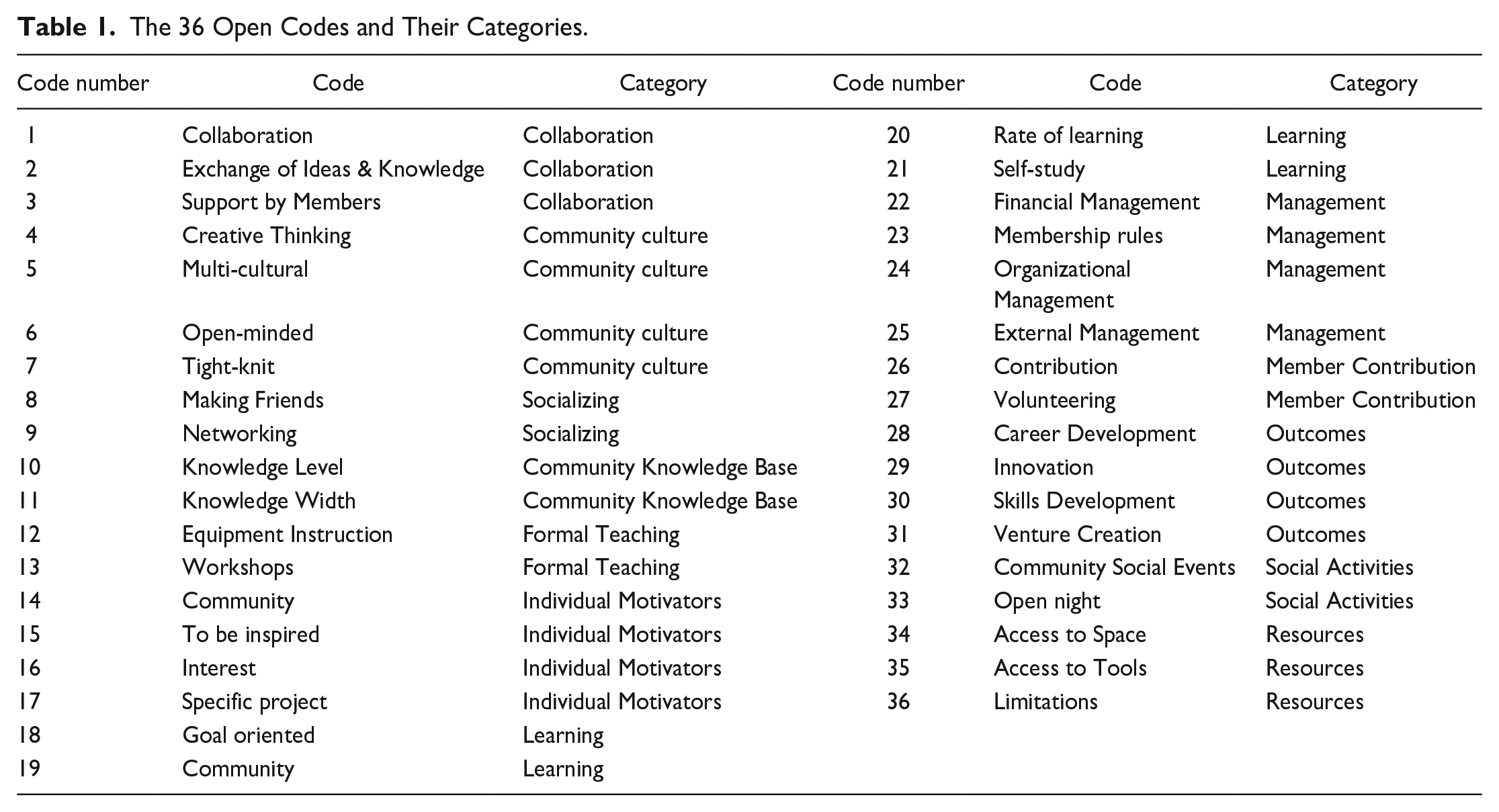
In the first stage, the open coding stage, the researcher is encouraged to disassemble the data to code it effectively (Strauss, 1987). A suitable strategy for this is line-by-line coding, in which the researcher codes every line of a coding document (Strauss & Corbin, 1990). Line-by-line coding was used for the first three interviews to focus on the data and force the researcher to ignore initial preconceived ideas. The goal of the open-coding stage is to group the codes into data. In this case, after the completion of all coding, and assessing codes for saturation and redundancies, 36 open codes were identified. These 36 codes were organized into 12 open categories and are depicted in Table 1. Open categories are categories that stem from the data, and each of these categories is explanatory in nature. Each category is to give minor answers on what is occurring and what is observable through the research (Strauss & Corbin, 1990).
The 36 Open Codes and Their Categories.
Axial coding is the second step of the coding process, where relationships among concepts and categories are to be found (Strauss & Corbin, 1998). Within Strauss and Corbin’s approach to grounded theory, this is done by using the coding paradigm model to analyze categories upon categories, putting them into a relationship model (Strauss, 1987). The coding paradigm was used and is shown in Figure 1. The coding paradigm consists of identifying a central phenomenon and relating causal conditions, context, intervening conditions, strategies, and consequences to it. The central phenomenon is the main theme of the research; it is what binds all of the research together. All other factors within this paradigm model are linked in a way to this central phenomenon, creating a big picture of the relationships of all categories included (Strauss & Corbin, 1990).

The coding paradigm adopted from Strauss and Corbin (1990).
In the selective coding phase, the researcher retrieves a core category and selects codes that work in relation to it (Strauss, 1987). Hence, the purpose is to choose the core category and relate it to other categories previously created. As the whole coding process is dynamic and concurrent, the researcher is to begin with selective coding early on, yet as the research process continues, this stage becomes increasingly important. In this case, the phenomenon within the axial coding stage had been described as learning in a collaborative environment, and using Strauss and Corbin’s advice to use existing literature during the data analysis phase enabled connecting this phenomenon to the concept of collaborative learning. Thus, collaborative learning was identified to be the core category connecting all other categories of the research, and as a result, an emergent theory was built.
Ethics
The researcher followed all necessary ethical steps to ensure ethical adherence according to the rules and regulations. Furthermore, participants gave their written and verbal consent to be part of this study and were assured that this research was only to be used for academic purposes. All identities of individual participants as well as the case study are anonymized to protect individual identities.
Findings
The emergent theory, The collaborative learning and its outcomes, describes how collaborative learning in a makerspace facilitates knowledge acquisition among its members and leads to the outcomes of skill development, venture creation, and innovation. To present these findings, first the core category collaborative learning is explained. This gives insight into the experiences of individuals and their interactions as well as how a makerspace impacts the knowledge of individuals. Second, the main categories in relation to the core category collaborative learning are explained. This illustrates how various factors work together to create an environment where collaborative learning is fostered. Finally, the emergent theory, The collaborative learning and its outcomes, is presented to place collaborative learning into context. This theory offers an explanation as to how makerspaces impact innovation within high tech industries, as it shows how the process of collaborative learning leads to the outcomes skill development, venture creation, and innovation.
Core Category
The core category identified within this grounded theory was collaborative learning. Collaborative learning occurs when two or more individuals come together to learn something (Dillenbourg, 1999). Although there does not yet seem to be an exact definition for collaborative learning, it seems clear that it is an umbrella term for a variety of educational approaches and that it at least partially relies on informal learning processes (Laal & Laal, 2012). This core category originated from the initial code Learning by community and was coined Collaborative learning after reviewing existing literature. Strauss and Corbin (1990) recommend comparing the existing literature to research findings, to enrich the research, enabling the emergent theory to be coined collaborative learning.
Collaborative learning is the core category of this grounded theory as it both appears heavily in the data and is strongly connected to other categories. Figure 2 shows the collaborative learning as the central phenomenon. One interviewee describes this process by stating “a lot of people are learning and teaching each other different skills and exchange skills” (r13). This explains how individuals in the makerspace interact with each other. Another respondent describes the benefits of this process by stating “Sometimes I can look something up on Google spending two or three hours, or they could just help you in a few minutes” (r12). Here it is observable that collaborative learning accelerates the rate of learning, illustrating the impact that collaborative learning has on the knowledge of the members at the space. This collaborative learning process seems heavily engrained in the makerspace, as another member describes how a peer helped him overcome a major issue in his project: I couldn’t get an LED light to work, it just wouldn’t work, and one guy was watching me and came over and asked if I had tried taking it apart. . . So we took it apart, and found that one wire was simply turned the wrong way. So I put it back together, and then it worked fine (r1).
Thus, it is clear that the process of collaborative learning is central in impacting knowledge and that this occurs by members interacting and engaging in collaborative learning activities.

The core category in relation to the four main categories.
A key observation was that collaborative learning was usually combined with two other learning strategies, formal learning and self-learning. When collaborative learning was combined with one or both of these learning strategies, several interviewees described learning at a quicker rate. For instance, one respondent stated, “I think it’s [learning] definitely goes faster than if I had to figure it out by myself” (r12). Thus, the community acts as a support for assisting both self-learning and formal learning, and collaborative learning has a supportive function in the learning process. Figure 3 shows the three major modes of learning interacting with each other, which shows the importance of collaborative learning. It was observed to be pivotal in shaping knowledge and learning. As is visible, there are four different combinations of learning occurring, with three of these combinations including collaborative learning, which are regions 1, 2, and 3. Region 0 is the only combination that does not include collaborative learning and was coined “Outsider” learning. This type of learning is done by nonmembers that simply visit the makerspace for a single workshop under the premise that they do not interact with community members and engage in collaborative learning. As the makerspace offers various workshops for members and nonmembers, this type of learning does seem to exist yet does not seem to be common. Oftentimes, even nonmembers seem to engage in collaborative learning by engaging in communication with other makers. Hence, the importance of this type of learning is to be considered rather small. Regions 1, 2, and 3, on the other hand, are the regions that give insight into the underlying mechanism of collaborative learning within the makerspace. These three regions show that different combinations of learning techniques correspond to different complexities of learning and demonstrate how individuals develop their knowledge within the makerspace, while collaborative learning remains a constant process throughout.

Interaction between the three major modes of learning.
Region 1: Low-Complexity Learning
Formal learning matched with collaborative learning is adopted for low-complexity learning tasks, such as introductory workshops on equipment and basic technological knowledge. Self-learning is not a factor here, as the individual is not required to self-study to learn due to the low complexity involved. This is the type of learning that a beginner or a novice undertakes when he wants to learn introductory technological topics. One interviewee explains how he has taught several workshops giving basic instruction on how to use the equipment. This is of key importance as he states that “a lot of people learn a lot of basic skills there” (r15). Furthermore, collaborative learning is used in combination with formal teaching to help members bridge gaps in knowledge. One interviewee addresses this by describing her experience during an introductory workshop I felt a little far behind and that made me a little bit stressed, but people there were just helping me out. I think some were also beginners, but everyone helped me out and then I slowly picked up and then it was very good. (r12)
This shows that the help does not only come from more knowledgeable individuals or mentors but also from peers of a similar knowledge level that engage in collaborative learning with each other. Hence, collaborative learning acts as a supporting mechanism in a formal learning environment within makerspaces.
Region 2: Mid-Complexity Learning
When collaborative learning is matched with both formal learning and self-learning, mid-complexity learning occurs. This may be in the form of intermediate or advanced technical workshops. An example of this was a hydroponics workshop that was instructed by one of the interviewees. He described this experience as following, I basically taught them all the basics and then we did a design thinking sort of based process to create their own hydroponic system and you know at the end of these two months, everyone had a system to present that was operational. (r3)
This shows an example of mid-complexity learning in action. A formal teaching approach is used to instruct students, while the community is there to support learners. In addition, learners are required to spend time outside the workshop to study and work on their projects, due to the complexity of the subject. The community is supportive and willing to help at any time, yet it is expected that students are dedicated self-learners. This is illustrated by an interviewee stating, “if you want to do this thing, you know, and you want help, you have to show us that you’ve done some legwork” (r3). Hence, it was found that the combination of these three modes of learning functions efficiently for mid-complexity learning.
Region 3: High-Complexity Learning
High-complexity learning takes place when there is a mixture of self-study and collaborative learning occurring. The lack of formal learning present here is conceivable due to the high level of complexity. There may simply be a lack of formal education available at this level, as there may be a lack of resources available for complex formal education or other limitations. In addition, this type of learning can operate at an expert level, whereby new knowledge development can result in cutting-edge knowledge. An example of collaborative learning at this complexity level is described by a member as he explained how a fellow community member enquired as to why he was not using a higher voltage for his prototype: So someone said why don’t you just put 1,000 volts around the lungs of the belt? And I was like, are you crazy, I’m not going to put, and I don’t want to kill the user. So you got high voltage, it’s going to kill . . . And then that kind of thought process. For this one actually, the guy that was helping me really spend a lot of time, like we spend 4 hours just discussing this hypothesis, this topic, and experimenting. (r9)
It is therefore visible that members sometimes offer advice and ideas randomly while being willing to spend significant time discussing details. It was observed that high-complexity collaborative learning occurs both planned and unplanned, helping makers in their projects and understanding. One respondent describes the importance of collaborative learning in facilitating high-complexity learning, If I had access to a workspace that I could use every day with all the equipment but without the community that wouldn’t have been as useful to me, because it’s having access to that community, to people that can guide you, people that can help you. (r1)
Main Categories
The four main categories that are based on the core category collaborative learning are: (a) community interaction, (b) learning, (c) community capacity, and (d) management. Each category relates to the collaborative learning process and influences it.
Community Interaction
This category encapsulates the dynamics of makerspace members interacting with each other. It is made up of the subcategories’ collaboration, networking, and social events. Overall, there seems to be a high level of community interaction, as one participant points out “if you’re in [the space] you actually talk to people a lot” (P12). A lot of times this community interaction is constructive in nature, as one interviewee comments “they gave us a ton of good advice” (P1). Community members may discuss technical knowledge, projects, or even outside business ventures. For example, one member discussed how community interaction was important for his own business, “We always chat about the strategy, the channels because we both have our own businesses, so a lot of this stuff is very similar” (r10). This constructive interaction gives insight into how members can gain diverse and valuable knowledge from each other.
Furthermore, community interaction is not limited to value-building activities. Members also socialize and make friends with others, even when they are not involved in the same type of projects. One member confirms this by stating “All the people I’ve made friends with, actually have had nothing to do with what I was doing directly” (r3).
Hence, members interact with each other in a variety of ways. Community interaction as a whole seems to be a catalyst for collaborative learning. An increase in community action causes tighter ties among community members, which in turn can contribute to an increase in information sharing and collaborative learning practices. As such, collaborative learning within a makerspace is dependent on a high level of community interaction. One member reiterates the importance of community interaction: Every day you come to [the space] to see people doing things or sitting on their desk, their coding. You just look at their screens, look at their numbers, if something there, it triggers you or something interest you, you then just support, ask your questions. (r2)
Moreover, this case study shows a high level of community interaction both in a subject-relevant manner and socializing manner. Both of these seem to stimulate collaborative learning activities, as they result in a stronger community and more interactions among individuals.
Learning
The category of learning comprised all codes and subcategories relating to individuals and the community as a whole engaging in learning activities. As collaborative learning was the core category of this grounded theory, it is clear that learning is central to the way makerspaces, its community, and its individuals work. In general, members seem to be self-motivated to learn, and the makerspace gives a good opportunity to do so. One interviewee described this, “if you’re self-driven learner and you’re looking for an environment where you can apply what you learned and share it with other people, this is a good environment to do it.“ (r7). Another interviewee elaborated on this by explaining why learning at the makerspace was effective, “You can learn anything you want in [the space], because there’s some experts in any domain. There’s software. There’s hardware. There’s also business and open management. So, for sure, it all depends on the interest” (r10). Therefore, it is apparent that members were both motivated to learn and effective at learning.
Formal learning and self-learning were the two modes of learning identified that were used in combination with collaborative learning. Formal learning was observed in the form of beginner-level equipment workshops as well as more advanced workshops on topics such as computer coding and hydroponics. One interviewee explained, “I took a PCB workshop. I learned about kind of designing your own PCBs for electronics” (r11). These workshops are usually taught by members, as another member illustrated, “I actually spent some time teaching some of the members how to use the particular equipment” (r15). Self-learning was observed in the way of individuals working and learning independently. One member points out the importance of this type of learning, “they’re self-learners, it’s actually that. It’s very self-driven” (R10). Thus, the self-learning culture seems to be engrained in the culture of a makerspace.
Community Capacity
The category community capacity describes the capacity of the community to be able to spread knowledge. The ability to spread knowledge is of key importance when it comes to facilitating collaborative learning. This category is comprised of the subcategories’ community culture and community knowledge base, as both influence the capacity to spread knowledge.
The first subcategory within this category is community culture. Community culture is found to enable the willingness and rate of knowledge sharing among community members. This is because the sense of community at this makerspace seems to be particularly strong. As one member described, “I praise the environment about the community and I believe that’s why most of the members are there” (r4), showing that at times the culture of the community may be the driver for why members continue coming to the makerspace. Another member confirmed the strong sense of community at the space by stating, “I’m part of [the] collective. I have shared ideas, shared values with the people and a shared sense is good or desirable and shared efforts or desire to make it work around those values” (r9). There seems to be a common belief that the makerspace is “something that’s more than just a space” (r7), and this seems to create a tight-knit community. One maker explained his relationships as: a deeper sort of link or bond with rather than like just drinking buddies, it’s more about finding people who have the same philosophy as you, you know, who are willing to learn new things and share things with people. (r3)
This strong sense of community seems to create a culture where idea sharing and creativity are encouraged. Individuals seem to feel empowered and confident in sharing their ideas. One interviewee confirmed this by stating, “You can easily discuss some stuff with them. They are not, all of them are not very narrow-minded. They are open for new ideas, and they are open for new concepts and different approaches” (r15). Thus, this case study illustrates how a strong community culture fosters collaborative learning. In a more abstract manner, it shows how community culture is a determinant for collaborative learning within this type of context.
The second subcategory is the community knowledge base. It was found that the community knowledge base is comprised of community knowledge level and community knowledge width. The community knowledge level was described as high by various interviewees, with one respondent describing it as follows, “a lot of the members have PhDs, have masters, they’re at the stage where they’re so smart, they don’t need to work for big companies” (r10). Furthermore, the overall knowledge width was described as significant, with many respondents describing the multidisciplinary backgrounds of many of the members of the makerspace. One interviewee stated, “You can learn a lot from other people at [the space] as they know many different things and technology” (r16). Hence, it is apparent how the community knowledge base has an impact on the potential for collaborative learning within the community. One interviewee offered an interpretation of the connection between the knowledge base and learning by stating, “there’s a lot of people have good background of education and are willing to share their skills, their bulk views, I think that is a short-cut for beginners” (r8). In the case of this makerspace, a multidisciplinary community that possesses a large amount of knowledge seems to enable a high level of collaborative learning. This shows that both knowledge level and width are determinants for the effectiveness of collaborative learning in makerspaces and illustrates the positive effect that community capacity has on collaborative learning. As a community becomes more knowledge-rich, it can facilitate richer collaborative learning.
Management
The category of management comprised of subcategories and codes that described aspects of the management of the makerspace. It showed that the management of the space can significantly impact the resources available as well as the efficiency of resource management. As a result, the resources available impact the extent to which collaborative learning is possible. For instance, one respondent described the limitations of the space: “The problem is a lot of it is funding. I’d love to have a bigger space, with more equipment, and maybe a learning program” (r15). The issue of funding is partially caused by the makerspace being run as a nonprofit organization. Another member elaborated on this structure: “it runs as a non-for-profit, and everything they make spend back on maintaining, paying the rent, getting new materials” (r1). As the space is run as a nonprofit organization, the space is reliant on makers to volunteer. One interviewee explains how volunteers are critically important to the makerspace. “You really need, you know, a good bunch of people with a passion to pull the whole thing forward because without it, there is no source of revenue and it just doesn’t work” (r6). This shows limitations in that particular management structure. This makerspace in particular is found to have some limitations in space caused by having to offer workshops to nonmembers, and equipment limitations, due to its lack of revenue sources. One respondent explained how members had to frequently repair broken equipment by stating “The equipment is not always reliable. So, you always have to fix the equipment” (r5). While there were clear limitations observed due to the management structure, the not-for-profit format may enable creativity and freedom. This is described by a respondent, “When you need a drill a hole but you don’t have a drill, how do you go about? Well, let’s first make a drill or buy a drill, whatever” (r11). He further elaborated how the management philosophy of the makerspace was critical of corporate sponsorship, we don’t want to advertise in the space. If anybody wants to donate anything to us, let them do it, but there’s nothing in return. And there was. . . if you’re an investor try and look into exploit the space, [go elsewhere]. (r11)
Hence, in this case, there seems to be a culture of not wanting to rely on commercial sources of income, and members believe this causes there to be a sense of freedom. One interviewee described the lack of rules by stating that when entering the makerspace “it’s acceptable to crawl through the window” (r11), illustrating how this type of organizational structure may allow individuals to enjoy a sense of freedom. These findings show that management is an important factor in makerspaces and collaborative learning. The management structure and practices may influence the levels of collaborative learning.
The Collaborative Learning and its Outcomes Theory
The emergent theory The collaborative learning and its outcomes theory created within this research is visible in Figure 4. It describes how collaborative learning in combination with various types of learning and at various learning complexities increases the skills of members and the community as a whole. Skill development is therefore a continuous outcome, while the process of collaborative learning creates two final types of outcomes, innovation and venture creation. The outcome of venture creation occurs when an idea or a project turns into a registered business. The outcome of innovation in this context is the creation of a new product or service resulting from projects at the makerspace. Both of these outcomes occur when one or more members become experts and create a product or service that results in a created venture or causes innovation. There is various evidence for these outcomes occurring, with one respondent stating “[The space] has a lot of members that created their own companies, and do their own projects, and make it [into] a product” (r13).

The collaborative learning and its outcomes theory.
In the case of venture creation, one respondent described his own experience of starting a venture as an outcome, “So the project was completed and now is my full-time job actually” (r5). The respondent describes the importance of the makerspace in this process by stating that without the makerspace “I don’t think starting my company would have been possible” (r5). Likewise, another member started a venture with two other members, and illustrated the process of doing so we did do a start-up because of [the space], so we met at [the space]. And we had an idea and we started talking about it and I became the hardware guy, one guy became the software guy and then and the third guy was like sales. And we actually tried to do it. We tried to raise money. We try to make some prototypes. We went to different factories and finally, we decided not to pursue it because financially, it was just we didn’t know how to make it to work, you know. But we had a nice product, people thought it was cute, but we couldn’t make it interesting enough to make money, so we decided to drop it after a year and a half. But that is definitely something that happened because of, yeah there at [the space]. (r6)
In both of these cases, venture creation occurred after being members at the makerspace and reaching high-complexity areas of learning.
In the case of innovation as an outcome, one respondent offers a firsthand example, We based our machines on a design done by [university name]. . . I actually ended up re-designing a new cooling system for it, which is better for us, because the cooling system it was designed for was more for a place like New England and not Shanghai, which wouldn’t have been suitable. So going from a stage where I didn’t even know where to start to being confident enough to re-design a cooling system. (r1)
This is not only evidence for innovation as an outcome, but it also illustrates how individuals can progress from being beginners to experts within the context of makerspaces. Another respondent describes innovative outcomes occurring frequently, “many experts that have built various new and very innovative products” (r14).
This theory describes how collaborative learning in combination with other types of learning facilitates these outcomes. Individuals at the space learn at various complexities and combine collaborative learning with other types of knowledge to build their knowledge. Once community members reach expert knowledge levels, they are able to create outcomes such as venture creation and innovation. There is a clear structure for individuals to develop their skills and knowledge, independent of their current knowledge level. The emergent theory suggests that independent of knowledge level, the makerspace offers an accommodating learning environment. Facilitating this fluidity of learning between complexities appears to be key to the success of a makerspace, as one maker described how many new members had little experience with certain hardware: “I think in that way [the space] is a place where people can get familiar with these tools and learn. Because especially a lot of people don’t grow up with tools” (r15). Creating formal learning opportunities to help beginners seems to indirectly help advanced members too. Although they might volunteer and have to spend time teaching skills to new members, once these members progress to higher complexity learning, a richer collaborative learning environment is fostered. This may occur due to accelerated rates of learning observable within the makerspace. Several interviewees described their rate of learning at the makerspace as faster than their usual learning rates. One interviewee states, I think when you are learning by yourself you can get caught in loops, and I was caught in those, but then I was there with all the community, and they would tell me “Do the baby steps, do this and that” to help me out of that loop and actually you can keep going. (r12)
A large portion of the skills developed can be considered technological skills, including hardware and software skills. One individual illustrates their own skills development journey, “It has been very instrumental in shaping my own self-esteem and expanding my field of abilities. There’s a lot of topics which I am much more confident about, because I’ve spent the sabbatical at [the space]” (r9). In this case, it is apparent that the respondent increased their technological knowledge, and it is likely that this expanding knowledge also increased their self-esteem in their own abilities. There is also evidence for soft-skill development, as one respondent describes “I wasn’t sure about how to ask clients, but then at [makerspace] I heard how they talk to clients, or how they approach clients, and then it turns out, and then it wasn’t as scary” (r12). In this case, the respondent learned how to improve their own sales strategy by learning from other members. It suggests that collaborative learning in this environment does not only accommodate technological learning but is also effective at developing soft skills. It is also observable that skills development can lead to career development, as one member joined the makerspace without knowing any computer programming and now teaches this skill to children. They describe how they changed their career as follows, “And now I changed my career to be a teacher, and I teach kids coding, and I studied from [the space]” (r13). Another member also stated that the makerspace helped him change his career, “I would say it gave me the career that I have today” (r11). He explains that he took part in a printed circuit board workshop, enjoyed it, and ended up learning enough to teach it himself. He was then hired by a company because of his knowledge in this area.
Discussion
This grounded theory has resulted in the emergent theory of The Collaborative Learning and its Outcomes. The process of collaborative learning empowers individual makers to transition from low-complexity to high-complexity areas of learning. As this occurs, individuals develop their skills. Thus, individual skill development can be seen as an ongoing outcome. This skill development can largely be classified as technological; however, at times other skills such as soft skills may be developed too. This ongoing process enables individuals to become experts, and once an individual or a team operates at an expert level, innovation and venture creation outcomes occur. Factors such as community interaction, community knowledge, and management of the makerspace can influence collaborative learning activities and thereby also the innovativeness of the makerspace. Fostering a strong community, increasing the knowledge level and width of the community, as well as adopting a favorable management strategy, can therefore increase positive outcomes by increasing collaborative learning levels. The Collaborative Learning and its Outcomes therefore describes how collaborative learning in makerspaces fosters innovation and venture creation by way of skills development.
The created theory provides a theoretical framework for understanding the collaborative learning processes within a makerspace. As such, this may aid in helping to create a definition for makerspaces in the future. Researchers have struggled with defining simple concepts concisely throughout the history of social sciences, and this will likely not be different for makerspaces. Academics and professionals may ponder what constitutes a makerspace and what does not. Thus, the process of collaborative learning may give some insight as well as other factors such as the strong sense of community culture and the bottom-up management of the space. As such, it is unfeasible to give a concise definition of what a makerspace is. However, considering the emergent theory created, some factors may be identified. It seems that factors such as open access, a welcoming community, and collaborative learning practices are sensible indicators for identifying a makerspace.
The collaborative learning process and its outcomes theory is a contribution to academia’s theoretical understanding of makerspaces. The research gap that this research was designed to address and was to understand how makerspaces impact innovation within the ICT industry. As such, the Collaborative Learning and its Outcomes Theory offers an explanation on how makerspaces impact innovation. Collaborative learning in conjunction with formal learning and self-learning aids individuals and groups in developing their knowledge. As a result, they develop their individual skills. When there is a significant amount of high-level complexity collaborative learning occurring within a makerspace, ventures are created and innovation is fostered. It needs to be considered that it is not simply a matter of facilitating collaborative learning within a makerspace, much more is it a matter of facilitating integrated learning among different modes of learning. As is visible in Figure 3, the combination of the three major modes of learning facilitates learning at various complexities of knowledge. This becomes pivotal in enabling innovative outcomes as is visible in The Collaborative Learning and its Outcomes Theory in Figure 4. Also, it will be essential to further investigate the interconnections between collaborative learning, the factors that influence it, and its outcomes. Doing so will both help further the theoretical understanding and optimize the process in a practical context.
In addition, this theory offers a contribution to the general theory of collaborative learning. The research on collaborative learning still seems to be somewhat in its infancy stage. As previously mentioned, there has not yet been an exact consensus on the definition of collaborative learning (Laal & Laal, 2012). This research confirms the importance of informal learning processes, as collaborative learning within the context of makerspaces is carried out both with and without formal learning practices. Furthermore, it can be inferred that collaborative learning is not a mutually exclusive learning strategy nor can it be simply stated that collaboration alone drives innovative outcomes. Much more does collaborative learning develop individual and group knowledge as well as spark new learning inquiries. This is to be considered of key importance because it shows a fundamentally important process responsible for innovative outcomes. These findings show that facilitating collaborative learning during projects offers great potential, whether in an academic or in a business context. When working in groups, collaborative learning helps bridge gaps of knowledge among individuals as well as potentially lead to synergistic learning effects. There is a need to research these synergistic learning effects further, as they seem to be of great value, particularly when they occur within a high-complexity learning environment. Fostering this type of synergistic learning may yield rich outcomes. In addition, The Collaborative Learning and its Outcomes Theory offers an insight into the use of collaborative learning in conjunction with other modes of learning at different levels of complexity. This observation may not be limited to makerspaces but has potential implications for other learning environments.
Finally, there are only a few studies that examine collaborative learning within the field of Business Management literature. One example is of a collaborative learning model being created for infrastructure construction projects (Manley & Chen, 2015). This shows the applicability of collaborative learning within business management research. Another study within this stream of research examined collaborative learning between firms and their customers. In this case, firms created an open collaborative platform to gather user data to create innovation (Rossi, 2011). Although topics such as open innovation and collaboration itself have received more interest in the business management literature, there is still a lack of research on collaborative learning. Considering that topics such as organizational learning (Levitt & March, 1988) have received a vast research interest, there is a clear need to research collaborative learning within the business management field.
Managerial Implications
Managers of makerspaces should consider that the more effective their space is in accommodating collaborative learning, the more innovative outcomes the makerspace will exhibit. Considering that the emergent theory shows how collaborative learning differs at various levels of complexity, managers of makerspaces should consider what level of knowledge their community members have. If there is a big variety in individual knowledge, they should focus on offering formal learning opportunities both for simple tasks such as using the equipment but also workshops that cover more complex subjects. Furthermore, managers should be aware that the exchange of ideas and knowledge among members is key. Thus, fostering a community culture that is accepting of differences will help create an environment, where individuals are willing to share their ideas and knowledge within the space. Managers should also be aware of potential resource limitations of their space and potential ways of reducing these limitations. For instance, they might find that they have to create workshops for nonmembers as a means to finance new equipment. It may not be necessary to have state-of-the-art equipment available, yet depending on the projects and interests of members, certain resources may significantly improve innovation outcomes.
Pedagogical Implications
Collaborative learning in education is not a new concept, and its merits have been documented (Gokhale, 1995). The pedagogical implications of this research are therefore angled around the potential use of makerspaces in education to further encourage collaborative learning. Strycker (2015) discusses the entry of makerspaces into formal education, as more schools are inclined to build learning environments similar to makerspaces. As such, The Collaborative Learning and its Outcomes Theory offers some pedagogical implications. First, a well-designed makerspace could be a place for students independent of knowledge level to learn together. The emergent theory can act as a guidance in creating a structure to facilitate low, medium, and high levels of complexity learning. This could be done by assessing students prior to joining a makerspace to determine which modes of learning would be optimal in fostering an individual student’s learning.
Furthermore, as this study was carried out in an ICT environment, the interests of the participants need to be considered. When recreating makerspaces at schools, not all students will be interested in ICT subjects. Thus, it may be useful to consider creating various experimental learning spaces based on different subject areas. Also, as was observable in this research, the makerspace sparked the interests of individual members. Creating various experimental learning spaces similar to the makerspace may help increase students interests in certain subjects.
Limitations
There are several key limitations of this study. First, the emergent theory created within this study is of substantive nature. This means that it is dependent on the context and cannot automatically be projected in a formal context. Validation of this theory in a formal setting is needed to determine whether this formal can be easily generalized. Second, as the method of data withdrawal was a single case study, there are some clear limitations. While this study investigated the effect that makerspaces have on innovation within the ICT industry, only a single makerspace was used as a case study. This means that potentially the findings of this one makerspace cannot be transferred to other makerspaces. However, the makerspace was picked due to its reputation of being a makerspace, where “typical” makerspace activities occur. Thus, the risk of this occurring is limited.
Finally, it has to be stated that the overall sample size of 16 is to be considered small. The small sample size is therefore clearly a limiting factor of this study. Scholars drawing implications from this study must do so with caution and consider the substantive nature of this study.
Conclusion
This research study was conducted to explain how makerspaces impacted innovation within the ICT industry, to expand the theoretical knowledge in an until now relatively unknown field. Using Strauss and Corbin’s (1990) grounded theory approach, it was found that the collaborative learning process is fundamental in causing individual learning outcomes as well as venture creation and innovation outcomes. The core category collaborative learning was essential in creating the emergent theory The Collaborative Learning and its Outcomes Theory. This theory explains how collaborative learning as a key process within makerspaces fosters continuous learning among individuals. When individuals and teams participate in high-complexity learning, venture creation and innovation occur. The process of collaborative learning therefore sheds insight into the mechanisms that cause makerspaces to be innovative environments. Individuals within the makerspace are in constant interaction with each other, creating a strong sense of community, and creating an effective collaborative learning environment. The strong community knowledge further facilitates this collaborative learning process, creating an environment where collaborative learning can occur at high complexity levels. This case study therefore illustrates how makerspaces impact innovation within the ICT industry and identifies collaborative learning as a key process within innovative environments. Finally, this research offers both managerial and pedagogical implications based on the findings derived from this research.
Footnotes
Acknowledgements
The authors thank the 16 interviewees who participated in this study.
Declaration of Conflicting Interests
The author(s) declared no potential conflicts of interest with respect to the research, authorship, and/or publication of this article.
Ethics Statement
All participants in this grounded theory study agreed to do so by giving verbal and written consent. Furthermore, all ethical guidelines were kept.
Funding
The author(s) received no financial support for the research and/or authorship of this article.
