




Abstract
In education, technological advances have boosted digital processes that expand training possibilities, such as xMOOCs (eXtended Massive Open Online Courses). The purpose of this study was to analyze the design of the xMOOC in the light of open and collaborative innovation and the social construction of learning. The quantitative method and descriptive statistical analysis were used to analyze the perceptions of eight expert’s MOOC developers based on the results of a Likert scale questionnaire. The results were integrated with a previous study carried out with inferential statistics on 217 xMOOC students. The findings revealed two approaches to innovation to support the social construction of learning and its challenges: (a) design and teaching-learning strategies that integrate social learning activities; (b) learning objectives to strengthen social learning activities through pedagogical and technological innovation. The contribution of this research is to add value to the body of knowledge available to trainers, researchers, and stakeholders in MOOC design, the social construction of learning, and open and collaborative innovation.
Keywords
Introduction
In an overview of the main application challenges of pedagogical and digital transformation, Massive Open Online Courses (MOOC) emerge as training opportunities. MOOCs have expanded as innovative educational models (Wan et al., 2020). Research on the nature and implications of these training spaces has also increased, and despite abundant scientific literature, some topics have been addressed less frequently (Fernández-Díaz et al., 2020). Some systematic literature reviews on MOOCs focus on students, motivation, retention, and completion processes (Moreno-Marcos et al., 2019) and the impact of instructional design (Zhu et al., 2018) and innovation (Fidalgo-Blanco et al., 2018). The enormous amount of data generated in MOOCs provides a possibility to build predictive models (Knox, 2018) of the commitment and success of the participants (Er et al., 2019). MOOCs have undergone changes in their broad content offerings, teaching and learning methods, and assessment strategies, but few articles have systematically analyzed these significant changes (Yousef & Sumner, 2021) and suggest MOOC research that addresses the difficulties experienced by participants in learning specific content, which would help to promote a better understanding of learning processes (Babori et al., 2019). Likewise, on a smaller scale, studies have been found that link the analysis of course design, the social construction of learning, and open and collaborative innovation, which is the purpose of this research.
Promoting knowledge as a common good can ensure that science benefits everyone without distinction. Both innovation and collaborative construction nurture the development of society; open science is an engine that stimulates the democratization of knowledge and brings the possibility of shared co-construction and open innovation (Ramírez-Montoya & Garcña-Pealvo, 2018). Due to education’s pressing challenges, such as the complex and atypical situation caused by the COVID-19 pandemic (Aldosari et al., 2022; Cabero Almenara et al., 2020), society needs flexible and resilient educational systems to face an unpredictable future (Ali, 2020) and to be able to assess progress and setbacks in teaching and learning (Aguayo et al., 2022). Challenges faced by emerging models of knowledge construction and digital creation have been identified (Marimon-Martí et al., 2022; Zou et al., 2021). These also impact open science’s benefits for research, academia, and society, based on sustainable solutions and open innovation that encourage co-creation and equal training opportunities for all (Ramírez & Samoilovich, 2021; Reyes Gallegos & López López, 2021). Consequently, innovative initiatives driven by open and collaborative innovation have connected with the needs of society and made scientific information and products more accessible and democratic.
In this sense, it is necessary to address innovation as crucial in offering MOOC training scenarios. The Oslo Manual establishes that innovation combines what a subject does (process) and what comes out (result), thus raising the standard of living of people or institutions and leading to a better understanding of political, social, organizational, and economic changes (OECD/Eurostat, 2018). These changes also apply to innovation in virtual learning environments. Examples are designing content that is equally accessible to all students, incorporating dynamic activities for their active participation, and planning interactions that encourage discussion and learning through networking activities, such as discussion forums where less motivated students interact (Che Lah et al., 2022; De Back et al., 2023). These may have important implications for learning the course content, consistent with student engagement and interaction patterns (Wise & Cui, 2018). In this environment, the digital world’s significant advances foster innovations in virtuality to strengthen learning processes.
Collaborative innovation between university, industry, and government can promote collaborative networks (Xue et al., 2018) for the development of courses integrating innovative tools (Carrera & Ramírez-Hernández, 2018) that can meet the knowledge needs of different types of students, as well as the development of skills and practice. At the same time, it is better to offer courses with richer and more selective content and that can be taught to students from different majors at the same time which would strengthen social learning from different fields of knowledge (Shen & Gu, 2018) strengthening networks and connections between students in a connective way (Yousef et al., 2020).
Designing effective online courses is a complex task that requires a lot of effort and attention to detail. One of the biggest challenges is to present information in a way that is both engaging and easy to understand, without overwhelming the students with too much content (Alsuwaida, 2022). Another important aspect is to encourage collaboration and interaction among students, which can be difficult to achieve in an online environment (Akinkuolie & Shortt, 2021). It’s clear that we need to find new and innovative ways to design online courses that are more effective and engaging, and that can help students achieve their learning goals (McDonald, 2023; Mei et al., 2021; Yoon et al., 2020).
Therefore, the relevance of this study lies mainly in adding value to the knowledge available on the social construction of learning when MOOCs are designed as spaces for open and collaborative innovation. Similarly, the differentiating value of this study lies in showing the challenges that can arise in the MOOC’s design when it incorporates innovation, communication, and interaction to facilitate the social construction of learning. With this background, the purpose of this study was to analyze the social construction of learning from the perception of eight experts who participated in the design of an eXtended Massive Open Online Course (xMOOC) on energy sustainability in the light of open and collaborative innovation. For this, the research questions that supported this investigation were:
RQ1. What were the perceptions of the experts who participated in the design and development of an energy sustainability MOOC toward the social construction of learning?
RQ2. What were the challenges faced by the experts in the design and development of MOOCs considering the social construction of learning in the light of open and collaborative innovation?
In order to answer the research questions, this study first presents the theoretical foundation of MOOCs as spaces for open and collaborative innovation and their implications for the design and social construction of learning. Then, it continues with the methodology, results, and discussion. It ends with the most relevant conclusions regarding the perceptions and challenges of MOOC designers for the social construction of learning. These focused on the design of teaching-learning strategies for social learning such as discussion forums that promote communication, interaction, and reflection of the content; in addition, they highlight the strengthening of social learning through pedagogical and technological innovations that contribute to the achievement of tangible and realistic learning objectives.
Theoretical Fundament
This section carefully reviews the related literature based on open and collaborative innovation and the educational field, particularly MOOCs. It also highlights the social construction of learning in the design of this type of course and the gaps that may arise for research. Some of the terms will be adopted with operational meaning in the context of this study.
MOOCs as Spaces for Open and Collaborative Innovation
In the educational field, open innovation is not linear and sequential but implies constant interaction and feedback in teaching and learning. From a systemic perspective, innovation comprises a learning process nourished by multidisciplinary and interdisciplinary approaches for the continuous resolution of problems. It can arise through links (cooperation, alliances, joint activities) or interactive processes in which open innovation generates current and future knowledge flows (Chesbrough et al., 2014), acquiring and absorbing knowledge from external sources in its innovation activities (inbound or internal), and outward when intentionally allowing others to use knowledge or ideas for their innovation activities (OECD/Eurostat, 2018). From these multiple contributions, the collaboration work of the team of experts can create new innovative opportunities for training people during their lives (Cachay-Huamán & Ramírez-Hernández, 2019). Consequently, this dynamic in open innovation processes opens possibilities for the flow of knowledge and the social construction of learning.
Considering a continuous change in pedagogical and digital approaches, MOOCs are increasingly oriented toward analyzing innovative proposals to solve their training challenges. Open innovation is the new paradigm of innovation. Since the beginning of 2000, it has signified the free transfer of knowledge among different individuals such as universities, companies, and governments (Burgos, 2020). This is where MOOCs come to constitute opportunities to promote learning experiences (Wu & Luo, 2022) throughout life, following the fourth Sustainable Development Goal (SDG) (Gómez-Llanos & Durán-Barroso, 2020). These opportunities can be found in innovations’ possibilities to highly transform the training field through new technologies, methodologies, or products (Fidalgo-Blanco et al., 2018). However, this has design and development implications for effective learning strategies in MOOCs (Alamri, 2022); hence, the need to analyze the impact of open and collaborative innovation in the design of MOOCs to promote the social construction of learning.
Open and Collaborative Innovation in the Design of MOOCs and the Social Construction of Learning
Open innovation constitutes a dynamic exchange process in which multiple actors promote change and add value to the environment, in this case, education. In rapidly changing contexts, open innovation offers a dynamic capacity to integrate, build, and reconfigure internal and external competencies, with the collaboration of actors who trust in the abilities of others to create and capture value from the exchange of resources such as ideas, knowledge or materials (Chesbrough et al., 2018) and with the support of digitalization that has facilitated the ease and nature of information flows (Bogers et al., 2019). From a pedagogical approach, in the design of MOOCs, it is interesting to consider the design for learning, but not the design of learning as such (Hrastinski, 2023), to describe activities and resources that promote the actual occurrence of learning and improve the quality and efficiency of the processes (Aldosari et al., 2022; A. Li et al., 2021). The change processes of open innovation can promote the development of new products or services within the design of an xMOOC as challenging and valuable opportunities for research.
The interrelationships of open innovation, the social construction of learning, and MOOCs’ designs fall into significant research gaps. Recent research has highlighted a variety of xMOOCs that attempt to create an online learning community with an emphasis on developing dialog and collaboration among learners (Papadakis, 2023). Although MOOCs can be an influential educational tool, one of the most frequent criticisms is the low participation rates in discussion forums, which can have repeated and irrelevant messages. However, exchanging ideas, communication, discussions, and consultations could benefit the participants with the joint construction of knowledge (He et al., 2018). Therefore, it is crucial to consider in the MOOC’s design the configuration of learning routes (C. Li & Zhou, 2018) and high-quality discussion threads in the forums that facilitate active participation; also, evaluation criteria that allow determining its impact and effectiveness in social learning (Foley et al., 2019). The dynamic that arises in the design of the MOOC invites us to visualize, from open and collaborative innovation, new proposals that promote the social construction of learning with resources, materials, and technology that lead to successful training production.
Methodology
Description of the Energy Sustainability xMOOC
The xMOOC called, “The New Electrical Industry in Mexico,” considered a space for open and collaborative innovation, was offered through the Binational Laboratory for Intelligent Management of Energy Sustainability and Technology (https://energialab.tec.mx/) through the MéxicoX platform. Within the team of experts who participated in the design and production of this xMOOC were educators with innovative synergy who worked with two research groups: “The Energy and Climate Change” group of the Faculty of Engineering and the “Research and Innovation in Education” group of the Faculty of Humanities and Education.
This collaboration between multidisciplinary experts was supported by the National Institute of Science, Technology, and Research of Mexico (CONACYT), the Ministry of Energy (SENER) and the Tecnologico de Monterrey (TEC) (Cachay-Huamán & Ramírez-Hernández, 2019). The MOOCs were designed considering a profile of participants interested in online training programs for energy sustainability, over 17 years of age, and who had completed secondary education (Burgos, 2020). This team of eight experts consisted of four professor experts in content, a graphic designer, two educational innovation professors, and an instructional designer. A robust team of experts helps improve course design, development, and implementation. All roles are necessary for the success of the course (Lazarinis et al., 2022).
Instrument
To assess the expert team’s perceptions of the MOOC design, an online questionnaire containing eight sections was administered. In the first section of the questionnaire, there were basic demographic questions related to identification data, gender, maximum level of studies completed, area of expertise, and role in course design. Each of the following sections of the questionnaire (Learning Objectives, Course Design Strategies, Mediation, Teaching-Learning Strategies, Learning Assessment, and Educational Innovation) included four items following a 4-point Likert scale (Strongly agree, Agree, Disagree, Strongly disagree). The last section included four open-ended questions asking the experts’ opinion about Multidisciplinary Construction and what contributions and challenges they had in this course design experience. For this study, the questions that were most related to the dimensions, indicators, and items presented in Table 1 and that responded to the questions of this study were selected: RQ1. What were the perceptions of the experts who participated in the design and development of an energy sustainability MOOC toward the social construction of learning? RQ2. What were the challenges faced by the experts in the design and development of MOOCs considering the social construction of learning in the light of open and collaborative innovation?
Study Dimensions, Indicators, and Items.
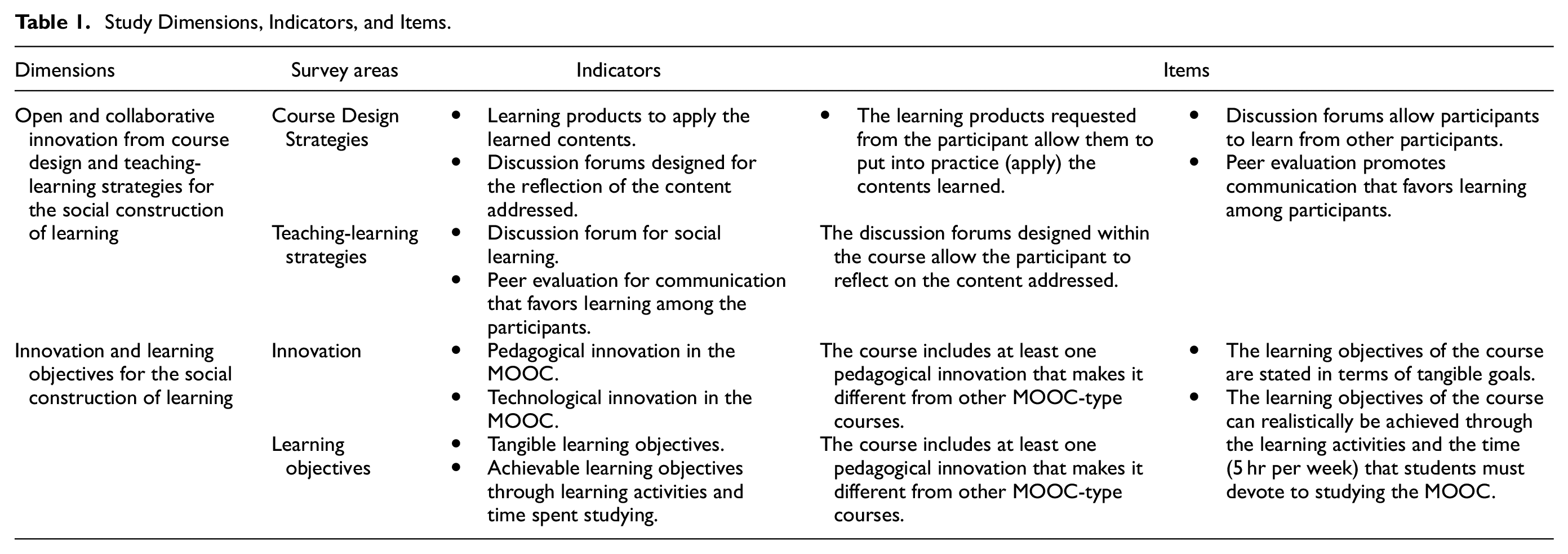
Regarding the validity and reliability of the questionnaire and surveys, it’s worth noting that a group of experts designed them and they were then piloted, yielding a Conbrach alpha of .898 for both the initial and final surveys (Valdivia Vázquez et al., 2018). Based on the statistical analysis, the instruments are considered reliable as the Conbrach alphas (α) of each one were greater than .8. Moreover, the alphas of the factor analysis showed that the items are aligned with the corresponding dimensions, which has positive statistical implications (Mena et al., 2017). To mitigate the threats related to prior knowledge on the topic, we conducted a construct validity analysis (Flake et al., 2022). An exhaustive literature review of the constructs involved in the study was carried out to limit this threat. We ensured that 96% of the references were from 2018 onward, and we referred to databases such as Scopus and WoS.
Data Collection
In this study, the quantitative method was used with descriptive statistics to analyze the experts’ perceptions of the MOOC design based on the results of the Likert scale questionnaire that incorporated dimensions associated with open and collaborative innovation and the social construction of learning (Table 1). Double-entry tables containing the frequency and percentage of the experts’ responses are presented. In addition, the results of this study added meaning to a previous survey of Minga-Vallejo and Ramírez-Montoya (2022) on the social construction of learning, in which 217 participants of the energy sustainability xMOOC were analyzed using inferential statistics. These participants completed the initial and final survey, which is included in the discussion of results.
Results
Open and Collaborative Innovation From Course Design and Teaching-Learning Strategies for the Social Construction of Learning
Table 2 analyzes the mixed opinions between the learning products with the interaction in the forums and the peer evaluation. In this case, the highest percentage of experts stated that they “strongly agree” (50%) and “agree” (37.5%) that the learning products requested from the participant allowed them to put into practice (apply) the content learned and that the discussion forums allowed participants to learn from each other.
Learning Products, Interaction in the Forums, and Peer Evaluation.
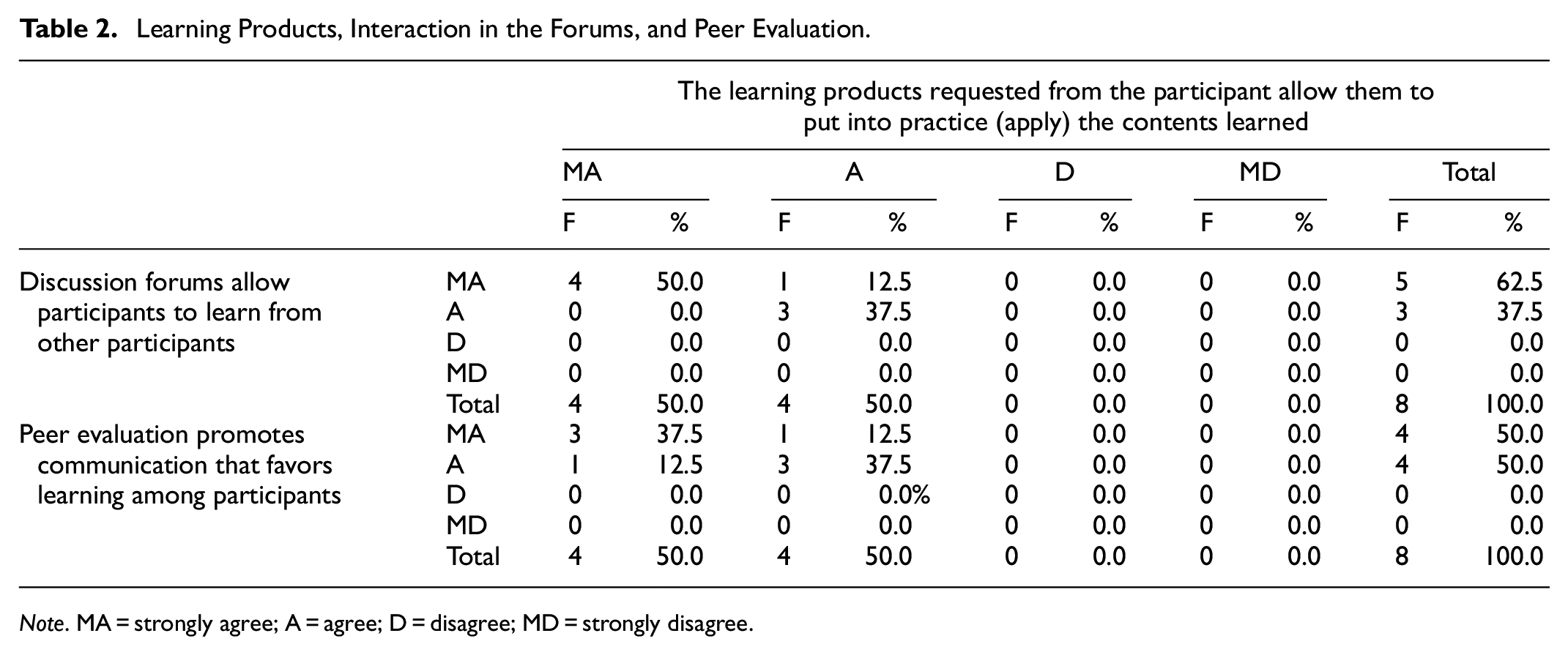
Note. MA = strongly agree; A = agree; D = disagree; MD = strongly disagree.
In addition, according to Table 2, there is a lower concentration of the experts’ opinions on the learning products and peer evaluation to promote communication that favors learning among the participants. 37.5% of the experts mentioned being “very much in agreement,” and the same percentage “agree.” Consequently, according to experts, discussion forums favor communication and interaction practices so that students learn from other students. Although MOOCs are largely designed for autonomous learning, some studies identify the importance of interactions between peers learners, and educators (Gregori et al., 2018).
Next, Table 3 analyzes the mixed opinions on the benefits of discussion forums for reflection on content with interaction and communication. Most experts “strongly agree” (62.5%) and “agree” (25.0%) that the discussion forums designed within the course allowed the participant to reflect on the content addressed from the learning generated by other participants.
Content, Interaction in the Forums and Peer Evaluation.

Note. MA = strongly agree; A = agree; D = disagree; MD = strongly disagree.
Table 3 also shows that 50.0% of the expert MOOC designers mentioned “strongly agree” and 25.0% “agree” that discussion forums and peer evaluation promote content reflection and communication that fosters social learning. However, MOOCs also require overcoming significant challenges. These include the high dropout rates and low levels of student participation in various educational activities found in other research (Papadakis, 2023).
Innovation and Learning Objectives for the Social Construction of Learning
Table 4 shows the results of the experts regarding pedagogical innovation and learning objectives. It is observed that only 42.9% of the experts “strongly agreed” that the course includes at least one innovation of a pedagogical nature that makes it different from other MOOC-type courses, which aligned with the learning objectives set for tangible goals. In addition, 14. 3% said they “agree,” and a similar percentage “disagree.”
Pedagogical Innovation and Learning Objectives.
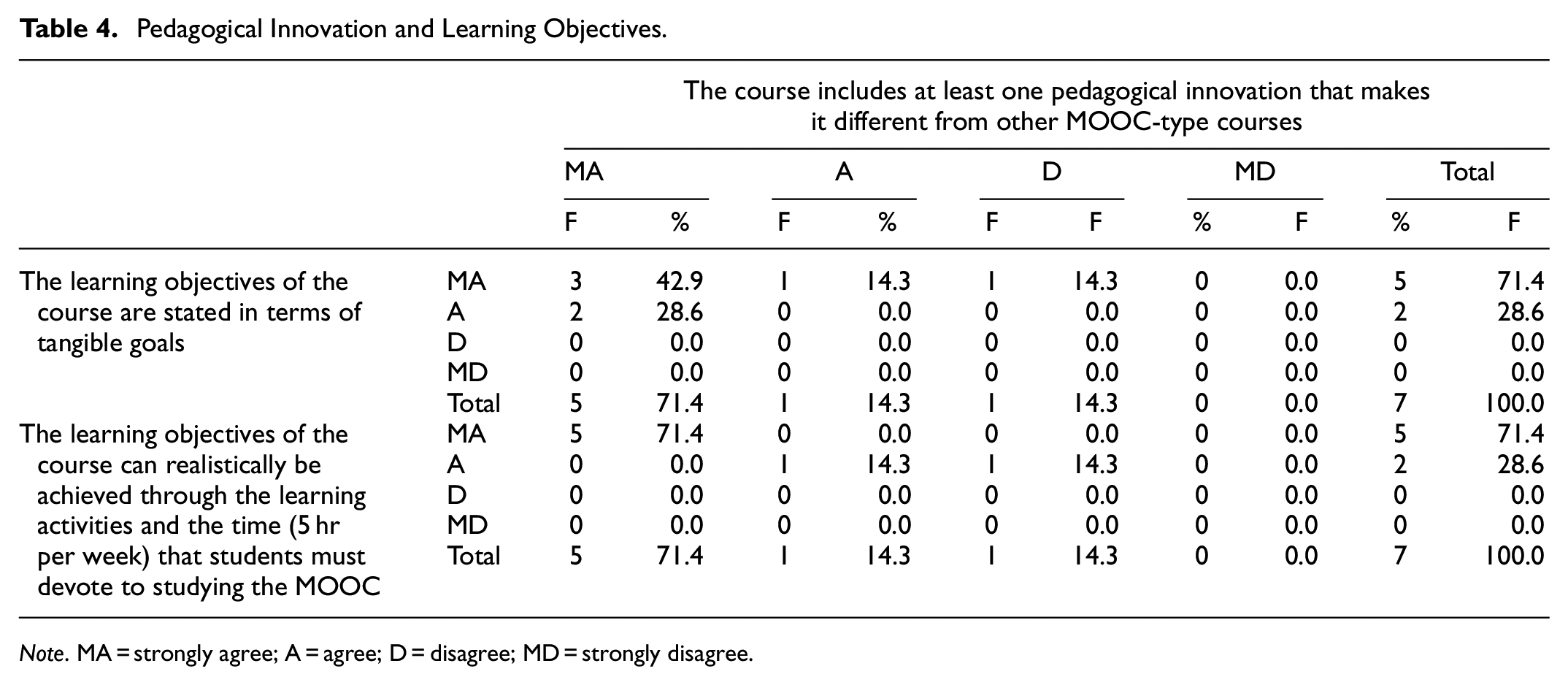
Note. MA = strongly agree; A = agree; D = disagree; MD = strongly disagree.
In the same way, Table 4 shows more consistency in the experts’ answers regarding pedagogical innovation and realistic and achievable learning objectives. 71.4% of the experts stated that they “strongly agree.” All these results show that the xMOOC included at least one innovation of a pedagogical nature that made it different and contributed to the tangible and realistic achievement of the learning objectives through learning activities and time dedicated to the MOOC. MOOCs promote new methodologies and innovative educational practices, including peer evaluation, which is not commonly used in traditional education (Palacios Hidalgo et al., 2020).
On the other hand, in Table 5, 42.9% of the experts “strongly agreed,” and 14.3% “agreed,” with a similar percentage “disagree,” that the course included at least one technological innovation, making it different from other MOOC-type courses and aligning with the learning objectives of the course by achieving tangible goals.
Technological Innovation and Learning Objectives.

Note. MA = strongly agree; A = agree; D = disagree; MD = strongly disagree.
In Table 5, greater consistency is detected in the experts’ opinions regarding technological innovation and realistic and achievable learning objectives through learning activities and time spent. 71.4% of the experts stated that they “strongly agree.” However, a smaller percentage (14.3%) of experts indicated they “disagree.” From this, it follows that for most experts, the course included at least one innovation of a technological nature that makes it different from other MOOC-type courses and that it supported the learning objectives that can realistically be achieved through learning activities and time dedicated to the course. The evolution of MOOCs and the use of technological innovations have resulted in a diverse range of learning experiences that are adapted to the preferences and needs of learners. This has enabled learning objectives to be better achieved (Pilli et al., 2018).
Discussion
Students generated learning products to put into practice the content they had learned. This learning came from the communication and interaction generated through the discussion forums and, to a lesser extent, peer evaluation. (Table 2). Contrary to the low participation rates in discussion forums that other MOOCs can frequently present (He et al., 2018), these findings support the results of another study (Minga-Vallejo and Ramírez-Montoya, 2022) that described students’ interest in carrying out innovative (Carrera & Ramírez-Hernández, 2018) and interactive activities (Zou et al., 2021) such as discussion forums to enhance social learning (Wu & Luo, 2022) and motivation to learn (Wan et al., 2020). It indicates the potential effective impact of this type of activity (Che Lah et al., 2022), both for those experienced with MOOC courses and for those taking them for the first time; therefore, from the practical perspective, the design of online learning should focus on meeting the needs of learners (A. Li et al., 2021). The discussion forums represent an xMOOC strength for which communication and interaction practices can be carried out more effectively.
The discussion forums were very useful for participants to reflect on the content and learn from each other. This type of social learning can be of great value in helping participants to consolidate their understanding of various topics (Table 3). The discussions related to the course content can significantly influence students’ participation and interaction and how they learn (Babori et al., 2019; Wise & Cui, 2018). However, as reported previously (Minga-Vallejo and Ramírez-Montoya, 2022), this interaction can be affected by age (Papadakis, 2023), in which the participant’s age significantly influenced the use of social networks for academic purposes. Also, other studies (Knox, 2018) show the role of feedback in communicative practices (Lazarinis et al., 2022; Shen & Gu, 2018) and its impact on the social construction of learning. Learning from other participants is one of the benefits provided by discussion forums; however, it is necessary to pay special attention to the use of social networks for academic purposes and the age of the participants.
Integrating pedagogical innovations in the design of the xMOOC means a tangible and realistic achievement in the attainment of learning objectives and in the time the learner spends on the MOOC. This makes a difference with similar courses (Table 4). Open and collaborative innovation is a practice gaining popularity (Oswald & Zhao, 2021) to generate and transfer knowledge through collaborative networks (Yousef et al., 2020) between university, industry, and government (Xue et al., 2018) and improve the products and services offered (Burgos, 2020). When the innovation in the xMOOC aligns with the work or study interests of the participants it may well optimize learning (Marimon-Martí et al., 2022) and, consequently, the social construction of learning (Minga-Vallejo & Ramírez-Montoya, 2022). Thus, there should be a balance between the learning objectives and the participants’ interests in the open innovation ecosystem (Chesbrough et al., 2018; Oswald & Zhao, 2021) and consistent planning of the course design to influence learning (Alamri, 2022) related to sustainability (C. Li & Zhou, 2018). Aligning learning objectives and the designed activities can open opportunities for the social construction of learning.
As technology advances, new ways of enhancing learning experiences are being discovered. Integrating these advances into the design of xMOOCs can improve the achievement of learning objectives through more engaging and interactive experiences for learners (Table 5). It is interesting to contrast these results with the findings found in the xMOOC participants (Minga-Vallejo & Ramírez-Montoya, 2022) who regardless of their profile heterogeneity stated that their training needs were met to the extent that the learning activities included an innovation, which can be developed from omnipresent digital platforms (Bogers et al., 2019) seen as levers of change (Yousef & Sumner, 2021) and innovation (Cabero Almenara et al., 2020). In another study, desirable products or services resulted from the decisions about the course design and its alignment with the SDGs (Gómez-Llanos & Durán-Barroso, 2020). In educational practice, innovative technology can strengthen the MOOC for social learning processes, adding value to the online modality.
Conclusions and Implications
This study carried out a descriptive analysis of the design of an xMOOC. The study had a particular focus on open and collaborative innovation, as well as the social construction of learning. Two innovation approaches are distinguished to support the social construction of learning and its challenges: (a) teaching-learning design and strategies that integrate social learning activities, and (b) learning objectives to strengthen social learning activities through pedagogical and technological innovation. Regarding the first approach, the experts involved in the design of the xMOOC recognized the value of discussion forums for fostering communication and interaction among learners. However, one of the challenges facing these courses is finding ways to incorporate innovative social learning activities that allow students to learn from each other, especially through peer evaluation.
Social construction of learning can be very beneficial for learners who wish to improve their understanding of various topics. Participating in discussion forums related to course content can significantly increase social interaction, leading to better reflections on the content. Although learning from other participants through discussion forums can be a significant advantage, it is important to consider the factors that affect this interaction.
Regarding the second approach, when designing an xMOOC, it is important to focus on learning objectives and to include both pedagogical and technological innovations in the course development. This not only reinforces the learning activities but also the social construction of learning, ultimately contributing to the achievement of tangible and realistic learning objectives. The challenge is to design a course that offers a training experience that has an added value that distinguishes it from others of its kind.
When it comes to educational practice, the study’s findings offer insight into the difficulties faced by experienced xMOOC developers when attempting to enhance the design of an xMOOC. Considering the course’s learning objectives, it is crucial to incorporate pedagogical and technological innovations that encourage social learning into the MOOC. One way of achieving this may be to encourage communication and interaction between learners through discussion forums and peer assessment. Engaging in activities that promote social interaction can lead to better comprehension and reflection of the course content.
Limitations and Future Research
One limitation of this study is that it only examines a single xMOOC. To gain a better understanding of xMOOCs design for the social construction of learning and open and collaborative innovation, more data and data sources would be beneficial. Future studies can strengthen research in this field by analyzing the development, implementation, and evaluation of innovative pedagogical activities that can enhance social interaction. As well as, a more in-depth study of technological innovations that promote the social construction of learning and can improve the overall educational experience.
Footnotes
Acknowledgements

Declaration of Conflicting Interests
The author(s) declared no potential conflicts of interest with respect to the research, authorship, and/or publication of this article.
Funding
The author(s) disclosed receipt of the following financial support for the research, authorship, and/or publication of this article: The Universidad Tecnica Particular de Loja (UTPL) is also thanked for the support of this research. In addition, this work is the result of project funding by CONACYT-SENER (Mexico) through the “Binational Laboratory for Intelligent Management of Energetic Sustainability and Technological Formation” project (Ref.266632). The authors wish to acknowledge the financial and technical support of Writing Lab, Institute for the Future of Education, Tecnologico de Monterrey, Mexico, in the production of this work.
The authors acknowledge the financial support of Tecnologico de Monterrey through the “Challenge-Based Research Funding Program 2022”. Project ID # I005 - IFE001 - C2-T3 – T.
An Ethics Statement (Including the Committee Approval Number) for Animal and Human Studies. If This is Not Applicable,Please State This Instead
Not applicable
Ethical Considerations
Privacy issues related to the collection, curation, and publication of student data were validated with Tecnologico de Monterrey’s data Owners and the Data Security and Information Management Departments.
Data Availability Statement
Data sharing not applicable to this article as no datasets were generated or analyzed during the current study.