




Abstract
This article studies the relationships among different factors and young people’s social change behaviour within three Eastern European countries. We surveyed 1906 students from Romania, Bulgaria, and Montenegro, all members of Generation Z, using SmartPLS software for data analysis. While there is a correlation between concern and behaviour, the impact sizes are small, indicating that good intentions do not always result in vivid responses. Social issues and individual freedom were the most powerful motivators. Business owners also exhibited more social change behaviour than non-business owners. Overall, our results suggest that Generation Z’s social change behaviour in the three EE countries gravitates around a self-orientation and intrinsic motivation, which influence the actions behind their good intentions.
Keywords
Introduction
After 35 years of transition and transformation, post-communist societies in Eastern Europe stand at a pivotal moment, demonstrating whether they have leaped into a democratic regime (Feldmann & Popa, 2022). This juncture is also marked by a shift driven by the rise of Generation Z,—individuals between age 15 and 29, as the dominant voice in social issues (Hayek, 2021), and also as consumers and employees. With protests around social and economic issues spearheaded by members of this generation (Walfisz, 2024), it is critical to understand recent developments in their social change behaviour, what drives it, how various concerns interact with it, and the influence of business ownership and different types of motivation.
Analysing responses from Generation Z representatives from 81 countries, including Romania, Bulgaria, and Montenegro; Seemiller and Grace (2024) concluded that ‘this is a generation that will likely see themselves as loyal, innovative, and caring, with a desire to make the world a more fair, just, and sustainable place’ (p. 152). These “good intentions”, representing potential future commitments, can only stimulate further interest in research related to Generation Z’s behaviour in the context of a European socioeconomic landscape.
Nevertheless, youth unemployment is an ongoing challenge in Eastern Europe, and unemployed individuals have the highest social isolation and the lowest commitment to all social engagement types (Kannan & Veazie, 2023). This problem is most acute in Generation Z, the demographic adversely affected socially by the COVID-19 pandemic.
Moreover, the pervasive impact of technology, coupled with the addictive nature of the internet, may account for the decreasing face-to-face interaction among young people, with potential implications for their social skill development (Shorey et al., 2024). Reduced social skills increase the risk of poverty or social exclusion (Eurostat, 2024). Alternatively, the ability to perform social tasks, each requiring a sophisticated interplay of behavioural responses to achieve a successful outcome, is essential because young people will not only act in their interest but will transmit part of their identity, their knowledge, and their social engagement. Nonetheless, little is known about the factors that shape the social change behaviour of young people.
Research on young people’s social change behaviour fostered by distinctive forms of self-expression and identity formation highlights variations across countries and cultural contexts (Seemiller & Grace, 2019, 2024; Twenge et al., 2019). Within the European context, most published work in this area originates from a single European country (Borusiak et al., 2020; Fratrièová & Kirchmayer, 2018; Kozáková & Gálová, 2021; Zsók et al., 2019), with few studies investigating Generation Z’s behaviour in the transitional economies of EE post-communist Europe, marked by a growing polarization of the society, economic disparities, political instability, and differentiated opportunities (Mungiu-Pippidi, 2015; Parnell et al., 2024). We address this gap by investigating the connections among life orientation, motivation, various life concerns, and business ownership on social change behaviour in three EE post-communist countries: Romania, Bulgaria, and Montenegro.
Firstly, the article focused on the theoretical basis for the behaviour orientation of Generation Z individuals, followed by hypothesis development. Apart from usual research factors, such as life orientation, motivators, or concerns, the investigation focused on business ownership as a self-determined form of behaviour. The disaggregated dataset collected within the Global Gen Z Study coordinated by Seemiller and Grace (2024), in which three of the four authors of the current article participated as collaborators, was analysed with SmartPLS (version 4) software with adherence to recognized protocols when assessing the measurement and structural models. Finally, we tested each hypothesis and evaluated the effect size with f2 values. Based on the findings and the discussion part, we offer recommendations to help researchers and practitioners increase Generation Z’s positive behavioural response, mainly through entrepreneurship, to increasing social challenges.
Theoretical Foundations and Hypotheses
Theoretical Basis
The theoretical foundation of this study is rooted in the Social Information Processing (SIP) theory (Walther, 1992) and Vroom’s (1964) Expectancy theory of motivation. SIP explains how individuals adjust behaviour in technology-mediated environments where cues are limited (Maletin & Kuratchenko, 2021). This is especially relevant for Gen Z, whose civic participation often occurs online (Ng & Cheung, 2022; Trifan & Pantea, 2023, 2024). Complementary, VIE theory explains why individuals choose between alternative forms of social behaviour by emphasizing the motivational calculus they undertake when they act. Although both theories have had broad applicability (Haywood et al., 2020; Zheng et al., 2025), they have rarely been connected to Gen Z’s social engagement and behaviour (Zboja et al., 2020), especially in the underexplored context of Eastern European post-communist countries, marked by fragile civic institutions (Akbar & Kisilowski, 2023) yet a strong digital participation (Koc-Michalska et al., 2024; National Sample, 2025).
By integrating Social Information Processing (SIP) Theory with VIE Theory, Generation Z’s social change behaviour can be better understood not only in terms of how their social behaviour is shaped when filtered through a screen, but also why they are motivated to act—through the nuanced mechanism of motivational calculus.
From the dynamic perspective of SIP theory, individuals adapt their interpersonal interactions to the digital environment. This dynamism is largely influenced nowadays by new technologies and social media that offer a vast amount of information and recommendations that have the potential to change how individuals evaluate social information and adjust their behaviour to fit their environment (e.g., Ng & Cheung, 2022; Trifan & Pantea, 2023, 2024). On social network sites, information often comes as a mixture of good and bad news and as a mixture of public and private postings intertwined with various activities. The influence of social media news consumption and individual expression on social networks can significantly predict attitudes and practices of involvement in social life (i.e., social change behaviour in the current study) (Pang et al., 2022). Moreover, according to SIP theory as individual form relationships and impressions in the digital space, which lack non-verbal cues, this online exposure can amplify concerns by repeated exposure to emotionally resonant information (Bergström & Jervelycke Belfrage, 2018). Given that Gen Z is labeled as the “anxious generation” (Haidt, 2024), concerns gain preeminence and become potential predictors of social change behaviour.
VIE Theory can explain the internal motivational calculus an individual engages in when exhibiting social change behaviours. Essentially, motivation is built upon the triad of valence–instrumentality–expectancy (Vroom, 1964). For example, a young person might get involved in a fundraising campaign because they care about the cause (i.e., Valence), feel that it will help them grow personally and professionally (i.e., Instrumentality), and believe that they can make a difference (i.e., Expectancy). In this theoretical framework, the concept of concerns mentioned earlier is useful to explain the valence of action. Building further the concept of life orientation is also relevant in this discussion about valence because it provides a framework for understanding an individual's attitude towards others, the value they assign to an idea or situation, and their choices regarding their well-being, society, and career. The study conducted by Seemiller and Grace (2024, p.16) reveals an emerging motivational model of Generation Z based on motivational sources such as seeing the fruits of one’s labour or accomplishments, having opportunities for advancement, and advocating for something one believes in—elements that can be interpreted as forms of motivational calculus. The idea of motivational calculus is further reinforced by Tirocchi’s (2024) study, which reveals that despite facing uncertainty and existential fragility, young people from Generation Z maintain hope for the future. Choosing a workplace that ‘shares their values’ is another example of motivational calculus, an aspect highlighted by Niemczynowicz et al. (2023). Also, Generation Z’s entrepreneurial behaviour serves as a compelling example of motivational calculus. For example, the study conducted by Saeedikiya et al. (2024) shows that digital infrastructure stimulates entrepreneurial innovation among Generation Z, contributing to the optimization of each component of the motivational calculus outlined in VIE theory.
In summary, life orientation, motivation, concerns, and business ownership present promising avenues for research into the social change behaviour of Generation Z.
Hypothesis Development
Life Orientation and Motivation
Research indicates that even in challenging environments, a positive life orientation enhances and sustains young individual's motivation through effective coping strategies and emotional regulation. By contrast, a negative life orientation tends to diminish motivation, impair coping abilities, and heighten emotional vulnerability (Huang & Zhang, 2022).
Specifically for Generation Z, previous studies illustrate a link between their life orientation and motivation. Thus, young people from Generation Z, characterized more by realism than optimism, yet holding hope that good things will happen for them in the future (Seemiller & Grace, 2024, p. 148), may be motivated to choose a workplace that offers both stability and meaning (Tirocchi, 2024). This choice aligns with the logic of motivational calculus based on adaptive motivation, in the sense that the individual adjusts their goals according to the reality they face. Additionally, Niemczynowicz et al. (2023) emphasize that Generation Z‘s motivation is the result of a continuous evaluation process through which an individual aligns their aspirations with real possibilities, within a framework defined by their life orientation. In other words, life orientation functions as a filter that guides Generation Z‘s choices. At the same time, motivational calculus represents the mechanism through which the individual decides what is worth the effort and what is not, based on the intended outcomes.
Therefore, we hypothesize that:
Motivation and Social Behaviour
Motivation represents the driving force of the societal transformation, whether deliberately aimed at change, such as with medium activism (Ng & Cheung, 2022), or unintentionally, as in the adoption of new technology (Trifan & Pantea, 2023). Tamir and Hughes (2018) uncovered that social rewards, such as positive social feedback and recognition, are potent motivators for complex social behaviours. Considering Generation Z’s high appetite for social media (Tirocchi, 2024), where feedback and recognition are instantly available, we can better understand their social implication.
At the same time, in the virtual environment where young spend most of their time (Maletin & Kuratchenko, 2021), the capacity to engage in a social cause is high and the effort low, because they were born and raised with technology—strengthening their belief that performance will lead to achieving a social outcome, and the expectation that effort will lead to performance. Thus, the motivational calculation framed by the VIE theory results in a positive outcome, especially when the social cause they engage with in various ways—from sharing information with others to donating money—aligns with their values of autonomy, achievement, and impacting others (Niemczynowicz et al., 2023).
Accordingly, we hypothesize that:
Life Orientation and Social Behaviour
VIE theory suggests that an individual's social change behaviour aims to achieve desired goals based on their life orientation, which acts as an anchor guiding engagement with the world. Previous studies have highlighted the transformative power of optimism in fostering prosocial behaviour among young people, inspiring hope and reflecting the link between an individual’s life orientation and their social change behaviour (Segerstrom et al., 2017). In their work about developmental trajectories of young people Reinders and Butz (2001) outline four types of social participation according to their life orientation: integration (characterized by a high level of both positive and negative orientation), assimilation (a strong positive orientation), segregation (a high negative disposition), and marginalization (both positive and negative orientation are low). In a context comparable to our study, Paszkowska-Rogacz (2024) found that assimilation and integrative forms of social participation were most common among Polish young adults aged 18 to 34, indicating active engagement in social contexts and suggesting a connection between Generation Z’s life orientation and their propensity for social change.
According to Seemiller and Grace (2024), despite the fact that Generation Z’s optimism has been strongly challenged by the COVID-19 pandemic, political movements, natural disasters, and wars, its members remain committed to the belief that they can have a positive impact on the world they live in and help make it more just. Studies and meta-analyses pointed out that they use new technologies, digital platforms, and social media to amplify their voices and mobilize others but tend to avoid content that requires high cognitive effort or causes emotional discomfort (Maletin & Kuratchenko, 2021; Trifan & Pantea, 2023; Tirocchi, 2024). This aspect may reflect a contemporary form of mental calculation for how Generation Z builds their future in realistic steps, seeking both autonomy and connection, financial stability and meaning, security and flexibility (Niemczynowicz et al., 2023).
In other words, their life orientation is expressed through a balance between the idealism of personal values and the pragmatism of decisions shaped by social realities, such as economic instability, accelerated digitalization, climate crisis, and political polarization.
As a result, we can anticipate that:
Concerns and Social Behaviour
In computer-mediated communication, Generation Z’s concerns about economic, social, and environmental injustice are not merely topics of conversation—they act as catalysts for relationship-driven social change (Thrift & Sugarman, 2019; Walfisz, 2024). This “crying for change” (Walfisz, 2024) is at least partially fueled by the economic recessions, social polarization, wars, and health crises that Generation Z has already experienced within their relatively short lifespans (Seemiller & Grace, 2024).
From the perspective of SIP Theory, the digital relationships embraced by Generation Z are emotionally charged and highly effective, as users can leverage limited cues to construct idealized and impactful connections with individuals, causes, and communities (Tamir & Hughes, 2018).
Accordingly, we hypothesize that:
Business Ownership and Social Behaviour
We expect a positive relationship between business ownership and social behaviour based on VIP theory, which suggests that behaviour is influenced by an individual’s expectation of a reward and the value they place on that reward (Vroom, 1964). The youth entrepreneurial research pointed out that Generation Z entrepreneurs view entrepreneurship not only through the lens of economic benefits, but also through the lens of their values of social responsibility and impact-driven goals (Saeedikiya et al., 2024). Therefore, they seek ventures that align with personal values and contribute to societal well-being (Trifan & Pantea, 2024), using digital activism to amplify their values (Tirocchi, 2024)
Accordingly, we hypothesize:
The hypotheses are summarized in Figure 1. We used gender as a control variable with male and female categories, as only 28 of the 1906 respondents in all three countries did not identify as male or female.

Hypotheses.
Materials and Methods
To test our hypotheses, we use a data set collected within the Global Gen Z Study coordinated by Seemiller and Grace (2024). The global dataset, resulting from a collective effort between September 2021 and January 2022, was disassembled into regional groups.
The study protocol was reviewed and approved by the institutional ethics committee, ensuring compliance with relevant ethical standards. We obtained written informed consent from all participants before data collection. Participants received detailed information outlining the purpose of the study, the researcher's contact information, what their participation involved, potential risks and benefits, data confidentiality practices, and their right to withdraw at any time. Consent was obtained electronically, and participants were allowed to ask questions before agreeing to take part. Participation was entirely voluntary. The online questionnaire used to collect data was anonymous, and no sensitive personal identifiers were collected; all data were anonymized before analysis.
In 2024, we disaggregated data for the three EE post-communist countries (i.e., Romania, Bulgaria, and Montenegro) and eliminated responses with missing values on the variable of interest. The final dataset contained the complete responses of 1,906 respondents: 1,005 from Romania, 519 responses from Bulgaria, and 382 from Montenegro. Over 68% of the respondents were female, and only 98 participants ran businesses (42 from Romania, 34 from Bulgaria, and 22 from Montenegro). Each of Generation Z’s social change behaviours was operationalized using Seemiller and Grace’s (2024) native translated questionnaire, consisting of 35 quantitative questions and six qualitative questions.
Life orientation involved five items measuring the extent to which a respondent holds generalized favourable expectancies for their future, as grounded by Seemiller and Grace (2024) in Scheier et al.’s (1994) Life Orientation Test; however, two measures were slightly adapted (Seemiller & Grace, 2024). The motivation construct incorporated 22 items (seven intrinsic motivators, eight extrinsic motivators, and seven relational motivators) to measure the extent to which a respondent finds various motivators useful. This construct was based on the Motivation Indicator (Seemiller, 2009). The concerns construct subsumed 24 items measuring the extent to which a respondent is concerned about different issues, such as economic, social, security & safety, and individual freedom. Social change behaviour (SCB), which was the outcome variable in this study, measured the frequency of respondents’ SCB in the past 12 months. The 11 items were developed in the Global Gen Z Study (Seemiller & Grace, 2024), based both on predominant opinions as gathered from the popular press and reports (e.g., Deloitte, World Economic Forum) and academic literature (e.g., Bales, 2017; Seemiller & Grace, 2019; Thrift & Sugarman, 2019).
Except for business ownership, all the constructs in the model are latent and were measured with multi-item reflective scales. In addition, motivation is a higher-order reflective construct, which is both a dependent variable and a moderator. Testing the hypotheses in this study requires a methodology that can assess the reliability and validity of latent constructs and their influence on social behaviour, while assessing motivation as a partial or full mediator. Structural equation modelling (SEM) provides a robust approach with a single model.
Hypotheses were evaluated with partial least squares SEM (SmartPLS version 4) software (J. Hair et al., 2024) with adherence to recognized protocols when assessing the measurement and structural models (J. F. Hair et al., 2021).
Results
We evaluated the integrity of the scales before testing the hypotheses. The three-dimensional motivation scale (intrinsic, extrinsic, relational) validated by Seemiller (2009) is measured as a higher-order construct (HOC). A two-stage process was employed to create the HOC measures. In the first stage, the HOC was removed, and the PLS-SEM algorithm was employed in a model with the lower-order constructs (LOCs) as independent variables. Each (LOC) was evaluated for reliability and validity. The items loaded above 0.700 on their respective scales. In the second stage, the latent values for each dimension were saved and used as construct measures.
Per Scheier et al.’s (1994) life orientation scale, two items were reverse-coded and did not load sufficiently in all three countries; therefore, we used the other three items as a construct measure.
The social change behaviour items loaded well on a single-dimensional scale. Following a factor analysis with varimax rotation, the concern items loaded along four dimensions: broad economic (seven items), social (six items), security & safety (seven items), and individual freedom (four items).
Table 1 provides select demographic details about the respondents. Most of the respondents in all three nations were female, and most did not own a business.
The Sample.

The constructs were measured reflectively. We assessed reliability and validity with the partial least squares (PLS) algorithm (see Table 3). Construct reliability was assessed with Cronbach’s alpha (Nunnally, 1978). Scores exceeded 0.700, except for motivation and life orientation, which are three-item scales. Composite reliability (rho_c) exceeded 0.700 (J. Hair et al., 2024), and average variance explained (AVE) scores exceeded 0.500 for all constructs except concern about broad economic issues (0.429) and social change behaviour (0.379), two constructs with Cronbach’s alpha scores exceeding .800. Unlike coefficient alpha, AVE is not biased in favor of large scales, so we considered eliminating items to raise the scores. However, the coefficient alpha and composite reliability(rho_c) scores exceeded 0.800 for both constructs (see Table 2), supporting the integrity of the measures. Hence, these concerns notwithstanding, the measures were deemed reliable overall.
Constructs, Items Loadings, and Reliabilities.

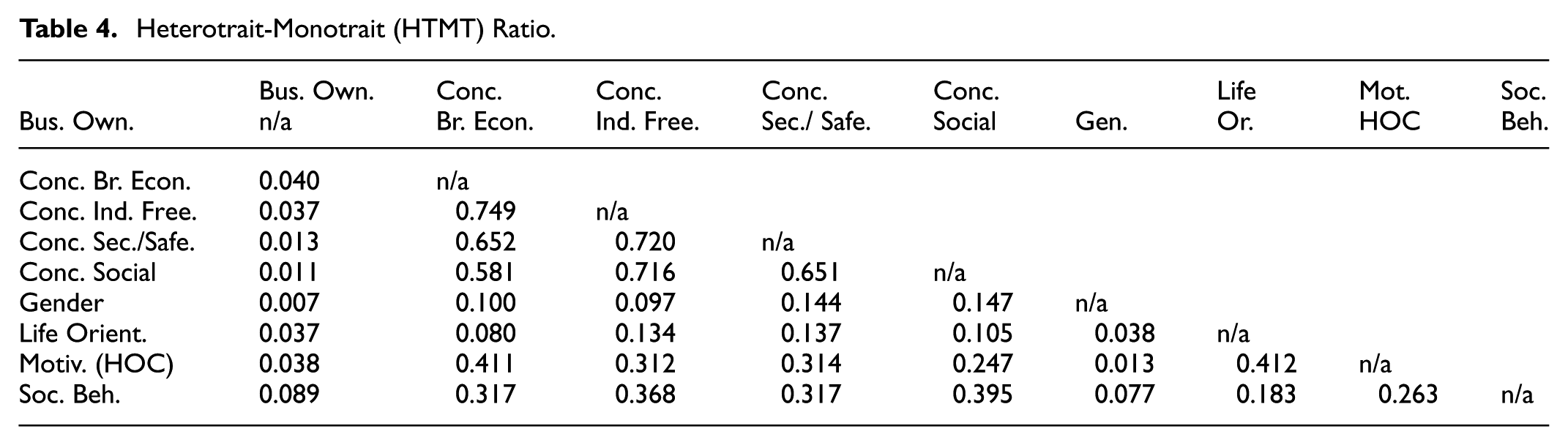
The Fornell-Larcker matrix in Table 3 and the heterotrait-monotrait (HTMT) matrix in Table 4 suggest discriminant validity for all constructs. Discriminant validity is established when HTMT values are below 0.85. None of the confidence intervals includes the corresponding threshold values (Franke & Sarstedt, 2019; Kline, 2010).
Fornell-Larcker Matrix.

Heterotrait-Monotrait (HTMT) Ratio.
We calculated variance inflation factor (VIF) scores, which were below 5.0 for all items except for concern for homophobia (5.396). These results suggest collinearity is not a significant concern. Also, factor-level VIF scores were less than 3.3 in all instances, suggesting the model is free from common method bias (Kock, 2015).
We used the bootstrapping algorithm in SmartPLS to test each hypothesis. We evaluated the effect size with f2 values per Cohen’s (1988) benchmarks of 0.02 (small), 0.15 (moderate), and 0.35 (large). The path model includes path coefficients, p-values, and effect sizes. The circles for the dependent variables in the model contain R2 values. The hypothesis testing results are provided in Figure 2 and Table 5.

Test results (all nations)*
Results (All Nations).
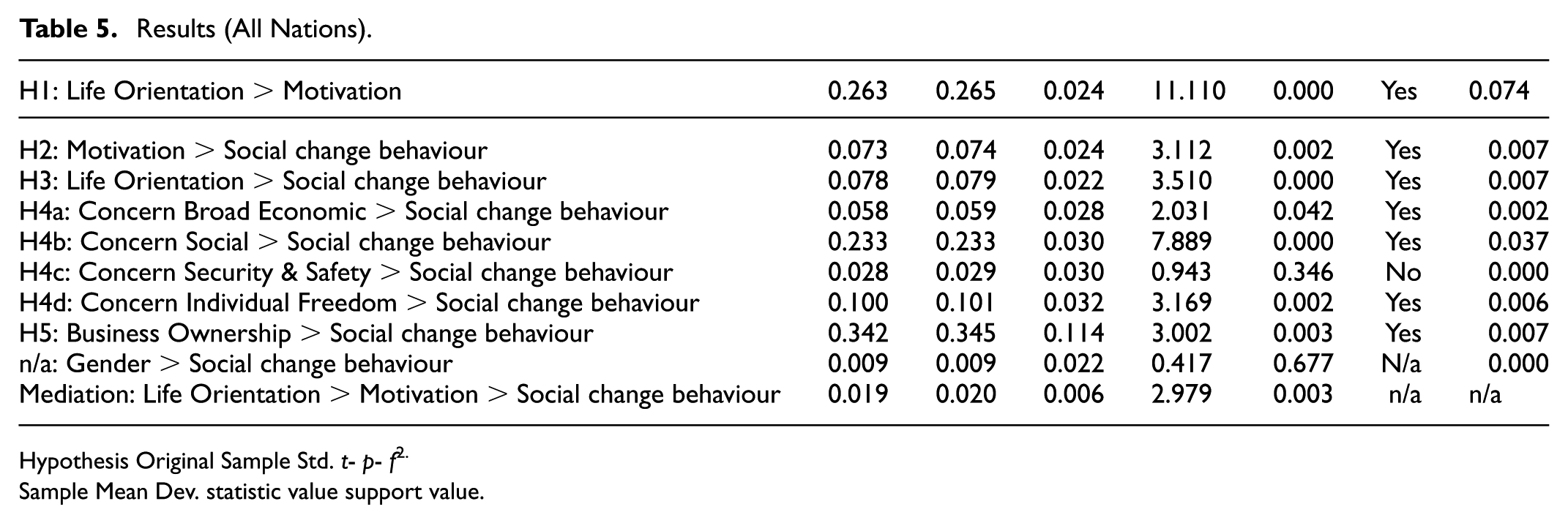
Hypothesis Original Sample Std. t- p- f2.
Sample Mean Dev. statistic value support value.
The first hypothesis was supported. Life orientation was significantly associated with motivation, with an effect size (f2) of 0.075.
The second hypothesis was supported. Motivation was significantly associated with social change behaviour, with an effect size (f2) of 0.010.
The third hypothesis was supported. Life orientation was significantly associated with social change behaviour, with an effect size (f2) of 0.007.
The fourth hypothesis was partially supported. Concerns about broad economic issues (H4a), social issues (H4b), and individual freedom (H4d) were significantly associated with social change behaviour, but concerns about security and safety (H4c) were not.
The fifth hypothesis was supported. Business ownership was significantly associated with social change behaviour, with an effect size (f2) of 0.007.
We also tested for mediation. Motivation partially mediated the relationship between life orientation and social change behaviour (p < .001).
Discussion
Overall, our findings support the idea that Generation Z’s social change behaviour follows a positive life orientation, motivation, concerns about social issues and individual freedom, and business ownership. The small effect size suggests that many members of Generation Z in the three studied post-communist EE countries revealed that good intentions, such as the desire to make the world a better place, do not always translate into measurable behavioural responses. Although included in the model as a control variable, there was no discernible link between gender and social change behaviour.
The Relationship Between Life Orientation and Social Change Behaviour
Life orientation was significantly associated with social change behaviour, suggesting that Generation Z individuals from Romania, Bulgaria, and Montenegro who believe future conditions will work out for the best are more frequently engaged in social change behaviour. Literature attributed this fact to dispositional optimism, which positively evaluates social information and behaviour adjustments (e.g., Cooke, 2017; Pang et al., 2022; Ng & Cheung, 2022; Shi et al., 2024). Previous research related to the global Generation Z’s life orientation (Seemiller & Grace, 2024) found that these individuals’ are realistic rather than optimistic about the challenges ahead’ (Seemiller & Grace, 2024), and that they value the ‘self-reliance’ aspect of optimism (Seligman, 2006) expressed in items such as ‘I am optimistic about my future’ and ‘I believe good things will happen for me’ more than the ‘others-reliance’ aspect of optimism expressed in the item ‘I believe people are inherently good’.
The small effect size (f2) of life orientation on social change behaviour (0.007) sheds new light on the association between life orientation and social change behaviour outcomes. Specifically, Generation Z individuals from Romania, Bulgaria, and Montenegro, who possess a positive life orientation, are more prone to get involved in social change behaviour. Still, this aspect does not necessarily translate into action. A possible explanation for the above-mentioned small effect size could be the COVID-19 pandemic, which was a significant event that impacted Generation Z in the life stage when their long-lasting values are still being shaped with its ‘general response to communication and learning globally including synchronous and a synchronous learning with an increased reliance on digital resources in place of face-to-face interaction’ (Ferri et al., 2020). As Ludwig (2016) explained, the action results from a person’s practical reasoning about what is best to do in the life orientation ‘light,’ which leads, if all goes well, to an intention directed toward future action. We assume that since not everything went well in the life of Generation Z, only a tiny part of their good prior intentions translated into social change behaviour actions, and those more frequently manifested in the virtual environment, such as staying informed or sharing information with others about a social issue they are concerned about (E. Botezat et al., 2024). Nevertheless, much further research is needed to verify this presupposition.
The Mediation of Motivation Between Life Orientation and Social Change Behaviour
As shown in Figure 2, the data analysis results reveal that the positive link between life orientation and social change behaviour is partially mediated by (intrinsic, extrinsic, and relational) motivation. This intermediation can occur because motivation transforms one’s perspectives and values into actionable behaviours. Life orientation’s emphasis on optimism and existential beliefs strongly influences how individuals perceive their role in society and their capacity to effect change. One explanation for this mediation can be found in self-determination theory (SDT), which suggests individuals are motivated by the need for autonomy, competence, and relatedness (Deci & Ryan, 2000). When satisfied, these psychological needs foster a sense of well-being and intrinsic motivation, leading individuals to engage in behaviours aligned with their life orientation. Therefore, someone with a positive life orientation may be more inclined to volunteer or participate in community activities because they believe in the value of their contributions and feel competent in their ability to make a difference.
Our finding is consistent with research by Li et al. (2018), which suggests that motivation plays a significant role in mediating the relationship between personal values and social engagement. They found that individuals with strong altruistic values were more motivated to participate in social causes, underscoring how motivation can be a conduit through which life orientation influences behaviour. Hence, as individuals’ life orientations evolve, their motivations adapt, subsequently affecting their social actions. It is noteworthy that previous empirical research on global Generation Z individuals (Seemiller & Grace, 2024) – conducted during pandemic times –, found them realistic and engaged in ‘low-time, low-risk, and individual social change behaviour s where they can get current updates, as well as share stories and links through their social media platforms and newsfeeds with the tap of a button’ (E. Botezat et al., 2024, p. 130). At the same time, their predominantly intrinsic sources of motivation in the top five motivation sources in Orthodox Europe, regions to which belong Romania, Bulgaria, and Montenegro, are ‘seeing the fruits of the own labour/accomplishment,’‘having an opportunity for advancement (promotion, new opportunities)’, ‘learning something or being better at something’, and ‘wanting to do well because you committed’ (Seemiller & Grace, 2024, p. 18) similar with previous other countries pre-COVID 19 studies’ findings (e.g., Fratrièová & Kirchmayer, 2018; Seemiller & Grace, 2016). Since the current study reveals that even though motivation is significantly associated with Generation Z’s social change behaviour, it has a small effect size (f2) of 0.010; we can say that ‘good intentions do not always lead to good outcomes.’ Indeed, good intentions can motivate Generation Z individuals to engage in social change behaviour at the individual level.
The Relationship Between Concerns and Social Change Behaviour
Contrary to our expectations, security and safety concerns were not significantly associated with social change behaviour. Interestingly, while concerns about broad economic issues did show a significant association with social change behaviour, they were not strong predictors. Although Generation Z individuals in Bulgaria, Montenegro, and Romania were concerned by broad economic concerns (Seemiller & Grace, 2024, p. 122), yet these concerns do not appear to strongly motivate engagement in social change initiatives. One possible explanation could be that rising in post-1989' clan capitalism countries, the Generation Z representatives in the three CEE countries took on addressing economic concerns by studying, working, and living in a Western European country characterized both by high levels of income and higher institutional development (Izyumov & Claxon, 2009). Therefore, these young people benefited from the right to move freely within the European Union and from the security and safety created inside the European space, which could have alleviated the need to engage in social change behaviour to address this kind of concern.
Aligned with our expectations, concerns about social issues and individual freedom were the most likely to prompt social behaviour. Specifically, Generation Z’s social change behaviour in the three EE countries follows social issues concerns, such as racism, police brutality, sexism, homophobia, or transphobia, on the one hand with the higher effect size (i.e., 0.037, see Table 5), and on the other hand with a little above the benchmark categorized by Cohen (1988) as small (0.02). One explanation for the higher effect size of social issues on social change behaviour can be found in Generation Z’s unprecedented sensitivity toward social justice (Hayek, 2021), illustrated by the predominantly young people’s engagement in protest activities. Young protesters appear to be incentivized both by a need for belonging and motives of self-actualization, shared in this individualistic cohort seeking the realization of their full and unique potentials (Renström et al., 2021). However, the relatively small effect size of social issues concerning social change behaviour shows that these individuals affected by social issues verbalize intentions but reduce their actions when they negatively evaluate the level of effort they must exert.
Furthermore, we could surmise that the small effect size (0.007) of individual freedom concerns on social change behaviour can be explained, at least partially, through the fact that Generation Z members experienced violations of personal rights during the COVID-19 pandemic (Carraro, 2024). Indeed, consider someone who sees freedom violated and is hindered from engaging in social behaviour in the real world for a long time, such as during the COVID-19 pandemic. In such cases, this can lead to fatigue and a social change behaviour imbalance between intentions and actions.
The Relationship Between Business Ownership and Social Change Behaviour
Finally, our study has identified that business owners were more likely to engage in social change behaviour, but it is unclear if their actions are associated with their business activity. This finding aligns with Sari et al.’s (2018) findings, which show that the social preferences among young entrepreneurs (i.e., reciprocity, inequity aversion, and altruism) influence their intention to impact society through their businesses. However, the small effect size (0.007) of business ownership on social change behaviour led to the conclusion that once Generation Z individual businesses started operating, they focused on the difficulties of entrepreneurship as practice. Consequently, it is possible that even with the same good intentions encapsulated in the so-called business social responsibility (Kumar et al., 2024), young business owners should prioritize their business interests to avoid failure rather than engaging in specific social change behaviours.
Meanwhile, Clark and Record (2017) stated that ‘locally facing firms that intentionally interface with community members and other local businesses are associated with greater levels of civic and political engagement compared with locally owned firms that sell their products to customers elsewhere’ (p. 875). Since our study was not designed to investigate the locally owned businesses that primarily serve a local consumer base, this issue is open for further research.
In short, our findings suggest that the intention behind Generation Z’s social change behaviour good intentions in the three EE countries, is a self-oriented and intrinsically motivated one and is put into practice by action if the action is perceived as leading to quick and immediate results that can be achieved with minimal (real-world) effort, low-risk, and low-time.
Implications and Limitations
Theoretically, this study advances our understanding of the complex interplay among multiple constructs—life orientation, motivation, personal concerns, business ownership, and social change behaviour—within Generation Z in post-communist Eastern European contexts, through the application of generic measurement and structural model analysis using SmartPLS 4. Although some scholars (Pang et al., 2022; Niemczynowicz et al., 2023; Paszkowska-Rogacz, 2024; Tirocchi, 2024; Trifan & Pantea, 2024) have focused on one or more of these constructs to examine their influence on Generation Z’s social behaviour, to our knowledge, no existing studies have yet incorporated such a wide range of factors into a single research model addressing Generation Z’s social change behaviour. Beyond this conceptual integration into a unified analytical framework, our findings also extend knowledge on the mechanisms through which attitudes, values, and prosocial goals identified as emerging trends in global studies on Generation Z (Seemiller & Grace, 2024) are transmitted, offering quantitative evidence for theoretical claims such as the intrinsic motivation to impact others. Furthermore, the results of our study make a significant contribution to the literature on social change behaviour among Generation Z youth in the context of three post-communist Eastern European economies, by highlighting social concern, individual freedom, and business ownership as dominant motivators. In doing so, we offer a more nuanced perspective on motivational dynamics in transitional societies, moving beyond simplistic assumptions often tied to economic hardship in such contexts.
Practically, the findings of the study offer actionable insights for educators, youth organizations, and civic institutions. Considering that Generation Z’s social change behaviour in the three Eastern European countries (Romania, Bulgaria, and Montenegro) gravitates toward self-orientation and intrinsic motivation, educational programs aimed at fostering prosocial behaviour should leverage intrinsic motivation by recognizing Generation Z’s interest in personal growth, visible impact, and autonomy (Niemczynowicz et al., 2023). Specifically, prosocial programs should be designed to offer participants the opportunity to see the fruits of their labour or accomplishment, to have an opportunity for advancement, or to learn something or be better at something, which are among the top motivational drivers of Generation Z individuals in Orthodox Europe (Seemiller & Grace, 2024, p. 18).
In addition, to transform good intentions related to improving society into visible actions such as entrepreneurship, educators and policymakers should create educational and social contexts that value intrinsic motivation, offering young people real opportunities for personal affirmation, autonomy, and skill development. Such initiatives could include entrepreneurial learning programs that foster active engagement, critical thinking, collaboration, and social responsibility – all essential elements for converting prosocial intentions into concrete actions, as shown by previous studies such as those conducted by Trifan and Pantea (2024) and E.-A. Botezat et al. (2025) in the Romanian context.
Beyond its theoretical and practical contributions, our study has limitations. First, we used a combination of previously validated scales and items based on the literature because our work was exploratory. While providing a comprehensive understanding, this approach may have limited the depth of our analysis. Although most of the hypothesized links were supported (i.e., p-values below 0.05), the effect sizes (f2 values) and variance explained (R2) were relatively small, except for the overall influence of life orientation. Hence, the practical significance is modest, and there is considerable unexplained variance in the model.
Second, the three samples consist of students, which may not be representative. Other members of Generation Z (e.g., non-students) might have different proclivities, so our conclusions are not necessarily generalizable.
Third, our work relies on sample respondents from three post-communist EE countries characterized by survival and secular values in traditional social institutions. For this reason, we exercise caution when generalizing our results to other countries. Therefore, future research should consider, both economically and culturally, the extent to which findings from other countries match ours.
Conclusion and Future Research Directions
This study found that Generation Z’s social change behaviour in the three Eastern European post-communist countries—Romania, Bulgaria, and Montenegro—gravitates around a positive life orientation, intrinsic motivation, concerns about social issues and individual freedom, and aspirations toward business ownership. The current study not only provides empirical support for global theoretical claims regarding the prosocial values and intrinsic motivation of Generation Z, but also offers practical recommendations for educators and policymakers in designing programs aimed at fostering a positive life orientation, cultivating intrinsic motivation, and supporting the exercise of individual freedoms, as well as stimulating entrepreneurial spirit. These could provide a pathway for transforming this generation’s latent prosocial intentions into concrete civic actions.
Although our work helps fill a gap in Generation Z research, further investigation is needed, and we have identified several future research opportunities that can expand the understanding of Generation Z’s social change behaviour and support its progression from intention to action. First, more research is needed to examine the motivational foundations of Generation Z’s social change behaviour. A comprehensive explanation of youngsters’ social change behaviour motivation should distinguish both between proximal, distal, and ultimate levels of influence and between permanent and temporary motivation. Moreover, future research should reconsider Generation Z’s intentions behind the good intentions by considering the impact of actions (i.e., outcomes) both in the virtual reality and the physical world.
Second, Generation Z’s increased social, environmental, and economic engagement underscores the need for work that considers attitudes toward nonmarket strategy (NMS), even if they are not business owners or employees. NMS includes political and social interactions between organizations and external actors mediated by governments, public institutions, media, and other stakeholders, but relatively little is known about this topic in emerging economies (Parnell et al., 2024).
Third, more research on Generation Z’s motivations, concerns, and business ownership in Central and Eastern Europe (CEE) is needed because of the region’s unique socioeconomic and political landscape. Factors such as cronyism, economic disparities, and political instability in influence the perspectives and generational engagement (Mungiu-Pippidi, 2015; Parnell et al., 2024).
Footnotes
Acknowledgements
The authors wish to thank Dr. Corey Seemiller and Dr. Meghan Grace, coordinators of the Global Gen Z Study, in which Dr. Elena Botezat, Dr. Silvia Fotea, and Dr. Ioan Fotea were involved, for providing access to the global dataset.

Ethical Considerations
Consent to Participate
We obtained written informed consent from all participants before data collection. Participants received a detailed information outlining the purpose of the study, researchers contact information, what their participation involved, potential risks and benefits, data confidentiality practices, and their right to withdraw at any time. Consent was obtained electronically, and participants were given the opportunity to ask questions before agreeing to take part.
Consent for Publication
We obtained written consent from all participants before data was collected. We informed the participants that results of this study may be presented at conferences, and/or published in journals, books, and the popular media. Data may be used in future research and/or shared with future researchers for studies related to Generation Z, youth, and teens, as well as other topics associated with the intent of this research. Data collected will not be used for decision-making or profiling of any individual.
Funding
The authors received no financial support for the research, authorship, and/or publication of this article.
Declaration of Conflicting Interests
The authors declared no potential conflicts of interest with respect to the research, authorship, and/or publication of this article.
Data Availability Statement
Data subject to third party restrictions: The data that support the findings of this study are available from Dr. Corey Seemiller and Dr. Meghan Grace from Wright State University, coordinators of the Global Gen Z Study. Restrictions apply to the availability of these data, which were used under license for this study.