




Abstract
Generation Z, who are prospective customers, are digital natives. As the infrastructure and technology of the internet have developed, this study examines whether digital disruption demonstrates the uniqueness of Generation Z and affects their attitudes toward products they rarely see. Digital media, social network sites, and instant messaging are emphasized due to their relationship to digital disruption. Social networks (e.g., social network sites and instant messaging) encourage interactions and are therefore separate from digital media. The questionnaire in this study was based on a thorough literature review, and reliability and validity were ensured. A total of 505 responses were used for hypothesis testing by the bootstrapping method and ordinary least squares. The results partially comply with the suggestion that Generation Z depends more on information from digital media than previous generations. However, social networks have a greater effect than digital media and do not show generational differences. Although the nature and lifestyle differ across generations, certain circumstances (e.g., working requirements) cause people to not conform to the stereotype of a specific generation. Hence, digital disruption creates generational differences, but these differences can be eliminated through practice. Given the development of digital innovation and its wider systemic effects, this study discusses the disruption of digital technology and the emergence of digital natives. The influences and the interactions identified establish a foundation for empirical practitioners and future researchers.
Keywords
Introduction
“Generation Z (Gen Z) is officially here. How will we manage?” This was the headline of an online article in Forbes in 2018, which indicates an urgent need to understand Gen Z. Gen Zers are known as digital natives and are famous for their reliance on social networks (Francis & Hoefel, 2018). Members of Gen Z are now prospective customers and the future workforce, and they will gradually influence society by participating in digital platform activities. Hence, the potential influencing power of Gen Z has received attention from companies such as Etsy and Unilever, which have initiated corresponding strategies to target Gen Z shoppers (BBC, 2021).
The literature on Gen Z focuses on their perceptions in the workplace, such as career aspirations (Barhate & Dirani, 2022), job retention (Jayathilake et al., 2021) and how to deal with them (Gabrielova & Buchko, 2021). Gen Z’s perception of marketing activities is another research stream (Djafarova & Bowes, 2021; Munsch, 2021). These studies highlight the importance of studying Gen Z; however, these studies have not discussed how digital disruption affects Gen Z’s attitude formation and makes Gen Z different from previous generations.
Deutsch and Gerard (1955) suggested that individuals are affected by two types of social influence: informational and normative. Social influence is used in the internet era to examine acceptance or use of technology and e-services. Previous studies have examined the motivation of social influence on internet banking services (Chaouali et al., 2016; Matsuo et al., 2018; Naeem, 2020), online shopping (Lee et al., 2011), online games playing (I.-C. Chang et al., 2014), and online community participation (Zhou, 2011). Gen Z is used to searching for information online (Francis & Hoefel, 2018); hence, digital media and social network platforms are regarded as channels of social influence in the digital era that affect individuals’ attitude formation. Previous studies have suggested that information sources have different meanings for information receivers, which results in them forming different attitudes toward a subject (C.-W. Chang & Chuang, 2019; Russo & Simeone, 2017). Additionally, social influence is related to the information source, as shown by Okazaki (2009a), which used the social influence model to compare the differences between PC-based and mobile-based eWOM. Accordingly, the segmentation of influences is helpful in examining attitude formation in the digital environment, which has not yet been widely examined.
Generations are shaped by the context in which they emerge, and researchers have focused on generational differences such as the usage of emojis (Koch et al., 2022; Prada et al., 2018), attitudes toward work (Weeks & Schaffert, 2019), attitudes toward climate change (Jordan, 2021; Tyson et al., 2021), and marketing strategies (Munsch, 2021). Although previous studies have noted the importance of generational differences, the way generations are viewed can change considerably as events such as digital disruption intervene. This study examines whether these generation labels still exist in the context of digital disruption or are stereotypes attached to generations.
To address these knowledge gaps, this paper seeks to answer the following questions: (1) How does the attitude of Gen Z become disrupted during these processes and in turn reveal its uniqueness? (2) Do different types of online information have effects of different extents? (3) Do generational differences fade away as digital disruption intervenes?
Literature Review and Hypothesis Development
Generation Z (Gen Z)
Gen Z includes people born between 1995 and 2012 (Gabrielova & Buchko, 2021). Gen Zers are true digital natives: from a very young age, they have been exposed to the internet, social networks, and mobile systems. According to Wikia, the world’s leading collaborative digital media company, 25% of Gen Zers are actively connected to the internet within 5 minutes of waking up, and 73% are connected within an hour (Wikia, 2013).
Gen Zers may be young, but they are undoubtedly prospective customers. Gen Z influences household purchases in the amount of $200 billion annually (Autotrader & Kelly Blue Book, 2016); therefore, Gen Z is targeted by companies. Regarding Gen Zers’ shopping habits and concerns about sustainability, Etsy spent $1.62 billion buying Depop, a UK-based second-hand fashion app (BBC, 2021), and Unilever plans to reduce plastic use by using more recycled plastic and finding other alternative materials (BBC, 2019). Researchers and empirical practitioners seemingly agree that understanding Gen Z is critical.
Discovering generational differences is also imperative for researchers and empirical practitioners. Previous researchers have investigated the similarities and differences between Gen Z and previous generations on several issues, such as attitudes toward climate change (Tyson et al., 2021), the government’s role, political preferences, the use of gender-neutral pronouns (Parker & Igielnik, 2020), value, and spending habits (Francis & Hoefel, 2018). Specifically, compared with older adults, Gen Zers are more aware of climate change and the need for action (Tyson et al., 2021). The awareness of climate change is derived from their use of digital media and social networks; they frequently see climate change content online, which then encourages them to become involved with the issue by participating in activities. The changing environment (i.e., digital disruption) can accentuate the differences between generations.
Digital Disruption
Digital disruption is a rapidly unfolding process through which digital innovation fundamentally alters value creation logic, unbundling, and recombining linkages among resources or even creating new ones (Skog et al., 2018). Digital disruption is framed as a type of environmental turbulence induced by digital innovation. Hence, radical digital innovation and its wider systemic effects are referred to as digital disruption in this study.
The most well-known products of digital disruption include personal computers (Eriksen & Ihlstrom, 2000), the internet (Lessig, 2002), mobile devices (Graham & Smart, 2010), social media and search engines (Kaplan & Haenlein, 2010), and content aggregator apps. In response to digital disruption, major communications, mass media, and entertainment companies are quickly deploying their digital platforms and implementing online revenue models (Gray, 2008). For example, newspaper companies have shifted their focus from print to digital formats as the future of news content distribution. Because internet information is now inexpensive and abundant, readers are moving online to read news, share articles and search for information (Utesheva et al., 2016). Moreover, digital disruption has made technologies for social networking and interactions between individuals easier and more powerful.
Researchers have suggested that different information sources have distinct influences on information receivers (C.-W. Chang & Chuang, 2019; Russo & Simeone, 2017). Therefore, the influences of digital media and social networks, the two products of digital disruption, will be examined from a social influence perspective.
Social Influence Theory
Attitude formation can be regarded as a learning process in which all judgments are made with reference to others. Previous studies regarding attitude formation have been rooted on social influence theory. Latané (1981) suggested that the effects of others on individuals’ attitudinal formation are a representation of social influence. Sherif (1937) and Asch (1956) also discussed the function of social influence. Hence, the core of social influence theory can be understood as an individual’s attitudes, opinions and subsequent behaviors being affected by other members in a group (Kelman, 1958).
Deutsch and Gerard (1955) argued that using a more general term “group influence” to characterize the impact of social factors is insufficient; therefore, they identified two types of social influence: informational and normative. Informational social influence is defined as the influence that accompanies accepting information obtained from others as evidence about reality. Kelman (1958) further argued that the process of internalization explains the function of informational social influence, in which individuals are influenced because their induced behavior is intrinsically rewarding. Individuals think the information is useful in solving the problems they confront; therefore, being influenced brings satisfaction.
The other type of social influence Deutsch and Gerard (1955) proposed is normative social influence. Normative social influence is the influence of complying with the positive expectations of others. Hu et al. (2019) argued that consumer research has demonstrated that the process of compliance and identification can explain the function of normative social influence. Compliance occurs when individuals accept influence to receive approval from group members, whereas identification occurs when individuals accept influence to maintain the relationship with group members.
The concepts of informational and normative social influence have been applied in previous studies (C.-W. Chang & Chuang, 2019; Hu et al., 2019). However, the physical presence of other people has been replaced by online interactions. Individuals are inundated with digital devices that they use to search for information online, review comments provided by unknown users on forums, and communicate with their social network members through social media platforms and software. Evidence has shown that individuals are willing to accept information from people who are not their friends (Lee et al., 2011) or who are unknown but seem trustworthy (C.-W. Chang & Chuang, 2019). Hence, the phenomenon highlights the importance of studying the effects of social influence within the time of digital disruption. Accordingly, digital media and social networks are regarded as informational and normative social influences affecting individuals’ attitude formation in the digital era.
Digital Media Influence
Information is important, especially when individuals want to make informed choices, and digital media plays a role as an information source in the digital era. Digital media here refers to internet news, forums, electronic word of mouth, and company websites. The application regards digital media as informational social influence based on the nature of Gen Z. Gen Z is the best-educated generation (Parker & Igielnik, 2020), who learned to use electronic devices in their early life stages and depend heavily on the internet; therefore, members of Gen Z are inclined to search for information online (Dimock, 2019). Hence, digital media is applicable in examining the influences of informational social factors.
Informational social influence is the influence of accepting certain knowledge obtained from others as evidence of reality (Deutsch & Gerard, 1955). The application of informational social influence has been studied in empirical works. Tyson et al. (2021) compared Gen Z and older adults and found that the more Gen Z sees climate change content online, the more likely they are to become involved with it. Moreover, Okazaki (2009a) compared the effects of PC-based and mobile-based eWOM.
Lee et al. (2011) argued that informational social influence is especially important when individuals face difficulties in making decisions alone. When individuals feel that making decisions alone is difficult, they turn to searching for information through digital media. During the information gathering process, individuals think the information is evidence of truth and can solve the problem; then, they accept the influence brought by the information and become satisfied (Kelman, 1958).
For tasks that Gen Z has not experienced previously, such as purchasing cars, Gen Zers show caution in making decisions. For example, Gen Zers will search for relevant information on manufacturers, dealers, and third-party websites. Moreover, digital media influences Gen Zers’ decisions. If Gen Zers have been exposed to digital media messages about the dangers caused by distracted drivers, information on safety and technology become their top concerns (Autotrader & Kelly Blue Book, 2016). The information obtained from digital media is regarded as useful and complies with Gen Z’s value system; hence, digital media achieves its social influence on Gen Zers.
As another example, when Michael Phelps, the Olympic gold medalist, talked about his experience in using a folk treatment after a competition, Gen Z easily received this information and wanted to try the treatment as well. Similarly, if the content on digital media encourages people to receive the coronavirus vaccine, the information receiver’s attitude can be influenced. Information from digital media can evoke an array of intense reactions toward a specific object in younger generations. Alternatively, if a famous blogger shows his or her experience with using an ancient treatment or online news shows a foreigner using the ancient treatment and suggesting it is cool, Gen Z is likely to be exposed to and influenced by this information and to think that the Gua Sha tool is useful or that using the Gua Sha tool is fashionable.
Because Gen Z is more easily exposed to such digital media than previous generations, digital media is more likely to influence Gen Z’s attitude toward a product. Hence, Hypothesis 1 is derived as follows:
Hypothesis 1: The effect of digital media on Gen Z’s attitude toward products is greater than that on previous generations.
Social Network Influence
The arrival of digital disruption has radically changed every individual’s life, especially the nature of their social interactions. Gen Zers spend more time on their phones than with actual people, and communication through their phones has become a new form of socialization. Apparently, Gen Z’s social lives occur on their phones (Twenge, 2017). The second social influence factor Deutsch and Gerard (1955) proposed is normative social influence, which is the influence of complying with the positive expectations of others. Considering that Gen Z’s social lives occur on their phones, the normative social influences in the digital era are supposed to occur online.
The booming of social network sites and heavily used instant messaging have attracted researchers’ attention (Farooq & Jan, 2012; Francis & Hoefel, 2018; Parker & Igielnik, 2020) and can explain the process of normative social influence. Social networks are a graph of relationships and interactions within a group of individuals in which information is disseminated and influences members (Sohn, 2014). Although searching for information from digital media is easy and inexpensive, the credibility of the information is sometimes doubtful, and the massive amount of information requires time to digest. Hence, individuals tend to seek information and knowledge from members of their social network (Sturiale & Scuderi, 2013). In the digital era, social network websites allow individuals to focus on particular aspects of interest and to socialize with acquaintances and people they do not know in the physical world (Lueg et al., 2006; Okazaki, 2009b). Furthermore, exponentially growing instant messaging facilitates daily conversations among social network members.
The greatest normative social influences are usually exerted within reference groups (Lord et al., 2001). Hu et al. (2019) suggested that normative social influence can be accomplished through either the process of compliance or identification. Specifically, Kelman (1958) suggested that social influences occur when individuals hope to receive a favorable reaction from others (i.e., compliance) or when individuals want to maintain a satisfying relationship with other people (i.e., identification). Gen Zers live on the internet. Sharing opinions, insights, perceptions, and experiences with others through social network websites and instant messages create a sense of belongingness to a social network.
Statistics also support the argument that their frequency of interaction on social networks makes Gen Zers more likely to be influenced by social networks. Tyson et al. (2021) found that approximately 70% of Gen Zers admit that their emotions are affected by the content shown on social networking websites, compared with 41% of Baby Boomers and older respondents, implying a generational difference. The Pew Research Center’s 2021 survey showed that Gen Z respondents had higher motivation for action than other respondents after being exposed to specific content. Seemingly, the information from social networks and the interaction between social network members determine Gen Z’s attitudes toward products and services (Wang et al., 2012; Williams et al., 2010) and their decision-making processes (Hennig-Thurau et al., 2010; Okazaki, 2009b). Accordingly, we hypothesize the following:
Hypothesis 2: The effect of social networks on Gen Z’s attitude toward products is greater than that on previous generations.
Methodology
Sample
A questionnaire was used as the research instrument for this study. The data were obtained in Taiwan, where digital infrastructure is well established. The questionnaire was divided into two sections: the first section solicited information on the respondents’ demographic data, and the second section was related to the influencing factors that affect purchase attitude. Perceptions of the two independent variables, that is, the digital media influence and the social network influence, were obtained in this section. The data were subjected to reliability tests and factor analysis before the final analysis was conducted by the bootstrapping method. Bootstrapping is a resampling method used to simulate samples from a data set using random replacement; therefore, the bootstrapping method allows us to provide an inference without the need to assume the population distribution. The bootstrapping method is notable for being valid for more conditions and ensures that statistical evaluations are as accurate and unbiased as possible.
Among the 505 responses received, 186 were from the online survey, and the rest were collected from the public space. Table 1 presents the demographics of the research sample. Among the respondents, 38% (190) were male, 60.6% (306) were female, and the rest of the respondents chose not to answer. A total of 45.5% of the respondents claimed that their disposable income was over 10,000 NT dollars each month, and 79.8% of the respondents had a college degree or a college education. In addition to procedural controls, such as anonymous submission, a short questionnaire, and minimization of the ambiguity of the measurement items, Harman’s single-factor test was performed to check for common method bias. The results showed that the first factor accounted for <40% of the total variance, which suggests that common method bias is an unlikely concern in the data.
Demographics of the Sample.

Measurement
To ensure content validity, the measures for the constructs used in this study were based on a thorough literature review. The respondents were asked to answer questions based on their opinions, rated on a seven-point Likert scale. Multi-item variables were based on an unweighted average of relevant items. With all Cronbach’s α values above .70, the constructs exhibited good validity (Hair et al., 1998). All the average variance extracted (AVE) of constructs was above .5, which complies with Bagozzi and Yi’s (1988) criteria that convergent validity is ensured. All multi-item constructs showed good discriminant validity based on factor analysis using scree plots of eigenvalues, and all expected factor loadings were above 0.50. The Fornell and Larcker (1981) measurement of discriminant validity was also used. The square root of the AVE of every construct was higher than the coefficient of correlation, which ensured that the constructs had good discriminant validity. The composite reliability (CR) of observable variables exceeded .7, as suggested by the criteria of Fornell and Larcker (1981), indicating good composite reliability.
To examine the influence of digital disruption, this study used Gua Sha tools as the research context. The Gua Sha tool used here is a skin scraper used in Chinese treatment to ease the discomfort of the human body. It is an ancient therapy tool but is not as commonly used as in the past. The way Gen Z reacts when facing this unfamiliar product can reveal the uniqueness of Gen Z.
Digital media influence was used to assess the respondents’ opinions on using Gua Sha tools with 3 items adapted from Bhattacherjee (2000). Three items measuring social network influence were also adapted from Bhattacherjee (2000) and assessed the respondents’ opinions on using Gua Sha tools based on recommendations from their social network members. Consistent with a previous study, attitude was measured as the extent of the respondent’s belief in using Gua Sha tools, and three items were adapted from Mathieson (1991). The studied variables and items are presented in Table 2. The control variables, which included gender, experience using the product, and disposable income to ensure the proposed relationships, were not influenced.
Research Constructs.

Results
Table 3 shows the means, standard deviations, and correlations between the study variables.
Descriptive Statistics for the Study Variables a
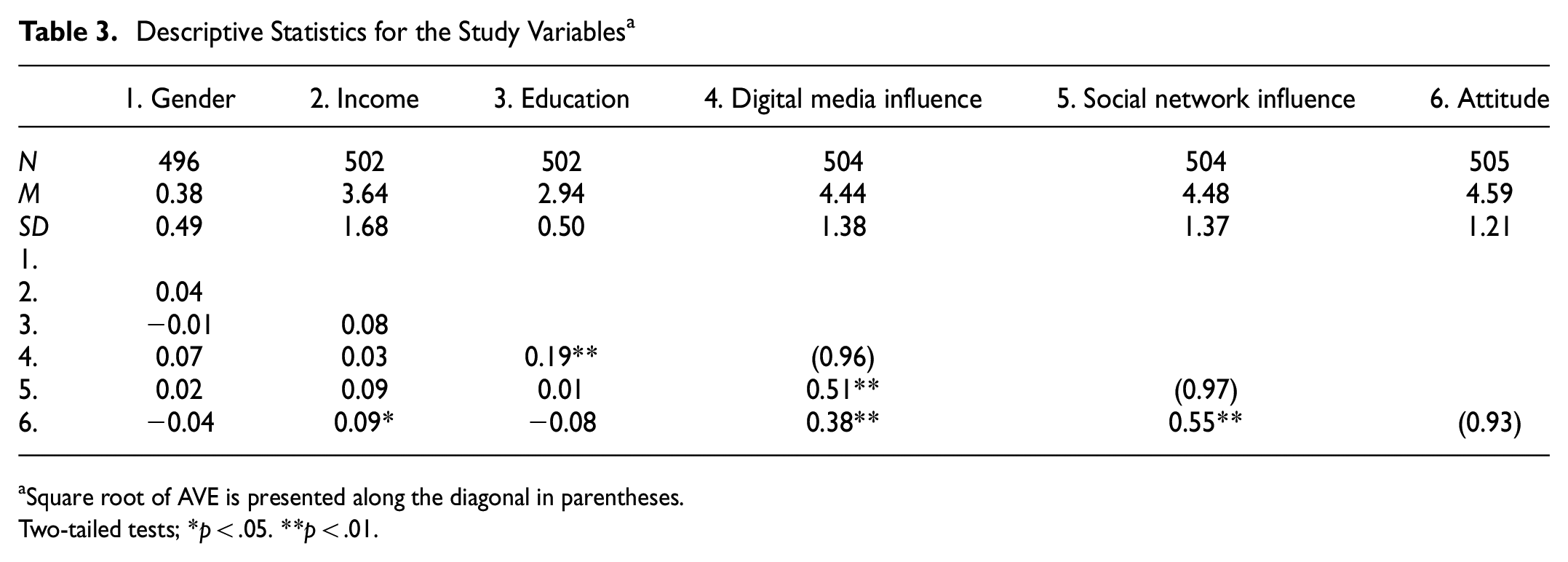
Square root of AVE is presented along the diagonal in parentheses.
Two-tailed tests; *p < .05. **p < .01.
The PROCESS macro by Hayes (2013) was used because it provides the coefficients from ordinary least squares (OLS) analysis and the bootstrapping method. Hypothesis 1 focuses on the digital media influence due to the potential influence brought about by digital disruption and the nature of Gen Z. With regard to the effect of being a member of Gen Z on the relation between digital media influence and attitude toward the Gua Sha tool, the results show that digital media influence has a positive effect (a = 0.20, p < .001) on the attitude toward the Gua Sha tool. The significant positive coefficient of the interaction (ab = 0.28, p < .001) suggests that the effect of digital media influence on Gen Z’s attitude toward the product is greater than the effect on the previous generation. The R2 for this regression model was .23, which indicates that 23% of the variance in attitude was explained by digital media influence. A bias-corrected bootstrap 95% confidence interval for the indirect effect, based on 10,000 bootstrap samples, was entirely above zero (0.14–0.42). This result supports Hypothesis 1, which suggested that Gen Z’s attitudes are more likely to be influenced by digital media.
Hypothesis 2 examines the accompanying social network effect of digital disruption on attitude. The argument suggests that as digital disruption is interrupted, social network websites and instant messaging facilitate interaction between social network members. This situation is more likely to occur with Gen Z due to its members’ addiction to the internet and mobile devices. However, the empirical result shows that the interaction is not significant in either method. A bias-corrected bootstrap 95% confidence interval for the indirect effect (ab = 0.05), based on 10,000 bootstrap samples, contains zero (−0.09 to 0.19). Hence, Hypothesis 2 is not supported. That is, the effect of social network influence on attitude toward an unfamiliar product does not show significant differences between Gen Z and previous generations (Table 4).
Bootstrapping and OLS Regression Results for the Hypotheses a .

Unstandardized coefficients are shown with standard errors in parentheses; [lower 95% confidence interval, upper 95% confidence interval] based on 10,000 bootstrap samples.
p<.01. **p<.001.
This study performed an additional analysis to determine whether the reactions of Gen Z to digital media influence and social network influence varied with combinations of demographic data (e.g., gender, income, and educational background). The empirical results suggest that Gen Z reactions to digital influence (F(1,491) = 0.003, p = .953) and to social network influence (F(1,491) = 1.121, p = .290) do not significantly differ with gender. Hence, gender is not a critical factor in explaining the influences in the digital disrupted era, nor is income. The interaction between income and Gen Z responses to digital media influence (F(5,489) = 1.729, p = .126) and to social network influence (F(5,489) = 0.792, p = .556) suggested that the level of disposable income did affect these influences.
The interactions between educational background and Gen Z reactions to digital influence (F(3,493) = 1.557, p = .851) and to social network influence (F(3,493) = 1.941, p = .122) are not significantly different. However, the main effect of educational background on digital influence (F(3,493) = 8.077, p = .000) is statistically significant. Hence, multiple comparisons were conducted. The results showed that the extent of digital media’s influence was more affected by higher education, with college and graduate school having a significantly (p < .05) stronger effect than other levels of education.
Discussion and Conclusions
Members of Gen Z are the next target customers and workforce in the market; thus, understanding Gen Z’s perceptions and values can help marketers initiate corresponding strategies. With regard to digital disruption, this study examines whether Gen Z differs from previous generations due to their unique lifestyle. Specifically, digital media and social networks are emphasized due to their relationship to Gen Z and digital disruption.
The empirical findings support the hypothesis that digital media influence has a greater effect on determining the attitudes of Gen Z than on the previous generation. The result complies with our impression of Gen Z that their addiction to digital devices causes them to more easily be influenced by digital media (Jordan, 2021; Tyson et al., 2021) and follows the argument of Lord et al. (2001) that informational influence is significantly effective in certain situations. Gen Zers are confident that they have the ability to evaluate the value of an unfamiliar product and are pragmatic in searching for clues. Compared with previous generations, Gen Z is more comfortable absorbing knowledge online. Through the online search process, Gen Z is influenced by digital media because the vast amount of online information seemingly reflects reality. Hence, informational social influences occur.
Moreover, Gen Z can refer to other sources before making a judgment. The emergence of social network websites and instant messaging allow more frequent interactions between social network members. The hypothesis assumed that digital natives take advantage of familiarity with digital devices and are more likely to be influenced by normative social influence. However, the empirical result is unable to support this argument.
The wide use of instant messaging in the workplace can probably explain the insignificant effect of social networks on Gen Z’s attitudes. In Taiwan, people are forced to use instant messaging because it has become a major communication method at work. People in the same business unit create a group in which supervisors deliver information and subordinates report their work. Instant messaging has also become an efficient way to keep in touch with clients. Hence, regardless of their generation, people must become accustomed to instant messaging. Individuals can use this skill in communicating with their social network members in daily life. Although members of previous generations are not digital natives and are not addicted to the internet, life events force them to adapt to the changes brought about by digital disruption. Therefore, although the natures and lifestyles of these generations are different, some situations can turn these differences into similar attributes across generations.
The results also comply with previous findings showing that individuals react differently to information providers, which influences their attitudes (C.-W. Chang & Chuang, 2019; Russo & Simeone, 2017). Accordingly, the traditional classification of information providers (i.e., media and digital media) is not sufficient to explain individuals’ behaviors toward digital disruption. Additionally, it is worth noting that educational background can make a difference in the digital era. Gen Zers with higher education are more inclined to be influenced by digital media, which may be due to the heavy dependence on digital media and mastering the skills required to search for information online. Gen Zers with higher education are well trained in online searching at school, and online information is now inexpensive and easy to obtain. Therefore, if Gen Zers with higher education are unwilling to make decisions alone, they will search for information online before making decisions. The tendency of the reliance on digital media and the extent of being influenced will become more obvious.
Of course, this study has limitations. For example, most of the respondents were female. Future researchers may consider potential gender differences and focus on the male perspective. Furthermore, a different research setting may provide future researchers with a deeper understanding of the antecedents of generations’ attitude formation.
Theoretical Contributions
This study contributes to the literature in three ways. First, this study applied social influence theory in examining Gen Z’s attitude formation in a digitally disrupted research context. Although the literature has established the existence of normative and informational social influence, most of the studies focus on normative social influences. Moreover, studies examining digital natives’ attitude formation or generational differences are less common in the social influence literature. Hence, this study contributes to the literature in two ways: (1) considering two types of social influences in the digital era in one study and (2) examining the generational differences in social influence theory and finding that digital disruption bridges the generational gap to some extent.
Second, this study emphasizes the importance of studying Generation Z. Members of Gen Z are prospective customers and the future workforce; therefore, understanding their attitude formation process is critical. However, previous studies have rarely addressed the differing influences of various information providers on this generation. The findings of this study contribute a greater understanding of how Gen Z’s attitude is influenced and how the influence may differ due to varying educational backgrounds.
Third, this study urges a more detailed media classification be applied to the literature. The public classifies media by determining whether they are digital forms. As digital disruption occurs, the traditional classification is not sufficient in explaining consumer behavior. The major information providers have transferred to online platforms to attract readers and cut costs. Hence, separating digital media and social media into a more detailed manner can provide more meaningful implications for future studies.
Practical Implications
Events such as digital disruption and economic or social incidents shape the views of a generation; therefore, this study provides some compelling clues about how Gen Z shapes the future. However, the current impression of generations should be revised. During digital disruption, generations need to adapt to certain situations, which can further influence their lifestyles. Hence, generational differences may not be as obvious in the digital era as we expect. Accordingly, empirical practitioners should adopt the advanced perspective that generations’ lifestyles can change over time. The current lessons for empirical practitioners include observing the changes in generations, possessing a positive attitude toward upcoming Gen Zers, and understanding that Gen Z may have attributes similar to their own.
Moreover, understanding which social influence is more effective in certain situations is essential for empirical practitioners. Different types of social influences have distinct processing logics that can translate into different meanings for individuals. Hence, empirical practitioners should identify the situation and exert proper social influences by exposing consumers to such influences. For example, digital media is a suitable communication channel for Gen Z. Hence, empirical practitioners can provide evidence to seize Gen Z’s attention through digital media.
Gen Zers are prospective customers and the future workforce; therefore, learning how to communicate with Gen Zers and work with them is important. Empirical practitioners may benefit from the results by understanding Gen Z’s perceptions and values, which can be the baseline in initiating corresponding managerial strategies.
Footnotes
Declaration of Conflicting Interests
The author(s) declared no potential conflicts of interest with respect to the research, authorship, and/or publication of this article.
Funding
The author(s) disclosed receipt of the following financial support for the research, authorship, and/or publication of this article: This work was supported by the National Science and Technology Council [grant number NSTC 111-2410-H-031-034-].
