




Abstract
The literature on corruption is extensive. However, specific effects of corruption on industrial structure upgrade have received little attention in the context of China. Therefore, following the concept of organizational performance and social capital theory, a number of panel models are developed to explore how different institution domains (i.e., government’s willingness to reform, business ownership structure, and government-business collusion) moderate the effect size of corruption on upgrading the industrial structure in China. The results are generally robust after endogeneity corrections, and suggest that the effect size of corruption on the industrial structure upgrade is evidently moderated by willingness to reform and ownership structure, but government-business collusion does not appear to have a similar effect. These findings explain the variation in the corruption-performance link, and provide a novel perspective for policy makers and regulators to understand the evolutionary path of corruption within the process of economic transition in China. A local government must thoroughly understand the dynamics of an industrial structure upgrade and acquire competencies and knowledge about when the effect of corruption reaches its inflection point and how its downside can be alleviated by placing specific formal and informal institutional reforms.
Keywords
Introduction
Recent trends in socio-economic development research have highlighted the importance for understanding disparities in human well-being through the lens of institutional quality (Harraf et al., 2020). Scholars have raised question regarding the role of formal institution such as the quality of a local government (e.g., efficiency, impartiality, democracy, etc.). The quality of a local government is believed to be a key determinant for improving intellectual capital efficiency (Hamdan et al., 2017) increasing people’s happiness level (Youssef & Diab, 2021), changing living environment (Zhao & Zhou, 2021), etc. Compared to formal institutions that can be changed in a relatively short time, informal institutions including cultures, social norms or values take a much longer time to be amended, and an informal institution with a low quality is also likely to hinder the improvement of a formal institution (Williamson, 2000). In this vein, corruption, among other important informal institutions that could have negative impacts on socio-economic progress, can be considered as “informal” too, representing an “inappropriate” human interaction in a society. Particularly, the presence of corruption in the context of developing economies have different features compared to its conceptualization in the west, as local cultures and traditions may have a stronger power in determining and sustaining business relationships (De Clercq et al., 2010).
China is a quintessential developing country where the prevalence of corruption is evidently intertwined with the process of rapid socio-economic development. Now, its economic growth faces various challenges and hardships such as a low rate of growth, imbalance in the supply side structure, and industrial structure inefficiency (Dong et al., 2011). Therefore, upgrade and optimization of the industrial structure has become a key point of socio-economic sustainability. During this transition period, traditional industries and emerging industries are competing with each other for limited resources, and efforts to influence the decision-making direction of government departments and enforcement has provided a breeding ground for corruption (Celentani & Ganuza, 2002; Lin, 2005; Venard & Hanafi, 2008).
However, how the inevitable surge of corruption could affect the state’s promotion and implementation of industrial structure optimization and adjustment is less straightforward. Research on exploring the transmission mechanism of corruption affecting the industrial structure upgrade is scarce in China, as most studies mainly focus on exploring its interrelationship with specific socio-economic aspects such as metropolitanization (Xu et al., 2017) or urban-rural income disparity (Hong & Zhang, 2021). Therefore, this paper aims to understand the complex role of corruption during the process of the industrial structure upgrade, and develops scenarios that incorporates not only the bribe-offering party (i.e., business), but also the bribe-accepting party (i.e., government) and the government-business collusion. Specifically, we seek answers to the following questions: (a) how the presence of corruption affects the industrial structure upgrade in China, and (b) how this effect can be moderated by different institution domains. Based on the concept of organizational performance and social capital theory (Adler & Kwon, 2000), we define the degree of an industrial structure upgrade is a performance outcome (Peng & Luo, 2000), corruption is an initial push/pull factor, and three informal and formal institution proxies—willingness to reform, ownership structure and government-business collusion are moderators which provide access to valuable social capital that can be used to facilitate corruptive behaviors.
This empirical study offers a meaningful context for the theoretical understanding of the role of informal institutions on socio-economic progress in a specific context, and whether the interplay between different formal/informal institutions accelerate/hinder the industrial structure upgrade in China. In addition, there are also three empirical contributions in this paper. First, most previous studies focus on either the relationship between corruption and socio-economic development or business/government ties and organizational/economic performance (e.g., Dunfee & Warren, 2001; Luo, 2004). In comparison, the study proposes a “corruption-relationship-performance” framework which, to a certain extent, integrates those fragmented concepts into one broadly defined framework and provides a clearer logic thread toward how the presence of corruption conflicts with institutional improvements. Second, as transmission routes of corruption are extremely complex, a novel measure this paper proposes is to elucidate the differences between the moderating effects of relationship domains on an industrial structure upgrade through the presence of corruption; this measure enriches the research on developing counter-measures against corrupt behaviors. Finally, compared to previous studies that use dummy variable (Fung et al., 2007) or Likert scale approach (Li et al., 2009), this study uses continuous proxy variables based on both subjective and objective assessment in a temporal order, thus providing a new idea to measure relationship domains.
The rest of this paper is organized as follows. The literature review and hypotheses development are presented in sections 2 and 3, respectively. Methodology and sampling method are given in section 4. In section 5, the main findings are discussed, and section 6 concludes.
Theoretical Background
The Definition and Measurement of Corruption
Corruption studied in academia usually refers to political corruption. Following Shleifer and Vishny (1993) and Aidt (2010), corruption is defined as “government officials use public power to obtain personal interests.” The definition of corruption by Transparency International and the World Bank is similar. Many other authoritative definitions of corruption also link corruption with public power and believe that the existence of public power is the root cause of corruption. Synthesizing these concepts, the corruption studied in this paper refers to the official criminal behavior of national public servants, including corruption, bribery, malfeasance, and embezzlement.
At present, there are generally two types of measurement methods for corruption: subjective evaluation and objective evaluation methods. Subjective evaluation methods are mainly used in the transnational research on corruption, scoring the degree of local corruption from multiple perspectives at the national level, including the Global Corruption Perceptions Index (CPI) published by Transparent International Organization on an annual basis, which is the most widely used measure of the extent of intercountry corruption (Dal Bó & Rossi, 2007; Suzuki, 2018); the International Country Risk Guide (ICRG) published by the International Country Risk Guide (Treisman, 2007); the Business International (BI) index published by the Economist Group (Koyuncu & Yilmaz, 2008), and the World Bank Governance Index (WBGI) published by Kaufmann (Kaufmann et al., 2005). In addition, many scholars also use subjective evaluations of corruption perceptions at the corporate level to measure the degree of corruption (e.g., De Rosa et al., 2015; Sisaye, 2021; Venard, 2009; Venard & Hanafi, 2008).
In comparison, the objective evaluation method is mainly employed at more disaggregated levels such as region or firm. For instance, to investigate the amount or frequency of bribery, Svensson (2003) and Fisman and Svensson (2007) analyze Ugandan corporate bribery behavior and associated outcomes. Kaufmann and Wei (1999) produced the World Competitiveness Report based on surveys of enterprises in a number of countries. Using judicial indicators, the evaluation of the extent of corruption in the number of corruption cases committed by civil servants is also an alternative. Goel and Rich (1989) and Dincer and Gunalp (2012) use the number of civil servants sentenced to bribery in each state counted by the U.S. Department of Justice to measure the degree of regional corruption. Glaeser and Saks (2006) use statistics on federal corruption convictions to analyze corruption in the United States. Schopf (2011) measures corruption by estimating “rent outflow” and bribes accepted by relevant officials. In China, researchers generally choose the number of cases of corruption, bribery, and embezzlement of public funds published in the Procuratorial Yearbook as a proxy to reflect the degree of regional corruption such as Fan (2013), Dong and Torgler (2013), and Jiang and Nie (2014).
In our review of previous literature, measuring corruptive behaviors is always a challenging task, as in many cases, its presence is neither explicit nor direct. Particularly in developing economies, it is likely to be embedded into culture which in turn become a social norm of behavior (Harraf et al., 2020). Subjective measures such as constructing a corruption index or conducting a survey (e.g., Salman & Laouisset, 2020) to a certain degree, could reflect genuine, candid voices among people toward unnoticed corruptive behaviors that are less likely to be detected by judiciary authorities. However, it is difficult to be generated and applied at disaggregate levels and over time, as variations in people’s perception toward corruption across regions or cities within a country is likely to be minor and does not significantly change in a short period, thus a regional or temporal analysis is not feasible. On the flip side, objective measures such as counting the number of civil servants sentenced to bribery helps scholars to quantify the presence of corruption as a “level” in a spatial-temporal order. But again, publicly exposed corruptive behaviors are only integral to the real situation in a region or city. Therefore, it is not surprising that no academic consensus on perfectively measuring corruptive behaviors had been reached.
In line with above seminal works and the nature of this study (i.e., an aggregate analysis at the provincial level), we choose an objective measure to generate the variable representing the degree of corruption, as this is the common approach that has been adopted by a wide range of literature. Even though it does not capture all unnoticed patterns of corruption, it is believed that the number of publicly exposed corruption cases is proportionate to a real level of corruption in total.
Corruption Control, Growth, and Industrial Structure Upgrade
The presence of corruption is believed to be a cause that affects economic growth. Existing views can be generally divided into three categories: the theory of goodness of corruption (Dong & Torgler, 2013), the theory of harmfulness of corruption (Aidt, 2010), and the theory of compromise in stages (Méndez & Sepúlveda, 2006). The theory of goodness of corruption holds that under the conditions of a rigid system, lack of government governance, or market failure, corruption can lubricate economic activities and promote economic growth (e.g., Jiang & Nie, 2014; Méon & Weill, 2010). In comparison, the harmful corruption theory states that corruption may disrupt market order, is a stumbling block to social fairness, and has significant negative effects on finance, investment, and foreign investment, thus inhibiting economic growth (e.g., Butler et al., 2009; Faruq et al., 2013; Johnson et al., 2014; Swaleheen, 2011). The compromise in stages perspective is that the impact of corruption on economic growth is U-shaped, which can be also defined as the Kuznets Effect (Méndez & Sepúlveda, 2006). Specifically, in the initial stage of economic development, corruption has made up for government vacancies and institutional loopholes, improved the efficiency of social operations, and thus promoted economic growth. With the increasing personal income level, the institutional system that was gradually developed after construction is completed and corruption will show negative effects such as hindering industrial structure upgrade and corporative innovation (Sandholtz & Koetzle, 2000), leading to a suppression of growth. For instance, Li et al. (2010) uses subjective and objective indicators as independent variables to investigate the dynamic relationship of corruption with China’s economic growth, and the research results confirmed the Kuznets effect between the two.
Based on the understanding about the essential relationship between socio-economic development and corruption. Extensive research has further taken the presence of corruption as a “mirror” to understand multidimensional impacts of weak institutions, such as inefficiency in public governance (Alqooti, 2020), political instability (Awad et al., 2021), poor bank performance (Derbali, 2021), high government spending (Dzhumashev, 2014), persistent economic underdevelopment (Uberti, 2018), or even mortality rate (Akimoto, 2021). Many scholars argue that institution reform, both formally and informally, could reduce negative effects brought by corruption such as an improvement of financial ecological environment (Lv et al., 2017), an intermediate ethnic fractionalization (Cerqueti et al., 2012), etc.
However, the manifestation of corruption, through the perspective of industrial structure upgrade, appears to be more complicated than other scenarios mentioned above. As an industrial structure upgrade has both the periodic and market characteristics, ascribing the role of corruption during this dynamic process need to be coordinated with favorable economic, social and policy conditions. With this in mind, the present literature is discrepant in clarifying the linkage between corruption and industrial structure upgrade in the context of China. A number of studies have shown negative effects of corruption on the development of specific industrial sectors, such as Zhou (2010) and Tan and Zhang (2011), who study the effects of corruption-inducing factors in the real estate sector, arguing that over-concentration of public power in the real estate sector, inflexible supply of basic resources, and excessive housing prices that led to an extremely high incidence of corruption, appear to be the main reasons for the frequent occurrence of corruption crimes. In contrast, as the forementioned theory of goodness of corruption advocates, it is believed that corruption may also help the process of industrial structure upgrade in some scenarios, performing as a nexus that matches resources and market demands to a certain degree. For instance, Fan (2013) specifically reveals that the impact of corruption on technological innovation in high-tech industries depends on the outcome of a “traction and restraint” dynamic. Taking corruption into consideration, government’s R&D investment has a positive scale effect on the innovation efficiency of high-tech industries.
It is noteworthy that this strand of literature has shown preliminary ideas about investigating the complicated effect of corruption on the industrial structure upgrade in China, but neither the mainstream research trend regarding an interplay between different institutions nor the dynamic of economic transition in China has been taken into consideration. Therefore, in most cases, only a “cause and effect” scenario is proposed while understanding which institutional variables may contribute more to restricting or impeding corruption has been essentially overlooked. Therefore, in light of the current research gap, this study aims to reconcile the inconsistency among present studies to some extent, and also to further expand the understanding of effects of other institutional variables as moderators between corruption and industrial structure upgrade.
Hypotheses Development
Theoretical Framework
Following Luo et al. (2012), we apply social capital theory to the concept of organizational performance for developing the theoretical framework of this study, where three proxies are used to represent the major business-government relationships in China.
According to the concept of organizational performance, the construct of organizational performance is multi-faceted including both economic and operational performance (Venkatraman & Ramanujam, 1986): the former reflects the fulfillment of economics goals and latter refers to non-economic aspects such as societal relationship or competiveness related factors. In this case, we argue that an industrial structure upgrade is more likely to be an economic performance reflection, as a high quality industrial structure is inevitably related to profit growth, sale growth, increase in asset/investment return, etc.
Social capital theory defines social ties as a type of resource that helps holders to achieve a variety of positive outcomes, and this relationship domain is usually defined as guanxi in China. Park and Luo (2001) state that guanxi is a social network and tie of managers in a company with other business partners, competitors or government officials that is helpful in achieving organizational goals. It includes both business ties and government ties, and we particularly focus on governments ties with a vertical structure (i.e., between authorities and subordinates) (Luk et al., 2008). Government ties often function as a substitute for regular institutional supports, as social capital gained from social ties with governments could compensate for a lack of information, resources, regulations and laws (Xin & Pearce, 1996). In light of this perspective, we argue that a government tie is more likely to be associated with economic performance, and such a relationship-performance link is usually intertwined with the presence of corruption in China during the economic transition process (Luo, 2004).
Therefore, corruption can be considered as an outcome of negative aspects of social capital (Gu et al., 2008). Because it roots in the complicated nature of relationship-performance links, thus its effect also appears to be contingent on different contextual factors (Adler & Kwon, 2000). With this in mind, the study proposes three different scenarios that may represent how government-business ties moderate the effect size of occupation on an industrial structure upgrade and the hypotheses are specifically developed below:
Corruption and Government Feature
According to Zucchini (2011), government can be divided into two categories. One is the reformist government that advocates reform or new appointments that need to build on their previous achievements. In comparison, a conservative government is more likely to advocate stability or fight for error-free policies. For local government officials, when local governments formulate and implement industrial structure upgrade strategies, the decision-making direction of corruption is completely different. Reformist governments tend to accept bribes from emerging industries (i.e., a local government is receptive to new knowledge, skills, and views). To some extent, this type of corruption does not change the direction of an industrial structure upgrade, and may even shorten the evaluation process and allow a government to prioritize support to specific enterprises more quickly and accurately. As a result, new companies succeed in improving the efficiency of industrial structure optimization. However, this type of corruption also undermines the fair market competition mechanism, and new companies that have not participated in bribery can only seek development through other channels.
A conservative government is likely to accept bribes from companies in traditional sectors (i.e., it is less likely to learn and accept new concepts and technologies) (Capano & Pritoni, 2016). In this case, the megatrend of an industrial structure upgrade helps companies that offer bribes to continue to survive in traditional industries and it is easier to obtain high profits from corruption for officials, too. Such corruption will not only frustrate the rapid development and growth of emerging high-level industries, but may also make it impossible to invest funds actively in R&D and thus the chance to transform the industries is missed. As a result, this type of corruption is likely to inhibit the process of optimizing industrial structure.
In summary, from the perspective of the bribe recipient, corruption may slow down an industrial structure upgrade and may also promote it, depending on whether government officials are reformers or conservatives. Therefore, hypothesis 1 is proposed as below:
Corruption and Ownership Structure
When traditional enterprises are in the process of upgrading industrial structure, facing industry restrictions such as de-capacity, de-stocking, and stricter supervision and enforcement by government, they may pay higher bribery costs in exchange for survival and profitability in the short term. In this process, these enterprises are likely to use bribery to obtain industrial development space; however, increasing bribery costs use a significant portion of upgrade resources, and thus these companies are unable or unwilling to invest in large-scale R&D, which somehow delays their own reform processes. Therefore, bribery in these industries of the traditional economy is likely to slow down the speed of the industrial structure upgrade or reduce the positive effect of the industrial structure upgrade.
However, according to the naive industry theory (Krueger & Tuncer, 1982), in the early development stage for emerging industries, markets for technology, products, professionals, and skilled workers are immature. Most companies are small or medium-sized, with high market entry barriers, scarce resources, and scarce funds. Under such circumstances, emerging enterprises seek strong support from a local government (Xu et al., 2017), which not only provides a basis for the emergence of corruption, but also forms a new community that reconciles conflicts between officials and enterprises (Fiocco & Gilli, 2016). In this case, a high level of bribery from emerging enterprises, similarly to traditional ones, is also likely to restrict the speed of an industrial structure upgrade, but it is also an efficient channel to obtain strong support from local governments including time, manpower, and funds, which in turn facilitate the development of these high-end industries. Therefore, if this positive effect is greater, it is plausible to assume that corrupt behaviors driven by emerging enterprises may promote an industrial structure upgrade to a certain extent.
In summary, in the process of upgrading the industrial structure, the impact of bribery corruption also appears to depend on the competition between traditional and emerging industries with respect to acquiring a right to survive. Therefore, an ownership structure (i.e., the joint effect of traditional and emerging enterprises) seems to be important in determining the overall effect of corruption and we propose the following hypothesis:
Corruption and Government-Business Collusion
In traditional industries that have established a mature and stable relationship with a local government, corruption behaviors are more hidden, thus regulators need to take a large amount of time and effort to investigate and obtain evidence. In comparison, emerging industries, whose scale is relatively small with a short growth history, have not yet established a mature and stable cooperative relationship with a local government. The probability of successful collusion behavior is therefore small, and a regulatory authority can implement a weak supervisory model with low costs (Shleifer & Vishny, 1993). Therefore, from the perspective of a regulator, strong collusion—normally between traditional industries and a local government—is more difficult to be detected and constrained, and is likely to lead to a higher degree of corruption which in turn affects the progress of an industrial structure upgrade. Combining the effects of both aspects with the features of government and markets mentioned in hypotheses 1 and 2, the overall effect of government-business collusion on an industrial structure upgrade can be complicated. The significant disparity in terms of socio-economic development level among different regions and provinces in China may mix the sub-effect of collusion, thus its total effect on industrial structure upgrade is less clear and we propose the following hypothesis:
Methodology
Sample Selection and Data Sources
In verifying the above hypotheses that involves complicated interrelationships between corruption, industrial structure upgrade and other institutions, our dataset covers a range of primary and secondary sources. In this context, 30 provinces, municipalities, and autonomous regions in China are used as the spatial unit to construct the structure of research sample over the period 1998 to 2016. Tibet is excluded because required data is missing. It is ideal to have a dataset at more disaggregate level such as city level. However, neither the official statistics nor private datasets could have such a data composition. Therefore, we call a further development of dataset at more disaggregate levels. The basic data used for generating each variable is collected from different sources, specifically:
The dependent variable related to the degree of industrial structure is derived from China Statistical Yearbook and Provinces and Autonomous Regions, and the Municipality’s Statistical Yearbook.
The main independent variable, namely, the degree of corruption, is collected from China Procuratorial Yearbook, and Provinces and Autonomous Regions, Municipalities directly under the Central Government Procuratorial Yearbook.
The information regarding the socio-economic condition of a given local economy including labor and capital reserves, growth rate and average wage of government officials are collected from China Statistical Yearbook, Provinces, Autonomous Regions and the Municipality’s Statistical Yearbook, China CNKI Database, and Wind Database.
Finally, for constructing the proxies of measuring the effects of different institutions such as a local government’s willingness to reform (H1), ownership structure (H2), and business-government collusion (H3), this paper also uses data sources or data generation method from Wang et al. (2011, 2016, 2018), and Cai et al. (2018). Please see more details in the below section.
As the dataset of this study deals with many observations with various features, it is difficult to use methods such as interview or experiment to estimate the degree of corruption in a spatial-temporal order. However, our research sample still includes some primary sources to reflect the quality of institutions. For instance, marketization level of a local government and the efficiency of a local government’s review and approval, as the sub-components to construct the indexes of willingness to reform and government-business collusion, are all estimated based on primary survey sources.
Model Specification
Based on the hypotheses developed above, the present study constructs the basic model that assumes that the level of an industrial structure upgrade (

Time and regional dummies are also included to control the effect of general socio-economic shocks and heterogeneity among different provinces. In this case, fixed effects estimation can partially solve the potential endogeneity issue caused by time-invariant unobservable factors. Moreover, including interactive terms between corruption degree (
Blundell-Bond’s (2002) system GMM estimator is further introduced for checking robustness, and is expected to deliver more robust endogeneity corrected estimations:
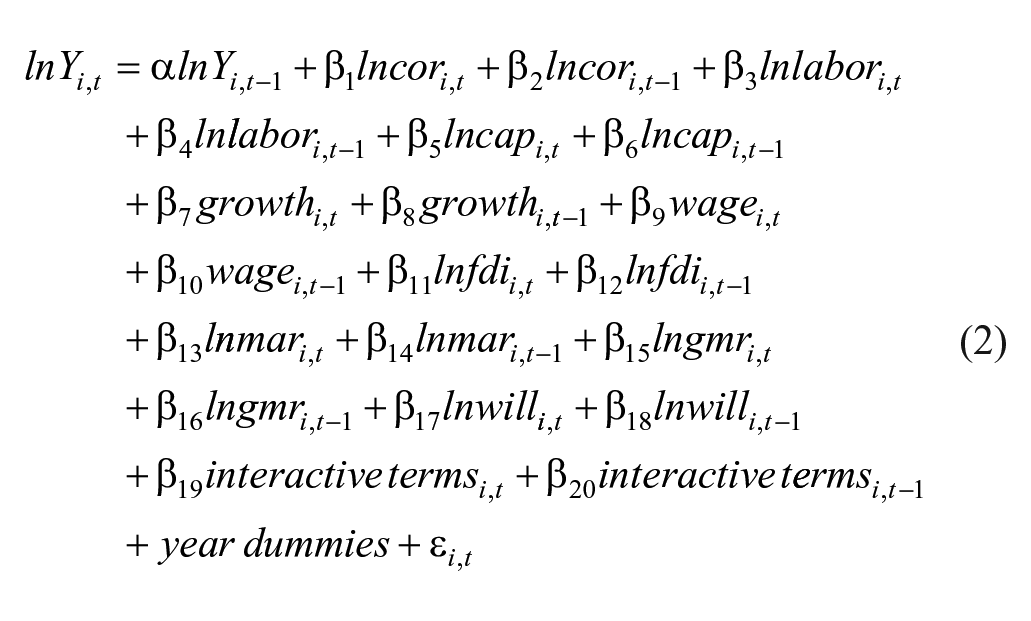
In equation (2), an autoregressive panel model indicates that the current level of an industrial structure upgrade is determined by both its current and past values. Through solving dynamic bias caused by the normal fixed effects estimation, this model can also be used to deal with the endogeneity issue such as simultaneity that cannot be well solved by the fixed effects estimation. Accordingly, the long-run coefficients for each variable are

Variable Definition
Dependent variable
The level of industrial structure upgrade: this paper examines the degree of an industrial structure upgrade from two dimensions: the advanced level of an industrial structure upgrade (lnad) and the degree of industrial structure upgrade realization (lntl).
First, the proxy indicator for the advanced level of an industrial structure upgrade is tertiary industry labor productivity, that is, tertiary industry labor productivity (ad) = tertiary industry’s total output value/the number of tertiary employment. This index value is logarithmically processed.
Second, the rationalization of an industrial structure upgrade is proxied by the Theil Index. The Theil Index (Wu et al., 2018) is expressed as TL =
Independent variables
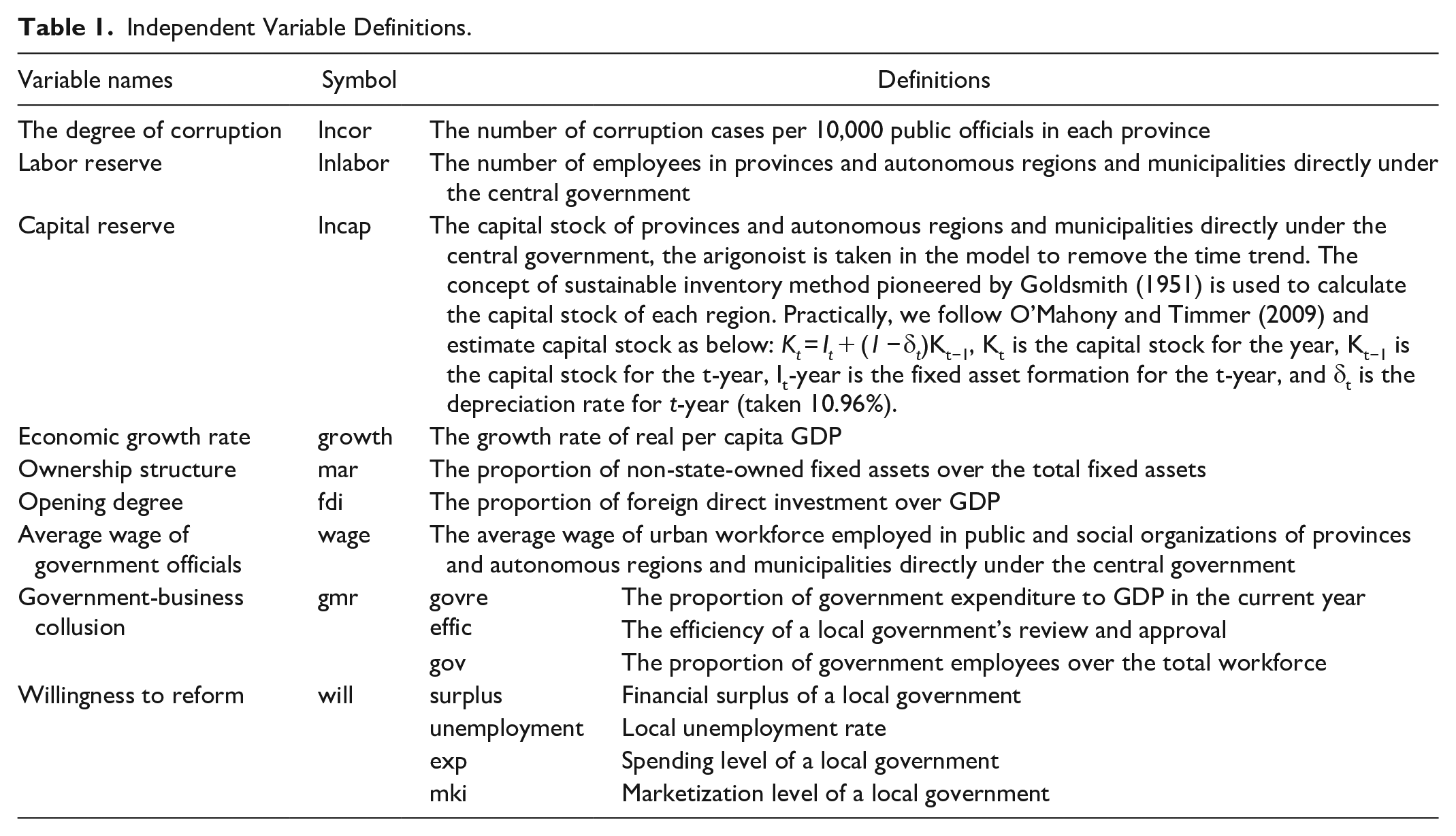
The estimation methods for each independent variable are illustrated in Table 1. Table 2 lists the descriptive statistics.
Independent Variable Definitions.
Summary Statistics.

It is worth mentioning that a number of core independent variables employed in this analysis are not directly accessible in a public dataset, thus this paper integrates the estimations from Wang et al. (2011, 2016, 2018), and Cai et al. (2018): the former uses the Arithmetic Average Method, and generates a weighted index incorporating the efficiency of a local government’s review and approval (i.e., measured by business owners’ attitudes toward government efficiency and its degree of intervention to local enterprises), the size of a local government (i.e., a smaller government is assumed to be less likely to intervene in market activities), and the ratio of resources that the public can access over the total amount of resources (i.e., a higher ratio implies lesser constraint from a local government) to indicate the strength of a government-business collusion; the latter, based on Principle Component Analysis, abstracts the common factor from the unemployment rate and the spending level (i.e., a lower rate indicates less pressure of a scheduled performance review by the central government, thus the local government is more likely to focus on reform), financial surplus (i.e., a local government has more resources to implement reform), and marketization level (i.e., a higher level indicates a more transparent, justice market environment) to represent the level of willingness of a local government to reform (Fan et al., 2013).
Empirical Results and Discussions
Table 2 shows that there is a great disparity in terms of socio-economic development across different provinces in China. For instance, the value of willingness to reform (lnwill) lies between 0.513 and 6.345, with a standard deviation of 0.978. Some of the independent variables show greater changes—the level of capital stock ranges (lncap) from 6.368 to 11.763. The following multicollinearity test (Table 3) shows that the model employed in this study is unlikely to suffer from the issue of significant multicollinearity, as the coefficients of most of variables are low. In comparison, only a few variables have comparatively high values, such as lnmar and lncap or lnmar and lnwill. However, this can be deemed realistic as the higher level of willingness of a local government to reform is inevitable linked with an industrial structure with a higher proportion of non-state owned enterprises. In response, we test our model through multiple specifications in order to deliver robust results, and these variables, for the purpose of this study, will not be included in one regression at the same time.
Multicollinearity Test.

p < .10. **p < .05. ***p < .01.
Econometric Results
The basic estimation excludes the interrelationship between corruption and government, market, or enterprise, thus the independent effects of corruption and other control variables can be observed. In Table 4, the results based on OLS (i.e., without dummy variables) and LSDV (i.e., with a time dummy variable) models are generally consistent. In comparison, the fixed effects estimation (i.e., with time and province dummy variables) shows different patterns.
Basic Results.

Note. Standard errors in parentheses. Dependent variable: lnad.
p < .10. **p < .05. ***p < .01.
Specifically, the coefficient of the degree of corruption (lncor) is significantly negative in all model specifications, implying that as the number of corruption cases per 10,000 public officials in a province drops, the productivity of tertiary industries is likely to increase. This finding indicates that the lower the degree of corruption, the more beneficial it is to upgrade the industrial structure, and vice versa. Next, the proxies of ownership structure (lnmar), willingness to reform (lnwill), and government-business collusion (lngmr) are included in the regressions. Similarly, OLS and LSDV models deliver consistent results; for instance, the effects of lnmar and lnwill are significantly negative and positive, respectively, while that of lngmr is insignificant. However, when the regional heterogeneity is taken into account, all of these independent effects become insignificant, suggesting that there is a significant disparity in terms of local government features, ownership structure, and government-business collusion among different regions in China. Such heterogeneity impedes us in interpreting the effect of corruption in a complicated market scenario and thus a further model modification is needed.
The estimation in Table 4 implies that the degree of an industrial structure upgrade cannot be simply explained by the degree of corruption alone. It appears that the transmission mechanism from corruption behaviors to actual socio-economic outcomes is complicated and involves the relationship between enterprises, government, and market. Accordingly, we further interact the degree of corruption (lncor) with ownership structure (lnmar), government-business collusion (lngmr), and willingness to reform (lnwill) respectively in Table 5, to determine whether the effect of corruption can be understood.
Corruption and Productivity.

Note. Standard errors in parentheses. Dependent variable: lnad, fixed effects estimation in all model specifications.
p < .10. **p < .05. ***p < .01.
First, the coefficients of corruption (lncor), willingness to reform (lnwill), and their interactive term are .364, .254, and −.0734, respectively, with the level of significance as shown in Column 1. This result confirms hypothesis 1, as the Chinese local governments appear to be reformational rather than conventional on average in the recent two decades; thus, emerging enterprises, compared to traditional sectors, are more likely to be facilitated by offering bribery, and benefits they receive are likely to make the presence of corruption have a positive effect on an industrial structure upgrade. However, along with a higher level of willingness to reform, the positive effect of corruption decreases, which is a realistic outcome of the general institutional improvement; its effect becomes negative for an industrial structure upgrade if the value of willingness to reform is above 4.96, which accounts for 75.1% of the total sample in this study (428/570 = .751).
In comparison, the coefficients of corruption (lncor), ownership structure (lnmar), and their interactive term are −.196, 1.101, and −.323, respectively, with the level of significance as shown in Column 2. This finding suggests that an increase in the proportion of emerging enterprises is likely to increase the productivity in tertiary sectors, but a higher degree of corruption reduces such an effect. In contrast, the total effect of corruption on an industrial structure upgrade is always negative and is even further negatively moderated by a higher proportion of emerging enterprises. This implies that even though the density of private enterprises is continuously increasing, which exerts a positive effect on productivity growth, state-owned enterprises still have much stronger capability to obtain a “living space” in its own environment. Therefore, as mentioned in the hypotheses development, the effect of traditional industries may overwhelm that of emerging industries, inhibiting the process of an industrial structure upgrade in China. Hypothesis 2 is confirmed.
As shown in Column 3, the coefficients of variables incorporating the effects of government-business collusion are not much different from those in Table 4. Particularly, the coefficients of corruption (lncor), government-business collusion (lngmr), and their interactive term are not significant. The explanation for this is two-fold: on one hand, this may imply that there is a great disparity in terms of the level of such collusion among different regions, thus the average effect on moderating the relationship between an industrial structure upgrade and corruption is not significant, and on the other hand, this may be a direct reflection of how the development trajectory of the general legal construction and anti-corruption laws and regulations have been forged in China over the past two decades. Much lesser enterprises, whether they are regarded as “traditional” or “emerging,” have chances to obtain benefits through bribery. Even though the collusion between government and enterprise is still observed, it becomes much more economically and socially costly and time-consuming, and this is no longer a venue to contribute to high quality development (Zhang & Keh, 2010). Therefore, hypothesis 3 is also verified.
With respect to other control variables, the coefficient of labor reserve (lnlabor) is significantly negative in all model specifications, meaning that when the employment of a province increases, the labor productivity of the province’s tertiary industry may decrease. This result shows that a gradual increase of labor resources in a region will not drive an advanced process of an industrial structure upgrade, and may even have a suppressing effect; a large component of specific human capital that is important in promoting an industrial structure upgrade appears to be dislocated (Hausmann et al., 2007; Zhou, 2018). The coefficient of capital reserve lncap is generally insignificant based on the fixed effects estimation; such an effect is only significantly positive in Column 2 where the effects of ownership structure and corruption are taken into account. This finding, not surprisingly, is consistent with previous studies (e.g., Zhang et al., 2021) that claim that the simple accumulation of capital is likely to lead to a capital misallocation and thus has an inhibitory effect on growth quality. Once again, the coefficient of lnfdi is not significant based on the fixed effects estimation and the coefficient of average salary level (wage) of government officials is only significantly positive in Column 2. When the average salary of government officials in a province increases, the productivity in tertiary industries also increases, which shows that raising the salary of government officials may curb the occurrence of corruption, and confirms the feasibility of “high salaries with honest civil servants” in anti-corruption work in various provinces, autonomous regions, and municipalities (Van Rijckeghem & Weder, 2001).
In conclusion, the coefficients of the variables investigated in this study slightly vary in different modifications, but the results can be explained in a consistent way and are conformed to reality. Most importantly, it appears that the effect size of corruption on an industrial structure upgrade is evidently moderated by specific institution domains (i.e., government feature and ownership structure).
Robustness Test
To ensure our results are robust, two tests are conducted from different perspectives. First, we replace the dependent variable, the advanced level of an industrial structure upgrade (lnad) (i.e., productivity in the tertiary sector) by the rationalization of an industrial structure upgrade (lntl) (i.e., industrial structure rationality). This is a different perspective to measure an economic performance. Second, the dynamic GMM estimator is employed to further deal with the issue of endogeneity.
As can be seen in Columns 1, Table 6, with the endogeneity and autoregressive corrections, the interpretation of the results is generally consistent with the estimations in Tables 4 and 5. For instance, the long run coefficient of lnlabor is significantly negative (e.g., (−.964 + .838)/(1 − .801) = −.633), and the independent effect of lncor on the improvement of productivity in the tertiary sector is significantly negative (i.e., −.178/(1 − .801) = −.894). Again, its associated effect with government-business collusion is insignificant. In addition, the coefficients of lnfdi and growth become significantly positive; this finding may imply that the dynamic GMM estimation reveals a different pattern compared to the fixed effects model after further dealing with the issue of endogeneity caused by simultaneity. Following this line of thought, the proportion of foreign direct investment in a province increases and the labor productivity of tertiary industries in a province may also increase correspondingly, indicating that the higher a region’s degree of opening up to the outside world, the more favorable it is for upgrading the industrial structure (Wang et al., 2020). As the degree of opening up to the outside world increases, the degree of interaction between domestic and overseas industries increases, the market’s grasp of the global industry’s development direction is more accurate, and the demand for advanced emerging industries is strengthened.
Robustness Test (Dynamic GMM Model).

Note. All regressions passed the Hansen J test. Standard errors in parentheses.
p < .10. **p < .05. ***p < .01.
Regarding the dependent variable lntl, a higher Theil Index indicates a more unreasonable industrial structure. The interpretation of the results presented in Columns 5 to 8 are also generally consistent with those in Tables 5 and 6 that have lnad as dependent variable, even though the signs of variables may vary according to a different model specification. For instance, the coefficient of corruption is −.106, with the level of significance shown in Column 5. This implies that the independent effect of a higher level of corruption appear to lead to a more reasonable industrial structure on average (i.e., a Theil Index is smaller).
However, incorporating the effects of relationship domains, such a “positive” effect is no longer straightforward. Column 6 shows that the interactive effect between ownership structure lnmar (i.e., the proportion of emerging industries) and the presence of corruption is significantly positive (i.e., (.648 − .565)/(1 − .895) = .790), meaning that given a higher density of emerging industries in a regional economy, the presence of corruption is only likely to exert a more negative effect on the improvement of an industrial structure (i.e., the total effect of lncor is always positively related to a value of Theil Index). On the flip side, a higher density of emerging industries plays a positive role in improving industrial structure, as there is negative effect observed on the industrial structure improvement (i.e., (−2.179 + 1.877)/(1 − .895) = −2.876). However, this effect is constrained by a higher degree of corruption; the positive interactive effect between lnmar and lncor will eventually turn the negative effect of lnmar to be positive (i.e., having an unreasonable structure).
The significantly negative relationship between the degree of willingness to reform and corruption in Column 7 indicates that a higher level of corruption is only likely to be associated with a more reasonable industrial structure when the value of a local government’s willingness to reform is above 5.000 (i.e., .141/.0282 = 5.000), where 74.0% (i.e., 422/570 = .740) of the sample regions meet this criterion according to the statistics summary. This implies that a reformist government is more likely to accelerate the process of industrial structure through taking bribery, thus a symbiotic relationship among corruption, willingness to reform and industrial structure upgrade is inevitable. In comparison, the interactive effect between government-business collusion and corruption is again insignificant in Column 8, which is similar to the pattern captured by the fixed effects estimation. This finding further supports hypothesis 3, as the assumption that a higher level of collusion facilitates the process of an industrial structure upgrade cannot be supported.
In summary, a similar conclusion is reached, as the effect size of corruption is still constrained by institutional conditions. Specifically, corruption appears to contribute to improving industrial structure to some extent, but it is quite context-based. As long as the overall institutional quality improves, it eventually brings negative effect to an industrial structure upgrade in another way around. Taking into account all above, it is believed that institutional conditions play important roles in determining the effect size of corruption on an industrial structure upgrade in China, and in many particular scenarios, such an effect varies.
Conclusions and Implications
Conclusions
Most of the existing literature focuses on the relationship between corruption and economic growth (Aidt, 2010; Mauro, 1995; Mo, 2001), and rarely discusses the relationship between corruption and an industrial structure upgrade incorporating complex government-business relationships. In response, our investigation is one of a few studies that systematically analyze the different impacts of various parties involved in corruption during the process of an industrial structure upgrade. The findings provide important materials and references for policy makers to understand the transmission mechanism of corruption both in China and worldwide.
Based on fixed effects and dynamic GMM estimations, the results are robust through multiple model specifications. Specifically, our findings provide three important lessons for policy makers and local regulators: (1) corruption plays a declining role in determining the process of an industrial structure upgrade in China; (2) ownership structure and a local government’s willingness to reform appear to be the useful scenarios to demonstrate how the effect size of corruption is moderated by a government-business relationship; (3) there is a tendency that organizations and industries in China start to rely less on government ties, but more on market mechanisms, as a government-business collusion in China does not appear to facilitate the process of an industrial structure upgrade on average (Xie & Zhang, 2020). Along with confirming hypotheses 1 to 3, these findings, to a certain degree, are consistent with present studies that claim that corruption does not facilitate high-quality socio-economic growth in the long term (e.g., Aidt, 2010; Hodge et al., 2011). At the initial stage of an industrial structure upgrade, the attitude of government and the market toward such a reform measure is not clear and the degree of corruption is low, and thus corruption bring social capital that improves the efficiency of resource allocation to a certain extent, which in turn accelerates the process of an industrial structure upgrade. However, the associated institutional environment is also inevitably improved. The growing level of corruption therefore reduces the efficiency of resource allocation, conflicts with the advanced socio-economic system, and has an inhibitory effect on an industrial structure upgrade (Emerson, 2002; Hanif et al., 2020; Jain, 2001; Lui, 1996). Nevertheless, corruption still has some tendency to provide benefits to some extent, as the majority of these moderating factors representing local institutional quality have to reach a certain level to turn the effect of corruption to be negative.
Implications
Our findings have a range of implications. Despite the overall important role of corruption in affecting the industrial structure upgrade in China, policy makers and regulators need to understand its dynamic roles in different relationship domains. It should be obvious that dealing with corruption is a complicated issue that involves not only “draconian laws,” but also the improvement of market mechanisms. Therefore, it appears that there is not a “one-size-fits-all” solution across different regions and cities in China. A local government must comprehensively understand the dynamics of an industrial structure upgrade, and acquire competencies and knowledge about when the effect of corruption reaches its inflection point and how its downside can be alleviated by placing specific “socio-economic” constrains such as ownership reform. Moreover, business and government performing their respective functions can greatly improve the efficiency of industrial structure upgrade. This requires a concept change toward the present government-business relationship model in the Chinese society, even though government ties may continue holding strong implications for business and industry development in future. The central and local governments have to envisage such a raising conflict between deeply rooted cultural characteristics and the mature of rational–bureaucratic system (Zhang & Keh, 2010).
The main limitation of this study is that the data is not accessible at a more disaggregated level, thus a specific investigation of major cities or regions is not feasible. Also, the variables regarding government-business collusion and willingness to reform are subjectively generated. Therefore, there is a need for a harmonized dataset at the regional or city level. Finally, we acknowledge that the findings of this study may be not generalizable to other economies; they present a new perspective for future research to explore.
Footnotes
Acknowledgements
The authors gratefully acknowledge the help comments from reviewers and editors.
Availability of Data and Material
The datasets used and/or analyzed during the current study are available from the corresponding author on reasonable request.
Declaration of Conflicting Interests
The author(s) declared no potential conflicts of interest with respect to the research, authorship, and/or publication of this article.
Funding
The author(s) disclosed receipt of the following financial support for the research, authorship, and/or publication of this article: This research was funded by the China Postdoctoral Science Foundation funded project (Grant No. 2017M613092), the Fundamental Research Funds for the Central Universities (Grant No. SK2020018).
