




Abstract
Only a few studies focus on scientists’ innovative work behavior (IWB); thus, this study aims to explore its determinants. The study analyzed the effects of personal factors (learning motivation, professionalism, emotional intelligence, and job competence), job characteristic factors (task identity, job autonomy, feedback, and skill variety), cultural factors (hierarchical culture, group culture, development culture, and learning culture), and relationship factors (internal network, external network, leader support, and coworker support) on scientists’ IWB. To this end, we collected data by conducting a survey. The model developed in this study focuses on the direct and indirect roles of relationship factors. A total of 1,200 scientists in Korea were selected for the sample, using a proportional distribution method. Based on age and gender, stratified by research institutes (both public and private) and universities. Out of 1,172 valid samples, the responses of 849 scientists were finally analyzed. The variables included learning motivation, professionalism, job competence, task identity, skill variety, and external network were derived as determinants of scientists’ IWB. In addition, personal and job characteristics primarily influenced this behavior. Furthermore, the internal network, external network, leader support, and coworker support moderated the relationship between innovative work behavior and its antecedents. These findings imply that scientists’ IWB is enhanced not only by personal resources, better job design, and cultural capital but also by social relationship support, which facilitates or buffers personal, job, and cultural factors.
Keywords
Introduction
This study aimed to analyze the factors influencing scientists’ innovative work behavior (IWB). To this end, it focused on personal factors, job characteristic factors, and cultural factors as factors affecting scientists’ IWB and identified the direct and indirect effects of relationship factors.
The research gaps addressed in this study highlight the importance of analyzing scientists’ innovative behavior, as shown below:
First, despite the critical importance of scientists' innovative behavior for both national economic growth and organizational competitiveness (Aghion et al., 2009; Ikeda et al., 2019), research on its determinants remains limited. While companies with high workforce agility demonstrate greater innovation capacity (Franco & Landini, 2022), comprehensive studies specifically examining scientists' IWB are scarce. A study
Second, from a theoretical perspective, existing studies have only analyzed IWB in a piecemeal fashion rather than from an integrated perspective. This focus on specific variables has resulted in a lack of integrative insight. For example, Alhmoudi et al. (2024) demonstrated the role of corporate social responsibility in IWB. Similarly, Kholifah et al. (2024) showed that soft skills competence and organizational culture significantly impact IWB. Furthermore, Bauwens et al. (2024) confirmed that only strong performance management systems foster IWB (i.e., those with high distinctiveness, high consistency, and high consensus). Similarly, Lewaherilla et al. (2024) noted the significant relationship between intellectual capital, IWB, and business performance. Regarding gender, Al-Taie and Khattak (2024) indicated the impact of the relationship between perceived organizational support and human resources practices on IWB. Pham et al. (2024) found the pathways to IWB and job performance, highlighting the significant role of public service motivation, transformational leadership, and person-organization fit. Venketsamy and Lew (2024) reported the significant role of intrinsic and extrinsic reward synergies for IWB, while Abd-Elmoghith et al. (2024) focused on nursing personnel’s perceptions of ethical climate and IWB.
However, these studies primarily focus on a single variable, failing to address a broader range of factors in a balanced way. A bibliometric meta-study on the evolution of the literature on IWB (2013–2023) by Nor et al. (2024) highlighted a bias toward studies on engagement, commitment, and leadership. However, Research has insufficiently addressed multiple factors influencing IWB, particularly overlooking fundamental human relationship factors (Hashim et al., 2024). While existing studies emphasize individual and organizational factors, they neglect the relational nature of human behavior in organizational contexts.
Third, although the impact of leadership has been explored in the relational dimension, some relationship factors have been overlooked. Regarding leadership, Al Nahyan et al. (2024) showed that both an innovative organizational culture and servant leadership are significantly and positively related to employees’ IWB. The results also show that they stimulate employees’ IWB through perceived organizational support. In addition, Islam et al. (2024) confirmed the critical role of entrepreneurial leadership in the relationship between knowledge sharing and IWB. Similarly, transformational leadership reinforced the relationship between performance management systems consensus and IWB (Bauwens et al., 2024). However, in organizational socialization processes, various factors intervene in the relationship between organizational factors and IWB (Torlak et al., 2024). For example, according to Hock-Doepgen et al. (2024), organizational support has a significant impact on IWB. These findings suggest that both relationships and organizational leadership have an important role in IWB.
Fourth, although many studies focus on moderators and parameters in IWB, comparative research remains insufficient. Recent studies have focused on the relationship between independent variables and IWB rather than the direct relationship between them. This has naturally led to a growing interest in mediators and moderators. For example, Al Nahyan et al. (2024) confirmed the moderating role of task independence in managerial coaching and IWB. In addition, Islam et al. (2024) showed that employees’ perception of entrepreneurial leadership strengthens the association between knowledge sharing and IWB. Regarding other variables, Zafar et al. (2024) examined that the interdependent dynamics of IWB, innovative culture, employee inventive performance, and emotional intelligence. However, as these studies only focus on a linear role or single path using a specific mediator or moderator, they are not comparative. Thus, more comparative studies are crucial to enable variable generalization.
The remainder of the paper is organized as follows: the theoretical background in the “Theoretical Background” section reviews existing studies on IWB, explains the factors that affect IWB, and presents the research hypotheses. “Sampling and Measurement”section describes the reliability of the questionnaires and research design to measure each factor and variable, while “Analysis and Results” section attempts to test the hypotheses through descriptive, correlation, and regression analyses between variables. Finally, “Analysis and Findings” section discusses the implications of this study and future research directions based on the analysis results.
Theoretical Background
Innovative Work Behavior
Several studies have defined IWB; some have described it as complicated, non-routine behavior that encourages employees to express new ideas, forgo old ideas, and question existing work methods (Kessel et al., 2012). It involves employees’ generation, creation, development, application, promotion, realization, and modification of new ideas to help their organization through job performance (Thurlings et al., 2023). Ideas are always associated with creativity and are often discussed simultaneously with innovation. Here, IWB refers to more than just creativity in the initial stages of developing new and valuable ideas (Scott & Bruce, 1994).
Second, some studies emphasized the aspects of ability and capability embedded in innovative behavior. IWB refers to an employee’s ability to improve unique job-related ideas in an organization (Axtell et al., 2023). It can also pertain to the ability to develop fresh ideas and perspectives and translate them into innovation (Escribá-Carda et al., 2017). Thus, IWB can help to develop new products, marketplaces, methods, and combinations (Dhar, 2015).
Third, some studies have focused on the actions and behaviors involved in implementing ideas. Salam and Aslan (2023) stated that, in addition to creativity, IWB involves idea publicity and implementation. Farr and Ford (1990) defined IWB as the act of employees generating, adopting, or utilizing ideas to improve their work or organizational performance. A person’s behavior in the workplace and the arena of modern work proactively promotes new and valuable ideas, work processes, products, and procedures (Siregar et al., 2019).
Fourth, several studies have explored innovation outcomes. Scott and Bruce (1994) defined it as an act of voluntarily improving individual and organizational performance by generating and implementing solutions to problems, including the development of ideas or technologies related to new products and improvement of working relationships and administrative procedures to enhance process efficiency and effectiveness (Kleysen & Street, 2001). Finally, previous research has investigated the link between ideas and results by exploring employees’ creation, adoption, and implementation of innovative quality in products, techniques, and work processes (Yuan & Woodman, 2010). Here, IWB refers to employees’ behavior to intentionally create, introduce, and apply new ideas at work in a group or organization to enhance performance (Janssen, 2000).
These different definitions of IWB posit it as a multidimensional construct. The multifaceted elements of creative action emerge from identifying, encouraging, and implementing novel and valuable ideas (Scott & Bruce, 1994). Thus, a multidimensional definition of IWB should include a range of behaviors. As such, Kleysen and Street (2001) define IWB as the creation, introduction, and application of useful novelties at all organizational levels and view it as an individual action or task. IWB is a combination of behaviors related to the development and implementation of a new, important, and beneficial idea to improve employee and organizational performance (De Jong & Den Hartog, 2023). Various types of innovative behavior occur throughout an innovation or change process: idea generation continues throughout the process, while application begins in its early stages (Tuominen & Toivonen, 2011).
Extensive research has identified multiple IWB determinants across organizational levels, including leadership, work environment, individual characteristics, and job design factors (Javed et al., 2019), specialization, functional differentiation (Zornoza et al., 2007), and organizational size (Wolske et al., 2017). Meta-analyses demonstrate stable relationships between structural factors (specialization, professionalism, centralization) and innovation outcomes (Damanpour, 1991), with team process variables showing the strongest associations with creativity and innovation (ρs between .4 and .5).
Specifically, the input variables (i.e., team composition and structure) showed smaller effect sizes (Hülsheger et al., 2009a).
Overall trends in IWB research, rather than simple variable approaches, center on level and factor variables. Most commonly, the determinants of innovation are delineated at the individual, organizational, and environmental levels. According to Baldridge and Burnham (1975), at the individual level, gender, age, and personal characteristics do not affect IWB in complex organizations, while administrative status and role influence the innovation process. At the structural organization level, organizational size and complexity impact organizational innovation behavior, while at the environmental level, this behavior is influenced by community inputs. Salam and Aslan (2023) classify employees’ influence on IWB into internal and external factors. Internal factors include innovative personal characteristics and the desire to engage in innovation, while external factors include team climate (technology, values, finances, etc.) and management support. Kimberly and Evanisko (1981) examined how individual, organizational, and contextual factors impact organizational innovation factors, for example, the impact of hospitals’ adoption of technological and administrative innovations. In addition, Srirahayu et al. (2023) used personal, organizational, and external factors as determinants of IWB. Reviewing 57 eligible studies, Srirahayu et al. (2023) identified three factors that influenced IWB in public organizations: personal, inter/teamwork, and organizational.
This research examines four theoretical domains influencing IWB: personal, job characteristic, cultural, and relational factors. Job characteristics theory (Hackman & Oldham, 1976) provides the foundation for understanding how work design elements—skill variety, task identity, autonomy, and feedback—influence innovation through psychological states of meaningfulness, responsibility, and knowledge of results. Innovation, as a performance outcome requiring freedom and diversity, is particularly influenced by job autonomy, task identity, and feedback mechanisms.
Second, cultural factors operate collectively to influence individual innovative behavior. The Cultural Value Framework (Quinn & Rohrbaugh, 1983) establishes that effective cultures, characterized by external orientation and flexibility, drive organizational innovation. Brettel et al. (2015) show that developmental, group, and rational cultures have a strong positive impact, whereas the impact of hierarchical culture is negative.
Third, relational factors shape cognitive processes through social network mechanisms (Douglas & Wildavsky, 1983). Social networks facilitate innovation by enabling information gathering, resource access, and exposure to new perspectives—essential requirements for innovative behavior (De Jong & Den Hartog, 2010; Leenders and Dolfsma, 2016).
The difference between the three factors exists; personal variables are in the private sphere and can be difficult to manage organizationally. Job design variables, on the other hand, exist in the public space of the organization and are variables that the organization can intentionally intervene in. Cultural and relational variables are collective in nature, which makes them different from the highly personal individual variables. Relational variables are interactive, which makes them different from personal or job characteristic factors that are more general in nature.
Personal Factors
Personal factors affect IWB. Based on the five types of IWB identified by Kleysen and Street (2001), learning motivation, professionalism, emotional intelligence, and job competence were identified as personal factors. Among these factors, the motivation to learn is considered a basic factor in learning processes and refers to the desire to learn something. It refers to the extent to which learners voluntarily strive to improve their performance and aspirations (Noe & Schmitt, 1986). Using survey data from 179 students in five classes who took creative courses at three universities in Taiwan, Shiu et al. (2012) positively related learning motivation to innovative behavior and found that creative self-efficacy mediates this relationship. Yean et al. (2016) showed that academic staff members who are highly engaged at work are more likely to exhibit a higher level of learning goal orientation, which ultimately translates into IWB. Based on this rationale, we propose the following hypothesis:
As innovation is the productive utilization of knowledge, knowledge-based professionalism is closely related to IWB. Professionalism is typically defined as taking pride in one's ability to perform a job based on expertise and training in the field (Chisholm et al., 2006). Popovich et al. (2011) identified characteristics that underlie the expression of professionalism: responsibility for one's actions, commitment to self-improvement of skills and knowledge, creativity and innovation, knowledge and skill in the profession, pride in the profession, and service orientation. Based on a questionnaire survey of 60 vocational teachers, the characteristics of professionalism were positively related to IWB. Specifically, the “metacognitive dimension” of professionalism was considered crucial. Accordingly, we propose the following hypothesis:
The concept of emotional intelligence is used to describe interpersonal adjustment and individual emotions and has emerged as an important factor in psychology (Matthews et al., 2004). Traditionally, cognitive intelligence has been considered to drive innovation; however, it has more recently been recognized as an innovation factor (Goyal & Akhilesh, 2007). In a study of 500 employees from 19 organizations in the United Arab Emirates, Suliman and Al-Shaikh (2007) demonstrated a positive association between emotional intelligence and IWB. According to Malik (2021), emotional intelligence has a direct positive impact on employees’ tacit knowledge sharing and IWB. Similarly, through a review of other meta-analyses, Van Rooy and Viswesvaran (2004) confirmed the significant effect of emotional intelligence on academic and professional performance. Accordingly, we propose the following hypothesis:
Job competence refers to workers’ overall performance capabilities. In general, people with higher competence demonstrate better job performance. Employee competence, which is influenced by intrapreneurial competencies (Aris et al., 2019), has the greatest impact on IWB (Phil-Tingvad & Klausen, 2020). In this regard, Aima et al. (2017) identified nine factors that affect performance. Among them, work motivation and job competence positively impacted performance. Waenink (2012) investigated the competencies that foster IWB among employees, finding that different competencies had varying types of positive influence on IWB. Internal networking skills, proactivity, and role-breadth self-efficacy positively influenced IWB, although competence in organizational knowledge had no impact. Based on the above, this study assumes that scientists’ personal competence positively affects their IWB. Accordingly, we propose the following hypothesis:
Job Characteristic Factors
A multifunctional job design and perceived human resource management (HRM) system promote employee involvement in innovative activities through increased feelings of ownership over work-related issues and problems (Dorenbosch et al., 2005). This study analyzed the impact of job characteristics on innovation as a job design factor. We focus on the following four job characteristics: task identity, autonomy, skill variety, and feedback (Hackman & Oldham, 1976).
Task identity represents the perception of how the current task relates to the overall outcome (Hackman & Oldham, 1976). A high task identity provides workers with a broader perspective when completing the job as an entire and identifiable part, enabling them to be creative in identifying problems or challenging issues (Suseno et al., 2020). Task autonomy refers to an actor’s degree of discretion in deciding when and how to complete a task (Hackman & Oldham, 1976). Task autonomy is an HRM practice widely studied in public organizations and has a positive influence on IWB (Phil-Tingvad & Klausen, 2020). Autonomy is also related to individual innovation (Shalley & Gilson, 2004; Yelon et al., 2004). Skill variety refers to the need for and applicability of various skills to perform a job (Hackman & Oldham, 1976). Skill variety increases employees’ creativity as it provides them with a high degree of behavioral freedom to develop and assess new ideas (Noefer et al., 2009). Finally, feedback refers to the degree to which an actor receives feedback on their progress and performance information regarding the results (Hackman & Oldham, 1976). Employees who receive relevant, useful, and constructive job feedback are likely to be innovative as they try to acquire new knowledge and skills to improve their work outcomes (Hammond et al., 2011). Accordingly, we propose the following hypothesis:
Cultural Factors
To elicit IWB, an incentive system at the individual level and cultural artifacts at the organizational level are needed to ensure that innovation permeates the organization. This suggests that organizational culture and climate are important determinants of IWB (Robbins, 1996). This organizational climate should encourage innovation and creativity (Hammond et al., 2011). Moreover, important management tools for culture include knowledge of the innovation strategy, which encourages management, and a risk-tolerant culture (Phil-Tingvad & Klausen, 2020). Quinn and Rohrbaugh (1983) divided culture into four types: hierarchical, rational, group, and developmental. Based on internal, external, and flexibility factors, Cameron Kim and Quinn Robert (1999) categorized hierarchical cultures as control-oriented (hierarchy), competitive (market), cooperative (clan), and ad hoc (adhocracy). Among the four types, we focused on hierarchical, group, and developmental cultures. According to Büschgens et al. (2013), different cultures have different impacts on innovation. A developmental culture that emphasizes an external and flexible orientation is most likely to be implemented by managers of innovative organizations. Meanwhile, group and rational cultures are consistent with the goals of an innovative organization. However, hierarchical cultures are less likely to be found in innovative organizations because they emphasize control and internal orientation. Siswanti (2022) noted that except for hierarchical culture, adhocracy, clan, and mark/rational cultures have significant relationships with innovation. In a study of 298 enterprises, Brettel et al. (2015) found that developmental, group, and rational cultures had a strong positive impact, whereas a hierarchical culture had a negative influence. They argued the importance of fostering an organization’s external orientation. Accordingly, we propose the following hypothesis:
At the organizational level, learning can be a source of innovation and may be achieved through formal training. However, it can also be culturally constructed to influence innovation. An organizational learning culture is defined as a set of norms and values regarding the functioning of an organization (Škerlavaj et al., 2010). In addition, learning cultures have commonalities with different cultural types in organizations. Within the competing values framework, an organizational learning culture covers aspects of all four cultural types: group, developmental, hierarchical, and rational (Škerlavaj et al., 2010). The task-related learning potential of the workplace fosters employees’ IWB (Cangialosi et al., 2020). Accordingly, we propose the following hypothesis:
Relationship Factors
Since scientists are inherently social beings, the social networks and support systems that characterize their relationships influence their behavior. Additionally, scientists, by nature, conduct collaborative research through networks with people in the scientific community and achieve results such as technology commercialization and diffusion using external networks. From this perspective, networks constitute a major source of social capital for scientists. Leenders and Dolfsma (2016) demonstrated that social networks inside a firm, between firms, and outside the firm facilitate innovation, enabling employees to gather resources and learn about new ideas and perspectives, which in turn drive IWB. Moreover, after examining the relationships between participative leadership, external work contacts, and innovative output, they found that external work contacts were positively related to IWB (De Jong & Den Hartog, 2010). Accordingly, we propose the following hypothesis:
March and Simon (1958) conceptualized the employment relationship as an exchange between organizational inducements and employee contributions (March & Simon, 1993). According to Scott and Bruce (1994), organizational members share their expertise and knowledge to help each other when faced with new or difficult problems, while their cooperation and support can promote new ideas or creativity in problem situations, leading to new tasks. Perceived organizational support has a critical impact on IWB (Afsar & Badir, 2017). For example, a supportive work environment is conducive to innovation (Hülsheger et al., 2009b), and social support from coworkers and leaders creates a comfortable innovation environment. Employees who enjoy favorable internal social support from team members are more likely to implement their ideas (Hammond et al., 2011). Supervisors’ and coworkers’ support moderate the relationship between boundary integration and IWB (Yasir & Majid, 2019), while leaders influence employees' innovative behavior through deliberate actions aimed at stimulating idea generation and application and general, daily behavior (De Jong & Den Hartog, 2023).
Regarding social support in organizations, much research has been conducted on the impact of leadership on innovation, especially in the context of leaders. Liao et al. (2010) discovered a high-quality exchange relationship between leaders (to some extent, supervisors might represent their organization) and employees, which could promote employee creativity. Accordingly, we propose the following hypothesis:
Moderation Effect by Relationship Factors
Recently, research has focused more on moderators and mediators. This is because the type of innovation may vary depending on the situation, such as workplace practices, techniques, and the working environment (Salam & Aslan, 2023). Individual innovative behavior is the outcome of four interacting systems: individual, leadership, workgroup, and climate (Scott & Bruce, 1994). Furthermore, tangible (size and debt) and intangible factors (human factors, commercial resources, organizational resources, diversification, and internationalization) influence innovation through their interaction with each other (Galende & de la Fuente, 2003). Although a positive relationship generally exists between these factors, five variables moderated this relationship: type of IT innovation, type of organization, stage of adoption, scope of size, and type of size measure (Lee & Xia, 2006). Finally, another meta-analysis of the relationships between four predictor types (individual differences, motivation, job characteristics, and contextual influences) and individual-level workplace innovation, individual factors, job characteristic factors, and the environment found them to be moderately associated with phases of the innovation process (Hammond et al., 2011).
Moreover, Wang et al. (2015) showed that the impact of leader-subordinate relationships on innovation is moderated by social networks. In an empirical study of 134 employees (response rate: 88%) and 31 supervisors (response rate: 97%) at an Italian consulting company, Nedkovski and Guercin (2021) demonstrated that having many homophilous ties, such as professional background and gender, increases the positive relationship between social network brokerage and individuals’ innovative behavior.
Leaders and coworkers influence the relationship between IWB and its antecedents. When employees with high help/support from coworkers exhibit the highest level of firm service innovation, leaders or managers can enhance this positive relationship by relying more on increased social interaction (Li & Liu, 2019). Wang et al. (2015) found that leader–member exchange (LMX) was positively and significantly related to innovative behavior only when the number of within-group strong ties was low. Moreover, LMX fully mediated the positive relationship between weak out-group ties and innovative behavior.
Furthermore, horizontal support from coworkers is as important as support from leaders. Montani et al. (2012) reported the moderating role of coworker support. Based on a survey of 186 employees at a chemical and pharmaceutical company, they found that positive relationships between supervisor support and innovative behaviors were significant only in the case of high coworker support. When affective commitment fully mediated the positive relationship between perceived social support and IWB, perceived coworker support moderated the relationship (Yang et al., 2020). Moreover, coworker support complemented the role of leaders. Here, coworker feedback moderates the mediated relationship between supervisor feedback and innovative behavior through work engagement (Eva et al., 2019). Accordingly, we propose the following hypothesis:
Based on the hypotheses, our research framework is shown in Figure 1.

Research framework.
Sampling and Measurement
Data Collection
The data used in this study were collected by a specialized research company (Korea Research Co.) from the “Career Development Panel Survey for Scientists (2021)” under support from the KIRD (Korea Institute of Human Resources Development in Science and Technology). A lot of researchers who participated in the questionnaire are scientists mainly under the NST. NST stands for National Research Councils for Science and Technology. In Korea, public technology research organizations belong to this association. Also, a few scientists in private research institute and university participated in survey. The survey was conducted from November 26, 2021, to December 15, 2021, among graduates of the KIRD. KIRD is a training organization for scientists employed at the 25 research institutes under NST. A total of 1,200 individuals were selected for the sample, using a proportional distribution method based on age and gender, stratified by research institutes (both public and private) and universities. The target sample size was 1,000 respondents, with a maximum allowable sampling error of approximately ±4.4 percentage points at a 95 percentage confidence level. The survey was carried out online through a web-based platform accessible via PC, tablet, or smartphone. The list of survey participants was provided by the National Institute of Science and Technology Human Resources Development, and the survey was conducted by Korea Research Co., Ltd. Considering the limitations of using personal information in web surveys and variability in controlling concurrent connections, data were collected from a sample of 1,200 participants. After removing 28 non-responses through an analysis of variance and standard deviation, 1,172 valid samples remained, from which the responses of 849 scientists from public research institutes and private companies were finally analyzed.
The specific demographics of the survey participants are shown in the Table 1.
Characteristics of the Samples.

Measurement Items and Reliability Analysis
This study aims to analyze the factors that determine scientists’ IWB. Scientists’ IWB is the dependent variable, while personal, job characteristic, cultural, and relationship factors are the independent variables. Personal factors include learning motivation, professionalism, emotional intelligence, and job competence as measurement items. Job characteristic factors include task identity, job autonomy, feedback, and skill variety, while cultural factors include hierarchical orientation, group culture, learning climate, and innovation as measurement items. The relationship factors are internal and external networks, leadership support, and co-workers’ support.
We used the measures of IWB from De Jong and Den Hartog (2010). professionalism, job competence, and job autonomy from Kim & Baek (2007), and learning motivation from Jim & Yoo (2009), emotional intelligence from Wong & Law (2017), task indentity form Seo et al. (2018), feedback from Lee (2018), organization culture from Wudarzewski (2018), learning motivation, internal and external network from Kim et al. (2017), coworker and leader support from Lee & Jo (2019). We revised those measures after pretest stage.
A pretest was conducted in two ways: first, a cognitive test of 10 experts. Based on these results, we revised the questionnaire and conducted a small-scale survey of 30 scientists with the revised questionnaire. A pretest was conducted before the questionnaire was fully implemented. This was done in two ways: first, a cognitive test of 10 experts. The experts checked the questions for question difficulty, logic, and reality. Based on these results, we revised the questionnaire and conducted a small-scale survey of 30 scientists with the revised questionnaire. We analyzed the distribution of responses and the non-response rate. Also, we analyzed the responses to open-ended questions in order to identify areas where the questionnaire needed to be revised.
The results of the reliability analysis for each measurement item are shown below. Cronbach's α values for all items exceeded .7 except for hierarchical orientation.
The dependent variable, IWB, was measured with the following statements (Cronbach α = .874): “I try different new ways of doing things,”“In the course of my job, I constantly try to find areas in which I can improve,”“I strive to create/apply new and original ways of doing things,” and “I tend to propose new ideas to solve problems that arise in the course of my work.” Respondents were asked to indicate their level of agreement with these statements on a five-point scale (1 = strongly disagree and 5 = strongly agree).
Among the independent variables, learning motivation in personal factors was measured with the following statements (Cronbach α = .819): “I try to spend as much time as I can on self-improvement,”“I tend to take pleasure in learning new things,”“I engage in learning with clear goals,” Professionalism was measured with the following statements (Cronbach α = .810): “I have a strong work ethic in my job,”“I am an expert in my field of work,”“I keep my focus on what I am interested in rather than what is trending.” The statements for emotional intelligence were: “I am in control of my emotions” and “I am calm about everything” (Cronbach α = .752). Job competence was measured through “current overall level of competency” and “current planning competency level,” which indicated “current level of job performance” (Cronbach α = .891). The following statements for job competence were measured on a five-point scale: “not good enough to work alone,”“can work alone,”“good enough to work alone,”“ability to teach others,” and “creative and innovative.”
Job characteristics included task identity, job autonomy, feedback, and skill variety. First, task identity was measured with the following statements (Cronbach α = .791): “I am solely responsible for all aspects of my work,”“The work I do is organized so that I can take charge of the entire task from start to finish,” and “I think it’s more important to have an overarching role.” Job autonomy was measured with the following statements (Cronbach α = .818): “I tend to have more freedom and independence in my work,”“I am not a fan of unnecessary bureaucracy when it comes to getting things done,” and “I have choices about how I do things and the procedures I follow.” Feedback was measured with the following statements (Cronbach α = .723): “I have feedback from coworkers about how well I am doing my job,”“I have feedback from my boss about how well I am doing my job.” Skill variety was measured with the following statements (Cronbach α = .809): “My job requires a variety of skills” and “My work is highly technical.”
Among the cultural factors, hierarchical culture was measured with the following statements (Cronbach α = .571): “My organization is controlled and structured,”“My organization emphasizes hierarchy.” Group culture was measured with the following statements (Cronbach α = .702): “My organization values the unity of the group over the individual” and “My organization values institutional goals over personal goals.” The measurement statements for development culture were as follows (Cronbach α = .903): “My organization values dynamism and creativity,”“My organization values personal challenge, innovation, freedom and individuality,” and “My organization is responsive and flexible to change,” The measurement statements for learning climate were as follows (Cronbach α = .900): “My organization always emphasizes the importance of employee training,”“My organization encourages its members to learn in various ways,” and “My organization is open to new ideas and changes.”
Among the relationship factors, internal network was measured with the following statements (Cronbach α = .787): “I have many close coworkers with whom I can discuss work-related issues” and “I meet frequently with members of my organization in connection with my work and have close relationships with them.” External networks were measured with the following statements (Cronbach α = .856): “I tend to collaborate with outside experts to get things done” and “I frequently meet and get to know outside experts in my work.” Measurement statements for leader support (Cronbach α = .920) included: “My boss stimulated my intellectual curiosity by bringing different perspectives into the problem-solving process,”“My boss intellectually stimulates me by bringing new perspectives to my work,” and “My boss tends to talk passionately about what needs to be done.” Finally, coworker support was measured (Cronbach α = .873) with the following statements: “My coworkers help me with my work as if it were their own” and “My coworkers gave me a lot of encouragement and help when I struggled.”
Since this study collected responses to two or more variables through self-reporting from the same respondents, there is a possibility of common-method bias. Therefore, Harman's single factor test (Podsakoff et al., 2003) was conducted to verify the existence of such bias. As a result of the main factor analysis using all the variables used in this study, it was confirmed that the first factor, which accounts for the most explanatory power, has 23.933% of the variance, which is less than 50%. Therefore, it was determined that the distortion caused by the common method bias was not significant.
Validity Analysis
Prior to analyzing the data, we first validated the measures. The results showed that all the criteria for goodness of fit were satisfied (chi-square = 1298.477, p = .000, CFI = .963, NFI = .932, TLI = .953, RMSEA = .036, SRMR = .036). To check the convergent and discriminant validity of the latent variables, we calculated CR, AVE values, and correlation coefficients between the latent variables. The analysis showed that the standardized coefficients were mostly greater than 0.7. The standardized coefficients were mostly greater than 0.6. They confirmed the convergent validity.
For discriminant validity, the correlation coefficients between some latent variables are greater than .6. However, when compared the rooted AVE value and the correlation coefficients between the latent variables, it was confirmed that the latent variables are distinguished from each other in the latter values. The skewness did not exceed the absolute value of 2, and the kurtosis did not exceed the absolute value of 7, indicating that the univariate normality of all variables was secured. Univariate normality of all variables (Table 2).
Validity Analysis.

Correlation is not specified in the model.
Note. The bold diagonal values represent the square roots of the average variance extracted (AVE).
p < 0.10, *p < 0.05, **p < 0.01, ***p < 0.001.
Discriminant validity was further rigorously tested using the heterotrait-monotrait ratio of the correlations (HTMT) method, which is a method for evaluating discriminant validity among latent variables in structural equation modelling. This method was proposed by Henseler et al. (2015), who pointed out the lack of sensitivity of comparing the correlation coefficients between latent variables and the square root of the mean variance extracted. Discriminant validity is claimed to be clearly present when the calculated HTMT value between latent variables is lower than 0.85, with 0.9 or less generally considered acceptable. In our analysis, the HTMT values were .85 or less, indicating discriminant validity (Table 3).
Validity Analysis (HTMT Analysis).

Analysis and Findings
Descriptive Analysis
A mean comparison analysis was conducted to determine any differences in the mean of the demographic variables of the scientists’ IWB between the groups using a t-test and one-way analysis of variance. Demographic variables included gender, years of service, employment type, income, and organizational type (public/private).
Figure 2 shows that IWB was higher for men than for women (t = 4.165, p = .000). Years of service followed a U-shaped model, with a higher IWB found for younger respondents, which then decreased with age (F-value = 2.214, p-value = .076). However, in the 50+ age group, IWB increased again. We can infer from this that novelty is associated with creativity at a younger age, whereas creativity at an older age is based on work experience. In terms of employment, part-time workers are more likely to be consultative than full-time workers (t = −1.665, p = .096). Work behavior that focuses on short-term performance is linked to the productivity of creativity. In terms of organization type, private sector employees had a higher IWB than public sector employees, but the difference was not statistically significant (t = .410, p = .682). Finally, IWB was higher for those earning more than 4 million won than for those earning less than 2 million won (F = 1.338, p = .238).

Mean difference by socio-demographic group.
To analyze the mean differences between the independent variables and IWB, we divided the groups into below-average (low group) and above-average (high group) based on the mean of the target variable and analyzed the mean of responses to the IWB for each group (low and high). Figure 3 shows the mean values of IWB for the high and low groups for each variable.

Mean difference by high and low group.
Regarding personal factors, learning motivation (F = −11.396, p < .001), professionalism (F = −19.904, p < .001), emotional intelligence (F = −6.485, p < .001), and job competence (F = −8.588, p < .001) differed significantly in the means between groups. These results suggest that learning motivation, professionalism, emotional intelligence, and job competence may be driving forces behind IWB adoption. The significant differences in learning motivation and professionalism are noteworthy. For job characteristic factors, the means between groups differed significantly for task identity (F = −11.370, p < .001), job autonomy (F = −4.856, p < .001), feedback (F = −17.760, p < .001), and skill variety (F = 16.793, p < .001). While all four variables had statistically significant differences, task identity had the largest difference, followed by skill variety.
Regarding cultural factors, hierarchical and group cultures did not show significant differences in the means. On the other hand, significant mean differences were found for learning climate (F = −5.402, p < .001) and development culture (F = −4.263, p < .001). In each of the three cultural factor categories, IWB was higher in the high group. Interestingly, IWB was higher in the high-level hierarchical culture group than in the low-level hierarchical culture group. This suggests that innovative behavior can occur even in a hierarchical rank-oriented environment. IWB differed between the high- and low-level groups based on learning climate, and this difference was larger than that between the high- and low-level groups for the previous three culture types. This result may be because conceptually, learning culture is closely related to IWB.
For the relationship factor, the internal network (F = −6.420, p < .001), external network (F = −9.698, p < .001), leader support (F = −4.636, p < .001), and cowork support (F = −4.407, p < .001) showed significant mean differences. The largest difference among the four relationships was observed for the external network, followed by the internal network. The fact that the IWB of the social support group was larger than that of the network group suggests a significantly positive function of the network in the scientist group.
Regression Analysis
A multiple linear regression analysis was conducted to determine the variables and structures that influenced scientists’ IWB. As a prerequisite for regression analysis, such as multicollinearity, the variance inflation factor (VIF) was checked. A VIF of 10 or more usually indicates the existence of multicollinearity, while a value of 5 or more implies stringent criteria. The results of the multicollinearity check for the variables used in this study showed that the VIF values were lower than the standard, ranging from a minimum of 1.204 to a maximum of 2.035, thereby ruling out the possibility of multicollinearity.
From Table 4, model 1 only included the gender and control variables, namely years of service, employment type (full-time or part-time), income, and the type of institution (public or private). The model fit is F = 3.787 (p < .01), with an explanatory power of 1.6%. Among the variables in Model 1, only gender was significant. This can be statistically interpreted as a higher level of IWB among men than among women in science and technology. However, because the overall sample is composed of more men than women, it is appropriate to conclude that women are less likely to innovate than men.
Regression Results.

p < .05, **p < .01, ***p < .001.
Model 2 added personal factors consisting of learning motivation, professionalism, emotional intelligence, and job competence to the control variables. The results of the analysis (F = 52.698, p < .001) confirmed that the regression model was appropriate. The explanatory power of Model 2 is 34.8%, a significant increase compared with that of Model 1. As in model 1, only gender was significant among the control variables that affected IWB. Three components of the personal factor variables were significant. Specifically, the higher the learning motivation, the higher the IWB. Learning motivation had the largest standardized regression coefficient, demonstrating the importance of a learning organization. The higher the professionalism, the higher the IWB among those who perceived themselves as having expertise in their work and field. In particular, those who consistently worked in their field showed higher professionalism. Also, job competence increases the IWB.
Model 3 added the job characteristic factor to Model 2 and included task identity, job autonomy, feedback, and skill variety. The model fit of Model 3 was F = 48.623 (p < .001), confirming that it was a suitable regression model with an explanatory power of 42.2%. Among the variables of the job characteristic factor, it was confirmed that greater task identity, more opportunities for feedback, and greater skill variety led to higher IWB. Job autonomy did not play a significant role in inducing IWB.
In Model 4, the culture factor was added to Model 3, and the fit of the model was confirmed to be good (F = 37.433, p < .001). The explanatory power of the model was 42.2%. However, no significant differences across cultural groups were found.
Model 5 added the relationship factor. The model fit was secured (F = 32.300, p < .001), and the explanatory power of the model was 43.7%. In Model 5, it was assumed that a stronger internal network and a better external network result in better leader support and that more help and support from colleagues would increase IWB. Among the variables comprising the relationship factor, significant results were obtained for the external network, which can be interpreted as more business exchanges, such as a well-organized collaboration network with external experts, resulting in higher IWB.
In Models 1 through 5, we added control variables and personal, job, cultural, and relationship-related factors to examine their impact on IWB. The variables that had the greatest impact on IWB were personal factors; except of learning motivation, professionalism, and job competence had a consistently significant impact on IWB. This finding suggests that scientists’ IWB is determined by individual factors. Scientists are characterized by task specificity and professionalism, and their IWB is determined by their willingness and ability to develop. Similarly, among the job characteristics, task identity and skill variation had positive and consistent effects on scientists’ IWB. It can be interpreted from this that a higher awareness of the identity of their work and more technical demands received from their work increases their IWB by developing their personal capabilities through learning or external exchange. This suggests that the nature and type of work performed by scientists may affect their IWB.
Also, the increase in IWB when the external network is well formed in the relationship factor can be interpreted as IWB occurring through collaboration with representatives of external organizations or other types of work rather than internal networks. This is because the organization has a fixed number of people dedicated to such work or research.
Taken together, the results of the above analyses indicate that scientists have their own research areas and accumulate and expand their professional knowledge in their fields. Therefore, scientists’ IWB is strongly influenced by their individual capabilities and learning. When work gives additional skills, task identity and feedback, it results in finding new ways to solve problems or trying to make improvements. In addition, since only a limited number of scientists oversee research in the field within the organization, exchanges with external institutions and collaboration with the people in charge increases IWB more than internal networks do. This suggests that the organization must continue to develop and strengthen these external networks.
To analyze the influence of relationship factors, we conducted a moderation analysis, finding that 9 of the 48 interaction terms were significant. The overall procedure for the interaction term follows Baron and Kenny (1986). A simple slope graph examining the relationships among the independent, moderator, and dependent variables is shown in the figures below.
In Figures 4 to 6, IWB is the dependent variable, and the internal network is the moderating variable. Figure 4 shows that IWB increased as the independent variable, professionalism, increased. However, the effect of this increase depends on the internal network. As an increase in professionalism increases IWB, the internal network also increases. This suggests that the internal network facilitates the effect of professionalism on IWB. Figure 5 shows that the internal network influences the effect of emotional intelligence on IWB. In the high internal network group, IWB increased as emotional intelligence increased; however, in the low internal network group, IWB decreased as emotional intelligence increased. Figure 6 shows that internal networks intervene in the effect of job competence on IWB. Higher job competence is associated with higher IWB scores. However, this effect was stronger in the low internal network group. These findings suggest that job competence and internal networks are more antagonistic than complementary.
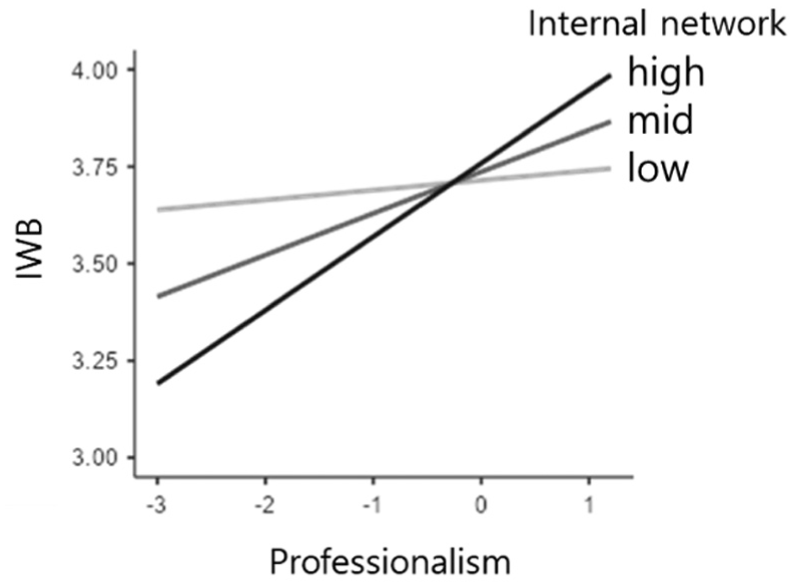
IV (Professionalism) × MV(Internal Network).

IV (Emotional intelligence) × MV(Internal Network).

IV (Job Competence) × MV(Internal Network).
Figure 7 shows that external networks were involved in the effect of job competence on IWB. Higher job competence leads to higher IWB, but this effect depends on the external network. The extent to which job competence increases IWB is greater in the high external network group; however, the effect of external networks tends to weaken as job competence increases.
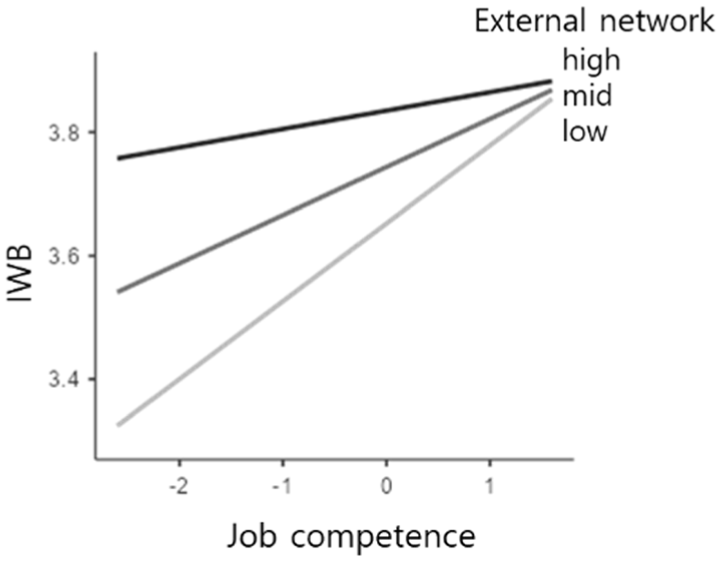
IV (Job Competence) × MV(External Network).
Figure 8 shows that leader support influences the effect of development culture on IWB. In the high leader support group, IWB was higher when development culture was stronger, whereas in the low leader support group, IWB was lower when development culture was stronger.

IV (Development Culture) × MV(Leader Support).
Figures 9, 10, 11, and 12 show the moderating role of coworkers. Figure 9 shows that the effect of emotional intelligence on IWB depends on the level of coworkers’ support. In the high coworker support group, IWB increased as emotional intelligence increased. However, in the low coworker support group, IWB decreased as emotional intelligence increased. The same effect was evident for job autonomy: in Figure 10, IWB increased as job autonomy increased in the high coworker support group but decreased as job autonomy increased in the low coworker support group. Figure 11, the coworker support influences the effect of development culture on IWB. Figure 12 shows that coworker support intervenes in the effect of the learning climate on IWB. A better learning climate is associated with a higher IWB. However, this effect was strongest in the low coworker support group. These results suggest that the learning climate and coworkers’ support are more antagonistic than complementary.

IV (Emotional Intelligence) × MV(Coworker Support).

IV (Job Autonomy) × MV(Coworker Support).

IV (Development Culture) × MV(Coworker Support).

IV (Learning Climate) × MV(Coworker Support).
Findings and Summary
This study aimed to explore the factors that determine the IWB of science and technology employees. The variables in previous studies on IWB have been useful in explaining the innovation behavior of individuals in the general occupational field. However, existing research did not consider the specific characteristics and situation of scientists. Therefore, an IWB model that considers the scientific context is necessary. By reviewing previous studies, this study constructed a research model that incorporates individual, job characteristic, cultural, and relationship factors.
The results showed that higher learning motivation, professionalism, and job competence in personal factors; task identity and skill variety in job characteristics; and external networks in relationship factors increase scientists’ IWB in organizations.
The implications of these results are as follows: First, many significant variables for IWB are personal, suggesting that scientists’ IWB depends on their personal qualities and competencies. Notably, none of the collective cultural variables were significant. This suggests that improving scientists’ IWB should focus on individual rather than collective management. Second, although personal factors are significant, job characteristics are influenced by task identity and skill variety, while relationship factors are influenced by external networks. These results suggest that although personal management is the focus of scientists’ IWB, job design and management should also be explored.
Based on the standardized regression coefficients, learning motivation was the most influential independent variable, followed by skill variety, external networks, task identity, job competence, and professionalism.
The implications of these results are, first, since most influential variables are individual variables, IWB management in scientist organizations should be oriented toward management that emphasizes the role of individual scientists. In general organizations, the job design and cultural management of organizational units are emphasized rather than individuals; however, in scientific organizations, management methods that can enhance learning motivation and professionalism should be developed to improve competence based on individual autonomy.
Second, we can observe the importance of external networks for scientists’ IWB. Scientists have expanded their innovation capabilities through their participation and experience in the scientific community. Therefore, support should be provided to facilitate external relationships among scientists.
Third, although individuals matter, job design is also important. Job design can increase skill variety and task identity. Job enlargement and enrichment should be strengthened so that employees can perform a variety of tasks rather than simple repetitive tasks to increase their interest in their jobs. Education and training should also be provided to strengthen their sense of professionalism and increase their attachment to their jobs.
Fourth, the effect of relationship factors on IWB is both direct and indirect. In the regression analysis, internal networks, coworker support, and leader support had no effect on IWB; however, in the moderation analysis, these three variables intervened in the effect of other independent variables on IWB. To analyze the influence of relationship factors, a moderated effect analysis was conducted, which indicated that 9 of the 48 interaction terms were significant. For each variable, the internal network facilitated the positive impact of emotional intelligence and professionalism on IWB. However, when job competence is strong, a weak internal network increases IWB. An external network facilitates the positive impact of job competence on IWB. However, this moderating effect tended to decrease as job competence increased. In the case of emotional intelligence, job autonomy and development culture, coworker support moderated the static effects on IWB. Finally, when the effect of the organizational learning climate on IWB increases, the effect of coworker support on IWB decreases.
Theoretical and Practical Implications
For examining the theoretical contribution, we compared our findings with those presented in hypothesis. First, learning motivation, professionalism, and job competence have a significant impact on IWB at the individual level. This finding confirms the findings of Shiu & Yu. (2010) on learning culture, Messmann et al. (2010) on professionalism, and Aima et al. (2017) on job competence. However, it does not confirm Van Rooy and Viswesvaran’s (2004) meta-study on emotional intelligence. The reason why the emotional variable did not retain its significance is that the role of emotional intelligence is weak because the expert group is more rational. Second, in terms of job characteristics, task identity, feedback, and skill variety have a significant impact on IWB. Task identity confirms the findings of Schweisfurth & Raasch (2018), feedback confirms the findings of Hammond et al. (2011), and skill variety confirms the findings of Noefer et al. (2009). However, job autonomy does not confirm the findings of Shalley and Gilson (2004) and Yelon et al. (2004). The reason why job autonomy does not play a role is that most of the autonomy is guaranteed in professional organisations, so the variance of autonomy is small. Third, the variables of cultural factors do not have a significant effect on IWB. These results do not support the findings of Brettel et al. (2015), who confirmed the validity of culture in innovation behaviour, and Cangialosi et al. (2020), who confirmed the significant role of learning culture. The failure of cultural variables to play a role suggests that the nature of professional organisations may not be such that a culture predicated on collectivity is formed. Fourth, in terms of relational factors, Leenders and Dolfsma (2016) suggest internal and external network effects, but only external effects were found in this study. There are no effects for supervisors or colleagues as suggested by Liao et al. (2010). This is interpreted as being due to the fact that scientists in expert groups are not immersed in relational factors. Finally, all four relationship variables play a moderating role. These findings confirm the findings of Wang et al. (2015), Li and Liu (2019), Yang et al. (2020). The results of this study suggest that the relationship variables are effective as indirect effect variables rather than direct effect variables.
The theoretical implications of this study are as follows. First, this study is significant in that it reveals the significant role of relationship factors that have been overlooked in previous studies that focused only on leadership. However, this study found that peer support and external networks play important roles in IWB. Second, the comparative study of the variables in the relationship dimension confirmed their respective roles. The internal network, external network, peer support, and leader support played different roles. The theoretical contribution of this study is that it confirmed the significant roles of internal and external networks, which were overlooked in previous studies. Moreover, our findings on the role of relationship factors can be better understood through the lens of Social Exchange Theory (SET) (Blau, 1964; Cropanzano & Mitchell, 2005; Emerson, 1976). SET posits that social behavior results from an exchange process aimed at maximizing benefits and minimizing costs. In the context of scientists' IWB, our findings suggest that relationship networks function as exchanges of valuable resources—knowledge, support, and opportunities—that foster innovation (Katz & Martin, 1997; Powell et al., 1996). In Particular, the significant moderating effects of internal networks, external networks, leader support, and coworker support align with SET's proposition that reciprocal exchanges create obligations that motivate innovative behavior (Coyle-Shapiro & Shore, 2007; Gouldner, 1960).
The finding that external networks facilitate the positive impact of job competence on IWB can be interpreted through SET as an exchange relationship where external collaborations provide resources that enhance the conversion of competence into innovative outputs (Burt, 2004; Reagans & McEvily, 2003). Similarly, our results regarding the moderating role of leader and coworker support connect to leader-member exchange theory (Graen & Uhl-Bien, 1995) and team-member exchange theory (Liden et al., 2000; Seers, 1989), both extensions of SET that explain how quality relationships with supervisors and peers can create favorable conditions for innovation. Future research could more explicitly test these exchange mechanisms in scientific communities and examine how different types of exchange relationships contribute to various phases of the innovation process (Perry-Smith & Mannucci, 2017).
Limitations and Directions for Further Studies
This study analyzed the influence of four factors on IWB: personal, job characteristics, cultural, and relationship factors. A few limitations of the study should be acknowledged. First, the division into the four factors was arbitrary, and there may be other factors besides those discussed in this study. For example, organizational structure, technology, and environmental factors could also be considered. Second, the variables comprising each of the four elements were also arbitrary. For example, job significance was excluded from the job characteristic variables and rational culture was not included as a cultural factor. These could be included in future studies. Third, scientists have different types of jobs, and the variables that can be affected by the four factors are likely to differ for each type. Finally, our research was conducted exclusively on Korean scientists, which may limit the generalizability of our findings to other cultural contexts. National culture significantly influences organizational behavior (Hofstede et al., 2010), and Korea's cultural characteristics—including high power distance, collectivism, and strong relational orientation—may have shaped our results. Future research should extend this investigation to scientists in different cultural contexts, particularly in Western countries with more individualistic orientations (Markus & Kitayama, 2010), to determine whether the patterns observed here are universal or culturally specific. Additionally, comparative studies across different national innovation systems (Nelson, 1993; Lundvall, 2010) would provide valuable insights into how institutional environments affect scientists' innovative work behavior.
Footnotes
Acknowledgements
We thank Myung Chul Kim for make some helpful assistance for data collection, manuscript preparation, interpretation, implications discussion, and other manuscript polishing work.

Author Contributions
Sehyeok Jeon: Research conceptualization, project supervision, final approval
Seoyong Kim: data analysis, technical writing
Miri Kim: Background research, contextual framing, reference management
Funding
The authors disclosed receipt of the following financial support for the research, authorship, and/or publication of this article: This work was supported by the Ministry of Education of the Republic of Korea and the National Research Foundation of Korea (NRF-2021S1A5C2A02087244).
Declaration of Conflicting Interests
The authors declared the following potential conflicts of interest with respect to the research, authorship, and/or publication of this article: Seoyong Kim reports financial support was provided by The Ministry of Education of the Republic of Korea and the National Research Foundation of Korea. Miri Kim and Sehyeok Jeon reports financial support was provided by The Ministry of Education of the Republic of Korea and the National Research Foundation of Korea.
Data Availability Statement
The data that support the findings of this study are available from the corresponding author upon reasonable request.