



Abstract
This study aims to explore, from a follower-centered perspective, the mechanism by which transformational leadership (TL) impacts employees’ innovative work behavior (IWB) in organizations, and is mediated by psychological empowerment and work engagement. A quantitative approach was employed, utilizing data collected via a survey administered in Vietnam from a sample of 390 voluntary and anonymous respondents obtained through purposive and snowball sampling methods. A parallel multiple mediation model was tested using partial least squares structural equation modeling (PLS-SEM) analysis and bootstrapping estimation. The results indicate that TL positively affects IWB, and psychological empowerment mediates the relationship between these constructs. However, the mediating role of employees’ work engagement was not supported. The findings of this study suggest that organizations can enhance employees’ IWB by selecting, training, and developing leaders with TL styles to promote employees’ competence, motivation, relatedness, and autonomy.
Plain language summary
This study is among the few studies paralleled investigating the mediating roles of psychological empowerment and work engagement in the relationship between transformational leaders and employees’ innovative work behaviorsin a collectivist society influenced by Confucian culture (specifically Vietnam). The findings confirm that transformational leaders influence IWB through motivational factors (i.e., psychological empowerment), not work-related factors (i.e., work engagement).
Keywords
Introduction
Innovation is critical for organizational development and sustainability in a changing and turbulent business environment (Farrukh et al., 2023; Odoardi et al., 2015). In addition, in the face of intense competition and the pressures of global market dynamics, companies are compelled to pursue innovation as a means of self-reinvention and to maintain their competitive advantage (Strobl et al., 2020). Among the different types and levels of innovation, individual innovation is a cornerstone for creating and maintaining an organization’s competitive advantage, which ensures the survival and success of the organization (Afsar & Umrani, 2020; Gupta, 2020; Strobl et al., 2020). Therefore, organizations endeavor to promote their employees’ innovation to bring long-term and sustainable organizational benefits (AlEssa & Durugbo, 2022).
Innovative work behaviors (IWBs) refer to a set of complex and non-routine behaviors that employees perform during the innovation process (De Jong & Den Hartog, 2010) and encompass developing, promoting, and implementing creative ideas (Afsar et al., 2014). A plethora of studies claim that individual IWB fosters collective and organizational innovation (Afsar & Umrani, 2020; Farrukh et al., 2023; Strobl et al., 2020). In addition, leadership is a key catalyst for enhancing employee innovation, as it shapes attitudes, behaviors, and mindsets that are aligned with organizational goals (Afsar & Umrani, 2020; Odoardi et al., 2015; Parveen & Alshehri, 2023; Walsh & Arnold, 2020; Yudiatmaja et al., 2023). Among the various leadership styles, recent studies highlight the dominant role of transformational leadership (TL) in shaping follower’s IWBs (Afsar et al., 2014; AlEssa & Durugbo, 2022; Awan & Jehanzeb, 2022; V. Garg et al., 2023; Rehmani et al., 2023; Safrizal et al., 2024). TL refers to the characteristics and actions of leaders who motivate and inspire their followers to pursue shared goals (Carless et al., 2000). It encompasses various practices, including articulating a clear vision, developing staff, offering support, empowering team members, promoting innovation, modeling desired behavior, and demonstrating charisma (Carless et al., 2000). These traits foster creativity and innovation among employees (Alhosani & Ahmad, 2024; Gumusluoglu & Ilsev, 2009; Minh-Duc & Huu-Lam, 2019), and are key predictors of their willingness to engage in IWB (Afsar et al., 2014; Awan & Jehanzeb, 2022; V. Garg et al., 2023). Although TL has recently been acknowledged as crucial in promoting followers’ IWB, the underlying mechanisms through which TL influences IWB, particularly via parallel mediators, have received limited attention in research (Awan & Jehanzeb, 2022; V. Garg et al., 2023).
Previous studies have explored the underlying mechanism of the TL–IWB relationship via several factors, including psychological empowerment (Afsar et al., 2014; Alhosani & Ahmad, 2024), knowledge sharing (Choi et al., 2016), innovation climate (Korku & Kaya, 2023), and meaningful work (Pradhan & Jena, 2019). However, most of these studies have primarily focused on examining the mediating role of single factors from a leader-centered collective, or organizational perspective.
AlEssa and Durugbo (2022) suggest that the current literature reflects a dynamic field with a diverse focus on the mechanisms and motivations behind generating, introducing, and implementing innovative ideas, especially in different contexts. According to Aydogmus et al. (2018), in addition to being influenced by a leader’s actual behaviors, leadership effectiveness is also shaped by followers’ perceptions, which reflects a follower-centered perspective on leadership. Moreover, a follower-centered perspective on TL emphasizes that transformational leaders inspire their followers to achieve the organization’s shared vision by addressing the followers’ psychological and motivational processes (Gumusluoglu & Ilsev, 2009). Thus, this study enhances understanding of the comprehensive process through which TL influences employee IWB by incorporating the underlying mechanisms of motivational factors (i.e., psychological empowerment) and work-related factors (i.e., work engagement). In particular, the primary focus of this paper is to present the development and empirical testing of a parallel mediation model to explain the TL–IWB relationship through followers’ psychological processes, specifically in the context of a collectivist, Confucian-influenced culture (Vietnam), where TL has been shown to exert a significant influence (Crede et al., 2019).
Drawing on self-determination theory (SDT; Ryan & Deci, 2000) and social exchange theory (SET; Blau, 1964), the present study investigated the relationship between TL and IWB and the multiple mediation roles of psychological empowerment and work engagement. Psychological empowerment is an individual psychological state that reflects an active orientation toward one’s work role (Grošelj et al., 2021). It is an intrinsic motivation that manifests in four cognitions: meaning (valuing goals and roles based on principles), competence (task performance ability), self-determination (control and autonomy in decision-making), and impact (influence on organizational outcomes). Work engagement is a psychological state related to current work, which is characterized by vigor (energy and persistence), dedication (enthusiasm and willingness to face challenges), and absorption (focus and intensity; Schaufeli et al., 2006). In a work context, SDT helps explain how TL can support employees in fulfilling their basic organizational needs, including competence, autonomy, and relatedness (Ryan & Deci, 2000). In turn, this fosters psychological empowerment, an intrinsic motivational factor, which ultimately turns into IWBs. Furthermore, by providing employees with autonomy, transformational leaders foster an environment that encourages the generation of new ideas. Psychological empowerment enhances employees’ intrinsic motivation by driving them to invest additional effort in creative and innovative endeavors. SET (Blau, 1964) argues that when employees receive idealized influence, intellectual stimulation, individualized consideration, and inspirational motivation from their leaders, they are more likely to psychologically engage in their work with a fulfilled state of mind (Ghadi et al., 2013; Lai et al., 2020). Consequently, these highly work-engaged employees tend to perform beyond their call of duty by engaging in discretionary IWBs (Afsar et al., 2021; Barkat et al., 2024).
The present study contributes to the existing literature on TL and IWB. First, this study contributes to the understanding of the relationship between TL and IWB through an individual micro-level analysis from a follower-centered perspective. It provides further evidence of the role leaders play in fostering individual innovation in a collectivist society influenced by Confucian culture (specifically Vietnam), where TL holds significant importance. As such, it addresses a significant gap in the literature as existing studies on this topic remain limited (Crede et al., 2019; Rao Jada et al., 2019). Second, by uncovering the parallel mediating mechanisms that have been largely overlooked in prior studies, this research advances understanding of the underlying psychological processes and motivational factors that transmit the effects of leadership on followers’ outcomes.
Literature Review and Hypotheses
Theoretical Background
Self-Determination Theory
Self-determination theory (SDT; Deci et al., 2017) is a widely influential framework for understanding human motivation and well-being. The theory links basic psychological needs to well-being, psychological growth, and quality of life. Research shows that autonomous motivation, whether intrinsic or well-internalized extrinsic motivation, fosters greater interest, energy, confidence, and innovation, thus enhancing performance and overall well-being (Xu, 2022; Yu et al., 2024). The foundation of SDT begins with the view that the impact of a variety of environmental factors (which in the workplace are compensation, job design, and management style) on motivation and experiences is largely driven by three specific and innate psychological needs: competence (White, 1959), relatedness or belongingness (Baumeister & Leary, 2017), and autonomy or self-determination (De Charms, 1968). Addressing these psychological needs is crucial for psychological health and well-being, as well as facilitating successful interaction in social environments (Ryan, 1995), and research into SDT has consistently confirmed that social environments, including the workplace, foster the fulfillment of basic psychological needs, promote autonomous motivation and psychological and physical well-being, and improve performance, particularly in heuristic tasks (Ryan & Deci, 2000). Therefore, the idea of “basic needs support” has become integral to understanding the social conditions, including within workgroups, that influence motivation, well-being, and performance. The more specific concept of “autonomy support” is also frequently used to describe workplace settings, and studies indicate that basic needs support and autonomy support are strongly connected and lead to highly similar outcomes (Fernet et al., 2012).
In the late 20th century, leadership scholars introduced the concept of TL, a style that is centered on charismatic leaders who inspire, motivate, and empower others (Avolio & Bass, 1995; Knezović & Drkić, 2021). Such leaders serve as role models, actively engaging in work and problem-solving with enthusiasm and openness. Transformational leaders present innovative ideas that surpass conventional thinking, coupled with the passion for communicating those ideas and supporting their employees in a way that energizes these employees and gives their work a deeper meaning. This is exhibited through individualized consideration, which, from the perspective of SDT, helps fulfill employees’ basic psychological needs for competence, autonomy, and relatedness. To support these psychological needs, leaders should recognize employees’ viewpoints, offer them more opportunities to implement novel ideas, and avoid using pressure or coercive language, all of which contribute to fostering employees’ intrinsic motivation.
Social Exchange Theory
Social exchange theory (SET), which is fundamentally viewed as the exchange of benefits between two or more parties, is described as the “voluntary actions of individuals that are motivated by the returns they are expected to bring and typically do, in fact, bring from others” (Blau, 1964, p. 91). SET is widely employed in work settings, where supervisors and managers motivate social exchanges with their followers by offering them encouragement and high expectations for improved performance (Sungu et al., 2019); which ultimately leads to achieved mutual benefits (Blau, 1964). One fundamental tenet of SET is that such relationships are “give-and-take” and necessitate trust, obligation, and trustworthiness, as long as mutual benefits are displayed. According to social exchange theory, employees are likely to participate in extra-role behaviors and support their organization to achieve common goals in reciprocation for their organization and supervisors’ fair treatment, effective support, and provision of useful resources (Organ, 1988).
SET can explain the relationship between transformational leaders and employees’ engagement. Effective leaders foster strong leader–follower relationships and enhance followers’ sense of belonging by showing genuine consideration and care for other individuals (Zhu et al., 2009). Consequently, employees might reciprocate this extra care and consideration by giving their entire effort at work. When an effective leader provides their employees with personal resources such as consideration, care, and respect, employees perceive the workplace as supportive, which fosters a sense of duty to positively return the favor. It has been argued that this reciprocation manifests as various forms of positive behaviors, namely work engagement (Saks, 2006). Consequently, TL enhances individual work engagement.
Transformational Leadership and Innovative Work Behaviors
TL involves the traits and behaviors of leaders who inspire and encourage their followers to work toward common objectives (Carless et al., 2000). These traits and behaviors foster creativity and innovation among employees (Alhosani & Ahmad, 2024; Gumusluoglu & Ilsev, 2009; Minh-Duc & Huu-Lam, 2019), which are key predictors of their willingness to engage in IWB (Afsar et al., 2014). From a social exchange perspective’s Blau (1964) suggests that individuals are prone to engaging in positive behaviors when they perceive their contributions as recognized and appreciated. Through behaviors such as intellectual stimulation, personalized consideration, and inspirational motivation, transformational leaders help build trust and commitment in their followers (Bass & Avolio, 1994). This sense of trust, which is created through positive transformational leader–follower exchanges, fosters a work environment where employees feel secure enough to take risks and experiment with innovative ideas. When employees feel that their efforts to innovate will be valued, recognized, and reciprocated, they are more likely to contribute creative ideas and engage in IWB (Janssen, 2000).
Moreover, transformational leaders with high individualized support typically offer positive reinforcement, provide opportunities for growth, and create a supportive environment in which employees feel valued. When employees recognize their leaders’ support and commitment to their development, they become motivated to reciprocate by demonstrating increased creativity and innovation (Alhosani & Ahmad, 2024; V. Garg et al., 2023; Minh-Duc & Huu-Lam, 2019; M. Zhang et al., 2022). Transformational leaders can inspire their employees to pursue innovation by showing enthusiasm and optimism toward new ideas. Acting as charismatic leaders, they can foster organizational innovation by encouraging employees to explore new ideas, exhibit creative behaviors, and improve their analytical and problem-solving capabilities (Sosik, 1997). Additionally, transformational leaders empower their staff to want to positively change existing work systems, initiate new approaches to problem-solving, and develop novel solutions (Afsar et al., 2014). These behaviors are seen as “exchanged” because employees are willing to provide greater effort and innovation in return for the support and trust they receive from their transformational leaders.
Existing empirical literature (Afsar et al., 2014; Awan & Jehanzeb, 2022; V. Garg et al., 2023; Stanescu et al., 2021; Yudiatmaja et al., 2023; M. Zhang et al., 2022) supports the argument that transformational leadership positively affects employees’ IWB. TL promotes an organizational climate that encourages and supports innovation, making employees feel free to engage in innovative behaviors (Stanescu et al., 2021). Transformational leaders enhance their followers’ IWB by stimulating their creativity, fostering bonds among coworkers, integrating employees into their work tasks and the organization, and emphasizing their intrinsic motivation and personal development. Therefore, we hypothesize that:
Hypothesis 1: Transformational leadership is positively related to employee’s innovative work behaviors.
The Mediating Role of Psychological Empowerment
Spreitzer (1995, p. 1443) defined psychological empowerment as “intrinsic task motivation manifested in a set of four cognitions reflecting an individual’s orientation to his or her work role,” including meaning (valuing goals and work roles in light of principles and standards), competence (ability to perform the task skillfully), self-determination (having control and decision-making autonomy), and impact (making influence on organizational outcomes; Soleimani et al., 2023). According to SDT, employees motivated by intrinsic rather than extrinsic rewards are more likely to commit to their work (Y. Zhang & Yang, 2021). Parry and Proctor-Thomson (2002) argue that transformational leaders value followers, delegate authority to others, and recognize employee performance, which in turn, enhances the employees’ intrinsic motivation and fosters their psychological empowerment.
Specifically, when given authority and participation in decision-making and idea creation, employees feel more empowered to complete tasks with autonomy, control, and self-determination, which fosters IWB (Jauhari et al., 2017; Jung et al., 2003). Having autonomy and a sense of power and self-determination can foster an employee’s creative process (Alhosani & Ahmad, 2024; Jauhari et al., 2017). Furthermore, through intellectual stimulation, transformational leaders appreciate their followers and recognize their performance and contribution to organizational outcomes, which reinforces followers’ sense of impact—an essential aspect of psychological empowerment (Jauhari et al., 2017; Masood & Afsar, 2017; Mohammed & Al-Abrrow, 2024). Consequently, transformational leaders motivate their employees with high levels of psychological empowerment to take the initiative and approach challenges creatively (Pieterse et al., 2010; Stanescu et al., 2021). By effectively communicating a clear and inspiring vision, these leaders arouse their followers’ intrinsic motivations, which helps employees realize the meaning of their work (V. Garg et al., 2023; Gumusluoglu & Ilsev, 2009; Jauhari et al., 2017). Accordingly, employees are willing to make the extra effort required to introduce novel ideas (V. Garg et al., 2023). Finally, serving as an example, transformational leaders boost employees’ self-efficacy and make them more competent to experience psychological empowerment (Huynh, 2021; Masood & Afsar, 2017), which in turn, fosters their creativity and IWB (Stanescu et al., 2021). Based on the above discussion, the following hypothesis is proposed:
Hypothesis 2: Psychological empowerment mediates the positive relationship between transformational leadership and employee’s innovative work behaviors.
The Mediating Role of Work Engagement
Work engagement is a psychological state encompassing three types of employees’ feelings about themselves at work: vigor (characterized by energy, mental resilience, and persistence), dedication (characterized by enthusiasm, inspiration, and willingness to challenge at work), and absorption (characterized by concentration, intensity, and immersion in work; Schaufeli et al., 2006). Since innovation is a process requiring considerable effort, employees need to do three things: both physically and psychologically engage in their work with resilience to avoid detaching from their job (vigor), demonstrate high concentration and a willingness to change and take on challenges (dedication), and completely focus with high intensity on the innovative behaviors (absorption). Therefore, employees with a high level of work engagement are more likely to engage in IWB. Previous studies have also confirmed the positive relationship between work engagement and IWB in organizations (Afsar et al., 2021; Saeed AlShamsi et al., 2022).
Drawing on SET, we argue that when employees recognize the characteristic behaviors of transformational leaders, they are prone to engaging in their work and demonstrating innovative behavior. Employees led by transformational leaders may work harder and for longer periods of time on their tasks (i.e., physical energies, vigor), focus intently on innovative responsibilities (i.e., cognitive energies, absorption), and also have stronger emotional ties to the tasks that make up their assigned innovative roles (i.e., emotional energies, dedication; Rich et al., 2010). Specifically, transformational leaders may enhance followers’ awareness of their value and contributions to the organization, encouraging them to engage in their work (Ghadi et al., 2013; Lai et al., 2020). Through individualized support provided by leaders, the relationship between leaders and followers is enforced, enhancing their sense of belonging to the organization (Zhu et al., 2009). By offering special personal attention and emotional support, leaders can enhance their followers’ psychological safety, thereby increasing their readiness to fully engage at work (Ghadi et al., 2013; Lai et al., 2020). These elements characterize a vigorous state of engagement at work. Similarly, recognizing their contribution to their organization increases employees’ intrinsic motivation, which in turn, increases their level of dedication (Ghadi et al., 2013). Furthermore, transformational leaders can create an optimistic and appealing vision of the future that inspires followers to immerse themselves in their work (absorption; Ghadi et al., 2013; Lai et al., 2020).
S. Garg and Dhar (2017) suggest that employees who have positive perceptions of their leaders are more likely to reciprocate by demonstrating high levels of engagement at work. Employees with high work engagement are proactive in taking the initiative, investigating different approaches to solving problems, seeking out different approaches and ideas to solving problems, supporting innovative ideas, and eventually implementing these possibilities (Chang et al., 2013). Hence, IWB can be seen as followers’ reciprocation for what they receive from their transformational leaders, which in turn, enhances their work engagement. Thus, we propose:
Hypothesis 3: Work engagement mediates the positive relationship between transformational leadership and employees’ innovative work behaviors.
Figure 1 presents the conceptual research framework.

Conceptual research framework.
Methodology
Sample and Data Collection
The target population for this study comprised Vietnamese employees who work under line managers and are involved in IWB. The research was conducted across both large-scale enterprises and small- and medium-sized enterprises (SMEs) in Vietnam. The Vietnamese workforce, characterized by its youth, dynamism, and creativity, plays a pivotal role in driving innovation and fostering economic transformation in the country. Data were collected in purposive and snowball sampling methods with the administered survey. This method was applied because it can collect a large sample within a short time at a reasonable cost and assure the anonymity of respondents (Al Wali et al., 2023). Furthermore, purposive sampling is deemed suitable in cases where research criteria are specific (i.e., working with line manager and engage in IWB) and target participants correspond to the study’s objectives (i.e., employees working in various types of enterprises in Vietnam; Etikan et al., 2016). Therefore, the utilization of purposive sampling together with snowball sampling methods aimed at ensuring the data collection of employees spanning various organizations and locations within research context.
The questionnaires with all closed-answer questions (after deploying a back-translated process from the original scales in English to Vietnamese) were distributed to the target respondents. Then, we asked them to send the questionnaires to their coworkers and friends. A brief introduction to a clear research purpose of the study and the authors’ acknowledgment to use the collected data solely for academic research purposes is provided at the beginning of the survey. In addition, respondents are given the right to stop answering the questionnaire at any time and are guaranteed anonymity (respondents do not need to provide any information about their identity, contact information or work organization). The data will be collected, coded in number and the results, imply that the study will be used for public and not specifically for any individual or organization, to make theoretical and practical contributions to general organizational management. To ensure validity and reliability, during the data collection process, one of the authors, alongside several research assistants, contacted the target respondents to ask for their participation with a clear explanation of the research objectives. After fully understanding the data collection process, participants voluntarily completed the survey and submitted it to the researchers. We acknowledge the limitations of the data collection method that may potentially cause the common method variance (CMV) problem. We attempt to detect and address this issue, and the results are presented in a later section.
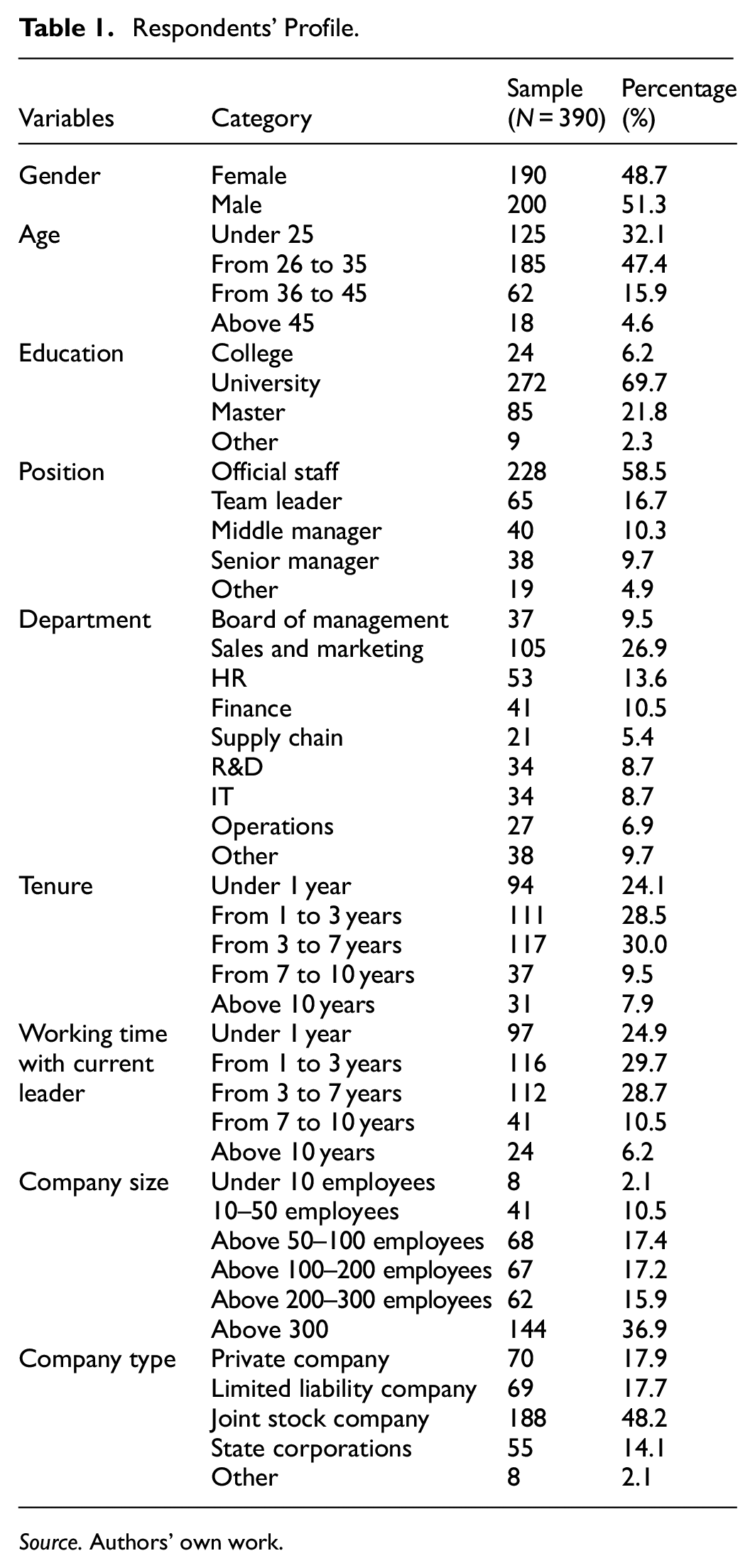
The final data set contained 390 responses (165 (42.3%) online responses and 224 (57.7%) hardcopies). According to Krejcie and Morgan (1970) a sample of 384 is considered sufficient for a study with a large population. In addition, a dataset of 250 is considered as large data, which can yield similar results for both CB-SEM and PLS-SEM (Hair et al., 2019). Thus, this sample size is sufficient for further analysis. Among 390 respondents, males accounted for 51.3% (n = 200) and females accounted for 48.7% (n = 190). Almost half of the respondents were from 26 to 35 years old (47.4%, n = 185), and 15.9% (n = 62) were aged from 36 to 45. The majority of respondents had more than 1 year of tenure at their current company and under their current leader. A significant proportion (91.5%, n = 357) held either a university degree or a master’s diploma. Respondents represented a variety of departments, including the board of management (9.5%), sales and marketing (26.9%, n = 105), as well as HR, finance, supply chain, and others. Their companies also varied in type—such as private enterprises, limited liability companies, joint stock companies, and state-owned corporations—and size. Table 1 provides a detailed profile of the respondents.
Respondents’ Profile.
Source. Authors’ own work.
Measures
The measurement items in this study were adopted from well-established relevant studies and evaluated using a five-point Likert scale.
Transformational leadership (TL) was measured using a seven-item scale developed by Carless et al. (2000), which captures the assessment of employees toward their direct manager/leader in various aspects. This assessment utilized a five-point Likert scale ranging from 1 (strongly disagree) to 5 (strongly agree). A sample of this scale includes “My leader gives encouragement and recognition to staff.” Cronbach’s alpha value of this scale was 0.899.
Psychological empowerment was assessed using a 12-item scale of four dimensions (meaning, competence, self-determination, and impact) developed by Spreitzer (1995) based on a five-point Likert scale ranging from 1 (strongly disagree) to 5 (strongly agree). The respondents were asked to rate their self-assessment of their perception and experience of their current job. Each dimension was measured on a three-item scale. Sample items of meaning dimension included “My job activities are personally meaningful to me,” of competence dimension included “I have mastered skills necessary for my job,” and of self-determination included “I can decide on my own how to go about doing my work,” and of impact included “My impact on what happens in my department is large.” Cronbach’s alpha values of these dimensions were all above 0.7 (meaning: 0.867, competence: 0.787, self-determination: 0.839, and impact: 0.880). Cronbach’s alpha for the psychological empowerment scale was 0.904.
Work Engagement
A nine-item scale of three dimensions (vigor, dedication, and absorption) developed by Schaufeli et al. (2006) was adopted to measure employees’ positive state of mind, commitment, and absorption in the current work. Each item was rated with a five-point Likert scale ranging from strongly disagree (1) to strongly agree (5). Sample items included “At my work, I feel bursting with energy” (vigor), “I am enthusiastic about my job” (dedication), and “I am immersed in my work” (absorption). Cronbach’s alpha values of these dimensions were all above 0.8 (vigor: 0.873, dedication: 0.847, and absorption: 0.868). Cronbach’s alpha for the work engagement scale was 0.938.
Innovative work behaviors (IWB) was assessed using a nine-item scale developed by De Jong and Den Hartog (2010). Respondents were asked to assess the frequency of the behaviors through which they contribute to the innovative process in their jobs on a five-point Likert scale ranging from never (1) to always (5). Sample item included “How often do you generate original solutions for problems.” Cronbach’s alpha of the IWB scale was 0.89. Cronbach’s alpha value on this scale was 0.887.
Data Analysis Strategy
We assessed the measurement model and tested the proposed hypotheses using Partial Least Squares Structural Equation Modeling (PLS-SEM) with the support of SmartPLS 4.0. This technique has become widely applied and significant in human resource management and organizational behavior research (Ringle et al., 2020). The PLS-SEM analysis contains two main steps: (1) measurement model assessment and (2) structural model estimation (Hair et al., 2019; Ringle et al., 2020).
Common Method Variance
Being aware of the CMV problems caused by a cross-sectional study, the guidelines provided by Podsakoff et al. (2012) was followed to address the potential CMV issues. The target respondents were assured of their right to fill in the questionnaire directly, voluntarily, and anonymously, with the freedom to stop or submit their responses at any time. The questionnaire used easily comprehensible language and concise questions to convey research objectives and underwent rigorous back-translation and pretest. Harman’s single-factor test was conducted, revealing that a single factor explained 39.29% of the variance. Furthermore, all constructs exhibited inner variance inflation factors (VIF) below 3.3 (ranging from 1.789 to 2.206, see Table 2). The findings indicate that CMV is not a critical issue of this study.
First-order Constructs Validity and Reliability.

Source. Authors’ own work.
Results
Measurement Model Assessment
Due to the presence of two second-order reflective constructs, namely psychological empowerment and work engagement in the research model, this study began with a comprehensive evaluation of the first-order (lower-order) measurement model, followed by an analysis of the second-order (higher-order) constructs. Initially, the evaluation of the first-order measurement model employed specific criteria, such as internal consistency, construct reliability, and validity. Table 2 presents the first-order constructs’ validity and reliability testing. The factor loadings of all items were more than 0.5, ensuring adequate convergent validity of first-order constructs. Moreover, all AVE values were greater than 0.5, ranging from 0.554 to 0.711, also displaying acceptable convergent validity of all constructs. All Cronbach’s Alpha values of first-order constructs were larger than 0.7, ranging from 0.787 (competence) to 0.880 (impacts), thereby confirming construct reliability. The Composite Reliability (CR) values of all first-order constructs also exceeded 0.7, which registered the smallest CR at 0.789 (competence) and the biggest CR at 0.885 (impacts), indicating satisfactory internal consistency of all constructs. Thus, it can be considered that all first-order constructs satisfied the requirements of reliability and validity for establishing the higher-order constructs and structural model analysis (Hair et al., 2019; Podsakoff et al., 2012; Ringle et al., 2020).
In this study, we employed the repeated indicators approach, as suggested by Becker et al. (2012) to handle the second-order hierarchical latent variables (i.e., psychological empowerment and work engagement). Table 3 illustrates that Cronbach’s alpha coefficients for these constructs ranged from 0.887 (IWB) to 0.935 (work engagement), and CR values for all assessed constructs from 0.893 (IWB) to 0.935 (work engagement) exceeded the recommended threshold of 0.70, thereby confirming their strong reliability. Additionally, Average Variance Extracted (AVE) values were evaluated against the thresholds of 0.5, successfully establishing the convergent validity of the examined constructs. Furthermore, the discriminant validity of the constructs was assessed using the Heterotrait-Monotrait (HTMT) ratio, with a threshold value of 0.85. The HTMT values ranged from 0.550 to 0.764, confirming the discriminant validity of all constructs. Consequently, the measurement model exhibited both reliability and validity (Hair et al., 2019; Ringle et al., 2020), allowing for further analysis of the structural model for hypothesis testing.
Second-order Constructs Validity and Reliability.

Source. Authors’ own work.
Note. TL = transformational leadership; IWB = innovative work behaviors.
Structural Model Assessment and Hypotheses Testing
To evaluate the quality of the structural model, this study used three criteria: the coefficient of determination (R2 value), the effect size (f2), and predictive relevance (Q2 index). The results of structural model estimates are summarized in Table 4. The R2 value for IWB was 0.666, indicating a moderate level of predictive power for the proposed model. Similarly, the R2 values for psychological empowerment and work engagement were 0.436 and 0.304, respectively. Effect sizes (f2) measured the change in R2 when a specific exogenous construct was removed from the model. The threshold values of f2 at 0.02, 0.15, and 0.35 correspond to small, medium, and large, respectively. The effect sizes of TL in relation to psychological empowerment (f2 = 0.773) and work engagement (f2 = 0.437) were large, while the effect size in relation to IWB was medium (f2 = 0.183). The effect sizes of psychological empowerment and work engagement on IWB were medium (f2 = 0.326) and small (f2 = 0.012), respectively. Q2 values are utilized to assess the model’s ability to predict outcomes beyond the training data, and they serve as a measure of out-of-sample prediction. All Q2 values were greater than 0, ranging from 0.252 to 0.396, indicating satisfactory predictive relevance (Hair et al., 2019; Ringle et al., 2020).
Results of Structural Model Estimates.

Source. Authors’ own work.
Note. TL = transformational leadership; IWB = innovative work behaviors.
All proposed hypotheses were tested simultaneously using the PLS-SEM with a bootstrapping procedure of 5000 resamples (Hair et al., 2019). The first hypothesis proposed a positive relationship between TL and IWB. The results showed a significant main effect of TL on IWB (b = 0.708, t = 16.808, p < 0.001), thereby supporting hypothesis 1. To test the mediation hypotheses, we examined the indirect effects. Hypothesis 2 states that psychological empowerment mediates the relationship between TL and IWB. The results demonstrated a significant indirect effect between TL and IWB through psychological empowerment (b = 0.325, t = 6.223, p < 0.001; 95% CI [0.226, 0.432]). Thus, hypothesis 2 was supported. Likewise, hypothesis 3 proposed that work engagement mediates the relationship between TL and IWB. However, the results indicated that the indirect effect between TL and IWB through work engagement was not significant (b = 0.046, t = 1.567, p < 0.001; 95% CI [−0.012, 0.102]), thus, hypothesis 3 was not supported. To further explore the nature of the mediating role of psychological empowerment, the positive direct effects of TL on IWB were examined. Particularly, in the presence of psychological empowerment and work engagement, the direct effect of TL on IWB decreased from 0.708 (t = 16.808, p < 0.001) to 0.337 (t = 4.794, p < 0.001), while still being statistically significant. Hence, psychological empowerment was recognized as a partial mediator and specifically classified as a complementary mediator in the relationship between TL and IWB.
Figure 2 depicts the result of the multiple mediation model.

Result of multiple mediation model.
Discussion
This study investigated how TL fosters employees’ IWB through the multiple mediating roles of psychological empowerment and work engagement. There are three significant conclusions to the research findings.
First, this study confirmed the role of transformational leaders in boosting employees to engage more in innovative behaviors at work. This finding is in line with the results of previous studies (e.g., V. Garg et al., 2023; Knezović & Drkić, 2021; Masood & Afsar, 2017; Rehmani et al., 2023; Stanescu et al., 2021; Tan et al., 2021; Yudiatmaja et al., 2023; M. Zhang et al., 2022) that argue for the positive effect of TL on IWB in environments where employees are free to propose and implement innovative ideas and promote overall organizational effectiveness (V. Garg et al., 2023). Capable transformational leaders articulate and communicate common goals and the organizational vision effectively, provide their followers with a bright organizational picture, and thus inspire the creation of new ideas. Moreover, transformational leaders can stimulate their followers to want to be more proactive and utilize their intellectual abilities to generate new ideas and implement innovative ones, which leads to a higher level of IWB (Afsar et al., 2014; V. Garg et al., 2023; Jung et al., 2003). Transformational leaders also provide adequate support for employees to proactively think “outside the box” whenever they are faced with tasks and challenges. Accordingly, they encourage their employees’ creativity as well as their capacity to persuade others to implement novel ideas (Afsar et al., 2014), which in turn, promotes the employees’ IWB.
Second, the research findings demonstrate that employees’ psychological empowerment mediates the positive relationship between TL and IWB. This finding further confirms previous studies (e.g., Afsar et al., 2014; Dust et al., 2014; V. Garg et al., 2023; Jung et al., 2003; Mohammed & Al-Abrrow, 2024; Stanescu et al., 2021) that have revealed that employees exhibit innovativeness in their behavior due to their feelings of empowerment while working with transformational leaders (Afsar et al., 2014). Moreover, the results here also support earlier research findings (Avolio et al., 2004; Pieterse et al., 2010; Stanescu et al., 2021) showing that psychologically empowered employees exhibit higher levels of IWB. Consequently, transformational leaders emphasize meaningful and worthy work roles, make employees feel more empowered, and have a high degree of autonomy, self-determination, and competence, which in turn, encourages them to display more innovative behaviors (Stanescu et al., 2021). This argument aligns with SDT in suggesting that employees who exhibit high intrinsic task motivation are pivotal to fostering innovation within organizations (V. Garg et al., 2023). TL plays a crucial role in this process by intrinsically motivating employees through a clear and achievable vision, which helps them find deeper meaning in their work. Moreover, transformational leaders inspire their employees through their passion, boosting their employees’ confidence and self-efficacy levels and emphasizing the importance of their work. This in turn, fosters a sense of purpose, encouraging employees to exert extra effort toward creative thinking and the generation of innovative ideas in their work (V. Garg et al., 2023; Gumusluoglu & Ilsev, 2009). As a result, this study contributes to the existing empirical evidence demonstrating that transformational leaders intrinsically motivate employees to exhibit IWB, which is attributed to variations in empowerment, autonomy, self-determination, meaning, and competence (Afsar et al., 2014; Stanescu et al., 2021).
Finally, unlike previous studies that have demonstrated the mediating role of work engagement in the relationship between motivational factors and employees’ behavior as well as work performance (Karataş & Çankır, 2023), this study failed to demonstrate the mediating role of employee work engagement. This result might have arisen due to the absence of a relationship between engagement and IWB in this study, which contradicts previous research findings (Barkat et al., 2024; S. Garg & Dhar, 2017) suggesting that work engagement fosters employees’ IWB. However, this is not a surprising finding, given that this study found a positive influence of TL on employee work engagement. This positive relationship aligns with earlier studies (Ghadi et al., 2013; Zhu et al., 2009) indicating that TL mainly positively impacts employees’ work engagement when employees are proactive, creative, and innovative (Zhu et al., 2009).
Theoretical Implications
The findings of this study represent a more nuanced way of theorizing the TL–IWB link. This study specifically offers theoretical support to SET and SDT, which helps to explain the indirect effect of TL on IWB.
First, in response to an expanding research interest in IWB, this study enriches the growing body of leadership and individual-level innovation literature by providing empirical support for a positive TL–IWB relationship in an emerging economy with a collectivistic, Confucian cultural context—specifically Vietnam. This offers a clear explanation of the effect of a proper leadership style such as TL and the individual innovation it can exert. In accordance with SET, individuals reciprocate more positive behavior in exchange for the organizations’ alleged values. Therefore, employees attempt to engage in extra-role behaviors such as IWB as a result of the social exchange leader–follower relationship created by TL (Bass & Avolio, 1994). Previous research has suggested that leaders in Asian countries, including Vietnam, where risk-taking is not culturally normative, tend to be less inclined to make or support risky organizational decisions (Tan et al., 2021). However, it has been proposed that TL emerges more easily within collectivistic cultures (Choi et al., 2016). Consistent with findings from other Confucian Asian societies (Choi et al., 2016; Tan et al., 2021), this study suggests that in contrast to Western organizations, where individualism predominates, investment in TL can effectively foster innovation in a collectivistic setting. In Western cultures, especially those characterized by individualism, innovation is often viewed as a personal achievement, and employees are encouraged to express unique ideas regardless of hierarchical constraints. In collectivist societies such as Vietnam, however, there is a strong emphasis on group goals, with individuals often prioritizing collective interests over personal ones. In such a context, innovation may also be seen through a collective lens, where transformational leaders can create a supportive climate for employees to share innovative ideas without fear of disrupting hierarchical norms. Moreover, because Vietnam is a high power distance society, most Vietnamese organizations accept a hierarchical order and commanding leadership style (Minkov & Kaasa, 2022). Such a leadership approach, however, is detrimental to employees’ engagement in innovative behaviors, and therefore, is insufficient to satisfy the demands of modern management (Iqbal et al., 2022). Consequently, this study’s findings imply that a people-centric leadership style, such as TL, is more appropriate for encouraging employees’ innovative behaviors in the context of high power distance and hierarchical cultural structures.
This study was conducted within Vietnamese enterprises, including both oversized organizations and small and medium enterprises, in contrast to previous studies, which have been conducted within large companies in Western countries (Knezović & Drkić, 2021). The research findings presented here indicate that TL is contextual and should not be disregarded in theoretical studies that examine its impact on IWB. This implies that environmental factors, such as leadership traits, can significantly influence intrinsic motivation (Nguyen et al., 2022), which is in line with SDT. Therefore, this study builds upon previous studies that highlight the significance of leadership style, especially TL, for fostering IWB (V. Garg et al., 2023; Stanescu et al., 2021).
Second, this is one of the first studies to simultaneously examine the mediating roles of psychological empowerment and work engagement in the relationship between TL and IWB. This study adds to the growing literature by explicitly investigating the impact mechanisms of TL on employees’ IWB through psychological empowerment. The findings of the mediation analysis unraveled transformational leaders’ empowering role in fostering IWB among their workforces. Due to their characteristic behaviors, transformational leaders in Vietnamese enterprises, including oversized organizations and SMEs, tend to create a supportive organizational climate that stimulates employees to be more proactive and utilize their intellectual abilities to freely generate and implement novel ideas (Afsar et al., 2014; V. Garg et al., 2023; Jung et al., 2003). By imparting a clear and compelling vision, transformational leaders can intrinsically motivate their followers, making the work seem more meaningful and worth the extra effort required for innovation (V. Garg et al., 2023). Furthermore, transformational leaders cultivate an environment conducive to generating fresh ideas by offering autonomy to employees. Psychological empowerment further boosts employees’ intrinsic motivation to make them expend extra effort in creative and innovative activities. In other words, transformational leaders, especially in Vietnamese enterprises, intrinsically motivate their followers to equip them with high levels of psychological empowerment, in turn encouraging employees to engage in discretionary behaviors such as developing and executing novel ideas that foster individual IWB. Consequently, this study highlights the importance of having an appropriate leadership style, such as TL, which promotes intrinsic motivation, thereby increasing employees’ innovative behaviors at work.
This study found no evidence for the mediating role of work engagement in the relationship between TL and IWB because of the absence of the direct impact of work engagement on IWB. This could be explained by the fact that in accordance with social exchange theory, within Vietnamese enterprises, transformational leaders contribute to developing employees’ work engagement. Transformational leaders often emphasize inspirational visions and collective goals and provide a safe and supportive environment, motivating employees to put their energy and effort into current tasks rather than into discretionary and extra-role behaviors such as IWB.
Arguably, the most significant contribution to the literature is the indirect influence of TL on IWB through increased psychological empowerment. SDT proposes that every human has three fundamental psychological needs—autonomy, competence, and relatedness—which are the basis for personal growth and development (Ryan & Deci, 2000). According to SDT, psychological empowerment is similar to intrinsic motivation, and is defined as an individual’s sense of meaningfulness in their work, their ability to perform effectively, regulate their behavior, and influence their work environment (Spreitzer, 1995). In line with SDT, this study suggests that when employees are intrinsically motivated by transformational leaders to enhance their psychological feelings of empowerment, they may demonstrate more IWB. In particular, transformational leaders share information about the firm’s work process, and communicate a clear and inspiring vision as well as overall objectives with their followers, thus improving their perception of their work’s meaningfulness (V. Garg et al., 2023). Additionally, transformational leaders are generous with praise, encouragement, and persuasion toward employees as the employees master new skills, thus improving their competence (Masood & Afsar, 2017). Furthermore, transformational leaders are willing to give autonomy to their subordinates, further increasing their self-determination.
Finally, transformational leaders readily involve subordinates in decision-making, making them realize that can impact the organization’s operations. Based on the findings of research into SDT (Ryan & Deci, 2000), the supportive, caring, and encouraging environment created by TL fosters the necessary confidence for employees to engage in IWB. TL, which empowers employees through processes such as autonomy, participation in decision-making, and information sharing, effectively instills psychological empowerment among employees. This psychological empowerment motivates employees to engage in proactive work behavior, including IWB. Consequently, this study contributes to the existing research (e.g., Gupta, 2020; Y. Zhang & Yang, 2021) that has tried to understand the underlying mechanisms by which intrinsic motivation can promote creativity and innovation. The additional theoretical implication is to consider psychological empowerment as the motivational precondition of IWB, consistent with the suggestions of Grošelj et al. (2021). The results presented here highlight the importance of psychological empowerment as intrinsic motivation in the positive link between TL and IWB.
Practical Implications
The research results provide practical implications for organizational practice, especially for selecting, training, and developing organizational leaders. The findings of this empirical study confirm that in non-Western contexts (such as Vietnam in this study) when employees work with supervisors and managers with a TL style, employees feel more psychologically empowered. In turn, psychological empowerment can enhance IWB. Consequently, when deciding to appoint and recruit managerial positions, practitioners should pay more attention to selecting transformational leaders. Generally, the selection process for a lower-level manager places more emphasis on technical proficiency than it does on interpersonal skills. Lai et al. (2020) suggested that recruiters should interview candidates about their experiences with TL.
Furthermore, TL skills can be learned and developed through leadership training programs, and combining leadership training with personal feedback is essential for enhancing TL. Finally, another significant practical implication of this study is to empower employees psychologically. To foster psychological empowerment, managers should establish a personal relationship with their employees and gain insight into their unique needs. This process is not a one-time incentive but rather an ongoing effort that should be integrated into every stage of employee management, from the selection to the development to the retention of employees. For small and medium-sized businesses, focusing on proactive employees with individual career aspirations that align with organizational objectives is vital to achieving psychological empowerment. Organizational managers should adopt a structural approach to business that allows for decentralized decision-making, encouraging employees to share ideas and opinions in meetings. Finally, it is essential to prioritize job designs that promote employee autonomy.
Limitations and Future Research
This study has some limitations. First, we were unable to determine causality because of the cross-sectional nature of the data. Although we tried to improve the validity and reliability of the data by using purposive and snowball sampling techniques, and we performed statistical tests to tackle the CMV issues, longitudinal research and multiple sources of data collection with a rigorous design will strengthen the robustness of the research results and allow for causal relationships to be determined (Bos-Nehles et al., 2017). However, it must be acknowledged that asking employees to rate their IWB could lead to socially desirable answers.
Secondly, in this study, IWB was measured using a single-dimension measurement scale rather than multiple-dimension scales, which limits the ability to comprehensively analyze the detailed relationships. Future studies could employ different approaches to measure the concept of IWB, including taking a multi-dimensional view of IWB—for example, idea generation and idea implementation (Noefer et al., 2009), idea generation, idea promotion, and idea application (Veenendaal & Bondarouk, 2015), or the generation, introduction, and application of innovative ideas (AlEssa & Durugbo, 2022)—in order to better understand the specific impact of TL on each dimension of IWB.
Third, this study focused on the underlying mechanism of TL and IWB at the individual micro-level from a follower-centered perspective. Future research could investigate the impact of different leadership styles, such as servant leadership, ethical leadership, and toxic leadership, on IWB. Additionally, future studies could explore various leadership styles, including digital and purpose-driven leadership, incorporating a meso-level analysis that considers individual, team, and organizational levels (AlEssa & Durugbo, 2022). This approach would provide a more comprehensive understanding of the interactions among various agents in the TL–IWB relationship, as generating, introducing, and implementing ideas requires interaction and support from teams, groups, and organizations.
Finally, this study was conducted in a developing economy with a collectivist culture and the influence of Confucianism, namely Vietnam. However, national cultural factors have not yet been studied in relation to organizational contexts, which may limit the generalizability of the research findings. Therefore, future studies should focus on the role of cultural factors (such as perceived cultural support, or dimensions of national culture such as power distance, and collectivism vs. individualism) by using data collected from different industry sectors and geographical regions to obtain more comprehensive and insightful results.
Conclusion
In summary, the present study confirms the role of TL in fostering followers’ IWB, providing organizations with opportunities to gain a competitive advantage in dynamic environments. The study also articulates the underlying mechanisms of the psychological and motivational processes at the individual micro-level from a follower-centered perspective. The findings explain the linkages between TL and IWB through intrinsic motivational factors, such as psychological empowerment, which enhances individual competence, autonomy, and relatedness, rather than through work-related factors, such as work engagement.
Footnotes

Ethical Considerations
An ethics statement (including the committee approval number) for animal and human studies. If this is not applicable, please state this instead: This study used self-rated and anonymous questionnaires, the respondents voluntarily participated in filling the questionnaires. The respondents are adults and have the full right to stop the survey at any time. So, it is not required to apply for the ethics statement for the research conducting on animal and human objects.
Funding
The author(s) disclosed receipt of the following financial support for the research, authorship, and/or publication of this article: This research is funded by Foreign Trade University, Vietnam, under the research program number FTURP01-2020-02.
Declaration of Conflicting Interests
The author(s) declared no potential conflicts of interest with respect to the research, authorship, and/or publication of this article.
Data Availability Statement
Data available on request.