




Abstract
Leadership stains affect the follower’s performances regarding innovative work behavior, and a gap is found in leadership research in higher education, specifically in Pakistan. The basic purpose of this research is to point out the effect of leadership styles on innovative work behavior under the mediating and moderating roles of organizational culture and organizational citizenship behavior among the Head of the Departments (HODs) in higher education institutions (HEIs). A survey method has been carried out to collect data from 160 respondents to, further, verify how leadership styles of academic leaders affect employees’ performances in universities. The statistical study exposes a substantial positive effect of leadership styles on innovative work behaviors of employees highlighting mediating and moderating effects of organizational culture and OCB on such a relationship. This study carries various implications for prior research in both theoretical and practical fields, and its scope may also be enlarged, geographically or institutionally, to another context. This research uncovers the relationship of leadership styles and innovative work behavior in academic research, which has been ignored before in higher education of Pakistan.
Keywords
Introduction
In the previous decade, the interest of academicians increased day by day to explore the topic of leadership in higher education, to cope with the changes occurring in technology, globalization, and work innovative practices, worldwide, in different sectors and in higher education. The topic of leadership remains a controversial issue in the realm of philosophers and scholars. Till now, a large number of books and articles have been published on this specific subject to explore the nature and antecedent of leadership in academia (Awan & Mahmood, 2010). To get definite outputs, people domineer organizational life and make their struggle in a synchronized way. The current study aims to investigate the different styles of leadership, such as transformational, transactional, and laissez-faire, established on Full Range Theory of leadership, social exchange, and leader–member exchange theories in the prediction of innovative work behavior under the mediating and moderating roles of organizational culture and organizational citizenship behavior.
Transformational leaders are observed to concentrate on long-term issues and future requirements, and are found to be useful, humanistic, and inspirational from a complete perspective (Avolio & Bass, 2001). Whereas, transactional leadership is goal oriented and emphasizes on how to set objectives, and its further monitoring and regulating outputs. Bass and Avolio (2000) argue that laissez-faire is involved in non-transaction decisions which eventually do not perform. In this style of leadership, commonly actions are delayed, and authority rests unconsulted. Leadership styles have been studied by different researchers in different contexts encompassing the higher education institutions (HEIs). In HEIs, the leadership styles have been explored by taking vice-chancellors, deans, and the directors as academic leaders (Khan, 2018). However, the present study selects Head of the Departments (HODs) to investigate the leadership styles in relationship with innovative work behavior. These leaders hold distinguished places in institutional set ups, and are subsumed by different scholars as the actual academic heroes (Khan, 2018). Their nature of work includes not only academic activities but also administrative and financial affairs in the attached departments. The exposure of the academics needs to be larger toward the academic venture so that he or she would be creative and innovative to bring diversity in their respective departments.
Innovative work behavior has been termed to be a dynamic and multifaceted phenomenon that also covers creativity. It comprises four interrelated attributes, that is, acknowledgment of the issue, concept creation, promotion, and recognition (Khan et al., 2012). All these features are used for creativity-oriented tasks and implementation-oriented behaviors that involve the projection of new ideas. To get a competitive edge in the current market, it is imperative to be competitive and innovative (Khan et al., 2012). Now, the organizations compel their managers to innovate their techniques and approaches in products as well as in behaviors, to achieve fruitful outcomes.
The establishment of innovative work behavior has been recognized globally in the education-related field, particularly with the introduction of information technology and e-practices. So, it is essential to launch innovative work behavior in the education sector because leadership has a crucial role in advancing these behaviors in an organization (Jung et al., 2003). Majority of the scholars propose that new styles of leadership are vital for organizations to preempt the circumstances and way forward (Jung et al., 2003). OCB explains the activities and behavior which are required from employees by leaders to attain their common targets and objectives. For instance, helping new employees at the workplace, enhancing the workflow of progression, working additional hours, contributing in corporate events, and giving useful suggestions for development (Bambale, 2014). It has been proposed in previous studies that leaders can assist improve, shape, and retain a desired organizational culture which may influence innovative work behavior by generating new sets of shared values (Jaskyte, 2004; Naqshbandi & Tabche, 2018). Leaders may produce and handle an organizational culture that progresses innovation, and may form such an organizational culture which helps innovativeness (Jaskyte, 2004). Nonetheless, few gaps have been identified which are related to the effects of leadership styles (Transformational and Transactional) on innovation and creativity. Initially, the past studies have searched the influence of transformational and transactional leadership on innovation, but still there is disagreement among researchers on the leadership style’s effect on innovative work behavior in HEIs of Pakistan (Jia et al., 2018; Khan, 2018). A number of studies have focused on the association of leadership and innovative work behavior or how individual innovation has been viewed at leadership styles. Although, these have been originally intended to evaluate the effect of leadership styles on the performance of employees rather than on their innovative work behavior (Jia et al., 2018). However, there is less empirical research on what behaviors exactly academic leaders should present to improve innovative work behavior (Abbas, 2017). Abbas et al. (2012) recommend that, in future, the role of transactional leadership style and lassiez-faire leadership style may also be examined in the higher education sector of Pakistan. Past research concentrates on production workers. However, there is a research gap concerning academic leaders which are considered as knowledge-intensive employees (Nödl, 2017).
Moreover, this study is different from past studies because no conclusive and empirical findings have been found that examine the effect of leadership styles on innovative work behavior, moderated by OCB and mediated by organizational culture, in the HEIs of Pakistan. Established on the conclusions of examination, this research has been carried out by adding the variables of leadership styles (transformational, transactional, and lassiez-faire), organizational culture, innovative work behavior, and OCB into a complete model of study. The current research is based on Full Range Theory of leadership that aims to investigate the leadership styles, such as transformational, transactional in the prediction of innovative work behavior under the mediating role of organizational culture, and moderating effect of OCB among the HODs in the higher education sector of Pakistan. A direct relationship between lassiez-faire leadership style and innovative work behavior has also been examined in the target population.
Despite the practical importance, this study has been organized on the Full Range Theory of leadership, social exchange theory, and leader–member exchange theory, which has not been tested in Pakistani culture to investigate innovative work behavior (Khan et al., 2012). Therefore, this research also grabs theoretical importance in taking the initiative in examining the leadership styles, innovative work behavior, organizational culture, and organizational citizenship behavior in the higher education sector of Pakistan.
Problem Statement
The output of the HEIs is not promising and faces challenges of availability of resources, although the available resources are reportedly underused due to the lack of adequate required leadership (Khan, 2018). The leadership cannot perform properly because research tells that HEIs are victim of different cultural groupings which have engendered nepotism, favoritism, and injustice (Khan, 2018). For this aim, this research has been carried out in the context of HEIs, where for many years there has been leadership crises (Khan, 2018). The HEIs not only assist to advance their academics in innovation and creativity but also offer leadership to every segment of economy. Comparatively, very less study has been pursued to establish the effect of certain mediator, such as organizational culture about the relationship of leadership and innovative work behavior in organizations in general and in the HEIs in particular, in developing nations like Pakistan (Khan, 2018). In the present scenario, only innovative behavior caters to the academics performance and growth of institution. “The higher educational institutions direly need a leadership who are comprehensively innovative and creative to accomplish the task of rehabilitation in said sphere” (Khan, 2018, p. 22).
In addition to the spread of knowledge, educational institutions can also play a critical role in the economic development of a country. Academic institutions of Pakistan are comparatively less capable to gain a competitive edge among the global educational institutions, which play an essential role in the economic development of their countries. Leadership style practices in Pakistani academic institutions are still traditional, which are resistant to innovative work behavior among the academics and the educational setup (Abbas et al., 2012).
Literature Review
Leadership always remains the topic of philosophers and historians, and human society and academicians subsequently researched it for a long time (Awan & Mahmood, 2010). Leadership carries a multidimensional nature, so it is hard to give a universal meaning of leadership which entails all the facts of it. According to Alonderiene and Majauskaite (2016), leadership is a method to affect people to get specific goals or findings. Leadership theories take a long time in development. In the start of the 20th century, it starts with the concept of the Great Man theory emphasizing on unique leadership characteristics. Later on, leadership theory comes under criticism, and other approaches emerge, such as team leadership, leadership styles, contingency, situational, and path-goal theories (Beyer, 2012). In the same era, several other leadership approaches have also emerged, that is, authentic, visionary, servant, distributed, and shared (Beyer, 2012). This research stresses the leadership styles and their effect on innovative work behavior. So, the most cited leadership styles in literature are transformational, transactional, and laissez-faire styles (Webb, 2008). There is paucity of empirical work on these leadership styles in relation to innovative work behavior.
Leadership Styles
Transformational leadership is also called charismatic leadership. It is based on the vision of a leader who can transform individuals or individual efforts of followers. Transformational leaders are termed as motivational, influential and, inspirational (Khan et al., 2012). This type of leader pays attention to future needs and is involved in long-term issues (Avolio & Bass, 2001). Transformational leadership is referred to as charismatic conceptually because followers pursue the leader’s actions. In this type of leadership, the leader motivates his or her followers to employ their abilities (Bass & Riggio, 2006). Transactional leadership uses the technique of sharing things, in which, both the leader and follower exchange things of value to reach the goals of the other (Lucey, 2017). A transactional leader is purely goal oriented. They put their concentration on the setting, managing, monitoring, and controlling outputs (Avolio & Bass, 2001). This kind of leadership urges on the level of economic exchange. Rewards and expectations are found to be the features of economic exchange (Lucey, 2017). On the contrary, lassiez-faire leadership is completely different in which actions are delayed, leaders have no interest in their responsibilities and decision making, and power remains unconsulted (Avolio & Bass, 2001). According to Bass and Riggio (2006), lassiez-faire leadership is not considered as potential leadership at all. The authors explicitly argue that it is subjected as a hands-off technique toward organizational development. This kind of leadership is not used as an active agent for change but the only position based. In this style of leadership, the leader only assumes that the employees will manage and organize themselves. In the same manner, style and behavior theory of leadership propose that lassiez-faire leadership is only assumed relevant in an innovative culture, where a team of highly motivated and skilled employees exist, and has an excellent past track record.
Leadership in HEIs
Leadership performs a vital role in the success of an educational organization worldwide (Osseo-Asare et al., 2005). Higher education has also changed according to the changes of the world dynamics regarding technological developments, globalization, and societal changes. The increasing pressure of demand, a cultural shift in higher education, managerial diversity, and financial constraints have compelled higher education too to change and adopt the leadership practices (Alonderiene & Majauskaite, 2016). An ongoing debate is initiated whether HEIs can be seen as a business organization if similar methods are used when dealing with the educational institution. Various business organizations have been researched in the field of leadership, and decidedly fewer studies exist on the role of leadership in HEIs. These educational institutions are required to be dealt as business organizations because it is worth millions (Lumby, 2012). A survey conducted by Eacott (2011) in U.K. universities identifies significant anomalies about the leadership perception in HEIs. According to Lumby (2012), HEIs’ features are not distinguished from the rest of organizations and bound to come across public goals, and still are sustainable in business. They face changes in government policy, and are made for the premier aim to lead creative, expert, and independent employees. It is evident from the earlier studies that still there is a deficiency of qualified and experienced leaders in educational institutions (Eacott, 2011). “Educational leaders see themselves as representing core academic values rather than representing core organizational values” (Marshall, 2012, p. 224). The core characteristics and potentials of middle educational leaders are modeling, observation and acquired knowledge, and prior experience. Siddique et al. (2011) argue that academic leaders are facing extra challenges instead of business leaders, because of the distinguished stakeholders that are students and faculty. The mostly researched leadership styles in universities are transactional and transformational, but lassiez-faire leadership is scarcely studied (Webb, 2008).
Leadership Styles and Innovative Work Behavior
Innovative work behavior not only encompasses the advancement of new products in the milieu of research and development but covers the whole organization. According to Patterson et al. (2009) innovation is linked with change, creation, and implementation of concepts that are new to the organization, nation, world, and industry. Creativity produces the launching of new ideas, and it is reliant partially on the respective organizational management. However, it is seen that individuals create original designs (Stoffers et al., 2015). Nowadays, all modern organizations face multi-cultural and prospective challenges, and issues as a result of globalization. Innovative work behavior is necessary for all organizations to have a competitive edge in the current global competition, and to progress in the current era of struggle (Jung et al., 2003). The existence of innovative work behavior, in modern organizations, is considerably recognized by effective leadership. They cultivate innovative thinking and form an innovative work culture to obtain new knowledge, skills, and technology (Jung et al., 2003). The capability to generate innovative solutions is based on knowledge and experience of an individual and more than that to use that skill and expertise to resolve new issues (Stoffers et al., 2015). Previous studies poorly explain the creativity and innovative work behaviors in education sector (Mumford et al., 2012). Innovative work behavior is classified into three subsections: namely, idea generation, coalition building, and execution. In the beginning, innovation is started by identifying the problem, its explanation, and then seeking a viable solution to handle it. The resolution of the innovative problem depends on launching a new idea or rearrangement of current plans (Mumford et al., 2012). After that, the innovator wants support for this, and he may perceive uncertainty on how to sell his ideas. Last, innovation can be executed. The employees should adopt various types of skills and attitudes to understand creative innovation and the following solution for innovative problems (Stoffers et al., 2015). Other researchers also endorse the concept that leadership is the predictor of innovation whether it is inbound or outbound (Naqshbandi et al., 2019). The author, further, explains that leaders build a vibrant organizational vision which is imperative to take a change in cultural standards to imitate greater innovation (Khan et al., 2012; Naqshbandi & Tabche, 2018).
There is an intense need to advance innovative work behavior in the higher education sector because leadership plays a key role in progressing innovative work behavior in organizations. Different scholars clearly state that new styles of leadership are vital for bringing positive changes in circumstances (Hitt & Duane, 2002). Despite its practical implications, the relationship of leadership styles and innovative work behavior needs to be tested in the Pakistani culture to predict innovative work behavior in the educational institutions. According to the Full Range of leadership theory, transformational leadership is more effective in advancing innovation, understanding, and creativity for greater accomplishment among employees within the organization (Khan et al., 2012). Effective leaders enhance the capacity building of their followers and motivate them to produce new concepts and ideas. They offer intellectual inspiration and re-visit the underlying problems in the workplace. Effective leaders help their followers to improve their abilities, performance, and personal qualities by employing inspirational motivation (Khan et al., 2012). Finally, followers attain high achievements set by their respective leaders. Contingency leadership theory states that the leadership style adopted is contingent on an organization’s situation and set performance goals. In this regard, the traditional leadership styles and their relationship with innovation have remained the attention of various studies (Naqshbandi & Tabche, 2018). Certain leadership styles, such as directive leadership and aversive leadership style, have been observed to act as barriers to innovation. This phenomenon occurs because these leadership styles are characterized by control, compliance, and low flexibility, and low innovation among employees (Naqshbandi & Tabche, 2018). Existing studies support the concept that leadership promotes innovation and creativity, although a considerable review of literature shows that not much has been explored about the role of leadership styles in advancing innovation (Naqshbandi & Tabche, 2018).
Earlier studies find a significant effect of transformational leadership on innovative work behavior (Afsar et al., 2014; Contreras et al., 2017; Khan et al., 2012). However, in spite of this evidence, the findings are still scarce and inconsistent (Contreras et al., 2017). In contrast, transactional leadership has received less attention in relation to innovative work behavior, probably because this style of leadership is more task-oriented (Contreras et al., 2017). Coherently, Khaola and Sephelane (2013) find that transactional leadership is negatively related to innovative work behavior, while other researchers surprisingly identify that transactional leaders also promote the employees’ innovative behavior almost in the same fashion as transformational leadership (Contreras et al., 2017). These researchers do not find any substantial difference between these two leadership and summarize that both styles of leadership positively influence innovative work behavior (Contreras et al., 2017; Khan et al., 2012).
Previous scholars briefly highlight the relationship between leadership and innovative work behavior and examine a positive correlation between them (Jaskyte, 2004; Judge & Piccolo, 2004; Khan et al., 2012). Several other researchers analyze transformational leadership that leads to innovative work behavior in school, colleges, and universities (Abbas et al., 2012). The connection between transactional leadership and innovative work behavior has been acknowledged differently in earlier literature. Few studies documented a significant positive association (Boerner et al., 2007), and no correlation was also examined by various researchers (Boerner et al., 2007; Moss & Ritossa, 2007). Lassiez-faire leadership has been found weak and having no effect on innovative work behavior (Boerner et al., 2007; Moss & Ritossa, 2007). On the contrary, most of the studies suggest that lassiez-faire leadership has negative or no connection with innovation and creativity (Yang, 2015). Even though scarce, some empirical studies propose positive outcomes of lassiez-faire leadership in employees’ innovation tendency (Ryan & Tipu, 2013; Yang, 2015). According to Full Range Leadership theory, this style has not been considered effective because these leaders are delayed in action and decision making, and they ignore the leadership responsibilities (Yang, 2015).
Based on the above literature, we can assume that
Organizational Citizenship Behavior as a Moderator
Organizational citizenship behavior can be defined as “individual behavior that is discretionary, not directly or explicitly recognized by the formal reward system and in the aggregate promotes the effective functioning of the organization” (Bies, 1989, p. 33). OCB explains the activities and behavior required from employees by leaders to attain their common targets and objectives. For instance, helping new employees at the workplace, enhancing the workflow of progression, working additional hours, contributing to corporate events, and giving useful suggestions for development (Bambale, 2014). It has been observed that leadership styles (transformational and transactional) positively influence OCB, and employees have been seen to likely respond to relations and transformation-oriented leaders (Michel & Tews, 2016). Leadership has been considered as vital across many fields and organizations regarding OCB (Bottomley et al., 2016). The positive effect of transformational leadership on OCB has been discovered in industrial organizational settings (Lee et al., 2013). Furthermore, very less focus has been paid to such relationship in HEIs. Likewise, their subordinates replicate their behaviors and become supportive and co-operative to each other. Leaders outline the ways in which employees flourish their job characteristic (Piccolo & Colquitt, 2006). Study by Lin (2013) has stressed on the part of leaders to promote vigorous organizational citizenship behavior to get advantage from its optimistic effects. The correlation between leadership and OCB has been identified in banking and manufacturing sector to improve performance (Irshad & Hashmi, 2014; Li & Wu, 2015). The influence of transformational leadership has been found stronger than transactional leadership on OCB (Khaola & Sephelane, 2013). As mentioned earlier, transactional leaders stimulate subordinates to get defined goals, while transformational leader’s effect subordinates to do away from expectations (MacKenzie et al., 2001), and no clear effect of lassiez-faire leadership has been seen on OCB. According to MacKenzie et al. (2001), a positive association has been expected between transactional leadership and OCB. Whereas there is a vast literature that has examined innovative work behavior and organizational citizenship behavior independently, there is a lack of empirical research that has considered the relationship between OCB of knowledge workers (academic leaders) and their creative work behavior together. Although, it is imperative for the academic leaders in the institution to draw focus on the OCB to safeguard their skilled employees from losing. For achieving success, various efforts should be made to enhance the innovative behavior of academic leaders which not only enhances the organizational productivity but also improves the innovation and creativity among the members (Rita et al., 2018). OCB moderates the relationship between leadership styles and innovative work behavior because it advances the transformation of resources, welfare of the community, innovation, and adaptability of institutions (Rita et al., 2018). OCB also enhances the effectiveness and efficiency of the academic leaders in the placement of limited resources and managing problem-solving issues (Rita et al., 2018). In general, OCB and innovative work behavior are interconnected. Both have effected each other because both are discretionary extra behavior (Khaola & Sephelane, 2013). Of the many leadership styles, transformational leadership style has been found to have a significant effect on OCB and innovative work behavior (Khaola & Sephelane, 2013; Rita et al., 2018). The impacts of transformational leadership on OCB are generally stronger than those of transactional and lassiez-faire leadership styles (Khaola & Sephelane, 2013). Transactional leadership style is likely to affect OCB and innovative work behavior if there is direct linkage between contingent reward behavior and OCBs (MacKenzie et al., 2001). These leadership styles generally pay attention on giving support, team work, sharing autonomy in decision making, and authorizing the adoption of ideas which may improve academics’ innovative behavior (H. Li et al., 2019). The link between leadership and OCB has been studied in other contexts and industries (Purvanova et al., 2006), but not in academic settings.
Based on the above evidence, it can be hypothesized as follows:
Organizational Culture as a Mediator
Organizational culture is the process of the behaviors, values, beliefs, and habits that direct individuals behaviors in an organization. Culture enables leaders to look definite behaviors that should model and teach employees how to behave. In other words, organizational culture is the system of values and beliefs that shape employees’ behaviors in an organization (Eskiler et al., 2016). In this regard, organizational culture is one of the most significant determinants of innovative work behavior, and enables leaders in organizations to get competitive edge (Eskiler et al., 2016). Organizational culture works like glue in bonding employees and an institution system together, and at the same time producing positive and innovative work behavior (Khan et al., 2018). Innovative culture produces in-group collectivism among individuals by producing an atmosphere which challenges thinking and ideas. Leadership style, shown by the leaders, in motivating intellectual stimulation, tries to engender innovative culture in the institution (Khan et al., 2018; Mekpor & Dartey-Baah, 2017). Innovative culture cannot be expected on its own without the support of a leader particularly in their leadership style (Yu, 2017). An innovative organizational culture refers to creative, innovative, and result-oriented and challenging working environment, and has a significant impact on leadership styles (Yu, 2017). Although earlier studies have made it clear that various factors are found to be the main determinants of innovative work behavior, among these, leadership styles (transformational and transactional), organizational culture, resources, and skills are the key factors influencing creativity and innovation in the institutions (Rabbani et al., 2014). Collective creative behaviors of workforce is also a response toward environmental dynamics of the institutions, such as organizational culture (Hemmatinezhad et al., 2012). It has also been argued that those leaders who want to replenish their institutions strive to develop those organizational cultures which are supportive for innovation and creativity. There are several empirical evidences about the phenomenon in which leadership styles perform its role to advance a creative culture, and cultivating innovative and creative behaviors within (Rabbani et al., 2014). Some researchers clarify this connection by examining that transformational leaders establish an encouraging environment rather than transactional and lassiez-faire, in which groups can produce ideas (Rabbani et al., 2014). Most of the earlier scholars propose that leaders can shape such organizational culture which stimulates creativity and innovation among employees in the institution. Leadership works has confirmed that leaders perform a prominent role in modeling the innovative culture of an institution (Naqshbandi et al., 2019). Therefore, organizations need leaders to efficiently source, assimilate, acquire, and use modern knowledge and creative concepts for employees’ knowledge creation and application (Naqshbandi et al., 2019).
Therefore, organizational culture may play a mediating role between leadership styles and innovative work behavior in the institution (Rabbani et al., 2014). Literature stresses to carry out study on such variables, that is, leadership styles, organizational culture, and innovative work behavior in a comprehensive way. It is of great significance for institutions which are wholly reliant on employee output in creative ideas (Rabbani et al., 2014). Majority of the earlier studies, of leadership and creativity, have been carried out in Western context (Parjanen, 2012; Sarros et al., 2011). Research shows that transformational leadership is highly related to certain cultural types, like innovative and supportive. Leaders in the HEIs should evaluate and adopt changes to several aspects of organizational culture, particularly in areas of mission, personnel policies, goal planning, and image making. In fact, employee–leader relationship has been acknowledged as a social exchange relationship in many studies. However, it is crucial to know which culture needs such leadership styles because leadership style will differ in terms of each organization (Rabbani et al., 2014). Existing studies support the concept that leadership promotes innovation and creativity, although a considerable review of literature shows that not much is explored about the role of leadership styles in advancing innovation and organizational culture (Naqshbandi & Tabche, 2018).
On the contrary, transactional leadership is more tasks oriented and transformational leadership is relationship oriented, which bring these differences. Lassiez-faire leadership tends to have a weak effect on organizational culture and creativity, but this relationship needs to be tested in other settings as well (Hwang, 2012; Rabbani et al., 2014). Hence, it is not considerably obvious what will be the influence of leadership styles on organizational culture and innovative work behavior in non-Western culture, such as Asia (Hwang, 2012). Very less empirical research has been conducted on such relationship, particularly in Pakistan, but limited to the field of sports, and more conclusive research is needed in the academic settings as well to achieve in-depth results and cross-culture validation (Rabbani et al., 2014).
Theoretical Foundation
The theoretical model of this study proposes associations of leadership styles, organizational culture, OCB, and innovative work behavior as shown in Figure 1. This study is based on the various findings of the previous researchers that document that leadership style has a positive and significant effect on innovative work behavior through OCB and organizational culture. This research is based on two theories, namely, social exchange theory and full range leadership theory. Social exchange theory integrates depth to the building of this research (Gooty & Yammarino, 2016). Based on this theory, the leader and follower establish a two-way relationship in which one party gets something worthy from another party, and in return, the other party becomes obligatory to respond in the same way (Blau, 2017; Emerson, 1972). In addition, this reciprocity rules bear beneficial outcomes for both the leader and the organizations. Besides this, the leader–member exchange theory investigates the connection between employees and their respective leaders (Gerstner & Day, 1997). This theory also argues that leaders do not deal with employees equally, but construct an individual relationship with different levels of trust and obligation (Gooty & Yammarino, 2016). The researcher opines further, that the leader–member exchange theory finds a two-way approach instead of emphasizing on the personal attributes of the leader. A positive leader–member association can motivate his subordinate to involve in OCB.
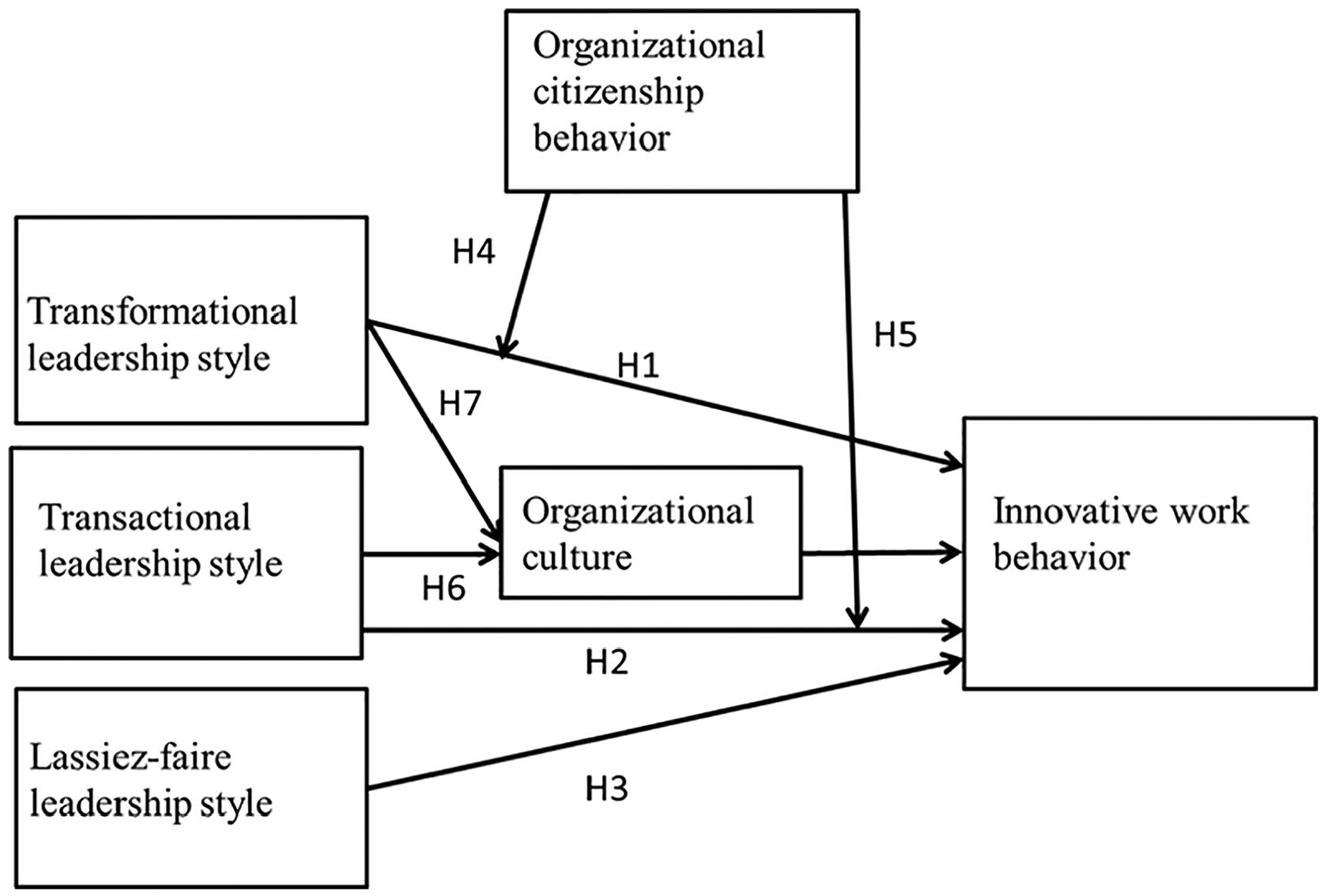
Conceptual framework.
Furthermore, a positive leader–member relationship may have a substantial effect on various number of outcomes for the organization, such as OCB, innovation, commitment, and creativity, some of the factors of performance that have been researched in the past (Jha & Jha, 2013). On the contrary, the Full Range Theory of leadership gives a framework that offers three styles of leadership. Both the transformational and transactional forms are more active, while lassiez-faire leadership is found less effective in organizational settings.
According to the Full Range leadership theory, transformational leadership is more effective in advancing innovation, understanding, and creativity for greater accomplishment among employees within the organization (Khan et al., 2012). Effective leaders enhance the capacity building of their followers and motivate them to produce new concepts and ideas. The connection between transactional leadership and innovative work behavior has been acknowledged differently in earlier literature. Some researchers showed a negative association between transactional leadership and innovative work behavior (Khaola & Sephelane, 2013). While some studies document a significant positive association (Contreras et al., 2017) and no correlation has been also examined by various researchers (Boerner et al., 2007; Moss & Ritossa, 2007). The association between leadership and OCB has been identified in the banking and manufacturing sector to improve performance (Irshad & Hashmi, 2014; C. Li & Wu, 2015). According to Full Range Leadership theory, lassiez-faire style is not subsumed effective because these leaders are delayed in action and decision making, and they ignore the leadership responsibilities (Yang, 2015). Likewise, style and behavior theory of leadership propose that lassiez-faire leadership is only assumed relevant in an innovative culture where a team of highly motivated and skilled employees exist and have an excellent track record of past.
This research aims to test whether statistical data from Pakistan confirm the specified theories. Suggested theoretical links among various variables of this research are displayed in Figure 1.
Method
Data have been gathered through a survey from public universities, located in the Khyber Pakhtunkhwa, Pakistan. The researcher selects professors and associate professors (HODs) as participants because they have been assumed to be the academic leaders along with having general knowledge and experience about their department’s university functions. Those HODs who have served their organization for a minimum of 6 years have been administered the questionnaire. The sampling frame of this research has been taken from the Higher Education Commission website (HEC; 2015–2016). Stratified sampling has been initially applied to choose the universities from the Khyber Pakhtunkhwa public sector universities and to give equal opportunity to both male and female HODs in the list. It is apparent that the whole sample involves both male and female who serve in six public universities situated in Khyber Pakhtunkhwa, Pakistan. Convenience sampling method has also been employed to randomly choose the departments and faculties from every recognized university. Personal visits have been rendered to all those selected universities, for the encouragement of participation and data collection. The participants have been allowed to fill the survey by using paper format or electronically. After repeated visits, out of the total 300 distributed surveys, 166 have been returned. Out of these, six surveys have been found missing value or outliers or typo errors (Hair et al., 2010). Consequently, a sum of 160 usable questionnaires has been thus employed for data analysis, with a response rate of 53%. Sample size has a significant impact in accomplishing statistical significance. According to the GPower analysis, a sample of 150 with an alpha of .05 and seven predictors would be sufficient to find a medium effect size with a power of .95 (Okwuazi, 2014). On the contrary, Hair et al. (2014) recommend the application of G-power to identify sample size in partial least squares structural equation modeling (PLS-SEM) studies. In this study, G-power analysis shows that a minimum sample size of 146 was needed to get the desired power of 95%. A majority of the participants (47) were recorded from the University of Peshawar, followed by University of Engineering and Technology (40), Agriculture University (27), Islamia College University (20), Khyber Medical University (16), and Institute of Management Sciences University (10). The data have been analyzed by using SPSS-23 and PLS-SEM.
Instrumentations
Leadership styles, such as transformational, transactional, and lassiez-faire have been measured by using the multifactor leadership questionnaire. The scale of nine items has been used to measure leadership styles which range from strongly disagree (1) to strongly agree (5). The alpha coefficient for the construct has been reported as .84.
Innovative work behavior has been measured by taking established items from the previous studies (Butt, 2006). A scale of six items has been used to measure innovative work behavior which ranges from strongly disagree (1) to strongly agree (5). The alpha coefficient for the construct has been reported as .94. This scale carried high internal consistency and is declared to be a valid tool in the context of Pakistan (Abbas et al., 2012).
Organizational culture has been measured by employing the questionnaire adopted from the study of Cameron and Quinn (2011). This tool consisted of a set of five items, and the scale ranges from strongly disagree (1) to strongly agree (5). The alpha coefficient for the construct has been reported as .82.
Organizational citizenship behavior has been measured by employing the established items taken from the earlier study of Yan and Yan (2013). A scale of six items has been applied to estimate the OCB, which ranges from strongly disagree (1) to strongly agree (5). The alpha coefficient for the construct has been reported to range from .82 to .96.
Measurement Model
To examine the accuracy of the model, first reliability and validity of the variables have been measured as well as convergent validity and discriminant validity have been run. After estimating the PLS algorithm, every item factor loadings have been checked. The rule of thumb for keeping loadings of the item ranges from 0.50 to 0.70 (Sarstedt et al., 2014). It has been found that all the items of the constructs attained an acceptable value of factor loadings aforesaid.
Moreover, Cronbach’s alpha and composite reliability for internal consistency of all variables come across the recommended range, which is .7 and .8 as suggested by Hair et al. (2011). In the same tune, the average variance extracted (AVE) regarding convergent validity for all the variables has occurred in the range of 0.5 as suggested by Bagozzi and Yi (1988). In a nutshell, the discriminant validity has also been confirmed by assessing Fornell and Larcker (1981), cross-loadings, and Heterotrait–Monotrait ratio. The square root of the AVE must be higher than the corresponding diagonal values of all the constructs while the HTMT ratio can be established when all the values fall under the range of 0.90 (Hair et al., 2017). So, this research achieves the discriminant validity successfully. Measurement model assesses both reflective and formative constructs. The advantage of PLS-SEM is that it combines all the variables in one model and evaluates it. Leadership styles act as a reflective construct in this model. Hence, this model is termed to be reflective-reflective model. Table 1 shows all the values related to the constructs reliability and validity. While Tables 2 and 3 presents variables discriminant validity.
Constructs Reliability and Validity.
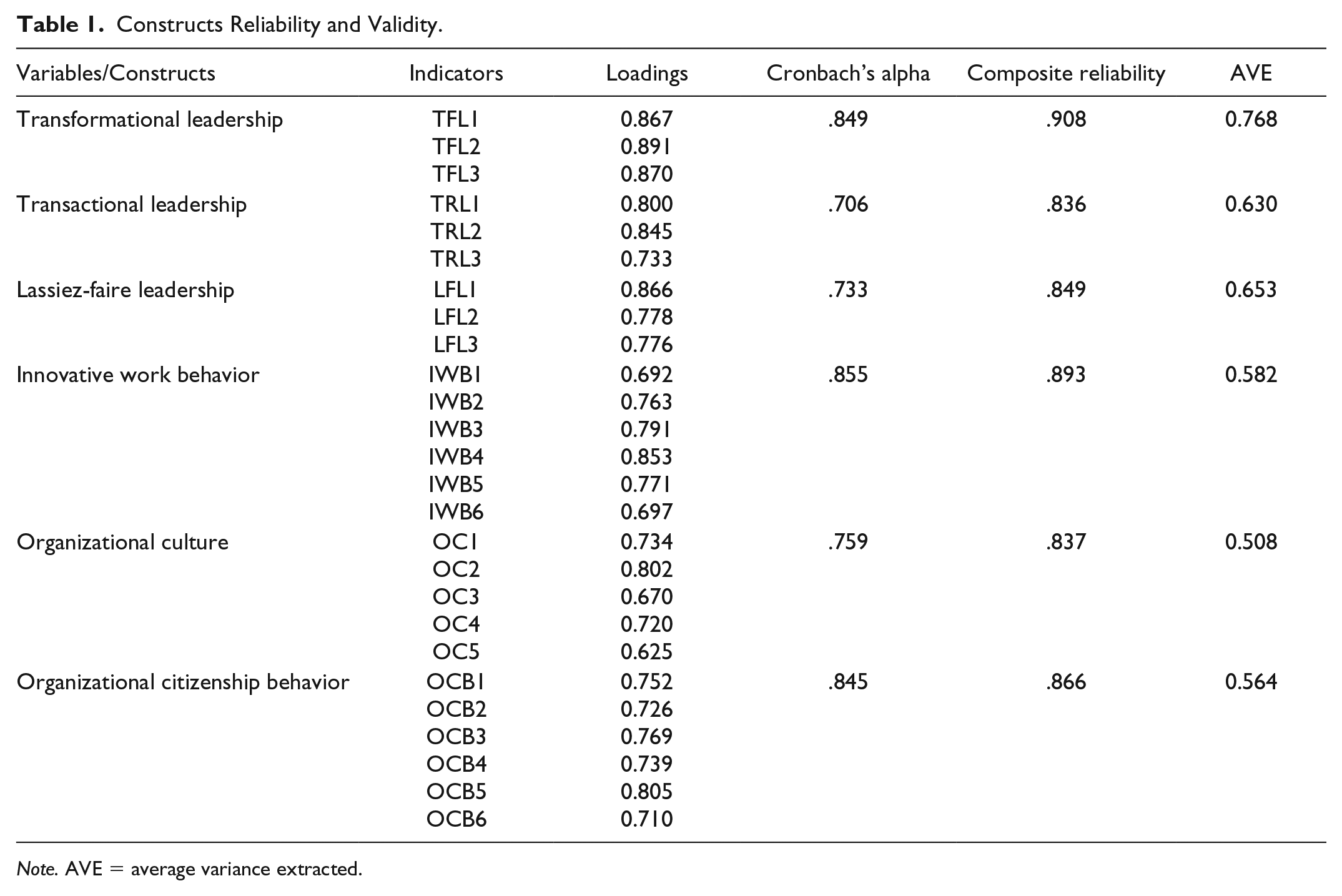
Note. AVE = average variance extracted.
Fornell–Larcker Criteria.

Note. IWB = innovative work behavior; LFL = lassiez-faire leadership; OC = organizational culture; OCB = organizational citizenship behavior; TFL = transformational leadership; TRL = transactional leadership.
HTMT Ratio.
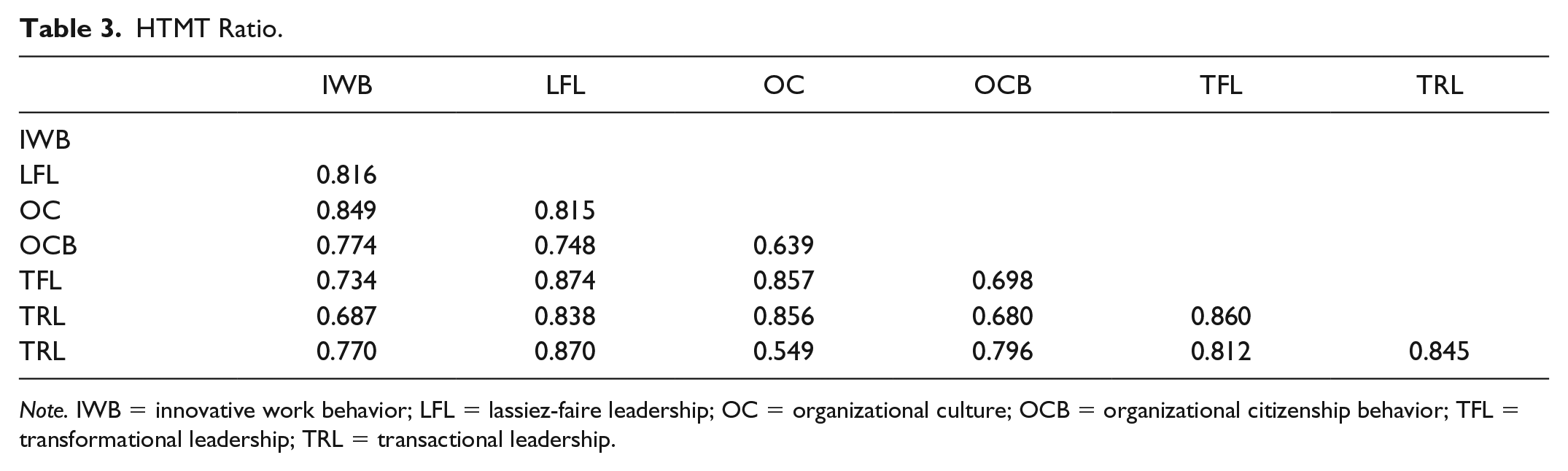
Note. IWB = innovative work behavior; LFL = lassiez-faire leadership; OC = organizational culture; OCB = organizational citizenship behavior; TFL = transformational leadership; TRL = transactional leadership.
Structural Model
After satisfying the results of the measurement model, the next stage is to run the structural model to determine the regression part of the model. In this stage, hypotheses have been tested along with the assessment of R2, effect size, and predictive relevance through calculating PLS algorithm and Bootstrapping method. Structural model not only determines the direct association between the constructs, but also identifies the mediating and moderating effect among the variables (Hair et al., 2011). The path coefficients and t values have been shown in Figure 2. The fundamental metrics of the structural model are the significance level of path coefficient, R2, effect size, and Q2. According to Hair et al. (2017), these metrics must be reported in the structural model. The significance level of path coefficient can be determined by their magnitude sign, which is ±1, and by using t-statistics values. The recommended range for t value is 1.96. Table 7 presents the entire path coefficient, and t value of the developed hypotheses of the research, while R2 values determine the predictive accuracy of the model. It reveals the change that occurs due to the independent variable on the dependent variable (Hair et al., 2013). The R2 values are .67, .33, and .19 documented as significant, moderate, and weak (Chin, 2000). Table 4 signifies the values of R2 of the dependent variables.

Structural model.
R2 Values.

Moreover, the effect size measures the remaining variance of R2 in the dependent variable. The recommended values for R2 are .02, .15, and .35 with small, medium, and large effects (Hair et al., 2012). The values of the effect size can be seen in Table 5. Last, Q2 is called predictive relevance, and is found by the blindfolding method (Hair et al., 2013). It is only determined for reflective dependent variables. The acceptable range for Q2 should be above 0. The values of Q2 are shown in Table 6.
Effect Size Values.

Note. IWB = innovative work behavior; LFL = lassiez-faire leadership; OC = organizational culture; OCB = organizational citizenship behavior; TFL = transformational leadership; TRL = transactional leadership.
Q2 Values.

Note. IWB = innovative work behavior; OC = organizational culture; OCB = organizational citizenship behavior.
Hypotheses Testing
All the hypotheses developed from literature have been tested. In this section, the direct effect of leadership styles, that is, transformational, transactional, and lassiez-faire, has been examined in a relationship with innovative work behavior among the target population. The mediation analysis and moderation analysis are briefly discussed in the following sections.
The researcher examined the effect of TFL on innovative work behavior in H1. The path coefficient and t value for the correlation are .272 and 3.514, and identified significant. So, this hypothesis has been supported by the statistical data.
The researcher measures the effect of TRL on IWB in H2. The path coefficient and t value reported are 0.162 and 3.299, which means a significant effect exists of Transformational leadership on innovative work behavior.
In the third hypothesis, the researcher investigates the effect of LFL on IWB, and has found no effect or significant relationship between these two variables. The path coefficient and t value noted is 0.037 and 0.689. Most of the previous authors propose that lassiez-faire leadership has less or no effect on innovative work behavior which is subsequently confirmed by this study.
In H4, the moderating effect of OCB has been analyzed on the relationship between TFL and IWB. It has been found that there is a moderating effect of OCB on such a relationship because the beta value and t value have been noted significant (β value = .214, t value = 3.076). So, this hypothesis has been confirmed by the empirical data.
H5 reveals that OCB moderates the relationship between TRL and IWB. It has been found that the moderating effect of OCB on such a relationship reported positive and significant (β value = 0.173, t value = 1.971). Again, this hypothesis has been also verified.
H6 shows OC mediates the relationship between TFL and IWB among the target population. From the results, it is obvious that OC has a mediating effect on such relationship with having path coefficient and t value (TFL → OC → IWB, β value = .143, t value = 3.984). It is concluded that OC mediates such relationship, and it can be seen in Table 7.
Hypothesis Testing (β Value and t Value).

Note. TFL = transformational leadership; IWB = innovative work behavior; TRL = transactional leadership; LFL = lassiez-faire leadership; OC = organizational culture; OCB = organizational citizenship behavior.
p > .005.
H7 illustrates that OC mediates the relationship between TRL and IWB among the target population. From the results. (TRL → OC → IWB, β value = .170, t value = 3.147). It is concluded that OC mediates such relationship and can be seen in Table 7 in detail.
The entire direct hypotheses have been supported by the results along with those which were developed on the basis of mediating and moderating effect in the study. Table 7 briefly describes all the seven hypotheses results, including beta values and t values.
Discussion
In this research, a model has been formulated and tested to examine the effect of leadership styles, that is, transformational, transactional, and lassiez-faire on innovative work behavior. The impact of transformational and transactional leadership on innovative work behavior have also been investigated under the mediating role of organizational culture and moderating effect of OCB. The results exhibit a good support for most predicted links. Transformational and transactional leadership styles show a significant effect on innovative work behavior. As predicted, it has been observed that transformational leadership empowers academic leaders to perform better in making their employees creative and innovative. Therefore, HEIs with both transformational and transactional leaders are quite capable to get their innovative strategies excel in the institutions. In general, this verifies the results from previous studies that support the influence of both transformational and transactional leadership styles about the cultivation of innovative behaviors in employees (Abbas et al., 2012; Afsar et al., 2014; Contreras et al., 2017; Khan et al., 2012; Yan & Yan, 2013). Effective leaders motivate and encourage their employees to develop new ideas and concepts within the organization (Naqshbandi et al., 2019). Encouragement and motivation of effective leaders support the innovative work behavior of employees. Such leadership also acknowledges employees to mingle in innovative actions by representing the favorite behaviors. Although, the outcomes of this research show that both styles of leadership are imperative for HEIs that aspire to adopt innovative work behaviors. Contrary to these styles, in this study, lassiez-faire leadership style has been found having no effect on innovative work behavior. Hence, this study confirms the results of the previous researchers that lassiez-faire leadership has no such effect on innovative work behavior in workplace (Boerner et al., 2007; Moss & Ritossa, 2007; Yang, 2015). Moreover, the current study examines the moderating effect of OCB on the relationship between leadership styles, that is, transformational and transactional and innovative work behavior. This study advocates that leadership styles (transformational and transactional) are a valid predictor of OCB and innovative work behavior, and the results are in consonance with the findings of past scholars (Rita et al., 2018; Zabihi & Hashemzehi, 2012). The current study reports that OCB moderated such relationship in a positive and significant manner. Thus, it can be summarized that transformational leadership has more prominent influence in setting up OCB (Sharma & Bhatnagar, 2014), and innovative work behavior as aforementioned by earlier scholars (Lucey, 2017). The present study contributes to existing empirical studies in that transformational and transactional leadership is positively related to both extra role behaviors (OCB) and innovative work behavior in a non-Western context. It also verifies the earlier studies conducted on the association of transformational leadership and OCB and transformational leadership and innovative work behavior (Khaola & Sephelane, 2013). On the contrary, in the present study, OCB also moderates the relationship between transactional leadership and innovative work behavior and re-validates the previous findings of MacKenzie et al. (2001). Therefore, all the proposed hypotheses have been accepted in supporting the empirical data. This study presents successful mediating effect of organizational culture between the transformational and transactional leadership styles and innovative work behavior. Hence, it has been confirmed that both styles of leadership performs a crucial role in making innovative culture and subsequently enhancing innovative behavior of the employees. Moreover, there is a direct impact of transformational and transactional leadership styles on innovative work behavior, but when the organizational culture mediates such relationship, the association becomes more strengthened by supporting the innovative culture in the HEIs. This result is consistent with the findings of Rabbani et al. (2014). It has been documented in several past studies that organizational culture attributes influence innovative work behavior. Through analysis, it is also investigated that transformational leadership has positive and significant impact on organizational culture (Sarros et al., 2011). These findings illustrate that a transformational leader builds a constructive and pleasant work environment in the institution. It has also been revealed from the findings of this study that transactional leaders can effectively contribute to the organizational culture, and expect to produce a positive and significant effect on innovative work behavior. Those educational institutions, which are in the process of change and development, require changing their culture, and making it creative and innovative. Organizational culture is found to have a linear correlation with innovative work behavior (Eskiler et al., 2016). Academic leaders help support the organizational culture to be more creative, adaptive, and innovative ultimately boosting the innovative work behavior in the workplace.
The current study laid the foundation by studying the leadership styles, that is, transformational, transactional, and laissez-faire with innovative work behavior under the mediating and moderating effect of organizational culture and OCB, respectively. The integration of the study variables into one framework is a novel contribution to both the literature of leadership and innovative work behavior. The results of the current study reveal that establishing the link between two complex paradigms of leadership styles and innovative work behavior through organizational culture is a promising and unique contribution to the literature of leadership in academic sector. Organizational culture embedded with supportive leadership leads to employees’ autonomy, self-esteem, and creativity, and results in improved organizational performance.
Conclusions, Limitations, and Future Study
This research develops a framework to discourse the effect of leadership styles, that is, transformational and transactional on innovative work behavior with the moderating and mediating effect of OCB and organizational culture in the target population. On the contrary, the effect of lassiez-faire style on innovative work behavior has been independently tested. The study has been carried out on the HODs in the HEIs of Khyber Pakhtunkhwa, Pakistan. Hence, this study provides significant contributions to the leadership styles, OCB, organizational culture, and innovative work behavior literature. The study explicitly signifies that in the Pakistani HEI context, both leadership styles, such as transformational and transactional, are effective for encouraging innovative behavior in the employees. It also recommends that the transformational leadership style can productively be employed by HODs to motivate employee innovative behavior in the target population by stimulating employees to bring novel ideas and concepts. The higher education sector may also utilize the efforts of transactional leaders for getting competitive advantage by advancing innovative behavior among individuals and groups.
Findings of this research propose that academic leaders (HODs) in academic settings, particularly in universities, may motivate their subordinates to seek viable solutions for their issues, and to make them innovative and creative. By adopting innovative and creative behavior, employees may enhance their self-esteem and make work purposeful. This research contributes, both in the field of theory and practice, by concentrating on universities and their academic leaders and provide considerable amount of literature to the existing one. Results of this study also provide understanding and full support to the employees regarding the link of leadership styles such as transformational and transactional with the organizational culture. Both transformational and transactional styles influence organizational culture positively, and contribute effectively in providing opportunities for performance of extra role behaviors. This research also imparts credibility to the concept that transformational leaders, with innovative and charismatic behavior, will lead to more innovative and productive employees.
Most of the outcomes of this research align with full range leadership theory, social exchange theory, and leader–member exchange theory. So, theories are verified in a collectivist context of educational institutions in Pakistan. This study highlights the significant role of transformational leadership which may engender an innovative culture and enhance the quality of organizational creativity and innovation. Certainly, the findings firmly recommend that this research may be supportive for the scholars and practitioners to better comprehend the role of leadership styles and its effect on organizational culture and innovative work behavior. The current study may assist the public sector universities in the recruitment and selection methods of employees. Practically, for institutions which desire to perform high-quality innovative results, the academic leaders may attempt to give employees and organizations with value and goals, inspirational and transactional stimulation and OCB. This research has added a big deal to the full range leadership theory, with the verification of several theorists’ assumptions and the earlier results, already conducted in the other settings in Pakistan such as in banking and tourism sector.
The significance of leadership cannot be overlooked within universities because the majority of the leadership studies are mainly emphasized on administrative and managerial positions inside corporate and industrial settings. The current research limelight’s the impact of leadership styles on employees to make them innovative and creative to, further, compete in the global education robustly.
This research carries only three leadership styles, and it should be more beneficial and informative by getting more styles of leadership into account, such as charismatic, autocratic, and democratic. This research conducts a cross-sectional survey design with a small sample which commonly produces low internal validity. Future researchers can adopt a large sample size, or otherwise carry out an experimental research design to re-investigate the existing model. In the present research, data have been gathered from public sector universities merely. Future scholars may conduct a comparison of both the public and the private sector, or include other sectors of economy such as telecom and small enterprises. The current study mainly elaborates the positive and significant effect of leadership styles on innovative work behavior. So, future researchers can also examine the potential mechanisms which can give worthy clarifications of the association, such as individual creativity, absorptive capability, and organizational learning, under the different leadership styles.
Footnotes
Declaration of Conflicting Interests
The author(s) declared no potential conflicts of interest with respect to the research, authorship, and/or publication of this article.
Funding
The author(s) received no financial support for the research, authorship, and/or publication of this article.
