



Abstract
With the growing development of the knowledge economy in recent years, the value of knowledge workers has increased substantially. On the basis of the broaden-and-build theory (B&B theory) and conservation of resources (CoR) theory the aim of this research work is to evaluate the mediating effect of leader-member exchange (LMX) and organizational learning (OL) between servant leadership and knowledge innovative work behavior (IWB). Current study included the participation of 496 knowledge employees from China’s high-tech companies. The responses of the survey were analyzed using MPLS software while utilizing the structural equation modeling method. The findings validated the link between servant leadership (SL) and IWB. In the relationship between SL and IWB, LMX and OL mediated the relationship as parallel mediator. This study discovered a correlation between SL and OL and LMX. In addition, the findings signify that in the Chinese high-tech companies’ SL style augments IWB through the support of OL and LMX. The results of the study are useful for harnessing the leader and member for achieving organizational objectives through enhancing the innovative work behavior in the knowledge workers of Chinese high-tech companies.
Introduction
Recently, Forbes Councils member urged for acknowledging the vital function and specific requirements of one billion knowledge workers in a recent Forbes research. It was recommended by authors that organization to adopt employ-centric, caring, engaging, and service-oriented models to enhance overall productivity and creativity (Ricard, 2021). Importance of knowledge workers has gained considerable momentum with the swift progression of the knowledge economy in recent past (N. O’Donovan, 2020). It is out of imagination to growth without innovation in the current business context of short cycles of products (Evans et al., 2017). Previously, only a few intelligent people pursued innovation, but now organizational employees are the main drivers of innovation (Shanker et al., 2017). Modern-era employees are an asset and an invaluable resource for firms (M. A. Khan et al., 2020; Shafique et al., 2019), responsible for introducing new concepts and products and it plays an important role in determining performance of firm (N. O’Donovan, 2020; Rubera & Kirca, 2012). This type of employee is often regarded as a knowledge worker (Drucker, 2006). Recognizing this phenomenon, modern organizations encourage their employees to share novel ideas for performance improvements. In response, many studies on antecedents of employee IWB have emerged in the past few years (Jan et al., 2022; Shanker et al., 2017). Yet, some experts (M. M. Khan et al., 2021) assert the need for future research into other factors, that is, employee-centric leadership (M. A. Khan et al., 2020) and explanatory mechanisms of IWB (Cai et al., 2018).
Recently, scholars have started examining various types of leadership styles, that is, authentic leadership (Grošelj et al., 2021), transformational leadership (Pradhan & Jena, 2019) and inclusive leadership (Shakil et al., 2021) to have a key role in subordinate’s’ IWB. Similarly, M. M. Khan et al. (2021) argued that SL could be an important predicator of followers’ IWB. Because study found servant behavior to be an essential attribute for leaders to bring IWB in the followers of healthcare sector (Ahmad et al., 2021). The empirical linkages between SL and IWB has yet to be explored specially in the high-technology firms of China (Cai et al., 2018; Zhu & Zhang, 2020). According to Greenleaf (1977), servant leaders are those who have “the natural feeling that one wants to serve, to serve first” (p. 7). Prior studies found that SL significantly improve followers job performance (Schwarz et al., 2016) and employee creativity (Jaiswal & Dhar, 2017). Hence, current research work aims to examine the nexus between SL and employee IWB.
To investigate the association between SL and employee IWB in the high-tech firms of China, it is crucial to examine how servant leader encourage employees to demonstrate IWB. Current study assumes LMX and OL as potential parallel mediators explaining the relationship between SL and IWB. LMX is pertinent relationship between leadership and their followers based on four factors including professional respect, affect, contribution and loyalty (R. Liden & Maslyn, 1998). Prior research works explicitly established the empirical association between SL and LMX (Anand et al., 2011; Wu et al., 2013). As these leaders focus on developing the leadership capabilities in subordinates and building their subordinates into more potential workers of the organization, SL is plausible to build LMX (high quality linkage) in the group members (Ahmad et al., 2021; Greenleaf, 1977). These research studies highlighted that SL develop high LMX with their subordinates and allow them to demonstrate IWB. Therefore, this research work assumes that LMX has an important mediating role between SL and IWB. This research work also assumes that OL is another possible mediating path in the linkage between SL and IWB. Leadership is important for OL as of its effect on the degree of support and inspiration for development and learning in organization (Salas-Vallina et al., 2017). In the literature of organization behavior, the empirical relationship between SL and OL is severely unexplored (Xie, 2020). However, in the business setting this linkage between SL and OL is worthy to be explored. (Xie, 2019). Therefore, this study assumes OL as parallel mediator of SL and IWB.
The study at hand proposes that SL establishes high-quality LMX and OL culture to incite IWB. The positive sentiments, resource expansion, and work freedom emerging from this sociopolitical process enable employees to develop new ideas to execute efficiently. As far we know, the empirical model explaining the parallel mediating role of LMX and OL between SL and IWB is scant. The paper adds to the current works in several ways. First, the paper is among the few studies on SL and IWB (Jan et al., 2022; M. A. Khan et al., 2020; M. M. Khan et al., 2021) hence increased the body of knowledge in this specific domain. Second, there is scarcity of empirical studies testing the specific relationship, this is the first empirical work that establishes the key role of LMX and OL in generating IWB by linking SL, LMX, OL, and IWB in a unified framework (Aboramadan et al., 2021; Xie, 2020; Zeng & Xu, 2020). Third, while aiming at the addition in the body of knowledge of SL theory, the paper has attempted to broaden the conceptual lens in SL theory, as asserted by earlier authors (Eva et al., 2019). Fourth, in terms of the theoretical contribution this research extended body of knowledge of B&B theory (Fredrickson, 2004) and COR theory (Hobfoll, 1989) to build the case for the mediating role of LMX and OL between SL and IWB. Fourth, the current model adds to the B&B theory in validating LMX as an explanatory mechanism in the SL-IWB nexus, as asserted by the proponents of SL theory (Zeng & Xu, 2020). As of this research, there has been a scarcity of models explaining the parallel mediating role of LMX and OL between SL and IWB. Also, there is no previous study using time lagged data to explain the link between SL and IWB, with LMX and OL as mediators, hence adding value in the body of knowledge IWB and its antecedents.
The second section covers theoretical background and hypotheses development, comprising a critical overview of past concepts and empirical studies for developing different hypotheses. The third section delineates methodology, including research design, sample, data gathering, and procedures. The fourth section presents the findings and results of this study. Final section comprises upon the discussion on the main results, practical implications, contributions, limitations, and future directions.
Theoretical Background and the Hypotheses Development
The Relationship Between SL and IWB
The risky nature of IWB for both the knowledge workers and the enterprises necessitates continuous leadership support for the propagation of IWB (Jan et al., 2022). Recognizing the importance of IWB, significant attention has been devoted by scholars to examining the leadership role in generating IWB. J. P. De Jong and Den Hartog (2008) proposed that leaders displaying innovative role-modeling, recognizing employee needs, consulting, delegating, and undermining micromanagement, are more likely to enhance employee IWB. As SL exhibit all these traits, they hold the potential to increase employee IWB. SL instills an overarching vision among followers, thereby employees to work toward innovative ideas (M. A. Khan et al., 2020). SL contributes to idea searching and innovation development by constantly engaging followers, seeking feedback, and valuing their input and initiatives (Ahmad et al., 2021). SL can effectively persuade followers to consider organizational outcomes (e.g., innovation) and growth as their accomplishments (Xie, 2020). When employees experience a failure, SL work practices like autonomy, delegation, shared decision-making, and extended support could strengthen employee propensity to engage in IWB (Cai et al., 2018). Employees develop and implement new ideas because SL prioritizes seeking and acting on their input (Page & Wong, 2000). Many experts consider autonomy a prerequisite of IWB (M. A. Khan et al., 2020; Shakil et al., 2021). SL encourages followers to be autonomous in their work (Graham, 1995), thereby meeting the fundamental needs of IWB.
Furthermore, the nonexistence of micromanagement practices in SL could contribute to IWB in allowing the followers to actively create their distinct processes, procedures and possible ways. The leader-follower trust relationship (rather than command and control) provide freedom to followers in managing their daily working affairs and operations, while enhancing their ability to innovate (J. P. J. de Jong & Den Hartog, 2007). More so, the sensitive nature of IWB mandates an agile leader who can extend support and instill confidence among knowledge workers embarking on their path to innovation, disregarding the failure risk (J. P. J. de Jong & Den Hartog, 2007). The agility of SL is an important attribute that could facilitate IWB (M. A. Khan et al., 2020). Apart from the argument stated above, there is growing evidence that SL positively affects IWB (M. M. Khan et al., 2021; Zhang et al., 2020). Thus, this study proposed the below hypothesis.
The Link Between SL and OL
OL is an organizational process of acquiring, transferring, and creating knowledge to produce new ideas and knowledge (Garvin, 1993; Örtenblad, 2001). Marsick and Watkins (2003) proposed seven OL dimensions, namely “continuous learning, inquiry and dialog, collaboration and team learning, people empowerment for the people dimension, environmental connection, embedded systems, and strategic leadership.” A learning organization is categorized by cooperation, teamwork, information-based processes, and innovation (Confessore & Kops, 1998). OL is recognized as a critical factor to improve long-term performance (van Veelen & Ufkes, 2019), enabling firms to gain a competitive advantage by enhancing their structure (Slater & Narver, 1995). García-Morales et al. (2008) found a favorable influence of OL on employee performance and growth in the manufacturing industry. In the leadership context, few scholars have explored the influence of leadership style (mainly transactional and transformational) on OL (e.g., E. J. Kim & Park, 2019; Zagoršek et al., 2009). That said, Vera and Crossan (2004) asserted the facilitating role of leadership in OL. Choudhary et al. (2013) compared the impact of TL and SL on OL in the service sector of Pakistan. The authors concluded that SL contributes to OL and knowledge by considering followers’ needs, even though such influence is lower than transformational leaders. Nonetheless, extant works on this topic lack depth, scope, and empirical evidence (Domínguez-Escrig et al., 2020).
Although SL is not performance-driven with respect to “sacrificing people on the altar of profit and growth,” yet they exhibit sufficient energy to drive OL (Sendjaya, 2015, p. 4). Past studies corroborate that TL and SL can significantly contribute to initiating a learning organization (Singh, 2008; Xie, 2020). Domínguez-Escrig et al. (2020) stated that SL recognize and attempt to overcome their deficiency in knowledge by nurturing a learning atmosphere that encourages experimentation to assist employees in learning and creating new ideas or concepts. SL’s emphasis on employee growth fosters a culture of OL. Besides that, SL are altruistic, a trait positively relating to OL (Mallén et al., 2016). SL, as altruistic leaders, facilitate a supportive and safe working environment in which making mistakes, risk-taking, and dialog are encouraged (rather than penalized). SL effectively address negative sentiments (e.g., disappointment and anxiety) and promote positive emotions (Domínguez-Escrig et al., 2020). Emotions are central to the organizational process (Antonacopoulou & Gabriel, 2001). Stewardship theory, a tenet of SL, posits that leaders endorse two-way communication, low power distance, participative and involvement-driven culture, trust-based relationships, and strengthen external relationships, among other elements (Domínguez-Escrig et al., 2020; Xie, 2020). These factors are crucial for promoting OL (cf. Akharbin et al., 2014; Chiva et al., 2007). Nonaka and Takeuchi (2011) argued that wise leaders (like servant leaders) promote exchanges inside organizations, combine people with conflicting goals, encourage sharing of information, enhance communication, and engage followers or employees; consequently, disseminating leadership to the optimal level throughout the enterprise. By doing this, such leaders revive knowledge and increase learning. Thus, the following hypothesis is assumed:
The Link Between SL and LMX
As per theory of LMX, the leader-follower relationships are complex, unique, and interactive, causing various individual outcomes (Dulebohn et al., 2012), with fundamental transactional exchanges at the lowest level and reciprocal respect, communication, mutual influence, trust, and higher-order need fulfillment at the highest level (Graen & Uhl-Bien, 1995). In higher context of LMX associations, leader extend strong support (Ghufran Ali Khan et al., 2022; Nazir et al., 2021) and followers reciprocate by dedicating extra effort and time to their works to the best of their capability (Newman et al., 2017). Poor quality LMX connection are categorized by contract-focused and strict role-defined job interactions (Janssen & Van Yperen, 2004). Theoretically, the LMX four-dimension model, including “loyalty,”“affect,”“contribution,” and “professional respect,” has attracted considerable academic focus and interest (R. Liden & Maslyn, 1998). Initially, Dienesch and Liden (1986) proposed that LMX associations depend on three distinct exchange aspects, “currencies,” or mechanisms: (i) contribution—the perceived input of leader and member to the exchange process; (ii) loyalty—public support expression; (iii) affect—shared affection among members. R. Liden and Maslyn (1998) developed the scale by adding the fourth dimension, professional respect—leader-member should demonstrate mutual professional respect to exploit the full benefits of LMX.
Recent research studies also suggested a high-quality LMX incites positive attitudes, sentiments, behaviors, and individual and employee results (Janssen & Van Yperen, 2004) for example, innovative behaviors, job-related commitment, improved performance, engagement, task performance, and job satisfaction (M. S. Kim & Koo, 2017; Moin et al., 2021). As an antecedent to high-quality LMX, SL exhibits the necessary skills and abilities to develop superior LMX associations based on mutual respect, open communication, and trust (Mostafa & El-Motalib, 2019). Lee (2005) stated that employees generally engage in high-quality LMX if leaders espouse a motivation for serving their followers. SL develop service-centered leader-member relationships by prioritizing the creation of social exchanges (rather than economic) (M. A. Khan et al., 2020; R. C. Liden et al., 2008). SL forms a trust-centric relationship based on reciprocal responsibilities among leaders and followers (Jan et al., 2022; Shim et al., 2016). SL develops a strong LMX culture by solving problems, understand, and empathize with employees, emphasize their development, and create opportunities for them to gain new insight, skills, and knowledge (see also, R. C. Liden et al., 2008; Mostafa & El-Motalib, 2019). The concern of SL for society enables them to gain the trust of followers who perceive them as the main decision-makers caring for all (Newman et al., 2017). Besides, many studies have found support for the positive influence of SL on LMX in a big Chinese state-owned firms (Newman et al., 2017); charitable hospitals across Sweden (Hanse et al., 2016); Egyptian public healthcare sector (Mostafa & Motalib, 2019). Accordingly, the current study proposes the following hypothesis:
The Role of OL as a Mediator Between SL and IWB
Extended evidence as per the recent studies supports the link between leadership and OL (Xie, 2020; Zagoršek et al., 2009), a factor significantly contributing to organizational and individual innovation (Abdi & Senin, 2014; Ahmad et al., 2021; Pratoom & Savatsomboon, 2012; Stata, 1989). As per Naranjo-Valencia et al. (2011), innovation occurs when knowledge workers attain new or existing knowledge from internal and external knowledge sources (e.g., colleagues and industry peers), which is then shared and exchanged to benefit the organization (Cho & Chang, 2008; Salavou & Lioukas, 2003). Daddi et al. (2016) investigated [and found support for] firm-level innovation due to knowledge spillovers and resource-sharing led by employees. In a study of Chinese companies, Zhu and Zhang (2020) concluded that leaders are the “principal sources” driving positive employee sentiments toward eco-innovation. Academically, the intervening role of OL between transformational leadership and innovation has been tested by many scholars for: Taiwan’s tech, financial (Liao et al., 2017), and education sector (Hsiao & Chang, 2011); global pharmaceutical sector (García-Morales et al., 2008); Spanish manufacturing sector (García-Morales et al., 2012); and Iranian manufacturing sector (Noruzy et al., 2013). Employees are more inclined to innovate and contribute to high overall innovation performance when leaders trigger positive sentiments, create a friendly climate, and provide necessary resources, autonomy, and freedom (Khattak et al., 2022), a colloquial description of SL. Despite that, the role of OL as a mediator in the context of SL-IWB nexus remains unexplored. A feasible explanation for the mediating impact of OL between SL and IWB resides in the work of Van Dierendonck and Rook (2010), B&B theory (Fredrickson, 2001) and the COR theory (Hobfoll, 2002). The B&B theory posits that positive emotions activate thought-action repertoire and cognitive mechanisms ideal for creative thinking (Fredrickson, 2001). Besides other traits, SL’s humility (standing back) enable thought-action repertoire development. SL facilitates followers to experience positive emotions by learning, experimenting, making mistakes, idea creation, (Van Dierendonck & Rook, 2010). Such positive emotions and provision of cognitive and physical resources trigger the sociopolitical processes (M. A. Khan et al., 2020), which augments the thought-action repertoire of knowledge workers and enhance their ability to pitch new ideas (Fredrickson, 2001; M. A. Khan et al., 2020). SL-nurtured organizational learning climate enhances employee available resources (cf. Van Dierendonck & Rook, 2010) that are necessary for new idea implementation (Cai et al., 2018). In line with the COR theory (Hobfoll, 2002), knowledge workers attempt to expand available resources to access other resources, that is, relational resources. Sociopolitical processes, built on relational resources, help implement ideas, that is, the latter phase of employee IWB (M. A. Khan et al., 2020; M. M. Khan et al., 2021). Based on the above arguments, the following hypotheses are proposed:
The Role of LMX as a Mediator Between SL and IWB
SL focus on building leader-follower relationships based on mutual respect, trust, and obligation (Liden et al., 2008), a precondition of achieving high-quality LMX (Graen & Uhl-Bien, 1995). Again, drawing from the recent works in the COR and B&B theory, sociopolitical processes led by strong “relationships” are mandatory for idea generation (Ahmad et al., 2021; M. A. Khan et al., 2020). While proposing future directions in the SL theory, Van Dierendonck and Rook (2010) used the basis of the social exchange theory to predict that SL may enhance employee creativity and innovative behaviors through the mediating effect of high-quality LMX. SL’s focus on empowerment, delegation, and development of employees garners high-quality LMX relationships (representing mutuality of obligation, trust, and respect); consequently, helping followers to engage in challenging and risky projects (Nauman et al., 2022). Such high-quality LMX relationships strengthen sociopolitical processes for conceptualizing novel ideas (cf. B&B, Fredrickson, 2001), encouraging them to acquire the necessary resources and support to implement new ideas (COR, Hobfoll, 2002). Experts agree that such relationships, behaviors, and attitudes are fertile grounds for creative performance (Liao et al., 2017; Tierney et al., 1999) and IWB (M. M. Khan et al., 2021; Van Dierendonck & Rook, 2010). To summarize prior beliefs, employees demonstrate IWB when leaders provide a conducive environment, a strong sense of intrinsic motivation, autonomy, competency, and tolerance for ambiguity among followers (see for review, Cai et al., 2018; Van Dierendonck & Rook, 2010). Past research on other leadership like transformation leadership (Jyoti & Bhau, 2015) and empowering leadership (Echebiri & Amundsen, 2021) corroborate with the current proposition that LMX remains a significant mediator between leadership and employee innovation capacity. More recently, Zeng and Xu (2020) empirically substantiated the positive moderating effect of LMX between SL and IWB. Thus, the following hypotheses are proposed:
Methods and Measures
Sample and Participants
The authors adopted a survey technique for data gathering. The data were collected through a structured survey document from knowledge workers in high technology firms (health care, education and service) across China. Finally, from 135 high tech firms 496 complete survey were received. Out of 156 high-tech firms, 54 are the small and medium-sized enterprises. The strength of employees in each firm were between 50 and 200. The knowledge workers were recruited using academic-corporate relationships and alumnus working in the human resource department of high-tech companies. After acquiring consent and permissions from officials and staff members, the HR department permitted data collection with some restrictions and assigned a representative for the survey administration. A WeChat (social-networking app) group was set up for distributing surveys. Data were collected in two phases with a time interval of 4 weeks. The electronic survey could only be submitted if filled. An essential requirement for these participants was previous and current experience in innovation and R&D projects.
In the first phase, the respondents completed the survey involving key demographics, SL, LMX, and organizational learning. After a month, a short questionnaire of IWB was completed in the second phase. This data collection strategy was carried out to control for common method variance (CMV). The common method bias was tested that gave the value of 64.3% well above from 50%. Finally, a total of 496 usable paired data were extracted for testing the hypothesis. The responses rate was 83.4%. The good response rate is due to the courtesy follow-up calls for data collection.
Table 1 shows the main demographic details disclosed by the HR representatives in the selected high technology firms. Table 1 shows the main demographic details disclosed by the HR representatives in the selected high technology firms.
Respondents’ Profile (n = 496).

Measures
The measurement scales were adopted from different sources for all variables, including SL, leader-LMX, IWB, and OL. A five-point Likert scale was adopted, in which 1 = strongly disagree, 2 = disagree, 3 = neutral, 4 = agree, 5 = strongly agree. The survey document was translated into simplified Chinese using the Brislin (1970) back-translation techniques for Chinese respondents. The seven-item measurement scale of SL-7 (α = .96) was adopted from the work of R. C. Liden et al. (2015). A sample item of the scale is: “My boss puts my best interests ahead of his/her own.” A six-item battery developed by Scott and Bruce (1994) was used to measure employee IWB. One of the sample items is: “I generate creative ideas at work.” LMX was measured using a seven-item developed by Scandura and Graen (1984) and later modified by Graen and Uhl-Bien (1995). One sample item rated by employees is: “I have a good working relationship with my supervisor.” A four-item scale developed by García-Morales et al. (2008) was used to measure organizational learning. One sample item is: “The organization was a learning organization.” Data were analyzed using statistical packages using MPLUS 8.3.
Results and Findings
Table 2 presents the summarized version of mean, standard deviation, Pearson’s correlations, As seen, the results showed that SL significantly and positively associated with IWB (r = .754, p < .001), OL (r = .694, p < .001), LMX (r = .617, p < .001).
Mean, SD, Pearson’s Correlations.

Note. N = 496. SL = servant leadership; OL = organizational learning; LMX = leader-member exchange; IWB = innovative work behavior.
p < .01. **p < .001 (two-tailed).
Table 3 shows the results of the reliability and validity statistics. As seen below, the results supported good internal consistency for SL (α = .955), OL (α = .816), LMX (α = .909), and IWB (α = .924), as per commonly accepted standards, that is, Cronbach’s (α) coefficients ≥ .7. Moreover, the validity was evaluated using the factor loading scores (FLS), composite reliability (CR), standard error (SE), and average (AVE). As depicted below, the factor loading score (FLS) higher than 0.5 on average, offering empirical evidence for the significance test. The factor loading scores, AVE, and CR of all the four variables were well above the acceptable threshold: SL (FLS = 0.769–0.927; p < .001; AVE = 0.756; CR = 0.956); OL (FLS = 0.628–0.778; p < .001; AVE = 0.539; CR = 0.823); LMX (FLS = 0.681–0.848; p < .001; AVE = 0.6; CR = 0.913); IWB (FLS = 0.749–0.852; p < .001; AVE = 0.674; CR = 0.925).
Reliability and Validity Statistics.
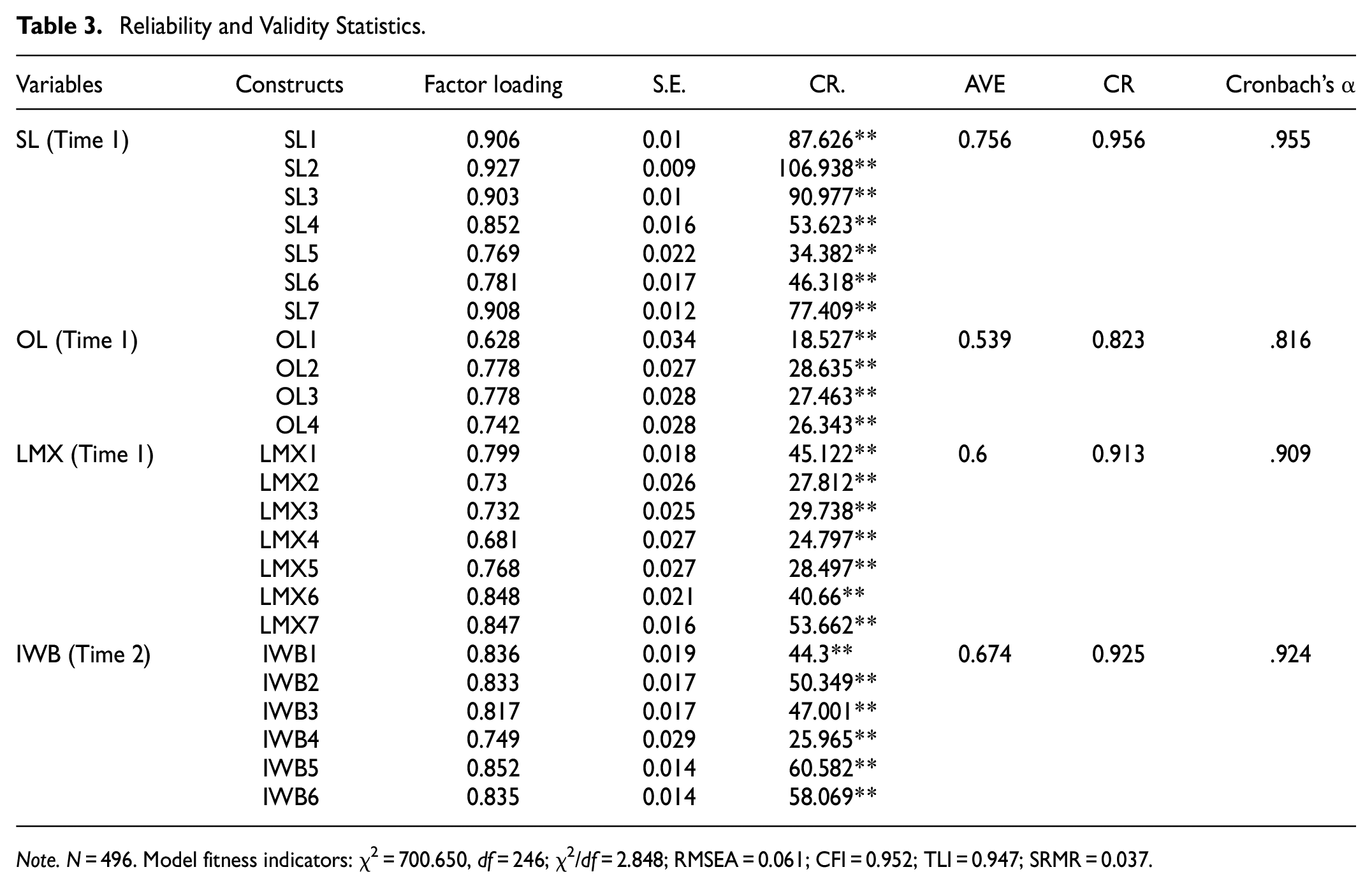
Note. N = 496. Model fitness indicators: χ2 = 700.650, df = 246; χ2/df = 2.848; RMSEA = 0.061; CFI = 0.952; TLI = 0.947; SRMR = 0.037.
Table 4 reported the results of confirmatory factor analysis (CFA) for model fitness and goodness. Earlier works (Nasser-Abu Alhija & Wisenbaker, 2006), the following six criterion were used to gage model fitness: χ2/df(<3), the root mean square error of approximation (RMSEA < 0.08), comparative fit index (CFI > 0.9), Tucker–Lewis index (TLI > 0.9), standardized/weighted root mean square residual (SRMR < 0.08). The base-line model (BM), including SL, OL, LMX, and IWB, was compared against different competing models. The BM fitting index (i.e., χ2/df = 2.848, RMSEA = 0.061, CFI = 0.952, TLI = 0.947, SRMR = 0.037) was superior than that of three competing models at p < .001. This result demonstrated that BM exhibited a good discriminant validity and respondents could conveniently discriminate the study constructs.
Results of CFAs: Comparison of Measurement Models.
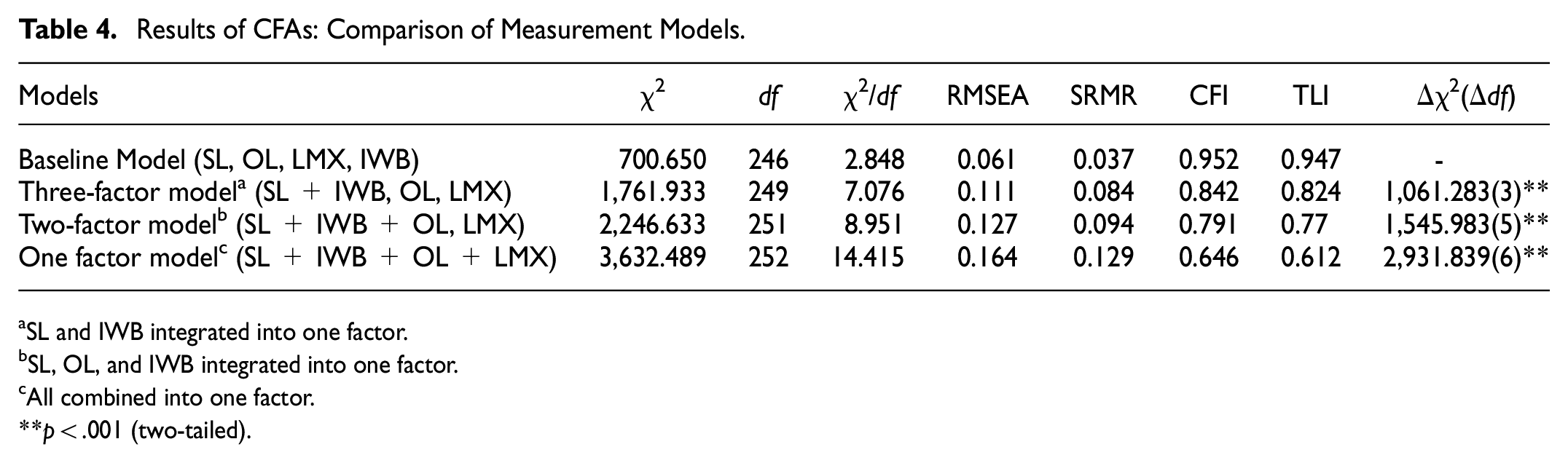
SL and IWB integrated into one factor.
SL, OL, and IWB integrated into one factor.
All combined into one factor.
p < .001 (two-tailed).
Table 5 shows the results of the common method variance (CMV). Even though the two phased data collection involved in different time limited the possibility of CMV, it was crucial to recheck for robustness. Following Podsakoff et al.’s (2003) approach, the potential effect of CMV was checked by estimating a new measurement model comprising a common method factor and four focal variables. The results demonstrated that the new measurement model exhibited a good fit to the data (χ2 = 525.088, df = 218, χ2/df = 2.409, RMSEA = 0.053, CFI = 0.968, TLI = 0.959, SRMR = 0.026), supporting that the new model was better than that of the BM (p < .001) and that CMV posed no threat to current results.
Common Method Variance.

Table 6 shows the summary of the direct and indirect effects. The structure equation modeling (SEM) analysis for the theoretical model showed (Figure 1) that the SEM model fits the data very well: χ2 = 701.621, df = 247, χ2/df = 2.841, RMSEA = 0.061, CFI = 0.952, TLI = 0.947, SRMR = 0.037. For direct effects, the results corroborated that SL positively affected OL (β = .412, p < .001), LMX (β = .485, p < .001), and IWB (β = .386, p < .001), as hypothesized in H 1-H3. The results also indicated that OL (β = .475, p < .001) and LMX positively affected IWB (β = .347, 95% CI [0.285, 0.406], p < .001). Thus, and H6 were accepted. For indirect effects, the results confirmed the indirect and mediating effect of OL (β = .196, p < .001) and LMX (β = .168, p < .001) between SL and IWB, thereby supporting H5 and H7.
Hypothesis Testing: Standardized Indirect and Direct Effects at 95% Confidence Intervals.

Note. BC 95% CI = bias-corrected 95% confidence interval; Estimate = the effect estimate using 5,000 bootstrap samples; estimates with CIs that do not include zero are statistically significant.

Results of SEM for the modified mode.
Discussion and Conclusion
The main objective of the study was to test the influence of SL on the IWB if any of the knowledge workers in high-tech firms based in China. Secondly, this research study also attempted to explore the link of LMX and OL act as parallel explanatory mechanism in the SL-IWB nexus. Third, this research also tried to explore the how traits of SL facilitate the quality and level of LMX. The paper also made an effort to examine how SL contribute to OL. Findings of the current paper corroborating the results of the past studies. This study found that SL to be increasing employees IWB that was similar to the finding of the previous studies (Ahmad et al., 2021; M. A. Khan et al., 2020). This study also corroborating the finding of Newman et al. (2017) who argued that SL is significantly affect LMX. Agarwal et al. (2012) found that LMX is the antecedent for employees IWB, similar result was found by current research paper. Most importantly, the results of the current study revealed that SL is innovation-friendly and capable of developing high-quality LMX to promote IWB among knowledge workers. Even though a recent study has examined LMX as a moderator between SL and IWB (Zeng & Xu, 2020), the mediating role of LMX in this relationship remains widely unexplored. Finding of current research found that OL enable worker to display IWB. Battistelli et al. (2019) highlighted that work-based learning is a key factor of employ IWB. This study proposed [and found support for] OL as a mediator between SL and IWB. Although Domínguez-Escrig et al. (2020) modeled OL in a SL study, the authors used radical innovation as a dependent variable, a construct dissimilar to IWB.
Practical Implications
The study has practical and theoretical implications. In terms of practical implications this research study proposes few of the important practical implications for managers, practitioners, and high-tech enterprises especially working in China, for example, the study shows that knowledge workers display IWB when there are high-quality LMX that nurture the sociopolitical process needed for idea creation. At the same time, the results revealed that such relationships allow knowledge workers freedom to build and broaden available resources to implement novel ideas at work. More so, the results indicate that employees demonstrate innovative behaviors in environments where OL is prioritized. Thus, organizations should recognize the mediating role of LMX and OL as critical factors for promoting IWB among knowledge workers, SL qualities should be used as a basis for selecting and recruiting managers and supervisors of different project teams.
Theoretical Implications
In addition to the practical implications, the study has theoretical implications. First, while aiming at the addition in the body of knowledge of SL theory, the paper has attempted to broaden the conceptual lens in SL theory, as asserted by earlier authors (Eva et al., 2019; Van Dierendonck & Rook, 2010). Second, this research while testing the mediating role of LMX and OL between SL and IWB extended prior works in the B&B theory (Hobfoll, 1989) and COR theory (Fredrickson, 2004). As of this writing, there has been a scarcity of models explaining the parallel mediating role of LMX and OL between SL and IWB. Also, no previous study time lag data to explain the link between SL and IWB, with LMX and OL as mediators.
Limitations and Future Recommendations
Few of the limitations of the study are expected to open new research avenues. For instance, the study focuses on the high-tech sector in China. Perhaps, future research can test the current model in public sector organizations and different industries, for example, telecommunication, healthcare, manufacturing. Second, another limitation pertains to the use of two mediators (OL and LMX). Future studies should explore other intervening mediators and moderators, that is, regulatory focus (Neubert et al., 2008), psychological empowerment, and organizational climate (Afsar & Umrani, 2019). Third, the current study was restricted to SL (antecedent). Comparing different leadership styles (e.g., ethical leadership, spiritual leadership, and authentic leadership) would add to the relative effectiveness of other leadership models in different contexts (Opoku et al., 2019; Zhu & Zhang, 2020). Fourth, this study incorporated one (LMX) of the three potential mediators linking SL to employee IWB proposed by Van Dierendonck and Rook (2010). Researchers are encouraged to integrate the other two mediators in future models, namely self-concordance and role expectation and feedback. The study aimed at addressing the OL and IWB that would be studied in depth to gain detailed insight, that remained the limitation of the study and could be a greater way forward for the researcher investigating the organizational behavior and learning attitude.
Footnotes
Appendix
Declaration of Conflicting Interests
The author(s) declared no potential conflicts of interest with respect to the research, authorship, and/or publication of this article.
Funding
The author(s) received no financial support for the research, authorship, and/or publication of this article.
Ethical Statement
All potential procedures were adhered to safeguard compliance with national and international ethical standards. All procedures in this study involving human participants comply in strict accordance with the Belmont Report, and Nuremberg Code, and 1964 Helsinki declaration and its later amendments or comparable ethical standards. A consent form was signed by all individuals who participated in this study.
