




Abstract
This study investigated the impact of artificial intelligence on the load capacity factor. Based on data collected from G20 countries from 1998 to 2017, the basic results indicated that artificial intelligence reduced the load capacity factor. The impact of artificial intelligence was also less noticeable in nations with higher load capacity factors, as shown by the quantile regression studies. The robust tests confirmed the negative influence. Moreover, intellectual property rights lessened the effect of artificial intelligence on the environment. Economic growth played a mediating role in the nexus between artificial intelligence and the environment. The influence of artificial intelligence on the environment increased when the share of urbanization rose above the threshold of 84.1%. Several policy implications were then proposed by the study in light of these findings.
Introduction
Background
The G20, or Group of 20, was established in reaction to the Asian financial crisis in the late 1990s. During the 2008 global financial crisis, the G20 was elevated to a meeting for leaders. The group expanded to include major emerging economies like China, India, and Brazil, reflecting their growing economic importance. Since then, the G20 has become the premier forum for international economic cooperation, representing around 85% of global gross domestic product (GDP) and two-thirds of the world’s population (Gautam, 2022; Kathuria & Kukreja, 2019). These economies not only hold significant economic positions, but also have a substantial impact on the environment. According to OECD (2021), roughly 80% of the world’s greenhouse gas emissions come from the G20 countries, which led to efforts such as Paris-aligned levers and interventions (Smith & Gonzalez, 2021). Yet, despite these efforts, environmental degradation and its associated effects continue to worsen.
The economy has changed dramatically as a result of the development of robots. By automating jobs that were previously completed by people, robots have completely changed a number of industries and improved productivity and efficiency. They also operate continuously without the need for breaks or sleep, which, compared to humans, allows them to produce more with the same input (Liu, Rasool, et al., 2024). Robots can also utilize resources and reduce waste more effectively. Nevertheless, their influence beyond the economy extends to environmental concerns, particularly the load capacity factor (LCF).
The concept of LCF was derived from the supply and consumption of natural resources, expressed by the formula biocapacity divided by ecological footprint (Kartal et al., 2023). LCF measures the availability and consumption of resources and serves as a comprehensive indicator of environmental quality that has been widely applied in many studies (Adebayo & Samour, 2024; Pata et al., 2023; Pata, Wang, et al., 2024; Wang, Sun, et al., 2024). However, Robots’ operation consumes electricity, which-if sourced from non-clean sources-can lead to environmental pollution. Additionally, the manufacturing of robots requires significant resource consumption, which, if not managed properly, can harm the environment. To add, whether artificial intelligence (AI) can enhance LCF is still up for debate.
The manufacturing of industrial robots and environmental protection both involve technological advancement, which inevitably brings up the issue of intellectual property rights (IPRs). IPRs serve as a comprehensive instrument that includes legal and regulatory regulations to protect knowledge against unethical replication. The absence of IPRs can lead to a deteriorating environment due to a lack of motivation for innovation. Firms may be less likely to invest in new technologies since they are easily replicable without the need for licensing or authorization (Abid et al., 2022; Papageorgiadis et al., 2014, pp. 1998–2011). Strict IPRs may be detrimental to innovation (Abdin et al., 2024; Furukawa, 2010); however, the moderating effect of IPRs on the link between AI and LCF has not been extensively studied. Thus, it is essential to examine the moderating function of IPRs in order to raise policymakers’ awareness of its role.
As AI fosters economic growth (the expansion of industries and services), it can lead to increased resource consumption and higher energy demands (Rasheed et al., 2024), particularly in sectors like manufacturing, technology, and transportation. When AI is widely used in industry, production capacity may increase, resulting in higher energy and raw material consumption.
Besides, as earnings rise alongside urbanization, consumer demands shift (Parikh & Shukla, 1995). Compared to domestic production in rural homes, commercial production in urban areas requires a substantially higher energy input (Madlener & Sunak, 2011). With increasing urbanization, the effects of AI on LCF may differ greatly once urbanization reaches a particular point.
Objective, Methodology, and Findings
This study’s main objective was to analyze the effect of AI on LCF in G20 countries, as well as to incorporate the moderating effect of IPRs. Additionally, the mediating effect of economic growth proxied by GDP per capita, was investigated. Finally, the threshold effect of urbanization was examined.
This study primarily addresses the following research questions:
Does AI affect LCF in G20 countries?
Do IPRs moderate the impact of AI on LCF?
Does AI influence LCF through the channel of economic growth?
Can urbanization serve as a threshold variable in examining the impact of AI on LCF?
The basic regression results indicated that AI decreased LCF. Quantile regression results indicated that AI adversely affected the environment at different quantiles of LCF, while the coefficient showed a decreasing trend from the lower quantile to the higher quantile. Robustness tests further confirmed the basic regression results. Additionally, IPRs was found to weaken the negative effect of AI on LCF. AI was also found to reduce the LCF by fostering economic growth, which played a larger role. The coefficient of AI also increased significantly when the level urbanization crossed the threshold.
Contributions
This study adds to the corpus of literature in in several ways. First, it investigates the impact of AI on LCF. Undeniably, several researchers have examined various elements influencing the LCF, including renewable energy (Pata & Samour, 2022), globalization (Xu et al., 2022), environmental-related technologies (Sun et al., 2024), tourism and energy consumption (Pata & Balsalobre-Lorente, 2022), and oil prices (Djedaiet et al., 2024). Despite AI’s crucial role in influencing both the biocapacity and ecological footprint, the impact of AI on LCF has been overlooked. Consequently, the goal of this research is to offer fresh perspectives on the impact of AI on LCF.
Second, the G20 can be regarded as the most developed countries, and they have achieved economic growth that at the same time result in environmental degradation (Viglioni et al., 2024). Examining the impact of AI on the ecological sustainability of this group of developed countries may therefore provide development ideas for less developed economies. In evaluating environmental impacts, the LCF is a better measure of environmental sustainability than ecological footprint (EF) and CO2 emissions because it concurrently captures both ecological demand and biocapacity (supply), whereas CO2 emissions and EF merely reflect carbon output and specific aspects of ecological demand (e.g., carbon footprint, forest area), respectively (Djedaiet et al., 2024). However, this has hardly been used in studies of G20 countries. To the best of the authors’ knowledge, this study is the first to analyze the impact of AI on sustainability proxied by LCF in G20 countries.
Third, besides the mean influence of AI on LCF, the impact of AI on LCF at different quantiles of LCF was also analyzed. Therefore, this study's conclusions might provide new insights to decision-makers in nations with varying environmental circumstances. Fourth, this study incorporated mechanism analysis, including the moderating role of IPRs, on the effect of AI on LCF, as well as the mediating effect of economic growth. Finally, the study explored the threshold effect of urbanization.
The structure of this article is illustrated in Figure 1.

Structure of the article.
Literature Review
Literature About AI, LCF, and IPRs
Environmental quality has drawn a lot of scholarly interest, and in recent years, many academics have employed ecological footprint (Abba Yadou et al., 2024; Chen et al., 2022; Liu, Rasool, et al., 2024; Rehman et al., 2021; Sun et al., 2023), consumption-based CO2 emissions (Oyebanji et al., 2023; Razzaq et al., 2023), and CO2 emissions (Yao et al., 2024) as stand-ins for environmental quality. However, none of them are comprehensive indicators. LCF proposed by Siche et al. (2010) gauges a nation’s capacity to sustain its people with the same life quality. Stated differently, it discloses the sustainability of a society’s current ecological system. LCF is defined as the relationship between the supply and consumption of natural resources, expressed by the formula biocapacity/ecological footprint. When this indicator falls below the threshold value of 1, it indicates that the current ecosystem cannot support current human demand. Conversely, a value above 1 implies that the ecosystem is sustainable.
Researchers have incorporated additional factors to analyze LCF in different scenarios, including renewable energy, oil prices, tourism, and energy consumption (Pata & Balsalobre-Lorente, 2022), biomass energy consumption, trade openness, and globalization. With rapid technological advancements, new influencing factors have emerged, such as industrial robots. Therefore, scholars increasingly examined the role of AI in ecological governance. Due to its vital significance in the industry, energy systems and daily life, AI is often regarded as having positive effects. In empirical literature, research on the environmental impact of AI primarily focused on two trends: one at the national levels and the other at the micro-level within enterprises.
For the first trend, Yu et al. (2023) examined how AI affects environmental quality in China using data at the city level. The results supported AI’s ability to reduce carbon emissions. Besides that, AI achieved the above effect by improving energy efficiency and green innovation. Similar improvements in environmental quality regarding the impact of AI in China were found by Liu, Yang, and Zhang (2024), Wang, Wang, et al. (2023), and Wang, Liu, et al. (2023). Li et al. (2022) examined the impact of AI on the environment in 35 countries, concluding that the popularity of industrial robots helped reduce carbon intensity by increasing productivity, streamlining structures, and fostering technological advancement. In industrialized nations, the effect of improving the environment was also increasingly noticeable. Luan et al. (2022) identified the link between AI and air pollution in 74 countries, and found that AI made the air quality worse. Mediation analysis showed that the increased energy consumption brought by robots ultimately resulted in increased air pollution. The rising efficiency brought by robots also led to an increase in overall energy usage. Population density was found to offset the impact of AI on pollution. Areas with large population densities could also have cheaper labor costs, which could make the deployment of robots prohibitively expensive and, hence, less popular. Yao et al. (2024) identified the link between AI and CO2 emissions for OECD and BRICS countries, confirming the decarbonization effect of AI and concluding the existence of regional heterogeneity in this effect between OECD and non-OECD, developed, and developing countries. By optimizing manufacturing processes, promoting the use of low-carbon energy systems, and optimizing resource utilization, industrial robots were also found to contribute to decarbonization. A similar effect of AI on environmental quality for 72 countries was documented in the study by Chen et al. (2022). They concluded that AI reduced EF, and that time savings and energy upgrade were the channels via which this effect was realized. The benefits of AI on the environment were also amplified by the rapid economic growth and improvements in human capital.
For the second trend, AI reduced the pollution level in Chinese firms (He et al., 2024; Qi et al., 2024).
Table 1 summarise the below literature.
Summary of the AI-Environment Related Literature.

The research on how IPRs affect environmental quality has not reached an agreement in recent years, showing that IPRs have the potential to both facilitate and impede the achievement of high environmental quality.
According to the law and finance theory, one important component of technical advancements is a robust and effective legal framework (La Porta et al., 1997). Limited literature has examined the impact of IPRs on the environment. For example, Pan et al. (2023) examined the impact of IPRs on air pollution using the difference-in-differences method in China. The regression results indicated that cities that implemented IPR policies had better environmental quality compared to cities that did not implement these policies. In the context of G20 countries, it was found that carbon emissions could be decreased with the help of legislative measures (Viglioni et al., 2024).
In a nutshell, the extant literature has examined the impact of AI on environmental pressure in China (Liu, Yang, & Zhang, 2024; Wang, Liu, et al., 2023; Yu et al., 2023), OECD and BRICS countries (Yao et al., 2024), and 35/72 countries (Chen et al., 2022; Li et al., 2022) and firms (He et al., 2024; Qi et al., 2024). However, among the G20 nations, the relationship has not been examined. Examining this relationship is especially crucial given the G20 countries’ considerable influence on the world economic and energy scene. Furthermore, in this context, LCF has hardly ever been used as a stand-in for environmental quality. Furthermore, research examining the moderating impact of IPRs on AI-LCF remains limited.
Mechanism Analysis and Research Hypotheses
Direct Impact of AI
The Khazzoom–Brookes (K-B) theory (Khazzoom, 1980) provides a theoretical foundation for understanding the complex relationship between AI and environmental outcomes, identifying two primary mechanisms: the rebound effect and the income effect. The rebound effect (Greening et al., 2000) suggests that more efficient steam engines led to an increase in coal consumption, as the energy saved per unit was outweighed by the overall increase in energy consumption. AI is connected with machinery, infrastructure and data centers, which require huge amounts of energy. On the other hand, the income effect proposes that mass production by machines lowers the cost of goods, resulting in lower prices. This stimulates demand, which leads to increased production and environmental damage.
In light of the arguments above, the study proposes the following hypothesis:
A stronger IPR is essential for advanced technology, where this kind of policy will give leaders more protection (Acemoglu & Akcigit, 2012) that can boost the incentive for lead companies. Liu, Guo, and Bi (2023) contended that IPRs can boost green technologies and environmentally-friendly programs. Innovations in renewable energy could reduce fossil fuel consumption, while advancements in energy efficiency technologies could encourage the judicious depletion of resources (Qing et al., 2024).
However, some scholars have voiced different views. The strength of IPRs determined the extent to which imitating firms emulate innovative companies (Acemoglu & Akcigit, 2012). A stronger IPR has been claimed to be essential for advanced technology, and this kind of policy will give leaders more protection. Abdin et al. (2024) argued that IPR does not necessarily promote innovation. Rather, IPRs hinder companies from copying the technology of industry leaders, which has a detrimental effect on their ability to innovate in both products and processes. Furukawa (2010) concluded that the optimal strength of IPRs enforcement depends on the cost of innovation. Both high startup costs and low IPRs strength can inhibit innovation; thus, an appropriate level of IPRs enforcement is most suitable.
Hence, it was anticipated that IPR may also influence the impact of AI on the environment.
Based on this, the study hypothesizes the following:
Indirect Impact of AI
AI has a significant impact on LCF through economic growth through two main channels. First, automation and productivity gains brought about by AI boost industrial output and general economic activity (Gao & Feng, 2023), which may result in increased resource exploitation and energy consumption. Second, AI may speed up mass production and consumption by promoting innovation and opening up new markets (Strusani & Houngbonon, 2019). This would increase demand for energy and raw materials, which are frequently dominated by carbon-intensive sources. Hence, this study posit:
Nonlinear Impact of AI on LCF
Urbanization has two opposing impacts on the quality of the environment. Early on, environmental degradation is lessened because the efficiency impact—which results from economies of scale in energy use, better public infrastructure, and more effective resource allocation (Madlener & Sunak, 2011)—tends to overcome the pressure effect. But as urbanization progresses, the pressure effect—fuelled by growing consumption, industrial expansion, and the need for housing and transportation (Guney et al., 2025; Zhu et al., 2023)—takes over, increasing ecological stress and degrading the LCF. Further evidence that the relationship between urbanization, AI adoption, and LCF is unlikely to be strictly linear and may instead exhibit a non-linear pattern.
Hence, this study posit:
Data and Methodology
Following the method of Appiah-Otoo et al. (2023), this study selected 19 G20 countries (excluding the European Union) to analyze the influence of AI on LCF in G20 countries. Data were obtained from different sources. Firstly, LCF from GFN (2023) was chosen as the dependent variable. Secondly, the stock of robots sourced from the International Federation of Robotics was chosen as the independent variable. Third, country-level control variables such as foreign direct investment (FDI), fiscal policy, and Trade were gathered from the World Development Indicators (WDI). Fourth, IPRs was proxied by the patent enforcement index (PEI) from Papageorgiadis et al., 2014, pp. 1998–2011) and Papageorgiadis and Sofka (2020, pp. 1998–2017). Fifth, mediation and threshold variables involving economic growth, and urbanization were extracted from the WDI. Since the IPR data spans from 1998 to 2017, the final dataset, ensuring panel data balance, includes 18 countries over the same period.
Dependent Variable: LCF
Adopting the approach used by Caglar et al. (2024), this study utilized LCF as the indicator of sustainability. The development of LCF between 1998 and 2017 is depicted in Figures 2 and 3. The lowest numbers fall between 0 and 1, and the greatest values fall between 3 and 4. Greater ecological carrying capacity is indicated by darker hues. A comparison of 1998 and 2017 shows that LCF has decreased in most regions.

Map of LCF of G20 blocks for the period 1998.

Map of LCF of G20 blocks for the period 2017.
Independent Variable: Artificial Intelligence
AI plays a crucial role in the manufacturing industry. With the advancement of automation technology, the application of AI has become a key factor in improving production efficiency and product quality. AI can reduce labor costs, increase production speed, and minimize errors caused by human factors. Following the study of Luan et al. (2022), this study measured AI based on the stock of robots sourced from the International Federation of Robotics. The study transformed the data into log term.
Control Variable
Previous research has indicated that LCF can be influenced by the following variables. The LCF is positively impacted by financial development (FD) with the support of green energy programs, leading to increased LCF (Wang, Balsalobre-Lorente, et al., 2024). To optimize short-term economic gains, financial institutions may prioritize projects that yield high profits but this may come with significant environmental costs (Ali & Ramakrishnan, 2022). Fiscal policies deal with inequality, unemployment, and inflation, which can have favorable environmental externalities (Ya et al., 2024). Besides that, expansionary fiscal policies provide direct money to invest in green technology and products (Yilanci & Pata, 2022, pp. 1875–1920). International trade facilitates the transnational flow of finished products and raw materials, increasing demand and supply of products, which may negatively affect LCF (Caglar et al., 2023). Hence, with reference to Acheampong (2019), Caglar et al. (2023), Sinha and Shahbaz (2018), Yilanci and Pata (2022), FD, Fiscal, and Trade were chosen as control variables.
The detailed information for the variables above is summarized in Table 2.
Variables Explanations.

Econometric Model
This study employed a two-way fixed effect model to examine the impact of AI on LCF (Equation 1).
The method of Kendo and Tchakounte (2022) was followed by using the fixed-effect quantile regression to get a comprehensive result (Equation 2). Scholars like Kendo and Tchakounte (2022) and Machado and Silva (2019) favor this approach over mean-based estimation methods because this method can illustrate the effect of AI on LCF across various quantiles, as illustrated in Equation 2.
The moderating effect of IPRs is shown in Equation 3.
The mediating effect can be seen in Equations 4 and 5. Firstly, the analysis focused on the significance of α1 in Equation 4 and α2 in Equation 5. Another analysis was conducted on the significance of α3 in Equation 5. A partial mediating impact was suggested if α3 was significant.
Because AI may influence LCF in different situations, its impact can differ at different urbanization levels. This study referred to the panel threshold model proposed by (Hansen, 1999). The non-linear equation of this model was not fixed, and the threshold values, as well as their amounts, depended on the sample. The bootstrap technique can be used to evaluate the statistical significance of the thresholds, and the method offers an asymptotic distribution theory to generate confidence intervals for the parameters to be estimated. The threshold effect of urbanization is shown in Equation 6.
The following empirical equation was thus proposed:



where:
LCFit = load capacity factor of country i at time t.
AIit = artificial intelligence of country i at time t.
IPRs it = the patent enforcement index of country i at time t.
CCit = control variable of country i at time t.
Mit = mediating variable of country i at time t.
Urban it = the level of urbanization of country i at time t.
ε ijt = the error term.
QT is the conditional quantile, T represents the quantile, V represents the country-fixed effects and μ captures the time-fixed effect.
I (*) is the schematic function.
Empirical Results
Descriptive Statistics and Pre-Benchmark Regression Tests
Table 3 presents the descriptive statistics of variables for all countries in the sample.
Descriptive Statistics for All Countries.

In terms of the dependent variable, the mean value of LCF was .826 with a standard deviation of .848. In the sample, the mean value of the independent variable was 9.314. For the control variables, the mean values of FD, Fiscal, and Trade are 87.36, 16.36, and 49.64, respectively, with standard deviations of 52.74, 3.921, and 17.02.
The absence of multicollinearity is confirmed because the correlation matric depicted in Figure 4 is under .8 and the VIF value shown in Table 3 is under 10.

Correlation matric.
Following the method of Du and Fang (2025) and Pata and Karlilar (2024), this study performed the following test.
Table 4 shows the results of slope heterogeneity. The null hypothesis of homogeneity was rejected since the delta (Δ) and biased adjusted delta (Δadj.) were significant at the 1%. The Pesaran CD, Pesaran scaled LM, and Breusch–Pagan LM tests were performed to avoid overlooking cross-sectional dependence (Breusch & Pagan, 1980; Pesaran, 2004). The results demonstrated in Table 5 indicated the existence of CD for all variables.
Testing for Slope Homogeneity.

p < .01.
Results of Cross-Sectional Dependence Tests.

p < .01. **p < .05. ***p < .1.
The CIP test was used to test stationary of variable in Table 6. LCF, AI, and Trade were stationary at level while other variables were at 1st difference.
Stationary Test Results.

p < .01. **p < .05. ***p < .1.
Basic Results
Control variables are incorporated into the equation step by step, and the corresponding results are presented in Table 7. As observed in Table 7, AI remains negative across all columns. Moreover, in column (4), where all control variables are incorporated, a one-unit increase in AI leads to a .006 reduction in LCF. This confirms hypothesis H1.
Basic Regression Result.

Note. Standard errors in parentheses.
p < .01. **p < .05. ***p < .1.
In order to handle and store data, AI programs need substantial computing power, which can result in higher energy usage. If fossil fuels are utilized to produce this energy, there could be an increase in carbon emissions, which would cause harm to the environment (Allen, 2020). Besides that, this damage to LCF may stem from the income effect and rebound effect. The use of AI could boost economic growth and productivity, raising people’s incomes in the process. A rise in income may then lead to an increase in people’s consumption of energy and other resources, which would lower LCF. AI applications can also decrease resource usage per unit and increase resource efficiency. However, when resources become more affordable and available, this rise in efficiency could also raise the demand for them (Luan et al., 2022). In this case, LCF is decreased even when the unit resource consumption declines because the overall resource consumption may rise. The negative sign of AI on environment echoes the study of Luan et al. (2022) for 74 countries, but contradicts the studies by Wang, Liu, et al. (2023), Yao et al. (2024) and Yu et al. (2023) for China, OECD, and BRICS countries regarding the impact of AI on CO2 emissions, as well as the works of Chen et al. (2022) and Li et al. (2022), who confirmed that AI is positively correlated with environmental quality in 35 and 72 countries.
Besides, the regression results showed that FD negatively contributed to LCF, while Trade was positively correlated with LCF. However, the impact of Fiscal was not significant.
The negative sign of FD was attributed to the fact that FD promotes economic activities, which are accompanied by the burning of fossil fuels (Ahmad et al., 2022). Consequently, this reduces the LCF. The conclusion is similar to the results of Acheampong (2019) for sub-Saharan Africa countries, as well as Ahmad, Jiang, Majeed, and Raza (2020) for belt and road countries. In terms of Trade, increased economic investment and reduced import tariffs are two effects of greater openness that work together to promote a shift in the economy’s structure towards going green (Rehman et al., 2021). Besides that, trade was accompanied by advanced industrial techniques that provide a favorable ecological impact (Dauda et al., 2021). A similar positive impact was confirmed by Sinha and Shahbaz (2018) for India and countries in Africa (Dauda et al., 2021).
Quantile Regression
Panel quantile regression can produce a more reliable result by offering a more thorough study of the model estimate at various quantiles of the dependent variable (Koenker, 2004). This method can be more trustworthy when there is an abnormal distribution of the data. Additionally, this method is useful in ascertaining the relative importance of extreme values (Ding et al., 2023). Hence, following the method of Zheng et al. (2023), four quantiles (25th, 50th, 75th, and 90th) were chosen, as depicted in Table 8.
Fixed-Effect Panel Quantile Regression.

Note. Standard errors in parentheses.
p < 0.01. **p < .05. ***p < .1.
The sign of AI was negative in all selected quantiles, which further supported Hypothesis 1. As the quantile moved from 25th to 90th, the magnitude decreased. Initially, a unit rise in AI led to a .015 decrease in LCF at the 25th percentile of LCF. However, the elasticity decreased to .011 at the 90th percentile. On the one hand, the level of technology was lower in lower quantiles of LCF. The manufacturing methods of AI-related facilities such as industrial robots and cloud computing devices were relatively inefficient, which consumed substantial resources and energy. Consequently, AI had a greater impact on LCF in these quantiles. On the other hand, people usually emphasize on LCF maintenance more in higher quantiles of LCF. This prioritization leads to a reduced influence of AI on LCF.
Robustness Test
Robustness Test 1: Deal with Endogeneity
The Instrumental Variables Two-Stage Least Squares (IV-2SLS) technique was employed to deal with endogeneity issue. In line with the method of Ding and Xue (2023) and Ding et al. (2024), this study use the one-period lag of independent variable as IV, as it is highly correlated with the current value of the independent variable (relevance) while remaining exogenous to the contemporaneous error term (exogeneity).
Table 9 displays the findings. The IV coefficient is statistically significant, as indicated in column (1), and the instrument validity is confirmed by the Cragg–Donald Wald F statistic and the Anderson canon. corr. LM statistic. The robustness of the baseline results is further demonstrated in column (2), where the coefficient of AI stays negative.
IV-2SLS Estimations.

Note. Standard errors in parentheses.
p < .01. **p < .05. ***p < .1.
Robustness Test 2: Add extra Control Variable
The robustness of the empirical results was likely to be diminished by the absence of relevant variables, leading to an estimation foundation. An additional control variable was added to the model to see if the main conclusions changed. Education has the power to raise ecological consciousness in society and encourage companies and individuals to embrace eco-friendly activities (Dai et al., 2024). The pollution haven theory suggests that FDI may result in a decline in environmental quality (Viglioni et al., 2024). Besides that, FDI tends to inhibit domestic innovation, which exacerbates environmental problems (Khan et al., 2022). Economic expansion and infrastructural development are also frequently linked (Amador-Jimenez & Willis, 2012), where buildings and roads typically require a significant amount of energy and resources to construct. Furthermore, construction operations may worsen LCF by reducing biodiversity and degrading ecosystems. Therefore, this study incorporates education, proxied by the Human Capital (HC) Index from Penn World Table, foreign direct investment (FDI), measured by net inflows as a percentage of GDP, and economic growth, represented by the logarithm of GDP per capita from the WDI. The basic result was confirmed by the regression results reported in columns (1) to (3) of Table 10.
Robustness Test.

Note. Standard errors in parentheses.
p < .01. **p < .05. ***p < .1.
Robustness Test 3: Other Estimate Technique
The feasible generalized least squares technique (FGLS) can handle the potential heteroskedasticity and autocorrelation issues (Liu, Dong, & Jiang, 2023). The Driscoll–Kraay standard error (DKSE) can get robust standard errors and efficient estimates (Sarkodie & Strezov, 2019). Therefore, this study adopts these two techniques and outcomes are reported in columns (4) and (5) of Table 10. Hypothesis 1 is further confirmed.
Test of Mechanism
Moderating Effect of IPRs
Different legal environments may have an impact on how AI affects LCF. For example, varying degrees of IPRs can result in different outcomes. IPRs that are overly-protected can result in technological monopolies and innovation obstacles, which prevent other people from using this technology to solve environmental problems. This may impede the advancement of eco-friendly technologies, which would cause environmental issues to worsen. The results in column (6) of Table 10 show that the interaction term (AI * IPRs) has a significant positive coefficient. This suggests that a rise in IPRs may alleviate the negative impact of AI on LCF. This can be explained by the following: a sophisticated legal structure is a prerequisite, but not an adequate one, to protect against copying and appropriation (Papageorgiadis et al., 2014, pp. 1998–2011). Strict IPRs incentivise businesses to invest in the creation of eco-friendly technologies (Abdin et al., 2024; Liu, Guo, & Bi, 2023). This may result in a rise in the share of renewable energy supplements, which would reduce the strain on the environment. Besides that, IPR promotes technology sharing through licensing agreements (Papageorgiadis et al., 2014, pp. 1998–2011), which facilitate the adoption of greener technologies and more efficient production methods. Finally, strong IPRs are often connected with a higher regulatory environment. By making it more expensive to produce “dirty” items in AI so that they become unattractive (Neves et al., 2020), this legal environment works to minimise the negative impact of AI and increase LCF.
Mediating Effect
As mentioned above, AI causes LCF to deteriorate in G20 countries, but the question remained on how this occurred. Equations 4 and 5 were examined for the mediating role of economic growth.
The regression results in Column (2) of Table 11 showed that AI promoted economic growth proxied by GDP per capita (log.). Economic growth often brings growing earnings and increased levels of spending. Consumer demand tends to shift toward more energy-intensive products, such as cars and home appliances, as household incomes rise. This accelerates energy consumption and carbon emissions, further degrading the quality of the environment. Furthermore, AI may be responsible for this economic expansion by speeding up the growth of resource-intensive industries (Zeng & Wang, 2025), which raises resource consumption overall.
Mediation Effect.

Note. Standard errors in parentheses.
p < .01. **p < .05. ***p < .1.
By integrating the regression in the last three columns, the conclusion can be made that economic growth had a partial mediating effect and that the intermediary effect accounted for 39.82%.
The mediation effect is further confirmed, as the interval 0 is not included in the bootstrap test’s bs_1, and the Sobel test’s Z-value was −1.958.
Threshold Effect of Urbanization
Due to the limitations of the model specification, a simple linear relationship was insufficient to reveal the intrinsic association between AI and LCF. As a result, this study introduced a panel threshold regression model to explore the nonlinear relationship between AI and LCF and chose Urban as the threshold variable. Urbanization plays a crucial role in how AI influences CO2 emissions. AI has the potential to improve resource utilization efficiency and environmental management at low levels of urbanization, which could mitigate its adverse effects on the environment. However, urban population growth increases material uses and has negative effects on the environment (Nathaniel et al., 2021). Ahmad, Jiang, Majeed, Umar, et al. (2020)and Sun et al. (2023) also confirmed that urban regions’ quick growth may result in higher resource and energy demands. AI may be used to accelerate production and consumption growth at high urbanization levels, thereby raising resource demands and environmental pressure. Therefore, this study used Urban proxied by urban population (% of total population) as the threshold variable.
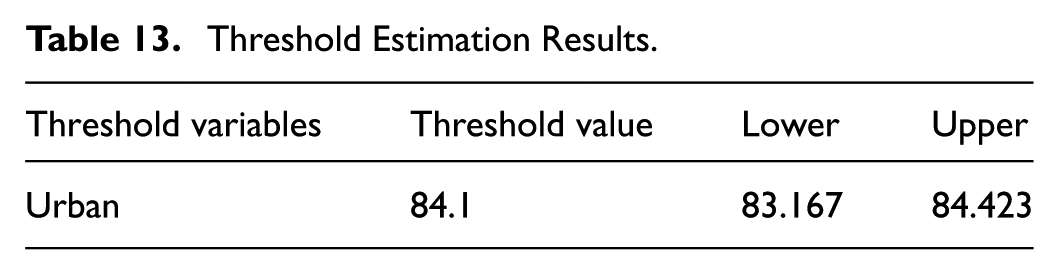
Firstly, the threshold effect test was conducted. Table 12 displays the F statistics and corresponding p-values for the hypotheses based on a single (ST), double (DT), or triple threshold (TT). The p-values indicated that there was a ST effect of urbanization on the environmental impact of AI, and it was significant at the 1% level while the DT and TT was not significant. Furthermore, based on the threshold effect test, different threshold values needed to be further estimated. The threshold value of urbanization as indicated in Table 13 was 84.1. Furthermore, in accordance with the threshold model’s regression concept, the γ value was the threshold value as the likelihood ratio approached zero. Figure 5 shows the likelihood ratio (LR) test result. The threshold value was further confirmed.
Results of the Threshold Effect Test.

Threshold Estimation Results.

LR graph for the single-threshold test of urbanization.
Next, by substituting the threshold value of 84.1 into the equation, the extent of AI’s impact on LCF at different levels of urbanization could be learned. In Table 14, when urbanization was lower than 84.1%, 1 unit increase in AI led to a decrease in LCF by .012 and this effect was statistically significant at 1% level. When urbanization was higher than 84.1%, AI had a statistically significant negative effect on LCF at 5% level with an effect coefficient of .038. The different coefficient can be explained by the higher number of resources need. Urbanization imposes greater pressure on transportation and energy demands (Faisal et al., 2021), and this effect may become more pronounced once the urbanization level exceeds the threshold value.
Results of Panel Threshold Regression.
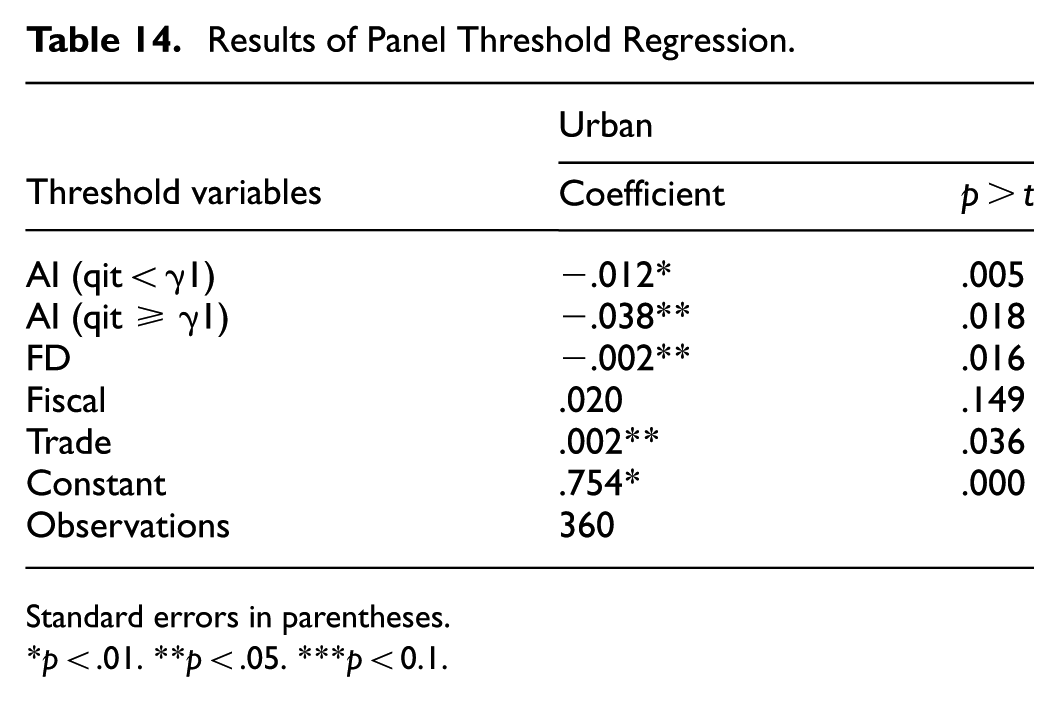
Standard errors in parentheses.
p < .01. **p < .05. ***p < 0.1.
Conclusion and Policy Recommendations
As AI continues to advance, its environmental implications are gaining prominence in scholarly discourse. This research used two-way fixed effect model, fixed-effect quantile regression model, and panel threshold regression to examine the link between AI and LCF. Besides that, this study incorporated the moderating role of IPRs, the mediating role of economic growth, and the threshold of urbanization.
The basic results indicated that AI reduced LCF. Quantile regression results revealed that this influence was more pronounced in countries with lower LCF. The robustness test confirmed the reduction effect. Besides that, IPRs alleviated the negative impact of AI on LCF. AI reduced LCF by fostering economic growth. When urbanization surpassed 84.1%, the impact of AI changed from −.012 to −.038.
Four main policy implications were concluded from this research. First, promoting green energy for AI operations, rewarding energy-efficient AI technologies, and establishing energy consumption guidelines for AI systems should be the main priorities of legislators. Furthermore, encouraging sustainable economic growth and tackling the rebound effect through demand-management measures can help guarantee that AI-driven productivity improvements do not result in excessive resource consumption. Balanced development and green practices are also crucial. For countries with low LCF, enhancing production technologies and methods are fundamental to alleviate the dilemma of development that would lead to lower LCF.
Second, it is imperative to strengthen the protection of IPRs to incentivize innovation in eco-friendly technologies and practices. This can be achieved by strengthening patent rights for green innovations and providing grants or tax credits to companies that develop ecologically friendly products. Third, it is suggested to enforce green standards for AI systems and technologies to encourage economic diversification strategies that reduce dependence on industries with high environmental impacts. Finally, in order to control the effects of urbanization on environmental quality, the support of urban planning methods that place a high priority on ecological sustainability is indispensable.
This study has limitations that could inspire further research. Firstly, due to the limitations of the IPRs and AI data, the sample period is restricted to 2017, and therefore does not capture post-COVID-19 changes. Future research could incorporate more recent periods as data availability improves. Secondly, more mediating and moderating variables should be explored to elucidate the mechanisms through which AI affects LCF. Finally, alternative methodologies such as CS-ARDL could be employed to complement traditional approaches in analyzing the impact of AI on LCF.
Footnotes

Funding
The authors disclosed receipt of the following financial support for the research, authorship, and/or publication of this article: Our research study was supported by the RKAT of Universitas Sebelas Maret for the 2025 fiscal year through the International Collaborative Research (KI-UNS) scheme under Grant No. 369/UN27.22/PT.01.03/2025 and the Geran Putra Berimpak sponsored by Universiti Putra Malaysia under Grant No. GPB/2024/9811100.
Declaration of Conflicting Interests
The authors declared no potential conflicts of interest with respect to the research, authorship, and/or publication of this article.
Data Availability Statement
The datasets used and/or analyzed during the current study available from the corresponding author on reasonable request.