




Abstract
Using the Triple Helix model, this study explores the government-university relationship in the context of China’s AI talent development, and their outcomes in terms of AI program deployment, enrollment and faculty. Their interaction may best be summarized as a model of government pull and university response, but with more support and autonomy for the Shuang Yiliu groups. Specifically, the state has maintained a dominant role as a policymaker in promoting the production of AI personnel and showed strong mobilizing abilities to integrate universities into the national AI strategy. Government guidelines outlined the roadmap for training top AI talent with a focus on Shuang Yiliu universities, universities with Shuang Yiliu disciplines, and interdisciplinary graduate students. Universities have responded with quick launch of AI programs, large enrollment and faculty with advanced training and overseas experience. A multi-level AI personnel training system has taken shape. With their privilege in financial and policy support and more autonomy, Shuang Yiliu universities, and universities with Shuang Yiliu disciplines will be the main producers of AI-concentrated graduate students. Theoretical contributions are discussed and policy and practice implications for addressing AI program distributions, talent development and retention, faculty and research, and AI as a discipline provided.
Plain language summary
Using the Triple Helix model, this study aims to examine the government-university relationship in the context of China’s AI talent development, and its outcomes in terms of AI program deployment, enrollment and faculty. The researchers argue the interaction may best be summarized as a model of government pull and university response, but with more support and autonomy for the Shuang Yiliu groups. Content analysis found that the state maintained a dominant role as a policy maker in promoting the production of AI personnel. National regulators capitalized on their authority and demonstrated strong mobilizing capacities to integrate universities, along with local governments and enterprises, into national AI strategy. The guidelines issued by government agencies outlined the roadmap for training top AI talent with a focus on Shuang Yiliu universities, universities with Shuang Yiliu disciplines, and interdisciplinary graduate students. Universities have responded quickly to the state’s call with AI programs, large enrollment and faculty with advanced training and overseas experience. A multi-level AI personnel training system has come into place. But regional and tier differences were found and government’s effort to balance such differences was identified. With their privilege in financial and policy support and more autonomy, Shuang Yiliu universities, and universities with Shuang Yiliu disciplines will be the main producers of AI-concentrated graduate students. The previous emphasis on overseas research training or work experience has pushed Chinese scholars to go abroad and attracted overseas returnees, which in turn may facilitate international collaboration and exchange in AI. This study has several policy and practice implications for AI program distributions, talent development and retention, faculty and research, and AI as a discipline. This study investigated mainly the government-university relationship in the Triple Helix model. Future research may further examine the role of industry in AI talent development.
Introduction
Artificial intelligence, or AI, has become a critical arena of international competition due to its potential to economic growth, global security, and human rights among others. China prioritized AI in its 13th Five-Year Plan (2016–2020). “The New Generation Artificial Intelligence Development Plan” (AIDP) drew the roadmap for China to become a leading AI power by 2030 and set the goal to become a global innovation center (State Council, 2017). AIDP is “the first national-level legislative effort focusing explicitly on the development of AI as a unified strategy” and China expects AI can boost the country in three areas—international competition, economic development and social governance (Roberts et al., 2021).
Talent is at the core of the challenge to prove the value of AI applications (Gagné, 2019b) and more important than algorithms to the progress of basic AI research. An article in the journal Nature names high-impact papers, people, and ethics as the three fields China would need to catch up with the U.S. (O’Meara, 2019). An American think tank argues securing vital US technological advantages and cultivating the talent to compete with China, among others, are key carriers of American competitiveness (CNAS, 2019).
There is a significant AI personnel shortage globally (CSET, 2019). The U.S. leads the world in attracting, educating and retaining AI talent (TalentSeer, 2020). Among a total of 477,956 professionals, the U.S. provides more than 180,000 specialized AI technical talent and China supplies 20,000 (Gagné, 2020). In response, universities worldwide have been making bold moves to boost AI personnel supply. Since the 2010s, Stanford University and the Massachusetts Institute of Technology have seen a surge in student enrollment in AI and machine learning courses, as well as applications for doctorates in computer science and electrical engineering. Mohamed bin Zayed University of Artificial Intelligence, the world’s first of its sort, was launched in Abu Dhabi in 2019.
China is no exception when it comes to AI talent shortage, especially top talent (Tsinghua University, 2018). In addition, most of China’s AI graduates choose to work in industry rather than academia (Cyranoski, 2018). But China’s talent pool has been growing under various incentives. Peking University launched the country’s first undergraduate AI course in 2004 (Cyranoski, 2018). Established AI researchers are attracted to move back to the country (Zhang, 2019).
In China, the state plays a dominant role in the process of knowledge creation among government, university, and industry—the major stakeholders in knowledge infrastructure (Abbas et al., 2019). Universities are the incubator for new interdisciplinary fields and industrial sectors (Etzkowtiz & Zhou, 2007). This study examines the dynamism between government and higher education, two key actors in the Triple Helix model, and the current state of China’s AI talent development.
Literature Review
According to the Triple Helix model, the university-industry-government interactions are crucial to innovation in a knowledge-based economy (Etzkowitz, 2008). The three main functionalities in this Triple Helix are “(a) knowledge production (carried primarily by academia), (b) wealth generation (industry), (c) and normative control (governance)” (Leydesdorff & Ivanova, 2016). Unlike other nonlinear models of innovation which emphasize the firm or the state, the Triple Helix accentuates the role of the university in a reciprocal relationship (Etzkowitz & Leydesdorff, 1995; 2000). University comes to the fore “as a source of entrepreneurship and technology as well as critical inquiry” (Etzkowitz & Leydesdorff, 2000, p. 1) and “as the core spiral” (p. 9) while government provides the rules.
One of the criticisms of the Triple Helix model is its lack of sensitivity to national contexts (Cai, 2013). Shinn (2002) notes that the three actors—“university, business and government all function in a national setting” (p. 610), and scientific disciplines and specialities operate in different ways across institutions. As a theory developed in the West, theoretical research and empirical evidence of this model come more from developed economies and focus on Western contexts (Etzkowitz, 2012; Jacob et al., 2003; Strand & Leydesdorff, 2013) except for some studies of developing countries (Razak & Saad, 2007; Saad & Zawdie, 2011).
According to the three types of Triple Helix models proposed by Etzkowitz and Leydesdorff (2000), in a statist model, represented by the former Soviet Union and Eastern European countries, the role of university lies in teaching and academic research with the government in control (Razak & White, 2015). In the laissez-faire model, found in Sweden, university and state are in supportive positions driven by the industry (Etzkowitz, 2003). This model is also exemplified by the Silicon Valley, where big Internet firms have sidelined the role of state and academia in innovation (Cai & Etzkowitz, 2020). Although there is a global tendency toward a balanced model, such balances between government, university, and industry barely exist in reality (Cai & Etzkowitz, 2020).
China adopted the Soviet system early and reformed later (Balzer & Askonas, 2016), forming a unique socio-economic system (Chen et al., 2016). Research on the Triple Helix in the Chinese context began in the late 2000s (Zhou & Peng, 2008) and have a shared view that this model is the solution for China (Cai, 2014). In China, the government-university dynamism follows a top-down centralist approach with government acting as the commander and initiator (Etzkowitz & Zhou, 2007), as well as the main source of funding (Abbas et al., 2019). Most Chinese universities are run by the state, and have more research and development resources and personnel compared with the industry (Chen et al., 2016). This is dubbed as the “government-pulled triple helix” (Zhou & Etzkowitz, 2011, p. 7), which is different from the university-pushed model of the US.
Nonetheless, Chinese universities following government plans and guidelines remain a key element in the latter’s innovation policy (Abbas et al., 2019). With a more pragmatic approach, consistent effort, greater openness to international collaboration, China has launched national strategies such as the 211 and 985 Projects to develop its research universities with state endowment of resources—both human capital and financial support—to foster innovation (Balzer & Askonas, 2016; Liu & Huang, 2018; Zhou & Etzkowitz, 2011). Chinese universities have been transforming their roles from teaching to research and creating university-run enterprises (Zhou & Etzkowitz, 2011).
Apart from teaching and research, nurturing and attracting talent is another defining feature of universities’ role (Rodrigues & Melo, 2013). Overshadowed by the private sector, the educational infrastructure in the Silicon Valley failed to provide the skilled workers tech companies needed (Scott & Kirst, 2017). In China, since the early 1990s, the government has become aware of the imperativeness to train science and engineering graduates and increased funding for master’s and doctoral programs (Liu & White, 2001). However, companies still struggle to find the talent they need despite the large number of students trained in science and technology (MGI, 2015). Previous Triple Helix studies investigated the university-government collaboration (Abbas et al., 2019), and innovation in other high technologies such as dye-sensitized solar cell (Zhang et al., 2014) and nanotechnology (Balzer & Askonas, 2016) in the Chinese context, but few studies examined the talent development role of Chinese universities in a fast-developing and highly competitive field of innovation—AI.
Thus, this study looked into the government-university relationship in China’s AI talent development and its outcomes. Specifically, this study analyzed the Chinese government’s policies on AI talent development within the framework of the Triple Helix model, and examined their effects on AI knowledge infrastructure and the intellectual deployment of AI programs in higher education institutions.
Methodology
To understand how the state guides the training of AI talent, this study reviewed key documents issued by the Ministry of Education, the agency that supervises the Chinese education system, and others since China initiated its AI strategy. Further, this study employed a content analysis of AI programs, admissions and faculty, supplemented with textual analysis, to identify the AI talent development missions and visions, and relevant program information, presenting an overview of the outcomes of these regulations.
Given the variety of skills and areas of expertise associated with AI, including machine learning, statistics and many others, there is no commonly accepted definition or measurement of AI talent. As a result, estimates of the global AI talent pool vary across agencies (Gagné, 2020; TalentSeer, 2020). In this study, AI talent mainly refers to students and students-turned-professionals in computer science and electronic information engineering, electric/electrical engineering, electric/electrical science and technology and in some cases in mathematics and statistics, according to the official discipline catalog issued by the Chinese Ministry of Education (2020a).
Sampling
Purposive sampling was employed to ensure that the selected sample had the specific characteristics and quality for this study (Wimmer & Dominick, 2011). China’s Ministry of Education approved 35 universities to launch AI programs in 2018 and 180 more by 2020, totaling 215.
The Chinese Ministry of Education (2017), along with other government agencies, released two lists of universities and disciplines for Shuang Yiliu, or Double First-Class Initiative, after the plan was first announced in 2015. This is an ambitious higher education development scheme aiming to support selected elite universities and disciplines to achieve world-class status by the middle of the century when China celebrates its centenary. The Initiative includes a list of 42 Shuang Yiliu universities and another list of 95 Shuang Yiliu disciplines out of a total of about 2,000 colleges. As these institutions are privileged to recruit talented scholars from home and abroad, enjoy greater financial support and institutional autonomy (Peters & Besley, 2018), studying AI programs, enrollment, and faculty of the Shuang Yiliu universities and universities with Shuang Yiliu disciplines associated with AI would help develop a more calibrated understanding of China’s AI talent training ecosystem. Therefore, in addition to the universities whose AI programs have been green-lighted, the Shuang Yiliu groups were further investigated regarding their programs, enrollment and faculty.
AI is interdisciplinary and may include fundamental knowledge and research as well as the societal and moral issues in its application (Bible, 2018). This study particularly examined Shuang Yiliu disciplines commonly believed to be more critical to the development of AI, including computer science and technology (14), information and communication engineering (8), electric/electrical engineering (7), electric/electrical science and technology (5), mathematics (14), and statistics (7). As some universities have more than one Shuang Yiliu discipline, a total of 34 universities were generated.
The Ministry of Education adjusts the listed universities and disciplines every 5 years based on accreditation results. Those sampled in this study were on the 2017 lists.
Data Collection
Websites are critical to colleges and universities for three reasons: communication, access to tools such as databases and directories, and the promotion and marketing of the institution (Hart et al., 2015). Official websites in Chinese language of the samples such as their “About us,”“Mission,” and “Overview” pages were thus analyzed for their reliability and authority. Despite universities’ webpage designs varied, the researchers tried all means available to mine the data, making it as exhaustive as possible. Based on previous research (Cokley et al., 2019; Weissman et al., 2019), webpages of students’ affairs office, undergraduate and graduate admission offices and faculty biographies or curriculum vitae were also searched and URLs collected. When uncertainties occurred, telephone calls were made to relevant offices of sampled universities for fact checking.
Data collection was conducted in late 2020. Some 14 Ministry of Education-announced programs with no webpages available during data collection were removed from further analysis as they had been approved recently and their programs might still be nascent. This resulted in websites or webpages of 201 universities with AI approval. Among them, 26 are Shuang Yiliu universities, accounting for 12.9% of the total.
Coding Variables and Procedures
Samples included three categories—universities having obtained undergraduate AI program approval (201), Shuang Yiliu universities (26), and universities with six selected Shuang Yiliu disciplines (34).
Programs were content analyzed for whether or not an AI program had been launched, the year if yes and the school to which it is affiliated; whether or not a separate AI school had been launched; and the location. Students’ enrollment data were coded for levels (undergraduate, graduate or doctoral) and scales. Faculty biographies were coded for academic titles (full/associate/assistant professorship/others), terminal degree obtained and the granting institution, and overseas experience, including obtaining an academic degree, working, or visiting as a scholar. Different titles of the same ranking were categorized into one. Overseas refers to countries and areas outside mainland China. Faculty research interests were also collected and analyzed as a supplementary tool to understand the direction of China’s AI talent cultivation and research.
Coding was conducted by 11 trained coders independently using the above coding protocol. Because coding decision relied on simple extraction of website content that was either absent or present, discrepancies were resolved via discussion instead of formal tests for intercoder reliability. Data then were computed for descriptive statistics.
Results
Policy Context Promoting China’s AI Talent Cultivation
To win the edge in this global AI talent race, the Chinese government has moved to improve the size and quality of its AI talent pool (Kania, 2018) and issued a series of documents as policy guidance and support (Table 1).
China’s AI Talent Cultivation Documents.

The AIDP mentions “talent” 34 times. Its Section Two, Item 3, specifies the talent goals for 2020 and 2030 are to gather a number of high-level personnel and innovation teams, and to establish some world-leading AI technology innovation and personnel training centers respectively. Section Three, Item 4 calls for accelerating the training and gathering of high-end AI talent resorting to dual measures—improving local AI education system for a talent pool and inducing the world’s top talent. The cultivation of compound talent mastering interdisciplinary knowledge of AI plus economy, society and other areas, and the cooperation with world’s top AI institutions are encouraged. The AIDP specifically underlines the importance of launching AI programs, promoting the creation of a discipline in the domain of AI, establishing AI institutes in pilot schools, and increasing the enrollment of master’s and doctoral students in AI and related disciplines.
To implement the AIDP, the Ministry of Education (2018) issued the “Artificial Intelligence Innovation Action Plan for Institutions of Higher Education” (hereafter the Plan). One of the goals is to train talented people in the field of AI. In the section about improving the training system in AI, the Plan specifies promoting the creation of first-level disciplines. The Ministry supports the creation of AI-oriented disciplines in computer science and other related technical disciplines, promotes “AI+X” majors and strengthens the cultivation of AI talent at multiple levels.
Ministry of Education, National Development and Reform Commission and Ministry of Finance (2020) jointly issued “Certain Opinions on Promoting Disciplines Merging at Double First-Class Institutes and on Accelerating the Cultivation of Graduate Students in the AI Field” (hereafter the Opinions), aiming to promote high-end AI talent. The Opinions aims to address critical issues China faces as it becomes a global leader in cutting-edge technology. It emphasizes using a project-oriented approach to cultivate “AI+X” -type talent, and solve algorithms, software and integrated circuit design problems that require technological breakthroughs. Multi-stakeholders including selected universities, industrial sectors and local governments are expected to engage with fiscal investment and policy support. Item 14 of Section V emphasizes expanding enrollment scale of graduate students, especially doctoral students.
The findings here suggest government’s policies as a significant driving force to higher education in China’s AI personnel development, or government-pulled as argued in previous study (Zhou & Etzkowitz, 2011). The roles of Chinese government in AI innovation mechanism include encouraging the launch of AI programs, training AI brains at multiple levels, and emphasizing interdisciplinary AI education through a series of regulations. China takes a pragmatic approach so that AI trainees can learn in practice to solve critical problems in its AI research and development. Sources of fundings and policy support come from both industry and governments at national and local levels. In the interactions for AI talent development, higher education institutions, with the industrial sector, are more responsive than proactive. This might be attributed to the fact that they are both controlled by government as found in China’s regulating of its tech sector. Shuang Yiliu institutions are expected to assume the responsibilities to do the most cutting-edge research and produce upper-level AI brains.
Distribution of AI Programs
Among the AI program-approved universities whose webpages were available, a third has launched a separate AI school, the rest have AI programs affiliated to other schools, including computer science and the like, information or electronic information engineering, data science focusing on mathematics or statistics, and others (Table 2).
Affiliations of AI Schools and Programs.

In terms of regional distribution, Jiangsu, located in eastern China and adjacent to Shanghai, topped the list with 18 AI programs, followed by Beijing and Shandong with 15 each. The number of AI programs in other provinces varied greatly. Areas such as Hainan, Xinjiang, Ningxia, and Tibet did not have AI programs. Overall, most of the AI programs were distributed in eastern China with vibrant economy and rich educational resources while the northwestern inland trailed with sporadic programs (Figure 1).

Regional distribution of undergraduate AI programs.
For clarity, the 34 universities with Shuang Yiliu disciplines were grouped according to their Shuang Yiliu and AI program status quo (Table 3). The serial number for each group does not indicate hierarchy. Each group was listed alphabetically by university names. Some 26 universities in Groups I, II, and III were on the Shuang Yiliu universities list. Group I, including 15 universities, launched both AI programs and AI schools, becoming the flagship of China’s AI education. Universities in Group II—Shanghai Jiao Tong, Sichuan, Nankai, and Sun Yat-sen—similar competitiveness as they launched either an AI program or school.
AI Program Profiles of Universities With Shuang Yiliu Disciplines.

Note. In the table, a checkmark ✓ stands for yes; and the absence of it indicates no. 1 = computer science and Technology. 2 = information and communication engineering. 3 = electric/electrical engineering. 4 = electric/electrical science and Technology. 5 = mathematics. 6 = statistics.
Although the seven institutions in Group III were on the list of Shuang Yiliu universities and disciplines, none of them had an AI program approved or a school established. The initial results were somewhat unexpected as some of them, such as Peking University and Tsinghua University, have already achieved worldwide prestige. A further textual analysis of webpages found that these universities had adopted various strategies and taken different routes. Some emphasized AI research. For instance, Tsinghua, Peking, and the National University of Defence Technology have launched research-oriented academies for AI. East China Normal University launched Shanghai Institute for AI Education, integrating AI with the university’s leadership in education. Others provided AI education or research less conspicuously. Central South University had an AI & Robotics Lab in its School of Automation. The University of Science and Technology of China provided undergraduate programs in electronic information engineering with an AI concentration. The only institute without any AI establishment was Xinjiang University, in China’s far northwest. But a Tsinghua advisory committee was formed in 2019 to help Xinjiang promote its information science and AI research as part of the national campaign for education equity and a more balanced regional development.
Groups IV consists of institutions with Shuang Yiliu disciplines but not part of Shuang Yiliu universities. Although they may not be as outstanding as those in the first three groups, they usually have strengths in certain disciplines or are top universities in the province. Beijing University of Posts and Telecommunications and Xidian University, known as Xi’an Electronic Technology University by the Chinese, are both prestigious in China featuring electronic and information science/technology. The former is actually jointly built by the Ministry of Education and the Ministry of Industry and Information Technology. This indicates such universities likely may receive more financial and policy support from provincial authorities and ministries in charge. This case indicates the school’s emphasis on multi-party participation in the implementation of the Opinions.
Universities in Group V seem to bear limited significance as they have had no AI programs or schools in place. However, it does not mean they have no credit to claim. They were attempting by giving full play of Shuang Yiliu disciplines to their advantages. Shanghai University of Finance and Economics’ Institute of Data Science and Statistics is a research entity jointly sponsored with the National Bureau of Statistics. Relying on the University’s Shuang Yiliu disciplines of statistics, plus computer science, economics, and finance, the Institute positioned its AI research in quantitative investment and securities services. Northeast Normal University, whose Statistics and Mathematics are both Shuang Yiliu disciplines, launched a big data and AI lab in collaboration with China Unicom, one of the world’s largest mobile service providers. With a Shuang Yiliu discipline in Information and Communication Engineering, North China Electric Power University provided undergraduate programs in control and computer engineering with an AI concentration.
Geographically, nearly half of the 34 universities with Shuang Yiliu disciplines are in China’s four direct-administered municipalities, including Beijing (8), Shanghai (4), Tianjin (2), and Chongqing (1). These mega cities are part of the first-tier administrative division system enjoying the same status as provinces. The remaining 19 universities are all seated in provincial capitals except for Xiamen University, which is located in Xiamen, a coastal city with a well-developed economy and World Bank-indexed business environment.
Overall, the evidence suggests that with government policies and funding favor universities with Shuang Yiliu disciplines, geographical advantage as links to transport networks, more developed economies, and adjacency to world-renowned high-tech companies, AI programs, labs and institutes in regions that are top performers on China’s provincial GDP list are more likely to develop and retain the talent its AI industry needs most. Universities with selected Shuang Yiliu disciplines are more likely to make research breakthroughs and innovations in AI and train talent at the higher end, providing the human capital the industry hunts for. Universities were found to take advantages of their top-notch disciplines in collaboration with national ministries and conglomerates in talent development.
Enrollment of AI Students
The analysis of enrollment information consists of two parts—levels and scales. In all, only 31 universities provided a more systematic and continuous AI education and were qualified to confer academic degrees at three levels: bachelor, master, and doctorate.
Some 194 of the 201 universities with approved AI programs were found to have official enrollment information available, including five in 2018, 42 in 2019, and 147 in 2020. At graduate level, 64 institutes (31.8%) offered AI-related master’s degrees while 36 (17.9%) recruited doctoral students (Figure 2).

Enrollment levels.
Compared with AI program-approved universities, 21 out of 26 Shuang Yiliu universities recruited master’s and doctoral students, accounting for more than four fifths (80.8%). Their enrollment of AI students was found to favor graduate students, showing their investment and strengths in the development of top AI talent compared with non-Shuang Yiliu peers.
Universities with Shuang Yiliu disciplines shared similar patterns in graduate admissions although they had a slightly higher proportion of doctoral programs (82.4%) than Shuang Yiliu universities. It is not surprising that they offered fewer undergraduate degrees in AI as this study found that universities in Groups III and V either focused on AI research, collaboration with the trade, or positioned AI as a concentration under a different but relevant major. This indicates the Opinions has had an impact on universities with Shuang Yiliu disciplines.
The investigation of enrollment scale was conducted through the official statistics and plans released by admission offices and schools. This study estimates with moderate confidence that Chinese higher education institutions may produce 16,000 to 18,000 college graduates with undergraduate and graduate degrees in AI every year at the end of the 14th Five-Year Plan (2021–2025; Figure 3). The enrollment of 2,265 (45%) graduate students in universities with Shuang Yiliu disciplines nears that of 2,764 (55%) undergraduate students, indicating the tendency to train AI students that the country urgently needs at a higher level. With nearly one of ten graduates having a Ph.D., universities with Shuang Yiliu disciplines also produce the highest proportion of doctoral students with AI concentration.

Enrollment scales.
Profile of AI Faculty
The screening of the faculty pages of the universities with approved AI programs found only 137 had faculty information available online. Given the growing importance of the faculty biographical pages for scholarly identity, academic exchange and networking with academics of similar interests, and showcasing an institutional, departmental, or programmatic identity to prospective students and collaborators, the results are disappointing. A total of 2,879 faculty biography pages from universities with approved AI programs, 510 pages from Shuang Yiliu universities, and another 814 from universities with Shuang Yiliu disciplines were coded (Table 4).
AI Faculty Profile.

In terms of academic ranking, Shuang Yiliu universities and universities with Shuang Yiliu disciplines both had an inverted pyramid-shaped distribution with full professors as the largest group, percentage then descending with academic ranking. Full professors and associate professors accounted for 90.6% and 86.5% respectively in Shuang Yiliu universities and universities with Shuang Yiliu disciplines. The high percentage of senior faculty might be because some of them began in another field and then gradually shifted to AI studies. And some universities have taken a more pragmatic approach by recruiting established researchers as their faces to launch AI program or school within a short period of time. This is in line with the AIDP’s call to bring in world-class AI personnel. In contrast, only about one-third (35.9%) of faculty at universities with approved AI programs held professorships.
The examination of AI faculty’s terminal degree shows that the majority has obtained a doctorate. Universities with Shuang Yiliu disciplines had the highest percentage of doctoral faculty (92.9%), followed by the Shuang Yiliu universities (85.9%), and universities with AI program approval (72.1%). The results indicate most faculty teaching and researching AI are qualified at least in terms of academic training level.
Many universities competed for academics returning to China after obtaining doctoral degrees overseas. Top Chinese universities, in particular, once mandated an overseas experience of at least 6 months, often as a visiting scholar, for the promotion to full professorship. The significance attached to overseas experience and degree in recruitment and academic promotion was changed in October 2020 by the State Council’s document to reform education evaluation (Ministry of Education, 2020b). Result of this study echoes the cumulative effects of the previous emphasis. Around half of the faculty of Shuang Yiliu universities (53.9%) and universities with Shuang Yiliu disciplines (46.9%) had previous overseas experience. On average, about one out of every five academics in Shuang Yiliu universities (23.5%) and universities with Shuang Yiliu disciplines (19.4%) obtained a terminal degree from institutions outside mainland China. In both dimensions, Shuang Yiliu universities stood out with the highest proportion of faculty with overseas education or work experience, demonstrating strengths as the top tier in Chinese higher education. The overseas returnees’ global visions and cross-cultural experiences will also be of great value to the students, who are to design and shape the future of China’s AI.
With miscellaneous terms collected on the faculty bio pages, coding was challenging because academia had no consistent method for identifying research interests. But a word cloud of 96 research interest terms was generated, each referred to by at least five scholars (Figure 4). The top-five self-claimed research interests were machine learning (173), artificial intelligence (154), software engineering (126), artificial intelligence technology (104), and computer vision (104), each mentioned by more than 100 faculty members. They were followed by pattern recognition (86), computer technology (78), data mining (75), artificial intelligence and application (56), image processing (45), deep learning (41), natural language processing (40). Some were umbrella terms, such as artificial intelligence and software engineering. This shows the interdisciplinary nature of AI research and the lack of a consistent disciplinary system. More importantly, it indicates where AI research in China has been headed, especially in areas such as computer vision, image processing, and natural language processing, where China is considered a global leader (Allen, 2019).
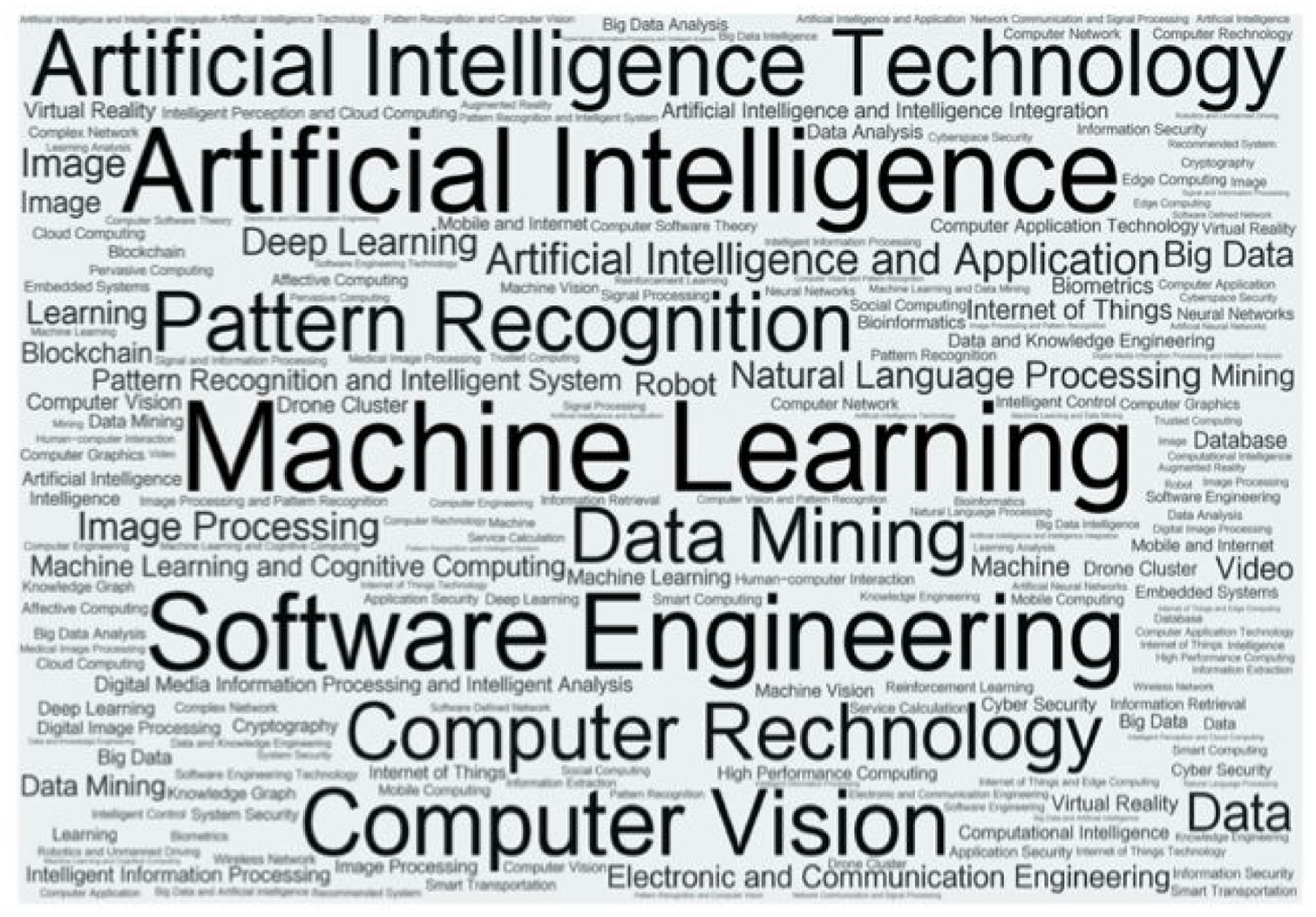
Research interests word cloud.
Discussion and Conclusions
Using the Triple Helix model, this study explored the government-university relationship in the context of China’s AI talent development, and its outcomes in terms of AI program deployment, enrollment and faculty. Their interaction may best be summarized as a model of government pull and university response, but with more support and autonomy for the Shuang Yiliu groups.
It was found that the state maintained a dominant role as a policy maker in promoting the production of AI personnel. National regulators capitalized on their authority and demonstrated strong mobilizing capacities to integrate universities, along with local governments and enterprises, into national AI strategy. The guidelines issued by government agencies outlined the roadmap for training top AI talent with a focus on Shuang Yiliu universities, universities with Shuang Yiliu disciplines, and interdisciplinary graduate students.
Universities have responded quickly to the state’s call with AI programs, large enrollment and faculty with advanced training and overseas experience. A multi-level AI personnel training system has come into place. But regional and tier differences were found and government’s effort to balance such differences was identified. With their privilege in financial and policy support and more autonomy, Shuang Yiliu universities, and universities with Shuang Yiliu disciplines will be the main producers of AI-concentrated graduate students. The previous emphasis on overseas research training or work experience has pushed Chinese scholars to go abroad and attracted overseas returnees, which in turn may facilitate international collaboration and exchange in AI.
This study has several theoretical contributions and policy implications.
Theoretical Contributions
This study may contribute to understanding the government-university relationship in innovation in the context of a country like China with unique socio-economic characteristics and a Triple Helix model that is neither statist nor laissez-faire. The findings are broadly consistent with previous examinations on China where university, with industry, was pulled by government (Zhou & Etzkowitz, 2011). Meanwhile, the state has also shown pragmatism whether mobilizing potential human capital to solve critical problems in China’s AI development or leaving more autonomy to Shuang Yiliu institutions through a series of guidelines and financial support. Therefore, this study argue the government-university interaction may best be summarized as a model in which government pulls and university responds, but with more support and autonomy for the Shuang Yiliu groups.
A Brookings Institution report (Parilla & Liu, 2019) refers to future economic development as “talent-driven.” Tripartite collaboration, namely “university talent, industry interest, and government support” (Balzer & Askonas, 2016) is considered the formula for innovation. Thus, in addition to research on the university’s roles in teaching, research, collaborating with industry, this research may add insights on university’s talent development into the extant literature on the Triple Helix.
Policy and Practice Implications
This study has several policy and practice implications for AI program distributions, talent development and retention, faculty and research, and AI as a discipline.
Although China’s AI talent cultivation programs are layered, regional discrepancy should be addressed. Chinese universities have implemented the policies swiftly but the quality of these programs varied. Research-oriented AI academies have been launched with the capacity to tackle applied issues as China strives for technological breakthroughs and global leadership in AI. Programs run by provincial universities might be starting from scratch and later produce students to join the AI workforce at the middle or more basic fields. With programs distributed in both the Shuang Yiliu universities and local colleges, it shows the administration’s orientation to a more layered strategic layout and regional balance. However, most AI programs are located in the more populous and developed east and southeast. Thus, the west and northwest of the country need more educational investment and policy incentives for economic growth and citizen well-being.
The Shuang Yiliu has incubated China’s top AI talent, but measures should be introduced for talent retention. With the Ministry of Education’s leverage to graduate-level AI education, Shuang Yiliu universities, especially universities with selected Shuang Yiliu disciplines, are most likely to provide the high-level AI personnel and research China needs most. While the AIDP emphasizes the introduction of high-level and young talent overseas, administrators need to be alert to brain drain on two fronts. Chinese AI talent may go overseas for graduate education and stay there for career development. Or, as Gagné’s (2019a) reports, nearly one-quarter of Chinese researchers work in other countries, mostly the US, after receiving PhDs from China. Likewise, AI faculty may leave academia for industry, as seen in the U.S. (Perrault et al., 2019). Bold measures are needed to incentivize inflow and retention. Provinces and cities with leading GDP particularly should capitalize on AI talent provided by institutions they host for local economic development. These governments should also encourage local industry to participate in building AI talent pipelines.
The education background of China’s AI faculty is competitive and satisfactory. Shuang Yiliu universities and universities with Shuang Yiliu disciplines also have more established AI researchers leading AI teaching and research. It shows effects of AIDP, in which one of the measures proposed for gathering top AI talent is to attract world AI personnel to China. As AI education becomes graduate-oriented and gears toward solving real problems, the privilege to access manpower, funding, and equipment critical for technological breakthroughs and cutting-edge research may further allure more talent to China. Further, more transnational collaboration is urged regardless of the tension between China and the West in key high-tech sectors.
A discipline is formed by its subject of inquiry, methods used for exploration and the community of people who work in it (Bible, 2018). In terms of AI, all three have been changing. To promote AI to be a first-level discipline needs scientific and innovative discussion and design. The Ministry of Education has been promoting a multidisciplinary AI+X model for talent development since 2018. Current AI programs in this study are mostly hosted under several disciplines though none of them has AI in their names. Given the complexity of AI research, promoting AI to be a first-level discipline merits delicate design. The U.S. National Center for Education Statistics (2019), affiliated to the Department of Education, introduced the Classification of Instructional Programs (CIP-2020), the counterpart of China’s State Council Academic Degree Committee, and the discipline categories. In CIP-2020, Artificial Intelligence (11.0102) is categorized under Computer and Information Sciences, General (11.01), as part of Computer and Information Sciences and Support Services (11). It is defined as a program focusing on “the symbolic inference, representation, and simulation by computers and software of human learning and reasoning processes and capabilities, and the computer modeling of human motor control and motion” and including “instruction in computing theory, cybernetics, human factors, natural language processing, and applicable aspects of engineering, technology, and specific end-use applications.” AI can also be found in Human Computer Interaction (30.3101), Linguistics, and Modeling, Virtual Environments and Simulation. This comparison indicates in the US AI is not a first-level discipline, but rather interdisciplinary. AI is a fast-developing research field. How it could be best classified in the current discipline system is an issue for educators and researchers worldwide not just for China.
Limitations and Future Work Direction
This study is based on secondary data retrieved from selected universities and used a non-exhaustive sample. There are two reasons. The institutions might not post all relevant information online. AI is not a first-level discipline yet and interdisciplinary in nature. Related fields such as cognitive science or neuroscience were therefore not included.
The Triple Helix model is a macro-level approach. A micro-foundations perspective is needed to understand how AI talent, as an individual-level factor, may affect China’s AI industry. Research funding is also an important consideration especially in high-tech oriented programs, although funding information is less easily accessible.
This study investigated mainly the government-university relationship in the Triple Helix model. Future research may further examine the role of industry in AI talent development.
Footnotes
Acknowledgements
The researchers would like to show thanks to the coders without whom this research would not have been possible.
Declaration of Conflicting Interests
The author(s) declared no potential conflicts of interest with respect to the research, authorship, and/or publication of this article.
Funding
The author(s) disclosed receipt of the following financial support for the research, authorship, and/or publication of this article: This study was funded by the National Social Science Fund of China (18BXW113).
Ethical Approval
This is not applicable.

Data Availability Statement
The datasets generated and/or analyzed during the current study are available from the corresponding author on reasonable request.