



Abstract
This study is the first to examine how the strength of intellectual property rights protection (IPRP) in regional trade agreements (RTAs) affects the stability of services trade. Utilizing a structural gravity model for a panel of 76 countries over the period 2003 to 2020, this paper finds that stronger IPRP in RTAs significantly enhances the stability of services exports among member countries. The effect is more pronounced when information mobility between trading partners is stronger and when the gap in domestic IPRP levels between countries is narrower. These findings offer valuable guidance for countries negotiating RTAs to foster more stable trade relations.
Keywords
Introduction
The increasing instability of international trade, driven largely by the rise of non-tariff barriers and protectionist measures, presents significant challenges for policymakers and businesses (Ahmed, 2024). In this context, identifying institutional factors that can enhance the stability of cross-border trade relations has become a pressing research concern. One promising but underexplored factor is the role of intellectual property rights protection (IPRP) clauses embedded within regional trade agreements (RTAs).
Over the past two decades, RTAs have evolved beyond traditional tariff reductions to incorporate “behind-the-border” provisions, including those related to environmental standards, digital trade, and intellectual property rights (IPR; Zhao, 2023). Notably, the strength and breadth of IPRP provisions have been steadily increasing, particularly in RTAs signed by developed economies (Chakraborty & Dey 2024; Santacreu & LaBelle, 2021). This trend has extended to developing countries as well, as they seek to attract foreign investment, integrate into global value chains, and promote sustainable trade growth.
Compared to multilateral agreements such as the TRIPS Agreement, modern RTAs—including the Regional Comprehensive Economic Partnership Agreement (RCEP)—feature significantly stronger and broader IPRP commitments (Dai & Sun, 2024). For member countries, RTAs reduce trade barriers, standardize trading conditions, and influence the structure and resilience of foreign trade (Santeramo & Lamonaca, 2022). IPRP provisions, in particular, are closely intertwined with the development of a country’s industrial chain, supply chain, and innovation capacity. Therefore, examining the impact of IPRP strength in RTAs on the stability of international trade—especially services trade—has both theoretical significance and practical policy relevance.
Existing literature has primarily focused on three areas: the effects of RTAs (or IPRP) on goods trade (Campi & Dueñas, 2019; Laget et al., 2020; Sheikh & Kanwar, 2024); the effects of RTAs (or IPRP) on services trade (Q. Lin & Lin, 2023; Ou et al., 2024; Van der Marel & Shepherd, 2013; H. Zhang et al., 2023); and the effects of RTAs (or IPRP) on the stability of goods trade (Gao & Zhu, 2024; Mansfield & Reinhardt, 2008; K. Wang & Tong, 2019). While these studies provide important insights, there remains a clear gap: little is known about how IPRP provisions in RTAs affect the stability—rather than simply the volume—of services trade.
The importance of focusing on services trade is reinforced by its distinct characteristics compared to goods trade. Services transactions are typically more dependent on intellectual property, involve more intangible assets, and differ in their modes of delivery and consumption (Dai et al., 2015). Moreover, IPR-related issues, such as copyright, patents, and trade secrets, are central to many services transactions, particularly in knowledge-intensive sectors (Shen & Liang, 2021). These distinctions highlight the need for a deeper understanding of how legal protections embedded in RTAs influence services trade dynamics.
Addressing these gaps, the present study investigates the relationship between the strength of IPRP provisions in RTAs and the stability of services exports among member countries. Using panel data from 76 countries between 2003 and 2020, and detailed coding of RTA provisions from the DESTA database, the study offers new empirical evidence on how variations in IPRP enforcement and coverage affect trade stability outcomes.
This research makes three key contributions. First, it is the first to establish a direct empirical link between IPRP strength in RTAs and the stability of services exports. Second, it disaggregates IPRP into two dimensions—enforcement strength and coverage breadth—allowing a more nuanced understanding of how different aspects of protection matter. Third, it identifies key moderating factors, including information mobility and the domestic IPRP gap between partners, which condition the effectiveness of IPRP in promoting trade stability.
The remainder of this paper is structured as follows. Section “Literature Review” reviews the relevant literature. Section “Theoretical Background” develops the theoretical framework and hypotheses. Section “Materials and Methods” introduces the data and methodology. Section “Results and Discussion” presents and discusses the empirical results. Finally, Section “Conclusion, Policies, and Limitations” offers conclusions and policy implications.
Literature Review
Impact of RTA on International Trade
Early studies argued that regional trade agreements (RTAs) create trade by expanding import demand and production, while also causing trade diversion by substituting imports from non-member countries with those from member countries (Krueger, 1999; Viner, 1950). Subsequent research suggested that the trade creation effects of RTAs generally outweigh their trade diversion effects, leading to net gains in trade (Caliendo & Parro, 2015; Romalis, 2007). In addition, deeper and higher-standard RTAs not only directly stimulate the economic development of member countries but also indirectly contribute to the expansion of global trade networks (Baldwin, 2011). Building on these findings, scholars have increasingly examined the broader impacts of RTAs, including their influence on economic development, trade relations, and the quality of export products among member states (Baier & Bergstrand, 2007; R. Y. Li et al., 2020).
As international trade developed, scholars began to systematically quantify the provisions contained within RTAs. Henrik et al. (2010) pioneered this effort by constructing an index measuring the depth of RTA provisions, distinguishing between “WTO+” and “WTO-X” elements. Subsequent research has extensively examined how the depth of RTA provisions influences both import and export trade. Hofmann et al. (2017) advanced this line of inquiry by compiling detailed information on specific provisions and their enforceability across 279 RTAs, resulting in the creation of the Content of Trade Agreements Database. This database enables a more granular assessment of how deeper trade agreements enhance value-added trade linkages. Building on these efforts, Laget et al. (2020) argued that one of the primary motivations for countries or regions to sign high-level RTAs is to promote and support the functioning of global value chains. Their empirical findings suggest that deeper RTAs are particularly effective in increasing the value of intermediate products and fostering the growth of high-value-added industries. As the scope of RTA provisions has expanded from traditional cross-border measures to behind-border regulations, research on in-depth RTAs has also diversified, incorporating new perspectives such as digital trade, services trade, rules of origin, competition policy, and investment.
Impact of IPRP on International Trade
The strengthening of intellectual property rights protection (IPRP) can simultaneously generate opposing effects on trade (Doanh et al., 2022; Maskus & Penubarti, 1995). Maskus and Penubarti (1995) argued that while IPRP encourages technological advancement and boosts exports, it can also restrict trade by creating monopolies that raise prices. Similarly, Doanh et al. (2022) described these dynamics as market expansion and market power effects. Despite these opposing mechanisms, most empirical studies report a net positive impact. For exporting countries, reasonable IPRP promotes innovation disclosure and productivity growth, thereby enhancing high-quality exports (Rafiquzzaman, 2002; Raizada & Dhillon, 2017). Dong and Yu (2024) further highlighted that strengthened institutional mechanisms supporting innovation, such as green finance initiatives, contribute not only to technological advancement but also to broader economic stability, reinforcing the positive role of protective agreements like IPRP. F. Hu et al. (2024) further emphasized that the evolution of global innovation networks, particularly through cooperative patenting activities, strengthens the international diffusion of innovation, suggesting that stronger IPRP frameworks can enhance participation in global knowledge flows and facilitate high-value trade exchanges. Moreover, efficient allocation of labor and reduction in skill-based factor mismatches, as highlighted by S. Zhang, Li, et al. (2023), are crucial for enhancing the trade gains from improved IPRP. In addition, S. Zhang, Zhang, et al. (2023) emphasized that institutional reforms fostering labor income growth underpin the broader economic benefits of intellectual property protections. For importing countries, stronger domestic IPRP increases imports of high-tech products from innovation-intensive economies (Ivus, 2010). Awokuse and Yin (2010), using data on manufacturing exports to China, and Branstetter et al. (2011), examining U.S. exports to 16 countries, also confirmed that improved IPRP in destination markets significantly boosts exports.
As RTA provisions have evolved from cross-border to behind-border regulations, the role of IPRP in trade has attracted growing attention. Maskus and Ridley (2016) found that preferential trade agreements (PTAs) with IP-related clauses significantly enhance aggregate trade, particularly for middle-income countries. Campi and Dueñas (2019) observed positive effects for developed countries but limited gains for developing ones. Sheikh and Kanwar (2024) reported no immediate effects on overall exports but identified stronger IPR sensitivity within specific industrial clusters. Cheng et al. (2024) further highlighted that in the presence of weak protections and incentive structures, strategic attacks and disruptions can undermine resource exchanges, implying that strong institutional frameworks, such as robust IPRP, are essential for maintaining stable trade relations. Other studies showed that RTAs with IPRP provisions promote trade in knowledge- and technology-intensive products, although the effects vary by sector and development level (Han et al., 2018; Martínez-Zarzoso & Chelala, 2021; L. Y. Wang et al., 2021).
Impact of RTAs and IPRP on Services Trade
Due to limited statistical data on services trade, relatively few studies have explored the impact of RTAs on this sector. Nonetheless, existing empirical evidence generally finds that RTAs effectively promote services trade flows (Guillin, 2013; Lee & Cho, 2017; Q. Lin & Lin, 2023; Van der Marel & Shepherd, 2013). For instance, Q. Lin and Lin (2023), introduced a structural gravity adjustment, show that RTAs significantly boost services exports among members. Van der Marel and Shepherd (2013), analyzed nine service sectors across major OECD economies as well as China and India, find that RTAs have the strongest trade effects on financial, trade, and communication services.
Research specifically examining the link between IPRP and services trade remains limited. Ma (2014), using Chinese data, finds that stronger IPRP generally promotes services trade, though the effect varies across industries. H. Zhang et al. (2023) showed that IPRP positively influences the intensive margin but negatively affects the extensive margin of services trade. Focusing on digital services, Ou et al. (2024) found that IPRP enhances trade in this sector. Additionally, Ren et al. (2024) emphasized the role of digital factors and data utilization in enhancing productivity, further supporting the importance of digital infrastructure and IPR protection for expanding services trade. Overall, these studies reveal a net positive impact of IPRP on services trade, aligning with findings from the goods trade literature. Further research has refined this understanding: Dai et al. (2015) identified a U-shaped relationship between IPRP and the technological sophistication of service exports, while Shen and Liang (2021) concluded that stronger IPRP improves the competitiveness of service exports.
Impact of RTA on Export Trade Stability
Some studies have examined the factors influencing export stability, including firm size (Chen et al., 2012), export product quality (Shi, 2014), trade costs (Qi & Zheng, 2020), GVC participation (Díaz-Mora et al., 2018), export structure (Zhou & Fan, 2023) and RTA (Mansfield & Reinhardt, 2008; Zhu & Lin, 2012; Gao & Zhu, 2024; K. Wang & Tong, 2019). Y. Wang and Luo (2025) also emphasized that financial support mechanisms, such as credit guarantees, play a critical role in strengthening export stability by improving the resilience of small enterprises to external shocks. Some have shown that RTA has a positive impact on trade stability. Mansfield and Reinhardt (2008) analyzed bilateral trade from 1951 to 2001 for 162 countries, constructing a trade volatility index from a macro perspective. Their findings indicated that RTAs could mitigate bilateral trade fluctuations. Zhu and Lin (2012) and Gao and Zhu (2024) utilized trade data between China and its trading partners and revealed that RTAs significantly promote the export stability of member countries. K. Wang and Tong (2019) reached a similar conclusion at the enterprise level—specifically, that RTAs significantly enhance the stability of Chinese enterprises’ exports to member countries. X. Zhang et al. (2022) highlighted that systemic risks and volatility spillovers across markets can destabilize trade patterns, underscoring the importance of institutional frameworks like RTAs in mitigating such risks and promoting trade stability. It is important to note that the focus of these studies was on goods trade rather than services trade.
The research discussed in this section is most closely related to the present study but differs in two key respects. First, while existing literature primarily examines the overall impact of RTAs, this paper specifically focuses on the IPRP provisions within RTAs. Investigating these detailed behind-border elements, such as intellectual property rights protection, deepens our understanding of how RTAs influence trade dynamics. Second, whereas prior studies largely address goods trade, this study centers on services trade. Given the distinct characteristics of goods and services—and the ongoing debate over the applicability of traditional trade theories to services (Feketekuty, 1986; Hindley & Smith, 1984)—this distinction is critical. Moreover, with services accounting for an increasingly significant share of global trade and becoming a major focus within RTAs, identifying the role of IPRP in services trade stability is particularly important.
Despite the growing significance of services trade and the increasing inclusion of intellectual property rights protection within RTAs, little is known about how these provisions influence the stability of services trade. While existing research has explored the effects of IPRP on goods trade and on the growth of services exports, the role of IPRP in stabilizing services trade has been largely overlooked. This study addresses this gap by investigating not only the direct impact of IPRP strength but also the moderating roles of information mobility and the IPRP gap between trading partners. By doing so, it makes three key contributions: (a) it extends the gravity model framework to analyze trade stability in the services sector; (b) it disaggregates the IPRP strength into enforcement and coverage dimensions to offer nuanced insights; and (c) it highlights contextual factors (ICT development and IPRP gap) that condition the effects of IPRP in RTAs. These contributions provide a richer understanding of how RTAs can be designed to support stable services trade flows in an increasingly knowledge-driven global economy.
A summary of the key literature discussed above is provided in Table 1, outlining the dependent variables, core independent variables, regression methods, and principal findings of each study.
Summary of the Key Literature.

Recent research continues to highlight the evolving role of intellectual property rights in shaping services trade. For example, Rimmer (2022) found that stronger IPRP provisions enhance the trade of digitally delivered services among high-income countries. Similarly, Sun et al. (2024) provided evidence that IPRP embedded in RTAs has a differential effect across traditional and knowledge-intensive service sectors, with stronger impacts observed in finance, telecommunications, and professional services. Moreover, Sheikh and Kanwar (2024) emphasized that the legal enforceability of IPR provisions, rather than their mere inclusion, determines their trade-promoting effects, especially in the services domain. These studies reinforce the growing recognition that the strength and enforceability of IPRP are critical not only for goods trade but also for stabilizing and promoting services trade. This paper builds on these insights by focusing specifically on how IPRP in RTAs influences the stability of services trade, rather than merely its volume or growth.
Beyond intellectual property rights protection itself, several other factors have been identified as shaping the relationship between trade agreements and services trade outcomes. For example, Herman and Oliver (2023) demonstrated that the quality of digital infrastructure significantly conditions the ability of services exporters to benefit from trade agreements. Similarly, Raimondi and Scoppola (2024) emphasized that lower trade costs and better regulatory quality amplify the trade-enhancing effects of RTAs. In addition, Mattoo et al. (2020) highlighted that strong domestic legal systems and effective enforcement environments are crucial for realizing the potential gains from service liberalization and intellectual property provisions. Building on these insights, this study not only focuses on the strength of IPRP in RTAs but also examines the moderating roles of information mobility and IPRP gaps between trading partners.
Theoretical Background
The strength of intellectual property rights protection (IPRP) in RTAs can enhance the stability of services exports among member countries in several ways. First, stronger IPRP stabilizes the supply and pricing of service products by reducing the risk of technological imitation (Kiedaisch, 2015). Countries signing RTAs with strong IPRP provisions benefit from improved domestic IPRP, enhanced resource allocation, lower production costs, and greater innovation capacity (Fang & Shi, 2023), all of which support more stable trade relations. Recent research has shown that executives’ legal expertise significantly enhances corporate innovation capacity, emphasizing the role of institutional quality—such as intellectual property protection—in driving stable trade relations (Dai et al., 2024).
Second, stronger IPRP promotes stability by increasing the diversity and quality of service products. By encouraging enterprises to disclose innovations and attract financing, IPRP fosters service product diversification and upgrading, better matching the varied needs of export markets (Gnangnon, 2024).
Third, stronger IPRP helps create a fair and orderly business environment. It improves contract enforcement (Hudson & Minea, 2013) and lowers transaction costs by strengthening institutional constraints (Papageorgiadis et al., 2020). Reduced risks of imitation diminish costly trade disputes, while higher imitation costs for importers strengthen ongoing trade ties among members, enhancing trade stability.
Although these mechanisms apply to both goods and services trade, the effect is more pronounced in services for several reasons. First, intellectual property itself constitutes a form of services trade, and stable IPRP promotes IPR transactions. Second, due to the intangible nature of services, infringement is harder to detect, making strong protection more critical. Third, services trade heavily involves copyrights, patents, and trade secrets—especially in outsourcing—which increases the risk of information leakage. Fourth, the simultaneous production and consumption of services (e.g., through the movement of natural persons or commercial presence) further heightens exposure to infringement risks. Thus, compared to goods trade, the stability of services trade relies more heavily on strong IPRP provisions. Given the heterogeneity across services sectors, the impact of IPRP may differ depending on the nature of the services involved, as highlighted by L. Li et al. (2024). Based on these considerations, this study proposes the following research hypothesis:
Hypothesis 1: Stronger IPRP in RTAs leads to greater stability of services trade among member countries.
Information and communication technology (ICT) is part of a country’s infrastructure and is widely used in everyday life, daily communication, and manufacturing operations (Czernich, 2011). The digital age has empowered ICT to revolutionize the manner in which people interact with each other, thereby initiating profound societal transformations. Therefore, the application of ICT significantly mitigates the risk of information asymmetry, reduces the transaction costs of information search, enhances the efficiency of resource allocation, and drives the growth of services trade (Brynjolfsson et al, 2011; Freund & Weinhold, 2002; Meijers, 2014). Xu et al. (2023) also showed that institutional innovations, such as smart city policies, can significantly enhance economic efficiency and environmental outcomes, suggesting that broader innovations in digital and governance infrastructure similarly stabilize services trade. ICT should have a relatively greater effect on trade in services than that in goods, since some services can be transmittable via the Internet and can be traded almost costlessly (Freund & Weinhold, 2004). Furthermore, the development of ICT has overcome obstacles in spatial communication, enabling timely and effective resolution of trade disputes related to IPR. In sum, in the context of the increasing strength of IPRP in RTA, the development of ICT strengthens the impact mechanisms mentioned above, reinforces the role of IPRP provisions, and stabilizes services trade among member countries. Based on this, the following research hypothesis is proposed:
Hypothesis 2: Stronger information mobility among RTA members enhances the contribution of IPRP provisions to the stability of trade.
Countries differ in the strength of their intellectual property rights protection (IPRP). Several studies have examined the impact of IPR infringement on innovation under asymmetric protection regimes, where IPRP is stricter in the global North and weaker in the global South (Auriol et al., 2019). The gap in domestic IPRP between trading partners is likely to influence the extent to which IPRP in RTAs stabilizes services exports. A smaller IPRP gap between two countries facilitates agreement on IPR issues, reduces the operational complexity of implementing provisions, and lowers the risk of IPR-related trade disputes. Additionally, narrowing the IPRP gap signals a convergence in innovation capabilities, mitigating risks of market monopolization by innovation-rich countries and stabilizing product prices. Thus, a smaller domestic IPRP gap is expected to amplify the positive impact of IPRP provisions on services trade stability among RTA members. Based on this reasoning, the study proposes:
Hypothesis 3: The smaller the gap in domestic IPRP between trading partners, the greater the contribution of IPRP in RTAs to the stability of services trade among member countries.
Yang et al. (2024) emphasized the importance of accounting for latent group structures when analyzing heterogeneous relationships, suggesting that variations in institutional quality across countries could significantly moderate the impact of trade agreements on trade outcomes.
Materials and Methods
Formulation of the Econometric Model
The gravity model has been widely applied to assess the effects of institutions, policies, and other factors on bilateral trade flows. Rose (2005) noted that the gravity model provides a natural framework for examining the impact of WTO and GATT membership on trade flow stability, using a modified version of the traditional model for his analysis. Building on Rose’s approach, Chowdhury et al. (2021) and Ghosh and Yamarik (2019) explored how RTAs influence the stability of international trade and FDI. This study adopts a structural gravity model similar to these earlier works for its empirical analysis.
To test Hypothesis 1, the following baseline regression model is used:

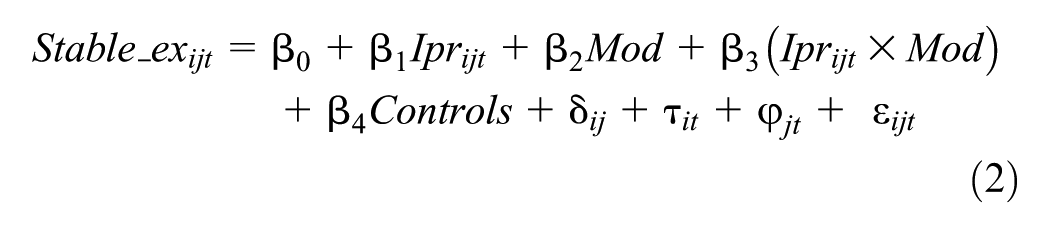
To test Hypotheses 2 and 3, the following model is constructed.
In Equation 1, i, j, and t represent the exporting country, importing country, and the year, respectively. Stable_exijt is the dependent variable, indicating the stability of country i’s exports of services trade to country j in year t. Iprijt is the core explanatory variable, including three indicators of the overall strength (IprTijt), enforcement strength (IprEijt), and coverage breadth (IprCijt) of an RTA between countries i and j in year t. Controls represent the control variables, including the exchange rate stability (Stable_exchangeijt), and a dummy variable (RTAijt). α0 is the intercept term, and εijt is the stochastic disturbance term.
Equation 1 incorporates three sets of fixed effects: bilateral (δij), exporter-time (τit), and importer-time (φjt), These fixed effects have been recommended to be used in structural gravity model to identify the effects of RTAs on trade (Baier & Bergstrand, 2007; Head & Mayer, 2014; Yotov et al., 2016). The fixed bilateral effects, δij, represent the time-invariant characteristics of the trade relationship between i and j. It is included to avoid biases due to unobservable factors that affect trade (Baier & Bergstrand, 2007; Yotov et al., 2016). Because fixed bilateral effects are introduced, the bilateral and time-invariant variables, such as geographical distance, cannot be included in this model. Exporter-time (τit) and importer-time (φjt) represent all the factors that are specific to each country and time period. These two fixed effects are included to control for inward and outward multilateral resistance (Head & Mayer, 2014; Yotov et al., 2016). Multilateral resistance means third countries’ barriers to trade that affect the trade flows between two countries. In the gravity model, failing to include multilateral resistance terms may lead to biased regression results.
In Equation 2, Mod refers to two moderators: information mobility (ICTijt) and the gap in domestic IPRP between trading partners (GAPijt). An interaction terms of Iprijt and Mod are introduced in Equation 2 to test the Hypotheses 2 and 3. If the regression coefficient of the interaction term, Iprijt × ICTijt, is significantly negative, it means that, the stronger the information mobility among RTA members, the greater the contribution of IPRP to the stability of services trade. Hence, Hypothesis 2 is confirmed. Similarly, if the regression coefficient of the interaction term, Iprijt × GAPijt, is significantly positive, it means that the smaller the gap in domestic IPRP between trading partners, the greater the contribution of IPRP in RTAs to the stability of services trade. In this case, Hypothesis 3 is confirmed. The definitions of the other variables in Equation 2 remain consistent with those in Equation 1.
The Poisson pseudo-maximum likelihood (PPML) estimator has become widely used for structural gravity estimations due to its advantageous properties. As demonstrated by Silva and Tenreyro (2006), PPML effectively addresses heteroskedasticity, a common issue in international trade data. Accordingly, this study employs PPML to estimate all equations.
The RTA sample in this study is sourced from the DESTA database, which quantitatively analyzes qualitative RTA provisions by measuring their depth across 10 dimensions, including market access regulations, intellectual property rights (IPR), public procurement, and trade remedies. By the end of 2020, the texts of 710 RTAs had been evaluated. This study specifically uses DESTA’s measurements related to IPRP in RTAs. The analysis covers the period from 2003 to 2020, with 2003 marking the peak in the number of RTA signatories. Only RTAs that were effectively implemented during this period are considered. The RTA data are then matched with the OECD-TiVA database for services trade, excluding country pairs with missing data, resulting in a final sample of 76 countries.
Definitions of the Variables
Dependent Variable
The dependent variable in this study is the stability of services exports among RTA members (Stable_exijt). Export stability is commonly assessed through an export volatility index, often calculated using the absolute value method or the moving average method (D. Y. Lin et al., 2015). However, both approaches face challenges in cross-country comparisons due to differences in economic development and trade environments, and changes over time can affect export volatility differently across countries. Specifically, the absolute value method reduces comparability, while the moving average method is highly sensitive to outliers caused by factors such as climate, policy shifts, and cultural influences. To address these limitations, this study combines both methods to measure export stability. Following Love (1979) and Vannoorenberghe et al. (2016), the services export volatility index is constructed as follows:

where EXijt represents country i’s export of services to country j in year t, EXijt−1 denotes export in year t − 1, and
Core Explanatory Variables
The core explanatory variable is the strength of IPRP in RTAs. Quantitative measurements of RTA provisions typically use indicator scoring or keyword extraction methods—where scoring standards are set, scores are assigned based on compliance, and aggregated to produce a strength index. Following Gao and Zhu (2024) and Elsig and Surbeck (2016), this study employs the DESTA database, which provides information on 22 issues related to IPRP strength. These issues are used as scoring criteria to measure the strength of IPRP in RTAs.
The strength of IPRP in RTA is not only reflected in the breadth of coverage but also its enforcement strength (Araujo et al., 2016). Broader coverage indicates that its IPRP is more comprehensive, and greater enforcement strength is more favorable for enforcement of RTA. The interplay between the two enhances the stability of export trade among member countries. This study measures the strength of IPRP in RTAs in three respects: the overall strength of IPRP in RTAs, and two sub-indicators of enforcement strength and coverage breadth. The measurement formula is shown in Equation 4.

The overall protection strength (IprTijt) is statistically derived from all 22 issues in the RTA regarding IPRP. The enforcement strength (IprEijt) is obtained from the 11 questions related to enforcement strength. Similarly, the coverage breadth (IprCijt) is determined by the 11 questions related to coverage breadth. All three are calculated as shown in Equation 4. According to Hypothesis 1, the regression coefficients of these three variables are expected to be negative.
Other Variables
The exchange rate stability (Stable_exchangeijt) refers to the volatility index of the exchange rate between the importing and exporting countries. Fluctuations in exchange rates can lead some businesses to enter or exit a country’s market, causing unstable changes in export volumes. Therefore, a stable exchange rate can reduce export instability. The measurement of exchange rate stability typically involves calculating the standard deviation, mean, or variation rate using daily, monthly, or yearly exchange rate data. Because of data availability, and to minimize the impact of outliers, this study uses the annual exchange rate values between bilateral countries. The method of measuring this variable is the same as in Equation 3, that is, the difference between the exchange rates of the currencies between the trading partners in years t and t − 1 respectively is divided by the average exchange rate of these 2 years. A smaller fluctuation rate in the exchange rates between importing and exporting countries is more favorable for stabilizing the prices and demand for exported products, contributing to the stability of export. The regression coefficient of Stable_exchangeijt is expected to be positive. Rose (2005) and Mansfield and Reinhardt (2008) similarly concluded that stable exchange rates contribute to more stable trade relationships.
The dummy variable (RTAijt) is introduced to control for the impact of RTAs on the volatility of services trade. As noted in Section “Impact of RTA on Export Trade Stability,” several studies, including Mansfield and Reinhardt (2008), find that RTAs positively influence trade stability. RTAijt is assigned a value of 1 if an RTA between two countries is in effect and 0 otherwise.
Information Mobility (ICTijt)
Following M. L. Wang and Choi (2019), this study measures information mobility between trading partners using the combined total of their internet penetration rates and mobile phone usage rates, based on available data. Domestic IPRP gap between trading parties (GAPijt). The GAPijt indicator is constructed following the method of A. G. Z. Hu and Png (2013), by first calculating the domestic IPRP level for each country and then taking the absolute difference between them, as shown in Equation 5.

where GPit and GPjt represent the GP index for countries i and j, respectively in year t. Similarly, Fraserit and Fraserjt represent the values of the legal and property rights indicators in the Fraser index for countries i and j, respectively in year t. A. G. Z. Hu and Png’s (2013) method combine the strengths of Ginarte and Park’s (1997) and Park’s (2008)“GP index” with the Fraser Institute’s “Fraser index.” The GP index includes five components: the extent of patent protection coverage, provisions for loss protection, enforcement mechanisms, membership in international patent agreements, and the duration of protection. The Fraser index measures the legal system and property rights. A smaller GAPijt value reflects a narrower gap in IPRP between the two trading countries.
Data Source
The dependent variable, the stability of services exports, is sourced from the OECD-TiVA database. The core explanatory variable, the strength of IPRP in RTAs, is obtained from the DESTA database. Bilateral exchange rates are collected from the International Financial Statistics (IFS) database. The dummy variable (RTAijt) is also derived from the DESTA database. Information mobility indicators (ICTijt) are sourced from the World Bank’s World Development Indicators (WDI) database. The Fraser index is obtained from the Fraser Institute of Canada (https://www.fraserinstitute.org/), and the GP index is retrieved from the website of Walter G. Park (https://www.american.edu/cas/faculty/wgp.cfm).
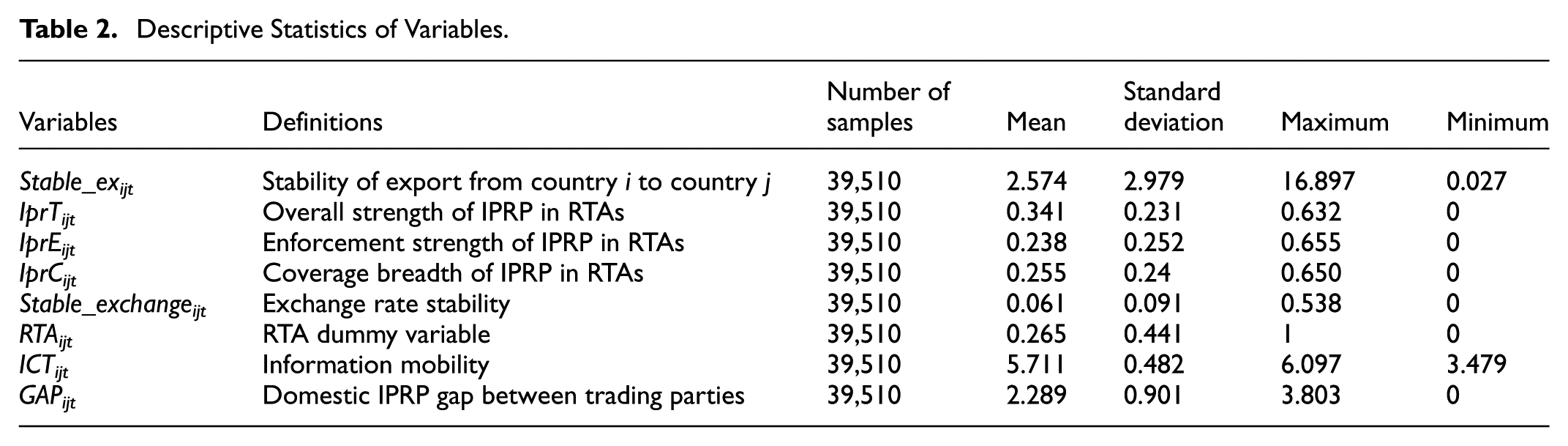
Table 2 presents the descriptive statistics of the main variables. The mean value of Stable_exijt is 2.574, with a minimum of 0.027 (indicating the most stability) and a maximum of 16.897 (indicating the least stability), suggesting substantial variation in export stability across country pairs. The mean value of IprTijt is 0.341 with a low standard deviation of 0.231, indicating relatively stable variation within the sample. Similarly, IprCijt exhibits comparable characteristics. In contrast, IprEijt has a mean of 0.238, which is lower than its standard deviation of 0.252, implying greater dispersion in enforcement strength.
Descriptive Statistics of Variables.
Results and Discussion
Benchmark Regression
Table 3 presents the benchmark regression results. Columns (1) to (3) report estimates without control variables, while Columns (4) to (6) incorporate control variables. In Column (1), the regression coefficient of IprTijt is negative and significant at the 1% level, indicating that stronger IPRP in RTAs enhances the stability of services trade among member countries. Columns (2) and (3) show that both enforcement strength and coverage breadth positively impact export stability, with enforcement strength exerting a stronger effect. As emphasized by Araujo et al. (2016) and Elsig and Surbeck (2016), without effective enforcement, the richness of contractual provisions loses much of its value. Gao and Zhu (2024) further demonstrated that enforcement strength has a greater influence than coverage breadth on goods trade stability, and this study extends that insight to the services sector. After introducing control variables, the results in Columns (4) to (6) confirm that stronger IPRP in RTAs continues to significantly promote the stability of services trade, thus verifying Hypothesis 1.
Results of Benchmark Regression.
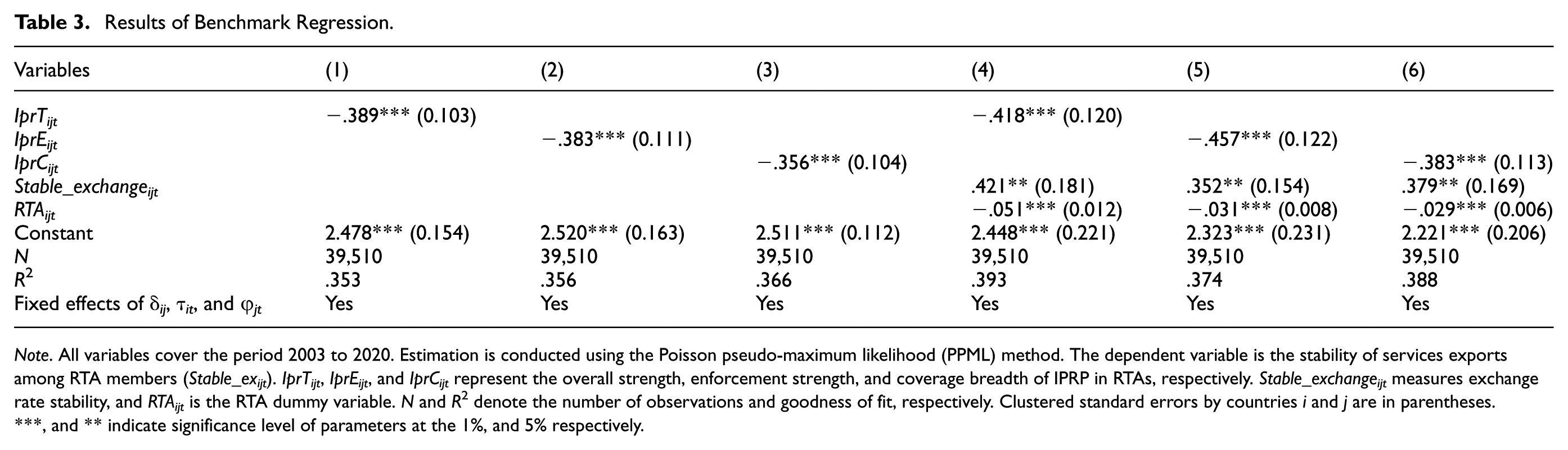
Note. All variables cover the period 2003 to 2020. Estimation is conducted using the Poisson pseudo-maximum likelihood (PPML) method. The dependent variable is the stability of services exports among RTA members (Stable_exijt). IprTijt, IprEijt, and IprCijt represent the overall strength, enforcement strength, and coverage breadth of IPRP in RTAs, respectively. Stable_exchangeijt measures exchange rate stability, and RTAijt is the RTA dummy variable. N and R2 denote the number of observations and goodness of fit, respectively. Clustered standard errors by countries i and j are in parentheses.
***, and ** indicate significance level of parameters at the 1%, and 5% respectively.
Robustness Test
Replacement or Addition of Explanatory Variables
Another approach to measuring the strength of IPRP in RTAs is to assess the degree of conformity of IPRP provisions with WTO and WIPO regulations. A higher degree of conformity suggests fewer enforcement disputes and more effective IPRP. Following Elsig and Surbeck (2016), this study constructs an index (IprMijt) from the DESTA database to represent this conformity, and uses it as a replacement for the overall IPRP strength variable in the regression model. As shown in Column (1) of Table 4, the coefficient of IprMijt is negative and significant at the 1% level, confirming the robustness of the results.
Replacement or Addition of Explanatory Variables.

Note. All variables cover the period 2003 to 2020. Estimation uses the Poisson pseudo-maximum likelihood (PPML) method. The dependent variable is the stability of services exports (Stable_exijt). IprMijt measures the degree of conformity of IPRP provisions in RTAs with WTO/WIPO regulations; IprTijt, IprEijt, and IprCijt capture the overall strength, enforcement strength, and coverage breadth of IPRP, respectively. ICTijt reflects information mobility, Stable_exchangeijt captures exchange rate stability, and RTAijt is the RTA dummy variable. N and R2 represent the number of observations and model fit. Clustered standard errors by countries i and j are in parentheses.
***, and ** indicate significance of parameters at the 1%, and 5% levels respectively.
The improvement of digital infrastructure has made its impact on services trade increasingly evident (Prica & Bartlett, 2019), potentially influencing the stability of services trade. It is expected that better-developed digital infrastructure in trading partner countries contributes positively to the stability of services trade. Information mobility (ICTijt) serves as an indicator of digital infrastructure; it is added to Equation 1 as an explanatory variable, and the regression results are shown in Columns (2) to (4) of Table 4. The regression coefficient of ICTijt is significantly negative, indicating that higher ICT development strengthens the stability of services trade. Moreover, the regression coefficients of the three explanatory variables remain robust.
To address potential reverse causality between the strength of IPRP in RTAs and the stability of services exports, all time-variant variables are lagged by one period. The regression results, presented in Table 5, show that the coefficients for the three core explanatory variables (lagged one period) remain negative and statistically significant at the 1% level, confirming the robustness of the findings.
Regression Results With One-Period Lagged Core Variables to Address Potential Reverse Causality.
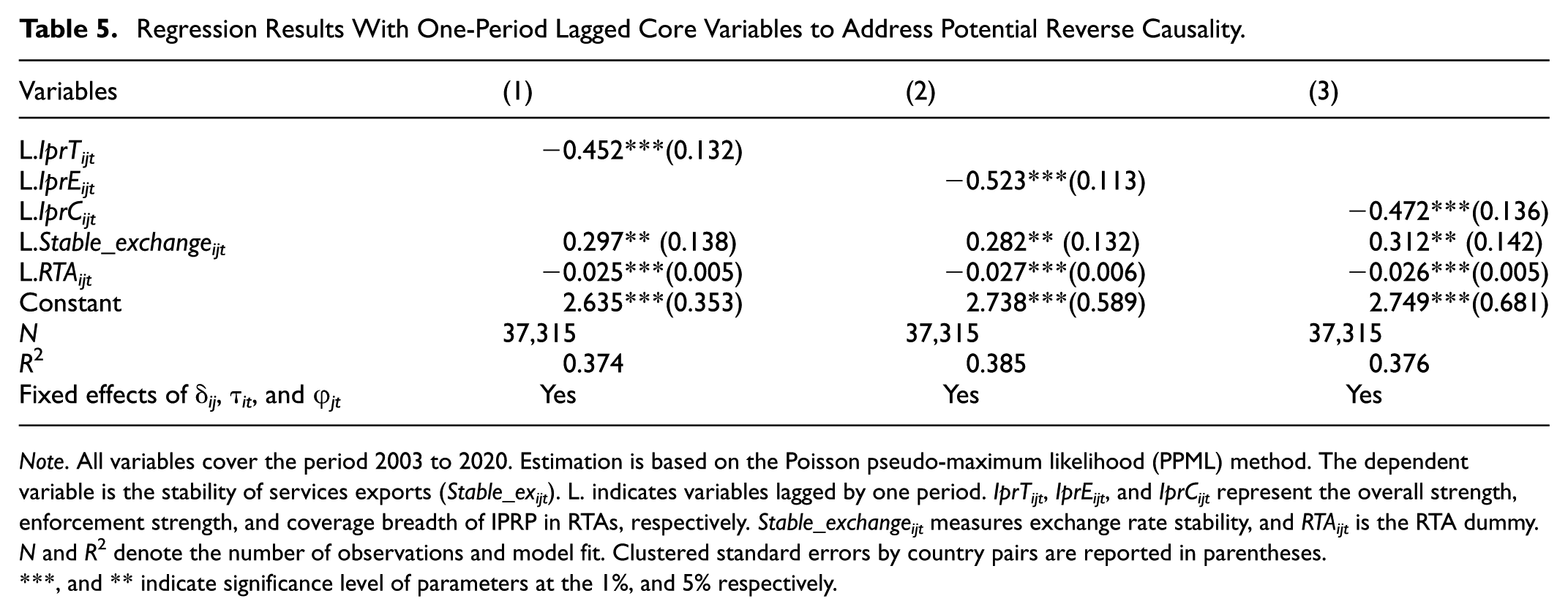
Note. All variables cover the period 2003 to 2020. Estimation is based on the Poisson pseudo-maximum likelihood (PPML) method. The dependent variable is the stability of services exports (Stable_exijt). L. indicates variables lagged by one period. IprTijt, IprEijt, and IprCijt represent the overall strength, enforcement strength, and coverage breadth of IPRP in RTAs, respectively. Stable_exchangeijt measures exchange rate stability, and RTAijt is the RTA dummy. N and R2 denote the number of observations and model fit. Clustered standard errors by country pairs are reported in parentheses.
***, and ** indicate significance level of parameters at the 1%, and 5% respectively.
Although the robustness tests confirm the stability of the estimated relationships across various specifications, it is important to recognize that the impact of IPRP provisions on services trade stability may vary over time. Given the relatively long sample period (2003–2020), structural changes in the global economy—such as the 2008 to 2009 global financial crisis, the rise of digital services trade in the 2010s, and shifts in global intellectual property governance—may have influenced the dynamics between IPRP strength and services trade stability.
While this study does not explicitly conduct sub-period analyses due to data constraints, we acknowledge that future studies could benefit from examining whether the effects of IPRP provisions intensified, weakened, or shifted following major global events. Incorporating temporal heterogeneity could provide deeper insights into the evolving role of intellectual property rights in stabilizing international services trade
Different Categories of Country Pairs
This section investigates the heterogeneous effects of IPRP on trade across different types of country pairs. First, we classify the 76 sample countries into developed and developing economies based on the World Bank’s per capita GNI criteria, defining high-income economies as developed countries and the remainder as developing countries. We then categorize country pairs into four types: South-North, North-South, North-North, and South-South, where the first country denotes the exporter and the second the importer (“North” for developed and “South” for developing countries).
As Table 6 shows, the regression results are statistically insignificant only for North-North pairs, while they remain significant for all other pairings. This finding suggests that stringent IPRP provisions do not significantly affect trade stability between developed countries. A plausible explanation is that developed economies already maintain strong IPRP protection regimes domestically, even prior to RTA formation. Thus, additional IPRP commitments in trade agreements may have limited marginal impact on their bilateral trade flows. A comparison of the results in Columns (1), (2), and (4) reveals that IPRP plays a more pronounced role in FTAs between developed and developing countries. This phenomenon may stem from the demonstration and spillover effects exerted by developed countries on their developing counterparts.
Different Categories of Country Pairs.

Note. All variables cover the period 2003 to 2020. Estimation uses the Poisson pseudo-maximum likelihood (PPML) method. The dependent variable is the stability of services exports (Stable_exijt). IprTijt, IprEijt, and IprCijt represent the overall strength, enforcement strength, and coverage breadth of IPRP in RTAs. Controls include Stable_exchangeijt and RTAijt. N and R2 indicate the number of observations and model fit. Clustered standard errors by country pairs are reported in parentheses.
***, and ** indicate significance level of parameters at the 1%, and 5% respectively.
Instrumental Variable Method
As shown by Baier and Bergstrand (2007), country-pair fixed effects help mitigate potential endogeneity by controlling for time-invariant unobservable characteristics linked to bilateral trade policy variables, such as RTAs. This paper adopts country-pair fixed effects for that purpose and additionally applies an instrumental variable (IV) strategy to address possible reverse causality. Following Peng and Lin (2021), we construct IVs for the three core explanatory variables. Specifically, for each country pair (i, j), we first calculate the average IPRP strength in RTAs signed by country i with other countries (excluding j), and similarly for country j with others. The mean of these two averages forms the IV for overall IPRP strength, with the same method used for enforcement strength and coverage breadth. Since these IVs are based on agreements with third parties and not directly on the bilateral relationship between i and j, they are valid instruments.
Two-stage least squares (2SLS) estimation is employed for the endogeneity test. The second-stage results (Table 7) show that all IVs are significantly correlated with their respective explanatory variables at the 1% level. The IVs also pass the weak identification test, and the results align with the benchmark regression, confirming robustness.
Endogeneity Test Results Using Instrumental Variables.
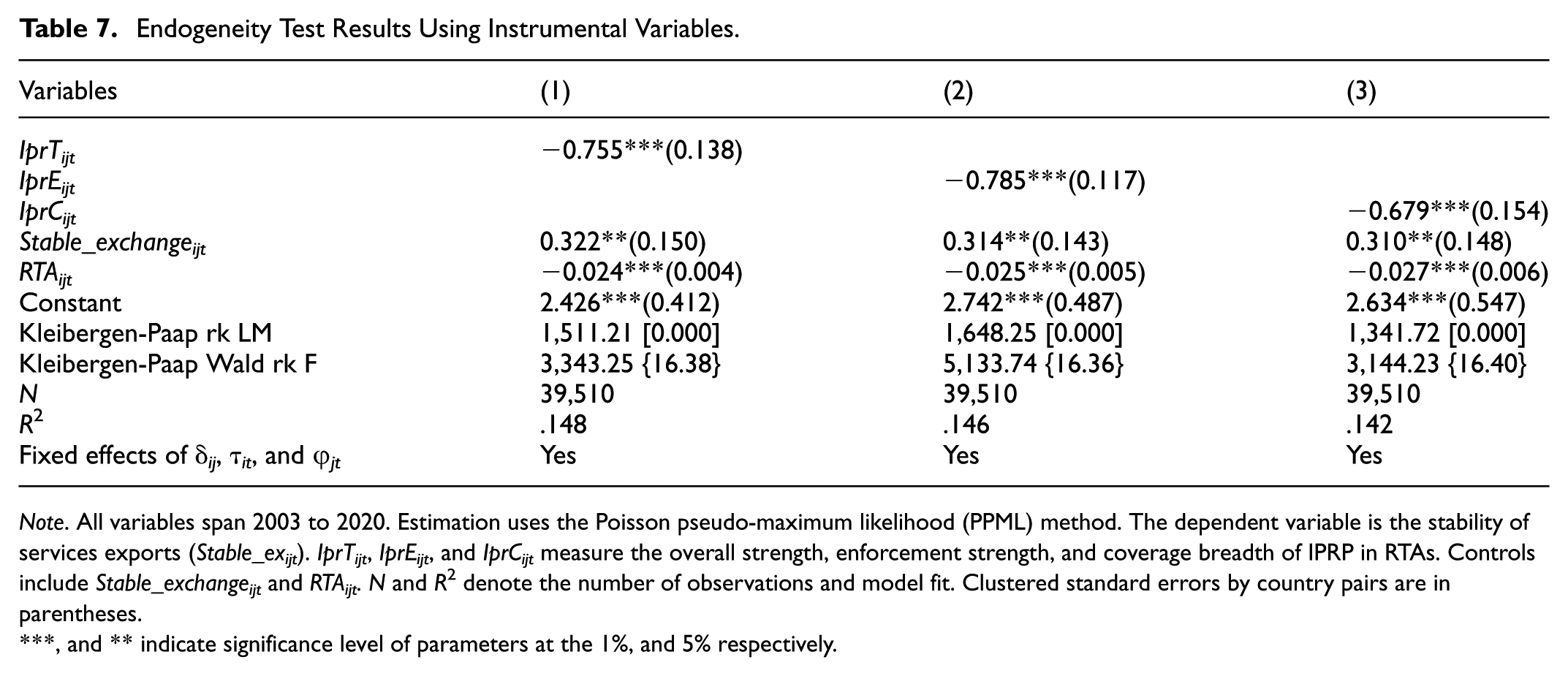
Note. All variables span 2003 to 2020. Estimation uses the Poisson pseudo-maximum likelihood (PPML) method. The dependent variable is the stability of services exports (Stable_exijt). IprTijt, IprEijt, and IprCijt measure the overall strength, enforcement strength, and coverage breadth of IPRP in RTAs. Controls include Stable_exchangeijt and RTAijt. N and R2 denote the number of observations and model fit. Clustered standard errors by country pairs are in parentheses.
***, and ** indicate significance level of parameters at the 1%, and 5% respectively.
Analysis of Moderating Effects
In this section, this paper constructs moderating effects models to further explore how information mobility, the gap in domestic IPRP between trading partners, and world economic policy uncertainty influence the relationship between IPRP strength and services export stability.
Moderating Effect of Information Mobility
According to Equation 2, information mobility is introduced as a moderator to explore its role in the impact of the strength of IPRP in RTAs on the stability of services trade. In Table 8, three interaction terms—IprTijt × ICTijt, IprEijt × ICTijt, and IprCijt × ICTijt are added respectively as explanatory variables. The regression results show that the interaction terms are all significantly negative. This suggests that improvements in ICT between trading partners enhance information mobility, thereby strengthening the impact of IPRP in RTAs on the stability of services exports. In other words, greater information mobility among RTA members amplifies the contribution of IPRP to trade stability. Thus, Hypothesis 2 is supported.
Moderating Effect of Information Mobility.

Note. All variables span 2003 to 2020. The estimation method is Poisson pseudo-maximum likelihood (PPML). The dependent variable is the stability of services exports (Stable_exijt); core variables include IprTijt (overall IPRP strength), IprEijt (enforcement strength), IprCijt (coverage breadth), and ICTijt (information mobility). Regressions control for Stable_exchangeijt and RTAijt. N and R2 represent the number of observations and goodness of fit. Clustered standard errors (by country pairs) are reported in parentheses.
***, and ** indicate significance level of parameters at the 1%, and 5% respectively.
Moderating Effect of the Domestic IPRP Gap on Services Trade Stability
Based on Equation 2, the domestic IPRP gap between trading partners is introduced as a moderating variable. As shown in Table 8, the interaction terms—IprTijt × GAPijt, IprEijt × GAPijt, and IprCijt × GAPijt—are all significantly positive. This suggests that a smaller gap in domestic IPRP between trading partners strengthens the positive impact of IPRP provisions on services trade stability. Therefore, Hypothesis 3 is supported.
Moderating Effect of the Gap in Domestic IPRP Between Trading Parties
Table 9 explores how the domestic IPRP gap between trading partners moderates the impact of IPRP strength on services trade stability. In Column (1), the interaction term IprTijt × GAPijt is significantly positive, suggesting that a smaller gap in domestic IPRP between countries strengthens the positive effect of IPRP on export stability. Similarly, in Columns (2) and (3), the interaction terms IprEijt × GAPijt and IprCijt × GAPijt are also positive and significant, reinforcing that when countries have more similar IPRP standards, the contribution of enforcement strength and coverage breadth to services trade stability becomes stronger. This finding supports Hypothesis 3. In addition, the coefficients for GAPijt are negative and significant across all models, indicating that larger disparities in domestic IPRP weaken the stability of services trade between RTA members.
Moderating Effect of the Gap in Domestic IPRP Between Trading Parties.

Note. All variables span 2003 to 2020. The estimation method is Poisson pseudo-maximum likelihood (PPML). The dependent variable is the stability of services exports (Stable_exijt); core variables include IprTijt (overall IPRP strength), IprEijt (enforcement strength), IprCijt (coverage breadth), and GAPijt (Domestic IPRP gap). Regressions control Stable_exchangeijt and RTAijt. N and R2 represent the number of observations and goodness of fit. Clustered standard errors (by country pairs) are reported in parentheses.
, and ** indicate significance level of parameters at the 1%, and 5% respectively.
Moderating Effect of World Economic Policy Uncertainty
Table 10 examines how global economic policy uncertainty moderates the relationship between IPRP strength and services trade stability. Columns (1), (3), and (5) show that Uncert has a positive and significant coefficient, confirming that higher global policy uncertainty reduces services trade stability. Meanwhile, the interaction terms—IprTijt × Uncert, IprEijt × Uncert, and IprCijt × Uncert—are all positive and significant in Columns (2), (4), and (6), respectively. This indicates that when global economic policy uncertainty is lower, the positive impact of IPRP strength on services trade stability is further enhanced. Thus, lower uncertainty conditions allow IPRP provisions to play a more effective stabilizing role in trade relationships.
Moderating Effect of World Economic Policy Uncertainty on the Relationship Between IPRP strength and Services Trade Stability.

Note. All variables cover the period from 2003 to 2020. The estimation method is Poisson pseudo-maximum likelihood (PPML). The dependent variable is the stability of services exports among RTA members (Stable_exijt). Regressions control for Stable_exchangeijt and RTAijt. N and R2 represent the number of observations and model fit. Clustered standard errors by countries i and j are in parentheses. IprTijt = overall strength of IPRP in RTAs; IprEijt = enforcement strength; IprCijt = coverage breadth; Uncert = World Economic Policy Uncertainty Index.
indicates significance at the 1% level.
Conclusion, Policies, and Limitations
This study investigates the impact of the strength of intellectual property rights protection (IPRP) provisions in regional trade agreements (RTAs) on the stability of services trade, using a panel of 76 countries with RTA relations between 2003 and 2020.
The findings reveal that stronger IPRP clauses within RTAs significantly enhance the stability of services trade among member countries. In particular, enforcement strength within IPRP provisions exerts a more substantial positive effect compared to coverage breadth. Moreover, when trading partners exhibit higher levels of information mobility and narrower gaps in domestic IPRP standards, the stabilizing effect of IPRP becomes even more pronounced. Interestingly, while the positive impact of IPRP is robust across most country pairings, it is less evident in trade between two developed economies, where domestic protections are already strong. Additionally, greater global economic policy uncertainty tends to undermine services trade stability, while lower uncertainty magnifies the benefits of strong IPRP frameworks. Stable bilateral exchange rates also contribute to enhanced stability in services trade.
Implications to Real-World Context
These results offer important practical lessons for countries at different stages of development: For developed economies such as those in the European Union or North America, while strong domestic IPRP regimes already exist, incorporating high-standard IPRP clauses into RTAs helps maintain services trade resilience, particularly when dealing with emerging digital and knowledge-based industries. Furthermore, during periods of heightened uncertainty—such as the COVID-19 pandemic or financial crises—continued enforcement and adaptation of IPRP standards within RTAs can protect services trade flows against external shocks.
For developing economies like Vietnam, Kenya, or Colombia, the findings suggest that negotiating RTAs with stronger, enforceable IPRP clauses—and simultaneously upgrading domestic intellectual property systems—can significantly enhance services trade stability and attractiveness to foreign investors. In particular, investments in digital infrastructure and the alignment of domestic laws with international IPRP standards (such as TRIPS-Plus) can amplify these benefits.
For South–South agreements (e.g., MERCOSUR, ASEAN agreements between less developed members), the study highlights that although IPRP language is often included, enforcement mechanisms are frequently weak or underdeveloped. Strengthening dispute resolution mechanisms, establishing clear penalties for IPR violations, and promoting capacity-building initiatives could substantially improve the stabilizing impact of these agreements on services trade.
Governments should also recognize that narrowing gaps in domestic IPRP standards among trading partners is crucial. Harmonization of legal frameworks and mutual recognition of IPR rights would reduce transaction costs and legal uncertainty, promoting more stable and predictable trade flows across borders.
Finally, as information mobility was found to significantly reinforce the positive impact of IPRP on trade stability, investments in digital connectivity, cybersecurity infrastructure, and secure communication platforms are essential for countries seeking to maximize the benefits of services trade liberalization.
Limitations and Implications for Interpretation
Several limitations should be acknowledged. Although service export volatility was measured using a combination of the absolute value method and the moving average method to improve robustness, these techniques may still fail to capture more nuanced structural changes or sector-specific shocks. Alternative approaches, such as generalized autoregressive conditional heteroskedasticity (GARCH) models or sector-focused volatility measures, could provide valuable refinements in future studies.
The scope of the sample, covering 76 countries, also introduces a limitation regarding generalizability. Since the sample disproportionately includes countries more actively engaged in regional integration and services liberalization, the results may not fully extend to economies with weaker institutions or lower participation in global services trade. Extending the analysis to underrepresented regions such as Africa, South Asia, and the Middle East would be a fruitful direction for future research.
Moreover, external shocks such as changes in global trade governance, protectionist surges, or major economic crises could significantly influence the dynamics observed in this study. Although we incorporated the World Economic Policy Uncertainty Index to account for such risks, a more granular examination of specific crises—such as the 2008 financial crisis or the COVID-19 pandemic—could deepen our understanding of how external volatility moderates the effectiveness of IPRP provisions.
Future Research Directions
Building on the findings of this study, future research could explore several promising avenues. Employing dynamic or sector-specific volatility measures would refine the assessment of services trade stability. Expanding the analysis to a broader range of economies would enhance the external validity of the conclusions. Moreover, investigating how specific categories of services—such as digital services, professional services, or tourism—respond to IPRP provisions under different external conditions would offer deeper sectoral insights. Understanding how IPRP interacts with services trade during periods of major global crises also represents a valuable extension of this research agenda.
Footnotes
Acknowledgements
We would like to thank Da Ling, and Fei Zuolan (both from Guizhou University) for their invaluable advices.

Ethical Considerations
There was no usage of either animal or human studies.
Funding
The authors disclosed receipt of the following financial support for the research, authorship, and/or publication of this article: This study is financially supported by the Taishan Young Scholar Program (tsqn202103070), the Taishan Scholar Foundation of Shandong Province, China, and the National Social Science Fund of China “Impact of Intensifying International Economic and Trade Frictions on the Asia-Pacific Regional Value Chain and China's Countermeasures”.
Declaration of Conflicting Interests
The authors declared no potential conflicts of interest with respect to the research, authorship, and/or publication of this article.
Data Availability Statement
The data used in this study are available from open databases without restriction. The method for accessing them is illustrated in the text.