




Abstract
This study investigates the impact of ambidextrous leadership on employee voice behavior in the context of medical device industry in Vietnam. It also examines the mediating role of intrinsic motivation, and the moderating role of power distance on the relationship between ambidextrous leadership on employee voice. Utilizing data from 207 employees across 12 companies in Ho Chi Minh City, the study employs a quantitative approach to test these hypotheses. Results demonstrate a significant positive relationship between ambidextrous leadership and employee voice behavior. This relationship is partially mediated by intrinsic motivation. Furthermore, the study finds that power distance moderates the indirect relationship between ambidextrous leadership and employee voice behavior through intrinsic motivation. In low-power-distance contexts, where authority is more equitably distributed, the positive influence of ambidextrous leadership on employee voice behavior via intrinsic motivation is stronger. This research contributes to the existing literature by shedding light on the mechanisms through which ambidextrous leadership fosters employee voice behavior and by highlighting the critical role of power distance in shaping this relationship.
Plain Language Summary
This study shows that when leaders in Vietnamese medical device companies can effectively balance both innovation and everyday operations, their employees are more likely to speak up with their ideas. This happens because these leaders motivate their employees to feel good about their work and want to contribute. Importantly, the study also found that the positive impact of this leadership style is stronger in a cultural context where employees feel more comfortable expressing their opinions freely. This research provides valuable insights for leaders and organizations in Vietnam on how to create a more open and innovative work environment.
Introduction
Employee voice is a critical construct studied across organizational psychology, organization studies, employment relations, and human resource management (Budd & Zagelmeyer, 2010). It reflects the extent to which employees engage in decision-making across task-specific to strategic levels (Wilkinson et al., 2020). In today’s competitive business environment, frontline employees provide insights and information that managers may overlook, making employee feedback essential for organizational performance (Senge, 2006). Successful team learning further depends on members’ willingness to share ideas about work processes (Nembhard & Edmondson, 2006).
Also, employee voice is often positioned as a driver of engagement, leading to improved productivity and task performance (Wilkinson et al., 2019). Extensive research highlights its link to positive organizational outcomes (Mackenzie et al., 2011), spanning innovation, work processes, motivation, and team learning (Edmondson, 1999). However, many employees remain reluctant to speak up, often fearing that the risks of voicing concerns outweigh potential benefits (Morrison & Milliken, 2000). Hierarchical structures and status differences frequently discourage employees from believing their input will be valued, or that speaking up could trigger negative consequences (Morrison & Rothman, 2009). Understanding who speaks up and under what organizational conditions remains essential for creating environments that encourage and utilize employee voice for continuous improvement.
While employee voice has been extensively studied in Western contexts and across industries, empirical research in Vietnam remains limited, particularly within the healthcare manufacturing sector. According to UNFPA, Vietnam’s rapidly aging population and rising healthcare expenditure, driven by both citizen demand and government investment, have catalyzed significant growth in the medical device manufacturing industry. As reported by B&Company (2025), the sector was valued at US$1.67 billion in 2023 and projected to reach US$2.1 billion by 2026. The sector is marked by strong foreign direct investment and supportive government policies. These dynamics create a timely and contextually relevant setting for examining how leadership, specifically ambidextrous leadership shapes employee voice within a high-performance, quality-sensitive, and culturally hierarchical environment.
Leaders play a pivotal role in shaping employees’ psychological states and behaviors (Howell & Costley, 2001). Numerous studies have examined leadership styles in relation to employee voice (Elsetouhi et al., 2023; Jiang et al., 2022; Peng & Chen, 2022; Younas et al., 2023; Zheng et al., 2022), yet few have addressed the effects of ambidextrous or paradoxical leadership (Xiao et al., 2023). Ambidextrous leadership, by encouraging exploration and innovation, enhances employees’ motivation to think independently and pursue new solutions (Rosing et al., 2011). Recent studies show its positive effects on service quality (Slåtten et al., 2023) and employee performance (Babu et al., 2024), with open leadership behavior—an element of ambidextrous leadership—promoting employee innovation and engagement.
Vietnam’s hierarchical culture and high power distance often restrict open communication and bottom-up innovation, emphasizing the need for leadership approaches that balance control with empowerment. Originally rooted in Western contexts, ambidextrous leadership is increasingly being adapted to suit Vietnamese organizational realities (Duc et al., 2020; Tho et al., 2025; Trieu et al., 2023). Given the growing complexity and paradoxes in management, ambidextrous leadership may become a vital leadership model in Vietnam. Therefore, exploring its impact on employee voice is both timely and theoretically significant.
Self-Determination Theory (SDT) provides a useful lens for understanding the psychological mechanisms underlying employee behaviors. It posits that individuals are intrinsically driven to achieve psychological growth and well-being, particularly when their needs for autonomy, competence, and relatedness are fulfilled (Deci & Ryan, 2014; Parker et al., 2010). When these needs are met, employees naturally engage in proactive and prosocial behaviors, including voice. Scholars have applied SDT to examine how empowering leadership fosters voice through mechanisms like harmonious passion (Gao & Jiang, 2019). Similarly, Duan et al. (2017) highlight how transformational leadership initiates a pygmalion process, enhancing intrinsic motivation and encouraging voice.
Intrinsic motivation, which is defined as engagement driven by internal satisfaction rather than external rewards has gained growing attention in management research over the past decade. Studies consistently link intrinsic motivation to improved performance, engagement, creativity, and organizational commitment (Endriulaitienė & Morkevičiūtė, 2020). Moreover, psychological needs are critical predictors of workplace behavior, including voice (Chamberlin et al., 2017). These insights underscore the importance of examining how ambidextrous leadership fosters intrinsic motivation, which in turn promotes employee voice.
While intrinsic motivation is essential, contextual factors such as institutional and cultural influences also shape employee behaviors. Although extensive research exists on employee voice in Western countries (Freeman et al., n.d.), studies in Southeast Asia remain limited. Scholars stress the need to identify boundary conditions that influence leadership effectiveness (Jung et al., 2009). In China, for instance, researchers advocate for integrating cultural contexts into leadership studies (Zhang et al., 2015), given its high power distance (Shao et al., 2013). In Confucian societies, including Vietnam, power disparities are seen as natural and reinforced through laws, norms, and social structures (Triandis, 1996; Liang, 2014). Consequently, this study examines how power distance moderates the relationship between ambidextrous leadership and employee voice, addressing a gap in the Southeast Asian context.
This research investigates the mediating role of intrinsic motivation in the relationship between ambidextrous leadership and employee voice, while also exploring the moderating effect of power distance. Specifically, it addresses the following research questions: How does ambidextrous leadership influence employee voice in Vietnamese healthcare manufacturing firms? Does intrinsic motivation mediate this relationship? And, how does high power distance moderate the impact of ambidextrous leadership on employee voice?
Grounded in the basic psychological need satisfaction sub-theory of SDT (Deci et al., 2017), this study examines whether opening and closing leader behaviors encourage employee voice by fulfilling competence and relatedness needs. This research contributes to the ambidextrous leadership and employee voice literature in several ways. First, it introduces intrinsic motivation as a mediator, highlighting its role in driving proactive employee behaviors. Second, it extends Ouyang et al. (2022) by examining power distance as a moderator within a Southeast Asian context. Third, it demonstrates the interaction between leadership style and cultural context in shaping voice behavior. Finally, the findings offer practical insights for leadership development in Vietnamese organizations aiming to build more engaged and innovative workforces.
The remainder of this paper is structured as follows: Section “Literature Review” reviews the relevant literature on employee voice, leadership, and intrinsic motivation; Section “Methods” outlines the research methodology; Section “Results” presents the results; and Section “Discussion and Conclusion” discusses the findings, implications, and limitations of the study.
Literature Review
Self-Determination Theory
Self-determination theory (SDT) posits that individuals possess three fundamental psychological needs such as autonomy, relatedness, and competence, that must be satisfied to foster optimal development, growth, and well-being (Deci & Ryan, 2014). Autonomy reflects the desire for control and ownership over one’s actions, relatedness captures the need to build meaningful interpersonal relationships characterized by mutual respect, and competence refers to the aspiration to acquire knowledge, skills, and proficiency in one’s role. When these needs are fulfilled within a given context, individuals become autonomously motivated to engage in proactive and constructive work behaviors (Parker et al., 2010). For example, job autonomy, the perception of having discretion in work-related decision-making has been shown to enhance employees’ willingness to voice opinions and concerns by fostering higher self-efficacy (Tangirala & Ramanujam, 2008).
Meta-analytic findings further highlight that leadership behaviors significantly influence psychological empowerment, a key driver of proactive behaviors such as voice (Seibert et al., 2011). Delegation practices by leaders can strengthen employees’ sense of empowerment, subsequently enhancing organizational citizenship behaviors. Additionally, Liang et al. (2012) demonstrated that satisfying employees’ relational needs increases job engagement and fosters relational identification, with transformational leadership enhancing voice behavior through these mediating mechanisms, although their study did not directly measure the satisfaction of basic psychological needs. Xu et al. (2017) also found that both moral efficacy and coworker emotional support play significant roles in promoting employee voice.
SDT offers a comprehensive framework for understanding the nature, antecedents, and outcomes of intrinsic motivation (Gagné & Deci, 2005). According to the theory, social environments that fulfill employees’ psychological needs are essential for cultivating intrinsic motivation, which in turn encourages proactive work behaviors, including employee voice (Ryan & Deci, 2000).
Ambidextrous Leadership
March (1991), widely credited with initiating scholarly interest in organizational ambidexterity, highlighted the need for firms to balance two fundamentally distinct activities: exploitation (focused on efficiency, execution, and implementation) and exploration (centered on innovation, experimentation, and discovery). Levinthal and March (1993) further emphasized that an organization’s long-term survival depends on its ability to manage both activities effectively. Although both are critical for creativity and innovation, they require distinct strategies, organizational contexts, and leadership behaviors (Rosing et al., 2011).
Expanding on this foundation, Gupta et al. (2006) introduced the concept of ambidextrous leadership, advocating for its integration into leadership research. Ambidextrous leadership reflects a leader’s ability to encourage both exploratory and exploitative behaviors in subordinates by flexibly adjusting their own behaviors (Rosing et al., 2011). This leadership style combines elements of flexibility and control, cost efficiency, and differentiation, addressing the complex demands of rapidly changing environments (Kao et al., 2015; Trong Tuan, 2017). Zheng et al. (2019) conceptualize ambidextrous leadership as a behavioral approach that manages and integrates conflicting activities over time, promoting organizational adaptability. Similarly, Zacher and Rosing (2015) describe it as the leader’s capacity to alternate between opening behaviors (encouraging idea generation) and closing behaviors (driving implementation), ensuring a balanced range of subordinate actions.
Vietnam, as an emerging economy with dynamic market conditions and hierarchical workplace norms, provides a contextually relevant setting for examining ambidextrous leadership. Existing research in Vietnam remains limited but growing. Trong Tuan (2017) found that ambidextrous leadership positively influenced entrepreneurial orientation and job crafting in software firms. Duc et al. (2020) further demonstrated that opening leadership fosters exploratory learning, while closing leadership enhances exploitative learning, with their interaction promoting team innovation in the retail services sector. These findings underscore the need for further research on how ambidextrous leadership shapes employee behaviors in the Vietnamese context.
Employee Voice
The concept of employee voice has become increasingly versatile, with diverse interpretations across fields such as human resource management, political science, economics, organizational behavior, psychology, and law (Wilkinson et al., 2010). Morrison et al. (2011) identify three dominant themes in the literature: voice as a verbal expression, as a voluntary behavior influenced by various factors, and as a proactive effort aimed at organizational improvement and constructive change. However, these perspectives often overlook expressions of dissatisfaction or complaints, which other scholars argue are integral to employee voice.
Economists, for instance, are frequently critiqued for conceptualizing voice through a narrow lens of rational choice, ignoring power dynamics and the role of formal collective structures like trade unions (Marchington, 2009). Similarly, legal scholars are criticized for focusing primarily on procedural aspects of worker voice, neglecting its economic, social, and psychological dimensions (Gollan & Dundon, 2007). To address these limitations, a more holistic framework is required—one that acknowledges the multifaceted nature of voice, including individual dissent, collective organization, and participation in managerial decision-making (Wilkinson et al., 2020). The ongoing challenge for organizations lies in balancing traditional mechanisms, such as collective bargaining and grievance procedures, with more collaborative and participatory forms of employee voice that remain underexplored in the literature.
Intrinsic Motivation
Motivation is broadly categorized into two types: extrinsic and intrinsic. Extrinsic motivation refers to behaviors driven by the expectation of external rewards or the avoidance of negative outcomes, such as incentives or sanctions (Ryan & Deci, 2000). In contrast, intrinsic motivation arises from the inherent enjoyment, interest, or satisfaction derived from engaging in the activity itself, independent of external consequences (Cerasoli et al., 2014). Additionally, some scholars have identified obligation-based intrinsic motivation, where individuals act in alignment with personal values, beliefs, and ethical standards (Li et al., 2012). However, the present study focuses on intrinsic motivation driven by the inherent enjoyment and satisfaction associated with task engagement.
Extensive research has shown that intrinsically motivated individuals typically demonstrate higher levels of performance, engagement, creativity, and organizational commitment (Koestner et al., 2008). These individuals often exhibit traits such as curiosity, cognitive flexibility, and openness to new ideas, enabling them to approach problem-solving with heuristic thinking, reduced defensiveness, and a greater willingness to embrace innovative perspectives (Zhou & Shalley, 2003). Notably, intrinsic motivation is especially valuable in contexts where traditional extrinsic incentives are less effective in eliciting desired behaviors, making it a critical factor in promoting proactive work outcomes like employee voice (Pink, 2011).
Ambidextrous Leadership and Employee Voice
Ambidextrous leadership, a managerial approach fostering both exploration and exploitation (Rosing et al., 2011), can create an environment conducive to employee voice behavior, the ability and willingness to express ideas and suggestions (Morrison et al., 2011). By balancing exploration and exploitation, ambidextrous leadership signals a commitment to both creativity and efficiency. This encourages employees to share their ideas, perceiving their contributions as valuable. Additionally, ambidextrous leaders foster psychological safety (Nembhard & Edmondson, 2006), a crucial factor for employee voice, by creating a space where employees can express their opinions without fear of negative consequences. Furthermore, ambidextrous leadership promotes open communication and feedback (Bledow et al., 2011), stimulating dialogue and debate at all organizational levels. This active engagement by leaders encourages employee participation in voice behavior. In a setting that prioritizes creative ideas and risk-taking (Carnevale et al., 2017), employees are encouraged to express their viewpoints. Therefore, we propose the following hypothesis:
Ambidextrous Leadership and Employee Intrinsic Motivation
This study adopts Self-determination theory (SDT) to examine the relationship between leadership behaviors and employee intrinsic motivation. According to SDT, individuals possess three fundamental psychological needs: autonomy (the desire to be the origin of one’s own actions and decisions), competence (the aspiration to feel effective and proficient), and relatedness (the need to experience meaningful social connections) (Sheldon & Prentice, 2019). When social environments, such as workplaces, satisfy these needs, individuals are more likely to experience heightened intrinsic motivation (Ryan & Deci, 2000). Leadership plays a critical role in shaping these motivational states by influencing how employees perceive the fulfillment of their psychological needs.
Despite its relevance, research linking leadership styles to intrinsic motivation remains relatively limited (Chipunza et al., 2011; Masi & Cooke, 2000). Existing studies show that transactional leadership is negatively associated with intrinsic motivation, while transformational leadership positively influences employees’ motivational states (Masi & Cooke, 2000). found that transformational leadership significantly enhances employee satisfaction, even during training phases, with trained leaders demonstrating more positive attitudes toward employee development. Similarly, Chipunza et al. (2011) report stronger links between transformational leadership and employee motivation compared to laissez-faire and transactional leadership styles.
Transformational leadership fosters intrinsic motivation by addressing employees’ psychological needs through behaviors such as intellectual stimulation and individualized consideration (Bass, 1999; Harbi et al., 2019). By providing intellectual challenges and personalized support, leaders enhance employees’ sense of competence and relatedness.
Building on this foundation, ambidextrous leadership offers a more nuanced approach by integrating both opening and closing behaviors (Rosing et al., 2011). Opening behaviors stimulate exploration and innovation, encouraging independent thinking and alternative problem-solving approaches. Closing behaviors, in contrast, provide structure and goal clarity. While transformational leadership may encompass both elements, ambidextrous leadership explicitly emphasizes the flexible adaptation between them. This distinction motivates further examination of how ambidextrous leadership influences employee intrinsic motivation.
Mediating Role of Intrinsic Motivation
Proactive behavior is typically shaped by two motivational states: the “can do” and the “reason to” states (Parker et al., 2010). The “can do” state refers to an individual’s belief in their capability to perform a particular task. However, this belief alone does not inherently motivate action. In contrast, the “reason to” state reflects an individual’s internal rationale or motivation to engage in a specific proactive behavior. Applied to the context of employee voice, psychological safety—though essential for fostering a belief that speaking up is possible—may not by itself serve as a sufficient driver for employees to actually voice their opinions or concerns. Therefore, a more nuanced understanding of the psychological mechanisms that underlie employee voice behavior is warranted. Self-determination theory (SDT), particularly the concept of basic psychological need satisfaction, offers valuable insights into these motivational processes.
According to SDT, individuals possess an innate tendency toward psychological growth and well-being, which drives their behaviors to fulfill these objectives (Ryan & Deci, 2000). When employees’ basic needs for autonomy, competence, and relatedness are satisfied within the work environment, they develop intrinsic motivation, which in turn fosters proactive and prosocial behaviors, including voice. A growing body of research demonstrates that need satisfaction at work is positively linked to various forms of prosocial workplace behavior (Van den Broeck et al., 2016). Employees who feel autonomous, competent, and socially connected are more likely to exceed formal job expectations by offering constructive suggestions and raising concerns, thereby contributing to organizational improvement. Thus, SDT provides a robust theoretical foundation for hypothesizing that intrinsic motivation is positively associated with employee voice behavior.
Although existing research highlights the role of leadership characteristics such as openness and accessibility in promoting voice, there remains a gap in understanding the underlying psychological processes that link leadership behaviors to employee voice (Morrison, 2011). Specifically, limited attention has been paid to the motivational mechanisms driving this relationship. Emerging research suggests that leaders influence employee intrinsic motivation through their leadership style, which subsequently shapes employee decision-making and behavioral outcomes (V. Gupta, 2020). Ambidextrous leaders, with their ability to flexibly alternate between opening and closing behaviors based on situational demands, are well-positioned to meet employees’ diverse psychological needs. By doing so, they foster intrinsic motivation, which then promotes voice behavior. Given the motivational underpinnings of decision-making and voice (Ouyang et al., 2022), this study posits the following:
The Moderating Effect of Power Distance
Hofstede (1991) introduced the concept of power distance as a key cultural dimension, describing the extent to which inequalities in power and authority are perceived as natural and justified within a society. Power distance shapes how individuals accept hierarchical differences, with societies characterized as having either high or low levels of power distance. In Confucian-influenced cultures, such as many East Asian nations, hierarchical disparities are regarded as an inherent and legitimate feature of social relationships. Confucianism deeply embedded in East Asian thought, continues to shape social behavior, cognitive patterns, and organizational dynamics. Vietnam is widely recognized as a high power distance and collectivist society with a long-term orientation.
However, Vietnam’s socio-cultural landscape has undergone significant change since the implementation of “Đổi mới” economic reforms. These reforms have introduced market-driven values, altered living standards, and reshaped social norms, leading to both the erosion of traditional Confucian values and the emergence of new behavioral patterns. Unlike Japan, South Korea, or Singapore—where Confucianism weakened during periods of modernization—Vietnam’s transition has resulted in what scholars refer to as “Vietnamese Confucianism,” a distinct adaptation that blends traditional values with contemporary socio-economic realities.
This study posits that power distance moderates the relationship between ambidextrous leadership and employee voice behavior. Two main reasons inform the selection of power distance as a moderator. First, self-determination theory (SDT) literature highlights power distance as an influential contextual factor that shapes how psychological needs are met in workplace settings (Deci et al., 2017). Examining this moderator can extend SDT scholarship in non-Western contexts. Second, meta-analyses on leadership outcomes (Lee et al., 2020) emphasize power distance as a critical boundary condition influencing leadership effectiveness.
Employees with high power distance tend to accept hierarchical authority, maintaining emotional distance from leaders and avoiding direct confrontation (Guo et al., 2022; Liang, 2014). Such employees often perceive leaders as figures deserving unquestioned respect and deference, fostering compliance and minimizing dissent (Burgoon et al., 1982). When faced with conflicting perspectives, they are more likely to defer to their leaders’ decisions, thereby reducing the likelihood of engaging in voice behavior (Kirkbride et al., 1991). Liang (2014) further found that employees with high power distance often create social distance from supervisors, which undermines relational quality and limits leaders’ ability to motivate employees effectively.
Conversely, employees with low power distance are more likely to challenge hierarchical norms, communicate openly, and engage in upward feedback (Hofstede, 2001). They perceive themselves as equal contributors to organizational success and view leaders as accountable partners in decision-making. Wang et al. (2012) reported that employees with low power distance react more negatively to unfair treatment, showing stronger sensitivity to issues like interactional justice. Similarly, Li and Sun (2015) found that power distance attenuates the negative effects of authoritarian leadership on employee voice.
Moreover, employees with high power distance, even when strongly identifying with their leaders, often feel powerless to influence decision-making due to perceived status gaps. As a result, they are more likely to suppress their opinions, exercising caution and self-censorship when interacting with authority figures (Botero & Van Dyne, 2009). In contrast, low power distance employees see themselves as integral organizational members with the right and responsibility to voice their ideas and contribute to decision-making processes (Liang, 2014).
In summary, power distance is expected to weaken the positive relationship between ambidextrous leadership and employee voice behavior. Therefore, the following hypothesis is proposed:
The proposed research framework is presented in Figure 1.

Proposed research model.
Methods
Research Approach
This study adopts a positivist research design, emphasizing a quantitative approach for data collection and analysis. This approach, as asserted by Westbrook (1994), is optimal for comprehensively understanding social science phenomena. The methodology involves administering a survey with twenty-five questions to employees, aiming to explore the impact of ambidextrous leadership on employee voice behavior.
Sampling Technique
Convenience sampling was used to collect samples. This study mostly concentrates on Ho Chi Minh City. Ho Chi Minh City was selected for a specific reason. Ho Chi Minh City is the most populous region in the country; hence, investing in healthcare will be a primary concern. This location also hosts a significant number of medical device firms in Vietnam.
The first thing that we did was try to get the consent and endorsement of the chief executive officer of each company before we started collecting data. Through networking, we contacted 12 companies in medical device industry in Ho Chi Minh City to obtain survey samples. All of them agree to participate to the survey. Non-probabilistic sampling was utilized to recruit employees from all departments. HR managers were requested to supply lists of department members along with their contact information for this recruitment process. Subsequently, we contacted them through telephone and messaging, invited their participation. The survey link, created as a Google Form, was shared with contacts via Zalo message. A Zalo message reminder was sent to the non-respondents after a period of 5 days.
According to Comrey and Lee (1992), sample size adequacy can be broadly evaluated as follows: 50—extremely poor, 100—poor, 200—fair, 300—good, 500—very good, 1,000 or more—excellent. Guadagnoli and Velicer (1988) support the idea that absolute minimum sample sizes are more meaningful than subject-to-item ratios, with recommendations ranging from a sample size of 50 (Barrett & Kline, 1981) to 400 (Aleamoni, 1976). Given 23 items for employees in this study, we followed a variable-to-sample ratio of 8:1, as recommended by O’Rourke and Hatcher (2013) for factor analysis, implying that an employee sample size of 184 would be sufficient. To ensure robustness, at least 200 samples were targeted.
Measurement Scales
To avoid distortion from respondents selecting intermediate values due to traditional compromise tendencies, all scales were rated on a 5-point Likert scale ranging from 1 (strongly disagree) to 5 (strongly agree), following the methodology of existing studies. The survey included control variables such as respondents’ gender, age, education, years of employment, and the nature of the business. The questionnaire was first developed in English and subsequently translated into Vietnamese by a bilingual academic. This procedure was implemented due to the limited understanding of English among employees in Vietnam. Back translation was performed to ensure comparability between the English and Vietnamese versions, and any discrepancies were addressed. All 23 items were translated into Vietnamese.
Employee voice was measured using the scale developed by LePine and Van Dyne (1998), comprising six items in one dimension. The scale assesses the extent to which employees are motivated to contribute and the degree to which their superiors appreciate those contributions.
Intrinsic motivation, identified as a critical factor in employees’ propensity for creative problem-solving, was measured using a six-item scale from (Amabile et al., 1994), with employees self-rating their motivations.
Ambidextrous leadership was assessed using daily leader opening and closing behaviors, with two scales adapted from Zacher and Rosing (2015). Each scale included four items, and the product of the mean scores of these behaviors measured ambidextrous leadership. Participants rated their leaders’ ambidextrous leadership. The interaction term, representing the additional influence on the dependent variable when two variables coexist, was applied in line with studies by Jiang et al. (2023). Power-distance orientation was measured using an adaptation of Hofstede’s international work survey (Hofstede, 2001), combining three items to form a single power-distance scale.
The questionnaire comprised 27 items, including four questions on demographic information (age, gender, duration of employment, and industry) and 23 Likert-scale items with responses from 1 (strongly disagree) to 5 (strongly agree).
Data Collection
A pilot study was conducted to evaluate the suitability of survey instruments in the Vietnamese context. Respondents completed the questionnaire and provided feedback on their comprehension of the questions. The goal was to ensure that all respondents interpreted the questions correctly and consistently, leading to more effective data collection. The pilot study focused on creating and presenting the questions, laying out the questionnaires, and estimating the time needed to complete them. In this pilot study, three companies with a matrix management system were examined, revealing that various leadership styles can influence a single employee. An adjustment is made in the Ambidextrous Leadership Scale, specifically allowing employees to rate only one of their leaders. These adjustments were made to the measurement scales without altering their fundamental meaning before data collection.
All participants were fully informed about the aims of the project and any potential risks prior to their involvement. Initial contact was made with prospective participants, and only those who provided consent were invited to complete the survey. The survey instrument included a clear project description and an informed consent section, requiring participants to select either “I agree to participate in the survey” or “I do not agree to participate.” Those who declined consent were automatically withdrawn from the survey.
This study initially received 250 responses through an online survey using Google Forms. After examining and verifying the survey replies, 218 responses were considered, resulting in a final sample size of 207 qualifying respondents. The remaining responses were excluded due to misunderstandings regarding reversed-scale questions or reliability issues. Consequently, the study achieved an 83% response rate.
Data Analysis
Data analysis involved descriptive statistics, reliability testing, confirmatory factor analysis (CFA), and partial least squares structural equation modeling (PLS-SEM). PLS-SEM was chosen over covariance-based SEM (CB-SEM) for several reasons. First, the study’s primary aim was predictive, focusing on explaining variance in employee voice behavior and testing complex mediation and moderation effects involving ambidextrous leadership, intrinsic motivation, and power distance. PLS-SEM is well-suited for such prediction-focused models and for maximizing explained variance (Hair et al., 2017; Sarstedt et al., 2019). Second, given the study’s modest sample size, PLS-SEM was preferable due to its higher statistical power and lower sensitivity to sample size limitations (Hair et al., 2011). Third, as the empirical application of Self-Determination Theory and Ambidextrous Leadership Theory in the Vietnamese healthcare manufacturing sector remains limited, PLS-SEM offered the flexibility needed for this exploratory context without requiring strict data distribution assumptions.
Results
Demographic Profiles of Respondents
The sample consisted of 207 respondents, with 93 males (44.9%) and 114 females (55.1%), ensuring an equal gender balance and limiting biases. The majority of respondents, 145 individuals (70.0%), were aged between 31 and 39 years, followed by 28 individuals (13.5%) under 25 years old. Additionally, 25 respondents (12.1%) were aged between 26 and 30, and only 9 respondents (4.3%) were over 40 years old, indicating that most employees surveyed are in the mid-career age range of 31 to 39 years.
Regarding work experience, 125 respondents (60.4%) had 1 to 3 years of experience in their current company, while 34 respondents (16.4%) had less than 1 year, 27 respondents (13.0%) had 3 to 5 years, and 21 respondents (10.1%) had more than 5 years. This suggests that most surveyed employees are relatively early in their careers, with significant representation of those with moderate levels of experience in their current company.
This sample composition reflects the realities of modern career trajectories, where mid-career professionals frequently experience shifts in employment, resulting in a mix of mid-career age and relatively early tenure in their current organizations.
Quality of Observed Variables
As presented in Table 1, the outer loading coefficients for all items in the scales (AL, EV, IM, and PW) were analyzed. According to Hair et al. (2022), outer loading values greater than 0.7 indicate good item significance. Most outer loading values exceeded this threshold, demonstrating strong correlations with their respective constructs. Some items (C-AL3, C-AL4, EV2, EV3, and IM6) were excluded from the final confirmatory factor analysis (CFA) due to their low standardized factor loadings (below the 0.5 threshold) and high modification indices, which indicated potential cross-loading issues and redundancy with other items within the same construct. The initial CFA revealed that retaining these items would significantly reduce model fit, as indicated by elevated values of the Root Mean Square Error of Approximation (RMSEA) and the Comparative Fit Index (CFI). Their removal improved the overall model fit and construct validity without compromising the theoretical integrity of the ambidextrous leadership measurement.
Outer Loading Factors.

Note. AL = Ambidextrous Leadership; EV = Employee Voice; IM = Intrinsic Motivation; PW = Power Distance.
Scale Reliability
The scales’ reliability was evaluated using Cronbach’s Alpha (α) and Composite Reliability (CR). All constructs displayed high reliability, with Cronbach’s Alpha values ranging from 0.859 to 0.960, and CR values exceeding 0.9. The average variance extracted (AVE) for all constructs was above 0.5, confirming convergent validity (see Table 2). Specifically, the AVE values were: AL = 0.834, EV = 0.704, IM = 0.734, and PW = 0.846.
Scale Reliability Results.

Note. AL = Ambidextrous Leadership; EV = Employee Voice; IM = Intrinsic Motivation; PW = Power Distance.
Discriminant Validity
Discriminant validity was assessed using cross-loadings of observed variables, the Fornell-Larcker Criterion, and the Heterotrait-Monotrait (HTMT) ratio. As shown in Table 3, the analysis demonstrated that outer loadings for all observed variables exceeded their respective cross-loadings with other constructs. The square root of the AVE for each construct was higher than the correlations with other constructs, satisfying the Fornell-Larcker Criterion.
Fornell-Larcker Criterion.

Note. AL = Ambidextrous Leadership; EV = Employee Voice; IM = Intrinsic Motivation; PW = Power Distance.
Evaluation of the PLS-SEM Structural Model
As presented in Table 4, the Variance Inflation Factor (VIF) values for most variables were below the threshold of 5, indicating no significant multicollinearity issues. Although some variables had VIF values above 3, they did not significantly impact the overall analysis. Therefore, the structural model remains valid for interpreting the relationships within the model.
Variance Inflation Factor (VIF).

The adequacy of the model is evaluated through R2 values, with a minimum threshold of 0.1 for validity, as suggested by Hair et al. (2022). Analysis revealed R2 values of 0.417 for Intrinsic Motivation (IM) and 0.734 for Employee Voice (EV), with adjusted R2 values of 0.414 for IM and 0.729 for EV. These values indicate a good fit, suggesting that the independent variables (AL, IM, and PW) significantly account for the variance in the dependent variables (IM and EV).
To evaluate the influence of the independent variables on the dependent variables, the f1 coefficients were analyzed according to Cohen’s (1988) criteria. The f1 coefficient for Ambidextrous Leadership (AL) is 0.715, indicating a large effect size. For Employee Voice (EV), the f1 values are 0.216 for AL, 0.245 for IM, and 0.070 for PW, indicating medium effects for AL and IM, and a small effect for PW.
Hypothesis Testing
Table 5 reveals results of testing the direct and moderating effects. Hypothesis H1 was confirmed with a path coefficient of 0.358 and a T-statistic of 6.280, indicating that ambidextrous leadership (AL) positively and significantly influences employee voice (EV) (p = .000). This suggests that an ambidextrous leadership style fosters an environment conducive to creativity and autonomy, encouraging employees to express their opinions, propose ideas, and provide feedback.
Results of Testing the Direct and Moderating Effects.
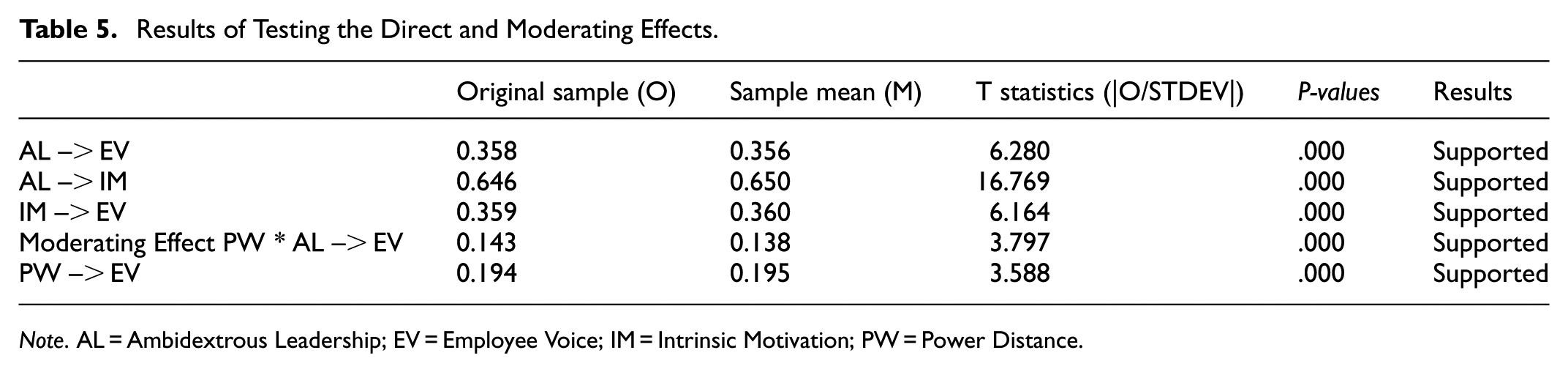
Note. AL = Ambidextrous Leadership; EV = Employee Voice; IM = Intrinsic Motivation; PW = Power Distance.
Hypothesis H2 was also confirmed, with a path coefficient of 0.646 and a T-statistic of 16.769, showing that ambidextrous leadership (AL) strongly positively affects employee intrinsic motivation (IM) (p = .000). Effective ambidextrous leadership enhances intrinsic motivation, leading employees to engage more fully in their work.
Hypothesis H3, with a path coefficient of 0.359 and a T-statistic of 6.164, demonstrated that employee intrinsic motivation (IM) positively impacts employee voice (EV) (p = .000). Intrinsically motivated employees are more proactive in expressing their views and contributing to organizational discussions.
Hypothesis H4 confirmed the moderating effect of power distance (PW) on the relationship between ambidextrous leadership (AL) and employee voice (EV) with a path coefficient of 0.143 and a T-statistic of 3.797 (p = .000). Specifically, in low power distance environments, ambidextrous leadership is more effective in encouraging employee voice.
Hypothesis H5 was tested to examine the specific indirect effect of ambidextrous leadership (AL) on employee voice (EV) through employee intrinsic motivation (IM). The results show a path coefficient of 0.232 and a T-statistic of 6.060, with a significance level of 1% (p = .000). This indicates that ambidextrous leadership indirectly enhances employee voice by fostering intrinsic motivation.
Discussion and Conclusion
This research addresses an important gap in understanding how ambidextrous leadership influences employee voice behavior. While previous studies have largely examined the impact of single leadership styles such as transformational, transactional, or servant leadership on employee voice (Younas et al., 2023), this study offers new theoretical and empirical insights by positioning ambidextrous leadership within the Self-Determination Theory (SDT) framework. Specifically, our findings demonstrate that ambidextrous leadership, through its dual focus on exploration and exploitation, enhances employees’ capacity and willingness to voice their opinions in a more rational, constructive, and context-sensitive manner. This leadership style fosters an environment that simultaneously values innovation and operational efficiency, promotes psychological safety, supports continuous learning, and encourages adaptive decision-making. This holistic approach enables employees to feel empowered, intrinsically motivated, and psychologically safe, thereby enhancing their engagement in organizational discourse and decision-making processes.
Our results further confirm that employees’ power distance orientation significantly and negatively affects their propensity to engage in voice behavior. Consistent with Hu and Judge (2017), this study empirically validates the inhibitory role of power distance, showing that employees with a higher acceptance of hierarchical inequality are less likely to express dissenting views or suggestions. This finding extends the growing body of research on voice facilitation in high power distance cultures, much of which has focused on China (Guo et al., 2022; Zhu & Akhtar, 2014). In contexts characterized by high power distance, leaders are often perceived as punitive or dismissive toward employee input (Ilgen et al., 1981). As a result, employees may choose to remain silent, fearing retaliation or criticism. This aligns with Landau (2009), who observed that employees in high power distance settings often remain disengaged and emotionally distant from organizational initiatives. Disempowerment arising from rigid hierarchies negatively impacts organizational performance. Supporting this, Chen et al. (2011) found that power sharing enhances job performance, partly by fostering psychological empowerment. Similarly, Lin et al. (2013) demonstrated that employees in low power distance contexts reported higher psychological well-being and job satisfaction. From a practical perspective, our findings highlight the need for managers to actively encourage employee involvement in decision-making, seek employee perspectives, and provide both supportive and constructive feedback—even when employees face challenges.
Vietnam’s deeply rooted hierarchical culture and bureaucratic structures further amplify these dynamics. As Xu et al. (2022) noted, Vietnamese organizations are often characterized by employee self-protection behaviors and a preference for explicit, top-down directives. However, Vietnam’s ongoing transition toward market orientation and global integration (Nguyen et al., 2015) underscores the urgency of organizational change and innovation. To navigate this evolving environment, Vietnamese organizations must adopt ambidextrous leadership approaches that strike a careful balance between reinforcing hierarchical clarity (exploitation) and fostering psychological safety and open communication (exploration). Such leadership can enable firms to sustain operational control while creating space for employee input and innovation—key to enhancing organizational adaptability and employee engagement.
This study also contributes to employee voice literature by examining the mediating role of intrinsic motivation. Extending the work of Duan et al. (2017), which focused on transformational leadership and intrinsic motivation, our research demonstrates that ambidextrous leadership indirectly fosters employee voice behavior by enhancing intrinsic motivation. While prior studies have largely emphasized the altruistic dimensions of employee voice (Van Dyne et al., 2003), this study highlights that intrinsic motivation also reflects employees’ desire for growth, learning, and self-development. Ambidextrous leadership fosters intellectual stimulation and encourages employees to embrace challenges (Amabile et al., 1994), prompting them to voice suggestions and concerns as a means of personal and professional development.
Moreover, ambidextrous leadership nurtures a growth mindset (Gouda & Tiwari, 2024), motivating employees to seek learning opportunities, embrace feedback, and pursue continuous improvement—key drivers of voice behavior. Using survey data from Vietnamese medical device manufacturing firms, our results confirm that ambidextrous leadership positively influences intrinsic motivation, which in turn significantly predicts employee voice behavior. When leaders adopt an ambidextrous approach, employees are more inclined to articulate ideas, provide feedback, and participate in organizational discussions. This finding aligns with Ouyang et al. (2022), and Peng (2020), who also reported positive links between ambidextrous leadership and employee voice.
The confirmation of intrinsic motivation’s mediating role further enriches our understanding of motivational mechanisms in organizational behavior. Intrinsic motivation is widely recognized as a key predictor of organizational citizenship behavior, including voice (Cerasoli et al., 2014). Employees driven by intrinsic motivation are more likely to engage in voice behavior that is both proactive and high in quality. By enhancing employees’ intrinsic motivation, ambidextrous leadership facilitates thoughtful evaluation of the risks and benefits associated with speaking up, encouraging calculated and constructive voice behaviors. Our study, therefore, contributes to leadership and motivation literature by demonstrating how intrinsic motivational processes link ambidextrous leadership to voice outcomes.
Importantly, this research also addresses overlooked dimensions of employee voice motivation by integrating both self-interest and altruistic perspectives (Van Dyne et al., 2003). While previous studies have predominantly focused on employees’ prosocial motivations, this study highlights that employees may also use voice behavior as a means to secure resources, enhance competence, or protect personal interests. By embedding intrinsic motivation within our theoretical model, we offer a more nuanced understanding of the complex motivational drivers behind employee voice.
Furthermore, this study introduces power distance as a critical boundary condition moderating the effect of ambidextrous leadership on employee voice. Our findings suggest that the positive impact of ambidextrous leadership on voice behavior weakens as power distance increases. In low power distance contexts, ambidextrous leadership is more effective in promoting open communication and voice expression. Employees in such environments perceive leadership behaviors as more supportive and empowering, facilitating their willingness to speak up. This observation aligns with Lee et al.’s (2020) meta-analysis, which highlighted power distance as a key contextual factor shaping leadership outcomes. Additionally, our findings extend the leadership substitutes theory (Porter & McLaughlin, 2006) by demonstrating how organizational-level cultural variables like power distance shape employees’ responses to leadership behaviors.
While prior studies such as Peng (2020) and Ouyang et al. (2022) have examined the individual-level mechanisms underlying ambidextrous leadership and voice—such as leader identification and cognitive flexibility—our research advances this stream by identifying power distance as a cross-level moderator. This supports growing calls for multi-level research on leadership effectiveness and highlights the need for leadership models that integrate individual, team, and organizational-level factors (Xenikou, 2021).
Practically, the findings of this study offer several actionable recommendations for organizational leaders and managers, especially in emerging market contexts like Vietnam. First, investment in leadership development programs is essential. Training that helps leaders develop ambidextrous competencies—balancing exploration and exploitation—can strengthen their ability to foster employee voice. Leaders should cultivate behaviors that encourage experimentation and flexibility while also providing clear direction and performance expectations. Such duality will help address both performance consistency and innovation needs.
Second, organizations should proactively create work environments that nurture intrinsic motivation. This includes offering employees opportunities for skill development, fostering autonomy in task execution, recognizing individual contributions, and building a supportive social climate. By addressing employees’ needs for autonomy, competence, and relatedness, organizations can enhance intrinsic motivation and, in turn, voice behavior.
Third, reducing hierarchical barriers and minimizing excessive power distance should become a priority for organizations aiming to foster a culture of open communication and participation. Interventions such as inclusive leadership training, feedback culture development, and employee empowerment initiatives can help achieve this. In the Vietnamese context, where hierarchical norms are deeply embedded, managers can gradually build a more open communication climate by encouraging constructive feedback, celebrating employee contributions, and developing leadership behaviors that signal psychological safety.
Furthermore, organizations should implement voice-supportive HR practices such as employee advocacy programs, storytelling initiatives that highlight positive voice behavior, and systems for recognizing and rewarding employee suggestions. These practices not only foster a sense of ownership and belonging but also help employees perceive voice as both safe and valued.
Finally, organizations should encourage employees to challenge traditional norms that discourage voice behavior, particularly those rooted in cultural tendencies toward conformity and deference. Promoting awareness about the benefits of voice for organizational learning, innovation, and performance can help shift employee mindsets over time. Additionally, managers should provide constructive feedback when employees voice concerns and offer support when voiced suggestions encounter resistance.
This study has several limitations. First, the cross-sectional design restricts causal inference and overlooks temporal dynamics; future research should adopt longitudinal or experimental approaches. Second, the sample was primarily drawn from the medical device industry, limiting generalizability. Broader industry representation would enhance external validity. Third, individual differences (e.g., personality traits, values) and contextual factors (e.g., organizational culture, leadership trust) were not fully explored. These should be examined as potential moderators in future studies. Lastly, endogeneity risks remain; employing instrumental variable techniques or multi-wave data collection could improve causal interpretation, especially when grounded in established theories like SDT and Ambidextrous Leadership Theory.
Footnotes

Ethical Considerations
This study was conducted in accordance with standard ethical research practices. All procedures involving human participants complied with institutional and international research ethics guidelines.
Consent to Participate
All participants were fully informed about the aims of the project and any potential risks prior to their involvement. Initial contact was made with prospective participants, and only those who provided consent were invited to complete the survey. The survey instrument included a clear project description and an informed consent section, requiring participants to select either “I agree to participate in the survey” or “I do not agree to participate.” Those who declined consent were automatically withdrawn from the survey.
Funding
The authors received no financial support for the research, authorship, and/or publication of this article.
Declaration of Conflicting Interests
The authors declared no potential conflicts of interest with respect to the research, authorship, and/or publication of this article.
Data Availability Statement
Data are available on request.