




Abstract
This study examines the impact of digital leadership on employee voice behaviors, which are critical for organizations’ success in digital transformation. Using social exchange theory as the model foundation, we conducted a two-wave survey to explore the content and attributes of voice behaviors. Our findings show that digital leadership plays a crucial role in promoting employee voice behaviors, indirectly affecting prohibitive and promotive voice behaviors through employee empowerment. We found that digital leadership increases prohibitive voice behavior through increasing work engagement rather than promotive voice behavior. Additionally, our study reveals that employee empowerment and work engagement do not mediate the chain of effects between digital leadership and promotive voice behavior. This research contributes to the literature on digital leadership, employee voice behaviors, and social exchange theory, providing new insights into the role of digital leadership in promoting employee voice behaviors.
Plain language summary
Employee participation in the digitalization of organizations is essential. However, there is a need for further analysis of the impacts of digital leadership on employee behaviors. To address this gap, we conducted a two-wave survey to examine whether and how digital leadership promotes employee voice behaviors. We adopted social exchange theory as the model foundation and focused on the content and attributes of voice behaviors rather than treating it as a form of citizenship behavior like previous research. This work demonstrates that digital leadership is crucial in promoting employee voice behaviors and indirectly affects prohibitive and promotive voices behaviors through employee empowerment. Our study shows that digital leadership increases prohibitive voice behavior rather than promotive voice behavior by increasing work engagement. Furthermore, our study reveals that employee empowerment and work engagement do not mediate the chain of effects between digital leadership and promotive voice behavior. Our research contributes to the literature on digital leadership, employee voice behaviors, and social exchange theory by providing new insights into the role of digital leadership in promoting employee voice behaviors.
Keywords
Introduction
In the face of the COVID-19 pandemic, businesses have increasingly adopted digital technologies to enable more effective use of online or virtual platforms. However, the complexity and challenges of digital work have also caused workplace issues that require addressing (Abbas Khan, 2021). Organizations must allow employees to voice their concerns to maintain critical and reflective thinking and adapt to constantly changing environments (Bernauer & Kornau, 2024; H. Kim & Leach, 2020). Digital channels enable employees to express their opinions anonymously and have greater autonomy over the information they share (Ellmer & Reichel, 2021). Digital leadership has emerged as a form of leadership in the digital transformation era, affecting employees’ perceptions and behaviors (Krug et al., 2018). Previous studies have shown that digital leadership positively impacts digital transformation in organizations (AlNuaimi et al., 2022; F. Li, 2020; T. D. Wang et al., 2022). However, research on the micro-mechanisms of digital leadership within organizations, particularly the effect of digital managerial leadership on employee behavior, is limited. Significantly, the uncertainty and unpredictability of events during the COVID-19 pandemic may reduce employee willingness to speak up (Wee & Fehr, 2021), making it crucial for managers to understand the implications of digital technology and leadership for employee perceptions of voice behavior safety and effectiveness. This study aims to fill this gap by examining the relationship between digital leadership and employee voice behaviors and the different impacts and path differences of different types of voice behavior under the influence of digital leadership. This study addresses the following questions: (1) How does digital leadership affect employees’ prohibitive and promotive voices? (2) How does digital leadership influence the two voice behaviors? Moreover, (3) what are the differences among these paths?
To address how digital leadership influences employee voice behaviors, we propose examining the mechanisms between employee empowerment and work engagement as potential drivers of employee voice behaviors. Employee empowerment refers to the sharing and delegating of power by organizational power holders through formal and informal practices, creating a sense of control and power for employees (Conger & Kanungo, 1988; Menon, 2001). Despite evidence showing the role of employee empowerment in promoting employee voice behaviors (X. M. Liu et al., 2020; Spreitzer, 1995; X. Y. Wei et al., 2020), some scholars argue that digital technology may lead to excessive control and depersonalization, causing disengagement and less willingness to speak up (Rani et al., 2021). Thus, digital leadership should promote employee empowerment to encourage voice behaviors by influencing their perceived sense of empowerment. Scholars suggest that the relationship between managers and employees involves specific psychological expectations (Schein et al., 1980) that determine whether employees are engaged and perform their work roles, known as work engagement (Kahn, 1990). Despite its discussion (T. L. Liang et al., 2017), researchers must verify work engagement as a mediator between leadership and employee voice behaviors in digitization. Additionally, employee empowerment leads to more autonomy and access to resources, which affects employees’ psychological states and intrinsic motivation, subsequently influencing work engagement (Bakker et al., 2007). Therefore, we hypothesize that employee empowerment and work engagement mediate between digital leadership and employee voice behaviors.
To test our hypotheses, we utilized the social exchange theory (Ahmad et al., 2023; Bierstedt, 1965). We conducted a two-wave survey employing structural equation modeling (SEM) to investigate the influence and mechanisms of digital leadership on employee voice behaviors. Our study emphasizes the critical role of digital leadership in promoting employee voice behaviors, reaffirming that leadership is an antecedent of such behavior (Li & Sun, 2015; Ouyang et al., 2022). While prior research on digital leadership has mainly focused on conceptual, trait, and ability constructs (Avolio et al., 2014; C. Liu et al., 2018; Roman et al., 2019; Weber et al., 2022), our work validates the micro-level mechanisms of digital leadership within organizations, highlighting its importance. Our study predicts digital leadership’s direct and indirect effects on employee voice behaviors through employee empowerment and work engagement. By doing so, we expand the antecedents of employee voice behaviors and discover different paths of influence of different types of voice behavior under the same leadership. Work engagement significantly mediated the relationship between digital leadership and prohibitive voice behavior but did not mediate promotive voice behavior. Therefore, this study suggests that even in a digital work context, the value orientations of prohibitive and promotive voice behavior may differ (J. Liang et al., 2012; Van Dyne & LePine, 1998), which leads to differences in their paths of influence. Consequently, our research provides valuable insights for promoting employee voice behaviors and helps managers adopt targeted strategies. Building on these findings, we discuss the chain-mediated effects of employee empowerment and work engagement between digital leadership and prohibitive voice behavior. Finally, we extend the organizational behavior research of social exchange theory, elucidating that, even in the digital context, social exchange theory remains relevant for analyzing interactive behavior between managers and employees. In contrast to previous research (Yue et al., 2022), we emphasize mutualism between managers and employees and focus on power relations and rationality.
The study is structured as follows: Section “Literature Review and Hypotheses” reviews the relevant literature about digital leadership and employee voice behaviors, develops hypotheses, and constructs a conceptual framework. Section “Materials and Methods” provides the research methodology and empirical analyses. The results, theoretical and practical ramifications, as well as its limitations and future potentials, are all presented in Sections “Results” and “Discussion and Conclusion.”
Literature Review and Hypotheses
Social Exchange Theory
Social exchange theory provides a suitable theoretical framework for understanding digital leadership and employee voice behaviors. Social exchange theory explains individual interactions as a negotiation process involving potential exchange rules such as reciprocity, rationality, power inequality, and group benefits (Cropanzano & Mitchell, 2005). In this theory, exchanges between managers and employees are considered two-way processes where both parties expect to gain benefits while considering potential costs. Although researchers have primarily focused on the perspective of reciprocity (Pundt et al., 2010) and ignored power relations within exchange processes, they recognize social exchange theory as necessary in explaining employee voice behaviors (Chernyak-Hai & Rabenu, 2018). In particular, power differences within organizations in the digital age may limit employee voice opportunities and willingness. Social exchange theory defines power as the ability to provide valuable rewards, influence and control others, and shape their activities (Homans, 1958). Therefore, digital leadership enhances employee empowerment through power-sharing and delegation, allowing employees more resources and capabilities to meet their power needs and improve their representation and influence within organizations (K. T. Wang et al., 2018). In addition, there are also informal psychological expectations between managers and employees (Cook, 2015). When managers satisfy specific psychological expectations, employees are more likely to invest physical, cognitive, and emotional resources and provide feedback through employee voice behaviors (Zeijen et al., 2020). In the digital context, it is essential to consider how digital technologies shape the dynamics of resource exchange and social relations (Kim et al., 2018). For example, digital communication tools increase communication frequency between managers and employees and promote resource exchange. However, the lack of face-to-face communication and interpersonal interactions can lead to a sense of disconnection (Ellmer & Reichel, 2021). At the same time, the misuse of digital monitoring tools may result in the deprivation of employee power. Therefore, digital leaders and employees must learn and work together to address these issues and maximize group benefits.
Digital Leadership
In digitalization, digital leadership plays a critical role as an influential process that facilitates changes in individuals, teams, and organizations. Avolio et al. (2014) and Van Wart et al. (2017) describe how digital technologies mediate this process, encompassing attitudes, emotions, thinking, behavior, and performance. Digital leadership possesses several characteristics, such as strategic changes, transformative visions, forward-thinking mindsets, and strong adaption, which are essential in keeping up with the digital frontier (Weber et al., 2022; Zhu et al., 2022). It encompasses various leadership styles and behaviors, including transformational leadership, which focuses on inspiring and motivating employees to achieve their full potential. It encompasses various leadership styles and behaviors, including transformational leadership, which focuses on inspiring and motivating employees to achieve their full potential (Weber et al., 2019). Additionally, it emphasizes managers’ capabilities in digital communications, digital social networks, digital transformation, digital teams, digital technology, and digital trust (Roman et al., 2019). As a crucial aspect of digital organizational transformation, digital leadership focuses on interacting with organizational stakeholders and guiding followers to access, use, and innovate digital technologies to identify digitalization opportunities (De Waal et al., 2016). The concept of digital leadership has been the focus of numerous studies, including its characteristics, capability development, and its impacts on digital transformation (Tigre et al., 2022). Nevertheless, some studies, such as C. Wei et al. (2020) and Dery et al. (2017), have explored how digital leadership positively influences employees’ emotions, thoughts, and actions. It is important to note that digital leadership plays a vital role in an organization’s success, as employees’ emotional, cognitive, and behavioral reactions can significantly affect the outcome of organizational transformation (Agote et al., 2016). Therefore, managers should establish close relationships with their staff, particularly in digital environments (Kahai, 2012). Although several studies have demonstrated the positive impacts of digital leadership on employees’ vision, thinking, initiative, and motivation (S. H. Wang et al., 2022; T. D. Wang et al., 2022), most of these works have neglected the impacts of digital leadership on employee behaviors. Thus, this current work aims to address this gap in the literature.
Employee Voice Behaviors
Given the numerous obstacles involved, relying solely on managers to avoid risks, optimize processes, and improve organizational performance can be challenging in digitization. Employees can participate in digitization and contribute to their team, department, or organization through employee voice behaviors (Bernauer & Kornau, 2024; Vandyne et al., 1995). This behavior involves sharing work-related ideas, suggestions, and concerns with managers and can divide into prohibitive and promotive voices (J. Liang et al., 2012). The prohibitive voice aims to prevent harmful and unethical behavior, while the promotive voice aims to promote events favorable to the organization. Typically, employees express their voice behavior through digital voice channels such as WeChat and WhatsApp in the digital transformation of enterprises. These channels enable employees to quickly and inexpensively obtain information, express themselves anonymously, and increase their willingness to share their emotions, knowledge, and experience (Khan et al., 2023). Matching digital voice channels with material resource allocation can synergize digital technology and management, encouraging employee voice behaviors (Ellmer & Reichel, 2021).
Additionally, digital technology expands employees’ social exchange networks within the organization, increasing opportunities for discussing work-related topics (H. Kim & Leach, 2020). However, digital technology has drawbacks, such as information overload and the digital divide (Gegenhuber et al., 2021). Although research on the influence of digital voice channels on employee voice behaviors is limited, it is crucial to understand the influence and mechanism of managers’ leadership behavior and employees’ voice behavior in the digital context. Both types of voice behavior may challenge established processes and institutions, potentially harming managers’ interests and leading to misunderstandings and loss of personal resources (T. L. Liang et al., 2017). Whether and what kind of voices are raised depends on employees’ perceptions of the validity and safety of their voices (Parker & Collins, 2010) and managers’ openness to discourse (Chamberlin et al., 2017). Therefore, understanding the influence and mechanism of managers’ leadership behavior and employees’ voice behavior in the digital context is essential for understanding employee voice behaviors.
Digital Leadership and Employee Voice Behaviors
Drawing on the Social Exchange Theory, this study explores the factors influencing leader-member exchange behaviors in digital contexts. Managers are motivated to maximize profits and minimize losses through supportive behaviors toward employees, particularly in unpredictable and vulnerable situations (Ahmad et al., 2023; Cropanzano & Mitchell, 2005). In light of the COVID-19 pandemic and digitalization, this study proposes a framework in which digital leadership leverages digital technology to encourage employee voice behaviors. Firstly, digital leadership adopts interactive and transformative approaches to encourage exchanging ideas and information flows within the organization, fostering creativity and generating more innovative solutions (Bunjak et al., 2022; Rohlfer et al., 2022). It promotes openness and discourse within the organization, positively impacting employee voice behaviors. Secondly, digital leadership stresses the importance of building digital social networks to spread positive emotions among employees, enhancing their safety and security in uncertain circumstances (J. Li et al., 2022; Matsunaga, 2022). It enables employees to overcome barriers to voice behaviors and respond to prohibitive and promotive voices. Thirdly, digital leadership leverages digital technology to communicate essential qualities such as honesty, kindness, justice, and consistency to employees, reducing power distances and building digital trust between managers and employees (Roman et al., 2019). It enhances employees’ perceptions that their thoughts and opinions are valued and safe to express. Finally, based on the Social Exchange Theory, employees are motivated to take risks and use voice behaviors to increase their work duties after receiving benefits and values from their managers (Ruiz-Palomino et al., 2019). Employees are more likely to engage in voice behaviors by strengthening social exchange relationships. Based on the analyses above-mentioned, the following hypotheses are proposed.
H1a: Digital leadership significantly and positively influences employees’ prohibitive voice.
H1b: Digital leadership significantly and positively influences employees’ promotive voice.
The Mediating Roles of Employee Empowerment
Employee empowerment is a term that describes an individual’s belief in their capabilities, skills, and capacity to perform and effectively control their work environment, as well as the authority and autonomy to take action within the workplace (Men, 2011). Researchers have found a positive association between employee empowerment and favorable attitudes and behaviors, such as job satisfaction, organizational commitment, innovative performance, and organizational citizenship (Chiang & Hsieh, 2012; Gupta et al., 2022; Pelit et al., 2011). Recent research has suggested that managers can foster employee empowerment through formal and informal practices that delegate power and provide the necessary support, including resources, information, participation, autonomy, feedback, and organizational assistance (Baird & Wang, 2010; Kim & Fernandez, 2017). Thus, digital leadership can encourage employee empowerment by providing this support within a digital leadership framework. On the one hand, digital leadership can establish digital teams, set motivational targets, and grant employees more autonomy through digital platforms, particularly in remote work situations where team support and interpersonal interactions may be limited (K. T. Wang et al., 2018). These practices can enhance employees’ self-efficacy and sense of self-worth.
On the other hand, digital leadership can leverage digital technology to create efficient work environments and support the access, integration, and migration of high-quality digital information, thus empowering employees to work remotely and autonomously (Kuo et al., 2010; C. Liu et al., 2018). These practices increase employees’ perception of empowerment. Therefore, we propose the following hypothesis.
H2: Digital leadership significantly and positively affects employee empowerment.
Employees who perceive themselves as empowered are more likely to feel that their voice has safety and validity, leading them to voice promotively or voice prohibitively (X. Y. Wei et al., 2020). Additionally, these individuals often have a stronger sense of responsibility toward their organization and are more likely to identify obstacles and provide solutions to support organizational success (Yoo, 2017). The social exchange theory suggests that employee empowerment is a relationship-based concept, where power is the capability to create exchange value (Cook, 2015). Therefore, employees with a strong sense of empowerment are more capable of creating value for the organization. They are also more likely to take action to improve their performance and provide a voice to express concerns or make suggestions for change (Fernandez & Moldogaziev, 2013). Employees respond positively to empowering actions by their managers due to the principles of equality and reciprocity. Digital leadership can enhance employees’ perceptions of empowerment through digital technology and empowering behaviors, leading to more dedicated employees who voice promotively and prohibitively. Based on these points, the following hypotheses are proposed.
H3a: Employee empowerment mediates the relationships between digital leadership and employees’ prohibitive voice.
H3b: Employee empowerment mediates the relationships between digital leadership and employees’ promotive voice.
The Mediating Roles of Employee Work Engagement
Work engagement refers to an individual’s cognitive, mental, and physical involvement in their work role (Kahn, 1990). Highly engaged employees demonstrate energy, dedication, and concentration (Schaufeli et al., 2002). Essential psychological experiences, such as the sense of psychological meaningfulness, safety, and availability, are critical factors that can significantly impact an employee’s level of work engagement (Calvo et al., 2021). Psychological meaningfulness focuses on the benefits an individual derives from their work, safety relates to their ability to perform work without fear of negative consequences, and availability represents the physical, emotional, and cognitive resources an individual has available to devote to their work. We hypothesize that digital leadership can enhance employee engagement by improving work role experiences. Firstly, digital leadership promotes digitalization within an organization and articulates a digital vision that combines the short- and long-term benefits of digital transformation for employees (Oberlander & Bipp, 2022). This approach enhances employees’ sense of meaningfulness and encourages their engagement with digitalization. Secondly, digital leadership fosters a culture of fast learning and failure in a digital setting and provides informal emotional support within the organization, enhancing employees’ psychological safety (Monje Amor et al., 2021). It encourages employees to engage with their work without fear of negative consequences. Thirdly, digital leadership leverages technology to assess employee skills and provide targeted resources, thus reducing the mental and physical stress associated with job demands and boosting employees’ perceived psychological availability, ultimately driving higher levels of work engagement (Bakker et al., 2007). Finally, based on the social exchange theory, employees are likely to reciprocate with higher work engagement and a greater willingness to support digital leadership initiatives when digital leadership meets employees’ needs for benefits, security, and resources (Tigre et al., 2022). Based on the above analyses, the following hypothesis is proposed.
H4: Digital leadership significantly and positively affects employees’ work engagement.
Employee work engagement is one of the primary causes of extra-role behaviors (Albrecht, 2012). Highly engaged employees are adaptable and strive to improve their workplace, recognizing the long-term benefits for the organization and their careers (Song et al., 2022; Walk, 2012). As such, they view employee voice behaviors as both a responsibility and an opportunity to contribute to organizational development (Gilstrap & Hart, 2020), offering both prohibitive and promotive voices. Work engagement is an employee’s autonomous, voluntary investment, and when employees invest more, they become more concerned about organizational situations (Chen et al., 2022) to maximize profits and minimize losses (Cook, 2015). Therefore, when digital leadership meets employees’ needs and encourages work engagement, employees are motivated to express their concerns and offer suggestions for improvement through prohibitive and promotive voices (Kao et al., 2022; T. L. Liang et al., 2017). Based on these ideas, the following hypotheses are proposed:
H5a: Employee work engagement mediates the relationship between digital leadership and employee prohibitive voice.
H5b: Employee work engagement mediated the relationship between digital leadership and employee promotive voice.
Chained-Mediating Roles of Employee Empowerment and Work Engagement
Employee empowerment is a mechanism for influencing attitudes and behaviors through organizational policies, human resource practices, and social network structures (Menon, 2001). Which unlocks employees’ potential, enriches their psychological resources, and enhances work engagement has been shown (Monje Amor et al., 2020). The initial hypotheses suggest that digital leadership can influence employee voice behaviors through employee empowerment and work engagement. On the one hand, digital leadership incorporates formal organizational methods, such as participative leadership and information exchange, that contribute to employee empowerment (Fernandez & Moldogaziev, 2013; Lashley, 1999). Employee empowerment improves psychological resources, lowers the chances of resource depletion in high-stress situations, and encourages employees to engage in work. Employees may also express prohibitive and promotive voices to improve the work environment (Kakkar et al., 2016).
On the other hand, in line with social exchange theory, empowered employees have more resources and abilities to engage in their work in exchange for digital leadership support. As a result, employees are more likely to raise prohibitive and promotive voices to enhance organizational operations, safeguard existing resources, and acquire additional resources. Therefore, we propose the following hypotheses (Figure 1).
H6a: There is a chained-mediating effect of employee empowerment and work engagement in the relationships between digital leadership and employees’ prohibitive voice.
H6b: There is a chained-mediating effect between employee empowerment and work engagement in the relationships between digital leadership and employees’ promotive voice.

Conceptual model of this study.
Materials and Methods
Participants and Procedure
We adopt a sample from 11 publicly listed enterprises in Southwest China. These samples are mainly from the automotive, white goods, chemical and pharmaceutical, food manufacturing, and construction industries, and they were restricted to publicly listed enterprises that had adopted digitalization. Listed enterprises are selected because they have more financial capabilities to invest in and implement digitalization than other small and medium-sized enterprises. This study utilized a two waves collection procedure of 10-day gaps to limit the influences of common method bias on the data (Podsakoff et al., 2003). With the assistance of a human resources management specialist, we distributed questionnaire A at time point 1 after assigning a specific identification number to on-site employees. Employees completed the survey during non-working hours and deposited it into a designated collection box. Ten days later, at time point 2, questionnaire B was distributed and collected by the collection procedure for survey A. The questionnaires were matched and organized based on their identification numbers. For online employees, our human resources management specialist distributed questionnaire A and B links at time point 1 and time point 2, respectively, and matched and organized the surveys based on their I.P. addresses. At point 1, the data about employees’ social and economic information, digital leadership levels (as rated by employees for their respective managers), and employee voice behaviors were collected. At point 2, data about employee empowerment and work engagement were obtained. The initial distribution of 840 questionnaires has a return rate of 82.9%, as 697 questionnaires are completed and returned. Then, those employees who have already responded to the original questionnaire continue to answer the second survey at the second point. Finally, 634 questionnaires were returned, with a return rate of 93.3%, and 117 invalid questionnaires were removed, resulting in a valid return rate of 81.5% from 517 valid questionnaires.
Measures
The scales for all variables in this study are changed from previous studies and rated on the 5-point Likert scale, with “1” to “5” indicating “very non-compliant” to “very compliant” respectively.
Digital leadership is measured using an 18-question scale developed by Roman et al. (2019). For example, “My leader uses a wide variety of digital communication methods.” with a Cronbach’s alpha coefficient of .916, CR value of .962, and AVE value of .591.
Employee empowerment drew on Rogers et al. (1997) to construct a 16-item scale, such as “When I make work plans, I am almost certain to do the work.” Cronbach’s alpha coefficient is .915, CR value is .951, and AVE value is .547.
Work engagement is measured using the UWES-9 scale developed by Schaufeli et al. (2006). For example, “When I get up in the morning, I feel like going to work.” Cronbach’s alpha coefficient is .935, CR value is .927, and AVE value is .578.
Employee voice behaviors is measured by using a 10-question scale developed by J. Liang et al. (2012). For example, “Speaking up honestly with problems that might cause serious loss to the work unit, even when/though dissenting opinions exist” is used to measure prohibitive voice, and “Raising suggestions to improve the unit’s working procedure” is used to measure promotive voice. Cronbach’s alpha coefficient is .874, CR value is .914, and AVE value is .518.
Meanwhile, the gender, age, education, and length of service of employees are selected as controlled variables in this study. The results of descriptive statistics show that 46.8% of the employees are female, 52.4% of the employees are between 21 and 30 years old, 72.3% of the employees have a bachelor’s degree or above, and 89.7% of the employees have worked in their organization for more than 2 years.
Results
Common-Method Bias Analyses and Confirmatory Factor Analyses
In this section, the Harman one-factor test is employed for common method bias, and the results indicate that 65.15 % of the variance is explained. Moreover, the variation explained for the primary factor is 29.62%, which is less than 40% and less than half of the total variance explained, suggesting that the problem of common method bias in this study is acceptable. The validated factor analysis of the five constructs, namely digital leadership, employee empowerment, work engagement, prohibitive voice, and promotive voice, was undertaken using the AMOS23 program. As shown in Table 1, the five-factor model achieves a greater fit degree than the other models, suggesting that the five concepts in this study have excellent discriminant validity (χ2 = 2538.769, DF = 1270, χ2/DF = 1.999, RMR = 0.029, IFI = 0.905, TLI = 0.896, CFI = 0.904, RMSEA = 0.044).
Results of Confirmatory Factor Analyses.

Note. DL = digital leadership; EE = employee empowerment; WE = work engagement; EVB1 = prohibitive voice; EVB2 = promotive voice.
Descriptive and Correlational Analyses
The descriptive and correlational analyses were depicted in Table 2, which shows no extremes for any variable’s means, standard deviations, correlation coefficients, and significance levels. The results demonstrate that digital leadership is significantly and positively connected with employee empowerment, work engagement, and prohibitive and promotive voices, providing a foundation for future hypothesis verifications.
Means, SD, and Correlations of All Variable.

Note. N = 517. DL = digital leadership; EE = employee empowerment; WE = work engagement; EVB1 = prohibitive voice; EVB2 = promotive voice.
p < .05. **p < .01. ***p < .001.
This study confirms the connection between various latent variables of the second order. Consequently, hypotheses are tested by the structural equation model (SEM). First, the SEM on digital leadership and employee voice behaviors fit very well (χ2/df = 2,093, GFI = .910, IFI = .945, TLI = .939, CFI = .944, RMSEA = .046). The findings show that digital leadership significantly and positively affects the prohibitive voice (β1 = .552, p < .001) and promotive voice (β2 = .599, p < .001). Both hypotheses, H1a and H1b, were confirmed.
Since there are three types of multiple mediation models, which are the pure chain mediation model, the parallel mediation model, and the compound mediation model, this study first utilized digital leadership as the independent variable, prohibitive employee voice, and employee promotive voice as the dependent variables, and employee empowerment and work engagement as the chain multiple mediation model A, as shown in Figure 1. The direct effect between employee empowerment and work engagement is then deleted from model A to develop competing model B. The direct effects between digital leadership and employee prohibitive voice and promotive voice are removed from model A to develop competing model C. Table 3 shows that model A is more complicated and fits better than competing models B and C. This study consequently built an SEM based on model A. Under 5,000 sample iterations and 95% confidence intervals, the Bootstrap technique examines the proximal and distant mediating effects of employee empowerment and work engagement. Figure 2 and Table 3 collectively show the outputs.
Alternative Model Test Results for the Study Variables.


Outputs of the conceptual model.
Based on the test results of the front-end indirect effect, in the paths of digital leadership, employee empowerment, and employee voice behaviors, the path coefficient of digital leadership on employee empowerment is .632 (p < .001), which satisfied the significance level and confirmed hypothesis H2.
The path coefficient between employee empowerment and restrictive prohibitive voice is a significant coefficient of .492 (p < .001). Moreover, the indirect effect estimate of employee empowerment in the links between digital leadership and prohibitive voice is .311 (p = .002 < .01), which reached the significance threshold, with a confidence interval [0.195, 0.469] that does not contain 0. The H3a hypothesis is verified.
Similarly, the path coefficient between employee empowerment and promotive voice is .542 (p < .001), which is statistically significant. Moreover, the estimated value of the indirect effect of employee empowerment in the links between digital leadership and promotive voice is .342 (p < .001), which reached the significance threshold, with the confidence interval [0.235, 0.494] that 0 is not involved. The H3b hypothesis is verified.
Among the paths of action for digital leadership, employee work engagement, and employee voice behaviors, the path coefficient for digital leadership and employee work engagement reached the significance threshold (p < .001). The H4 hypothesis is confirmed.
The path coefficient between employee work engagement and prohibitive voice is .302 (p < .001), which is statistically significant. The estimated impact value of the indirect effect of employee work engagement is .077 (p < .01), and the confidence interval [0.019, 0.172] does not contain 0. The H5a hypothesis is verified. The path coefficient between employee work engagement and promotive voice is .149 (p > .05), which is not statistically significant. The indirect effect estimating coeffects of employee work engagement, lying between digital leadership and promotive voice, is .038 (p > .05), which does not reach the significance level with the confidence interval [−0.006, 0.113] containing 0. The H5b hypothesis cannot be proven (Table 4).
Results of the Analysis of the Mediating Effect of Digital Leadership on Employee Voice Behaviors.
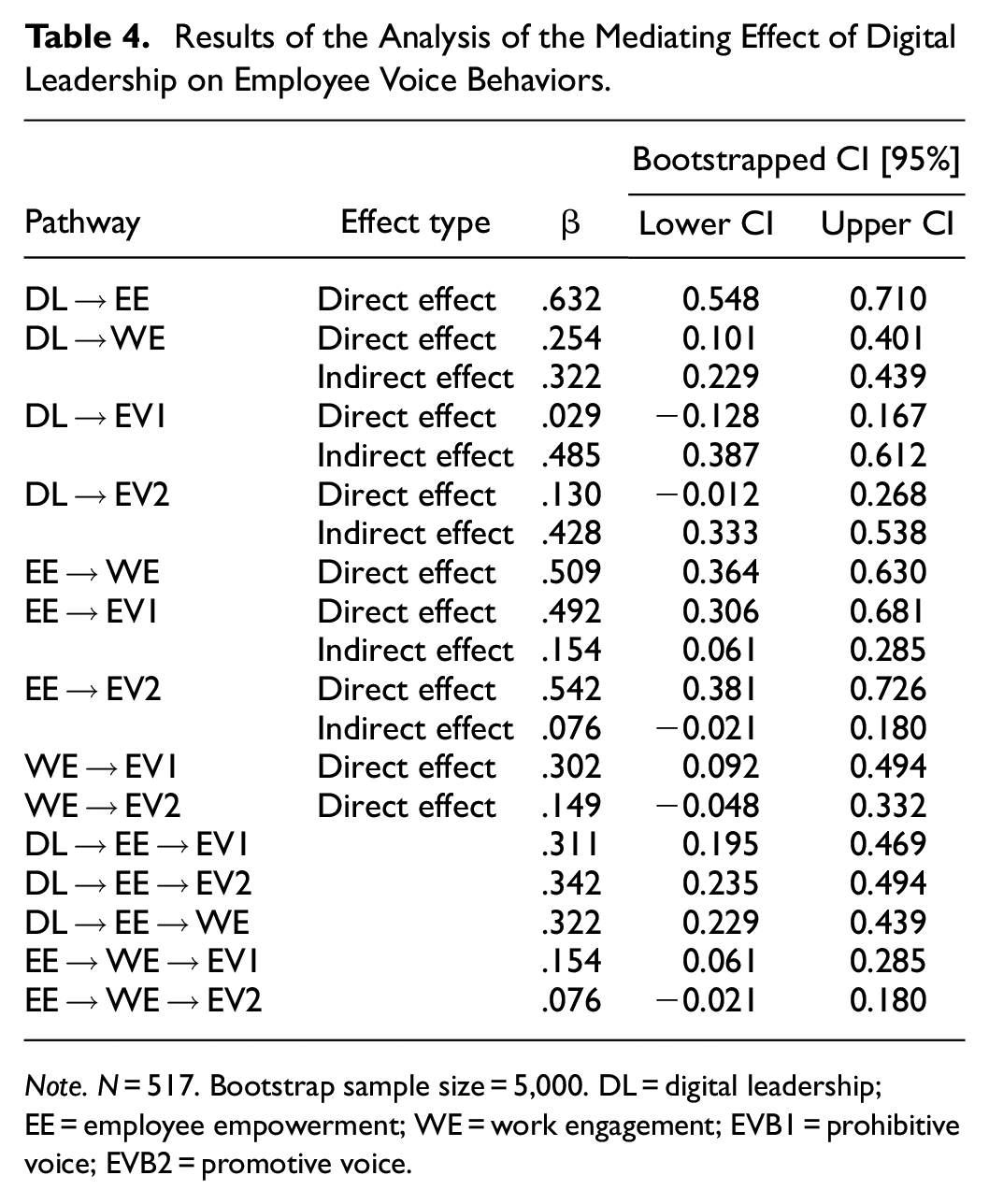
Note. N = 517. Bootstrap sample size = 5,000. DL = digital leadership; EE = employee empowerment; WE = work engagement; EVB1 = prohibitive voice; EVB2 = promotive voice.
Likely, according to the test results of the far-end indirect effect of employee empowerment, the path coefficient between employee empowerment and employee work engagement is .509 (p < .001), reaching the significance level. Furthermore, the indirect effect estimating the value of employee empowerment, lying between digital leadership and employee work engagement, is significant (β = .322, p < .001), and the confidence interval [0.229, 0.439] did not contain 0. The effect of employee work engagement on the link between employee empowerment and prohibitive voice is also significant (β = .154, p < .001), and 0 was not involved in the confidence interval [0.061, 0.285]. Further analysis reveals significant values for the chain-mediated effects of employee empowerment and work engagement on the relationships between digital leadership and prohibitive voice (β = .097, p < .01); the confidence interval [0.038, 0.184] does not contain 0. The H6a hypothesis is verified. Likewise, we concluded that the indirect effect estimating the coefficient of employee work engagement in the link between employee empowerment and promotive voice is insignificant (β = .076, p > .05), and the confidence interval [−0.021, 0.180] contains 0.
Moreover, the mediating chain effect of employee empowerment and work engagement in the link between digital leadership and promotive voice is not statistically significant (β = .048, p > .05), and the confidence interval [−0.012, 0.118] contains 0. The H6b hypothesis cannot be proven. Additionally, according to Table 5, all three mediating paths of the relationships between digital leadership and prohibitive voice are significant. However, only the front-end mediating path, namely “employee empowerment-employee engagement-promotive voice,” is significant and relates to the effects of digital leadership on promotive voice.
Mediated Pathway of Digital Leadership on Employee Voice Behaviors.

Discussion and Conclusion
Our study investigated whether and how digital leadership promotes employee voice behaviors. We adopted social exchange theory as the model foundation to explore this vital issue and designed a two-wave survey study to test the proposed hypotheses. This work demonstrates that digital leadership is crucial in promoting employee voice behaviors and indirectly affects prohibitive and promotive voices behaviors through employee empowerment. Our study shows that digital leadership increases prohibitive voice behavior rather than promotive voice behavior by increasing work engagement. Furthermore, our study reveals that employee empowerment and work engagement do not mediate the chain of effects between digital leadership and promotive voice behavior. Our research contributes to the literature on digital leadership, employee voice behaviors, and social exchange theory by providing new insights into the role of digital leadership in promoting employee voice behaviors.
First, our study proves that digital leadership is critical in promoting employee voice behaviors. Previous studies have discussed the concept (Avolio et al., 2014; Krug et al., 2018), traits (Weber et al., 2022), and abilities (Roman et al., 2019; Van Wart et al., 2017) of digital leadership and examined its effects on digitalization and innovation capabilities in organizations (T. D. Wang et al., 2022). Our study validates the micro-mechanisms of digital leadership within organizations, namely, the impact of digital leadership on employees’ cognition and behavior. While leadership is a significant determinant of employees’ cognition and behavior (Lin & Johnson, 2015; Morrison, 2011; Ng & Feldman, 2012), existing research must thoroughly explain whether and how digital leadership affects employees’ cognition and behavior, such as employee empowerment, work engagement, and voice behavior. It is a critical issue for all organizations because it could be risky to focus solely on digital leadership’s meso-level and macro-level effects while overlooking its micro-level effects on encouraging employee adaptation and participation in digitalization (Krug et al., 2018). We propose that digital leadership’s emphasis on employee empowerment is crucial for increasing employees’ work engagement and encouraging employee voice behaviors. This finding enriches our knowledge of the impact of digital leadership and how it affects employees.
Second, our work expands the antecedents of employee voice behaviors by demonstrating how digital leadership influences it. While previous research has identified paternalistic (Nazir et al., 2021) and humble leadership (Chen et al., 2022) as critical factors that impact employee voice behaviors, the advent and development of digital technology have changed how managers and employees communicate, collaborate, and exchange information (Ding et al., 2022). The lack of face-to-face communication and interpersonal interaction may lead to feelings of disconnection and increased psychological distance among employees (Bernauer & Kornau, 2024). Our research shows that digital leadership is crucial in promoting employee voice behaviors and reveals that employee empowerment and work engagement mediate this relationship. Therefore, our findings provide further evidence of the significant impact of leadership on employee voice behaviors in a digital context (Bernauer & Kornau, 2024; Ellmer & Reichel, 2021). By introducing employee empowerment and work engagement, our study advances the understanding of the exchange relationship (power relationship, informal psychological expectations) between managers and employees in a digital context and responds to the call for more research on voice behavior in a digital context. In contrast, some studies have focused on the mechanism of employee voice behaviors in digital voice channels. Moreover, they emphasized its influence on vocal behavior. Our study is the first to examine the impact and mechanism of digital leadership on employee voice behaviors in the digital workplace (Bernauer & Kornau, 2024; Ellmer & Reichel, 2021).
Third, unlike previous research that treated employee voice behaviors as a form of citizenship behavior (X. M. Liu et al., 2020), we focused on differences in the content and attributes of voice behaviors (J. Liang et al., 2012). For instance, although T. L. Liang et al. (2017) found that work engagement mediates the relationship between leadership and employee voice behaviors, they must delve into the mechanisms behind different types of voice behavior. We propose that digital leadership indirectly affects prohibitive and promotive voices behaviors by strengthening employees’ perception of empowerment through social exchange relationships. We also found that digital leadership may increase prohibitive voice behavior rather than promotive voice behavior by increasing work engagement. Additionally, digital leadership indirectly promotes work engagement by strengthening employees’ perception of empowerment, which leads to increased prohibitive voice behavior. Our study aligns with Wu and Du’s (2022) findings, which indicate that employees with high work engagement are more likely to engage in prohibitive voice behavior rather than promotive voice behavior as they seek to safeguard their resources. In cases of digital overload, employees may feel unsupported by their supervisors and have limited control over their future actions (Bernauer & Kornau, 2024), which may discourage them from participating in transformative initiatives (Khan et al., 2023). Instead, they may use prohibitive voice behavior to express their apprehensions about their future when job control is restricted (Lin & Johnson, 2015; Van Dyne & LePine, 1998). Our discovery adds to our understanding of the antecedents and potential mechanisms of different types of voice behavior.
Fourth, we demonstrate that social exchange theory applies to follower behaviors, such as employee voice behaviors, in digital work environments. In contrast, prior research on social exchange theory in management has primarily focused on exploring the exchange interactions between managers and employees based on the norm of reciprocity (Pundt et al., 2010). Our study addresses a significant research gap by emphasizing the power relationship and informal psychological expectations between managers and employees. Furthermore, even in digital work environments, the social exchange theory still holds explanatory power for the relationship between leaders and employees (Ahmad et al., 2023). For instance, the positive relationship between employee empowerment reinforced by digital leadership and employee behavior emphasizes the importance of employees considering leaders’ empowerment behavior as a standard exchange condition for generating voice behavior. Moreover, our study reveals that digital leadership influences employee work engagement through employee empowerment, making employees more likely to engage in prohibitive voice behavior instead of promotive voice behavior. It indicates that as rational actors, employees consider positive engagement or immediate loss prevention based on their circumstances in social exchange relationships (Cook, 2015; Homans, 1958). Our study contributes to a better understanding of the social interaction process between leaders and followers from the social exchange theory perspective.
Practical Implications
This study also provides managerial insights. First, our research has shown that digital leadership has a significant impact on employee empowerment, work engagement, and employee voice behaviors. Therefore, it is crucial for managers to recognize the importance of digital leadership and actively seek to improve their digital skills. They should provide training and support to help employees improve their digital communication skills and effectively use digital technology. It includes training on active listening, written communication, and feedback in a digital workplace and offering resources and support to help employees embrace, use, and innovate digital tools and technologies. Second, managers should focus on building and maintaining positive relationships with employees in a digital workplace. It includes using digital channels to facilitate communication and participation and reducing psychological distances between employees and managers through self-disclosure, discussion of shared ideas, and information sharing. Third, our work demonstrates the mediating chain role of employee empowerment and work engagement, and managers should consider employees’ empowerment perceptions and psychological conditions during work. They should transition from directive to participatory management via collaborative conversations, meetings, and voting. Using digital technology, managers may stimulate employees to generate more innovative ideas, enhancing their enthusiasm and dedication. Last, managers should encourage open and honest communication in person or through digital channels to create a supportive workplace culture and improve language behavior. It includes providing incentives and positive feedback on employee voice behaviors so that employees recognize their enthusiasm for their voice. Overall, these insights suggest that managers should embrace the digital era and prioritize the development of positive subordinate relationships, empowering employees, and creating a supportive workplace culture. By doing so, managers can improve language behavior and enhance the overall effectiveness of their organization.
From the employees’ perspective, they should concentrate on mastering digital technology, developing digital thoughts, and transforming them into digital skills. In digitalization, employees can participate in training and self-learning to enhance their digital technology acquisition, application, and innovation skills to overcome digitalization’s challenges and uncertainties. Additionally, work resources are presented more digitally in digital environments. Employees should pay particular attention to the flow of information in digital situations and make full use of the organizational digital resources. Moreover, employees should enhance their digital communication abilities, boost communication with their managers, and reduce cognitive disparities in digital environments. Thus, they may establish shared understandings and rapport with their managers. Lastly, throughout the digital transformation process, employees should take the initiative to assume risks and duties, actively convey ideas to their managers, and develop social exchange relationships.
Limitations and Future Research Directions
This work may have two limitations. For one thing, the sample is collected primarily from 11 listed enterprises in southwest of China, which may nurture statistical error due to the variances in differentiated industries and areas. Thus, the applicability of this paper necessitates more verification. Regarding this, continuing studies should expand the sample sizes, collect data from various countries and industries, and perform in-depth comparisons and analyses with this study. For another, although the data was collected at two time points, which can reduce the effects of common method bias on the results to some extent, the self-evaluation method applied to collect data cannot eliminate the negative effects from common method bias. Considering a combination of subjective and objective evaluation to establish the model’s causal links with empirical data will be an intriguing trend.
Supplemental Material
sj-docx-1-sgo-10.1177_21582440241260474 – Supplemental material for The Impacts of Digital Leadership on Employee Voice Behaviors: The Mediating Roles of Employee Empowerment and Work Engagement
Supplemental material, sj-docx-1-sgo-10.1177_21582440241260474 for The Impacts of Digital Leadership on Employee Voice Behaviors: The Mediating Roles of Employee Empowerment and Work Engagement by Cuibai Yang, Zhenli Li, Futian Li and Hongting Li in SAGE Open
Footnotes
Acknowledgements
The authors acknowledge the fundings from National Natural Science Foundation of China (71872027, 72172024), and International Office of Sichuan University (2022GJYDYL-10). The authors thank Sichuan Meta Digital Inspection & Testing Ltd for data collection.
Declaration of Conflicting Interests
The author(s) declared no potential conflicts of interest with respect to the research, authorship, and/or publication of this article.
Funding
The author(s) disclosed receipt of the following financial support for the research, authorship, and/or publication of this article: This research is funded by National Natural Science Foundation of China (71872027, 72172024), International Office of Sichuan University (2022GJYDYL-10), and Sichuan Meta Digital Inspection & Testing Ltd (Corporate Project: Research on the construction of digital leadership in enterprises).

Data Availability Statement
The dataset generated during this study consists of questionnaire survey data. Due to privacy and confidentiality concerns, these data are not publicly available. However, aggregated and anonymized data can be provided upon reasonable request. Researchers interested in accessing the data can contact the author at
Supplemental Material
Supplemental material for this article is available online.
References
Supplementary Material
Please find the following supplemental material available below.
For Open Access articles published under a Creative Commons License, all supplemental material carries the same license as the article it is associated with.
For non-Open Access articles published, all supplemental material carries a non-exclusive license, and permission requests for re-use of supplemental material or any part of supplemental material shall be sent directly to the copyright owner as specified in the copyright notice associated with the article.
