




Abstract
The primary objective of learning engaged in higher education is to build graduate students who have great competence. This study aims to analyze the academic motivation of Papuan students at Sebelas Maret University. Data were collected through questionnaires and interviews. The participants were undergraduate students of Papua and West Papua. The results showed that the extrinsic motivation of the Papuan student is more dominant than is intrinsic motivation. The factors that influenced the low motivation of Papuan students are peers, family, teacher, the background of education, social conditions, economics, and politics. This research is expected to provide information and a basis for lecturers, universities, and policymakers to pay more attention to Papuan student motivation and further increase their learning motivation.
Introduction
The primary objective of the learning process undertaken in higher education is to create graduate students who have great ability and competence. Student activity in education is the implementation of powerful motivation (Yong, 2009). Motivation is an essential factor to increase the involvement and activity of students in teaching and learning processes (Pavlou, 2006) and has a significant role in encouraging the student learning achievement (Rana, Mahmood, & Reid, 2015; Yong, 2009). Motivation is a very complicated psychological process and is a trigger of a person or group to achieve an expected goal (Muftah & Galea, 2013; Surifah, Mustiati, Syaifullah, & Bowo, 2016). It is dynamic and contextual related to the learning strategy that can be controlled by the students themselves (Dai & Sternberg, 2004; Wong, Chai, Chen, & Chin, 2013).
Academic motivation is a problem that has long been developed in school, and already many relevant studies present and discuss it (Cho, Harrist, Steele, & Murn, 2015; Duta, 2015; Pintrich, 2003). Learning motivation is divided into both intrinsic motivation and extrinsic motivation. Intrinsic motivation refers to the fact of doing an activity for oneself, and the enjoyment and satisfaction derived from the student. For example, the student goes to class because he gains the exciting and gratifying feeling of receiving more about the subject matter. Students with intrinsic motivation seek to develop themselves to achieve learning goals. Intrinsic motivation to learn is a meaningfulness to gain value and make academic achievement regardless of whether the material or task is interesting or uninteresting (Williams & Williams, 2011). It relates to several constructs such as exploration, curiosity, learning goal, and intrinsic intellectuality (Vallerand et al., 1992). For instance, the student is intrinsically motivated to recognize when they studied a book for the slight pleasure that they experience while reading something new.
Contrary to the intrinsic motivation, extrinsic motivation pertains to a wide variety of behaviors that they engaged in as a means to an end and not for their sake. For example, students study because their parents force them. The extrinsic motivation refers to motive that is outside of and in a variety of behaviors related to a person or means of something from the outside. Extrinsic motivation refers to something that comes from outside and apart from one’s self-behavior (Shia, 1998; Wong et al., 2013). Some factors that influence students’ extrinsic motivation are family expectation, teacher expectations, money, and peer acceptance (Shia, 1998). All of these factors involve proving one’s competence to another. This can be seen as an individual need to seem satisfactory as a student. For instance, a student studies the night before the tests or exams because his or her parents force him or her to. The student undertakes to internalize the motives for his or her actions. Extrinsic motivation tends to be a proof of student ability, whereas intrinsic motivation encourages students to develop their expertise.
The learning process in college is different from other education levels. Three main activities in the university are teaching, research, and community service. These activities are delivering each individual to always think freely, creatively, and innovatively. College is a learning space that trains individuals as free humans in acquiring knowledge. The students are left by themselves to run the learning process. Many factors affect students in learning, but it needs to be understood that not all students have high motivation. In the process of learning, motivation can be grown with the guidance of all educational elements such as learning methods, subject matter, and the use of instructional media (Oktaria, Zulkardi, & Somakim, 2013). The learning motivation is synergized in the activities of learning in the class, research and socialize with the community through various activities. Each individual is not only seeking knowledge but also applying and shaping it. The character of the individual is shaped into a person who excels intellectually, emotionally, and spiritually.
The educational conditions in Papua have not shown significant progress. A survey by the Indonesian Institute of Sciences (LIPI) of 27,298 respondents for 3 weeks in November 2017 showed that low-quality education was a major problem in Papua, followed by infrastructure and transport and exploitation of natural resources. Poor education has a serious impact on the low performance of regional development. The statistical data of the Indonesian government show that the Human Development Index (HDI) of Papua and West Papua is at the lowest level compared with other provinces in Indonesia. This case indicates the low condition of education and public health in there. The United Nations Development Program (UNDP) also stated that HDI in Papua was 57.25 lower than the average of 69.55. Education in Papua still needs to be improved from the elementary and secondary school. Data from the United Nations Children’s Fund (UNICEF) show that 30% of Papuan students did not finish primary and secondary school. In the rural area, about 50% of the elementary students and 73% of junior high school students choose to drop out of school.
Increasing the quality of education in Papua is a priority of Indonesian governments that are managed effectively and efficiently, transparently and accountably (Erdianto, 2016). One of the ways to improve the quality of education in Papua is sending students who are considered having potential academics over to 48 universities and 22 qualified polytechnics through the educational affirmation (ADik) program. One of the government-appointed universities to accept and educate Papuan students is Sebelas Maret University (UNS), which is located in Surakarta, Central Java. The aim of the ADik program is to open and provide the widest possible access for Papuan students to study in a qualified college and be able to align them with another of the nation. Another purpose of the ADik program is to educate future leaders who are motivated to bring disparate people together to solve complex critical challenges faced in Papuan society. The purpose of this study was to investigate Papuan student motivation in UNS. The research question is,
Method
Setting and Participant
The setting of this study is in UNS located in Surakarta City Central Java Indonesia. UNS always appertained in the 10 top and favorite universities in Indonesia. This university is one of 48 state universities, which is characterized by the Indonesian government to participate in the affirmation programs (ADik) for Papuan students. The participant was chosen by purposive sampling technique area. Purposive sampling is a sampling technique in which the researcher relies on his or her judgment when choosing members of the population to participate in the study.
The numbers of participants in this study were 60 undergraduate students of Papua and West Papua, with grade point average (GPA) of 2.96 (SD = 0.176). The participants are 45 male students and 15 female students in several faculties with various majors and fields of study such as Educational, Mathematics and Natural Sciences, Engineering, Medicine, Public Health, and Economics. The distribution of the respondents is 43 students from Papua and 17 students from West Papua. The participant is coming from various districts of Jayapura, Jaya Wijaya, Nabire, Intan Jaya, Wamena, Central Mamberamo, Tolikara, South Sorong, and Biak Numfor.
Data Collection and Analysis
Data were collected through questionnaires and in-depth interviews with the participants. The research design is an explanatory sequel design (Figure 1). Researchers attempted to explore and analyze the motivation of Papuan students quantitatively through questionnaires and qualitatively through interview based on their cultural and social experiences during their lectures at UNS.

Explanatory sequel research design (Creswell, 2012).
Quantitative data were collected through the Motivated Strategies for Learning Questionnaire (MSLQ). MSLQ is a research instrument that aims to measure student motivation and instructional strategies of a student in higher education (Pintrich, 2003). MSLQ in this study is developed by Shia (1998), which consists both of intrinsic motivation and extrinsic motivation. Intrinsic motivation included mastery goal and a need for achievement, while extrinsic motivation included authority expectations, family and lecturer, peer acceptance, power motivations, and fear of failure. The numbers of items of the questionnaire is 60. This questionnaire was composed of questions that were measured using a 5-point Likert-type scale of the participants’ level of agreement: “I agree completely (5),” “I agree (4),” “I am not sure (3),” I disagree (2),” and “I disagree completely (1).” This instrument is valid and reliable with Alpha Cronbach = 0.8627. Data from the questionnaire were processed and analyzed using the Statistical Package for the Social Sciences (SPSS version 23). SPSS in this study was used to examine Papuan students’ intrinsic and extrinsic motivation.
While the qualitative data were gathered through in-depth interviews to explore the participants’ information and unique experiences as an approach to research (Newsome & Cooper, 2016), interview data were collected based on students’ opinions, their definitions, and their interpretations (Silverman, 2015). Semistructured interviews were conducted individually twice over a six-month period of study for all students, with questions such as reasons for studying at UNS, previous educational background, family, friendships, challenges during lectures, learning difficulties, learning methods, and finances or scholarships. This interview aims to investigate the information and all of the factors that are thought to affect their academic motivation. Qualitative data were analyzed by the researchers through four stages: organizing data, exploring and sorting data, descriptive analysis, sustainability analysis, and interpretation. Validation of qualitative data was executed by the triangulation method. Triangulation, according to Johnson and Christensen (2013), is used to make studies and research process more systematic; it mutually cross-checks information so that conclusions taken through various procedures or sources are trustworthy.
Result and Discussion
Motivation is a key factor in understanding student academic persistence and performance. Based on the results of data analysis, students’ learning motivation is low (3.3299) and varies for every aspect of extrinsic and intrinsic motivation. The results of SPSS analysis for extrinsic and intrinsic motivation are shown in Table 1.
Papuan Student Learning Motivation.
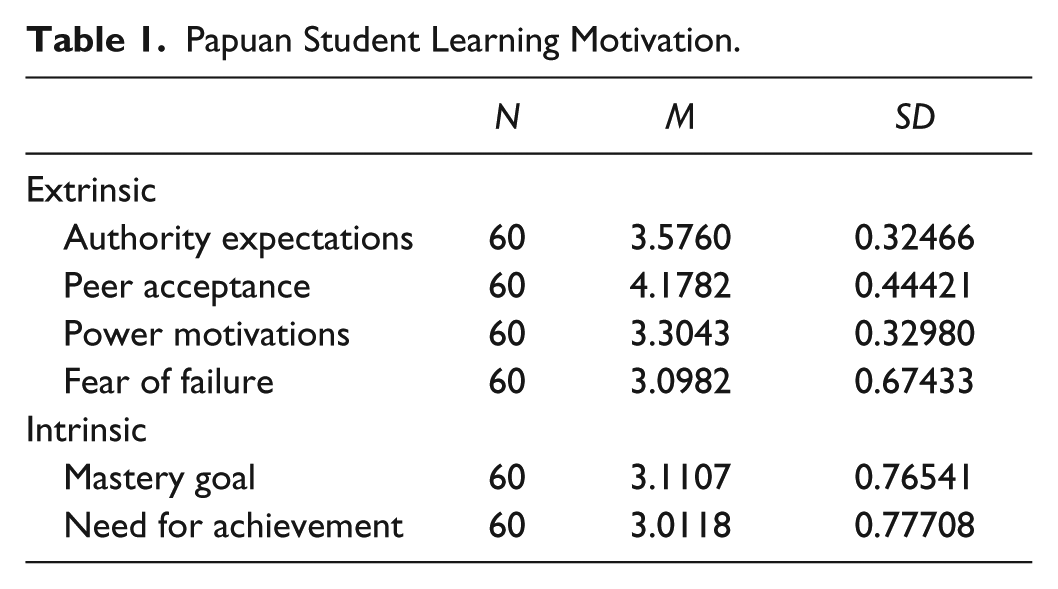
In general, the academic extrinsic motivation of Papuan students is more dominant than intrinsic motivation. This academic motivation is dominated by the desire to be accepted by friends and groups.
Extrinsic Motivation
The majority of participants have been away from parents since primary school. They had to move from their rural area to the city to get a better education. Their parents believed that their sons were studying. Considering parenting and full support for the child brings about a sense of responsibility, student-positive behavior, and self-determination (Katz, Madjar, & Harari, 2015; McNeal, 2014). Another extrinsic motivation is government, but this motivation is debilitating. Interviews indicated that the greater the award received, the lower the motivation of learning. This is very interesting where sufficient financial support should be affected and increase student academic motivation. Papuan students who receive larger scholarships tend to have low motivation and cannot complete their study. Significant scholarships make them more consumptive and lazy to study. “The scholarship that I get is exaggerated, and the cost of living in Surakarta is so cheap that it makes me more consumptive, I can’t control my self” (interview, April 1, 2017). Great scholarship receipts did not accompany mental changes. Papuan students who formerly lived in Papua at a high living cost received substantial scholarships in Surakarta with a low living cost. This condition is kind of a culture shock; different cultural values can make students shocked and uncontrolled. “For what I learn and study when the money has a lot” (interview, May 15, 2017). Culture shock is the entirety of emotional reactions related to the temporary inability to assimilate a new culture, causing difficulty in knowing what is appropriate and what is not (Bolen, 2007; Whalen, 2012). In this case, the students experience cultural change, and cultural transition makes them unable to control themselves. Students attending universities in a culture different from their own have to contend with novel social and educational organizations, behaviors, and expectations (Zhou, Topping, Jindal-Snape, & Todman, 2008).
The way the lecturer teaches, the clarity in conveying the material, the method of instruction, the interaction with the student, and the management of the lecture process also affect the student’s academic motivation. Lecturers who have good performance, skills, and attitudes make students more motivated to attend the classes, listen, and learn more seriously. Teachers have an important role in student learning motivation (Agezo, 2010). The role of teachers is influential in building student learning motivation, such as how teachers convey materials, methods, and strategies used in education and how to communicate and interact with students; even the appearance and behavior of teachers during teaching affect student learning motivation (Blašková, Blaško, Jankalová, & Jankal, 2014; Suciu & Mata, 2011). Montalvo and Roedel (1995) posit that learners are more motivated to learn when being taught by their preferred teacher than unwanted teachers. Keeping good interaction between teachers and students through collaborative learning helps to increase students’ confidence in class (McGlynn, 2008). The majority of Papuan students are motivated to attend friendly lectures, humorous lecturers, and not too rigid in giving lectures. The atmosphere is harmonious, and fun makes students feel comfortable and enjoyable, easier to understand the concept, and active following the lecture. Some students said they had problems when the lecturers were using the Javanese language in class: “I do not understand when the teachers have been using the Javanese language, I feel like an alien, so difficult to understand” (interview, March 13, 2017).
Healthy relationships or quality management with the peers creates a sense of comfort in learning because there is a sense of appreciation and confidence that would increase their motivation. In Surakarta, Papuan students are surrounded and communicated by Javanese people who are very concerned about the attitude of politeness and manners. Javanese people are a society that strongly upholds customs courtesy, manners, and wisdom in behavior (Triyanto & Handayani, 2016). One participant posit that “I learned Javanese culture” (interview, March 12, 2017). One way of conceptualizing troublesome unsuccessful social interaction is failed verbal and nonverbal communication (Bochner, 1986). An intersection between two culturally disparate persons is in principle no different from any other social encounter, except that there are much greater opportunities for miscommunication. Papuan students have difficulty in interacting and adapting because of their vastly different backgrounds. The desire to be accepted by peers motivated them to show their existence. Papuan students often asked peers about a material; they try to communicate, “I have to active and interactive because of my different knowledge, skill, culture, and appearance” (interview, April 14, 2017). Papuan students are keenly aware that their physical appearance, different language styles give rise to bad stigmas such as uneducated, weak work ethic, primitive, free sex, drunkard, temper, and anger, and is part of a separatist group (Corputty & Suharko, 2007). The existence of negative stigma is also a reason for them to prove that they are good also.
Power motivation is frequently noticed in students in a university setting. A student who is motivated by power feels the need to control his environment by proving their competence to others. Power motivation is hard to recognize in the student because of the improvement in achievement measures (Vallerand et al., 1992). His or her extrinsic motivation can be seen as an individual need that must be sufficed to feel accepted as a student. This motivation can be easily missed for intrinsic motivation. The difference will appear when a block occurs in the process of reaching the goal, the power motivator may appear frustrated and helpless while the intrinsic motivator will find a strategy to solve the barrier. Papuan students have low power motivation, they are less determined power to complete and look for strategies to solve a problem, fighting ability, and creative problem solving less. One of the participants said, “I do not like to think hard and easy to despair if any a difficulty in learning” (interview, March 4, 2017).
Fear of failure is brought about by obvious approaches to the circumstances to avoid such fear. The motive to avoid failure is a general character to avoid failure or the capacity to react with humiliation and embarrassment when the achievement test fails. Fear appeals refer to messages that repeatedly remind students about the importance of passing exams and the consequences of failure (Putwain & Symes, 2014; von der Embse, Schultz, & Draughn, 2015). Fear appeals are intended to increase test performance by provoking students’ fear of negative consequences. Papuan students are not afraid to fail if their performance is poor or unsuccessful at the time of the exam. There is a belief that they will be graduating because the lecturer will tolerate the limited ability and their background area. I am not afraid to fail, because we are affirmative students, where lecturers will understand our incompetence (interview, April 25, 2017). Actually, fear of failure helps Papuan students to improve their motivation. Fear of failure can encourage them to study hard so they can brag of families when they return to their province.
Intrinsic Motivation
The low intrinsic motivation is based on the lack of understanding the importance of education and the essence of learning itself. In short, the Papuan student shortage of understanding the mastery goal of learning. It is highly realized because of the social condition of society, geographic and political conditions that do not support the educational system in Papua. Unsafe political conditions, the weak economy, and inadequate schools significantly affect the education of Papuan students. Davis (2017) posited that the political and economic situation influenced the educational achievement and motivation of students. In short, a conducive learning environment greatly affects the meaningfulness of learning for students (Nevison, Drewery, Pretti, & Cormier, 2017). One of the participants stated that “My school often takes off when I was an elementary school because of an armed conflict between Indonesian soldiers and the Papuan Freedom Organization” (interview, March 13, 2017). The geographical condition such as forest, mountain, and difficulty in educational access become the main factor of their low learning motivation. The security and political conditions that do not support the education process also become the other factor of their low motivation. The existence of OPM (Organisasi Papua Merdeka/Papuan Freedom Organization) makes education at the primary school not go well. The organization is moving into an area that is harassing people’s security. The learning environment should be conducive and accessible so as to contribute to improving student motivation (Williams & Williams, 2011). In other words, a supportive learning atmosphere will make students understand the purpose of the importance of learning.
According to Ryan and Deci (2000), students who are motivated by their desires are better than students who want to earn rewards or are extrinsic. Students who are driven by extrinsic factors have a greater risk of academic misconduct or lower academic achievement than students who are motivated by intrinsic factors (Afzal, Ali, Khan, & Hamid, 2010; Lei, 2010). Students with intrinsic motivation are more dominant than students with extrinsic motivation and have a more developed tendency in the learning process (Williams & Williams, 2011). Intrinsic motivation can provide experiences such as fun, feelings of being freely involved, which include the mastery of goals and the need for achievement, which is not experienced by Papuan students.
Motivation is fundamental to be known by educators so that the results of learning achievement can be attained without catalyzed by other factors. In general, there are five keys to improve Papuan academic motivation, namely, students themselves, teachers and governments, subject knowledge, media, and the learning environment. A comfortable and educational learning environment is a determining factor to improve students’ learning motivation. Some suggestions for strengthening the learning motivation of Papuan students are awakened and maintain the spirit of students, keeping to learn with their consciousness; increase the role of lecturers such as advisers, facilitators, instructors, discussion friends, and encouragement; using a variety of methods and using suitable media and in accordance with the purpose of learning; recognize and maintain good communication and interaction with students both in and outside lectures.
This research is expected to serve information for educator and university as a policymaker to pay more attention to the Papuan students’ academic motivation who have different characters and independence in learning. The university as an educational institution is expected to develop the motivation of Papuan students in learning, and encourage Papuan students to develop their capabilities so they have a motivation to learn. Several actions that can be arranged to enhance Papuan student motivation is improving their extrinsic motivation, such as providing learning facilities, creating a conducive learning environment, implementing specific learning strategies, and providing an independent learning program. Cooperation from all parties, educators, universities, and government are also needed to improve Papuan students’ motivation. The government should give a favorable learning condition for Papuan students. Papuan students need to be better briefed before learning in new places, especially the socio-cultural character in the education location. Scholarship grants to them also need to be supervised to be used for the benefit of their studies. Rewards for students who graduate on time and punishment for students who do not pass on time or drop out (DO) also need to be considered.
Limitation
This study is limited to Papuan students at UNS. The results of this study cannot be generalized because the number of participants is few and only arranged at one university in Surakarta.
Conclusion
Based on the discussion, it can be concluded that the academic motivation of Papuan students is low, where the dominant factor is extrinsic motivation. Papuan student motivation needs to be improved and considered because extrinsic motivation is only a temporary drive to learn. Economic, social, political, and demographic conditions are also suspected to be factors that lead to their low learning motivation. This study is expected to contribute to teachers in improving the motivation of students in learning. Papuan students must obtain a safe and conducive learning environment to become quality students so that they will not have obstacles while studying college.
Footnotes
Declaration of Conflicting Interests
The author(s) declared no potential conflicts of interest with respect to the research, authorship, and/or publication of this article.
Funding
The author(s) disclosed receipt of the following financial support for the research, authorship, and/or publication of this article: The author received financial support from Sebelas Maret University.
