




Abstract
Motivation is considered an important impetus driving and sustaining individuals’ efforts to fulfill their goals. Against the backdrop that university academics worldwide are increasingly expected to produce research output in prestigious journals for both individual and institutional development, it is necessary to understand academics’ research motivation and its relations with research productivity in international and local journals. This study, being descriptive and explanatory in nature, surveyed 309 academics who taught English as a foreign language (TEFL) in China. Results showed that the participants exhibited stronger extrinsic motivation, in the form of external and identified regulations, than intrinsic motivation. However, these two subtypes of extrinsic motivation were significantly negatively associated with academic publishing, whereas intrinsic motivation was the significant positive factor associated with the participants’ publication in international journals. These findings remind both academics and educational managers of the importance of enhancing intrinsic motivation and refining contextual support in improving academics’ research productivity.
Keywords
Introduction
The last two decades have witnessed the rise of new managerialism as the dominant ideological discourse underpinning university management worldwide, which has profound consequences for academics in many contexts (e.g., Kallio & Kallio, 2014; Lynch, 2015; Tran, Burns & Ollerhead, 2017; Yang & Welch, 2012). In particular, governments and university managements have embraced global ranking exercises, and research productivity is a key performance indicator in these ranking exercises (Jiang, Borg, & Borg, 2017; Lynch, 2015; Song, 2018). Consequently, many institutions have adopted a performance-based research evaluation system (Hicks, 2012). University academics are pressured to do research and publish in prestigious publication outlets such as journals indexed in the Social Sciences Citation Index (SSCI) and Arts and Humanities Citation Index (A&HCI) (Chou, 2014; Salager-Meyer, 2014; Zheng & Guo, 2019) because evaluation outcomes often have positive or negative implications for their career pursuits, including tenure application and promotion.
Motivation for research can be considered an important factor influencing university academics’ research productivity, and, more specifically, publication in elite international and local journals. The stress and tension created in the new managerial culture may lead many to wonder about academics’ motivation to conduct research and the effects of motivation on research publication. Extant research has reported the relationships between motivation and research productivity among academics of economics and/or business administration and other disciplines (Chen, Gupta, & Hoshower, 2006; Horodnic & Zait, 2015; Tien, 2000, 2008). However, although some studies have explored research motivation of nonnative English-speaking (NNES) academics who teach English as a foreign language (TEFL) (Borg, 2009; Borg & Liu, 2013; Gao & Zheng, 2018; Xu, 2014; Yuan, Sun, & Teng, 2016), these studies mostly used descriptive statistics or qualitative narrations without examining the associations between research motivation and research productivity.
We address the important issue of how research motivation is related to research production with a focus on the TEFL academics in the Chinese context. In China, English language teachers are generally recruited to two types of department. One is the College English Teaching Department (CETD) (similar to a university’s English Language Center in many parts of the world) (Bai & Hudson, 2011; Borg & Liu, 2013). Teachers in the CETD mainly teach general English skills to non-English majors, and a master’s degree is usually the threshold for entering the department. Another type is the English Language and Literature Department (ELLD), whose mission is to teach English and related courses (e.g., English linguistics and literature) to students majoring in English (Bai & Hudson, 2011). Faculty members in the ELLD usually possess a PhD degree and carry a research workload. That said, research and scholarly publishing have become important criteria in performance evaluation and career advancement of teachers in both departments alike (Borg & Liu, 2013). Therefore, English teaching staff members in CETD and ELLD are collectively referred to as TEFL academics in this study (see Bai & Hudson, 2011). According to Wang and Han (2011), TEFL academics in China accounted for 9.7% of the whole academics in the higher education sector, a proportion larger than that of any other disciplines in humanities and social sciences.
This study targeted TEFL academics for the following reasons: (a) Chinese TEFL academics have been widely reported to shoulder a heavy teaching workload and have a weaker track record in research and publishing than tertiary teachers from other disciplines in social sciences (Borg, 2009; Xu, 2014). (b) They possess an edge in the use of English for academic communication and thus the potential to publish in international journals, compared to NNES academics in other disciplines. (c) China is a major site of English language teaching activity (Borg & Liu, 2013), and insights generated in this context can be of broad relevance to tertiary teachers of the phenomenally large population of English language learners around the world. In light of many universities’ aspirations to enter the world-wide university hierarchy (Lynch, 2015; Song, 2018; Yang & Welch, 2012), this line of research can also provide universities or government with practical implications for facilitating university academics’ professional development.
This study first explored university academics’ research motivation and then tested the associations between research motivation and research productivity measured as articles published in international and domestic journals. It addresses the following two research questions:
University Academics’ Research Motivation
The importance of generating research motivation among language teachers has been increasingly emphasized (see Bai, 2018; Tao, Zhao, & Chen, 2019), and in this study, we investigated how it can be associated with Chinese academics’ research productivity in terms of journal publication. Motivation generally refers to the reasons underlying what people think and how they behave (Graham & Weiner, 1996). High levels of motivation can give rise to and sustain individuals’ efforts to fulfill their goals, such as research publication in the context of this study.
Motivation can be theorized in a variety of ways. This study draws on the self-determination theory (SDT) in educational psychology to theorize motivation in terms of intrinsic and extrinsic motivation (Deci & Ryan, 1985). SDT takes an organismic approach, which views human behavior as an expression of intrinsic needs and psychological drives to act on the environment, instead of as a passive reaction to the environment. Broadly speaking, intrinsic motivation refers to engagement in certain tasks or behaviors primarily for their own sake, whereas extrinsic motivation pertains to actions taken for external incentives or rewards. Intrinsic motivation (IM) is further categorized into three subtypes: to gain knowledge (IM-knowledge), to accomplish difficult tasks (IM-accomplishment), and to experience enjoyment of the activity (IM-stimulation) (Noels, 2001). Extrinsic motivation is broken down into four distinct forms of regulation: external, introjected, identified, and integrated, which are situated on a continuum ranging from lesser to greater degrees of self-determination. External regulation indicates that an action is taken due to external contingencies (e.g., tangible rewards); introjected regulation refers to an individual’s self-imposed pressure in response to external contingencies (e.g., for self-worth or pride); identified regulation is the process of an individual’s recognition and acceptance of the value of an action; and integrated regulation involves fully internalizing the value of an action into other aspects of the self (Deci & Ryan, 2000), which is seldom addressed in the literature (Noels, 2001).
The framework of intrinsic and extrinsic motivation has been influential in motivational psychology research. Amabile, Hill, Hennessey, and Tighe (1994) applied this framework in their development of the well-known instrument The Work Preference Inventory (WPI), which captures the two primary motivational orientations. However, the WPI was not constructed according to Deci and Ryan’s (1985) framework, and in that, it contains four secondary factors, that is, enjoyment and challenge classified under intrinsic motivation, and outward orientation and compensation under extrinsic motivation. Besides, the WPI items capture generic motivational orientations (e.g., “I enjoy tackling problems that are completely new to me”) without specifying particular respondents or tasks, for instance, both college students and working adults were recruited in Amabile et al.’s (1994) study. With reference to Amabile et al.’s WPI, Xie, Mao, and Zhang (2014) designed a scale with items tailored to measure Chinese university teachers’ intrinsic and extrinsic motivation for research. In Xie et al.’s (2014) study, the internal consistency reliability (Cronbach’s α) for intrinsic motivation was .918 and for extrinsic motivation was .745, both of which were above .7 and acceptable (Field, 2009). Xie et al.’s (2014) study found that, overall, the teachers exhibited low research motivation, with extrinsic motivation being higher than intrinsic motivation.
Recent research has shown that Chinese TEFL academics, similar to their counterparts elsewhere (Borg, 2009), exhibited low motivation for research, and many participants alluded to their low levels of intrinsic and extrinsic motivation. Xu’s (2014) narrative study with Chinese university English language teachers found that the majority of the participants reported extrinsic motivation, such as doing research for promotion or graduation. In Borg and Liu’s (2013) study on college English teachers in China, some participants candidly confessed their lack of intrinsic and extrinsic motivation for research. Bai and Hudson’s (2011) study with Chinese English language teachers also identified a lack of intrinsic research motivation among the participants. These results indicate that the notions of intrinsic motivation and extrinsic motivation probably make the most intuitive sense to Chinese TEFL academics when reflecting on their research engagement.
Chinese TEFL academics have also reported difficulties in publishing in international journals (Belcher, 2007; Canagarajah, 2003) and local prestigious journals, that is, those included in the Chinese Social Sciences Citation Index (CSSCI) (Xu, 2014). Being NNES researchers, they have to overcome linguistic hurdles (Flowerdew, 1999) and develop academic literacy to acculturate into the Western rhetorical norms and discursive preferences present in international journals (Hu & Cao, 2011). In the domestic context, a source of difficulties lies in the small number of CSSCI journals in relevant fields, which is disproportional to the vast number of TEFL academics (Xu, 2014). In addition, other factors have been reported to influence TEFL academics’ research engagement and publication, such as lack of time due to a heavy teaching workload (Bai & Hudson, 2011; Xu, 2014), shortage of research knowledge and skills (Yuan et al., 2016), and lack of collegial collaboration and institutional support (Borg & Liu, 2013; Xu, 2014).
In the light of China’s recent initiative to build “first class” universities and “first class” academic disciplines (a.k.a. The Double First Class scheme) (State Council, 2015), Chinese university academics are accordingly expected to increase their publications in international journals. Publication in domestic CSSCI journals also becomes an important criterion for evaluating university academics’ research performance (Lai, Du, & Li, 2014). Yet against the backdrop of these policies and practices, how the Chinese TEFL academics are motivated to undertake research and how their research motivation is associated with their research productivity remain to be explored.
Research on the Relation Between Academics’ Motivation and Research Productivity
Although to our best knowledge the relationship between motivation and research productivity among TEFL academics have not been statistically tested, such a link among academics in other disciplines has been reported. Chen et al. (2006) surveyed 320 business faculty members in the United States to explore the influence of various motivational factors on research productivity. They found that those who attached high importance to both intrinsic and extrinsic rewards of research published more journal articles, and promotion was a strong motivational factor. Gender was not correlated with research productivity. Similarly, the research publication of German and American researchers in management and economics were also found to be directly proportional to monetary incentives attached to a promotion (Backes-Gellner & Schlinghoff, 2010). Tien’s (2000, 2008) studies explored the influence of motivational factors and demographic factors such as age, gender, educational background, and institutional type on research productivity among academics in Taiwan. She reported that both promotion valence (extrinsic reward) and satisfaction of curiosity (intrinsic reward) significantly predicted article publishing. In addition, article publishing was significantly predicted by degree and institutional affiliation favoring possession of a doctoral degree and affiliation in public institutions. Age and gender did not significantly predict research productivity. Liddle, Westergren, and Duke (1997) also reported no gender difference in research productivity among 51 counseling faculty in the United States.
Notably, Horodnic and Zait (2015) adapted Amabile et al.’s (1994) WPI scale to measure motivation of 506 Romanian academics of economics and business administration. They reported that intrinsic motivation captured by the enjoyment index significantly positively influenced research productivity, whereas extrinsic motivation captured by the compensation index had a negative effect. They interpreted this negagive effect as implying that in a country undergoing transition, extrinsically motivated academics tended to seek financial profits in private sector. This study also confirmed that degree and academic rank (i.e., title) positively influenced research productivity. Research productivity was predicted by age and gender favoring younger academics and male academics. Posen, Templer, Forward, and Stokes’ (2005) study with 480 academic clinical psychologists in California also found that the male academics published more than their female counterparts. These studies collectively indicate that the effects of demographic factors need to be considered and controlled when researching research motivation and research productivity.
Method
This study, being descriptive and explanatory in nature, investigated through a questionnaire Chinese TEFL academics’ profiles of research motivation and the extent to which their research motivation was associated with research productivity in terms of articles published in international and domestic prestigious journals. Although followed-up interviews with 10 of the respondents were also conducted, this article mainly reports on the questionnaire findings.
Participants
The survey participants were 309 university teachers who taught English language and related courses in the domains of foreign languages and literature. As presented later, the survey was conducted online and respondent recruitment involved sending invitation emails to colleagues and advertising this study on http://iresearch.unipus.cn, which is a website dedicated to academic research and communication in the field of foreign languages teaching. It should be noted that the current sample, particularly due to its online self-selection nature, was by no means representative, in terms of quantitative and structure, of the vast population of TEFL academics in China, for example, 122,646 in 2009 (Ministry of Education, 2010). This is acknowledged as a limitation hard to avoid due to the inherent difficulties in eliciting data from language teachers who are already busy and stressed out (Hobbs & Kubanyiova, 2008).
The respondents were asked to supply demographic information including gender, age, academic degree, professional title, and type and location of their affiliation. Their responses showed that they were from 79 cities across the northern (n = 122), eastern (n = 74), southern (n = 41), western (n = 27), and central (n = 45) parts of China. Table 1 shows the participants’ demographic information.
Distribution of Demographic Information of the Participants.

Three respondents indicated “Others,” which were not included in the four categories.
Universities enlisted in “Project 985” are deemed to be of higher rank than those in “Project 211,” the two being the national programs intended to build world-class universities (Yang & Welch, 2012).
Instrument
The questionnaire contained two parts. Part 1 elicited the respondents’ demographic information as presented above and the number of articles that they had published in international journals and prestigious domestic journals, that is, those indexed in the CSSCI. In Part 2, the scale items measuring motivation for research were presented. The questionnaire was written in Chinese and answered anonymously. The participants were asked to rate the extent of their agreement with the statements.
The items measuring research motivation were adapted from Xie et al.’s (2014) study, which investigated Chinese university teachers’ research motivation in terms of intrinsic and extrinsic motivation. To suit the present research purposes, minor modifications were made to the original items so that the instrument was more relevant to the current participants. For instance, the item “I published papers in order to accomplish my research workload” was added. Originally, there were 25 items measured on a 5-point Likert scale, ranging from 1 = strongly disagree to 5 = strongly agree. An exploratory factor analysis (EFA) was run using the Statistical Package for Social Sciences (SPSS) Statistics 22.0 to identify the major dimensions of research motivation, which resulted in 22 items measuring four dimensions of research motivation: intrinsic motivation, identified regulation, introjected regulation, and external regulation (reported later).
Data Collection Procedure
The questionnaire was administered via a professional online survey website (www.sojump.com), which is widely used in Mainland China. To promote participation, we sent an e-mail invitation to colleagues in universities requesting their help to pass along the invitation to native Chinese-speaking English language teachers. This study was also publicized on the academic website (http://iresearch.unipus.cn). To avoid casual or cavalier responses, the questionnaire survey was purposely made nonpublic and unindexed by search engines. The data collection commenced in December 2015 and lasted about 4 months.
Data Analysis
The data collected from the survey were first subject to an EFA to test the construct validity of research motivation and identify the factorial structure of this scale. Descriptive statistics were then computed using SPSS 22.0 to reveal the participants’ profiles of research motivation and their journal publications.
Regression analyses were then run to test the predicting role of research motivation, with the number of the participants’ published articles in international refereed journals and domestic CSSCI journals as the dependent variables. As each dependent variable was a nonnegative integer, Poisson regression analysis would be appropriate (Faraway, 2016). However, as the assumption of no overdispersion (i.e., the observed variance of the count and the mean being similar) (Kabacoff, 2015) was not met, 1 negative binomial regression analysis was used. Also, due to the existence of excessive zeros in the data (reported below), a zero-inflated model should be considered (Kabacoff, 2015). Therefore, a zero-inflated negative binomial regression model (ZINBRM) was tested, respectively, with international publications and domestic publications being the dependent variables. The ZINBRM in the current case could be viewed to fit two models simultaneously—one that predicted who would publish articles at all (i.e., a logistic regression model) and the second that predicted the number of articles from the independent variables (i.e., a negative binomial regression model) (Faraway, 2016). Demographic factors (i.e., gender, age, degree, professional title, and affiliation) were also included to the ZINBRMs to control for their possible effects. The analyses were conducted with the open-source statistical program R 3.5.0 (R Core Team, 2018), using the additional package pscl (Zeileis, Kleiber, & Jackman, 2008).
Findings
Dimensions of Research Motivation
An EFA was first performed to identify the dimensions of research motivation, which provided evidence for construct validity. The assumptions for factorability were met, as the Kaiser–Meyer–Olkin (KMO) measure of sampling adequacy was 0.939 (i.e., above 0.9), Bartlett’s test of sphericity was significant (p < .001), and the values on the diagonal of the anti-image correlation matrix ranged between .746 and .968 (i.e., above .5) (Field, 2009).
Principal axis factoring was used for factor extraction and direct oblimin was used for rotation. The number of factors extracted was determined by jointly considering eigenvalues (greater than 1), the scree plot, factor loadings (above |.40|), variance explained (larger than 60%), and theoretical ground (see Hair, Black, Babin, & Anderson, 2010). The initial analysis yielded five factors with eigenvalues larger than one, but when one item with low communality was removed, a four-factor structure emerged. Two more items were progressively removed due to high cross-factor loadings, which may be caused by the low relevance of item content (e.g., Item 25, “I am engaged in research because of the flexibility of work”). This resulted in a final solution of four factors with simple and theoretically sound structure with reference to Deci and Ryan’s (2000) intrinsic and extrinsic motivation framework, which accounted for 61.54% of the variance. 2 The first factor contains items that describe motivation related to individuals’ internalized values of research such as personal fulfillment or obligation to the field or the society. This factor appears to match identified regulation, which was thus labeled as identified regulation—self-fulfillment and obligation. The second factor contains items related to motives to increase one’s status or reputation, which are less internalized than the motives in the first factor. The second factor corresponds to introjected regulation that involves self-imposed pressure in the face of external contingencies. It was then labeled as introjected regulation—reputation and recognition. The third factor includes items highly related to external incentives such as promotion or completion of research workload. This factor was then labeled as external regulation—promotion and performance. The last factor consists of items describing intrinsic interest and aspiration, which was accordingly labeled as intrinsic motivation—interest and aspiration. Detailed factor loadings are shown in Table 2. Table 3 summarizes the four dimensions and their reliability coefficients, which were all above .80 and indicated good internal consistency reliability (Field, 2009).
Factor Loadings of Research Motivation.
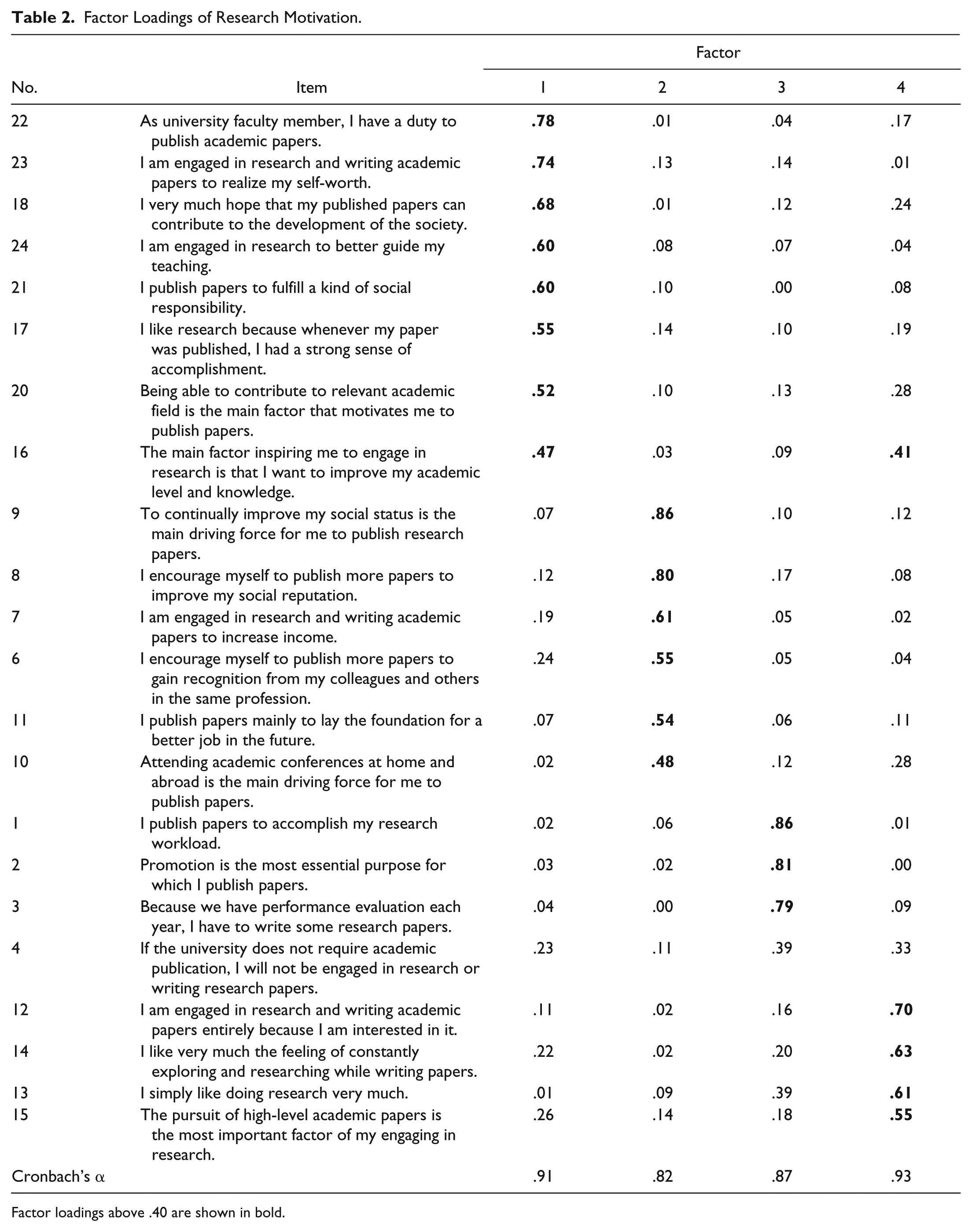
Factor loadings above .40 are shown in bold.
Dimensions of Research Motivation and Their Reliability Coefficients.

Participants’ Profiles of Research Motivation and Research Productivity
The scores of items designated to the four dimensions were averaged to represent the participants’ levels of the four dimensions of research motivation. Table 4 shows the descriptive statistics of the participants’ motivation toward research.
Distributive Statistics for Research Motivation.

This is the maximum of the average of scores on the six items measuring introjected regulation, that is, (5+5+5+5+5+4)/6 = 4.83.
Table 4 shows that of the four dimensions of motivation, the academics’ external regulation (M = 3.50) was at the highest level, followed by identified regulation (M = 3.34). Intrinsic motivation ranked at third place (M = 3.05), whereas introjected regulation was at the lowest level (M = 2.76).
Table 5 shows the frequency distribution of responses to each item. For the sake of clarity, the percentages for agreement (scores of 5 and 4), neutral (score of 3), and disagreement (scores of 2 and 1) are reported.
Frequency of Responses to Research Motivation (%).

As seen in Table 5, the items measuring intrinsic motivation were affirmed by small proportions of the respondents. For instance, only 35.6% of them confirmed their interest in doing research (Item 12) and 46.9% admitted that they liked the feeling of constantly exploring and researching (Item 14).
Regarding the three dimensions of extrinsic motivation, items for external regulation were embraced by large proportions of the respondents who indicated their research engagement was driven by needs for promotion (Item 2, 73.5%), performance evaluation (Item 3, 68.6%), and accomplishing workload (Item 1, 62.1%), whereas 34.3% of them admitted that they would not engage in research if their university did not require academic publication (Item 4).
In terms of identified regulation, many respondents agreed to the reason for their research engagement was to better guide their teaching (Item 24, 60.8%). This suggests that many teachers viewed that research engagement could facilitate their teaching practice. Besides, many of them endorsed the statements that they engaged in research to improve their “academic level and knowledge” (Item 16, 61.8%) and to “contribute to the development of the society” (Item 18, 60.2%), which indicates, to a certain degree, the respondents’ recognition and acceptance of the value of research.
The percentages of respondents endorsing items of introjected regulation—reputation and recognition—were also small. Although Item 6 (“to gain recognition from my colleagues and others in the same profession”) received endorsement from 50.5% of the respondents, other items in this category were embraced by one third or less of the respondents, for instance, only 31.7% endorsed the motive of improving their social reputation (Item 8).
Table 6 shows the descriptive statistics of the surveyed teachers’ publications in international refereed journals and domestic CSSCI journals. It can be seen that the teachers published far more articles in CSSCI journals (497) than in international outlets (172). The mode was zero, indicating that many teachers had no publications by the time of this survey was conducted.
Distributive Statistics for the Teachers’ Publications.

Note. CSSCI = Chinese Social Sciences Citation Index.
Relationship Between Research Motivation and Research Productivity
In the examination of the relationship between research motivation and research productivity measured by articles published in international journals and local CSSCI journals, demographic factors including age, gender, degree, professional title, and affiliation were first entered as one block and motivational factors were added (see Tien, 2008). This allows for controlling the effects of demographic factors and comparing the nested models by conducting a chi-square (χ2) test on the difference of their log-likelihoods (Kabacoff, 2015).
The two models of the ZINBRM for international publications are shown in Table 7. Each model contains two panels, representing the count and zero-inflation portions of the model. The zero-inflation panel includes b estimates, which are the logit coefficients predicting the likelihood of zero publication. The count panel includes negative binomial regression coefficients (b), which predict the number of articles published in international refereed journals.
Zero-Inflated Negative Binomial Regression on International Publications.

p < .05. ***p < .001.
As Table 7 shows, under the zero-inflation panel across Models A1 and A2, education and title were the two significant predictors taking a negative sign. As this portion models the probability of a zero count, the negative sign indicates that the lower a teacher’s education (p < .001) and professional title (p < .05), the more likely it was that they had not published any articles. Under the count panel in Model A1, affiliation was a significant predictor of the count (p < .05). With motivational factors added in Model A2, two subtypes of motivation, that is, intrinsic motivation and identified regulation, significantly predicted the count (p < .001). Intrinsic motivation was positively associated with the count (.87), indicating that the higher a teacher’s intrinsic motivation, the greater the number of published articles. In contrast, the negative coefficient of identified regulation (–.65) indicates that the higher this type of extrinsic motivation, the fewer the articles published. The χ2 test of the difference of the log-likelihoods was significant (p < .05), which indicated that Model A2 improves significantly over Model A1.
Table 8 shows the results of the ZINBRM for publications in domestic CSSCI journals. Similar, under the zero-inflation panel, the probability of a zero count was significantly predicted by degree in Model B1 and by degree and title in Model B2. Besides, under the count panel across models, degree and title both significantly predicted the count (p < .001), showing that that the higher a teacher’s degree and professional title, the greater the likelihood he or she had published more articles in local CSSCI journals. When motivational factors were added to Model B2, the only significant motivational factor was external regulation, whose influence on publication was negative (–2.78). This indicates that the more a teacher was motivated by promotion and performance, the fewer articles he or she published in local journals. The χ2 test of the difference of the log-likelihoods was nonsignificant (p > .05), which indicated that Model B2 does not improve significantly over Model B1.
Zero-Inflated Negative Binomial Regression on Domestic Publications.
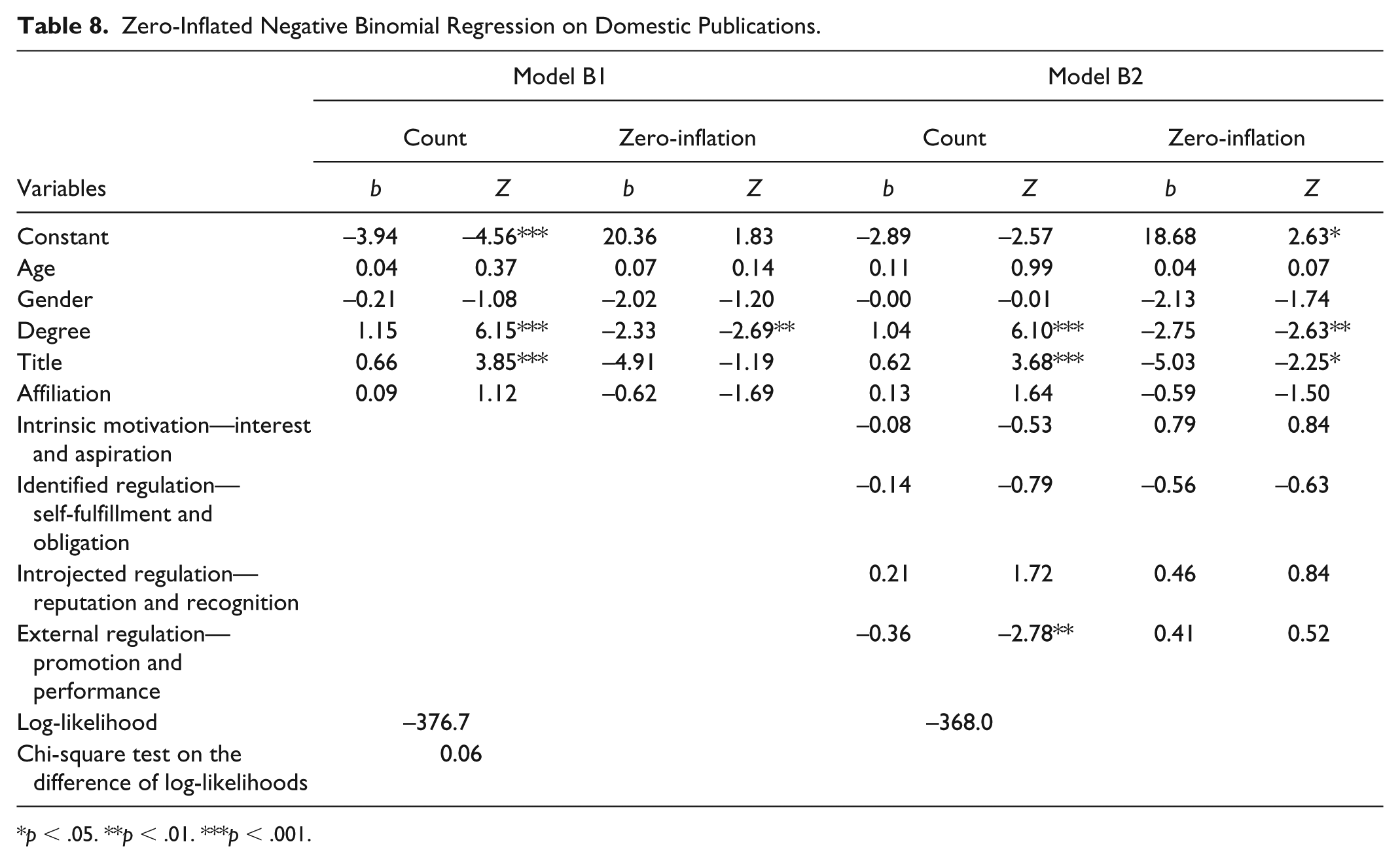
p < .05. **p < .01. ***p < .001.
Summing up, the results suggest that with demographic factors controlled, intrinsic motivation was positively correlated with the surveyed academics’ international publications, whereas only two subtypes of extrinsic motivation were significantly negatively associated with their research publications. That is, identified regulation was negatively associated with international publications and external regulation was negatively associated with domestic CSSCI publications.
Discussion
This study has first identified four dimensions of Chinese TEFL academics’ research motivation measured within the framework of intrinsic and extrinsic motivation (Deci & Ryan, 2000): intrinsic motivation, identified regulation, introjected regulation, and external regulation. Consistent with Deci and Ryan’s (2000) theory, the four dimensions appeared to be situated along a continuum anchored by most and least autonomous regulation. This study found that the respondents’ external regulation was stronger than their intrinsic motivation, which echoed Xie et al.’s (2014) findings and previous qualitative findings (Bai & Hudson, 2011; Xu, 2014). These results, together with those reported by Borg and Liu (2013) and Bai and Hudson (2011) revealed that Chinese TEFL academics’ primary concern tends to be career promotion, which reflects the current landscape of university academics’ professional development, which prioritizes publication (Gao & Zheng, 2018; Jiang et al., 2017; Song, 2018; Zheng & Guo, 2019).
Fortunately, many respondents in the survey agreed that they did research to better guide their teaching. This finding attests to the proposition of “a symbiotic nexus between teaching and research” (Neumann, 1992, p. 159) and is consistent with previous findings that many English language teachers in China engage in research to inform their pedagogical practices (Bai, 2018; Bai & Hudson, 2011; Borg & Liu, 2013). This reflects a tendency among this group of academics to identify with their professional role in not only transmitting knowledge but also constructing knowledge through research.
The results showed that with the effects of demographic factors controlled, intrinsic motivation was positively and extrinsic motivation captured by identified regulation was negatively correlated with the academics’ international publications. Intrinsic motivation concerns impetus inherent in the activities, whereas extrinsic motivation to different degrees rests on contingencies external to the activities. Writing and publishing papers in English-medium international journals are challenging for NNES scholars (Flowerdew, 1999) and particularly require authorial persistence (Belcher, 2007). The positive association indicated that in the face of the tremendous challenges of doing research and writing in English for international journals, intrinsically motivated teachers who find genuine contentment in these activities can eventually succeed. The academics whose research was driven by pursuits of self-worth or better teaching, that is, identified regulation measured in this study, may rather opt for disseminating their research through other outlets such as conference presentations. This may somewhat explain the negative association between identified regulation and international publications found in this study.
The result also showed that intrinsic motivation was not significantly correlated with domestic CSSCI publications, but extrinsic motivation captured by external regulation showed significantly negative association. This may be because writing and publishing in domestic journals is less linguistically and rhetorically demanding for the majority of Chinese academics and thus requires less intrinsic force. Rather, as found in this study, it was the academics’ degree and title, which can be viewed as indicators of research experience, that were significantly associated with domestic journal publications. This is consistent with previous findings on the positive roles of research experience (Bai & Hudson, 2011), degree, and title in research productivity (Horodnic & Zait, 2015). The negative association between external regulation and domestic publications may imply that when academics are pressured to do research by external factors such as research workload or promotion, and when publishing in CSSCI journals was beyond their reach, they may seek easier or more feasible solutions such as publishing in non-CSSCI journals or publishing books at their own expenses.
Overall, the positive relationship between intrinsic motivation and international publication is expected and in line with previous findings (Chen et al., 2006; Horodnic & Zait, 2015; Tien, 2008). The negative relationships between extrinsic motivation in one form or another and article publishing add to extant mixed findings, resembling Horodnic and Zait’s (2015) results, but seemingly contradicting the positive relationship between motivation for promotion and research productivity reported in Chen et al. (2006) and Tien (2000). The major source of these discrepancies may be the different ways of operationalizing promotion. Chen et al. (2006) measured promotion by multiplying academics’ perceived importance of promotion by the probability of achieving promotion through research, whereas Tien (2000) measured motivation for promotion by multiplying promotion valence and the instrumentality of research performance for promotion, whose values ranged between 0% and 100%. In this study, the academics were asked to indicate their agreement to promotion as a motive for their research, and promotion was only one of the items measuring external regulation.
Taken together, the present findings indicated that although the TEFL academics possessed higher levels of extrinsic research motivation, such motivation did not guarantee success in publishing or may even have deprived them of a sense of self-control over their research activities. Extrinsic motivation may induce short bursts of effort, but cannot sustain the persistence and commitment required in the arduous process of research and writing for publication. As Deci and Ryan (2000) rightly stated, “externally regulated behaviors are predicted to be contingency dependent in that they show poor maintenance and transfer once contingencies are withdrawn” (p. 236).
Of the demographic factors examined, degree and title were significantly associated with research productivity, which largely confirmed the findings reported by Tien (2000, 2008) and Horodnic and Zait (2015). Age and gender were nonsignificant factors (see also Liddle et al., 1997; Tien, 2000, 2008). These results may be because although females accounted for a large percentage of TEFL academics (e.g., 76.4% in this study), they usually are occupied by family obligations. Therefore, gender did not turn out to be linked with publications. Also, writing and publishing papers requires specific academic literacy that does not necessarily increase with age.
Although this study has attempted to employ inferential statistics and recruit university academics from diverse regions in China, it should be acknowledged that given the small sample size, the results can by no means be generalized to larger populations. Besides, it is a tenuous process for researchers to get their work published. Nevertheless, with the increased expectations of academics’ research output in various contexts, such as the European (e.g., Lynch, 2015) and Asia-Pacific regions (e.g., Lee & Lee, 2013), the findings have important implications for promoting research among university academics in China and other similar contexts so that academics can adapt themselves to the “publish or perish” challenge (Lee & Lee, 2013).
Conclusion and Suggestions
This study has investigated the research motivation of Chinese university TEFL academics and its association with research productivity in terms of journal publication. The participants were found to exhibit stronger external and identified regulations than intrinsic motivation. However, with demographic factors being controlled, the two subtypes of extrinsic motivation were significantly negatively associated with journal publication, whereas intrinsic motivation was the only factor positively linked with publication in international refereed journals.
Although university academics’ motivation to engage in research has been explored previously, this study highlights the necessity of going beyond descriptions by employing inferential statistics to examine the association of research motivation and academic publication among TEFL academics. The patterned relationships between motivation and research outputs explored in this study can inform university academics who are tackling the dire need for and thorny concern with research productivity that is carrying increasing weight in the tertiary education sector (Lai et al., 2014; Song, 2018; Tao et al., 2019).
First, university academics need to be mindful of the propelling role of intrinsic research motivation underlying research productivity. Arguably, intrinsic motivation develops from constant trial and error. Academics can attend and disseminate research at domestic and international conferences so as to get acquainted and engage in communication with academic communities. As the behind-the-scenes experiences mostly develop from participation in communities of practice and are only faintly hinted, if at all, in published products (Canagarajah, 2003), colleagues knowledgeable about publishing in high-ranking international journals could share their writing and submission experiences with others. Shepherded by experienced colleagues, novice academics who have succeeded in publishing in international journals can have their intrinsic research motivation enhanced and augmented, and gradually transform from peripheral members to legitimate participants in international and domestic academic communities.
Colleges or departments can build research teams, academic writing clubs, or other types of academic communities to create a supportive research culture, which can help foster academics’ intrinsic interests in academic research and writing. Given the important roles of degree and title, institutional policies need to offer opportunities for professional development, such as encouraging or financing academics to enroll in a doctoral program. Alternatively, visiting scholar programs or research training programs can be offered to TEFL teachers who cannot afford to leave for full-time doctoral training, for instance, due to family responsibilities. In short, university management and policy makers need to particularly promote and protect academics’ research motivation and morale when making policies for assessing faculty’s research excellence or academic performance.
Footnotes
Declaration of Conflicting Interests
The author(s) declared no potential conflicts of interest with respect to the research, authorship, and/or publication of this article.
Funding
The author(s) disclosed receipt of the following financial support for the research, authorship, and/or publication of this article: This study was supported by the National Social Science Fund of China (project no. 14BYY067).
