




Abstract
The study identifies how subordinates of a multinational organization in Saudi Arabia perceive ambidextrous leadership’s explorative and exploitative factors. A qualitative design was adopted for the study. Data was collected from the employees’ comments about the leaders in a large multinational conglomorate’s organizational Electronic Social Networking (ESN) platform. The comments so collected were analyzed using Thematic Analysis (TA) to address the research objectives. The study results indicate that the leaders exhibited exploration, exploitation, and temporal flexibility styles signifying ambidextrous leadership. Ambidexterity is an aspect that is receiving increased research attention. Despite its widespread use in management science, ambidextrous leadership (AL), and individual level ambidexterity got initiated only in the current decade. The current study extends the literature about AL.
Keywords
Introduction
The past few years have seen increased interest in organizational ambidexterity (OA), and its multiple and varied uses in management practices (O’Reilly & Tushman, 2004; Raisch et al., 2009). A multi-fold increase in management literature has also been observed since then (Helbin & Van Looy, 2021; Kosasih et al., 2020; Rosing et al., 2011; Sulphey, 2019; Sulphey & Alkahthani, 2017; Tarba et al., 2020). Though a new addition to management science, ambidexterity now has diverse approaches and views (Bernal & Toro-Jaramilo, 2019; O’Reilly & Tushman, 2004; Raisch & Birkinshaw, 2008; Sulphey, 2019).
Though works about OA can be found as early as Duncan (1976 ), it started to get a boost with the “seminal work” conducted by March (1991). After that, a substantial literature has been published about OA (Eraslan & Altindag, 2021; O’Reilly & Tushman, 2004; Sulphey & Alkahthani, 2017). However, the nonexistence of an integrated theoretical framework about OA has led to diverging viewpoints about the concept (Huber, 1991; Yan et al., 2016). March (1991) identified “exploration” and “exploitation” as the two opposite activities that could result in OA. While exploration is identifying unique ideas and opportunities that could lead to innovation, exploitation involves making the best use of all existing organizational knowledge and resources efficiently. Both of them are fundamentally different activities that call for divergent resources and attention from corporate leaders (Chang et al., 2011; Tarba et al., 2020). Yan et al. (2016) cautioned that there is a definite need to have dexterity between exploration and exploitation. The concentration of attention on either of the two would spell disaster to the organization.
Despite being an evolving concept, research about OA has not been anchored around a few perspectives, and vast diversity can be observed. A few of them include organizational development and change (Tushman & O’Reilly, 1996), organizational learning (March, 1991; Wang & Rafiq, 2009 ; Yan et al., 2016), creativity and innovation (Adler et al., 1999; Jansen et al., 2006 ; Zacher & Rosing, 2015), leadership (Jansen et al., 2008; Tuan-Luu, 2017), social entrepreneurial orientation (Martínez-Climent et al., 2019), etc. Despite OA’s widespread use in management science, ambidexterity at the individual level got initiated only in the current decade (Laureiro-Martínez et al., 2010; Mom et al., 2009). It is only recently that ambidextrous leadership (AL) started receiving scholarly attention (Keller & Weibler, 2015; Martínez-Climent et al., 2019).
The present paper intends to empirically test using a qualitative methodology, the AL theory, and identify how the team members view their leaders in a large multinational organization in Saudi Arabia. It also attempts to contribute to management literature by identifying whether AL exists in the country. The study assumes significance as the Middle East region in general and Saudi Arabia has a unique culture (Sulphey & Alkahtani, 2018), and leadership styles vary substantially from the other areas. Further, this article’s contribution to literature would be substantial, as studies examining the construct of AL with a qualitative methodology are scarce. The present study, based on its findings, intends to provide directions for future research in AL. Leadership is a construct with multiple practical implications. The present study’s findings would help in leadership development, thereby inculcating in the leaders’ the required complementary behaviors.
Review of Literature
Organizational Ambidexterity
Organizations that simultaneously or consecutively pursue exploration and exploitation are known as ambidextrous (Lavie et al., 2010; Raisch et al., 2009; Simsek et al., 2009; Sulphey, 2019; Tarba et al., 2020). Though the concept of organizational ambidexterity (OA) is new, it has been defined in multiple ways. A few definitions are presented chronologically in Table 1.
Definitions of OA.
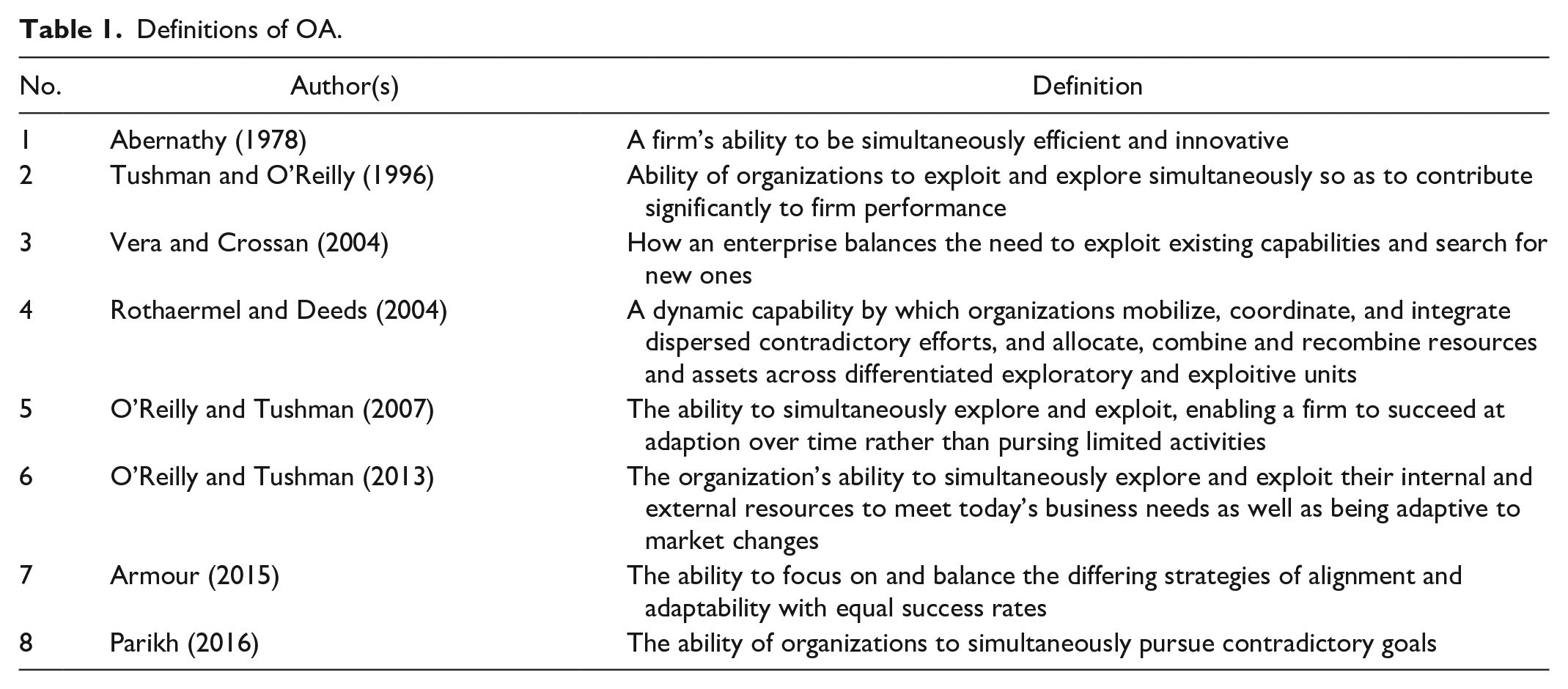
From these definitions, it can be observed that almost all the OA theorists have considered it to involve two factors—exploitation and exploration. Exploration Theory postulates that organizations need to enhance their efficiency in the short term by exploitation. Simultaneously, they need to improve flexibility and innovation in the long term by exploration (Adler et al., 1999; March, 1991; Ojiako et al., 2021; O’Reilly & Tushman, 2013; Sulphey, 2020a). Both exploitation and exploration were considered isomorphic (Fiol et al., 2001; Mom et al., 2009). Those organizations which follow exploration and exploitation simultaneously are known as ambidextrous (Lavie et al., 2010; Parikh, 2016; Raisch et al., 2009; Simsek et al., 2009; Stelzl et al., 2020). It is now pertinent to discuss the two.
Exploitation attempts to enhance organizational consistency and involves consolidating the available internal knowledge (Holmqvist, 2004). It protects existing internal knowledge and beliefs against ensuring maximum returns from them (Floyd & Lane, 2000; Ubeda-Garcia et al., 2021). Exploration is directed toward improving the diversity and reach of organizational experiences and knowledgebase (Holmqvist, 2004; Ojiako et al., 2021; Sidhu et al., 2007). Exploration thus involves a drastic reconsideration of the organizational beliefs and replacing them with better alternatives based on individual contexts (Floyd & Lane, 2000). Exploitation helps organizations enhance short-term efficiency, and exploration ensures flexibility of operation and innovation in the long term (Adler et al., 1999; March, 1991).
Substantial empirical evidence exists to prove that organizations will manage scarce resources efficiently if a fair balance is maintained between exploration and exploitation (Cao et al., 2009; Chang & Hughes, 2012; Chang et al., 2011; Ojiako et al., 2021). Alternatively, conflicts between the two are bound to result in unfair distribution of resources (Gupta et al., 2006).
Individual-Level Ambidexterity
Studies on OA focused mainly on the firm or unit level ambidexterity (Keller & Weibler, 2015; O’Reilly & Tushman, 2004). An empirical examination of individual-level ambidexterity started to receive attention only recently (Laureiro-Martínez et al., 2010). After that, scholars began to emphasize management behavior as a precursor of OA (Al-Agry, 2021; Bierly et al., 2009; Carmeli & Halevi, 2009; Taylor & Helfat, 2009). It was also opined that since OA is generally sustained in organizations through the complex interactions between individuals, it should be given due importance (Morgeson & Hofmann, 1999; Schnellbächer & Heidenreich, 2020). Since exploitation and exploration are multi-level constructs, Al-Agry (2021), Raisch et al. (2009), and Simsek (2009) considered OA to be influenced by the cumulative personal ambidexterity of the organization’s members.
The interplay of exploration and exploitation has been submitted to multiple empirical examinations (Gupta et al., 2006; Laureiro-Martínez et al., 2010; Lewin et al., 1999). Equal allocation of attention by leaders to exploration and exploitation has been a significant challenge due to their aversion to risk and an inherent fascination with efficiency (Al-Agry, 2021; Kahneman & Tversky, 1979; Levinthal & March, 1993; Lewin et al., 1999). They further suggested that this mentality tends to influence managers toward activities related to exploitation. This over-emphasis on exploitation could result in an inherent risk of developing a rigid mentality that could hamper learning behavior and restitution within the organization (Cao et al., 2009). Typical examples of this over-emphasis on exploitation are the leadership of Polaroid and Nokia. Due to their undue insistence on exploitation and acute resistance to exploration, Polaroid’s leadership strictly adhered to the belief on their existing strengths too rigidly, resulting in the company’s failure (Tripsas & Gavetti, 2000). Similarly, Nokia was over-focused on its existing strengths and resorted to “control culture,” in sharp contrast with the preferred culture of innovation (Bouwman et al., 2014; Sulphey, 2019).
Laureiro-Martínez et al. (2010) conducted path-breaking research when examining the neuro-scientific fundamentals of individual-level ambidexterity. They found exploration and exploitation were associated with the cognitive process of individuals. They assumed that ambidexterity is associated with complex levels of cognition. Gupta et al. (2006) found that adherence to either exploration or exploitation is present at the individual level. They also commented that adherence to a style would result in conflicts concerning the allocation of scarce resources.
Ambidextrous Leadership
Leadership is one of the most critical factors influencing subordinate behavior (Basheer & Sulphey, 2012; Day & Antonakis, 2012; Sulphey, 2020b). Ambidextrous leaders, and hence explorative and exploitative, encourage their subordinates to proactively identify innovative ideas and solutions in the workplace (Al-Agry, 2021; Tuan-Luu, 2017). Further, AL can also promote the qualities of proactiveness, innovativeness, and risk-taking (Eraslan & Altindag, 2021; Tuan-Luu, 2017). Leadership could also significantly impact the stimulation of subordinates’ ambidexterity (Jansen et al., 2008; Mueller et al., 2020; Nemanich & Vera, 2009). AL encourages its followers to accomplish organizational goals through creating a conducive environment, wherein an atmosphere of mutual trust and support reigns (Gibson & Birkinshaw, 2004). An ambidextrous leader is engaged in “exploiting existing competencies as well as exploring new opportunities with equal dexterity” (Lubatkin et al., 2006, p. 647). Such leaders strive to avoid path dependency and keep at bay the obsolescence of knowledge and employee competencies. Rosing et al. (2011, p. 957) defined AL as: “the ability to foster both explorative and exploitative behaviors in followers by increasing or reducing variance in their behavior and flexibly switching between those behaviors.”
Keller and Weibler (2015) did substantial research about ambidextrous leadership and succeeded in elucidating the relationship between leadership behavior and its effect on subordinate’s individual level ambidexterity. They empirically exposed the relationship between managerial ambidexterity and cognitive tensions. Such cognitive strains, they observed, could be detrimental to the psychological and social well-being of individuals. The need to balancing the dichotomous concepts of exploration and exploitation by leaders and the need for individual-level ambidexterity was emphasized by Keller and Weibler (2015). Gibson and Birkinshaw (2004) argued that individuals seldom have a simultaneous pursuit of exploration and exploitation. They usually are forced to divide their available time between the two opposing patterns. Later, the same view was also expressed by Laureiro-Martínez et al. (2010).
Theoretical Perspective
The theory around AL revolves around the complex interaction between two complementary leadership behaviors—opening and closing (Katou et al., 2021; Mascareño et al., 2021; Rosing et al., 2011). The theory postulates that leaders capable of engaging in both these behaviors would encourage innovative behavior among their teammates (Busola Oluwafemi et al., 2020). The theory further posits that these complementary leadership behaviors’ complex interactions effectively induce innovative behaviors among team members. The two behaviors are now discussed:
Rosing et al. (2011) also identified a third behavior after opening and closing—temporal flexibility. According to them, this behavior switches between opening and closing behavior, depending on the situation. Opening and closing leadership behaviors can be related to but distinct from transformational leadership (Zacher & Rosing, 2015). Since the opening leadership style encourages followers to do tasks differently, they tend to strengthen the possibility of exploring and generating new ideas. They recognize innovation, thereby facilitating innovative products and services (Busola Oluwafemi et al., 2020; Katou et al., 2021; Messmann & Mulder, 2012).
Leaders with the closing style set goals and monitor them closely. This behavior could strengthen idea promotion and realization, thereby inculcating the followers from implementation behavior (de Jong & Den Hartog, 2007). Closing leaders tend to closely support and monitor actions (de Jong & Den Hartog, 2007; Scott & Bruce, 1994). AL theory suggests that opening leadership behaviors will result in followers’ exploration activities, and closing leaders attempt follower exploitation activities (Mascareño et al., 2021; Zacher & Rosing, 2015). It would now be pertinent to have a discussion about exploration and exploitation in AL.
Exploration and Exploitation in AL
As in OA’s case, AI also consists of exploration and exploitation (Floyd & Lane, 2000; Mascareño et al., 2021; Prieto-Pastor & Martin-Perez, 2015) and the flexible switching between the two (Bledow et al., 2009; Rosing et al., 2011). Similarly, Prieto-Pastor and Martin-Perez (2015) found that the ambidextrous leadership style can promote exploration and exploitation.
The AL theory postulates that the harmonious interaction of exploitation and exploration would effectively promote individual team involvement and innovation (Gerlach et al., 2020; Mascareño et al., 2021; Zacher & Rosing, 2015; Zacher & Wilden, 2014). AL style of leadership would be ideal than a single one (Zacher & Rosing, 2015). Tushman et al. (2011) opined that great leaders could manage tensions arising out of exploration and exploration by developing an “overarching vision,” by balancing various tensions. Such leaders would foster team innovation, which is the team’s capability to generate creative ideas and implement such ideas to yield beneficial outcomes (West & Farr, 1990 ).
The present paper attempts to empirically test how followers perceive AL in a large multinational organization in Saudi Arabia. It intends to contribute leadership literature by analyzing whether leaders exhibit opening and closing behaviors, and thereby AL. Based on the findings, it is intended to provide creative directions for future works in AL. The study is also intended to have practical implications, as it can be used to develop and implement innovative leadership training that would facilitate the complementary leadership behaviors of opening and closing and inculcate exploration and exploitation among the followers.
As mentioned elsewhere, AL theory proposes that leaders engaging in opening and closing behaviors are facilitate positive behaviors among followers. They also foster exploration and exploitation among followers (Rosing et al., 2011) and innovation and creativity (Gerlach et al., 2020; Gibson & Birkinshaw, 2004; Raisch & Birkinshaw, 2008; Zacher & Rosing, 2015). These two behaviors, in turn, facilitate organizational learning (March, 1991). Based on the broad review of literature presented in the earlier sections, the following hypothesis is formulated for the study:
H1. Leaders in Saudi Arabia exercise ambidextrous leadership.
Methodology
Since the study investigates a less understood phenomenon, a qualitative methodological approach, as proposed by Edmondson (2002), was used. This approach is now extensively used in examining new and innovative phenomena (Cech & Blair-Loy, 2014; Dodson, 2013; Munsch, 2016; Stone & Hernandez, 2013). A qualitative design seeks out “. . . the specific quality that is typical of a phenomenon” (Denscombe, 2017) and is based on the interpretations of related theories (Parse, 1996). These interpretations are made from observing the innumerable social interactions in natural settings (O’Brien et al., 2014). The most significant advantage of the qualitative design is that it facilitates the generation of quality data and queries capable of exploring the “realistic attitude or behavior” (Kuper et al., 2008). Toward this, a detailed investigation is done into the processes and context involved as a whole (Yin, 2003).
Data Source and Sampling
The documents used for analysis in the present study were obtained from the Employee Social Network (ESN) platform. The ESN contains interactions and discussions by the organizations’ employees about various social and organizational topics. Out of this, the comments about leadership on ESN for over 3 years have been considered for the study. All comments in the document contained unabridged texts. The texts have been used unaltered by the researchers. One hundred seventy-eight employee comments over ESN for the immediate past 3 years about leadership in the organization were collected non-randomly for the study. The organization chosen was multinational and multi-organization conglomerate involved in the Petro carbon business. The company being multinational has employees from across the globe. Thus, the sampling used is purposive and is used widely in qualitative research (Creswell, 2013). A fair review of the literature shows that this is the first research to adopt this methodology in ambidextrous leadership.
Advantages of This Data Source
The present method of data collection has multiple advantages over others. Typically, in quantitative research, data is collected using a questionnaire or checklist. In such situations, respondents are often compelled to respond to the data collection tool, even in unwilling cases. Due to this, the respondents could react in a “desirable manner.” They may desist from expressing their free and frank opinions and views.
Since employees are under no obligation to respond over the ESN, they have responded as per their free will and pleasure. In another sense, there were mindful that they were not responding to any study. As such, the comments could qualify to be “honest,” “genuine,” and “unadulterated.” Thus, the study’s findings would be eligible as authentic and genuine, thereby a strong validity. A review of the literature shows that only a few studies have attempted such a method.
Data Analysis
There are many approaches to collecting and analyzing qualitative data. The distinctions between them are not evident as there are multiple overlaps between them. A few approaches to data collection are briefly presented in Table 2.
Different approaches to analyzing qualitative data.
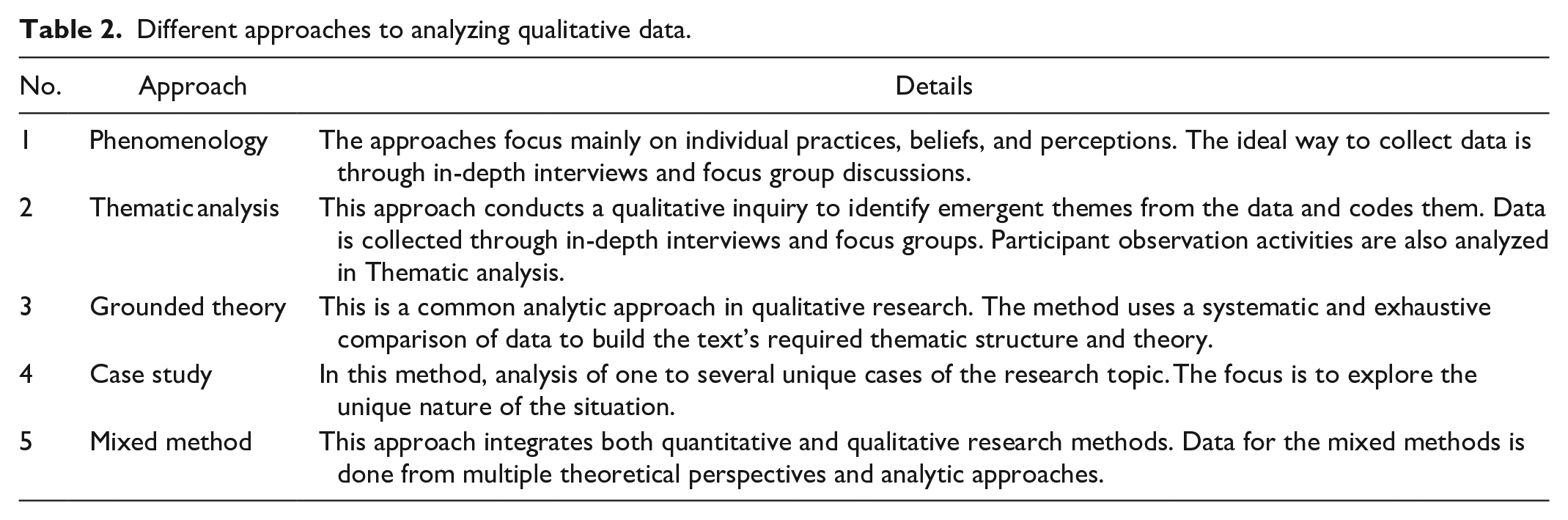
For analyzing the data in the present case, thematic analysis (TA) was used. This is a qualitative analysis method in which textual inputs are analyzed to identify patterns in the data (Braun & Clarke, 2006). TA is widely employed in social and behavioral research. The method involves interpreting textual data, identifying and coding the various themes, and making the required interpretations (Guest et al., 2012). Hence, this approach is ideal for analyzing employees’ comments over ESN and arriving at conclusions. Due to the unique nature of the data and data source, none of the other qualitative approaches (provided in Table 2) are suited for such an analysis. The data collected from ESM were scrutinized and interpreted to understand the meaning of developing empirical knowledge, based on the suggestions provided by Rapley (2007). The coding of data under TA is dependent on whether the various themes are based on appropriate theory (Braun & Clarke, 2006).
As stated earlier, data for the study involved 178 comments made by employees of a multi-organization, multi-country conglomerate in the petroleum industry over the immediate past 3 years. The employees were from across the globe, with many nationalities commenting on the topic. Observations were then segregated based on relevance and coded. Open and axial coding was resorted to, which facilitated the theory’s elaboration, based on which the principal and relevant themes could emerge. Open coding is the first approach to the data. Here, the data is read through multiple times, based on the meanings that could emerge from the data. After that, the data and codes are constantly compared to establish each code’s properties (Mey & Mruck, 2011). Axial coding helps in the identification of the relationships between the open codes. In another sense, they were identifying the connection among the codes. Pattern frequencies can be observed and pertinent sequences identified (Strauss & Corbin, 1990). In short, axial coding helps in investigating the various relationships between the different concepts and categories. Analysis of comments was done based on their respective relevance to the research objectives and the theory. The interpretations arrived thus were compared, and the differences resolved.
Findings
The study intended to conduct a qualitative study to find out the presence of AL. Data for the study was gathered from a Saudi multinational conglomerate’s employee comments over the official ESN. From the innumerable transactions made by the employees over the past 3 years, 178 comments about perceived leadership styles were identified to be analyzed. It could be observed that many members described their leaders to be adequately encouraging and motivating them to be innovative and creative to achieve higher goals. Leaders believed that motivating followers could lead to innovation and better organizational performances (Ambrose & Kulik, 1999; Gerlach et al., 2020). This points toward the explorational attitude of the leaders (Holmqvist, 2004; Mascareño et al., 2021; Sidhu et al., 2007). Figure 1 presents the word cloud, based on relevancy, derived from the 178 comments made by the employees. Word cloud, according to Havley & Keane, 2007), is a “. . . visual presentations of a set of words, typically a set of tags, in which attributes of the text such as size, weight, or color can be used to represent features (e.g., frequency) of the associated terms” (Havley & Keane, 2007). The word cloud presents the most frequently used words based on relevancy. From the figure, it can be observed that employees have included strong terminologies used by ambidextrous leaders in their comments.

Word cloud.
Over 38 comments made by the employees could be identified to the possible explorative, and 32 comments could be identified to exploitative behavior of the leaders. Twenty-two comments were pointing toward temporal flexibility. These aspects are discussed in the following sections, with a few verbatim comments being presented.
A few comments made by the followers about their leaders pointing toward their propensity for AL are presented in the following sections:
One member noted about their organizational leaders:
They aim to unleash the inherent potential of every individual staff.
They minimize the “assumptions” element in the decision-making formula and try to gather as many facts as possible.
They work closely with members on understanding the problem carefully before jumping directly into implementing quick fixes and imported solutions.
Another comment that points toward challenging the status quo:
Leaders are never satisfied with traditional practice, static thinking, conventional wisdom, or common performance.
They are only uncomfortable with anything that embraces the status quo.
Leadership is pursuit—the pursuit of excellence, truth, of what’s next, of what if, of change, of value, of results, of relationships, service, and knowledge. The pursuit leads to attainment. What one pursues would determine the path one travels, the people one associates with, the character one develops, and ultimately, what one does or does not achieve.
Having a mindset focused on pursuit critical to leadership, lacking this one quality can sentence a leader to mediocrity or even obsolescence. The manner, method, and motivation behind any pursuit set truly great leaders apart from the masses.
Yet another comment which has stated explicitly about the willingness of leaders to change the status quo goes like this:
Have transparency and openness to discussions, emotionally intelligent, as well as having a collaborative approach.
Willingness to change the status quo and see those changes through, rather than jumping from one silver bullet to the next, but at the same time not being rigid and stubborn.
A follower commented on the competencies of their leaders thus:
Leaders have competencies like Influence, Vision, Creativity, Risk-Taking, Resource Allocation. Some other major leader activities evident include Networking, Talent Management, and Customer Engagement.
New leaders need to be positioned in the intensive practice cycle to prepare them for future challenges.
The exploitative attitude of leaders was also evident from the statements of a follower. For instance, according to him:
Leaders provide clear direction and updates if the direction changes. Constructive feedback and recognition are also very important and required at all times. Furthermore, and more challenging, also develop his/her team members, and carry a strong belief in the value of the work being done.
Finally, and most challenging, the leader instills passion in the employees and ensures all are driven toward success.
Another member stated thus:
Leaders have the power of influence to help and guide team members functioning to their highest potential.
Leaders have a self-reflection where they can identify their value and boundary to be values leaders; they are leaders with a vision of truly knowing themselves and leading themselves before leading others.
Leaders have a visionary perspective and have the ability to measure things from a different viewpoint.
Achievement of organizational goals was the focus of another comment:
Leaders know how to trigger action to achieve the goal in a safe and applicable way with a higher understanding of the nature of the works and the human involvement in it. Further, who could accept both Victory and Defeat in the same manner.
It can be observed from this comment that leaders are along involved in utilizing the organizational experiences and facilitating the consolidation of the available knowledge base, thereby confirming the definition of exploitation as presented by Holmqvist (2004).
The element of “temporal flexibility” (Rosing et al., 2011) was also evidenced when the balance of both exploration and exploitation was found to be stated in a few comments. This is what one member commented about the leaders:
Know themselves: We need to be clear about our values, priorities, and preferences.
Committed: Effective leaders are not afraid to take on responsibilities.
Know they do not know everything: The most challenging leadership element is to bring individuals together to move forward.
Be open to change: Changes need to be expected and responded to.
Go the extra mile: Don’t be content with doing only your duty. Do more than it.
Another member commented thus:
Drive to achieve organization goals successfully with available resources.
Hard work isn’t enough to be a good leader. Having the knowledge, skills to deal with the team, and confidence are the main factors for leadership.
Leaders can look for upcoming changes and challenges and utilize the available resources properly for business benefits.
Learning new methods of running both business and personal life is important for a future leader.
It was also commented by another member that:
Leaders have a clear vision of the future challenges and the strategies to overcome the expected difficulties and convert these challenges into opportunities.
Thus, the analysis shows that the leaders exhibit explorative, exploitative, and temporal flexibility, ideal for the organization’s long-term success.
Discussion
Leadership is a definite predictor of organizational success. There is sufficient evidence in management literature about its capability to foster individual, group, and organizational creativity (Hammond et al., 2011; Rosing et al., 2011). Many social scientists have revealed the ability of the complex style of AL to bring in marked changes in organizations (Kafetzopoulos, 2021; Ojiako et al., 2021; Rosing et al., 2011; Stelzl et al., 2020; Sulphey, 2019, 2020a; Sulphey & Alkahthani, 2017). The two complementary leadership behaviors present in AL interact to bring in high levels of creativity and innovation in the work settings (Busola Oluwafemi et al., 2020; Gerlach et al., 2020; Rosing et al., 2011). The objective of the study was to examine the presence of AL in Saudi Arabia. The present study has found support to the hypothesis that followers perceive that AL exists among Saudi leaders.
The most significant advantage of the study is that it has collected objective data. Instead of relying on self-rating questionnaires, data were extracted from the ESN, which has been made voluntarily in the employees’ free time. The team members were never under any form of pressure to respond in a socially acceptable manner. The data also has the advantage of being neutral to identification, which works as a guarantee against responses’ favorability. No earlier studies seem to have used this form of data for analysis. As such, the findings of this study are unique.
Implications
This study has both theoretical and practical implications. The findings propose that organizational leaders required a broad assortment of leadership behavior. They need to have an opening, closing, and temporal flexibility. This would help foster the AL style in organizations, thereby extending the AL theory proposed by Rosing et al. (2011). These findings suggest a complementary leadership style, wherein leaders, even while setting rules and intervening to implement them, need to encourage followers to alter routines and do tasks creatively. The need for this type of complementary style can be emphasized by organizations in their leadership and management development programs. Since opening and closing behaviors complement each other, those leaders with opening leadership styles can derive benefits from followers having a high closing behavior, and vice versa. The respective organizations can develop required leadership and management development programs to foster AL among their leaders. There is, however, the need for further empirical examinations to identify how a wide range of leadership behaviors can be fostered. The present study is the first of its type, which examined the ambidexterity theory using the qualitative method.
Like any other study, the present one also could have limitations that may be addressed in the future. The study’s findings need to be interpreted with care because of the normal criticism that qualitative studies, due to their ambivalence, lack of rigor, are subjected to biases during interpretation (Denzin, 1988). A certain amount of possibility of this bias is acknowledged. These limitations could be minimized by using multiple methods like triangulation, interview, case study, etc. (Yin, 2003). Further, potential mediating and moderating conditions like certain other related employee behaviors, characteristics, structural and cultural aspects, etc., were not considered in this study. It is also to be considered that most leadership studies have been done using quantitative methods, with questionnaires. Data for several recent other leadership studies have been collected through interviews. Future research could be undertaken using a mixed methodology to replicate and extend the present study’s findings.
Conclusion
In conclusion, this study has substantially contributed to the literature on ambidextrous leadership theory (Rosing et al., 2011) and ambidextrous leadership. The research has shown that leaders in Saudi Arabia practice AL. The conclusion has been arrived from the willful and voluntary opinions of the followers, derived from the ENS, spread over 3 years, of a large multinational conglomerate. The study has provided evidence that leaders exhibit high explorative and exploitative leadership behaviors and a harmonious shift between the two. This leadership style has been found to foster innovation among the followers (Gerlach et al., 2020; Raisch & Birkinshaw, 2008; Zacher & Rosing, 2015) and organizational learning (March, 1991; Yan et al., 2016).
Despite a few potential methodological limitations, the present theory-based research presents a significant step toward acquiring a fair understanding of certain specific leadership behaviors that could build a motivated, empowered, and innovative work team. These specific employee behaviors have the strong potential to bring innovation in organizations and facilitate them to face the current global competition and severely uncertain market conditions. It is hoped that the findings reported in this paper would be a valuable basis for future studies that aim to examine exploration and exposition and flexible ambidextrous leadership. Based on the present study, the authors would be highly gratified if further investigations are undertaken in AL’s challenging and fecund area.
Footnotes
Declaration of Conflicting Interests
The author(s) declared no potential conflicts of interest with respect to the research, authorship, and/or publication of this article.
Funding
The author(s) received no financial support for the research, authorship, and/or publication of this article.
