




Abstract
Women’s economic empowerment is often touted as a key driver of global development, but what role do their spouses play in this equation remains understudied? This study fills this gap by investigating the relationship between spousal support and enterprise achievement of 450 women entrepreneurs in Tamil Nadu, India a region notable for its traditional gender dynamics. Using a quantitative approach, we analyzed four types of spousal support—financial, emotional, household and hands-on, and constructive business interference—utilizing Partial Least Squares Structural Equation Modeling (PLS-SEM). Results indicate that spousal support, both financial and emotional, is fundamental to the success of women entrepreneurs. Constructive involvement from husbands can further enhance entrepreneurial outcomes, underscoring the importance of a supportive partnership. Conversely, household and hands-on assistance, while valuable, do not significantly impact success, suggesting that emotional and financial backings are more critical. Socio-cultural factors also play a significant role, highlighting the need to address societal norms that may hinder women’s entrepreneurial pursuits. The findings support policies that encourage spousal engagement in women’s economic activities, aligning with Sustainable Development Goals related to gender equality and decent work. Policies and interventions aimed at engaging spouses in women’s economic activities, while addressing cultural norms that influence gender roles, are essential for promoting women’s empowerment, economic participation, and overall development. Encouraging supportive partnerships can thus serve as a vital strategy for advancing gender equality and sustainable economic growth.
Plain Language Summary
This study explores the relationship between spousal support and women entrepreneurs’ success in Tamil Nadu, India. The research reveals that spousal support has a significant positive impact on women entrepreneurs’ success. However, the study also identifies socio-cultural and economic factors that mediate this relationship. Specifically, it finds that: Socio-cultural factors such as traditional gender roles, family expectations, and social norms play a crucial role in amplifying the boosting effect of spousal support on women entrepreneurs’ success. Economic factors such as access to resources, market opportunities, and social networks also influence the relationship between spousal support and women entrepreneurs’ success. The study concludes that understanding these mediating factors is essential to developing effective interventions and policies to support women entrepreneurs in Tamil Nadu. By acknowledging the complex interplay between socio-cultural and economic factors, policymakers and stakeholders can create a more supportive environment that enables women entrepreneurs to thrive.
Keywords
Introduction
Although women often receive appreciation for their husbands’ success, this is not always the case (Kang & Yaacob, 2024). Increasing access to education and involvement in socioeconomic activities has enabled women to achieve greater success than their spouses in some instances, particularly through entrepreneurship. A nurturing and encouraging partner plays a vital role in empowering women, leading to greater accomplishments in their entrepreneurial ventures (Hossain & Lim, 2024; Aldrich & Fiol, 1994). Spousal support includes encouragement, understanding, being present during difficult business times, sharing household and childcare responsibilities, investing in her business, and actively participating in activities such as packing, marketing, advertising, and bookkeeping (Nasir & Ul-Durar, 2024; Wani, 2023). Kanter’s (1977) Spousal Support Theory posits that married women often face greater challenges than their single counterparts due to the domestic responsibilities they assume. However, supportive partners provide the time and resources necessary for women to pursue entrepreneurial endeavors effectively.
The United Nations’ Sustainable Development Goals (SDGs) aim to promote economic growth, social justice, and environmental sustainability (Manoharan et al., 2025; Tremblay et al., 2020). SDG 5 focuses on achieving gender equality and empowering women and girls (Le Crom, 2022; Rai et al., 2019). Women’s economic empowerment also relates to other SDGs, such as SDG 8 (Decent Work and Economic Growth; Frey, 2018; Venkatesan & Luongo, 2019), SDG 12 (Responsible Consumption and Production), and SDG 10 (Reducing Inequalities; Krauss et al., 2022). Tamil Nadu, a southern Indian state, has made notable progress in promoting women’s entrepreneurship, with a participation rate in the labor force of 38.2% for men and 21.9% for women stated by Ministry of Human Resource Development, Government of India (2019; Usharani, 2024). Despite this, many women face challenges in balancing business and family responsibilities (Suthamathi & Prabu, 2018). A recent study indicates that only 14% of registered businesses in Tamil Nadu are owned or managed by married women, according to the Tamil Nadu Chamber of Commerce and Industry (TNCCI), with a lower women’s labor force participation rate of 24.6% compared to the national average, as per the National Sample Survey Office (NSSO). Nonetheless, Tamil Nadu ranks second in India for female entrepreneurs, with approximately 5.6 lakh as of March 2021, as reported by the Department of Industrial Policy and Promotion (DIPP) and the Ministry of Statistics and Program Implementation (Vignesh, 2024). The All India Manufacturers Organization (AIMO) revealed that around 37% of female entrepreneurs in India were married in 2019. Additionally, there are approximately 15.37 lakh micro, small, and medium enterprises (MSMEs), with 3.5 lakh units owned by women, underscoring the significant role women play in Tamil Nadu’s economy.
Table 2 indicates that Tamil Nadu ranks third among Indian states in the percentage of female business owners registered under the Women Entrepreneurship Platform (WEP). This statistic indicates significant progress in promoting female entrepreneurship within the state. While in a culture where traditional gender roles often dictate responsibilities, insufficient spousal support may prevent women from fully capitalizing on the opportunities available to them. This observation underscores the importance of understanding not just the participation rates but also the qualitative aspects of support that women receive from their spouses.
Table of Acronyms.

Entrepreneurship in Tamil Nadu: A Statistical Breakdown by Gender.

Sources. Census 2011, NSSO 71st Round, PLFS 2017 to 2018, NASSCOM, Tamil Nadu Government Data.
Marital Relationship in Tamil Nadu
In Tamil Nadu, marriage extends beyond two individuals to encompass two families. A patriarchal society expects women to focus on household and family duties over personal ambitions (Kiruthika & Geetha, 2024; Madraswale & Velmurugan, 2023; Muthulakshmi & Jaisun, 2023). Women are typically seen as homemakers and caregivers, with men as the primary breadwinners (Arumugam et al., 2022; J. S. Kumar & Shobana, 2024). However, this dependency can also create pressure for women to succeed in business (Aravamudhan, 2024; Anandharaman & Rangaswamy, 2024). Despite norms, many Tamil Nadu women entrepreneurs receive significant spousal support, especially in business pursuits (M. A. Ahmed & Ahmed, 2024; Singh & Supina, 2025; Sivakumar & Senthilkumar, 2018). Educated women often find encouragement from their spouses after marriage, aiding career progression (Khandelwal & Sehgal, 2018). However, traditional gender roles still restrict women’s full participation in entrepreneurship (Rao, 2015; Shinnar et al., 2012).
Despite the significant number of married women entrepreneurs in Tamil Nadu, there remains a lack of understanding about how marriage and spousal support influence their entrepreneurial journeys within the region’s cultural and social context. Existing research on the impact of spousal influence on women’s entrepreneurship has predominantly focused on Western countries, resulting in a notable research gap concerning the unique dynamics present in non-Western settings like Tamil Nadu (Nikina et al., 2015; Wolf & Frese, 2018). This gap hampers understanding of how spousal support aligns with local norms to influence women’s business success (Bayala et al., 2023; Nikina et al., 2015; Wolf & Frese, 2018). Various forms—financial, emotional, sharing household duties, direct involvement, and constructive interference—are crucial in shaping entrepreneurial results (Bayala et al., 2023; Sullivan & Meek, 2012). Factors like spouses’ age, education, family income, and peer influences vary across cultures and affect support dynamics (Welter et al., 2014; Calleja et al., 2020). Financial and emotional support are especially vital in overcoming gender barriers in Tamil Nadu’s entrepreneurship scene (Kiruthika & Geetha, 2024; Noor et al., 2022). The socio-cultural and economic traits of spouses are often overlooked, limiting understanding of their full impact on women’s entrepreneurship. Studying these interactions is a key for grasping how spouses influence women’s business success in Tamil Nadu. The socio-cultural and economic characteristics of spouses are often overlooked, limiting the understanding of their full impact on women’s entrepreneurship. Studying these interactions is crucial for grasping how spouses influence women’s business success in Tamil Nadu.
To address this research gap, the present study aims to investigate the nuanced roles of spousal support in the entrepreneurial success of married women in Tamil Nadu. Specifically, we will assess how various forms of support—financial, emotional, and practical—contribute to business outcomes, such as income generation and growth potential. The research aims to develop a predictive model for business success, analyzing both the direct and indirect effects of spousal support on businesses led by women. This framework will enhance our understanding of the interplay between spousal dynamics and entrepreneurial performance, thus contributing to the growing body of literature on women’s entrepreneurship by highlighting the unique socio-cultural contextual factors at play in Tamil Nadu. Ultimately, this research aims to inform policies that enhance the economic empowerment of women in similar socio-cultural settings, thereby advancing gender equality and economic growth in alignment with the United Nations’ Sustainable Development Goals.
The following inter-connected research questions will be addressed to fill the existing gap:
Background of the Study and Hypotheses Development
An Array of Assistance Provided by a Spouse
Spousal support plays a crucial role in fostering a positive and supportive marital and business environment. Research has consistently shown that having a supportive spouse and a strong marital relationship are essential assets for women entrepreneurs, as they help reduce pressure in the work-family context (Uysal Irak et al., 2020) and improve their standard of living (Md-Sidin et al., 2010). This support empowers women to achieve success in both family life and business (Kiruthika & Geetha, 2024; Sundari & Gannasekaran, 2019).
Financial Support
Financial support plays a critical role in the success of women entrepreneurs. It has various forms, including providing start-up capital (Chen & Hu, 2023), crowdfunding, online lending services (Azkiya, 2024), and digital payment systems (Harini et al., 2025) or offering financial assistance during challenging times (Adams et al., 1996; Halbesleben et al., 2010). Partner backing in exploring and leveraging these technological tools significantly enhances financial opportunities for women’s business achievement (Mahato & Jha, 2024; Seshasai & Shriya, 2024). Such financial backing can be quickly mobilized and serves as a safety net, especially during periods of business failure or downturn (Amin et al., 2017; Dyer, 2012; Dyer et al., 2014). Research indicates that financial support allows women to invest confidently in innovative ideas, thereby improving their success rates (Irwin et al., 2025; Le et al., 2020). Furthermore, substantial financial resources available within a family play a significant role in influencing the survival rates of entrepreneurs (Bird & Wennberg, 2016; S. M. Ghouse et al., 2021; Van Auken & Werbel, 2006). The sense of financial stability provided by a spouse’s consistent income is a key factor in understanding why married women entrepreneurs are less likely to abandon their ventures (Lin et al., 2018). Additionally, a steady household income of a partner often motivates women to initiate entrepreneurial endeavors (Anandharaman & Rangaswamy, 2024; Henley, 2005).
Emotional Support
Emotional support is widely recognized as the most significant form of support, surpassing instrumental support (Miller et al., 2016). This type of support can substantially bolster women’s self-confidence and embolden them to assume entrepreneurial roles (Banu et al., 2025). This is due to the profound impact that emotional support can have on an individual’s—especially women’s—well-being (Ryan & Willits, 2007), mental health (Aycan & Eskin, 2005), and overall sense of belonging within a relationship (Kiruthika & Geetha, 2024). A study by Felgueira et al. (2024) found that women who engage with online entrepreneurial networks often receive vital emotional support from their partners, frequently help in curating these online connections. Empathetic understanding, motivation, attentive listening, and being present during difficult business times are crucial for fostering a deep emotional connection and promoting resilience in times of adversity and success (Antoniou et al., 2021; Durrah et al., 2024; Thompson et al., 2020). Additionally, emotional support is a key that helps women who often juggling between family responsibilities and professional objectives (Eddleston & Powell, 2012). This support not only enables them to navigate the intricate dynamics of their familial duties (Zhang & Bowen, 2021) and work commitments (Wani, 2023), but also helps alleviate the burdensome pressures (Jang & Danes, 2013) and potential conflicts that may arise from juggling these dual roles (Powell & Eddleston, 2017).
Household and Hands-On Support
Married women’s business performance is significantly influenced by the household and childcare support they receive from their spouses. Assistance with household chores, childcare (Croom & Miller, 2018), and cooking enables women to dedicate more time to their businesses and ultimately leads to business success (Patrick et al., 2016; Thébaud, 2016). Research suggests that dedicating time to childcare positively impact marital relationships and the longevity of women’s enterprises (Hochschild, 2012; Hsu et al., 2016; Williams, 2009). Women whose spouses provide modern ideologies and household support find it easier to manage their business and family goals (Bruce, 1999; S. Ghouse et al., 2017). Partners play a crucial role in shaping business actions and outputs through hands-on assistance, guidance, expertise sharing, resource provision, and networking opportunities (Radosavljevic et al., 2022). Additionally, backing from partners includes technical assistance, like website development or digital marketing, which directly influences business growth (Alhakimi & Albashiri, 2023; Seshasai & Shriya, 2024). This support leads to improved decision-making, problem-solving, innovation, and, ultimately, greater success for the venture (Mari et al., 2024).
The framework (Figure 1) illustrates how different types of spousal support—emotional, financial, household, hands-on, and constructive business interference—interact and impact the psychological well-being, business performance, and success of female entrepreneurs. Emotional support boosts confidence and psychological well-being through attitudes like empathy, encouragement, and active listening. Financial aid provides a readily available resource for business management and expansion. Household support allows women to dedicate more time to business activities, enhancing success. Hands-on support enables effective task completion and decision-making. Constructive business interference leverages the spouse’s expertise and experience, benefiting women in business. By providing diverse forms of support, women are more likely to maintain long-term business operations, expand their businesses, increase revenue, and develop risk management capabilities.

Array of spousal support that boost the success of women entrepreneurs.
Constructive Business Interference
Married women often struggle to maintain a clear boundary between their professional and personal lives. As a result, they may involve their spouses and children in their business activities to enhance efficiency. While a partner’s technological expertise can be beneficial, it can also present challenges (Mahato & Jha, 2024; Mari et al., 2024). On one hand, a spouse offers valuable insights and constructive feedback on technology-related business strategies; on the other hand, excessive involvement and differing tech preferences may limit a woman’s autonomy and creativity (Alhakimi & Albashiri, 2023; Poggesi et al., 2024). This involvement fosters a deeper understanding of the enterprise, promotes a sense of dedication among spouses, and enables women to pursue their objectives in both business and family spheres (Patrick et al., 2016; Rahman et al., 2024). Their regular participation in business activities also reduces women’s stress levels and alleviates childcare duties, decreasing the likelihood of work-family conflicts (Al-Dajani & Marlow, 2010; Danes et al., 2009; Lewis & Massey, 2011; Li & Chen, 2023). Furthermore, business support is a crucial factor in helping women overcome initial economic challenges in entrepreneurship (Hormiga et al., 2011). A partner’s expertise and familiarity with the business field are valuable resources for women entrepreneurs (Bird & Wennberg, 2016; Dyer et al., 2014; Miller et al., 2016). Constructive marriages drive the development of strong professional connections, both within and outside the family, through trustworthy relationships with individuals who understand women’s business pursuits (Chaudhary & Singh, 2023).
Spousal Support and Its Impact on Business Success
The support from spouses significantly impacts the mental well-being and overall health of women entrepreneurs. Emotional reinforcement plays a crucial role in boosting motivation and stress management (Mihic et al., 2015), helping women entrepreneurs overcome obstacles and achieve success (D. D. Gupta, 2013). This backing empowers women to take risks and venture into new territories, knowing they have their partner’s support (Gratan et al., 2019; Hsu et al., 2019). The encouragement and assistance create a nurturing environment where women entrepreneurs feel empowered to explore new opportunities and push boundaries, leading to growth and success (Tiwari & Goel, 2020). Additionally, it helps entrepreneurs achieve a better work-life balance (Bayhan Karapinar et al., 2020), which is essential for maintaining a healthy lifestyle and avoiding burnout (Khandelwal & Sehgal, 2018).
Mediating Role of Socio-Cultural and Economic Factors and Its Impact on Spousal Support
In patriarchal societies, cultural norms and collectivist values significantly shape the support spouses provide to women entrepreneurs. For example, spouses may be reluctant to offer support if they view entrepreneurship as a male-dominated domain or if they hold traditional gender role expectations (Bilimoria & Piderit, 2007; Rahman et al., 2024). Moreover, factors such as financial security, religious beliefs, and family background can affect the level of support offered by spouses (Carter & Williams, 2010; Harrison-Walker, 2023; Neubaum & Parboteeah, 2008). Furthermore, partners are more likely to engage in supportive actions if they have personal career ambitions or entrepreneurial aspirations (Marlow & McAdam, 2016). The quality of support tends to be more constructive for smaller-scale businesses (Honig & Kramer, 2011; Muhammad et al., 2023). Industry- or sector-specific factors, along with spouses’ relevant education and skills, can also impact the level of support provided (Amin et al., 2017; Jang & Danes, 2013; Zhang & Bowen, 2021).
Regardless of the growing interest in spousal support and its influence on women entrepreneurs, significant gaps remain in the literature. Most studies have predominantly focused on financial and emotional support without adequately exploring how socio-cultural and economic factors mediate these relationships across diverse communities, which is under-examined. Finally, the complexities of spousal interference, where support can sometimes obstruct progress, have not received adequate attention. Addressing these gaps is essential for a comprehensive understanding of how spousal support, mediated by socio-cultural and economic factors, contributes to the success of women entrepreneurs.
Theoretical Framework
To analyze socio-cultural and economic factors as mediating variables, it is essential to consider two theoretical viewpoints: wedding (C. J. Sager, 1976; C. Sager, 1977; Sager et al., 1971) and contractual relationships (Rousseau, 1989, 1990), as well as gender role ideologies (Minnotte et al., 2010). First Gender Role Ideology provides insight into how deeply rooted societal norms and patriarchal values shape spouses’ perceptions and attitudes toward women’s entrepreneurial endeavors, often reinforcing traditional gender roles that limit support (V. K. Gupta et al., 2019). Second, Marriage Contract Theory offers a perspective on how evolving marital agreements—driven by modernization, globalization, and changing economic roles—affect the dynamics of spousal support within marriages. Together, these theories enable the analysis of both societal-level influences and interpersonal relationship factors that mediate support behaviors. Employing this dual framework allows for a nuanced exploration of how societal expectations and shifting marital roles either hinder or facilitate support for women’s entrepreneurship, particularly in a patriarchal context like Tamil Nadu. This comprehensive approach addresses gaps in existing literature by capturing the intertwined socio-cultural and economic dimensions that shape women’s entrepreneurial success, making it a well-suited theoretical foundation for the study.
Gender Role Ideologies
In the context of spousal support for women entrepreneurs in Tamil Nadu, gender role ideologies suggest that traditional patriarchal norms may influence spouses’ attitudes toward their wives’ entrepreneurial endeavors. In Tamil Nadu, where patriarchal values are deeply ingrained, husbands may be socialized to view their wives primarily as caregivers and homemakers rather than as business owners or entrepreneurs (S. M. Ghouse et al., 2021; Kalaiyarasan, 2023). This socialization may result in a lack of support and understanding for women who choose to start their businesses, as spouses may not see entrepreneurship as a suitable activity for women (Aldrich & Fiol, 1994; S. Ghouse et al., 2017). Furthermore, gender role ideologies can shape spouses’ expectations around household responsibilities, with men often expected to be the breadwinners and women managing the household. This division of labor can lead to the perception that entrepreneurship lies outside the realm of women’s responsibilities, further diminishing support from spouses (Anandharaman & Rangaswamy, 2023; Brush & Greene, 2001; Burgess & Borg, 2011). By examining the impact of gender role ideologies on spousal support for women entrepreneurs in Tamil Nadu, this research aims to understand how societal expectations influence the level of support women receive from their spouses.
Figure 2 illustrates how both theories influences the support provided by spouses to women, impacting their business success both directly and indirectly.
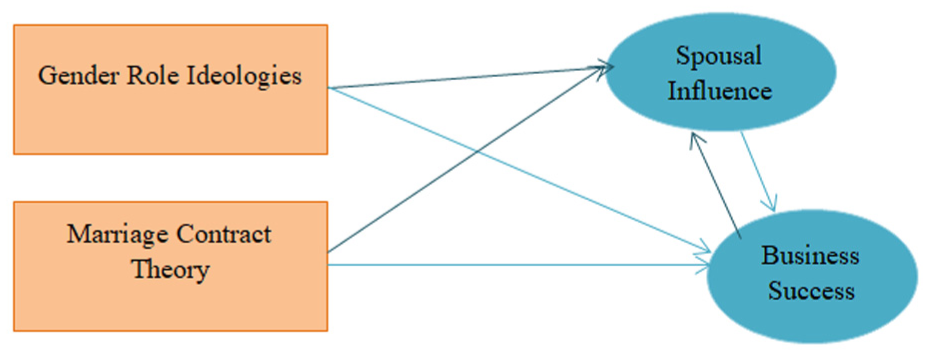
Theoretical framework.
Marriage Contract Theory
The Marriage Contract Theory provides a framework to examine the relationship between spousal support and women’s entrepreneurship in Tamil Nadu (Goody, 1973). Traditional Indian marriage contracts often emphasize men’s roles as providers and women’s roles as caregivers, which can lead to a lack of recognition and support for women’s entrepreneurial endeavors (P. Kumar, 2016; Mishra, 2017). However, with modernization and globalization, these marriage contracts may be evolving to recognize women’s changing roles and contributions to family finances (Durrah et al., 2024; Joshi et al., 2015; Srivastava, 2017). This shift could result in increased spousal support for wives’ entrepreneurial pursuits (M. Ahmed & Ahmed, 2024), acknowledging the benefits of women’s economic independence (Wadhwa et al., 2017). This research aims to investigate how evolving marriage contracts influence the level of support women receive from their spouses in Tamil Nadu.
Despite extensive research on women entrepreneurship and spousal support, there remains a significant gap in understanding how societal norms and marital dynamics specifically influence support behaviors in the context of Tamil Nadu. Most existing studies focus either on societal gender norms (Bianchi et al., 2023) or individual marital relationships in isolation (El-Fiky, 2023), lacking an integrated perspective that captures both levels of influence. This gap limits a comprehensive understanding of the complex interplay between cultural expectations and marital agreements that shape support for women entrepreneurs.
Theoretically, this study contributes by integrating gender role ideology and marriage contract theory, offering a novel framework to examine how societal gender norms and evolving marital roles jointly influence spousal support. While gender role ideology elucidates the societal and cultural underpinnings that reinforce traditional gender expectations, marriage contract theory provides insight into how changing marital agreements and expectations impact support dynamics within marriages.
The rationale for employing these two theories lies in their complementary nature: Gender Role Ideology captures the macro-level societal influences, whereas Marriage Contract Theory addresses the micro-level interpersonal relationships. Together, they enable a nuanced analysis of the socio-cultural and economic factors that facilitate support for women entrepreneurs, especially in a traditional yet dynamically changing society like Tamil Nadu. This integrated theoretical approach thus fills a critical gap and enhances our understanding of the multifaceted support mechanisms essential for women’s business success.
Hypothesized Model
This research aims to augment understanding of socio-cultural and economic factors influencing the support spouses provide to women’s businesses and success. By integrating and synthesizing existing literature, this study proposes a novel conceptual framework that explores the intricate ways in which socio-cultural and economic factors mediate spousal support, particularly emotional and instrumental support (financial aid, household assistance, hands-on support, and constructive business involvement). The framework assesses the factors contributing to success among women entrepreneurs in a patriarchal society, considering socio-cultural and economic elements as mediating variables. The study aims to develop a predictable model of business success by examining the direct and indirect effects of support on women-led businesses. Figure 3 illustrates the conceptual model and path diagram that explains the mediation relationships between dependent and independent variables (Table 3).

Conceptual framework and hypotheses relationship.
Study Hypotheses.

Methodology
Respondents and Sample Size
This study focused on female entrepreneurs in Tamil Nadu, India, who owned micro, small, and medium enterprises. A quantitative approach was used to evaluate the impact of spouses on the success of these businesses. The descriptive research design allowed for the analysis and validation of results, but it did not allow for control over variables.
Sampling Technique
Due to the absence of a complete registry of married women entrepreneurs in Tamil Nadu—since numerous are involved in micro enterprises and often run unregistered businesses with their spouses—a non-probability sampling technique was utilized. Specifically, purposive sampling was used to intentionally select participants who had both business ownership and marital experience of more than one year, thereby enriching the relevance and depth of data collected. This targeted approach ensured that the sample included respondents with relevant and in-depth experiences, thereby enhancing the validity and richness of the data for analyzing specific relationships within the study context. Convenient sampling was used to gather responses from participants who were willing and available to respond to the survey.
Sample Size
The determination of the sample size was complex due to the large number of unregistered or unlisted businesses owned by married women in Tamil Nadu, necessitating a representative and diverse sample across five districts. To address this, the study employed Cochran’s (1977) formula for non-probability sampling to decide the minimum sample size. An estimated maximum variability of .5 (p = .5) is anticipated. Additionally, a 95% confidence interval within a margin of error of ±5% are applied for determining the minimum sample size for the study:


To detect medium effects with sufficient power (typically 0.80) at a 5% significance level, larger samples are generally preferred. Therefore sample sizes around 400 are often considered adequate for PLS-SEM in social science research, especially with complex models. Therefore a power analysis was conducted setting the significance level (alpha) at .05 and aiming for a power of 0.80, meaning there is an 80% probability of detecting an effect if one exists. Based on estimated effect sizes from previous research and pilot data, the analysis indicated that a sample of 450 participants would be sufficient to reliably identify significant relationships in the study. This approach ensures that the results are statistically robust and generalizable to the target population.
Pilot Study
Initially, a pilot study was conducted in Coimbatore with 55 participants, focusing on testing the reliability and validity of the self-administered questionnaire, which comprised 42 items aimed at capturing various dimensions of spousal support and entrepreneurial success. Following the pilot, the main study was rolled out, targeting a larger sample of 450 participants.
Data Collection Timeline and Setting
The six-month data collection endeavors commenced in March 2024 and concluded in June 2024, utilizing surveys that concentrated on a diverse range of businesses owned by married women. During the initial months 1 to 2, efforts were directed toward the design and piloting of the research instruments, followed by months 3 to 4, during which data were collected via structured questionnaires administered within urban and semi-urban districts pertinent to the study’s context, executed at business locations and women’s associations. Surveys were designed to allow participants to respond freely without fear of judgment. The structured questionnaires were disseminated through local networks, social media platforms, and entrepreneurship associations, in conjunction with follow-up reminders intended to bolster participation rates. Month 5 was dedicated to data cleaning and preliminary analysis, culminating in the final analysis and reporting during month 6. From an initial target of 450 participants, we successfully obtained 423 complete responses after the elimination of any incomplete or erroneous submissions, thereby ensuring the integrity and reliability of our data.
Respondents received a detailed information sheet explaining the study’s purpose, methodology, potential risks, and benefits, enabling them to make an informed consent regarding their involvement. Explicit consent was obtained prior to the completion of the self-administered questionnaire, which was available in both English and Tamil to accommodate diverse respondents. Participants were emphasized that their participation was voluntary and that they can withdraw at any time without repercussions. Ethical considerations were paramount, with approvals obtained from both the Institutional Ethical Committee for Human Studies and District Industries Center.
The majority of female entrepreneurs in this study fall within the age range of 21 to 30 years. The predominant educational attainment among participants is at the postgraduate level (44%), followed by higher secondary (40%) and graduate (16%). Most participants (86%) are currently married, while smaller percentages are divorced (5%) or widowed (9%). A significant number of participants (44%) have been in marital relationships for 1 to 5 years, and substantial proportions (62%) reside in nuclear family setups. The majority of spouses are also between the ages of 21 and 30 years. A similar pattern is observed in the academic qualifications of their partners, with a lower incidence of postgraduate degrees; 46% hold undergraduate qualifications. Analysis of spouse occupations indicates that a majority (30%) are engaged in private-sector employment. In terms of monthly earnings, the highest proportion of spouses (44%) report incomes within the bracket of 10,001 to 15,000. Additionally, a considerable portion (55%) of female entrepreneurs does not have any employees in their businesses. The demographic profile of the sample is illustrated in Table 4, which provides breakdowns by age, education level, and family type.
Socioeconomic Background of the Sample (N = 423).

Instruments
Spousal Support That Boost the Success of Business-Women
Support from the spouse was evaluated through the utilization of constructs consisting of 18 items, which were employed to measure the impact of this support on the achievement of business success. The assessment of financial support entailed the use of five items drawn from the research of Wolf and Frese (2018). An illustration of an item in this category is “The spouse contributes tangible assets to facilitate the expansion of my business.” Emotional support was examined using four items sourced from the study conducted by Ummiroh et al. (2022), with a sample statement being “The emotional support provided by the spouse plays a crucial role in helping me maintain harmonious work-life equilibrium.” Household and practical assistance were evaluated through the application of five items inspired by the previous research of Thébaud (2016). Furthermore, the analysis of constructive involvement in business affairs was conducted using four items developed by Ummiroh et al. (2022) and Sommarström et al. (2020). An example of a statement in this regard is “The spouse contributes to the expansion of business networks by leveraging their connections.”
Socio-cultural and economic factors were measured through the earlier work of Brush et al. (2009). The sample item is “The shared family values and support from my spouse have contributed to my success as a woman entrepreneur.” Business success was assessed through four items related to the previous work of N. Gupta and Mirchandani (2018). The sample scale is “Enterprise getting profitability because of spousal support.” (Brush, de Bruin, & Welter, 2009)
All item was assessed utilizing a five-point Likert scale, range from strongly disagree (1) to strongly agree (5); within the anticipated value range of 42 to 200, a higher value additionally indicated increased accessibility of spousal support. The tool was originally designed in the English language and subsequently rendered into Tamil, the vernacular of the participants involved. The translation process was facilitated by the collaboration of three experts. According to the research conducted by Aycan and Eskin (2005), internal consistency was reported to be at a coefficient of .83. In the present study, a higher level of reliability was established, reaching .84 for the entirety of the scale.
Data Screening
Before evaluating the data, it is imperative to verify the cleanliness and appropriateness of the collected data for subsequent analysis. Initially, a thorough examination of missing values was conducted, revealing that only 7% of participants’ accounts had missing data, which is below the 10% threshold. The missing data were addressed using the expectation maximization (EM) method in version 22 of SPSS software. Subsequently, it was essential to confirm the normal distribution of the data, which typically involves conducting a normality test. However, the use of Smart PLS-SEM presents an advantage as it eliminates the necessity for a normality test, thereby mitigating concerns regarding distribution in this study. To prevent potential biases in the data, common method bias (CMB) was assessed through exploratory factor analysis (EFA), where each key factor was included to determine if any particular variable might explain significant covariance. The examination of CMB involved conducting Harman’s one-factor test, which indicated that a single factor accounted for only 28.364% of the total variance, below the 50% threshold recommended by Podsakoff et al. (2003), thereby alleviating concerns regarding common method bias in this research (Table 5). Furthermore, all Variance Inflation Factor (VIF) values in the inner model were found to have collinearity statistics below the threshold level of 3.3, as suggested by Kock (2015).
Total Variance (Harman’s Single Factor Test).

Note. Extraction method: Principal axis factoring.
The analysis incorporated cross-validated redundancy (Q2) and R2 correlation coefficients (R2) to gauge the model’s predictive power and degree of association. The R2 value represents the variance explained by each independent construct. Following Cohen’s (1988) guidelines, R2 values exceeding .26 are deemed strong. Consequently, in this study, the R2 values for SCE and BS are considered strong as they surpass .26, specifically measuring at .650 for SCE and .762 for BS. Additionally, the Q2 value was analyzed to assess the overall consistency of the research paradigm. According to Henseler et al. (2016), a Q2 value is considered valid when it exceeds zero. Thus, in this investigation, the Q2 values for both SCE and BS are significant since they exceed zero. The conformity of both R2 and Q2 values with the validity evaluation criteria suggests that the collected data were reliable and suitable for subsequent analysis, as illustrated in Table 6.
R 2 and Q2.

Note. SCE = Socio-cultural and economic factors; BS = business success.
Data Analysis
The dataset was analyzed using Smart PLS version 4.0, software specifically designed for Partial Least Squares Structural Equation Modelling (PLS-SEM). PLS-SEM is well-suited for our exploratory research because it effectively handles complex models that involve multiple mediators. Additionally, it can accommodate smaller sample sizes and is robust against non-normal data distributions. This study’s research question requires modeling these interdependencies because it investigates how spousal support influences business success through multiple mediating factors. This is not a simple cause-and-effect relationship between two variables. Instead, it explores a complex network of influences where spousal support might impact business success directly but also indirectly through factors like emotional support, financial support, and motivation. These mediators are not independent; they interact and influence each other. A simple regression analysis would fail to capture these intricate relationships and the interplay between the mediating variables. Our research involves examining multiple mediators and their indirect effects, which requires a modeling approach capable of simultaneously assessing these multiple pathways. PLS-SEM is particularly well-suited for this purpose because it allows for the modeling of complex relationships among constructs with multiple mediators, providing comprehensive insights into both direct and indirect effects. Moreover, PLS-SEM is often preferred because the study’s goal is to build a predictive model, rather than just testing a specific theory.
PLS-SEM involves a phased approach, with the first stage examining the measurement model (outer model) and the second stage evaluating the structural model (inner model). The outer model assesses the mapping between indicators and constructs, while the inner model examines relationships among constructs. As stated by Sarstedt et al. (2022), this phased approach allows for a comprehensive analysis of the data, and the findings will be discussed in the results and discussion section.
Results
Validation of the Indicators
The model evaluation focuses on the outer model to establish convergent validity, which consists of three indices: factor loadings, reliability, and average variance extracted. According to Sarstedt et al. (2022) and Kline (2015), these indices should meet specific thresholds: factor loadings >0.70, reliability >.70 (using both Cronbach’s alpha and composite reliability), and average variance extracted >.50. The analysis in Table 7 shows that the outer model meets these criteria: standardized factor loadings range from 0.752 to 0.912, Cronbach’s alpha and composite reliability range from .775 to .885, and average variance extracted ranges from .619 to .692. One item in the socio-cultural and economic factor was removed due to low value (0.687). The composite reliability values are all above .70, and Cronbach’s alpha coefficients exceed .848, indicating convergent validity of the scales.
Measurement Model (Convergent Validity and Reliability).

Note. AVE = average variance extracted; CR = composite reliability; Item (SCE5) was removed because of low loading.
In assessing discriminant validity, it is imperative to report both the square root of the average variance extracted (AVE) and cross-loadings. Tables 8 and 9 represent the outcomes of the discriminant validity coefficient based on the Fornell-Larcker criterion and Heterotrait-monotrait (HTMT) ratios to assess the measurement model which is essential for confirming that the constructs measured in our study are distinct and not overlapping. Results show that every item considered was met the criteria for reliability and convergent validity, as recommended by Sarstedt et al. (2022). According to the Fornell-Larcker criterion in Table 8, discriminant validity is established when the square root of the Average Variance Extracted (AVE) for each construct (indicated in bold and italic values) is greater than the correlations between that construct and all other constructs in the model. In our analysis, the square root AVEs for Financial Support (FS), Emotional Support (ES), Household Support (HHS), Constructive Business Interference (CBI), Socio-Cultural Effects (SCE), and Business Success (BS) demonstrate satisfactory discriminant validity, as each is greater than the respective correlations with other factors. <0.85 as recommended by Hair and Alamer (2022) indicates adequate discriminant validity.
Discriminant Validity Coefficients (Fornell-Larcker Criterion).

Note. Italic and bold values represent the square roots of AVEs.
Discriminant Validity (Heterotrait-monotrait Ratios [HTMT]).

Assessment of the Inner Model
After confirming the reliability and validity of the variable measures, the inner model was evaluated to assess the relationships among the sovereign factors (FS, ES, HHS, CBI, and SCE) and their ability to predict the sovereign latent construct (BS). The path coefficients and standardized outer loadings are presented in Figure 2. The R2 value was found to be .762, indicating that the independent constructs explain 76% of the variance in BS.
The inner model was further evaluated using Q2 and F2. Q2 assesses the predictive impact of the model’s mean, while F2 evaluates the change in R2 when independent constructs are removed. The results showed that Q2 exceeded the threshold value of 0, indicating predictive significance for the endogenous construct. F2 values also met satisfactory levels, with most exceeding the threshold value of 0.02. These findings are presented in Tables 10 and 11.
Q 2 Predict Test.

Note. SCE = socio-cultural and economic factor; BS = business success.
F 2 Predict Test.

Note. SCE = socio-cultural and economic factor; BS = business success; FS = financial support; ES = emotional support; HHS = household and hands-on support; CBI = constructive business interference.
The general rule for testing the hypothesis is that the t-value must exist than 1.96 at a significance level of 0.05. In this research, we applied the commendation of Sarstedt et al. (2022); therefore, a sum of 5,000 subsamples was extract for bootstrapping settings in order to validate the significance of all path associations in the structural model, t-values, along with hypothesis results at a significance level of 0.05. The result of the t-value for every item surpassed 1.96, indicating a significant relationship among the construct variables, apart from the t-values for HHS → BS, CBI → SCE, and CBI → SCE → BS being 1.45, 1.38, and 1.94, respectively. Additionally, the results of the structural model recommend proceeding for additional examination to evaluate the direct and not direct relationships among the construct factors along with hypotheses tested as follow (Figure 4).

Structural model.
Direct Hypotheses Testing
Table 11 and Figure 2 illustrate the direct relationships among the construct items along with the outcomes of hypothesis testing. Support for the hypothesized path relationships among the independent constructs (FS, ES, HHS, CBI, and ESE) was established, showing complete support for FS, ES, and HHS, but not for CBI. Specifically, the path coefficients indicated significance for FS → SCE (β = .342, t = 7.054, p = .000), ES → SCE (β = .362, t = 7.123, p = .000), and HHS → SCE (β = .118, t = 3.522, p = .000). In contrast, the path coefficient for CBI → SCE (β = −.058, t = 1.384, p = .124) was not significant. Therefore,
Further analysis revealed a significant and strong positive correlation between SCE and BS (β = .224, t = 3.984, p = .000), indicating that SCE is a strong predictor of BS, thereby supporting Hypothesis 5. The direct hypothesized relationships between FS, ES, HHS, and CBI with BS received varying levels of support. The paths from FS, ES, and HHS to BS were significant, demonstrating full support for these relationships, while the relationship between CBI and BS did not achieve significance. The significant relationships included FS → BS (β = .372, t = 7.138, p = .000), ES → BS (β = .196, t = 3.304, p = .001), and CBI → BS (β = .236, t = 3.744, p = .005). However, the path coefficient for HHS → BS (β = −.041, t = 1.348, p = .112) was not significant. Consequently,
This study revealed a robust and noteworthy correlation between financial support (FS), emotional support (ES), and socio-cultural and economic factors (SCE), with coefficients of .342 and .362, respectively. Additionally, FS and SCE demonstrated substantial relationships with business success (BS), with coefficients of .372 and .224, respectively. These findings underscore the influential and direct effects of financial and emotional support on women’s business success, as highlighted in Table 12.
Direct Hypotheses Result.

Note. FS = financial support; ES = emotional support; HHS = household and hands-on support; CBI = constructive business interference
Mediation Hypotheses
Socio-cultural and economic factors were hypothesized to mediate between spousal support, including financial support (FS), emotional support (ES), household and hands-on support (HHS), constructive business interference (CBI), and business success (BS) from
Mediation Hypotheses Result.

Note. FS = financial support; ES = emotional support; HHS = household and hands-on support; CBI = constructive business interference
Discussion
Researchers conducted an in-depth exploration of the impact of various forms of positive support offered by spouses on Tamil Nadu businesswomen, as well as the intricate ways in which socio-cultural and economic factors influence the extent of this support. The value of this study is bolstered by thorough investigations conducted by Wolf and Frese (2018), Marlow and McAdam (2016), Saparito and Bosco (2024), Wani (2023), and numerous others in the field of entrepreneurship. The findings of this study underscore the significant influence of spousal support—particularly financial and emotional—on the entrepreneurial success of women in Tamil Nadu. These results align with and expand upon existing literature in South Asian and similar cultural contexts.
The positive impact of spousal financial support (FS) on women’s business success corroborates prior research by S. Ghouse et al. (2017) and S. M. Ghouse et al. (2021), which emphasized that access to financial resources, often provided by spouses in patriarchal societies, is a critical enabler for women entrepreneurs. In regions such as Tamil Nadu, where access to formal financial institutions may be limited or influenced by cultural factors, spousal financial support plays a crucial role. This observation aligns with research conducted in Oman and other areas of South Asia, which emphasizes the importance of family-based financial assistance in supporting rural women’s entrepreneurship (Durrah et al., 2024; S. Ghouse et al., 2017). Similarly, the significant positive effect of emotional support (ES) on business success aligns with research by Deng et al. (2024) and Uysal Irak et al. (2020), which suggests that emotional backing enhances women’s confidence, motivation, and resilience—all crucial in navigating societal barriers. In the context of Tamil Nadu’s traditional gender norms, emotional support often compensates for societal skepticism and provides the psychological reassurance necessary for women to persist in entrepreneurial activities.
The mixed results regarding household and hands-on support (HHS) reflect cultural norms that often limit spousal involvement in domestic and entrepreneurial support roles. This is consistent with Neubaum and Parboteeah (2008), who found that in many South Asian cultures, domestic chores and business tasks are gendered activities, with men less likely to actively participate. The non-significant direct effect of HHS on success suggests that such support may be less accessible or perceived as less impactful in this context.
Conversely, the positive influence of constructive business interference (CBI) on women’s success echoes findings from Durrah et al. (2024), where active spouse involvement in business decisions—if aligned with the entrepreneur’s goals—enhances business performance. This indicates that, within Tamil Nadu’s cultural setting, spouses’ active engagement can be beneficial when it complements women’s efforts, challenging stereotypes that spousal interference is always detrimental.
Overall, these results reinforce the importance of culturally embedded support systems in shaping women’s entrepreneurial outcomes. They align with broader literature indicating that in patriarchal societies, support from spouses and family is essential; however, the forms and impacts of this support are shaped by societal norms. The findings support the idea that emotional and financial backing are universally significant, yet their effectiveness depends on the socio-cultural environment, as highlighted by S. M. Ghouse et al. (2021) and S. Ghouse et al. (2017).This study’s results show that in Tamil Nadu, spousal support—especially financial and emotional—serves as a crucial facilitator of women’s entrepreneurship, echoing patterns observed across South Asian cultures. These insights contribute to a deeper understanding of how traditional gender roles and family dynamics influence entrepreneurial success in similar socio-cultural contexts.
Theoretical Implications
The findings of this study illuminate the significant impact of spousal support on the success of women entrepreneurs, providing valuable insights through the lenses of marriage contract theory and gender role ideology. From a theoretical standpoint, the marriage contract theory offers a framework for understanding the dynamics of spousal roles and responsibilities within entrepreneurial partnerships. This study suggests that the negotiation of these roles is crucial; when spouses perceive their contributions as integral to the business, it enhances the entrepreneur’s resilience and success. Furthermore, gender role ideology theory help explain how traditional views about gender roles can either facilitate or hinder spousal support. Understanding these ideological underpinnings allows for a deeper exploration of how societal norms shape expectations around entrepreneurial participation and support within marriages, paving the way for future research to examine these dynamics across diverse cultural contexts.
Practical Implications
Based on our empirical findings, which highlight the significant role of spousal support in enhancing women entrepreneurs’ success, several targeted recommendations emerge for policymakers, entrepreneurship educators, and community support systems. Our data indicate that women who receive active spousal involvement experience greater access to resources, emotional encouragement, and shared decision-making, leading to improved business outcomes. Therefore, policymakers should develop initiatives such as financial literacy programs for couples, joint business development workshops, and mentorship schemes that explicitly promote spousal participation. These programs can help redefine traditional gender roles and foster collaborative entrepreneurship, as our findings suggest that mutual support between spouses significantly correlates with higher business sustainability. Additionally, creating community support networks—such as peer groups and mentorship programs—can reinforce these efforts by providing platforms for spouses to share experiences and strategies. Our research also points to the importance of supportive policies like affordable childcare and flexible work arrangements, which directly address the barriers faced by women entrepreneurs with active spousal involvement. To evaluate the effectiveness of these initiatives, establishing clear metrics—such as increases in joint business ventures, business growth, and spousal engagement levels—will be essential. For entrepreneurship educators, incorporating modules that emphasize the benefits of spousal support and joint entrepreneurship, supported by case studies from our data, can motivate future women entrepreneurs. Community-level interventions, including organizing events that involve both women entrepreneurs and their spouses, are crucial for fostering understanding and collaboration, as our findings show that such engagement enhances business resilience and growth. Implementing these evidence-based strategies will create an enabling environment that leverages spousal support, directly contributing to the sustained success of women-led enterprises.
Limitations and Future Study Recommendations
Limitations
This study is subject to several limitations that should be considered when interpreting the findings. Methodologically, the use of a quantitative survey approach provided valuable statistical insights but limited the depth of understanding regarding the complex, contextual factors influencing spousal support and entrepreneurial success. The cross-sectional nature of the study captures data at a single point in time, which restricts the ability to establish causality or examine changes and trends over time. Data collection relied on self-reported questionnaires, which are susceptible to biases such as social desirability bias, recall bias, and respondent misreporting, potentially affecting the accuracy and reliability of the responses.
The sample was drawn from women entrepreneurs in Tamil Nadu who were accessible, willing, and available for participation, which may result in selection bias and underrepresentation of marginalized groups, such as women in rural or conservative communities where participation might be limited. Additionally, the sample size, while adequate for initial exploratory analysis, may not fully capture the heterogeneity of women entrepreneurs across the diverse socio-economic and cultural landscape of Tamil Nadu. The regional focus on Tamil Nadu poses significant limitations regarding the generalizability of the findings; Tamil Nadu’s unique socio-cultural norms, family structures, gender roles, and economic environment influence spousal dynamics in ways that may not be reflective of other Indian states or countries. Therefore, caution must be exercised when attempting to apply these findings beyond this specific regional context, as variations in cultural and socio-economic factors could lead to different outcomes elsewhere. Collectively, these methodological constraints, data limitations, and regional specificity highlight the need for further research, preferably employing longitudinal, qualitative, or mixed-method approaches, to deepen understanding and enhance the generalizability of insights into women’s entrepreneurial experiences and the role of spousal support.
Future Study Recommendations
Despite these limitations, this study lays a valuable foundation for future research. Subsequent inquiries should delve into the influence of spousal support on entrepreneurial success across urban and rural settings, as well as within various industries. Additionally, exploring how spousal support contributes to women’s entrepreneurial resilience and coping mechanisms would provide insights into their capacity to overcome challenges and setbacks. It’s also imperative for future research to examine the mediating roles of socio-cultural and economic factors in shaping the relationship between spousal support and entrepreneurial outcomes, alongside investigating other support systems, such as family, friends, and colleagues. Moreover, analyzing the dynamics of spousal support over time could illuminate its long-term effects on entrepreneurial success and how these relationships evolve throughout the entrepreneurial journey. By addressing these gaps, future studies can deepen our understanding of the intricate interplay between spousal support and entrepreneurial success, ultimately informing tailored strategies to empower women entrepreneurs globally.
Conclusion
Tamil Nadu’s social landscape has long posed significant barriers for women, especially married women, in terms of engaging in entrepreneurial activities. This male-dominated environment is reflected in various studies and data that illustrate the limited role of married women in the business sphere. For instance, research by the Tamil Nadu Chamber of Commerce and Industry (TNCCI) indicates that only 14% of registered businesses in the state are owned or managed by women. Additionally, the National Sample Survey Office (NSSO) reveals that women’s labor force participation in Tamil Nadu is just 24.6%, which is markedly lower than the national average. The World Bank’s Global Gender Gap Index further illustrates the issue, ranking India 145th out of 153 countries, while a survey conducted by the Confederation of Indian Industry (CII) shows that a mere 12% of women entrepreneurs in India come from Tamil Nadu. These figures underline the necessity of examining the entrepreneurial potential of married women as a crucial step toward fostering gender equality and stimulating economic progress in the region.
The challenges faced by married women in entrepreneurship are multifaceted and reflect broader societal attitudes toward gender roles. These challenges can deter women’s participation and success in entrepreneurial endeavors. Thus, there is an urgent need for infrastructure, policies, and support systems that cater specifically to these women’s unique needs and aspirations. As awareness of female entrepreneurship grows, there is increasing recognition among researchers and practitioners of the importance of this issue.
Our study indicates that the support of spouses plays a critical role in the entrepreneurial success of women in Tamil Nadu. Through the application of Structural Equation Modeling (SEM), we identified key forms of spousal support—financial, emotional, household and hands-on, and constructive business interference—and their influence on women’s business outcomes. Specifically, the Comparative Fit Index (CFI) of Z and Tucker-Lewis Index (TLI) of A indicate an excellent fit of our model, while the Root Mean Square Error of Approximation (RMSEA) of B supports the notion that our hypothesized relationships accurately reflect the realities faced by married women entrepreneurs. However, the effectiveness of this support is deeply influenced by the socio-cultural and economic context. For instance, while financial and emotional backing tends to yield positive outcomes, the engagement of husbands can have varying impacts—sometimes fostering success and other times imposing constraints, depending on existing societal dynamics.
Overall, the intersection of socio-cultural dynamics and spousal support presents both challenges and opportunities for married women entrepreneurs in Tamil Nadu. By prioritizing the needs of these women and fostering an environment in which their entrepreneurial aspirations can thrive, we can work toward achieving greater gender equality and driving sustainable economic growth. Continued exploration and proactive measures in this arena can lead to a more inclusive and robust entrepreneurial landscape that benefits society as a whole.
Footnotes
Acknowledgements
We express our gratitude to the Vellore Institute of Technology university for giving us the chance to conduct this research.

Ethical Considerations
Ethical review and approval was obtained from Institutional Ethical Committee for Human Studies (IECH) and the number is VITACW2024/15IECH/June 2024/46 on June 2024. Respondents gave written consent for review and signature before starting interviews.
Author Contributions
A. Kiruthika: Performed the experiments; Conceived and designed the experiments; Wrote the paper; and Analyzed and interpreted the data. R. Geetha: Formal analysis, validation, visualization, supervision, reviewing, funding, and editing.
Funding
The authors received no financial support for the research, authorship, and/or publication of this article.
Declaration of Conflicting Interests
The authors declared no potential conflicts of interest with respect to the research, authorship, and/or publication of this article.
Data Availability Statement
Data sharing not applicable to this article as no datasets were generated or analyzed during the current study.