




Abstract
This study was conducted to examine innovation and succession planning of some Minangkabau family business using the institutional logic approach. It is important to note that the Minangkabau is completely a Muslim society in Indonesia and one of the largest matrilineal societies in the world. Moreover, innovation and succession planning are important factors and interlinked concepts signifying the dynamics of a family business. A qualitative approach was implemented in this study and this involved interviewing 17 Minangkabau people from six family businesses after which thematic analysis was utilized to examine the collected data. It was discovered that there were two consecutive major patterns regarding family business innovation and succession planning based on business, community or socio-cultural values, and family logic. Moreover, two possible paths were identified with the interviewees observed to have one which involved the importance of succession planning and its consequences on business innovation. This means family business innovation in real organizations needs to be based on trustworthiness as well as the adoption of appropriate changes and strategies.
Keywords
Introduction
Researchers have extensively examined the idea of family business from different viewpoints. However, there has been a lack of focus on family businesses within the context of matrilineal Muslim societies, which exhibit a unique combination of characteristics that differ from typical social norms. The settings for family business are complicated (Miroshnychenko et al., 2021) and the vibrancy of business can be increased by analyzing from the perspective of matrilineal Muslim society. It is important to note that Muslim and matrilineal systems are seemingly contradictory. This is because a matrilineal society usually provides a strong bargaining position for female while Muslim religion predominantly attached importance to patriarchal values. Therefore, there is a need to expand family business innovation study in a distinct cultural background to further enhance the scientific comprehension of family business and entrepreneurship, especially female entrepreneurship (Franzke et al., 2022). The combination of the unique culture of the Minangkabau society with contemporary issues in family entrepreneurship can provide some new perspectives in the study of family business study.
Family business has the ability to serve as a platform to develop entrepreneurs (Porfírioa et al., 2020). It also constitutes a large percentage of overall total business in several countries with most big multinational companies reported to have started as family business (Rondi et al., 2019). This is the reason it is interesting to understand the existence of this concept among the Minangkabau ethnic group which is a complete Muslim community and the current largest matrilineal society in the world. Therefore, this study focused on two important issues found in family business, succession planning and innovation, in order to enhance the understanding of the concept in Minangkabau society. Succession planning is obviously important to business because it signifies continuity and strategies (Sharma et al., 1997). It normally shows the capabilities to select the preferred succession path through formal or informal methods (Rech et al., 2021). This raised the question “What is the succession plan strategies in the unique context of the Minangkabau ethnic group in Indonesia?”
The continuity of a family business which was represented by succession planning in this study is not sufficient to ensure business survival despite its importance. This is the reason family businesses also need to pursue innovation in the present highly competitive era. Rondi et al. (2019) and Issah et al. (2023) suggested that unlike non-family businesses, they require the application of different methods of business innovation. This led to the development of another question “Can Minangkabau family business owners become strategic thinkers with a higher likelihood to innovate?” It was discovered that family business in a Muslim society have some embedded problems inhibiting business innovation. Moreover, Muslim entrepreneurs are also not strongly linked to smooth succession planning and business innovation. This was observed from the argument of Kuran (2010) that Muslim entrepreneurs were less likely to build real business organizations due to the lack of continuity. The phenomenon shows that the two concepts are inseparable because succession planning can be the determinant for the implementation of business innovation in the practical sense.
Islamic values are important to family business in Minangkabau because the people mostly identified themselves as Muslim (Games & Mardiah, 2022) and this possibly has some consequences. For example, conservative Islamic values encourage men to be the backbone of their family and this means both genders are encouraged to exhibit differences in terms of masculinity, and femininity (Torab, 1996). Greater gender equality is expected in Minangkabau culture due to its matrilineal system which has provided women with more freedom and autonomy. This is partly because women inherit ancestral properties such as land and houses (Hadler, 2008). Despite these seemingly paradoxical circumstances, the Minangkabau ethnic group in West Sumatra, Indonesia has managed to maintain a harmonious society. These insights can provide valuable contributions to the studies on family business and entrepreneurship.
Another new insight offered in addition to the nature of the unique setting of this study was the investigation of Minangkabau family business’ responsiveness to succession planning and innovation. This was assessed within the context of a developing country, through the lens of institutional logic where bad family business governance and conflict of interest are predominant (Sun et al., 2022). The institutional logics perspective takes into account the capacity of different stakeholders in influencing how an organization reacts to institutional pressures (Min et al., 2022) with an emphasis on three institutions including family, business, and community (Basco, 2017). The concept emerged from the dynamics of conflicts between majority and minority actors in organizations in line with some perspectives such as the economic rationale and socioemotional wealth (Min et al., 2022). The framework allows the exploration of how changes in social and value influence family business dynamics. However, some changes have been made due to the increase in individualistic values (Aldrich et al., 2021; Araujo & Martuccelli, 2014). The novelty offered by this study was in the form of gender dynamics because only little research has been conducted on family business innovation and gender (Röd, 2016). This is important because the role of women has improved significantly in recent times despite the persistence of patriarchal family structures. Women can now take on greater responsibilities and even become breadwinners earning higher incomes than before (Ruggles, 2015). This shift signifies the growing power of female entrepreneurship, even in the realm of family business and patriarchal societies. The trend is especially evident in matrilineal societies, where women traditionally held significant power. Therefore, this study aims to capture this recent phenomenon with emphasis on family business with a lesser degree of patriarchal organization. Attention was placed on the evolution of women’s growing involvement in family business entrepreneurship, even in traditionally male-dominated contexts.
Literature Review
Institutional Logic Approach
The institutional logic approach is a conceptual framework designed to examine the interdependence of different institutions, individuals, and organizations within a social context (Thornton et al., 2012). Its application in family business showed the combination of different stakeholders including the founders, managers, and customers, each with their interests and expectations. Aparicio et al. (2017) stated that the negotiations between these stakeholders usually determines family business practices. Basco (2017) also mentioned that the implementation of the institutional logic approach in family business produced three goals which are community, family, and business logic. Smith (2014) also suggested that family business in matrilineal societies need to consider three domains including business, family, and socio-cultural aspects. Family logic emphasizes transforming social relationships into reciprocal and unconditional commitments, whereas market logic focuses on the process of commercializing such relationships and activities (Friedland & Alford, 1991). Community logic, on the other hand, emphasizes collaboration among actors (Greenwood et al., 2011). This means family business is not just about the intersection of business and family logic but also the influence of the culture in a particular society or community.
Succession Planning, Gender Issues, and Innovation in Family Business
This study focused on arguably the two most important aspects of family business and entrepreneurship in non-western culture-succession planning and business strategies—especially in the Muslim and matrilineal context. Succession planning was regarded as the most important issue in family business (Hauck & Prügl, 2015). It was also explained as an interlinked concept widely accepted as a process rather than a singular event (Baltazar et al., 2023). Family business founders were encouraged to have a succession plan but it was discovered that majority do not have the plan. Another interesting point was that women are typically considered unexpected successors (Meroño-Cerdán, 2023). Meanwhile, succession planning is expected to capture the perspectives of the next generation in order to provide further insights for both the current and previous generations (Baltazar et al., 2023). This study was framed by gender differences with a focus on a matrilineal society where women hold a strong bargaining position due to their ownership of ancestral properties. Wang et al. (2022) and Franzke et al. (2022) suggested that the gender aspects offer new perspectives in family entrepreneurship study because different genders have unique characteristics with distinct outcomes. This can influence the strategic aspects of family business because women do not necessarily view radical approaches and formalistic organization as the best ways to enhance business growth.
Family businesses have unique characteristics distinguishing their innovation processes from non-family businesses (Rondi et al., 2019). Despite their long-term perspectives, family businesses are typically seen as traditional, hesitant to innovate (Duran et al., 2016), and have lower internal innovation (Liu et al., 2017) but have the ability to benefit greatly from innovation compared to non-family businesses. However, family business innovation faces greater challenges and risks due to the involvement of multiple actors with different interests (Gomez-Mejia et al., 2014). The integration of innovation into profitable business ventures can enhance effectiveness through the exploration of limited resources (Duran et al., 2016). Therefore, this emphasizes the role of community logic as indicated by the significant influence of external forces in changing the dynamics of family business innovation.
Women are considered a minority in the context of entrepreneurs. The success of women-led businesses, however, tend to be on par to men once they are able to overcome barriers and create a strong business establishment (Belda & Cabrer-Borrás, 2018). Family support appears to be critical in the context of family business for the success of female entrepreneurship. It was also discovered that women are more inclined to pursue succession, particularly when they are young or highly educated (Welsh & Kaciak, 2019). Limited research has been conducted in the context of family business regarding the correlation between innovation and succession planning. Meanwhile, the only few conducted showed that succession planning has the potential to enhance family business by identifying strategic pathways for innovation such as technological changes and adoption (Zybura et al., 2021). Another study by Meroño-Cerdán (2023) showed that many family businesses do not have detailed succession planning despite its importance in changing the levels of family business innovation. The differences in the innovation viewpoints and capabilities of successors were also reported to be very influential in determining business performance (Baltazar et al., 2023). This is the reason that the succession phase was perceived as a critical stage with significant positive and negative influences on family business innovation (Hauck & Prügl, 2015).
Family Business Innovation in a Matrilineal Society
Sharma et al. (1997) argued that understanding the impact of culture on strategy implementation is one crucial aspect of family business. For example, Aderonke (2014) emphasized the importance of cultures such as the extended family system and inheritance law in successful succession among Nigerians. Moreover, smooth succession planning was considered a key part of successful strategic management and this means that it is possible to leverage this strategy to enhance business innovation. Carlock and Ward (2001) also identified several business strategies that are based on both business and market situations. These concepts need to be considered because there are specific different business situations, either strong or weak, that can be used to deal with particular market situations such as intense competition. It was further argued that each situation requires market adaptability and an ability to project and attain long term goals. For example, leaders should look for opportunities to explore new niches in the market or different positioning strategies but this is only achievable when family business has been designed using proper strategies.
Family businesses in Minangkabau were found to be inseparable from society. It was also observed that the matriarchy has generally shifted to a patrilineal system due to social changes. This was indicated by the recognition of the core family and the dominance of men as leaders in both public and domestic domains even though a matrilineal system is predominant in the community (Hadler, 2008). A previous study by Games et al. (2021) focused on Minangkabau entrepreneurship and found the influence of the community on the activities of the entrepreneurs, including their business strategies, due to their preference for a short-term perspective that can enhance their reputation. This was observed to be a reminiscence of the “face” concept in Confucian culture where people evaluate themselves based on moral character and Mianzi (external prestige) as previously noted by Begley and Tan (2001). Hastuti et al. (2015) further reported that the ability of Minangkabau entrepreneurs, mostly family businesses, to provide jobs for other citizens in society has become a sign of success.
The analysis of some other matrilineal societies can be helpful to this study due to their uniqueness. For example, the Khasi of Meghalaya in northeast India also embraces a matrilineal society. Gneezy et al. (2009) investigated the differences in the competitiveness of the women compared to the men as well as the activities of the Khasi with those in Maasai which is a patriarchy-based society based in Tanzania. The results indicated that women from the Khasi society exhibited a higher inclination toward competitive environments compared to men from the two societies. Another experimental study by Gong and Yang (2012) analyzed the contrast between men and women in risk attitudes between two neighboring ethnic groups in Yunnan province of south-western China which include the Yi ethnic group (patriarchal) and the Mosuo ethnic group (matriarchal). The results showed that in both ethnic groups, women demonstrated a greater aversion to risky behavior compared to men, although the difference between men and women was less significant for Mosuo. These observations support the notion that matrilineal culture strengthens the role of women in society and increases their confidence.
Methodology
A qualitative approach was used due to its ability to capture phenomena considered unpopular and subtle, especially for Westerners, such as family entrepreneurship in the Minangkabau culture. Therefore, a semi-structured in-depth interview was adopted to determine the dynamics of the Minangkabau family entrepreneurship in relation to succession and innovation. The central study question posed in this study was:
How do Minangkabau Family Business Actors Understand and Practice Succession Planning and Business Innovation?
Some of the questions formulated for further exploration are stated as follows:
Do you have any succession planning? If yes, how was it formulated?
How did family members, especially successors, respond to succession planning?
What do you think about the gender aspect of succession planning? Does it really matter?
What do you think about innovation in today’s market?
What do you think about the link between succession planning and business innovation?
Table 1 displays information about respondents’ backgrounds. A total of 17 people operating 6 different types of business were interviewed. They include 5 business founders out of which 2 were female and 12 second-generation owners consisting of 7 females. The different types of business include book and grocery, gold and jewelry, homeware, pharmacy, convenience, and clothing stores. It was discovered that five of these businesses were located in Ranah (West Sumatra) while only one, the gold and jewelry store, was in Rantau (outside West Sumatra). The selection of these 17 interviewees was based on the suggestion of Malterud et al. (2016) that the number of participants in the sample varies depending on research aims, the quality of the interviews, and the specificity of the interviewees.
Interviewees’ Profile.

The selection criteria include explicit acknowledgment of being a native of Minangkabau and part of a family business. This means all the interviewees had a mother from Minangkabau considering the matrilineal status of the society. Another criterion was their reputation as panggaleh or saudagar (entrepreneurs) within Minangkabau society based on the confirmation from community members and their colleagues. The individuals were also selected due to their capability to explain the two key issues of concern in this study—succession planning and business innovation. The ages of the interviewees were observed to range from 27 to 77 years old and this represents the different generations of family business owners in Minangkabau. The interviews were conducted from October 2021 to February 2022.
Data Analysis
The data retrieved during the interviews were analyzed using thematic analysis. This is due to the ability of this method to provide useful perspectives to determine the business strategies of female entrepreneurs in a family business in a particular context and to assist in the confirmation of specific theories and develop research models that may be used to further understand complex theoretical issues. Moreover, an inductive method was chosen to account for variability of interpretations, and a let-it-flow approach was utilized for its value in offering some originality in the current research. In accordance with the suggestions made by Attride-Stirling (2001) and Braun and Clarke (2006), data analysis was done by finding and labeling “basic themes,” and then organizing themes by what they have in common, to the further identify higher, “global-level” themes. In this case, “succession planning” and “family business innovation” were used as global themes while “family logic, business logic, and community/socio-cultural logic” were selected as the organizing themes as suggested by the institutional logic concept. The themes previously identified were rechecked and confirmed while some patterns were expected to emerge from the responses of interviewees to determine the existence of the concepts being studied in the context of both matrilineal and Islamic society of Minangkabau. NVivo 12 software was used to formulate all the themes identified in the current research, and it was also used to sort the comments from the interviewees based on their relevance, and later grouped into consistent categories. Finally, as suggested by Cacciotti et al. (2016), some models were created based on the findings, which were further used to create additional research propositions.
Results
The responses from both male and female successors showed the existence of two trajectories for succession planning. The first pattern was from female successors and later confirmed by business founders. It was discovered that succession planning was never discussed seriously within their family and this means there is no plan and preference for a particular gender. Nisa (clothing store, 27 years old) stated that “We have been given chances by our parents. Those who show their enthusiasm to join family business are welcomed. Those who were not interested are allowed to choose their business or career path.” Furthermore, Ros (second-generation, female, 29 years old) also said that: We never openly discuss succession planning. Perhaps he assumed that I know my responsibilities as the only successor. He led by example. He shows me how to interact with people…
This showed that the business founder applied a “let it flow approach.” Moreover, Reni (second-generation, female, 40 years old) reflected on the way her late father treated her as the future leader of business because she is the only offspring. Although he had no choice other than his daughter as successors, he never forced her to continue the legacy of business. Reni said: His relationship with his colleagues went beyond business. They kept in contact with one another. Whenever we go to Medan, for example, my father’s friend always welcomes us and paid for our expenses. This is something I want to emulate.
This means the father never explicitly discussed the future leadership but allowed the daughter to gain experience and practical knowledge related to the business atmosphere
The second pattern showed that there was no explicit succession planning but male successors are preferred. According to Mon (gold and jewelry, 32 years old), there was no discussion on succession planning but father (Haji, 60 years old) clearly indicated the preference for men as successors because they are considered the backbone of family. The father was quoted to have said “Men are responsible for their family, women do not have to… we provide assets and money for them, but they do not have to work for life, their husband should do that for them.” In Minangkabau culture, it is widely accepted that women inherit, manage, and benefit from ancestral properties such as land and houses but are not allowed to sell the inheritance unless in emergencies like poverty.
These two patterns were further confirmed by all the founders to be the way family succession planning has been conducted. For example, a female founder, Mak (77 years old), showed the tendency to allow her children to choose their path despite the desire not to let the daughters engage in entrepreneurship like her as indicated in the following statement:
I let all my children, female and male, do whatever they want to do. I am even prouder when my daughters have fixed incomes so that they can manage their life with certainty.
The same approach was applied to business innovation and this means successors were first interviewed after which their perspectives were confirmed by the founders. It was discovered that there was no predetermined pattern regarding business innovation and its implementation as indicated in Table 2. Moreover, some of those that implemented a “let it flow” approach for succession planning had different business innovation strategies compared to those with specific succession plans, in this case, preference for male successors.
A Summary of the Findings.

All successors without specific succession planning showed similar attributes as indicated by their lack of specific business innovation to ensure high-growth business. This does not mean they are against business growth but they believe it should be based on consensus to create harmony within the family. This was best expressed by the principle of Nin’s (female successor, 37 years old) father which was quoted by Nin as follows:
I will buy some land and build some stores so that you can at least have income if something bad happens. If your husband leaves you, don’t worry, you can sell fried bananas in front of our stores. Just buy a big frying pan and fry banana for you and your family to survive.
Nin further proposed an idea that the path preferred by her father was possibly because her grandfather led a polygamous life and this made life more difficult for her grandmother. This is the reason the father intends to prepare for the worst situation that could be faced by the daughters and also to protect them from the traumas previously experienced. The father wants the children to prioritize family, even in conducting business activities. This was further confirmed by the son, Yan (45 years old, Nin’s brother), as stated in the following statement.
Ayah (father) taught us to work together. He has shown us a way by providing some stores that can be used by us in the future and now we can benefit from this system. He let us choose what we want to sell, he simply provided some stores to be filled with goods. His children are now following his path.
It was also discovered in Table 2 that business innovation tended to be more dynamic and responsive to changes when male children are preferred as successors. This was best presented by Mon (male successor, Haji’s son):
Papi (father) controls business by frequently asking for and providing solutions to the problem at the stores. As the third child and second son in our big family, I have lesser responsibility compared to my older brother who has been prepared to handle the majority of Papi’s business, 10 out of 24 stores for Utte, and 4 for me, 1 for my younger brother Jojo, and the rest are handled by our relatives. We have a family meeting three times a year, every four months, to share stories.
The founder, Haji, keeps telling these sons about the importance of working hard and being creative in identifying and targeting the market. Moreover, the stores were divided based on the number of sons with more jobs and responsibilities given to the eldest. This led to a more aggressive approach to expanding the market. This was confirmed by Haji that: Men are suitable for business innovation because they are prepared to do so. Crises such as the pandemic require strong leadership. Men should be responsible for this hard task.
It is important to note that the founder is still a key factor in business as indicated by the centralization process implemented. The process requires each son to report the activities of the store being managed and also to be accountable. Interestingly, Haji does not allow the daughters to handle any store due to the belief that they are supposed to be loyal to their husbands but they can run a business as long as they are permitted.
It is worth noting that both types of succession planning and business innovation were influenced by the implementation of Islamic values in business practices. Most of the interviewees believed that submission to God is one of the keys to protecting their business. For example, Yan stated that business can be as simple as the obedience to pay alms (zakah) and this is the reason for the continuation of the tradition of paying zakah initiated by their father. Yan is required to carefully calculate family assets to pay “the zakah” which is 2.5% of the wealth every year as part of the obligation of being Muslim. Reni also mentioned the lesser importance of planning in doing business because she was taught by her father to believe that “God is the best planner and this means as long as we are doing good things, God will take care of our businesses.” This showed that the preference of some potential successors to engage in different career and education paths as well as live in other cities is likely part of God’s plan to prepare them for certain responsibilities. Haji also identifies baraqa, blessings from God, as the most important thing in life. He follows Islamic teachings by generously giving zakah every year as previously mentioned. Haji also admitted that his successful business is supported by consistency in maintaining good relationships among family members and building networks with the Minangkabau people. This was indicated by the initiation of regular meetings with family members to allow the next generations to know each other and also to maintain a sense of togetherness.
Discussion
The interviewees provided some insights regarding succession and business innovation in Minangkabau. Figure 1 shows the possible two paths or strategies to pursue business growth. The first are the founders without succession planning and systematic business innovation but strict prioritization of family and harmony. These people were considered “traditionalist” in line with the findings of Meroño-Cerdán (2023) that the majority of family businesses have no detailed succession planning and this usually leads to the implementation of a “let it flow” approach. The second are the founders that prefer male successors even though there is no proper discussion within the family regarding the succession plan. They also let their children know there is a clear distinction between role of female and males, thereby, indicating the culture of masculinity in the supposedly Minangkabau matrilineal society. This path was also referred to as the “go with the flow” approach.

Two paths of business growth in Minangkabau family business.
The appointment of women as successors was found to be dependent on the willingness of the male founders. However, the founders that intentionally or unintentionally allow all their children to participate in family business provided a big opportunity for women to be successors. It is also important to note that consistency was observed to be a key issue to ensure the successful implementation of innovation to achieve business growth. The absence of succession planning allowed women to be key player in creating harmony within family. A female founder, Mak, showed that women needed to work with male founders to have the legitimate power to manage family business, thereby, creating harmony based on trust. It was also discovered by a female successor, Nin (Mak’s daughter), that some women are interested in having their business. The harmonious relationship was found to be related to the willingness of Nin’s brothers to share the family’s wealth among all the children. The phenomenon is very interesting because Nin also inherited ancestral properties such as a house because the parents, as founders, led by example by being honest, fair, and cautious about the future of their children. This is in line with the findings of Triandis (2001) that the provision of in-group support is highly encouraged in a collectivist culture. In summary, trust was considered an important concept in very uncertain processes such as the case of succession.
The findings showed that the reliance on trust was in line with the path of Chinese entrepreneurs in Indonesia. Dieleman (2007) reported that trust and collaboration are societal norms expected to strengthen business innovation. It was further noted that Chinese entrepreneurs in Indonesia relied on trust and quanxi (networks). The information obtained from the interviewees showed that there was no clear and open discussion regarding succession and this subsequently affected business innovation. The founders were observed to have only indicated a preference for male successors implicitly because they believe female have been granted ancestral properties and funded by their husbands. This contrasts with the findings of previous studies that underscored the importance of family businesses having a clear and unambiguous succession planning strategy (Rondi et al., 2019; Sharma et al., 1997) and a perspective from the next generation (Baltazar et al., 2023). The lack of open discussion was explained by the inability of the potential successors to raise the issue with their parents. The sons refuse to speak out to avoid being perceived as “rebels” in terms of cultural values. It is also pertinent to note that Islam allows the sons to inherit twice their parents’ wealth compared to daughters. Meanwhile, Minangkabau culture provides an opportunity for females to have more ancestral properties such as land and house. They are also well-protected because some founders intentionally allocated the same proportion of their wealth to all the children as an inheritance. It was discovered that the sons did not indicate any evidence of complaints, at least explicitly, because they understand the norms of women’s privileges in their culture.
The founder of the gold and jewelry did not allow the daughters to run family business due to the belief that they are expected to focus on their duty as a wife and mother. This reflected the concept of women as limpapeh rumah gadang (the central pillar of matrilineal culture) where they are expected to serve as role models for the family. The observation was also in line with the suggestion of Jimenez (2009) that wives and daughters have a greater role in ensuring continuity and growth. However, their role as the provider of tranquility and flexibility can assist in the procedure of unanticipated succession for a Minangkabau family business. It is crucial to acknowledge that a “Go with the flow” method in family succession planning is not new as indicated by its existence in developed countries with more well-structured business contexts. This can be observed by the inability of the founders to decide on their successors until they die (Ibrahim et al., 2001). Moreover, the findings showed that there are appears to be a greater impact of women’s involvement in shaping the future of family business in Minangkabau through their actions and inactions. This was indicated by the path usually created by the system to make trust the key factor when women decide to get involved in family business. In a situation where they decide not to participate, the dominant perspective is mainly the particular changes in the external environment influencing the market.
The interviewees also indicated two types of groups concerning business innovation and these include the “traditionalist” that put family first and the “real business” operating as a normal business organization. Both groups were observed to have embraced and benefitted from business innovation. For example, Haji’s family business enjoyed full benefit from Minangkabau networks and this closely reflected the conceptualization of business logic that emphasizes the importance of business innovation (Min et al., 2022). It was further noted by Teece (2010) that business models and strategies are important representatives of business innovation. Furthermore, Kuran (2010) suggested that the lack of separation between family and business can inhibit innovation in Islamic cultural entrepreneurship because the strategies do not reflect the processes of a real organization. However, the success and continued existence of family businesses operating based on trust rather than strategic planning indicated the importance of consistency in business operations. This was reflected in the survival of these businesses when none of the family members broke the cycle of trust and to pursue business growth even though the pace was slower compared to those that implemented innovation strategies.
The findings further showed the importance of baraqa (a flow of divine blessings) to the founders and owners of these family businesses. For example, three owners showed that the concept provide deeper meanings for their business journey. They reported some losses because of the cheating activities of their employees but believe the phenomenon was a test of persistence in managing a business. Moreover, all the family business owners interviewed believe in zakah (alms) by giving out a minimum of their assets and sales every year. Am and Yan (Homewares) also promised not to cheat customers because they believe the act can lead to a loss of baraqa from God. The trend aligned with the findings of Games and Sari (2022) that baraqa is one of the most important factors influencing successful Minangkabau entrepreneurship. This broadly means family business can be developed by using various different perspectives (Miller et al., 2017; Min et al., 2022). Moreover, the results showed that spiritual capital influences the socio-cultural values of the society and has become a norm in family business.
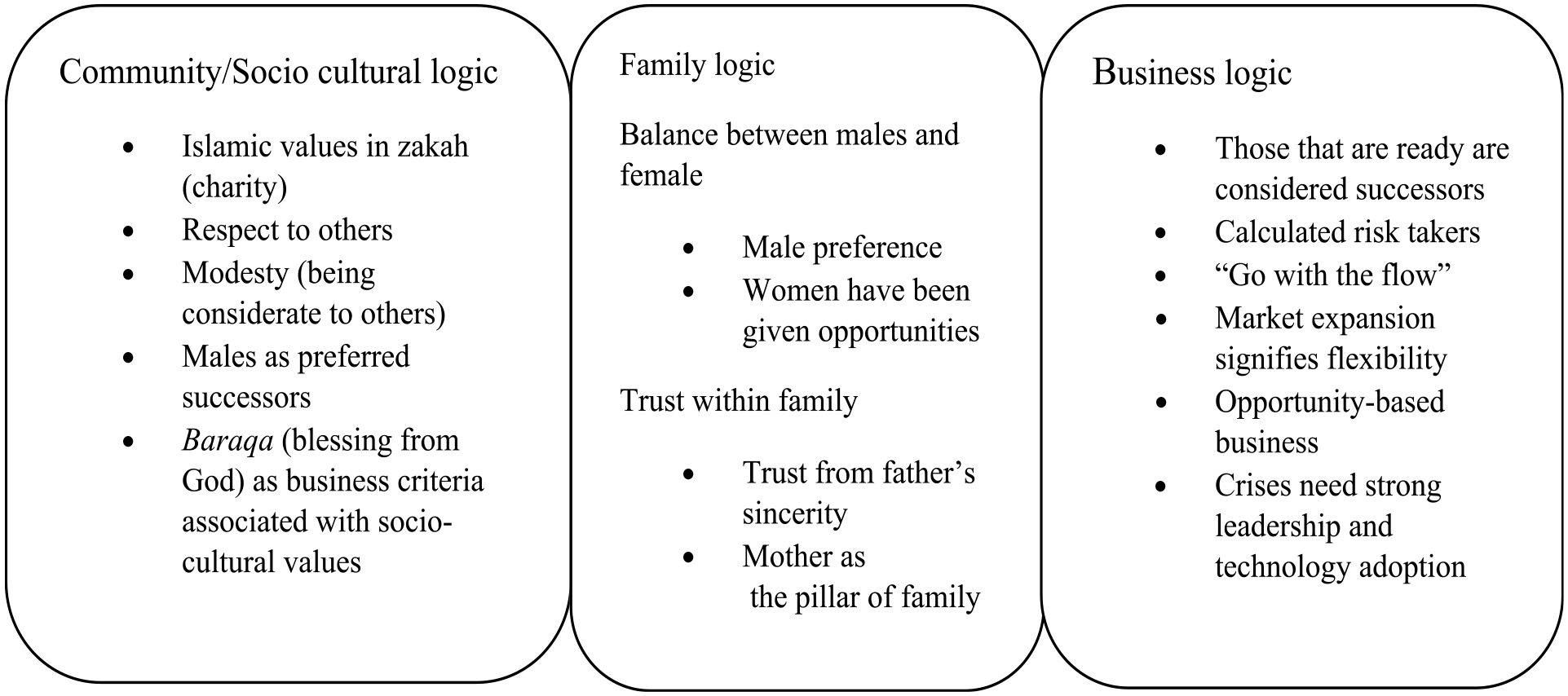
Further analysis was further conducted based on the institutional logic approach and presented in the following Figure 2.
Family business logics.
Basco (2017) used the institutional logic approach to analyze the intricate connections between family, business, and community logic in unique settings. In this study, community and sociocultural logic were evident through the incorporation of Islamic values and norms such as zakah (alms), baraqa (blessing from God), and male preference which is a socially constructed norm in Muslim community. Business logic viewed male successors as the norm because they are traditionally better positioned to innovate due to their greater access to networks and partnerships. Wang et al. (2022) suggested that female entrepreneurs need to enhance their social capital to secure external financing. This means the ability of female entrepreneurs to establish networks and demonstrate innovative abilities can assist in balancing the male preference in succession planning and family business innovation. Moreover, predecessors are expected to assess the current situation and consider the potential role of women as CEOs, particularly for family business innovation. It is also interesting to note that crises such as the pandemic encouraged the enthusiasm for strong leadership associated with the preference of males as successors as indicated by some of the interviewees. However, Leppäaho and Ritala (2022) reported the ability of strong technological and digital innovation capabilities to serve as the turning point for family business during and after the pandemic. This business logic showed that female successors with these capabilities also have the potential to lead family business innovation. Meanwhile, it was discovered that all female respondents interviewed had no specific digital technology and marketing capabilities and this made them indecisive successors. These findings led to the development of five propositions considered to have the capability to address the correlation among gender, succession planning, and family business innovation.
P1. In the context of a matrilineal society with a strong bargaining position for female, the appointment of females without a proper plan for a succession role can reduce the level of innovation in family business compared to male successors.
P2. In the context of matrilineal society, women can play a greater role as the foundation of family business due to their function as wives and mothers by inspiring equality within the operations of business.
P3. In terms of family logic, the ability of the predecessors to lead by example and instill trust is the main inspiration to ensure dynamism in family business activities including succession planning and innovation.
P4. The socio-cultural logic of matrilineal Muslim society studied indicated the preference for male successors but business logic showed that female with the capabilities to innovate can also lead family business as the CEO. This means the predecessor can select a female that displays appropriate knowledge and skills from the beginning of business as successors.
P5. A Muslim society with highly spiritual capital such as the Minangkabau considers the concept of baraqa (blessing from God) an important success criterion that brings comfort and guidance to family business. Therefore, submission to God and sincerity are recommended as the foundation and ways to conduct business activities.
Conclusions
This study contributes positively to the existing literature on family business and entrepreneurship which was discovered to have been less focused on, especially concerning matrilineal and Muslim societies. The findings showed the possibility of a strong link between family succession planning and business innovation in Minangkabau’s matrilineal and Muslim society. It was discovered that these two important family business components, namely succession and business innovation, are interlinked. Moreover, two patterns identified for a succession planning aspect include the lack of a clear plan and the preference for a male child as a successor. The first pattern emerged as a result of a series of indecisive rules but this does not mean it is a bad decision due to the possibility of achieving effective operations based on the existence of complete trust among family members. The survival, stability, and calculated risk of family business with this pattern were found to be conservative but produced consistent results in terms of business innovation such as market expansion. Meanwhile, the second pattern was observed to be closer to the operations of a real business organization with a standard organizational structure, the ability to embrace changes, and the capacity to benefit from networks. This means the pattern was suitable for the development and implementation of innovation in family business. It was also discovered that socio-cultural logic supports the preference for males as successors. Furthermore, female in matrilineal system are not required to become entrepreneurs or pursue careers because they are the natural inheritors of ancestral properties. This means female have “nothing to lose” while men are being prepared to become natural leaders due to their lack of assets. The study showed that female successors may not be favored in terms of business logic but they can seize opportunities to lead family business when they demonstrate the appropriate capabilities. The results also revealed that trust and sincerity from predecessors are important factors that could help maintain family business cohesion. Moreover, the interviewees did not discuss any potential conflicts between Islamic beliefs and the Minangkabau tradition that places women as inheritors of ancestral properties and grants them a strong bargaining position relative to men.
Limitations and Future Research Suggestions
The present study provided further understanding concerning the Minangkabau family business which is one of the sources of entrepreneurship in Indonesia. A total of five propositions were also indicated to be explored further in future studies. Moreover, there is a need to analyze the data from more respondents engaged in family business in Minangkabau using a quantitative approach to ensure better generalization of the findings. More focus should be placed on comparing female and male family business owners in both patriarchal and matrilineal societies. It will also be interesting to analyze family business of migrants in Minangkabau. Another important observation was that this study only focused on innovation of family business without any attention to the outcomes even though all the interviewees were selected because of their reputation and overall business performance. Therefore, there is a need to study business performance or innovation effectiveness of these family business in the future. It is also important to examine the technological innovation that can be effectively implemented by family business, especially those with female CEOs in order to determine their capabilities to innovate during and after crises. Furthermore, a missing link was identified between Islam and business, especially the concept of spirituality and business performance, and this needs further analysis. Lastly, there is a need to apply a more feminist approach to compare the aspirations and business strategies of women in Minangkabau to their male counterparts.
Practical and Social Implications
This study identified two distinct paths taken by the interviewees and these emphasized the importance of trust and strategic business planning such as market expansion and network development. It is crucial to maintain consistent trustworthiness, especially in situations where there is no clear succession plan or strategic vision for innovation. Moreover, interviewees should initiate discussions about business innovation including market expansion and internal affairs such as profit and loss sharing to strengthen the “traditionalist” approach. The adoption of genuine organizational innovation can also assist in accelerating business growth considering the existence of a strong trust foundation. From a social perspective, the Minangkabau ethnic group, which has long been studied by anthropologists and sociologists, has the ability to provide valuable insights regarding the connection between family business and cultural values. This is possible because the group maintains its identity despite the influence of several social changes. However, the reliance of the interviewees on trust and family values may not be fully compatible with contemporary business practices and this means their activities need to be supported by modern system. In this case, role of women as limpapeh rumah gadang which emphasizes their functions as mothers and wives need to be reinterpreted by society. Therefore, women need to voice their aspirations earlier and more explicitly.
Footnotes
Declaration of Conflicting Interests
The author(s) declared no potential conflicts of interest with respect to the research, authorship, and/or publication of this article.
Funding
The author(s) disclosed receipt of the following financial support for the research, authorship, and/or publication of this article: This work was supported by Universitas Andalas (T/59/UN.16.17/PT 01.03/Soshum-RPT/2022).
Ethical Approval
The present study has been approved by the Institutional Review Board of Universitas Andalas. All participants agreed to be interviewed by signing consent forms.

Data Availability Statement
Data sharing is not applicable to this article as no datasets were generated or analyzed during the current study.