



Abstract
This study examined the mediating role of social connectedness and perceived spousal support in explaining the relationship between parental burnout, and their interpersonal cognitive distortions. The research was conducted within the framework of the correlational model. The research sample consisted of 526 married parents. Data were analyzed using Regression analysis and SPSS Process Macro. As a result of the study, it was found that parents’ interpersonal cognitive distortions positively and significantly explained their burnout. It was found that social connectedness and perceived spousal support had a significant partial mediating role in defining the relationship between parental burnout, and their interpersonal cognitive distortions. The mediation effect was found to be close to a moderate effect size. In light of these results, it was suggested that psychoeducational activities should be carried out to prevent or reduce burnout in parents to develop rational thoughts about their interpersonal relationships, strengthen their social connectedness, and increase supportive relationships between spouses.
Plain language summary
Parenthood is a role that individuals gain with children’s entry into their lives and brings essential responsibilities. While fulfilling parental duties, individuals sometimes find themselves in a spiral of unsolvable problems. When parents feel exhausted, they need resources to support them. Examining the characteristics accompanying this journey is essential since it is impossible to resign or retire from the parenting role. This study examined the effects of interpersonal cognitive distortions, social connectedness, and perceived spousal support, which were predicted to improve parental burnout. Information about these characteristics was collected from 526 married parents. According to the study results, parents’ undistorted thoughts about relationships, strong social connections with the environment, and supportive relationships with their spouses helped reduce their burnout. Parents should be encouraged to develop healthier thoughts about their interpersonal relationships, strong social ties with the environment, and supportive relationships with their spouses to reduce burnout.
Keywords
Introduction
Parenting understanding and values may differ from culture to culture (Bornstein, 2013). In order to better understand parenting in Turkey, it was deemed important to first analyze the Turkish family structure. Turkey is generally considered a collectivist culture (Hofstede, 2011; Hofstede et al., 2010). Individualistic cultures emphasize autonomy and self-confidence, while collectivistic cultures value obedience and conformity (Harkness & Super, 2006). Kağıtçıbaşı (2000) states that interdependence is more prominent than autonomy and independence in family relationships in Turkey. However, with the impact of social changes and modernization Turkey’s family structure changed and individualism has come to the fore in family relations (Hatipler, 2023). In support of this view, Engin (2022) states that the family structure has changed with individualization in Turkey; family dissolution has increased, the sense of togetherness has decreased and raising children has become more difficult.
In Turkey, more than one family member has entered the labor force due to difficult economic conditions; the roles of men and women in the family have changed with the change in gender roles, and phenomena such as equal division of labor between men and women and help with housework have come to the fore (Akbaş, 2024; Uluğtekin Bulu, 2011). Tekin Epik et al. (2017) and Zeybekoğlu (2013) state that with the entry of women into working life in Turkey, fatherhood roles have changed and parent’s awareness to assume joint responsibility has developed. However, it is emphasized that even in families where mothers work full-time, most of the childcare and housework is still done by mothers (Aguiar-Quintana et al., 2021; Matias et al., 2012). Therefore, although spouses undertake the economic burden of the family together, it is stated that the workload of women in Turkey has not changed due to their traditional roles and their responsibilities in housework are higher than men (Çarkoğlu & Kalaycıoğlu, 2013). In support of this view, the results of the Turkish Family Structure Survey revealed that women generally undertake housework (childcare [94.4%], laundry and dishwashing [85.6%], cooking and daily cleaning of the house [85.4%], setting and clearing the table [84.8%], ironing [81.8%]), while men are responsible for providing for the household (74%). In addition, in this study, it was determined that spouses’ not helping each other, irresponsible and indifferent behavior is the most important determinant of divorce (Turkish Statistical Institute [TÜİK], 2021). It was determined that 187,343 people divorced in Turkey in 2024 which increased compared to previous years reaching the highest level in history (TÜİK, 2024). In light of these explanations, it is understood that it is important for couples to share the responsibility of being a spouse and parent and to support each other for their marriages to continue healthily.
While people generally expect parenthood to be a pleasant experience, it involves a complex range of emotions, including joy, stress, and uncertainty. Faircloth (2014) states that in recent years, parental attitudes such as how parents feed, discipline, and engage in play with their children have become a focal point in public discussions and academic research. With the change in expectations toward parents, it is assumed that parents who were accepted as attentive parents 50 years ago can now be seen as neglectful parents at best (Nelson, 2010). It is thought that the increase in expectations regarding the parental role in society, the frequent topics of “How to be a better parent” on digital platforms, and the increase in “phenomenal parents” may increase the sensitivity of parents about the extent to which they can fulfill the requirements of being a parent. It is stated that parents may experience burnout when they cannot cope with the pressures and expectations (Mikolajczak & Roskam, 2018). In addition, it has been emphasized that parents’ high standards and expectations for their children may also cause them to experience burnout (Lin, Szczygieł, & Piotrowski, 2022).
Factors such as the numerous tasks that come with being a parent and the lack of external support (family and social support) can increase parental burnout, while factors such as leisure activities and time allocated for rest can reduce burnout (Sorkkila & Aunola, 2020). Indeed, Lindström et al. (2011) stated that parents who do not receive adequate social support and cannot find leisure time are more likely to experience burnout. For example, studies examining the COVID-19 pandemic period as a time in which parents’ social support sources decreased, and their responsibilities at home increased revealed that parents experienced more burnout during this period (Le Vigouroux et al., 2022; G. Li et al., 2023; Mikolajczak & Roskam, 2018; Woine et al., 2022). It was found that parents with high resilience during the pandemic process experienced less burnout (Sorkkila & Aunola, 2022). In some studies, it has been observed that parental burnout negatively affects parents’ well-being and marital relationship, and may have destructive consequences such as neglect and abuse toward children (Mikolajczak et al., 2018), suicidal and escape thoughts (Mikolajczak & Roskam, 2018), and tendency toward violence against their children (Chen et al., 2019). In addition, it has been found that burnout negatively affects parent-child communication and children’s mental health (Yang et al., 2021; Yönel, 2021), and causes academic burnout (G. Li et al., 2023), anxiety, loneliness, aggression, depression and life dissatisfaction in children (Yuan et al., 2022). When the prevalence of parental burnout is evaluated, it is accepted that it has a prevalence of 5% worldwide and is considered to be one of the public health problems of concern (Gruber et al., 2021; Mikolajczak et al., 2021) as it may have negative consequences for the health of the parent (Mikolajczak et al., 2019) and the health of the child (Yang et al., 2021).
In light of the above explanations, it is understood that parental burnout is a situation that parents need to cope with. It is thought that it is important to determine the factors that may be related to this situation to prevent harmful situations due to parental burnout. In this context, it is considered that examining the relationships between parental burnout and interpersonal cognitive distortions, social connectedness and perceived spousal support may contribute to the studies to be conducted to improve the lives of both parents and their children who may be affected by parental burnout. As a result, this study aims to reveal the relationship between parents’ interpersonal cognitive distortions and burnout and whether social connectedness and perceived spousal support mediate role in this relationship.
Theoretical Foundations
Parental Burnout
A child can sometimes be a source of great joy for parents, while at other times, they can bring endless work and fatigue. At this point, although parenting is a source of happiness, it can also cause burnout in parents (Çakmak & Arıkan, 2024). Parental burnout is described as including four primary symptoms; feeling intense exhaustion related to parental roles; emotional distancing of the individual from their children, loss of pleasure and competence in the parental role; perceived contrast between the previous and current parental self (thinking that the person was a better parent before) (Roskam et al., 2018). Mikolajczak et al. (2018) define parental burnout as the perceived inability to cope with the stresses and difficulties that occur with the responsibilities of being a parent. Roskam et al. (2017) define parental burnout as intense exhaustion related to the parental role in which the individual is emotionally distanced from the child and doubts their parenting skills. In a different definition, parental burnout is expressed as a psychological syndrome that develops due to chronic stress experienced as part of the parenting role (Ning et al., 2023). Mikolajczak et al. (2018) state that parental burnout covers four dimensions. These dimensions are listed as parents being physically and emotionally tired of being a parent, emotionally distancing from their children, fulfilling their responsibilities at a minimum level, and feeling ineffective in parenting. Mikolajczak and Roskam (2018) explain parental personality, wrong methods applied in child-rearing, and lack of social support as a risk factor for parental burnout; although parental self-compassion, child-rearing skills, leisure time utilization, and social support as protective factors. Sorkkila and Aunola (2022) emphasized that being a young parent, spending more time with their children, having a child with special needs and having a young child are determinants of parental burnout.
Interpersonal Cognitive Distortions
According to the cognitive approach, thoughts form the basis of emotions and behaviors (A. T. Beck et al., 1979). J. S. Beck (2014) explains the cognitive structure of schemas, which are shaped by individual experiences and serve as a framework for interpreting future events. He also discusses cognitive distortions that arise from negative schemas and introduces the cognitive triangle, which represents an individual’s thoughts about the self, future, and life, influenced by these distortions. “Cognitive Theory” states that cognitive structures, including cognitive schemas, cognitive distortions, and cognitive triangles, are related to each other and prepare the ground for unrealistic evaluations (Pössel & Thomas, 2011). It is stated that the harmful content of these cognitive structures causes depression (A. T. Beck, 2002). In addition, A. Beck (1976) emphasizes that depressive symptoms in individuals are caused by cognitive distortions related to the events experienced by the individual. Cognitive distortions are defined as making wrong inferences based on erroneous or insufficient information and difficulty identifying reality (A. T. Beck, et al., 1979). Corey (2016) defines cognitive distortions as logic errors in individuals’ thought systems. According to Briere (2000), the most common cognitive distortions are self-criticism (low self-esteem), tendency to blame oneself (feeling responsible for adverse events beyond one’s control), feeling of helplessness (general state of anxiety), hopelessness (belief in hopelessness about the future), and preoccupation with danger (exaggeration of dangers and troubles in the world). Cognitive distortions negatively affect individuals’ evaluation of interpersonal relationships (Hamamci, 2005).
Interpersonal cognitive distortions are defined as individuals having perfectionist, rigid, and dysfunctional thinking about interpersonal relationships (DiGiuseppe & Zee, 1986). Hamamci and Büyüköztürk (2004) analyzed interpersonal cognitive distortions in three dimensions: intimacy avoidance, unrealistic relationship expectations, and mindreading. The closeness avoidance dimension explains the belief that establishing relationships with others will bring negative consequences, the unrealistic relationship expectancy dimension explains the high expectations one’s behavior and the behavior of others, and the mind reading dimension explains the unrealistic estimation of others’ thoughts and feelings. Individuals with interpersonal cognitive distortions are more prone to misunderstanding and misinterpreting behaviors (Leung & Poon, 2001) and therefore experiencing conflict (Hamamci & Büyüköztürk, 2004). However, as individuals’ interpersonal cognitive distortions increase, their anxiety and avoidance (Yazici-Celebiİ et al., 2024), separation anxiety (Başbuğ et al., 2016) and psychological vulnerability (Elmas, 2022) increase; their marital satisfaction (Gezer & Özkamalı, 2023) and life satisfaction (Elmas, 2022) decrease. It was found that childhood traumas, anxious attachment (Demir Kaya et al., 2023), perceived parental rejection (Epli et al., 2021), and loneliness (Turan, 2010) had an increasing effect on the emergence of interpersonal cognitive distortions.
Social Connectedness
The need to belong, accepted as one of the basic psychological needs of individuals (Baumeister & Leary, 1995), is expressed as initiating and maintaining meaningful relationships in the social environment (Amodeo, 2014). The need for belonging arises when individuals feel the necessity to establish social relationships and to be together (Gültekin & Arıcıoğlu, 2017). Lee and Robbins (1995) argued that belonging consists of three dimensions: companionship, emotional closeness, and commitment, and extended the definition of belonging to include social connectedness. Lee and Robbins (1998) define social connectedness as an individual’s subjective perception of feeling a meaningful part of social and emotional relationships. Malecki and Demaray (2002) define social connectedness as a reflection of individuals’ closeness and belonging to social life. In a different definition, social connectedness is defined as the level of being close, establishing relationships, and sharing resources with people in various social groups such as family, school, neighborhood, and community (Townsend & McWhirter, 2005).
The development of social connectedness continues throughout life as secure attachment in infancy (Karcher & Sass, 2010), the search for identity and establishing emotional relationships in adolescence, and the desire to develop close relationships in adulthood (Lee & Robbins, 2000). In the “Thriving Through Relationships” Model, which emphasizes the importance of close relationships, it is assumed that close relationships (family, romantic partner, spouse) are vital for development, protect individuals from the adverse effects of stress, support their development, and help them get stronger from challenging life conditions (Feeney & Collins, 2015). Singer (1998) states that close relationships contribute to individuals finding purpose and meaning in their lives. Okur et al. (2025) also stated that close relationships within the family are a protective factor for psychological health and family communication is related to happiness.
When the literature is examined, it is seen that different theoretical approaches are addressing social connectedness. For example, according to “The Interpersonal Theory” which emphasizes the importance of social ties, individuals’ feelings, thoughts, and behaviors can affect and be affected by others (Coyne, 1976; Kiesler, 1996). In support of this view, Joiner et al. (1999) found that depression has an interpersonal nature and depression can be improved through social relationships. Similarly, according to “Social Networks Theory” the health and well-being of individuals are affected by the health and well-being of the people around them (Smith & Christakis, 2008). According to “Social Capital Theory” another approach to social connectedness, it is important for individuals to have continuous and extensive social networks and to establish strong social ties with society for the development of their social capital (Bourdieu, 1986). Social capital obtained from relational ties such as marriage, family, and friendship is associated with happiness, life satisfaction, and health, that is, subjective well-being (Helliwell & Putnam, 2004). Similarly, Ehsan et al. (2019) emphasized that social capital is good for physical and mental health and protective against mortality. According to “Social Identity Theory” which is another approach that deals with social connectedness, individual characteristics and the structure of the social group in which they live are effective in forming individuals’ social identity (Tajfel & Turner, 1979). The basic premise of this theory is that in many social situations, people think of themselves and others not as unique individuals but as members of a group (Ellemers & Haslam, 2012). According to Haslam et al. (2021), it is considered important for individuals to have good relationships with other people in coping with difficulties in life, and it is emphasized that social identity contributes to psychological well-being with the feelings of trust and support brought by belonging to a group. Lee and Robbins (1995) explain social connectedness within Kohut’s “Self-Psychology Theory” framework. According to these researchers, every human being is an object, and these objects, that is, people, fulfill other people’s needs of being loved, cared for, approved, or respected, and individuals’ selves thus develop (Kohut, 1977).
Social connectedness is associated with psychological well-being and general physical health (Mehrpour et al., 2024; Williams & Galliher, 2006), and it is accepted that social connectedness is a strong determinant of mental health (Beutel et al., 2017; Wickramaratne et al., 2022). Individuals with high social connectedness feel that they belong to a family, friend, or social group, are more easily included in social environments (Lee et al., 2001; Lee & Robbins, 1998) and develop more meaningful relationships in their environment (Kaminski et al., 2010). It has been emphasized that individuals with low social connectedness may avoid interpersonal relationships, see themselves as strangers in social environments, feel misunderstood by others, and have difficulty establishing relationships in social life (Lee et al., 2001; Lee & Robbins, 1998).
Perceived Spousal Support
It can be said that social support from the environment plays a vital role in people’s ability to cope with difficult life events. Social support can occur in different forms, such as getting help from the environment with a problem, obtaining information, economic support, or emotional support (İ. Yıldırım, 2004). Thoits (1995) defines social support as helping people under stress. According to Haslam et al. (2021), stress is a subjective experience; a similar situation may cause different reactions in individuals. Lazarus and Folkman (1984) emphasize that the adequacy of coping resources and the threat to the self effectively perceive an event as stressful. Emphasizing that social support has a positive role in coping with stress, Cohen and Wills (1985) explain this role within the framework of the Buffering Model and Main Effect Model. According to the “Main Effect Model” social support alone contributes directly to well-being, and having social support improves one’s general health regardless of stressful or non-stressful situations. According to the “Buffering Model” social support protects individuals against the adverse effects of stress in stressful situations and reduces psychological distress. These two models provide a basic framework to explain the positive relationship between social support and well-being. According to “Relational Regulation Theory (RRT)” another approach in which social support is emphasized as an important factor that reduces stress is that people regulate their emotions, thoughts, and actions through daily interactions with others. In this way, it has been stated that the social support they receive reduces stress and contributes to individuals’ positive well-being (Lakey et al., 2010).
Lakey (2010), in his “Social Support Theory” (SST), divides social support into two: perceived support (subjective belief that one will be helped in stressful times) and received support (concrete acts of help received in stressful times). The quality of social support may vary according to the help-seeking efforts and social skills of the person receiving support and the resources and motivation of the person providing support (Feeney & Collins, 2015). Individuals’ sources of social support are their parents, family members, spouses, friends, neighbors, relatives, etc. (İ. Yıldırım, 2004). Spousal support, one of the social support sources for individuals, can be categorized into two types: received support, which refers to the number and quality of support behaviors offered by spouses, and perceived support, which relates to individuals’ perceptions of the presence and adequacy of support (Dehle et al., 2001). It has been emphasized that the support perceived from the spouse after a stressful life event is more positively practical than the support received (Helgeson, 1993). Cutrona (1996) emphasizes that spousal support has four aspects: helping to prevent emotional withdrawal and depression in stressful situations, preventing conflicts from turning into destructive behaviors, strengthening emotional bonds between spouses and providing a positive marital experience. According to Rugel (1997), the basis of many problematic marriages is that the spouses do not support each other. Yedirir and Hamarta (2015) also stated that spouses’ perception of emotional support, evaluation support and social friendship support from their partners increased their marital satisfaction.
The Relationships Between Variables
In this study, it is predicted that there is a positive relationship between parental burnout and interpersonal cognitive distortions (H1). According to “Cognitive Behavioural Theory (CBT)” one of the theoretical approaches examined to explain this hypothesis, emotional difficulties experienced by individuals are related to how they interpret events (J. S. Beck, 2014). According to this theory, the factor that elicits emotion as a result of events is the thoughts about the event rather than the event itself (A. T. Beck, 1991). In addition, people tend to create irrational cognitions, develop unhealthy emotions, and exhibit dysfunctional behaviors (Ellis, 1991). A. Beck (1976) defines cognitive distortions as the wrong attitudes, opinions, and beliefs of individuals toward their own or others’ social behaviors and states that cognitive distortions cause the emergence of depressive symptoms in individuals. However, repetitive cognitive distortions lead to mood disorders (Leahy, 1997), anxiety disorders (Kashdan et al., 2006; Tairi et al., 2016; Wilson et al., 2011), social anxiety (Çakır, 2010), and problems in social life and bilateral relationships (Sharf, 2015). In this study, it was predicted that interpersonal cognitive distortions may increase parental burnout.
Although the reviewed study examined the relationship between parental burnout and interpersonal cognitive distortions, it was found that parents’ negative cognitive evaluations of their parenting increased parental burnout (Woine et al., 2022). When examining the relationship between parental burnout and early maladaptive schemas, it was found that schemas such as abandonment/instability, defectiveness/shame, dependency/incompetence, failure, pessimism, and punishment had a positive effect on burnout (Le Vigouroux et al., 2023). These results suggest that there may be a negative relationship between parental burnout and interpersonal cognitive distortions. Parents may experience less burnout as they develop rational thoughts in their relationships with other people.
In this study, it is predicted that there are negative relationships between interpersonal cognitive distortions and social connectedness (H2) and perceived spousal support (H3). According to “Attachment Theory” which is one of the theoretical approaches examined to explain these hypotheses, the experiences internalized by the individual as a result of his/her relationship with the attachment figure constitute a prototype for the close relationships he/she will develop outside the family in the following period (Bowlby, 1975). Similarly, Park and Waters (1989) emphasize that the mother-child bond is important in the child’s social development and subsequent close relationships. Bartholomew and Horowitz (1991) stated that individuals with secure attachment styles can easily establish close relationships, while individuals with obsessive, anxious, and indifferent attachment styles, which are defined as insecure attachments, have negative feelings toward both themselves and others. Although no study examines the relationship between parents’ interpersonal cognitive distortions and social connectedness, Çiftçi (2022) found a negative relationship between interpersonal cognitive distortions and family belongingness. Demir Kaya et al. (2023) revealed that people with more interpersonal cognitive distortions have anxious attachment. However, it was found that there was a negative relationship between parents’ interpersonal cognitive distortions and perceived spousal support (Muhtar, 2022). Based on these results, it can be said that parents’ distorted thoughts about their relationships may negatively affect their social connectedness and perceived spousal support.
In this study, it is estimated that there is a positive relationship between parents’ social connectedness and perceived spousal support (H4). It is thought that individuals’ social connectedness may affect their relationships with their spouses. Individuals with high social connectedness are likely to establish closer and trust-based relationships with their spouses. This closeness may increase recognizing and appreciation of spousal support. On the other hand, as social connectedness increases, individuals’ tendency to be supportive may increase. Thus, individuals may offer more support to their spouses. Considering the reciprocal nature of support, support from one spouse may increase the support from the other. In addition, individuals with high social connectedness can express themselves more comfortably by establishing open communication. Thus, they can request their spouses’ support more openly. Although there is no research on the relationship between the support parents perceive from their spouses and their social connectedness, Duru (2008) found a positive relationship between social connectedness and perceived family and personal support. Santini et al. (2015) also found that perceived social support and social connectedness have a protective role in the prevention of depression. In addition, it is observed that as the social connectedness of the parents increases, the perceived spousal support may also increase.
In this study, it is predicted that there is a negative relationship between parental burnout and social connectedness (H5). Among the theoretical approaches examined to explain this hypothesis, Ren et al. (2024), in their study based on the “Ecological Systems Theory” developed by Bronfenbrenner (1979), classified the factors affecting parental burnout of parents with children aged 0 to 18 as microsystem (individual factors), mesosystem (interpersonal factors), exosystem (organizational or social factors) and macrosystem (society/policy or culture factors). As a result of the study, the most related factors are microsystem (individual factors, gender, education level, and income) (Prandstetter et al., 2023); mesosystem (interpersonal factors, poor parent-child relationship) (Zhuo et al., 2022), good communication between spouses, sharing responsibilities and emotional support (Ren et al., 2024) ecosystem (organizational or community factors, more children in the household) (Favez et al., 2023; Sodi et al., 2020), childhood diseases (Hong et al., 2022; Liu et al., 2024), social support (Lin, Goldenberg et al., 2022; Szczygieł et al., 2020); macrosystem (less parental burnout in collectivist cultures) (Ren et al., 2024). There is no research examining the relationship between parental burnout and social connectedness, which is the other variable of the study. Negative relationships were found between parental burnout and having a collectivist culture and being compatible, and positive relationships were found between having an individualist culture (Le Vigouroux & Scola, 2018; Roskam et al., 2021; Wang et al., 2025). Therefore, it is evaluated that as the societies of parents become stronger, their likelihood of experiencing burnout may decrease.
In this study, it is predicted that there is a negative relationship between parental burnout and perceived spousal support (H6). Ulusoy (2021) found a negative relationship between perceived spousal support and parental burnout in support of this hypothesis. According to Mikolajczak and Roskam’s (2018)“The Balance Between Risks and Resources Theory (BR2),” the imbalance between parenting demands (risk factors) and parenting resources (protective factors) causes parental burnout. According to this theory, parental perfectionism, low social intelligence, lack of spousal and external support (family, nursery, etc.), lack of emotion management, single parenthood, poor coping skills, a high number of children in the household are listed as risk factors. In contrast, parental self-compassion, leisure time, spousal support, co-parenting, and positive child-rearing practices are exemplified as protective factors. In addition, in this theory, to prevent parental burnout, increasing resources to help cope is considered an effective method to prevent and intervene in parental burnout.
Single parenthood, one of the risk factors, is defined as the mother or father being responsible for the care of the child alone as a parent (Karaca Aydın, 2019). Single parenthood is an important situation that can occur due to situations such as divorce and the loss of a spouse, causing the family to break up and all family members to be negatively affected (Türkarslan, 2007). Some people may become single parents by having a child out of wedlock, adopting a child or becoming a surrogate mother (ArıcıÖzcan, 2017). Regardless of the form of single parenthood, single spouses in these families have to carry out many tasks alone, such as childcare, financial obligations of the house, and continuing the responsibilities of the spouse who left home (Aydıner Boylu & Öztop, 2013). Co-parenting is considered a risk and protective factor, includes consensus on parenting practices, supportive and empowering communication about parenting, division of labor and joint family management (Feinberg, 2003). Co-parenting takes the relationship between parents beyond the romantic relationship and parents can remain connected to each other through co-parenting despite their separation (Favez et al., 2013). Co-parenting includes supportive and non-supportive elements (Belsky et al., 1996). While supportive co-parenting is characterized by parents communicating effectively with each other and cooperating in raising their children, unsupportive co-parenting is related to disagreements and conflicts between parents about child rearing (Kara & Sümer, 2022; Teubert & Pinquart, 2010). Therefore, co-parenting can be expressed as a protective factor contributing to family happiness and a potential risk factor that may complicate family relationships (Favez et al., 2013).
Parental stress may decrease in cases where the person agrees with his/her spouse on parenting goals and practices, where the spouse takes an active role in decision-making processes, and where the person is valued as a parent (Durtschi et al., 2017; Mikolajczak et al., 2017). Supportive co-parenting reduces parental stress (Mikolajczak et al., 2018), increases marital satisfaction (Favez et al., 2013; Talbot & McHale, 2004), and makes parents feel competent (Feinberg, 2003; Galaugher, 2018). On the other hand, unsupportive co-parenting leads to increased parenting stress (Choi & Becher, 2019) and parental burnout (Bastiaansen et al., 2021; Mikolajczak & Roskam, 2018; S. Yıldırım, 2023) and decreased parenting competence (K. Crnic & Ross, 2017). However, single parents were found to experience more burnout (Arikan et al., 2020). In light of these research results, it can be stated that spouses’ support for each other may reduce the likelihood of experiencing burnout.
In this study, it is predicted that the increase in parents’ interpersonal cognitive distortions will increase their perceptions of social connectedness and spousal support, which may decrease their burnout (H7). No research on this subject was found. In addition, there is no theory explaining the relationship between these variables. Parents’ negative and distorted thoughts may cause their burnout to become more pronounced. Moreover, as their interpersonal cognitive distortions increase, parents’ engagement with their social environment (friends and community) and the support they perceive from their spouse may decrease. On the other hand, parents’ positive social relationships and support may help prevent burnout. As the social connectedness of individuals and the support they receive from their spouses increase, the effect of their distorted thoughts in their relationships may decrease, and they may feel less burned out.
Conceptual Framework
Today, parents may develop high standards for raising their children and feel intense social pressure to succeed. Individuals who think they cannot be good parents and feel inadequate may set unattainable parenting goals and may become exhausted in their efforts to achieve them. This may also be influenced by their partners’ support and expectations, shaping their sense of adequacy in parenting. At this point, interpersonal cognitive distortions may come into play. It is estimated that parents with unrealistic relationship expectations may have high expectations for both their behaviors and the behaviors of their children and spouses. At the same time, it is thought that parents with interpersonal cognitive distortions may decrease their social connectedness, avoid close relationships, and even decrease their perceived spousal support. On the other hand, it is predicted that parents may experience less burnout when they feel they belong to an environment and perceive support from their spouses.
When the literature on parental burnout was examined, it was noticed that this concept started to be addressed relatively more during the COVID-19, and the number of studies on parental burnout was limited. Some studies examine the relationships between the research variables. However, no study was found to examine the relationship between parental burnout and interpersonal cognitive distortions, social connectedness, and perceived spousal support. In addition, there is no research on the mediating role of social connectedness and perceived spousal support in explaining the relationship between parental burnout, and their interpersonal cognitive distortions. In this study, it is predicted that as parents’ interpersonal cognitive distortions increase, their burnout will increase as their social connectedness and perceived spousal support decrease. The research results can provide insight to parents and mental health workers in understanding parental burnout and protecting and increasing the well-being of parents. In addition, the results obtained from the study may indirectly contribute to improving the lives of children affected by parental burnout. From this point of view, this study aims to examine whether there is a mediating role of social connectedness and perceived spousal support in the relationship between parents’ interpersonal cognitive distortions and burnout. Regression analysis and SPSS Process Macro were used to analyze the data obtained to test the multidimensional relationships between the study variables (Model 6). There is no study in which the research variables are analyzed together. This research can contribute to the literature in this way. The following hypotheses were developed for this study and tested within the scope of a mediation model (Figure 1).
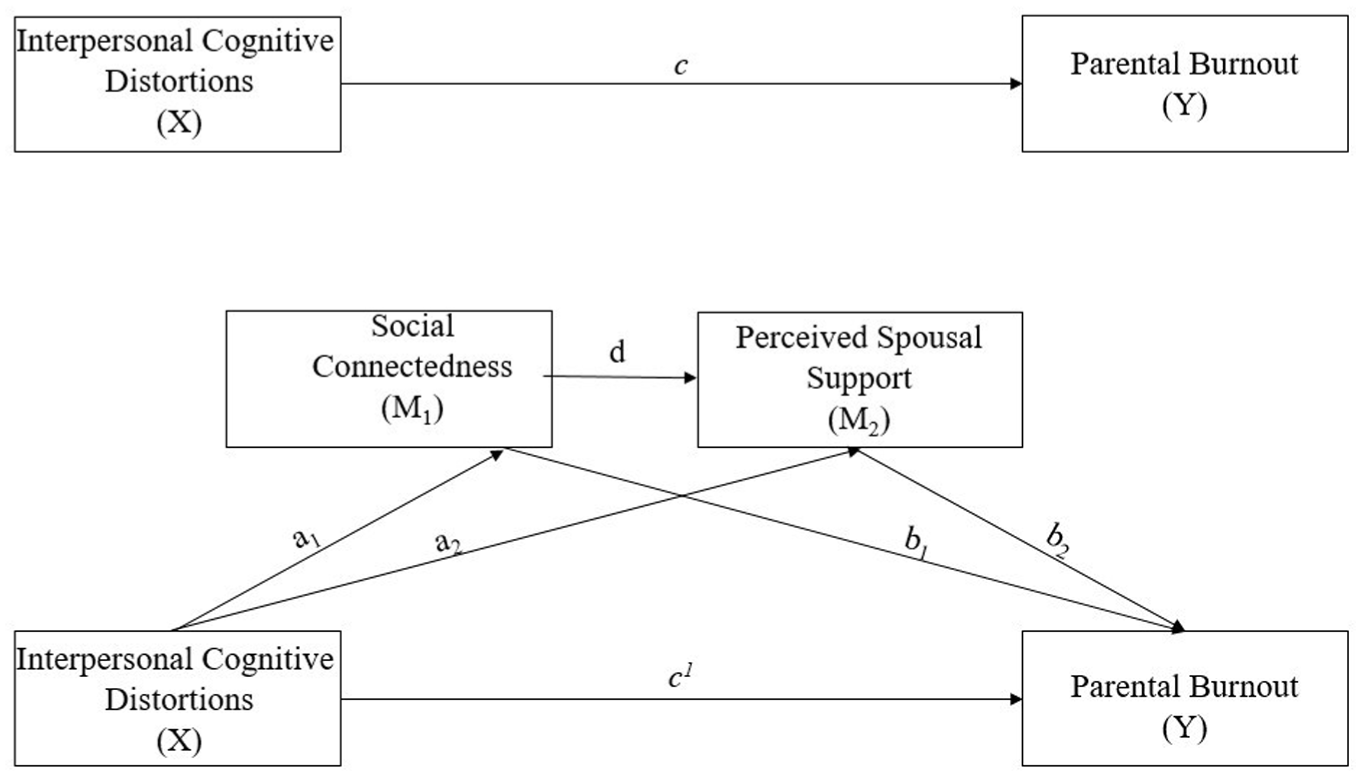
Hypothetical model of the study: Model 6 (Hayes, 2013).
Hypotheses
Method
Research Design
This study examined whether social connectedness and perceived spousal support mediate the role of explaining the relationship between parental burnout, and their interpersonal cognitive distortions. The research was conducted within the framework of the correlative investigation model. This correlation model, reveals the presence or absence of relationships between two or more variables describing the level of existing relationships (McMillan & Schumacher, 2010). The dependent variable of this study is parental burnout; the independent variable is interpersonal cognitive distortions, and the mediating variables are social connectedness and perceived spousal support.
Participants
The study sample consisted of 526 married parents with children. However, it was not known whether the participants were married to each other. The research scope, reached 424 female (80.6%) and 102 male (19.4%) participants. The gender distribution in the sample emerged randomly, with a predominance of female participants. The age range of the participants was 24 to 55, and the average age was 42.36. The research sample was determined within the framework of the criterion sampling method. In the criterion sampling method, units that meet the criteria specified for the sample were selected for the sample group (Marshall & Rossman, 2014). Since perceived spousal support, one of the mediating variables in this research was examined within the scope of the study, “married with children” was determined as a criterion in determining the sample group.
Instruments
Personal Information Form
The researchers, developed this form to collect information about the parent’s gender and age.
Parental Burnout Assessment (PBA)
In cooperation with Isabelle Roskam from Belgium and Arıkan and her colleagues in Turkey, The Turkish adaptation of the Parental Burnout Assessment (PBA) is now available (Arikan et al., 2020). The PBA has been used in some studies examining parental burnout (Yönel, 2021; S. Yıldırım, 2023). PBA consisted of four subscales: Emotional Exhaustion (EX) (9 items; e.g., I feel entirely run down by my role as a parent), Feelings of Being Fed Up (FU) (5 items; e.g., I cannot stand my role as father/mother anymore), Contrast with Previous Parental Self (CO) (6 items; e.g., I am no longer proud of myself as a parent), and Emotional Distancing (ED) (3 items; e.g., I do what I am supposed to do for my child(ren), but nothing more). The scale is a seven-point Likert type rated between never (0) and every day (6). An increase in the score obtained from the scale was interpreted as increasing parental burnout. Cronbach Alpha reliability coefficient was calculated for the entire scale (α = .90). When the validity findings of the scale were examined (Satorra–Bentler scaled Chi-square statistics (S-Bχ2) (226) = 3,498.67 (p < .001), CFI = 0.99, GFI = 0.99, RMSEA = 0.06; 90% CI [0.05, 0.07], and SRMR = 0.07.) the scale appeared to have good fit values (Arikan et al., 2020). Within the scope of this research, the reliability of the measurement tool was tested again, and the Cronbach Alpha internal consistency coefficient was calculated (α = .92). This value was understood to be at a good level (George & Mallery, 2003).
Interpersonal Cognitive Distortions Scale (ICDS)
In this study, the ICDS developed by Hamamci and Büyüköztürk (2004), was used to evaluate the cognitive distortions individuals have in their interpersonal relationships The ICDS has been used in some research examining interpersonal cognitive distortions (Bulut et al., 2020; Çetin & Hamamcı, 2023; Elmas, 2022; Karabacak, 2017; Yılmaz et al., 2023). The answers to the scale were arranged in a five-point Likert type, ranging from “I completely disagree” to “I completely agree.” The scale consists of three dimensions: avoidance of intimacy, unrealistic relationship expectations, and mindreading, and 19 items. Avoidance of Intimacy (AI) (8 items; e.g., Being too friendly with people often causes problems), Unrealistic Relationship Expectations (URE) (8 items; e.g., I want everyone I have a relationship with to share all their feelings and thoughts with me.), Mindreading (3 items; e.g., I understand what others think even if they do not express it). Higher scores on the scale indicate that individuals have more interpersonal cognitive distortions. In the liability analysis of the scale, the Cronbach Alpha coefficient calculated for the total scale was found to be .67, and the test-retest reliability coefficient was .74. For the criterion validity of the scale, its correlation with the Cognitive Distortions Scale, Automatic Thoughts Scale, and Conflict Tendency scales was examined, and it was found that the scale showed a positive and significant relationship with these scales (Hamamci & Büyüköztürk, 2004). Within the scope of this research, the reliability of the measurement tool was tested again, and the Cronbach Alpha internal consistency coefficient was calculated (α = .82). This value is understood to be at a good level (George & Mallery, 2003).
Social Connectedness Scale-Revised (SCS-R)
In this study, SCS-R developed by Lee and Robbins (2000) and adapted into Turkish by Sarıçam and Deveci (2017) was used to determine the social connectedness levels of individuals. The SCS-R has been used in a number of studies examining social connectedness (Baş, 2020; Satan, 2020; Tüzün et al., 2022). The answers to the scale were arranged in a six-point Likert type, ranging from “I totally disagree” to “I totally agree.” The scale consists of a single dimension and 20 items (e.g., I don’t feel relevant to most people). Items 1, 2, 3, 4, 5, 6, 8, 10, 15, and 18 in the scale are scored reversely. Increasing scores from the scale indicate that they have a greater sense of connectedness. As a result of the exploratory factor analysis applied to the data obtained from scale validity and was met with the Bartlett Sphericity Value (χ2 = 3,320.697, df = 190) and the value of Kaiser Meyer-Olkin (KMO) test’s result for sample suitability coefficient, was (0.92). As a result of the confirmatory factor analysis applied to the same data, it was determined that the A chi-square (χ2) goodness of fit test values (χ2/df = 160) = 299.54, p < .001, RMSEA = 0.07. CFI = 0.91. RMSR = 0.08) were at a good level. The study calculated the Cronbach Alpha reliability coefficient for the scale as .86 (Sarıçam & Deveci, 2017). Within the scope of this research, the reliability of the measurement tool was tested again, and the Cronbach Alpha internal consistency coefficient was calculated (α = .86). It is understood that this value is at a good level (George & Mallery, 2003).
Spouse Support Scale (SSS)
In this study, the SSS developed by İ. Yıldırım (2004) was used to measure the support that spouses perceive from each other. The SSS has been used in some studies examining perceived spousal support (Aydın et al., 2022; Kabasakal & Soylu, 2016; Temel & Efil, 2024; Vural Batık, 2019). The scale consists of 4 dimensions and 27 items: Emotional Support (ES) (9 items; e.g., It makes me feel like you are there for me.), Financial Aid and Information Support (FAIS) (7 items; e.g., He/She takes care of any problems regarding our home). Appreciation Support (AS) (8 items; e.g., Appreciates my achievements), and Social Interest Support (SIS) (3 items; e.g., He/ She talks to me and shares his troubles.). Each item in this scale is rated as a three-point Likert type (1 = not suitable for me, 2 = partially ideal for me, 3 = suitable for me). Items 10, 20, and 24 on the scale were scored reversely. Total scores ranged between 27 and 81. Higher scores on the scale indicated that the individual receives more support from their spouse. In the reliability analysis calculated for the total scale, the Cronbach’s Alpha coefficient was found to be (α = .95), and the test-retest reliability coefficient was (r = .89). The validity of the scale was tested in two ways: factor analysis and the validity of similar scales. The Kaiser-Meyer-Olkin (KMO) Test was used to measure how suited the data is for the scale’s construct validity, and a value of (r = .952) was obtained. Also, the Bartlett test was significant (p < .05). The Beck Depression Scale (BDS) (Turkish Form) was used to measure the validity with similar scales. A significant negative (r = −.27) relationship was found between the two scales (İ. Yıldırım, 2004). Within the scope of the current research, the reliability of the Spouse Support Scale (SSS) was tested again, and Cronbach’s Alpha internal consistency coefficient was calculated (α = .96), and this value was at a reasonable level (George & Mallery, 2003).
Data Collection
Permission to use was obtained from the researchers who developed the data collection tools to be used in this study. Research permission was obtained from the Ethics Committee of a university in Turkey (institution name and decision number blinded for peer review; approval date: 18.12.2023). Data were collected between February and March 2024. The purpose and content of the study were introduced to the participants. The Informed Consent Form for the research was presented to the participants, and their consent forms were obtained for voluntary participation. The scales were administered to the participants via online forms. The researchers collected the data in 1 month. Participants who wrote their e-mail addresses were promised that the results of the study would be sent to them.
Data Analysis
This study examined the mediating role of social connectedness and perceived spousal support in explaining the relationship between parental burnout, and their interpersonal cognitive distortions. In mediation analysis, it is determined whether the independent variable (X) explains the dependent variable (Y) through one or more mediating variables (M). In the model created within this framework, the direct and indirect effects of the independent variable on the dependent variable are investigated (Hayes, 2013). The model developed in the research will be analyzed using regression analysis. The research data analysis, first checked whether the assumptions required for regression analysis (Pallant, 2015) were met. The assumptions tested in this direction are: 1. Outliers, 2. Normality, 3. Multicollinearity, 4. Autocorrelation. The findings obtained regarding the control of these assumptions are below.
Outliers
In the study, outliers were calculated for each measure and analyzed univariate and multivariate. Z-scores were calculated for the data to determine the univariate outliers. According to Çokluk et al. (2012), data with z scores less than -3 and greater than +3 are univariate outliers. According to the analyses, it was understood that there were no data with these values. Mahalonobis distance value was calculated for multivariate extreme values. Considering that there is one dependent variable and three independent variables in the study, the degree of freedom (sd) value corresponding to .01 significance level in the Pearson’s Chi-Square (χ2) tests significance distribution table is 11.34 (Laurencelle & Dupuis, 2002). As a result of the analysis, it was seen that there was no Mahalonobis value in the data set that was higher than the prescribed cutoff value. In this way, it was accepted that the variables did not have multivariate extreme values.
Normality
Skewness and kurtosis values were calculated to test whether the variables in the study have a normal distribution (Table 1). In order to ensure a normal distribution, the skewness value is expected to be between −3 and +3, and the kurtosis value is likely between −10 and +10 (Kline, 2015). As a result of the analysis, the skewness values of the variables were between 1.357 and 0.164, and the kurtosis values were between 1.351 and 0.035. It was understood that the data showed a normal distribution.
Descriptive Statistics of the Variables of the Study.

Multicollinearity
To test whether there was a multicollinearity problem among the variables, the relationships between the study variables were analyzed by correlation analysis (Table 2). For no multicollinearity between the variables, the correlation value was expected to be lower than .90 (Pallant, 2015). As a result of the analyses, it was understood that the correlation values between the variables ranged from −.205 to .382. In addition, Tolerance Values (TV) and Variance Inflation Factor (VIF) values were calculated to test for multicollinearity. The VIF value should be less than 10, and the TV should be greater than 0.2 to avoid multicollinearity (Büyüköztürk, 2009). According to the results, TV values varied between 0.775 and 0.848, and VIF values ranged between 1.290 and 1.150. According to these results, there was no multicollinearity between the variables.
Pearson Correlation Analysis Results for the Relationship Between the Variables of the Study.

p < .01.
Autocorrelation
The Durbin-Watson coefficient was calculated to test whether there is autocorrelation between variables. This value was expected to be between 1.5 and 2.5 (Kalaycı, 2009). The calculated coefficient value was found to be 1.986; therefore, it was understood that there was no autocorrelation between the variables. After it was understood that the assumptions required for the regression analysis were met, the multiple mediation analysis was carried out to examine whether the mediating variables (social connectedness and perceived spousal support) had a significant role in the effect of the independent variable (parents’ interpersonal cognitive distortions) on the dependent variable (parental burnout), was conducted within the framework of Model 6 of SPSS 25.0 Process Macro 4.1 version based on the bootstrap method developed by Hayes (2013). Mediation analysis was tested with the Bootstrap method (5,000 resamples), which was considered to give more valid results than the Sobel test (Gürbüz, 2019). In mediation effect analyses conducted with the bootstrap method, the confidence interval (95% confidence interval) was obtained to confirm that the research hypothesis should not contain a zero (0) value (MacKinnon et al., 2004).
At the same time, minimum, maximum, mean, standard deviation, skewness, and kurtosis values were calculated in the data analysis. AMOS 21.0 and SPSS 28.0 package programs were used to test the validity and reliability analyses of the measurement tools used in the study, and the significance level was accepted as 0.05.
Findings
Table 1 presents descriptive statistics related to the study variables: parents’ interpersonal cognitive distortions, parental burnout, social connectedness, and perceived spousal support.
When Table 1 is examined, the means (
When Table 2 is analyzed, negative and statistically significant relationships were found between interpersonal cognitive distortions and social connectedness (r = −.353, p < .01) and perceived spousal support (r = −.205, p < .01); positive and statistically significant relationships were found between parental burnout (r = .311, p < .01). There were positively statistically significant relationships between social connectedness and perceived spousal support (r = .382, p < .01) and negatively statistically significant relationships between social connectedness and parental burnout (r = −.380, p < .01). In addition, negative and statistically significant relationships were found between perceived spousal support and parental burnout (r = −.375, p < .01).
The study first aimed to determine whether there is a relationship between parents’ interpersonal cognitive distortions and parental burnout, and if so, to what extent. Then, the relationships between parents’ interpersonal cognitive distortions, social connectedness, and perceived spousal support were examined. After this stage, the relationships between social connectedness and perceived spousal support with parental burnout were tested. Finally, if there is a significant relationship between parents’ interpersonal cognitive distortions and parental burnout, it was tried to reveal whether social connectedness and perceived spousal support have a mediating role in this relationship. The mediation analysis in question was carried out through Hayes’s (2013) (Process) Analysis. In this context, the results of the regression analysis based on the bootstrap method are presented in Table 3.
Regression Analysis Results for Multiple Parallel Mediation Test.
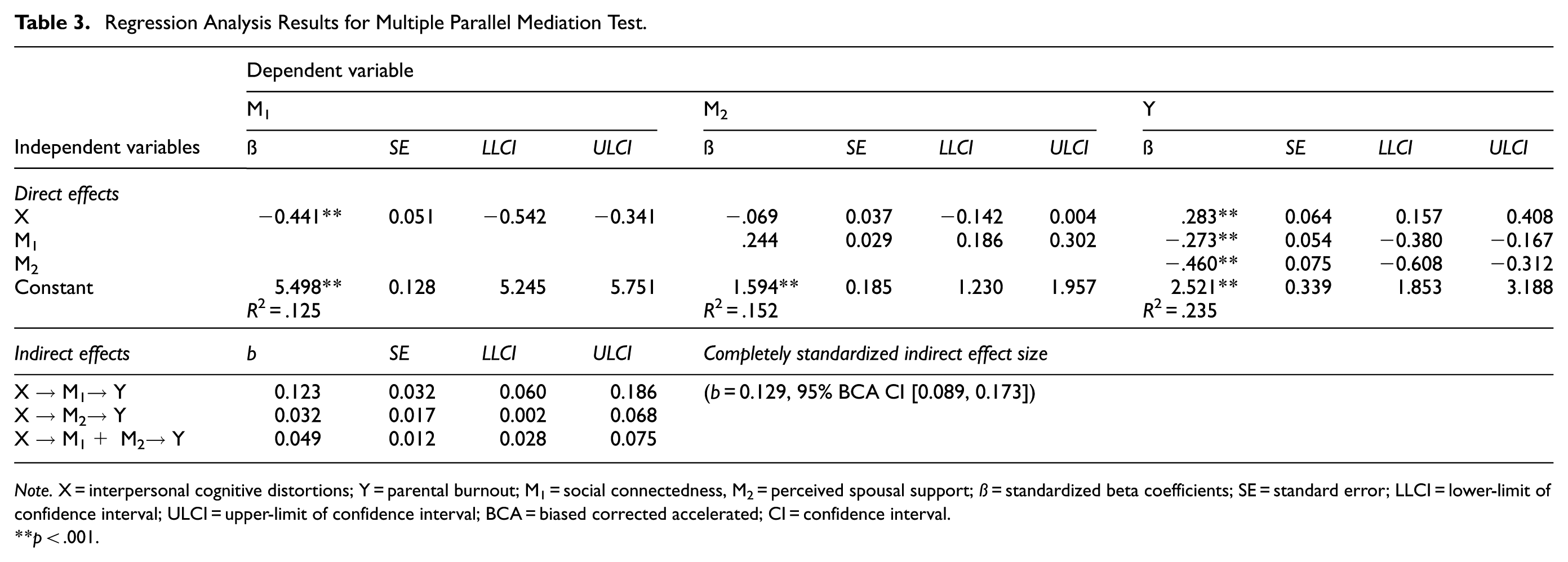
Note. X = interpersonal cognitive distortions; Y = parental burnout; M1 = social connectedness, M2 = perceived spousal support; ß = standardized beta coefficients; SE = standard error; LLCI = lower-limit of confidence interval; ULCI = upper-limit of confidence interval; BCA = biased corrected accelerated; CI = confidence interval.
p < .001.
When the direct effects in Table 3 were examined, it was found that the independent variable, parents’ interpersonal cognitive distortions, negatively and significantly predicted one of the mediating variables, the social connectedness (ß = −.441, 95% CI [−0.542, −0.341]). However, although there was a negative relationship between parents’ interpersonal cognitive distortions and perceived spousal support, it was found that parents’ interpersonal cognitive distortions did not significantly predict the other mediator variable, perceived spousal support (ß = −.069, 95% CI [−0.142, 0.004]). On the other hand, it was found that parents’ interpersonal cognitive distortions positively and significantly predicted the dependent variable, parental burnout (ß = .283, 95% CI [0.157, 0.408]). However, social connectedness (ß = −.273, 95% CI [−0.380, −0.167]) and perceived spousal support (ß = −.460, 95% CI [−0.608, −0.312]) were found to negatively and significantly predict parental burnout. It was found that parents’ social connectedness positively and significantly predicted the perceived spousal support (ß = .244, 95% CI [0.186, 0.302]).
When the indirect effects in Table 3 were analyzed, it was determined that social connectedness (ß = .123, 95% CI [0.060, 0.186]) and perceived spousal support (ß = .032, 95% CI [0.002, 0.068]) had a significant mediating role in explaining the relationship between parents’ burnout, and their interpersonal cognitive distortions. Similarly, it was determined that social connectedness and perceived spousal support together (ß = .049, 95% CI [0.028, 0.075]) significantly mediated the relationship between parents’ burnout, and their interpersonal cognitive distortions.
The fully standardized effect size of the mediation effect in Table 3 is R2 = .129. An effect size value close to .01 is considered a low effect, close to .09 is a medium effect, and close to .25 is a high effect (Preacher & Kelley, 2011). In this context, it can be said that the mediation effect in the tested model was close to a moderate effect size. Other values obtained for the tested model are presented in Figure 2.

Findings related to the hypothetical model of the study: Model 6 (Hayes, 2013).
Figure 2 shows that the independent variable, interpersonal cognitive distortions, positively and significantly explained the dependent variable, parental burnout, before the mediating variables were included (c = 0.485**). Similarly, when mediating variables were added to the relationship between the independent variable and the dependent variable, it was seen that the positive and significant relationship between the independent and dependent variables decreased but continued (c1 = 0.283**). According to these results, when social connectedness and perceived spousal support were added to the relationship between interpersonal cognitive distortions and parental burnout, it was found that there was a certain level of decrease in this relationship. Still, the direction and significance of this relationship remained the same. In other words, it was found that social connectedness and perceived spousal support partially mediated the relationship between interpersonal cognitive distortions and parental burnout. (Baron & Kenny, 1986).
Discussion
The current study, examined the mediating role of social connectedness and perceived spousal support in explaining the relationship between parents’ burnout, and their interpersonal cognitive distortions. The analyses found that social connectedness and perceived spousal support had a partial mediating effect. The mediation effect was found to be close to a moderate effect size.
In the current study, parents’ interpersonal cognitive distortions explained their burnout positively and significantly (H1: Accepted). In other words, as parents’ interpersonal cognitive distortions increase, their burnout also increases. When this result is evaluated within the framework of “Cognitive Behavioural Therapy,” rather than the events themselves, the meaning that individuals attribute to them determines their emotional reactions (A. T. Beck, 1991). Moreover, irrational cognitions of individuals may lead to unhealthy emotions and dysfunctional behaviors (Ellis, 1991). Cognitive distortions may cause individuals to perceive challenging situations as more stressful and difficult to manage (A. Beck, 1976). It can be said that individuals who have rational thoughts in interpersonal relationships will have a positive perspective in their parenting lives and will experience less burnout. It supports this idea; Woine et al. (2022) concluded that parents’ negative cognitive evaluations of their parenting increased parental burnout. Additionally, in a study conducted by Le Vigouroux et al. (2023), it was found that early maladaptive schemas and parental burnout were positively related. The results of this study support the conclusion that there is a positive relationship between parental burnout and interpersonal cognitive distortions. It can be said that interventions aimed at regulating parents’ interpersonal cognitive distortions can effectively reduce burnout levels and make parenting processes healthier.
In the current study, parents’ interpersonal cognitive distortions explained their social connectedness negatively and significantly (H2: Accepted). In other words, as parents’ interpersonal cognitive distortions increase, their social connectedness decreases. This result can be discussed within the framework of “Attachment Theory.” According to this theory, individuals’ early attachment experiences play a determining role in how they will establish and maintain their social relationships (Bowlby, 1975). In addition, according to this theory, individuals with secure attachments establish healthy relationships with their environment, while individuals with insecure attachments establish maladaptive relationships with their environment (Bartholomew & Horowitz, 1991). It is estimated that individuals who develop healthy thoughts in their interpersonal relationships will be in harmony with their environment, will create a sense of belonging to the group they are in, and will be able to maintain their relationships. Therefore, their social connectedness will be stronger. In a study consistent with this explanation, Çiftçi (2022) found that the family belonging decreases as individuals’ interpersonal cognitive distortions increase. In this context, it can be said that individuals who develop healthy thoughts in interpersonal relationships are in harmony with their environment and develop a sense of belonging, which strengthens their social connectedness.
In the current study, it was found that parents’ interpersonal cognitive distortions were not a significant predictor of perceived spousal support (H3: Rejected). However, according to the correlation values in which the binary relationships between these two variables were analyzed, it was found that there was a low-level negative and significant relationship. It is thought that parents’ interpersonal cognitive distortions do not explain the perceived spousal support at a substantial level because the relationship between these variables, even if significant, is at a low level. The negative correlation between these two variables in the study can be explained by the fact that parents with interpersonal cognitive distortions may make wrong evaluations about situations and make unhealthy inferences in their relationships with their spouses. Therefore, evaluating events with unrealistic thoughts may cause individuals to infer that they do not receive enough support from their spouses. In parallel with this interpretation, Muhtar’s (2022) study supported the conclusion that a negative relationship exists between parents’ interpersonal cognitive distortions and perceived spousal support. In addition, Demir Kaya et al. (2023) found that interpersonal cognitive distortions increased anxious attachment style, weakening the perception of spousal support. According to “Attachment Theory” individuals’ attachment styles affect the trust and support they perceive in their close relationships (Mikulincer & Shaver, 2007). In this context, parents’ interpersonal cognitive distortions may lead them to perceive the support they receive from their spouses as lower. The fact that parents’ interpersonal cognitive distortions did not significantly explain perceived spousal support in this study suggests that different variables may influence parents’ perceptions of spousal support. As a matter of fact, Bradbury and Karney (2004), in their study examining the factors affecting satisfaction in marriage and close relationships, concluded that many factors, such as relationship dynamics, communication styles, and external stress sources affect relationship quality.
The current study, found that parents’ social connectedness positively and significantly explains perceived spousal support (H4: Accepted). According to this result, as parents’ social connectedness increases, the support they perceive from their spouses increases. Individuals with strong social ties with close friends, family, and relatives can see themselves as more compatible with their environment, develop a sense of belonging to their group, and positively evaluate their environment. Considering the close relationship with a spouse, it is expected that receiving support from them will positively impact their social relationships. Therefore, it is thought that social connectedness and perceived support from the spouse are two situations that nourish each other. Similar to this explanation, a study found that as the support parents perceive from people they describe as unique and their families increase, their social connectedness also increases (Duru, 2008). However, Santini et al. (2015) emphasized the protective role of perceived social support and social connectedness in the prevention of depression. According to the “Social Support Theory” social support networks not only facilitate individuals to cope with stress but also make individuals healthier, more adaptable, and resilient (Cohen & Wills, 1985). In this context, individuals with strong social connectedness are expected to perceive and appreciate emotional support and help more effectively (Haslam et al., 2015). Based on these explanations, it can be said that parents’ social connectedness and perceived spousal support affect each other. In this direction, it can be said that interventions aimed at strengthening social connectedness may increase the support perceived by individuals from their spouses.
In the current study, parents’ social connectedness explained their burnout negatively and significantly. In other words, as parents’ social connectedness increases, their burnout decreases (H5: Accepted). It is expected that individuals who care about their connections with others, who are in harmony with their environment, and who have a developed sense of belonging will have a positive parenting experience and will experience less burnout. In their explanation based on Bronfenbrenner’s “Ecological Systems Theory,”Ren et al. (2024) classified the factors affecting parental burnout as microsystem (individual factors), mesosystem (interpersonal factors), exosystem (organizational or societal factors) and macrosystem (society/political or cultural factors). It is also emphasized that social support is an important factor affecting parental burnout within the exosystem and that strong social ties can reduce it (Lin, Goldenberg et al., 2022; Ren et al., 2024; Szczygieł et al., 2020). As a result, although there is no research examining the relationship between social connectedness and parental burnout, it can be said that strong social ties function as a protective factor against parental burnout based on the abovementioned explanations.
In the current study, parents perceived spousal support negatively and significantly explained their burnout (H6: Accepted). In other words, as parents’ perceptions of support from their spouses increase, their burnout decreases. It is evaluated that parents’ emotional and behavioral support from their spouses on issues such as child-rearing, home-related responsibilities, and finding time for oneself will positively impact them. Therefore, they will experience less burnout. Supporting these comments, Ulusoy (2021) found that the appreciation and social interest support received from the spouse were significant and positive predictors in explaining women’s burnout. However, some studies have shown that cooperation between spouses reduces parental burnout (Arikan et al., 2020; Bastiaansen et al., 2021; Mikolajczak & Roskam, 2018; S. Yıldırım, 2023). According to Mikolajczak and Roskam’s (2018)“Risk and Resource Theory” parental burnout results from an imbalance between parenting demands (risk factors) and parenting resources (protective factors). This theory also emphasizes that increasing coping resources is an effective method to prevent and intervene in parental burnout. Parents experience less stress when they agree with their spouses about their parenting and feel that their spouses see them as valued as parents (Durtschi et al., 2017; Mikolajczak et al., 2017). Therefore, it can be said that cooperation between spouses, developing a supportive co-parenting approach, and the support they perceive from their spouses effectively reduce burnout.
In the current study, it was concluded that social connectedness and perceived spousal support had a significant mediating role in explaining the relationship between parental burnout, and their interpersonal cognitive distortions (H7: Accepted). It was found that as parents’ interpersonal cognitive distortions increased, their burnout increased, while their social connectedness and perceived spousal support decreased. In addition, it was found that as the social connectedness of parents increased, their perceived spousal support increased. On the other hand, as parents’ social connectedness and perceived spousal support increased, their burnout decreased.
In the relevant literature, no theoretical approach has been found that directly explains the relationship between parents’ social connectedness and perceived spousal support, interpersonal cognitive distortions, and burnout. However, the view that parents’ negative and distorted thoughts may make their burnout more apparent can be based on the “Cognitive Behavioral Theory” (A. Beck, 1976). This theory argues that individuals’ cognitive distortions make it difficult for them to cope with stressful situations and increase their psychological problems. According to the research hypothesis (H7), as parents’ interpersonal cognitive distortions increase, their connectedness to their social environment (friends and community) and perceived support from their spouse may decrease. On the other hand, the positive social relationships parents experience, and their support for each other may help prevent burnout. According to the “Social Support Theory” (Cohen & Wills, 1985), it is emphasized that social support makes it easier for individuals to cope with stress and supports them in healthier social interactions. However, according to the “Risks and Resources Theory (BR2)” (Mikolajczak & Roskam, 2018), difficulties encountered in parenting processes (e.g., stressful parenting demands) and insufficient spousal support can lead to parental burnout. Similarly, according to the “Parenting Stress Model” (K. A. Crnic & Greenberg, 1990), healthier social interactions and emotional and practical support for parents can help prevent burnout. In studies conducted on this subject, Bastiaansen et al. (2021) and Favez et al. (2013) have shown that supportive social relationships between parents (especially support from the spouse) can alleviate feelings of loneliness, stress, and burnout.
In light of these results, it was determined that the strength of the positive relationship between parents’ interpersonal cognitive distortions and their burnout decreased with the increase in their social connectedness and perceived spousal support. In other words, parents’ interpersonal cognitive distortions increased their burnout, while their social connectedness and perceived spousal support decreased their burnout.
Despite its significant findings, the study had some limitations for generalization of these findings; firstly, it was carried out within the Turkish context, so; the relationships between variables might reveal different connections in other countries. Secondly, the data of this study was collected from a sample of mostly women (80.6%) and married parents, using online forms accordingly. It can be said that this method also affected the results of the study. In other words, parents whose marriage did not continue due to reasons such as separation from their spouse or loss of their spouse were excluded from the study. However, since the research was carried out without any project or funding support, the data for the research was collected at one time and remained limited. Another limitation of their search is that the sample group is not distributed homogeneously by gender. However, the reason for this imbalance is unknown, as participation was voluntary and not controlled for gender distribution. Additionally, the parents participating in the study were not asked any questions about how many children they had or the ages of their children.
In light of the results obtained from the research, it is recommended that psychoeducational studies be carried out to help parents develop rational thoughts about their interpersonal relationships, strengthen their social connectedness, and increase supportive relationships between spouses to prevent or reduce burnout. Thanks to these psychoeducation studies, parents can be supported to have better marriages and to get more satisfaction from their marital relationships. Additionally, in future studies, variables such as perceived social support from people such as family and friends, cognitive schemas, gender roles, coping with stress, and resiliency building abilities which may be related to parental burnout, can be examined. In addition, the effect of the number of children and the ages of the children on parental burnout can be examined. The statistical power and generalizability of the findings obtained from a larger sample group and data collected over a more extended period may be higher. It is recommended that studies be conducted with groups where the sample group is homogeneously distributed in terms of gender. Finally, future studies can investigate the parenting burnout of partners. A mediation model that considers these elements may yield more accurate results.
Footnotes

Ethical Considerations
Research permission was obtained from the Ethics Committee of a university in Turkey (institution name and decision number blinded for peer review; approval date: 18.12.2023). We confirm that all practices in the article were carried out in accordance with relevant guidelines and regulations, such as the Declaration of Helsinki.
Consent to Participate
Respondents gave written consent for review and signature before starting interviews.
Author Contributions
FC, EM, and MD collaborated on the research design. EM and MD made significant contributions to the data collection process. FC and EM contributed significantly to data analysis and interpretation. FC, EM, and MD read and approved the final draft of the manuscript.
Funding
The authors received no financial support for the research, authorship, and/or publication of this article.
Declaration of Conflicting Interests
The authors declared no potential conflicts of interest with respect to the research, authorship, and/or publication of this article.