




Abstract
University students worldwide face significant stressors affecting their psychological well-being, yet there is a need for a more comprehensive understanding of how individual emotional strengths, social resources, and adaptive capacities interact, particularly within diverse cultural contexts such as Mainland China. This mixed-methods study addresses this gap by investigating the relationships among positive emotionality, perceived social support, resilience, and psychological well-being in a sample of 564 undergraduate students from Mainland China. Utilizing both quantitative and qualitative approaches, the research provides a comprehensive exploration of how these factors contribute to students’ well-being. Quantitative data were analyzed using Pearson correlations and structural equation modeling (SEM) to test the hypothesized mediation model. The SEM results revealed that both positive emotionality and perceived social support significantly predicted psychological well-being, with resilience serving as a partial mediator for both relationships within the integrated model. Positive emotionality had a direct effect on well-being, with resilience accounting for 41.6% of its total impact, while perceived social support explained 43.8% of its effect through resilience. The qualitative phase, based on thematic analysis of 32 semi-structured interviews, offered deeper insights into these relationships, highlighting key themes such as emotional regulation, the role of relational support networks, resilience development through academic challenges, and proactive mental health practices. The findings have both theoretical and practical implications, particularly in supporting the development of resilience-building interventions for university students.
Plain Language Summary
This study explored how positive emotions, social support from friends and family, and the ability to bounce back from challenges (resilience) influence the mental well-being of university students in Mainland China. A total of 564 undergraduate students participated in the research, which combined surveys and interviews to get a fuller understanding of their experiences. The survey results showed that students who experienced more positive emotions, like joy and enthusiasm, or felt supported by their social networks, tended to have better mental health. Resilience, or the ability to recover from setbacks, was found to be an important factor that helped students manage stress and maintain well-being. Specifically, resilience explained a large part of how positive emotions and social support contributed to better mental health. In addition to the surveys, 32 students were interviewed to gain deeper insights. These interviews revealed important themes such as how students manage their emotions, the crucial role that friendships and family play, how overcoming academic challenges strengthens resilience, and the value of proactive mental health practices like mindfulness and journaling.
Keywords
Introduction
University students face numerous academic, social, and personal challenges that significantly impact their psychological well-being (Park et al., 2020). The transition to adulthood, combined with academic demands, social integration pressures, and career planning, often leads to increased stress, anxiety, and mental health issues (Bayram & Bilgel, 2008; Conley et al., 2013; Dupéré et al., 2015; Hunt & Eisenberg, 2010). Identifying factors that enhance well-being is crucial for effective mental health interventions.
Psychological well-being, as outlined by Ryff and Keyes (1995), emphasizes self-fulfillment, personal growth, and meaningful relationships over mere pleasure or discomfort avoidance. Their model includes six dimensions: autonomy, environmental mastery, personal growth, positive relationships, purpose in life, and self-acceptance, offering a comprehensive framework for understanding mental health (Ryff, 2013; Ryff & Singer, 1998). This framework is particularly relevant to university students navigating academic, social, and personal development challenges (Boylan et al., 2022; Hanson et al., 2016; Keyes et al., 2002). However, research often examines individual factors influencing well-being separately, and there is a need for a more comprehensive understanding of how attributes like positive emotionality, resources such as social support, and adaptive capacities like resilience collectively contribute to psychological well-being through integrated models.
Positive emotionality, the tendency to experience joy, enthusiasm, and contentment (Watson & Naragon, 2009), is a key contributor to well-being (Rana & Nandinee, 2016; Vázquez et al., 2009). Fredrickson’s (2001) broaden-and-build theory posits that positive emotions enhance mental health by broadening thought and behavior, fostering resilience and social connections. Individuals with higher positive emotionality manage stress more effectively and maintain better well-being (Fredrickson & Joiner, 2002; Houben et al., 2015; Khazanov & Ruscio, 2016). Despite this, how positive emotionality, perceived social support, and resilience jointly influence psychological well-being, particularly the pathways through which these effects occur, remains an area needing further exploration, representing a gap this study aims to address.
Perceived social support refers to the emotional, instrumental, and informational assistance individuals believe they can access from family, friends, and others (Zimet et al., 1988). Social support is a protective factor that mitigates stress and promotes mental health (Cohen & Wills, 1985). For university students, it reduces anxiety and depression while enhancing life satisfaction and self-esteem (Stallman, 2010; Yıldırım & Tanrıverdi, 2021). While its direct benefits are recognized, its interplay with resilience in fostering well-being warrants more investigation. Resilience, the ability to adapt and recover from adversity, is vital for managing stressors in higher education (Masten, 2001; Smith et al., 2008). It is a dynamic process influenced by personal and environmental factors, including social support (Herrman et al., 2011; Rutter, 2012). Resilience helps sustain well-being through the interplay of emotional, cognitive, and social systems (Masten et al., 2021). While it is known to buffer the negative effects of academic and personal stress (Denovan & Macaskill, 2017; Wilks & Spivey, 2010), its specific role as a mediator in the relationships between positive emotionality and psychological well-being, and between perceived social support and psychological well-being, especially among university students, remains insufficiently explored.
Therefore, the primary objective of this mixed-methods study is to investigate the interplay of positive emotionality, perceived social support, and resilience in relation to psychological well-being among university students in Mainland China. Specifically, this research aims to: (1) examine the direct associations of positive emotionality and perceived social support with psychological well-being; and (2) more centrally, investigate the mediating role of resilience in the pathways between positive emotionality and psychological well-being, as well as between perceived social support and psychological well-being. By employing both quantitative methods to test these relationships within an integrated model and qualitative methods to explore students’ lived experiences, this study seeks to provide a comprehensive analysis of these dynamics.
Literature Review
Psychological Well-Being
Psychological well-being involves an individual’s perception of purpose, personal growth, autonomy, self-acceptance, and relationships (Ryff & Keyes, 1995). Unlike the hedonic view, which focuses on pleasure and pain avoidance, Ryff’s (1989) eudaimonic perspective emphasizes self-fulfillment and development as key components of health (Ryff & Singer, 1998). The six dimensions of Ryff’s model—autonomy, environmental mastery, personal growth, positive relationships, purpose in life, and self-acceptance—offer a comprehensive framework for understanding mental health (Ryff & Keyes, 1995). Autonomy refers to independent decision-making, environmental mastery to managing life’s demands, personal growth to self-development, positive relationships to fulfilling connections, purpose in life to meaningful goals, and self-acceptance to a positive self-view.
Ryff’s (2013) model extends beyond the absence of mental illness to include positive functioning, making it widely used in higher education research to assess student well-being (Weiss et al., 2016). University students face academic, social, and developmental challenges that often increase stress and anxiety (Bayram & Bilgel, 2008; Bowman, 2010; Conley et al., 2013; Hunt & Eisenberg, 2010; Lizarte Simón et al., 2024; Lomberg & Jordaan, 2024). With its focus on autonomy, personal growth, and positive relationships, Ryff’s model provides valuable insights into how students navigate these challenges (Keyes et al., 2002; Ryff & Singer, 1998). This framework has been instrumental in designing interventions to improve student outcomes. Studies targeting dimensions like personal growth and self-acceptance have shown significant effectiveness in promoting well-being (Morales-Rodríguez et al., 2020; Van Dierendonck & Lam, 2023). Resilience also emerges as a protective factor, buffering the effects of academic and social stress (Li & Hasson, 2020; Thanoi et al., 2023). Research supports the model’s utility in addressing the developmental challenges of university students (Bowman, 2010; Conley et al., 2013).
Cross-cultural research highlights how cultural norms shape well-being. While core dimensions like autonomy, environmental mastery, and personal growth are universally relevant, their expression and the factors affecting them can vary significantly across contexts (Huang & Zhang, 2022; Thanoi et al., 2023). For example, autonomy and relationships are perceived differently in Thailand and Singapore compared to Western cultures (Thanoi et al., 2023). This cultural lens is also critical when considering large-scale stressors; for instance, the COVID-19 pandemic significantly impacted Chinese students’ well-being due to factors like online learning and isolation (Huang & Zhang, 2022; Zhou & Yu, 2021), and the experience of these challenges, as well as coping mechanisms employed, may have been influenced by specific socio-cultural factors prevalent in China, such as collectivist values or educational system pressures. The pandemic thus provided a stark example of how unique contextual events can interact with cultural backgrounds to affect well-being manifestations. These findings emphasize the importance of culturally sensitive interventions for diverse student populations (Douwes et al., 2023; Keyes et al., 2002).
Resilience and social support critically influence student psychological well-being, especially amidst intense academic pressures in higher education (Denovan & Macaskill, 2017; Wilks & Spivey, 2010). Resilience—the ability to adapt and recover from adversity—mediates between academic stressors and positive psychological outcomes (Li & Hasson, 2020; Morales-Rodríguez et al., 2020). Higher resilience equips students to better manage university stress, improving mental health, personal growth, and mastery (Galante et al., 2016; Ramasubramanian, 2017). Social support from various sources (peers, family, institutions) is also key in mitigating academic stress (Yıldırım & Tanrıverdi, 2021; Zhou & Yu, 2021). Strong social networks are linked to greater student autonomy, self-acceptance, and better psychological outcomes (Brannan et al., 2013; Warren et al., 2009). While peer support fosters belonging and aids navigation of university demands, family support offers emotional stability (Stallman, 2010; Zhou & Yu, 2021). These findings highlight the need for supportive academic communities to promote student well-being and resilience.
Accurate and culturally sensitive measurement of psychological well-being is essential in higher education research. Ryff’s Scales of Psychological Well-being are extensively validated across diverse cultures and populations, including university students (Clark et al., 2001; Douwes et al., 2023). Providing comprehensive assessment of well-being’s six dimensions, these scales are instrumental in student population studies (cross-sectional and longitudinal). Adaptations may be needed, however, for cultural relevance. For instance, Leung and Pong (2021) suggest integrating spiritual well-being to improve the scales’ applicability for certain groups, underscoring the need to consider unique values and experiences with Ryff’s model in diverse populations (Douwes et al., 2023; Leung & Pong, 2021).
Positive Emotionality and Its Role in Psychological Well-Being
Positive emotionality, the tendency to experience emotions such as joy, enthusiasm, and contentment, is a fundamental aspect of personality and temperament (Putnam, 2012; Watson & Naragon, 2009). Fredrickson’s (2001) broaden-and-build theory explains that positive emotions expand cognitive and behavioral capacities, fostering resilience, problem-solving, and social connections, which contribute to long-term psychological well-being (Fredrickson, 2001; Fredrickson & Joiner, 2002). Unlike negative emotions, which narrow focus and activate survival responses, positive emotions promote adaptive coping and supportive relationships, creating an upward spiral of well-being (Fredrickson, 2001; Fredrickson & Joiner, 2018).
Empirical research confirms the strong link between positive emotionality and psychological well-being. Frequent positive emotions reduce the risk of mental health issues such as depression (Khazanov & Ruscio, 2016; Houben et al., 2015). Khazanov and Ruscio’s (2016) meta-analysis identified low positive emotionality as a significant risk factor for depression, highlighting its protective role in mental health. Therapeutic approaches that cultivate positive emotions have been shown to enhance resilience and well-being (Fitzpatrick & Stalikas, 2008; Weytens et al., 2014). Interventions aimed at increasing positive emotions improve subjective well-being and reduce depression by fostering adaptive coping strategies (Weytens et al., 2014).
Beyond its direct emotional benefits, positive emotionality also supports cognitive functioning, contributing to outcomes like enhanced academic performance. Avia (1997) argued that positive emotions directly improve cognitive processing and learning outcomes. Understanding the pervasive influence of positive emotionality is also aided by recognizing its complex nature; for instance, associated traits like energy and sociability are understood to be shaped by both genetic and environmental factors (Eid et al., 2003), which can affect its overall expression and impact. Furthermore, actively engaging with these emotional states through regulation strategies, such as savoring positive experiences, is crucial for amplifying their benefits and promoting sustained well-being (Quoidbach et al., 2010).
Positive emotionality significantly influences academic success, social relationships, and mental health among university students. Students who frequently experience positive emotions exhibit greater resilience, engagement, and self-compassion, which predict better psychological well-being and academic performance (Kotera et al., 2022). Positive emotions enhance motivation, improve academic outcomes, and foster meaningful social interactions, essential for navigating higher education challenges (Lawson et al., 2021; Wetter & Hankin, 2009). The impact of positive emotionality also extends to the learning environment; for example, Lawson et al. (2021) demonstrated that students taught by instructors displaying positive emotions showed higher engagement and better academic performance than those taught by more neutral instructors, suggesting that exposure to positive emotional cues in educational settings can significantly enhance student learning experiences and outcomes.
Beyond academics, positive emotionality benefits mental health. Wetter and Hankin (2009) found that adolescents with higher positive emotionality experienced stronger supportive relationships and greater protection against depression. Houben et al. (2015) showed that the frequency and intensity of positive emotions positively correlate with psychological well-being, emphasizing the importance of cultivating positive emotional experiences. Overall, Fredrickson’s broaden-and-build theory explains how positive emotions contribute to long-term mental health by broadening cognitive and behavioral capacities, fostering resilience, and strengthening social connections. Empirical studies lend strong support to the role of positive emotionality in therapeutic and educational contexts, suggesting that interventions to enhance positive emotions and emotion regulation can effectively promote well-being among university students.
Perceived Social Support and Well-Being in Young Adults
Perceived social support refers to an individual’s evaluation of the availability and adequacy of emotional, instrumental, and informational support during times of need (Zimet et al., 1988). It emphasizes the perceived benefits of these resources over their mere existence (Richman et al., 1998). Emotional support involves empathy and care, instrumental support includes tangible help, and informational support provides advice and guidance (Brown et al., 1987). These forms of support are critical for mental health, as illustrated by the stress-buffering model, which posits that social support reduces stress by offering coping resources (Cohen & Wills, 1985). Relational regulation theory further highlights that regular social interactions enhance emotional regulation and well-being, even in non-stressful situations (Lakey & Orehek, 2011).
For young adults, especially university students, perceived social support is strongly linked to improved psychological well-being (Cobo-Rendón et al., 2020; Derakhshan & Fathi, 2024). This life stage involves transitions, such as leaving home and coping with academic pressures, which heighten vulnerability to mental health challenges. Research consistently shows that higher perceived social support correlates with lower anxiety, depression, and loneliness, alongside greater life satisfaction and self-esteem (Stallman et al., 2018; Yıldırım & Tanrıverdi, 2021). Meta-analyses confirm this, with Wang et al. (2018) identifying an inverse relationship between social support and mental health problems like loneliness and depression.
The quality of perceived social support is more critical than its quantity in shaping psychological outcomes. Rueger et al. (2016) found that adolescents and young adults with high-quality support were less likely to develop depressive symptoms, highlighting the importance of meaningful interactions over the number of connections. Different sources of social support—family, peers, and academic mentors—offer distinct contributions to students’ well-being. Family support provides emotional stability during stress, as family members often offer emotional, instrumental, and spiritual aid (Alorani & Alradaydeh, 2018; Brown et al., 1987; Richman et al., 1998). Brannan et al. (2013) showed that strong family ties enhance resilience and life satisfaction, underscoring their protective role in mental health.
Peer support fosters belonging and helps students manage academic and social challenges. Peer relationships provide emotional sharing, collaboration, and mutual support, reducing isolation and enhancing mental health (Brannan et al., 2013; Mazer & Thompson, 2011). In university settings, peer bonds are particularly vital for managing academic pressures, with peer support linked to increased motivation, engagement, and relational closeness (Mazer & Thompson, 2011). Academic mentors also play a key role by offering informational and instrumental support. Supportive mentoring relationships are associated with better academic performance, higher motivation, and stronger self-efficacy, which contribute to overall well-being (Derakhshan & Fathi, 2025; Warren et al., 2009). During the COVID-19 pandemic, peer support and formal academic support from institutional sources (such as faculty and academic advisors) were especially important, outweighing family support in mitigating the stress of online learning and social isolation (Huang et al., 2021).
Resilience as a Mediator Between Emotionality, Social Support, and Well-Being
Resilience is the capacity to adapt and recover from adversity, shaped by personal characteristics and environmental factors (Masten, 2001). Described by Masten (2001) as “ordinary magic,” resilience is viewed as a common, adaptive process rather than an extraordinary trait (Herrman et al., 2011; Wu et al., 2013). Modern models emphasize the interplay of cognitive, emotional, and social systems in sustaining psychological well-being, with protective factors such as positive emotionality and social support playing key roles in buffering stress and enhancing mental health (Masten et al., 2021). For university students, resilience is critical for managing academic, social, and developmental challenges. It helps maintain emotional stability and well-being despite pressures like academic setbacks, financial difficulties, and interpersonal conflicts (Denovan & Macaskill, 2017; Hartson et al., 2023; Wilks & Spivey, 2010; Zhang & Fathi, 2024). The transition to adulthood, marked by identity formation and increased responsibilities, makes resilience an essential resource for thriving both academically and socially (Ramasubramanian, 2017).
Research highlights resilience’s role in mitigating negative mental health outcomes such as depression and anxiety. Malkoç and Yalçın (2015) found that resilience, combined with social support and coping strategies, is strongly linked to higher psychological well-being in university students. Interventions like mindfulness practices enhance resilience by improving emotional regulation and stress management, contributing to better mental health outcomes (Fathi et al., 2023; Galante et al., 2016; Ramasubramanian, 2017). Furthermore, a significant line of inquiry suggests that resilience acts as a key mediating factor, potentially explaining how individual characteristics such as positive emotionality and contextual resources like social support translate into improved psychological well-being. Positive emotions like optimism and joy enhance resilience, which in turn promotes psychological well-being (Denovan & Macaskill, 2017; Fredrickson, 2001). Fredrickson’s (2001) broaden-and-build theory explains how positive emotions expand cognitive and behavioral flexibility, fostering lasting psychological resources, including resilience, and supporting effective coping mechanisms.
Resilience also mediates the relationship between positive emotionality and psychological well-being. Dumont and Provost (1999) found that individuals experiencing more positive emotions were better equipped to develop resilience, enhancing their ability to manage stress and maintain mental health. Similarly, Rasheed et al. (2022) demonstrated that resilience transforms positive emotional experiences into enduring psychological strength. Social support also plays a crucial role in building resilience, particularly in university settings. Strong networks—comprising family, peers, and academic mentors—provide resources that help individuals recover from adversity and sustain well-being (Dumont & Provost, 1999; Wilks & Spivey, 2010). Resilience mediates the relationship between social support and well-being, illustrating how support systems foster resilience and promote mental health (Kelifa et al., 2021). For example, Kelifa et al. (2021) found that resilience mitigated the impact of adverse childhood experiences on subjective well-being among college students.
Additional studies provide evidence for the mediating role of resilience in the link between social support and well-being. Malkoç and Yalçın (2015) reported that students with higher perceived social support exhibited greater resilience, which was associated with better mental health and life satisfaction. Similarly, Chue and Cheung (2023) confirmed that resilience mediates the effects of social support on well-being, emphasizing how support indirectly enhances well-being by fostering resilience. In summary, resilience is a key mediator linking positive emotionality and social support to psychological well-being. Positive emotionality builds resilience by expanding psychological resources, while social support strengthens it through emotional and instrumental aid. Targeted interventions to promote resilience can significantly improve student mental health by addressing emotional regulation and strengthening social support systems, enabling students to better navigate academic and social challenges.
The Current Study
Building upon the gaps identified and aligning with the primary objective stated in the introduction, this study investigates the interplay of positive emotionality, perceived social support, and resilience in relation to psychological well-being among university students in Mainland China. While prior research has indeed established that positive emotionality and social support can enhance well-being, and that resilience often acts as a mediator, the unique contribution of this research lies in several key areas. First, it provides a focused examination of these dynamics specifically within the context of university students in Mainland China, a population experiencing unique academic and socio-cultural pressures. Second, this study employs a mixed-methods design to offer a more comprehensive and nuanced understanding; it not only quantitatively tests an integrated model of these relationships, including the specific mediating effects of resilience, but also delves into the rich, qualitative lived experiences that illuminate how these processes unfold for students. This dual approach aims to provide both statistical evidence and deep contextual insights into the pathways to well-being in this specific group. With the increasing pressures these students face—academically, socially, and personally—understanding this combined influence and the specific pathways through which they operate, particularly the mediating role of resilience, is essential for developing effective mental health interventions in educational settings. To explore these dynamics comprehensively, this integrated mixed-methods design is used, incorporating both quantitative and qualitative approaches as outlined in our objectives.
The quantitative phase utilizes structural equation modeling (SEM) to examine an integrated model of how positive emotionality, perceived social support, and resilience collectively influence psychological well-being. Specifically, this phase seeks to answer the overarching research question: How do positive emotionality and perceived social support, both directly and indirectly through the mediating effect of resilience, contribute to the psychological well-being of university students in Mainland China? This overarching question is addressed through the following specific hypotheses, which test the pathways within our proposed integrated model:
Through testing these hypotheses within a single structural model, the study seeks to offer empirical evidence for the role of resilience in linking emotional and social resources to well-being within the specified cultural and academic context.
The qualitative phase of the study complements the quantitative findings by exploring students’ lived experiences with positive emotionality, social support, and resilience. Through semi-structured interviews, the study delves deeper into how students perceive and navigate emotional and social challenges, providing rich, contextualized insights into the pathways to well-being, thereby adding depth to the quantitative model.
Methods
Participants
The study sample consisted of 564 undergraduate students enrolled in various universities across Mainland China. The participants included 239 males (42.4%) and 325 females (57.6%), ranging in age from 18 to 24 years (mean age = 20.5, SD = 1.5). These students represented a broad range of academic disciplines, with 26.6% (n = 150) majoring in humanities, 28.9% (n = 163) in social sciences, 23.4% (n = 132) in natural sciences, and 21.1% (n = 119) in engineering. This distribution provided a varied representation of students from different fields within our sample.
To enhance regional diversity within the sample, students were recruited from five key regions in Mainland China: Hunan (21.3%, n = 120), Guangdong (18.1%, n = 102), Jiangsu (19.9%, n = 112), Sichuan (20.7%, n = 117), and Beijing (20.0%, n = 113). This geographic representation was intended to capture a range of educational and socio-cultural environments present across the country, thereby broadening the scope of the experiences included in the study.
Eligible participants were full-time undergraduate students, and they were recruited through a combination of university email lists, social media platforms (such as WeChat and QQ), and classroom announcements. All participants provided informed consent, which included detailed information about the study’s purpose, procedures, and their right to withdraw at any time without penalty. Participation was entirely voluntary, and no financial or academic incentives were offered.
In terms of ethnicity, the majority of participants (91.3%) identified as Han Chinese, while 8.7% represented various ethnic minority groups, reflecting the general demographic distribution of Mainland China’s university population. Additionally, the sample consisted predominantly of first- and second-year students (64.2%), with 35.8% being third- and fourth-year students. Socio-economic background data indicated that most participants reported middle-class family backgrounds.
This diversity in academic discipline, geographic region, ethnic background, year of study, and socio-economic status was sought to facilitate a more comprehensive exploration of how key variables—positive emotionality, social support, resilience, and psychological well-being—interacted across different student demographics within the collected data.
To ensure confidentiality and anonymity, each participant was assigned a unique identification code. All data collection followed strict ethical guidelines, and procedures were reviewed and approved by the Institutional Review Board at Hunan First Normal University. Data collection took place over a 3-month period, from March to May 2023.
Measures
Positive Emotionality
To measure positive emotionality, a shortened version of the Positive Affect Scale from the Positive and Negative Affect Schedule (PANAS; Damasio et al., 2013) was used. This scale captures the frequency of positive emotions participants experienced over the previous week, encompassing emotions such as happiness, cheerfulness, and contentment. Responses were recorded using a 5-point Likert scale, where 0 represented “very little or nothing” and 4 denoted “extremely.” The total score was obtained by summing the individual item scores, with higher totals reflecting higher levels of positive emotionality. In the present study, the scale demonstrated strong internal reliability, with a Cronbach’s alpha of .84. Confirmatory factor analysis (CFA) provided evidence supporting the construct validity of the scale in this sample, χ2/df = 2.56, CFI = 0.93, TLI = 0.91, RMSEA = 0.048 (90% CI [0.034, 0.061]), SRMR = 0.042.
Psychological Well-Being
Participants’ psychological well-being was assessed using the 18-item Scale of Psychological Well-Being (SPWB; Ryff & Keyes, 1995). This instrument evaluates six key aspects of well-being: autonomy, environmental mastery, personal growth, positive relations with others, purpose in life, and self-acceptance. Participants responded to statements such as, “Life has been a continuous process of learning, changing, and growth,” on a 6-point Likert scale ranging from 1 (strongly disagree) to 6 (strongly agree). Mean scores were calculated, with higher averages indicating greater psychological well-being. The scale exhibited excellent internal consistency in this study, with a Cronbach’s alpha of 0.86. CFA results indicated good construct validity, χ2/df = 2.89, CFI = 0.94, TLI = 0.92, RMSEA = 0.050 (90% CI [0.037, 0.063]), SRMR = 0.046.
Perceived Social Support
The Multidimensional Scale of Perceived Social Support (MSPSS; Zimet et al., 1988) was employed to measure participants’ perceptions of social support from various sources, including family, friends, and significant others. This 12-item instrument asked participants to rate items such as “I get the emotional help and support I need from my family” using a 6-point Likert scale, where 1 indicated “strongly disagree” and 6 indicated “strongly agree.” Average scores were calculated, with higher values reflecting stronger perceived social support. The MSPSS displayed high internal reliability in this sample, with a Cronbach’s alpha of .91. The CFA demonstrated adequate construct validity, χ2/df = 2.21, CFI = 0.96, TLI = 0.94, RMSEA = 0.045 (90% CI [0.032, 0.059]), SRMR = 0.038.
Resilience
Resilience was assessed using the Brief Resilience Scale (BRS; Smith et al., 2008), a six-item instrument designed to measure participants’ ability to recover from stressful situations. Participants rated their agreement with statements such as “I tend to bounce back quickly after hard times” on a 5-point Likert scale ranging from 1 (strongly disagree) to 5 (strongly agree). In accordance with the standard scoring procedure for the BRS, items 1, 3, and 5, which are negatively worded (e.g., “I have a hard time making it through stressful events”), were reverse-scored. The total resilience score was calculated by averaging the item scores, with higher scores reflecting greater resilience. In this study, the BRS demonstrated good internal consistency, with a Cronbach’s alpha of .83. CFA results supported good construct validity, χ2/df = 2.47, CFI = 0.92, TLI = 0.90, RMSEA = 0.049 (90% CI [0.035, 0.064]), SRMR = 0.041.
Interviews
For the qualitative phase, a systematic purposive sampling strategy was employed to select 32 participants from the 564 survey respondents who had agreed to follow-up interviews. The primary goal of this strategy was to ensure a diversity of perspectives and experiences related to the core constructs, rather than to achieve statistical representativeness of the larger quantitative sample. To guide this selection and mitigate potential selection bias, we specifically focused on three criteria: level of psychological well-being, gender, and academic year.
Participants’ scores on the Scale of Psychological Well-Being (SPWB) from the quantitative phase were used to categorize them into low, medium, and high well-being groups (based on tertile splits). We then purposefully selected students to ensure representation from each of these three well-being categories (approximately 10–11 students per category). Concurrently, we aimed for a near-equal representation of male (n = 15) and female (n = 17) participants and ensured a mix of students across academic years (first/second year, n = 18; third/fourth year, n = 14). This structured approach ensured that the final interview sample of 32 students was not only diverse but also allowed for an exploration of varying experiences across these key demographic and psychological characteristics.
Semi-structured interviews, lasting 45 to 60 min, were conducted in Mandarin (face-to-face or via encrypted video call) to explore personal experiences with resilience, social support, positive emotions, and their influence on well-being. Sample questions included: “Can you describe a challenging situation you faced and how you managed to overcome it?”, “How do your relationships with family and friends affect your emotional well-being?”, and “In what ways do positive emotions contribute to your ability to handle stress?”
Procedure
Data collection took place from March to May 2023, following approval from the Institutional Review Board. A multi-phase recruitment strategy targeted diverse student populations across Mainland China. Participants were recruited via university email campaigns, social media platforms (WeChat, QQ), and in-class announcements at partner universities to ensure broad representation across disciplines and regions.
Potential participants received an electronic information sheet outlining the study’s purpose, methodology, confidentiality measures, and the voluntary nature of participation. Informed consent was obtained through a secure online form before proceeding with the study. Data collection was conducted entirely online using Wenjuanxing, a widely used academic platform in China.
Participants could choose to complete the survey in Mandarin or English, with scales translated and back-translated by bilingual experts to ensure linguistic and conceptual equivalence. Both versions were pilot-tested with 50 participants to evaluate clarity, cultural relevance, and to gather preliminary feedback on item comprehension and the perceived appropriateness of the scales for their intended constructs.
To ensure data quality, four attention-check items were included to identify inattentive responses. Participants failing two or more checks were excluded. The survey also allowed participants to pause and resume, reducing fatigue. Upon completion, participants received a debriefing document reiterating key ethical considerations and data storage details. During the 3-month period, biweekly reminders were sent to those who had expressed interest but had not completed the survey. Of 710 initial respondents, 564 were included after screening for incomplete and inattentive responses. All data were securely stored on encrypted servers, with access restricted to the research team to ensure confidentiality and compliance with ethical standards.
Data Analysis
This study used a mixed-methods approach, combining quantitative and qualitative analyses. Quantitative data were analyzed with IBM SPSS Statistics 25 for descriptive and correlation analyses, and AMOS 24 for advanced modeling. Descriptive statistics (means, standard deviations, ranges) were calculated for key variables, including positive emotionality, social support, resilience, and well-being. Internal consistency was assessed using Cronbach’s alpha, with values above .70 indicating reliability (Nunnally & Bernstein, 1994). Pearson correlations were used to explore relationships between variables.
Mediation analyses, conducted with the PROCESS macro for SPSS (Hayes, 2013), assessed resilience as a mediator between positive emotionality, social support, and well-being. Bootstrapping with 5,000 resamples and 95% bias-corrected confidence intervals determined the significance of indirect effects, which were considered significant if the confidence interval excluded zero. SEM tested the mediation model, accounting for measurement error (Kline, 2015). Model fit was evaluated using indices such as the Comparative Fit Index (CFI), Tucker-Lewis Index (TLI), and Root Mean Square Error of Approximation (RMSEA), with CFI and TLI > 0.90 and RMSEA < 0.08 indicating good fit (Hu & Bentler, 1999).
For qualitative data, interview transcripts were analyzed using thematic analysis (Braun & Clarke, 2006) with NVivo 12 for data management. Transcripts were reviewed, and codes were generated iteratively to identify themes and subthemes. Key quotes illustrated findings. Two researchers independently coded the data, resolving discrepancies through discussion. Intercoder reliability was high, with a Cohen’s kappa of .85 (McHugh, 2012). Integrating quantitative and qualitative findings provided a comprehensive understanding of how emotionality, social support, and resilience influence well-being in Chinese university students.
Results
Quantitative Results
The quantitative results of this study were analyzed using IBM SPSS Statistics Version 25 and AMOS Version 24. Descriptive statistics, Pearson correlations, mediation analyses, and SEM were employed to explore the relationships among positive emotionality, perceived social support, resilience, and psychological well-being.
Descriptive Statistics and Correlations
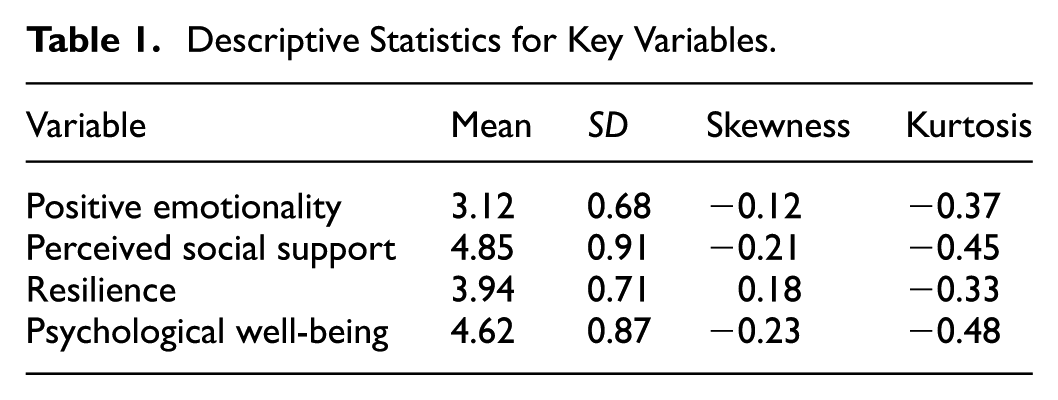
Table 1 presents descriptive statistics for the key study variables: positive emotionality, perceived social support, resilience, and psychological well-being. Mean scores generally indicated moderate to high levels across these variables (see Table 1 for specific M and SD values). All variables demonstrated acceptable skewness (range −0.23 to 0.65) and kurtosis (range −0.48 to 0.58) values, falling within typical limits (±1) and confirming their suitability for subsequent parametric analyses (Kline, 2015).
Descriptive Statistics for Key Variables.
To examine the relationships between these key variables, Pearson correlation analyses were conducted. As detailed in Table 2, all variables yielded significant positive intercorrelations (all ps < .001), offering initial support for the hypothesized associations. Notably, psychological well-being showed strong positive correlations with resilience (r = .68), positive emotionality (r = .62), and perceived social support (r = .49). Furthermore, positive emotionality was strongly related to resilience (r = .58), and perceived social support also correlated significantly with resilience (r = .51). These findings consistently suggest that higher levels of each of these positive constructs were associated with higher levels of the others.
Pearson Correlation Matrix for Key Variables.

p < .001.
Mediation Analysis
To examine the mediating role of resilience in the relationships between positive emotionality and psychological well-being, and between perceived social support and psychological well-being, mediation analyses were conducted using the PROCESS macro in SPSS (Hayes, 2013). A bootstrapping procedure with 5,000 resamples was applied to assess the significance of indirect effects, providing more accurate estimates compared to traditional mediation methods. Table 3 shows the mediation pathways, including the proportion of total effect mediated, both unstandardized (b) and standardized (β) coefficients for direct, indirect, and total effects. These mediation pathways are also visually represented in the overall structural model (see Figure 1). Effect sizes, including the proportion of variance explained (R2 change) and Cohen’s d, were reported where appropriate to provide a clearer understanding of the strength of these mediating relationships.
Mediation Analysis Results.

p < .001.
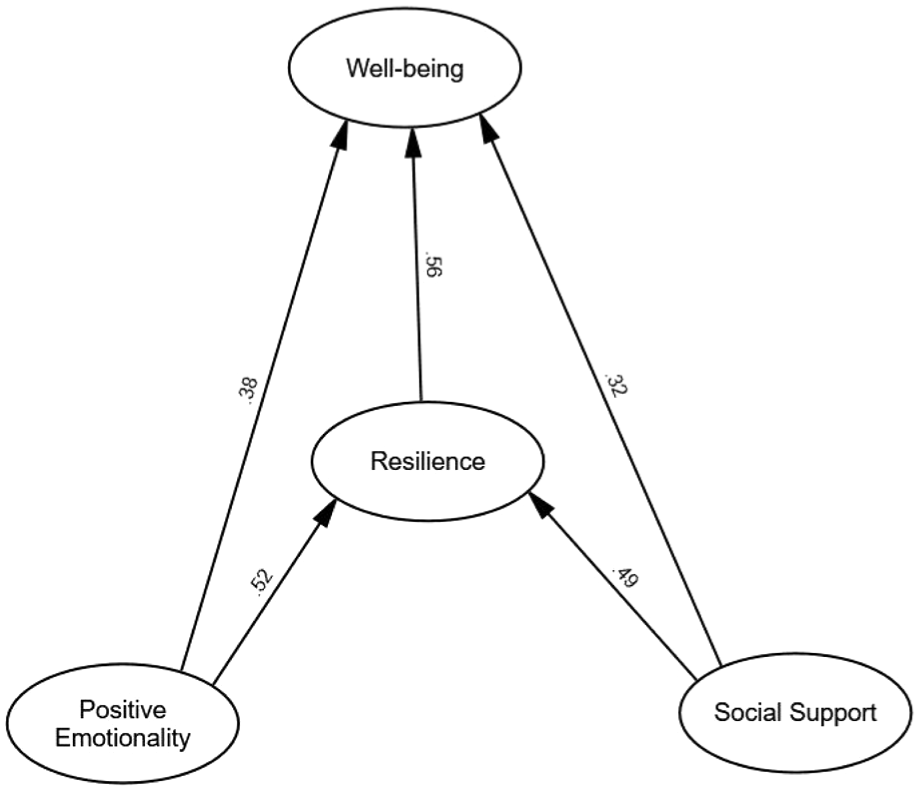
The final mediation model.
Model 1: Positive Emotionality as Predictor
In the first model, with positive emotionality as the predictor and psychological well-being as the outcome, the total effect of positive emotionality on psychological well-being was significant (b = 0.72, SE = 0.06, p < .001), suggesting that individuals who experienced more frequent positive emotions reported higher levels of psychological well-being. The standardized total effect was β = .53, indicating a strong positive association.
When resilience was included as a mediator, the direct effect of positive emotionality on psychological well-being decreased but remained significant (b = 0.42, SE = 0.07, p < .001; β = .31). The indirect effect of positive emotionality on psychological well-being through resilience was also significant (b = 0.30, SE = 0.05; β = .22), with a 95% bias-corrected confidence interval (CI) of 0.21 to 0.41, which did not include zero, indicating partial mediation. The mediation effect size, as indicated by Cohen’s d, was 0.39, reflecting a moderate effect. Additionally, resilience accounted for approximately 41.6% of the total effect of positive emotionality on psychological well-being (R2 change = .12), suggesting that resilience plays a critical role by serving as a significant pathway through which positive emotional experiences contribute to well-being.
Model 2: Perceived Social Support as Predictor
In the second model, perceived social support was entered as the predictor, and the total effect of perceived social support on psychological well-being was significant (b = 0.64, SE = 0.05, p < .001; β = .48), indicating that individuals with higher levels of perceived social support reported greater psychological well-being.
With resilience added as a mediator, the direct effect of perceived social support on psychological well-being was reduced but remained significant (b = 0.36, SE = 0.06, p < .001; β = .27). The indirect effect through resilience was also significant (b = 0.28, SE = 0.04; β = .21), with a 95% bias-corrected CI ranging from 0.19 to 0.37. This partial mediation indicates that resilience explains about 43.8% of the relationship between perceived social support and psychological well-being (R2 change = .14). Cohen’s d for the mediation effect was 0.42, reflecting a moderate effect size, suggesting that resilience not only directly influences well-being but also provides a significant indirect pathway for social support to positively affect psychological well-being.
SEM Results
To further examine the relationships among the variables, a SEM approach was utilized using AMOS Version 24. SEM was particularly useful for testing the hypothesized model, which proposed that positive emotionality and perceived social support would have both direct and indirect effects (mediated by resilience) on psychological well-being. This analysis allowed for the simultaneous assessment of all paths, providing a comprehensive view of the relationships among the variables while accounting for measurement errors.
The hypothesized model fit the data well, as indicated by the following fit indices: χ2(124) = 289.67, p < .001, CFI = 0.95, TLI = 0.93, RMSEA = 0.045 (90% CI [0.038, 0.052]). These indices demonstrate that the model provided a good fit to the data, with values meeting the commonly accepted thresholds for acceptable model fit (Hu & Bentler, 1999). The CFI and TLI values were above 0.90, and the RMSEA was below the cutoff of 0.08, indicating an excellent fit between the model and the observed data.
The path coefficients for the SEM model were consistent with and further supported the findings from the mediation analyses. Positive emotionality had a significant direct effect on psychological well-being (β = .38, SE = 0.07, p < .001), as well as a significant indirect effect through resilience (β = .29, SE = 0.05, p < .001). This indicates that positive emotionality influences psychological well-being both directly and indirectly by enhancing resilience.
Similarly, perceived social support had a direct effect on psychological well-being (β = .32, SE = 0.06, p < .001), as well as an indirect effect via resilience (β = .26, SE = 0.04, p < .001). These results suggest that while social support directly enhances well-being, its positive influence also extends indirectly to well-being by fostering resilience, a pathway that was found to be statistically significant (Table 4).
SEM Path Coefficients for the Hypothesized Model.

p < .001.
To assess whether the relationships between positive emotionality, perceived social support, resilience, and psychological well-being differed based on gender or academic year, multi-group SEM analyses were conducted. This approach allowed evaluation of potential moderating effects of these demographic factors on the model’s pathways. Separate models were tested for male versus female participants and for first/second-year versus third/fourth-year students.
Gender Differences
Multi-group SEM indicated good model fit for both male (χ2(124) = 210.12, p < .001, CFI = 0.94, TLI = 0.92, RMSEA = 0.048 [90% CI 0.041, 0.056]) and female students (χ2(124) = 267.98, p < .001, CFI = 0.93, TLI = 0.91, RMSEA = 0.052 [90% CI 0.045, 0.060]). These fit indices met established criteria for model adequacy (Hu & Bentler, 1999), suggesting the proposed relationships were well-represented in both groups.
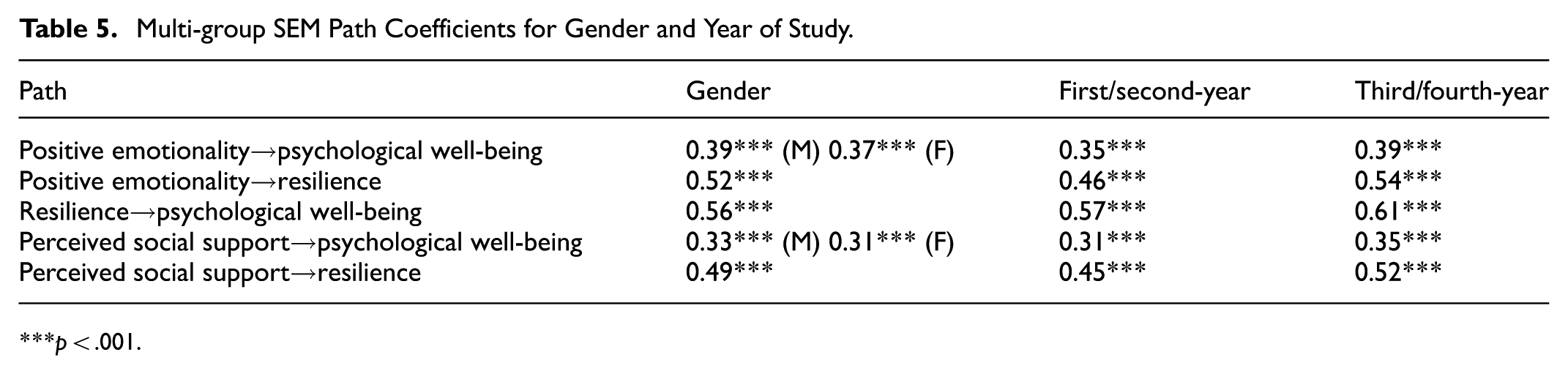
Comparison of path coefficients (see Table 5) revealed no statistically significant differences across genders in the strength of direct or indirect effects. For both male and female participants, the relationships involving positive emotionality, perceived social support, resilience, and psychological well-being remained consistent. For example, the direct effect of positive emotionality on psychological well-being was significant for both males (β = .39, SE = 0.07, p < .001) and females (β = .37, SE = 0.06, p < .001). Similarly, the indirect effect of positive emotionality via resilience was significant for both males (β = .28, SE = 0.05, p < .001) and females (β = .30, SE = 0.05, p < .001). These findings indicate that the hypothesized model applies equally well across genders, with no evidence of gender as a moderating factor.
Multi-group SEM Path Coefficients for Gender and Year of Study.
p < .001.
Year of Study Differences
The model also demonstrated good fit for both first/second-year students (χ2(124) = 275.43, p < .001, CFI = 0.94, TLI = 0.92, RMSEA = 0.047 [90% CI 0.039, 0.055]) and third/fourth-year students (χ2(124) = 284.67, p < .001, CFI = 0.93, TLI = 0.91, RMSEA = 0.050 [90% CI 0.042, 0.058]).
Although overall relationship patterns remained consistent (see Table 5), comparisons revealed differences in the strength of resilience’s indirect effect on psychological well-being. Specifically, the indirect effect of positive emotionality via resilience was stronger for third/fourth-year students (β = .32, SE = 0.06, p < .001) compared to first/second-year students (β = .25, SE = 0.05, p < .001). A similar pattern emerged for the indirect effect of perceived social support via resilience, which was also stronger among third/fourth-year students (β = .30, SE = 0.05, p < .001) than among first/second-year students (β = .24, SE = 0.04, p < .001). These findings suggest that as students progress academically, resilience plays an increasingly significant role in linking positive emotionality and social support to psychological well-being. Older students, likely facing more complex challenges, may rely more heavily on resilience, thereby enhancing its mediating effect.
Qualitative Results
The qualitative phase explored participants’ nuanced experiences regarding positive emotionality, perceived social support, resilience, and psychological well-being. Semi-structured interviews were conducted with 32 participants, purposively selected based on their reported levels of psychological well-being, gender, and academic year. Thematic analysis, following Braun and Clarke’s (2006) six-phase approach, was applied to the interview data to identify patterns in their lived experiences. Four major themes emerged, reflecting how positive emotions, social support, and resilience influenced psychological well-being. These themes are discussed below, supported by interview excerpts.
Theme 1: Emotional Awareness and Regulation
The participants frequently emphasized the importance of emotional awareness, describing how recognizing and managing their emotions—both positive and negative—played a central role in their daily functioning. While some students had developed strategies to regulate their emotional responses, others reported struggling with this balance.
For instance, one participant highlighted the importance of staying mindful of emotions during stressful periods: “When I feel like I’m about to lose control, I try to take a step back and breathe. I remind myself of something positive that happened recently, like getting good feedback on my project” (Participant 7, Female, Third-year).
Similarly, another student discussed the value of maintaining perspective during emotionally charged situations: “I’ve learned to recognize when I’m feeling overwhelmed, and instead of reacting immediately, I try to understand why I’m feeling that way. It helps me calm down” (Participant 5, Male, Second-year).
This ability to manage emotional triggers was often seen as critical for maintaining psychological well-being, particularly among students with higher reported well-being. Emotional regulation involved actively managing emotional responses to maintain focus and reduce stress, rather than merely suppressing negative emotions. Participants demonstrating higher emotional awareness also described using self-reflective techniques, such as journaling or meditation, to process their emotions.
Theme 2: Relational Support Networks as a Source of Stability
Participants highlighted the vital role of social support, especially from peers, in their university experience. Many described friendships as essential for emotional and academic stability, often perceiving these networks as safety nets during challenging academic times.
One student described how friendships provided consistent support: “My friends are my go-to when things get tough. We’re all in the same boat with our studies, and just talking to them makes things feel a little more manageable” (Participant 12, Male, Second-year).
In contrast, some students mentioned family members as primary sources of emotional support, especially during personal stress. For example, one participant reflected: “Even though I’m far from home, my mom always checks in with me. Sometimes just talking to her makes me feel less isolated” (Participant 19, Female, First-year).
Interestingly, the interviews revealed that while friends often provided primary emotional support for daily university challenges, family members were crucial during more personal difficulties. This dual reliance on friends for academic-related stress and family for personal emotional support highlighted the varied dimensions of social networks in supporting students’ psychological well-being.
Theme 3: Building Resilience Through Academic Challenges
The students articulated how facing and overcoming academic challenges contributed to their resilience. For many, academic failures or frustrations served as turning points for learning to cope with adversity and developing stronger self-efficacy.
One student shared his experience of struggling academically in his first year: “I failed a major exam early on, and it was devastating. But after that, I knew I had to change how I approached my studies. Now, even when I’m stressed, I remind myself that I’ve gotten through worse” (Participant 21, Male, Fourth-year).
Another participant described how overcoming the language barrier during her exchange program helped build resilience: “When I first went on the exchange, I couldn’t keep up with the language, and it was embarrassing. But I worked at it, and by the end of the semester, I felt much more confident. I realized that I could adapt to new environments if I put in the effort” (Participant 10, Female, Third-year).
This theme highlighted that resilience developed not only through academic achievement but also through experiencing and recovering from failure. These experiences were often transformative, reshaping students’ approaches to challenges. Importantly, students with higher reported resilience tended to view these difficulties as learning opportunities rather than setbacks, fostering a more optimistic outlook.
Theme 4: Mental Health Awareness and Proactive Well-being Practices
The participants expressed increasing awareness of mental health resources and the importance of proactive strategies for maintaining well-being. They frequently discussed incorporating practices like mindfulness, physical exercise, and using university counseling services into their routines. Those with lower psychological well-being often described turning to these resources to regain control over their mental health.
For example, one student noted: “I didn’t take mental health seriously at first, but now I use the university’s counseling service when things get overwhelming. It really helps me put things into perspective” (Participant 14, Female, Second-year).
Another student reflected on how mindfulness helped manage daily stress: “I started practicing mindfulness as part of my daily routine. It’s a small thing, but it’s made a huge difference in how I handle stress. I feel more in control” (Participant 16, Male, Fourth-year).
Interestingly, students with higher reported well-being were more likely to have integrated personal coping mechanisms (e.g., journaling, exercise, meditation) into their routines, while those with lower well-being tended to rely more on formal mental health services. This suggests that students at different points in their well-being journey may benefit from varied interventions.
In summary, the qualitative phase provided a rich exploration of how positive emotionality, social support, and resilience interact to shape psychological well-being among Chinese university students. Emotional awareness and regulation, the central role of relational support networks, resilience built through academic challenges, and growing mental health awareness emerged as key themes.
Discussion
This mixed-methods study was designed to investigate the interplay of positive emotionality, perceived social support, and resilience in relation to psychological well-being among university students in Mainland China, with a specific focus on the direct effects of positive emotionality and social support, and the central mediating role of resilience. Our findings, derived from both quantitative modeling of these pathways and in-depth qualitative inquiry into student experiences, largely support the hypothesized relationships and offer crucial insights into how emotional, social, and adaptive capacities shape student mental health, thereby highlighting key areas for interventions.
Positive emotionality emerged as a significant factor in psychological well-being, supporting Fredrickson’s broaden-and-build theory (Fredrickson, 2001). Positive emotions were strongly associated with resilience and well-being, aligning with research showing that positive emotionality promotes mental health, buffers against challenges, and supports adaptive coping (Houben et al., 2015; Khazanov & Ruscio, 2016; Vázquez et al., 2009). By fostering resilience, positive emotionality contributes significantly to the development and maintenance of long-term psychological health (Fredrickson & Joiner, 2018; Morales-Rodríguez et al., 2020; Rasheed et al., 2022).
This study adds to the literature by showing that resilience partially mediates the relationship between positive emotionality and well-being, with resilience accounting for 41.6% of the total effect. Consistent with Fredrickson’s theory, positive emotions help build lasting psychological resources that improve mental health (Denovan & Macaskill, 2017; Dumont & Provost, 1999). Qualitative data further illustrate how students use positive emotionality through practices like mindfulness and self-reflection to regulate emotions and reduce stress (Galante et al., 2016; Weytens et al., 2014). These findings underscore the critical role of positive emotionality in fostering resilience and promoting well-being in student populations (Kotera et al., 2022; Lawson et al., 2021; Wetter & Hankin, 2009).
Perceived social support also emerged as a critical factor in enhancing psychological well-being. Consistent with the stress-buffering model (Cohen & Wills, 1985), the quantitative results indicate that perceived social support directly contributes to well-being while also indirectly influencing it through resilience. This finding aligns with research showing that social support acts as a protective factor in higher education, where academic pressures can negatively affect mental health (Denovan & Macaskill, 2017; Wilks & Spivey, 2010). Several studies have demonstrated that social support fosters resilience, which in turn promotes well-being (Kelifa et al., 2021; Wilks, 2008). In the current study, 43.8% of the effect of social support on well-being was mediated by resilience, supporting the view that strong social networks help students develop the emotional and cognitive resources needed to manage stress effectively (Brannan et al., 2013; Li & Hasson, 2020).
The qualitative data add depth to this understanding by illustrating the different types of social support that students rely on, highlighting the distinct contributions of family, peers, and academic mentors. These findings resonate with research showing that family support provides emotional stability during personal challenges (Alorani & Alradaydeh, 2018; Richman et al., 1998), while peer support plays a pivotal role in helping students navigate academic pressures (Brannan et al., 2013; Mazer & Thompson, 2011). Furthermore, the instrumental and informational support provided by academic mentors is critical for students’ academic success and mental health, as demonstrated in prior studies (Malkoç & Yalçın, 2015; Warren et al., 2009). During the COVID-19 pandemic, the reliance on peer and academic support increased, highlighting the importance of social support systems in maintaining student well-being under exceptional circumstances (Huang et al., 2021; Zhou & Yu, 2021).
Notably, the study found no significant gender differences in the relationships between positive emotionality, social support, resilience, and well-being. This finding supports prior research indicating that both male and female students benefit equally from social support and positive emotionality in fostering resilience and well-being (Stallman et al., 2018; Yıldırım & Tanrıverdi, 2021). These results suggest that interventions aimed at enhancing well-being through social support and emotional regulation should be equally effective across genders.
Resilience emerged as a key mediator in this study, translating both emotional and social resources into improved well-being. This finding is consistent with previous research that underscores resilience as a critical psychological resource for managing the challenges of higher education (Denovan & Macaskill, 2017; Morales-Rodríguez et al., 2020; Wilks, 2008). The stronger mediating role of resilience among third- and fourth-year students is particularly significant. As students advance in their academic careers, they encounter greater academic and social pressures, requiring more developed coping strategies (Ramasubramanian, 2017). Qualitative data further supported this, with students describing how overcoming academic challenges strengthened their resilience and enhanced their ability to manage stress (Hartson et al., 2023). These results align with Masten’s (2001) concept of resilience as “ordinary magic,” a fundamental capacity for adaptation cultivated through facing adversity.
Additionally, the qualitative phase of the study revealed an increased awareness of mental health resources among students and a shift toward more proactive approaches to well-being. Students with higher psychological well-being tended to use self-directed coping strategies, such as mindfulness and journaling, practices known to improve emotional regulation and stress management (Fitzpatrick & Stalikas, 2008; Weytens et al., 2014). In contrast, students with lower well-being scores relied more on formal mental health services, indicating that interventions may need to be tailored to different stages of students’ mental health development. These findings align with broader research emphasizing the role of proactive mental health practices in preventing and addressing psychological challenges among university students (Stallman et al., 2018; Ramasubramanian, 2017).
Cultural and contextual factors significantly influenced psychological well-being in this study, particularly regarding the sources of social support students prioritized. Qualitative data revealed that students from regions with strong familial values relied more on family support, highlighting the impact of cultural norms (Huang & Zhang, 2022; Thanoi et al., 2023). The COVID-19 pandemic also increased reliance on peer and academic support, emphasizing the need for context-sensitive interventions to promote well-being (Douwes et al., 2023; Zhou & Yu, 2021). These findings support the importance of culturally tailored approaches to address the diverse needs of student populations (Ryff, 2013; Weiss et al., 2016).
Conclusion
In sum, this mixed-methods study successfully addressed its primary objective by investigating the interplay of positive emotionality, perceived social support, and resilience in relation to psychological well-being among university students in Mainland China. Our findings provide an in-depth analysis confirming the significant direct roles of positive emotionality and perceived social support, and crucially highlight resilience as a vital partial mediator that channels the positive effects of these emotional and social resources towards improved student well-being outcomes. The integration of quantitative modeling of these specific pathways with rich qualitative insights into student experiences offers a comprehensive understanding of how these individual and social elements collectively shape well-being in this specific cultural context. These insights carry important implications for designing interventions aimed at improving student well-being, particularly by promoting positive emotional experiences, reinforcing social support systems, and strategically enhancing resilience to help students manage the pressures of academic life.
Theoretical and Practical Implications
This study offers distinct theoretical and practical implications for university students in Mainland China. Theoretically, it contributes as an early mixed-methods investigation in this context, concurrently examining how positive emotionality, perceived social support, and resilience predict psychological well-being. Our findings quantitatively specify resilience’s mediating role, accounting for 41.6% of positive emotionality’s and 43.8% of perceived social support’s effect on well-being in this cultural setting. The research supports Fredrickson’s (2001) broaden-and-build theory by empirically confirming that positive emotionality enhances well-being, with resilience as a key mediator, thereby extending the theory’s cultural relevance beyond predominantly Western contexts. Additionally, the study aligns with Masten’s (2001) view of resilience as a dynamic, adaptive process cultivated by individual traits like positive emotionality and environmental factors such as social support. The mixed-methods design further enriches the understanding of resilience by combining qualitative insights on students’ experiences, like building resilience from academic setbacks, with quantitative outcomes. This integration underscores the value of mixed-methods research for a more holistic and culturally nuanced understanding of complex psychological constructs like resilience and well-being among Chinese university students.
Practically, the findings highlight universities’ critical need to prioritize interventions addressing emotional regulation and social support. Resilience’s mediating role suggests that programs fostering positive emotional experiences and regulation skills can indirectly improve mental health by enhancing students’ recovery from adversity. Such interventions could include mindfulness training, emotional regulation workshops, and programs developing optimism and self-compassion. This study also emphasizes nurturing robust social support systems through enhanced peer mentoring, student-led groups, and integrated academic advising with mental health services. Building on this, tutor and peer mentor training could be expanded beyond academic aid to include skills in empathetic responses to distress, fostering positive emotionality and a growth mindset, guiding students to utilize varied support networks (recognizing distinct peer and family roles as per our qualitative data), and encouraging help-seeking and connection to formal mental health services.
More specifically, these findings can inform a comprehensive, integrated support initiative, tentatively termed the “Student Holistic Academic Resilience & Well-being Program (SHA-RAW Program).” This program would first address emotional awareness and regulation, offering training in identifying emotional triggers and practical regulation techniques. For instance, mindfulness practices (Galante et al., 2016) and cognitive reframing of academic stressors could be taught in weekly workshops supplemented by online resources, while strategies for savoring positive experiences (Weytens et al., 2014) would be encouraged as ongoing practice.
Subsequently, the program would aim to strengthen relational support networks. Structured opportunities in tutoring groups or workshops would foster supportive peer relationships, featuring facilitated discussions on shared challenges, mutual support, and skills like active listening and conflict management. Dedicated workshops could address effective communication with and leveraging support from family, alongside activities like collaborative network mapping to help students identify and broaden their support systems, potentially initiated during orientation and revisited mid-semester.
Another component would focus on building resilience through academic experiences, integrating qualitative insights about overcoming challenges. This module, perhaps delivered as interactive workshops, would include psychoeducation on resilience as an adaptive process (Masten, 2001), training in coping skills for academic and emotional challenges, and reflective practices in tutoring sessions to reframe failures as learning opportunities. Sharing anonymized resilience narratives could also normalize struggle. For senior students, intensive workshops could target resilience for career transitions, focusing on career exploration and stress management.
Crucially, the SHA-RAW Program would be integrated into existing academic support, with ongoing tutor training. It would also proactively promote university mental health services and encourage proactive well-being practices. Such a holistic program extends beyond traditional academic support by cultivating the emotional, social, and resilient capacities critical for student well-being, applying insights from both statistical modeling and lived experiences.
Finally, targeted, stage-specific interventions are important. Given resilience’s stronger mediating role among older students, third- and fourth-year students facing career planning stressors might benefit from interventions emphasizing resilience for uncertainty and stress management. Conversely, first- and second-year students might need more focus on forming social connections and foundational emotional resilience for the academic transition. The SHA-RAW Program could be adapted with different emphases and workshop cycles—such as more frequent social-bonding activities for first-years and intensive career-resilience modules for final-years—to ensure relevance across the university experience.
Limitations and Future Research
This study has several limitations that offer avenues for future research. First, while the study provides valuable insights into university students in Mainland China, the sampling strategy has implications for the generalizability of the findings. The sample, although diverse in terms of discipline and drawn from multiple regions, relied on online recruitment and volunteer participation. Consequently, it may not be fully representative of the entire population of over 40 million university students in China, and this approach can introduce selection biases inherent in convenience or self-selected samples. Thus, the findings should be interpreted with this consideration. The relatively homogeneous cultural background of the sample further limits the direct generalizability of our findings to students in different countries, regions, or from more diverse cultural contexts. Future research should therefore endeavor to employ more systematic, stratified random sampling techniques across a broader and more institutionally diverse range of universities to achieve a more nationally representative sample within China. Concurrently, expanding research to include students from a wider array of international cultural backgrounds is crucial to explore the universality and cross-cultural applicability of the identified relationships.
Second, as a result of its cross-sectional design, this study cannot definitively establish causal relationships between positive emotionality, social support, resilience, and psychological well-being. For instance, although the results indicate that positive emotionality and perceived social support significantly predict psychological well-being, it remains unclear whether these factors directly lead to improved well-being, or conversely, if students with higher psychological well-being are more predisposed to experience positive emotions and garner social support. Consequently, longitudinal studies are crucial to track these dynamics over time, particularly during critical academic transitions, to clarify the causal pathways and the precise manner in which emotional regulation and social support contribute to resilience and well-being.
Third, reliance on self-report measures introduces potential biases, such as social desirability and self-perception distortions. Future research should incorporate objective measures, such as physiological stress markers (e.g., cortisol levels) or behavioral indicators (e.g., academic performance), to complement subjective data. Observational or experimental methods could also help establish causal links between these variables. Furthermore, regarding measurement tools, while validated scales were used, potential cultural differences in the applicability and interpretation of some items may still exist. Future research could benefit from initiatives to further adapt and re-validate these scales for specific local contexts, such as the Mainland Chinese student population, or combine existing scales with multiple measurement tools, including locally developed instruments, to improve the accuracy and reliability of the measurements.
Regarding the qualitative component, while purposive sampling aimed to capture diverse experiences across psychological well-being, gender, and academic year, the findings represent the perspectives of this specific sub-sample and are intended to provide depth and context rather than statistical generalizability to the entire student population.
Finally, while this study focused on resilience as a key mediator, it did not account for all potential influencing factors on psychological well-being. Variables such as family background, personal values, academic pressure, and broader socioeconomic or institutional factors were not explicitly examined but may also play significant roles. Future research should aim to incorporate a broader array of these potential influencing factors, in addition to exploring other mediators or moderators like cultural values, personality traits (e.g., neuroticism, conscientiousness), and coping strategies (e.g., problem-focused vs. emotion-focused coping). Examining these factors could inform culturally tailored interventions and help construct a more comprehensive model of university students’ psychological well-being, particularly in contexts like China, where familial and community support systems differ from those in Western settings.
Footnotes

Ethical Considerations
This research was conducted with the utmost respect for ethical principles. The study protocol received a comprehensive review and was granted approval by the Ethics Committee of the School of Foreign Studies at Hunan First Normal University in Changsha, Hunan Province, China. The committee verified that the research posed no potential risk of harm to participants. All procedures strictly adhered to relevant guidelines and regulations.
Consent to Participate
Written informed consent was obtained from all participants involved in the study. They were fully informed about the research objectives, had the opportunity to ask questions, and participated voluntarily after understanding their right to withdraw at any stage without explanation or consequence.
Author Contributions
All authors significantly contributed to the reported work. This includes involvement in the conception, study design, execution, data collection, analysis, interpretation, drafting, revising, and critically reviewing the manuscript. Each author provided final approval for the published version, agreed on the target journal for submission, and assumes accountability for all aspects of the research.
Funding
The authors disclosed receipt of the following financial support for the research, authorship, and/or publication of this article: This work was sponsored in part by the National Education Science Planning of China under the National General Program “Research on the Value Orientation and Implementation Mechanisms for Cultivating Outstanding Rural Teachers in the New Era” (Grant No. BIA190187).
Declaration of Conflicting Interests
The authors declared no potential conflicts of interest with respect to the research, authorship, and/or publication of this article.
Data Availability Statement
The anonymized data generated during this study are available upon reasonable request from the corresponding author. We kindly request that any researcher interested in accessing the data outlines their intended purpose for using it.