




Abstract
Previous research works demonstrate that risk perception (RP) of coronavirus disease 2019 (COVID-19) may result in experiencing negative emotions. The current research sought to further appraise of whether perceived social support alleviated the negative impact of RP of COVID-19 on subjective well-being (SWB) among university students. A sum of 594 university students in China aged 16 to 25 years old completed an online questionnaire during the COVID-19 outbreak on college campuses. The results found that uncontrollability negatively predicted positive affect and satisfaction with life; susceptibility, severity, and uncontrollability positively predicted negative affect in university students. Moreover, the relation between RP of COVID-19 and SWB was moderated by perceived social support. RP of COVID-19 predicted SWB in university students with high perceived social support but not amongst those with low perceived social support. Thus, the current research indicates that RP of COVID-19 may inhibit SWB and that high perceived social support may alleviate the negative role of RP of COVID-19 in SWB in university students.
Plain language summary
The decline in subjective well-being during the COVID-19 pandemic is an important issue. Previous studies demonstrate that risk perception of COVID-19 is expected to result in experience negative emotions. However, little is known about whether high risk perception of COVID-19 always lead to a decrease in SWB, and whether there are boundary conditions in the relationship between risk perception of COVID-19 and SWB. We conducted a questionnaire survey with 594 Chinese college students between 16 and 25 years old during the COVID-19 outbreak on college campuses. The results found that uncontrollability negatively predicted positive affect and life satisfaction; susceptibility, severity and uncontrollability positively predicted negative affect in college students. Moreover, the relationship between risk perception of COVID-19 and SWB was moderated by perceived social support. Risk perception of COVID-19 predicted SWB in college students with high perceived social support rather than in those with low perceived social support. Thus, the current research indicates that perception of COVID-19 may inhibit SWB and that high perceived social support may alleviate the negative role of perception of COVID-19 in SWB in college students. The findings offer important practical guidance for improving college students’ subjective well-being.
Introduction
The outbreak of coronavirus disease (COVID-19) in December 2019 disrupted the normal rhythm of university students study and life and brought a lot of inconveniences, such as suspension of classes, university campus quarantine, lockdown, strict control, continuous nucleic acid testing or frequent pop-ups of health codes (Galea et al., 2020), which triggered various social psychological problems that beset everyone such as restfulness, apprehension, and worry (Alsolais et al., 2021), and further caused a sharp decline in subjective well-being (SWB).
For university students, the social and psychological problems brought on by the epidemic are more prominent. During the pandemic, the lockdown has prevented undergraduates from freely accessing their campuses. When the epidemic occurred on campus, undergraduates were obliged to stay indoors and were forced into prolonged confinement, which led to the accumulation of negative emotions (Pérez-Fuentes et al., 2020). This situation makes undergraduates pay too much attention to some negative information (Chen et al., 2023). They escape such an emergency by drinking, smoking, playing video games, addicting to mobile phones, etc. (Jiang et al., 2022; Peng et al., 2022), thus resulting in a decrease in SWB. The multiple pressures of epidemic prevention, study, and employment, as well as the sudden changes in the pace of life, make many students not adapt to it, and are prone to experience adverse emotional states including tension, apprehension, irritability, loneliness, helplessness, and depression (Cao et al., 2020; X. Zhao et al., 2021; Zhuang et al., 2021). In addition, a cross-sectional study looking at the effect of COVID-19 on the psychological well-being of university students after school reopening showed that students, having infected acquittances, bring afraid of being infected, and exhibiting pessimism toward COVID-19 were prone to face apprehension or depression (Ren et al., 2021). Research also shows that during the pandemic, self-quarantine, classmate quarantine, routine wearing of masks, lock restrictions, some areas of the school that were closed due to COVID-19, and family finances were affected by COVID-19 were the main influencing causal elements concerning apprehension or depression (Ren et al., 2021). In this way, COVID-19 has a significant impact on undergraduates’ SWB and brings new challenges to their mental health. Henceforth, the SWB of the university students necessitates enhancement during the pandemic.
SWB pertains to an overall judgment of an individual’s living state, as well as a comprehensive reflection of his or her social function and adaptive state, which is one of the important indicators to measure mental health (Diener, 1984; Diener & Lucas, 2008). It is considered to be a multi-dimensional structure, including positive affect, negative affect, and satisfaction with life (Diener, 1984; Diener et al., 1999). SWB has been proven as a key function in the development of university students. A great body of literature has indicated that high SWB is associated with positive developmental outcomes, such as high self-esteem, good academic achievement, more altruistic behaviors, and less depression and apprehension (Akar Vural et al., 2020; Bortes et al., 2021; Burns et al., 2011; Rhoads et al., 2021; Q. Yang et al., 2019). Given that positive affect is particularly significant for the eventual victory over the pandemic and the resumption of happiness, exploring SWB’s antecedents and thereby providing insights for contributing to university students’ SWB and further adaptive development.
Relationship Between Risk Perception (RP) of COVID-19 and SWB
According to Affective Load Theory, an individuals’ affective state is determined by the structure of the information intense environment (Nahl, 2004, 2005). As a global health crisis of worldwide significance, the COVID-19 pandemic is distinguished by substantial transmissibility, extensive scope, protracted duration, and grave health impact (Huang et al., 2023). During the COVID-19 epidemic, various online public opinions and negative information have followed. In this information-stressed environment, the RP of COVID-19 often exerts an influence on individual’s emotional state. RP of COVID-19, as an individual’s psychological reflection of the uncertainty of the outbreak of COVID-19, pertains to an individual’s subjective feelings, experience, and understanding of a variety of objective epidemic risks existing on the outside (Cui et al., 2021), which can be divided into three dimensions (i.e., susceptibility, severity, and uncontrollability). Cui et al. (2021) discovered that the Chinese public, including university students, exhibited a higher RP during the pandemic. RP is also an important indicator to measure public psychological panic (B. Zhang et al., 2023). Due to the health hazards of COVID-19, individuals will be in a state of high stress during the pandemic, fearing that they will be infected and not receive good treatment after infection, and then fear the results for being infected (i.e., death or serious health impacts) (Ding et al., 2020). During the pandemic, individuals who are on a state of high alert for a long period of time will have a sense of great risk and susceptibility to the onset or reappearance of the disease, which will increase apprehension and even develop the affective disorder (Pérez-Fuentes et al., 2020), which will lead to a decrease in SWB. Individuals with greater degree RP are more prone to be affected by sudden changes in the pace of life, and suffer from apprehension, depression, etc. (Cao et al., 2020; X. Zhao et al., 2021), then reducing their SWB. Therefore, RP of COVID-19 may be inversely correlated with SWB.
Moderating Roles of Perceived Social Support
The relationship between RP of COVID-19 and SWB has been explored above, but will a higher RP of COVID-19 always lead to a decrease in SWB? Are there boundary conditions for the relationship between RP of COVID-19 and SWB? Previous research suggested that support from external resources (perceived social support) can mitigate the negative effects of external high-pressure events (Racine et al., 2019; Viseu et al., 2018). This indicates that the negative effects of RP of COVID-19 on SWB may be different with high perceived social support and low perceived social support. Perceived social support refers to the belief that aid would be received by those in need from other parties (Cohen, 1988; Cohen & Wills, 1985). According to the stress-buffering effects of social support by Cohen and Wills (1985), when facing pressure or stressful events, individuals with a greater degree of perceived social support will carry out positive cognitive reappraisal and reevaluate stressful events, which may inhibit adverse physiological or psychological reactions (i.e., apprehension and depression), and thereby reducing the negative effects of pressure. Therefore, individuals with elevated RP may not have adverse effects due to their high perceived social support. Empirical studies also show that perceived social support has a positive effect on individual SWB (Li et al., 2020; O’Handley & Courtice, 2022). Individuals with greater degree of perceived social support can access more social resources and adopt a positive attitude to face difficulties and challenges brought by the epidemic, reducing the accumulation of negative emotions, thus exerting a significant effect on SWB (Li et al., 2020; Wolters et al., 2022). Additionally, individuals with higher perceived social support may adopt adaptive emotion regulation strategies and carry out positive cognitive reappraisal (W. P. Cai et al., 2017; You et al., 2018), which will help them cope with the pressure brought by COVID-19 by enhancing their resilience, improve their mental health, and enable them to show more positive emotions and increase their SWB when the epidemic occurs. In this way, perceived social support may moderate the relationship between RP of COVID-19 and SWB.
The Current Study
In summary, RP of COVID-19 and perceived social support are both important factors affecting SWB and may interact and jointly affect university students’ SWB. Most studies have explored the negative impact of RP of COVID-19 on individuals’ psychological well-being, and the indirectly effect of coping styles, perceived stress, and meaning-making between RP of COVID-19 and psychological well-being (Krok & Zarzycka, 2020; Krok et al., 2023). Nevertheless, limited research has focused on the protective effect of external stressful events on SWB from the perspective of psychological resources. Therefore, this study will seek to assess the relation between RP and SWB, and understand the moderating role of social support. The current study is designed for assessing the relationships between RP of COVID-19 (i.e., susceptibility, severity, and uncontrollability) with SWB (i.e., positive affect, negative affect, and satisfaction with life), and the moderating function of perceived social support in the relationship between RP of COVID-19 and SWB among university students in China. Building upon previous findings and theoretical frameworks, this research puts forth below the hypotheses:
Hypothesis 1. RP of COVID-19 (i.e., susceptibility, severity, and uncontrollability) is negatively related to SWB (i.e., positive affect, negative affect, and satisfaction with life).
Hypothesis 2. Perceived social support moderates the relation between RP of COVID-19 and SWB.
Methods
Participants and Procedure
There was a small outbreak at a university in a Chinese city in October 2022. During this time, students are isolated in schools and restricted in their freedom of movement. A questionnaire was conducted among the students at this university. The cluster sampling method was used to conduct an online survey the class unit through the questionnaire star platform. With the assistance of counselors and instructors, questionnaires were distributed through WeChat and QQ groups to invite university students to partake in the survey. A sum of 594 valid data were collected, and the participants were all non-infected. At the beginning of the questionnaire, the purpose of this study was explained. Participants had been informed that their data were only for the purpose of the study and would be confidential. All participants signed informed consent. Participants were aged 16 to 25 years old (mean age: 19.23 ± 1.39 years). Among these participants, 197 (33.2%) were men, and 397 (66.8%) were women. They included 190 freshmen, 216 sophomores, 131 junior students, and 57 senior students. It should be noted that there were 38 participants under the age of 18, accounting for 6.4% of the total sample, all of whom were freshmen. In China, while most college students are over 18 years old, there are special cases that allow students to enter school early, such as completing their studies ahead of time, skipping grades, or participating in special gifted classes. Additionally, some regions implement a five-year primary education system, which results in students entering university 1 year earlier than usual. Therefore, a small percentage of students enter university under the age of 18.
Measures
COVID-19 RP
The Chinese version of the COVID-19 RP Measure produced by Cui et al. (2021) was adapted to measure residents’ RP during COVID-19 time. It has three subscales: susceptibility (e.g., “I’m more susceptible to infection than anyone else.”), severity (e.g., “Contracting COVID-19 can have serious sequelae.”) and uncontrollability (e.g., “I think this epidemic and spread is very difficult to control.”). Each subscale included three items rated on a 5-point scale ranging from 1 (strongly disagree) to 5 (strongly agree). Averages of the scores on the three items on each scale served as an individual’s susceptibility, severity, and uncontrollability scores. High scores illustrated high-RP during COVID-19 time. The reliability (Cronbach’s α) for the scale was .901 in the current research.
SWB
Positive and Negative Affect Scale (PANAS; Watson et al., 1988) and the Satisfaction with Life Scale (SLS; Diener et al., 1985) were used to measure subjective well-being. PANAS included 10-item positive affect (e.g., excited) and 10-item negative affect (e.g., afraid). Participants responded on a 5-point Likert scale ranging from 1 (none of the time) to 5 (all of the time) on all items. Averages of the scores on the 10 items on each scale served as an individual’s negative and positive affect scores. High scores illustrated high negative and positive affect. The reliability (Cronbach’s α) for the positive and negative affect subscales were .934 and .908 for this study.
The Chinese version of the Life Satisfaction Scale was employed to assess satisfaction with life Y. J. Cai et al., 2008). It is a single-factor scale comprising of five elements (e.g., “The conditions of my life are excellent”). The participants needed to indicate their levels of agreement on a 5-point Likert scale ranging from 1 (completely disagree) to 5 (completely agree) on all items. A mean score value would be obtained averaging the five elements to derive the subject’s satisfaction with life scores. High scores illustrated high satisfaction. The reliability (Cronbach’s α) for the scale was .873 in the current research.
Perceived Social Support
The perceived social support Scale developed by Yan and Zheng (2006) was adapted to measure university students perceived social support. The present study used the Chinese version (“I can rely on my friends when facing difficulties.”) to measure perceived social support on a 7-point scale ranging from 1 (strongly disagree) to 5 (strongly agree). An average of the scores on the 12 items served as the individual’s perceived social support scores. High scores indicated high perceived social support. The reliability (Cronbach’s α) for the scale was .960 in the current research.
Statistical Analysis
In the current research, descriptive statistics and statistical analysis were carried out with SPSS 26.0. The mean, standard deviation, and correlation of COVID-19 RP, perceived social supports, and subjective well-being were calculated to preliminarily test the relationship between variables. To test the direct and moderating effects of COVID-19 RP on subjective well-being, PROCESS macro was used for bootstrapping analysis (Hayes, 2013). It should be noted that the gender, age, and family economic status of the residents were controlled for when testing moderating effects. We employed 95% confidence intervals (CIs) to estimate the significance of the moderating effect. The moderating effect is significant if 95% CI does not contain 0. The number of bootstrap samples was set to 1,000. Before the bootstrapping analysis, COVID-19 RP and perceived social supports were centered on their means. Furthermore, the effects of COVID-19 RP (including susceptibility, severity, and uncontrollability) on subjective well-being at different levels of perceived social support (one standard deviations above and below (±1 SD) the mean) were estimated.
Results
Common Method Bias, Descriptive Statistics, and Correlation Analysis of Variables
All tools in this research adopted were self-report scales. To avoid the common method bias effect, Harman’s single factor had been adopted for testing test the common method bias. The findings indicated that 46 principal component factors were extracted. Eight of them were greater than 1. The interpretation rate of the first principal component was 29.296%, which was less than 40%, thus no common method bias existed (Zhou & Long, 2004).
Descriptive results and correlation analysis for COVID-19 RP, perceived social supports, and subjective well-being are depicted in Table 1. COVID-19 RP, including susceptibility, severity, and uncontrollability, was correlated negatively with perceived social support, positive affect, and satisfaction with life, and correlated positively with negative affect; perceived social support was correlated positively with positive affect and satisfaction with life, and correlated negatively with negative affect.
Descriptive Statistics and Correlation Analysis Between COVID-19 RP, Perceived Social Supports, and Subjective Well-Being.
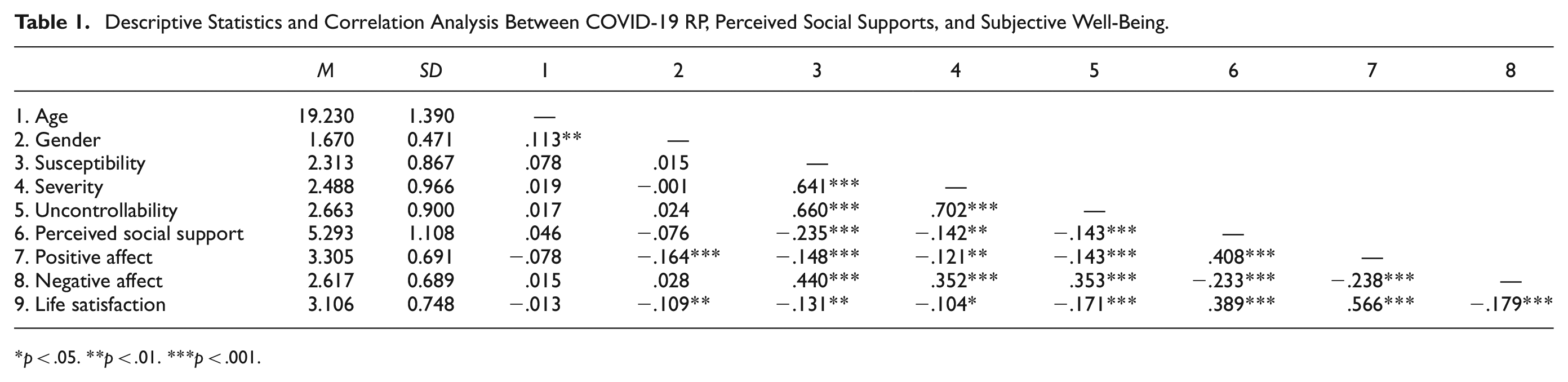
p < .05. **p < .01. ***p < .001.
The Predictive Effects of COVID-19 RP and Perceived Social Supports on Subjective Well-Being
Direct and moderating effects on subjective well-being are presented in Tables 2 to 4. The findings represented that uncontrollability negatively predicted positive affect and satisfaction with life; susceptibility, severity, and uncontrollability positively predicted negative affect. Moreover, perceived social support positively predicted positive affect and satisfaction with life, and negatively predicted negative affect.
Bootstrapping Analysis of COVID-19 RP Predicting Positive Affect.

Note. FES = family economic status; SUE = susceptibility of the epidemic; SEE = severity of the epidemic; UE = uncontrollability of the epidemic; PSS = perceived social supports; PA = positive affect.
p < .05. **p < .01. ***p < .001.
Bootstrapping Analysis of COVID-19 RP Predicting Negative Affect.

Note. FES = family economic status; SUE = susceptibility of the epidemic; SEE = severity of the epidemic; CE = uncontrollability of the epidemic; PSS = perceived social supports; NA = negative affect.
p < .05. **p < .01. ***p < .001.
Bootstrapping Analysis of COVID-19 RP Predicting Satisfaction with Life.
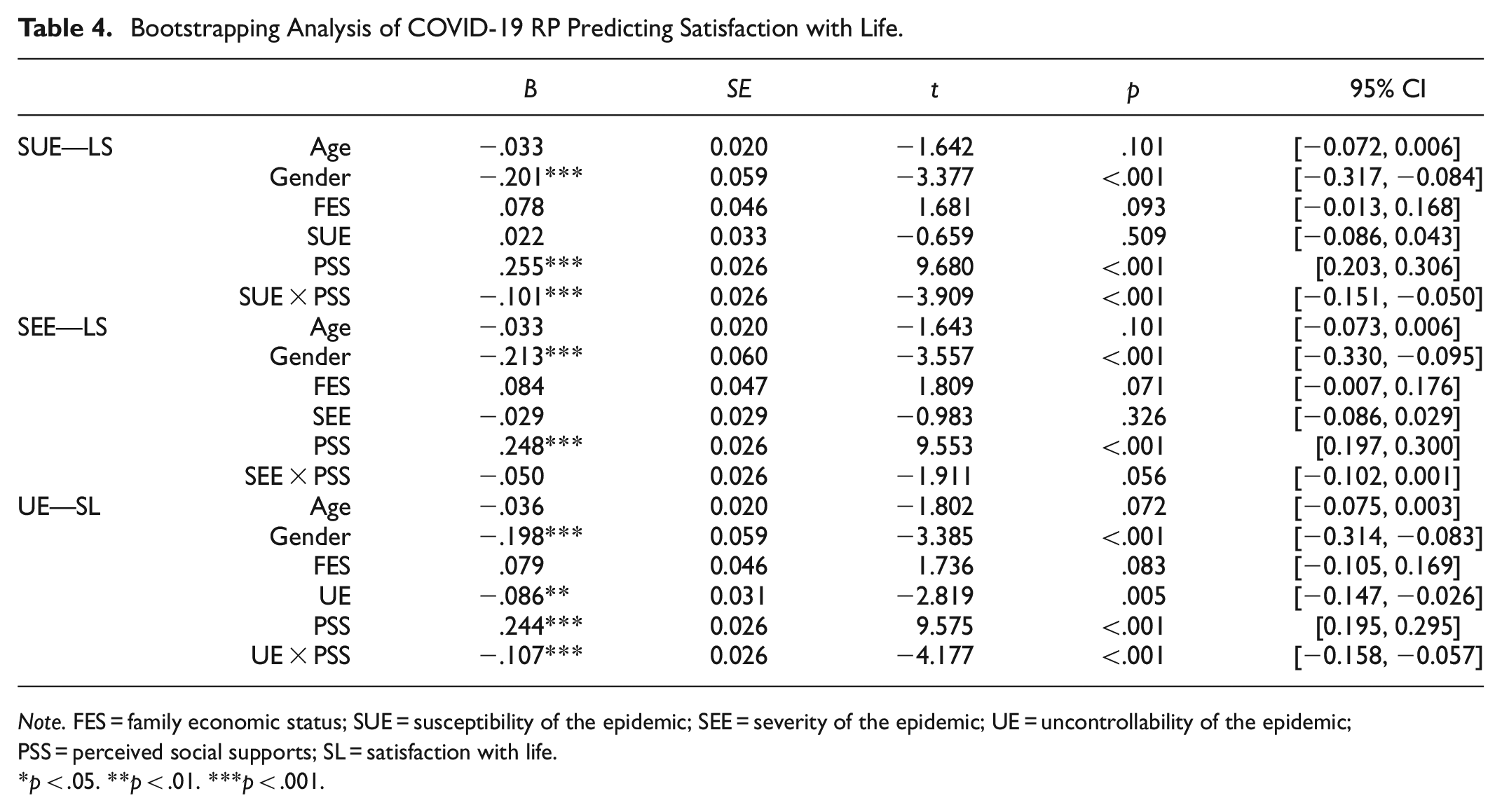
Note. FES = family economic status; SUE = susceptibility of the epidemic; SEE = severity of the epidemic; UE = uncontrollability of the epidemic; PSS = perceived social supports; SL = satisfaction with life.
p < .05. **p < .01. ***p < .001.
The Moderating Effect of Perceived Social Support
The Moderating Effect of Perceived Social Support Between COVID-19 RP and Positive Affect
As Table 2 illustrated, the interaction between susceptibility and perceived social support significantly predicted positive affect (B = −.091, p < .001, 95% CI [−0.137, −0.044]). As depicted in Figure 1, for residents with high perceived social support (+1 SD), susceptibility negatively predicted positive affect (B = −.137, p < .001, 95% CI [−0.215, −0.059]); for residents with low perceived social support (−1 SD), susceptibility did not predict positive affect (B = .064, p = .111, 95% CI [−0.015, 0.144]). Similar results were found for the relationship between severity and positive affect. As exhibited in Figure 2, severity negatively predicted positive affect with high perceived social support (B = −.125, p < .001, 95% CI [−0.193, −0.056]) but not those with low perceived social support (B = .057, p = .152, 95% CI [−0.021, 0.135]). As shown in Figure 3, uncontrollability negatively predicted positive affect with high perceived social support (B = −.132, p < .001, 95% CI [−0.206, −0.057]) but not those with low perceived social support (B = .011, p = .787, 95% CI [−0.067, 0.089]).

The moderating effect of perceived social support upon the relation between susceptibility and positive affect.

The moderating effect of perceived social support upon the relation between severity and positive affect.

The moderating effect of perceived social support upon the relation between uncontrollability and positive affect.
The Moderating Effect of Perceived Social Support Between COVID-19 RP and Negative Affect
As Table 3 illustrated, the interaction between uncontrollability and perceived social support significantly predicted negative affect (B = −.062, p = .011, 95% CI [0.014, 0.110]). As shown in Figure 4, for residents with high perceived social support (+1 SD), uncontrollability positively predicted negative affect (B = .314, p < .001, 95% CI [0.238, 0.390]); for residents with low perceived social support (−1 SD), uncontrollability also positively predicted negative affect (B = .176, p < .001, 95% CI [0.096, 0.256]).

The moderating effect of perceived social support upon the relation between uncontrollability and negative affect.
The Moderating Effect of Perceived Social Support Between COVID-19 RP and Satisfaction with Life
As Table 4 illustrated, the interaction between susceptibility and perceived social support significantly predicted satisfaction with life (B = −.101, p < .001, 95% CI [−0.151, −0.050]). As shown in Figure 5, for residents with high perceived social support (+1 SD), susceptibility negatively predicted satisfaction with life (B = −.133, p = .002, 95% CI [−0.218, −0.049]); for residents with low perceived social support (−1 SD), susceptibility positively predicted satisfaction with life (B = .089, p = .041, 95% CI [0.004, 0.176]). The interaction between uncontrollability and perceived social support significantly predicted satisfaction with life (B = −.107, p < .001, 95% CI [−0.158, −0.057]). As shown in Figure 6, uncontrollability negatively predicted satisfaction with life with high perceived social support (B = −.206, p < .001, 95% CI [−0.286, −0.125]) but not those with low perceived social support (B = .032, p = .451, 95% CI [−0.052, 0.116]).
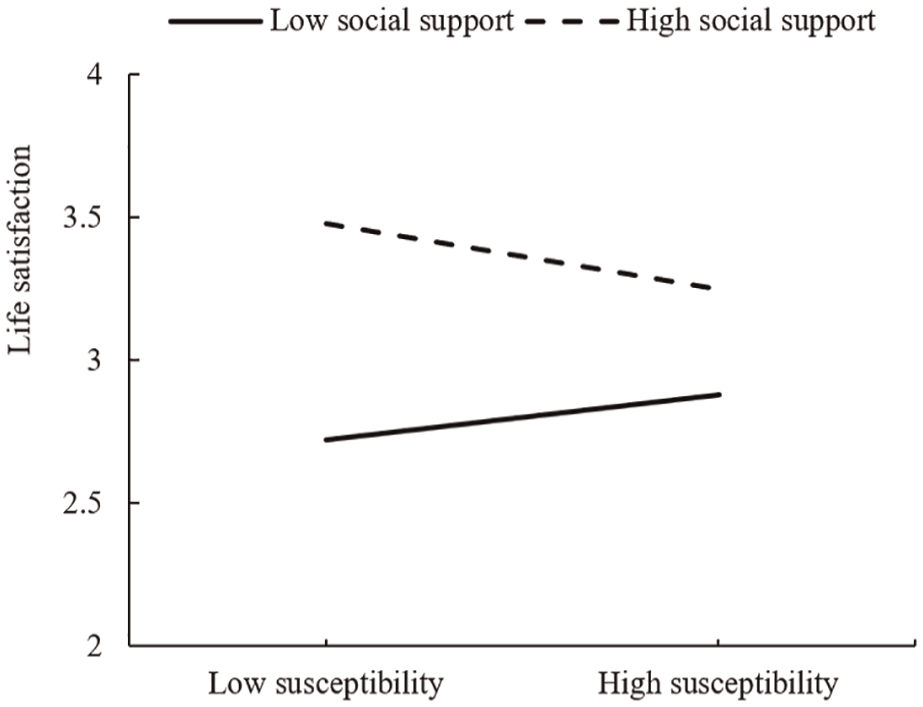
The moderating effect of perceived social support upon the relation between susceptibility and satisfaction with life.

The moderating effect of perceived social support upon the relation between uncontrollability and satisfaction with life.
Discussion
Two hypotheses of the current research were verified. Generally, uncontrollability negatively predicted positive affect and satisfaction with life; susceptibility, severity, and uncontrollability positively predicted negative affect in university students. In addition, perceived social support played a moderating role in the prediction of positive affect by susceptibility, severity, and uncontrollability; perceived social support played a moderating function in the prediction of negative affect by uncontrollability; perceived social support played a moderating role in the prediction of satisfaction with life by susceptibility and uncontrollability. RP of COVID-19 predicted SWB in university students with high perceived social support rather than in those with low perceived social support.
Relationship Between RP of COVID-19 and SWB
As expected, the results indicated that uncontrollability was negatively associated with positive affect and satisfaction with life in university students; susceptibility, severity, and uncontrollability were positively associated with negative affect, which is similar to previous findings (Dyer et al., 2022). Individuals with high-RP of COVID-19 will subjectively recognize the high susceptibility, severity, and uncontrollability of the COVID-19 pandemic, and believe that they may be susceptible to the risk of infection, which will bring a greater threat to their survival and development (J. Zhao et al., 2022). According to the health belief model, when an individual is exposed to a high risk of disease, it triggers a series of internal and external responses (Weinstein, 2000). This risk will directly result in the loss of individual health and other possible benefits, resulting in decreased SWB. In addition, existing studies have indicated that the higher the RP of COVID-19, the easier to pay attention to negative information (Hou et al., 2023). Individuals with negative attention bias are more likely to focus on the negative aspects of things, which will magnify negative emotions such as apprehension and depression in life and learning (Hong et al., 2021; Noguchi et al., 2006), leading to a decrease of SWB.
The current study further found that uncontrollability had an influence on all dimensions of SWB, including positive emotion, negative emotion, and satisfaction with life, while susceptibility and severity only affected negative emotion and had no significant effect on positive affect and satisfaction with life. COVID-19 is highly uncontrollable in terms of its development trend, virus avoidance, and safety protection (Ding et al., 2020). When university students’ perception of the uncontrollable COVID-19 epidemic is enhanced, they will have the perception of being infected with the virus and being enveloped by the virus, which will affect their normal emotional state. Due to the high infectivity and severe consequences of infection, people tend to feel threatened by the disease, leading to additional stress, apprehension, and depressive symptoms (Alsolais et al., 2021; Huang et al., 2023), which in turn increase the accumulation of negative emotions. Thus, RPof COVID-19 was negatively associated with SWB in university students. More importantly, the present study extends the findings of previous studies, confirming the relationship between different dimensions of RP of COVID-19 and SWB in university students.
Perceived Social Support as a Moderator
Furthermore, the moderating function of perceived social support upon the relation between RP of COVID-19 and SWB in university students was verified in the present study. Specifically, perceived social support alleviated the direct negative impact of susceptibility, severity, and uncontrollability on SWB. Meanwhile, with the increased RP of COVID-19, the decline of positive emotion and satisfaction with life slowed down and the rise of negative emotion slowed down with high perceived social support rather than those with low perceived social support.
Premised on the classic buffer model theory, social support, as a “buffer” role, can reduce the damaging effect of stressful events on people, and protect people’s physical and mental health (Cohen & Wills, 1985). In addition, existing studies have indicated that individuals who experience high perceived social support have more positive expectations when facing risk events, which can effectively relieve an individual’s tension and apprehension (N. Wang et al., 2017). This finding aligns with the results of the present study. Past research has also found that perceived social support can inhibit the positive predictive effect of negative attention bias on apprehension and depression (Hou et al., 2023; Yu et al., 2021). Compared with low perceived social support, university students with high perceptive social support have a smaller predictive effect of negative attention bias on apprehension and depression. In other words, individuals with high perceived social support can inhibit negative attention bias and slow down the increase of negative emotions, which is conducive to SWB.
In addition, perceived social support can increase the experience of positive emotions. In the face of stress, people with high perceived social support are more likely to shed negative emotions and maintain a good mood (Li et al., 2020). Furthermore, social support is conducive to the construction of psychological capital (Lowery & Cassidy, 2022; Sarwar et al., 2022; Y. Yang et al., 2022). High social support is related to high levels of psychological capital, such as hope, resilience, self-efficacy, and optimism (Lowery & Cassidy, 2022). More positive emotional and psychological resources not only mitigate the negative effects of the RP of COVID-19, but also help university students retain more resources to maintain their SWB. Thus, perceived social support acts as a “buffer” between RP of COVID-19 and SWB.
Theoretical and Practical Implications
This research offers some theoretical contributions. First, this study reveals RP is important for SWB and further confirms the relationship between different dimensions of RP of COVID-19 and SWB in university students. Second, this paper confirms the function of perceived social support as buffers against the negative effect of RP on the SWB of university students. Perceived social support can be a protective element for university students’ SWB. Even though university students have high RP, educators can improve their SWB by interfering with their perceived social support, thereby reducing the negative effect of RP upon their SWB.
As a result of negative life experiences caused by the COVID-19 epidemic, university students inevitably have psychological stress reactions from various aspects, including family, school, and society. Therefore, effective intervention measures can be taken to deal with the unexpected situation of university student’s mental health, which is conducive to providing a strong guarantee for the well-being of students. In order to mitigate the dissemination of COVID-19 that may stem from personal interaction within close proximity and treatment, online or smartphone-based psychoeducation during the pandemic is beneficial for psychological interventions and promoting mental health among university students, including Cognitive behavioral therapy (CBT) (Ho et al., 2020; M. W. B. Zhang & Ho, 2017). Previous study has found that CBT can reduce maladaptive coping behaviors including avoidance, self-blame, and insomnia by relieving individual stress (Soh et al., 2020). Maladaptive coping behaviors are often associated with poor mental health. BCT performed on an online platform can benefit patients infected with COVID-19 and those isolated at home without access to professional care. Sharing the difficulties and solutions that individuals face during the pandemic through online platforms can provide peer support to individuals and help enhance their psychological well-being (Ho et al., 2020). Therefore, psychological interventions on online platforms during the pandemic are critical to boosting individual well-being.
Government and school leaders are crucial factors in promoting the psychological well-being of university students throughout the pandemic. Studies have found that accurate and up-to-date information on the number of recovered cases, treatment modalities, and modes of transmission, as well as regular updates on the number and location of infections, are associated with reduced apprehension and depression (Ding et al., 2020; Sharma et al., 2017). Governments must communicate timely, accurate and latest information about the COVID-19 outbreak to the public, which can help increase individuals’ trust in the government and may further reduce their apprehension about contracting COVID-19 (Tan et al., 2020). Other research works have found that personal psychoneuroimmunity preventative policies, such as regular hand washing, and mask mandate, as well as organizational measures, such as improved sanitation in public places and attention to student health, can help reduce the likelihood of psychiatric symptoms in university students (Lin et al., 2020; Tan et al., 2020; Ünal & Özdemir, 2022). Psychoneuroimmunity prevention measures by governments and schools can help to mitigate the dissemination of coronavirus disease, minimize apprehension and depression during the pandemic, and further promote SWB.
Limitations and Future Research
This study is not without certain limitations. First, this study was cross-sectional and did not take into account the changing landscape during the COVID-19 pandemic. People may perceive risks differently in the early and late stages of an outbreak. Future studies should consider tracking the entire process of an emergency and collecting data at multiple time points to further understand how RP affects university students’ SWB, and verify the causal relationships among RP and SWB in university students. Second, the data were collected in China. While the current findings provide useful understanding of the role of RP on SWB during the COVID-19 pandemic, future researchers must be cautious in applying the results to other situations and differed countries with different restrictions. Cross-sectional research from participating eight countries showed that during the pandemic, Poland and the Philippines were the highest degrees of apprehension, depression, and stress, China were medium levels of apprehension, depression, and stress, while Vietnam exhibited the lowest mean scores within such contexts (C. Wang et al., 2021). On the one hand, cultural differences may affect individuals’ subjective assessment of epidemic risk, which further leads to different mental health of individuals. On the other hand, due to different epidemic prevention and control policies in different countries, individuals’ RP of COVID-19 is different, which will also lead to differences in apprehension, depression, and other symptoms in different countries. Future studies should further expand the samples from different countries to further verify and extend the conclusions of this study.
Third, this study focuses upon the influence of RP of COVID-19 on university students’ SWB, without involving additional variables. Previous research has shown that physical symptoms resembling COVID-19 infection and the perceived influence of the pandemic can lead to negative psychological well-being outcomes (C. Wang et al., 2021). Therefore, future studies should include physical symptoms resembling COVID-19 infection and the perceived impact of the pandemic in the model of this study to further enrich and improve the conclusions of this study. Finally, the current study did not examine possible mediating variables when discussing the relationship between RP and university students’ SWB. Previous research has shown that the need for health information as well as the perceived influence of the pandemic moderates the relation between physical symptoms and negative psychological well-being outcomes (C. Wang et al., 2021). Therefore, mediating variables can be included in the subsequent investigation of the relationship between RP and university students’ SWB, so as to further enrich existing empirical studies and deepen the understanding of the internal mechanism of the relationship between RP and university students’ SWB.
Footnotes
Declaration of Conflicting Interests
The author(s) declared no potential conflicts of interest with respect to the research, authorship, and/or publication of this article.
Funding
The author(s) disclosed receipt of the following financial support for the research, authorship, and/or publication of this article: This research was supported by the Fundamental Research Funds for the Central Universities [2023QN1084], the Social Science Foundation of Jiangsu Province [23SHC016], and the Teaching Research Major Project of China University of Mining and Technology [2023ZDKT06-209].
Informed Consent
Informed consent was obtained from all individual participants included in the study.

Data Availability Statement
The datasets generated during and/or analyzed during the current study are available from the corresponding author on reasonable request.