




Abstract
This study examined flow at work, an optimal experience for individuals and organizations generating motivation and well-being. Relationships between job resources, flow at work, and personal resources were investigated, and their association with positive/negative emotions at work was also investigated. In all, 520 Italian nurses completed a questionnaire which measured supervisors’ support, job autonomy (job resources), job competencies, self-efficacy at work (personal resources), flow at work, and positive and negative emotions at work. Data analysis performed using a structural equations model showed that job resources were positively associated with flow at work, which was positively associated with personal resources. Moreover, job resources were positively associated with personal resources through flow at work, and job resources and flow at work were positively associated with positive emotions. The relationship between these variables and well-being/discomfort highlights the importance of promoting flow at work, supporting job resources that nurture positive experiences at work.
Keywords
Introduction
The nursing profession has often been studied in terms of negative aspects, but considering the characteristics of this job, it is also important to consider the positive aspects that enhance well-being, health, and performance. The nursing profession is, in fact, attracting the attention of more and more researchers because of its peculiarities: the aging of the workforce, the increased demand for health services, longer shifts and greater workload, absenteeism, turnover, and staff shortages are problems that can either reduce the perception of well-being at work or increase psychological and physical discomfort (Chan, Tam, Lung, Wong, & Chau, 2013; Cortese, 2013; Flahive, 2013; Gille & Houy, 2014; Lee, Dai, & McCreary, 2015; Pyrillis, 2013). These features give rise to a sort of vicious circle leading to a shortage of nurses, linked both to nurses quitting their jobs and to nurses who could potentially begin this job but instead do not (van der Heijden et al., 2010). Therefore, studies on psychological issues within the nursing profession are important to promote workers’ well-being and to contribute to the quality of the service for the community. From this perspective, nursing is characterized by several different demands, related to technical aspects of the profession, on one side and physical, emotional, and relational demands on the other, which, if not correctly balanced by resources, lead to psychological and physical discomfort.
In this professional context, characterized by many demands, it is therefore very important to assume a research perspective that allows to identify the presence of possible resources. In this sense, a contribution can derive from the studies on Positive Organizational Behavior, focusing on the positive indicators of the profession to develop and protect workers’ health. Within these studies, researchers are increasingly examining a promising area, related to flow experiences, described as optimal for the individual (and for the organization), because they are able to generate motivation and well-being (Csikszentmihalyi, 1975).
Adopting the theoretical framework of the Job Demands–Resources Model (JD-R Model; Bakker & Demerouti, 2014), this study has been conducted on a sample of nurses working in a public hospital and aims first to identify the effects of job resources (JR; supervisors’ support and job autonomy) and of flow at work (FaW) on personal resources (PR; job competencies and self-efficacy at work), that is the resources of the person which can be applied, activated, enhanced, or also decreased at work. The second aim of this study is to identify the effects of the relationship between JR, FaW, and PR on positive and negative emotions at work, considered by several studies as indicators of psychological well-being and distress (Barrett-Cheetham, Williams, & Bednall, 2016; Diener, Suh, Lucas, & Smith, 1999; Galatzer-Levy et al., 2013).
The JD-R Model
According to the JD-R Model (Bakker & Demerouti, 2014), working activities are characterized by demands and by resources to deal with these demands: if demands are not balanced by resources, they can trigger a process of deterioration of health that can lead to burnout, exhaustion, or discomfort. On the contrary, resources can set off a motivational process generating well-being and improving job performance and can moderate the effect of demands on health and well-being, thus protecting workers.
Considering the need to find a balance in working activities, the JD-R Model has been used to explain well-being/distress dynamics in several professional contexts, including that of nursing (Bakker & Sanz-Vergel, 2013; Cortese, Gatti, & Ghislieri, 2014; Trépanier, Fernet, Austin, Forest, & Vallerand, 2014).
JD are defined as “those physical, psychological, social, or organizational aspects of the job that require sustained physical and/or psychological (cognitive and emotional) effort or skills and are therefore associated with certain physiological and/or psychological costs” (Bakker & Demerouti, 2007, p. 312). JD can be general, across all types of jobs (e.g., workload), and specific, linked to work characteristics (Karasek et al., 1998). For nurses, specific JD are, for example, interactions with patients and their families, the relationship with doctors, contact with suffering and death, and emotional dissonance (Bakker & Sanz-Vergel, 2013; Colombo, Zito, & Ghislieri, 2012; Cortese et al., 2014).
JR are defined as “those physical, psychological, social, or organizational aspects of the job that are either/or: functional in achieving work goals; reduce JD and the associated physiological and psychological costs; stimulate personal growth, learning, and development” (Bakker & Demerouti, 2007, p. 312). JR are seen in the light of their motivational potential, their ability to induce workers to achieve results, buffer the effects of JD, and foster the individual’s growth and development. Therefore, resources are crucial aspects of work as they can protect workers from discomfort outcomes and help individuals to improve their performance, stimulating their development. Resources related to the job are, for example, supervisors’ and colleagues’ support, job autonomy and control over the organization of work, training activities, feedback on performance, development of skills, and clarity of tasks.
Beyond JR, individuals also have PR: positive aspects of the self, linked to resilience and to the ability of individuals to control and manage their environment (Hobfoll, Johnson, Ennis, & Jackson, 2003). These resources are described as having positive effects on psychological and physical well-being and making people more able to deal with demanding situations, keeping them energetic, facilitating their engagement, and protecting them from psychological discomfort (Van Wingerden, Derks, & Bakker, 2017; Xanthopoulou, Bakker, & Fischbach, 2013). PR are dynamic and open to development (Avey, Luthans, & Jensen, 2009) and lead individuals to engage with their tasks and to perform them better (Salanova, Schaufeli, Xanthopoulou, & Bakker, 2010). Moreover, studies within the JD-R model consider competencies as PR too, also related to JR and work engagement (Akkermans, Schaufeli, Brenninkmeijer, & Blonk, 2013; Akkermans & Tims, 2017).
JR and PR are both related to psychological well-being and positive organizational outcomes (Xanthopoulou, Bakker, Demerouti, & Schaufeli, 2007). This is also in line with the Conservation of Resources (COR) theory which suggests that individuals tend to protect and maintain resources, which generate other resources, resulting in positive outcomes and well-being (Hobfoll, 2002).
Flow and FaW
The nursing profession is associated with potential risks in terms of health, but it is also highly engaging and motivating (Bringsén, Ejlertsson, & Andersson, 2011), and this protects workers against job dissatisfaction and discomfort (Wolf, 1970). Understanding the motivational aspects is functional to promote not only the quality of working life, but also the quality of the service provided (Nayeri, Negarandeh, Vaismoradi, Ahmadi, & Faghihzadeh, 2009). For this reason, it might be interesting to apply the construct of flow to the study of work motivation among nurses.
Csikszentmihalyi (1990) defined flow as a state of consciousness in which people are totally immersed and focused on the activity they are carrying out, feel pleasure during the activity, have control of the situation, have clear goals, and experience high intrinsic motivation. Flow is a holistic experience that occurs when people perform an activity in which they feel involved and committed (Nakamura & Csikszentmihalyi, 2002). According to Llorens, Salanova, and Rodriguez (2013), flow occurs when the situation poses a high level of challenge, balanced by a similarly high level of ability (skill) of the individual.
The first studies on flow considered this within the context of recreational or leisure activities, as these have the characteristics for experiencing flow: they have rules that involve learning new skills and setting goals, give a sense of control over activities, provide feedback, and simplify concentration and involvement in the activity (Csikszentmihalyi, 1990). Csikszentmihalyi (1997), however, suggested that flow can arise in every situation in which an activity is being performed. According to other research (Csikszentmihalyi & LeFevre, 1989; Delle Fave & Bassi, 1998; Fullagar & Kelloway, 2009; Nielsen & Cleal, 2010), flow is experienced more during working time than in leisure time, highlighting the importance of investing time and energy to experience flow.
Based on these studies on the perceived flow during the working time, Bakker (2008) applied the flow experience to the working condition, defining FaW as a short-term peak experience characterized by absorption (immersion and total concentration in the work), work enjoyment (pleasure experienced by people during work), and intrinsic work motivation (working to feel pleasure and satisfaction).
As FaW has been described as a perfect balance between challenges and skills, both placed at a high level, it has been suggested that it could be interpreted on the basis of the JD-R Model. Specifically, individuals may experience FaW when high JD are balanced against high professional skills (Llorens et al., 2013), but also when—in addition to professional skills—they have access to JR, in the form of support of supervisors and colleagues, feedback on performance, job autonomy, clarity of the task, control over work, and coaching (Csikszentmihalyi, 2003).
JD, on the contrary, reduce the experience of FaW and, in particular, the components of enjoyment and intrinsic motivation (Bakker, 2008). Moreover, experiencing FaW reduces the perception of psychological and physical discomfort, preventing exhaustion and enhancing work performance (Demerouti, Bakker, Sonnentag, & Fullagar, 2012; Zito, Cortese, & Colombo, 2016).
Referring to the nursing profession, few studies have focused on the experience of FaW. Of these, the study by Bringsén et al. (2011) found FaW to be positively associated with the specific activity of “taking care” and with the individual’s cognitive resources, while the study by Zito et al. (2016) suggested that JR are important antecedents of FaW and that their mediation is crucial to reduce feelings of discomfort among nurses.
Well-Being, FaW, and Resources
Work is crucial for an individual’s well-being, as it brings identity, tasks, social opportunities, and the possibility to engage in new challenges and new social status (Warr, 1999). Studies investigating FaW support the claim that work gives the opportunity to experience states of well-being, particularly when resources are available (Bakker, 2008; Zito et al., 2016). Although only few studies have investigated the relationship between the FaW experience and the resources available within an organization, specifically within the framework of the JD-R Model, the authors who have addressed this relationship found that JR were strong antecedents of FaW (Bakker, 2005; Salanova, Bakker, & Llorens, 2006; Zito et al., 2016). Therefore, when considering the well-being process, JR assumes a relevant role: in fact, a lack of resources has a detrimental effect on workers’ motivation and performance, because it impedes the achievement of goals and the possibility of learning (Wong, Hui, & Law, 1998).
Flow is an optimal and inner experience; a study by Salanova et al. (2006) found that it can trigger a sort of virtuous circle that, in terms of job experience, means the possibility of professional growth and the acquisition of PR. More precisely, on one hand, FaW allows people to develop new skills and a sense of mastery, meaning control over the work and active participation in the work. On the other hand, the development of skills contributes to the process of individual growth through the search for bigger challenges (Delle Fave & Bassi, 1998).
Considering that FaW is a positive experience and that individuals protect and create their resources, this could mean that resources increase the FaW experience, but also that FaW may lead to more resources. This is consistent with the broaden-and-build theory of positive emotions by Fredrickson (1998, 2002), as suggested by Salanova et al. (2006). This study reported that positive emotions can lead to durable psychological resources and activate a process of psychological well-being. In the light of the positive psychology framework (Seligman & Csikszentmihalyi, 2000), a positive experience such as FaW may lead people to create durable PR. Salanova et al. (2006) found that resources and FaW mutually influence each other: job and PR can predict FaW and, in an upward spiral, PR and FaW lead to a greater perception of JR.
Based on the literature and empirical evidences on JR, PR, and FaW mentioned above, suggesting a strong link between resources and FaW, we formulated the following hypotheses:
Beyond suggesting a link between FaW and resources, the literature highlighted the presence of a relationship between FaW, resources, and emotions (Fredrickson, 2002), which can be interesting to explore in nursing profession, as emotions can be considered a component of well-being. More precisely, within the hedonic approach on well-being, the presence of positive emotions, with the absence of negative emotions, have been considered as a component of psychological well-being (Ryan & Deci, 2001; Steger, Kashdan, & Oishi, 2008). For example, Diener (2000) defined subjective well-being as a set of circumstances that includes the individual’s emotional responses (positive and negative) to subjective experience, affirming that “people experience abundant subjective well-being when they feel many pleasant and few unpleasant emotions” (p. 34), and Diener et al. (1999) have proposed a list of emotions related to well-being including, among others, happiness, euphoria, pride, shame, envy, and anger. Warr (1990) assumed the existence of two orthogonal axes, activation and enjoyment, on which most emotional states resulting from the daily experience can be placed, and in this perspective, De Jonge and Schaufeli (1998) showed the higher relevance of the enjoyment axis for the definition of well-being. These considerations are in line with the construct of FaW and the “core” dimension of enjoyment that leads to positive emotional experience and, thus, can promote the individual’s well-being.
Based on these statements from literature about the relationships between JR, PR, FaW, and emotions, the following hypotheses are formulated:
Moreover, as literature suggests that it is possible to consider a mediator role of FaW (Lavigne, Forest, & Cravier-Braud, 2012; Zito et al., 2016), we furthermore formulated the following hypotheses:
Figure 1 shows the theoretical model and the expected relationships.
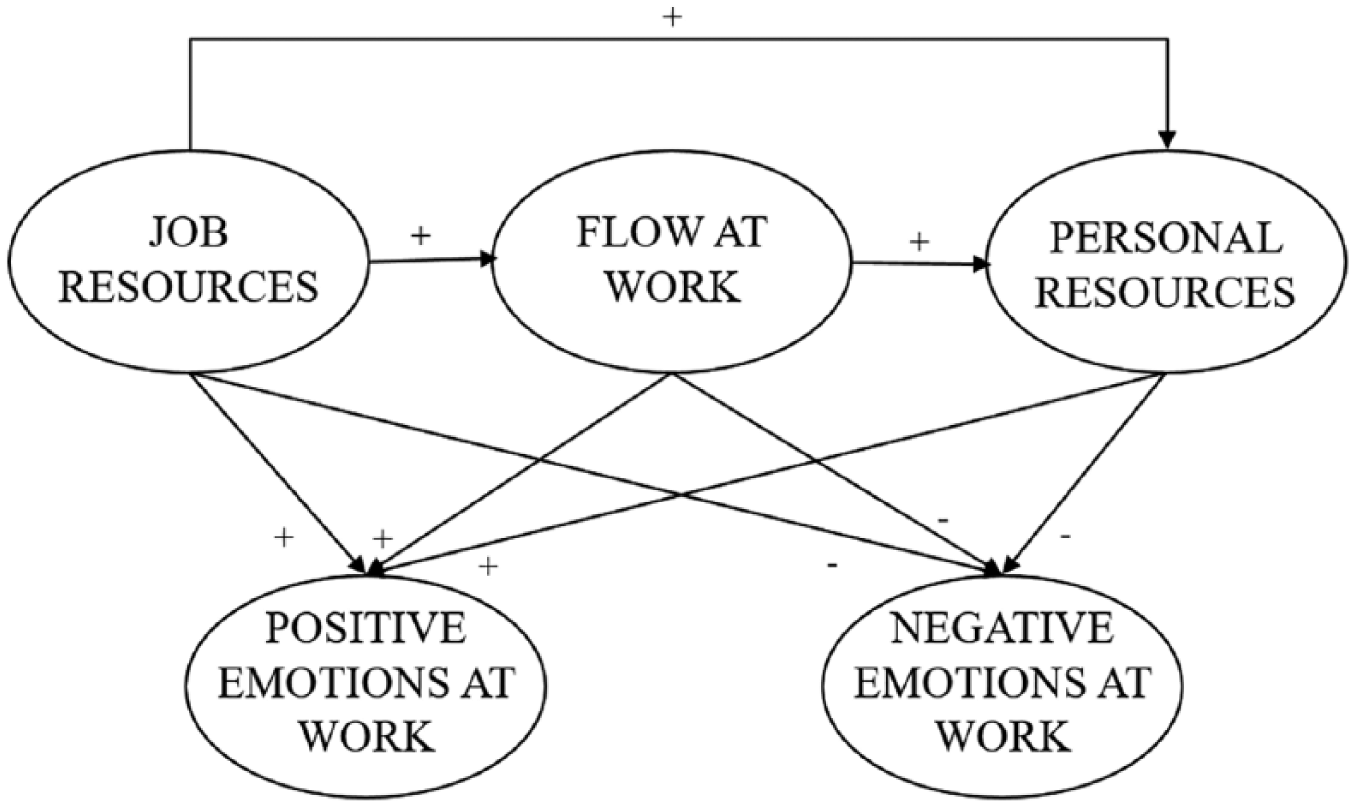
The theoretical model.
Method
Procedure and Participants
The respondents filled out a printed self-report questionnaire: the researchers obtained permission from the Hospital Board of Directors and the coordinators then organized the distribution of the questionnaires among nurses. All questionnaires included a cover letter explaining the research, the anonymity of data, and the voluntary nature of participation in the study and giving instructions on how to complete the questionnaire. The procedure envisaged the availability of drop boxes in which the nurses could return the completed questionnaire, to guarantee anonymity.
A total of 617 nurses working in a public hospital in the North of Italy (80.0% of all nurses at the hospital) participated in the study. Data cleaning excluded 97 incomplete questionnaires and the final set consisted of 520 nurses (67.4% of the total). As for gender, 87.8% of participants were women, with an average age of 42.22 years (SD = 8.96 years). The majority of respondents worked full time (84.1%), had an average seniority of 15.12 years (SD = 10.15 years), and worked about 37.22 hr per week (SD = 6.65 hr).
Measures
The study considered different variables categorized on the basis of the literature and on the JD-R Model (Bakker & Demerouti, 2014). In particular, the study identified JR (supervisors’ support; job autonomy); PR (job competencies; self-efficacy at work); and FaW; emotions at work (positive and negative).
Supervisors’ support is composed of four items on a 6-point Likert-type scale ranging from 1 (not at all) to 6 (completely) taken from the scale by Caplan, Cobb, French, Harrison, and Pinneau (1975), to measure perceived support from direct supervisors, as this could reduce distress and increase well-being.
Job autonomy is composed of three items on a 5-point Likert-type scale ranging from 1 (never) to 5 (always) taken from the scale by Bakker, Demerouti, and Verbeke (2004), to measure the individual’s control over work, which increases the level of well-being.
Job competencies is composed of six items on a 4-point Likert-type scale ranging from 1 (never) to 4 (always) of the diagnostic functions subscale taken from the Nurse Competence Scale (NCS) by Meretoja, Isoaho, and Leino-Kilpi (2004). Competencies are skills that enable workers to achieve their goals.
Self-efficacy at work is composed of five items on a 5-point Likert-type scale ranging from 1 (not at all capable) to 5 (quite capable), taken from the Work Self-Efficacy Scale (WSES) by Avallone, Pepe, and Porcelli (2007). This scale measures individuals’ engagement in their work and refers to beliefs that people have about their own ability to organize work to achieve goals.
FaW is composed of 13 items on a 7-point Likert-type scale ranging from 1 (never) to 7 (always) taken from Bakker (2008). For the present study, the Italian adaptation by Zito, Bakker, Colombo, and Cortese (2015) was used.
The Positive emotions at work measure is composed of six items on a 6-point Likert-type scale ranging from 1 (never) to 6 (always) taken from Warr (1990), considered as an indicator of emotional psychological well-being.
The Negative emotions at work measure is composed of six items on a 6-point Likert-type scale ranging from 1 (never) to 6 (always) taken from Warr (1990), considered as an indicator of emotional psychological discomfort.
Analyses
Analyses were performed using SPSS 22 and Mplus 7. SPSS 22 was used to calculate means, standard deviations, and alpha reliabilities (α) for each scale and correlations (Pearson’s r) between variables. Mplus 7 was used to estimate a structural equations model (SEM), considering the relationship between JR, PR, and the mediating role of FaW between resources and emotions.
Goodness of fit of the model was evaluated using the chi-square value (χ2), comparative fit index (CFI), Tucker–Lewis index (TLI), root mean square error approximation (RMSEA), and standardized root mean square residual (SRMR) indices. Latent variables were built through the parceling method (Yang, Nay, & Hoyle, 2010).
All parcels showed significant loadings (p < .001) in the present SEM.
Moreover, to examine the potential effects of common method bias, two different models were compared following Harman’s single-factor procedure (Podsakoff & Organ, 1986). First, a confirmatory factor analysis considering the five latent variables was conducted, fit indices: χ2(850) = 2,509.681, p < .001, CFI = .91, TLI = .90, RMSEA = .05, SRMR = .05, compared with a one-factor model with all items loading on one factor, fit indices: χ2(860) = 4,315.324, p < .001, CFI = .50, TLI = .47, RMSEA = .09, SRMR = .10, showing that the first model fitted the data better than the one-factor model, thus supporting the appropriateness of each item related to the hypothesized latent factor. Additionally, a chi-square statistical significance comparison confirmed this result (chi-square difference = 1,805.643 with 10 df; p < .001).
Results
Referring to the psychometric characteristics, all the assessed variables showed good reliabilities with Cronbach’s alphas ranging from .75 to .90 (Table 1).
Means, Standard Deviations, and Correlations (Pearson’s r).

Note. Cronbach’s alphas on the diagonal (between brackets).
p < .01.
FaW showed significant correlations with all the assessed variables (Table 1): it was positively correlated with positive emotions (r = .58; p < .01), job autonomy (r = .38; p < .01), self-efficacy at work (r = .33; p < .01), job competencies (r = .28; p < .01), and supervisors’ support (r = .21; p < .01) and had a negative correlation with negative emotions (r = −.17; p < .01).
Positive emotions showed positive correlations with both JR and PR. As for FaW, positive emotions correlated with job autonomy (r = .38; p < .01) and less with supervisors’ support (r = .28; p < .01). Moreover, this variable correlated with job competencies (r = .29; p < .01) and self-efficacy at work (r = .27; p < .01) and had a negative correlation with negative emotions (r = −.45; p < .01), as expected.
Negative emotions showed a higher negative correlation with JR, in particular with job autonomy (r = −.18; p < .01) and supervisors’ support (r = −.13; p < .01). Within PR, negative emotions showed a negative correlation with job competencies (r = −.11; p < .01) and no correlations with self-efficacy at work.
Among JR, only job autonomy showed significant correlations with PR, job competencies (r = .22; p < .01), and self-efficacy at work (r = .20; p < .01). Supervisors’ support showed no correlations with PR.
As for the SEM, different alternative models were tested to evaluate and gain a more in-depth understanding of the characteristics of the relationships between variables in this sample; in the end, the full Model 1 (concerning all the variables: JR, FaW, PR, and positive and negative emotions at work) was chosen and confirmed as the best one. As shown in Table 2, the fit indices of the other tested models were not as good as Model 1, making all the hypothesized relationships meaningful: in particular, Models 2 (considering only JR, FaW, and PR and removing positive and negative emotions), 3 (considering only JR, FaW, PR, and positive emotions and removing negative emotions), 4 (considering only JR, FaW, PR, and negative emotions and removing positive emotions), and 5 (considering only JR, FaW, positive emotions, and negative emotions and removing PR) showed a higher RMSEA than Model 1; Model 4, not including positive emotions, showed a low TLI (below the .90 threshold value). This weakness of Model 4 reinforced the relevance of positive emotions in the evaluation of the relationships between JR, FaW, and PR.
Alternative Tested Models.

Note. CFI = comparative fit index; TLI = Tucker–Lewis index; RMSEA = root mean square error of approximation; CI = confidence interval; SRMR = standardized root mean square residual.
Model 1 (Figure 2) showed good fit indices: χ2(34) = 132.16, p < .001, CFI = .96, TLI = .93, RMSEA = .07, SRMR = .05. Both CFI and TLI, less dependent on sample size, exceeded the .90 threshold value, suggesting an appropriate fit between the data set and the model. The model showed JR to be directly positively associated with FaW (β = .68; p < .01), and with positive emotions (β = .20; p < .05), and to have no association with negative emotions.

SEM: job resources, FaW, personal job resources, positive emotions at work, and negative emotions at work.
FaW was found to be directly positively associated with PR (β = .50; p < .01), with positive emotions (β = .57; p < .01), and directly negatively associated with negative emotions (β = −.30; p < .05). The association between FaW and positive emotions at work was stronger than that with negative emotions at work, highlighting the expected effect of FaW in leading to positive experiences.
PR had no significant direct relation with positive or negative emotions, and the direct relation between JR and PR was also not significant. In the estimated model, the indirect relation between JR and PR was significant. Bootstrapping was used to test the significance of the hypothesized mediation. The distribution was generated with 2,000 bootstraps: the resulting CI did not include zero, indicating a significant mediation (Table 3). JR was positively associated with PR through FaW (β = .34; p < .01), indicating the strong potential of FaW as a mediator and the role of JR as an antecedent of FaW.
Indirect Effects of the Estimated SEM Using Bootstrapping.

Note. SEM = structural equations model; CI =confidence interval; JR = job resources; FaW = flow at work; PR = personal resources.
Moreover, JR were found to have two other indirect relations: positive with emotions (β = .39; p < .01) and negative emotions (β = −.20; p < .05) through FaW, once again highlighting the role of FaW as a mediator and its potential in leading to positive experience and in buffering the experience of negative feelings, together with the presence of resources in the organization.
Discussion
The indication of a mediating role of FaW is in line with the literature on the relationship between resources, FaW, and psychological well-being and exhaustion (Salanova et al., 2006; Zito et al., 2016). An innovative aspect of this study is that it has highlighted the role of PR at work, as previous studies suggested that these are open to development leading to engagement (Avey et al., 2009; Salanova et al., 2010) and because the perception of optimal experience can lead to personal growth and the individual’s development (Delle Fave & Massimini, 2010; Salanova et al., 2006). Another original aspect of this study is the extended use of the JD-R Model, based on the assumption that an availability of JR could enhance and develop workers’ PR, producing optimal experience, also in the light of a psychological capital fostering personal and professional growth and well-being. Moreover, the present study considered the nursing profession from a different point of view: while studies on health-care contexts have traditionally only focused on negative aspects such as emotional exhaustion or dissatisfaction, this study also focused on the positive aspects of the work. In fact, due to the complexity of the nursing profession, which requires high-level competencies and experience and involves relationships with patients and their families, this job has a fatigue component, but it is also an enriching and motivating profession that offers personal and professional satisfaction and growth (Bringsén et al., 2011).
The correlations were consistent with the findings of studies suggesting that JR, PR, and FaW are linked by a positive relationship (Bakker, 2008; Mäkikangas, Bakker, Aunola, & Demerouti, 2010; Salanova et al., 2006). In this sample, supervisors’ support did not significantly correlate with job competencies or with self-efficacy at work. However, we chose to group these variables as defined latent variables as suggested by the literature (Bakker & Demerouti, 2017) and the latent variables actually significantly interacted in this study.
Looking at JR and PR, supervisors’ support showed nonsignificant relations with PR, but considering the significant relation between job autonomy and PR, and also considering the literature suggesting that JR can enhance PR (Salanova et al., 2006), the direct relation between JR and PR was still estimated in the SEM.
Moreover, the high correlation between FaW and positive emotions highlights the potential of FaW in leading to positive experience (Csikszentmihalyi, 1990; Steele & Fullagar, 2009).
Examination of the model confirmed the role of JR as antecedents of FaW, showing any direct relation between JR and PR, partially confirming H1, stating that JR were positively associated both with FaW and PR. The confirmed result is in line with the literature which suggests that resources are strong antecedents of FaW (Bakker, 2005; Demerouti, 2006). The relation between JR and PR was only found with FaW as a mediator, confirming H2, stating that JR were positively associated with PR through FaW. This point needs further investigation because it shows the strong role of JR in predicting FaW that “absorbs” all the potential of JR and mediates their impact in influencing PR. These findings emphasize the role of the optimal experience at work for personal and professional development.
One of the most noticeable remarks in the SEM is the role of FaW, which strongly influences PR, thus confirming H3, stating that FaW was positively associated with PR: the optimal experience can lead to growth of individuals (Delle Fave & Bassi, 1998) who, in this case, feel they have more competencies and self-efficacy. JR as antecedents of FaW, which, in turn, enhances PR, suggests the importance of fostering FaW that could lead to higher performance (Demerouti, 2006).
Moreover, the strong relation between JR and FaW emerges also in the experience of well-being at work. In fact, in the estimated model, only JR and FaW were positively associated with positive emotions, partially confirming H4, stating that JR, FaW, and also PR were positively associated with positive emotions at work. These findings are also in line with studies suggesting that flow is positively related to physical health and generates positive emotions (Steele & Fullagar, 2009).
As for negative emotions, as expected, FaW was negatively associated with negative emotions, as FaW can protect against distress and negative outcomes. In this study, JR and PR had no effects on emotions, thus partially confirming H5, stating that FaW, JR, and PR were negatively associated with negative emotions at work.
As for the indirect effects, JR can indirectly influence positive emotions through FaW, once again highlighting the role of resources (and of FaW) in fostering well-being experiences at work (Demerouti, Bakker, Nachreiner, & Schaufeli, 2001). In addition, JR was negatively associated with negative emotions at work through FaW, suggesting the strong relation between JR and FaW that could be defined as virtuous (Bakker, 2008; Salanova et al., 2006). Considering the results of the estimated model, H6, stating that JR are indirectly positively associated with positive emotions at work and indirectly negatively associated with negative emotions at work through FaW, was confirmed.
These results show that FaW is closely associated with the individual’s development (Delle Fave & Bassi, 1998; Salanova et al., 2006).
One of the strengths of this study is that it finally stressed the importance of the presence of JR to create the optimal experience that can lead to the growth of PR (and thus, development and improved performance) and the role of resources and FaW in leading to positive emotions and in protecting the individual from negative emotions. These results are consistent with other studies suggesting that JR trigger the motivational process and thus lead to well-being and performance (Mäkikangas et al., 2010) and that flow is related to high positive mood (Eisenberger, Jones, Stinglhamber, Shanock, & Randall, 2005). Different studies have, in fact, reported that JR are antecedents of FaW (Bakker, 2008; Zito et al., 2016) and, in particular, that supervisors’ support could be crucial. Indeed, supervisors’ support could be functional to cope with work stress and job demand and to increase affective commitment toward the organization (Setti et al., 2018). For this reason, it is important to focus on the role of supervisors, implementing appropriate human resources management practices (in terms of recruiting, selection, training, feedback, evaluation, and compensation), with the aim of promoting skills and behaviors able to develop high-quality relationships with each of their nurses.
JR giving rise to a virtuous circle of FaW, development and well-being, are in line with the COR theory (Hobfoll, 2002) that assumes that people protect resources against discomfort.
The purpose of analyzing what determines well-being and discomfort within the organization is to support the quality of working life and the services offered, particularly in a profession like nursing, where there is the risk of discomfort. The added value of this study is that in the explanation of well-being and discomfort at work, it considered not only those aspects related to the organizational context (JR) but also personal aspects (PR). Indeed, the model results revealed the absence of a direct relationship between JR and PR and highlighted the importance of creating the conditions to experience FaW.
Practical Implications
Understanding the role of FaW in the nursing context, which is highly demanding, is crucial to promote motivation and quality of working life among employees engaged in providing assistance and caring tasks.
From a practical standpoint, it could be functional to foster flow experiences in different intervention areas. The first concerns increasing resources, as these have a motivational role on employees’ dedication and ability to perform the work task (Bakker & Demerouti, 2007), contribute to well-being (Korunka, Kubicek, Schaufeli, & Hoonakker, 2009), give meaning to work, and lead to positive experiences and awareness of goals and opportunities (Demerouti et al., 2012). Workers who are conscious of the potential of JR and their impact on well-being actually improve their performance and are a strong resource for the organization in terms of productivity. Nurses could experience FaW by having the possibility to tackle both routine tasks and challenging activities, allowing them to use their abilities. It is therefore important to create the conditions to foster individuals’ personal and professional growth through resources such as job autonomy, clarity of tasks, feedback on performance, organizational support, and possibility to broaden competencies. Improving organizational support also means addressing the relational aspect: constructive feedback, conflict management, job autonomy, problem solving, decision making, and negotiation are resources that facilitate FaW and foster PR. Moreover, a condition that can support organizational resources is the training of supervisors and updating of employees involved in human resources management, so that they understand the motivational process at work.
The second area concerns the enhancement of PR and the awareness of interindividual differences related to the method and the speed of acquisition and maintenance of resources. According to the COR theory (Hobfoll, 1989), the resource pool is different for each individual and subjectively assessed. This is crucial for the inclusion of new employees and for professional and career development, acting adequately to achieve a balance between challenges and skills. Furthermore, maintaining the level of general psychological well-being is also important because it influences the investment of resources to obtain additional resources (Hobfoll, 1989). Indeed, according to the COR theory, workers who report high levels of discomfort at work may be unable to or have difficulty in recognizing and/or using their own resources. Therefore, maintaining high levels of well-being at work is important for the recognition and the activation of resources that also allow flow to be experienced.
These types of interventions could, in the long term, foster a positive culture that supports organizational policies and practices oriented not only toward job performance or to the containment of discomfort (Luthans, 2003) but also to the promotion of well-being, motivation, and health (Wright, 2003).
Limitations and Future Research
A limitation of this study is the use of a self-report questionnaire and a cross-sectional research design that does not permit the establishment of a definite causal relationship between variables. This is linked to the use of questionnaires measuring FaW retrospectively; however, previous studies on FaW used questionnaires with good results.
Future research could analyze FaW through longitudinal studies and diary studies to observe fluctuations in FaW perception and in perceived resources and their relationship with well-being over time. Previous studies have, in fact, formulated hypotheses about the adaptive flexibility of flow over time (Demerouti et al., 2012). Moreover, longitudinal studies could help to shed more light on the process whereby the positive experience creates new resources (Salanova et al., 2006), leading to well-being.
Another limitation of this study could be the collection of data within a single context. However, the results obtained using this homogeneous sample will encourage further flow research in other occupations to gain a better understanding about whether FaW occurs more frequently in specific professions (Llorens et al., 2013).
Furthermore, as FaW is considered to be linked to energy (Demerouti et al., 2012; Fredrickson & Levenson, 1998), future research should also consider the role of recovery of energy to understand its relationship with FaW and whether it could have a role in personal growth, professional development, and performance. Future research should, in fact, include the evaluation of job performance, as it has been suggested that FaW may also be associated with high performance (Eisenberger et al., 2005; Fullagar & Kelloway, 2009).
Footnotes
Declaration of Conflicting Interests
The author(s) declared no potential conflicts of interest with respect to the research, authorship, and/or publication of this article.
Funding
The author(s) received no financial support for the research, authorship, and/or publication of this article.