



Abstract
Learning burnout (LB) is a critical factor influencing university students’ learning engagement. While existing research has explored the relationships among professional identity (PI), mental resilience (MR), and learning burnout (LB), most studies have oversimplified the impact of PI on LB as a direct causal pathway. Against the backdrop of the growing demand for higher education quality improvement, this study aims to address the existing gaps in understanding the complex interaction mechanisms among these three constructs (i.e., PI, MR, and LB). Specifically, it focuses on the mechanism underlying the relationship between PI and LB, with an emphasis on examining the mediating effect of MR. The study results showed that: (1) PI exerted a significant positive predictive effect on MR (β = .255, p < .001), with the dimensions of Professional Self and Behavioral Tendency contributing the most; (2) PI had a significant negative impact on LB (β = −.122, p < .025), and the three dimensions of Attitude and Motivation, Professional Self, and Professional Environment were particularly prominent in this regard; (3) The inhibitory effect of MR on LB (β = −.243, p < .001) was mainly reflected in alleviating the Low Achievement. Mediation analysis indicated that MR played a partial mediating role between PI and LB (mediation effect size = −0.07, 95%CI [−0.120, −0.039]). These results provide a theoretical basis and practical pathways for colleges and universities to reduce students’ LB by improving their PI and MR, and hold important implications for optimizing the talent cultivation system.
Keywords
Introduction
The knowledge economy era has arrived. In this era, science and technology are the primary productive force. The competition between countries has essentially become a contest centered on cutting-edge knowledge and its materialized outcomes: high and new technologies (Sui & Jin, 2024). Universities are the main institutions for higher education. They do not just provide scientific and technological achievements to the nation and society. More importantly, they cultivate and supply talents to both.
Per data released by the Ministry of Education, over 47 million students are currently enrolled in China’s colleges and universities. This enrollment scale meets the globally recognized standard for universal higher education. Yet many people see college admission as no more than the minimum threshold for a promising future. They pick a major at random, with only one goal: getting a college degree. These students lack a strong sense of PI. They also don’t understand their majors deeply. This leaves them with little motivation to learn—and unsure about their future.
Zeng et al. (2024) found in their survey that online learning is now widely integrated into university courses. However, the high autonomy required by online learning makes it hard for many college students to keep using it consistently—leading to LB among this group. Pham and Duong (2024) provided empirical evidence that academic burnout experienced during higher education can predict similar career challenges. Specifically, this applies to management majors in English as a Foreign Language (EFL) contexts as they progress in their professional trajectories. Song and Xie (2019) conducted a survey in Southwest China and found that 25.9% of students viewed their learned knowledge as useless. The idea that “studying is worthless” has made students doubt the value of learning, disrupted their overall plans for their academic careers, and ultimately fostered a dislike for studying. From these phenomena, we can infer that after 9 years of high-intensity, high-pressure compulsory education, students already feel resistant to learning. Upon entering university—a more open and flexible environment—poor academic performance may occur if: (1) the course content does not align with their interests, or (2) they struggle to adapt to the university’s teaching methods. If, at this point, parents set overly high academic goals for them and frequently criticize them for underperformance, students may easily develop aversion to learning due to sustained pressure.
While existing studies have examined topics related to PI, MR, and LB, most frame the impact of PI on LB as a direct process. The exploration of MR’s mediating role in this relationship remains insufficient—especially the lack of systematic, integrated research on the dynamic connections between these three constructs. As the number of higher education attendees grows, issues related to low PI and high LB have become increasingly common. Notably, PI influences talent development quality and disciplinary progress by shaping students’ learning motivation (Xing & Zhou, 2017). This study addresses these gaps by constructing a model of the relationships between PI, MR, and LB, and by exploring MR’s mediating effect in depth. It fills the cognitive gap in existing research regarding the complex interaction mechanisms of the three constructs, and offers a more targeted theoretical perspective for effectively boosting college students’ PI and reducing LB. Furthermore, building on its analysis of the link between college students’ PI and LB, this study proposes specific measures to enhance PI and alleviate LB—providing actionable insights for talent development in colleges and universities. It also helps students gain a better understanding of themselves, gradually strengthen their PI, reduce LB, and unlock their intrinsic learning motivation, ultimately enabling them to realize their professional value.
Literature Review
Theoretical Basis
Current research on PI has developed a relatively systematic theoretical framework. Scholars generally define it as a dynamic process through which individuals integrate emotionally and psychologically with their professional roles (Tian et al., 2016). As a key dimension of social identity, it shows significant correlations with learning affect and behaviors (Mao & Sui, 2018). Existing studies have conceptualized PI primarily from three theoretical perspectives: Ibarra and Petriglieri (2010) proposed that PI is a dynamic process of seeking balance between professional practice and personal identity via “provisional selves”, emphasizing that individuals achieve psychological adaptation through role experimentation. Beijaard et al. (2004), by contrast, conceptualized it as a multidimensional structure encompassing three core dimensions—subject-matter expertise, pedagogical competence, and professional attitude—and highlighted its foundational role in teachers’ professional development. Trede et al. (2012) further argued that PI is an actively constructed process, shaped by participatory practices and reflective dialogue within sociocultural contexts. It embodies the dual characteristics of individual agency and social structure. In terms of influencing factors, a multi-level analytical framework has been established: At the macro level, the strength of national policy support and the degree of social recognition serve as key external conditions (Hu, 2019); At the meso level, the management systems and training frameworks of organizations play a central role; At the micro level, individual psychological traits and professional literacy exert a decisive impact. Among these factors, self-efficacy—identified as a critical mediating variable—has been proven to significantly transmit the positive effects of job satisfaction and internal locus of control on teachers’ PI.
This study constructs the six dimensions of PI based on the structural elements validated by Li (2009a, 2009b), which are specifically Attitude and Motivation, Professional Self, Professional Role, Professional Environment, Professional Knowledge and Ability, and Behavioral Tendency. Professional Self refers to a learner’s perceptions, understandings, and views regarding their own image, self-worth, and self-development; Professional Role encompasses a learner’s perception and positioning of their own role, their understanding and evaluation of profession-related role expectations posed by the times, as well as their outlook or planning for their future professional role; and Professional Environment denotes the working conditions a learner will face when engaging in profession-related work in the future, including both tangible and intangible elements that learners need to perceive, understand, and evaluate. Professional Knowledge and Ability refers to a professional learner’s cognition, understanding, reflection, and assessment of the professional knowledge and skills they have acquired, and this cognition helps them recognize their own capabilities in the workplace. Attitude and Motivation represents the intrinsic reasons or endogenous motivation behind a learner’s choice of profession, reflecting an individual’s preferences and commitment level in professional selection while carrying certain attributes of certainty and a sense of belonging. Behavioral Tendency, meanwhile, refers to the level of behavioral willingness, inclination, or engagement demonstrated by a professional learner during classroom learning and teacher-student interactions.
Research on MR originated with Rutter’s (1985) seminal study on maternal deprivation. Foreign researchers have proposed three primary types of definitions for MR: the first is the trait-based definition, which emphasizes that MR is an inherent quality unique to each individual. Werner (1995) noted that MR refers to an individual’s ability to minimize errors when confronting extreme circumstances. The second is the outcome-based definition, which focuses on positive outcomes following adversity—for instance, Masten (2001) defined MR as an individual’s capacity to adapt positively and grow in the face of significant threats. The third is the process-based definition, which highlights a dynamic, evolving process; Luthar et al. (2003) described MR as the process through which individuals maintain positive adaptability and achieve dynamic adjustments amid adversity. Despite these differing perspectives, all definitions share two core elements: the ability to cope with significant stressors and the occurrence of positive adaptive outcomes—and these elements form the fundamental dimensions for assessing MR. Drawing on existing research consensus, this study operationalizes MR as an individual’s stable adaptive capacity when facing adversity, and conceptualizes it as a developable intrinsic psychological trait.
Current research on LB primarily builds on the occupational burnout theoretical framework developed by Freudenberger (1974) and Maslach and Jackson (1981). It conceptualizes LB as a negative psychological state—marked by the depletion of individuals’ physical and mental resources, as well as reduced self-efficacy—caused by prolonged and excessive academic demands. Scholars have expanded this concept from diverse angles: Torem (1982) highlights its manifestations in student groups, specifically energy exhaustion, academic disengagement, and declining academic performance stemming from chronic academic stress; Wang (2006) focuses on the physical and mental exhaustion experienced by secondary school students when their coping mechanisms fail; and Lian et al. (2006) systematically identified the core feature of LB among university students—motivation loss and negative attitudes triggered by persistent academic pressure—while developing a three-dimensional structural model that includes Depression, Misbehavior, and Low Achievement. Synthesizing existing theoretical consensus, this study defines LB as a persistent negative psychological state in students, shaped by the combined impact of long-term curriculum-related pressure and insufficient intrinsic motivation. It is characterized by the three key symptoms of Depression, Misbehavior, and Low Achievement.
Model Construction and Research Hypothesis
The Relationship Between Professional Identity and Mental Resilience
Q. Chen et al. (2019) found that students with a higher level of PI demonstrate greater resilience when facing academic challenges. Smith et al. (2019) argued that PI is closely associated with MR among nursing students—those with stronger PI tend to adopt a more positive and optimistic attitude when addressing difficulties in professional learning. X. Liu et al. (2025) further noted that improving the MR of newly enrolled nursing students in vocational colleges can enhance their PI, which in turn boosts their level of learning engagement.
Synthesizing previous research, it is evident that PI exerts a positive predictive effect on MR. This positive influence fosters students’ greater hope for their academic and personal lives, which in turn enhances their engagement in professional learning—further strengthening their PI. Building on this, this study proposes the following research hypothesis:
The Relationship Between Professional Identity and Learning Burnout
Edwards and Dirette (2010) noted in their study that occupational therapists’ PI significantly influences their job burnout levels: the stronger their occupational identity, the lower their job burnout. Zhang et al. (2014) similarly found that nursing undergraduates with a higher level of PI report lower LB. L. Chen and Yang (2018) surveyed 538 special education teacher candidates and observed that these candidates’ LB decreased as their PI improved. When PI was used as a grouping variable, the total scores of LB showed significant inter-group differences (F = 31.495, p < .001).
Synthesizing previous research, it is clear that PI exerts a negative predictive effect on LB—meaning enhancing students’ PI can reduce their LB. Building on this, this study proposes the following research hypothesis:
The Relationship Between Mental Resilience and Learning Burnout
MR refers to an individual’s inherent quality of demonstrating strong adaptability when facing adversity or significant stress. Feng (2022) noted that a significant negative correlation exists between college students’ MR and LB—with MR also exerting a significant negative predictive effect on both LB and its respective dimensions among this group. H. Chen (2014) further observed that individuals with different resilience levels exhibit significant differences in LB: those with higher MR report lower LB, and the two constructs show a significant negative correlation. Harker et al. (2016) similarly found that higher resilience levels are a significant predictor of lower psychological distress, professional burnout, and secondary traumatic stress; additionally, higher mindfulness levels significantly predict lower psychological distress and professional burnout.
It is thus evident that MR serves as a robust predictor of LB. Students with strong MR demonstrate better ability to regulate and adapt to academic pressure, and enhancing MR is crucial for fostering students’“joy in learning” and helping them better fulfill tasks corresponding to their developmental stage. Building on this, this study proposes the following research hypothesis:
The Relationship Between Mental Resilience, Professional Identity, and Learning Burnout
Most studies on PI and LB have focused on specific groups, such as nursing students and preschool education majors, with relatively few targeting college students in general. Among domestic research on MR, MR is mostly treated as a dependent, mediating, or moderating variable. For instance, Wu et al. (2021) noted that MR moderates both the direct effect of family socioeconomic status on LB and the mediating effect of subjective well-being in this relationship. Ding et al. (2022) further observed that MR exerts a mediating effect on the total score of LB.
MR refers to an individual’s capacity for strong adaptability when facing adversity or significant stress, and it is an inherent trait unique to each person. Individuals with different levels of MR are affected differently by PI in terms of their LB levels. Therefore, this model incorporates the mediating role of MR and proposes the following research hypothesis:
Grounded in an integrated framework of Social Cognitive Career Theory (SCCT) and the Job Demands-Resources (JD-R) model, this study constructs a theoretical mechanism model illustrating how PI influences LB. From the perspective of individual cognitive motivation, SCCT explains the mediating pathway through which PI—manifested as domain-specific self-efficacy and outcome expectations—suppresses LB (a negative manifestation of goal obstruction) via MR (self-regulatory resources; Lent & Brown, 2006). The JD-R model further reveals the “resource-protection-adaptation” mechanism: as a key psychological resource, PI buffers the negative impact of academic demands by enhancing MR (Bakker & Demerouti, 2017). This dual-theoretical framework not only encompasses the multi-level “environment-cognition-behavior” chain of influence but also aligns with the unique impact of collectivist culture on the formation of PI in the Chinese educational context (Hou et al., 2012). Employing structural equation modeling, this study will validate the core pathway—whereby PI alleviates LB through the mediation of MR—ultimately providing an intervention framework with both theoretical depth and cultural adaptability for mental health education in colleges and universities. The established research model is presented in Figure 1 below.

The hypothesis model.
Participants and Methods
Participants and Procedure
Over the course of 1 year, this study conducted a sampling questionnaire survey among Chinese universities. The research strictly adhered to the ethical norms for studies involving humans and complied with the APA Ethical Principles of Psychologists and Code of Conduct. Questionnaires were distributed online, and no formative credits or other material incentives were offered to participants to avoid potential coercion. Prior to questionnaire administration, we obtained verbal informed consent from each participant through the introduction section of the online questionnaire. Participants were clearly informed of the study’s purpose, data collection scope, methods of anonymous processing, data usage (limited to academic research only), potential risks (minimal psychological and privacy risks due to non-invasive survey content), and the right to withdraw freely at any time—withdrawal could be initiated by closing the questionnaire without completing it, and no adverse consequences or impacts on their interests would result from withdrawal.
To minimize risks to participants, the questionnaire adopted a fully anonymous design: no personal identifying information (such as name, student ID, contact details, or school name) was collected, and the survey content avoided sensitive, offensive, or potentially distressing questions. The potential benefits of this research—providing theoretical support for optimizing college students’ mental health interventions and alleviating learning burnout—significantly outweigh the minimal risks associated with participation.
A total of 725 questionnaires were collected. After excluding 17 invalid ones (defined as incomplete responses, identical answers to all items, or logically contradictory responses), 708 valid samples remained, resulting in a valid response rate of 97.60%. As shown in Table 1, among the valid participants: 39.7% were male students and 60.3% were female students; 88% were aged 22 or younger; and over 90% were currently enrolled undergraduates.
Demographic Profile of Participants.

Instruments
As shown in Appendix Table A1, This study operationalizes PI across six dimensions, drawing on the structural elements validated by Li (2009a, 2009b). These dimensions specifically include: Attitude and Motivation, Professional Self, Professional Role, Professional Environment, Professional Knowledge and Ability, and Behavioral Tendency. MR was measured using a dedicated questionnaire—a critical tool for assessing this construct. Yu and Zhang (2007) developed a Chinese version of the Connor-Davidson Resilience Scale (CD-RISC) following their research on diverse populations in China. Due to its strong reliability and validity, this Chinese CD-RISC has been widely adopted in domestic studies. The present study employed its shortened version, the CD-RISC-10, to evaluate college students’ MR levels. A comprehensive literature review revealed that the College Student Learning Burnout Questionnaire by Lian et al. (2006) is widely used and demonstrates robust reliability and validity. Consequently, this questionnaire was selected to measure college students’ LB in the current study. LB was conceptualized as a three-factor structure, encompassing Depression, Misbehavior, and Low Achievement.
Convergent validity reflects whether individual indicators measure the same construct, while composite reliability (CR) assesses the overall reliability of a construct. To test these properties, standardized factor loadings of each measurement item on its corresponding dimension were first calculated using the established confirmatory factor analysis (CFA) model. Subsequently, the average variance extracted (AVE)—an indicator of convergent validity—and CR values were computed for each dimension. Per academic standards, convergent validity and composite reliability are considered adequate if the minimum AVE value is 0.5 and the minimum CR value is 0.7 (Guo et al., 2019). As presented in Table 2, the validity test results for the scale show that the factor loading of nearly all items exceeded 0.7, indicating high representativeness of the items for their respective dimensions. Additionally, all AVE values exceeded 0.5 and all CR values exceeded 0.7. Collectively, these results confirm that each dimension of the scale demonstrates good convergent validity and composite reliability.
Reliability and Validity of Constructs.

Note. CR = composite reliability; AVE = average variance extracted; PI = professional identity; MR = mental resilience; LB = learning burnout.
Regarding the overall reliability of the questionnaire, a Cronbach’s α coefficient of .858 was obtained from an analysis of all 46 items in the scale. Since this value exceeds .7, it indicates a high level of overall stability and internal consistency among the items (Nunnally, 1978). Table 2 presents the reliability analysis results for the items under each dimension of the questionnaire: Attitude and Motivation (Cronbach’s α = .927), Professional Self (Cronbach’s α = .881), Professional Role (Cronbach’s α = .838), Professional Environment (Cronbach’s α = .855), Professional Knowledge and Ability (Cronbach’s α = .887), Behavioral Tendency (Cronbach’s α = .872), MR (Cronbach’s α = .904), Depression (Cronbach’s α = .864), Misbehavior (Cronbach’s α = .895), and Low Achievement (Cronbach’s α = .889). All Cronbach’s α coefficients exceed .7, confirming that the reliability of each dimension meets academic requirements and that the data within each dimension demonstrate sufficient stability and internal consistency.
For the questionnaire, the CFA model yielded the following fit indices: CMIN/DF = 2.099 (p = .000), which falls within the acceptable range of 1–3; RMSEA = 0.039, a value below the 0.08 threshold for acceptable fit; GFI = 0.892; IFI = 0.946; and CFI = 0.946; TLI = 0.943. Collectively, these indices demonstrate that the CFA model of the scale exhibits acceptable model fit (Kelly & Walton, 2020).
Statistical Analyses
The research process of this study is illustrated in Figure 2. First, a literature review was conducted to analyze the current research background and status quo, laying the foundation for subsequent work. Based on the insights from this review, the study’s hypotheses were proposed and a theoretical relationship model was constructed. Next, a questionnaire survey was administered to collect participant data. For data analysis, SPSS and AMOS software were used to establish a model examining the relationship between PI and LB—with MR as a mediating variable—to explore the functional mechanisms among PI, MR, and LB. The mediating role of MR in the model was tested using the bootstrapping method (2,000 resamples) proposed by Preacher and Hayes (2008). Finally, the data analysis results were discussed, and practical recommendations were put forward.
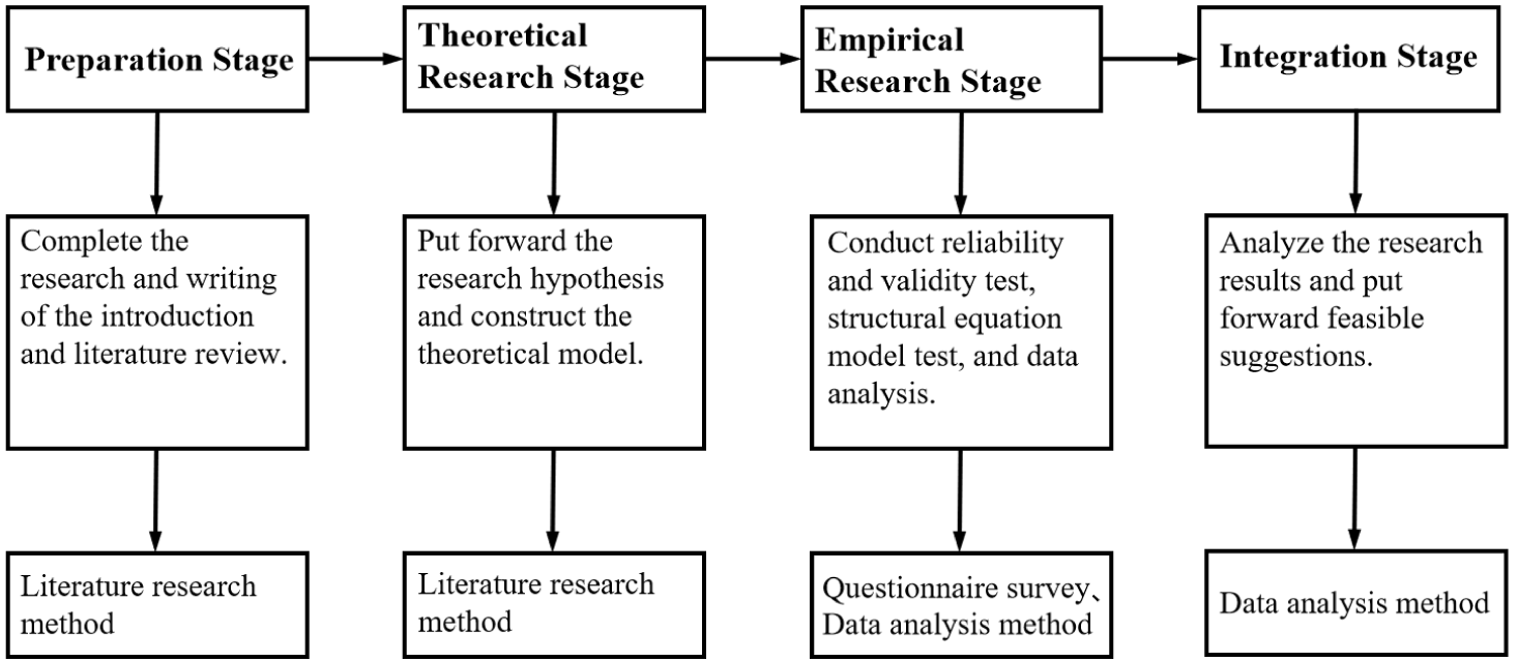
Research design concept.
Results
The Predictive Relationship Among Professional Identity, Learning Burnout, and Mental Resilience
Figure 3 presents the SEM analysis model illustrating the relationship between PI and LB, and as shown in Table 3: the standardized path coefficient from PI to MR is 0.255 (p < .001), indicating that PI exerts a significant positive predictive effect on MR, thus Hypothesis H1 is supported; the standardized path coefficient from MR to LB is −0.243 (p < .001), demonstrating that MR has a significant negative predictive effect on LB, so Hypothesis H2 is therefore supported; the standardized path coefficient from PI to LB is −0.122 (p < .025), revealing a significant negative predictive effect of PI on LB, and Hypothesis H3 is accordingly supported.

Structural equation model diagram.
Hypothesis Testing Results for Path Relationships in the SEM Model.

Note. n = 708; SE = standard error; CR = critical ratio; PI = professional identity; MR = mental resilience; LB = learning burnout.
p < .001.
Given that demographic variables may act as confounding factors in the model, gender was included as a control variable to conduct hierarchical regression analysis. Model 1 examined the effect of the control variable (gender) on the dependent variable (LB), while Model 2 incorporated the independent variables (PI and MR) into the model to analyze their effects on the dependent variable, controlling for gender. As presented in Table 4, Model 1 yielded an R2 of .001 with a non-significant p-value, indicating that gender exerts no confounding effect on the predictive roles of PI and MR regarding LB.
Hierarchical Regression Analysis Results.

Note. PI = professional identity; MR = mental resilience.
The Predictive Relationship Between Professional Identity Sub-Dimensions and Mental Resilience
As presented in Table 5, among the sub-dimensions of PI: the Professional Self dimension positively predicts MR at the significance level of p < .05, with a standardized regression coefficient (β) of .149; the Behavioral Tendency dimension also positively predicts MR at p < .05, with a standardized regression coefficient (β) of .103. In summary, both Professional Self and Behavioral Tendency exert a significant positive predictive effect on MR. Furthermore, the magnitude of their predictive effects on MR, in descending order, is: Professional Self > Behavioral Tendency. In contrast, the Attitude and Motivation, Professional Role, Professional Environment, and Professional Knowledge and Ability dimensions show no significant predictive effect on MR.
Correlations and Predictive Effects of Professional Identity Sub-Dimensions on Mental Resilience.
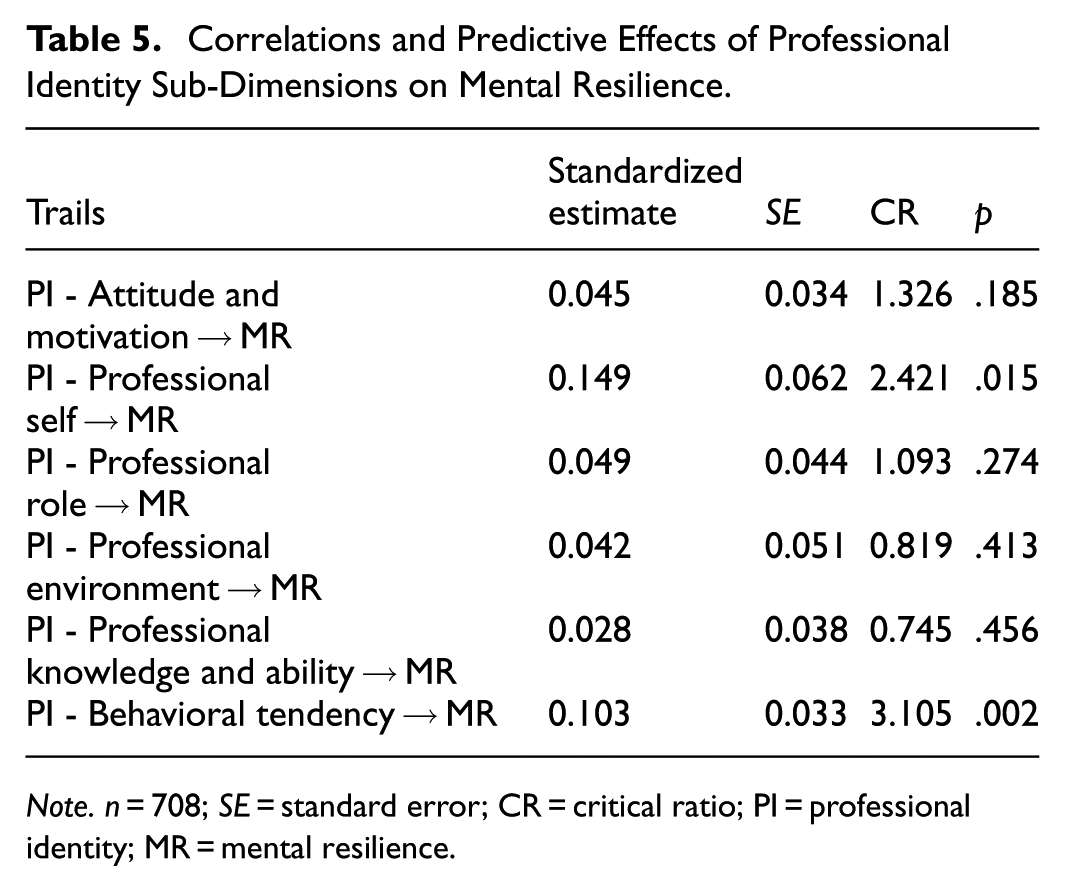
Note. n = 708; SE = standard error; CR = critical ratio; PI = professional identity; MR = mental resilience.
The Predictive Relationship Between Professional Identity Sub-Dimensions and Learning Burnout
As presented in Table 6, among the sub-dimensions PI: the Attitude and Motivation dimension negatively predicts LB at the significance level of p < .05, with a standardized regression coefficient (β) of −.109; the Professional Self dimension also negatively predicts LB at p < .05, with a standardized regression coefficient (β) of −.123; the Professional Role dimension positively predicts LB at p < .05, with a standardized regression coefficient (β) of .113; and the Professional Environment dimension negatively predicts LB at p < .05, with a standardized regression coefficient (β) of −.149. In summary, the Attitude and Motivation, Professional Self, and Professional Environment dimensions all exert a significant negative predictive effect on LB. Furthermore, the magnitude of their negative predictive effects on LB, in descending order, is: Professional Environment > Professional Self > Attitude and Motivation. In contrast, the Professional Role dimension has a significant positive predictive effect on LB, while the Professional Knowledge and Ability and Behavioral Tendency dimensions show no significant predictive effect on LB.
Correlations and Predictive Effects of Professional Identity Sub-Dimensions on Learning Burnout.
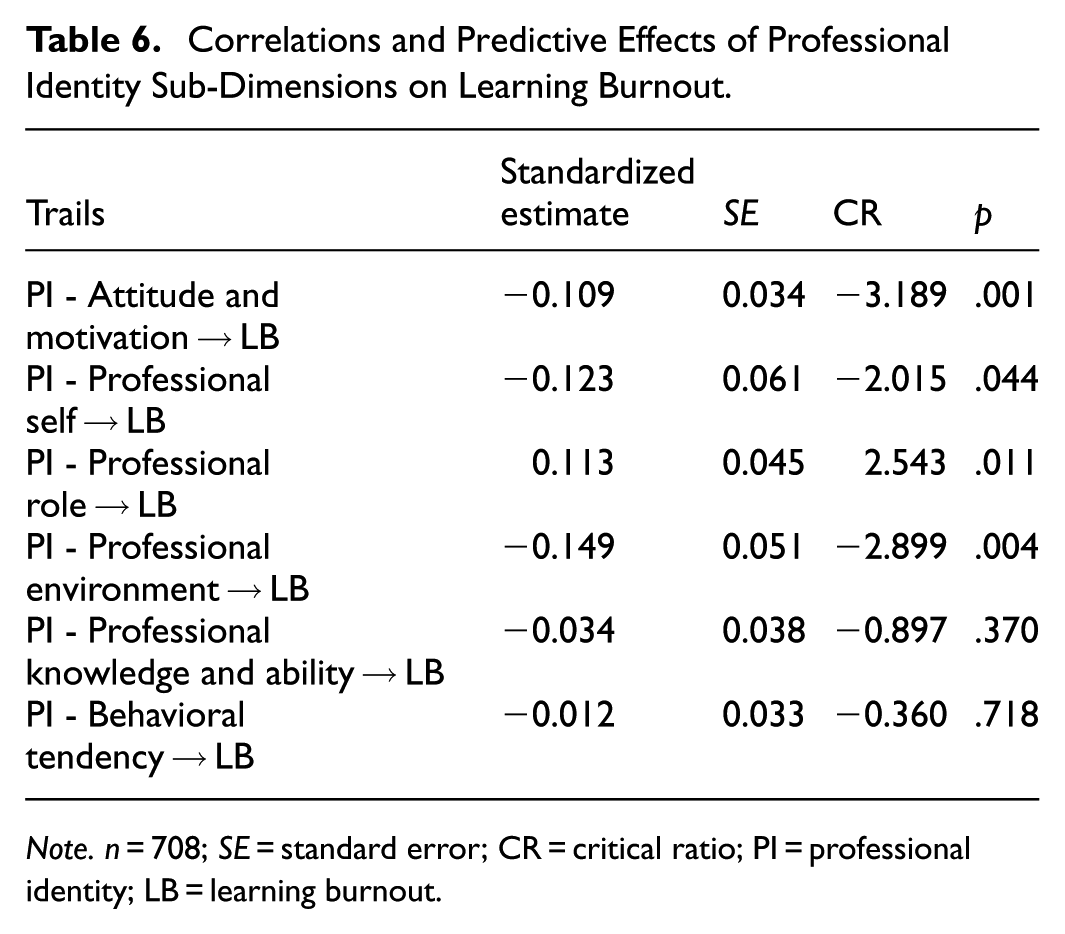
Note. n = 708; SE = standard error; CR = critical ratio; PI = professional identity; LB = learning burnout.
The Predictive Relationship Between Mental Resilience and Learning Burnout Sub-Dimensions
As presented in Table 7, MR negatively predicts the three sub-dimensions of LB—Depression, Misbehavior, and Low Achievement—at the significance level of p < .001, with standardized regression coefficients (β) of −.191, −.188, and −.267, respectively. In summary, MR exerts a significant negative predictive effect on LB overall, and it also demonstrates a significant negative predictive effect on each of the three sub-dimensions of LB. Specifically, MR has the strongest negative predictive effect on the Low Achievement dimension, followed by the Depression dimension and then the Misbehavior dimension.
Correlations and Predictive Effects of Mental Resilience on Learning Burnout Sub-Dimensions.

Note. n = 708; SE = standard error; CR = critical ratio; MR = mental resilience; LB = learning burnout.
p < .001.
Results of Testing the Mediating Effect of Mental Resilience
The mediating effect test results reveal that the mediating effect value of MR in the relationship between PI and LB is −0.07. For Hypothesis H4 (which posits this mediating effect), the 95% confidence interval is [−0.120, −0.039], with no zero included within this range (Preacher & Hayes, 2008). This confirms that Hypothesis H4 is supported and that MR exerts a mediating effect on the relationship between PI and LB. Additionally, the direct effect value of PI on LB is −0.139, with a 95% confidence interval of [−0.342, −0.080] (also excluding zero) (Table 8). The presence of a significant direct effect indicates that the mediating effect of MR is partial.
Path Coefficients of the Mediating Effect Model.

Note. CI = confidence interval; PI = professional identity; MR = mental resilience; LB = learning burnout.
Discussions and Conclusions
Professional Identity Exerts a Significant Positive Predictive Effect on Mental Resilience, Particularly via the Professional Self and Behavioral Tendency Dimensions
The results of the study showed that generally there was a significant predictive relationship of PI on MR among college and university students. This finding aligns with the empirical evidence from Chinese scholars such as Gong et al. (2020) and Y. Liu et al. (2020), all of which confirm a stable and positive association between PI and MR. From a theoretical mechanism perspective, the conclusions of this study are further supported by several internationally prominent theoretical frameworks. First, Hobfoll’s (2018) Conservation of Resources (COR) Theory emphasizes that PI itself constitutes a key psychological resource—it motivates individuals to engage proactively in learning behaviors and fosters a positive “resource-achievement-resilience” cycle. Second, Lent and Brown’s (2019) Social Cognitive Career Theory (SCCT) posits that PI enhances students’ self-efficacy and positive outcome expectations in their respective fields, thereby enabling them to reframe academic stress as developmental challenges. Collectively, these theories demonstrate that PI influences MR through multiple combined pathways, including motivation activation, resource accumulation, and cognitive restructuring. This provides a systematic and in-depth theoretical explanation for the significant positive relationship observed between the two constructs in this study.
Further analysis revealed that two specific sub-dimensions of PI also exert positive predictive effects on MR: Professional Self and Behavioral Tendency. Students with high scores on the Professional Self dimension typically demonstrate stronger self-worth and self-perception. Their greater capacity for self-acceptance fosters higher levels of MR. For the Behavioral Tendency dimension, students with high scores tend to exhibit proactive learning behaviors—such as paying close attention in class and engaging actively with teachers outside of class. These positive behaviors are more likely to yield favorable learning outcomes, ultimately creating a virtuous cycle that supports students’ positive development and enhances their MR. In contrast, the remaining sub-dimensions of PI show no predictive effect on MR, for the following reasons: Attitude and Motivation reflects the internal reasons behind students’ choice of major. As it only influences the initial decision to select a major (rather than shaping students’ ongoing psychological resources), it does not predict MR. Professional Role refers to learners’ perception and positioning of their future professional identity (e.g., some students may perceive teaching or medicine as high-status professions). However, this is merely a cognitive perception and does not translate into tangible impacts on MR. Professional Environment involves learners’ understanding of the working conditions associated with their future profession, while Professional Knowledge and Ability relates to their awareness of the skills required for relevant occupations. Since the students in this study are still enrolled in school (i.e., they have not graduated or entered the workforce), these two sub-dimensions have no practical relevance to their current MR.
Professional Identity Exerts a Significant Negative Predictive Effect on Learning Burnout: Evidence from the Attitude and Motivation, Professional Self, and Professional Environment Dimensions
The results of this study indicate that PI has a significant negative predictive effect on LB—a finding that aligns closely with numerous empirical studies and theoretical perspectives both in China and internationally. Tang and Cai (2023) directly confirmed that PI serves as a key predictor of LB, with a direct negative association between the two constructs, while Edwards and Dirette (2010) further supported this in a study of occupational therapists, finding that higher PI correlated with lower LB levels and demonstrating strong cross-population applicability of this conclusion across diverse professional fields. From a mechanistic standpoint, PI reduces LB through multiple interrelated pathways: a strong PI motivates students to invest greater effort in learning to uphold their self-esteem (Pekrun et al., 2002), thereby minimizing manifestations of Misbehavior; sustained academic effort leads to improved academic performance, creating a positive feedback loop of “competence → liking → sense of fulfillment” (Fredricks & Eccles, 2002) that effectively alleviates feelings of Low Achievement; and emotional engagement with one’s major directly fosters positive emotional experiences (Pekrun, 2019), reducing tendencies toward Depression. This multi-path mechanism aligns with Bandura’s (2018) Social Cognitive Theory, specifically its “triadic reciprocal determinism” framework, which posits that cognitions (professional identity), behaviors (learning engagement), and environmental factors (academic achievement) interact dynamically to shape psychological states (LB), and it also resonates with the Job Demands-Resources (JD-R) Model—PI, as a critical personal resource, can buffer the stress induced by academic demands and prevent the excessive depletion of psychological resources (Bakker & Demerouti, 2017).
Among the sub-dimensions of PI, this study found that Attitude and Motivation, Professional Self, and Professional Environment all exert significant negative predictive effects on LB, with the magnitude of their effects in descending order being: Professional Environment > Professional Self > Attitude and Motivation. In contrast, the Professional Knowledge and Ability and Behavioral Tendency dimensions show no significant predictive effect on LB. This indicates that engagement solely in classroom learning and teacher-student interaction is insufficient to prevent the onset of LB. Compared with behavioral investment (e.g., passive participation in academic activities), heartfelt recognition of one’s major—along with acknowledgment of the major’s social status and the working conditions associated with future related careers—is more effective in mitigating LB. If students engage in learning merely mechanically (rather than with intrinsic motivation), their learning efficiency will be extremely low; this, in turn, leads to significantly diminished learning outcomes, a lack of academic achievement, and ultimately an increase in LB levels.
Mental Resilience Exerts a Significant Negative Predictive Effect on Learning Burnout, Particularly in the Low Achievement Sub-Dimension
The results of this study demonstrate that MR has a significant negative predictive effect on LB—a finding that has been consistently validated across multiple educational stages and populations. Rao et al. (2022), in a study of nursing majors, identified a significant negative correlation between MR and LB; further, Li (2016) confirmed in a sample of junior high school students that lower MR is associated with higher LB, underscoring the cross-stage stability of this relationship. From a mechanistic perspective, individuals with high MR typically exhibit stronger cognitive-emotional regulation capabilities: they proactively seek problem-solving approaches (Fletcher & Sarkar, 2013), set clear learning goals (Martin & Marsh, 2006), and manage academic emotions effectively (Gross, 2015). These adaptive coping strategies foster positive academic emotions, enabling learners to face challenges with an optimistic outlook (Southwick et al., 2014) and thereby significantly reducing the negative impacts of academic stress. This underlying mechanism aligns with Fredrickson’s (2001) Broaden-and-Build Theory in positive psychology, which posits that MR expands cognitive and behavioral resources, constructs a sustainable reservoir of personal developmental resources, and ultimately forms a psychological buffer against LB.
Among the sub-dimensions of LB, this study found that MR exerts the strongest negative predictive effect on the Low Achievement sub-dimension, followed by the Depression sub-dimension and then the Misbehavior sub-dimension in descending order of effect magnitude. A plausible explanation for this pattern is that students with low MR tend to develop negative learning mindsets when facing academic difficulties, and they struggle to adjust these mindsets in a timely manner. This negative cognitive state first impairs learners’ sense of academic achievement—hence the most pronounced impact on the Low Achievement sub-dimension. Once students fail to gain a sense of achievement, their learning outcomes are significantly diminished; this, in turn, may lead to the emergence of negative learning behaviors and an intensification of avoidance tendencies toward academic challenges.
Mental Resilience Plays a Partial Mediating Role Between Professional Identity and Learning Burnout: Professional Identity Influences Learning Burnout Both Directly and Indirectly Through Mental Resilience
Through mediating effect testing, this study found significant associations among PI, MR, and LB—specifically, MR functions as a partial mediator between PI and LB. This result aligns closely with existing theoretical frameworks and numerous empirical studies. Connor and Davidson (2003) noted that MR, as a developable psychological capacity, enables individuals to cope effectively with stress and adversity; this supports the present study’s conceptualization of MR as a mediating variable. Fredrickson’s (2001) Broaden-and-Build Theory further elaborates on this mechanism: positive emotional resources (e.g., the sense of value derived from PI) expand an individual’s cognitive and behavioral repertoire, thereby enhancing MR and fostering adaptive development. Practical observations also confirm that students with higher MR are more skilled at regulating their mindsets and maintaining focus on goals (Southwick et al., 2014). Even when their PI is temporarily low, these students can still gain a sense of academic achievement by adopting positive behavioral strategies—such as optimizing learning methods and proactively seeking social support—which in turn helps them effectively mitigate LB (Martin & Marsh, 2006).
From the perspective of educational practice, uncovering this mediating mechanism offers a dual-path intervention strategy for alleviating college students’ LB: on one hand, students’ PI can be enhanced by intensifying professional cognitive education and refining career development planning; on the other hand, MR training programs—such as cognitive-behavioral therapy (CBT) and resilience-building workshops—can be rolled out to strengthen students’ capacity to cope with academic setbacks.
Recommendations and Suggestions
Reducing College Students’ Learning Burnout Through Learning Atmosphere Cultivation and Teacher Training
To create a positive learning environment, foster a strong atmosphere of academic dedication, and support students across all grade levels in making greater progress in their academic development, universities and colleges should establish and refine effective academic atmosphere systems. Specifically, they can organize initiatives such as “Academic Atmosphere Building Month” and “Outstanding Student Model Selection” to cultivate a learning environment where students are willing to learn and eager to excel. Appropriate learning methods enable students to achieve twice the result with half the effort, significantly alleviating negative emotions arising from academic tasks. Therefore, teachers should guide students to identify personalized learning methods and implement structured daily supervision (rather than rigid mandatory measures) to help students develop positive study habits. Additionally, institutions should strengthen teacher training to enhance instructors’ teaching competence—guiding teachers to design assessments with reasonable difficulty levels based on students’ Zone of Proximal Development (ZPD), thereby ensuring students gain a sufficient sense of academic achievement.
Enhancing College Students’ Professional Identity Through Curriculum Design and Practical Training
First, in the framework of formulating curriculum systems or employment support policies aimed at boosting learners’ PI, priority should be given to helping students develop an accurate understanding of their professional roles. This enables students to clarify their role positioning during professional learning, thereby providing sustained, inward-outward positive feedback for the formation and development of their PI. Specific measures to achieve this include: leveraging regular data feedback to track real-time, significant changes in learners’ emotions, attitudes, and values toward professional learning; offering targeted workplace experience courses to help students identify the positioning of roles related to their major in the new era; and elevating the professional prestige of the major—all of which contribute to strengthening students’ PI. Second, it is essential to help students gain an early understanding of objective factors related to their major’s future, such as workplace environment and salary, while continuously expanding their access to professional knowledge and competencies. To this end, institutions can strengthen the controllability and observability of professional knowledge and skill training models—this not only provides effective data feedback for optimizing teaching, but also enhances learners’ perceived behavioral control and supports the establishment of a targeted resource platform for improving their professional capabilities. Additionally, practical initiatives like on-the-job internships, social practice, and community service can allow students to experience workplace environments in advance, helping them form realistic psychological expectations of their major’s future work settings and thereby fostering the development of their PI. Third, efforts should be made to guide students in developing a positive learning attitude, enrich the connotation of professional activities—such as in-class learning, teacher-student interactions, and further study—and increase students’ willingness to engage in professional learning, all of which contribute to enhancing their PI. Additionally, education authorities at all levels should strengthen career guidance for students prior to college application, offering professional experience courses to help high school students gain early insights into different majors. For lower-grade college students, institutions should provide access to a major transfer platform and offer second majors for minor studies, supporting students in finding a major that aligns with their interests and goals as soon as possible.
Enhancing College Students’ Mental Resilience Through Mental Health Education
Universities and colleges must further strengthen their focus on college students’ mental health and cultivate their resilience in the face of setbacks. To this end, institutions can adopt flexible and diverse approaches—such as group counseling sessions and mental health education courses—to enhance students’ MR and foster a positive, optimistic mindset. Specifically, they can offer targeted workshops on setback resilience, leveraging the final years of students’ campus life (before entering the workforce) to cultivate their ability to endure hardships and develop a resilient character. Notably, students with a strong PI tend to form a positive self-concept regarding their academic abilities and hold favorable evaluations of their own learning competence—both of which contribute to improved MR. In turn, MR enables college students to quickly adjust their mindset when confronting challenges: a higher level of MR helps students maintain greater focus on their studies, identify effective learning methods, and gain a sense of academic achievement, thereby reducing LB. Additionally, it strengthens students’ understanding and recognition of their majors, empowering them to adopt proactive coping strategies when facing academic difficulties. This, in turn, guides them to make appropriate academic decisions and further enhances their sense of academic achievement.
Limitations and Future Research
This study adopted questionnaire surveys and quantitative analysis methods; however, the depth of student data exploration remained insufficient, failing to fully capture the characteristics of individual differences. For future research, qualitative research methods such as interviews can be integrated into a mixed-methods design to further investigate the interactive mechanisms among PI, LB, and MR.
Although this study strived to include diverse university samples within Zhejiang Province, constraints such as time costs, resource limitations, and social network access led to the final sample being predominantly composed of undergraduate students from Zhejiang University of Technology. This geographical limitation may compromise the generalizability of the conclusions. Subsequent studies should expand the scope and diversity of sampling, and conduct joint surveys across multiple universities to obtain more representative data.
Conclusion
In this study, PI was treated as the independent variable, LB as the dependent variable, and MR as the mediating variable, with a relationship model between PI and LB constructed accordingly. A questionnaire survey was conducted to measure learners’ responses across all dimensions of the aforementioned latent variables, and a total of 708 valid questionnaires were collected from college students. Using SPSS and AMOS, a relational model between PI and LB—with MR as the mediating variable—was established to explore the operational mechanisms among PI, MR, and LB. The results indicated the following: first, PI exerted a significant positive predictive effect on MR; second, MR had a significant negative predictive effect on LB; and third, PI also demonstrated a significant negative predictive effect on LB. Additionally, MR played a partial mediating role in the relationship between PI and LB—specifically, a portion of the negative predictive effect of PI on LB was transmitted through MR. By focusing on the joint mechanism through which PI and MR influence LB levels, this study further expands the research scope of PI, enriches its connotation, and provides a reference for subsequent related studies.
Footnotes
Appendix
Specific Content of the Questionnaire.

| Variable | Item | Topic |
|---|---|---|
| Attitude and motivation | AM1 | Thinking of being able to engage in work related to this major, I feel sincere pride and pride. |
| AM2 | It takes a lot of effort to learn this major well, but I think it is worth it. | |
| AM3 | To engage in work related to my major is in line with my ideals and values. | |
| AM4 | I feel that my major will prepare me for a glorious and arduous career in the future. | |
| AM5 | I want to become a professional skilled “professional practitioner”. | |
| Professional self | PS1 | I have been trying to make myself a dedicated “professional practitioner”. |
| PS2 | I believe I can get promoted based on my ability to do something related to my major. | |
| PS3 | Generally speaking, I think I have done my best in my major. | |
| PS4 | I know exactly what kind of “professional practitioner” I should be. | |
| PS5 | I have a clear goal and self-plan for my professional development. | |
| Professional role | PR1 | Engaged in professional related work, the social status will be relatively low. |
| PR2 | I am not satisfied with the role positioning of “relevant practitioners in this profession”. | |
| PR3 | Under the circumstances of The Times, the requirements for “practitioners related to this profession” are too high and difficult. | |
| PR4 | I think there is a big gap between my actual role and my expected role in the process of professional learning. | |
| Professional environment | PE1 | When I encounter difficulties in my professional study, I can always get help from people around me (teachers/friends, etc.). |
| PE2 | As far as I know, the working atmosphere of “relevant practitioners in this profession” (getting along with leaders/colleagues) is relatively harmonious and friendly. | |
| PE3 | The school provides a stage for me to develop my professional ability. | |
| Professional knowledge and ability | PKA1 | I can complete a certain degree of work according to the professional knowledge I have learned. |
| PKA2 | Compared with before, I can communicate my professional knowledge with others more freely. | |
| PKA3 | Compared with before, I now pay more attention to the life and integration of professional knowledge. | |
| PKA4 | Compared with before, my subject knowledge and professional skills have been developed to a certain extent. | |
| Behavioral tendency | BT1 | I am willing to participate in the study or activities related to my major to improve my professional skills. |
| BT2 | I am willing to take the initiative to understand the purpose, philosophy and standards of this major and its future development. | |
| BT3 | I am willing to actively apply the professional knowledge I have learned to my own work and life practice. | |
| BT4 | I always try to improve my professional learning state through reflection. | |
| Mental resilience | RE1 | When things change, I’m flexible. |
| RE2 | When I encounter difficulties, I can handle them well. | |
| RE3 | When faced with problems, I can deal with them with humor. | |
| RE4 | My ability to bounce back (to return to my original state) after experiencing illness or suffering is very strong. | |
| RE5 | I think I am a strong person when faced with challenges in life. | |
| RE6 | I don’t let failure get me down. | |
| RE7 | I have the ability to deal with unpleasant feelings, such as anger. | |
| RE8 | When I’m under pressure, I can concentrate on my thoughts. | |
| RE9 | I can achieve my goals even when I encounter obstacles. | |
| Depression | EE1 | When I wake up every day, I feel tired with the thought of dealing with a day of study. |
| EE2 | I feel exhausted after a whole day’s study. | |
| EE3 | It’s hard for me to maintain a lasting enthusiasm for learning. | |
| EE4 | I always feel bored and anxious when it comes to exams. | |
| Misbehavior | IB1 | The only time I read or study is during exams. |
| IB2 | I don’t think I have enough patience in learning. | |
| IB3 | I seldom plan my study time. | |
| IB4 | I seldom take the initiative to study after class. | |
| Low achievement | LA1 | It is easy for me to master professional knowledge. |
| LA2 | I can easily complete the courses and learning tasks in the current stage. | |
| LA3 | When studying, I can deal with my emotional problems calmly. | |
| LA4 | I am always full of energy when I study. |

Ethical Considerations
As a theoretical analysis of human research ethics, this study does not involve the recruitment of actual human subjects or interventional experiments, and no ethical approval number is required temporarily. The analysis of ethical norms in this paper is based on the Declaration of Helsinki and relevant Chinese regulations on human research ethics, and the design of the involved informed consent process meets the core requirements of protecting the rights and interests of research participants.
Consent to Participate
All participants gave their consent for participation.
Consent for Publication
All authors gave their consent for publication.
Author Contributions
Xin-Min Huang designed and carried out the research and conducted the data analysis and summary. Shu-Ping Zhang and Wei Xu conducted the research, and participated in the data analysis. All authors contributed to the article and approved the submitted version.
Funding
The authors disclosed receipt of the following financial support for the research, authorship, and/or publication of this article: This work was supported the financial supports by the Zhejiang Province Higher Education Society Research Project “AI Empowering Education and Teaching Application Research” Special Project in 2025, Grant/Award Number: KT2025457: Fundamental Research Funds for the Provincial Universities of Zhejiang, Grant/Award Number: GB202302007: the Zhejiang Provincial Teaching Reform Project, Grant/Award Number: JGBA2024068.
Declaration of Conflicting Interests
The authors declared no potential conflicts of interest with respect to the research, authorship, and/or publication of this article.
Data Availability Statement
The research data have not been uploaded to a public repository and are not openly accessible. However, the Data Availability Statement explains that the data can be obtained for research purposes by contacting the corresponding author with permission.