



Abstract
This study employs quantile regression, fixed-effects regression, and other statistical methods to examine the “motherhood penalty” (MP) and “fatherhood premium” (FP) using China Health and Nutrition Survey (CHNS) data from 1989 to 2015. Quantile regression results indicate that after controlling for standard labor market return characteristics, an increase in motherhood proportion significantly reduces earnings among low-income women, while the expansion of fatherhood steadily enhances wages at lower quantiles. Fixed-effects regressions further reveal persistent long-term effects: women’s earnings decline by approximately 15% following childbirth and do not recover over time, whereas men’s wages remain around 20% higher than their pre-fatherhood levels, exhibiting a stable premium without signs of convergence. The FEIS model suggests that prospective mothers already experience earnings reductions before childbirth, reinforcing cumulative labor market disadvantages. These findings highlight the inadequacies of existing fertility support and gender equality policies. Strengthening employment protections, optimizing parental leave policies, and promoting workplace inclusivity are essential to mitigating fertility decline, advancing gender equity, and fostering sustainable socioeconomic development.
Plain Language Summary
This study investigates how parenthood affects men’s and women’s earnings in China, using longitudinal survey data from 1989 to 2015. It finds that women face a significant “motherhood penalty” in the labor market—wages drop sharply after childbirth and remain lower for years. In contrast, men often receive a “fatherhood premium”—a wage increase that persists over time. These effects are not uniform across all workers; they are particularly severe for low-income women and more favorable for high-income men. To capture how these impacts differ across income levels, the study uses quantile regression models. The results show that low-income mothers can lose more than 20% of their wages after childbirth, while higher-income women experience milder losses or even neutral effects. For fathers, wage increases are most pronounced in lower- and middle-income groups, reaching more than 30% in some cases. These patterns reveal how parenthood can exacerbate existing income inequality, especially when reinforced by traditional gender roles and limited institutional support. Importantly, the study finds that women’s wages start to decline even before childbirth, suggesting that they may adjust their career choices in anticipation of family responsibilities. Meanwhile, men’s wage gains appear largely unrelated to childrearing burdens and instead reflect employer bias or social expectations around fatherhood. The findings highlight the need for stronger policies to reduce the motherhood penalty and support gender equality. Key recommendations include expanding paid parental leave for both parents, improving access to affordable childcare, and enforcing workplace protections against gender-based discrimination. Addressing these issues is essential not only to improving women’s career prospects but also to encouraging higher fertility rates and creating a more inclusive labor market.
Keywords
Introduction
Since the 1980s, China’s number of births has continued to decline, officially entering a period of negative population growth in 2022. Despite the relaxation of family planning policies to allow for two-child and three-child families, overall fertility rates have not significantly improved. According to the Seventh National Population Census, China’s total fertility rate stands at only 1.3, far below the replacement level. This prolonged period of low fertility not only presents severe socioeconomic challenges but also intensifies women’s role conflict between careers and family responsibilities, drawing significant attention to the issue of the “motherhood penalty.”
The “motherhood penalty” refers to the systematic occupational disadvantages women face after becoming mothers, including career interruptions, reduced promotion opportunities, wage decreases, and the accumulation of long-term income disadvantages. In contrast, men often experience a “fatherhood premium,” characterized by accelerated wage growth and career advancement following parenthood. These phenomena underscore the profound impact of marriage and parenthood on gender roles in the labor market.
Contemporary ideological shifts have further exacerbated the motherhood penalty. In Western societies, the prevailing notion of “soft essentialism” reframes women’s balancing of work and family responsibilities as a symbol of “free choice.” In China, this ideology intertwines with Marxist gender equality, neoliberal values, and Confucian patriarchal traditions, forming a “mosaic gender ideology” (Ji et al., 2017; Tian & Chen, 2024; Zhou, 2020). This ideology demands that women demonstrate independence and efficiency in the workplace while taking on primary responsibilities for cognitive, caregiving, and emotional labor at home, thereby intensifying the role conflict and identity fragmentation between career aspirations and maternal responsibilities.
In East Asian countries influenced by Confucian culture, work-family trajectories are highly intertwined (W. H. Yu, 2009). With increasing social stratification, growing economic uncertainties, and the rise of child-centered parenting, traditional gender division of labor has been further reinforced, worsening women’s challenges in the labor market. According to OECD data, women’s labor force participation in Japan and South Korea drops significantly during childbearing years, forming a characteristic M-shaped curve, while men’s participation rates remain consistently high (Figure 1), reflecting the long-term gendered nature of occupational trajectories. Moreover, phenomena such as the “glass ceiling,” the “sticky floor,” the rise of “intensive motherhood,” and the growing visibility of stay-at-home mothers have intensified criticism of the motherhood penalty, especially among urban women (Mezzadri et al., 2021).

Labor force participation rate (% of population ages 15+).
This study focuses on the Chinese context, integrating empirical data on the “motherhood penalty (MP)” and “fatherhood premium (FP)” to systematically examine their distributional characteristics and long-term dynamics in the labor market from both static and dynamic perspectives. By doing so, the research aims to provide theoretical insights into achieving gender equality and offer empirical evidence for optimizing labor market and social policies.
Research Context and Literature Review
China’s socio-economic transformation has significantly altered women’s roles in the labor market. During the early stages of reform and opening-up, the planned economy and state-assigned employment system propelled female labor force participation to globally leading levels (UNDP, 1995). The expansion of education and the implementation of family planning policies further enhanced women’s social engagement. However, the deepening market-oriented reforms of the 1990s introduced substantial challenges. The decoupling of welfare systems from state-owned enterprises, the withdrawal of childcare subsidies, and the revival of traditional gender norms—such as “childcare is a family responsibility” and “men work outside, women manage the home” (Du & Dong, 2009; Xiao & Asahullah, 2020)—created persistent obstacles to women’s career continuity and income growth. According to the Chinese Women’s Social Status Survey, public endorsement of traditional gender roles rose from 44.2% in 1990 to 57.8% in 2010, underscoring their revival amid market reforms.
In the later stages of market reform, women’s disadvantaged position in the labor market became increasingly evident. This was particularly pronounced among low-skilled and less-educated women, who faced significant wage discrimination due to the “sticky floor effect” (Chi & Li, 2008; Jia & Dong, 2013; Mu & Tian, 2022). At the same time, privatization and deregulation granted firms greater discretion, inadvertently fostering institutional conditions that sustained FP (Seneviratne, 2020). Despite women’s growing human capital, the gender wage gap has persisted and has increasingly manifested as occupational gender segregation (Ji et al., 2017).
In recent years, the relaxation of fertility policies has brought motherhood-related challenges to the forefront, with wide-ranging and lasting implications (Liu, 2023). Studies have found that policy adjustments not only failed to significantly boost female labor force participation rates but also exacerbated structural changes in women’s career trajectories, making MP more pronounced (Van Winkle & Fasang, 2020; Musick et al., 2020; Hsu, 2021; Y. J. Wang & Zhang, 2022). For instance, Shen & Jiang (2020) noted that under the two-child policy, women of childbearing age often face long-term difficulties due to career interruptions or stagnation. Even women who achieve career advancement or income growth post-childbirth often rely heavily on intergenerational family support and endure long-term high work intensity (J. Yu & Cheng, 2024).
In the 21st century, the rise of the digital and gig economies has provided women with new employment opportunities and greater flexibility in career choices. Some studies suggest that the digital economy has mitigated MP to some extent by promoting formal employment, alleviating caregiving burdens, and fostering gender equality (Zhang et al., 2024). However, such positive effects are not universal and are often perceived as compromises in career development rather than genuine equality (Ma, 2022; Zheng et al., 2024). The challenges of MP and FP remain unresolved, prompting scholars to shift their focus from simple gender wage differences to how parenthood impacts the distribution of wage premiums and penalties within gender groups.
Existing studies have extensively explored the mechanisms underlying MP and FP, focusing on three primary perspectives. First, from the perspective of work experience and human capital theory (Becker, 1985), childbirth deprives women of opportunities to accumulate work experience and pursue professional training. In China, women often face “demotion and pay cuts” after childbirth, with some employers masking illegal practices as “flexible work arrangements” that, in reality, disrupt women’s career development (Goldin, 2014; W. Yu & Hara, 2021). In contrast, men are more incentivized to invest in their human capital due to FP (Staff & Mortimer, 2012). Second, compensating wage theory posits that women with children are more likely to prioritize “family-friendly” jobs or arrangements, even at the cost of lower pay, to gain “non-pecuniary amenities” (Glauber, 2012; Hodges, 2020; Hsu, 2021). Conversely, men often pursue higher-intensity and more challenging jobs after becoming fathers (Budig & England, 2001). Third, discrimination theory suggests that the time and energy consumed in parenting send a signal that women cannot fulfill the dual roles of “ideal worker” and “good mother” (Kim et al., 2020; Meng et al., 2023; Thebaud and Taylor, 2021). For men, fatherhood often reinforces perceptions of traditional paternal roles, earning them positive bias from employers (Fuller & Cooke, 2018; W. Yu & Kuo, 2024).
While these studies have deepened theoretical understandings of MP and FP (Cukrowska-Torzewska & Matysiak, 2020; de Linde Leonard & Stanley, 2020), most have relied on static analytical frameworks and thus failed to capture the dynamic evolution of earnings and employment trajectories after parenthood (Kahn et al., 2014; Musick et al., 2020). In the Chinese context, research on the distributional heterogeneity of parenthood effects across income groups remains limited, and few studies approach this issue from a life-course perspective (Jalovaara & Fasang, 2020; Van Winkle & Fasang, 2020). Building on this foundation, this study contributes to the literature in three key ways. First, it provides new empirical evidence on how parenthood affects earnings over time and how these impacts differ across income groups. Second, it develops an integrated empirical strategy that combines unconditional quantile models and panel-based fixed-effects designs to capture both distributional heterogeneity and long-term individual wage dynamics. Third, the analysis moves beyond average gender wage gaps to examine intra-gender disparities shaped by parenthood, revealing how motherhood and fatherhood differently influence labor market outcomes.
Based on this context, we propose the following hypotheses:
Analytic Strategy
To capture both the distributional patterns and long-term evolution of MP and FP, this study adopts a multi-method analytical framework that integrates cross-sectional and panel-based approaches.
First, unconditional quantile regression (UQR) and unconditional quantile treatment effects (UQTE) serve as the baseline regression approaches, while linear regression (LR) and conditional quantile regression (CQR) are included to provide robustness checks and facilitate comprehensive analysis of wage disparities across quantiles. Quantile regression is particularly advantageous in its flexibility to accommodate response variables with varying distributional forms, enabling a nuanced depiction of wage disparities across the distribution (Budig & Hodges, 2010; Killewald & Bearak, 2014). Compared to CQR, UQR is better suited for addressing the nonrandom nature of childbirth and its differential effects on wages at various quantiles. Furthermore, individual- and year-level high-dimensional fixed effects are incorporated, offering a powerful tool for identifying the heterogeneous impacts of MP and FP across wage distributions (England et al., 2016; Rios-Avila & Maroto, 2022).
Second, to address the endogeneity concerns arising from the nonrandom selection into parenthood, inverse probability weighting (IPW) is applied within the UQR framework to correct for sample selection bias. As highlighted by Firpo and Pinto (2016) and Rios-Avila (2020), IPW assigns appropriate weights to different individual distributions, effectively adjusting for potential biases in the estimation of MP and FP. Additionally, the cultural context of early and universal marriage and childbearing in China alleviates some of the randomness in parenthood selection, contributing to a more precise model identification (Ji & Yeung, 2014).
Third, to examine the long-term wage effects, the study employs a distributed fixed effects model, following the framework proposed by Ludwig and Brüderl (2018) and incorporating the event-study approach of Hsu (2021). This transformation involves constructing dummy variables to capture the time intervals between survey years and childbirth, allowing the model to trace wage dynamics relative to childbirth timing. Furthermore, we account for the timing of second and third births to isolate the impact of first childbirths, thereby enhancing the accuracy of the model’s identification.
In addition, the study incorporates a Fixed-Effects Individual-Specific Slopes (FEIS) model to address unobservable heterogeneity in individual human capital traits, such as personality and social skills, that may influence both wage trajectories and parenthood timing. The FEIS model effectively isolates intra- and inter-individual long-term trends, further improving the identification of dynamic patterns in MP and FP.
Finally, for respondents with parental status, the analysis retains only those who completed childbirth during the survey period while including childless individuals to facilitate meaningful comparisons. By focusing on within-gender comparisons, this approach ensures sample consistency and minimizes the confounding effects of intersecting gender roles and parenthood behavior on the model.
The comprehensive application of these models not only provides a detailed depiction of the heterogeneous wage distribution effects of MP and FP but also establishes a solid methodological foundation for analyzing their long-term dynamics.
Data and Variables
This study utilizes longitudinal data from the China Health and Nutrition Survey (CHNS) spanning the years 1989 to 2015 (Table 1). The CHNS survey, an ongoing open cohort initiative, is a collaborative project between the Carolina Population Center at the University of North Carolina at Chapel Hill and the National Institute for Nutrition and Health (NINH) at the Chinese Center for Disease Control and Prevention (CCDC). It offers a comprehensive dataset encompassing variables related to women’s marriage and childbearing. This study predefines the sample to include women and men aged 16 to 52 with reproductive capability, with a priority given to retaining records where both spouses have been interviewed. After an initial data cleaning process, we identified 17,445 female interview records and 20,835 male interview records for subsequent quantile regression analysis. Upon narrowing the sample to individuals who reported giving birth during the interview period, the female panel data consisted of 2,976 person-years, involving 1,040 respondents and averaging 2.86 interview records. The male panel data, under the same conditions, totaled 4,560 person-years, involving 1,574 respondents with an average of 2.90 interview records. Below is a comprehensive breakdown of the variables:
Descriptive Statistics of Wage in Different Group (CHNS 1989–2015).

Note. t statistics in parentheses.
p < .01. ***p < .001.
This study employs wage rate and the natural logarithm of annual wage as dependent variables. Salary records were adjusted to income per unit time and annual income based on the 2015 Consumer Price Index (CPI). Key independent variables are the number of children born to the respondent and whether the respondent takes a parental role, denoted as children, motherhood (for women) and fatherhood (for men), respectively. The number of children was top-coded at three. A respondent is identified as a parent if there exists a biological relationship with at least one child.
To capture the dynamic effects of childbirth on earnings, we construct a series of event-time indicators based on the respondent’s age at childbirth and the survey year. Specifically, we define the time distance from the childbirth event as

Each
Control variables are categorized into distinct groups. The first category encompasses individual characteristics, including age and square age, minority status, education (years), married, and the spousal wage income, a categorical variable indicating housework time spent on chores, and dummy variables denoted as T controlling the effects of birth of the second and third child. The second category involves job characteristics, including tenure, squared tenure, job, occupation, and unit. The aim is to eliminate the positive correlation between work experience and wage income. Since the survey lacks tenure data, we estimate it as (respondent age − years of education − 7), following Z. Wang and Li’s (2016) proposal considering the typical starting age for primary school in China. Job, occupation, and unit are controlled according to their original types. The third category comprises regional characteristics, encompassing location (1 = eastern region of China), unemployment rates (provincial level), population density (urban level), educational resources (accessibility to community educational resources) and urban (1 = urban area).
We stratify males and females into different cohorts based on whether they have children. Column (4) in Table 2 displays the results of t-tests for mean differences between these cohorts. Notably, the income of the childless women was marginally lower than that of the child-rearing group in the early 1990s but saw a significant increase in subsequent years. The shift from negative to positive differences between the two groups indicates the emergence of a “work-family” balance concern. As mentioned earlier, during the initial phase of China’s economic restructuring, the substantial demand for a labor force, the regulation of family planning policies, and robust public education resources elevated Chinese women’s labor participation rate to a global forefront. However, as the reform of state-owned enterprises neared completion during the national capital reorganization and social transformation, the employment landscape for women shifted. The “work-family” balance has become a pressing concern, particularly amid the separation of public and private sectors. Interestingly, this issue isn’t as pronounced among males. While childless men earned less than those with children before the 21st century, differences are now insignificant.
Quantile Regressions (Female Workers, CHNS 1989–2015).

Note. t statistics in parentheses.
p < .05. **p < .01. ***p < .001.
Empirical Results
Quantile Regressions
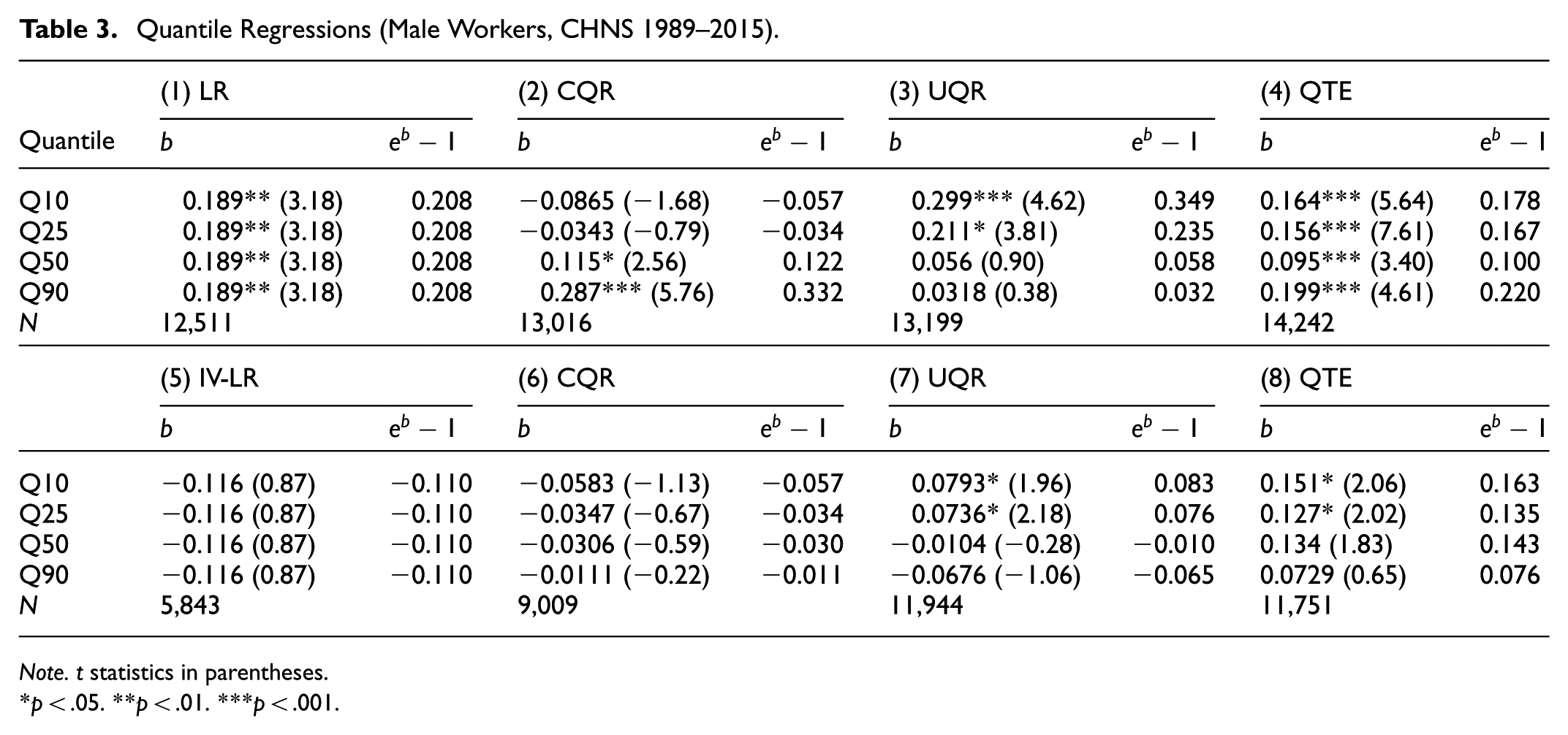
Building on the preceding discussion and descriptive statistics, this section presents quantile regression results that examine how parenthood influences wage outcomes across the income distribution. Table 3 highlights the estimated coefficients for these two variables, omitting others for clarity. By examining four distinct quantiles, we explore distributional disparities, such as potential “sticky floor” and “glass ceiling” effects, moving beyond central tendencies captured by linear regression. Specifically, the linear regression (LR) model employs Recentered Influence Function (RIF) statistics, while the clustered quantile regression (CQR) and unconditional quantile regression (UQR) models, based on Canay (2011) and Rios-Avila and Moroto (2022), utilize individual-level clustering with bootstrapped standard errors (100 samples). To address extreme propensity scores, we apply inverse probability weighting and exclude observations with propensity scores below 0.025 or above 0.975. Columns (4) and (8) of Table 3 report average treatment effects using unconditional quantile treatment effects (UQTE), providing additional insights into wage distributional patterns.
Quantile Regressions (Male Workers, CHNS 1989–2015).
Note. t statistics in parentheses.
p < .05. **p < .01. ***p < .001.
In Table 2, columns (1) through (4) and column (8) use motherhood as the primary independent variable, while columns (5) through (7) examine the number of children, with only column (5) employing the gender of the firstborn child as an instrumental variable to address the endogeneity of childbearing in the OLS model. To ensure wage variations are more accurately attributed to motherhood-related mechanisms, we exclude individuals with incomplete survey records or those exiting the labor market due to reasons other than job searching or household labor. Additionally, employer types that poorly reflect wage changes stemming from human capital depreciation or workplace discrimination—such as business owners—are excluded, while unpaid family work and self-employment are retained.
The results reveal significant distributional disparities. For instance, in column (5), an additional child corresponds to a 30% wage reduction for women in the LR model. CQR estimates show that mothers in the 10th and 25th percentiles experience wage penalties of at least 20% and 10%, respectively, whereas mothers at the 90th percentile earn 30% more than childless women. Notably, CQR controls for factors influencing wage changes by conditioning on numerous covariates and applying fixed effects to remove within-group means, potentially altering the absolute distribution of wages and limiting direct interpretations of MP’s impact on the entire wage distribution. In column (7), UQR results show that, assuming an additional child for each woman, wages decrease by 6.1% at the 10th percentile and 3.6% at the 25th percentile, while no significant changes are observed at the 90th percentile. These patterns underscore the uneven cost of motherhood across the wage spectrum, highlighting that lower-income women bear a disproportionate economic burden due to motherhood, aligning with the “sticky floor” hypothesis.
UQTE represents the difference in potential earnings between all women without children and all women with children. The results further suggest that mothers in top income brackets experience wage reductions exceeding 20%, reflecting amplified economic disparities as the proportion of mothers increases. These findings resonate with theoretical discussions on MP, wherein systemic discrimination and limited career advancement opportunities exacerbate existing income inequalities.
Table 3 shifts the focus to fatherhood, revealing consistent positive wage effects. In the LR model, fatherhood corresponds to a 20.8% income increase across the full sample. CQR results indicate that this premium varies significantly across income percentiles, ranging from 12.2% at the median to 33.2% at the 90th percentile. Similarly, UQR estimates show wage increases of 34.9% and 23.5% for the 10th and 25th percentiles, respectively, assuming all males in the sample are fathers. By comparison, shifting the independent variable to the number of children reduces the magnitude of the premium. For instance, having one additional child is associated with wage increases of 8.3% and 7.6% at the 10th and 25th percentiles.
The UQTE results reinforce these patterns, demonstrating a fatherhood premium of 16.3% and 13.5% at lower income percentiles. These findings reflect social norms in East Asia, where low-income men tend to have more children and benefit from traditional gender divisions of labor that enhance their bargaining power and mobility. At higher income levels, the premium diminishes after applying sample restrictions, suggesting that excluded individuals likely possess unobserved traits linked to higher wages.
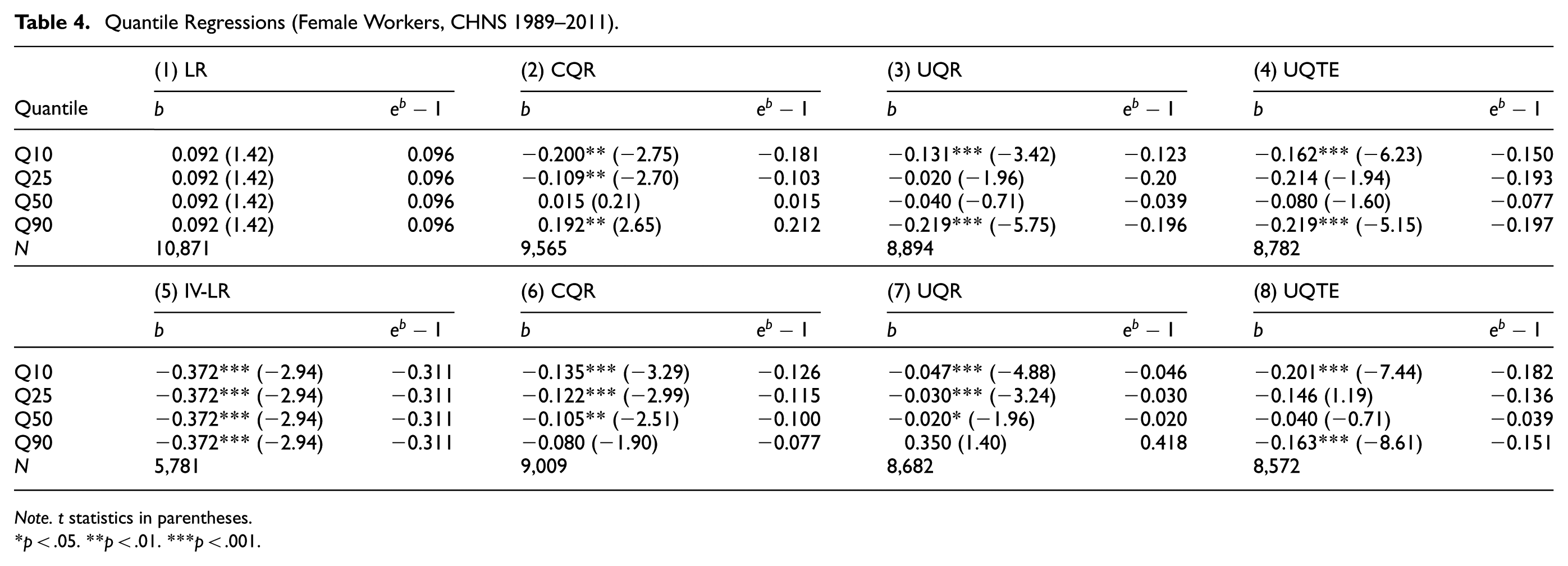
Building on this, we further exclude post-2011 samples to address potential biases introduced by China’s gradual relaxation of fertility restrictions, which transitioned from the “Double-Only-Child Policy” to the “Universal Two-Child Policy.” These policy changes, coupled with limited societal support and reproductive resources, likely influenced labor market participation and income distribution, particularly among low-income groups. By isolating the pre-2011 data, we aim to disentangle the effects of gender roles and the associated wage penalties and premiums from the broader impacts of policy-driven fertility shifts. The results are as follows:
The updated regression results confirm the persistence of heterogeneous effects for both motherhood penalties and fatherhood premiums. Mothers consistently earn significantly lower wages compared to childless women (Table 4), while fathers enjoy notable wage advantages over childless men (Table 5). These patterns are particularly pronounced at the 10th and 25th percentiles of the income distribution, underscoring the asymmetric influence of gender roles on wage dynamics. This evidence highlights the unequal distribution of wage penalties and premiums across income levels, reinforcing the theoretical importance of gender norms in shaping labor market outcomes.
Quantile Regressions (Female Workers, CHNS 1989–2011).
Note. t statistics in parentheses.
p < .05. **p < .01. ***p < .001.
Quantile Regressions (Male Workers, CHNS 1989–2011).

Note. t statistics in parentheses.
p < .05. **p < .01. ***p < .001.
Distributed Fixed Effects Regressions
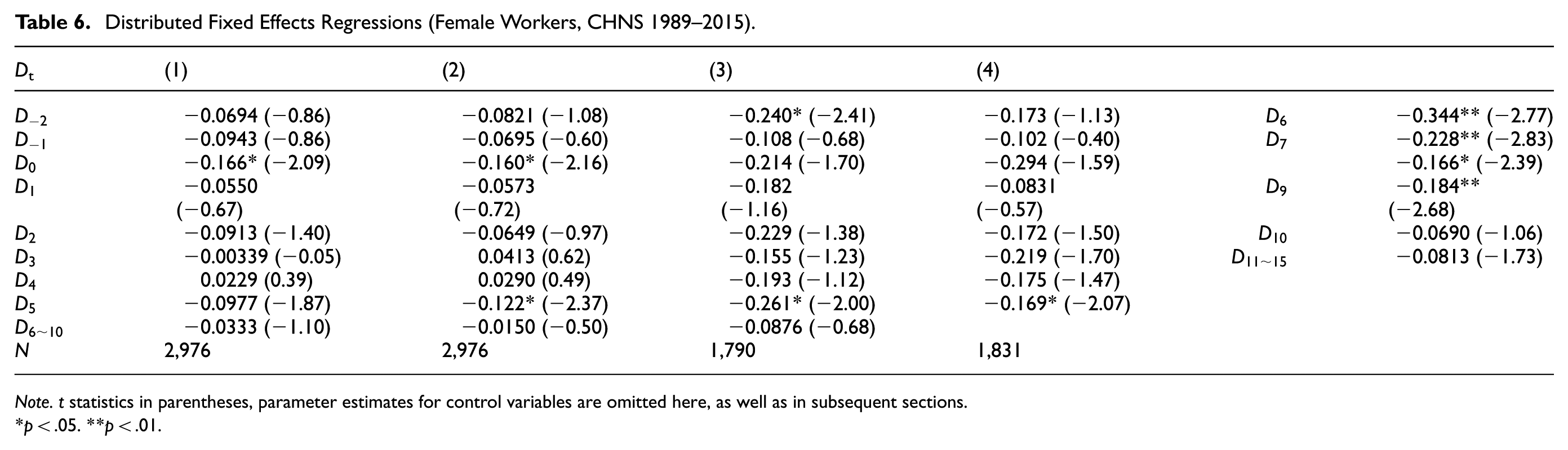
In this section, the model uses income variables trimmed to exclude extreme values beyond the 1st and 99th percentiles. Regression analyses are conducted with individual-level clustered standard errors. Tables 6 and 7 present the enduring income dynamics, with wage rates as the dependent variable.
Distributed Fixed Effects Regressions (Female Workers, CHNS 1989–2015).
Note. t statistics in parentheses, parameter estimates for control variables are omitted here, as well as in subsequent sections.
p < .05. **p < .01.
Distributed Fixed Effects Regressions (Male Workers, CHNS 1989–2015).

Note. t statistics in parentheses.
p < .05. **p < .01.
Due to the stringent sampling criteria focusing exclusively on women experiencing their first childbirth during the survey period, the sample size is substantially reduced. In Table 6, all regression models incorporate individual and time fixed effects to account for partial heterogeneity and control for the timing of subsequent childbirths, ensuring the results specifically reflect the impact of the first childbirth. Additionally, regional characteristics and the spouse’s wage rate are included as controls to account for socio-economic factors influencing income fluctuations during marriage and childbirth, while also mitigating the impact of assortative mating on earnings dynamics. The wage level in the 3 years preceding childbirth serves as the reference point. Regression models (1) to (3) progressively add control variables, while regression (4) extends the observation window to 15 years post-childbirth. Even when using wage rates to smooth fluctuations in work effort, Table 6 shows a notable 14.8% wage drop for women in the year of childbirth relative to pre-birth levels.
Motherhood triggers a cumulative income disadvantage that persists well beyond the year of childbirth. While income reductions during the childbirth year may partly reflect temporary productivity declines due to physical recovery, the results indicate significant and sustained decreases in women’s wage levels for five or more years. Depending on the observation window, women’s wages 5 years post-childbirth are 11.5% to 23.0% lower than their pre-childbirth levels. As China transitions out of its first demographic dividend, societal expectations around motherhood impose significant costs on women, which have not been adequately internalized by societal institutions. These prolonged income penalties reflect the residual effects of motherhood, largely driven by entrenched gender norms and expectations. Even after accounting for human capital, the persistence of MP underscores its deep cultural and structural foundations.
By contrast, Table 7 highlights that the fatherhood premium (FP) is both significant and enduring. Columns (1) to (3) show that men’s wages increase substantially, with an immediate rise of over 23.6% in the year following their wife’s childbirth compared to their wage level in the third year before childbirth. Since returns on human capital investments accumulate gradually and working hours are standardized through wage rates, these abrupt short-term income increases are likely attributable to the gendered division of labor after childbirth and the symbolic “status value” of fatherhood. Furthermore, fatherhood continues to exert a positive influence, with significant wage gains persisting 3 and 6 years after childbirth.
To ensure robustness, annual wage data is also used as the dependent variable, with results summarized in a line graph for conciseness. Figure 2 illustrates the trajectories of MP and FP over time, using wage rates and annual income as dependent variables, respectively. Consistent with Tables 6 and 7, women’s earnings experience a substantial and significant decline during the childbirth year and the subsequent 5 years, while men’s earnings show a sustained premium in both the short and long terms. Notably, characteristics such as human capital, age, education, and work duration are excluded from the models, allowing observed income changes to reflect residual motherhood effects. These effects stem from factors such as discrimination, preferences for family-friendly work arrangements, and unobservable declines in human capital or productivity.

Long-term effects of the motherhood penalty and fatherhood premium.
Analyzing long-term income changes using annual wages reveals that job characteristics alone cannot fully absorb the impact of accumulated work experience. This results in more pronounced income changes when annual wages are used as the dependent variable compared to wage rates. The findings support the view that MP and FP arise partly through their influence on labor force participation intensity. Specifically, the variability observed when switching the dependent variable to annual income highlights the critical role of the extensive margin of labor supply. This includes non-monetary trade-offs tied to gendered roles, such as unpaid household labor, which significantly contribute to income disparities.
Distributed Fixed Effects Regressions With Individual Slopes
This section adopts the Fixed Effects Individual Slopes (FEIS) model to examine the long-term impact of years of education on wage growth trajectories.
Years of education not only reflect an individual’s accumulation of human capital but also serve as a proxy for certain unobservable heterogeneities, such as cognitive abilities, gender role attitudes, and occupational preferences. These factors influence marriage choices and play a role in shaping individuals’ segmentation into different labor markets. Workers with higher educational attainment are more likely to secure positions in high-value-added or stable career paths, while those with lower levels of education tend to cluster in low-value-added jobs. Consequently, these differences lead to diverging wage growth trajectories. Additionally, individuals with higher education levels are often considered more attractive in the marriage market, increasing the likelihood of partnering with spouses who possess high earning potential, which further reinforces wage growth patterns.
Although years of education are generally treated as time-invariant, the extended observation period in the dataset suggests that some individuals may have pursued additional education or training during the survey period. For example, some respondents in the sample may have pursued higher education, completed degree upgrades, or participated in vocational training, resulting in increased levels of education. Therefore, variations in educational attainment are incorporated as a key factor influencing individual wage growth trajectories, making the FEIS model an appropriate choice for analysis. To ensure robustness, we also employ the Group-Specific Fixed Effects (FEGS) and standard Fixed Effects (FE) models.
Given that FEIS regressions require each respondent to have at least three observations (the minimum sum of the trend term and intercept in this study), the sample size is significantly reduced (Tables 8 and 9).
Distributed Fixed Effects Regressions With Individual Slopes (Female Workers, CHNS 1989–2015).

Note. t statistics in parentheses.
p < .05. **p < .01.
Distributed Fixed Effects Regressions With Individual Slopes (Male Workers, CHNS 1989–2015).

Note. t statistics in parentheses.
p < .05. **p < .01. ***p < .001.
The FEIS de-trended regression results indicate that women’s post-childbirth income changes align with the pattern of cumulative disadvantage. Specifically, compared to their income levels 3 years before childbirth, women’s wages had already declined by more than 20% in total prior to childbirth, with further reductions of −12.9%, −22.5%, and −24.2% within the first 5−years after childbirth. According to the results in Column 3, a downward trend in wages may prompt women to make fertility decisions. Results from FEGS and FE regressions further corroborate these findings, demonstrating significant declines in women’s income during the 4 to 5 years following childbirth. These results reflect the persistent depletion of women’s economic capital due to childbirth, particularly in the absence of effective social support and policy interventions.
In the FEGS regression, the inclusion of the interaction term PA_EDU yields a significantly positive coefficient, indicating that mothers with higher education levels can mitigate the income losses associated with childbirth. Specifically, education enhances mothers’ adaptability in the labor market, helping them partially offset childbirth-related income losses. In other words, education plays a role in alleviating MP, and its mitigating effect becomes more evident over time, allowing highly educated women to leverage their skill premiums to enhance their wage growth trajectories (Table 8).
In contrast to the wage penalty faced by women, the FEIS estimates of the fatherhood earnings increase align closely with the FE model. Societal norms generally recognize that men bear fewer childbearing-related costs and experience less physiological and income-related stress compared to women. Interestingly, the results do not indicate a significant influence of income growth potential on men’s decisions to become fathers. This implies that fatherhood decisions may not be primarily motivated by short-term income prospects. The fatherhood premium persists over time, starting at over 35% in the first year, remaining above 30% in the third year, and gradually declining to 18% between 6 to 10 years post-childbirth. In contrast, the decision to embrace motherhood appears more selective than that of fatherhood. While human capital theory suggests that delaying childbirth reduces costs, some women may choose to have children during periods of lower income to avoid greater career disruptions later. This decision-making process reflects significant differences in the economic paths of mothers and fathers, further revealing how gender roles affect the economic effects of fertility.
Consistent with Figure 2, we use annual wage as the dependent variable to conduct robustness checks in our regression analysis. The findings shown in Figure 3 suggest that unobserved heterogeneity has a limited impact on men’s wage income, as similar trends are estimated by both Fixed Effects and Fixed Effects with Individual Slopes, indicating that fatherhood is relatively random for men. Conversely, women often face an income penalty even before childbirth. In both cases, women tend to make parenthood decisions when their income is relatively modest, posing challenges to recovering pre-birth wage levels. In the era of advancing digital industries and a growing feminist culture, women’s relative productivity advantages are increasingly evident, leading to higher expectations for career and income growth. However, unequal competition opportunities pose greater challenges for women in managing various costs after becoming mothers, contributing significantly to the low fertility intentions among women of childbearing age.

Long-term effects of the motherhood penalty and fatherhood premium under different regression.
Conclusion
China’s economic transformation has reshaped labor division and income distribution mechanisms, shifting the costs of childbirth and childcare from employers and the state to individual women. Simultaneously, societal and corporate expectations regarding women’s maternal responsibilities have intensified, placing greater pressure on women to balance career advancement and family obligations. Using CHNS data, this study confirms the significant presence of the motherhood penalty and fatherhood premium in China’s labor market and reveals their persistence over time and variation across income levels.
Quantile regression results indicate that the motherhood penalty is particularly pronounced among low-income women, who have weaker bargaining power in the labor market and lack effective social support systems to mitigate childbirth costs. Current employment protections remain insufficient, particularly in the informal sector, where childbirth often results in exclusion from stable employment and deepens existing labor market vulnerabilities for low-income women. Against this backdrop, extending well-compensated paternity and parental leave while encouraging greater male participation in household caregiving could reduce parenthood-related career disruptions and ease the unequal caregiving burden on women.
Parenthood also reshapes income patterns over time, leading to lasting and unequal career outcomes for women and men, as evidenced by distributed fixed-effects and FEIS regressions. For women, childbirth not only leads to immediate income losses but often coincides with periods of declining earnings, indicating strategic timing under labor market constraints. Over time, this compounds into a cumulative disadvantage, pushing many women into more flexible yet lower-paying career paths and limiting their upward mobility. In contrast, men tend to experience stable or even enhanced earnings after becoming fathers, benefiting from societal expectations that reward paternal responsibility. These asymmetric trajectories reinforce entrenched gender norms and institutionalize unequal labor market outcomes.
Addressing these disparities requires differentiated and sustained institutional responses. Low-income mothers, who face the most severe constraints, would benefit from targeted income security mechanisms and childcare support that reduce the economic penalties of caregiving. Strengthening employment protections around childbirth and supporting women’s return to secure, upwardly mobile employment could help prevent early setbacks from compounding into long-term disadvantages. Encouraging meaningful paternal engagement through well-designed leave incentives may also redistribute caregiving responsibilities more equitably and alleviate the disproportionate impact of parenthood on women’s professional lives.
This study empirically documents the motherhood penalty and fatherhood premium, though several limitations remain that suggest directions for future research. First, despite controlling for labor market characteristics to eliminate differences in sample productivity and efficiency, variable definitions require further refinement. For example, limitations in controlling for tenure, training, and career interruptions may result in an incomplete depiction of human capital accumulation. Second, the exclusion of individuals who have never participated in the labor market from the quantile regression analysis may lead to an underestimation of the motherhood penalty at lower quantiles. Third, due to the survey structure and timeframe, it is not possible to verify whether respondents who had not given birth by the last survey wave later became parents, which may introduce estimation bias. Fourth, while this study quantifies the motherhood penalty and fatherhood premium, the absence of data beyond 2015 limits the ability to fully assess how the universal two-child policy has influenced these labor market outcomes. Future research should incorporate post-2015 data to examine whether policy changes have altered the magnitude or persistence of these effects. Finally, although this study employs distributed fixed FE regression, FEIS regression, and inverse probability weighting to address endogeneity concerns, some women may have preemptively adjusted their career and income structures before childbirth to mitigate its economic impact, which remains an area requiring deeper investigation.
According to the 2005 Population Census, 94.3% of employed women in China have given birth. Rooted in longstanding East Asian cultural traditions, childbirth has been deeply ingrained as a central aspect of womanhood. However, as women’s social status rises and their autonomy strengthens, societal expectations regarding gender roles are undergoing profound transformation. On one hand, women, as a vital labor force, increasingly aspire to career advancement and personal fulfillment; on the other hand, societal expectations regarding maternal responsibilities continue to exert significant pressures. The discourse surrounding motherhood and the conflicts it generates not only expose the limitations of gender constructs but also highlight the erosion of women’s fundamental rights due to work-family conflicts. The motherhood penalty in the labor market hampers women’s opportunities for equal pay, discourages maternal workforce participation, and poses substantial obstacles to both gender equity and reproductive justice.
China’s 20th National Congress emphasized the establishment of a comprehensive fertility support policy system, marking a critical step toward addressing the motherhood penalty and signaling strong policy commitment to reducing childbirth-related costs. This shift represents a crucial advancement in gender equality efforts. Optimizing fertility support policies will not only help alleviate the challenges of low birth rates but also create new opportunities to enhance women’s labor rights. Through this study, we advocate for the construction of a distinctly Chinese model of motherhood—one that integrates both societal virtues and individual values. Strengthening an open and publicly accessible childcare system, integrating fertility policies with employment protections, and facilitating women’s ability to balance professional and family roles are essential steps toward resolving the work-family conflict and achieving a more equitable labor market.
Footnotes
Acknowledgements
We would like to thank our Editor and anonymous reviewer(s) for their valuable comments. This work is supported by the Shandong Provincial Natural Science Foundation (No. ZR2022MG027; No. ZR2022MG057), the Shandong Provincial Social Science Planning Project (No. 22CGLJ21; No. 22CJJJ29), the Key Project of National Social Science Foundation of China (No. 21AZD071), the Taishan Scholars Program of Shandong Province (No. tsqn20161041).

Funding
The authors received no financial support for the research, authorship, and/or publication of this article.
Declaration of Conflicting Interests
The authors declared no potential conflicts of interest with respect to the research, authorship, and/or publication of this article.
Data Availability Statement
Data sharing not applicable to this article as no datasets were generated or analyzed during the current study.