




Abstract
Using data from the Beijing-Shanghai-Jiangsu-Zhejiang (B-S-J-Z) region of the 2018 PISA database, this research examines the role of teacher enthusiasm (TE) in explaining the academic achievement gap between urban and rural students. The results indicate that the TE levels in rural schools are significantly lower than those in urban schools; and education production function estimations show that, on average, higher TE is still positively associated with better achievement among rural students. Quantile regression analyses further reveal that the beneficial impact of TE on achievement is strongest among high-achieving students and gradually weakens toward the lower end of the achievement distribution. Oaxaca–Blinder decomposition results indicate that differences in TE levels (endowment effects) explain a substantial portion of the overall urban–rural achievement gap. Decomposition across achievement percentiles reveals that the urban–rural gap attributable to TE level differences is most pronounced in the middle and upper percentiles but disappears in the lowest two deciles. In contrast, the portion of the achievement gap explained by differences in TE return (coefficient effects) consistently narrows as achievement scores increase.
Keywords
Introduction
Despite China’s tremendous advancements in basic education over recent decades, the achievement gap between urban and rural areas continues to widen (T. Yang & Li, 2018). In the context of a knowledge-based economy, equipping the entire population with relevant skills and knowledge is imperative for achieving sustainable development (J. Zhang et al., 2018). Therefore, understanding the factors that influence this urban–rural achievement gap provides crucial insights for improving educational policies aimed at bridging geographic disparities in student achievement (Lounkaew, 2013; J. Zhang et al., 2018; Zong et al., 2018).
Teacher quality is widely regarded as a key determinant in explaining urban–rural differences in educational achievement, as poor teacher quality serves as a direct obstacle to student success and weakens the effectiveness of infrastructure investments in less-developed regions (E. Xue & Li, 2015; J. Zhang et al., 2018). Since the beginning of the 21st century, China has implemented a series of initiatives aimed at enhancing the quality of rural teachers, including the public-funded normal students program, the rural teacher support program, and the special-post teacher program(E. Xue & Li, 2015). Notably, these initiatives have predominantly focused on improving tangible aspects of teacher quality, such as educational qualifications, while often overlooking intangible aspects, including teacher enthusiasm (TE).
However, some studies suggest that solely focusing on enhancing teachers’ tangible aspects may not lead to significant improvements in student achievement, especially when weighed against potential cost implications (Rockoff, 2004). Conversely, a growing body of research highlights the positive correlation between TE and student performance (Frenzel et al., 2019; Kane & Staiger, 2008; Kunter et al., 2011). This evidence suggests the necessity of recognizing TE as a critical component of teaching proficiency. The OECD has consequently urged prioritizing TE within the education system (Frenzel et al., 2019).
Given that substandard working conditions can erode TE (Kunter et al., 2011; Trépanier et al., 2014), it may be particularly challenging for Chinese rural teachers, who often operate in less favorable conditions, to sustain their enthusiasm. In fact, recent claims from Chinese media have suggested that teachers in rural areas exhibit a lack of enthusiasm toward their jobs (H. Wang et al., 2022). Furthermore, considering that TE’s influence on student achievement may depend on their learning foundations (Lazarides et al., 2021; C. Wang et al., 2020), rural Chinese students’ weak learning foundations could weaken TE’s benefit. However, the scarcity of research on TE in China leaves a gap in understanding its importance in rural areas and its potential role in explaining the urban–rural achievement gap. Therefore, this study aims to address these research gaps by investigating the effect of TE on the urban–rural achievement disparity in China.
The contributions of this paper are manifold. First, this study has the potential to provide evidence-based recommendations for reducing the urban–rural achievement gap in China from a TE perspective, presenting a valuable guide for countries grappling with similar challenges of unequal educational development. Prior studies have largely utilized data from developed regions with more balanced educational resource distribution (Frenzel et al., 2019; Kunter et al., 2011; Lazarides et al., 2021) or focused on tangible aspects of teacher quality (Lounkaew, 2013; Qi & Zheng, 2019; J. Zhang et al., 2018; Zong et al., 2018). In comparison, this study emphasizes the importance of TE for China within the context of unequal educational development. Second, this study employs the Oaxaca–Blinder decomposition method to examine TE’s role in the urban–rural achievement gap by estimating both the extent to which TE level differences contribute to this gap (i.e., the endowment effect) and the extent to which TE return differences contribute (i.e., the coefficient effect). Third, this study conducts a beyond-mean-level analysis to better understand TE’s role across different test quantiles, highlighting the importance of heterogeneity in formulating precise and effective policies aimed at narrowing the urban–rural achievement gap.
Literature Review
Teacher Enthusiasm
Teacher enthusiasm (TE) is widely recognized as an affective orientation of teachers, conceptualized as a trait deeply rooted in the affective-motivational process. It represents a critical characteristic that underpins successful teaching and fosters positive classroom environments (Keller et al., 2016; Kunter et al., 2008). It encompasses the degree of enjoyment, excitement, and pleasure that teachers typically experience in their professional activities (Kunter et al., 2008). Extensive research underscores the pivotal role of TE in promoting student motivation and improving the effectiveness of teaching skills, positioning it as an integral attribute of teacher quality (Kunter et al., 2008). Acknowledging the importance of TE, the OECD has advocated greater emphasis on this aspect (OECD, 2019).
Previous studies have outlined different approaches for evaluating TE, either through direct methods, where teachers express their personal feelings of enjoyment and passion in teaching (termed “experienced enthusiasm”), or indirectly, through students’ perceptions of these feelings in their teachers (termed “displayed enthusiasm”; Frenzel et al., 2019; Keller et al., 2016). Keller et al. (2014) proposed that experienced enthusiasm could indirectly affect students’ interest and learning motivation through the mediation of displayed enthusiasm. Locke and Woods (1982) further contended that students must perceive their teachers’ enthusiasm clearly in order for it to practically influence their learning outcomes. Consequently, TE perceived by students could exert a more direct and positive effect on students’ emotional responses and learning outcomes compared to teachers’ self-reported experienced enthusiasm (Keller et al., 2014). Recognizing this, the OECD integrated student-perceived TE into its 2018 PISA assessment, providing valuable empirical data for exploring TE within the Chinese educational context. Therefore, this paper specifically focuses on displayed TE rather than experienced TE.
According to the Job Demands-Resources (JD-R) model, both job demands (e.g., workload and classroom management) and job resources (e.g., professional opportunities and leadership support) significantly shape teachers’ affective experiences (Skaalvik & Skaalvik, 2017; Trépanier et al., 2014; Yin et al., 2016). In China, despite substantial government investments in balancing compulsory education, rural schools continue to face resource shortages and excessive workloads (H. Wang et al., 2022; J. Zhang et al., 2018; Zong et al., 2018), which suppress TE levels in these schools and create a pronounced urban–rural disparity in TE. Moreover, empirical evidence indicates that rural teachers in China are more prone to negative emotions, such as occupational burnout, compared to their urban counterparts (Hou & Cai, 2012; Wu et al., 2019), further underscoring a TE deficit in rural China. Therefore, this study poses the following research question: Is TE lower in rural areas compared to urban areas? This aims to identify the urban–rural level difference in TE.
The Influence of Teacher Enthusiasm on Student Achievement
A substantial body of research, predominantly drawing on samples from developed regions, has consistently demonstrated a positive correlation between TE and student achievement. This positive relationship primarily arises from three mechanisms: supportive instructional practices, value induction, and emotional contagion (Frenzel et al., 2019; Kunter et al., 2011; Lazarides et al., 2021).
From the perspective of supportive instructional practices, TE serves as a catalyst that significantly enhances classroom instruction, thereby boosting students’ academic achievement. Enthusiasm is essential for sustaining high intrinsic motivation in teaching (OECD, 2019). Heightened levels of TE may enhance teachers’ self-learning and improve their pedagogical approaches (Frenzel et al., 2019). Thus, enthusiastic teachers are more committed to adopting innovative teaching methods and showcasing strong instructional dedication, both of which can lead to improved student achievement (Kunter et al., 2011; Lazarides et al., 2018).
According to Pekrun’s (2006) control-value theory of achievement emotion, teachers who demonstrate a strong passion for their profession, such as enthusiasm, can enhance students’ motivation and autonomy through the value induction mechanism (Keller et al., 2016). Specifically, enthusiastic teachers create a conducive and welcoming atmosphere that fosters students’ perceived control over their learning. Observing their teacher’s genuine passion for the subject and the teaching process, students feel more confident, take control of their learning, and experience positive achievement emotions – ultimately improving their performance (Frenzel et al., 2019; Kim & Schallert, 2014; König, 2021). Furthermore, by demonstrating fervor and commitment, enthusiastic teachers enhance the perceived value of the subject they teach. Students, in turn, view the content as meaningful and worthwhile, which heightens their motivation related to achievement and deepens their engagement (Becker et al., 2014).
TE could also indirectly enhance student academic achievement through emotional contagion mechanisms (Hatfield et al., 1993; Keller et al., 2016). Nonverbal displays of enthusiasm, such as animated facial expressions, dynamic gestures, and varied vocal tone, could capture and sustain students’ attention (Babad, 2007). Experimental studies report that high-enthusiasm teaching conditions increase students’ on-task behavior, while reducing disruptive behaviors under enthusiastic instruction (Keller et al., 2016). Parallel findings in teacher-immediacy research (Christophel, 1990; Richmond et al., 1987) further demonstrate that teachers’ positive emotional expressions are “caught” by students, fostering stronger teacher–student rapport, reducing anxiety, and promoting motivation—each of which benefits students’ achievement.
Some studies have provided evidence of the positive effects of TE on student achievement (Frenzel et al., 2019; Kane & Staiger, 2008; Kunter et al., 2011; Patrick et al., 2000; C. Wang et al., 2020). However, these findings primarily stem from developed regions, leaving the relationship between TE and student achievement underexplored in disadvantaged areas, such as rural China. First, supportive instructional practices rely on a collaborative school culture and formal professional learning communities (Vescio et al., 2008), which are often absent in disadvantaged schools. Second, value induction requires students to perceive meaning and relevance in the subject matter, which is usually underdeveloped in disadvantaged contexts due to limited academic exposure, insufficient parental support, and limited opportunities to connect learning with future goals (Lazarides et al., 2019). Third, emotional contagion depends on students’ active emotional responsiveness and reciprocal feedback (Hatfield et al., 1993), capacities often lacking among disadvantaged students in such schools, who tend to exhibit passive engagement and low emotional sensitivity (Fong & Kremer, 2020). Drawing on empirical research from two Chinese provinces, C. Wang et al. (2020) demonstrate that students’ prior low academic performance diminishes the positive impact of teacher enthusiasm on achievement. Given the significant urban–rural educational disparities in China (P. Xue, 2012), further empirical research is needed to determine whether TE can effectively enhance student achievement in rural China. Accordingly, this study seeks to address two research questions: (1) Does TE positively influence student achievement in rural China? (2) Is the impact of TE on student achievement lower in rural areas than in urban areas? These questions aim to identify the return difference in TE exists between rural and urban areas.
Furthermore, previous research on the relationship between TE and student achievement has typically relied on mean-level analyses (Bettencourt et al., 1983; Jungert et al., 2020; Kim & Schallert, 2014; König, 2021; Kunter et al., 2013), assuming that educational input exerts a uniform effect across the entire achievement distribution. However, this assumption may not hold, as students’ characteristics and behaviors vary markedly across different achievement percentiles (Lounkaew, 2013). Given that foundational learning skills can moderate the impact of TE (Palmer et al., 2019), a more nuanced, beyond-mean-level analysis is warranted. Accordingly, this study employs unconditional quantile regressions (UQRs) to investigate how the relationship between TE and student achievement varies across different points in the achievement distribution.
The Role of TE in Explaining the Urban–Rural Achievement Gap
Drawing on the literature review above, Figure 1 presents a theoretical framework that illustrates how TE explains the urban–rural achievement gap. Poor conditions in rural schools hinder TE levels and obstruct the mechanisms—supportive instructional practices, value induction, and emotional contagion—through which TE influences student achievement. By contrast, these mechanisms may function effectively in urban settings.

Theoretical framework for TE in explaining the urban–rural achievement gap.
Although several studies have linked the urban–rural achievement gap to differences in teacher characteristics (Qi & Zheng, 2019; J. Zhang et al., 2018; Zong et al., 2018), they have primarily focused on tangible aspects such as teacher qualifications, while overlooking intangible factors like TE. If evidence shows that the TE levels are lower in rural areas and that the positive impact of TE on student achievement is diminished in those regions, then TE may significantly contribute to the urban–rural gap. Consequently, this study poses the following key research question: To what extent do level- and return-differences in TE explain the urban–rural achievement gap?
The Oaxaca-Blinder decomposition technique, which effectively assesses the absolute and relative contributions of factors to the achievement gap (Lounkaew, 2013; Luo et al., 2021; Qi & Zheng, 2019), is used here to address this question. Nonetheless, most previous studies have applied the Oaxaca–Blinder decomposition technique only at the mean level, neglecting analyses beyond the mean to investigate the achievement gap. Thus, this study aims to bridge the gap by integrating UQRs and Oaxaca–Blinder decomposition to examine TE’s role in explaining the urban–rural achievement gap across the entire student achievement distribution.
Since strategic interventions are needed to improve TE (Bettencourt et al., 1983), enhancing TE among Chinese rural teachers may require well-targeted initiatives or systematic training. Thus, the primary objective of this study is to examine the relationship between TE and student achievement, as well as the role of TE in explaining the urban–rural achievement disparity. This research aims to provide empirical evidence advocating the prioritization of TE in government initiatives to foster high-quality rural teachers in China.
Data and Variables
Data
This study utilized the PISA 2018 data from four provinces and municipalities in China: Beijing, Shanghai, Jiangsu, and Zhejiang (B-S-J-Z). PISA 2018 focused on assessing literacy as the primary subject and collected data on language teachers’ enthusiasm for teaching. Moreover, PISA 2018 collected various other information, including tangible school quality traits, which provided a rich dataset for this study. Following the methodology used in previous PISA-based studies (Amini & Nivorozhkin, 2015; Lounkaew, 2013), this study categorizes schools as urban or rural. After excluding cases with missing core variable data, the analytic sample comprises 360 schools, with 4,588 students from 139 rural schools and 7,351 students from 221 urban schools.
Variables
First, consistent with PISA 2018′s emphasis on literacy, this study uses the literacy test score as the dependent variable to represent student achievement. Although PISA 2018 provides 10 plausible values for each student’s test score, prior studies indicate that when focusing solely on the direction of input-outcome relationships, analyses based on a single plausible value could produce results nearly identical to those using all 10 (Amini & Nivorozhkin, 2015; Lounkaew, 2013). Therefore, this study uses the first plausible value as the dependent variable. The scores are standardized to have a mean of 500 and a standard deviation of 100. According to the data description, urban students have an average score of 574.15, significantly higher than the 541.71 average score of rural students, resulting in a 32.44-point urban–rural gap. Figure 2 displays the distribution of these scores, revealing that the score distribution of rural students is significantly skewed toward lower values compared to that of urban students.

Distribution of students’ literacy test scores in urban and rural areas.
Second, the key explanatory variable in this study is student-perceived teacher enthusiasm. PISA 2018 measures TE by asking students to indicate their level of agreement with statements such as “It was clear to me that the teacher liked teaching us,”“The enthusiasm of the teacher inspired me,”“It was clear that the teacher liked to deal with the topic of the lesson,” and “The teacher showed enjoyment in teaching.” Students express their level of agreement using a 4-point Likert scale, ranging from “strongly disagree” (1) to “strongly agree” (4). The Cronbach’s alpha coefficient for this scale is .896, indicating high internal consistency. Because of the PISA 2018 data structure, this study analyzes TE exclusively at the school level. Notably, we aggregated student-reported enthusiasm scores to the school level for two reasons. First, students within the same school share similar instructional contexts, and relying on individual ratings risks inflating measurement error; therefore, multilevel aggregation improves reliability and reduces bias in the estimated effects. Second, the PISA database provides data exclusively at the student and school levels, which prevents linking to specific teachers or classrooms and necessitates a two-level school-student analytic framework. Prior PISA research has shown that school-level aggregates of teacher behaviors effectively capture the variation in teaching quality between schools and explain significant differences in student outcomes (Jang et al., 2022; Lau & Ho, 2022; Ma et al., 2021).
Therefore, a two-step process is implemented to generate the school-level TE variable. (i) A factor analysis is conducted on the student-level items to extract the first principal factor, which is then linearly scaled to the range of 0 to 100, resulting in the student-level TE variable. (ii) The average of this student-level TE scores is computed for each school to obtain the school-level TE variable. Furthermore, for the student-level TE variable, the intragroup consistency indicator (Rwg) has a mean of 0.80 and a median of 0.81, both of which exceed 0.7. This indicates that the data meet the requirements for clustering data from the individual level to the school level.
Finally, this study introduces the following control variables: (i) Student characteristics, including educational stage, gender, and mathematics score. Incorporating the mathematics score helps mitigate endogeneity arising from omitted individual ability factors, such as innate cognitive skills, which could otherwise bias our estimates. (ii) Family characteristics, represented by four indicators measuring socioeconomic and cultural status. These indices were synthesized by the PISA project team using item response theory, and a higher value indicates greater household resources in the corresponding dimension. (iii) Tangible school quality traits, including five indicators measuring schools’ hardware and software resources. As depicted in Table 1, considerable urban–rural disparities exist. Specifically, urban students have higher household resource levels and benefit from more extensive hardware and software resources in their schools compared to their rural counterparts.
Descriptive Statistics of Control Variables in the Study.

All indicators are standardized to have a mean of 0 and a standard deviation of 1.
A t test was conducted to test urban–rural differences.
p < .01.
Methodology
OLS Regression Model
To examine the effects of TE on rural students’ achievement (RQ2), we estimate the following equation using rural observations only:

In Equation 1,
To assess whether this effect differs between urban and rural schools (RQ3), we utilize the following equation on the full sample:

In Equation 2,
Oaxaca–Blinder Decomposition Method
We employ the Oaxaca-Blinder decomposition technique to reveal how and to what extent TE could explain the urban–rural gap in student achievement (RQ4). This technique is widely used to decompose the determinants of the achievement gap among students (Arteaga & Glewwe, 2019; Blinder, 1973; Lounkaew, 2013; Oaxaca, 1973). Specifically, according to Equation 1, the urban–rural difference in the average score can be written as follows:
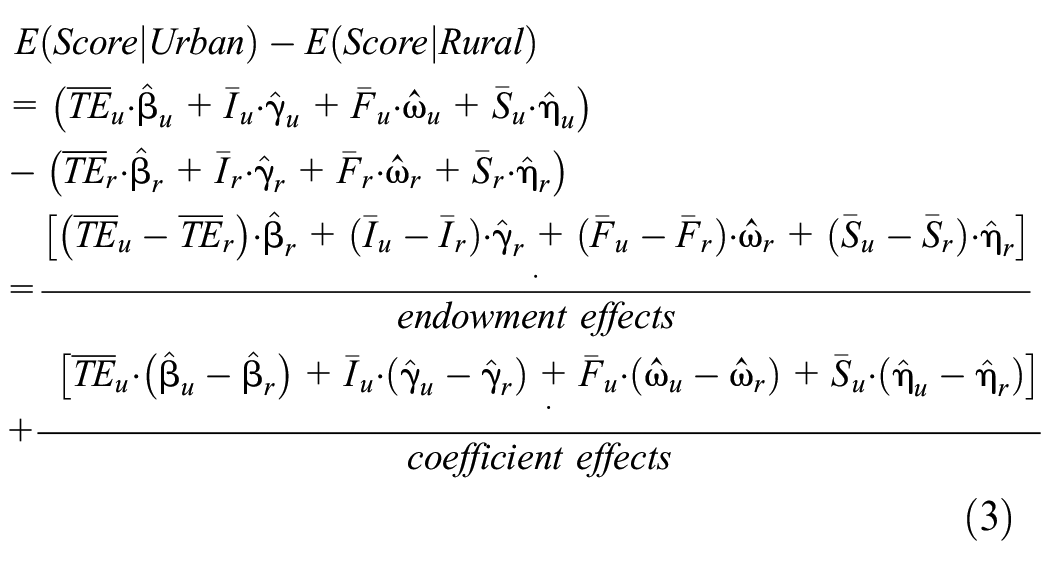
In Equation 3, the source of the urban–rural student achievement gap is decomposed into two parts. The first part includes
The second part includes
Unconditional Quantile Regression (UQR)
Since TE’s impact may vary across the achievement distribution and OLS estimates only mean effects, we use unconditional quantile regression (UQR) to identify heterogeneous impacts (Lounkaew, 2013). UQR uses the recentered influence function (RIF) for quantile

In Equation 4,
Results
Urban–Rural Gap in Teacher Enthusiasm
Descriptive results (see Figure 3) show that the mean TE score is 71.54 for urban teachers versus 67.29 for rural teachers. A t-test confirms that this difference is statistically significant. These findings address our first research question, revealing a significant urban–rural gap in TE, with urban teachers exhibiting higher enthusiasm than their rural counterparts.

Urban–rural gap in teacher enthusiasm.
The Effect of Teacher Enthusiasm on Student Achievement
Mean-Level Estimation Results
To address the second question at the mean level, OLS regression was used to estimate Equation 1 within the rural sample. Models (1)–(3), as shown in Table 2, sequentially introduce the control variables and disclose that TE has a consistently significant positive impact on rural students’ achievement at the mean level across all models. This finding underscores the importance of TE in enhancing the educational outcomes of rural students.
OLS Regression Results: The Effect of Teacher Enthusiasm on Student Achievement.

Note. 1. t statistics are in brackets; 2. *p < .1, **p < .05, ***p < .01; 3. Standard errors are clustered at the school level. 4. We calculated the variance inflation factor (VIF) for TE in models (1)–(6), obtaining values ranging from 2.10 to 3.45, all well below the commonly accepted threshold of 10. Thus, there is no reason to suspect multicollinearity.
To answer the third question at the mean level, we conducted two further analyses. First, we estimated Equation 1 using the urban sample, and the results are reported in models (4)–(6) of Table 2. Comparing models (3) and (6), both of which include all control variables, shows that a one-unit increase in TE raises literacy scores by 0.215 points for rural students and 0.711 points for urban students. While these findings offer preliminary yet somewhat uncertain evidence suggesting that TE’s impact on student achievement is less significant in rural areas compared to urban areas, further analysis is essential. Second, we estimated Equation 2 on the full sample, and the results are reported in models (7)–(9) of Table 2. The significant positive interaction term (TE × Urban) confirms that TE’s impact on achievement is indeed weaker in rural than in urban areas.
Beyond-Mean-Level Estimation Results
We conducted a beyond-mean-level analysis to further explore the findings for questions 2 and 3. Specifically, we employ the UQR method to estimate Equation 1 separately for urban and rural samples across various score percentiles. Table 3 shows coefficients at the 10th, 30th, 50th, 70th, and 90th percentiles, while Figure 4 depicts the coefficients across all percentiles.
UQR Results: The Effect of Teacher Enthusiasm on Student Achievement.

Note. 1. t statistics are in brackets; 2. **p < .05, ***p < .01; 3. All the models include the entire set of control variables used in model (3), and the specific control variables are shown in Table 2. The coefficients of these variables are not reported here due to limited space.
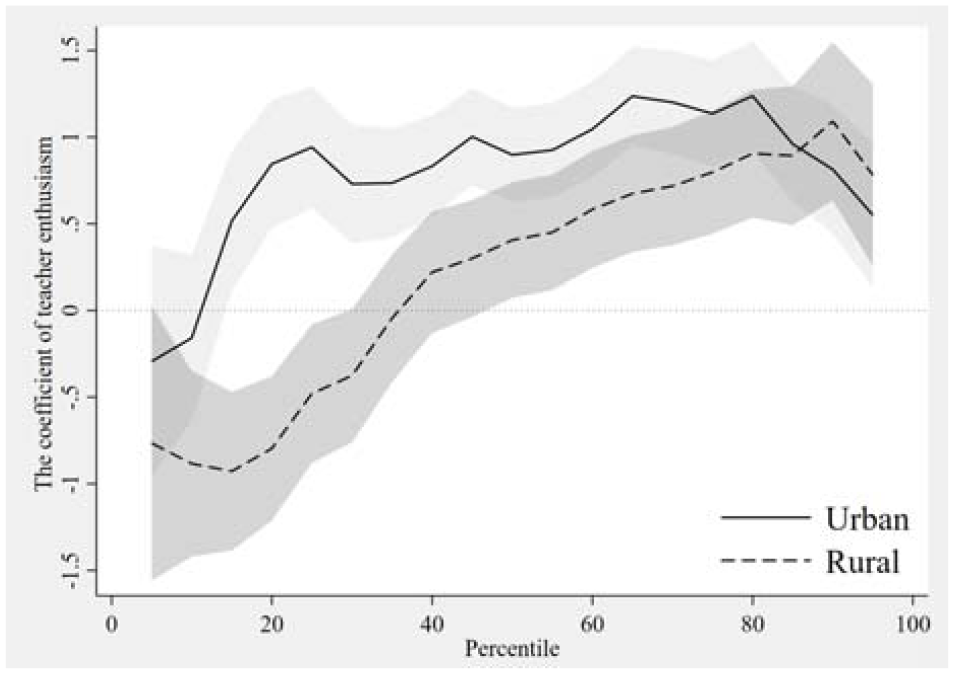
The effect of teacher enthusiasm on student achievement across different percentiles.
Regarding the second question, TE’s effect on rural students depends on their learning foundations. At the lower 10th and 30th percentiles, increases in TE have a negative impact on rural students’ achievement. Two mechanisms may explain this. First, enthusiastic teachers frequently emphasize the significance and real-world relevance of the subject matter (Keller et al., 2016). However, low-performing students often lack the necessary background to internalize these value messages, which can cause frustration and demotivation when they struggle to keep pace. Second, teachers convey passion through expressions, gestures, and vocal intonations (Hatfield et al., 1993); yet, low performers often exhibit low classroom engagement and emotional responsiveness (Fong & Kremer, 2020), which hinders their ability to catch or reciprocate enthusiasm. Teachers then naturally focus on more responsive students (Metcalfe & Game, 2006), further sidelining low performers and creating a negative feedback loop. Together, these dynamics may harm low-performing students in rural areas.
Conversely, enhancing TE proves effective in improving the academic achievement of mid- and high-performing rural students, primarily benefiting top-performing students. Starting from around the 40th percentile of the test score distribution, the coefficients become positive and exhibit a gradual increment. This trend likely reflects the fact that students with solid learning foundations are more attentive and develop stronger interest in and appreciation for subjects taught by enthusiastic teachers. These students are also more likely to provide positive feedback and build stronger relationships with teachers, which enthusiastic teachers highly value. This, in turn, leads to greater attention to these students and ultimately significant improvements in student achievement.
Regarding the third question, although TE’s coefficient magnitudes differ between urban and rural samples, their percentile-level trends remain generally consistent. Notably, low-performing urban students do not experience significant adverse impacts from increased TE. This discrepancy arises from more robust support systems in urban environments. First, urban students routinely participate in extensive remedial and after-school programs (Y. Zhang, 2013), which help struggling students keep pace when classroom instruction accelerates. Second, urban parents typically have higher educational levels, enabling them to provide academic guidance, actively communicate with teachers, and supervise home learning (P. Yang & Xu, 2017), thereby buffering any unintended negative consequences of increased TE. Rural students generally lack such support, thus making low-performing rural students more vulnerable to the negative impacts of increased TE.
However, TE coefficients exhibit a consistent upward trend in rural areas and eventually surpass those for urban students at the top percentiles. Specifically, at the 90th percentile, the coefficient for rural students is 1.092, compared to 0.814 for urban students. This suggests that rural students, who are often disadvantaged in terms of family resources and other quality traits compared to their urban counterparts, are more reliant on school for academic support and development. Hence, once middle- and top-ranking rural students are taught by enthusiastic teachers, their benefits from these teachers would significantly improve and could even surpass those of urban students.
Decomposing the Urban–rural Achievement Gap
In response to the fourth question, this section concentrates on determining the degree to which TE contributes to the urban–rural gap, employing the Oaxaca–Blinder decomposition method. Table 4 presents the decomposition results at the mean level (based on OLS), as well as those at specific percentiles (based on UQR). Figures 5 and 6 detail the decomposition results across the entire distribution.
Oaxaca–Blinder Decomposition of the Urban–Rural Score Gap.

Note. 1. Rural students are treated as the reference group; 2. Bootstrapped standard errors (with 200 replications) are reported in brackets; 3. *p < 0.1, **p < .05, ***p < .01; 4. Percentages are the contribution of the urban–rural gap in the corresponding components to the urban–rural score gap.

Endowment effects of teacher enthusiasm on the urban–rural score gap beyond the mean level.

Coefficient effects of teacher enthusiasm on the urban–rural score gap beyond the mean level.
Mean-Level Estimation Results
At the mean level, the urban–rural discrepancy in literacy test scores amounts to 32.438. The endowment effect for TE is 3.059, which contributes significantly to 9.43% of the urban–rural gap in test scores. This finding indicates that if rural students were to experience a level of TE equivalent to that of urban students, the urban–rural score gap would shrink by 9.43%. In contrast, the endowment effect of tangible school quality traits (e.g., teachers’ educational backgrounds) measured in this study accounts for only 3.77% of the urban–rural gap, approximately half of the TE endowment effect. Additionally, the coefficient effect for TE is 33.561, contributing substantially to 103.46% of the urban–rural score gap. This suggests that if the impact size of TE on rural students were equal to that on urban students, the urban–rural score gap would be reduced by 103.46%. In this event, it could be inferred that rural students’ test scores might even surpass those of urban students. In contrast, the coefficient effect of tangible school quality traits explains only a minor 4% of the urban–rural gap, significantly less than the TE effect.
Hence, the Oaxaca–Blinder decomposition results at the mean level indicate that TE significantly contributes to the urban–rural education disparity. It follows that improving TE and its influence on student performance in rural areas could play a crucial role in narrowing the urban–rural education divide. Moreover, the efficacy of these strategies in reducing the urban–rural educational gap is likely to surpass that of improving tangible school quality traits.
Beyond-Mean-Level Estimation Results
We now proceed to the beyond-mean-level decomposition results to assess how the role of TE in explaining the urban–rural performance gap varies across the score distribution. The endowment effects indicate that TE disparity does not significantly contribute to the urban–rural achievement gap at the lowest performance tier. However, for mid- to top-ranking students (i.e., at the 30th, 50th, 70th, and 90th percentiles), the TE difference accounts for approximately 9% to 14% of the urban–rural achievement gap. The coefficient effects indicate that for all students except those in the top decile, differences in the return to TE between urban and rural areas partially explain the urban–rural achievement gap. The contribution of this discrepancy to the urban–rural achievement gap gradually decreases as students’ scores increase. Notably, for top students (90th percentile), the coefficient effects turn negative, suggesting that TE’s greater impact on rural top performers has helped reduce the urban–rural gap.
In summary, the findings reveal differing dynamics in the contribution of TE to the urban–rural achievement gap across various student groups. First, for bottom-ranked students, the urban–rural gap mainly results from differences in returns to TE (coefficient effects), whereas TE level differences (endowment effects) have minimal contribution. For these students, policy emphasis should be placed on enhancing the effectiveness of how rural students benefit from TE. Second, for mid- to high-achieving students, the urban–rural gap attributed to TE level differences (endowment effects) steadily increases with scores, whereas the gap attributed to coefficient effects gradually diminishes but remains present. Thus, for such students, both enhancing rural teachers’ enthusiasm and ensuring rural students fully benefit from TE should be equally prioritized to reduce the urban–rural gap. Third, for top-ranked students, the endowment effects of TE contribute to the urban–rural achievement gap, while the coefficient effects of TE exert minimal influence. Therefore, for these students, improving the overall level of TE in rural areas is a practical approach to narrowing the urban–rural achievement gap.
Discussion and Conclusion
Drawing on PISA 2018 data, this study explores the urban–rural achievement gap in China from the perspective of teacher enthusiasm. Our results confirm that rural teachers demonstrate lower TE than their urban counterparts; however, TE has a positive correlation with student achievement, even in rural settings. These findings align with previous studies from developed countries (Frenzel et al., 2019; Kunter et al., 2011; Lazarides et al., 202127). A notable inference from this study is that rural students’ weaker learning foundations generally reduce the returns to TE; thus, the average return on TE is lower in rural areas compared to urban areas.
UQR results further reveal that TE’s effects shift from negative to positive as student achievement percentiles increase in rural areas. Specifically, rural students at average or above-average levels notably benefit from enhanced TE, with top-performing rural students experiencing the most significant gains, surpassing their urban peers. However, TE can harm low-performing rural students because they lack the background to internalize teachers’ value messaging and often exhibit low engagement, which prevents them from reciprocating enthusiasm.
Furthermore, the Oaxaca–Blinder decomposition highlights TE’s critical role in explaining the urban–rural achievement gap, surpassing tangible school quality traits in explanatory power. Our analysis across achievement percentiles further clarifies that addressing TE disparities becomes more crucial at higher percentiles, while reducing differences in TE returns is more significant at lower percentiles.
These findings have important practical implications. First, boosting rural teachers’ enthusiasm should be a priority for policymakers and administrators, given its impact on student achievement. Although China has implemented policies to improve rural teacher quality, these mainly focus on tangible qualifications. Intangible aspects like TE often receive insufficient attention. TE is significantly influenced by various factors in the working environment, such as job resources, benefits, and interpersonal relationships with colleagues (Ho et al., 2011). Cultivating genuine TE requires systematic support through targeted professional training (Bettencourt et al., 1983). Consequently, teacher recruitment, particularly in low-resource settings, should assess candidates not only on their professional competencies but also on their intrinsic motivation, educational dedication, and public service commitment. This approach facilitates the attraction and retention of enthusiastic teachers in these areas (OECD, 2018). Furthermore, empirical evidence suggests that incorporating “wise intervention” strategies, that is, professional development activities designed to guide teachers in creating personalized growth-mindset messages and concrete implementation plans, can effectively meet their core psychological needs, thereby enhancing intrinsic motivation and sustaining authentic enthusiasm even under challenging conditions (Hecht et al., 2023).
Second, strategies to maximize TE’s returns on rural students’ achievement are crucial to narrowing the urban–rural gap. Deficient learning foundations hinder rural students’ classroom engagement and feedback (Frenzel et al., 2019; Kim & Schallert, 2014; Kunter et al., 2013), thereby limiting the return on investment in students’ achievement. Since strong teacher–student relationships are often lacking in rural schools (Yao & Mao, 2008), cultivating them is key to enhancing TE’s returns on rural students’ achievement. Additionally, teacher development programs should aim to reduce perceived hierarchical distance between teachers and students and improve instructional techniques to foster positive emotional contagion and value induction processes.
Third, implementing differentiated policies for various achievement percentiles is vital to optimizing TE’s impact in rural areas. Focus should ensure that lower-scoring students also benefit from interventions. In the process of enhancing teacher enthusiasm through training, it is essential to underscore that rural teachers should not overlook students who are less engaged in class or provide minimal feedback, particularly those at the lower end of the academic achievement rank. Rural teachers should also adopt personalized teaching strategies and provide tailored support to students with diverse educational backgrounds. These inclusive approaches mitigate the challenges low-achieving students face in adapting to innovative methods from enthusiastic teachers.
However, this study has certain limitations. First, this study draws on PISA 2018 data, which is limited to language teachers in the B-S-J-Z provinces and municipalities—regions located in China’s developed eastern region. Future research should examine whether these findings generalize to teachers in other subjects or to less developed regions beyond the four sample provinces. Second, PISA 2018 provides only student-reported measures of TE and lacks indicators for the mechanisms linking TE to achievement. Future studies should adopt a multi-method design to comprehensively measure TE and the mechanisms through which it exerts its effects. In-depth interviews with teachers and students will shed light on emotional contagion and value induction, while systematic teacher self-assessments and structured classroom observations will document instructional practices. Integrating these qualitative insights with physiological metrics such as heart rate variability and skin conductance will provide a richer and more nuanced understanding of how teacher enthusiasm influences student motivation, engagement, and learning outcomes. Finally, as this study relies solely on cross-sectional data, it cannot establish causal relationships between TE and student achievement. Future research should incorporate random experimental interventions, quasi-experimental designs, or conduct longitudinal tracking surveys to enable causal inference and to examine the mediating mechanisms through which TE influences student motivation, engagement, and learning behaviors.
Footnotes

Ethical Considerations
This study utilized the large-scale data in PISA 2018, which is publicly available and was collected by the OECD. The data collection and ethical considerations were the responsibility of the OECD.
Funding
The authors disclosed receipt of the following financial support for the research, authorship, and/or publication of this article: This work was supported by the National Natural Science Foundation of China Project [grant number: 72274019], the First-class Education Discipline Development Project, Beijing Normal University [grant number: YLXKPY-XSDW202208, YLXKPY-ZYSB202207, YLXKPY-XSDW202404], and the 74th Batch of China Postdoctoral Science Foundation [grant number: 2023M741303].
Declaration of Conflicting Interests
The authors declared no potential conflicts of interest with respect to the research, authorship, and/or publication of this article.
Data Availability Statement
Data sharing not applicable to this article as no datasets were generated or analyzed during the current study.