




Abstract
The conventional explanation of raising income inequality is often referred to as the market forces hypothesis. Global forces have led to structural economic changes in which we now have a two-tiered economy: a highly skilled and highly paid economy at the top of the income distribution and a poorly skilled and poorly paid economy at the bottom of the income distribution. In recent years, however, the conventional theory has been called into question by what can be characterized as the public policy hypothesis that holds that it is because of public policy, both active and passive, that labor market institutions that served to bolster incomes of the poor and middle class deteriorated. As a consequence of this deterioration, income inequality has only risen. Through an examination of data from the Current Population Survey during the 2000s, this article seeks to address to what extent these two hypotheses are related. Although there is no question that the data does support the market forces hypothesis, the data also show that these forces may have been exacerbated by the deterioration of important labor market institutions.
Over the past few decades, income inequality has increased. Although income inequality, in and of itself, may not necessarily be a bad thing, the policy problem is the rate of increase in income inequality, largely because of what it represents: the disappearance of the middle class. 1 Still, there may be disagreements over the extent to which it is a problem because income inequality is not the same as wage inequality. Income includes more than simply wages—what workers earn in exchange for their services; it also includes dividends and public supports. In this article, I focus on the narrower issue of wage inequality by addressing the following two questions: Is inequality a function of market forces, particularly globalization? Or is it the result of deliberate public policy decisions that have effectively rewarded some at the expense of others, thereby resulting in greater inequality?
One school of thought holds income inequality to be the result of globalization and the changing base of the economy, from an industrial manufacturing-based economy to a postindustrial service sector economy. By this school, manufacturing jobs that may not have required great technological skill have been replaced with service sector jobs that divide into two tiers: highly skilled and highly paid workers at the top and poorly skilled and poorly paid workers at the bottom. This is otherwise known as the competitive market hypothesis.
The other school holds that income inequality grew beginning in the 1980s because of policies that were hostile to labor. As a result, unionism declined, the minimum wage was allowed to stagnate, and the National Labor Relations Board was stacked by those whose agenda it was to gut the National Labor Relations Act (Dannin, 2006). In addition, an earlier tax code predicated on progressivism was replaced with one that favored capital and effectively redistributed wealth and income from the poor and middle class to the wealthy (Gilens, 2012; Kelly, 2009; McCarty, Poole, & Rosenthal, 2008; Stiglitz, 2012). The key element of this alternative hypothesis, which in this article will be referred to as the public policy hypothesis, is that because of public policy decisions labor market institutions—most notably unions, minimum wages, and to a lesser extent progressive taxation—that served to bolster incomes of the poor and middle class and effectively maintain the middle class, diminished with the result of their absence being rising income inequality. This hypothesis does not deny the role of market forces in an increasingly global economy, rather it maintains that these forces were only exacerbated by public policy decisions. Still, the main focus of the public policy hypothesis is the impact of declining labor market institutions like unions and the minimum wage on inequality.
Through an examination of data from the Current Population Survey (CPS) on full-time wage earners during the 2000s, I seek to address to what extent the two hypotheses are related. Although the second hypothesis does not deny the first, the first often does not acknowledge the role of the second. And to the extent that the role of unions and minimum wages is acknowledged, it is often in the context of how globalization requires greater wage flexibility and less wage rigidity. The data cannot establish a linkage between the decline of these institutions and specific policy decisions, but it can provide a reasonable basis for speculation about the role policy may have played in rising inequality. If it is true that these policy decisions may have even exacerbated trends to greater inequality, it then follows that the same policy decisions were complicit in trampling the rights of workers.
Rising Income Inequality
Those at the top of the distribution have seen their incomes increase while those at the bottom have seen their incomes decrease in real terms. This has effectively narrowed the middle class, whose wages have stagnated in aggregate terms since the 1970s (Danziger & Gottschalk, 1995; Hungerford, 1993; Newman, 1993; Phillips, 1990; Stiglitz, 2012; Wolff, 1994). Historically, income and wealth have been distributed unevenly. Those at the top of the distribution—owners of the means of production and contemporary managers—have held the bulk of a nation’s wealth while workers have held very little. Capitalist markets according to David McNally (2011) are about disciplining workers. Because workers do not have the means to live without being dependent on others for income through work, they are forced to conform to the dictates of those who control the means of production or face uncertainty through unemployment and eventual poverty. This means that as income inequality increases, those at the bottom of the distribution become more dependent and ultimately more vulnerable. As such, their rights as workers also diminish.
According to McNally (2011), a key event was Fed Chair Paul Volker’s announcement in 1979 that the Great Boom was over, which also would come to represent an elite offensive as a war against laxity and laziness. This war would include cuts in social programs, reduced wages, and broken unions. All of these would be necessary to restore the good old American work ethic, whereby working people would be taught again that prospective poverty would be punishment for their failure to work hard. It also meant that economic slumps, which have always been a feature of capitalist marketplaces, would be blamed on workers. From the 1970s onward, governments and employers around the world launched a coordinated offensive to roll back union power, labor rights, and workers’ wages, benefits, and working conditions. The sharp fall in wages in one country quickly produced the same pattern of boosting profits and incomes of the rich. Crises, another feature of capitalism, also contribute to driving down workers’ wages, and as capitalism ages, crises need to become more severe to do the work of restoring conditions for expansion. With falling wages and rising profits and incomes of those at the top, income inequality only increased.
This process was aided in part by the breakdown of the Bretton Woods system in 1971, which following World War II had all major currencies tied to the U.S. dollar, which itself was linked to gold. Following 1971, with currencies no longer tied to either the dollar or gold, governments were freed up to increase their money supply and spend their way out of a crisis. In a bid to stimulate their economies, governments increased their money supply by 12%. Between 1971 and 1973, the United States drove up the money supply by 40% while the United Kingdom experienced a 30% increase. Although these efforts created a mini-boom, it was at a cost of increasing inflation. Rising inflation during the late 1970s would only lead to Volker’s severe medicine of contracting the money supply, thereby leading to severe recession with great unemployment into the 1980s. These forces too would work to push down wages, especially among the low-skilled at the bottom, thereby leading to increased inequality. The Great Boom, then, was followed by a great contraction. Prior to the end of the Great Boom, the average household income of the top 5% of households in the United States during the 1960s and 1970s was only 16 times the average income of the bottom 20%. But between 1979 and 2007 the top 1% of families had 60% of the income gains while the bottom 90% had only about 9% of the income gains (Belman & Wolfson, 2014).
These trends can either be explained in terms of so-called natural forces whereby an oversupply of low-skilled workers will only depress wages, thereby creating a wider gap between the top and the bottom. Or they can be explained as the product of neoliberal policies that effectively created this global economy, and which in turn has provided cover for neoliberal policy makers intent on enriching elites.
Competitive Market Hypothesis
The competitive market model holds rising wage inequality to be a function of structural economic transformation. With technological advances there has been an increased demand for skilled labor, with the oversupply of low-skilled labor effectively forcing down the wages of those at the bottom of the distribution. Technological change has tended to be biased toward those with higher levels of education and skills (Autor, Katz, & Kearney, 2008; Balleer & van Rens, 2013; Juhn, Murphy, & Pierce, 1993; Sandler & Wapler, 2004; Vivarelli, 2014). According to this school of thought, the labor market is divided into a primary market where high premiums are placed on skilled workers, and a secondary market with unskilled workers trapped in the lowest-wage service sector of the economy. Between 1963 and 1989, the wages of the least skilled, those in the bottom 10th percentile, fell by 5%, while the wages of the most skilled, those in the 90th percentile, increased by 40%. The net result of this divergence was an enormous increase in wage inequality (Juhn et al., 1993; Katz & Murphy, 1992; Katz, Murphy, & Krueger, 1992). Moreover, fewer people were completing high school during the second half of the 20th century, which resulted in greater inequality because there were fewer people able to work in jobs where technological demands were greater (Goldin & Katz, 2008).
This hypothesis is often referred to as the “canonical” model, which maintains that because of technological advances, there has been a greater demand for skilled workers. As a result, the oversupply of unskilled labor will only push down wages, and inequality will increase (Acemoglu & Autor, 2012). In this model, there are two distinct groups: college and high school workers performing two distinct and imperfectly sustainable occupations or producing two imperfectly sustainable goods. As a result of technological change, the labor market has become greatly polarized (Autor & Dorn, 2013). Therefore, it is a foregone conclusion that the wages of unskilled workers will be forced down while the wages of the skilled workers are driven up, thereby increasing the gap between the two.
Gordon Lafer (2002), for example, observes that while the idea of a skills mismatch has become a convenient explanation for falling wages and rising inequality, it is the decline in unionism, rather than less education or training that has played a greater role in determining wages of most workers. Institutions that protected the wages of production workers have been eliminated while professional earnings have remained protected by an elaborate system of immigration control, business, educational credentials, and legal mandates. The earnings of professionals have not been propped up by the rarity of their skills, but by their ability to exert institutional barriers to competition. The biggest blow to those at the bottom of the distribution has been the deterioration of unions. With this decline came a corresponding decline in wages because union wages were generally 28.4% higher than those of unorganized workers. Or as Freeman and Medoff (1984) most famously observes, a 10% increase in organizing in manufacturing generates a 1.5% increase in the union wage. Wage rates for workers were maintained by the union premium; not that workers receive wages equal to their marginal productivity according to traditional human capital theory. It is institutions that set rates and determine the worth. It is no coincidence, then, that the value of the minimum wage declined as union membership declined. Among the functions performed by unions was that they got their members out to vote (Hacker & Pierson, 2010). Moreover, the minimum wage tended to be increased when there was a strong constituency behind it, and that constituency was organized labor. With the decline of unions that constituency effectively disappeared (Levin-Waldman, 2001). Even those that hold that inequality increased due to market forces of supply and demand concede that a decline in the minimum wage may have contributed to rising wage inequality, at least in the lower tail of the wage distribution (Autor et al., 2008; Belman & Wolfson, 2014).
Public Policy Hypothesis
Those who subscribe to the public policy hypothesis maintain rising inequality to be due to a set of neoliberal public policy decisions that favored the interests of the wealthy over those at the bottom or in the middle. Neoliberal policies have generally included greater free trade, reductions in government spending, privatization, antiunionism, as well as call for greater flexibility when it comes to workers’ wages. Because of these decisions, the gap between the top and the bottom widened even more. But this hypothesis also includes the failure of public policy to respond to market forces that were creating inequality, and that this failure in policy could also have been a function of a political process favoring those at the top of the income distribution over those at the bottom and in the middle. Institutionalists—institutional economists and increasingly political scientists—hold rising wage inequality to be due to a shift in public policy and a corresponding decline in labor market institutions like unions and the minimum wage in the United States and wage councils in Britain (Card & DiNardo, 2002; Craypo & Cormier, 2000; DiNardo & Lemieux, 1997; Fortin & Lemieux, 1997; Galbraith, 1998; Gordon, 1996; Howell, 1999; Howell & Huebler, 2001; Lee, 1997; Lemieux, 1998; Machin, 1997; Palley, 1998; Piore, 1995; Wallerstein, 1999). From the mid-1990s, decreasing union density was accompanied by a falling union wage premium because of the declining demand for union labor. This was due to increasing competitiveness throughout the U.S. economy, and union companies faced nonunion competition (Blanchflower & Bryson, 2008). Within the union sector, wage inequality was low (Freeman, 2004), but declining unionism contributed to a steep increase in wage inequality in both the United States and the United Kingdom during the 1980s. And in Canada, the rise in the real minimum wage may have actually offset the pressure toward increased inequality associated with the decline in union strength during the 1980s and late-1990s, while in the United States, it was approximately constant over the same period (Card, Lemieux, & Riddell, 2008).
Thomas Piketty (2014) observes that the minimum wage in France played a role in reducing wage inequality in the post–World War II years, while wage inequality in the United States rose as the minimum wage was in decline. A national minimum wage was created in France in 1950, but was seldom increased thereafter and only fell farther behind the average wage. But in 1970, the minimum wage was officially indexed to the mean wage. Moreover, governments from 1968 to 1983 felt obligated to increase the minimum wage significantly almost every year in a seething social and political climate. From 1968 to 1983, the purchasing power of the minimum wage also increased by more than 130%, while the mean wage only increased by 50%. The result was a significant compression of wage inequality. In the United States, however, a subclass of “supermanagers” emerged. Inequality had reached its lowest ebb between 1950 and 1980, whereby the top decile of the income distribution claimed 30% to 35% of the nation’s income. After 1980, however, income inequality exploded with the top decile share of the national income rising to between 45% and 50% in the 2000s. The causes of rising income inequality in the United States are largely due to the unprecedented increase in wage inequality, and especially the extremely high compensation of managers at the top of the distribution. The competitive market thesis with its emphasis on technical skill, however, does not offer a satisfactory explanation of the rise of the supermanager or of wage inequality in the United States after 1980. The implications would appear to be clear: Had the minimum wage in the United States during this period kept up, as it had in France, wage inequality in the United States would have been less. The failure to maintain the minimum wage in the United States has to be viewed as a public policy choice. Moreover, the implication is consistent with McNally’s argument that neoliberal policies in response to a slump only serve to further depress wages at the bottom, thereby leading to greater inequality.
Income inequality has increased partly due to the deterioration of the minimum wage (Volscho, 2005). According to Slonimczyk and Skott (2012), the simultaneous increase in the relative wages and employment of high-skilled workers has been interpreted as evidence of skill-biased technical change. They show that a decline in the minimum wage can generate deterioration in the position of low-skilled workers, both in terms of wages and employment. They assume that high-skilled workers can get two types of jobs: “good” high-tech jobs and “bad” low-tech jobs. Low-skilled workers, however, have only one type of employment opportunity, which is low tech. An increase in the minimum wage, then, can reduce the employment of high-skilled workers in low-tech jobs. This deterioration of employment conditions for high-skilled workers in the low-tech labor market relaxes the no-shirking conditions in high-tech jobs and stimulates employment. The minimum wage, then, is likely to be an important reference point for wages at the low end of the spectrum. A rise in the minimum wage may give firms an incentive to adjust wages above the minimum wage to avoid adverse effects on morale, productivity, and labor turnover. If the minimum wage is a reference point, a higher minimum wage can reduce inequality by exerting upward pressure on wages from the bottom
Countries with centralized wage setting institutions also have lower levels of wage inequality (Pontusson, 2005; Wallerstein, 2008). Those who argue the public policy hypothesis are in some measure critiquing neoliberalism that free markets with open borders and free movement of capital and workers will result in greater prosperity. Mishel, Schmitt, and Shierholz (2014) argue that the rise in economic inequality can be explained since the late 1970s as the outcome of an array of economic policies that had the effect of widening the gap between the top 1% and the rest of the nation. The wage gap between the middle and bottom expanded from 1979 through the late 1980s, and grew much more for women than for men. The initial gap between the bottom and the middle followed the erosion of the inflation adjusted value of the minimum wage. As the purchasing power of the minimum declined by roughly 30%, wages at the bottom were undercut, with a particularly big impact on women. Meanwhile, the widening wage gap within the top half of the wage structure—between the 90th and 50th percentiles—was also the result of concrete policy choices, including the erosion of union power, trade policies, deregulation, macroeconomic power grounded in excessive unemployment rates, and other factors that contributed to the reduction in workers’ bargaining power. Wages in the middle have been suppressed by more international trade, particularly since 1985, and excessive unemployment through most of the last decade has also exerted a downward pressure on wages in the middle. To simply focus on technology as the source of rising inequality only directs attention away from the real causes of inequality: conscious economic policy choices that have undermined the bargaining power of workers at the middle and at the bottom. These conscious economic policy choices reflect the neoliberal assumptions about what leads to economic growth and prosperity.
Institutionalists argue that in the absence of institutions to prop up the wages of those at the bottom of the distribution, income inequality is bound to increase. The institutionalist, however, rejects the neoclassical synthesis—also the basis for neoliberalism—that employers and workers freely negotiate wages and working conditions. Rather, institutions are needed because of asymmetrical power relations which effectively leave workers vulnerable to exploitation. In the neoclassical model, everybody is a wants trader. In the world of asymmetrical power, only employers are wants traders where workers are needs traders. They need to work to survive. Kristian Braekkan and Victoria Sowa (2015) argue that more attention needs to be paid to exploitation because capitalism is a disciplinary system in which workers are perpetually disciplined by their need to work in exchange for wages that enable them to subsist. And as globalism required that wages fall to be competitive and that social programs be cut so that business environments would be attractive to investment and economic growth, the effect has been to only discipline workers more. Exploitation, as they define it, can be a state of mind—that workers perceive themselves to be exploited. This refers to what they call “psychological contracts,” which are the expectations workers have based on the employer’s explicit and implicit promises communicated prior to hiring. The neoclassical model assumes that workers who are exploited can simply leave and take another job elsewhere, but this is only true in a slack labor market. A worker with few options for survival but to remain in an employment situation where psychological contract violations occur would effectively be forced to be in a situation where he or she will continue to be exploited. And if workers perceive themselves to be exploited, there may be less organizational commitment. They found that perceived contract violations led to decreased organizational commitment and to decreased trust in the employing organization. It then follows that technological change which forces down the wages of low-skilled workers is effectively exploiting them, and that income inequality is simply a manifestation of that exploitation.
According to Joseph Stiglitz (2012), while globalization did play a role in growing inequality, the collapse of good jobs during the last quarter century was due to public policy decisions. With this collapse, wages also fell with a resultant increase in disparity between the top and the bottom. As a result of labor market polarization, more money has gone to the top while more of the people have been going to the bottom. Stiglitz attributes this to government policies that only reinforced the political power of those at the top of the distribution at the expense of those at the bottom and in the middle. The American political system has been more responsive to those with money, and as the distribution became more unequal, it was only a foregone conclusion that policies pursued by elected officials would favor those at the higher end of the distribution (Bachrach and Botwinick, 1992; Bartels, 2008).
Rising inequality has only left those at the top of the distribution with more ability to influence public policy, and in the direction that serves their interests at the expense of those at the bottom. This polarization, according to Nolan McCarty et al. (2008), has enabled those at the top of the income distribution to devote more time and resources into supporting a political party strongly opposed to redistribution. Volscho and Kelly (2012) find that congressional shifts to the Republican party along with declining union membership and lower top tax rates on top of a financial asset bubble did strongly contribute to the rise of the super-rich. Moreover, the politics of the labor market are important. As union membership decreased, a greater share of income shifted toward the top 1% between 1949 and 2008.
The wealthiest Americans appear to exert more political influence than the less fortunate citizens, and the wealthiest citizens tend to be considerably more active in politics than the typical citizen. Those from households with incomes over US $100,000 are far more likely to engage in various forms of civic participation than those from households with incomes of less than US $30,000. Moreover, the rate of participation rises dramatically as one moves from a household of less than US $30,000 to a household of US $30,000 to US $60,000 (Levin-Waldman, 2013). The gap between the policy preferences of the wealthy and those of other citizens is especially evident when it comes to job programs and income support. To the extent that this is true, it calls into question whether all groups really do have equal standing. This might then imply that a more equitable distribution could conceivably result in more responsiveness, because members of Congress would no longer have incentives to favor the affluent over the less affluent, or better financed interest groups over poorly financed groups.
In measuring the relationship between policy preferences and policy outcomes, Martin Gilens (2012) finds that the link between outcomes and preferences tends to be stronger for higher income Americans than for the poor. At the same time, the inequality in representation between the affluent and slightly less well-off also suggests that the political system is tilted much more in favor of those at the very top of the income distribution. According to Jacob Hacker and Paul Pierson (2010), rising inequality in the United States is not mainly about the gap between the college educated and the rest, but the pulling away of the very top, which was facilitated by public policy. On the contrary, the failure to respond to market forces is in their view a deliberate policy choice. The absence of a government response to rising inequality can be regarded as a form of policy when it takes the form of “drift”—the deliberate failure to adapt policies to the shifting realities of a dynamic economy. One example of this is that intense opponents of the minimum wage have worked tirelessly and effectively to prevent it from being increased to prior levels or to be pegged to inflation. McCarty et al. (2008) note that minimum wage laws have always engendered liberal support and conservative opposition. Historically, minimum wage increases and expansive coverage generated a fair amount of bipartisan support. As polarization rose in the 1970s, bipartisanship disappeared. As a consequence of increasing Republican opposition in a period of polarization, there has been a dramatic decline in the real value of the minimum wage.
Piketty (2014) also defines the growth in inequality as the very top pulling away from the rest. But the history of inequality has been shaped by the way that economic, social, and political actors view what is just and what is not, and also by the relative power of those actors and the collective choices that result. And yet, much of this has been obscured by the economic discipline’s “childish passion for mathematics” (p. 32). This obsession has only served to create the appearance of being scientific, without having to answer the far more complex questions posed by the real world in which we live. Because this preoccupation has also created the appearance of neutrality, the competitive market hypothesis has been embraced more easily without stopping to consider the larger political and social context in which those forces were operating.
Still the fact that the growth in inequality has been due to primarily the top pulling away from the rest might call into question the impact of institutions like unions and the minimum wage on inequality. Autor et al. (2008) reject what they call the revisionist alternative to the competitive market hypothesis emphasizing skills biased toward technical change, arguing that it does not really explain the main problem of the top pulling away from the rest. Using data from the CPS, they only find partial support for the revisionist literature. They did agree that the declining minimum wage did contribute to a rise in wage inequality in the lower tail—the 50/10 ratio—during the 1980s, but they found little support for the strong focus of major revisionist claims. Inequality in the lower half of the distribution did increase rapidly during the 1980s, but reversed course thereafter. And yet, the persistent rise in inequality in the upper tail of the distribution belies the claim that the minimum wage, in and of itself, can provide a coherent explanation in the bulk of the increase in earnings inequality. Rather changes in the United States earnings distribution “polarized” with a strong and persistent rise in inequality in the upper half of the distribution and a slowing of inequality trends in the lower half of the distribution. Therefore, the revisionists are unable to provide a compelling explanation for the strong steady increase in upper tail inequality over the last 25 years and the polarization of employment growth since 1990. Rather skill demand shifts have played a central role in shaping the wage structure both during this period when inequality rose, and afterward when there was a greater polarization of wage growth (Autor et al., 2008). And yet, Autor, Manning, and Smith (2010) concede that between 1979 and 1989, the decline in the real value of the minimum wage was responsible for 30% to 50% growth of lower tail inequality in female, male, and pooled wage distributions as measured by the 50/10. Moreover, despite the modest total effects, they estimate that the effect of the minimum wage extends further up the wage distribution than would be predicted if the minimum wage had a purely mechanical effect on wages, such as raising the wages of all those who earned below it. One interpretation of these significant spillovers is that they do represent a true wage effect for those workers earning initially above the minimum. If true, the impact on inequality may not be what has traditionally been assumed. It is not simply a policy that benefits the poor.
Still, there is a difference between not being able to explain the pulling away and that institutions on the whole can at least play a role in reducing the increase in inequality. The minimum wage is an example of one such institution, and unionization or union density is an example another. Right-to-work laws, then, speak to other institutions that actually suppress wages. Moreover, the pulling way of the top has more to do with income, which includes more than wages. This is another reason why it pays to only look at wage inequality. Wage inequality will tend to be more compressed than larger income inequality. Therefore, if wage inequality has increased, then it is certainly the case that larger income inequality has increased. 2
Data
In this section, I look at data from the Integrated Public Use Microdata Series (IPUMS) CPS in an effort to determine which hypothesis carries more weight. Data assembled from the IPUMS mean that there will be uniformity in variables across time periods. Therefore, variables in one year of the CPS do not have to be aligned with approximate variables in another year. My principal focus is on the years 2002-2014 because various states during this period strengthened their own labor market institutions by passing minimum wage laws. I specifically focus on wage inequality and the increasing gap between the top and the bottom, largely because that is where the increase in the gap has been. In this article, I define deliberate policy decisions as allowing labor market institutions to deteriorate, which as a result may have led to increased inequality. Because one of the hypotheses that I am testing is that deliberate policy decisions were made, I am looking specifically at full-time workers working for wages. That is, I am specifically looking at a subsample of those who are working full-time. This reduces a sample of around 140,000 to approximately 45,000 (which varies in a given year). We have to assume that because income includes dividends at the top of the distribution as well as in-kind assistance at the bottom, income inequality will be greater than wage inequality, as shown in Note 2. Should a look at wage inequality on the basis of full-time workers show that the problem has been exacerbated over the years, it then stands to reason that the issue of wage inequality really understates the problem of overall income inequality. But it may also represent a more realistic look at the nation where most people live on wages earned, rather than other sources of income which may also be included in their income. In this vein, a look at wage income will not show the same pulling away of the top from the rest, which is not the same as saying that it is not a problem. At the same time, if the focus is on wage inequality rather than income inequality, the minimum wage and other labor market institutions become more important factors in accounting for increases in inequality because we are no longer looking at the pulling away that Piketty talks about. I also look only at wages because, as I will argue later, the remedy lies less in income transfer programs which can boost income at the bottom or taxation at the top which can reduce the gap between the top and bottom, but in serious wage policies that serve to bolster incomes and the middle class. In terms of policy decisions, we can only look at the consequences in terms of policies that over time have led to the absence of labor market institutions. In other words, the deliberate policy hypothesis is broadly defined to include the failure of policy to address rising inequality, and/or the failure to address the consequences of market forces that resulted in greater inequality, as well as those that perhaps exacerbated it. In making an attempt to test the relevance of the public policy hypothesis, I am not suggesting that policy makers deliberately sought to increase inequality, or to even turn a blind eye to the problem. Rather, there were forces other than changing economies in a global marketplace that contributed to the rise in inequality and that these forces cannot simply be dismissed.
When it comes to labor market institutions, there are a couple of different issues. The major labor market institutions that have served to bolster wages have been minimum wage laws, both at the federal and state levels, and union membership. In the CPS data, there is no significant reading on the union coverage variable, but unionism can nonetheless be measured by looking at the level of union density in each state. Union density has also declined considerably over the last three decades, with a precipitous decline occurring since 2002. There is also the issue of right-to-work laws, which are laws that bar the closed-union shop, thereby making union organizing more difficult. Right-to-work laws were enacted in many states following the Taft-Hartley Act of 1947 which because it barred the closed shop—the requirement that one must join a union as a condition of employment in already unionized plants—not only made it more difficult to unionize plants in America, but were specifically aimed at undermining unions. As such, they were ultimately about suppressing wages and may have been about asserting the rights of employers as property owners over their workers. Right-to-work laws, then, could be classified as antilabor market institutions because insofar as they were designed to make union organizing more difficult, they could potentially be seen as having the potential to suppress wages. More states in recent years have been passing right-to-work laws, especially in response to the growth of public sector unionism. In this vein, right-to-work laws can be seen as a deliberate policy choice at the state level with the potential to exacerbate wage inequality. There are several different measures of wage inequality. One measure is the ratio of the average income of the top quintile to the average of the bottom quintile. This measure, however, may actually understate the extent to which there is inequality because the Census Bureau top codes the income variable. Therefore, many researchers opt for the ratios between different percentiles. In the next few Tables, I present three measures of wage inequality: the 90/10 ratio, the 50/10 ratio, and the ratio between the top and bottom quintiles. General trends in wage inequality can be seen in Table 1.
General Trends in Wage Inequality (Percent).

Years that had increase in the federal minimum wage.
Overall, wage inequality appears to have increased. It increased 5.9% on the 90/10 measure and by 2.9% on the 50/10 measure. On the top-to-bottom measure, it dropped by 0.7%. Still, despite variations in the rates of inequality, there was a decline in wage inequality between 2006 and 2009. Then, beginning in 2010 inequality, according to the Quintile ratio measure, ticks up again. What is important about this period is that in 2007, the first phase of a three-phase increase in the minimum wage took effect, with the last phase occurring in 2009. Between 2009 and 2014, inequality increased because the mean income of the top quintile increased by 9.1% while it only increased by 1.9% among the bottom quintile. But between 2006 and 2009, the mean income of the bottom quintile increased by 28% while it only increased by 11.9% among the top quintile. These findings, however, would appear to be contrary to general trends in the data that show a marked increase in inequality during this period. The discrepancy is easily accounted for by the fact that I am only looking at full-time workers who are specifically in the labor force, and have indicated that they are at work. Therefore, the data in the table reflect what was specifically observed in this data set. Simply looking at data of only those working for wages full-time, one might conclude that wage inequality, as distinguished from income inequality, is not really a problem. But the note suggests otherwise (see Note 2).
The question, however, is how this inequality is affected by antilabor market and labor market institutions alike. Differences between right-to-work and non-right-to-work states can be seen in Table 2.
Wage Inequality in Right-to-Work States and Non-Right-to-Work States (Percent).

Note. RTW = right-to-work.
In the 2000s, save for a few exceptions, wage inequality is often lower in right-to-work states than in non-right-to-work states. In 2004, 2005, and 2011, wage inequality on the basis of the 90/10 ratio is higher in the right-to-work states than in the non-right-to-work states. Also in 2004 and 2011, wage inequality on the 50/10 measure is higher in the right-to-work states than in the non-right-to-work states, which suggests that in the absence of labor market institutions, they did have an effect in the lower tail of the distribution. Still the overall comparisons beg the question of why wage inequality would be higher in non-right-to-work states. Intuitively, we would expect inequality to be higher in right-to-work states because the effect, if not the purpose, of such laws is to suppress wages, especially wages at the bottom of the distribution. One reason for why inequality might be less in right-to-work states is because these laws are suppressing the overall wage structure in these states, thereby resulting in less of a gap between the top and the bottom. Right-to-work laws might have the effect of compressing wages. Another reason may have something to do with the overall impact of right-to-work laws on unionism. We would expect unionism, as measured by union density, to be even less in those states. In other words, it may not even be so much that right-to-work laws are suppressing wages than it is that union density is raising wages. But if unionism is in decline, union density will have less of an impact on wages and the degree to which there is wage inequality.
The next question, then, becomes just what the impact of union density on wage structure is and the degree to which there is wage inequality. Comparisons between high union density states and non-high union density states can be seen in Table 3.
Wage Inequality in High Union Density States and Low Union Density States (Percent).

In most years, on the basis of the 90/10 ratio, wage inequality is lower in high union density states than in low union density states. It is also interesting to note that from 2003 through 2006, and then again from 2011 to 2012, wage inequality is lower on the 50/10 ratio in high union density states than in low union density states. But on the quintile ratio, wage inequality is higher in high union density states than in low union density states. This raises the question of what the effect of declining union density is on relative wage inequality. We would expect to have compression in the wage distribution. But if the effect of neoliberal policies has been to undermine unions through capital mobility and to effectively drive down wages, then it makes sense that inequality on the basis of the quintile measure would increase as union density declines over the years.
As much as union density may be a factor in explaining why some states are more likely to have greater inequality than others, another institution that would be important to consider would be minimum wage laws. Whereas Table 1 is suggestive that increases in the federal minimum wage may in part have been responsible for decreases in wage inequality, the real test for minimum wage impacts on the states is the state minimum wage laws. Several states have their own minimum wage laws that are higher than the federal minimum wage. Comparisons between states with higher state minimum wages with those that do not have higher minimum wages or minimum wages at all can be seen in Table 4.
Inequality by States With Higher Minimum Wages Versus Those Without (Percent).
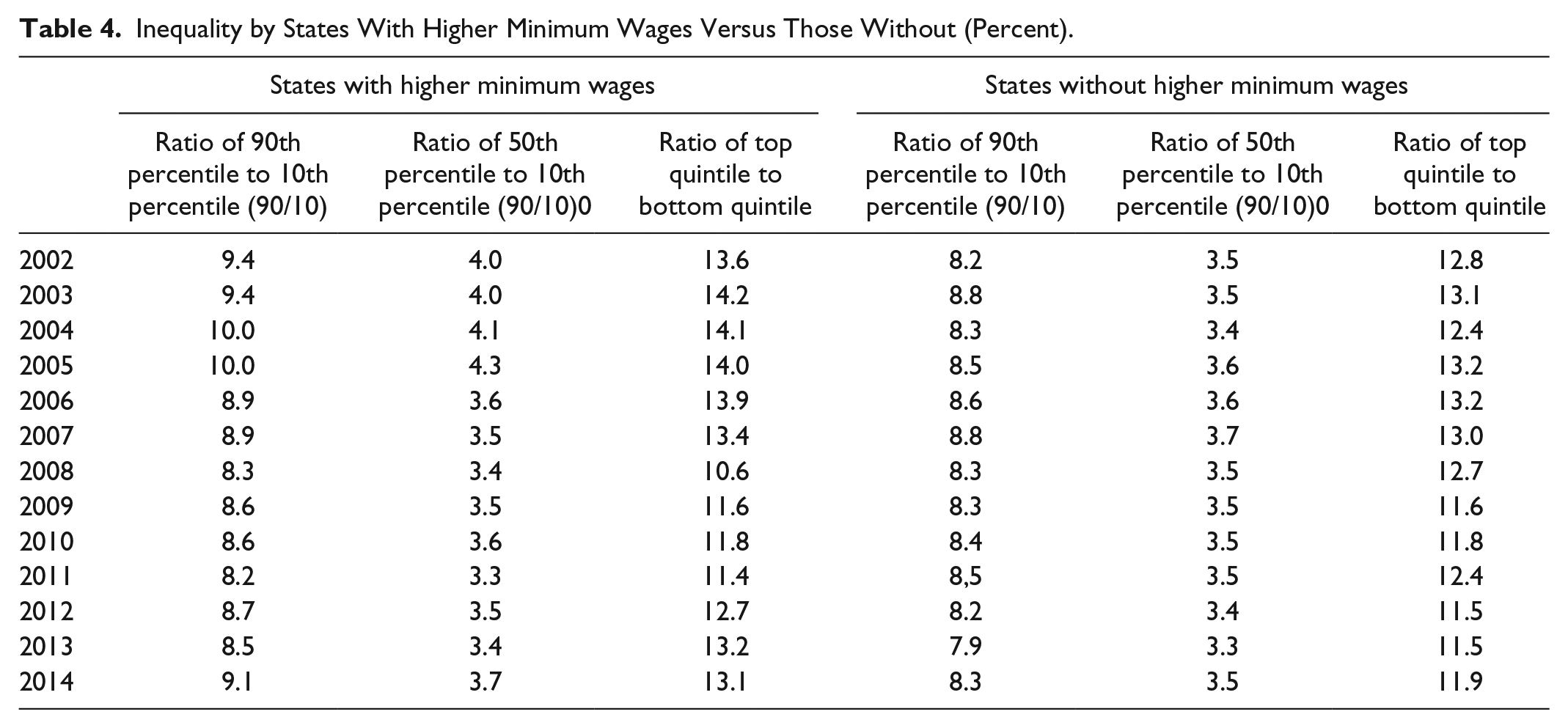
On the face of it, it would appear that states that have their own minimum wages that are higher than the federal minimum wage do not necessarily have less wage inequality than those states that do not. And this could very well be because there really are not that many states that have minimum wages, let alone ones that are higher than the federal minimum wage. It could also be that states where there is greater inequality are perhaps more likely to raise their own minimum wages. Still on the basis of the quintile measure, we see a slight drop in inequality on the basis of the quintile measure, from 2013 to 2014, whereas it increases in those states without higher minimum wages.
As the literature in the last section makes clear, there have been declines in those jobs that did not require greater skill, while there has been an increase in those jobs requiring greater skill. Overall, the data show that fewer people are working in manufacturing, and more people are working in Professional and Related occupations and, Professional and Technical, and Managerial industries, which is all consistent with what we would expect from globalization favoring greater skills. This becomes clearer from a look at the median wages for these key industries and occupations, which can be seen in Table 5. It is not clear, however, that these trends prove the argument of a diminishing school premium, as suggested by Goldin and Katz (2008).
Annual Median Wages of Key Occupations and Industries (in Nominal and Adjusted for 2013).
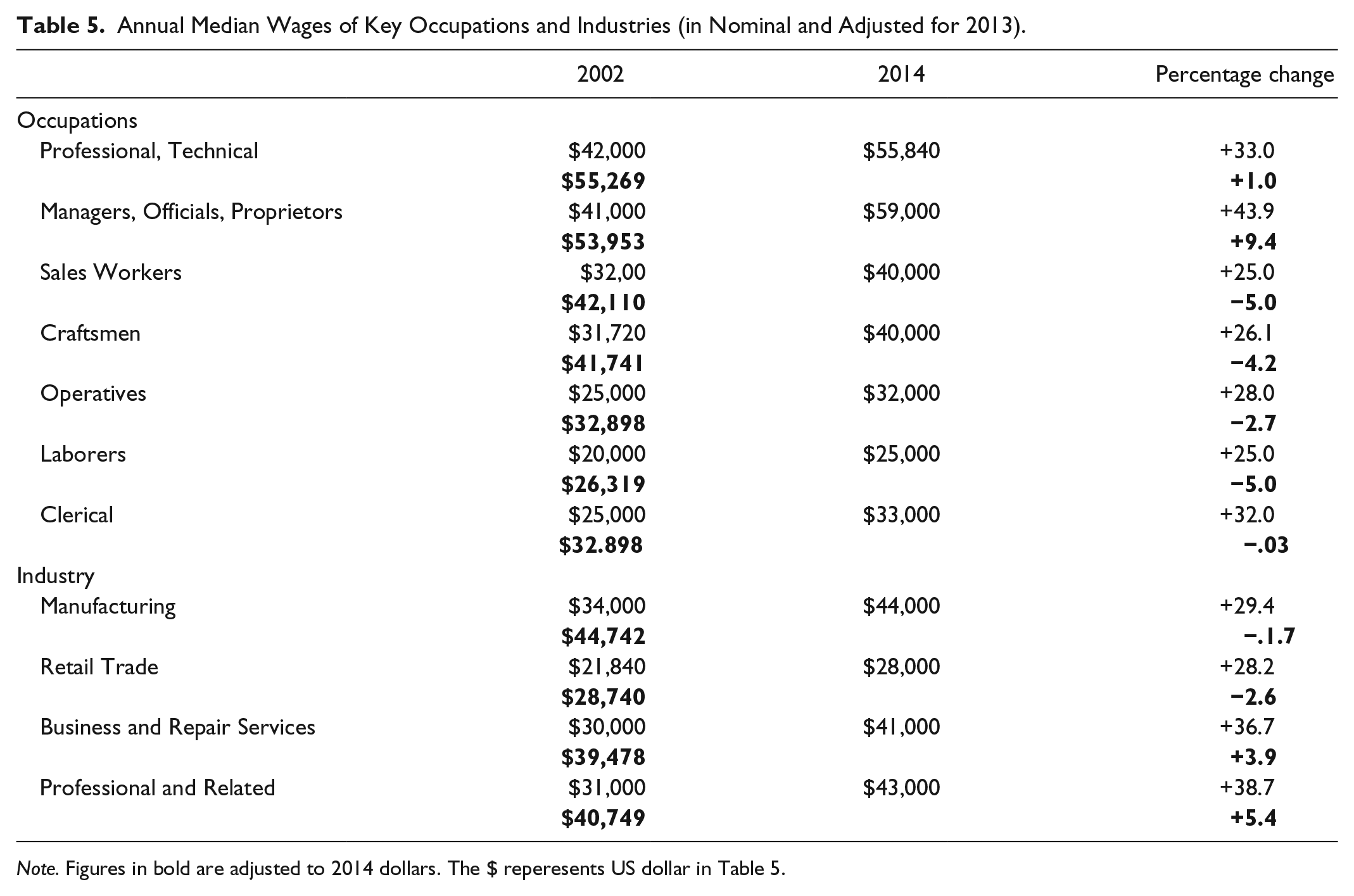
Note. Figures in bold are adjusted to 2014 dollars. The $ reperesents US dollar in Table 5.
Wages for those at the top appear to have grown considerably more than those at the bottom, at the same time that industries like manufacturing, and occupations like craftsmen, have fewer people in them. Although more people are working in Business and Repair Services, and perhaps this is where those who were displaced from manufacturing are now, the median wages are lower. The growth in wages in occupations and industries requiring greater skills appears to be greater than in those occupations and industries not requiring them.
Analysis
The question that needs to be addressed is just what the factors are that might lead to lower levels of wage inequality. The central question is whether wage inequality is lower in those states where labor market institutions like minimum wages have been stronger. Or stated the other way, has wage inequality been higher in those states where labor market institutions have been weaker? The competitive market hypothesis would argue that wage inequality is higher in those states where levels of educational attainment as a proxy for skills levels are lower, and there are fewer higher paying and more lower paying jobs because of industrial and occupational changes. If it is the competitive market hypothesis, then we would expect changes in the industrial and occupational compositions, as well as other demographic factors. But if it is the public policy hypothesis, institutions should make a difference. States that have certain labor market characteristics, such as labor market institutions, are more likely to have lower levels of wage inequality (as compared with the national ratio) than those states without those institutions. If it is the competitive market hypothesis, we would expect to have higher levels of inequality in those states where levels of educational attainment are also lower insofar as they serve as proxies for skill level. But if it is the deliberate policy hypothesis, then we would expect inequality to be lower in those states where there are labor market institutions, or at least where they have been strengthened.
Much of this can be sorted out through a logistical regression analysis, which can be seen in Table 6. At issue is what factors might account for lower levels of inequality in certain states. To construct the dependent variable of having a level of inequality lower than the national level, the quintile ratio had to be obtained for each state and compared with the national ratio. States were then divided into two categories: above or below the national quintile ratio. States in the below category were then set to a value of 1 with those above being set to a value of 0. Because skills may be a factor in wage inequality, the education variable can serve as a proxy for skills. Therefore, I test for the effects of having less than a 12th-grade education in addition to the effects of right-to-work laws, and being female. Also consistent with the skills biased toward technical change hypothesis, it also makes sense to test for the effects of those industries and occupations associated with higher pay and those associated with lower pay. I test for the effects of being in manufacturing, being in retail, being in business and repair services, being in clerical services, being in sales, being an operative, and being a laborer. I also test for the impact of a state minimum wage, higher than the federal minimum wage, whether the state has high union density, and whether the state’s 20th wage percentile is higher than the national 20th wage percentile. Each variable is set to a value of 1.
Regression Coefficients.

Note. Data runs from IPUMS CPS Files 1992, 2002-2013, Sarah Flood, Miriam King, Steven Ruggles, and J. Robert Warren. Integrated Public Use Microdata Series, Current Population Survey: Version 4.0. [dataset]. Minneapolis: University of Minnesota, 2015. http://doi.org/10.18128/D030.V4.0. Otherwise, the coefficients appear next to the labels and the numbers below refer to statistical significance.
In this section, I test the following hypotheses: (1) Inequality will be lower in those states where there are labor market institutions. Specifically, states where union density is high and where minimum wages have been increased will have lower levels of inequality, and that inequality will be lower following an increase in the minimum wage. (2) States where the 20th percentile is higher than national 20th percentile will also have lower levels of inequality. And, (3) because right-to-work states suppress wages, we would similarly expect inequality to be higher. Of course, as the skills biased toward technical change hypothesis suggest, inequality will be lower in those places where more people are working in manufacturing and in other high paying industries and occupations. On the face of it, all of these hypotheses may be deemed true. The logistical regression may sort out which of these variables has greater effect.
The argument of the competitive market hypothesis is that growing inequality is a function of a changing economic base, especially from manufacturing to services. As the regression coefficients suggest, manufacturing is important, but it does not follow that manufacturing jobs necessarily require greater education. They have traditionally paid better because they were often union jobs. With the decline in manufacturing has also come the decline of unionism. Services requiring great skill may result in higher wages while services requiring little skill will be at the bottom of the wage distribution. Fewer people in manufacturing would appear to reflect that trend. But we do not know that those manufacturing jobs that disappeared were necessarily skilled jobs. The public policy hypothesis might respond that it was unionism that historically made manufacturing jobs higher paying jobs, which because they were higher paying jobs, created the appearance that they were also higher skilled jobs (Glickman, 1997).
Manufacturing in all the years tested does have positive effects which are statistically significant for lower wage inequality, but it is by no means the biggest effect. Interestingly enough, the size of the coefficient gets smaller over time, which would appear to reinforce the idea of the declining influence of manufacturing. Retail sales also appear to have small positive effects, which are statistically significant. But the importance of retail would also be contingent on the specific occupations in retail or the types of retail operations. Craftsmen have small positive effects throughout the 2000s. This, of course, begs the question of whether these are jobs requiring higher skills. Perhaps more interesting are the effects for operatives and laborers. For laborers, the effects are positive and statistically significant during the 2000s. This too may have something to do with the changing nature of the economy. The size of the coefficients might suggest that those in manufacturing earn higher wages than those who specifically are operatives and laborers. That the effects are positive for these two occupational categories raises the question of whether it is because of growing low-wage service jobs which are lower paying than operatives and laborers. In other words, it is that their relative position in the overall wage structure has changed.
There is nothing in these regression coefficients to suggest that the changing nature of the economy requiring greater skills is not a factor. To the extent that educational attainment may at all serve as a proxy for skills, the coefficient for less than a 12th-grade education—itself a variable signifying little, if any skill—is what we would expect. Its effects are negative, and statistically significant, for being in a state with lower wage inequality throughout. In fact, the effects become even more negative as time goes on, which might add support to the competitive market hypothesis. Still, the most interesting effects are the institutional ones. High union density throughout the 2000s has negative effects. The effect of right-to-work laws become strongly positive for being in a state with lower wage inequality, which might have something to do with the overall impact of right-to-work laws being that they compress the overall wage structures in those states. The gap may not be as wide because the top is not pulling away from the bottom to that degree in those states without institutions to prop up wages.
The strongest effects appear to be those states where the 20th percentile of the wage distribution is higher than the 20th percentile of the national wage distribution and where states have passed higher minimum wages between 2007 and 2011, and also in 2014, the year that many states either raised their own wages or first enacted them. The higher than 20th percentile variable is important because wage inequality tends to be lower when those at the bottom are earning more, and when their wages are rising at a higher rate relative to the top (Gottschalk, 1997). Prior to 2007, there were not many states that had their own minimum wages, let alone higher minimum wages than the federal minimum wage. But in 2007, many states began passing their own and those that already had them raised them above the federal level. What really stands out are the very strong effects of being in a state with higher minimum wages. These effects are not quite as strong as the higher than the 20th percentile variable, although it would follow that one is more likely to be earning at or above the 20th percentile in a state with a higher minimum wage. Elsewhere, I(2011) construct 10 wage ranges—what he refers to as wage contours—beginning with the statutory minimum wage in each year. Each contour ranged an additional 25%, until 10 were constructed. In years when the statutory minimum wage increased, the median wage in each contour also increased, and in years when the statutory minimum wage did not increase, the median wages in each contour remained unchanged. Therefore, it may be that states with higher minimum wages are, through wage contour effects, able to push up the wages of those earning in wage ranges above the minimum wage, in which case the 20th percentile would also be pushed higher. Moreover, much of the recent literature on the minimum wage effects on average wages suggest that increases in the minimum wage do lead to higher average wages (Belman & Wolfson, 2014). Barring the 20th percentile, the higher state minimum wage, at least from 2007 through 2011 and then again in 2014, has the strongest effect. That its effect shrinks between 2011 and 2014—it is even negative in 2012—may speak more to states not having kept up afterward. In other words, stronger institutions do appear to have an effect for wage inequality being less in those states where they exist, and/or may have been strengthened. It will be recalled that Autor et al. (2008) claim this to only be the case in the lower tail of the distribution. The data in this study, however, may be suggestive of broader effects. But even if what they observed was primarily in the lower tail of the distribution, it does not negate the fact that institutions still make a difference, or at a minimum their strengthening needs to be a response to globalization.
Policy Implication
As much as institutions can be said to make a difference, we cannot completely discount the competitive market hypothesis. Rather, it alone cannot account for the growth in wage inequality over the years. Moreover, it is not clear that the trends in the data that would support the competitive market hypothesis as the source of growing wage inequality were not hastened by policy decisions that resulted in the deterioration of institutions. Letting the marketplace run its natural course is still a putative policy, even if it is one of doing nothing. Goldin and Katz’s (2008) central conclusion with regard to the changing wage structure, return to skill, and growing wage inequality is that supply changes have been critical. By supply changes, they mean the oversupply of native-born American workers with lower levels of educational attainment. After the early-1970s, high school graduation rates stopped increasing. Moreover, the United States no longer led the world in the education of young adults. It is the relative slowdown in the growth of U.S. education that has had important implications for trends in inequality in the United States compared with other countries. They note that skill-biased technological change has been just as rapid in European countries as it has been in the United States, but education continued to advance in those counties while it lagged in the United States. Although wage inequality increased in most Organisation for Economic Co-Operation and Development (OECD) countries after 1980, the increase in wage inequality was greater in the United States. By most standard measures, the returns to education, particularly college, graduate, and professional training, are high. Therefore, they propose policies to increase the growth rate of educational attainment and the relative supply of college workers. This would involve creating greater access to quality preschool education for children from disadvantaged families, improving the operations of K-12 schooling so that more will graduate and be ready for college, and making financial aid sufficiently generous and transparent so that those who are college-ready will be able to complete a 4-year college degree or gain marketable skills at a community college. Because the progressivity of the tax code has greatly diminished since the 1980s, they suggest a modest increase in tax rates at the very top end of the distribution to provide revenue to fund payroll tax relief for lower wage workers, more generous Earned Income Tax Credit (EITC), and greater health care. As much as they agree that market forces have been exacerbated by the deterioration in labor market institutions, they do not necessarily support strong institutional interventions in wage setting because of the potential costs in terms of employment opportunities, especially as market forces are pushing in the opposite direction. Still, they conclude that some enhancement of institutions to bolster the earnings of workers could still work well when accompanied by policies to expand education and increase the overall supply of skills.
As important as education might be, the coefficients for less than a 12th-grade education are negative for states having lower levels of inequality, which is what we would expect. Similarly, having a manufacturing base would also lead states to have lower levels of inequality. But the effects of these variables are not as strong as the income variables, which leads to the logical conclusion that policy predicated on education and training alone, or even bringing back manufacturing were that even possible, is not enough. Rather, there has to be a strengthening of labor market institutions.
In other words, the results are suggestive that had institutions been in place, there may have been lower levels of wage inequality, because they would have mitigated the effects of globalization. Which is to say, in the face of global market forces that hasten Joseph Schumpeter’s (1975) concept of “creative destruction,” it is all the more important that institutions be in place that can prop up the wages of the middle class. Such labor market institutions need to be strengthened to, at a minimum, slow the growth in wage inequality, if not reduce it. If these institutions have been neglected, then it follows that credence has been added to the public policy hypothesis, as in measures were taken to assure that market forces would be allowed to go unchecked, which only exacerbated the tendency toward greater wage inequality. Policies favoring business over labor certainly have that effect. Moreover, unchecked market forces also have the ability, in addition to increasing wage inequality, to render most workplaces hostile environments. If minimum wages are not maintained with inflation, then the middle class falls behind. If policies are adopted that make union organizing more difficult, the effect is for businesses to receive more favorable treatment, albeit perhaps by default. When this happens, the power balance is tilted toward business and away from labor. This certainly has an impact on wage inequality. Perhaps what the data imply is that given the forces of globalization that have resulted in a two-tiered economy, the decline of important labor market institutions may have only made things worse. That is, wage inequality would have been less, even in the face of increasing globalization, had unions still been a presence and the federal minimum wage kept pace with inflation. Institutions, in other words, matter. The strong effects for state minimum wages that were higher than the federal minimum wage between 2007 and 2011 and again in 2014, along with the strong effects for states where the 20th percentile was higher than the national 20th percentile, suggest that a simple remedy for reducing wage inequality is to focus on ways to raise workers’ wages. Here, the answer is simpler than the more complicated proposals that policy makers often seek.
Much of the discussion of inequality and policies to address it focus specifically on assisting the poor. Policies that may overtax the wealthy to pay for programs that assist the poor are one means of addressing inequality. But policies specifically aimed at assisting the poor often do not have as much political appeal because of the stigma attached to being poor. That is one of the reasons for couching policy in terms of benefitting the broader middle class. Gilens (2012) calls this “targeting within universalism” (p. 250), because it would effectively bring policy into lines with the preferences of all Americans. It is not so much that the middle class is more worthy; rather, it is that when couched as a middle class policy it is likely to engender more political support.
One of the great criticisms of the minimum wage is that it promotes greater assistance to the nonpoor than it does to the poor. My argument may not dispute that, but by demonstrating that it had middle class welfare effects, I showed that the minimum wage has been an undervalued policy tool. Implicit is that if the wages of the middle class rise following increases in the minimum wage, then so too will the wages of the lower classes. This argument also rests on certain assumptions that are beyond the scope of this article, mainly that the minimum wage population is too narrowly constructed. All too often the literature on the minimum wage focuses on who is earning the statutory minimum. But that is less important than who is earning around the minimum wage because the statutory minimum wage serves as a reference point for the low-wage labor market, or what we could term the “effective” minimum wage population (Levin-Waldman, 2016). In its 2014 report on the minimum wage, the Congressional Budget Office (CBO) concluded that despite an increase in the minimum wage to US $10.10 resulting in lower employment by as much as 500,000 by 2016 if implemented, it would still on the whole be good for the economy. Through ripple effects, or what I (Levin-Waldman, 2011) have elsewhere referred to as contour effects, 16.5 million workers were going to get pay raises, and that there would be growth in the economy because of the macro impact of greater aggregate demand for goods and services. In coming to this conclusion, the CBO was clearly viewing the statutory minimum wage as a reference point for the larger low-wage labor market.
To the extent that maintenance of the middle class drives the economy because of a greater propensity to consume than those at the very top, this in the end becomes a matter of economic efficiency. And yet, the irony is that proponents of the competitive market hypothesis hold that it is precisely those market forces, that resulted in greater wage inequality, that are at the end of the day the epitome of efficiency. It is not so much that the public policy hypothesis supplants the market forces hypothesis, as it calls into question the core assumptions at the heart of the conventional wisdom of what are the sources of rising wage inequality. When the public policy hypothesis is added to the competitive market hypothesis, it becomes clear that rising income inequality, especially in the form of wage inequality, is as much a function of the power imbalance between workers and their employers as it is to the forces of globalization. Consequently, policy is needed to counteract these imbalances. If simply market forces, then society bears no responsibility and the onus is on the individual. This usually implies that it is incumbent upon workers to acquire and obtain the necessary skills to command higher wages in an increasingly global economy. But if more than market forces, as suggested by the data, then there may be a role for policy. One policy is for government to invest in human capital so that workers can function in today’s economy. Policy, however, need not be limited to training programs and other forms of human capital investment. That market forces have been exacerbated by the decline of institutions, it becomes clear that institutions, especially in the labor market, do matter and that the most effective way to reduce inequality is to in fact strengthen those institutions, especially in the face of increased globalization, or even underperformance. The institutions that Goldin and Katz (2008) would strengthen are clearly educational ones. And yet, supposing that more people completed high school and went onto college because of expected returns to education, would not the same market forces push down, due to an oversupply of more educated workers, their wages just as they pushed down the wages of those at the bottom due to the oversupply of low-skilled workers at the bottom? Arguably this may not arrest the top from pulling away from the rest, as has been the case, but even if it serves to reduce inequality in the lower tail of the distribution that might still be seen by some as a step in the right direction. In the end, the issue is about wages and wage policy. And wages that enable workers to maintain dignity in their work is ultimately about protecting workers’ rights. Wage inequality is going to be reduced when the percentage increases in wages of those at the bottom are greater than percentage increases in the wages of those at the top (Gottschalk, 1997). But if a wage policy also serves to arrest the wage stagnation that we have experienced for almost four decades, then everybody can benefit. It is true that taxing the wealthy more so that their after tax wage income will be less will reduce wage inequality, but that does not provide those at the bottom who really need the relief of higher wages. Moreover, workers’ dignity will be greater when their income increases because of more wages earned than when their incomes increase because they received more subsidies. The former makes them less dependent on the state and in so doing recognizes a property right that might be implicit in their labor. To the extent that wages can be raised, especially those at the bottom of the distribution, through public policy, and the effect is to reduce inequality, the working conditions of those at the bottom become less exploitive. This is not to say that strengthening labor market institutions will make us equal; but they can blunt the effects of exploitation in a market economy, which, when unfettered and unchecked, disciplines workers. Income inequality is merely a manifestation of the discipline. The more the inequality, the greater the exploitation.
Footnotes
Declaration of Conflicting Interests
The author(s) declared no potential conflicts of interest with respect to the research, authorship, and/or publication of this article.
Funding
The author(s) received no financial support for the research, authorship, and/or publication of this article.