




Abstract
A plethora of research has focused on the economic outcomes of Chinese entrepreneurs, but few have analyzed their life outcomes, especially health consequences. Our research aims to understand entrepreneurial health by exploring the causality between entrepreneurship and health outcomes in the Chinese context. We extracted five waves of data from a nationally representative dataset, that is, the China Family Panel Survey (2010, 2012, 2014, 2016, and 2018), to explore the causal relation. To solve the potential health selection in entrepreneurship, we applied a linear fixed-effects model to extract the causal relationship. In addition, with a nested design, we explored the mechanisms in the causal process. For self-rated health, self-employed people (β = .0696, p < .01) had significantly better self-rated health than employees. And employers (β = .113, p < .01) had even higher self-rated health. Job satisfaction and social status are effective mediators in this causal relation. For life satisfaction, employers (β = .191, p < .001) had a significantly higher life satisfaction than employees, while self-employed people have similar life satisfaction as employees. Job satisfaction and social status were effective mediators in this causal relationship. For mental health, while self-employed people were not significantly different from employees in terms of mental health, employers displayed a much lower mental wellbeing level than self-employed people or employees. Job satisfaction was an effective mediator in this causal relation, not social status. Our results showed that, similar to previous findings in Western countries, entrepreneurship would benefit one’s physical health and subjective wellbeing while worsening one’s mental health. Both job satisfaction and subjective social status were valid mechanisms in the process. Entrepreneurship exerts a significant influence on one’s health outcomes. The result implied that the government should implement supporting measures to alleviate entrepreneurial stress instead of only focusing on financial stress.
Plain language summary
Entrepreneurs are a rising population in China since the Reform and Open Up in 1978. While a plethora of research has focused on the economic outcomes of Chinese entrepreneurs, few have analyzed their life outcomes, especially their health consequences. In contrast, entrepreneurial health has been a widely discussed topic in western literatures. Capitalizing on five waves of data from a nationally representative dataset, that is, the China Family Panel Survey (2010, 2012, 2014, 2016, and 2018), our research is the first exploring the health outcomes of Chinese entrepreneurs and the first analyzing the causal relation between entrepreneurship and health outcomes. To solve the potential health selection in entrepreneurship, we applied linear fixed effects model to extract the causal relation. In addition, with a nested design, we explored the mechanisms in the causal process. Our results show that, similar to previous findings in western countries, entrepreneurship would benefit one’s physical health and subjective wellbeing while worsening one’s mental health. Both job satisfaction and subjective social status are valid mechanisms in the process. This implies that the government should implement supporting measures to alleviate entrepreneurial stress, instead of only focusing on their financial stress.
Introduction
Ever since the Reform and Open Up, China has witnessed a gradual growth of people engaging in self-employment, which now consists of approximately 20% to 30% of the total working force in major cities in the country (LinkedIn, 2015; S. B. Sun et al., 2024). While being a growing population in a typical developing country, entrepreneurs in China have unfortunately attracted little scholarly attention. At this moment, the limited research on Chinese entrepreneurship mostly focused on job satisfaction and economic integration (X. Wu, 2006; Zhou et al., 2020). In comparison, Western literature has widely discussed the health-related outcomes brought by specific economic activity. For example, under the job demand-control-support model, entrepreneurs who have more control over their jobs are under more satisfying working conditions that might yield better physical, cognitive, and emotional outcomes (Kahn, 1992; Lee & Ashforth, 1996; Van der Doef & Maes, 1999). Since China has a very different social and cultural background, for example, the still rather rigid working system and the mentality to keep a stable job, it would be interesting to examine how entrepreneurship as a type of high-status occupation might affect one’s health differently in the Chinese setting.
Though work-related health is already a widely discussed topic, little research has specifically explored the health of entrepreneurs per se, who consist of a high-status occupation but are relatively understudied in a field that tends to study the disadvantaged. The limited research has yielded conflicting results on whether entrepreneurship benefits one’s health (Dabić et al., 2020). Two issues are related to the conflicting findings: an incomprehensive measurement of entrepreneurs’ health outcomes and the lack of a more rigorous methodological framework. To tackle the problem, our research employs a comprehensive set of indicators, which are self-rated health, subjective wellbeing, and mental health. In addition, different from previous literature that mostly relied on cross-sectional datasets (Dheer, 2018), our research uses a longitudinal dataset, that is, five waves from the China Family Panel Survey (CFPS; 2010, 2012, 2014, 2016, and 2018) and applies the individual fixed-effect model to explore the causal association between entrepreneurship and health outcomes in China. To better understand the mechanisms in the process, this research also explores potential mediators (job satisfaction and subjective social status in our case) in the causal relation.
In sum, by looking at Chinese entrepreneurs, this research (1) further widens the geographical and social coverage of the health outcomes of economic activities, (2) widens our knowledge of how high-status occupation would affect one’s health outcomes, (3) employs a much more rigorous method to explore the relationship between entrepreneurship and a comprehensive set of health outcomes, and (4) finds the potential mechanisms in the causal relation.
Literature Review and Hypotheses
Work-related stress has been a widely discussed topic in developed countries, especially in European countries and the United States since last century (Buttner, 1992; Stephan & Roesler, 2010). Different from general work-related stress, entrepreneurial stress can be more complicated. While employees often only focus on limited aspects of their tasks, entrepreneurs, on the other hand, need to hold a more holistic view of the business. Depending on whether they have employees or not, entrepreneurs may also need to consider every minute detail of their work in addition to the bigger picture. In this way, entrepreneurs often experience role ambiguity and conflict, role overload, and responsibility pressure that are all predicted to be positively related to work stress and thus exacerbate their health (Buttner, 1992). However, at the same time, entrepreneurs naturally obtain control over their work on both authority and time flexibility, which theoretically should increase their job satisfaction and benefit health outcomes. In this vein, the complicated nature of entrepreneurial stress and its relationship with entrepreneurs’ health outcomes deserve much scholarly exploration.
Entrepreneurs provide job opportunities and contribute to economic growth, which makes them an essential element of dynamic economics (B. Sun & Fong, 2021; Van Praag & Versloot, 2007a, 2007b). While entrepreneurial activities can create the economic benefits, the health outcomes appear to be paradoxical. Previous research focusing on western settings confirmed that being an entrepreneur is one of the most stressful jobs (Cardon & Patel, 2015). Though, on average, the economic return of entrepreneurs can be higher than that of employees, entrepreneurs may face a deduction in their economic return if they were employees themselves (Van Praag & Versloot, 2007a, 2007b). Nevertheless, entrepreneurs still tend to report higher overall life and job satisfaction levels (Benz & Frey, 2004; Van Praag & Versloot, 2007a, 2007b). One possible explanation for the seemingly self-contradictory finding might be that, although entrepreneurship may bring stress and uncertain economic returns, entrepreneurs enjoy greater autonomy and control, which may contribute to job satisfaction and are essential to health and wellbeing (Stephan, 2018).
Existing research on entrepreneurial health comes from various disciplines, including organizational psychology, economics, and public health (B. Sun, 2021; S. B. Sun & Fong, 2022). For example, organizational psychologists focus on the predictors of entrepreneurs’ mental wellbeing, which is then often linked to the performance of the enterprise (Gorgievski & Stephan, 2016). From a different perspective, economists see mental wellbeing as a type of non-monetary return, which is something that can be strived for (Van Praag & Versloot, 2007a, 2007b). Moving away from the benefits of entrepreneurship, researchers from the public health discipline understand entrepreneurial health as one type of occupational health, which is often associated with the health risks related to entrepreneurship, such as chronic diseases (Boyd & Gumpert, 1983). Our research builds on previous studies by providing a sociological standpoint to understand entrepreneurial health from a micro perspective.
In terms of the methods used in previous research, based on a review of 144 research related to entrepreneurial health, more than ninety percent was survey-based quantitative research, with less than ten percent being qualitative interviews and a few mixed-method studies (Stephan, 2018). Since most of the research was survey-based, more than ninety percent of the research focused on individual-level analysis, with approximately 70% employing cross-sectional design and 25% using longitudinal/lagged research design. A few researches also employed experimental design, in which interventions provided business training or business grants to certain microenterprises (Berge et al., 2015). In terms of the analyses beyond the individual level, a few researches focused on the family level by looking at the work-family interface (Nguyen & Sawang, 2016; Parasuraman & Simmers, 2001), while even fewer conducted country-level analysis (Naudé et al., 2014).
Since our research uses a longitudinal dataset with nationally representative observations on the individual level, we, therefore, mainly focus on the findings exploring individual-level characteristics. Though the research focus varies across disciplines, researchers across disciplines have taken salaried employees as the starting point. According to previous findings, entrepreneurship can be both beneficial and detrimental to one’s health, as some researches argue that entrepreneurs tend to be less healthier than employees (Benavides et al., 2000; Jamal, 2007; Lewin-Epstein & Yuchtman-Yaar, 1991) while others support the opposite or claiming no obvious differences in the two groups’ health outcomes (Bradley & Roberts, 2004; Eden, 1975; Naughton, 1987). Both within and cross-country variations are observed. For example, even within the U.S. context, some researches revealed worse subjective health of self-employed persons (Dolinsky & Caputo, 2003), while others reported no significant difference in health outcomes between the two groups even if self-employed persons reported significantly lower coverage of health insurance (Perry & Rosen, 2001). Below, we summarize previous research findings by different measurements of health outcomes, that is, physical health, subjective wellbeing, and mental health.
Health Outcomes
Physical Health
Entrepreneurship can benefit one’s physical health, as entrepreneurs enjoy higher job control, authority, and flexibility, which are all positively correlated to one’s health. Most research on entrepreneurial health has predicted better physical health for entrepreneurs than for employees (Saarni et al., 2008; Stephan, 2018; Yoon & Bernell, 2013). Our research mainly focused on self-rated health as an indicator of one’s physical health. Self-rated health is the self-rated evaluation of overall health status, which can give respondents full freedom to apply their own interpretation of (general) heath conditions in surveys (Monden, 2014). For example, focusing on the Netherlands, researchers discovered that self-employed individuals have higher score of self-rated health than wage-earners, and such a difference in health tends to be constant overtime (Sewdas et al., 2018). In addition, positing the setting in the U.S. and using the instrumental variable method to deal with potential selection issues, researchers discovered that self-employment has a positive impact on self-rated physical health, which is demonstrated by lower levels of diabetes, lower blood pressure and lower cholesterol and arthritis (Yoon & Bernell, 2013). Seconding this finding, Stephan and Roesler (2010) also reported lower blood pressure as well as lower rates of hypertension for entrepreneurs. Relying on a cross-sectional sample from Finland, Saarni et al. (2008) further found that employers obtain the best health outcomes among all possible work categories, including employees, solo self-employed, and farmers. In addition, employees and solo self-employed people have comparable self-rated health, while farmers have the worst results throughout all possible health indicators.
On one hand, entrepreneurs can control job and enjoy a flexible job nature, which benefit one’s health outcomes. On the other, they may also face higher work-related stress as they are the ones to be fully responsible for the whole business operation. Previous research often found that high work-related stress decreases self-rated health, increases risk for chronic disease, and increases psychiatric morbidity (J. Ferrie et al., 2002; J. E. Ferrie et al., 2005; Kim & von Dem Knesebeck, 2015; Levenstein et al., 2001; Virtanen et al., 2013). More specifically, it is well-known that stress causes health-related problems, such as high blood pressure and obesity (R. A. Baron, 1998). For example, investigating the health status of 450 entrepreneurs, researchers discovered that approximately 60% of the participants reported high work stress and back problems, indigestion, insomnia, or headaches at least once a week (Mattes, 2016). Another research employing data from the National Health and Nutrition Examination Survey (NHANES) further clarified the association between entrepreneurial stress and physical health. Relying on path analysis, Cardon and Patel (2015) discovered that stress can be a double-edged sword. While motivating entrepreneurs’ active performance, entrepreneurial stress also harms their health outcomes. And positive affect can moderate this association.
In addition to entrepreneurial stress, entrepreneurs also experience high levels of job insecurity resulting from business cycles, trajectories toward self-employment, limited client base, etc. Though entrepreneurs often stay on the relatively higher social strata, depending on the different trajectories leading toward entrepreneurship, some self-employed may be forced into self-employment and thus experience more negative impacts on their physical health (Van Hoof, 2015). In addition, some self-employed people rely on a limited client base to provide goods and services but do not secure a contract with the clients, resulting in volatile income and thus negatively affecting one’s health (European Commission, 2016). Coupled with a welfare system that may not sufficiently cover the needs of the self-employed, they may face higher risks of unemployment and work for more days to compensate for instability. Taking cancer survivors as an example, self-employed cancer survivors have worse health outcomes. Meanwhile, the self-employed are more likely to work than salaried ones cancer treatment (Lauzier et al., 2008; Pearce et al., 2015; Van Hoof, 2015). While demonstrating the flexibility of self-employed economic activities, the patterns of prolonged working hours may also suggest the greater pressure on self-employed people. While the salaried may still retain stable incomes in post-cancer treatment, the self-employed survivors had to work for the financial reasons (Sharp et al., 2017). For example, self-employed survivors might experience a lower income after cancer and face financial changes in Canada and Norway (Lauzier et al., 2008; Torp et al., 2017). Therefore, under financial pressure and having less time to recuperate, self-employed people may experience worse physical health than those in certain vulnerable situations.
In addition to work-related stress and job insecurity, entrepreneurs also experience long working hours (Naughton, 1987), which decreases their time and opportunity to release the stress in healthy ways but turn to unhealthy foods or behaviors (e.g., junk foods, smoking, drinking; Goldsby et al., 2005). Capitalizing on two waves of data (1984 and 1985) in Israel, Lewin-Epstein and Yuchtman-Yaar (1991) revealed that, the self-employed have a higher probability to smoke and higher working stress than salaried workers. There are also differences in smoking among different age group, as older people tend to smoke less. They also confirmed that self-employment is positively related to longer working hours. However, self-rated health might not be associated with employment status.
Different from the findings above, another set of findings did not report significantly different physical health among the self-employed and employees. Replying on a random sample of 2,275 people aged 40 to 44 years old (among which 14.2% were self-employed), Parslow et al. (2004) examined the health outcomes between employed and self-employed workers. While both male and female entrepreneurs reported more decision authority, only male entrepreneurs had similar health outcomes to the employed. Self-employed females reported worse health.
Unlike most Western countries, Chinese culture values stability over autonomy. This feature may differentiate China from Western countries’ more common entrepreneurial pattern as China may still value an “Iron Rice Bowl” (S. B. Sun et al., 2024; J. Wang & Xie, 2015). Nevertheless, entrepreneurship was a key driver for economic miracle in the last three decades. Especially after the Reform and Open Up in the 1980s, a certain number of Chinese employees voluntarily became entrepreneurs to exploit the lucrative mass market, cheap labor in China, or both. In addition, unlike traditional Western countries, for example, the U.S. or U.K., in which employers generally strictly follow labor laws that protect the rights of employees, Chinese employees in private firms are generally not well protected. Previous research shows that 29% of the employees are not paid any additional wage for overtime hours, and 70% are paid less than the legally required 1.5 times the regular wage (S. Li & Lin, 2020; Ye et al., 2015). Considering this social phenomenon, picking up entrepreneurship in China might imply that one is no longer being exploited by those “unlawful” employers. Moreover, one can even start to exploit others if he/she becomes an employer. Taken together, based on previous empirical findings and my educated expectation, we hypothesize that:
Hypothesis 1: Entrepreneurship will increase one’s self-rated health in China.
Subjective Wellbeing
Subjective wellbeing (SWB) refers to a person’s cognitive and affective evaluation of life in an overall sense, which similar to “life satisfaction” or “happiness” (Monden, 2014). One’s self-rated health can be positively correlated to SWB, which explains why the former is often included as a covariate in studies on SWB. However, these two are not identical concepts. The correlation varies by population and by the exact measurement of self-rated health and SWB. Nevertheless, the overall pattern shows a moderate correlation between the two subjects, that is, the reported correlation is seldom lower than .2 or much higher than .5 (Monden, 2014).
Previous research pointed to SWB, a concept encompassing individuals’ global life satisfaction, as an especially informative indicator of entrepreneurial health (Diener, 2000; Diener et al., 1985; Srivastava et al., 2001). More importantly, SWB is strongly associated with work. SWB can improve productivity, income, career development, and job satisfaction (Wright & Cropanzano, 2000). Since a better working environment is often positively associated with positive attitudinal and emotional reactions, scholars often posit that entrepreneurship is positively associated with one’s SWB. For example, employing the German National Health Survey 1998, Stephan and Roesler (2010) confirmed the positive association between entrepreneurship and subjective wellbeing resulting from the better working conditions of entrepreneurs.
While subjective wellbeing is an intensively researched life outcome for economic activities, its relation to one’s work status is less explored and has yielded conflicting results (Binder & Coad, 2016; Frey & Stutzer, 2005; Stutzer & Frey, 2012). While job satisfaction, one aspect of SWB, generally shows a positive association with self-employment, it is not enough to explain self-employment on one’s overall life satisfaction (Andersson, 2008). One example would be the positive association between the levels of “dissatisfaction with life” and high self-employment rates (Noorderhaven et al., 2004). This would imply that a portion of the entrepreneurs were forced into their careers out of having no other choice. For them, entrepreneurship was a way out of unemployment, not an alternative career path to being an employee. At least on the macro level, they are more likely to experience lower subjective wellbeing (Bianchi, 2012).
Research on developed countries usually reported a positive correlation between entrepreneurship and life satisfaction. Using a dataset from the U.S., Blanchflower and Oswald (1998) found that young entrepreneurs are more satisfied. Similarly, using the Household Income and Labor Dynamics dataset, Craig et al. (2007) reported higher life satisfaction for small business owners in Australia. Using European datasets, Blanchflower (2004) also found a positive association, though weakly, between entrepeneurship and life satisfaction.
The above results might not well explain those necessity entrepreneurs who picked up entrepreneurship involuntarily. Indeed, using the British Household Panel Survey, Binder and Coad (2013) only proved that those voluntary self-employed people, that is, opportunity self-employment, were significantly happier with their overall life satisfaction than their employed peers. In a later study using a longitudinal dataset from the Germany Socioeconomic Panel, Binder and Coad (2016) again confirmed that only voluntary self-employment brings positive benefits in other domains of SWB in addition to pure work satisfaction. Those forced into entrepreneurship did not enjoy the “spillover” benefits to other life domains. In the case of China, a significant portion of Chinese entrepreneurs were those previous cadres and managerial staff who took the opportunity of the Reform and Open Up and translated their skills into entrepreneurship. At the same time, they could exploit the cheap laborers and take advantage of the lack of surveillance over the labor market, that is, forcing employees to work overtime but without extra payment. Understanding the relatively privileged position enjoyed by entrepreneurs, we hypothesize that:
Hypothesis 2: Entrepreneurship will increase one’s SWB in China.
Mental Health
Similar to the two health indicators mentioned above, the mental health of entrepreneurs is also inconclusive. Some researchers discovered a positive association between entrepreneurship and mental health measures (Stephan & Roesler, 2010), while others reported a negative or no significant association (Yoon & Bernell, 2013). This result is not unexpected as entrepreneurs represent a hybrid group of people (Binder & Coad, 2016).
Entrepreneurship is stressful, and research has generally agreed that entrepreneurs have higher job-related stress than employees. However, some entrepreneurs still have better mental health than employees, even if entrepreneurship is inherently stressful (Andersson, 2008; Parslow et al., 2004). One explanation might be the Attraction-Selection-Attrition (ASA) theory, which argues that entrepreneurs may have a relatively high capacity to tolerate and effectively manage stress (R. A. Baron et al., 2016). Therefore, entrepreneurs might be a group of self-selected people. For example, based on a national representative sample derived from the German National Health Survey 1998 and relying on a case-control design, researchers discovered that entrepreneurs had lower somatic and mental morbidity, higher wellbeing, and more favorable behavioral health outcomes (Stephan & Roesler, 2010).
Some research, however, reported opposite findings, in which entrepreneurship is detrimental to mental health. The likely causes for negative outcomes include loneliness, deep engagement in business, and the earnest need to excel (Boyd & Gumpert, 1983). In addition, long working hours and higher responsibility for their career and financial stability all add extra strain to self-employed people (Andersson, 2008). For these reasons, scholars hypothesized that self-employed people may have worse mental health problems than wage-earners. Using data from the National Health and Nutrition Examination Survey and controlling for prior health, Cardon and Patel (2015) found that the self-employed have more work burden than employees, which is also accompanied by positive impacts of stress on income. Similarly, using two waves (1991 and 2000) of the Swedish Level-of-Living Survey and applying conditional fixed-effects logit models, Andersson (2008) found out that while self-employed individuals have higher life and job satisfaction, they also display higher possibility for mental health problems, tiredness in particular. Moving away from North America and Europe, based on survey and medical data on Israeli males, researchers confirmed that self-employed workers experience greater work stress than wage-earners, which is detrimental to their mental health (Lewin-Epstein & Yuchtman-Yaar, 1991). The same association between entrepreneurship and stress also seems to hold in cross-national comparison. With cross-national data covering seventy countries in the world, Blanchflower (2004) also examined the impact of self-employment on various indicators of mental health.
Different from the two sets of findings above, some research did not report significantly different mental health between the self-employed and the employed. For example, focusing on Finland, researchers did not observe any obvious differences in either physical or mental health between self-employed people and salary earners (Saarni et al., 2008). Similarly, while researchers observed better physical health for self-employed people using the U.S. data, they did not observe significant differences in mental health measures between self-employed people and employees (Yoon & Bernell, 2013). Exploring entrepreneurial trajectories among Chinese older adults, scholars did not observe significant differences between different types of Chinese entrepreneurs in terms of their mental health (S. B. Sun et al., 2024).
In China, entrepreneurs have yet become an overly popular career choice, and many people still voluntarily start their own businesses for better economic outcomes. The financial market is not mature enough to feed the business owners’ loan requirements, and so are the regulations of the job market (DeYoung et al., 2015; J. Wu et al., 2008). The increasing pursuit of money also elevated the social status of Chinese entrepreneurs, who generally are more well-off than their salaried peers. The loopholes in the labor regulations make it possible for employers to exploit extra labor without extra cost. In this regard, we hypothesize that:
Hypothesis 3: Entrepreneurship will increase one’s mental health in China.
Mechanisms
As explained in the Introduction, we will explore several potential mechanisms through which one’s economic activities would influence one’s health outcomes. Since we are interested in exploring the life outcomes, especially the health consequences of Chinese entrepreneurs, we will focus on psycho-social mediators. Under the framework of the job demand-control-support model, numerous studies have shown that supporting work conditions, such as high control and high social support, are related to better self-rated health and SWB (Kahn, 1992; Lee & Ashforth, 1996; Van der Doef & Maes, 1999). At the same time, higher control over one’s job would generally yield higher job satisfaction (Blanchflower, 2000, 2004; Blanchflower & Oswald, 1998). Since self-employed people generally have higher job satisfaction due to an increasing control over their own economic activities, we will empirically find out whether job satisfaction is a valid mechanism in our causal analysis. The same logic would also apply to social status, which is also an often-looked-into factor in entrepreneurial studies because entrepreneurs belong to the high-status occupation (M. Van Praag, 2011).
Job Satisfaction
An important mechanism that channels the positive effects of entrepreneurship on one’s physical health and subjective wellbeing might be job satisfaction, as previous research generally indicated a positive association among these indicators (Blanchflower & Oswald, 1998; Bradley & Roberts, 2004). Eden (1975) conducted a pioneer study and found that the self-employed reported higher job satisfaction, which might largely contribute to the high level job autonomy. Also focusing on the US, Naughton (1987) discovered reported similar findings. Even after considering the longer working hours of self-employment, self-employed workers still reported higher job satisfaction than salaried workers. Similar results were reported by Benz and Frey (2004, 2008). Researchers confirmed that self-employment positively impacts job satisfaction, which is likely through independence at work and the absence of hierarchy.
In addition to job autonomy, the nature of entrepreneurial job, self-selection is also an important reason for entrepreneurs’ higher job satisfaction. Bradley and Roberts (2004) found that self-employed people have higher job satisfaction than those being employed. However, the extent to which the self-employed might bring job satisfaction decreases after controlling for one’s depression score and self-efficacy, meaning that self-employed people might be a group of highly self-selected individuals who have high self-efficacy and are more positive.
As previously mentioned, job satisfaction consists of an important portion of life satisfaction. Drawing data from the National Child Development Study (NCDS), Blanchflower and Oswald (1998) empirically analyzed whether self-employed British were happier than their employed peers. Self-employed people reported a significantly higher level of overall satisfaction, especially job satisfaction. This result was more pronounced for those who became entrepreneurs with no inheritance in starting the business. Blanchflower further carried on this research to 11 OECD countries, in which he had similar observations (Blanchflower, 2000). Later, Blanchflower further expanded his research to seventy countries, including both OECD countries and other poorer developing countries. The total micro-data covered a population of over 5 million individuals worldwide (Blanchflower, 2004). The relationship between self-employment and job satisfaction is still sustained, even if self-employed people across countries had reported higher stress and exhaustion from work. This confirms the concept that self-employment in general is a more desired style of economic activity, even if actually being self-employed is not as rosy as one may expect.
There is limited research, however, that reported non-significant differences between the self-employed and the employed in terms of job satisfaction. For example, Jamal (1997) revealed a non-significant difference in job satisfaction the two groups with Canadian data. In addition, self-employed Canadians had higher job stress and more psychosomatic health problems—the latter was rarely discussed in previous studies. Previous studies reveal that Chinese entrepreneurs often enjoy higher levels of job satisfaction (C. W. Wang et al., 2011). Since entrepreneurs also tend to have better self-rated health and experience positive moments in their lives, that is, higher job satisfaction in, it is natural to expect that a portion of the change in health might be explained by the change in job satisfaction. Based on this background and considering that different economic activities may also bring different levels of job satisfaction in China, we hypothesize that:
Hypothesis 4: Job satisfaction mediates the association between entrepreneurship and related health outcomes in China.
Social Status
Though only a few studies have looked explicitly into entrepreneurs’ social status, the existing ones generally show a positive association between entrepreneurship and higher social status (Malach-Pines et al., 2005). Especially in countries where entrepreneurship is viewed with higher social status, people are more motivated to take up this risk-bearing economic activity (Lerner & Hendeles, 1996). For example, in Israel, entrepreneurs are now the newest cultural heroes and role models (Lerner & Avrahami, 1999). People eulogize entrepreneurs as the “makers of new worlds” (Czarniawska-Joerges & Wolff, 1991), who are crucial to both the conception and the implementation of the idea of an enterprise (Kets de Vries, 1996). Researchers conducted a cross-country study among MBA students from Israel, the US, and Hungary. Compared to the latter two, Israelis demonstrated greater risk-taking expressed by the readiness to leave a secure job to join a start-up, implying that entrepreneurs might be a more favored career path with higher social status in an Israeli setting.
Previous research has generally reached the consensus that higher subjective social status is associated with better health consequences (Singh-Manoux et al., 2005). Usually, people of higher social status have a higher life expectancy and suffer less from disability than those of lower social status (Dalstra et al., 2005; Huisman et al., 2005; Mackenbach et al., 1997; Minkler et al., 2006). In addition, previous literature has also pointed to social status as an effective mediator for one’s self-rated health. For example, researchers proved that social status can fully or partially mediate the relation between education, occupational class, and self-reported health (Demakakos et al., 2008). Compared to the other measurements of socioeconomic status, such as education, subjective social status provides a more nuanced understanding of one’s demographic background. For example, individuals graduating from universities will generally have the same educational achievement, while those graduating from better universities may be captured by a higher subjective social status (Mirowsky & Ross, 2003).
At this moment, few literatures focusing on Chinese entrepreneurs have specifically discussed their social status. Focusing on rural migrant workers, scholars did find that compared to migrant laborers, migrant entrepreneurs running their own businesses (e.g., restaurants, shop owners) are better integrated into the urban society in the destination than migrant employees (Zhou et al., 2020). One reason is that these migrant entrepreneurs enjoy a higher social status that comes along with their relatively high income. Similarly, compared to most employees, entrepreneurs can enjoy the successful feeling of being leaders, whose higher social status is also conducive to their health outcomes. Since many Chinese entrepreneurs chose self-employment actively as they sniffed the financial benefits from the Reform and Open Up, we hypothesize that:
Hypothesis 5: Social status also mediates the association between entrepreneurship and related health outcomes in China.
Overall, we can find some evidence that, on average, entrepreneurs tend to spend 20% to 30% more time at work than employees and enjoy more job control (Volery & Pullich, 2010). Though the results are not conclusive, more research has reported better health outcomes for self-employed persons. A possible explanation is the active job hypothesis. Following the job demand-control-support model, entrepreneurs have higher control over their jobs than employees, leading to more favorable health outcomes. Nevertheless, possible explanations for the incongruent findings include sample bias likely due to self-selection, reliance on self-reported health measures, the use of different reference groups, the innate heterogeneity of the entrepreneur group, etc. More research relying on longitudinal data that may tackle the selection issue is in urgent need.
Dataset
To capture the relationship between entrepreneurship and health consequences in China, we pooled the five waves of the data (2010–2018 with a 2-year interval) from the China Family Panel Studies (CFPS). The CFPS is funded by Peking University and the National Natural Science Foundation of China. It is the first nationwide and longitudinal social survey that collects individual, family, and community data to review the transformation China has been undergoing in the 21st century (Xie & Jingwei, 2014). The survey was implemented in 2007. In 2010, the baseline survey was formally carried out in twenty-five provinces/municipalities, which were representative of 95% of the national population (Xie, 2013).
To explore the causal relation between entrepreneurship and its health outcomes, we limited the sample to respondents who have ever shifted between entrepreneurs and employees during the survey period. To increase the sample’s representativeness on a national level, we have weighted the sample based on the longitudinal weights for individuals in 2018 (i.e., rswt_natpn1018). The final analytical sample includes 33,685 person-year observations, covering 11,980 unique individuals. However, the exact size of the analytical samples throughout the models might be different from one another. Certain key dependent variables, such as the self-rated physical health, were not consistently collected throughout the waves and thus largely reduced the size of the corresponding analytical sample.
Variables
Dependent Variables
To comprehensively measure the health outcomes of entrepreneurship, we chose three health indicators in the analysis: self-rated physical health (physical), SWB, and mental health.
Self-rated physical health
Self-rated health is a continuous variable taking on the value from 1 to 5. A higher value represents better self-rated health. We directly took the values from the question “How do you think of your health situation?” The five possible answers are “5 extremely healthy,”“4 very healthy,”“3 healthy in general,”“2 normal,” and “1 unhealthy.” When the dependent variable is self-rated health, we have only included the observations from four waves of data, which are 2012, 2014, 2016, and 2018. The 2010 wave presented a rather different measurement for one’s self-rated health, making it incomparable to other waves.
SWB
SWB is measured by the variable life satisfaction, which takes on values from 1 to 5. A higher value represents better SWB. We took the values from the question “What is your level of satisfaction toward your life?” 5 represents “very satisfied” while 1 represents “very unsatisfied.” CFPS has consistently measured life satisfaction throughout the waves.
Mental health
Mental health is a continuous variable taking on values from 6 to 24. A higher value represents better mental health. Though CFPS has collected one’s mental health throughout the waves, it adopted the 6-Item Kessler Psychological Distress Scale for waves 2010 and 2014 and CES-D scale for the other waves. For the 2012 wave, CFPS adopted the 20-item CES-D scale for one’s mental health. However, in waves 2016 and 2018, CFPS streamlined the data collection and only collected 6 out of the 20 questions in the 20-item CES-D scale. We acknowledge the imperfect measurement of one’s mental health in CFPS. To obtain comparable measurements throughout the waves, we have only included the six recurring items from waves 2012, 2016, and 2018 in the analysis. The six questions are the frequency for the following items: “I felt depressed,”“I felt that everything I did was an effort,”“My sleep was restless,”“I felt lonely,”“I felt sad,” and “I could not get going.” The corresponding answers are “1 Most or all of the times (5–7 days),”“2 Occasionally or a moderate amount of time (3–4 days),”“3 Some or a little of the time (1–2 days),” and “4 Rarely or none of the time (less than 1 day).”
Key Independent Variables
Economic Activity
A wide range of definitions of entrepreneurship exists (Davidsson, 2005; Verheul et al., 2002). For example, Hébert and Link (1989) proposed a synthetic definition of entrepreneur as “someone who specializes in taking responsibility for and making judgmental decisions that affect the location, the form, and the use of goods, resources, or institutions.” Under such a definition, both self-employment and business ownership are equivalent to entrepreneurship. Though self-employed people and employers differ in their ability to hire employees, which may result in different economic trajectories, both types of working activities share certain features, such as having a high level of control over ones’ jobs, being highly accountable for the operation of the business, etc. To comprehensively capture the commonality shared by all types of entrepreneurs, we adopt the commonly used occupational definition of entrepreneurship, that is, entrepreneurs are people working for their own account and risk (Stephan & Roesler, 2010).
With the information above, we used economic activity to capture whether a person is an entrepreneur or not. Economic activity is a categorical variable taking on three possible values, with 0 representing employees, 1 representing self-employed people, and 2 representing employers. The CFPS questionnaire enquires about the type of organization the respondent mainly works for. Both self-employed people and employers are identified as “self-operation,” while people answering “working for an institution” are considered as employees. Additionally, respondents provided the total number of workers in the workplace. Self-employed people are those without any additional employees in the workplace except themselves, while employers are those with at least one additional employee in the workplace.
Job Satisfaction
Job satisfaction is one of the two mediators in the model. It is a continuous variable taking on values from 1 to 5, with a higher number representing higher job satisfaction. We took the values directly from the question, “How satisfied are you with your current job?” The five possible answers are “1 very unsatisfied,”“2 unsatisfied,”“3 normal,”“4 satisfied,” and “5 very satisfied.” CFPS has collected job satisfaction in four waves, including 2010, 2014, 2016, and 2018.
Social Status
One’s subjective social status is the other mediator in the model. It is a continuous variable ranging from 1 to 5, with a higher value representing higher social status. We took the values directly from the question, “What is your social status at this place?” 1 represents very low while 5 represents very high. CFPS has collected social status in all five waves.
Age
The age range is limited between 16 and 65 in the baseline. The legal working age in China is 16, when people finish their mandatory education. The retirement age for males in China is 60, which is much younger than that of many western countries. Since literature has pointed out that entrepreneurs, on average, tend to be older than employees, we extended the maximum age to 65 in my sample to align with the international standard. However, the retirement age does not actually bind entrepreneurs. The model includes both the actual age and its squared terms to capture any nonlinear relationship between age and health outcomes.
Educational Background
Educational background captures part of respondents’ socioeconomic status. We understand that fixed-effects models on the adult population often do not control for education, as one’s education tends to be stable after a certain age. However, self-employment can be a rather temporary state. For example, people can be self-employed at a young age and then go back to school to receive further education and advance their careers. Unlike most employees who first finish education and then look for jobs, some self-employed people may shift the order of these life events. In this regard, we decided to control for education in our model. As previously mentioned, the socioeconomic backgrounds of Chinese entrepreneurs are quite diverse, meaning it is important to control for this factor (Zhou et al., 2020). To better capture the changes in one’s educational background, we used years of study to measure one’s educational attainment. Thus, educational attainment is a continuous variable ranging from 0 to 22, with 0 representing no formal education or illiterate. The majority of the analytical sample has received 9 years of formal education (34.27%), followed by 12 years of formal education (21.04%). The third largest group is those with more than 15 years of formal education (19.97%), meaning approximately one-fifth of the sample has attained college or equivalent.
Control Variables
In the model, we controlled for a whole set of demographic and socioeconomic variables. Demographic variables include hukou status (urban = 1, rural = 0), migrant status (migrant = 1, non-migrant = 0), residence location (urban = 1, rural = 0), and marital status (married = 1, others = 0). Literature has pointed out that married people are more likely to become entrepreneurs, who may rely on their family members for additional labor support (CIDCA, 2018; C. W. Wang et al., 2011). Additionally, marriage tends to positively influence one’s health status (Verbrugge, 1979). Socioeconomic variables include party membership (party member = 1, others = 0), family income per capita, and property value. Previous literature has pointed out that cadres in state-owned companies may be better at transfer their social capital into private business once they became entrepreneurs (L. Li, 1995). Family assets per capita might provide a better measurement of the overall financial situation of the entrepreneur than family income per capita. However, CFPS has not yet released the information on family asset in the 2018 wave. To obtain more observations in the sample, we opted for family income per capita and controlled for property values (in 10,000 or wan) in the models. We applied log transformation to the family income per capita to adjust for excessive skewness.
Since we will apply a linear fixed-effect model in the analysis, we did not include any time-constant variables (e.g., gender, ethnicity) in the analysis, which will be wiped out from the model anyway.
Methodology
Previous research revealed that certain personality types are highly correlated with entrepreneurs, such as Creative Acquisitor, Distance Achiever, Controlled Perseverator, etc. (Müller & Gappisch, 2005). People with these personality types may be more likely to become entrepreneurs than others. Therefore, to deal with potential selection issues and to explore the causal relation between entrepreneurship and its health outcomes, we chose a linear fixed effects model to wipe out the effects of any unobserved time-invariant variables, for example, one’s personality. Additionally, on top of the linear fixed-effects model, we followed Baron and Kenny’s suggestion and applied nested models to test job satisfaction and social status in the association as potential mediators (R. M. Baron & Kenny, 1986).
Linear Fixed Effects Model
To explore the causal relation between entrepreneurship and its health outcomes, we relied on a four/five-period (T = 4/5) linear fixed effects model, as shown below, to capture the within-person variation.

Mediation Analysis
Figure 1 presents a basic mediation path diagram with one mediator in the causal chain. It assumes a three-variable system, in which two causal pathways feed into the dependent variable: the direct effect of the independent variable (path c) and the effects of the mediator (path b). Path a represents the effect of the independent variable on the mediator (R. M. Baron & Kenny, 1986). To test the three linkages of the mediation model, we applied three regression equations: first, we regressed the mediator on the independent variable; second, we regressed the dependent variable on the independent variable; and third, we regressed the dependent variable on both the independent variable and the mediator. In practice, since my model has two potential mediators, we first tested them separately and then tested them together to extract the combined mediating effects. To better illustrate the story, we delineate the causal relation to be tested in this study in Figure 2.

The path diagram for mediation analysis.
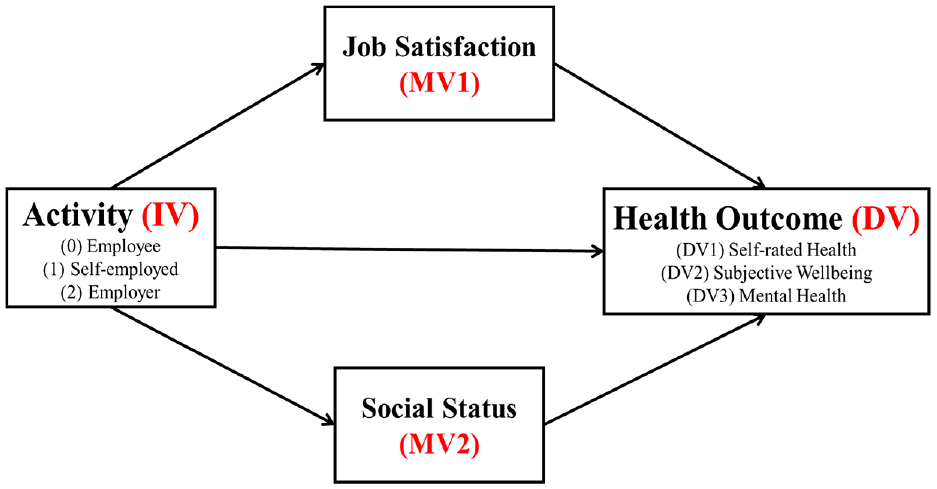
Theoretical path diagram between employment status and health outcomes, with job satisfaction and social status as potential mediators.
Results
Descriptive Statistics
Table 1 presents the descriptive statistics of our sample. The mean for self-rated health, one of the three outcome variables, was 3.13 for pooled cross-sectional data and remained at this value for the last observation of each person. The mean for life satisfaction was 3.62 for polled cross-sectional data and increased to 3.83 for the last observation per individual. The corresponding number for mental health changed from 21.16 to 20.97.
Descriptive Statistics.

Regarding the distribution of economic activity, employees, self-employed people, and employers comprised 78.31%, 19.06%, and 2.63% of the pooled cross-sectional data. As for the last observation of each person, the employees and employers rose slightly to 78.45% and 3.24%, respectively, while the self-employed people decreased slightly to 18.31%.
The mean for the two potential mediators, that is, job satisfaction and social status, was 3.47 and 2.79 for the pooled cross-sectional data and increased to 3.59 and 2.90 for the last observation.
Now, we come to the control variables. The mean age increased from 40.58 for the pooled data to 42.89 for the last observation. 42.46% of the population held urban Hukou for the pooled data, while the number decreased to 41.84% for the last observation. The percentage of married people increased from 83.64% to 84.51%. The mean years of education received increased from 9.91 to 9.95. The percentage of party membership increased from 8.70% to 11.95%. In the pooled data, 65.01% of the people lived in urban areas. And this number increased to 67.58% for the last observation. The percentage of migrants decreased from 4.10% to 1.30%. The logged mean family income per capita increased from 9.31 to 9.41, corresponding to 19,055.25 and 23,894.73 RMB per year, respectively. The mean property value (in wan or 10,000) increased from 47.93 for pooled data to 64.44 for the last observation.
Inferential Statistics
Tables 2 to 4 display the main results, in which the dependent variables are self-rated health, life satisfaction, and mental health, respectively. Within each table, we presented the results of the nested models to analyze the mediation effects.
Causal Relation Between Employment Status and Self-rated Health, with Job Satisfaction and Social Status as Potential Mediators.

p < .01. **p < .05. *p < .1; Robust standard errors in parentheses.
Causal Relation Between Employment Status and SWB, with Life Satisfaction and Social Status as Potential Mediators.

p < .01. **p < .05. *p < .1; Robust standard errors in parentheses.
Causal Relation Between Employment Status and Mental Health, with Job Satisfaction and Social Status as Mediators.

p < .01. **p < .05. *p < .1; Robust standard errors in parentheses.
Self-Rated Health
Table 2 presents Models 2.1 to 2.4, in which the dependent variable is self-rated health. Model 2.1 is the base model, and Model 2.2 includes job satisfaction as the mediator. Model 2.3 further included social status as the mediator. Model 2.4 included both mediators simultaneously. Model 2.1 shows that compared to employees, self-employed people have significantly higher self-rated health (0.070), and employers have even higher self-rated health (0.113). The adjusted R2 is .452 for Model 2.1, meaning that the model explains 45.2% of the variation in one’s self-rated health.
We included one mediator, job satisfaction, in Model 2.2. The coefficient for job satisfaction is significant at 1% level. One level increase in job satisfaction would lead to a 0.102-point increase in one’s self-rated health. Additionally, the coefficients for one’s economic activity have decreased significantly: the coefficient for the self-employed has dropped by 14.1% (from 0.0696 to 0.0598) and is only marginally significant at 10% level; the coefficient for employer has dropped by 24.1% (from 0.113 to 0.0858) and is no longer statistically significant. Together, the significant coefficient of job satisfaction and the insignificant coefficients for economic activity indicate that job satisfaction has fully mediated the causal relation between one’s economic activity and one’s self-rated health. Other variables in Model 2.2 were generally similar to those in Model 2.1.
We included the other mediator, social status, in Model 2.3. The coefficient for social status is statistically significant at 1% level, meaning one one-level increase in social status would lead to a 0.066-point increase in one’s self-rated health. The coefficients for one’s economic activity have also decreased: the coefficient for the self-employed has dropped by 3.2% (from 0.070 to 0.067) and is only marginally significant; the coefficient for employer dropped by 13.8% (from 0.113 to 0.097) and is only marginally significant. Other variables were generally similar to those in Model 2.1 and Model 2.2. Social status mediated a much smaller variation in one’s self-rated health than job satisfaction. Nevertheless, since the coefficients for economic activity are only marginally significant after the inclusion of social status, we regard social status as partially mediating the association.
To test the joint mediation of job satisfaction and social status, we have included both in Model 2.4. We can see that both job satisfaction and social status remain statistically significant at 1% level. At the same time, the coefficient for the self-employed dropped by 16.38% (from 0.0696 to 0.0582) and that for the employer dropped by 35.13% (from 0.113 to 0.0733). Additionally, the coefficient has either become insignificant or marginally significant. Therefore, we can argue that job satisfaction and social status together mediate the causal relation between economic activity and self-rated health.
SWB
The dependent variable for Model 3.1 to Model 3.4 is one’s SWB, which is measured by one’s life satisfaction. Model 3.1 is the base model. Model 3.2 further included job satisfaction on top of Model 3.1, and Model 3.3 included social status on top of Model 3.1. Combining the first three models, Model 3.4 included both job satisfaction and subjective social status as mediators.
In Model 3.1, the base model, employers’ life satisfaction is significantly higher than employees’ satisfaction by 0.191, and this difference is significant at 1% level. In contrast, life satisfaction of self-employed people is not much different from that of the employees. We can see that as one ages, he/she will have higher life satisfaction. Both family income per capita and property value would significantly increase one’s life satisfaction, while party membership tends to decrease one’s life satisfaction. Residence location, hukou status, migrant status, and educational background were not statistically significant in the model.
We first included job satisfaction on top of the base model (please refer to Model 3.2), which confirms that job satisfaction partially mediates the causal relation between economic activity and SWB. The coefficient for job satisfaction is statistically significant. At the same time, the coefficient for employer dropped by 21.5% (from 0.191 to 0.150) while remaining statistically significant. This means that job satisfaction explains 21.5% of the association between one’s economic activity and the resulting SWB. Other control variables generally stayed the same in the model.
We then included one’s subjective social status on top of the base model (please refer to Model 3.3), which shows that subjective social status also partially mediates the causal relation between economic activity and SWB. Not only is the coefficient for social status statistically significant, but the coefficient for employer also dropped by 30.4% (from 0.191 to 0.133). Since the coefficient for employer remained statistically significant, one’s subjective social status partially mediated the causal relation. Similarly, other control variables generally stayed the same in the model.
In Model 3.4, we included both job satisfaction and one’s subjective social status to test their combined mediating effects. Both job satisfaction and subjective social status were statistically significant at 1%. Additionally, while remaining statistically significant, the coefficient for employer dropped from 0.191 to 0.120. This indicates that changes in job satisfaction and subjective social status together explained 37.1.0% of the changes brought by economic activity on SWB.
Mental Health
Model 4.1 to Model 4.2 present the results of entrepreneurial outcomes on one’s mental health. As shown in Model 4.1, while self-employed people are not significantly different from employees in terms of mental health, employers displayed a much lower level of mental wellbeing than self-employed people or employees. More specifically, the coefficient for employers was 0.275 lower than that of the employee, and such a difference was statistically significant at 5% level.
We included job satisfaction as a potential mediator in Model 4.2. Job satisfaction is positively significant at 1% level. The coefficient for the self-employed dropped by 57.2% (from −0.0491 to −0.0772) and is not statistically significant. The coefficient for the employer dropped by 27.27% (from −0.275 to −0.350) and became only marginally significant. We can infer that although entrepreneurship brings higher job satisfaction, entrepreneurs’ mental health was even worsened in the process. One potential explanation is the higher work-related strain related to entrepreneurship, which forces one to be continuously engaged in work mentally, thus worsening one’s mental health. Since one’s social status is not statistically significant, as shown in Model 4.3, it is not a mediator in the causal relation.
Conclusion
Similar to most findings in western countries, self-employment, whether having employees or not, generally leads to improved self-rated health. Mediation analysis also shows that such an increase in health was mostly through the increase in one’s job satisfaction and less so through the increase in social status. As for SWB, shifting from employee to employer would significantly increase one’s life satisfaction through two channels, that is, job satisfaction and subjective social status. In fact, these two mediators together could explain nearly 30% of the increase in the entrepreneurial outcome on SWB. However, one needs to be cautious in concluding that entrepreneurship would lead to better SWB, as we have only observed a significant difference between employees and employers but not between employees and self-employed people. It is possible that while solo self-employment does provide general job autonomy, which should theoretically lead to higher SWB, solo self-employed people may consider themselves to be in the early stage of the business and thus have not reached higher life satisfaction yet. In addition, the dataset does not differentiate between self-employed people engaging in labor-intensive jobs and other self-employed people, which might indicate that not all self-employed individuals can be considered as traditional entrepreneurs.
The causal relation between entrepreneurship and one’s mental health further completes the story. While one may enjoy better physical health and SWB through either improvement in job satisfaction or social status, entrepreneurship is nevertheless mentally straining. The opposite results showed by SWB and mental health are explainable. SWB measures the positive aspects of people’s psychological, while mental health measures the negative aspects. In this way, these two factors might not be in the same dimension and scale for psychological symptoms. Therefore, entrepreneurship can make people happier and more satisfied and more stressed and depressed at the same time (Keyes, 2002). Even if entrepreneurs have higher job satisfaction, entrepreneurship nevertheless tends to worsen their mental health. Especially for employers, who are the people responsible not only for their own business but also for the living of their employees, entrepreneurship might come with more stress and responsibility that deteriorate one’s mental health. This result is also in line with previous findings in western countries, in which self-employment generally leads to an increase in mental strain.
This research explores the causal relation between entrepreneurship and health outcomes among the Chinese population. More specifically, it aims to test whether the positive association between entrepreneurship and health outcomes often found in western countries can also apply to the Chinese setting. Using a longitudinal dataset and employing an individual fixed-effect approach, this research improved on previous analyses that often relied on cross-sectional data. With a nested design, this research also explores the potential mechanisms in the causal relation between entrepreneurship and health outcomes. Our research yielded mixed findings, in which entrepreneurship would increase one’s self-rated health and SWB but would worsen one’s mental health. Job satisfaction and social status would either fully or partially mediate the first two causal relations, but not the last one.
Limitations and Strength of the Study
This study has several limitations, ranging from methodological weakness to data limitations. To solve the potential selection issue and to explore the causal relation between entrepreneurship and related health outcomes, we have applied a linear fixed-effect model in the analysis. However, the linear fixed-effect model could not solve potential reverse causation issues, meaning it could not account for the possibility that a person shifted to self-employment as a result of the changes in his/her health status. In addition, the fixed-effect model could not consider those who have stayed in one economic activity throughout the survey period, which unfortunately left a large chunk of the information unused and resulted in a rather small sample size. Regarding data limitation, the CFPS has only covered a period of less than ten years (from 2010 to 2018), while the rise of Chinese entrepreneurship started in the late 1970s. It is possible that Chinese entrepreneurs in different time periods may experience different health outcomes.
This research has several strengths as well. As the first study exploring Chinese entrepreneurial health, this research has greatly contributed to occupation health and labor economics. By looking at Chinese entrepreneurs, this research further widens the geographical and social coverage of the health outcomes of economic activities, widens our knowledge on how high-status occupation would affect one’s health outcomes, employs a much more rigorous method to explore the causal relation between entrepreneurship and a comprehensive set of health outcomes, and finds the potential mechanisms in the causal relation.
Recommendation
This research provides important policy implications by exploring the causal relation between economic activities and health outcomes. First, the government may want to craft a more comprehensive package to foster entrepreneurship. More specifically, on top of the financial and technical assistance the government has already implemented, it should also provide medical assistance to newborn entrepreneurs. Especially for those small business owners who are in their early stage of business, social support, and psychological assistance should be available in case these owners meet serious obstacles in business operation. In sum, China still has a long way to go in promoting healthy entrepreneurship.
Discussion
As the first study examining various health domains of entrepreneurship in China, this research broadens the scope of Chinese entrepreneurial research. Entrepreneurship can affect not just one’s social status or economic return but also one’s overall health, SWB, and mental stress. Acknowledging the complicated health outcomes of entrepreneurship, policymakers in China can design more comprehensive packages to nurture Chinese entrepreneurial development. For example, the government may want to provide more accessible counseling services on top of the financial assistance currently available.
Footnotes
Author Contributions
Skylar Biyang Sun: Conceptualization, Methodology, Software, Formal Analysis, Data Curation, Writing – Original Draft, Writing – Review & Editing, Visualization. Jing Ning: Methodology, Software, Writing – Review & Editing. Ke Yuan: Writing – Review & Editing, Methodology. Xiaohang Zhao: Conceptualization, Methodology, Writing – Review & Editing. Hongling Gong: Writing – Review & Editing, Methodology.
Declaration of Conflicting Interests
The author(s) declared no potential conflicts of interest with respect to the research, authorship, and/or publication of this article.
Funding
The author(s) disclosed receipt of the following financial support for the research, authorship, and/or publication of this article: This study was funded by the Natural Science Foundation of China [grant number 72304066], the Fundamental Research Funds for the Central Universities in UIBE [grant number 20QD08], Project No.2023CDSKXYGG006 supported by the

Code Availability
Available upon request.
Availability of Data and Material
Interested scholars may apply to the Institute of Social Science Survey (ISSS) in Peking University to obtain the microdata used in this research.