




Abstract
The fire incidents significantly influence the textile garments building structure directly or indirectly. Therefore, this article aims to assess the fire incident related to Textile Garments Manufacturing Buildings (TGMBs) in Karachi, Pakistan. Moreover, the questionnaires were filled out by professionals with knowledge and experience of past fire incidents. The literature review, international and national fire incidents in (TGMBs) identified 30 factors contributing to fire incidents in (TGMBs). The Relative Importance Index (RII) was utilized to rank the factors contributing to fire incidents in (TGMBs). This study exposes 81.6% of high-risk fire incidents in TGMBs in Karachi, Pakistan. The identified factors, including the availability of hazardous material on the floor, insufficient firefighting service, and timber structure floor, emerged as the top three contributors to the fire incident (TGMBs). This paper focused on the steps required to provide appropriate strategies to eliminate all 47 contribution factors, which increased the fire incident factor in (TGMBs) in Karachi, Pakistan. The research highlights the urgent consideration of effective fire risk assessment measures and enhancing fire safety in (TGMBs). The findings and recommendations presented in this study can serve as a valuable resource for the textile garments manufacturing sector, industry professionals, policymakers, and stakeholders in Karachi, Pakistan.
Plain Language Summary
This study delves into the impact of fire incidents on textile garment manufacturing facilities (TGMFs) in Karachi, Pakistan. Despite numerous fire incidents, there’s been limited research on this sector. The study aimed to understand these incidents by gathering insights from professionals familiar with past incidents. Through a thorough review of international and national incidents, 30 contributing factors to TGMF fires were identified. Using the Relative Importance Index (RII), these factors were ranked, revealing that factors like hazardous material presence, inadequate firefighting services, and timber structure floors are key contributors to TGMF fires. The study uncovered that 81.6% of TGMFs in Karachi are at high risk of fire incidents. It proposes strategies to address all 47 contributing factors and emphasizes the need for effective fire risk assessment and safety measures. The findings and recommendations provided can be valuable for TGMF stakeholders, industry professionals, and policymakers in Karachi, Pakistan, to enhance fire safety in these facilities.
Introduction
General Background View
A sustainable building structure must be carefully constructed to last more than 60 years to ensure longevity without devastation (Le et al., 2021). In the textile industry, fire incidents have directly or indirectly led to serious injury, fatality, property loss, and destruction of building structures (Tan et al., 2021), and textile workers consider the worst building infrastructure hazardous and dangerous. According to the World Fire Statistics (WFS) report, 45,000 fires resulted in 206 hundred deaths, while 69,500 injured from 48 progressive countries (Brushlinsky, Ahrens, Sokolov, & Wagner, 2016). One developed Nation faced 1.35 million fire incidents, 3,800 deaths, and 1,470,000 injured, including $15.9 billion in property losses (Mahood et al., 2022). Fire incidents are mostly observed within the textile sector compared to other regional sectors. These deviations indicate failures in the textile manufacturing sector to meet fire safety requirements or to take necessary measures to prevent fire incidents (Theuws et al., 2013).
Specific Pakistan View
Pakistan’s industrial sectors have faced various incidents ranging from security attacks to safety risks (Rush et al., 2020). Fire incidents have been recognized as Pakistan’s second most prevalent type of disaster (Ali et al., 2015). Previous reported fire incidents, including Ali Enterprises (2012) and others between 2015 and 2022 (e.g., Mundia Textile, Essa Tex, Rajwani Denim, Lucky One Textile Mill, Star Textile Mill, Afroze Textile Mill, and Artistic Milliners Unit) (Al Jazeera, 2015; Dawn, 2017, 2018, 2019; ECCHR, 2019; Forensic Architecture, 2018; IndustriALL Global Union, 2016; Workers Rights Consortium, 2022 and Campaign, 2013). Based on understanding fire incidents, appropriate research is required to determine the cause of the fire incidents in Pakistan’s garment sector. Mohsin et al. 2016 suggested that textile factory fires in Pakistan have caused significant loss of life and property over the past decade.
On September 11, 2012, a massive textile disaster resulted in 262 worker’s death and seriously 55 injured in a three-story building in Karachi (Dying, 2016). On April 13, 2023, a fire occurred at a six-story building of the Usman & Sons company in New Karachi; four firefighters were killed, and 14 others were injured (F. Khan, 2023). According to the (Soomro, 2021), a fire disaster affected 16 workers’ death in a Karachi garment factory.
Problem Statement, Study Significance, and Objective
Annually, textile buildings fire disasters disrupt Pakistan’s textile sector’s utilization and development procedure (Yasmeen et al., 2022). The statistical value of fire incidents in the Karachi textile buildings from 2015 to 2022 is mentioned in (Figure 1). Proper investigation is essential for assessing the current situation and eliminating future fire risks in textile buildings. Unfortunately, the textile sector was not given attention from the beginning. Therefore, the primary aim is to evaluate the fire risk in (TGMBs), identify the key factors contributing to fire incidents in (TGMBs) and propose effective strategies to reduce fire incident factors.

Municipal fire department data (2015–2022 December).
It is of greater significance to explore the elements that increase the fire incident of (TGMBs) in Karachi, Pakistan. This topic has not yet been researched because of recent serious fire events, literature, and research gap. This study’s objectives are to assess the factors that increase the fire incident of (TGMBs) in Karachi, Pakistan, and to provide solutions to the issues identified as contributing to the fire incident of TGMBs in Karachi, Pakistan.
Related Studies
Understanding Fire Outburst Behavior in Buildings
A thorough reading of fire behavior is optimal for monitoring and forecasting actual fire scenes (Meskéoulé Vondou et al., 2020). The combustion process involves the chemical reaction between oxygen and a fuel source, resulting in an emission of heat energy and the destruction of a particular substance (Winchell et al., 2021). The combusting substances produce temperature alteration and color variation flame during a real fire scene. The flame color of the “Rame” material transitions from red to yellow as the temperature decreases. As the temperature increases, the flames become white, manifesting white fire (Wang et al., 2017). The dynamic form of fire can be identified as a result of the air currents generated by wind.
In contrast, the composition of the smoke emanating from fires is contingent upon the nature of the combustible material involved (Toptaş & Hanbay, 2020). Moreover, the concept is clarified that eliminating a single variable will result in fire extinction by disrupting the fire triangle. Any one factor must be prohibited from combining with the remaining two variables to prevent the starting point of a fire. Subsequently, the traditional triangular framework was questioned by contemporary research, which proposed the addition of a fourth variable (Hasofer et al., 2006). According to the study, a chemical chain reaction acts as a reaction chain that accelerates the combustion process (Hasofer et al., 2006). C.-H. Chang and Huang (2005) have addressed the fire growth rate based and fire expansion impact on burning materials. Accordingly, (Čolić & Pečur, 2020) have demonstrated that fire can move vertically and horizontally throughout a building.
Fire Incidents in Textile Manufacturing Buildings
Fire risk is a universal concern observed in all countries. Textile developing countries such as India and Bangladesh have faced the highest yearly fire deaths (10,000–25,000; Bruslinskiy et al., 2019). The Asian region is the second-highest non-compliance rate with fire safety regulations (Rathnayake, Sridarran, & Abeynayake, 2020). Over the years, Karachi textile buildings have encountered numerous significant fire incidents (The Nation, 2012). Additionally, fire occurrences have been ranked as Pakistan’s second-highest catastrophe category (NDMA, 2007; Saif-ul-Islam et al., 2019). When examining fire-related incidents across various sectors, it becomes evident that the textile manufacturing sector has the highest reported non-conformities compared to other sectors in Pakistan (A. F. Khan & Ahmad, 2022). In 2012, there was a massive fire disaster in Tazreen Garments, Bangladesh, with approximately 112 workers’ deaths (Mahood et al., 2022). In 2013, eight people died in a fire incident at the Tung Hai T.M.B. in Mirpur, Dhaka (Naoshin et al., 2020; Wadud et al., 2014). According to (Rush et al., 2020), a fire disaster killed 13 textile workers in a New Delhi garments building. In the past decades, horrible fire incidents have been identified in the textile garment sector, namely the Ali Enterprises garment factory (Bugti, 2020; Raza et al., 2018). For example, Khalid et al. (2020) investigated smoke extraction efficiency in immersed tunnel fires using large eddy simulations, highlighting the critical influence of vent geometry and heat release rates on smoke movement and control. The dynamic form of fire can also be influenced by air currents generated by wind, which shape flame behavior and spread.
The massive building destruction observed ineffective fire alarm systems, locked emergency doors, windows covered with iron grills, blocked escape routes, and clothing bails (combustible material) stored on the main floor. Several textile buildings reported massive fire incidents in Karachi, Pakistan, such as M/S Rajwani Denim, Al-Awal Garment, and Essa Tex (Pvt) Ltd (Shaik et al., 2019). Bajaj (2012) mentioned that fire explosions and incidents frequently influence Karachi’s garments manufacturing industry.
Causal Factors to Building Fire Incidents
According to (Liu et al., 2012), ignoring the causes of fire occurrences reduces the effectiveness of the building’s existing fire safety measures. Unfortunately, there are an average of five to six fire-related fatalities in the UK daily. This statistic is regrettably representative of many other nations throughout the world. The Inadequate fire safety system and design characteristics errors are the main factors for insufficient fire safety in the buildings (Park et al., 2014).
Delft University, Crowne Plaza Hotel, Bradford building, and King’s Cross Station were recognized as significant fire disasters due to poor design features (Lottman et al., 2013). The building consisted of horizontal windows and a mezzanine floor that provided direction for relaxation and intimacy. The investigation revealed that fire occurrence severity worsened because these building structures accelerated fire spread vertically (Park et al., 2014). The Bradford City building and King’s Cross station fire incidents were the major causes of ancient buildings and wooden structures (Cheng et al., 2001). The investigation indicated bad signs in the fireman’s elevator, and the door’s color matching the adjacent walls made it challenging to recognize the entrance (Gatheeshgar et al., 2020).
A fire incident occurred at a Hong Kong high-rise building. The building design and construction require fire safety concerns during the renovation process (Li, Ng, & Skitmore, 2017; Wong & Lau, 2007). The doors were removed, and plywood panels were not permanently sealed during the renovation work in the lift shaft. The vertical gaps allowed the fire to spread quickly in the building (Wong & Lau, 2007). Moreover, the identified combustible material supported the fire’s quick spread (Lavigne et al., 2014). Most building fire causes electric spark during welding (J. I. Chang & Lin, 2006). A fire occurrence in Hong Kong was linked to deviating from the building’s original architectural function (Times, 2023). A fire brigade’s slow response would have increased the number of fire accidents in Karachi (Dawn, 2009). The construction workers involved irresponsible in using cigarettes during the working project (Wong & Lau, 2007). Shaikh et al. (2023) recent advances in fire modeling in Pakistan have also focused on forensic analysis of real building fires.
Building codes are essential to provide building protection and fire safety design. The legislation covers minimum safety regulations for building investors (Li, Zlatanova, & Fabbri, 2007). Several construction structures significantly influenced fire safety, while others may have a lesser impact. Moreover, architects show frustration over restrictive building codes hindering their performance from incorporating old building concepts (Li, Zlatanova, & Fabbri, 2007). In addition, international fire codes and standards recognized Pakistan as having a poorly organized Fire Brigade (Kodur et al., 2020). However, ineffective safety laws lead to ineffective safety measures (Stollard, 2014). Fire policies and actual scenarios have generated contradictions between previous fire incident investigations. During fire incidents, the occupant chooses the unfamiliar exit routes rather than the nearest emergency exit (Stollard, 2014).
The Ali Enterprises fire was significantly worsened by insufficient firefighting services and a lack of appropriate equipment (Siddique & Hussain, 2020), Emergency lighting (Ahmad et al., 2020), and Fire alarm system (Paś & Klimczak, 2019). For instance, Pakistan lacked firefighting vehicles like the Sky Lifter. Only about 15 Sky Lifters are in the country, and half are concentrated in the capital, resulting in insufficient firefighting resources. Increased fire dangers are also a result of the location of existing firefighting services (Anadolu, 2022). In addition, (Paul et al., 2022) emphasized the Delhi fire service difficulties in India, including a staff and equipment shortfall. Along with these flaws, the lack of emergency exits, poor safety signage, inaccessible stairs, inadequate ventilation, and a lack of emergency lighting all contributed to a considerable increase in casualties during various fire occurrences (Tazmul et al., 2018). Accordingly, Table 1 summarizes the factors contributing to the fire risk of (TGMBs).
Factors Contribute to Fire Incidents of (TGMBs).

Materials and Methods
This research combines exploratory and qualitative methods based on various data. The secondary data using an inclusive literature review, Articles from Science Direct, Google Scholar, JSTOR, and online sources following the availability criteria, validity, relevancy, and quality was selected to gain in-depth knowledge and causes contributing to the fire incidents in the (TGMBs). The primary data was collected through questionnaires, semi-structured interviews, and emphasizing three previous fire incident cases. Professionals with extensive knowledge about previous fire incidents were selected to complete the questionnaire. A total of 21 professionals with in-depth expertise in fire safety management within the three fire cases were selected in semi-structured in-depth interviews from the 75 questionnaires. Table 2 illustrates the respondent’s interview summary.
Interviewers’ Profiles.

In this research, a non-probability sampling approach was employed due to the absence of probability associations with the population units, with the researcher’s judgment being the basis for selection (Rowley, 2014). A purposive sampling technique was deemed the most appropriate for identifying interviewees within the non-probability sampling framework (Rowley, 2014).
Additionally, the study analyzed the quantitative data using the Relative Importance Index (RII) technique. According to (Gündüz et al., 2013), priorities identification and rank attributes in the (RII). In this context, the results derived from the five-point Likert scale were transformed using RII to ascertain the relative importance of different factors. The RII calculation was performed using Equation 1:

Where w = weighting determined by each respondent’s factor on the Likert scale.
A = most substantial weight on the scale.
N = overall response rate.
Ethical Considerations
Formal ethics approval was not required for this type of research in accordance with local legislation and institutional requirements. To minimize potential risks to participants, the study avoided the collection of sensitive personal information, ensured anonymity by assigning respondent codes, and stored raw data securely. Only aggregated findings are reported. The potential benefits of this research informing policy and improving fire safety in the textile garment manufacturing sector were considered to outweigh the minimal risk of participation. Written informed consent was obtained from all participants after explaining the study objectives, procedures, confidentiality protections, and voluntary nature of involvement.
Results and Discussion
Fire Risk Factors in Karachi Textile Garment Manufacturing Buildings
Below are the findings of Karachi’s three textile garment buildings that have gone through fire accidents presented separately as case studies.
Case Study 1
On September 12, 2012, a three-story textile garment factory in Karachi, Pakistan, occurred at 6:00 PM, killing 262 workers and seriously injuring 55; the factory fire scene images are shown in (Figure 2). The basement floor, ground floor, mezzanine floor, first floor, and second floor comprised the three stories of the building. The clothing bail was present on the ground floor. According to investigation reports, the fire was allegedly initiated on the ground floor using kerosene oil, where clothing bales wrapped in polyethylene plastic acted as fuel, contributing to the rapid spread throughout the building (Figure 3).
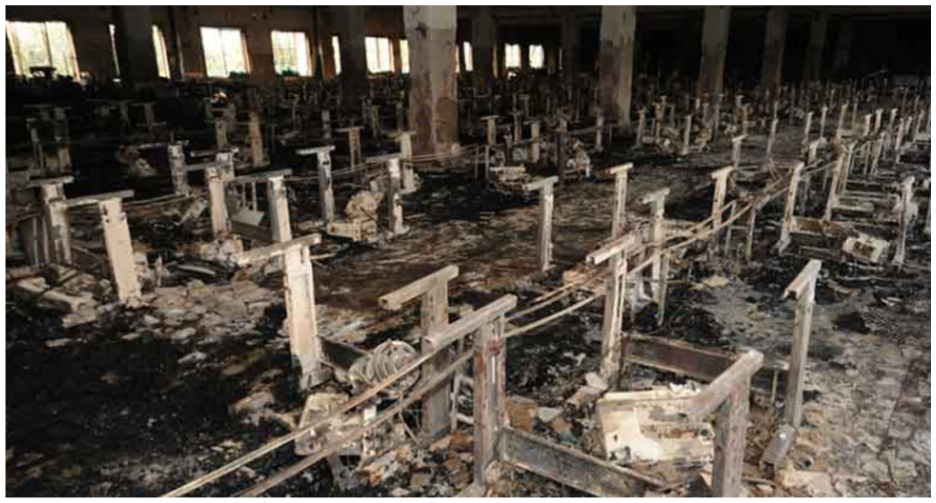
Factory scene inside.

Factory scene outside.
Case Study 2
At around 2.36 PM on March 10, 2017, an enormous fire erupted in a three-story building in Karachi due to an electrical short circuit. The fire broke out on Friday afternoon, taking 2 days to contain. The firefighters said the electrical wiring was outdated. Early on, the fire spread to the upper stories and nearby floors. Smoke and heat from a fire can enter the upper floors through the staircase or the building’s outside. Unfortunately, the absence of sprinkler systems in the building contributed to the fire’s rapid spread. The fire department lacked the necessary tools and fire tenders. There was only one snorkel actively putting out the flames. Poor firefighter gear encourages financial losses. Figure 4 shows the industry’s image before the fire, Figure 5 shows the industry’s image while it was burning, and Figure 6 represents the industry’s image 2 days following the fire.

Factory scene outside.

Factory scene outside.

Fire after 2 days.
Case Study 3
On April 13, 2023, a bedsheet factory’s multi-story building suffered a massive fire in the southern port city of Karachi, Pakistan. Four firefighters died, and nearly a dozen others were injured. Figure 7 illustrates the factory image from the outside after the fire.
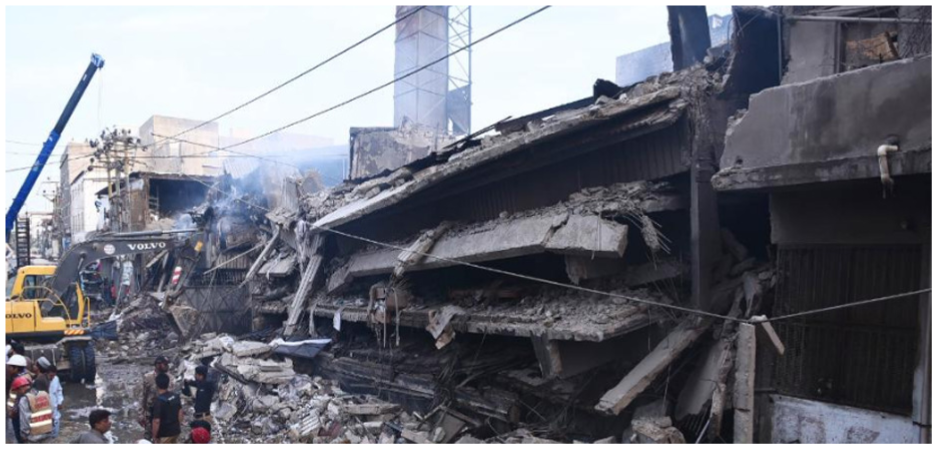
Factory scene outside.
The survey results indicate a high probability of fire incidents in Textile Manufacturing Garments Buildings (TMGBs) in Karachi, Pakistan, with 81.6% of respondents attributing a high fire risk to TMBs and 18.4% attributing a moderate fire risk.
A comprehensive literature review identified 30 factors associated with fire risk factors in textile buildings. A questionnaire was conducted among professionals with knowledge and experience regarding past fire incidents in the three selected cases to investigate factors. The survey utilized a Likert scale ranging from 1 to 5, allowing participants to assess their opinion on the importance of each. The collected responses from the questionnaire were then analyzed to determine the relevance of these identified factors in the context of fire incidents in (TGMBs) in Karachi, Pakistan. It is important to note that all respondents provided their answers based on their opinions and experiences. The Relative Importance Index (RII) values were computed as indicated in the analysis method to evaluate and rank the responses. All responses were evaluated and ranked using RII values, as shown in Table 3.
Ranked Factors Based on RII Value.

Table 3, illustrates the highest relevance (RII value of 1) of the availability of “hazardous material on the floor.” The RII value is .9999, followed by “Insufficient firefighting service” with an RII value of .9888. The “Timber structure floor” factor was rated third, indicating a substantial relationship to fire incidents in textile manufacturing buildings (TGMBs). The fourth and fifth most important, significant factors are “Electric wiring and poor maintenance” and “Electric sparks during the welding process.”
Respectively, RII values of the Iron burglar windows “.6111,” Exit door locked “.6” Emergency lighting “.5999” Fire hose reel “.5777” and the Fire alarm system “.5555” were regarded as the least significant. These findings suggest that these factors contribute to fire accidents in (TGMBs) Karachi, Pakistan. Availability of hazardous material on the floor received the highest RII score of all the variables and was consistently given a weight of five by all respondents. Respondents AH1, AH2, CJ1, and BA1 agree with this conclusion. In response, AH2 said:
[…] Hazardous material on the floor causes fires in (TGMBs). During the fire of Ali Enterprises, clothing bails were stored on the main ground floor, frequently blocking the escape route. However, clothing bails are wrapped in polyethene plastic, the predominant fuel for the fire.
Furthermore, respondent CJ1 addresses that:
[…] Insufficient firefighting service may cause fire incidents.
Respondent AA1 stated that evaluate the existing firefighting service to determine its strengths and weaknesses. Identify areas where improvements are needed, such as response time, equipment, training, or personnel.
Respondent AH1 illustrated that “timber structure floor” may cause fire incidents in (TGMBs). AA1 respondents agreed with timber structures on the mezzanine floor in Ali Enterprises. Karachi Building Regulation Authority (KBRA) states that all steel and other metal structural elements shall be protected with non-combustible materials to provide the required fire resistance. The above statement shows that the factory was not adopting international standards and regulations.
Respondent AH2 stated that
[…] Faulty electric wiring and poor maintenance cause fire incidents in TGMBs.
Furthermore, respondent CJ1 indicated that:
[…] The old building’s electric wiring structure cannot support the new electric system; the wires loosen and strung, which possibly causes breakdown and fire.
Respondent AA1 mentioned that welding fire generates hot slag, torch flames, and sparks which may reach temperatures about 2,000 degrees Fahrenheit, and the ability to move horizontally for up to 10 m when they fall.
Respondent CA2 mentioned the importance of the “Location of the firefighting department.”
[…] Most firefighting department’s located far away from the TGMBs. Respondent (AH2) stated developing a mechanism to get help from neighboring industries during the emergency.
The most significant causes of textile fires are “improper refurbishment and Heating, ventilation, and air conditioning (HVAC) systems.” Respondent CJ2 indicated that opening or removing lift shaft doors due to incorrect restoration was uncommon compared to other variables, supporting these findings. Additionally, the availability of built-in fire safety measures, such as closed fire dampers and smoke detectors in the duct system, can be credited for the lower ranking of “fire risk in HVAC systems.”
Through interviews and questionnaire surveys, 20 factors contributing to fire events were identified in addition to those mentioned in the literature. The “worn-out electrical sockets and grounding issues” and “high installation and repair costs of fire systems” were cited by respondent AH1 as major causes. According to respondent CH2, “improper chemical storage” raises the fire risk in TGMBs. Respondent BA2 emphasized that “Sudden breakdowns” can still happen even with thorough testing and monitoring of fire protection devices, increasing the severity of fire accidents. According to respondent BH2 and survey participants, “Penetration through fire-rated barriers” is a problem. The questionnaire survey’s respondents and respondent AH2 mentioned issues like “deficiencies in commanding at fire scenes,”“lack of fire training and awareness among employees,”“lack of technical knowledge regarding fire safety,” and “lack of competent and educated fire protection engineers in Karachi, Pakistan. Respondent AJ2 focused on “starting fire safety practices in the middle of business operations” and “lack of safety culture and attitudes in Pakistan.”
Respondent AA1 emphasized that:
[…] Due to the industry’s nature and the workforce’s diversity, garment companies often experience high worker turnover. This might result in a shortage of staff that is properly educated in fire safety since new hires might not have the necessary background or education to deal with fire situations. Additionally, the frequent turnover may bring a lack of knowledge of firefighting and evacuation protocols among the staff members.
“The existence of high-heat-generating equipment, such as heat sealers, boilers, thermal printers, and high-heat dyeing machines, was mentioned as contributing to the fire risk by respondent BH1.” Respondent BH2 underlined the need to follow standard operating procedures and highlighted placement difficulties linked to operational activities, such as locating chemical storage near the cooking or smoking area or storing chemicals near the trash yard. Respondent CA1 continued declaring:
[…] Due to a lack of passion and knowledge of fire training, department supervisors sometimes choose their least productive workers to participate in fire drills and training, increasing the fire risk.
Furthermore, Respondent AT1 claims to have one fire alarm in the main gate building. Another fire around 8 months earlier similarly failed the alarm system. Despite the incident, the fire alarm had not been repaired. Respondent AJ2 mentioned that the factory had five escape routes. Unfortunately, these doors could not open during the fire incident. Respondent AH2 mentioned the unavailability of a “fire hose reel” on the industry premises. The fire hose reel is fire safety equipment most significant for fire incidents (Stevens & Eijsink, 1994). Respondent CT1 disagreed about the practices of the “Emergency lighting” measures in the factory. A factory must install sufficient emergency lighting on particular points where emergency light functions automatically in case of emergency or electricity breakdown in the passages or workroom. According to respondent AH1, “Iron burglar windows” cause fire disasters. During the fire incident Ali Enterprises; windows were covered with iron burglar windows.
In addition to the previously mentioned factors, respondents highlighted issues in regulations and guidelines regarding fire safety. Respondents CH1, CH2, and questionnaire survey respondents identified the absence of specific fire regulations for the garments sector in Karachi and issues with existing fire regulations as contributing factors—furthermore, differences in the interpretation of Pakistan’s fire regulations and standards. Respondent BH2 explained the inadequacy of a proper monitoring mechanism for fire regulations and guidelines in Pakistan. Unclear definitions of fire regulations and redundant manufacturing ordinances plague fire safety rules in Pakistan’s garment business. Overall, a total of 47 factors contributing to textile building fire incidents were recognized through the study.
Fire Incidents Controlling Strategies in Karachi Pakistani TGMBs
Ever since the independence of Pakistan till today, Karachi textile industries have faced a considerable fire incident. Therefore, some strategies may become useful to decrease the fire incident in TGMBs, as mentioned in Table 4.
Strategies to Overcome Identified Factors Contribute to Fire Incidents of TMBs in Karachi, Pakistan.

Discussion
In this part, we concentrate on the fire risk of textile manufacturing buildings (TGMBs) in Karachi, Pakistan, and thoroughly analyze the studies and pertinent literature findings. We look at how the data gathered throughout the study process compares to the conclusions from previous literature and how they differ. The main study results are thoroughly explored, including justifications and insights into the data’s analysis. This section thoroughly explains the fire risk variables particular to (TGMBs) in Karachi, Pakistan, by comparing and contrasting the research results with the actual data.
Fire Incident of Textile Garments Manufacturing Buildings in Karachi
The fire incident is a major cause that directly or indirectly impacts the durability of buildings’ performance (Shokouhi et al., 2019). The fire statistics reported as the Asian region is considered the second-highest region with non-compliance in fire safety. The textile garments manufacturing sector has the highest number of fire incidents among all the other sectors (Islam et al., 2022). Moreover, fire incidents have been identified as the second-highest disaster topology in Pakistan. This study supported recognizing the fire incident in (TGMBs) Karachi, Pakistan. However, the level of fire incidents varied according to the responses and explanations of study respondents. The high fire risk of (TGMBs) in Pakistan was recognized by 81.6% of respondents, and 18.4% of respondents mentioned it as a moderate fire risk.
Factors Contributing to fire Risk of Textile Manufacturing Buildings in Karachi
According to (Tan & Moinuddin, 2019), factors contributing to fire incidents lead to the underperformance of existing building fire safety systems. Furthermore, a deep investigation is required to identify the factors contributing to the fire incident of (TGMBs) in Karachi, Pakistan. The 30 factors were identified in the literature findings. They were ranked with the responses from the questionnaire survey to recognize the relevance of fire incidents (TGMBs) in the Karachi, Pakistan context. The hazardous material on the floor, insufficient firefighting service, timber structure floor, faulty wiring, welding work with electric sparks, and building design features are recognized factors contributing to fire incidents in (TGMBs). The significance emphasizes determining the causes of building fire events and understanding the critical situation of the precise elements that increase the fire incident in Karachi Textile Garment Manufacturing Buildings. Thirty such indicators were found in the literature, and their importance to the fire incident of (TGMBs) in Karachi, Pakistan, was evaluated by ranking them based on survey answers. The top six contributing factors to the fire incident in Karachi Textile Garment Manufacturing Buildings were the availability of hazardous material on the floor, insufficient firefighting service, timber structure floor, electric wiring and poor maintenance, electric spark during the welding process, and location of firefighting department. These contributing factors become the reason to spread the fire quickly. The analysis found that floor storage of hazardous materials was a common cause of building fires (Electronic Library of Construction Occupational Safety and Health, 2001; Mikalsen et al., 2021).
Furthermore, insufficient firefighting service is another frequent cause of building fires (Kamau, 2007; Omar et al., 2007). The building design feature is blamed for a large fire in a high-rise building in Hong Kong (Wong & Lau, 2007). There are only 25 firefighting services in Pakistan. The Daily News (2019) mentioned that the mezzanine floor was fully covered with a timber structure, and the location of the firefighting department was also far away from the fire scene Ali Enterprises. Park et al. (2014) explained building design errors and difficulties integrating design features into the fire protection system. Poor building design characteristics lead to the notable fire incidents at Delf University, King’s Cross Station, Bradford City Building, and Crown Plaza Hotel.
Limitations and Future Research
This study is subject to several limitations. First, the sample size was relatively small (21 professionals) and purposively selected, which may limit the generalizability of the findings beyond the textile garment manufacturing sector in Karachi. Second, the research focused on three major fire incident cases, which, while representative of severe events, may not capture the full spectrum of fire risk scenarios in the region. Third, data collection relied on self-reported perceptions from professionals, which may be influenced by recall bias or personal interpretation. Future research could employ larger, more diverse samples, include additional geographic locations for comparative analysis, and integrate quantitative fire risk modeling or simulation approaches. Longitudinal studies could also examine the effectiveness of implemented safety strategies over time.
Conclusion
The literature findings validate the research results and examples from real-world situations, emphasizing the need to address these underlying causes to successfully reduce the fire incident in Karachi Textile Garment Manufacturing Buildings. The Karachi fire incidents posed a significant threat, as evidenced by the findings regarding the (TGMBs). The building fires behavior, locally and globally, and relevant literature on the subject further emphasized the dangers associated with such incidents. 81.6% of survey participants agreed that Karachi Textile Garment Manufacturing Buildings pose a significant fire risk. The research found 30 factors that increase the fire incidence in (TGMBs). Using RII values, we graded the importance of factors identified in the literature study to Pakistan’s garment industry. Mostly, (TGMBs) six factors cause a fire incident; availability of hazardous material on the floor, insufficient firefighting service, timber structure floor, faulty electric wiring, poor maintenance, welding work with electric sparks, and firefighting department location spread the fire quickly. Seventeen additional contributor factors to fire risk were identified via interviews and a questionnaire survey, in addition to those documented in the literature. Some of the recently identified factors are the lack of specific fire regulations for the textile garments sector in Karachi, the deficiencies of commanding at fire scenes, the high cost of installing and maintaining a fire safety system, the availability of high heat-generating machines, and improper chemical storages.
Furthermore, this research has identified 47 factors contributing to fire incidents in Karachi Textile Garment Manufacturing Buildings. In addition, this research has suggested many strategies and solutions to prevent fire incidents in textile garment manufacturing buildings (TGMBs) in Karachi, Pakistan. The findings and recommendations presented in this study can serve as a valuable resource for the textile garments manufacturing sector, industry professionals, policymakers, and stakeholders in Karachi, Pakistan.
Footnotes

Ethical Considerations
Formal ethics approval was not required for this type of research in accordance with local legislation and institutional requirements. To minimize potential risks to participants, the study avoided the collection of sensitive personal information, ensured anonymity by assigning respondent codes, and stored raw data securely. Only aggregated findings are reported. The potential benefits of this research informing policy and improving fire safety in the textile garment manufacturing sector were considered to outweigh the minimal risk of participation.
Consent to Participate
Written informed consent was obtained from all participants after explaining the study objectives, procedures, confidentiality protections, and voluntary nature of involvement.
Funding
The authors received no financial support for the research, authorship, and/or publication of this article.
Declaration of Conflicting Interests
The authors declared no potential conflicts of interest with respect to the research, authorship, and/or publication of this article.