




Abstract
This study applied the structural equation modeling (SEM) technique to explore the predictive relations among personality facets, writing strategy use, and writing performance of college students learning English as a foreign language (EFL). In total, 201 participants composed an argument-based essay, before being surveyed using two self-report instruments: the Personality Facet Scale (PFS), which measured 10 facets within the framework of the Five-Factor Model (FFM), and the Writing Strategy Scale (WSS) that assessed six types of strategy. The established structural model indicated the following: (a) Five types of strategy and six facets predicted writing performance, (b) nine facets predicted the use of at least one type of strategy, either positively or negatively, and (c) the five types of strategy mediated the relations between the nine facets and writing performance. As suggested, adding and treating strategy use as a mediator could help elaborate and elucidate the facet–performance relations in the EFL writing context.
Keywords
Introduction
Use and Taxonomy of Writing Strategies
Writing is a complex and dynamic activity that requires writers to initiate distinct behaviors to translate their abstract thoughts into print. In the existing literature, these writing behaviors are conceptualized and operationalized as writing strategies to investigate their impact in a systematic manner. For instance, He, Chang, and Chen (2011), who defined a writing strategy as “behaviors adopted by writers to complete their tasks” (p. 401), identified 21 distinctive writing strategies used to complete essay writing by college students learning English as a foreign language (EFL). Among these strategies were compensation strategies, such as consulting online dictionaries or using search engines to locate appropriate word choices or expressions. Monitoring or revising strategies were also identified from these students’ behaviors of checking their writing for grammatical and semantic concerns, estimating quality of written discourses, assessing the match between print and intended meanings, or rewriting misleading or erroneous structures. As He and colleagues concluded, by scrutinizing these strategies, exactly how college-level EFL writers approached and accomplished their essay-writing tasks could be comprehended.
Furthermore, researchers have classified individual strategies that share similar behaviors into respective types; they then aggregated these types into a taxonomy to examine the combined impact of distinctive strategy categories upon writing. For instance, Oxford (1990) developed the Strategy Inventory for Language Learning (SILL), accentuating that all its six types of strategy could be applied to explore and explain how non-native English-speaking (NNES) learners (e.g., EFL students) composed their writing. Likewise, Peñuelas (2012), who blended Oxford’s SILL and a writing questionnaire devised by Petrić and Czárl (2003) to research the strategy use of college students, formulated a six-type taxonomy that includes Memory Strategy, Cognitive Strategy, Metacognitive Strategy, Compensation Strategy, Social Strategy, and Affective Strategy. Memory Strategy comprises strategies that illustrate writers’ shared behaviors of retrieving information by activating schemata to produce written discourses (e.g., associating additional information with keywords that have been memorized), whereas Cognitive Strategy consists of individual strategies that have the behaviors of understanding and producing written discourses (e.g., summarizing, elaborating, or organizing intended ideas). Strategies that illuminate the shared behaviors by revealing writers’ deliberate management to facilitate writing quality are classified as Metacognitive Strategy (e.g., monitoring and/or evaluating quality of current writing, and/or planning contents). Other strategies that share the behaviors of bridging the gap between intended ideas and language deficits are grouped into the Compensation Strategy category (e.g., using synonyms or coining words to replace unknown vocabulary). Affective Strategy includes strategies that reflect the distinguishable behaviors of writers’ regulating their emotions (e.g., making positive statements on their own writing), whereas Social Strategy collects strategies that signal writers’ behaviors of cooperating with others (e.g., asking for peers’ comments on drafts). This taxonomy gathers a wide array of individual strategies, and it also encompasses underexplored types of Social Strategy and Affective Strategy. For these reasons, it would be an appropriate framework for the present study to investigate the writing strategy use of EFL college students.
Writing Strategy Use and Writing Performance
The literature within the EFL writing domain consistently suggests that writing strategy use determines writing performance (He, 2005). One line of research applies writing strategy questionnaires to identify strategies used by EFL college students, before relating the employment of such strategies to writing performance (e.g., scores on essays). For instance, Shawer (2016) adopted the SILL and identified Social Strategy and Metacognitive Strategy as two positive predictors of writing performance. In a comparable manner, Raoofi and Yahya (2017), who used the same strategy scale, found close associations between EFL college learners’ writing performance and their use of Metacognitive Strategy, Cognitive Strategy, and Affective Strategy. As evidenced by these relations, EFL writers can facilitate the quality of their writing once they constantly invest in cognitive engagement (e.g., writing several drafts or moving paragraphs around), suitably regulate and manage metacognitive efforts (e.g., monitoring or planning texts), aptly maintain emotional stability, and recurrently develop or alter ideas and thoughts through social interactions with peers or writing instructors.
The other line of research places its focus on the strategy use of writers with diverse writing proficiency levels, factoring such writing strategy use into distinctive levels of writing performance between high-proficiency writers and low-proficiency counterparts. To illustrate, De Silva and Graham (2015) demonstrated that the frequency for the high-ability group of EFL college students to utilize both planning strategies and self-monitoring strategies was higher than that of the low-proficiency group. Another study by Raimes (1985) reported that inexperienced writers who learned English as a second language (ESL) were attentive only to local elements. These writers simply revised mechanical aspects of their essays without employing any other strategies to estimate whether the words chosen, or the sentences constructed, accurately expressed their intended meanings. Because revisions were triggered only for grammatical concerns, those confusing statements, ambiguous texts, and unclear ideas stayed static. Accordingly, the comprehensibility of written products was seriously compromised, even though the revision strategies had been applied. By contrast, Bereiter and Scardamalia (1987) found that expert ESL writers cautious about the readership of their essays frequently applied strategies to plan their writing in advance toward the interest of potential audiences. They also often used strategies to self-monitor or evaluate their drafts, focusing not only on ungrammatical usage or mechanical mistakes, but also on perplexing expressions and unclear sentences. Once problematic discourses had been detected, strategies were utilized to revamp inappropriateness or correct inaccuracies. When difficulties in revising drafts had taken place at either a lexical, syntactic, or semantic level, compensation strategies were applied to surmount such difficulties. In light of these findings, less-able ESL/EFL college students simply monitor local elements of writing (e.g., spellings or punctuations) rather than global elements (e.g., word choices or intended meanings); they also seldom apply strategies to check writing quality. By contrast, more-able writers employ strategies to properly compensate their writing proficiency deficits, accurately evaluate the quality of written discourses, effectively overcome any issues that emerge, and appropriately manage their limited cognitive resources. Benefiting from the use of these strategies, more-able students can produce better written products than less-able counterparts.
Personality Traits and Writing Strategy Use of EFL College Students
Personality is found to act as an antecedent of strategy use by learners who strive to acquire a language other than their mother tongue. Some studies identify a close relation between a personality trait, Introversion, and writing strategy use (Ehrman & Oxford, 1990; Sharp, 2008). To illustrate, Ehrman and Oxford (1990) argued that introverts selected metacognitive strategies more frequently than did extraverts. Similarly, Sharp (2008) discovered a negative relationship between introversion and the use of social strategies. As these associations suggest, learners are disposed by their personality characteristics to choose the strategies that meet their predisposed temperaments. Introverts exhibit self-knowledge and are interested in understanding details, so they apply metacognitive strategies to make it easier for them to process information or produce output. Such learners are also distinguished as being reserved and non-gregarious, so they reduce their use of social strategies that do not accord to their personality characteristics.
Other studies show a positive association between another personality trait, Extraversion, and writing strategy use of EFL college students (Liyanage & Bartlett, 2013; Raoofi & Yahya, 2017). To take Liyanage and Bartlett’s (2013) study as an example, it illustrated that high Extraversion, accompanied by low Neuroticism, was a predictor for the use of cognitive strategies, metacognitive strategies, and social-affective strategies, whereas Introversion did not assume such a predictive role. In a similar vein, Raoofi and Yahya (2017) found that “personality traits such as extraversion appear to be a crucial factor in determining the use of the social strategies” (p. 196). In view of these findings, extraverts are gregarious, assertive, and action-oriented; predisposed by this trait, they may excitedly engage in writing tasks with full energy and enthusiasm. To compose and improve writing, cognitive strategies and metacognitive strategies are frequently applied. In addition, as extraverts are sociable and fond of interactions with acquaintances, they habitually choose social strategies, such as sharing their written drafts, exchanging writing ideas, asking for feedback, and seeking outward help, to compose their writing.
As reviewed early, writing strategy use is a factor that may considerably impact writing quality of EFL college students, and it is also a function of personality traits of these students. Nevertheless, the relationships between personality types and strategy use established in the EFL writing field of study are not always consistent. Although some studies show that Extraversion is positively related to use of Metacognitive Strategy and Social Strategy (e.g., Liyanage & Bartlett, 2013), other studies fail to recognize such relations (e.g., Sharp, 2008). Inevitably, this discrepancy of personality–strategy relationship revealed needs more empirical evidence for clarification. To this end, one adaptation should be considered when a new research attempt is set about. To illustrate further, as most EFL writing studies adopt either the Eysenck Personality Questionnaire (EPQ) or the Myers–Briggs Type Indicator (MBTI) to measure personality, their discussions tend to focus on distinctions between Introversion and Extraversion (Leaver, Ehrman, & Shekhtman, 2005). An alternative personality framework that covers a wide range of personality traits other than the Extraversion/Introversion dichotomy should be taken into consideration. In this regard, the Five-Factor Model (FFM) that covers five broad trait domains (and 30 personality facets) may serve as an appropriate framework to pinpoint personality–strategy–performance relations in the EFL writing context.
The FFM: Its Traits and Facets
To explore the core constituents of personality, theorists have applied the data-reduction technique to factor analyze lexical scales that contain natural language adjectives or theory-based questionnaires that include phrasal items (e.g., Eysenck, 1991). Five traits (also termed as “dimensions” or “factors”), albeit named slightly differently, have consistently emerged from such analyses (Goldberg, 1982; McCrae, 1989, 1991). McCrae and John (1992) promoted the application of the FFM by arguing that it was “a hierarchical organization of personality traits in terms of five basic dimensions: Extraversion, Agreeableness, Conscientiousness, Neuroticism, and Openness to Experience” (p. 175). Moreover, Goldberg (1982), who was credited for his coinage of the “Big 5,” focused his efforts on examining lexical data and recurrently identified five personality factors, namely, Extraversion/Surgency, Agreeableness, Conscientiousness, Emotional Stability, and Intellect. Along the line of the FFM, Soto and John (2009) observed that “adults’ personality characteristics can be organized in terms of five broad trait domains: Extraversion, Agreeableness, Conscientiousness, Neuroticism, and Openness” (p. 84). Because the five traits are deemed to represent core essences of personality, the FFM has become the most influential and dominant framework in contemporary psychology (McCrae & Costa, 2004).
According to paradigms of the FFM (Costa & McCrae, 1992), Neuroticism describes characteristics of individuals who tend to experience psychological distress, negative affect, or disorders like anxiety, anger, hostility, depression, or vulnerability. Extraversion depicts individuals who are emotionally positive and prone to be warm, assertive, social, and dominant. Conscientiousness portrays strong-willed and self-disciplined individuals who are likely to be hard-working, achievement-oriented, well-organized, and trustworthy. Agreeableness is illustrated in individuals with characteristics like altruism, compliance, modesty, sympathy, and tender-mindedness. Openness to Experience (or simply Openness) reflects aesthetic individuals who long for innovative ideas, fantasy, and sensations.
The five personality traits broadly describe how an individual will feel, think, and behave in either real world or educational settings. However, at a lower level, many specific characteristics—also called facets—can portray and conceptualize a trait in a narrower but clearer manner (Soto & John, 2009). Following the paradigm of the FFM, Costa, McCrae, and Dye (1991) used six facets to describe each of the five broad traits. For instance, the facets that underlie Conscientiousness are Competence, Order, Dutifulness, Achievement Striving, Self-discipline, and Deliberation. Notably, although being aggregated into and correlated with the same trait, these facets may differ from one another or from the trait in their relations with academic achievement.
To illustrate, Corker, Oswald, and Donnellan (2012) examined each of the Conscientiousness facets by focusing on their predictive potential for course performance, reporting that Self-discipline was the only one that functioned as a significant predictor. In a similar manner, a study by Noftle and Robins (2007) reported evidence to justify Achievement Striving as a stronger predictor of grade point average (GPA) than the composite of Conscientiousness, whereas the other facet, Order, was not related to GPA. Similarly, Vedel, Thomsen, and Larsen (2015) compared the Big Five traits to their 30 facets, in terms of their predictive power for GPA. Their regression results indicated that facets within the same trait domain displayed higher predicting power than the trait itself; moreover, these facets were varied in their relationship with GPA. In line with these findings, after comprehensively reviewing the research that investigated personality–performance relations, O’Connor and Paunonen (2007) reached their conclusion by emphasizing that the Big Five facets predicted academic performance better than their corresponding traits.
As evidenced, a single facet represents a more specific, concrete, and straightforward personality profile than a trait, so it may associate with learning outcomes more strongly and closely. Furthermore, learners who bear a certain trait tend to use or circumvent certain types of strategy. These different strategy profiles explain why learners vary in their academic achievement, task attainment, or course performance. Because facets are stronger predictors than traits, their relationship with learning outcomes should have unequivocally rendered the role of strategy use more thoroughly (e.g., acting as mediators between personality facets and academic performance). However, in the limited number of studies that have delved into facet-achievement associations, the issue of strategy use functioning as mediators has not been well addressed or explored, not to mention the testing of facet–strategy–performance relations in contexts where EFL college students are requested to complete an essay-writing task. To clarify this unsettled issue with solid empirical evidence, further studies that focus on how facets, writing strategy use, and writing performance of EFL college students would interact with one another need to be carried out.
Rationale and the Hypothesized Model
Sykes (2015) observed that “the personality of a learner is a major factor in determining the level of success in second language learning” (p. 715). Furthermore, Komarraju, Karau, Schmeck, and Avdic (2011) argued that “the paucity of current research as well as the inconsistency in findings calls for a closer examination of how individual differences in personality traits might be related to preferred strategies for learning and how these might influence academic achievement” (p. 473). Nevertheless, Soto and John (2009) cautioned that without exploring each facet individually, “aggregating these related but distinguishable facet traits into only five broad domains results in a loss of information” (p. 84). In this respect, previous research, which merely investigates traits, overlooks the impact of facets or lacks direct evidence to justify the relationship between facets and other variables, such as learning outcomes and strategy use. In addition, to further explicate these personality–strategy–achievement relations, Vedel et al. (2015) urged researchers to shift their focus from broad traits to specific facets, because the latter would be more strongly associated with learners’ strategy use in educational settings when compared with the former.
Moreover, the writing literature suggests that EFL college students may be predisposed by their distinctive personality traits to utilize or avoid writing strategies when approaching their tasks. The use or circumvention of such strategies further plays a decisive role in their written outcomes. For instance, Ruffing, Hahn, Spinath, Brünken, and Karbach (2015) adopted the NEO-Five-Factor Inventory to measure traits of German EFL learners at a college level. Their evidence pointed out that Conscientiousness and Openness were positive predictors of Elaboration Strategy (e.g., strategies of critical evaluation and cooperation with peers) and Learning Discipline Strategy (e.g., strategies of organization, rehearsal, and time/effort management). Another study by Ayhan and Türkyılmaz (2015) employed the Revised NEO-Personality Inventory (NEO-PI-R; Costa & McCrae, 1992) and Oxford’s (1990) SILL to survey Bosnian EFL college students. It showed that the relationships between Metacognitive Strategy use and four personality traits, namely, Extraversion, Openness, Agreeableness, and Conscientiousness, were all positive. As mentioned above, writing strategy use may profoundly correlate to writing performance of EFL college students. From this perspective, it can be hypothesized that strategy use is a function that significantly mediates relations between personality and writing performance. Yet, in an unfavorable manner, no study so far has examined the personality facets of EFL college students and their potential relationship to writing strategy use and writing performance. What also remains unsolved is whether writing strategies would act as functions that mediate the facet–performance relations in EFL writing contexts. To test the falsifiability of this hypothesis in the EFL writing domain, it calls for an integration of a writing strategy component into investigations on personality–performance relations.
Prompted by this proposition, the present study adopted the FFM as a framework and employed the structural equation modeling (SEM) technique to examine a hypothesized model that specified predictive relationships among 10 personality facets (Soto & John, 2009), six types of writing strategy (Peñuelas, 2012), and writing performance of EFL college students. In the model, the 10 facets were treated as exogenous factors (ξ) that predicted two endogenous factors (η), namely, the writing performance and writing strategy use of EFL college students. The types of writing strategy were also presumed to predict writing performance and mediate the facet–performance relations (see Figure 1 for this simplified measurement model).
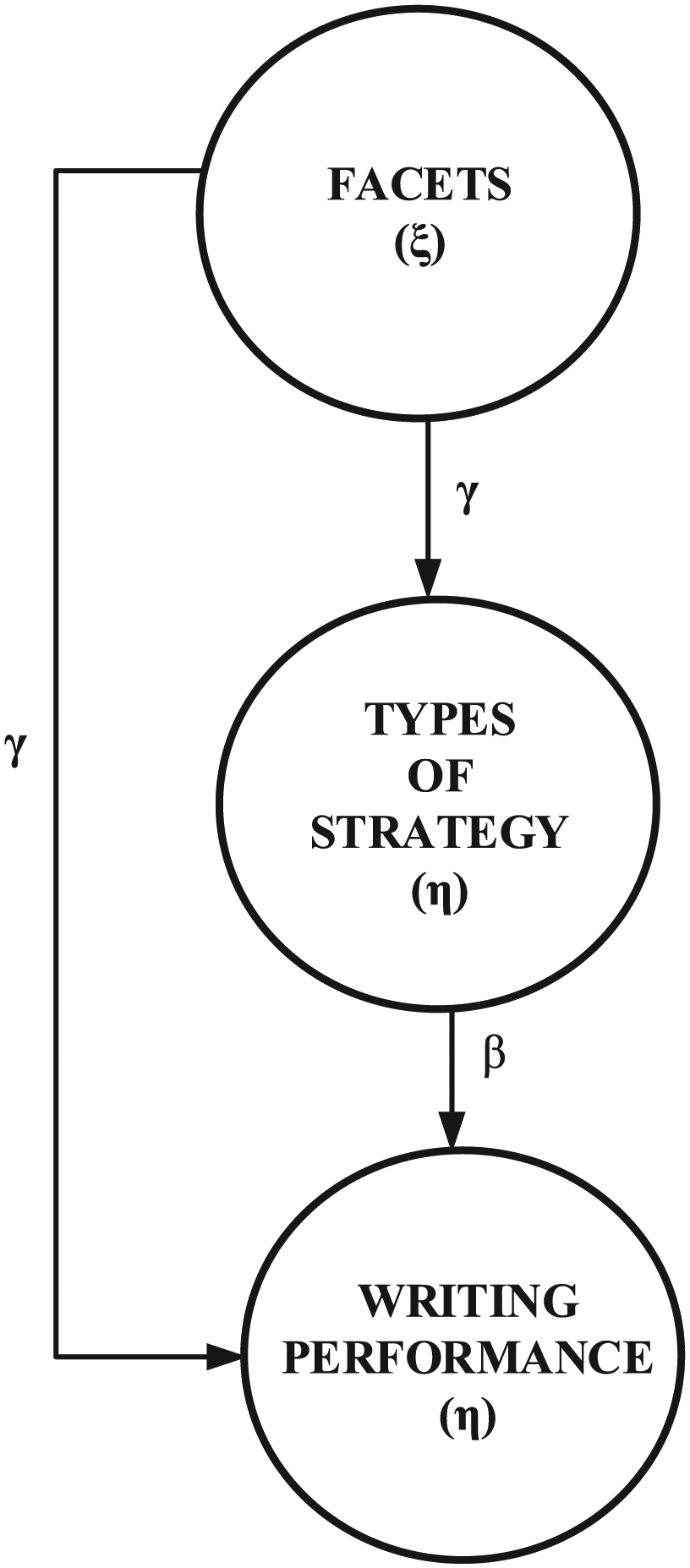
The simplified measurement model.
Method
Participants
The present study was conducted in a prestigious university located in north Taiwan, where English has been taught and learned as a foreign language. Prior to data collection, approval had been obtained from a research ethics committee that regulates and supervises studies involving human subjects. At this university, 201 English-major students, aged between 19 and 21, signed consent forms to indicate their agreement of participation. Before the study was carried out, all participants had accumulated 12 years of EFL learning experiences from their schooling. In addition, participants had taken two English writing courses and were also taking another that focused on promoting their English essay-writing skills when the current study was conducted. Taken together, participants are competent EFL learners who have cultivated adequate abilities to accomplish the essay-writing task demanded by the current study.
The Writing Task
Participants were asked to complete an essay-writing task that required them to defend their positions in either supporting or opposing capital punishment. This controversial, argumentative prompt was chosen because the literature has suggested that writers would need to apply a variety of writing strategies to complete essays whose topics are highly contentious and debatable (Ericsson & Simon, 1993). Participants were given 4 weeks to complete their writing tasks and were also clearly informed that sharing ideas and drafts with peers for comments and suggestions was allowed. After turning in their essays, participants were surveyed using two self-report scales.
Instruments
The Personality Facet Scale (PFS)
To measure participants’ personality facets, the PFS adapted from the Big Five Inventory (BFI) was administered. The BFI is a valid and reliable scale that has forty-four 5-point items to measure five broad personality traits (Soto, John, Gosling, & Potter, 2008). To extend its application to facet-level measurement, Soto and John (2009) chose 35 items from the BFI to develop the PFS. The PFS has 10 subscales to measure facets (i.e., two facets for each trait), respectively, and each subscale uses the same 5-point Likert-type format (“1” indicates “Disagree Strongly,” whereas “5” indicates “Agree Strongly”). The facets and their corresponding traits (specified within the brackets) are Assertiveness, Activity (Extraversion), Altruism, Compliance (Agreeableness), Order, Self-discipline (Conscientiousness), Anxiety, Depression (Neuroticism), Aesthetics, and Ideas (Openness).
The PFS was chosen for three reasons. First, although the NEO-PI-R has been considered as the most widely used instrument to assess personality characteristics at both the trait and facet levels, its 30 facets make it impractical for the present study to perform the SEM technique. Second, based on the factoring analysis results, Soto and John (2009) concluded that “there was strong convergence between each BFI facet scale and the corresponding NEO-PI-R facet” (p. 86). In other words, the PFS is conceptually equivalent to the NEO-PI-R in terms of the facets that the two scales aim to measure. Third, as McCrae and Costa (2007) emphasized, “brief scales can provide useful assessments of personality constructs” (p. 116). Relative to lengthy scales, the brevity of the PFS makes it less effortful but more efficient for participants to provide their responses. Together, the high convergence validity and a considerable size of reliability supported the use of the PFS in the current study.
Moreover, because the PFS is an imbalanced-keying scale (i.e., the number of true-keyed items is unequal to that of false-keyed ones), it will be discretionary to consider acquiescence tendencies (i.e., some respondents are prone to agree more, whereas others tend to disagree more without scrutinizing item content) before a factor analysis is conducted (Soto et al., 2008). To simultaneously remove acquiescence variation and keep the covariance matrix intact to carry out the SEM procedure, this study adopted the method of Proportion of Maximum Scaling (POMS; Little, 2013; Moeller, 2015), and its formula is expressed as follows:

where minimum response =1 and maximum response = 5.
After POMS had been carried out, the original facet data were transformed into metrics that ranged from 0 to 1. Subsequently, the factor analysis and the SEM technique were performed on the newly transformed POMS scores.
The Writing Strategy Scale (WSS)
To measure participants’ strategy use, the WSS developed by Peñuelas (2012) was utilized. The WSS has six subscales that amount to forty-seven 5-point anchored items (i.e., 1 indicates “Never True,” whereas 5 indicates “Always True”), and each subscale measures one type of writing strategy. These types of strategy were Memory Strategy, Cognitive Strategy, Compensation Strategy, Metacognitive Strategy, Affective Strategy, and Social Strategy. Sample items adopted from Peñuelas’ study are “I relate my composition topic to my background knowledge” (p. 109) (Memory Strategy); “I move paragraphs around in an attempt to organize my writing in a more coherent way” (p. 109) (Cognitive Strategy); “I use synonyms when I can’t find the word I mean” (p. 110) (Compensation Strategy); “I plan my composition in advance or while writing either mentally or in writing” (p. 110) (Metacognitive Strategy); “I motivate myself to keep writing by saying ‘come on,’ ‘go on,’ ‘you can do it’” (p. 111) (Affective Strategy); and “I give my writing to a friend or someone who is good at writing so that I have an opinion about my writing” (p. 112) (Social Strategy).
There are three reasons for selecting the WSS over the other available strategy scales. First, the WSS was adapted from Oxford’s (1990) SILL and Petrić and Czárl’s (2003) questionnaire. Both the SILL and the questionnaire were developed to measure the strategy use of second language (L2) or foreign language (FL) learners. Originating from such instruments that are suitable for L2/FL learners or writers, the WSS by nature can be an appropriate tool for EFL college students. Second, the WSS measures writing strategy use in a milieu where a writing task is demanded. This context and task format would match those of the present study. Third, Hayes and Flower (1980) pointed out that writing, at least, constituted three phases—pre-writing, in-writing, and post-writing phases. At each phase, writers may select distinctive strategies to approach their writing tasks. For instance, on the pre-writing phase, the strategy of planning thoughts/ideas ahead may be employed, whereas revising strategies (e.g., revising drafts for grammatical concerns) and memory strategies (e.g., choosing a word from a memorized lexicon) may appear during the post-writing phase and/or during the in-writing phase. Because the WSS covers a wide array of writing strategies on all three phases, it can capture a variety of strategies used by EFL participants throughout their writing processes.
Writing Performance
To measure writing performance, participants’ essays were analytically rated by two raters using a six-category rubric (He, Gou, Chien, Chen, & Chang, 2013). These categories were Content, Organization, Style/Quality Expressions, Language Use, Mechanics, and Length of Text, each equally weighted at 10 points. Training sessions were provided prior to the actual conduct of scoring participants’ essays to ensure the raters would reach a consensus on how to use this rubric to rate the essays. In the training, the two raters first applied the rubric to individually mark sample essays written by English-major sophomores other than participants. The prompt for these sample essays differed from the one used for the writing task. After finishing the marking, the raters showed each other their scores on each category. Discussions between the raters were initiated, focusing on how to dispel inconsistencies. The training sessions were not concluded until the two raters had felt confident in, and comfortable with, using such a rubric to consistently rate participants’ essays. Then, an aggregate of the six category scores was computed and used as an indicator of a participant’s writing performance. The value of the intra-class correlation coefficient (ICC), .96, revealed an elevated level of rating consistency between the two raters’ scores.
Results
Validity and Reliability of the Scales
To estimate validity of the PFS and the WSS, the technique of confirmatory factor analysis (CFA) was performed by running the
To assess the reliability of the two scales, two indices were computed, namely, Cronbach’s alpha (by performing SPSS 13.0) and Composite reliability (CR) (see Table 1). The values for all the subscales were larger than .70, which suggested that each subscale reached a prominent level of internal consistency. Synthetically, the two scales were justified to be exceptionally reliable and valid.
Descriptive Statistics of Facets, Writing Strategy, and Writing Performance (N = 201).
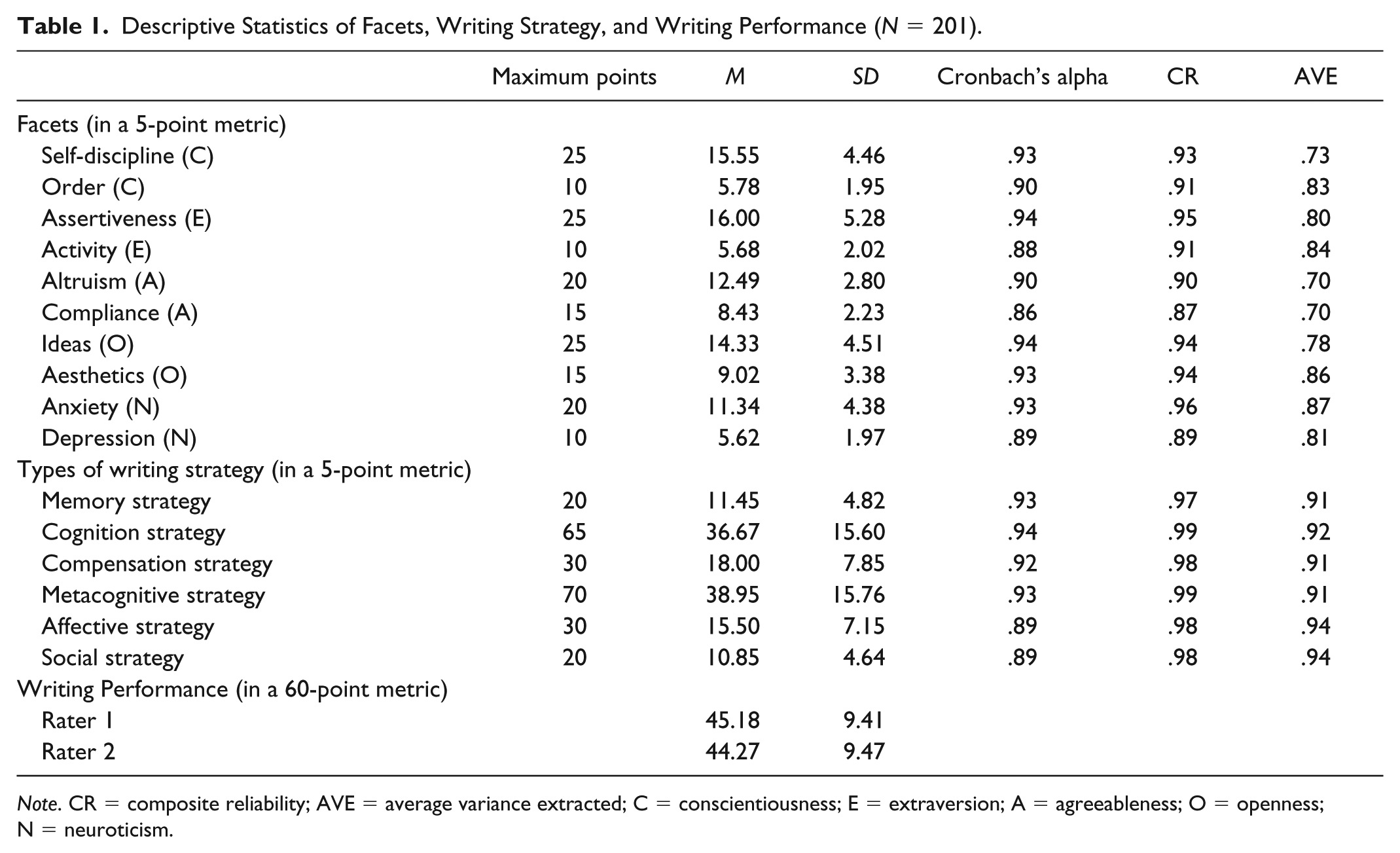
Note. CR = composite reliability; AVE = average variance extracted; C = conscientiousness; E = extraversion; A = agreeableness; O = openness; N = neuroticism.
The fit indices for the CFA model, along with their thresholds shown within the brackets (Anderson & Gerbing, 1988; Bagozzi & Yi, 1988), were examined: df = 3,119, χ2 = 4,842.49, p < .05 (>.05); root mean square error approximation (RMSEA) = .05 (≦.05); standardized root mean square residual (SRMR) = .05 (<.08); normed fit index (NFI) = .98 (>.90); non-normed fit index (NNFI) = .95 (>.90); comparative fit index (CFI) = .98 (>.95); normed χ2 = 1.55 (≦2); parsimonious normed fit index (PNFI) = .89 (>.50). Except for χ2, all the indices pointed to a good fit. However, because the χ2 statistic is sensitive to sample sizes, a normed χ2 is recommended to replace it. Because a normed χ2, whose value is no larger than 2, represents a good fit (Hu & Bentler, 1999), and such value for the present study was 1.55, it suggested that the CFA model fit the data and the latent variables be appropriately measured by the items (i.e., the indicators).
Zero-Order Correlations Among Facets, Writing Strategies, and Writing Performance
To estimate the correlations among the facets, writing strategies, and writing performance, zero-order correlation coefficients were computed (SPSS 13.0). As shown in Table 2, among all the correlations between the facets and scores of the two raters, only those of Altruism and Compliance (i.e., the two facets of Agreeableness) were not significant. Anxiety and Depression (i.e., the two facets of Neuroticism) were negatively related to scores, whereas the remaining six facets displayed positive relations. Moreover, all 10 facets were either positively or negatively linked to at least one type of writing strategy. Anxiety and Depression were the only two facets negatively linked to the six types of strategy. In addition, all strategy types were significantly and positively related to the scores of the two raters. As such, facets, writing strategy use, and writing performance were found to be closely interlinked to one another.
Zero-Order Correlation Coefficients for Facets, Writing Strategy, and Writing Performance.
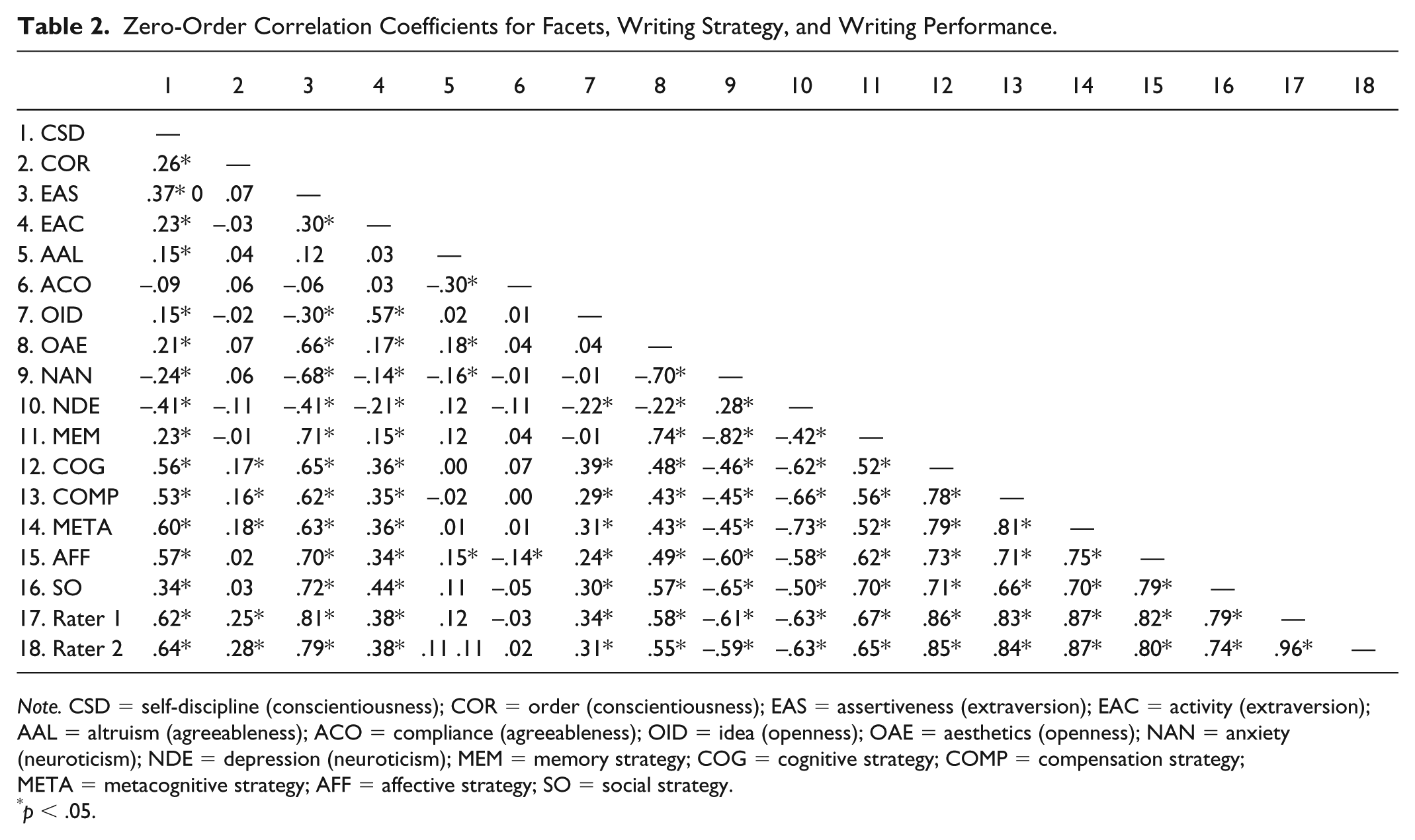
Note. CSD = self-discipline (conscientiousness); COR = order (conscientiousness); EAS = assertiveness (extraversion); EAC = activity (extraversion); AAL = altruism (agreeableness); ACO = compliance (agreeableness); OID = idea (openness); OAE = aesthetics (openness); NAN = anxiety (neuroticism); NDE = depression (neuroticism); MEM = memory strategy; COG = cognitive strategy; COMP = compensation strategy; META = metacognitive strategy; AFF = affective strategy; SO = social strategy.
p < .05.
The Structural Model
Convergent validity and model fit
After the SEM technique had been applied (Lisrel 8.8), a structural model was yielded (see Figure 2). To estimate convergent validity of the model, the values of the Average Variance Extracted (AVE) for the 16 constructs were computed. As shown in Table 1, all AVE values passed the cut-off threshold, .50 (Fornell & Larcker, 1981), and this indicated a prominent level of convergent validity. To gauge the discriminant validity of the SEM model, two criteria were adopted: (a) None of 95% critical interval (CI) for any coefficient in the Φ matrix of the independent variables should cross 1 (Jöreskog & Sörbom, 2007), and (b) for each construct, the root square of its AVE value should be larger than its all correlations with other constructs (Hair, Black, Babin, Anderson, & Tatham, 2006). As illustrated in Table 3, 95% CIs for all the 120 coefficients were lower than the cut-off criterion (e.g., the highest coefficient was .91 with a standard deviation of .02, and its 95% CI [.87, .95] still did not cross 1). The root squares of AVE for all the constructs were also larger than all other correlations. All these results attested to the high discriminant validity of this structural model.

The structural model with significant paths.
Correlation Matrix (Φ Matrix) of Independent Variables.

Note. The shadowed numbers are the root squares of AVE. The numbers within the brackets represent standard errors. CSD = self-discipline (conscientiousness); COR = order (conscientiousness); EAS = assertiveness (extraversion); EAC = activity (extraversion); AAL = altruism (agreeableness); ACO = compliance (agreeableness); OID = idea (openness); OAE = aesthetics (openness); NAN = anxiety (neuroticism); NDE = depression (neuroticism); MEM = memory strategy; COG = cognitive strategy; COMP = compensation strategy; META = metacognitive strategy; AFF = affective strategy; SO = social strategy.
To estimate the goodness of fit for the model, 14 indices were computed (thresholds were provided within the brackets): df = 3,291, χ2 = 5,236.72, p < .05 (p > .05); non-centrality parameter (NCP) = 1,945.72 (within 90% CI [1,752.44, 2,146.83] for NCP); SRMR = .05 (<.08); RMSEA = .05 (≦.05); expected cross-validation index (ECVI) = 28.97 (within 90% CI [28.1, 29.98] for ECVI); NFI = .98 (>.90); NNFI = .98 (>.90); CFI = .98 (>.95); incremental fit index (IFI) = .98 (>.95); relative fit index (RFI) = .95 (≧.95); PNFI = .90 (>.50); parsimony goodness-of-fit index (PGFI) = .57 (>.50); Akaike information criterion (AIC) = 5,794.12 (<saturated AIC = 7,140); normed χ2 = 1.60 (≦2). Although the χ2 statistic did not suggest a good fit, the normed χ2 and 12 indices all pointed out that the structural model fit the data. Given that the proposed model fits the data well, it seems unnecessary to conduct any further modifications by trimming or adding any path (MacCallum, Browne, & Sugawara, 1996). In other words, this SEM model is a parsimonious one that clearly illuminates the relationship among personality facets, writing strategy use, and writing performance of EFL college students.
Significant vs. nonsignificant paths (γ and β) in the model
The paths of this model showed that Self-discipline, Order, Assertiveness, and Activity (i.e., the two facets of Conscientiousness and Extraversion, respectively) positively predicted writing performance, whereas Anxiety and Depression negatively predicted writing performance. By contrast, Altruism and Compliance, along with Aesthetics and Ideas (i.e., the facets of Openness), were not linked to writing performance. Regarding the facet-strategy relations, except for Altruism, all the remaining nine facets significantly predicted writing strategy use. Order, Aesthetics, and Compliance were the three facets that predicted the choices of only one type of strategy, namely, Compensation Strategy, Memory Strategy, and Affective Strategy, respectively. Assertiveness, Self-discipline, and Depression, on the other hand, predicted the use of all strategy types. Nevertheless, these three facets did not display a uniform predictive relationship with strategy use. The predictive relations between Assertiveness and strategy use were all positive, but they were all negative for Depression. Self-discipline negatively predicted the use of Memory Strategy and Social Strategy, but a positive predictive association was identified between this facet and the remaining four strategy types, respectively. It is of note that no paired facet of a trait exhibited an identical facet–strategy relationship. For instance, unlike Depression, Anxiety merely predicted the use of Memory Strategy, Affective Strategy, and Social Strategy. Unlike Assertiveness, Activity predicted only the adoption of four types of strategy (i.e., Compensation Strategy, Metacognitive Strategy, Affective Strategy, and Social Strategy). To take another paired facet—Aesthetics and Idea—as an example, the former positively predicted the use of Memory Strategy only, but the latter negatively predicted the utilization of the same type of strategy and positively predicted the employment of Cognitive Strategy. Furthermore, except for Social Strategy, the remaining five types of writing strategy all positively predicted writing performance. In other words, these types of strategy were found to function as mediators that significantly mediated relationships between the nine facets and writing performance. This also indicated that the six facets that directly and positively predicted writing performance also imposed an indirect impact upon written outcomes by disposing participants to use Memory Strategy, Cognitive Strategy, Compensation Strategy, Metacognitive Strategy, and Affective Strategy. In brief, the paired facets of EFL college participants within the same trait domains displayed an identical relationship with writing performance, but distinctive relationships with strategy use.
Discussion
The current study shows that Self-discipline, Order, Assertiveness, and Activity predict the writing performance of EFL college participants in a significant manner. Not only does this finding indicate close relationships between these distinctive personality facets and writing performance, but it also implies how differently these EFL participants approach their writing tasks and how well they are able to produce their essays. To illustrate, in the PFS, Self-discipline is measured by items to assess: (a) How reliable, diligent, persistent, and concentrated an individual will be, and (b) whether an individual will plan ahead and follow through her or his plans firmly (Soto & John, 2009). As such, participants high on these items are predisposed to be industrious, determined, and pre-planning. They also blueprint their writing tasks and then strictly follow such plans set in advance. Moreover, these participants reliably and consistently pay focal attention to their essay writing at hand. Also, in the PFS, Order is measured by two items that gauge organized and heedful characteristics. Therefore, high scores on the items measuring this facet indicate that participants carefully regulate their writing efforts and systematize their writing tasks. That the two facets of Conscientiousness function as positive predictors of EFL college students’ writing performance is unsurprising. Bidjerano and Dai (2007) synthesized previous personality–achievement research and found “a consistent relationship between Conscientiousness and academic achievement” (p. 71). O’Connor and Paunonen (2007) conducted a meta-analysis study and reported a sizable, positive correlation between Conscientiousness and academic achievement. In line with these previous findings, the present study further illuminates that diligent and strong-minded EFL participants can control, regulate, plan, and organize their writing efforts well. Therefore, these participants are apt at producing high-quality essays.
Similarly, participants obtaining high scores on the PFS Activity items are described as being energetic and enthusiastic throughout their essay writing, whereas those high on the Assertiveness subscale are eager to articulate and share their ideas with peers instead of keeping quiet or being shy and reserved. EFL participants bearing the two facets of Extraversion are liable to engage actively and energetically in their writing tasks. They also enjoy sharing their thoughts and written drafts with classmates or teachers for feedback; accordingly, they can output satisfactory essays.
It is worth noting that the EFL writing research does not unanimously find positive evidence to support the beneficial role Extraversion assumes in improving writing performance. For instance, Liyanage and Bartlett (2013) emphasized that extraverts were those who actively, assertively, and enthusiastically engaged in writing tasks, but they might also be described as having “relatively inefficient functional processing and memory when compared to those of introverts” (p. 599). In other words, extraverts may be too gregarious or too unreserved to stay focused on their writing tasks. However, the current study shows that the more assertive and enthusiastic EFL participants are, the better their written essays will be. This tendency may be explained by the negative correlations between the facets of Extraversion and Neuroticism (i.e., Anxiety and Depression). To illustrate, Eysenck (1991) contended that extraverts easily failed to process efficiently upcoming information or to retrieve knowledge from memory when they were under impact of unstable emotions (i.e., high on Neuroticism). In the present study, the negative correlation coefficients observed between the facets of Neuroticism and those of Extraversion suggest that extraverted EFL participants are emotionally stable. Given that extraverted EFL participants actively engage in tasks and constantly share drafts without being disturbed by emotional instability, they can compose satisfactory writing.
That Anxiety and Depression negatively predict writing performance seems to be a foreseen finding. Liu (2012) examined the relationship between EFL learning achievement and personality types, identifying a negative association between Neuroticism and performance. Consistently, Bidjerano and Dai (2007) argued that a negative Neuroticism–achievement correlation suggested that “elevated emotional instability places individuals at the risk of diminished academic achievement” (p. 71). Zhang (2003) also illustrated that neurotic people “tend to experience such negative feelings as emotional instability, embarrassment, guilt, pessimism, and low self-esteem” (p. 1432). Consistent with these findings, the present study suggests that depressed and anxious EFL participants are moody and unable to handle stress or remain calm. Disrupted by emotional instability and negative affect, they may not stay focused on their writing tasks or keep channeling their efforts to code their ideas in English print. Accordingly, mediocre quality essays are produced.
The current study also reveals that Altruism, Compliance, Idea, and Aesthetics, the facets of Agreeableness and Openness, do not directly predict the writing performance of EFL college participants. In previous studies, Agreeableness and Openness tend to be highly related to academic achievement (O’Connor & Paunonen, 2007). For instance, Komarraju et al. (2011) contended that both Agreeableness and Openness positively predicted overall academic performance. Sorić, Penezić, and Burić (2017) also found that Agreeableness was positively related to academic achievement. Likewise, Bidjerano and Dai (2007) observed that Openness was an independent factor accounting for a great amount of variance for students’ GPA. However, the present study does not lend credence to these studies. There are two plausible explanations for the discrepancy between the facet–performance relationship observed in the current study and the trait–performance relationship reported in previous research. First, in previous trait studies that employed the FFM as the framework and scales like the BFI or NEO-PI-R, Agreeableness and Openness were treated as two broad composites that consisted of six facets each. The present study examines only two of them. The difference in the magnitude for the combined effects of the trait (i.e., six facets), as opposed to the independent impact of a single facet, may account for why Agreeableness and Openness predict academic achievement, but that Altruism, Compliance, Idea, and Aesthetics do not. Second, participants scoring highly on the Altruism subscale are helpful, unselfish, warm, considerate, and kind, whereas high scores on Compliance items signify participants as being forgiving, uncritical, and uncontentious. During writing, altruistic participants may be willing to aid peers, but such agreeable gestures may be beneficial for help-receivers but not for help-providers. Compliant participants may not find fault or quarrel with others; nevertheless, such agreeable gestures seem unrelated to how essays would or should be written. These explanations can also be cross-validated by the nonsignificant zero-order correlation coefficients for Altruism–performance and Compliance–performance relations. Taken together, as these facet–performance relationships suggest, participants may be provoked by their distinctive facets to approach essay writing in unique manners, which further assumes a role in how well their essays may be written.
In addition, all the writing strategy types, except for Social Strategy, positively predict writing performance. This finding indicates that EFL participants utilize Memory Strategy to relate writing prompts to their background knowledge. They also use Cognitive Strategy to create, organize, review, and revise linguistic forms, contents, and structures. Once writing difficulties present themselves, these participants will utilize Compensation Strategy to take advantage of available resources, such as dictionaries, to solve problems. Metacognitive Strategy will also be applied to plan and organize thoughts and ideas, followed by monitoring, evaluating, and reviewing the fit between ideas and print. By employing Affective Strategy to encourage and reward themselves, they can stay motivated during writing tasks and maintain optimism for written outcomes. Due to the habitual use of these strategies, EFL participants can output high-quality writing.
These positive strategy-performance links are corroborated by prior research. Teng and Zhang (2018) reported positive relationships between writing performance of EFL college students and their use of metacognitive strategies and cognitive strategies, whereas social strategy use was found uncorrelated to writing performance. Graham and Perin (2007) argued that L2 learners became able to compose quality essays after learning and applying strategies of planning, editing, and monitoring to their writing. A study by He et al. (2011) showed that compensation strategies were positively related to written outcomes of EFL college students in Taiwan. Chien (2012) also highlighted that high-achieving Taiwanese EFL college students differed from their low-achieving counterparts in their recurrent use of metacognitive strategies (e.g., mentally devising a clear scheme ahead and evaluating the match between intended meanings and print) and cognitive strategies (e.g., formulating linguistic expressions, reviewing previously written sections, and revising/editing contents of drafts). Olivares-Cuhat (2002) also found that the use of memory strategies and affective strategies, such as “using relaxation techniques, making positive statements, taking risks wisely” (p. 562), was highly related to writing performance. As evidenced by the current study and prior research, the more often EFL college students employ memory strategies, cognitive strategies, metacognitive strategies, compensation strategies, and affective strategies to complete their writing tasks, the better their essays will be.
Among the five strategy types that predict writing performance, Compensation Strategy exhibits the highest β value (= .37), indicating its strongest predictive power for written outcomes. What this observation suggests is twofold: (a) The use of compensation strategies may rectify participants’ linguistic deficits and improve their writing, and (b) the use of compensation strategies demonstrates EFL participants’ strong willingness to rise to writing difficulties and challenges. For instance, He et al. (2011) found that EFL college students set their writing goals up as mastering skills and outperforming peers. To achieve such goals, they are strongly motivated to produce high-quality essays. Once a difficulty that results from knowledge gaps occurs, they actively confront the difficulty and habitually apply compensation strategies, such as utilizing a dictionary for proper word choices or grammatical usage, to surmount it. In other words, using compensation strategies to clear away all writing difficulties increases writing quality and the chance to fulfill established goals. In like manner, EFL participants frequently apply the Compensation Strategy type to find the right synonyms, word choices, or expressions. Upon feeling stuck, they pause or re-read their writing, so they can reflect upon what has been written and clarify their thoughts to maintain a writing flow. They also use sources to estimate, modify, or generate innovative ideas for their writing tasks. Put differently, employment of these effective compensation strategies benefits EFL participants in promoting their writing quality once difficulties are smoothed out, original ideas are formulated and adjusted, and new thoughts are fabricated.
Moreover, the relationships between writing strategy use and each of the two facets within the same trait domain are not uniform. For instance, Assertiveness (one facet of Extraversion) predicts the use of all types of strategy, whereas its counterpart, Activity, predicts the adoption of only four strategies (i.e., except for Memory Strategy and Cognitive Strategy). This suggests that assertive participants, who are bold in making statements and pursuing conspicuous task performance, frequently apply cognitive strategies to compose, review, summarize, elaborate, or organize their essays. In addition, these assertive college students are also characterized to articulate and convey abstract thoughts in a clear and direct manner, so they often estimate the fit between their writing content and intended ideas. Metacognitive strategies are also applied to plan and then estimate and monitor what has been written, along with the use of compensation strategies (e.g., consulting dictionary) to expel any difficulty in expressing thoughts and usage. In addition, to relate their writing ideas to schemata or previous experiences, these assertive participants choose to utilize memory strategies. What is more, being communication-oriented, they employ affective strategies to intensify their own confidence in and motivation for writing, going on to apply social strategies to share their writing or seek help. On the other hand, participants high on Activity are energetic and enthusiastic; they are also fond of involving social interactions. This facet, therefore, disposes participants to engage actively in their writing tasks and choose Compensation Strategy, Metacognitive Strategy, and Affective Strategy to improve their essays, and Social Strategy to share and exchange drafts for feedback and comments.
Nevertheless, unlike Assertiveness, Activity does not predict the use of Memory Strategy and Cognitive Strategy. As revealed from the four significant γ values that represent magnitudes of Activity-Strategy relations, the one between this facet and Social Strategy is highest (i.e., .34 vs. .21, .14, and .12). This observation implies that social activities and interpersonal communications deeply occupy participants who bear high Activity, so these participants apply Social Strategy considerably frequently. In turn, they are not disposed by this facet to apply cognitive strategies to compose, estimate, read, restructure, or polish their essays, nor are they predisposed to choose memory strategies to associate drafts with previous knowledge.
The significance of delving into paired facets can also be realized from how differently Anxiety and Depression predict writing strategy use. To illustrate, Anxiety negatively predicts the use of Memory Strategy, Social Strategy, and Affective Strategy. This observation suggests the more anxious EFL participants are, the more likely they are to shun social interactions, elude retrieval of information from memory, and cease the cultivation of an interest in writing tasks. These associations indicate that anxious participants are nervous, uneasy, unfocused, and worried learners. Disturbed by such negative affect, they may lose the incentive to remain motivated toward writing and to retrieve information from their memory. Accordingly, they reduce the use of Affective Strategy and Memory Strategy. These anxious participants may also feel discomfort when contacting others in social activities. Consequently, they decrease their utilization of Social Strategy. However, unlike Anxiety, Depression negatively predicts all six types of writing strategy, which suggests that the more depressed participants are, the less likely they are to use any type of writing strategy. Depressed participants are sad, angry, inactive, unfocused, and dejected. They seem susceptible to such mood disorders, becoming unwilling to dedicate efforts toward their writing tasks. In light of these findings, Depression exerts a more momentous, although negative, impact upon participants’ writing strategy use than Anxiety. Only when individual facets in the same trait domain are explored can such dissimilarity in their relationship with strategy use be explicitly pinpointed.
Moreover, Self-discipline and Order are another pair of facets that exhibit a distinctive relationship with strategy use. Self-disciplined participants are concentrated, diligent, and persistent. They frequently apply Cognitive Strategy, Metacognitive Strategy, Compensation Strategy, and Affective Strategy to promote both their writing quality and spirit. Meanwhile, these participants also regulate their efforts by decreasing the adoption of Social Strategy. Because they frequently apply compensation strategies to utilize a dictionary for unfamiliar words or usage and to use sources to incite innovative ideas, they reduce the use of Memory Strategy (e.g., relating unfamiliar words with schemata and associating writing prompts with previous experiences). By contrast, Order predisposes participants to adopt merely one type of strategy, namely, Compensation Strategy. This relationship suggests that EFL participants high on Order are careful writers who are precautious about quality of their written products. Once difficulties that may deteriorate writing performance occur, compensation strategies are frequently adopted by these EFL participants to resolve the difficulties and safeguard writing quality. Moreover, Order also disposes EFL participants to be organized. When difficulties take place and interrupt writing processes, these participants often employ Compensation Strategy to make short pauses for reflecting on drafts. Accordingly, they can re-organize their ideas, thoughts, or contents for later writing. As the nonuniform relationships suggest, one of the paired facets may assume a more momentous role in increasing or decreasing the use of additional types of writing strategy than the other.
In the literature, Openness has been found to be associated with writing performance. For instance, the Council of Writing Program Administrators, the National Council of Teachers of English, and the National Writing Project (2011), all recognize that college students’ personality traits, such as curiosity and openness, are crucial in determining the quality of their writing. Also, Maslej, Rain, Fong, Oatley, and Mar (2014) identified an association between personality and writing, concluding that “creative writers scored higher on trait openness” (p. 192). Although the present study shows that the facets of Openness, Ideas and Aesthetics, do not directly predict how well EFL participants compose essays, they instead exhibit to exert an indirect impact upon written outcomes by predisposing these participants to apply Memory Strategy or Cognitive Strategy to write essays. To illustrate, high scores on the Idea subscale indicate that participants are curious, reflective, and deep thinkers who enjoy playing with ideas, while participants scoring highly on the Aesthetics items will hold great esteem of their artistic experiences. Participants who are full of innovative ideas and insights frequently employ Cognitive Strategy to formulate, think through, assess, and rearrange their drafts. Participants who have obtained a plethora of artistic experiences constantly utilize Memory Strategy to associate writing contents with their artistic experiences that have been amply accumulated. The use of such strategies then plays a role in promoting EFL participants’ essay quality. In other words, the more often aesthetic participants use Memory Strategy, the greater the writing performance they reveal. The more frequently Idea-predisposed participants utilize Cognitive Strategy, the better essays they produce. As evident in these relations, although facets like Idea and Aesthetics do not directly predict writing performance, they still provoke EFL participants to use those types of strategy that are beneficial for facilitating writing quality.
Furthermore, besides Altruism, all nine facets, no matter they can directly predict writing performance or not, unanimously impose an indirect impact upon writing performance by disposing EFL participants to use the five types of writing strategy, other than Social Strategy. The significance of this finding is twofold. First, it reveals that the nine facets are precursors of writing strategy use. In other words, these facets are antecedents of writing strategy use for EFL participants. Second, in previous personality research that focuses on the predictive relations between personality traits and academic achievement, the component of strategy tends to be disregarded, so are its mediating relations with facets and learning outcomes. The current study evidences that the five types of writing strategy are functions that mediate the relationships between the nine facets and the writing performance of EFL college students. Therefore, adding and treating strategy use as a mediator will help elaborate facet–performance relations in educational settings.
Conclusion
The present study may be the first attempt to illuminate the facet–strategy–performance associations in an EFL writing context. As Vedel et al. (2015) emphasized, “facets may vary in their association with variables such as academic performance” (p. 70). In line with this finding, the present study further shows that the facets exhibit distinctive relations, both with writing performance and with writing strategy use. This suggests that learners’ facets and their strategy use should be considered to illuminate the perplexing personality–achievement relationship.
Although the present study is of principal significance in promoting the current understanding of the facet–strategy–performance associations in the EFL writing context, there are limitations that should be noted before the findings can be appropriately generalized. First, the current study examines only 10 facets within the framework of the FFM. Although the researcher is aware that there are 30 facets in Costa and McCrae’s (1992) NEO-PI-R, using the SEM technique to test a model that involves so many variables (i.e., facets) is highly impractical (Jöreskog & Sörbom, 2007). However, future research that includes more than 10 facets is still encouraged if a structural model with acceptable fit indices can be successfully yielded. Second, participants in the current study are EFL college students pursing English as their major. Because the relationship between personality characteristics and academic achievement may be varied for college students with different majors (Vedel et al., 2015), directly applying the findings to other college students with majors other than English should be proceeded with great discretion. Alternatively, further research that focuses on college students of non-English majors is encouraged.
Footnotes
Declaration of Conflicting Interests
The author(s) declared no potential conflicts of interest with respect to the research, authorship, and/or publication of this article.
Funding
The author(s) disclosed receipt of the following financial support for the research, authorship, and/or publication of this article: This work was supported by the Ministry of Science and Technology of Taiwan (MOST-107-2410-H-152-004-MY2; NSC-102-2410-H-152-006; NSC-101-2410-H-152-015).
