



Abstract
The aim of the research is to identify the significant factors which influence employability skills. The research focused on the value of skills such as communication, interpersonal abilities, as well as teamwork. The research aimed to explore the mediating role of emotional intelligence in the relationship between digital skills and employability skills within the context of trainee teachers in the agricultural field. Stratified random sampling was utilised in the process of conducting a cross-sectional survey to 200 Malaysian agricultural trainee teachers majoring in higher education. The important variables were assessed via modified questionnaires. The researchers utilised structural equation modelling to examine the suggested model, resulting in the measurement model to show a satisfactory fit to the data. The findings unveiled a positive detailed exploration of emotional intelligence sub-constructs reveals that the mediating effect is only partial for each specific sub-construct, thus adding new insight to current understanding of the factors involved in this relationship.
Plain language summary
Employability skills among agricultural education students
Introduction
Technical and Vocational Education and Training (TVET) aims to produce graduates with a competitive edge. One of TVET’s primary goals is to prepare graduates with high-quality employability skills. There is a specific combination of technical and practical aptitudes for each job and these are more popularly known as soft skills. Studies have shown that candidates or prospective employees who have employability skills are able to augment their job capabilities and monthly earnings, thus showing to employers that they are beneficial in their current jobs (Catacutan et al., 2020). Additionally, current research outcomes emphasise the importance of employability competencies, such as communication, and teamwork as significant factors for securing employment in technology companies in Malaysia (Sally et al., 2021). As stated by Oraison et al. (2019), employers actively look for graduates who have practical skills and digital age skills, such as communication and problem-solving. The ability to utilise diverse skills, including communication and interpersonal abilities required by organisations, serves to improve the graduates’ employability. Monteiro et al.’s (2020) study shows that while academic competence is a prerequisite for job employability, students completing their studies should also be equipped with career management tools to utilise their positive qualities, to ensure their smooth transition into the labour market. Furthermore, Baird and Parayitam (2019) suggest that employers prioritise graduates with interpersonal competencies and problem-solving capabilities when making the decision to employ the latter. In the context of tertiary education, Higher Education Institutions (HEI) must show extra effort to improve their educational programmes, concentrating on practical skills which would be helpful to ensure that the graduates are employed, involving students enrolled in agricultural science education.
Graduates’ employability skills constitute an essential concern in Malaysia as well as globally. The discrepancy between the huge numbers of job-seekers and the limited number of vacant posts further worsens this predicament. Much research has looked into the factors which affect employability skills, including social media engagement and emotional intelligence (Ashaye et al., 2023; Hidayat et al., 2024), socio-emotional competencies (Zuluaga, 2024), soft skills (Sahudin, 2022), digital leadership (Zhan et al., 2024), and problem-solving skills (Sahudin, 2022). These significant aspects have been acknowledged as major factors involved in graduates’ employability. Emotional intelligence (García-Selva et al., 2024) and digital skills (Pažur Aničić et al., 2023) have been precisely recognised as essential elements which develop graduate employability skills. Nonetheless, amidst the multitude of studies which explored the key drivers of graduate employability, a huge gap exists when it comes to exploring the effects of emotional intelligence and digital skills on the job opportunities of higher education graduates. It seems that there is a lack of studies which have looked into the field of specialised industries such as agriculture, even though many academicians have explored how certain factors may disrupt conventional education. There is a noticeable gap due to the fact that most research on employability tends to be directed on general education or other sectors, and neglects to examine closely certain aspects of higher education, which demands a permutation of practical, scientific, and soft skills. While agriculture is experiencing a fast digital revolution, there is little knowledge about the effects of digital competencies and emotional intelligence on employability in this specific area. This gap prompts researchers to investigate how these competencies can supercharge the employability of agricultural graduates, thus opening the path to more finely tuned approaches in developing curricula and preparing for careers in this field.
Higher education programmes are helpful as they can train students to get successful careers students by adopting an inclusive method which blends technical knowledge, soft skills development, and emotional intelligence training. These programmes have the capability to adapt and equip students with the essential competencies to fulfil the changing requirements of agricultural employees. This feature is especially important to help students familiarise themselves with the trials of the digital age job market. Numerous prior studies have explored these competencies in various settings, involving the technology business (Sally et al., 2021), business sector (Hossain et al., 2020), and engineering sector (Sahudin, 2022). Nonetheless, no existing study has actually looked into the specific role of the mediating effect of emotional intelligence between digital skills and employability skills in the context of agricultural trainee teachers. This draws attention to a significant gap in the current body of knowledge. A deeper investigation of the theoretical foundations of employability skills and a more detailed data analysis may offer valuable insights and a more thorough understanding of the issue. As such, this study provides new insights to current knowledge regarding the determinants of employability skills among higher education graduates. The study’s main aim is to investigate the mediating role of emotional intelligence in the association between digital skills and the employability of graduates in higher education. These skills serve as important yardsticks for employers, as they are essential for nurturing a favourable work environment and encouraging the growth of a successful business. As such, the researchers propose three research hypothesis:
There is a significant relationship between digital skills and employability skills.
The relationships between digital skills and employability skills is mediated by emotional intelligence.
The relationships between digital skills and employability skills is mediated by self-emotion appraisal, others’ emotion appraisal, emotion use, and emotion regulation.
Theoretical Foundation
The conceptualisation of employability finds its primary foundation in the enduring significance of the human capital theory. The theory, which was put forward by Becker in 1965 (Becker, 1965), is a highly significant work which enables one to further understand the distribution of personal income, providing substantial influence in economics and business. Essentially, human capital theory focuses on the significant role of an individual’s knowledge, skills, and abilities as beneficial assets which have an extensive contribution towards economic growth and development. The theory postulates that skills acquired through education and training play a vital role in moulding an individual’s economic contributions and wider societal impact. The positive association between college students’ human capital and employment outcomes emphasises the significant role of education in nurturing a skilled and adaptable workforce, contributing to comprehensive economic and social development.
The human capital theory offers a robust framework for understanding and fostering employability skills by focusing on the importance of education, training, and individual factors to improve one’s readiness for employment. This theory is not only known for its economic associations as it is also connected to psychological and emotional dimensions. For example, it is associated with psychological capital, which covers positive psychological resources such as hope, efficacy, resilience, and optimism (Barros & Alves, 2003). Additionally, it has been associated with emotional well-being, thus affecting the relational origins of emotional well-being and early intervention programmes (Badran & Youssef-Morgan, 2015). The theory’s interdisciplinary integration emphasises its significance in personal and organisational advancement, underscoring its function in economic progress and profitability (Schore, 2015).
Particular studies have looked into the effects of human capital on certain aspects, such as employees’ innovative work behaviour. These studies offer some insight into the emotional aspects involved in human capital and the behavioural outcomes affecting the individual level (Akinyemi & Abiddin, 2013). Studies which explored the influence of international human capital and social relationships on entrepreneurial venture performance have emphasised the cognitive abilities provided by knowledge in recognising and capitalising on entrepreneurial opportunities (Choudhary et al., 2020). Moreover, research looking into the effects of human capital and social capital on Chinese college students’ employability stresses on the positive effect of human capital on employability (Yang et al., 2022). These studies accentuate the enduring relevance of human capital in moulding individuals’ readiness for employment in multiple situations.
Emotional well-being would perhaps be better conceptualised using Mayer and Salovey’s model of emotional intelligence. This is due to the fact that psychological capital, with its positive psychological resources such as emotional well-being, is associated with the human capital theory. The above-mentioned model has become an important resource of knowledge, thus increasing the scholarly contribution of emotional intelligence and its concerns (Mayer & Salovey, 1997). The model emphasises that emotional intelligence is a combination of conceptually related skills or abilities (Davies et al.,1998). This well-known conceptualisation has been applied in multiple situations, such as education, psychology, and organisational behaviour. Many studies have investigated the association between emotional intelligence and job performance, work engagement, and psychological capital, emphasising on the imrportance of emotional intelligence at the workplace (Widowati & Satrya, 2023). Furthermore, emotional intelligence has been associated with ethical leadership, psychological well-being, and the improvement of employability skills (Widowati & Satrya, 2023). Additionally, the model has been integrated into discussions on leadership, teamwork, and social capital, highlighting its function in influencing team dynamics and innovativeness (Goyal & Akhilesh, 2007). The combination of innovativeness, cognitive intelligence, emotional intelligence, and social capital of work teams has been studied with much interest, thus establishing the complex nature of emotional intelligence and its effects for organisational behaviour (Goyal & Akhilesh, 2007). Moreover, the ability model of emotional intelligence (Mayer & Salovey, 1997) describes the indirect effect of emotional intelligence by observing that people with higher emotional intelligence are better able to identify, regulate, and utilise their emotions to maximise performance results. In this study, emotional intelligence plays a mediating role in assisting the agricultural trainee teachers to convert digital competencies into employability skills, specifically in active and complicated work situations. The hypothesis that emotional intelligence not only directly enhances employability but also magnifies the effect of other competencies on graduate outcomes is reinforced by this theoretical framework (O’Pažur Aničić Boyle et al., 2011).
Emotional Intelligence
In Mayer et al.’s view (2008), the use of the term ‘emotional intelligence’ should be limited to abilities located at the intersection of emotions and intelligence. The authors particularly proposed that the term should be restricted to a set of abilities related to reasoning about emotions and utilising emotions to improve reasoning. This viewpoint underscores the cognitive dimension of emotional intelligence, focusing on the function of emotions to enable effective reasoning and problem-solving. A person needs emotional intelligence, social skills, and interpersonal skills for effective emotional management in the workplace. Emotional intelligence refers to a person’s capability to regulate his and other people’s feelings and emotions, and handle one’s thoughts and actions. It can be considered a mental ability which involves the capacity to control one’s emotions efficiently (Mayer et al., 1999). Interestingly, Mayer et al. (1999) highlight that reasoning, problem-solving, and assimilation are critical aspects in defining emotional intelligence. The term can be defined as the capability to perceive, analyse, and express one’s feelings in a healthy way while applying better self-control. As such, it can also be defined as the capability to regulate one’s emotions effectively in multiple situations, whether work-related or not.
Digital Skills
Digital skills comprise a diverse arrangement of capabilities which are increasingly acknowledged as vital in diverse educational and professional settings. Digital skills play a significant mediating function in education and engagement (Lybeck et al., 2023). Likewise, the practical incorporation of strategies in university education to cultivate digital skills management, emphasise the importance of flexibility, adaptability, and creativity in this educational process (Bondar et al., 2021). Digital skills can be defined as the readiness and capability to explore digital spaces, utilising digital technology to identify, search, process, assess, generate, use, and broadcast information for work purposes (Kharkivska, 2020). Digital skills cover valuable skills such as technical, information, communication, collaboration, creativity, critical thinking, problem-solving skills, and the knowledge of how to search, assess, and manage digital data. When someone is described as having digital skills, it means that he has the ability to use various technologies. Digital skills are also associated with computer usage and mastering information and communication technology (Mohd Saad et al., 2023). Therefore, these digital skills represent the ability to effectively use various digital technologies to make oneself ready for the digital world, specifically for employment purposes.
Employability Skills
Employability skills can be defined as soft skills which improve workplace productivity. They are very much required in current jobs and enable candidates or potential employees to upgrade their job skills. These skills come from the requirement of equipping individuals with the knowledge and competencies required to secure, retain, and advance in their current positions. Employability skills involve an individual’s competency of engaging in self-directed work to realise his potential via assigned tasks. These skills encompass various other types of competencies including communication, teamwork, problem-solving, and more. Employability skills also refer to transferable skills, core competencies, life skills, and critical talents that can be used in multiple jobs and situations, making an individual marketable. These skills comprise the information, soft skills, and competencies that graduates and employees need to enhance their capability to succeed in navigating difficult matters, getting used to the work environment, acquire, seek and hold on to the employment, progress in the workplace, face changes, and find jobs (Fajaryati et al., 2020; Magd, 2021). Thus, employability skills consist of the abilities or capabilities of an individual that help improve self-potential, making them complete with various skill requirements for employment. In this study, employability skills represent graduates’ competence to use emotional intelligence and digital skills to ensure higher acceptance of their potential with these critical skills.
Relationship Between Digital Skills and Employability Skills
Various studies have underscored the substantial influence of digital skills on employability. As stated by Bhatti et al. (2022), entry-level digital skills have been identified as a common denominator among employability skills for business graduates, transcending cultural differences. N. Chen et al. (2022) further demonstrated that digital skills have a mitigating function in alleviating the adverse effects of job displacement risk induced by artificial intelligence on both occupational wage and employment. Additionally, Pappas et al. (2017) highlighted the significance of digital skills for employability, with 69% of participants acknowledging them as highly important. Bejaković and Mrnjavac (2020) emphasised a statistically crucial association between digital skills and employment rates in the European Union (EU), showing the critical role of digital literacy in encouraging socio-economic advancement and enhancing employability. Furthermore, Chetty et al. (2018) stressed that digital skills act as a catalyst, particularly for individuals facing economic challenges, providing them with the means to help people beat poverty and become self-reliant. This underscores the transformative potential of digital skills on employability, offering a pathway toward economic empowerment and social upliftment.
The intersection between digital skills and employability skills is becoming more significant in the context of the current labour market. Digital skills, encompassing both literacy and competence in digital technologies, have emerged as significantly correlated with employment rates, underscoring their pivotal role in enhancing individuals’ employability (Bejaković & Mrnjavac, 2020). This correlation holds particular relevance in the current digital economy, where the acquisition of digital skills is imperative for active participation in the labour market and heightened productivity (Wu et al., 2023). Furthermore, the societal influence of digital literacy on employability is evident in its potential to help people overcome poverty and become self-reliant, thus showcasing the broader implications of digital skills for the workforce (Chetty et al., 2018). The influence of digital skills on employment is further accentuated by their potential moderating effect on the risks associated with job displacement due to artificial intelligence. As stated by N. Chen et al. (2022), digital skills are a positive moderator on the adverse effects of displacement risk on occupational wage and employment, implying a protective function of digital skills amid technological advancements. Moreover, the cultivation of digital skills is identified as a catalyst for enhancing graduates’ employability, highlighting the crucial function of digital transformation in preparing individuals for the dynamic job market.
Within the educational sphere, the nexus between digital skills and employability assumes profound significance, especially within the realm of preservice teachers. The critical evaluation of digital readiness and literacy among these educators is not merely a procedural formality; rather, it emerges as a fundamental imperative for cultivating precise and forward-looking digital literacy in the generations that will follow. This particular focus draws attention to the need of integrating digital skills into programmes for teacher preparation. As stated by Peled (2020), it is important to improve graduate employability as well as fulfilling the requirements of modern technology. A preservice teacher who possesses digital skills would be better equipped to meet the demands of the modern classroom and prepare himself for the latest technological advancements. Furthermore, the far-reaching effects of the COVID-19 pandemic have reverberated across various sectors, prompting a paradigm shift in how we view and approach work. Small and medium-sized enterprises (SMEs) have been significantly affected by the pandemic, thus prompting these companies to reconsider and recalibrate their operations. Herein lies a poignant illustration of the pivotal role of digitalisation in the recovery efforts of SMEs. Hamburg (2021) emphasises that as economic landscapes continue to transform, the possession of digital skills becomes not only desirable but imperative for professionals in diverse fields.
Relationship Between Emotional Intelligence and Employability Skills
Emotional intelligence has a significant function in developing the employability skills of teacher trainees. preservice teachers. Emotional intelligence is identified as a key factor in determining employability, alongside generic skills, self-efficacy, and self-confidence (Singh et al., 2017). The adaptability of emotional intelligence implies that it can be cultivated, particularly during practice placements, a significant aspect for preservice teachers transitioning into the workforce (Gribble et al., 2018). Studies conducted on engineering graduates and female graduates in Saudi Arabia, highlight the moderating role of emotional intelligence in the association between perceived soft skills and employability (Leila & Eldin, 2020). Recognising its growing importance, recommendations have been made to combine emotional intelligence competencies into existing employability programmes. Furthermore, Brown et al. (2017) acknowledge emotional intelligence as a crucial predictor of teamwork skills among occupational therapy undergraduates, emphasising its relevance in fostering collaborative abilities crucial for the workplace.
A wealth of research consistently shows a positive correlation linking emotional intelligence and notable achievements in workplace contexts. This correlation stands on firm ground, as evidenced by studies highlighting a significant nexus linking emotional intelligence, job performance, and overall job satisfaction (Akhtar et al., 2017; Idris et al., 2023). Furthermore, the strength of this correlation is emphasised by research indicating that emotional intelligence has a significant function in affecting employee performance, especially when there is a perceived abundance of organisational support (Akhtar et al., 2017). The intricate interplay of these relationships extends beyond mere performance metrics, delving into the realms of alleviating job stress and amplifying job satisfaction, thus creating a synergistic effect that contributes to an overall enhancement in job performance (Shoukat et al., 2019). This body of research underscores the intricate and interconnected nature of emotional intelligence within professional contexts, portraying it as a dynamic force which not only influences individual accomplishments but also shapes the broader landscape of workplace dynamics and well-being. Furthermore, emotional intelligence has been identified as a mediator in the complex association linking workplace bullying and flourishing, underscoring its potential impact on overall well-being within professional environments (Nel, 2019). As such, based on the empirical study, the researchers developed the conceptual model presented in Figure 1. It is acknowledged that there is a lack of previous research which explored the complicated mediating role of emotional intelligence in the association linking digital skills and the graduates’ employability in tertiary education.

The conceptual model.
Methodology
Research Design
A correlational research design was utilised to investigate the complicated interplay of digital skills, emotional intelligence, and employability skills. The analytical tool chosen was Structural Equation Modelling (SEM) to investigate the relationships in depth. The selection of a correlational design was for the purpose of discovering probable patterns and associations involved with the stated constructs. According to Ary et al. (2013), correlational research enables a comprehensive view of the associations involved with various variables. For this specific design, data collection was implemented to ascertain the prevailing relationships involving various variables (Fraenkel et al., 2012). The primary aim of this correlational research design is to reveal certain trends and connections among the variables under investigation.
Samples
The study population and location comprise undergraduates of Universiti Putra Malaysia and Universiti Pendidikan Sultan Idris who were studying in the Bachelor of Education in Agricultural Science programme. The researchers selected this population as there were only two tertiary education institutions which offer a Bachelor of Agricultural Science Education programme. A total of 200 students were involved, starting with 1st-year students up to 3rd-year students. On the other hand, 4th-year students were not selected as part of the population as they had graduated when the data collection was conducted by the researcher. This population is appropriate to be used as research respondents to help researchers obtain accurate and authentic data. A stratified random sampling technique was utilised as the number of respondents selected from the population was not similar and the characteristics of the respondents were different (Fraenkel et al., 2012). The students from the Bachelor of Agricultural Science Education programme were categorised into two main groups. The first group were students from research universities (Universiti Putra Malaysia). The second group were students from the teaching universities (Universiti Pendidikan Sultan Idris). As these groups may have differences in the study curriculum and objectives, the researchers expected probable variations in employability skills. As a counter-measure, the researchers tried their best to ensure that both clusters had equal number of respondents in order to increase the data diversity. As indicated from the study findings via physical questionnaire distribution and ‘Google form’ distribution, the researchers managed to obtain a total sample of 200 samples, namely 101 samples (50.5%) from students of and 99 samples (49.5%) from students of Universiti Pendidikan Sultan Idris.
The data collection procedure for this study commenced with the researchers acquiring approval from the Ethics Committee of Universiti Putra Malaysia (JKEUPM) to obtain a letter of permission for data collection with the reference number (JKEUPM-2023-955). After receiving approval, the researchers applied for another approval for data collection from the Universiti Putra Malaysia and the Universiti Pendidikan Sultan Idris. All data obtained from the respondent is confidential and the respondent’s privacy was ensured. The researcher did not need any form of personal information from the respondents such as name and phone number. Any possibility of harm to respondents had been diminished by ensuring that all activities had been conducted within the normal educational procedures in the Bachelor of Education in Agricultural Science programme. This ensured that no physical, psychological, or academic disadvantages affected the students. Students’ participation in the study was entirely voluntary. The researchers maintained the confidentiality of the study by acquiring and reporting anonymised data. This measure helped to protect the respondents’ privacy and well-being. The study’s expected benefits for the respondents and society members outweighed any marginal risks. It is hoped that the research results would assist in enhancing agricultural science education, upgrading the undergraduates’ learning experiences, and promoting improved teaching practices. Prospective students and other members of the educational community would certainly find the changes beneficial. After describing the research aims, processes and scope to the respondents, the researchers managed to acquire informed consent from them. The researchers also explained that the latter’s participation was completely voluntary and they had written down their agreement before the research was commenced.
Instruments
The researchers utilised items adapted from W. Chen et al.’s study (2023) in order to assess the employability variable. The reason for the instrument selection was the alignment of the questionnaire items with the researcher’s needs. There are 28 items in the survey, which are categorised into four sub-dimensions: knowledge and skills, personality qualities, interpersonal relationships, and career development. Each sub-dimensions consists of seven items. The researchers utilised the 5-point Likert scale, where each item is measured on a scale of 1 = Strongly Disagree (SD), 2 = Disagree (D), 3 = Uncertain (U), 4 = Agree (A), 5 = Strongly Agree (SA). The example of item for each sub-constructs is shown as the following: for knowledge and skills: ‘I will have the necessary professional competence for a job’, for personality qualities: ‘I will do the work with enthusiasm in the future’, for interpersonal relationships: ‘I will be able to build relationships to help me find a job’, and for career development: ‘I will make a reasonable choice from a variety job offer accepted’. Next, in order to assess emotional intelligence variables, the researcher utilised items adapted from Cejudo et al.’s study (2024). The reason for the instrument selection was the alignment of the questionnaire items with the researcher’s needs and also because the instrument had been a part of a previous research. The 16 survey items utilised are related to emotional intelligence. They are categorised into four sub-dimensions such as the following: self-emotion appraisal (I have a good understanding of my own emotions), others’ emotion appraisal (I am a good observer of other people’s emotions), emotion use (I always tell myself that I am a competent person), and emotion regulation (I can control my own emotions), with each sub-dimension containing four questions. Again, the survey was constructed using a 5-point Likert scale, with each item measured on a scale of 1 = strongly disagree (SD), 2 = disagree (D), 3 = uncertain (U), 4 = agree (A), 5 = strongly agree (SA). After that, in order to assess the digital skills variable, the researcher utilised items adapted from Bitemirova et al.’s study (2023). The reason for the instrument selection was the alignment of the questionnaire items with the research needs, and also because the instrument had been a part of a previous research. There are 10 items in the digital skills survey which are related to the digital skills dimension. The items for the digital skills dimension are further categorised into two sub-dimensions. There are six items for digital skills and four items for technical literacy. A 5-point Likert scale was utilised to construct this survey, with each item evaluated on a scale of 1 = strongly disagree (SD), 2 = disagree (D), 3 = uncertain (U), 4 = agree (A), 5 = strongly agree (SA). An example of an item for each sub-construct is shown here: for digital skills: ‘I am good at sharing and working with others effectively in a digital learning environment’. For technical literacy, the item would be ‘I am fully aware of the legal and ethical use of digital technology’.
Analysis
Descriptive statistics was applied in the initial analysis to manage the missing data and outliers, calculating means, standard deviations, skewness, and kurtosis for all sub-constructs. The Variance Inflation Factor (VIF < 5) was analysed in order to ensure freedom from collinearity. In order to identify univariate normality, the researchers considered the following values for skewness (±2.0) and kurtosis (±2.0) (Kline, 2005) as cutoff scores. Next, Structural Equation Modelling (SEM) using AMOS version 18.0 was employed to evaluate the hypothesised model. At the start, Confirmatory Factor Analyses (CFA) was analysed for each variable in a measurement model to verify the instruments’ dimension structures for the sample. Sequential models were examined for digital skills, emotional intelligence and employability skills sub-constructs. The next step was the establishment of the hypothesised model in order to assess the mediating effect of emotional intelligence linking digital skills and employability skills via the Bootstrapping method. To gauge model fit, the researchers utilised several criteria as suggested by Awang (2012). These included chi-square values (p > .05), the comparative fit index (CFI) (>0.900), Tucker-Lewis index (TLI) (>0.900), root mean square error of approximation (RMSEA) (<0.080), Goodness of Fit Index (>0.900), AGFI (>0.900), SRMR (<0.08). For the final step of analysing the discriminant validity, reliability, and convergent validity, the researchers applied composite reliability (CR) (>.60), Cronbach’s alpha values (>.70), and average variance extracted (AVE) (>0.50).
Results
Descriptive Results
The descriptive results for digital skills, emotional intelligence in relation to employability skills are shown in Table 1 below. For this research, the descriptive analysis comprised the mean values, standard deviation, skewness, and kurtosis.
Descriptive Outputs.

Note. “**” Significant.
As shown in the findings in Table 1, the undergraduates showed a moderate level of proficiency in digital skills, emotional intelligence, and employability skills, with mean values of 4.310, 4.301, and 4.400, respectively. The skewness scores were recorded in the range of −0.556 to −0.479 (within ±2.0), while kurtosis values were recorded in the range of 0.044 to 0.433 (within ±2.0). It is striking to note that none of the values exceeded the cutoff score for any of the four sub-constructs, thus suggesting a normal distribution (Kline, 2005). The findings suggested positive correlations among these skills. Precisely, digital skills showed a positive relationship with emotional intelligence (r = 0.813, p < .01) and employability skills (r = 0.692, p < .01). Furthermore, a positive association could be seen between emotional intelligence and employability skills (r = 0.752, p < .01). The data suggests a solid association linking digital skills, emotional intelligence, and employability skills among the student population.
Reliability and Validity Evidence
The researchers assessed the reliability of the measurement data using both Cronbach’s alpha and composite reliability (CR) (Table 2). The findings uncovered robust internal consistency scores for the present study, with values of 0.92 for digital skills, 0.93 for emotional intelligence, and 0.96 for employability skills. It is noteworthy to mention that all surveys exhibited Cronbach’s and CR values surpassing .7, affirming their high reliability. The composite reliability (C.R.) for each sub-construct of digital skills was in the range of .88 to .93, for emotional intelligence, the range was from .86 to .92, and for employability skills, the range was from 0.91 to 0.93. The overall composite reliability in this study surpassed the .7 threshold, indicating more than an acceptable level of reliability, but also showing strong internal consistency, in line with prior studies (Hair et al., 2010). From the analysis of the findings, the researchers found that the VIF values for each combination of exogenous and endogenous constructs varied between 2.943 to 3.126. This was considerably less than the crucial threshold of 5. As such, this indicates that all of the sub-constructs for employability, digital, and emotional intelligence in the model did not face any collinearity problems. Furthermore, validity assessments were implemented to examine the extent to which the measurement variables precisely represented the latent constructs in question. AVE metrics were employed for assessing convergent validity. The findings indicated that the AVE values for all sub-constructs were robust, ranging from 0.65 to 0.69 for digital skills, 0.64 to 0.75 for emotional intelligence, and 0.61 to 0.67 for employability skills. These results showed that each dimension had sufficient internal consistency, reinforcing the validity of convergence (Hair et al., 2010) and confirming the validity (Fornell & Larcker, 1981). Significantly, all sub-constructs surpassed the 0.5 threshold, showing adequacy for SEM analysis in this examination.
Reliability and Validity Output.

Furthermore, the discriminant validity was assessed by analysing the heterotrait-monotrait (HTMT) ratio of correlations (Henseler et al., 2015), emphasising the sub-constructs of employability skills, digital skills, and emotional intelligence. Table 3 presents the HTMT results. The HTMT values, ranging from 0.44 to 0.84, were below the 0.90 threshold for constructs that are conceptually similar to reflective constructs (Henseler et al., 2015). As such, the data verifies the model’s discriminant validity.
Heterotrait-Monotrait Ratio (HTMT) Results.

Measurement Model
The maximum likelihood estimation revealed that the measurement model for digital skills, comprising its two sub-constructs, showed a satisfactory fit with the data: χ2 = 97.241, χ2/df = 2.860, RMSEA = 0.097, CFI = 0.956, TLI = 0.942, AGFI = 0.900, SRMR = .036. Moreover, the measurement model linked with emotional intelligence suggested that four sub-constructs exhibited a commendable alignment with the observed data; χ2 = 231.804, χ2/df = 2.365, RMSEA = 0.083, CFI = 0.944, TLI = 0.931, AGFI = 0.900, SRMR = .045. However, one item (PEK4) of self-emotion appraisal is less than 0.70, and we removed this item from the upcoming analysis. The improved measurement model of emotional intelligence indicated that four sub-constructs exhibited a commendable alignment with the observed data; χ2 = 188.501, χ2/df = 2.244, RMSEA = 0.079, CFI = 0.954, TLI = 0.942, AGFI = 0.900, SRMR = .037. Moreover, the measurement model associated with employability skills indicated that four sub-constructs showed an acceptable alignment with the observed data; χ2 = 735.529, χ2/df = 2.138, RMSEA = 0.076, CFI = 0.907, TLI = 0.900, AGFI = 0.900, SRMR = .055. Nonetheless, the analysis showed that one item (HI4) of interpersonal relationships and one item (BK7) of career development had values less than 0.70, and the researchers deleted this item for the next analysis. The enhanced measurement model of employability skills suggested that four sub-constructs were aligned commendably with the observed data; χ2 = 621.617, χ2/df = 2.122, RMSEA = 0.075, CFI = 0.917, TLI = 0.907, AGFI = 0.901, SRMR = .051.
Though the chi-square result shows some significance, a thorough analysis of χ2/df, RMSEA, CFI, TLI, AGFI, and SRMR indicates that the a priori model maintains an appropriate factor structure. This further highlights the robustness and reliability of the selected model, regardless of the statistical significance of the chi-square test, thus strengthening confidence in the validity of the researchers’ measurement framework. All factor loadings obtained from the constructs of employability skills were in the range of approximately 0.714 to 0.876, for digital skills, the values varied from 0.793 to 0.857, and for emotional intelligence, the values varied from 0.737 to 0.914. These were all statistically significant. Notably, each item within every sub-construct showed statistically significant factor loadings (p < .001), verifying the correlation among items for each respective sub-construct. The standardised estimates for factor loading signified that all items surpassed the threshold of 0.70, exceeding the suggested standard as per Hair et al. (2010).
Examining the Hypothesised Model
Using the structural equation model (SEM), the researchers managed to achieve a good fit to the data as shown by: χ2 = 2,406.171, χ2/df = 1.976, RMSEA = 0.070, CFI = 0.900, TLI = 0.900, AGFI = 0.900, and SRMR = .0679. Figure 2 which is shown below presents the final structural model, which describes the association between emotional intelligence, digital skills, and employability skills. Significantly, all the parameter estimates for the complete structural paths in the suggested model came out as statistically significant. The standardised coefficients for the sub-constructs obtained from the loading factors fell in the range between 0.737 and 0.904, signifying substantial explanatory power. The path coefficient between the remaining items proved to be statistically significant at the .07 significance level.

The hypothesised models.
Direct and Indirect Effect
Table 4 describes complete statistics for the direct effect of digital skills → employability skills, and indirect effect of digital skills → emotional intelligence → employability skills. Additionally, the present study also takes into account the indirect effect of digital skills → sub-constructs of emotional intelligence → employability skills. This examination includes standardised estimates, unstandardised estimates, standard errors, critical ratios (CR), and p values.
Path Analysis.
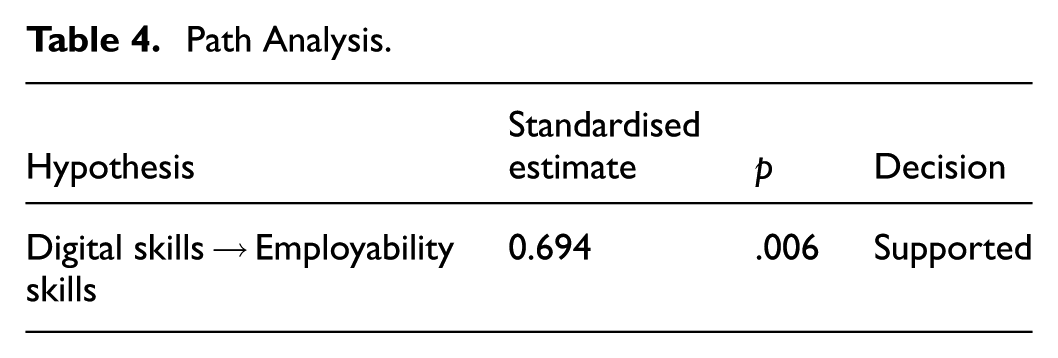
As can be seen in Table 4, the direct path coefficients showed significance in the relationships of digital skills → employability skills (β = .694, p < .05). As such, the hypothesis was fully supported. Digital skills (69.4%) described the variance in employability skills. Table 5 shows a view of complete statistics for the indirect effect of digital skills → emotional intelligence → employability skills; and the indirect effect of digital skills → sub-constructs of emotional intelligence → employability skills.
Bootstrapping for Indirect Effect.

Table 5 illustrates the association between digital skills and employability skills, which was fully mediated by emotional intelligence (β = .46, p < .05, 95% CI [0.32, 0.68]). Nonetheless, in separate tests, the researchers found the existence of partial mediating effect of emotional intelligence sub-construct. All the same, it was discovered that emotional intelligence’s indirect effect on the association between digital skills and employability skills continued to be significant. Moreover, there is a lack of studies implemented in the context of higher education students (see Sahudin, 2022; Sally et al., 2021). The current study offers a new insight to the existing body of knowledge. Partial mediating of emotional intelligence sub-construct was significant: (a) digital skills → PEK → employability skills (β = .29, p < .05, 95% CI [0.20, 0.38]), (b) digital skills → PEO → employability skills (β = .13, p < .05, [0.05, 0.23]), (c) digital skills → PE → employability skills (β = .24, p < .05, [0.13, 0.36]), and (d) digital skills → PI → employability skills (β = .15, p < .05, [0.04, 0.30]). As such, the hypothesis was fully accepted where there was a mediating effect of emotional intelligence between digital skills and employability skills, even though it generates different types of mediating effect.
Discussion
The findings indicated a positive association between digital skills and employability skills, in line with prior research (Bhatti et al., 2022; N. Chen et al., 2022; Chetty et al., 2018). One of the possible explanations is that digital skills have a significant function in forecasting employability skills, as people who are skilled in digital competencies demonstrate an enhanced capacity to navigate and contribute effectively in contemporary workplaces. The use of digital tools enhances technical expertise while also fostering adaptability, problem-solving abilities, and innovation, all of which are vital aspects of employability skills in today’s fast-changing workplace settings (Bondar et al., 2021). Additionally, digital skills empower individuals to communicate, collaborate, and efficiently manage information, thereby enhancing interpersonal and organisational abilities. This positive and significant association implies that higher levels of digital skills correlate with a better likelihood of possessing the diverse skill set essential for successful employment, establishing digital proficiency as a valuable predictor of overall employability skills. Another study highlighted that digital, global, and graduate skills are predictors of employment readiness, thus underscoring the multifaceted nature of skills necessary for employability (Bassah et al., 2023). This reinforces the importance of a comprehensive approach to skill development across various domains. Furthermore, the close association of digital skills with creativity and critical thinking (Kuntadi et al., 2022), emphasises their role in preparing students to adapt to technological advancements in the industry.
From the research, there is proof that emotional intelligence functions as a complete mediator between digital skills and employability skills. As such, this suggests that a strong level of emotional intelligence functions as the mechanism through which people with developed digital skills will tend to show increased employability skills. These results are in line with previous studies, such as Leila and Eldin’s study (2020), which acknowledged the role of emotional intelligence as a mediator. Emotional intelligence functions as a conduit through which digital skills affect a varied selection of professional competencies, including adaptability, interpersonal effectiveness, and problem-solving abilities. These competencies are vital in order for one to thrive in the current work environment. This unique combination focuses on the nuanced connection between these variables; as such, it emphasises the key function of emotional intelligence in closing the divide between technical proficiency and comprehensive employability. Additionally, emotional intelligence has been associated with certain competencies and outcomes related to employability, including self-efficacy, social skills, and job satisfaction among secondary education students (Salavera et al., 2017).
Nonetheless, in the context of the emotional intelligence sub-constructs, it was found that the mediating effect is not comprehensive but rather partial for each specific sub-construct. In alignment with this, the present study also revealed that self-emotion appraisal only partially mediates the association between digital skills and employability skills. The findings emphasise the need to consider factors related to self-emotion appraisal in the development of strategies targeted at enhancing students’ employability. The partial mediation of self-emotion appraisal in the link between digital skills and employability skills suggests that, while the capability to appraise and regulate one’s own emotions contributes to the impact of digital skills on employability, it does not encompass the entire influence. This is aligned with prior studies, indicating that self-emotion appraisal plays a mediating effect (Cece et al., 2020). People with advanced digital competencies are anticipated to possess heightened employability skills, and part of this association is elucidated by their proficiency in self-emotion appraisal. However, it is important to acknowledge that additional factors beyond self-emotion appraisal are likely playing a role in the observed connection linking digital skills and employability skills. This nuanced understanding implies that self-emotion appraisal functions as a mechanism through which digital skills influence employability skills but is not the sole determinant of this relationship. Furthermore, it is vital to recognise the key role of self-emotion appraisal, as it is a significant aspect of psychological health and emotional regulation, which affects other matters such as workplace conduct, coping strategies, and emotional reactions to stress and hardships (Ahmad et al., 2017). Its importance at the workplace is emphasised due to its status as a crucial predictor of resilience (Lee, 2023).
The recent investigation has brought to light that the evaluation of others’ emotions acts as a partial mediator in the intricate association between digital skills and employability skills. This discovery suggests that while the ability to assess and understand other people’s emotions contributes to explaining how digital skills enhance employability, it does not encompass the entirety of this impact. This is in line with previous studies which similarly identified self-emotion appraisal as having a mediating effect (Nguyen et al., 2022). More importantly, emotional appraisal has been identified as a significant predictor of career commitment and turnover intention, thus further highlighting its impact in professional contexts (Ahmad et al., 2017). In the case of people with advanced digital skills, a correlation with heightened employability skills is evident, and part of this connection is clarified by their adeptness in appraising and navigating the emotions of others. The significance of appraising others’ emotions extends beyond individual interactions, as it influences teamwork, communication, and overall collaborative effectiveness in professional environments (Kant, 2019). Recognising and incorporating these insights into strategies can contribute to the comprehensive enhancement of employability for individuals with advanced digital skills, emphasising the interpersonal and collaborative dimensions inherent in their skill set.
The findings highlight that the emotion regulation plays the function of a partial mediator in the intricate interplay linking digital skills and employability skills. This signifies that the intentional incorporation and adept management of emotions contribute to explaining how digital skills enhance overall employability. This is in line with earlier studies, such as the study by García-Selva et al. (2024), which demonstrated the significant mediating function of emotional intelligence in the association between employability skills and employer satisfaction, particularly within the context of recruiting fresh engineering graduates. Acknowledging and comprehending emotions play a pivotal role in dimensioning emotional experiences and bolstering reliability through sensemaking (Allen et al., 2014). Various modalities, including facial expressions, linguistic and acoustic features in speech, physiological parameters, and body movement, are essential for the nuanced recognition of emotions. The implications of our findings suggest that individuals equipped with advanced digital skills, who skillfully navigate and harness their emotions, are more likely to manifest heightened employability skills. This partial mediation underscores the notion that the deliberate use of emotions forms a crucial link connecting technical proficiency to broader employability competencies. Incorporating this understanding into professional development strategies holds the potential to enrich the comprehensive employability of individuals with advanced digital skills, underscoring the vital function of emotional intelligence in navigating the intricacies of the contemporary workplace. Furthermore, recognising the significance of emotion use extends beyond individual effectiveness, playing a vital role in fostering effective communication, collaboration, and overall success across diverse professional contexts. This multifaceted approach acknowledges the intricate interplay of technical skills and emotional intelligence in shaping a well-rounded and adaptable workforce for the challenges of the modern professional landscape.
The research emphasises the crucial function of emotion regulation as a partial mediator in the complex interaction between digital skills and employability skills, aligning with the results from prior research (Brindle et al., 2015; Sim & Zeman, 2005). This underscores the significance of understanding and regulating emotions in the context of both technical proficiency and broader employability competencies. Notably, emotion regulation skills have been recognised as important predictors of adherence to health guidelines, underscoring their relevance across various domains, including the employment landscape (Bailey et al., 2021). For instance, emotion regulation strategies mediated the pathways from positive and negative affect to depressive symptoms, emphasising the far-reaching impact of emotion regulation on mental health. Strategies such as reappraisal and suppression have vital functions in differentiating between healthy and unhealthy emotion regulation, influencing personality processes, individual differences, and life span development. Another potential reason is that emotion regulation is a complex process that includes the conscious or unconscious monitoring, evaluation, modulation, and management of emotional experiences and expressions (Panari et al., 2020). This encompasses the intensity, form, and duration of feelings, as well as the impact on emotion-related physiological states and behaviours. This multifaceted understanding of emotion regulation extends beyond its immediate implications for mental health to play a vital function in developing a person’s capacity to address the challenges of the workplace. Incorporating these insights into professional development strategies can contribute to the holistic development of individuals with advanced digital skills, emphasising the integral role of emotion regulation in both personal well-being and professional success.
Conclusion and Implication
The value of digital skills in increasing employability skills and the function of emotional intelligence as a primary mediating factor in this relationship are emphasised in the conclusion of the research. When assessed holistically, it is clear that emotional intelligence completely mediates the association between digital skills and employability. Nonetheless, its sub-constructs only partially mediate this relationship, thus signifying that different dimensions function in varying but complementary ways. More importantly, the control of emotions can be understood within a single framework of emotional management. Within this framework, the recognition, regulation, and intentional application of emotions function to enhance employability outcomes. Using this integrated perspective, emotional sub-constructs are observed as interconnected mechanisms which correspond to technical aptitude with adaptable workplace practices, instead of separate aspects. The development of this framework provides theoretical clarity and valuable suggestions to help upcoming professionals to develop their emotional and technology knowledge in rapidly changing disciplines.
The research presents a crucial contribution to the current body of knowledge and contains practical implications for academia and industry. As shown in the study, the positive correlation between digital skills and employability skills reinforces the literature on the important function of technological proficiency in improving overall employability skills. While the study establishes emotional intelligence as a complete mediator, the nuanced examination of its sub-constructs emphasises the need for an in-depth understanding of emotional intelligence dimensions in scholarly discussions. The identification of self-emotion appraisal and other emotional appraisal as partial mediators contributes to the literature by highlighting the nuanced emotional components influencing the digital skills-employability relationship. The emotion regulation, along with the recognition of emotion regulation as a partial mediator, advances the discourse on the intersection of emotional and technical skills, offering practical insights for both research and organisational practices. Realistically, these findings support a holistic approach to skills development, encouraging teachers and business proprietors to recognise and nurture the interconnectedness of digital proficiency, emotional intelligence, and effective emotion regulation to develop adaptable professionals in technology-driven industries, specifically among higher education students. The research emphasises critical considerations for designing higher education programmes which fulfil the evolving requirements of the job market for curriculum developers. Curricula should emphasise on the integration of digital skill development across various disciplines, thus ensuring that higher education students acquire the technical competencies necessary for success in modern workplaces. Moreover, curriculum developers should incorporate modules that delve into the specific dimensions of emotional intelligence, promoting a deeper awareness of its influence on employability for higher education students. Fundamentally, the study findings suggest a comprehensive approach to curriculum development, recognising the interrelationship between digital proficiency, emotional intelligence, and effective emotion regulation in preparing students as adaptable professionals for upcoming technology-driven industries.
Research Limitations and Future Suggestions
Like any research endeavour, our study has its set of limitations, and it is crucial to acknowledge and address these constraints to further refine other studies in the future. First of all, some hypotheses garnered full support from the researchers’ findings, while others may not have been entirely validated. It is plausible that variables like students’ knowledge, experience, and the depth of digital skills and emotional intelligence could hold greater significance in influencing employability skills. Other future research should explore more in detail to understand how these factors work together in the process to discover efficient techniques to improve employability skills. Secondly, even though the study uncovered correlations between variables, it is important to be remember that correlational studies do not establish causality. Due to the correlational design, it is difficult show a causal relationship between employability, emotional intelligence, and digital skills. The relationship which is being monitored may also be affected by reverse causality or unmeasured third-party factors, such as socioeconomic background or prior experience. As such, in order to simplify causal directions, researchers need to implement quasi-experimental designs in their forthcoming longitudinal or experimental studies; and they should also interpret the findings cautiously.
Thirdly, the research only involved public university students enrolled in higher education programmes. Therefore, the sample size was restricted to only 200 respondents. They comprised first to third year students of the agricultural education from their first to third year. The fourth year students were excluded. Even though the fourth-year students had completed their studies after the data had been acquired, the researchers believed that they had more mature skills (such as internship experience) and thus, they can be included in forthcoming research. Again, the respondents were selected from various states in Malaysia in order to have an equal representation of students from urban and rural environments (Nasir et al., 2022). The students’ main subjects in their academic backgrounds involved agricultural education. Such a restricted scope may have affected the results’ generalizability and reduced the model’s statistical power. As such, in order to improve the findings’ reliability and relevance, upcoming research should include more public universities and a more diverse students’ association. Even though the study results may be applicable to other fields, it is important to ascertain relevant application contexts, like the management of rural enterprise and agricultural technology promotion. The final aspect concerns a possible constraint regarding the reliance on self-reported measures, which may make certain biases or errors to be visible. The most effective way to assess digital and employability skills is by focusing on concrete evidence and observable behaviours. As a result, methods like studying or self-assessment may not always offer a true reflection of a person’s actual skill level or competence. Instead, direct observation of actions, results, or performance in real-world tasks tends to offer a much clearer and more objective measurement. To improve the validity of upcoming research results, researchers may find it beneficial to include objective measures or to employ numerous data sources. Objective measures, such as direct observation or physiological assessments, may offer more precise and dependable data. Using numerous data sources gives a complete view of the study phenomenon, thus capturing various aspects of the study construct. By implementing such approaches, researchers can increase the study results’ validity and reliability, making it possible for them to make more robust conclusions regarding the relationships between variables.
Footnotes

Ethical Considerations
The study had the permission from the Ethics Committee of Universiti Putra Malaysia (JKEUPM) to obtain a letter of permission to collect data with reference number (JKEUPM-2023-955)
Consent to Participate
All selected samples were given the written informed consent letter. After receiving confirmation from the researcher regarding complete confidentiality and the explicit clarification that their responses would be used exclusively for academic objectives, all 200 participants voluntarily participated in the study.
Author Contributions
The conception or design of the work: Muhammad Nurfirdaus Amran, Riyan Hidayat
The acquisition, analysis, or interpretation of data for the work;
Drafting the work or revising it critically for important intellectual content;
Funding
The authors disclosed receipt of the following financial support for the research, authorship, and/or publication of this article: This research received support from the Geran Putra Inisiatif (GPI) [grant numbers: 9796400].
Declaration of Conflicting Interests
The authors declared no potential conflicts of interest with respect to the research, authorship, and/or publication of this article.
Data Availability Statement
The datasets are available upon reasonable request from the corresponding author.