



Abstract
Human resource climate plays an important role in associating people with their organizations. However, there is a lack of empirical evidence about how faculty perceives components of the HR system, particularly in higher educational institutions. The aim of this paper is to explore the factors of HR climate and study their association with faculty retention in different Indian universities. The data for this study was collected through structured questionnaire administered to 306 faculty members of universities and their responses were analyzed using SPSS and AMOS. The results revealed that mentoring, professional development and compensation were perceived as major components of the HR climate. Of these three, mentoring and professional development played a significant role in predicting faculty retention. The post-hoc results showed that the factors varied in their significance according to the university type. These findings suggest that Indian universities lack a formal HR system and the need to integrate HR departments in the university environment is strongly recommended.
Keywords
Introduction
The Indian education system manifested its precedence with Nalanda and Taxila as coherent university structures given to the world but, to our dismay, India in terms of higher education system today lags behind and has been struggling to find a place in the top 100 of the world’s best universities (Banker & Bhal, 2020). Researchers have tried to define this institutional setting and reported that university is a community of people that facilitates sharing of knowledge and ideas. In comparison to other work structures, this formal setting finds its essence in being a socially integrated arrangement (August & Waltman, 2004). The concept further evolved to classify universities with distinguished features of academic freedom, ethical governance, excellent research productivity, funding from the state and adequate facilities with the status of “World Class Universities” (WCU) (Altbach, 2004; Banker & Bhal, 2020)
Higher education sector in India, governed by the University Grants Commission, Ministry of Education (Government of India), comprises five types of universities, namely, Central Universities, State Universities, Private Universities, Deemed to be Universities and Institutes of National Importance. With the advent of neoliberal policies in early 1990s, the growth of higher educational institutions has seen a tremendous rising curve, especially in the private sector (S. Raina, 2019). However, the rise in numbers has not equally contributed to faculty development. In the higher education ecosystem, faculties constitute a major element (EY-FICCI Report, 2021). Indian academics is characterized by job insecurity, incompatible salaries, lack of autonomy, high level of bureaucracy, minimum opportunities for faculty development, minimal involvement of faculty in decision making and much more (Altbach, 2014; K. Raina & Khatri, 2015).
The number of faculties in Indian universities has reached to 2.14 lakh and pupil–teacher ratio in the universities is 26:1 (All India Survey of Higher Education, 2020), which is comparatively lower in comparison to China (19:1) and the United States (14:1), indicating a shortage of faculty. A comparison of reports of All India Survey of Higher Education (AISHE) reveals that faculties in various universities have increased only by 24,000 on average a year whereas the number of student enrollment has increased by 12 lakhs. The problem of disengaged and demotivated faculty in higher educational institutions in India has been one of the most significant problems (Altbach, 2004; New Education Policy, 2020) that ultimately leads to faculty turnover.
We believe that these problems have hindered the path of Indian universities from becoming WCUs even as the knowledge economy is growing every day with increasing globalization. Researchers from every corner of the world, Western (Bozeman & Gaughan, 2011; Daly & Dee, 2006), Middle east (Ababneh, 2020; Allui & Sahni, 2016) and Asian (S. Ahmad & Shahzad, 2011; M. S. Ahmad et al., 2016; Nadarajah et al., 2012) have studied the rising problem of faculty turnover. However, Indian researchers have not studied this aspect comprehensively. Therefore, it becomes necessary to study what motivates and engages the Indian faculties. Using Strategic Human Resource Management (SHRM) as an explanatory lens, this study is an attempt to unfold the concept of HR climate in university settings. It aims to answer what constitutes HR climate in Indian universities by studying available policies, practices, programs, procedures which prevail in the universities and how these are perceived by the faculty. On identifying the factors that are perceived as significantly important by the faculty members, the authors of this paper further focus on the impact that these explored constructs have on the retention of faculty and, lastly, an attempt has been made to identify how explored HR climate factors vary in different types of Indian universities.
Theoretical Background and Review of Literature
This study is based on the organizational support theory (OST) (Eisenberger et al., 1986). The theory’s development has its roots in personifying organizations. When employees view the treatment they get from the organization as favorable, an attachment is developed and they reciprocate by related actions. This association contributes toward employee job satisfaction and organizational commitment which is called perceived organizational support (POS) under the OST. The theory is remarkable by its clear and empirically testable predictions related to antecedents (fairness, supervisor support, organizational rewards and job conditions) and outcomes (commitment, performance, reduced turnover, job involvement) (Figure 1) of POS (Rhoades & Eisenberger, 2002).

Organizational support theory antecedents and consequences (Rhoades & Eisenberger, 2002).
This study proposes that with a high POS, faculty members tend to develop greater identification with the institution and thus consider the HR climate to be favorable, which consequently influences their stay with the universities.
HR Climate
HR system has been a topic of extensive research both empirical and theoretical (Arthur & Boyles, 2007; Behravesh et al., 2020; Bowen & Ostroff, 2004). Focus has always been on the collective HR system of the organization to see its relevant impact on organizational and employee outcomes (Boon et al., 2011; Bowen & Ostroff, 2004; Ramsay et al., 2000; Truss, 2001). The HR system is basically composed of five components: HR principles, policies, programs, practices, and climate. HR principles refer to a set of values and norms being followed by individuals in the organization that drives employee performances (Arthur & Boyles, 2007; Becker & Gerhart, 1996). Policy dimension of the HR system emphasizes the objectives related to job design, recruitment, training and development, rewards and compensation developed by organizations for managing human resources. HR programs and practices refer to formal HR activities used in the organization to implement the policies; the only difference is that practices refer to the programs which are implemented by employees and lower-level staff (Arthur & Boyles, 2007).
This research focuses on the fifth component of the HR system, that is, the HR climate. The individual perceptions toward the HR programs, practices and policies that associate with the behavioral outcomes of the employees is called HR climate (Arthur & Boyles, 2007; Patterson et al., 2005). Further expanding on the concept, previous researchers also stated that these individual perceptions create a significant shared level of understanding amongst the employees to form the organizational-level HR climate (Ostroff & Bowen, 2000). When such individual perceptions are high in consensus, it is generally assumed that the organization has a strong HR climate and vice-versa (Bowen & Ostroff, 2004). It has also been observed that the definition of HR climate as shared individual perceptions agrees with the broad definitions of organizational climate (Jones & James, 1979; Schneider, 2000), signifying that HR climate is a part of the organizational climate.
HR system is basically contemplated into documents, but it is the perceptions of the employees for whom these practices are devised that affect their fit and outcomes in the organization (Wright & Nishii, 2013). Also, with the increase in the potency of components of an HR system, the HR system tends to function well and therefore such climate if developed (Jensen et al., 2013; Jiang et al., 2017) would help employees to become innovative, more productive and engaged (Lockwood, 2007). Management systems that focus on employee compensation policies, selection processes, performance appraisals practices, career management programs and professional development programs have engaged employees in return who are less likely to leave the organization (Alfes et al., 2013; Juhdi et al., 2013; Kehoe & Wright, 2013; Ramsay et al., 2000; Sanders et al., 2014).
The researchers highlight the role of HR department in building a strong HR system for the organizations. When the HR department professionals work with the heads of other departments, building trust-based relationships, it paves the way for an increased number of opportunities to form a robust climate (Kim & Ryu, 2011). Human capital has been acknowledged as an important organizational resource that enhances the position of the organization in society and drives it for competition. The current and advanced HR department is not only concerned with the conventional practices related to training, selection, compensation and performance appraisal; HR systems in today’s dynamic and competitive environments ensure that employees have the necessary potential and capabilities to perform their work (Appelbaum et al., 2000). Participation practices, job designs, decentralization and delegation, knowledge and information sharing, teamwork and problem solving groups are some of the few dimensions of advanced HR systems devised by HR offices contribute toward organizational competitiveness (Appelbaum et al., 2000; Barney & Wright, 1998; Guthrie, 2001; Op de Beeck et al., 2018).The role of HR department has also been found significant in influencing commitment of the employees toward organization ( Gilbert et al., 2011; Paré & Tremblay, 2007).
Employee Retention
Retaining employee in the organization is one the primary concerns of management. Organizations in today’s globalized era that fail to retain their human resources face hindrances in today’s competitive environment (Rappaport et al., 2003). Lockwood (2006) has defined employee retention as “the implementation of integrated strategies or systems designed to increase workplace productivity by developing improved processes for attracting, developing, retaining, and utilizing people with the required skills and aptitude to meet current and future business needs.” The definition clearly states the importance of organization’s systems in retention of employees. Employee turnover is a problem of every sector and has been researched extensively. Number of studies in various sectors has tried to understand the antecedents that contribute to an employee’s making the decision whether to stay with the organization or leave. Bartram et al. (2004) studied that the empowerment of nurses and social support from society significantly contributed to their job satisfaction and retention. A similar study in health sector was done by Katz et al. (2010) found that American nurses resort to turnover mainly because of three factors. Firstly, when they don’t feel valued in the organization followed by excessive working hours and lastly, poor administrative support. Health staff uses independent judgment while working and their commitment toward society is associated with their retention.
Fahim (2019) researched on human resource practices in the public sector organizations of Egypt and found that best HRM practices have been strongly associated with the turnover and retention decisions of employees. Modau et al. (2018) found similar results while studying employees’ attitude in South African call centers, research revealed that compensation contributes maximum toward employee retention followed by career advancement, work-life balance, and lastly supervisor support. Employee retention is also influenced by social relationships that employees form at workplaces. Alhmoud and Rjoub (2019) found extrinsic, intrinsic as well as social rewards to be significantly associated with the retention of Islamic bank employees in Jordan. Social relationships with the employees emerged as the major predictor of their retention. Similar research in Lebanon private businesses supported informal relationships, fun events at work place, and support of fun managers acted as antecedents of personnel retention (Ushakov & Shatila, 2021). Even in the manufacturing and extraction industries a culturally safe workplace, support mechanisms, and adequate professional development opportunities have been found to be as key retention factors (Khalid & Nawab, 2018; Parmenter & Barnes, 2021). Retention of human resources in every sector is important as the loss of employee leads to loss of expertise, workflow disruption, and direct as well as indirect costs (Brandt et al., 2016; Ramlall, 2004).
Higher Educational Settings
Faculty Retention
Higher education is one of the sectors that face the challenges of turnover. Retaining faculty is one the most challenging tasks that Higher Educational Institutions (HEIs) are dealing today (Ababneh, 2020; J. M. Pandit & Paul, 2021). Costs related to recruiting, selection, training of new faculty members and decreased morale, reduced productivity, disruption of course offering, etc. are the negative consequences associated with turnover of faculty (Daly & Dee, 2006; Lawrence et al., 2014). Like employee turnover in the above section faculty turnover and retention can also be attributed to various factors such as demographic characteristics, institutional framework, administrative support, class size, quality of students, learning and development policies, compensation benefits, promotional and advancement opportunities, career progression, job satisfaction, organizational climate, supervisory support, work-life balance, organizational culture and lastly HR practices etc. (Ababneh, 2020; Akhtar et al., 2015; Albalas et al., 2019; Daly & Dee, 2006; Grobler & Rensburg, 2019; Johnsrud & Rosser, 2002; Mashile et al., 2021; Sturges & Guest, 2001).
An interesting research by McMurray and Scott (2013) revealed the determinants of organizational climate for faculty, four dimensions: trust, support, fairness, and innovation affect attitudes of academia when they work in the institution. Campus climate can be improved with the help of faculty development and retention programs which contains elements of Mentorship, motivation, autonomy, voice raising and say in the decisions of university leadership helps new joined to maintain and support their intent to stay (Piercy et al., 2005). Hasanur Raihan Joarder et al. (2020) studied HR practices in Bangladesh HEIs, research revealed inadequate training and development opportunities, inequitable compensation structure, and lack of supervision has led faculty to leave the institution. A study from Pakistan also tested the impact of HR practices on faculty outcomes (emotional exhaustion and quit intentions) mediated by person-organization fit. The results showed that HR practices help in building consensus with university values and goals, ultimately contributing to faculty retention (Siyal et al., 2020).
Workload inequity amongst faculty has also been found to be significantly associated with their job satisfaction, burnout as well as retention (Barmby, 2006; Latimer et al., 2014; O’Meara, Lennartz et al., 2019; Perryman & Calvert, 2020; Watts & Robertson, 2011). One recent research from Pakistan studied employee retention in different sectors and found that delegative as well as consultative faculty participation in decision making influences their decisions to remain in the institution (Khalid & Nawab, 2018). New factors are emerging in the recent era such as institutional ranking as well as its reputation in the society also affecting faculty retention decisions. Matongolo et al. (2018) study found employer branding and people-oriented strategies motivate faculty to stay with the universities, as staff finds their competencies are valued and they aim for a better future within the same organization.
Researchers have stated the importance of an individual’s personality traits toward their retention. Jeswani and Dave (2012) conducted a study in technical institutes in India with five antecedents of human personality and found that extraversion and agreeableness are positively related to retention of academia. Senior staff acts as leaders in the higher educational settings so their leadership styles also acts as a significant cause in faculty continuance decisions for their career. A study in Ghana by Semarco and Cho (2018) from 279 head staff showed that monitoring, problem-solving behaviors, and clarifying attitudes influenced their planning activities, also planning activity significantly impacted retention of junior staff. Similar results were reported when junior medical faculty in Canada also indicated that their commitment to institution increases by having senior faculty as their role models (Steele et al., 2013). Another study by M. S. Ahmad et al. (2016) studied the difference in HR practices in public and private sector universities and found compensation to be a non-significant predictor of faculty retention in case of private sector universities and argued that management styles and leadership styles had a greater impact.
Retention of faculty as discussed is a complex phenomenon, Anderson and Gladwell (2004) conducted a study at the University of North Carolina, Greensboro, and identified factors that are in control of the departmental chair and vice-versa. Results indicated that faculty intent to stay is more attributed to those factors which are controlled by the departmental head. Departmental climate, curriculum setting, and skill development positively contributed to the retention of faculty.
Presence of HR Systems in Universities
In the context of education, for a number of years, there had been a lack of clarity on the conceptualization of HR climate. Studies related to the role of HR and universities, however, are thriving (Amin et al., 2014; J. M. Pandit & Paul, 2021). HR practices related to recruitment, training, performance appraisal, employee participation, career planning, job definition and compensation are positively related to university performance, faculty performance and their career development (S. Ahmad & Shahzad, 2011; Amin et al., 2014; Nadarajah et al., 2012).
Researchers have contrasting views in relation to presence of HR department in university settings. Researchers argue that university environment is different from corporate environment. The inclusion of formal HR offices has been denounced in several studies in higher education context. There is no stipulation to have formal HR offices, as universities are more collegial structures where there is a free transfer of knowledge and it is perceived that presence of formal HR systems erodes this freedom (Edgley-Pyshorn & Huisman, 2011). van Den Brink et al. (2013) in their study also opined that formal HR systems are more professional in their approach due to protocols related to recruitment and selection of staff while academicians find these systems as time consuming and more bureaucratic. On the flip side, Alqahtani and Ayentimi (2021) found that HR department functions are performed by the faculty deans, which led to loss of importance, validity and status of HR offices, ultimately limiting the progression of Strategic Human Resource Management (SHRM) in universities.
The Indian Scenario
India is a developing nation having one of the largest higher education systems after United states and China. Satisfied faculties and best students have always been the traits of World Class Universities (Salmi, 2009). Developing countries like India where academia should be having vast opportunities in their career is witnessing a major problem of brain drain as the status and paying capacity of Indian HEIs are deteriorating day by day (Banker & Bhal, 2020; Teferra & Altbachl, 2004). Also in one report by Klynveld Peat Marwick Goerdeler (KPMG) has highlighted the matter of faculty turnover in India and found that commitment of academia is compromised for better quality jobs in the multi-national firms (Maheshwari, 2014; Rumbley et al., 2008).
As far as Indian central and state universities are concerned, the strategic and key decisions (pay revisions, infrastructure development, recruitment and selection, expansion, faculty development) lie with the central and state governments (S. Raina, 2019) while these decisions in private and deemed universities are mainly fragmented by university administrators such as vice chancellors, registrars and establishment sections (Altbach, 2014; J. Pandit, 2022). In recent years government of India has substantially increased the compensation packages of academia with the help of various pay commissions, recruitment, and career progression procedures have also been systematized ensuring equitable representation of the members of society (New Education Policy, 2020). Whereas, private institutions are concerned they do not have comparative paying scales as they’re not funded by the government (Indiresan, 2007).
Despite various improvements for uplifting the status of Indian academia as a career choice faculties are still lacking motivation in terms of research as well as teaching, thereby institutions facing the problems of faculty turnover and disengaged faculty (Banker & Bhal, 2020; Indiresan, 2007; New Education Policy, 2020; K. Raina & Khatri, 2015). There’s a strong need to ensure which factors are considered significant by the faculty in different types of universities that affect their job and commitment level (New Education Policy, 2020; K. Raina & Khatri, 2015;).
Formal HR systems and related offices are not present Indian universities but policies, practices, procedures and programs for faculty and non-teaching staff do exist. Therefore it is apparent that there is an HR climate, formed by the shared perceptions of university staff, present in all universities. Since the components of an HR system in the education sector are not clearly defined in the literature in Indian context. Therefore, the researchers consulted Indian higher education experts as well as enrolled faculties of different types of universities to enlist the available components.(Table 1).
The Components of an HR System in India.

Research Gaps
Based on literature and findings of previous studies the authors have found certain gaps. Firstly, there is a knowledge gap in the prior research concerning HR Climate in Indian university settings (R. L. Jacobs, 2011; Miles, 2017; Muller-Bloch & Kranz, 2014). This encompasses several unexplored dimensions in the concerned area that lately have attracted research attention in recent years (J. M. Pandit & Paul, 2021). This study also addresses the empirical gap, as no study to date has directly attempted to explore the factors of HR Climate perceived by faculty and its relationship with faculty retention, also how these explored factors are significantly different in various types of HEIs in India (R. L. Jacobs, 2011; Miles, 2017; Muller-Bloch & Kranz, 2014). Also, this study has used OST as a theoretical base for this research. Earlier studies have mainly concentrated on expectancy theory while studying faculty turnover (Ababneh, 2020; Daly & Dee, 2006), which was worthy of recognition. Applying OST in the current study has generated new insights based on consequences and antecedents of perceived organizational support (R. L. Jacobs, 2011; Miles, 2017; Muller-Bloch & Kranz, 2014).
This study is an attempt to fill these gaps by evaluating the perceptions of faculty regarding various components of HRM in the Indian higher education sector, specifically in university settings.
Research Questions
Based on the literature and the research gap, this study seeks answers to the following research questions:
Which factors of HR climate are perceived significant by the faculty at work?
How the explored factors are significantly different in various types of universities?
How the explored factors influence faculty retention ?
Research Methodology
Data Collection and Sampling
The target participants of the study were faculty members employed at the university level in various departments. As per the UGC statistics (All India Survey of Higher Education, 2020), there are 30 universities in Punjab and Chandigarh., on an average there are 150 faculty members as per the website of different HEIs which were formed part of the sample. We considered 14 universities, comprising all types (one central, three state, eight private and two deemed to be) in our sample with faculty of three departments: management/commerce, engineering/applied sciences and social sciences and humanities. A pilot survey was done based on small sample criteria given by Hertzog (2008) to check the designed instrument’s reliability. Faculty of 25 from each type of university was selected for the pilot survey. Thus, a total of 100 faculties filled out the questionnaire and the reliability scores were calculated. Cronbach’s Alpha for HR Climate was .88 and faculty retention .72 which represented generally acceptable value >.7 (Hertzog, 2008). Since this study has used the self-designed instrument from various sources therefore the participants of the pilot study were not made part of the final sample (Peat et al., 2001). As the reliability statistics were in the acceptable range therefore the instrument was considered for final study. Face validation of the designed instrument was carried out by academicians from various universities. The respondents were informed about the purpose of the study and the confidentiality of their responses was assured. In the selected 14 universities approximately2,100 (14 × 150) faculty members formed the target population. Further, 700 questionnaires in total were distributed (50 per university) using stratified random sampling each strata forming one type of university. Out of 700 distributed questionnaires 350 were distributed physically and the rest 350 were targeted through electronic mode via google forms. From the physical mode, 204 responses were received (58.2% response rate) and 107 responses were web-based (30.6% response rate). Thus, 311 responses were received combining both electronic and physical modes which formed an overall 44.4% response rate. Although the response rate of 50% was considered an acceptable response rate, it has been found that online surveys are recognized to achieve much lower response rates than paper-based surveys (Nair et al., 2005; Nulty, 2008). It took 4 months (December 2020 to March 2021) to distribute the survey form physically, and electronically along with sending reminders and finally collecting the hard copies of the questionnaire. Following the strategies for determining the sample size provided by Israel (1992), we used a similar sample size as those of earlier studies conducted in the same context (Siyal et al., 2020). Of the received responses, five were excluded as outliers as they were unengaged responses (Osborne & Overbay, 2004). Finally 306 responses were considered for analysis.
Development of Instrument
The questionnaire used in the study to measure HR climate and faculty retention was adapted from various sources. Description of sources of items and their reliability statistics are provided in Tables 2 and 3. Respondents were asked to provide ratings on a five-point Likert scale ranging from 1 (Strongly disagree) to 5 (Strongly agree). Demographic variables related to faculty designation, university type, gender and tenure are considered for the study.
Reliability Statistics and Sources of HR Climate Instrument.

Reliability Statistics and Sources of Faculty Retention Instrument.

HR Climate
To measure the faculty perception of HR climate, 43 items were constructed. The measures were adapted from several existing measurement scales framed by various researchers. For intra-department faculty interactions, items (e.g., You can rely on your colleagues when things get tough on your job) were adapted from the Collaborative on academic careers in higher education (2005), Ababneh (2020) and Daly and Dee (2006). Szromek and Wolniak (2020) and Wood (1976) addressed various problems related to academic staff in their research, which too has been utilized here. As departmental communication, collaboration and communities of practice constitute an integral part of a university climate (Patton & Parker, 2017), items related to research and developmental facilities (e.g., You are able to access online journals/databases through university library) were adapted. The measurement indicator used by Payne and Pheysey (1971) was used in our study to quantitatively reflect similar aspects of communication (e.g., Your university has a smooth and efficient downward flow of communication). The role of university administration and management as perceived by the faculty was estimated by using the comprehensive set of items derived from Schulze (2007), Juhdi et al. (2013) and Muindi (2011); (e.g., Your university has a reputation for being indifferent to the needs of the wider community. (Ex. Community engagement in solving social issues)). Perceived value of monetary and fringe benefits (e.g., Your university provides you with attractive fringe benefits over and above your salary (health insurance, retirement plan contributions, etc.)) also formed a part of our survey instrument (Collaborative on academic careers in higher education, 2005; Heneman & Schwab, 1985; Schulze, 2007). Two items (Your institute/university provides assistance for your career advancement at regular intervals as recommended by UGC (University Grants Commission), Your institute/university has smooth and efficient flow of upward communication) were framed by the researchers with the help of experts.
Faculty Retention
From the previous literature concerning employee retention, a 10-item scale was constructed. Mashile et al. (2021) studied the turnover intentions amongst academicians in relation to organizational culture. The researcher used the 14-item scale developed by E. Jacobs and Roodt (2008) in the university context. In this study, four items concerning the faculty intention to stay or leave were considered. For example, “You frequently scan newspapers for alternate job opportunities.” Further, three items were adapted from the Allen and Meyer (1996) scale. Meyer and Allen (1991) has three dimensions: affective, continuance and normative. “‘Affective commitment is defined as an emotional attachment to an organization characterized by acceptance of organizational values and by the willingness to remain with the organization’” (Somers, 1995). Since willingness to stay with the organization forms a significant part therefore, Allen and Meyer (1996) organizational commitment scale was referred. These items represented the fidelity of employees toward their organization. For example, “It would take very little change in your present circumstances to cause you to leave this university.” Remaining three items were extracted from the scale developed by Ababneh (2020).
Data Analysis Strategy
Reliability
After collection and screening of the data, internal consistency of the constructs was calculated using SPSS version 22. Reliability was examined by applying Cronbach’s alpha, and the value of .952 and .78 for HR climate and faculty retention respectively were achieved, which are consistent with previous studies (M. S. Ahmad et al., 2016; Amin et al., 2014; Siyal et al., 2020).
To empirically examine the perceptions of faculty about the HR climate, exploratory factor analysis (EFA) and confirmatory factor analysis (CFA) were conducted. Amos version 23 was used to validate the components extracted from EFA. The sample of 306 responses was split into two data sets of 156 and 150 responses respectively. Following the factor analyzes, multiple regression analysis was conducted to examine the relationship between HR climate and faculty retention.
Results
Analysis of the Demographic Variables
7The demographic variables are illustrated in Table 4. Of the 306 respondents, 54.2% were males. The sample consisted largely of assistant professors, nearly 72%, whereas professors and associate professors collectively formed 28%. The distribution clearly reflected the presence of assistant professors large in number as also reported by the (All India Survey of Higher Education, 2020). The responses received were highest from the faculty of state universities, comprising 44.7% of the data. Also, the data was dominated by the full-time faculty with the number of 195 in comparison to part-time which was 111 in total.
Demographic Characteristics of the Respondents.

Study 1
Study 1 discovers the factors related to HR climate by using EFA (DeCoster, 1998), since no previous literature provides a clear picture about the components of HR climate with respect to Indian faculty.
EFA was conducted on 43 items from data set 1 (156 respondents) (Table 6) to examine the underlying factor structure of HR climate perceived by faculty. The 43 items represented the various dimensions of the work environment in the university setting. EFA reduces the dimensionality by combining the variables that share a common variance and are unobservable. This technique involves reduction of measurable and observable variables into fewer numbers of latent variables (Bartholomew et al., 2011).
We opted for principal component analysis (PCA), Principal Component Analysis analyzes the whole correlation matrix and the PCA technique uses the original data set and preserves as much information as possible (Norris & Lecavalier, 2010), PCA technique is best suited when the extracted components are not correlated (Yong & Pearce, 2013). In the current study, the observed correlation between the components was less than .32 therefore Varimax rotation was used to extract the factors (Tabachnick & Fidell, 2013).
According to Beavers et al. (2013), if the components have four or more items with loadings of 0.60 or higher, then the size of the sample is not relevant. Further, Fabrigar et al. (1999) and MacCallum et al. (2001) have also stated that weaker relations (0.40 or less) require large sample sizes. In our study, all items in the respective components have loadings higher than 0.60 therefore, sample size of 156 was considered adequate to conduct EFA. Also, the KMO was reported 0.906, which also indicated sample adequacy. Bartlett’s test of sphericity was also significant (χ2 = 5451.540; df = 903, p < = .05), indicating a strong relationship among variables (Yong & Pearce, 2013). There are several criteria to decide the number of components to be retained. This study follows the criteria given by Kaiser (1960) that specifies to retain all components with the eigenvalue greater than 1. The coefficients for items are displayed by size, with numbers <0.060 being suppressed (Chin et al., 1997).
Parallel analysis was also applied in determining the number of components extracted. The parallel analysis calculates random eigenvalues besides actual data with the help of the Monte Carlo Simulation Technique. For the current study, the Eigen values of actual as well as simulated data are presented in Table 5.
Eigen Values of the Actual Data and Simulative Data.
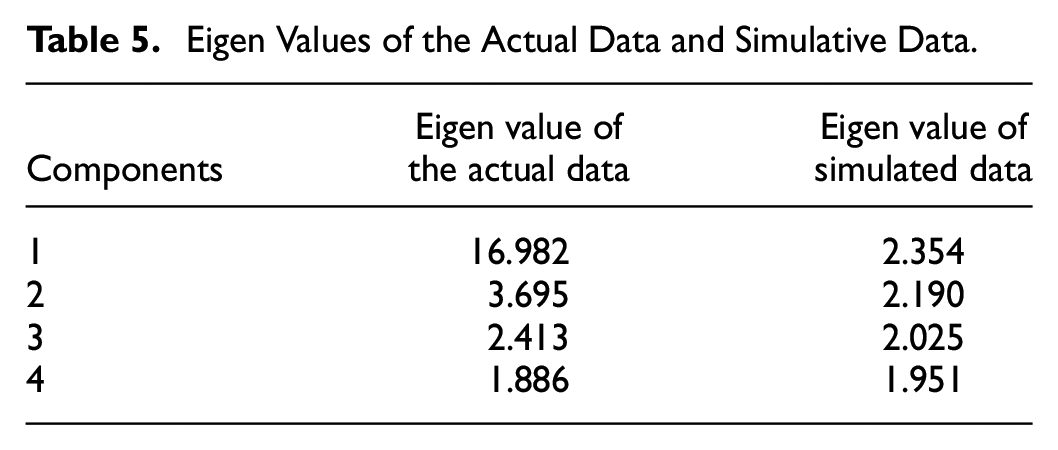
After examining the Table 5, it was observed that the eigenvalue of the first, second and third components in the actual data was higher than that of simulated data. When we shifted from the third component to the fourth the case was different and thus the number of the components extraction was restricted to 3 because the eigenvalue of the simulated data was found to be higher than the actual data (Cokluk & Koçak, 2016).
Three components containing 19 items were retained and named as mentoring, professional development, and compensation. These components explained the variance up to 53.69%, meeting the threshold of at least 50% of the cumulative variance to be explained by the extracted factors (Merenda, 1997). To address common method variance the researchers have used Harman’s Single factor test (Harman, 1960). Harman’s single factor estimated the shared variance between HR Climate items as only 39%, which is below the classic threshold of 50% (Harman, 1960), suggesting that common method bias is not present. The reliability of the extracted components was measured with Cronbach’s alpha, where all three factors scored above 0.70. (Table 6).
EFA Pattern Coefficient Matrix of the Three-Component Solution of HR Climate Items (N = 156).

Study 2
Study 2 was conducted on data set 2 (150 respondents) employing CFA to cross-validate the EFA structure from study 1. CFA was performed using maximum likelihood estimation (Byrne, 2005) on the second data set (n = 156) to test the validity of the factor structure identified by EFA. Boomsma (1985) too validated the use of the maximum likelihood approach in CFA for even a smaller sample size of 100, when the indicators obtained per factor are four or more (Table 3). The normality of the data was tested using Kolmogorov-Smirnov (K-S) and Shapiro-Wilk (S-W) tests. These tests reported p < .05 depicting non-normality. Due to the limitation of sample size, asymptotically distribution-free estimation has not been used to deal with non-normality as it requires a minimum sample of 200 (Walker & Smith, 2017). Therefore, we applied the Bollen-Stine (Bollen & Stine, 1992) bootstrap procedure, which repeatedly simulates the samples to produce an empirical distribution of the chi-square values from the covariance-matrix implied by the model (Nevitt & Hancock, 2001).
A first order CFA was performed with three latent variables and 19 observed items. Upon first analysis, the indices of the three-factor model yielded these results (root mean square error of approximation [RMSEA] =0.109; standardized root mean square residual [SRMR] =0.091; comparative fit index [CFI] =0.856). Thus, to overcome the discrepancies in the model, error terms between the items were allowed to covary. Two error terms between the items within mentoring and professional development and four error terms within the compensation factor that crossed the threshold of four according to the modification indices were covaried. The output was then checked to evaluate the standardized residuals covariance matrix. According to Joreskog and Sörbom (1993) values >2.58 are considerably large and reflect a significant discrepancy with the covariances in items. Therefore, four items (HR12, HR7, HR9, and HR42) were removed from the analysis.
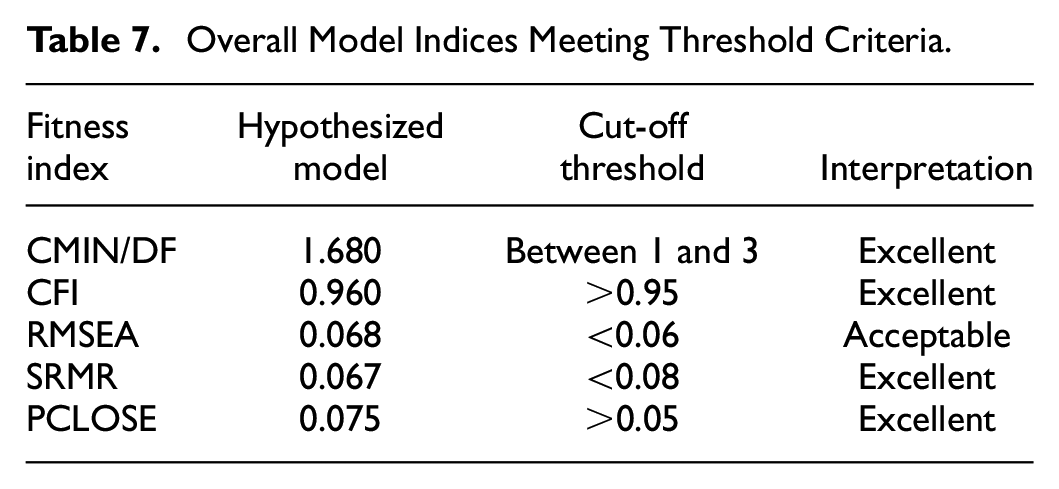
CFA was then rerun on the remaining 15 items (Figure 2). The standard chi-square reported the value of χ2 = 137.740, p = .000. Since the standard chi-square is not a reliable indicator of the adequacy of a model, as it is sensitive to large sample sizes, relative chi-square fit index was considered (Byrne, 2005; Hung et al., 2015; Ullman, 2001). Relative chi-square fit index for the hypothesized model reached the recommended threshold, χ2/df = 1.680. The “goodness of fit indices” were also found in the acceptable range (χ2 = 137.740, p = .000; CFI = .960; SRMR = .067; RMSEA = .068; PCLOSE = .075) (Table 7), suggesting a good fit between the hypothesized model and the observed data (Hu & Bentler, 1999). Conducting a Bollen-Stine procedure with 2000 bootstrap samples, which is normally recommended by statisticians, yielded p = .079, signifying that the model fit was acceptable using non-normal data (Enders, 2002; Walker & Smith, 2017).
Overall Model Indices Meeting Threshold Criteria.

CFA simple structure with standardized factor loadings (N = 150).
In this study, convergent and discriminant validities of the constructs were assessed through CFA. The construct validity was examined by the analysis of item and domain correlations (Skevington et al., 2004), which showed that the items correlated significantly with their own domain and no item was found to correlate strongly with other domains. Discriminant validity is based on inter-construct correlations. Correlation coefficients were high and ranged between .710 and .906 in the Mentoring domain, from .727 to .833 in the Professional Development domain and from .544 to .778 in Compensation domain. To calculate convergent validity, the composite reliability (CR), item loadings and average variance extracted (AVE) for each indicator was determined. The obtained values exceeded the threshold values of 0.5, as listed in (Table 8) (Fornell & Larcker, 1981). All items consistently supported the hypothesized constructs. Fornell and Larcker (1981) gave the criteria in which AVE of the constructs needs to be larger than the shared variance between the constructs (Table 9). The AVE of the three constructs was found greater than the shared variance, indicating discriminant validity of each construct. Validity of faculty retention was also tested, composite reliability came out to be 0.861 and AVE was 0.676, satisfying the recommended threshold criteria (Fornell & Larcker, 1981).
Factor Loadings, Convergent Validity, Reliability and Descriptive Statistics.

Discriminant Validity.

p < .010. ***p < .001.
Validity of Instrument as Per Standards for Educational and Psychological Testing
The validity of the designed instrument was also evaluated using widely used measure of Standards for Educational and Psychological Testing SEPT (American Educational Research Association, American Psychological Association, and National Council on Measurement in Education, 2014; Sireci & Soto, 2016; Sun et al., 2022). In the current research validity was assessed using five sources provided in the latest version of SEPT (American Educational Research Association, American Psychological Association, and National Council on Measurement in Education, 2014) (Table 10).
Validity of the Research Instrument as per SEPT.

Kruskal-Wallis Test
The dependence of parametric tests on the assumption of normality and homogeneity of variances made the researchers to use the non-parametric test. Since the data under study is non-normal and did not meet the required assumptions to study the significant differences of the dimensions of HR climate across various categories of Indian universities, non-parametric equivalent of ANOVA (the Kruskal-Wallis Test) was used (Field, 2013). The results in Table 11 show that all three confirmed factors were significantly different across the four types of universities.
Mean Ranks of the Categories of Universities and Results from Kruskal-Wallis Test.

Significant at p < .005.
From the post-hoc pairwise comparison, some interesting results were revealed (last column, Table 11). In terms of mentoring, the government owned universities (central and state) showed significant differences from that of universities controlled by administrators privately (private and deemed to be university). For professional development, deemed to be university was noticeably different from central and private universities. All universities were found to be significantly different in terms of compensation.
Multiple Regression Analysis
To explore the joint association between faculty retention and the factors of HR climate, multiple regression analysis was conducted (Table 12). In multiple regression analysis, the explained variance (R-square) was 14.4%, F(3,302) = 16.868, p < .05. The standardized regression coefficients ranged from 0.069 to 0.215. Mentoring was found to be strongly associated (p < .05) with faculty retention, followed by professional development (β = .174, p < .05). The association between compensation and faculty retention was statistically non-significant. This suggests that mentoring and professional development are significant independent predictors of faculty retention. The assumptions related to multiple regression analysis were met and multi-collinearity between the predictor variables was examined based on VIF < 5 and tolerance >0.20, successfully indicating no multi-collinearity. The assumption of normality of residuals to conduct multiple regression was met.
Multiple Regression Predicting Faculty Retention from the HR Climate Factors.
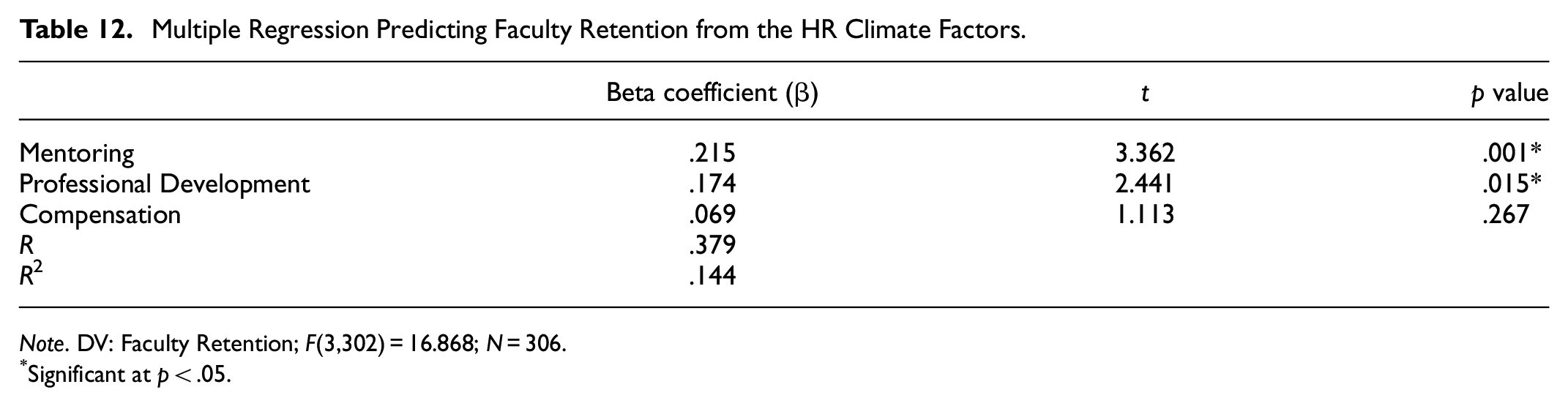
Note. DV: Faculty Retention; F(3,302) = 16.868; N = 306.
Significant at p < .05.
Discussion and Implications
This research explored the association of HR climate with faculty retention and how the explored HR Climate components vary in different types of HEIs. We have advanced the understanding of the concept of HR climate in the higher education sector by exploring the factors of HR system in general. Three components emerged from the data analysis: (a) mentoring, (b) professional development, and (c) compensation. Also, the results of multiple regression analysis provided a strong indication that the first two HR climate components were significant predictors of faculty retention, marking answers to the first and third research questions of the study. The sample of the current study has included all types of universities which exist in Indian Higher Educational Settings as per the University Grants Commission, Government of India. Researchers have made an effort to include academia working at each level from different departments, therefore, representing the overall population and making the results of the study generalizable.
Mentoring, as an HR practice, is the process of providing guidance, advice and support by experienced resource persons to the employees in order to help them learn and progress (Armstrong & Taylor, 2020). In higher education, to support the faculty in acquiring proficiency and building their work relationships and careers, effective mentoring programs are necessary (Bean et al., 2014; Mayer et al., 2014; Tareef, 2013; Varkey et al., 2012). Supervisor mentoring emerged as a preferred form of all mentoring embodiments that influence employee job outcomes related to job satisfaction, organizational commitment and intention to leave (Raabe & Beehr, 2003; Scandura & Williams, 2004). Previous studies (Bland et al., 2009; Falzarano & Zipp, 2012; Gwyn, 2011; Lynch et al., 2017; McKinley, 2004; Steele et al., 2013) support our results reflecting significant positive relationship between mentoring and retention of faculty.
Professional development of the faculty came out to be the next significant construct with respect to faculty retention. Professional development is the process that contributes to the learners’ development by empowering them with the consolidation of learning and work (Armstrong & Taylor, 2020). It benefits the individuals by allowing them to enhance their self-development and career advancement, and in improving their professional standing. It simultaneously allows organizations to be benefited by the enhanced individual abilities in achieving the organizational goals and objectives (Armstrong & Taylor, 2020).
In this study, items related to research support, communities of practice, collaboration and communication emerged as the major premises of professional development that significantly contribute toward faculty retention (Baker, 2010; Eagan & Garvey, 2015; O’Meara, Nyunt et al., 2019) in line with previous studies (Caffarella & Zinn, 1999; Kennedy, 2005; Power et al., 2018; Shagrir, 2017).
Compensation refers to financial and non-financial rewards provided to the workforce in return for the tasks performed by them. Compensation in general is a wider concept in comparison to salary. It consists of commission, fringe benefits, bonuses, reimbursements, allowances, perquisites, incentives, etc. Compensation, generally, has been found to be positively related to faculty retention (Ababneh, 2020; M. S. Ahmad et al., 2016; Gonzalez et al., 2015; Rumbley et al., 2008). Initially, we expected compensation to emerge as a significant predictor of faculty retention; however, to our surprise, the results were largely unexpected. It was interpreted that compensation did not play a key role in the retention of faculty. Several researchers have also found consistent results in this respect (Eisenberger et al., 1997, 2002; Manger & Eikeland, 1990; Samuel & Chipunza, 2013). Emergence of compensation as an insignificant predictor of faculty retention can be attributed to various constructive steps taken by the government of India (in case of the central and state universities) and administrators (for private and deemed universities) in the recent past with regard to salaries and other related benefits (New Education Policy, 2020).
The results of this study show that 53.69% if the variance regarding faculty retention can be explained by the HR climate factors, which signifies that a strong HR system, especially mentoring, in the university context plays a pivotal role in retaining faculty.
Post-hoc Results Discussion
The answer to our second research question is provided in this section. The post-hoc analysis (Table 11) depicted that mentoring in government-owned universities (central and state universities) was better than in the universities controlled by administrators privately (private and deemed to be universities). This can be attributed to the ongoing deprofessionalization process in the privately-owned Indian universities that function on the motivation of earning money, absence of academic freedom and authoritarian management styles (S. Raina, 2019). The post-hoc results in relation to professional development portray that deemed to be universities were significantly different from central and private universities. Ascribing to the eligibility criteria as specified by the University Grant Commission with respect to the deemed to be universities, the research done by faculty members of such universities has been given supreme importance and therefore it is interpreted that the professional development particularly in such universities is of greater quality and more satisfactory to the employees in comparison to other universities (The Gazette of India, 2019).
Lastly, compensation was found to be significantly different among most of the university types. This might be due to the different compensation policies followed by different university types. The central and state governments of India implement their own pay commissions in central and state universities respectively while private and deemed to be universities follow a self-regulated approach in determining the compensation structure.
Theoretical Contributions and Implications
This paper contributes to literature in many ways. First, it is the first study to explore perceived HR climate and retention using faculty as a sample. As discussed earlier, previous researchers on faculty turnover have focused mainly upon organizational climate and structural variables. Even Indian researchers have only addressed the problem of disengagement of faculty, faculty shortage and turnover (Banker & Bhal, 2020; J. M. Pandit & Paul, 2021; K. Raina & Khatri, 2015). This paper, as per the best of researchers’ knowledge has comprehensively studied and empirically tested each dimension in every type of university of Indian higher education making it pioneer for further research.
Second, this research adds to the literature by including the organizational support theory in the context of higher education unlike previous studies, which have focused on industrial and corporate area (Caesens et al., 2016; Liu & Liu, 2016). Till date, majority of the faculty turnover researchers (Ababneh, 2020; Daly & Dee, 2006; Johnsrud & Rosser, 2002; Zhou & Volkwein, 2004) have used expectancy theory, which basically is concerned with employee expectations from the organization, in their research whereas OST formulates a strong relationship between the perceived organizational antecedents (supervisor support, favorable rewards and job conditions) and consequences (increased affective commitment to the organization, increased performance, reduced withdrawal behaviors.) for the employees indicating a wider scope. The results of this study are also in consensus with OST findings (Eisenberger et al., 2002).
Third, this study offers rich findings in the form of literature to the concept of strategic human resource management as well as faculty retention. HR climate as a concept and its ingredients in the higher education context have not been discussed in detail in previous studies. This study is an attempt to unfold the relevant individual ingredients of HR system instead of considering them in a comprehensive manner.
Practical Implications
First, the results provide important insights for government officials, academic managers and administrators. Considering the results of this study, management can emphasize on building HR systems (Townsend et al., 2012). Perceptions and interpretations of the faculty regarding the HR climate of the university would be valuable to the authorities in designing policies, practices, programs and procedures particularly related to compensation, mentoring and professional development, which would also be beneficial in enhancing university effectiveness in the society (Allui & Sahni, 2016). The results of the study would be useful in developing transparent organizational designs and structures especially in government controlled universities. Government of India and University Grants Commission must focus on improving overall HR systems of universities rather than focusing only on institutional expansions and monetary policies. All India Survey of Higher Education which is conducted every year also include section on HRM in universities.
Second, after accounting for the importance of HR climate in relation to faculty, this study argued for the strong need of establishing HR departments in the Indian universities. Even when we were collecting data for the current study, faculties, especially from the deemed to be universities and private universities reiterated the need of an HR department as in implementing HR functions, faculties may not have prerequisite knowledge and a hold over them (Mellahi & Wood, 2013). HR departments influence HR climate strength in the organization and deliver effective implementation of HR practices. Presence of formal HR offices facilitates individuals to adapt to cultural changes and career progression if it synergically works with faculty and various departments (Allui & Sahni, 2016; Edgley-Pyshorn & Huisman, 2011). Recent research by (J. M. Pandit & Paul, 2021) on comparison of Indian and United States higher educational settings has also revealed inadequate and immature HRM systems in Indian universities and has recommended synchronization of systems with strategy as well as structure. Administrators of deemed universities who have excelled in enriching the professional development of their faculty can be the first to include HR departments in their universities and may set an example for other types of universities to follow.
No university overall thrives in all constructs. Therefore, we strongly believe that introduction of HR departments in the universities can help in ensuring that all aspects of HR system are taken into consideration for the overall progress of the faculties.
Limitations and Future Research Directions
No research is free from limitations and these should be considered while interpreting the results of this study too. Firstly, the relationship between HR climate along with faculty retention was tested without involving any mediating or moderating variables. Further elaboration of the concept can be developed by investigating the moderating or mediating effects of organizational commitment, organizational engagement, organizational climate and other related constructs (Ababneh, 2020; Juhdi et al., 2013).
Secondly this study has focused on the perceptions of practices, policies and procedures, and programs as opposed to actual HR practices and policies (Li et al., 2011; Sanders et al., 2008). We have examined the components of HR system based on the recommendations and advices of faculty and experts in this area. Future researchers can study the actual prevalent programs, policies and procedures and practices based on the type of universities in different regions of India. Thirdly, future researches should focus on mix methodology approach using both qualitative as well as quantitative techniques. Lastly, future researchers are suggested to incorporate stakeholder interests & situational factors that contribute to form effective HRM in HEIs and also study long-term consequences as suggested by Michael Beer in the “Harvard” Model (Beer et al., 1984, 2015).
As this research concept in the university context is in the primary stage, there can be several add-on researches which will unfold various related dimensions. The strength of the HR system of universities could be explored by examining the role of administrators, managers, senates, and faculty groups who design and implement HR systems. This research has studied variations in the perceptions based upon the type of universities. Future research can be conducted considering the hierarchy of faculty, as emphasized by Geare et al. (2014) when different employees are subjected to different HR practices. This could lead to generation of multiple HR systems.
Conclusion
It can be said that Indian faculty members from various types of universities perceive mentoring and professional development as the key factors of HR climate impacting their decision to stay in the organizations. The paper contributes theoretically and practically to the existing body of knowledge and we strongly recommend incorporating formal HR offices in the universities and a continued research in future related to faculty engagement in order to ensure that higher education in the nation and the world at large is being imparted at its highest standards.
Footnotes
Authors Contributions
S.V. and G.K. both conceived the idea, S.V. collected the data and contributed to the literature review. S.V. performed the data analysis and wrote the introduction, literature review, methodology and conclusion. G.K. supervised the project and contributed to shaping the article to ensure that the ideas are properly presented.
Declaration of Conflicting Interests
The author(s) declared no potential conflicts of interest with respect to the research, authorship, and/or publication of this article.
Funding
The author(s) received no financial support for the research, authorship, and/or publication of this article.
Availability of Data and Material
The data that support the findings in this study are available from the corresponding author, S.V., upon reasonable request.
Code Availibility
Code Availibility is not applicable to this article.
