



Abstract
Alleviating rural poverty plays a critical role in achieving comprehensive rural revitalization. This study selects typical villages in karst rocky desertification poverty-stricken mountainous areas as the research objects and applies fuzzy-set qualitative comparative analysis (fsQCA) and necessary condition analysis (NCA). Using an element–structure–function framework, this paper explores the driving mechanism of the multi-factor linkage of rural regional systems and the revitalization of poverty-stricken villages. The results show that single antecedent conditions are not necessary conditions for the rural revitalization of poverty-stricken villages. There are seven distinct pathways to achieve the revitalization of poverty-stricken villages, which are categorized into function–structure driven types, function–element driven types, and function–structure–element driven types. Each type has different configurations of influencing factors. This study uncovers the complex interaction mechanism among multiple factors behind the rural revitalization of poverty-stricken villages from a systematic perspective, offering insights to guide targeted local policy development.
Keywords
Introduction
Poverty remains a persistent global issue and one of the greatest challenges to sustainable development in developing countries (Guo et al., 2022). It extends beyond income and material deprivation to include limited access to education, healthcare, and basic public services, as well as vulnerability, social exclusion, and constrained opportunities for self-improvement (D. Li et al., 2021; UNDP, 2010). Although global extreme poverty declined from 36.2% in 1990 to 9% in 2023, recent crises—such as pandemics, natural disasters, conflicts, and economic instability—have pushed an estimated 165 million people back into poverty (M. Liu et al., 2023).
Since 2012, China has prioritized poverty alleviation as a central development strategy, launching targeted initiatives to eliminate poverty by 2020. This effort is widely regarded as a comprehensive national campaign to eliminate absolute poverty, improve living standards, and enhance the development capacity of impoverished populations through systematic policies, resource investment, and broad social mobilization. Its core objective—the “two assurances and three guarantees” (adequate food and clothing, and guaranteed access to compulsory education, basic medical care, and safe housing)—distinguishes it from broader poverty reduction approaches that emphasize income, opportunities, and rights. Under this strategy, China reduced its rural poor population by 98.99 million between 2012 and 2020, with an annual decline in the poverty rate of 1.3% points. However, eliminating absolute poverty does not mark the end of poverty (Wan et al., 2021). True poverty eradication requires dismantling the mechanisms that perpetuate poverty and realizing the full economic, social, and political rights of individuals and groups. As China's principal social contradictions evolve, preventing a return to poverty and promoting rural revitalization have become central to rural policy (Guo & Liu, 2021). Accordingly, development goals in poverty-stricken villages have shifted from basic survival to long-term revitalization. The key challenge now lies in transitioning from survival-oriented poverty alleviation to development-oriented poverty reduction, aimed at strengthening endogenous development capacity and achieving systemic coordination in rural areas. Reflecting this shift, Central Document No. 1 of 2021 emphasized the need to consolidate and expand poverty alleviation achievements alongside rural revitalization, a message reaffirmed in the 2024 document, which stressed preventing large-scale relapse into poverty as a foundational task. This study explores the mechanisms and pathways that enable this integration and evaluates the conditions necessary for transforming poverty-stricken villages to rural revitalization.
The coordinated integration of poverty alleviation and rural revitalization is a pivotal task amid the overlap of these national strategies. Existing research on this transition primarily addresses three areas: (a) theoretical and practical foundations, emphasizing shared goals, integrated policies, aligned stakeholder roles, reinforcing institutions, phased implementation, and spatiotemporal synergy (Dou & Ye, 2019; Tan et al., 2023); (b) identification, quantification, and mechanisms, often employing coupling coordination models, single-dimensional household analyses, and county-level panel Tobit models (Tan et al., 2023; C. Wang et al., 2023a; Yan et al., 2024), yet these tend to focus on policy texts, unidimensional indicators, or macro-level data, lacking micro-scale quantitative analysis; (c) mechanism design and implementation pathways, focusing on rural revitalization's five dimensions—industrial development, ecological conservation, social governance, and public services—and highlighting top-down consolidation, expanded intervention scopes, and differentiated policy frameworks for continuity between poverty alleviation and revitalization (Zuo et al., 2022). Despite extensive research on causes, mechanisms, and pathways, micro-scale studies targeting impoverished mountainous regions remain scarce. Given the pronounced heterogeneity in poverty incidence, drivers, development stages, and policies across rural China, critical questions arise: how to ensure a smooth transition of these areas within the “element–structure–function” framework; how to construct a rigorous analytical framework for the poverty-to-revitalization mechanism; and how to systematically analyze the endogenous and exogenous factors influencing transformation. Addressing these requires multi-dimensional, multi-scale analyses to elucidate constraints and drivers, providing robust theoretical and practical guidance for the strategic shift from poverty to revitalization.
In this paper, we take a micro-level approach, focusing on rural regions in Guangxi's karst areas, to analyse the theoretical framework of poverty-to-revitalization transformation. Using qualitative comparative analysis (QCA) and necessary condition analysis (NCA), we address the following research questions:
The remainder of this paper is organized as follows: section “Theoretical framework” presents the theoretical framework; section “Research design” outlines the methodology and data collection; section “Results” presents the results, including the pathways and mechanisms of the poverty-to-revitalization transition; section “Discussion” discusses the findings; section “Conclusions” concludes with policy implications.
Theoretical Framework
The human–land territorial system refers to a complex, open system with specific structures and functions formed by the mutual influence and feedback between two subsystems, “human” and “land” within a specific time–space range. These two subsystems are connected through the circulation of materials and the transformation of energy, and they exchange elements with the external environment (Yang & Liu, 2021). This complex system consists of human subjects engaging in production and life activities, the natural background coupling natural and human elements, and the socio-economic structure constituting human activities and resource flows. Under the influence of external environments, the three components and their internal elements are interconnected and affect one another, constantly changing with the evolution of the structure over time and space. As social productivity develops, the human–land relationship evolves through the processes of “transformation–adaptation” and “transcendence–constraint” within the carrying capacity of the environment. However, when conflicts and contradictions in the human–land relationship arise or even reach a negation state, the relationship can move toward a collapse mode of “destruction–decline”. Rural human–land relationships are an important perspective for geography to engage in poverty and rural revitalization research, which is reflected in changes in the elements, structure, and functions in rural areas (Yang & Liu, 2021; Y. Zhou & Liu, 2022).
Rural poverty is a spatial manifestation of an imbalanced human–land relationship. It primarily results from internal disequilibrium among key system components—namely, rural households, natural resource endowments, and socio-economic conditions—and is further exacerbated by external environmental shocks that disrupt the structure and function of the rural territorial system (Yang & Liu, 2021; Y. Zhou & Liu, 2022). Guided by natural, socio-economic, and policy factors, rural areas develop distinct spatial structures (J. Li & Gong, 2022; Zheng et al., 2022). These structures give rise to significant disparities in resource availability, industrial foundations, and service levels, ultimately leading to spatial differentiation in rural development. Consequently, low-development areas often cluster geographically, creating patterns of regional poverty (Liu et al., 2023; Luo et al., 2020; Okwi et al., 2007; Y. Zhou & Liu, 2022). The underlying causes of regional poverty lie in the tensions between natural constraints and external environmental pressures—such as limited resource endowments, inadequate infrastructure and services, poor transportation, environmental degradation, and recurring natural disasters (González et al., 2022; Junior et al., 2023; Liang et al., 2022; Ran et al., 2023; Ssekibaala & Kasule, 2023; Zhu et al., 2022). These structural challenges often suppress local development and erode internal motivation, resulting in individual poverty. In turn, widespread individual poverty can reinforce and perpetuate regional poverty (Y. Zhou & Liu, 2022; Zhu et al., 2022). While the two forms of poverty interact, individual poverty is fundamentally a capability deprivation (Sen, 1999). The natural environment provides the material basis and spatial carrier for the evolution of the rural human–land system, yet the direction and intensity of this evolution are ultimately determined by human capabilities—particularly the ability to coordinate and mobilize internal resources and respond to external shocks (Bird et al., 2022; Yang & Liu, 2021). The accumulation of individual disadvantages—such as poor health, inadequate living conditions, low education levels, high dependency ratios, unstable income, unemployment, ageing, lack of information, and limited access to credit—further entrenches poverty (J. Zhang et al., 2018; Tran et al., 2022; Adeleke et al., 2023; X. Zhang & Yang, 2023). Both regional and individual poverty reflect the broader imbalance of the human–land territorial system. While regional poverty tends to be persistent and structural, individual poverty is often transient. Addressing both forms of poverty in an integrated manner—especially through practical models that coordinate the human–land relationship—is essential to understanding the mechanisms behind the transition from poverty to revitalization (Figure 1).
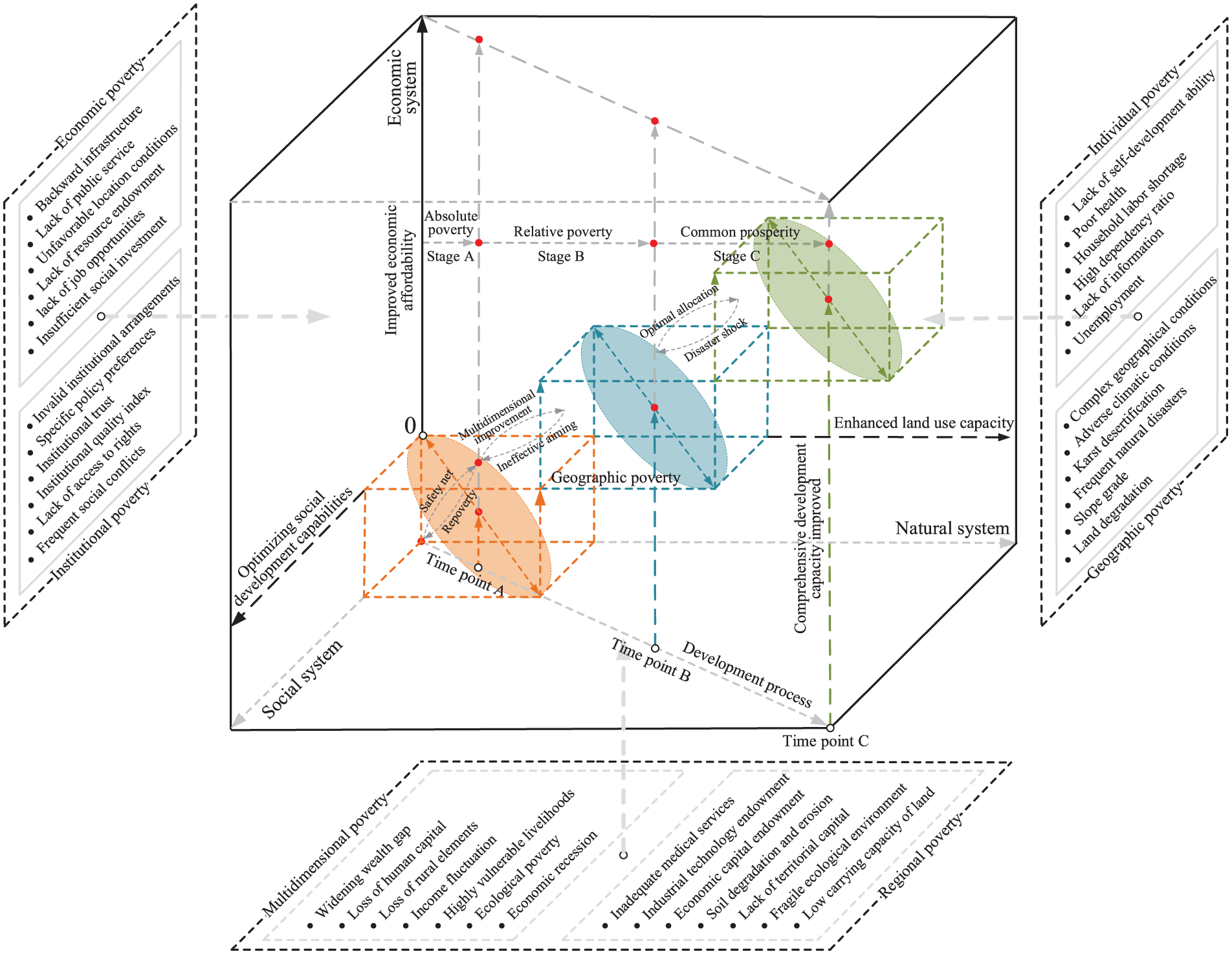
Analytical framework for the transition from poverty to revitalization.
Currently, China's poor population is mainly concentrated in hilly mountainous, restricted development, and ecologically fragile areas. These rural regions face high poverty concentrations, inadequate infrastructure, limited public services, and weak resource and environmental capacities. The severe imbalance among “human–land–industry–finance” elements challenges the consolidation of poverty alleviation achievements (G. Wang & Peng, 2021). Rural revitalization extends poverty alleviation by addressing this imbalance through transformation across five dimensions: industry, ecology, culture, governance, and living standards, enhancing interactions within the rural system (Figure 2). The shift from rural poverty to revitalization reflects a process of improving system functionality by coupling and reorganizing internal capacities and external elements to optimize the human–land territorial system. Specifically, industrial development drives economic growth and raises farmers' incomes by integrating labor, land, capital, technology, and information, aiding poverty reduction and preventing relapse. Land consolidation facilitates large-scale land use, agricultural extension, multisector integration, and rural branding, converting idle resources into assets and farmers into shareholders to diversify income sources (Yin et al., 2022; G. Wang et al., 2023b; T. Zhou et al., 2023). Ecological livability depends on environmental improvements and ecological poverty alleviation, including projects, compensation policies, public service jobs, and ecological agriculture, which optimize industrial structures and spatial ecological functions. Culture strongly influences poverty emergence and reduction by nurturing endogenous motivation and shaping informal norms that govern social order and behaviors, thereby attracting external resources. Effective governance ensures the functioning of the “production–living–ecology–culture” system, while improved livelihoods drive system reorganization and functional enhancement. Overall, the coupling and feedback among these dimensions jointly promote the smooth operation of the poverty–revitalization system.

Path mechanism of “element–structure–function” evolution to promote “poverty–revitalization.”
The transition from poverty to revitalization is a continuous process of adjusting and optimizing the elements, structure, and functions of a complex coupled system. It involves multiple factors, including natural endowments, socio-economic conditions, development capacity, industrial structure, social capital, institutional arrangements, public participation, and functional layout. These factors exert complex nonlinear effects on rural transformation and the smoothness of the transition. However, empirical studies on this transformation remain limited, especially those offering comprehensive qualitative and quantitative analyses. To effectively assess this relationship, it is crucial to consider the interplay of factors influencing both rural poverty and revitalization. This requires analyzing how different combinations of factors affect the transformation degree and identifying how these factors constrain or promote system functionality at various transformation stages, thereby offering new insights into their nuanced roles.
Research Design
Data Sources
The data used in this study were collected during field research conducted in November 2023 across multiple villages and households lifted out of poverty in the karst rocky desertification mountainous areas of Guangxi. The sample selection process for poverty-stricken villages followed four steps: (a) based on the national list of key poverty-stricken counties, counties were selected according to their economic development levels and poverty incidence rates; (b) the number and proportion of poverty-stricken counties in each prefecture-level city were calculated to guide city-level selection; (c) towns and villages were chosen based on their proximity to county seats and the economic development levels of poverty-stricken areas; (d) questionnaire surveys with village cadres and households were conducted, and villages with missing data on key variables were excluded to ensure the inclusion of both “positive” and “negative” cases. Following this procedure, 29 poverty-stricken villages were ultimately selected for analysis.
Research Methods
Necessary and sufficient relationships are key to analysing complex causality. A necessary condition means that without a cause, the outcome cannot occur, while a sufficient condition indicates that the presence of a cause (or combination of causes) guarantees the outcome (Miao & Zhao, 2023). Both qualitative comparative analysis (QCA) and necessary condition analysis (NCA) were employed to systematically explore how improvements in elements, structures, and functions drive rural transformation from poverty to revitalization. QCA formally examines causal relationships and interactions among variables or “conditions”, identifying factor combinations that produce specific outcomes to address system complexity (Sendra-Pons et al., 2022). By integrating theory and case knowledge, QCA detects patterns across cases and has gained widespread use in geography to bridge quantitative and qualitative approaches (Cairns et al., 2017; Kujala et al., 2022; G. Wang et al., 2023b; Verweij & Trell, 2019). Using Boolean algebra, QCA analyses truth tables of factor combinations leading to similar outcomes without omitted variable bias (Upadhyay, 2023). However, while QCA can assess necessity within specific phenomena, it treats necessity and sufficiency separately (G. Wang et al., 2023b). Thus, NCA is needed as a complementary method to uncover complex causal mechanisms involving necessary conditions.
Unlike QCA, NCA can not only identify necessary conditions for outcome variables but also quantitatively calculate the effect size of necessary conditions and the bottleneck level of these conditions (Dul et al., 2020). Specifically, NCA sets upper bounds for the levels of condition factors that represent the requirements for achieving a given result, showing how different conditional factors limit the realization of specific outcomes (Dul, 2016; Dul et al., 2020). The results of QCA include the causal relationships between different combinations of conditional factors and can explain the differential pathways for rural transformation from poverty to revitalization. NCA complements QCA’s advantage of providing a sufficiency analysis and further reveals the subtle effects of each conditional factor on different outcome levels. Therefore, this paper adopts an “element–structure–function” perspective, combining QCA and NCA to explore the complex nonlinear relationship between rural poverty and revitalization.
Variable Selection and Measurement
Rural revitalization aims to eliminate poverty through the comprehensive revitalization of industry, ecology, culture, governance, and living standards, promoting high-quality development in agriculture and rural areas and laying the foundation for achieving common prosperity. Rural revitalization is a comprehensive evaluation system and must be measured via composite indicators. Based on the considerations above, this paper constructs an indicator evaluation system that combines process indicators and outcome indicators of rural revitalization. The system draws on national indicators for building a well-off society, the Outline for Rural Poverty Alleviation and Development in China (2011 to 2020), the Rural Revitalization Strategy Plan (2018 to 2022), the ethnic minority rural common prosperity indicator system, and the results of existing research. As shown in Table 1, this paper constructs a four-level hierarchical model in which the goal layer uses the degree of poverty-to-revitalization transformation to assess the outcome variable. The first level includes five primary indicators, the second level includes 11 secondary indicators, and the third level includes 39 tertiary indicators. Since the units of measurement and the directions of influence for these indicators vary, the data for each indicator are standardized. The entropy weight TOPSIS method is then used to calculate the weight of each indicator.
Definitions and Measurements of the Outcome Variables (n = 29).
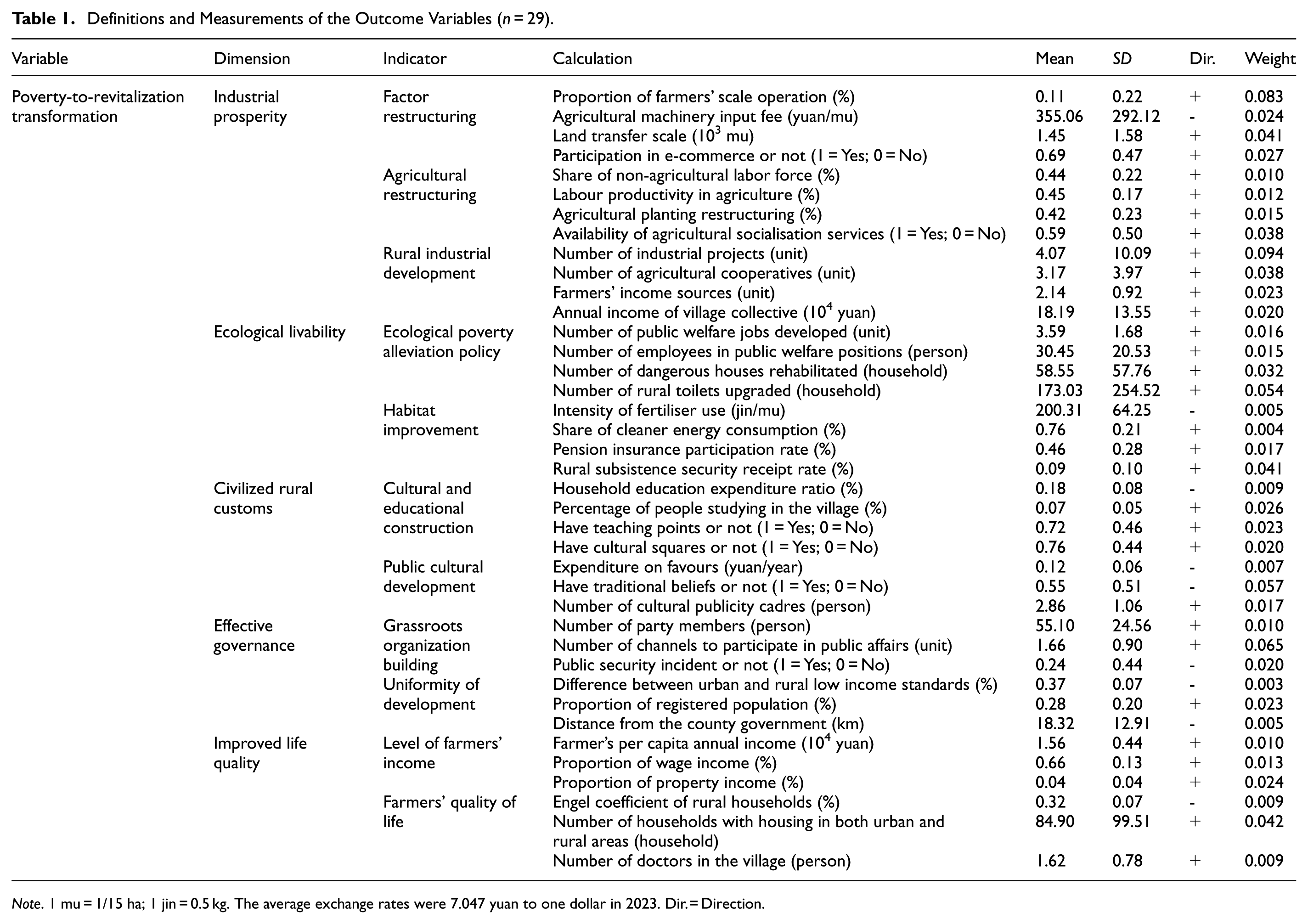
Note. 1 mu = 1/15 ha; 1 jin = 0.5 kg. The average exchange rates were 7.047 yuan to one dollar in 2023. Dir. = Direction.
The differences in the degree of rural revitalization achieved by different poverty-stricken villages can be explained by analysing the differences between conditional factors. QCA provides an effective way to separate the other factors influencing rural revitalization and focuses on the combinatorial effects of factors related to poverty-to-revitalization transformation. Elements, structures, and functions are three indispensable parts of the “poverty–revitalization” coupled system. The different configurations of elements determine the structure and functions of the system. The main conditional factors affecting “poverty–revitalization” development include resource endowments (land, population, capital, and technology), the institutional structure (spatial structure and governance structure), and functional systems (production function, living function, ecological function, and cultural function). Table 2 shows the measurement indicators for the conditional variables used in this paper. Topography and infrastructure completeness are key factors that determine whether rural areas in China are impoverished, while the cultivated land reclamation rate determines whether a region will fall into a “deforestation for reclamation–ecological destruction–regional poverty” vicious cycle (Luo et al., 2020; Y. Zhou & Liu, 2022; Y. Zhou et al., 2020). Poor health increases the medical burden on households, leading to a shortage of labour and prolonged poverty (Tran et al., 2022; Y. Zhou et al., 2020). Families with a high dependency ratio face disproportionately high work burdens and obvious time poverty, increasing the risk of falling back into poverty (Brown & Walle, 2021). Skills training is crucial for improving individual capacity and reducing the possibility of household poverty or a relapse into poverty (Jena et al., 2024). Interest-subsidized loans and cooperative support funds are important channels through which village enterprises and individuals obtain capital, narrowing the poverty gap between households (Ngong et al., 2023). Agricultural technology can reduce poverty, and large-scale farming can not only promote the application of technologies but also help impoverished households escape poverty (Habtewold, 2021). The institutional structure focuses mainly on spatial and governance structures. Spatial distances for production and living reflect spatial poverty differences in agricultural production and residents' living conditions, while leaders in wealth creation and marginally impoverished households reflect the elasticity and potential of the “poverty–revitalization” transition (Xu et al., 2019). The cropping index and per capita cultivated land area reflect the production capacity and utilization rate of cultivated land in rural areas. The living function mainly reflects the employment capacity and social security level of rural farmers, which are captured by employment support capacity and living security capacity. The better the soil quality is, the stronger the ecological function of the village, while greater ecological pressure weakens ecological functions (Radosavljevic et al., 2021). The cultural function of villages is reflected in the transformation and inheritance of cultural resources, which are measured mainly by landscape tourism and the density of schools.
Definitions and Measurements of the Condition Variables (n = 29).

Note. The “five Accesses” in rural areas represent access to water supply, access to electricity, access to roads, access to telecommunications, and access to radio and television.
Class = Classification; Dir. = Direction.
Results
Necessity analysis
Qualitative Comparative Analysis (QCA) is a configurational method grounded in set theory and fuzzy algebra, well-suited for exploring complex causal relationships and multiple interactions (Chen & Tian, 2022). This study applies fuzzy-set QCA (fsQCA), which—unlike crisp-set QCA (csQCA) that relies on binary data—allows for continuous data ranging from 0 to 1 (Sendra-Pons et al., 2022). A prerequisite for fsQCA is data calibration, whereby raw variables are transformed into fuzzy-set scores between 0 and 1. Following established practices, we used the direct calibration method, setting full membership, crossover, and full non-membership thresholds at the 75th, 50th, and 25th percentiles, respectively (Fiss, 2011; Miao & Zhao, 2023). We then assessed the necessity of each condition using consistency scores. A condition is considered necessary if its consistency exceeds 0.9. As shown in Table 3, for both high and low levels of transformation, no single condition variable exceeds this threshold, suggesting that no individual element, structural, or functional factor alone constitutes a necessary condition for the outcome. This underscores the configurational complexity of the “poverty–revitalization” system.
Single Configuration Necessity Test Results (n = 29).

Note: “∼” represents negation, referring to the low level or absence of the result.
In addition, the NCA method was employed to test necessity and identify bottleneck levels, thereby assessing the extent to which specific conditions constrain the occurrence of outcomes (Miao & Zhao, 2023). In NCA, a condition is considered necessary if its effect size (d) is ≥0.1 and the Monte Carlo permutation test yields a statistically significant result (p < 0.01) (Dul, 2016; Dul et al., 2020). As shown in Figure 3, both ceiling regression (CR) and ceiling envelopment (CE) analyses indicate that all antecedent conditions in the “poverty–revitalization” coupled system have effect sizes below 0.1 and fail to meet the dual criteria for necessity. These results align with the fsQCA findings, confirming that no single condition variable qualifies as a necessary condition for rural revitalization in poverty-stricken villages.

Necessary condition analysis results. The condition variables in the plot use calibrated fuzzy values. The larger the effect size, the greater the restriction of the condition on the result. 0 ≤d≤ 0.1 indicates “low effect”, and 0.1 < d <0.3 indicates “medium effect”. When calculating the p value, the number of repeated samples for the permutation test is 10,000. The sample size is 29.
Moreover, we conducted a bottleneck level analysis using the CR estimation method. The bottleneck level represents the minimum threshold that antecedent conditions must meet to achieve a specified level of the outcome variable (Du & Kim, 2021). As shown in Table 4, to reach a 70% level of rural revitalization in poverty-stricken villages, the living and ecological functions must reach at least 13.3% and 1.1%, respectively. To achieve 100% revitalization, capital, technology, spatial structure, governance structure, production function, living function, and ecological function must meet thresholds of 6%, 2%, 81%, 80.5%, 9.3%, 63.8%, and 1.8%, respectively. In contrast, land, population, and cultural function show no bottleneck constraints. These findings highlight that rural revitalization in impoverished villages is driven by the interplay of multiple factors. Therefore, a configurational analysis of these antecedent conditions is essential to further identify the combinations that lead to successful revitalization.
NCA Bottleneck Level Analysis of Necessity of Individual Conditions (n = 29).
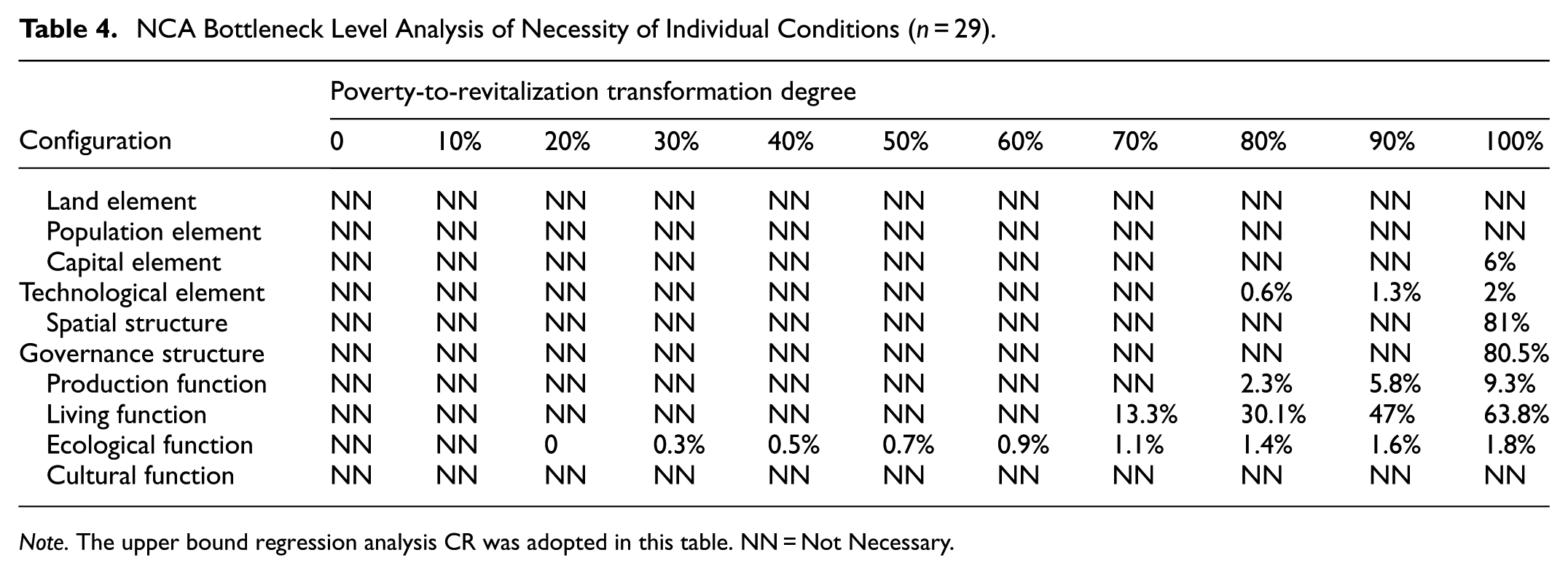
Note. The upper bound regression analysis CR was adopted in this table. NN = Not Necessary.
Configuration Analysis
Based on the preceding data calibration and necessity analysis, we conducted sufficiency analysis by setting the frequency threshold to 1, the raw consistency threshold to 0.8, and the PRI consistency threshold to 0.7, thereby generating a valid truth table (Chen & Tian, 2022; Du & Kim, 2021; Fiss, 2011). By comparing the intermediate and parsimonious solutions, core and peripheral conditions within each configuration were identified. As shown in Table 5, both the overall solution and individual configurations exceed the minimum consistency threshold of 0.75 (Schneider & Wagemann, 2012). The overall solution has a consistency of 0.927 and coverage of 0.448, aligning with fsQCA standards. Vertically, each configuration demonstrates that rural revitalization in poverty-stricken villages can be achieved through different combinations of initial conditions. That is, despite variations in resource endowments, factor structures, and system functions, multiple equivalent pathways to revitalization can emerge through factor reorganization and structural optimization. To further interpret these complex relationships, the configurations are categorized into three types: function–structure driven type (F-SDT: configurations 1a and 1b), function–element driven type (F-EDT: configurations 2a and 2b), and function–structure–element driven type (F-S-EDT: configurations 3a, 3b, and 3c). Each configuration is then examined through theoretical analysis and practical case studies.
Configuration Analysis Results.
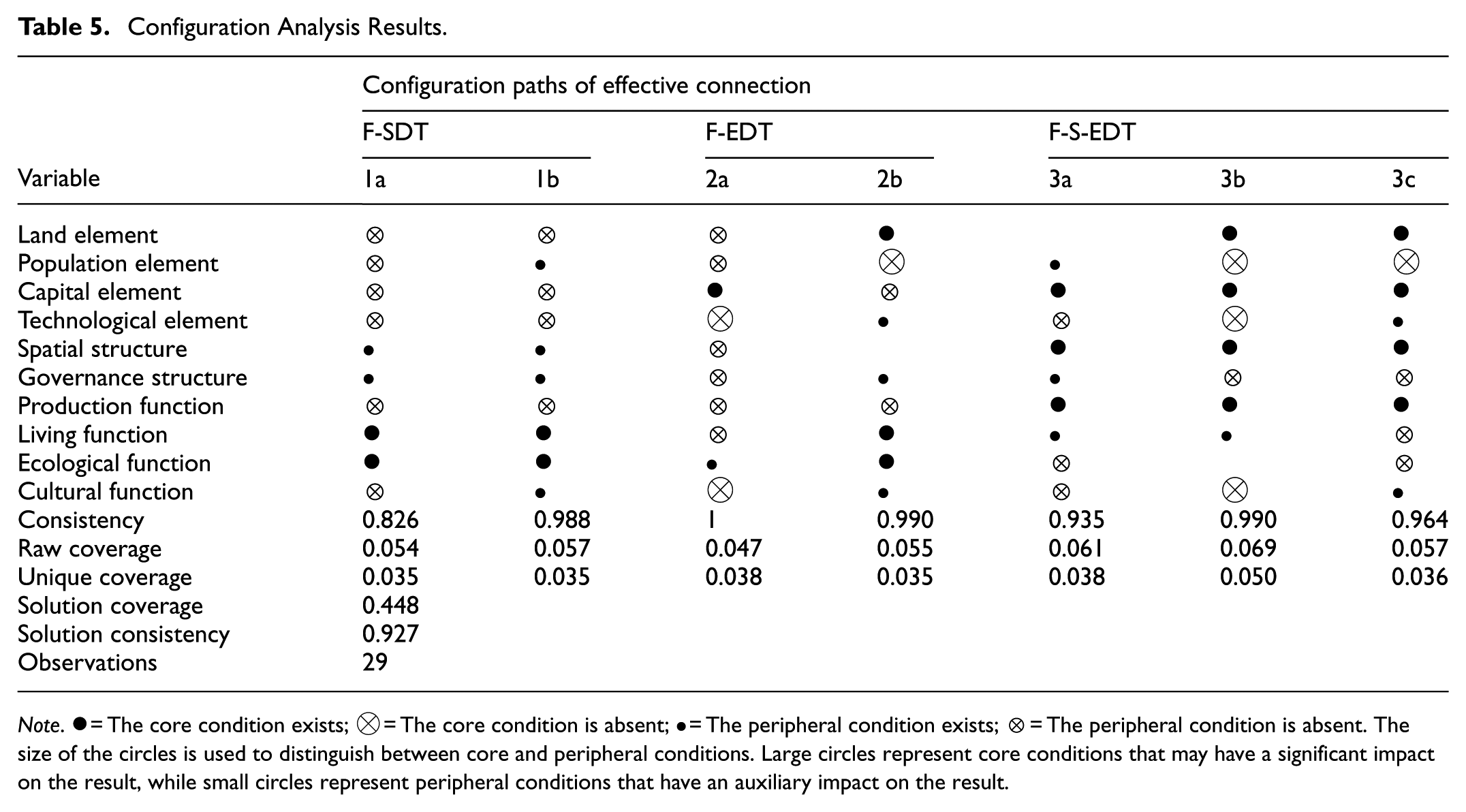
Note. ● = The core condition exists; ⊗ = The core condition is absent; • = The peripheral condition exists; ⨂ = The peripheral condition is absent. The size of the circles is used to distinguish between core and peripheral conditions. Large circles represent core conditions that may have a significant impact on the result, while small circles represent peripheral conditions that have an auxiliary impact on the result.
Functional–Structure Driven Type (F-SDT)
The function–structure driven configurations (1a and 1b) feature the living and ecological functions as core conditions, with spatial and governance structures as peripheral elements. In this configuration, improvements in institutional structures, living standards, and the ecological environment are central to advancing the transition from poverty alleviation to revitalization. Enhancing the rural living function—by strengthening employment capacity and living conditions—combined with expanded household consumption distances and reduced agricultural travel distances, supports spatial restructuring and sustained improvements in rural livelihoods. Governance diversification, fostered by cultivating local leaders in wealth creation, further reinforces this transformation. These local actors, possessing strong environmental adaptability in land use, industrial activities, and entrepreneurship, assist poor and marginal households in increasing income while promoting the synergistic development of production efficiency and ecological sustainability. Institutional restructuring translates into changes in land use and agricultural production, which in turn improve soil quality and optimize ecological spatial layouts. Configuration 1a, in particular, illustrates that when land, population, capital, and technology are not comparative advantages, fully leveraging ecological function becomes critical for achieving rural revitalization. For instance, Haokun Village in Lingyun County had a poverty rate of 70% in 2014, due to high dependency ratios, landlessness, and low income. However, its geographic and infrastructural conditions improved significantly after 2012 with the construction of a reservoir and road. Coupled with strengthened leadership by Party members and local prosperity leaders, the village capitalized on the ecological resources of Haokun Lake to develop tourism, wellness services, and ecological agriculture. A diversified income model emerged, including land leasing, ticket dividends, tourism employment, homestay operations, retail services, and specialty product sales. This collaborative effort between local government and residents raised non-agricultural employment to over 80%, with per capita net income exceeding 13,800 yuan by 2021. Such transformation demonstrates how poverty-stricken villages can overcome resource constraints through ecological and institutional optimization.
Compared with configuration 1a, configuration 1b shows that improving population elements and cultural functions further facilitates households' transition from poverty to wealth. In practice, this is common in the case villages through employment assistance, the planting of elites to drive farmers, culture–tourism integration, and social safety nets to guide low-income groups toward self-development. For example, Luzhu Village in Shanglin County had a poverty headcount ratio of 24% in 2017 and is still a village with a high level of poverty. Under the rural development strategy dominated by “red culture tourism +”, by transforming the village living environment; repairing revolutionary sites; providing skills and employment training; guiding poverty-stricken households in tourism; and breeding cooperatives and orchard employment, 40, 51 and 42 poverty-stricken households found employment. Relying on the “four supports and one sharing” model (support housing construction, employment, entrepreneurship, elderly care, and profit sharing) of cultural tourism poverty alleviation, the per capita annual income of the whole village reached 18,500 yuan in 2023.
Function–Element Driven Type (F-EDT)
The function–element driven type includes two paths—configurations 2a and 2b—with a combined coverage of 0.101. Configuration 2a is primarily driven by high capital input, non-high technology, and a non-high cultural function, with the ecological function acting as a necessary condition. This configuration reflects a capital-driven model, where villages lacking technological capacity and cultural resources can enhance system functionality—and thus transition from decline to revitalization—through increased external capital and ecological improvement. For example, in Caijia Village, Lingyun County, 52% of the population was classified as poverty-alleviation beneficiaries, and the village exhibited weak internal development capacity. To boost endogenous growth, Guilin Bank established a village-level committee and implemented an inclusive financial service model to support the expansion of mulberry planting and silkworm breeding. The bank issued 1 million yuan in loans, and with support from the Organization Department of the Municipal Party Committee, the village secured over 10 million yuan in additional funding and technical assistance. Through infrastructure upgrades, silkworm facility expansion, and improvements to the living environment and primary school, villagers' average annual income rose to 40,000 yuan, and the village collective income reached 222,100 yuan.
Configuration 2b features land elements, living function, and ecological function as core conditions, with population elements serving as peripheral conditions. Unlike the function–structure driven type, this configuration underscores how land constraints can hinder further improvements in system structure and functionality. For example, in 2023, the mulberry planting area in Pinghuai Village, Lingyun County, reached 9,000 mu—182% of the village's total cultivated land—averaging 27.22 mu per household. Despite deforestation and expanded planting efforts, land shortages persisted, resulting in a mismatch between silkworm production capacity and available mulberry resources. Land scarcity thus became the primary constraint on extending the silkworm industry chain. Survey data indicate that current planting density has reached 1,800 trees per mu, approaching the land's ecological carrying capacity, leaving little room for further expansion. Although most villagers have received training in silkworm breeding, the insufficient supply of mulberry leaves prevents intensification. As a result, the village committee has had to lease land from neighboring villages to meet demand for mulberry cultivation.
Function–Structure–Element Driven Type (F-S-EDT)
Function–structure–element driven types include three configurations—3a, 3b, and 3c—with higher raw coverage than the other two types, indicating strong generalizability. Across all three paths, capital elements, spatial structure, and production function emerge as core conditions. As the material foundation of the rural territorial system, the agricultural production function benefits from capital investment, which supports the transformation of traditional agricultural structures, shortens farming distances, reduces production costs, and facilitates the transition from poverty alleviation to rural revitalization. Configuration 3a highlights the auxiliary roles of population elements, governance structure, and living function, whereas Configuration 3b shows that optimizing land elements can yield similar outcomes even when population, technology, and cultural functions are underdeveloped. For example, Yaohe Village in Shanglin County, once listed among Nanning's 56 deeply impoverished villages, initially relied on photovoltaic industry dividends funded through poverty alleviation programs. However, this single-industry model proved inadequate in preventing large-scale return to poverty. With financial support from the Guangdong–Guangxi cooperation initiative, the village undertook land consolidation, optimized its production–living space layout, and built an agricultural demonstration park. Through a “training + employment” model, 200 villagers gained stable jobs. Additionally, 900,000 yuan was raised from various sources to establish the village's first enterprise. Operated under the “village collective + company + specialized households + poverty households” model, this initiative significantly strengthened the collective economy. As of now, Yaohe Village's collective income has reached 266,900 yuan, and the average annual income of formerly impoverished households has grown to 17,400 yuan.
In contrast to the intensive land use in Pinghuai Village (configuration 2b), most villages in configuration 3b suffer from fragile ecological environments, low cultivated land carrying capacity, and poor mountainous topsoil fertility. For example, Longbang Village in Tiandong County, situated over 800 m above sea level in the Dashi Mountain area, has only 0.46 mu of cultivated land per capita and a poverty rate of 98.72%. To address the severe “more people, less land” bottleneck, Longbang became the only poverty-stricken village in Guangxi to relocate its entire population. Post-relocation, the government leased over 1,100 acres for large-scale sugarcane cultivation, enabling 81.4% and 50.39% of poor households to participate in planting and breeding activities, respectively. Additionally, skills training, enterprise employment, self-employment, labor hiring, poverty alleviation workshops, and public welfare jobs addressed production and employment challenges for 25%, 12.5%, 0.7%, 11.2%, 5.5%, and 1.7% of relocated households, respectively. Consequently, the average annual per capita income reached 11,000 yuan.
Compared to configuration 3b, configuration 3c places greater emphasis on substituting the living function with technology elements and cultural function. For example, in 2015, Mofan Village in Tiandong County was a “hollow village” with a poverty rate of 10.62%. Adopting a “party branch + cooperative + tourism + poverty alleviation” model, the village consolidated and transferred over 6,500 mu of land and attracted technology-driven enterprises to establish a banana and dragon fruit demonstration base. This integrated large-scale landholders, capital, and technology, revitalizing idle land through large-scale operations and implementing incentive mechanisms such as “production sharing” and an “over-production commission” to encourage wage labor, land leasing, and profit sharing among villagers. By the end of 2016, the poverty rate had declined to 0.9%. In 2017, farmers' cooperatives were established to develop the Longtan Linghu Scenic Area, fostering rural tourism and enhancing agricultural production alongside cultural functions. Through dividends from shares, planting, and tourism, the village's collective income reached 350,000 yuan in 2023, with per capita annual income rising to 20,400 yuan.
Heterogeneity Analysis Based on Income Differences
Owing to the combined influence of economic, social, and environmental factors, villages exhibit significant disparities in their transition from poverty to revitalization. The village collective economy serves as both a crucial indicator of overall development capacity and a key measure of rural organizational mobilization and resource integration. It often determines whether a village depends heavily on government leadership and policy support to escape poverty or builds a stable economic foundation to improve infrastructure, upgrade local industries, and attract returning talent, thus fostering an endogenous development path characterized by “weak policy dependence and strong endogenous development momentum”. A robust village collective economy also provides the organizational foundation for farmers' cooperatives and industrial consortia and supports the establishment of village-level public service platforms. This helps prevent widespread poverty relapse by restructuring production and governance systems. Furthermore, villages with stronger collective economies are more likely to attract government and enterprise attention, securing priority access to project funding and forming a virtuous cycle of resource concentration, project implementation, and economic growth. In contrast, villages with weaker collective economies risk falling into a “resource scarcity–limited development–increased marginalization” dilemma, struggling to move beyond traditional, externally dependent poverty governance. Accordingly, this study groups villages by collective economic income into high- and low-income categories to explore heterogeneous development paths. As shown in Table 6, clear differences emerge: compared to low-income villages, high-income villages' transformation paths emphasize restructuring spatial and governance systems, with higher overall coverage and consistency. High-income villages prioritize the synergy of technological elements, governance structures, and cultural functions, whereas low-income villages focus more on production and ecological functions, supplemented by various factor improvements. These findings suggest that high-income villages require advanced technological application, scaled operations, and enhanced rural resilience through cultural identity and governance. Conversely, low-income villages rely more on improving factor endowments—such as land, population, and technology—and basic living security, with development paths largely “policy driven”.
Heterogeneous Effects by Collective Economic Income.

Heterogeneity Analysis Based on Location Differences
Beyond differences in village income, rural transformation also varies due to factors such as policy support and locational conditions, which shape distinct development paths in the transition from poverty to revitalization. Although the sample villages are located within the same prefecture-level city or county—ensuring relatively uniform access to rural revitalization and poverty alleviation policies—their location conditions vary significantly, encompassing remote mountainous villages, far suburban areas, as well as plain, river valley, and near suburban villages. Notably, 25% of the sample villages are located within 8 km of the county government, while far suburban villages are more than 30 km away. To explore the heterogeneity of development paths under different location conditions, this study uses the distance from the county government as a grouping criterion, classifying sample villages into near suburban and far suburban categories. As shown in Table 7, near suburban villages tend to promote rural multifunctionality through element reorganization, particularly emphasizing the synergy among population elements, capital elements, governance structures, and cultural functions. This combination forms core configuration paths of the F-EDT and F-S-EDT types, highlighting the ability of near suburban villages to leverage locational advantages to mobilize internal development resources and achieve rural system transformation. In contrast, far suburban villages—lacking strong resource endowments and locational advantages—rely more heavily on the optimization and reconstruction of functional structures. The configuration results indicate that the coordinated development of production, living, and ecological functions is the key condition for revitalization in these villages. Meanwhile, improvements in spatial and governance structures further support the integrated enhancement of rural multifunctionality.
Heterogeneous Effects by Locational Conditions.

Robustness Testing
This paper conducts a robustness test on the functional evolutionary configurations that explain the transformation from poverty-stricken villages to rural revitalization. As a set-theoretic method, fsQCA defines robustness as the presence of a subset relationship between results obtained under slight analytical variations, without altering the substantive interpretation of the findings. A major threat to fsQCA results arises from Boolean minimization, which can introduce aggregation bias, even in randomly generated datasets, potentially leading to false-positive subset relationships (Braumoeller, 2015; Ding, 2022). While common robustness tests—such as adjusting consistency thresholds, modifying PRI consistency, adding or removing cases, or introducing new conditions—can help validate configurations, these approaches lack statistical significance testing. To enhance the credibility of the results, this study applies a permutation test to assess whether the observed fsQCA configurations could be generated by random chance (Ding, 2022; Rohlfing, 2018). Specifically, using the QCAfalsePositive package in R, we conducted 10,000 iterations in which the outcome variable was randomly permuted, and the consistency and coverage values of each iteration were recorded to construct a permutation distribution. As shown in Table 8, the original configuration's consistency values fall outside the 95% confidence intervals of the permutation distributions, indicating that the observed results are statistically significant and not due to random variation.
Permutation Tests of Seven Configurations (n = 29).
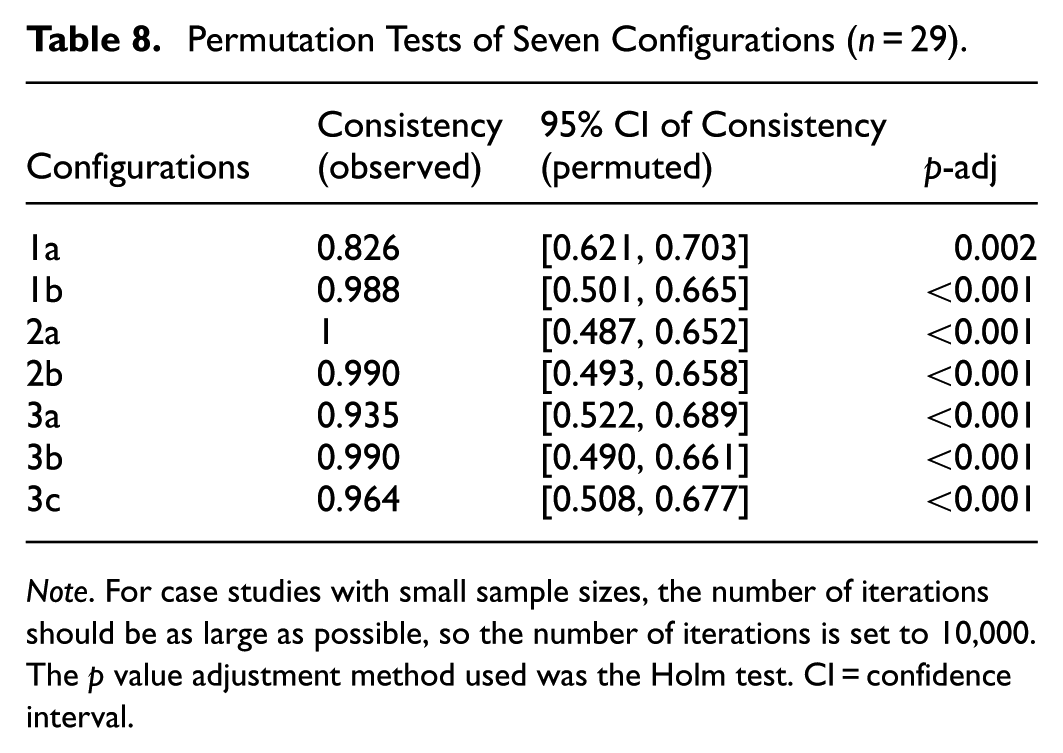
Note. For case studies with small sample sizes, the number of iterations should be as large as possible, so the number of iterations is set to 10,000. The p value adjustment method used was the Holm test. CI = confidence interval.
Parameter settings are a key factor affecting the robustness of fsQCA results. To ensure the reliability of the findings, this study conducted a series of sensitivity tests, following established practices (Du & Kim, 2021; Miao & Zhao, 2023; Schneider & Wagemann, 2012). Specifically, robustness was assessed through adjustments in calibration thresholds, case consistency levels, PRI consistency, and sample size. First, we tested the sensitivity to calibration anchors. In contrast to the original calibration using the 75th, 50th, and 25th percentiles, we recalibrated the data using the 95th, 50th, and 5th percentiles (Ding, 2022; Rihoux & Ragin, 2009). As shown in Figure 4a, six concise configurations were generated under the new thresholds, largely consistent with the original results. Moreover, the overall solution coverage increased from 0.448 to 0.519, and consistency rose from 0.927 to 0.937. Second, we increased the case consistency threshold from 0.80 to 0.85, while keeping the frequency threshold at 1. Figure 4b indicates that the resulting four configurations are subsets of the original configurations. Although the overall coverage slightly declined, both the consistency of individual configurations and the overall consistency improved. Similarly, after raising the PRI consistency threshold from 0.70 to 0.75, the configuration patterns remained unchanged (Figure 4c), confirming the stability of the results. Third, to assess sensitivity to sample size, we randomly removed six cases (case numbers 1, 6, 11, 16, 21, and 26) and re-ran the fsQCA with the same parameters. As shown in Figure 4d, the resulting model retained seven explanatory paths, with patterns closely aligned with the original model. The coverage (0.598) and consistency (0.934) of the new solution were also comparable to the original, further affirming robustness. In sum, these multi-angle robustness checks across calibration, consistency thresholds, and sample size variations support the stability and reliability of the original fsQCA results.
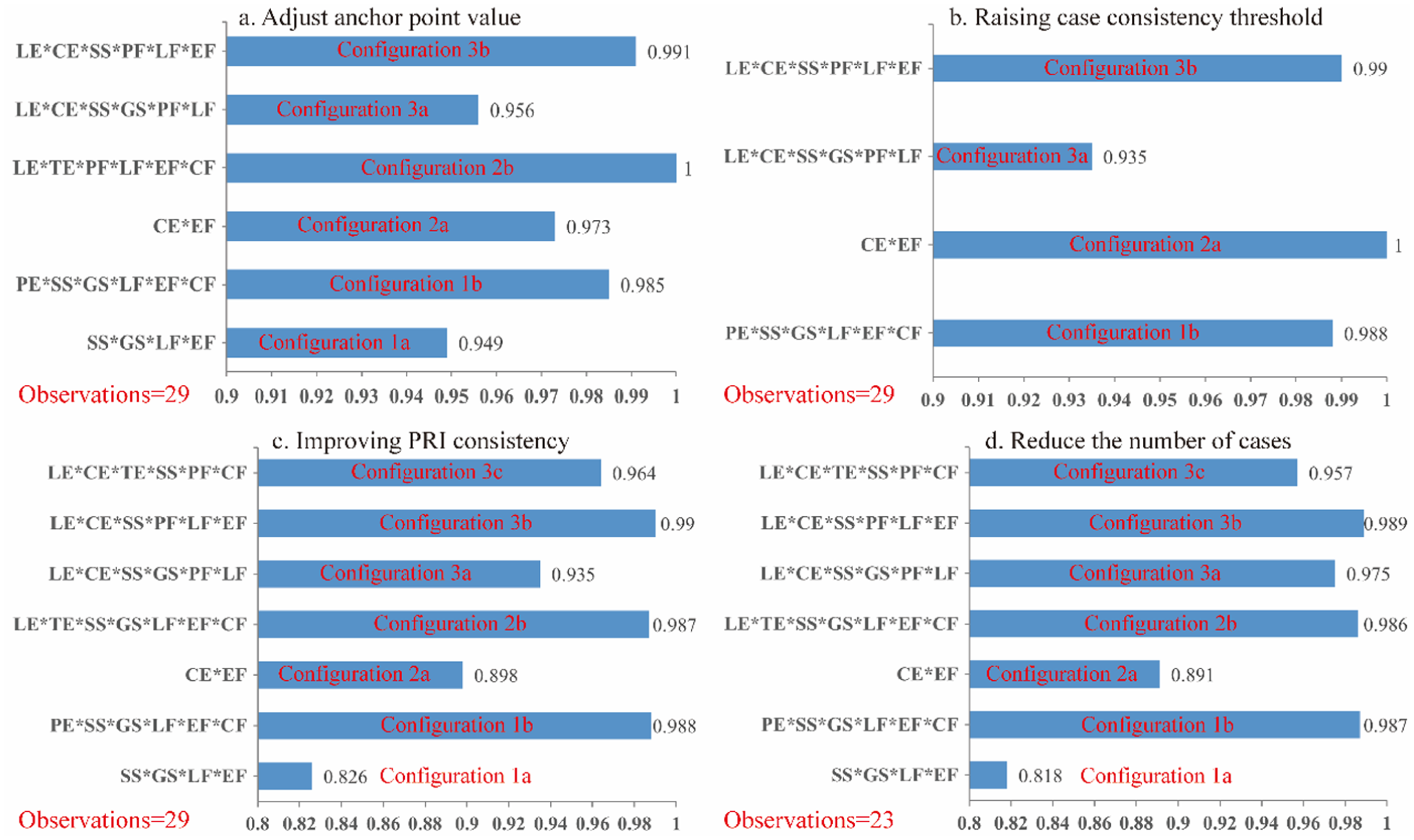
Robustness check.
Discussion
Theoretical Significance
China's development-oriented policies have greatly alleviated poverty in rural areas, achieving a transition from absolute poverty to relative poverty, from widespread poverty to localized poverty, and from chronic poverty to temporary poverty (Guo et al., 2022). Meanwhile, the siphon effect caused by the urban–rural development gap has led to a continuous outflow of rural development factors. Developed areas have quickly escaped poverty, whereas severely impoverished areas still face persistent poverty. Rural poverty is the result of various factors that affect the rural territorial system, leading to an imbalance in the human–land system, which can be addressed by adjusting its internal components of elements, structures, and functions. Although villages with varying levels of poverty may pursue different strategies for rural revitalization, empirical configurational evidence guiding these choices remains limited. Most quantitative studies on poverty reduction among rural households fail to differentiate between poverty types or identify specific solution pathways. Similarly, research on the spatial differentiation of poverty-stricken villages often emphasizes the net effect of single factors—such as ecological policies, eco-tourism, microcredit, digital villages, e-commerce, or industrial development—or relies on typical-case analyses. However, such approaches cannot fully capture the complex, heterogeneous mechanisms underlying rural development and its diverse outcomes. This study offers more targeted insights for identifying distinct poverty types and designing corresponding transformation strategies. The findings show that different initial endowment conditions can lead to multiple, non-mutually exclusive causal configurations achieving the same outcome. This implies that in agriculture-based developing countries, diverse pathways to poverty alleviation remain viable. In particular, remote mountain villages hold substantial potential for poverty reduction through policies that improve access to agricultural land and inputs, reconfigure production spaces, and promote cropping diversification.
China's unique development trajectory and poverty challenges—comparable to those of many developing countries—have made its experience a focal point in global poverty research. Central to China's poverty alleviation efforts is addressing uneven and insufficient regional development, to lift all poor households out of poverty. China has implemented systematic, holistic, and coordinated policies that target not only income-based poverty but also multidimensional deprivation, while facilitating a strategic shift from “poverty governance” to “rural revitalization”. This study offers a viable pathway for poverty-stricken villages in karst rocky desertification areas to transition toward revitalization. The identified configuration paths demonstrate how various combinations of land and capital elements, spatial structure, and production, living, and ecological functions can lead to high-level rural revitalization. In agricultural villages, production functions—as well as living and ecological functions—are essential components across different configurations. However, enhancing these functions alone is insufficient for long-term sustainability. Strengthening institutional structures, particularly spatial governance aligned with farmers' capabilities, is also critical for sustained rural development.
Given the interrelation and mutual transformation between regional and individual poverty, it is valuable to incorporate both household- and village-level indicators into the evaluation system—a dimension often overlooked in studies on the transformation of poverty-stricken villages. Special attention should be directed toward deeply impoverished villages in karst rocky desertification areas, where industrial foundations are weak, collective economies are underdeveloped, and reliance on external financial support is high. Enhancing production functions is vital for lifting households out of poverty, but achieving high-level rural development also depends on addressing key elements and structural factors. Capital inputs, for instance, incentivize land consolidation, spatial adjustment of agricultural production, and improvements in residential environments. The resulting optimization of spatial structure reinforces production transformation and functional upgrading, thereby facilitating the shift from poverty to revitalization. Overall, elements, structures, and functions are interdependent and collectively shape the extent of rural transformation. This study broadens the theoretical lens for assessing rural poverty transitions by offering a systematic perspective on their underlying complexity.
Improving the Effective Transformation of Poverty-Stricken Villages into Rural Revitalization Villages
Preventing a return to poverty is essential to the rural revitalization strategy and critical for ensuring the sustainable development of poverty-stricken villages. The “element–structure–function” analytical framework highlights three key areas for effective transformation: restructuring resource elements, optimizing institutional structures, and enhancing rural functions.
First, limited resource endowments do not necessarily prevent poverty-stricken villages from achieving rural revitalization. The functional structure–driven configuration reveals that, even in the absence of comparative advantages in land, population, capital, or technology, improvements in rural functions can be driven by optimizing institutional structures and strengthening village-level targeted poverty alleviation. In resource-constrained countries, such approaches—focused on accurately identifying and assisting poor populations—have proven effective and are widely adopted globally (Banerjee et al., 2015). Beyond targeting households, this strategy can also identify and leverage underutilized ecological and cultural functions at the village level. Achieving this requires strong government leadership and broad social participation to promote functional improvement through initiatives such as eco-tourism or red tourism.
Second, villages with more abundant resource endowments are better positioned to enhance rural multifunctionality through the optimal allocation of internal factors. In agriculture-dominated areas, land and capital are typically viewed as key drivers—aligning with findings by Ali et al. (2022) and S. Liu et al. (2024), who highlight the role of credit and land transfer in alleviating rural poverty. Specifically, aid funding can scale up capital-intensive agricultural production, while land expansion may generate economies of scale, boosting agricultural income. However, whether following a capital-intensive or large-scale farming path, deviation from ecological constraints risks resource over-exploitation and environmental degradation, ultimately undermining sustainable rural development. This ecological dimension is often overlooked in studies focused on single-factor poverty reduction, underscoring the need for further research on setting resource use boundaries and evaluating ecological sustainability in poverty-stricken villages.
Significant disparities in natural resources and management structures exist across villages, yet traditional research often adopts a “single-factor determinism” approach—emphasizing land, capital, or technology as the key to rural revitalization. In practice, however, this approach proves inadequate, especially in villages with limited resources and weak organizational capacity. Our findings indicate that only through the integrated reorganization of multiple elements, institutional restructuring, and functional coordination can the endogenous drivers of rural development be effectively activated. This transformation—from “element integration” to a “functional leap”—relies on the substitution and complementarity of factors within the rural system. By compensating for structural deficiencies through dynamic adaptation, this approach enhances system resilience and the long-term sustainability of poverty-stricken villages.
Limitations
This study has several limitations that warrant attention in future research. First, while fsQCA excels in theory-building through inductive analysis of necessary and sufficient conditions, future studies could adopt a deductive approach to test causal complexity and further validate our configurational findings. Second, the study is based on 29 poverty-stricken villages, within the typical fsQCA sample range of 15 to 80; however, expanding the sample to include more cases, strategies, and contextual conditions would enhance generalizability. Third, we did not account for the temporal dynamics of rural poverty transformation, which may involve shifting development trajectories and evaluation criteria over time. Future research could incorporate longitudinal data to explore temporal effects within the QCA framework.
Conclusions and Policy Implications
Conclusions
Using a configurational perspective, this study evaluates the effectiveness of rural transformation from poverty to revitalization through the logic of causal complexity. Applying fsQCA to data from 29 poverty-stricken villages in mountainous regions, the analysis reveals asymmetric causal relationships among “elements, structures, and functions”. Seven distinct configuration paths, each comprising multiple antecedent conditions, can lead to significant poverty-to-revitalization outcomes. In the function–structure driven type, improvements in living and ecological functions play a central role in addressing human–land system imbalances, while spatial and governance structures serve as important supporting factors—highlighting the value of enhancing the rural living environment and land consolidation. The intermediate solution for the function–element driven type identifies two causal configurations in which land and capital elements take precedence, improving system functions and facilitating revitalization. The function–structure–element driven type underscores the combined influence of land or capital, spatial structure, and production functions in achieving high-level revitalization.
Policy Implications
The F-SDT configuration path suggests that in villages with relatively weak resource endowments, optimizing institutional structures, living functions, and ecological functions can offset limitations in population and land, thereby fostering sustainable rural development. Accordingly, green industries that integrate ecological and living functions should be developed based on local conditions, alongside improvements in infrastructure and spatial planning. Simultaneously, local talent development and institutional support should be strengthened to enhance governance effectiveness.
The F-EDT configuration path indicates that in villages with weak cultural functions and limited technological foundations, external funding and optimized land resource allocation are essential for restructuring rural systems. Therefore, strengthening the “finance + monetary” investment coordination mechanism and expanding inclusive financial support for specialty industries and village collective projects is recommended. Meanwhile regional land coordination and transfer should be promoted, with models such as “unified operation + individual household income” explored to advance a revitalization path that integrates capital, land, and ecological development.
The F-S-EDT configuration path emphasizes capital or land, spatial structure, and agricultural production functions to optimize agricultural structure, adjust spatial layout, and support the transformation of poverty-stricken villages into revitalized ones. In villages with limited resource endowments and weak organizational capacity, efforts should focus on enhancing population, governance, and living functions based on local conditions. Land reclamation and transfer can help mitigate shortages in ecologically fragile areas, while technological innovation and cultural functions can improve quality of life and support diversified industrial development. Accordingly, increased investment is needed to support land transfers and infrastructure, promote the “village collective + enterprise + professional households + poor households” model, and foster employment and industrial integration. Additionally, strengthening technological extension and cultural revitalization is essential to enhance rural production and living functions and ensure a stable transition from poverty-stricken villages to rural revitalization.
In summary, poverty-stricken villages face varying degrees of imbalance among elements, structures, and functions, necessitating targeted rural restructuring strategies. A one-size-fits-all approach risks wasting human, financial, and material resources. To effectively advance rural revitalization, these villages should adopt flexible configurational strategies tailored to their specific element–structure combinations, leveraging administrative or market-oriented mechanisms to ensure steady progress.
Footnotes

Ethical Considerations
All procedures performed in this study were in accordance with the Declaration of Helsinki. It was also carried out according to guidance from the Ethics Committee of the School of Public Policy and Management of Guangxi University, whereby the need to obtain formal ethical approval for the study is not applicable as participation in the focus group sessions and household interviews was entirely voluntary. Informed consent was obtained from all participants in this study. Participants accept and voluntarily participate in this study. The study does not reveal the personal information of the respondents.
Funding
The authors disclosed receipt of the following financial support for the research, authorship, and/or publication of this article: Funded by National Natural Science Foundation of China (Grant No. 42301313), Natural Science Foundation of Guangxi Zhuang Autonomous Region (Grant No. 2024GXNSFBA010097), and the Key Research Base of Humanities and Social Sciences of Universities in Guangxi Zhuang Autonomous Region: Regional Social Governance Innovation Research Center (Grant No.202507).
Declaration of Conflicting Interests
The authors declared no potential conflicts of interest with respect to the research, authorship, and/or publication of this article.
Data Availability Statement
Data sharing not applicable to this article as no datasets were generated or analyzed during the current study.