




Abstract
Short-form video (SFV) marketing is a new technology for farmers in the context of rural revitalization. This study aims to analyze the factors and mechanisms influencing the use behavior of farmers’ SFV marketing of agricultural products from the perspective of government trust. By adding policy perception and government trust as external factors, the conceptual model and hypotheses were proposed based on UTAUT2. SEM was built to analyze the questionnaire data to test the hypotheses. Results showed that (1) Behavioral intention is significantly influenced by performance expectancy, social influence, facilitating conditions, effort expectancy, and price value; (2) The influence of paths varies across different age groups, suggesting the moderating role of age; (3) Policy perception does not directly affect the use behavior, but influences the use behavior through the mediating of government trust; (4) Government trust not only directly affect use behavior, but also indirectly impact the use behavior by the mediating effect of behavioral intention; (5) Use behavior is directly positively affected by government trust, behavioral intention and facilitating conditions; Finally, this study offers suggestions to optimize SFV platform construction and enhance government governance capabilities.
Introduction
The rural revitalization strategy is a vital strategy in China to address various rural problems (Liu et al., 2020). With the continuous development of information technology, SFV has become an essential channel for farmers to sell agricultural products. Through SFV platform, farmers can directly showcase their agricultural products, overcoming the limitations of the traditional sales model, such as numerous intermediaries and low product sales (Y. Wu, 2022). This innovative SFV marketing method not only helps increase farmers’ income but also promotes the implementation of the rural revitalization strategy to a certain extent. Until now, there have been many successful cases of rural entrepreneurs using SFV marketing (Giua et al., 2022). So, improving farmers’ use behavior of SFV marketing can be considered as a key link to realize the strategy of rural revitalization. However, due to the influence of many factors such as technical mastery, social influence, and government support in the process of farmers using SFV marketing (Giua et al., 2022; Zhao, 2024), most farmers’ acceptance and intention to use SFV marketing remain low. Hence, it is urgent to explore the influencing factors of farmers’ SFV marketing use behavior. The existing SFV marketing behavior research mainly focuses on consumer behavior, lacks the behavior of marketers like farmers (Dong et al., 2024; May & Siddoo, 2024; Xiao et al., 2023), and ignores the role of government in affecting use behavior.
Actually, the government plays an important role in guiding farmers to use SFV marketing technologies in policy context, through means such as policy interpretation, technical training, and economic support. And farmers’ trust in the government is crucial to policy implementation (Hitlin & Shutava, 2022). In other words, the successful advancement of rural revitalization is intrinsically linked to robust government support, as well as the trust farmers have in the government. Accordingly, this study attempts to address the question: In the context of rural revitalization, what factors and mechanisms influence farmers’ use behavior of SFV marketing of agricultural products, with a focus on the role of government trust?
Based on existing research and context, this paper proposes a theoretical model from the perspective of government trust, to investigate the use behavior of farmers’ SFV marketing of agricultural products, and verifies its validity. Specifically, this paper innovatively combined the government trust with the latest technology acceptance behavior theory UTAUT2 model, then established a theoretical model that includes influencing factors about farmers’ use behavior in SFV agricultural product marketing. Then, the Structural Equation Model is used for empirical analysis to test research hypotheses. The result of this study explains the use behavior of farmers’ SFV marketing and extends the applicability of the UTAUT2 model. Meanwhile, it helps grassroots governments recognize their role in promoting the effective adoption of SFV marketing among farmers. Finally, the proposed suggestions contribute to optimizing the construction of SFV platforms and enhancing the governance capacity of grassroots governments.
Literature Review and Theory
Literature Review
Government Trust
To the best of the authors’ knowledge, there is no formal definition of government trust until now. According to Tolbert and Mossberger (2006), government trust is a state of confidence, which is the public’s confidence in government behavior and output based on expectations. Some scholars argue that trust in the government is an attitude, which is the positive or negative attitude of citizens toward the policy system, government institutions, and policy implementers (Christensen & Lægreid, 2005; Huneeus, 2002). Hitlin and Shutava (2022) defined government trust as the public’s perception of government based on expectations of how it should operate. Others believe that trust in the government is a rational evaluation by the public on the policy system, government efficiency and whether the policy implementers meet the public’s expectations (Hansen, 2024). Tomankova (2019) defined government trust as the evaluation of bearing the direct or expected material and ideological costs of compliance with the government. From the perspective of rural revitalization, the grassroots government is the primary body directly in contact with the majority of farmers, and it is also the organization to implement and execute rural revitalization policies. According to the above researches, government trust is defined as farmers’ perception, confidence, support, and evaluation toward the government in this study.
In studies on government trust, most focus on how to predict, measure, and build government trust (Christensen & Lægreid, 2005; Houston & Harding, 2013; Mansoor, 2021; Norpoth, 2010; Roberts, 2008). Perceptions of users toward government trust are predicted by sociodemographic background and interpersonal trust (Houston & Harding, 2013). Government trust can be measured by specific support, indicated with expressed by people’s satisfaction with specific public services, and contrasted by determined by political, cultural, and demographic factors (Christensen & Lægreid, 2005). Political participation requires citizens to actively participate, actively understand policies, and thus understand the government’s implementation of policies (Roberts, 2008). The public’s perception of governance performance is based on the transparency, responsiveness, and fairness of government execution, which contributes to the establishment of government trust (Norpoth, 2010). Effective economic and social policies help establish trust between citizens. Approach to actively participate in decisions and the communication between government employees and citizens will build trust in the government (Mansoor, 2021). In addition, studies analyzed the role of government trust affecting others (Bruno et al., 2022; Hooda et al., 2022; Nguyen et al., 2023; Pagliaro et al., 2021). Government trust plays a crucial role in users’ behavior in using e-government systems (Hooda et al., 2022). Trust in government performance promotes users’ travel attitudes, perceived behavior and subjective norms (Nguyen et al., 2023). Concerning ethics and behavior, research shows that government trust mediates between binding moral approval and citizens’ prescriptive behavioral intention (Pagliaro et al., 2021). Trust in government reduces uncertainty and favors the acceptance of a public policy, meanwhile, contributes to recycling behavior, especially to those individuals who do not have recycling habits (Bruno et al., 2022). However, these studies mainly focus on government trust itself, few studies combine government trust theory and other theories.
Use Behavior
According to Tamilmani et al. (2021), UTAUT2 is widely used in information systems and other fields, it has been evidenced to have high explanatory power in use behavior (more than 70%; Z. Wu & Liu, 2023). Based on the literature review of UTAUT2, articles are divided into four categories of general citation, application, integration, and extension. Researches on use behavior mainly focus on the behavioral intention of various electronic platforms instead of use behavior, and build behavioral intention model based on UTAUT2 to find the influencing factors. Alalwan et al. (2018) discussed how the UTAUT2 variables affect the willingness to use online banking. Zahra et al. (2019) systematically reviewed the use of UTAUT2 model to explain the customers’ behavioral intention. Gunawan et al. (2019) explored the effects of UTAUT2 variables, personal information technology innovation, perceived cost, and environmental awareness on users’ intention to adopt e-books. Widyanto et al. (2020) added security and trust perception factors to UTAUT2 model, and analyzed the use intention of mobile payment applications. Zhang et al. (2021) refined the UTAUT2 model by adding perceived risk and extended its application to online learning platforms. Gansser and Reich (2021) used the UTAUT2 model to discuss the acceptance behavior of artificial intelligence products in the three application fields of mobile, home and health. Siyal et al. (2024) analyzed the variable mediation relationship of UTAUT2 in the mobile business application platform. Compared to behavioral intention, few studies delve into the influencing factors of use behavior (Agudo-Peregrina et al., 2014; Sun, 2025).
Short-Form Video Marketing
Researches on SFV marketing mainly focuses on marketing effectiveness and user engagement. In terms of marketing effectiveness, W. Wang and Zhang (2021) proposed a 5W model in E-commerce SFV marketing to summarize existing problems and propose countermeasures. Yueqin and Teo (2023) reviewed the literature on the development of SFV social media advertising and determinants in shaping its effectiveness. Maenhout (2022) compared the advertising effectiveness of long-form (vs. short-form) videos through an experimental study and found effective SFV marketing tools. D. Y. Kim and Yoo (2021) proposed an effective marketing advertising exposure method by analyzing the advertising attitudes of consumers in the challenge of topic tags on SFV platforms. In terms of user engagement, H. Li and Tu (2024) analyzed the matching links between SFV sources and destination types and explored their impact on user engagement and visit intention. Xiao et al. (2023) analyzed consumer engagement behavior in TikTok and explored the main characteristics of SFV marketing advertisements. Dong et al. (2024) explored the influencing factors on consumer engagement via the four aspects of matching, relevance, storytelling, and emotion in SFV content. May and Siddoo (2024) examined the internal and external factors that influence SFV consumption on social media platforms. Five internal factors explain customer motivation, and 28 external factors explain the use of technology. It can also be seen that those current researches on SFV marketing behavior mainly focus on consumers’ behavior (Dong et al., 2024; May & Siddoo, 2024; Xiao et al., 2023), and few researchers focus on marketers’ behavior. SFV is not regarded as an emerging technology used in marketing to find its acceptance behavior of managers’ technology.
As mentioned before, studies on use behavior always stop at behavioral intention, and few examine the use behavior of SFV marketing in China, especially for marketers like farmers. The UTAUT2 model with high explanation for technology acceptance behavior, is widely used to establish the use behavior model for explaining the influencing factors. However, these studies ignore the role of the government, despite the importance of government trust, which should be integrated with the UTAUT2 model. Therefore, in the context of rural revitalization, this study combines the government trust theory with UTAUT2 to jointly construct the use behavior model of farmers’ SFV marketing of agricultural products, aiming to address our research question.
Theoretical Basis
The Theory of Reasoned Action (TRA) is used to predict individual behavior intention under the assumption that people are rational, individual behavior will not be affected and individual behavior is fully controlled. However, such an assumption is difficult to satisfy in reality. The Theory of Planned Behavior (TPB) fills the gap left by TRA and expands the scope of application. With the advent of the digital age, more and more researchers focus on Technology Acceptance Behavior. The Technology Acceptance Model (TAM) model has attracted much attention, however, the external environment variables in TAM model is not segmented into specific dimensions. The extended technology acceptance model (TAM2) is put forward on top of TAM. Since TAM model and TAM2 model ignore the intrinsic motivation of individuals, Venkatesh et al. (2003) proposed the Unified Theory of Acceptance and Use of Technology (UTAUT) model, which plays an important role in explaining and predicting people’s acceptance degree of technology.
Venkatesh et al. (2012) proposed the extended Unified Theory of Acceptance and Use of Technology (UTAUT2). UTAUT2 adds three variables, including the constructs of enjoyment motivation, price value, and habits. It also removes the regulatory variable named voluntariness of use, and adds a direct path to facilitate conditions on behavioral intention. It is worth pointing out that performance expectancy, effort expectancy, social influence, facilitating conditions, hedonic motivation, price value, and habit jointly affect behavioral intention. Behavioral intention is the precursor of use behavior, facilitating conditions and habit can directly affect use behavior, and age, gender and experience play a moderating role in this model.
Conceptual Model
Model Framework
Considering SFV marketing as a new technology, the use behavior of farmers’ SFV marketing is a kind of technology acceptance behavior. Since the extended UTAUT2 is specifically designed to explain technology acceptance and use, it serves as an appropriate theoretical foundation to build our conceptual model (Grassini et al., 2024). In the UTAUT2 model, the variables of performance expectancy, effort expectancy, price value, social influence, facilitating conditions, hedonic motivation, and habit effectively capture the factors influencing use behavior, making them well-suited to address our research question (Venkatesh et al., 2012).
Since the purpose of farmers using SFV marketing to sell agricultural products is to make profits, rather than for enjoyment, and it requires much time for farmers to adapt to emerging technologies, making habit formation relatively difficult. Therefore, the variables of “hedonic motivation” and “habit” in UTAUT2 model are not included in the conceptual model. Additionally, the success of grassroots government management lies in improving farmers’ policy perception and building their trust in the government. As a result, two new variables, namely policy perception and government trust, are introduced to reflect the role of government.
Therefore, five core latent variables (performance expectancy, effort expectancy, price value, social influence, facilitating conditions, and policy perception) and two mediated variables (behavioral intention and government trust) were adopted to jointly establish the model framework of use behavior, as shown in Figure 1.

The use behavior model of farmers’ SFV marketing of agricultural products.
Research Hypothesis
Performance expectancy refers to the benefits that farmers get from using SFV marketing to sell agricultural products (Venkatesh et al., 2012). Meanwhile, Performance expectancy, effort expectancy, social influence, and price value positively affect the use intention of online learning platforms (Zhang et al., 2021). Therefore, the more income farmers get from SFV marketing, the more willing they are to use SFV marketing. Then the H1 hypothesis was proposed:
Effort expectancy can be conceptualized as the effort required by farmers to master SFV marketing technology, and the expected acceptable difficulty of using new technology. It has been proved that individuals’ intention to use new technologies is positively affected by the degree of difficulty and effort required to use them (Venkatesh et al., 2012). One empirical study indicates that effort expectancy is the most important factor positively affecting users’ behavioral intention to online behavior (Escobar-Rodríguez & Carvajal-Trujillo, 2014). Therefore, when learning SFV marketing technology becomes easy, farmers are more likely to adapt this new technology. Hence, the H2 hypothesis can be formulated:
Price value balances the actual cost and perceived profit that farmers gain from using SFV marketing to sell agricultural products, and balances the cost and benefit of individuals accepting new technologies (Venkatesh et al., 2012). In the context of mobile shopping applications, price value is a stimulative factor affecting users’ behavioral intention (Chopdar, 2022). Interestingly, it’s also confirmed that price value could have a positive impact on use intention of online learning platforms (Zhang et al., 2021). As a result, the higher price value of SFV marketing indicates higher cost performance, and facilitates a stronger intention of farmers to use SFV marketing. Thus, the H3 hypothesis postulates:
Social influence can be conceptualized as the extent to which farmers are influenced by the use of SFV marketing by surrounding people (Venkatesh et al., 2012), and is an important driving force for people to adopt cloud technologies (Kabra et al., 2023). Research suggests that social influence, like the infection and initiative of people around them, could positively affect the use intention of the hospital mobile application (Al Aufa et al., 2020). According to J. Kim and Park (2012), for specialized technology, social influences (including doctors, family members, especially children or grandchildren, as well as partners and colleagues) significantly affect the acceptance and use of health ICTs by individual elderly people. These empirical studies all confirmed that the stronger the social impact of SFV marketing and the higher popularity and recommendation degree, the higher the possibility of farmers using SFV marketing to sell agricultural products. Therefore, this study formulates the H4 hypothesis:
Facilitating conditions are the level of organizational support for technology (Venkatesh et al., 2012), also deemed as the perception of farmers toward the maturity and technical support of SFV marketing development. When it comes to using the network learning space, users will consider the required facilitating conditions, including hardware equipment, network technical support, and knowledge under the background of e-learning systems, because of the positive effects of facilitating conditions on behavioral intentions (Abbad, 2021). Another empirical study shows facilitating conditions positively affect the elderly’s use behavior as well (Sun, 2025). Therefore, the better the facilitating conditions, the stronger the farmers’ intention to accept and use SFV marketing. Accordingly, this study articulates the H5a and H5b hypotheses:
Policy perception could be defined as farmers’ subjective feelings and understanding of policy measures and implementation, which refers to people’s subjective perception and judgment of the government’s work competence and policy implementation ability. It will have an impact on people’s trust and behavioral response to the government (Hansen, 2024; Hitlin & Shutava, 2022). If the public perceives that policy implementation, especially in the economy, is working well, they will trust the government even if they oppose a particular decision (Whiteley et al., 2016). People gain trust in government from the process of policy perception. The stronger the subjective feeling of the policy, the more trust they have in the government (Hooda et al., 2022; Norpoth, 2010; Roberts, 2008). Therefore, the stronger farmers’ policy perception, the higher their trust in the government.
The degree of public recognition, understanding, and support for policies has a positive impact on their participation in rural revitalization activities (J. Li et al., 2021). Individuals’ attitudes toward the content of policies and government actions improve their attitudes toward new things, thereby increasing their acceptance and use of new things (C. Wang et al., 2022). Effective policy perception could inspire farmers to engage in the policy activities that the government encourages and assists. Thus, this study formulates the H6a and H6b hypotheses:
Government trust refers to farmers’ confidence, support, evaluation, and emotional attitude toward the government, as well as people’s subjective assumptions in participating in policy activities. According to Van der Weerd et al. (2011), higher levels of government trust could result in a higher intention to accept vaccination. Lean et al. (2009) also argued that the higher the degree of government trust, the stronger intention of citizens to use e-government services. In addition, government trust is the influencing factor of public behavior intention toward autonomous driving (Kolarova & Cherchi, 2021). Building citizens’ trust in government contributes to the generation of citizens’ intentions and actual behavior in adopting social media (Park et al., 2015). It could be inferred that farmers’ government trust could drive the acceptance and use of emerging technologies (like SFV marketing; Bruno et al., 2022; Pagliaro et al., 2021). Therefore, the hypotheses of H7a and H7b can be formulated:
Behavioral intention is defined as the intention of farmers to accept and use SFV marketing technology. Researchers found that behavioral intention directly affects use behavior (Venkatesh et al., 2003, 2012). In some fields, for example, fresh agricultural product distribution. It has been proved that behavioral intention is positively correlated with use behavior (Agudo-Peregrina et al., 2014). Therefore, farmers’ intention to use SFV marketing will directly drive them to use it to sell agricultural products. Thus, this study articulates the H8 hypothesis:
Policy trust is an important factor for the government to deliver policy and gain public support. Policy trust is based on people’s policy perception, because people feel policies through indicators such as implementation of beneficial policies and government performance, thereby building trust in the government (Hansen, 2024). Farmers’ use behavior implies that new technologies are constantly maturing and exerting economic benefits, government trust helps to improve people’s behavioral level of using new technologies and participating in policy activities (Sutherland et al., 2013). Furthermore, in the study of the relationship between risk perception and preventive behavior, government trust can effectively moderate its information behaviors (Jeong & Kim, 2024). Therefore, the H9 hypothesis postulates:
Behavioral intention is the antecedent variable of use behavior, while government trust is an antecedent variable of behavioral intention. If government trust has been established, farmers will directly improve their intention to participate in social activities, thus enhancing the possibility and enthusiasm of use behavior. Some findings have suggested the mediating role of intention between trust and use behavior (Hooda et al., 2022). Therefore, behavioral intention has a mediating effect between government trust and use behavior. Thereby, the H10 hypothesis can be formulated:
Methodology
Questionnaire
Venkatesh et al. (2012) developed scales that cover most dimensions of our constructs in the UTAUT2 model. Policy perception is how farmers feel about and understand government policies, and is measured by the degree of understanding, recognition, and implementation of policies from the scale of X. Wu et al. (2015). Government trust is their confidence and support for the government’s abilities and transparency. It is measured by three items of the government’s work performance, government management ability and government transparency, which are adopted from Jun et al. (2014). Table 1 shows the items of each variable dimension.
Measurement Item.

Source. Authors.
The questionnaire is used to collect data from farmer groups. Of the 500 questionnaires distributed, only 488 were returned. After screening and sorting, 449 effective questionnaires were left; thus, the effective questionnaire recovery rate is 92%.
Furthermore, to ensure the reliability of all the items in the questionnaire, Cronbach’s alpha test was conducted using SPSS 26. With a cut-off value of 0.70, the values of all constructs are higher than 0.80, indicating that the internal consistency is good and the reliability test is passed. The results of Kaiser-Meyer-Olkin (KMO) test showed that the overall KMO value of the scale was 0.968, which was close to 1, and the significance level in the Bartlett sphericity test was .000 < .05, indicating that the structural validity of the scale was good, and the questionnaire data were suitable for factor analysis.
Structural Equation Model
As a practical statistical analysis method that deals with the relationship between multiple latent variables simultaneously, SEM mainly depends on the measurement model and the structural model. The relationship between latent constructs and observable items is reflected by the measurement model, which could be examined by the Confirmatory Factor Analysis (CFA). The evaluation indicators include Composite Reliability (CR) and Average Variance Extracted (AVE). If the CR value of all latent constructs was estimated and found above the threshold value of the recommended level of 0.70 (Hair et al., 2019), the measurement model’s internal consistency is good. If the AVE value is found above the threshold value of 0.50 (Fornell & Larcker, 1981), and the square root of the AVE value is greater than the correlation coefficient between a pair of constructs, supporting discriminant validity (Fornell & Larcker, 1981). In the structural model, path analysis is used to analyze the causal relationship between latent variables. The evaluation indices include path coefficients and their significance based on p- or t-values, and mediating analysis describes the mediating effect of variables. The Bootstrap mediation effect method is usually adopted. In summary, Amos 26 was used for SEM analysis to complete the whole process of model construction, model revision, and model evaluation.
Results
Descriptive Statistical Analysis
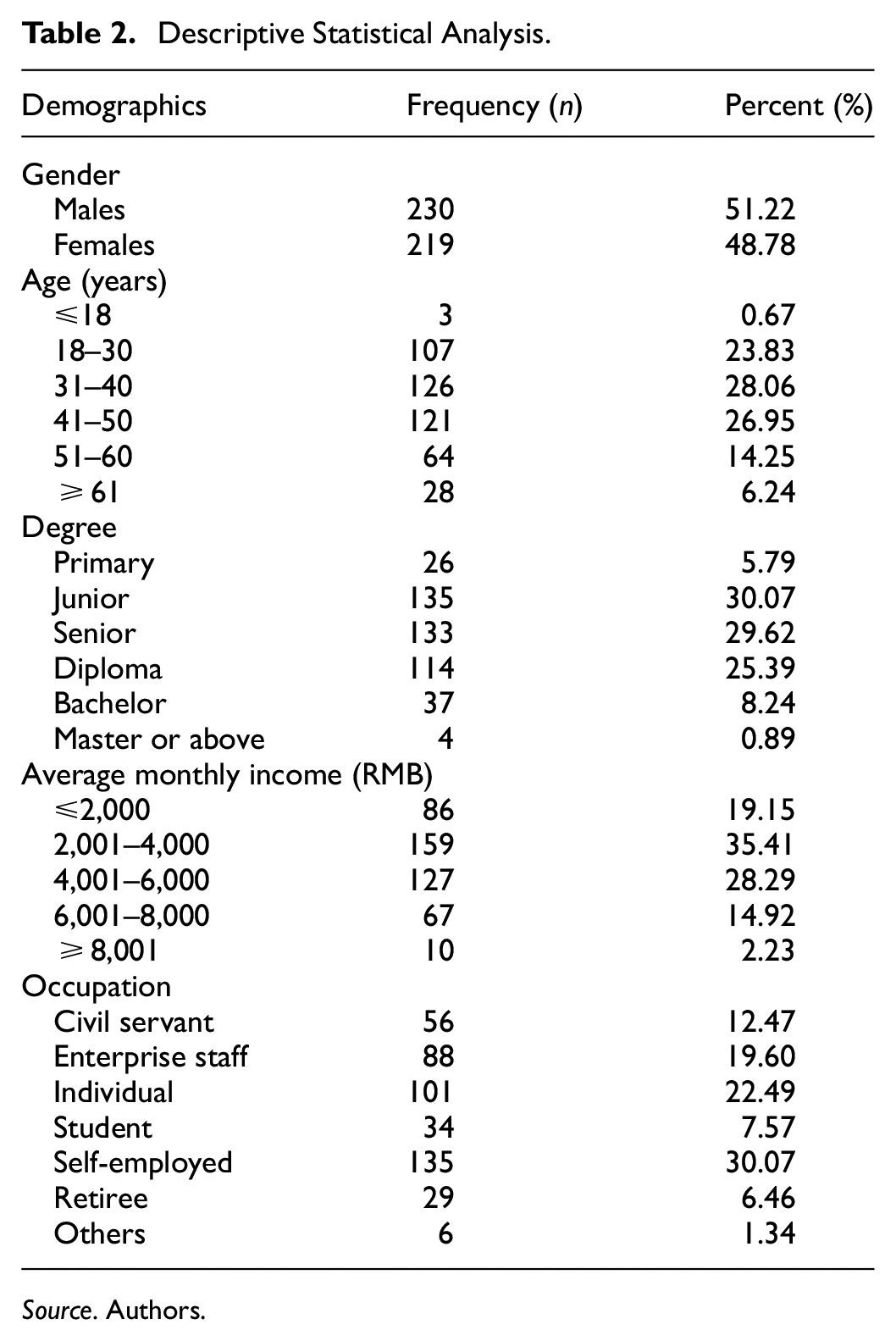
Usable responses were first used for descriptive statistical analysis. Notably, the male-to-female ratio of the sample was nearly 1:1, whereas males comprised about 51.22% of the total sample (n = 449). The age distribution of respondents is mainly concentrated in 31 to 40 (n = 126) and 41 to 50 (n = 121) age groups, who are middle-aged. Only 9.13% of respondents received a bachelor’s degree or higher. More than 80% of respondents have an average monthly income of less than 6000 RMB, with 35.41% of respondents earning between 2,001 and 4,000 RMB per month. In terms of occupation, approximately 30.07% of the respondents are individuals (n = 135), followed by self-employed (n = 101). It can be seen that the samples collected in this study can better reflect the current state of farmers (Table 2).
Descriptive Statistical Analysis.
Source. Authors.
Measurement Model
Construct Reliability
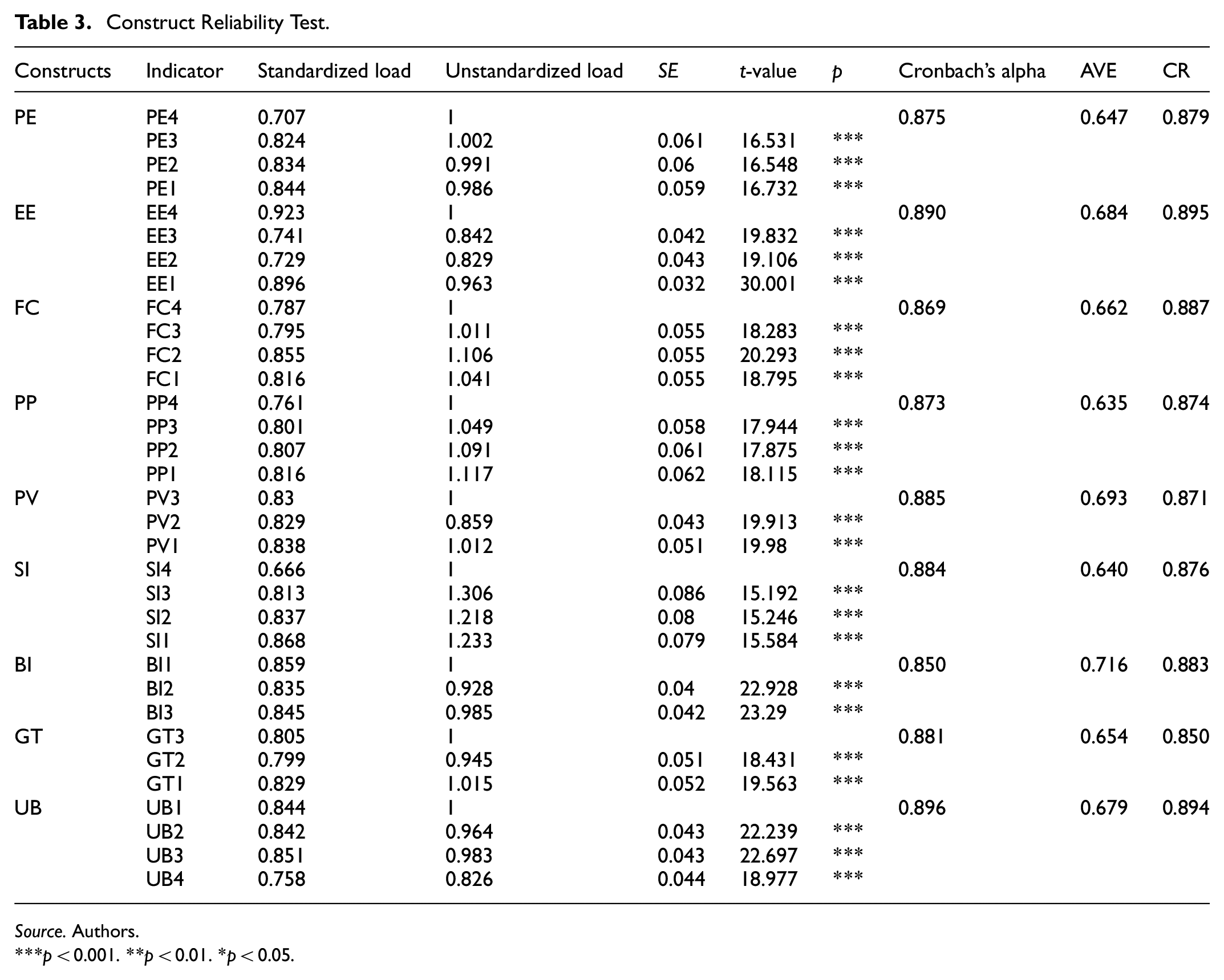
The convergent validity and discriminant validity of the scale were examined by CFA. Table 3 shows that AVE values of all dimensions were found above the cut-off value of 0.6, and CR values were greater than the suggested value of 0.8, indicating the convergent validity was supported.
Construct Reliability Test.
Source. Authors.
p < 0.001. **p < 0.01. *p < 0.05.
Convergent Validity
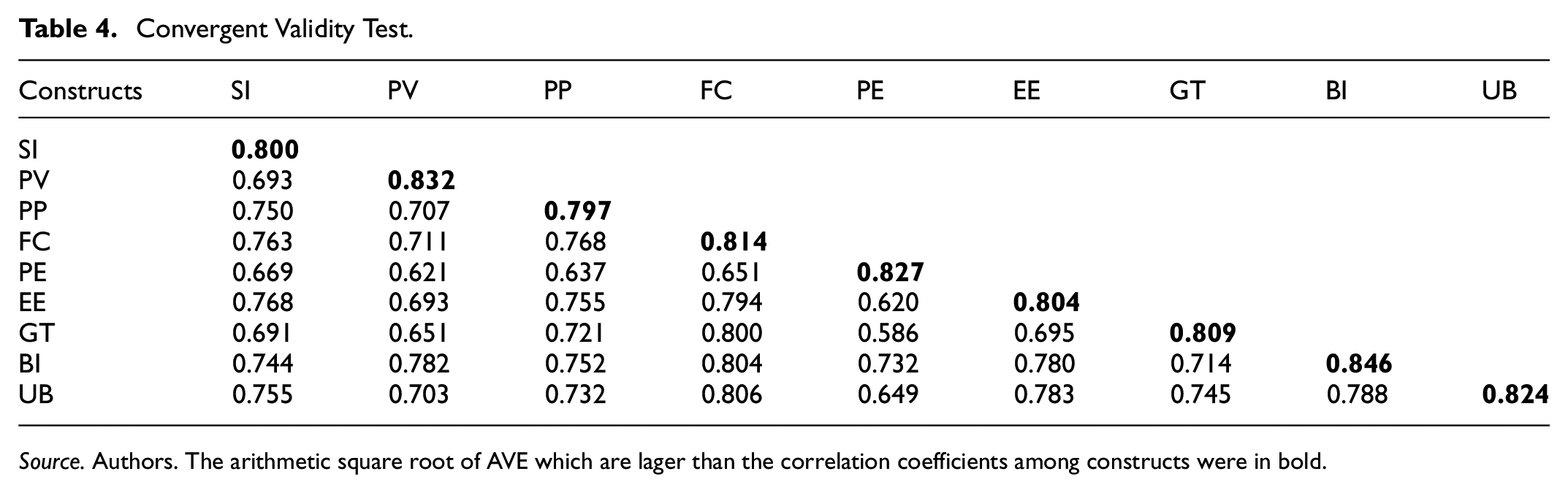
The Fornell-Larcker criterion is used for convergent validity. Table 4 shows that the correlation coefficients among all constructs were below the arithmetic square root of AVE, suggesting that the discriminant validity was also supported.
Convergent Validity Test.
Source. Authors. The arithmetic square root of AVE which are lager than the correlation coefficients among constructs were in bold.
Model Fit
The initial model was modified and improved according to the modified index in Amos. The results, shown in Table 5, indicate that the modified model fits well (CMIN/DF = 1.497, RMSEA = 0.033, GFI = 0.918, AGFI = 0.900, CFI = 0.981, NFI = 0.944, TLI = 0.978, and IFI = 0.981).
The Final Model Fitting Results.

Source. Authors.
Hypothesis Verification
Path Analysis
As for path coefficient analysis (Table 6), the coefficient values of the paths ending in BI including PE (γ = 0.394, p < 0.001); EE (γ = 0.135, p < 0.001); PV (γ = 0.130, p < 0.01); SI (γ = 0.267, p < 0.001); FC (γ = −0.144, p < 0.05); GT (γ = 0.203, p < 0.001) were all inferred to have a significant positive impact. Path coefficients starting with FC (γ = −0.348, p < 0.001); GT (γ = 0.428, p < 0.001); BI (γ = 0.419, p < 0.001) and ending in UB were inferred to have a significant positive impact as well. Additionally, PP (γ = 0.981, p < 0.001) was also found to have a significant influence on GT. However, the path coefficient of PP on UB was recognized as non-significant at the significance level of 0.05, indicating that except for H6b, research hypotheses (H1, H2, H3, H4, H5a, H5b, H6a, H7a, H7b, and H8) were supported.
Results of Standardized Estimates of Structural Model.

Source. Authors.
p < 0.001. **p < 0.01. *p < 0.05.
Moderation Analysis
Considering the possible moderating role of age in affecting use behavior (Laaouina et al., 2024), we validated it by conducting a multi-group analysis. The results showed that there were significant differences among different age groups. From Table 7, it is observed that the path coefficients differ from 18 to over 60 years old. Specifically, in the effect of EE on BI, the path coefficient of the 51 to 60 age group is −0.004, which is significantly different from the positive path influence of other age groups. It can also be seen from the effect of PV on BI in the 41 to 50 age group (γ = −0.042). Besides, we paid special attention to the age group over 60, since they are more challenged in accepting new technologies. Intra-group analysis results showed that 8 of 11 path effects passed the hypothesis test in the age group of over 60. Further, the behavioral intention of the elderly age group over 60 is significantly positively affected by price value (γ = 0.761), social influence (γ = 0.572), effort expectancy (γ = 0.164), with a decreasing impact intensity. In addition, inter-group analysis showed that compared with other age groups, in the paths PV → BI, SI → BI, and PP → GT, the path coefficients of the age group over 60 achieved the greatest results, indicating that compared with the younger group, price value and social influence have much more influence on the behavioral intention of farmers over 60. Meanwhile, policy perception has a greater impact on government trust.
Path coefficient of Moderation Analysis by Age Group.

Source. Authors.
p < 0.001. **p < 0.01. *p < 0.05.
Mediation Analysis
The most widely used method, Bootstrap (Cheung & Lau, 2008), to test the mediation effect is employed in this paper. It conducts 2000 self-samples to test the mediating effect of GT and BI. The results are displayed in Table 8.
Mediation analysis.

Source. Authors.
With 95% Bias-corrected confidence intervals, the direct effect of PP is [−0.325, 0.130], containing 0, while the indirect effect is (0.188, 0.720), not containing 0, indicating that GT plays a fully mediating role between PP and UB. The same result can be observed in the 95% percentile confidence interval. Thus, the hypothesis H9 is proved.
The lower and upper bounds of the direct and indirect effects of GT are both positive in the bias-corrected confidence interval and percentile confidence interval, excluding 0, indicating that BI plays a partial mediating role between GT and UB. Hence, the hypothesis H10 is supported.
As shown in Figure 2, except for H6b (PP → UB), all research hypotheses (H1, H2, H3, H4, H5a, H5b, H6a, H7a, H7b, H8, H9, and H10) were supported, indicating 12 of the 13 hypotheses formulated passed the hypothesis test.

Results of the SEM for the conceptual model.
Discussion
Behavior Influences
This paper explains the use behavior of farmers’ SFV marketing by building a model based on the UTAUT2 model. Aligned with the results of prior research, which shows that all seven factors in the UTAUT2 model have significant positive effects on behavioral intention (Venkatesh et al., 2012). Our study finds that five factors of PE, EE, PV, SI, and FC in the UTAUT2 model, all have significant positive effects on farmers’ behavioral intention of SFV marketing as shown in Figure 2. This finding validates the applicability of UTAUT2 model in explaining use behavior. Specifically, we discussed the results and compared them with other studies one by one according to the intensity of each factor’s influence on the behavioral intention.
Firstly, the results confirmed the primary role of PE in predictive BI (γ = 0.394, p < 0.001). This suggests that farmers will be keen to use SFV marketing if they realize that SFV marketing helps them increase the sales volume of agricultural products, the number of customers, and the profit gains. This finding is consistent with previous research findings investigating the positive impact of PE on BI on various emerging technologies (Grassini et al., 2024; Zhang et al., 2021). In our investigation, there are over 80% of respondents earn less than 6000 RMB per month, with 35.41% earning between 2,001 and 4,000 RMB per month. This also indicates that increasing farmers’ performance expectancy like actual income can effectively motivate farmers to use SFV marketing. Therefore, the government should consider the expectations of farmers when promoting SFV marketing.
Similarly, the results confirmed the importance of SI in predictive BI (γ = 0.267, p < 0.001). This shows that if farmers’ surrounding groups, such as their important relatives, friends, and grassroots government use SFV marketing more frequently, the number of referrals is strong, or there are successful cases around them, then farmers will be more willing to use SFV marketing. This finding is consistent with previous studies investigating the positive impact of SC on BI (Al Aufa et al., 2020; Kabra et al., 2023). Since more than half of the farmers are free individuals or self-employed in our survey, the driving force of the surrounding population is even more important. Therefore, the government should pay attention to the network between farmers and encourage mutual support to form a positive driving effect.
Also, the results reflected the positive influence of FC in predictive BI (γ = 0.144, p < 0.05). This reveals that if farmers perceive more condition support for the whole process (SFV shooting, editing, publishing, and viewing) of SFV marketing, such as higher technical maturity of SFV marketing, better stability of the platform, and enough devices, traffic and Wi-Fi, then farmers will be more willing to use SFV marketing. This is also consistent with existing researches (Mustafa et al., 2022; Sun, 2025). Furthermore, facilitating conditions refer to external factors that are shaped by the objective environment and the level of economic and technological development. They can directly affect farmers’ behavioral intention, as well as the use behavior of SFV marketing. The path coefficient of the FC on the UB (γ = 0.348, p < 0.001) is greater than that of FC on the BI, indicating that when facilitating conditions influence farmers’ technology acceptance behavior, they are more inclined to directly influence use behavior, rather than indirectly influencing it through behavioral intention. One reasonable explanation is that the influence of the facilitating conditions is more macroscopic and direct, affecting the final result, and the use behavior is the ultimate influence object of the behavioral intention. So, when the facilitating conditions affect both behavioral intention and use behavior, the latter path has a stronger influence.
The results proved the positive role of EE in predictive BI (γ = 0.135, p < 0.001). Our survey finds that more than 90% of farmers obtain a diploma or less, leading them to often consider the degree of effort they need for mastering a new technology. If the difficulty of mastering SFV marketing can be reduced, the effort required by the farmers will be less, then farmers will be more willing to use SFV marketing. This is in line with existing researches (Al-Adwan & Al-Debei, 2024; Escobar-Rodríguez & Carvajal-Trujillo, 2014). In fact, farmers need to take efforts throughout the process from downloading SFV app, operating the platform, and mastering the functions. Therefore, both the government and the SFV platform should try to comprehensively consider the difficulty of farmers in accepting new things and ease their efforts.
The study also finds the significant positive influence of PV in predictive BI (γ = 0.130, p < 0.01), where behavioral intention in the policy context can be described as farmers’ comprehensive assessment of the advantages gained by adopting SFV marketing and the costs incurred. According to this finding, farmers would be inspired to use SFV marketing if they believed it is more cost-effective with reasonable charges. This is consistent with existing researches (Chopdar, 2022; Zhang et al., 2021). Because the ultimate goal of farmers using SFV is to make profits, if there is less cost like store rents, traffic attracting fees, and operating costs while using them, then the profit will be greater, which is also what farmers expect.
Behavioral intention is the driving force of use behavior, as well as the mediating variable connecting the dimensions of all influencing factors in UTAUT2 model with use behavior. Aligned with the previous studies (Agudo-Peregrina et al., 2014; Mustafa et al., 2022), In our study of farmers’ SFV marketing, behavioral intention directly affects the possibility and enthusiasm of use behavior, and it has a significant positive effect on use behavior (γ = 0.419, p < 0.001). This suggests that farmers will be keen to use SFV marketing, if they take delight in studying, using, and recommending SFV marketing. Consistent with the research (Venkatesh et al., 2012), our research result also proves that behavioral intention is the prerequisite factor for use behavior. For the mediating role of behavioral intention between influencing factors and use behavior, there have been too many previous studies to prove this, so this paper defaults its establishment.
Policy Influences
Previous studies have shown that policy perception positively impacts government trust (Hooda et al., 2022; Norpoth, 2010; Roberts, 2008). This study confirmed the positive role of PP in affecting GT (γ = 0.981, p < 0.001). This shows that the more farmers understand the rural revitalization policy, the more they agree with the content of the policy, and the more satisfied with the implementation of the policy, the higher their trust in the government’s ability to govern. However, contrary to prior studies (J. Li et al., 2021; C. Wang et al., 2022), the path coefficient of PP on UB is negative (γ = −0.269, p = 0.063) as shown in Figure 2, hypothesis H6b does not pass the test, indicating that farmers’ perception of policy support for SFV marketing technology cannot directly impact the use behavior of SFV marketing. This may be because the policy perception is rooted in the internal subjective perceptions of farmers, while use behavior is influenced by both internal factors (e.g., farmers’ judgments) and external factors (e.g., the conditions of rural infrastructure; Talanow et al., 2021). External factors often have a stronger impact on use behavior. Therefore, even if the internal factors of farmers themselves have an impact on use behavior, they need to transition through external factors such as rural culture and agricultural promotion system.
Previous studies have shown the significant positive correlation between government trust and behavioral intention to participate in policy activities (Lean et al., 2009; Van der Weerd et al., 2011). The stronger trust in government, the higher the responsiveness of people to participate in policy behavior (Bruno et al., 2022; Pagliaro et al., 2021; Park et al., 2015). Consistent with these prior studies, the results in this study confirmed the significant positive impact of GT in predicting BI (γ = 0.203, p < 0.001) and GT in predicting UB (γ = 0.428, p < 0.001), indicating government trust positively affects both the behavioral intention and use behavior of SFV marketing of agricultural products. In other words, farmers will place more trust in the government, if they acknowledge the efficiency and performance of government personnel, or believe that what the government does is in their interests, or perceive high transparency in government actions. Considering the role of government, the grassroots government is a key link in implementing the rural revitalization strategy, and also a guaranteeing institution to participate in policy activities. Farmers’ trust in government brings them closer to the policy, and can effectively enhance their intention to use SFV marketing, thereby inspiring the behavioral participation in rural revitalization policies.
The results of mediation effect analysis in this study show that government trust plays a completely mediating role between policy perception and use behavior, which aligns with previous research results (Jeong & Kim, 2024). The positive correlation between policy perception and government trust was proved as well. However, policy perception does not directly affect use behavior, but indirectly influences use behavior through government trust. This is because farmers’ perception of policies is mainly based on the specific policy implementation behaviors of the grassroots government, thus generating satisfaction with the process and results of the implementation of the grassroots government policies, forming a good government image, and finally establishing a trust relationship with the government.
According to Hooda et al. (2022), research only tested the path between behavioral intention, government trust and use behavior, however, they ignored the mediating role of behavioral intention between government trust and use behavior and did not validate that. This study firstly analyzes and validates the relationship among behavioral intention, use behavior and government trust. The results of mediation effect analysis show that farmers’ behavioral intention mediates the influence of government trust on use behavior. Government trust can not only directly affect the use behavior, but also indirectly affect the use behavior through the behavioral intention. The direct effect value is 0.459, while the indirect effect value is 0.487. It can be seen that the weight of direct and indirect influence is equal in partial mediating effects. Government trust is established based on farmers’ personal experience with the government’s contribution. It can improve the stickiness of farmers on government, to understand, support and respond to the government’s policy implementation plan, and finally result in the intention and behavior to use SFV marketing technology in rural revitalization.
Finally, attention should be paid to the influence intensity of factors on use behavior. The above discussion shows that policy perception is not a positive promoter of use behavior. Use behavior is directly affected by the facilitating conditions, behavioral intention and government trust, while government trust has the greatest impact (0.428), followed by behavioral intention (0.419) and the facilitating conditions (0.348). This finding proves the important role of government trust in promoting farmers’ use of SFV marketing.
Conclusion and Suggestions
Conclusion
To fill the gap in the use behavior of farmers’ SFV marketing in the context of rural revitalization, this study proposes the conceptual model based on UTAUT2 model to examine the factors and mechanisms influencing farmers’ use behavior of SFV marketing from the perspective of government trust. Through empirical analysis, we find that performance expectancy, social influence, facilitating conditions, effort expectancy and price value all have positive impact on farmers’ behavioral intention of SFV marketing, and the influence intensity decreases successively. Besides, the influence of paths varies across different age groups, indicating that age plays a moderating role in farmers’ use behavior of SFV marketing. As for the role of government, policy perception cannot directly affect use behavior, it only indirectly affects use behavior through the fully mediating effect of government trust. Additionally, government trust directly affects the use behavior, and also indirectly impacts it through the mediating effect of behavioral intention. We also conclude that use behavior is directly positively affected by the government trust, behavioral intention and facilitating conditions, while government trust influences more. This paper proves that the UTAUT2 model is equally effective in the policy field, and the findings have practical implications for the construction of SFV platforms and government governance.
However, this study has some limitations. For example, only policy perception as a pre-factor affects government trust in the framework model, the influencing path seems narrow and not comprehensive enough. Future research will comprehensively examine the potential factors that influence government trust to increase the model’s interpretability.
Suggestions
In this study, three countermeasures and suggestions are proposed for the two main participants, the SFV platform and the grassroots government. These suggestions aim at optimizing the platform construction in terms of content and function of the SFV platform and improving the operational capacity of the government in implementing the rural revitalization policy.
Analysis of path coefficients reveals that performance expectancy is the strongest factor influencing farmers’ behavioral intention of SFV marketing, followed by social influence. This way, the first suggestion is to trigger performance expectancy and strengthen social influence. It is essential to enhance the promotion of SFV marketing in agriculture and rural areas, unlock the motivation of farmers to sell agricultural products through SFV platforms, and make SFV marketing advantages, such as low cost, fast communication, and high return, win great popular support. The survey results also show that if people who have benefited from SFV marketing recommend it, farmers are more willing to use it. Therefore, government should pay more attention to social influence and strengthen the promotion of SFV marketing among farmers. For instance, encouraging farmers who have utilized SFV marketing to actively advocate for its use, and giving certain rewards to farmers who successfully motivate the others around them to join the SFV marketing network. In this way, more and more villagers will engage in SFV assistant rural revitalization activities. The increasing acceptance and frequency of SFV marketing can accelerate the development of rural economy and the promotion of rural revitalization strategy.
Facilitating conditions rank third in influencing farmers’ behavioral intention of SFV marketing. Meanwhile, it affects both behavioral intention and use behavior, with a stronger impact on the latter. Accordingly, the second suggestion is to increase the facilitating conditions and optimize the intelligent recommendation. SFV platform is not only a platform for implementing marketing, but also the carrier of SFV technology realization. Thus, both active and passive methods can be used to develop SFV marketing. Active marketing is to expose SFV content through search engines and stream-cipher, and finally obtain user engagement. Meanwhile, passive marketing is to use the intelligent algorithm of SFV platform to carry out intelligent recommendations, which has higher requirements for SFV platform. Therefore, to match SFVs to the targeted population, the SFV platform should optimize the intelligent recommendation system to improve accuracy. In addition, the government should also increase its support for SFV platforms to optimize the functions and technologies, thereby increasing the technical support of SFV platforms for farmers to participate in rural revitalization.
The results show that policy perception cannot directly affect behavioral intention, but influences the use behavior of farmers’ SFV marketing through the mediating role of government trust, highlighting its critical role. Therefore, the third suggestion is to enhance policy perception and consolidate government trust. Policy perception is the subjective feeling and understanding of farmers on policy measures and policy implementation, which directly reflects the image and ability of grassroots governments. The establishment and stabilization of government trust is crucial for farmers to participate in rural revitalization by using SFV marketing technology. To build farmers’ trust in the government, the government should first collect the actual needs of farmers and implement policies according to regional differentiation and economic conditions. Next, more attention should be paid to the consistency of policies in the implementation process, to improve the implementation ability of government. Finally, to enhance the stability and continuity of grassroots government policies, when introducing and adjusting policy activities, deep consideration is needed to avoid arbitrary changes that may result in unfulfilled commitments to farmers.
Footnotes
Acknowledgements
We sincerely appreciate the feedback provided by the anonymous reviewers for improving this paper. Additionally, we would like to acknowledge the support of the project funding (the Natural Science Foundation of China (Major Program) under Grant No. 72331007, the Natural Science Foundation of China (General Program) under Grant No. 72171160, and the Sichuan Association of Higher Education under Grant No. SZJJ2024ZD-001.). Finally, we are grateful for the data support provided by the participants in the survey.

Ethical Considerations
This study is not applicable to animal and human studies, and no ethical statement is required.
Consent to Participate
We declare that informed verbal consent has been obtained from the participants for this study.
Consent for Publication
Not applicable.
Author Contributions
Conceptualization, Geer Teng and Zhigang Li; methodology, Haiyan Guo; software, Haiyan Guo; validation, Haiyan Guo, Geer Teng, and Zhigang Li; formal analysis, Geer Teng and Zhigang Li; investigation, Haiyan Guo and Xiaohong Song; resources, Jin Xiao; data curation, Haiyan Guo and Xiaohong Song; writing—original draft preparation, Haiyan Guo; writing—review and editing, Zhigang Li; supervision, Jin Xiao; project administration, Geer Teng and Jin Xiao; funding acquisition, Jin Xiao All authors have read and agreed to the published version of the manuscript.
Funding
The author(s) disclosed receipt of the following financial support for the research, authorship, and/or publication of this article: This research was funded by the Natural Science Foundation of China (Major Program) under Grant No. 72331007, the Natural Science Foundation of China (General Program) under Grant No. 72171160, and the Sichuan Association of Higher Education under Grant No. SZJJ2024ZD-001.
Declaration of Conflicting Interests
The author(s) declared no potential conflicts of interest with respect to the research, authorship, and/or publication of this article.
Data Availability Statement
The datasets used and analyzed during the current study are available from the corresponding author on reasonable request.