



Abstract
China’s rapid economic growth and correlating growth of metropolitan areas has attracted young people leaving their hometowns from the rural areas. Revitalizing the rural areas has been a national development strategy in China. College students returning home to start businesses is one way to alleviate the current shortage of young talents in rural areas of China. Based on the model of goal-directed behavior (MGB), this paper takes behavioral attitude, subjective norms, positive expectations of emotion, negative expectations of emotion, perceived behavioral controls, and government support, all as independent variables. The paper uses the desire as the intermediary variable to construct a goal-oriented behavior model about the intention of entrepreneurial initiatives by college students. By using survey data, the empirical analysis shows that the model has a strong explanatory power on the intention of college students. The positive expected emotions, perceived behavioral control, and government support, have a significantly positive influence on college student’s intentions through controlling behavior desire. The perceived behavioral control and behavioral desire of the subjects had a direct positive and significant influence on their intention. This research provides a reference for the government to formulate policies to attract college students to return to their hometowns to start businesses and boost rural revitalization.
Introduction
The past 40 years has witnessed the fast dramatic increase of economic development in China’s urban areas. The rapid growth has brought prosperity and opportunity which have attracted young and talented people migrating from rural to urban areas. As rural areas have been suffering from the urban migration of the young generations for decades, the rural economy is now lacking in labor and the rural development is seriously lacking of vigor. This dilemma is a global phenomenon. Many countries, including the most developed country like U.S., are all facing the challenge of creating and expanding rural development.
The strategy of rural revitalization is a major national development strategy of the Chinese government attempting to solve the problems of the agriculture industry and boosting rural development. Talent revitalization is an important component of rural revitalization. Its success will be a driving force for implementing the strategy of rural revitalization. The implementation of the rural revitalization strategy needs a well-educated, skilled, and innovative workforce to be resettled in rural areas (Y. Wang & Xiong, 2018). In recent years, Chinese local governments at all levels have introduced a large number of policies in order to attract talented young people to return to their rural home as an entrepreneur, which have had a positive impact on the recruitment of attracting younger generations back home (Luo, 2018). Meanwhile, the extensive training of students to be entrepreneurs in China’s education system carried out by colleges and universities has also played a role in enhancing the entrepreneurial intentions of college students to return home as an entrepreneur (Yuan & Zhang, 2019). However, the reality is that there are still vast differences between policies and practices, and the siphon effect of talent from rural to urban is still strong. Rural population loss, industrial shrinkage, and talent shortage, are the consequences. Therefore, how to attract college students to return home to start businesses in order to revitalize the countryside has become an important subject worth our attention. Solving this issue will provide a strong example of coherent policy for other developing and developed countries that are also facing the challenges of rural revitalization.
The current literature examines the factors influencing decisions and practices of college students who return home in order to start their own businesses. Most literature can be categorized into the following three aspects. Firstly, the personal characters, including age, gender, education, major, and income. The study by H. M. Wang (2016) found that gender, major, and education level, affect the intention of college student to return home to start a business, among which male college students have a higher intention to start a business than female college students, and rural college students have a stronger intention to return home to start a business than urban college students. Graduates from science and technology majors have stronger intention than those from humanities and arts majors (Xia & Zhang, 2020), while those with lower academic degree have higher motivation to return home to start a business than those with higher degree (Jin, 2017). Kibler (2013) found that the population density, the level of education, income and wealth and the rate of public and manufacturing sector employment of a region are related to the individual formation of entrepreneurial intentions.
Secondly, the internal psychological factors, including entrepreneurial motivation and entrepreneurial awareness (M. J. Malebana, 2014; M. Malebana & Swanepoel, 2015; Tomy & Pardede, 2020). On the motivation of entrepreneurship, Zhang (2018) conducted a survey of 321 students from four universities, and found that the low working pressure, the convenience of taking care of family members, the existence of entrepreneurial opportunities in the hometown, and the social responsibility of servicing hometown are the main motivations for college students to return home to start a business. College students who have participated in entrepreneurship training, entrepreneurship courses, and entrepreneurship lectures and guidance, have a stronger entrepreneurial intention to return hometown (Jin, 2017). Students with entrepreneurial experience or working experience in large and medium-sized enterprises have a strong intention to start a business (Xia & Zhang, 2020), while family background, including the parent’s education level, and whether relatives, friends, and classmates are entrepreneurs, also directly affect the intention of college students to start a business (Huang, 2017).
Thirdly, the external factors, including the entrepreneurial environment and the government policies (Janetius et al., 2018). The environmental factors could be divided into social factors, government factors, and family factors (Jin, 2017). The entrepreneurial environment has a positive effect on college students’ tendency to return home to start a business (Duan et al., 2016). Rural economic and social environment, infrastructure environment, local government entrepreneurship support policy, and financial services environment optimization are promoting the intention of college students to return home to start a business (Xia & Zhang, 2020; X. M. Zhao, 2021).
The current literature provides a wealth of reference on the subject, but with limitations. For example, the selection of influencing factors variables mainly considered the motivation, cognition, and environmental factors, but not the individual emotions and desires as the main variables into the theoretical model and empirical testing. The existing research basically adopts binary logic regression, only a few studies adopt the structural equation model, so there are shortcomings in the path exploration and the influence mechanism analysis of the factors influencing college students’ return to their homes, which need to be further improved.
Our study constructs an expanded behavior-oriented theoretical model, using the structural equation model, and empirically analyzing the main factors and influence mechanisms affecting college students’ intention to return home to start a business by a survey data. The contribution of our study is mainly reflected in variable setting, data adoption, and measurement statistics. This study makes a new attempt in variable setting. We use the model of goal-directed behavior (MGB) as the theoretical basis. In our model, the positive and negative expectation emotions is added to explore the role of emotions on college students’ intention to return home to start a business, and the desire is used as an intermediary variable to explore its intermediary role between behavioral attitude, subjective norms, expected emotions, perceived behavioral control, and intention. To increase the comprehensiveness of cognitive variables on the subjective norms, the perceived behavioral control is introduced as a variable. In addition, the government supports as an explanatory variable is added in our model.
On the data adoption, the data used by this research has unique advantages. This study designed a survey for the intention of college students to return home to start a business, and the survey objects are college students from Ganzhou, Jiangxi. Since the China central government grants Ganzhou City many supporting policies in recent years, Ganzhou experiences a rapid economic development, especially the navel orange and other agricultural industry development, which made college students have stronger interests to return home to start a business. Therefore, college students from Ganzhou are the ideal research object.
On aspect of the statistical measurement, this study uses the structural equation model, combined with factor analysis, regression analysis, and path analysis, to better identify and evaluate the influence factors of college students returning home to start a business, and to explore the mechanism of influence.
The main finding of this study is that the desire plays an intermediary role between the independent and dependent variable of college students’ intention to return home. Both cognitive behavioral control and positive expectation emotion in individuals have a significantly positive influence on college students’ intention to return home through the intermediary factor of the desire. The government supporting policy also has a significantly positive influence. These main conclusions and policy enlightenments will be of guiding and reference value to local governments at all levels in formulating and adjusting a series of support policies to attract college students to return home to start their own businesses.
The structure of the remaining sessions of our study is as follows: the second part is the literature review. The third part puts forward our model and the research hypothesis. The fourth part describes the survey design, and the fifth part are the empirical analysis and discussion on the survey results. And the last part summarizes the paper.
Literature Review
The model of goal-directed behavior (MGB) is a classical theoretical model evolved from the theory of planned behavior (Ajzen, 1991) to explain individual behavioral intention and practical action (Liu & Tang, 2014). The theory of planned behavior includes four main variables: behavioral attitude, subjective norm, perceived behavioral control, and behavioral intention, which emphasize the influence of cognitive factors on individual behavior intention, and the influence of behavioral intention on individual behavior, which is directly affected by behavioral attitude, subjective norms, and perceived behavioral control.
The theory of planned behavior has a strong explanatory effect on individual behavior and behavioral intention from the cognitive perspective, especially the influence of perceived behavioral control on individuals. However, it also has shortcomings, which mainly ignore the influence of individual emotion on their behavioral intention (Conner & Armitage, 2006).
Perugini and Bagozzi (2001) constructed a model of goal-directed behavior (MGB), to make up for the defects of planned behavior theory, by introducing the desire as an intermediary variable on the basis of retaining the original variables of planned behavior theory. They introduced expected emotions, including positive and negative expected emotions, which effectively integrated motivation, emotion, and cognitive factors into the decision-making. Compared with the theory of planned behavior, MGB not only considers the possibility of individual behavior from the cognitive level, but also from the motivation level, emphasizing the intermediary role of desire, and improving the prediction of individual behavior and behavior intention. Therefore, MGB becomes a common theoretical model in the research of individual behavior and behavioral intention.
The application of MGB is widely used in tourism, sports, culture, education, entertainment, and other fields. In the tourism study, Bo and Choi (2016) used an extended MGB model to study the slow-paced tourist behavior in Gulangyu, Xiamen, and the results showed that three key factors, knowledge, information searching behavior, and reality, determine the desire, which acts as an intermediary between attitude, subjective norms, behavioral perception control, and expected emotions. Han and Hae (2015) studied customers behavioral intention on choosing hotels. Based on the MGB, several key variables, such as environmental awareness, perceived effectiveness, eco-friendly behavior, and reputation, were expanded to explore the ecologically friendly behavior of consumers, and the results showed that the improved MGB had strong predictive ability. Lin et al. (2018) applied the MGB to the study of the emotional factors of farmers’ participation in rural tourism, and found that the behavioral attitude, subjective norms, positive expectation emotions, and perceived behavioral control of farmers had a positive influence on behavioral intention through behavior desire, while negative emotions had a negative impact on their intention to participate in rural tourism behavior through behavioral desire. C. K. Lee et al. (2020) introduced cultural worldview and authenticity into the MGB model in an empirical study of tourists visiting traditional famous places in Korea, and the results showed Cultural worldview and authenticity play an important role in tourists’ tourism decisions, and both cultural worldview and authenticity are indirectly related to desire and behavioral intentions, and desire plays a mediating effect.
In the field of sports, Yim and Byon (2021) compared the consumption behavior of sports enthusiasts through rational behavior model, planned behavior model, and goal-oriented behavior model, and found that the MGB model was more explanatory. Yim and Byon (2020) found that the expanded MGB model also has a good explanation for the sports consumption behavior of millennial fans.
In the culture study, S. J. Lee et al. (2018) combined MGB with the AIDA model to analyze the decision-making behavior of popular culture toward consumers choosing a travel destination, and the results showed that the focus on popular culture and positive expectations had a positive impact on the choice of consumer’s travel destination.
In the education study, Yu and Liu (2018) combined the MGB with the theory of self-determination to explore the internal influence mechanism of adults’ intention to participate in the online learning community, and the variables of attitude, subjective norms, expected emotions, competence, correlation, desire, and perception behavioral control have a positive influence on adults’ intention to participate in online learning. Qi et al. (2018) constructed a structural equation model with learning orientation and performance orientation as the intermediary, based on the theory of personality theory and MGB, and studied the knowledge-sharing behavior of college teachers with different personality traits. The results show that the learning-oriented intermediary effect is stronger than that of performance orientation, which indicates that teachers have a stronger motivation to share knowledge.
In the entertainment study, Ji and Nie (2017) used the MGB to analyze the influence factors of tourists’ intention to gamble in the six casinos at Macao, and found that the subjective norms of gambling and negative expectations of tourists are not significant to the desire to gamble.
In the above literature, the influence of expected emotion and desire on individual behavior, and behavioral intention in MGB have been used in various subjects, like tourism, sports, culture, education, entertainment. The intention of college students to return to their hometowns to start a business is a psychological factor, which is closely related to expected emotions and desires. Therefore, it is also feasible to apply the MGB to our research (Krueger & Carsrud, 1993; Tomy & Pardede, 2020). This study will construct a theoretical model based on MGB, and conduct an intention survey on students from seven colleges and universities in Jiangxi Province, identify the influencing factors of college students’ intention to return home and start a business, and explore the mechanism of influence and mechanism of action.
Model and Hypothesis
Research Model
Based on the goal-oriented behavior model (MGB) (Perugini & Bagozzi, 2001), this study believes that the intention of college students to return to their hometown to start a business is mainly affected by the following seven independent variables: Desire; Behavioral attitude; Subjective norms; Positive expectations; Negative expectations; Perceived behavioral control; Government support.
Desire is the direct motivation for college students to return home to start a business. Desire, as an intermediary variable, is affected by all other variables. Behavioral attitude is an estimated psychological state of college students for their homecoming entrepreneurial behavior, which is reflected in college students’ feelings about the current employment situation, rural environment and national policies. Subjective norms include the external social pressure that college students feel when deciding whether they are willing to return to their hometown to start a business. It mainly includes two aspects: one is the expectations of relatives and friends, and the other one is the constraints from the external factors, like public policy and technology. Positive expectations are expressed as positive effects of college students’ expectations, such as satisfying the sense of belongingness, realizing self-worth, and policy support. Negative expectations are expressed as the negative effects of college students’ expectations, such as lack of start-up funds and guidance, inadequate implementation of start-up services, and lack of interpersonal relationships. Perceived behavioral control is a college student’s self-perception of the difficulty to start a business, including the perception of the amount of entrepreneurial resources, the level of entrepreneurial ability, and the size of entrepreneurial opportunities. The external assistance provided by the government includes spiritual, financial, and training support.
This study builds the goal-directed behavior model (MGB) (Figure 1) by using behavioral attitude, subjective norms, positive expected emotions, negative expected emotions, perceived behavioral control, and government support as independent variables, with the desire as the intermediary variable, and the intention as the dependent variable.

The theoretical model of goal-directed behavior (MGB).
Research Hypothesis
Behavioral attitude. As an independent variable in the goal-oriented behavior model, behavioral attitude is an important indicator to measure the intention of college students to return home to start a business. Perugini and Bagozzi (2001) believed that behavioral attitude does not directly affect behavioral intention, but indirectly affect behavioral intention through desire. Bo and Choi (2016) hypothesized that attitude has a positive and significant effect on desire and tested it. The test results show that the hypothesis is valid. Han and Hae (2015) used the structural equation model to test the relationship between behavioral attitude and desire. The test results show that behavioral attitude has a significant positive effect on behavioral desire.
Our research proposes the following hypotheses:
H1: Behavioral attitude has a positive impact on college students’ desire to return home to start a business.
Subjective Norms
Subjective norms do not refer to the subjective ideas of the people, but refer to external social pressures that can influence the individual’s decision-making, which indirectly acts on the will through desire. Ji and Nie (2017) put forward the hypothesis that the subjective norms of tourists’ gambling consumption have a positive influence on their gambling desire in their research on Chinese tourists’ gambling consumption behavioral intentions and have been verified. Schuster et al. (2015) and S. J. Lee et al. (2018) verified that subjective norms have a positive effect on behavioral desires.
Our research proposes the following hypotheses:
H2: Subjective norms have a positive impact on college students’ desire to return home to start a business.
Positive and Negative Expectations
College students expect that there are many risks and uncertainties in the process of returning to their hometown to start a business, which will generate negative emotions; meanwhile, they are full of hopes and expectations for the future, which will generate positive emotions. Lin et al. (2018) proposed that positive expectations such as the improvement of quality of life and the improvement of overall quality are the main factors that promote farmers to participate in rural tourism, while negative expectations such as disturbance and destruction of the rural living environment will hinder the participation of farmers in rural tourism. They also verified that positive emotion would further strengthen the desire and affect the behavior of farmers participating in rural tourism, while the negative expected emotion will do the opposite. Manca and Fornara (2019) also verified the influence of positive expectations and negative expectations on desire.
Our research proposes the following hypotheses:
H3: Positive expectations have a positive impact on college students’ desire to return home to start a business.
H4: Negative expectations have a negative impact on college students’ desire to return home to start a business.
Government Support
College students need resources such as capital, policies, social network, and training, to start a business, which must be obtained from the external environment. In the context of the rural revitalization strategy, the government can provide these related resources. Zhong et al. (2016) believes that the intention of college students to start a business is affected by national and local entrepreneurial support policies, and proposes that the government should increase the promotion of college students’ entrepreneurship policies. L. Zhao (2012) proposed that for the agricultural start-up business, the supports can include four dimensions: government support, school support, family support, and negative support, verifying that information on finance, taxation, social security, and credit has a significant role in promoting college students’ desire for agricultural business. At the same time, other studies verified that government support has a positive impact on the intention and desire of college students to return to their hometown to start a business (Duan et al., 2016; Liu & Tang, 2014).
Our research proposes the following hypotheses:
H5: Government support has a positive impact on college students’ desire to return home to start a business.
Perceived Behavioral Control
When an individual feel that the more resources he can obtain and the smaller the expected obstacle, the stronger his perceived behavioral control (A. B. Wang et al., 2019). Han and Hae (2015) verified that perceived behavioral control has a positive effect on desire. Lin et al. (2018) used a binary logistic regression model to verify that perceived behavioral control has a positive and significant impact on behavioral intention. Bo and Choi (2016) empirically verified that perceived behavioral control as an independent variable can not only have a positive effect on behavioral intention through desire, but also directly affect behavioral intention.
Our research proposes the following hypotheses:
H6: Perceived behavioral control has a positive impact on college students’ desire to return home to start a business.
H7: Perceived behavioral control has a positive impact on the intention of college students to return home to start a business.
Desire and Its Mediation Effect
In the goal-oriented behavior model, motivation, emotion, and cognition are emphasized, and the motivation for college students is their desire to return to their hometown to start a business; desire is an intermediary variable that directly affects behavioral intentions (Perugini & Bagozzi, 2001). Yu and Liu (2018) verified that desire has a positive effect on the intention to participate in the online learning community of adults. The stronger the desire of adults to participate in the online learning community, the more conducive to the generation of their intention to participate. S. J. Lee et al. (2018) tested that desire has a positive and significant influence on fans’ intention to go to destinations with pop culture characteristics. Schuster et al. (2015) also conducted empirical tests on the relationship between attitudes, subjective norms, perceived behavioral control, expected emotions, and desires and behavioral intentions, and their results showed the mediation effect from the desire.
Our research proposes the following hypotheses:
H8: Desire has a positive impact on the intention of college students to return home to start a business.
H9: Behavioral attitudes have a positive impact on college students’ intention to return home and start a business through desire
H10: Subjective norms have a positive impact on college students’ intention to return home and start a business through desire
H11: Positive expectation emotions have a positive impact on college students’ intention to return home and start a business through desire
H12: Negative expectation emotions have a negative impact on college students’ intention to return home and start a business through desire
H13: Government support has a positive impact on the intention of college students to return home to start a business through desire
H14: Perceived behavioral control has a positive impact on college students’ intention to return home and start a business through desire.
In all, we put forward 14 hypotheses. Among them, H1 to H8 are the hypothesizes for the main effects, and H9 to H14 are for the mediation effect.
Research Design
The survey of this study is distributed to college students from Ganzhou, Jiangxi Province, in seven colleges and universities in Jiangxi Province, China. In the past few years, Ganzhou, as a developing area in Jiangxi Province, has received many supporting policies from the central government for rural revitalization, which made its college students have stronger interests to return home to start a business. The survey started from September 1, 2020 to 29 December, 2020. About 521 questionnaires had been collected, of which 478 were valid.
In order to ensure the quality of the survey, we used a typical random sampling method. The questionnaire design is based on the existing literature questionnaire (M. J. Malebana, 2014; Perugini & Bagozzi, 2001; Zhang, 2018), and the pre-survey and the expert consultation are carried out. The pre-survey invited 40 students to fill out the questionnaire, and consult the relevant experts. According to the feedback of the filler and the advice of experts, we deleted the unclearly expressed question items, and finalized the questionnaire.
The questionnaire of the survey consists of three parts: the instruction, the basic information, and the intention survey. The instruction session introduced the purpose of the survey, and promised that the collected data will only be used for research. The basic information session includes items such as home address, name, age, college level, major, grade, household registration type, and monthly living expenses. The intention survey part involves eight aspects of behavioral attitude, subjective norms, positive and negative expectation, government support, perceived behavioral control, desire, and intention of college students returning home to start a business. The questionnaire uses the Likert seven-level scale. The numbers 1, 2, 3, 4, 5, 6, and 7 respectively represent strongly disagree, disagree, a little disagree, neutral, a little agree, agree, and strongly agree. “Strongly disagree” means that the situation described in this question is completely inconsistent with the actual situation. “Strongly agree” means that the situation described in this question is completely consistent with the actual situation. 3 to 7 measurement items are set under each dimension.
Through investigation, this study finally recovered 478 valid samples. The basic information of the samples is shown in Table 1:
Basic Sample Information.

Empirical Analysis
Descriptive Statistics
Table 2 is the descriptive statistics of the main variables, including the mean, standard deviation, skewness, and kurtosis of each measurement item. When the skewness coefficient of the sample observation variable is greater than 3 and the kurtosis coefficient is greater than 8, the sample distribution may deviate from the normal distribution. The skewness coefficients of each variable in this study are all less than 3, and the kurtosis coefficients are all less than 8, which show that the sample data in this study conforms to the normal distribution.
Descriptive Statistics.

Reliability Analysis
This study uses the alpha coefficient (Cronbach’s Alpha) to measure the reliability of the questionnaire. The larger the alpha coefficient, the higher the reliability of the questionnaire. If the α coefficient is between .60 and .65, it is not acceptable; the value of α coefficient between .65 and .70 is the minimum acceptable value; the value of α coefficient between .70 and .80 is good; the value of α coefficient between .80 and .90 is excellent.
In addition, in this study, confirmatory factor analysis is used to test the validity of the questionnaire. The confirmatory factor analysis mainly verifies two kinds of validity: convergence validity and discriminative validity.
It can be seen from Table 3 that the α coefficients of behavioral attitude, subjective norms, positive expected emotions, negative expected emotions, perceived behavioral control, desire, government support, and intention are .817, .842, .865, .928, .905, .881, .906, and .959, and all are above .7. Except for negative expected sentiment of .928 and intention of .959, the rest of the alpha coefficient values are between .80 and .90, indicating that the questionnaire has good reliability.
Reliability and Convergence Validity.

In the convergence validity test, the absolute value of the factor loading estimate should be at least 0.5 or more, the average variance extraction (AVE) index value should be more than 0.5, and the facet reliability index value should be higher than 0.7, indicating good convergence validity. It can be seen from Table 3 that the factor loads of behavioral attitude, subjective norms, positive expected emotions, negative expected emotions, perceived behavioral control, desire, government support, and intention are all above 0.5, the CR values are all greater than 0.7, and the AVE values are all greater than 0.5, so this questionnaire has good convergence validity.
Table 4 shows that, in the eight-factor model fitting, the value of X2/DF is 3.375, the value of RMSEA is 0.071, the value of SRMR is 0.059, the value of TLI is 0.909, the value of CFI is 0.920, the value of IFI is 0.921, and the fitting indexes all reach the standard. By comparing different factor models, it shows that the eight-factor model is better than other competitive models, meaning that the eight variables have good discrimination validity.
Discriminative Validity.

Note. Eight factor (BA, SN, PAE, NAE, GS, PBC, DE, AS); Seven factor (BA+SN, PAE, NAE, GS, PBC, DE, AS); Six factor (BA+SN+PAE, NAE, GS, PBC, DE, AS); Five factor (BA+SN+PAE+NAE, GS, PBC, DE, AS); Four factors (BA+SN+PAE+NAE+GS, PBC, DE, AS); Three factors (BA+SN+PAE+NAE+GS+PBC, DE, AS); Two factors (BA+SN+PAE+NAE+GS+PBC+DE, AS); One factor (BA+SN+PAE+NAE+GS+PBC+DE+AS).
Structural Equation Model Analysis
In this study, the structural equation model is used for hypothesis testing. The structural equation model is a statistical method based on the covariance matrix of variables and comprehensively uses factor analysis, multiple regression analysis, and path analysis to analyze the relationship between variables. Therefore, the structural equation model is very suitable for the empirical research of this research.
Table 5 indicates that the value of X2/DF is 3.388, the value of RMSEA is 0.071, the value of SRMR is 0.060, the value of TLI is 0.908, the value of CFI is 0.919, the value of IFI is 0.919, and the fitting indicators are all up to Standard, hence the structural equation model fits well.
Structural Model Fitting.

From Table 6 we can see the coefficient of each path and its significance. Among them, behavioral attitudes, subjective norms, positive expected emotions, negative expected emotions, government support, and perceived behavioral control can explain desire for 57.8%. Perceived behavioral control, desire to explain intention is 81.4%.
Path Analysis.
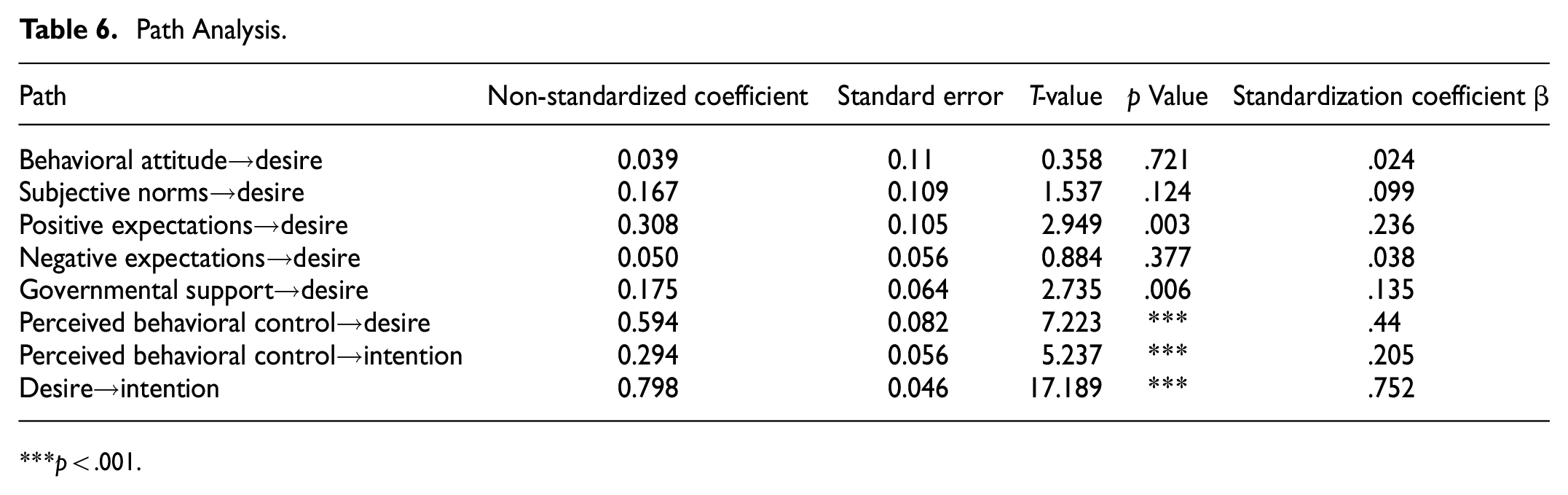
p < .001.
This verification uses a bias-corrected non-parametric percentile bootstrap method to estimate the significance of the mediation effect, in which the number of bootstraps is 5,000, and the confidence is 95%. It can be seen from Table 7 that in the path of Government support → Desire → Intention, the confidence interval does not include 0 [0.020, 0.254], indicating that the government support has a significant indirect effect on desire through desire, and the magnitude of the indirect effect is 0.102, which indicates H13 passing the test. In the path of Perceived behavioral control → Desire → Intention, the confidence interval does not contain 0 [0.349, 0.625], indicating that the perceived behavioral control has a significant indirect effect on desire through desire, and the magnitude of the indirect effect is 0.474, which indicates H14 passing the test. In the path of Positive expectation → Desire → Intention, the confidence interval does not contain 0 [0.058, 0.447], indicating that the positive expectation have a significant indirect effect on intention through desire, and the magnitude of the indirect effect is 0.246, which indicates H11 passing the test. In the paths of Negative expectation → desire → intention, subjective norms → desire →intention, behavioral attitude → desire → intention, the confidence interval contains 0, which shows that there is no significant indirect effect, which indicates H12, H10, and H9 rejected in the test.
Indirect Effect.

From the results of path analysis data in Table 6 and Figure 2, it can be seen that under the same control variables, the positive expectations of college students have a significant positive impact on desire (β = .236, p = .003) <.01), that is, H3 passes the test, and the hypothesis is accepted; government support has a significant positive effect on desire (β = .135, p = .006 < .01), that is, H5 passes the test, and the hypothesis is accepted; Perceived behavioral control has a significant positive effect on desire (β = .44, p < .001), that is, H6 passes the test, and the hypothesis is accepted; Perceived behavioral control has a significant positive influence on intention (β = .205, p < .001), that is, H7 passes the test, and the hypothesis is accepted; Desire has a significant positive effect on intention (β = .752, p < .001), that is, H8 passes the test and the hypothesis is accepted. Among them, the effect of the above variables on desire is from high to low in order of perceived behavioral control, positive expected emotion, and government support; the effect of desire on behavioral intention is higher than the effect of perceived behavioral control on behavioral intention.

Path analysis diagram of structural equation model.
In addition, behavioral attitudes (P = .721 > .01), subjective norms (P = .124 > .01) and negative expected emotions (P = .377 > .01) have no significant influence on desire, that is, H1, H2 and H4 are rejected. The empirical studies of Ji and Nie (2017) and Lin et al. (2018) show that behavioral attitudes and subjective norms have a positive and significant impact on desire, and negative expectations emotions have a negative and significant impact on desire.
Summary
Empirical results show that of the eight main effect hypotheses, three hypotheses are rejected and five are accepted. Of the six mediation effect hypotheses, three are accepted hold and three are rejected. The MGB model is a good fit, with strong empirical explanatory power for the study of college student’s intention to return to their hometowns to start businesses.
Among the eight hypotheses of the main effects, H1, H2, and H4 are rejected. The rejection of hypothesis H1 is consistent with the research results of Yu and Liu (2018), S. J. Lee et al. (2018), but inconsistent with the research results of Ji and Nie (2017), Han and Hae (2015) . The rejection of the H2 that subjective norms positively affect the desire of college students to return to their hometowns to start a business, is consistent with the research results of Ji and Nie (2017), Yu and Liu (2018), but inconsistent with the research results of S. J. Lee et al. (2018). The rejection of H4 is consistent with the research results of Ji and Nie (2017), Yu and Liu (2018), but inconsistent with the research results of Han and Hae (2015) .
Among the eight hypotheses in the main effects, H3, H5, H6, H7, and H8 are accepted. The acceptation of hypothesis H3 that positive expected emotions positively affect college students’ desire to return to their hometowns to start a business, is consistent with the findings of Ji and Nie (2017), Bo and Choi, but inconsistent with the findings of Yu and Liu (2018). The hypothesis H5 that Government support positively affects the desire of college students to return to their hometowns to start a business is accepted, because government support is a self-created variable, so there is no relevant literature to compare with. The acceptation of H6 that perceived behavioral control positively affects the desire of college students to return to their hometowns to start a business, is consistent with the research results of Ji and Nie (2017), Yu and Liu (2018), but inconsistent with the results of Han and Hae (2015), S. J. Lee et al. (2018). The acceptation of H7 and H8 is consistent with the research results of Ji and Nie (2017).
Among the six hypotheses in the mediation effect, H9, H10, and H12 are rejected, and H11, H13, and H14 are accepted. The mediation effect of intention is partially established. The rejection of H9 and H10 is consistent with the research results of Han and Hae (2015). The rejection of H12 is inconsistent with the research results of Lin et al. (2018). The acceptation of H11 is consistent with the research results of Lin et al. (2018) and Han and Hae (2015). Since the Government support in H13 is a self-created variable, there is no literature for reference. The acceptation of H14 is consistent with the findings of Lin et al. (2018), but inconsistent with the findings of S. J. Lee et al. (2018) and Han and Hae (2015).
Conclusion and Discussion
Conclusion
This study uses the model of goal-directed behavior (MGB) to explore the behavioral intention and influencing factors of college students’ who want to return to their hometown to start a business. It examines the relationship between behavioral attitude, subjective norms, positive and negative expectations, perceived behavioral control, government support, desire, and intention. Based on the results and empirical analysis, this research has drawn the following conclusions.
Government support has a significantly positive impact on the intention of college students to return home to start a business, while the government support also has a significantly positive impact through desire. Therefore, government support is an important external factor that affects college students’ intention to return home to start a business, which also means that government support directly affects the desire of college students, and indirectly influences the intention of college students to return home to start a business. When the government provides more entrepreneurial support through policies, services, training, and more venture capital and loans, the stronger the intention of college students to return home to start their own businesses and participate in rural revitalization will be. This is also consistent with what we see regarding the actual situation.
Perceived behavioral control has a significantly positive impact on college students’ intention to return home to start a business, while perceived behavioral control also has a significantly positive impact through desire. Perceived behavioral control is the main cognitive factor that affects college students’ intention to return home to start a business, and it can directly affect the intention, and also indirectly affect the intention through desire. When college students have self-confidence and believe they have access to sufficient venture capital, and combined with strong contacts and family relations, their intention to return home to participate in rural revitalization will be strong.
Having positive expectation emotion has a significantly positive impact on college students’ intention to return home to start a business, and also influences the intention through desire. Therefore, positive expectation emotion is an important emotional factor that affects college students’ intention, which also means that positive expectation emotion directly and indirectly influences college students’ intention through desire. When college students realize their self-value, satisfy their sense of belonging, and receive the positive expectations of policy, the stronger their intention to return home and participate in rural revitalization will be.
The theoretical significance of this study is the identification of the influential factors of college students’ intention to return home. The expected emotion, perceived behavioral control, and desire have a direct and significant positive influence on college students’ intention to return home to start a business, and the positive expectation emotion has an indirect positive influence on college students’ intention through desire. The findings confirm the explanatory power of the MGB to behavioral intention and are consistent with empirical findings from Bo and Choi (2016), S. J. Lee et al. (2018) and Shen and Liu (2018). However, the behavioral attitude, subjective norms, and negative expectation emotions of college students in the empirical results of this study had no significant effect on their intention to return home to start a business, which are differences with the empirical results of Ji and Nie (2017) and Lin et al. (2018).
Discussion
There are still certain limitations in this study. Firstly, the sample population is not well distributed based on the variables of age, grade, region, family economic level and so on. This may result in certain errors in the research results. The second is that the survey target is college students. This group may be more blindly optimistic, ignoring the risks and difficulties in the process of entrepreneurship. This could lead to a certain error in the results of the study.
The results of this study have the following implications for the government to formulate policies. The government may consider improving entrepreneurial services and create a better environment for entrepreneur, that is, providing venture capital, low-interest or interest-free venture loans, tax incentives, strengthen entrepreneurial training and counseling. These efforts can be undertaken in order to enhance the intention of college students to return home to participate in rural revitalization efforts.
The government should raise the positive expectations of university students. For college students, increasing self-worth, restoring hometown pride, and finding a true sense of belonging, there are ideas the government should care about and promote to encourage students who want to return home to start a business. These feeling will enhance their intention to return home and participate in the revitalization of the countryside.
Footnotes
Declaration of Conflicting Interests
The author(s) declared no potential conflicts of interest with respect to the research, authorship, and/or publication of this article.
Funding
The author(s) disclosed receipt of the following financial support for the research, authorship, and/or publication of this article: This work was supported by the research grants from Fund of Humanities and Social Sciences of Higher Education in Jiangxi Province, China (No. GL20125).

Availability of Data
The data that support the findings of this study are available from the corresponding author upon reasonable request.