




Abstract
This exploratory pilot study investigated the impact of a framework integrating drama-based and constructivist-oriented science instruction on pre-service teachers’ engagement and self-efficacy. A total of 151 post-course participants were invited to complete an online questionnaire. The theoretical framework was devised drawing from constructivist learning theory, drama-based pedagogy, and interdisciplinary learning. A mixed-methods approach was employed, combining quantitative, and qualitative analyses. K-means cluster analysis was used to identify student response patterns, with model quality evaluated using the Akaike Information Criterion (AIC) and Bayesian Information Criterion (BIC). A linear discriminant analysis (LDA) was conducted to assess the predictive power of background variables such as gender, academic program, and prior STEM experience. Results indicated distinct response patterns across clusters, with students demonstrating increased engagement and self-efficacy, particularly among those with prior STEM exposure. Contrary to expectations of convergence, the inclusion of drama-based instruction produced differentiated outcomes across learner profiles, suggesting that this may amplify rather than homogenize existing tendencies. This study contributes to the ongoing discourse on constructivist STEM education by illustrating how drama-based pedagogy could enhance levels of engagement and self-efficacy of pre-service teachers. Future studies should explore the long-term effects and sustainability of drama-based approaches across different educational settings, particularly in K-12 science classrooms.
Plain Language Summary
Many future teachers, especially those studying early childhood and special education, feel anxious about teaching science. This study tested whether combining drama activities with science lessons could help these teachers feel more confident and engaged. We worked with 151 student teachers in Taiwan who participated in drama-based science workshops. Instead of traditional lectures, students acted out scientific concepts through role-playing and hands-on activities. For example, they pretended to be ancient scientists discovering principles of floating and sinking, or used everyday materials like diapers to explore absorption. After the workshops, we found that students responded differently based on their backgrounds. Those who already had some science experience became much more confident and preferred student-centered teaching methods. However, students with less science background showed more modest improvements and still preferred structured, teacher-led approaches. The drama activities made science more enjoyable and accessible for everyone, but the benefits weren’t equal for all students. Those with prior science exposure gained more from the creative, open-ended approach, while others needed more guidance and support. This research shows that creative teaching methods like drama can improve science education for future teachers, but instructors need to provide different levels of support based on students’ backgrounds and confidence levels. The findings suggest that one-size-fits-all approaches may not work best - instead, teachers should adapt their methods to meet different students’ needs while building everyone’s confidence in science teaching.
Keywords
Introduction
Modern education systems increasingly face the challenge of meeting diverse learners’ needs in a rapidly evolving society. In science education specifically, traditional didactic approaches, often characterized by abstract instruction and passive learning, have struggled to engage student interest in teaching these topics, especially pre-service teachers in early childhood and special education programs. Historical enrollment patterns reveal strong reluctance among pre-service teachers toward science-related courses compared to significantly higher interest in drama-related electives.
Gender imbalance may also play a role. For example, at a national university where the present study was conducted, female students represent the vast majority in both departments (early childhood and special education, with gender ratios exceeding 30:1). Importantly, this gender imbalance was not unique to our institution. Across Taiwan [removed for anonymization], early childhood and special education departments in many universities demonstrate similarly skewed gender ratios. These departments often faced distinct challenges in science education compared to programs with more balanced gender compositions. However, the prevailing emphasis on sampling representativeness in educational research could inadvertently marginalize such departments with their voices and specific learning needs often being underrepresented (or even excluded) in broader studies, particularly when sampling is aimed at reflecting gender parity or disciplinary balance. This raises concerns about educational equity and the unique difficulties faced by predominantly female pre-service teachers in engaging with science education might remain unrecognized and unaddressed.
Therefore, this study was centered on the experiences of pre-service teachers in these underrepresented, gender-imbalanced departments. We examined the impact of constructivist, drama-based science instruction on their engagement and self-efficacy in efforts to highlight overlooked educational needs, contributing to more inclusive, and context-sensitive science teacher preparation.
This study is grounded in constructivist learning theory, which emphasizes active, social, and experiential processes of knowledge construction (Piaget, 1978; Vygotsky, 1978). Drama-based pedagogy, rooted in the work of Heathcote (1967, 1991a,1991b, 2002), offers an experiential, embodied learning environment that can foster engagement and meaning-making in ways traditional science teaching often cannot. Recent interdisciplinary models by Raphael and White (2021) and White et al. (2021) have emphasized the potential of integrating aesthetic, narrative, and inquiry-based elements into science education. The learning sciences literature further highlights the diversity of learner profiles (Fischer et al., 2018; Sawyer, 2005, 2008, 2023; Tokuhama-Espinosa, 2019a, 2019b), urging the adoption of pedagogical approaches that accommodate variations in motivation, cognitive style, and prior knowledge. Despite these theoretical advances, there remains a lack of empirical studies systematically examining the impact of drama-based science education across different learning science typologies and within diverse sociocultural contexts.
Although some have proposed integrating science education with entrepreneurial and value-creation pedagogies (Davis, 2023b), and discussed advanced temporal models for interdisciplinary STEM instruction (Tytler et al., 2021), few studies have empirically examined the differentiated effects of drama-based science instruction on learners with diverse educational backgrounds and learning tendencies. In Taiwan [removed for anonymization], the application of drama in science education is still uncommon due to limited teacher training, lack of institutional support, and the marginalization of interdisciplinary practices in curriculum design. More critically, there is a lack of systematic research focusing on how such pedagogies might impact student engagement and self-efficacy in teacher education programs with clear gender and subject-based imbalances. Investigating how specific populations, such as female-dominated early childhood and special education cohorts, respond to alternative science instruction can reveal both the potential and limitations of such approaches in real-world educational settings.
To shed light on this lack of information, the present exploratory pilot study was carried out to investigate whether the integration of drama-based pedagogy into constructivist science instruction could enhance engagement and self-efficacy among pre-service teachers enrolled in early childhood and special education programs at a national university. Rather than aiming for national representativeness, the study intentionally focused on exploring the targeted pedagogical impact on this localized, underrepresented learner group. We employed a mixed-methods approach, which included K-means cluster analysis and linear discriminant analysis, to identify response patterns and assess how learner characteristics such as gender, academic background, and prior STEM experience influence outcomes. This study not only contributes empirical evidence to the literature on constructivist drama-based science education but also provides practical insights for designing more inclusive science teacher preparation programs tailored to specific cultural and demographic contexts.
Research Questions
This study examines the effects of constructivist-oriented science instruction integrated with drama-based pedagogy on pre-service teachers in early childhood and special education programs at a national university. The following research questions guided the study:
To what extent does the integration of drama-based pedagogy into science instruction influence pre-service teachers’ engagement and self-efficacy?
What distinct response patterns emerge among pre-service teachers following the intervention, based on their engagement, self-efficacy, and science learning type?
Which background characteristics (e.g., gender, program affiliation, prior STEM experience) best differentiate cluster membership among participants?
Literature Review
This review synthesizes four interrelated strands of scholarship: drama-based pedagogy, constructivist learning theory, the learning sciences, and science learning typologies, to build a coherent theoretical foundation for examining how drama-based science instruction can enhance engagement, self-efficacy, and instructional preference among pre-service teachers in early childhood and special education programs.
Drama-Based Pedagogy in Science Teacher Education
Drama-based pedagogy has emerged as a promising instructional approach that fosters engagement, embodiment, and interdisciplinary thinking. In science education, it serves as a conduit for transforming abstract concepts into tangible, affectively resonant experiences (Dorion, 2009; Raphael & White, 2021). Prior studies have shown that when science instruction is enriched through drama, such as role-play, scenario creation, or performative storytelling, learners demonstrate improved conceptual understanding, motivation, and collaboration (White et al., 2021).
In teacher education, particularly for early childhood and special education pre-service teachers who may have limited confidence in STEM education, drama-based instruction provides an accessible and inclusive entry point into scientific content (Hobbs & Porsch, 2022; Lin, 2017). Approaching support the development of pedagogical creativity, professional identity, and emotional investment are essential for future educators tasked with fostering inquiry-based learning in young children.
Constructivist Theory and Instructional Design
Constructivist learning theory underpins the pedagogical rationale for integrating drama into science education. According to constructivist theorists, learning occurs actively, as individuals construct meaning through experience, interaction and reflection, rather than passively absorbing information (Piaget, 1978; Von Glasersfeld, 1995a). Drama-based pedagogy aligns closely with these principles by engaging learners in embodied exploration, social negotiation, and multimodal expression.
Von Glasersfeld (1995b) outlined the three foundational tenets of constructivism: (1) knowledge is constructed, not transmitted; (2) cognition functions to organize experience, not to represent reality; and (3) learning is context-dependent and shaped by individual interpretation. These ideas suggest that instructional designs should allow for student autonomy, contextual flexibility, and iterative discovery, all hallmarks of drama-infused science teaching. Thus, drama-based strategies can be seen as an applied form of constructivist design, where students collaboratively generate meaning through action and shared inquiry.
Learning Sciences and Learning Science Types
Learning science provides an interdisciplinary framework for understanding the cognitive, emotional, and social dynamics of learning in real-world contexts. This field incorporates advanced pedagogical models that support adaptive, student-centered instruction, with emphasis on variability, agency, and the role of context (Sawyer, 2008; Tokuhama-Espinosa, 2019a, 2019b). Within this viewpoint, drama-based science instruction can be seen as a catalyst for deep learning, activating multiple dimensions of engagement, and supporting diverse learner profiles.
To better understand how learners respond to varying types of instructional design, the current study employs a tripartite typology of science learning preferences: Type 1 (Planning), Type 2 (Configuration), and Type 3 (Buffet), which have been adapted from inquiry-based and self-directed learning frameworks (Wedekind, 2023). These types reflect increasing levels of autonomy and openness in the learning environment:
Type 1: Planning Learning emphasizes structured tasks, detailed instructions, and minimal material variability. Learners in this category prefer clarity and predictability and often benefit from teacher-centered approaches.
Type 2: Configuration Learning introduces moderate flexibility, which allows students to make choices within guided constraints. This aligns with scaffolded inquiry models, where teacher support gradually gives way to learner autonomy.
Type 3: Buffet Learning represents the highest level of learner agency, featuring open-ended tasks, diverse materials, and minimal instructional direction. This model is consistent with constructivist and exploratory paradigms, where students take ownership of both the learning process and outcomes (Bruner, 1961; Papert, 1980).
These types serve not only as descriptors of learner preference but also as indicators of engagement style and pedagogical responsiveness. Drama-based instruction, with its open, embodied, and collaborative nature, is hypothesized to support movement from Type 1 toward Type 3, particularly for students with higher initial self-efficacy or prior STEM exposure. This typology provides a valuable lens for examining the interaction of drama-based pedagogy with learner readiness to influence instructional transformation.
Implications for Teacher Preparation and Curriculum Innovation
For pre-service teacher education, particularly in culturally and disciplinarily diverse settings such as Taiwan’s [removed for anonymization], drama-based science instruction offers an opportunity to redesign engagement strategies and build professional capacities. Research suggests that drama-based activities promote metacognition, empathy, and adaptive teaching competencies (Zhai & Tan, 2015). Importantly, the teacher’s role is redefined as co-learner and facilitator, supporting a shift from didactic delivery to dialogic, student-responsive instruction.
In this study, the use of drama is situated within a constructivist framework that aligns well with the goals of inclusive STEM education. By engaging students in active role-play and inquiry-based collaboration, the aim is to support not only cognitive outcomes but also motivational and identity-related development. Given the gender imbalance and science anxiety often observed among pre-service early childhood teachers, this collaborative intervention is tailored to build confidence and curiosity through alternative, affectively engaging approaches to science. As such, this study contributes to the growing body of literature exploring how integrated, constructivist pedagogies could support equity, innovation, and instructional change in teacher education.
Methods
A questionnaire survey research design was adopted. An online questionnaire, with responses given on a 5-point Likert scale, was administered following the experimental activity. The response data were statistically analysed using SPSS and R language software. The aim was to investigate the satisfaction levels (including satisfaction with the constructivist-oriented science instruction integrated with a drama-based framework provided), self-efficacy, and reflections of 151 pre-service teachers who volunteered to participate in this study. Their participation included warm-up activities, improvisation, and linking scientific phenomena to practical science. The experimental activity was not a formal learning activity or part of the curriculum but focused on drama-based activities for all participants.
Table 1 and Figure 1 present samples of drama-based scenes, the materials provided, the content activity and the scientific concepts of the drama-based framework.
Drama-Based Scenarios, Materials, Content Activity, and Scientific Concepts.

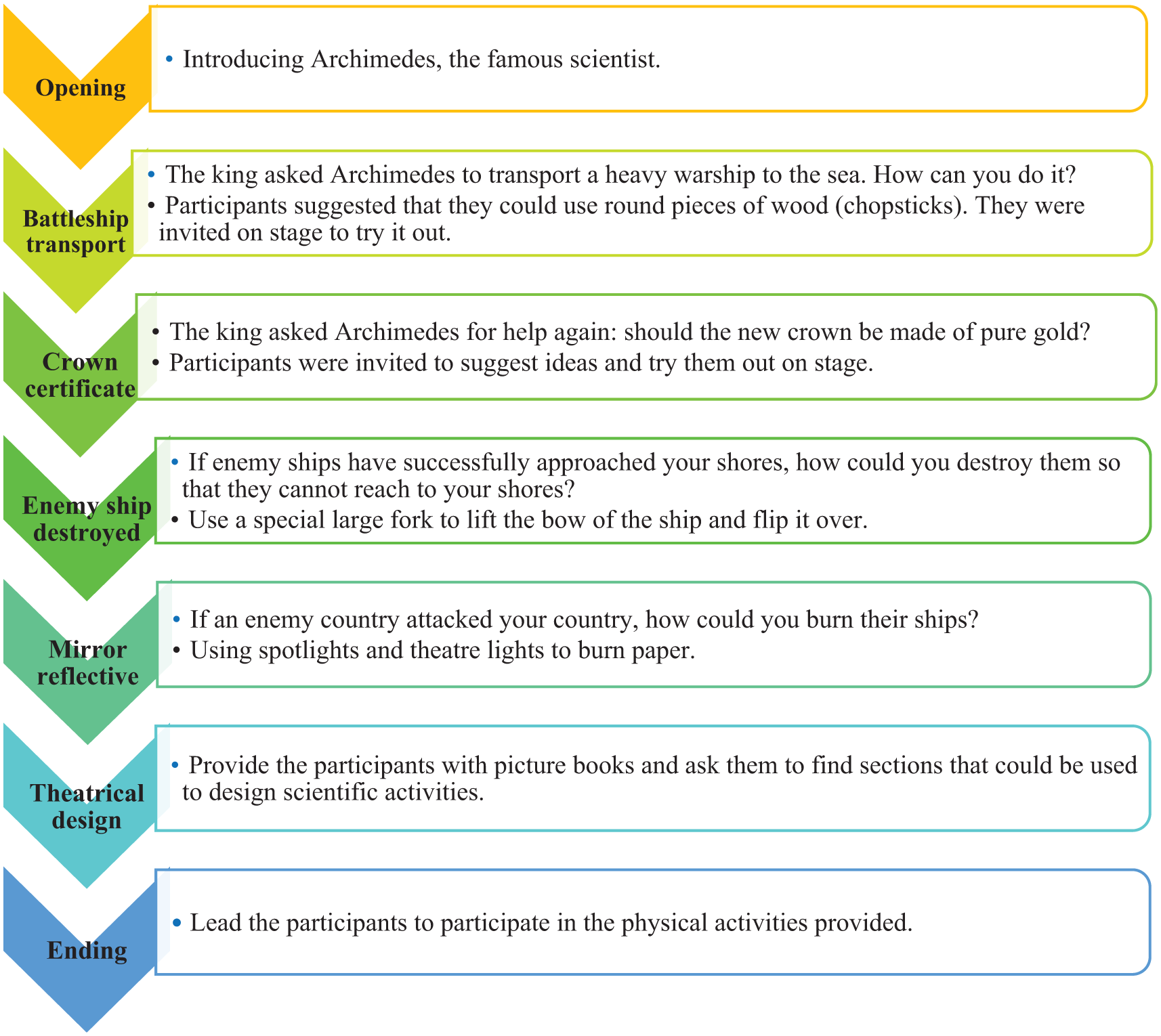
Example of the procedure for the drama-based approach in practical science.
Participants
A total of 151 pre-service teachers participated in this study. Initially, 103 participants were recruited; however, during the peer-review period, an additional 48 participants completed the same experimental activities under identical procedures and instructional conditions. All participants were enrolled in teacher education programs at the undergraduate or graduate level, drawn predominantly from the departments of Special Education and Early Childhood Education (see Table 2). Inclusion criteria remained consistent across both waves of data collection, ensuring methodological continuity and comparability. The expanded sample size was intended to strengthen the statistical power and enhance the generalizability of the study’s findings.
Demographic Variables of the Participants.

Each participant voluntarily participated in the experimental workshop. Participants were required to be proficient in English listening and speaking skills and to have the relevant professional educational knowledge. The final sample was composed predominantly of female participants (approximately 90.1%). Their primary areas of study included Early Childhood Education (42.4%), Special Education (51.7%), and other teacher education departments (6.0%).
The instructional team consisted of one lecturer (Dr. Wd) and two English-Chinese translators. Dr. Wd is a professional science educator from Germany who has been involved in utilizing drama-based approaches for practical science education for many years as part of the drama seed project.
In terms of prior experience, 35.8% of participants reported having previously participated in STEM activities, while 64.2% had not. Regarding familiarity with drama-based pedagogy, 23.4% reported having heard of it, whereas 76.6% had not. These background characteristics were considered as independent variables in the subsequent statistical analyses.
Teaching Intervention and Course Implementation
The instructional intervention was implemented as part of a pedagogical innovation project. The program aimed to support university instructors in addressing instructional challenges by promoting the integration of creative and interdisciplinary teaching strategies. The program aimed to support university instructors in addressing instructional challenges by promoting the integration of creative and interdisciplinary teaching strategies. This particular project was initiated by the research team after observing a striking gender imbalance and a significant discrepancy in course enrollment patterns between science and drama courses among students in early childhood and special education programs. To address these issues and enhance engagement in science learning, the authors developed and implemented a drama-based science education workshop specifically tailored to the needs of pre-service teachers in these departments.
Two identical workshops were conducted during the project period: the first in October 2024 and the second in May 2025. Both workshops followed the same instructional design, lesson plans, and pedagogical procedures. Students who had participated in the first workshop were excluded from the second to avoid duplication. Because the second workshop occurred during the peer review period for the current article, data from both implementations were combined to strengthen the study’s statistical power and generalizability, increasing the sample size from 103 to 151 participants.
The course was designed and delivered by Dr. Wd., a science educator from Germany with extensive experience in drama-based science pedagogy. The instructional content was collaboratively developed over ten planning meetings between Dr. Wd. and the research team to ensure cultural relevance, scientific rigor, and pedagogical coherence. Each workshop consisted of five weekly sessions, with each session lasting 3 hr, for a total of 15 instructional hours per cohort.
The instructional design was structured around the five-phase framework proposed by Davis (2023a): (1) contextual introduction, (2) role-play, (3) hands-on enactment, (4) problem-solving, and (5) reflective discussion. Participants worked in small groups of four to five, engaging in scenario development and character-based improvisation to explore scientific topics. The five themes addressed in the workshop included space, water, light, magnetism, and gyroscopic motion. To support accessibility and instructional quality, Dr. Wd. was assisted by two bilingual translators and the members of the research team.
Research Instrument
The instrument used in this study was a researcher-developed questionnaire, structured into three sections:
Section 1: Demographic and background variables.
This section gathered demographic data and background information, including gender, academic department, grade level, prior participation in STEM education, and familiarity with drama-based pedagogy in educational contexts (e.g., “Have you ever joined STEM education?” and “Have you ever heard of drama-based education?”).
Section 2: Satisfaction and self-efficacy.
The research instrument was a self-developed questionnaire constructed by the authors, drawing upon established literature, particularly Bandura’s (1997) theory of self-efficacy and Fischer et al.’s (2018) typology of learning sciences. The items were carefully designed to reflect the instructional content and pedagogical context of the current intervention. The questionnaire comprised three subscales:
Instructor satisfaction (10 items): This subscale measured participants’ satisfaction with the instructor’s teaching effectiveness, interactional style, and classroom engagement (e.g., Dr. Wd), including items such as “The instructor values interactive teaching, encourages student questions and the expression of opinions.”
Course content satisfaction (6 items): This subscale assessed participants’ satisfaction with the structure of the course, the integration of drama and science content, teaching materials, and activity design. An example item includes: “The content of this study has effectively enhanced my skills in integrating drama-based methods into practical science teaching.”
Self-efficacy in science teaching (10 items): Grounded in Bandura’s self-efficacy framework, this subscale measured participants’ perceived levels of confidence, competence, and willingness to apply drama-based approaches in their future science teaching. Example item: “I am confident that I can effectively integrate drama-based approaches into future teaching practices.”
Prior to formal data collection, the questionnaire was reviewed by three experts in science education and early childhood teacher training to ensure content validity. Feedback from these experts led to minor revisions in item wording and phrasing to enhance clarity and contextual appropriateness. The instrument’s reliability and construct validity are detailed in the following section.
Section 3: Open-ended questions.
Questions 1 to 26 were answered using a 5-point Likert scale (strongly agree, agree, acceptable, disagree, and strongly disagree). They were aimed at evaluating satisfaction with the integration of constructivist-oriented science instruction with a drama-based framework in practical science learning and assessing the students’ sense of self-efficacy. Questions 27 and 28 were categorical variables, allowing students to select their preferred learning types (planning, configuration, or buffet learning) both before and after the activity. The purpose was to observe any shifts in preferred learning type as a result of the intervention. Questions 29 and 30 were open questions that aimed to understand the participants’ reflections by recoding all wordings.
Reliability and Validity
Reliability
The reliability of the questionnaire was tested using the Cronbach’s α coefficient. Instructor satisfaction achieved an α of .930, course content satisfaction an α of .911, and self-efficacy an α of .932, while the overall α was .967. These results indicate a high level of internal consistency, suggesting that the instrument was a reliable measure for assessing satisfaction and self-efficacy in this context.
Validity
To assess construct validity, principal component analysis (PCA) with oblique rotation was conducted. The analysis yielded three factors with eigenvalues greater than 1, confirming the multidimensionality of the instrument. The Kaiser–Meyer–Olkin (KMO) measure of sampling adequacy was .899, and the Bartlett’s test of sphericity indicated significant results (χ2 = 2,854.21, df = 325, p < .001), suggesting that the data were suitable for factor analysis. The total explained variance for the three extracted factors was 74.27%, demonstrating strong construct validity of the instrument in capturing satisfaction and self-efficacy dimensions within the context of drama-based science education.
This instrument’s high reliability and validity indicate its suitability for further empirical investigation in assessing pre-service teacher satisfaction, self-efficacy, and their perceptions of drama-based science learning, contributing to the literature supporting evidence-based pedagogical innovation in science education.
Data Analysis
A mixed-methods framework was employed to collect both qualitative and quantitative data. Qualitative data, obtained through observation and video analysis, were used to examine the process and implementation of drama-based strategies in detail. Quantitative data were primarily derived from the post-workshop questionnaires, which were designed to assess the pre-service teachers’ satisfaction, self-efficacy, and reflections regarding the activity experience.
All background variables (e.g., gender, grade level, prior participation in STEM education, etc.; see Table 2) served as independent variables, while participants’ responses were the dependent variables. Data analyses were conducted using the descriptive statistics, cluster analysis results, and cluster analysis using K-means, and evaluations the using AIC and Schwarz’s BIC coefficient. An LDA model was constructed to examine the effectiveness of background variables in distinguishing between clusters.
Qualitative Data Analysis
To complement the quantitative survey data and gain deeper insighted into participants’ reflections on the drama-based science instruction, qualitative data were collected through two open-ended questions at the end of the questionnaire. These responses were analyzed using Braun and Clarke’s (2006) six-phase model of inductive thematic analysis. Thematic coding was used to identify patterns in participants’ perspectives without relying on a pre-existing coding scheme.
The analysis followed a three-stage coding structure:
Open coding: Key words and phrases from participants’ written responses were labeled and clustered into initial codes.
Axial coding: The codes were then organized into broader conceptual categories and subcategories based on their semantic similarities and contrasts.
Selective coding: The final step involved identifying overarching themes and relationships among the categories, forming a coherent interpretive framework.
To enhance the trustworthiness and internal validity of the findings, two researchers (Authors 1 and 2), both experienced in qualitative research and science education, independently participated in the coding process. Initially, both coders read 15% of the responses multiple times and recorded their impressions. They then independently coded units of meaning. This was followed by a collaborative discussion to develop an initial codebook. Author 1 proceeded to code 50% of the data using this codebook. After further discussion and refinement of complex or borderline cases, a second version of the codebook was created.
Using the revised codebook, Author 1 completed coding for the remaining 50% of the data, while Author 2 double-coded every fifth response. Any discrepancies were discussed and resolved through consensus. Inter-rater reliability was assessed using intra-class correlation (ICC) analysis (Bliese, 2000). Results confirmed acceptable levels of agreement between the two coders.
Each coded unit was labeled using the format “Theme–Item Number–Participant ID” (e.g., “Engagement–Q29–P12”), to facilitate traceability and transparency throughout the analysis.
Results
Descriptive Statistics
Descriptive statistics of the variables are presented in Table 2.
Cluster Analysis Results
We conducted a cluster analysis based on participants’ responses to the dependent variables, following the steps outlined below:
Selection of dependent variables: The dependent variables were selected for inclusion in the cluster analysis.
Data standardization: Since the dependent variables were categorised into three constructs, the data were standardised to eliminate variation among the different constructs.
Cluster analysis using K-means: We applied the K-means clustering algorithm and tested different numbers of clusters (k). The elbow method and silhouette score were used to determine the optimal number of clusters.
Visualization: Visual representations were generated to illustrate the distribution of clusters, as shown in Figures 2 and 3.
Evaluation using AIC and Schwarz’s BIC coefficients: The AIC and BIC coefficients were examined to evaluate the clustering results, as presented in Appendix Table A1.
Figure 2 illustrates the elbow method which was used to determine the optimal number of clusters. As can be seen in Figure 3, a silhouette score of .553 was achieved at k = 2, supporting the adequacy of a two-cluster solution. This score indicates moderate internal cohesion within clusters and clear separation between clusters, which meets the accepted threshold for a stable and interpretable cluster structure in educational settings (Rousseeuw, 1987).

Elbow method for optimal K.

Silhouette scores for different k.
Based on the above steps and using the silhouette score, we determined that the optimal number of clusters was k = 2, which yielded the highest score of .553 (see Figure 3). This indicates that the clustering configuration at k = 2 resulted in high within-cluster similarity and good between-cluster separation. Consequently, the participants were classified into two groups based on their responses to all dependent variables. The grouping information is presented in Table 3. As shown in Table 3, participants in Cluster 1 exhibited higher pre-intervention self-efficacy scores (M = 4.89, SD = .20), while those in Cluster 0 reported lower self-efficacy levels (M = 4.07, SD = .25). An independent samples t-test confirmed that the difference between the two clusters was statistically significant, t(149) = 23.02, p < .001, Cohen’s d = 3.78. The effect size for the difference in self-efficacy between Clusters 1 and 0 was large, indicating a strong practical significance of the observed difference. This suggests that students entered the course with substantially different levels of confidence regarding their ability to teach science effectively.
Cluster Feature Distributions.

These initial differences in self-efficacy served as the basis for further analysis of how the instructional intervention may have impacted students with contrasting starting points. The two-cluster structure also guided subsequent cross-tabulations and discriminant analyses to explore how background variables (e.g., prior STEM experience, department affiliation) might explain or predict cluster membership.
Discriminant Analysis Results
The identified clusters were used as the dependent variable and all background variables (e.g., gender, grade level, prior participation in STEM education, etc.; see Table 2) as independent variables in the subsequent discriminant analysis. This approach helped us understand the significance of various background factors in differentiating between the clusters. An LDA model was constructed to examine the effectiveness of background variables in distinguishing between clusters. The analysis results are presented in Table 4. Table 4 lists LDAs greater than 1, with higher values indicating a greater contribution of the variable to differentiating between clusters. Since we have only two clusters, the explained variance ratio of LDA is 1, which implies that the single discriminant dimension explains all the variability. This indicates that the current LDA model can perfectly distinguish between the two clusters. As shown in Table 4, “Have you ever joined STEM education?” (Response: “yes”) contributed the most to cluster differentiation (LDA = .534). The second largest contribution originated from “Have you ever heard of Drama-Based in education)?” (Response: “yes”), with an LDA of .351. The third highest contribution was from “Department: Early Childhood Education” (LDA = .301), followed by “Grade: Graduate level or above” (LDA = .229). Cross-tabulations with the clusters are presented in Appendix Tables A2 to A5. The cross-tabulation results indicate that only the proportion difference test (also known as the z-test for proportions) for “Have you ever joined STEM education?” shows a statistically significant difference. As shown in Figure 4, most students who had previously participated in STEM education are clustered in Group 1. This suggests that students with prior STEM education experience are more likely to be grouped in the high-scoring cluster (Cluster 1) in the cluster analysis. The results of cross-tabulation analysis for the other three variables did not reach statistical significance.
Sorted LDA Coefficients of Background Variables.

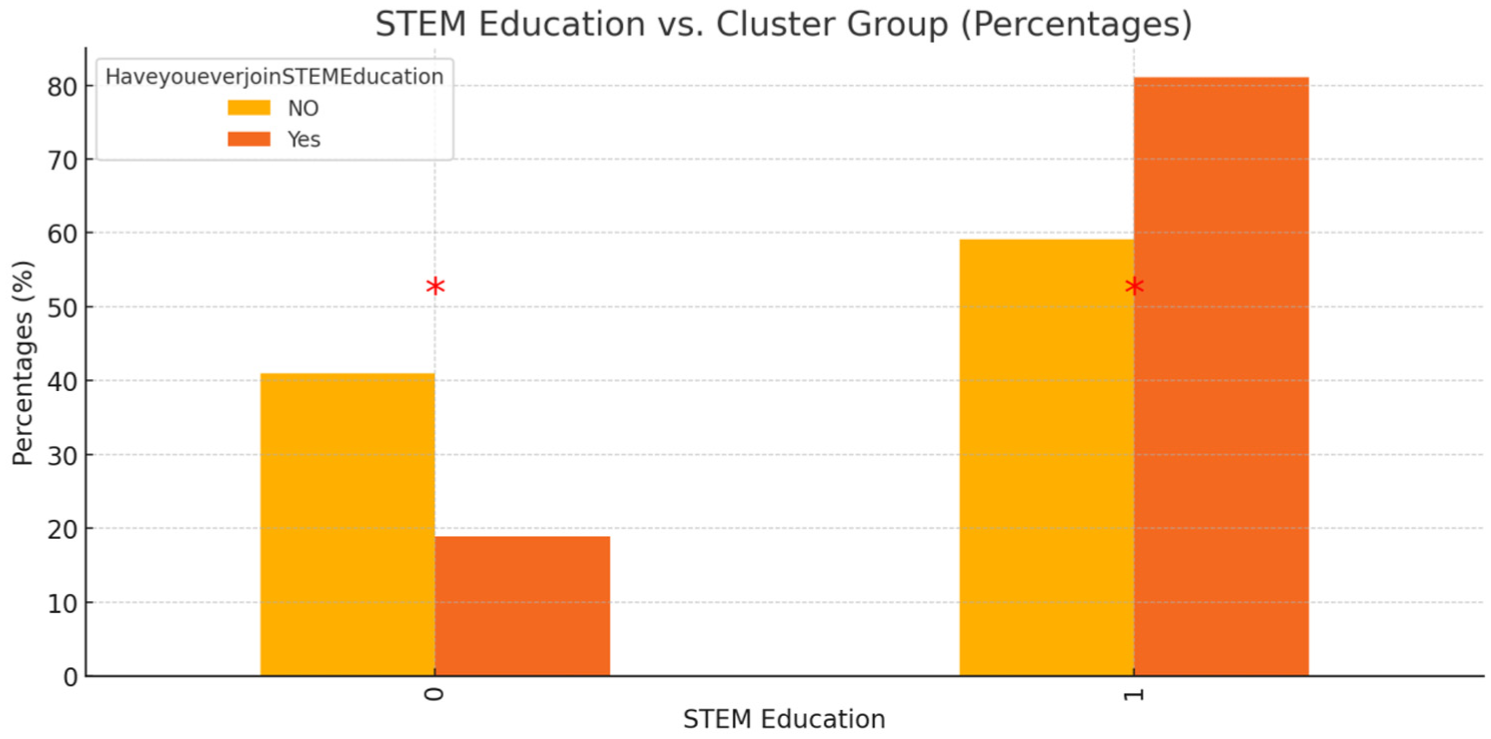
Cross-tabulation of STEM education participation by cluster group (percentages). “*” indicates 50% reference line.
Next, we used the identified clusters as independent variables and conducted a discriminant analysis with the pre- and post-test as dependent variables. The primary aim was to examine the impact of cluster groupings on pre- and post-test outcomes and calculate the LDA values accordingly. Both the pre- and post-test assessed students’ preferences for adopting one of three teaching methods (Types 1, 2, or 3) in future STEM education.
The findings indicated that prior STEM education experience significantly influenced initial engagement with drama-based pedagogy (LDA = .534). However, by the post-test phase, the impact of background factors diminished, indicating that the drama-based framework may have contributed to the creation of a more equitable learning environment. This is consistent with constructivist theory, which posits that active learning experiences can mitigate prior disparities (White et al., 2021).
Tables 5 and 6 present the cross-tabulations between cluster groupings and pre-test outcomes, as well as cluster groupings and post-test outcomes. In Table 5, only the “Type 3” category in the pre-test showed a statistically significant difference in the z-test for proportions. Although both clusters included 12 participants in this category, the difference in group sizes led to unequal proportions (25.0% in Cluster 0 vs. 11.7% in Cluster 1) resulting in a statistically significant disparity. This suggests that participants in Cluster 0 exhibited a relatively stronger tendency toward Type 3 responses in the pre-test. However, the other cross-tabulation results were not statistically significant.
Cross-Tabulation of Cluster Groups and Pre-Tests.

p < .05.
Table 6 shows the z-test results for proportions, revealing statistically significant post-test differences in both the Types 2 and 3 categories. Specifically, a significantly greater proportion of students in Cluster 1 were categorized as Type 3 (68.0%) compared to Cluster 0 (50.0%). Similarly, Cluster 1 also had a significantly higher proportion of students categorized as Type 2 (28.9%) than Cluster 0 (19.0%). No significant difference was observed in the Type 1 category.
Cross-Tabulation of Cluster Groups and Post-Tests.

p < .05.
These findings suggest that the two groups of students exhibited divergent patterns of response following the course. In particular, students in Cluster 1 were more likely to demonstrate Type 3 characteristics after completing the course, which may reflect stronger engagement or higher self-efficacy in science learning.
In summary, the proportion of students categorized as Type 3 significantly differentiated Clusters 0 and 1 in both the pre- and post-test. Although the number of students in this category was the same across clusters in the pre-test (12 students each), the underlying difference in total group sizes resulted in a significant disparity in proportions (25.0% vs. 11.7%). Notably, this difference became even more pronounced in the post-test results, with 68.0% of Cluster 1 students classified as Type 3 compared to 50.0% in Cluster 0.
Rather than reflecting a convergence effect, this sustained and even heightened difference suggests that the course may have had a differentiated impact on the two clusters. In particular, students in Cluster 1, who already showed higher engagement or readiness in the pre-test, may have benefited more from the drama-based science education intervention. The persistence of this divergence in Type 3 responses may indicate a reinforcing or amplifying effect of the course among students who were more predisposed to benefit from it. Qualitative responses supported this differentiation: students in Cluster 1 often described a sense of “freedom to explore” and “creative confidence” (e.g., P65, P30), while those aligned with Cluster 0 expressed appreciation for “clear instructions” and “step-by-step guidance” (e.g., P6, P11). These patterns are consistent with the observed quantitative learning type distributions across clusters.
Persistent Differences in Type 3 Teaching Methods Across the Pre- and Post-Test Phases
During the pre-test phase, a significant difference was observed between clusters in the Type 3 category, with 25.0% of students in Cluster 0 and only 11.7% in Cluster 1 categorized in this group. Notably, this significant difference persisted into the post-test phase, where 68.0% of students in Cluster 1 and 50.0% in Cluster 0 were identified as Type 3. These results suggest that the gap between the clusters not only remained but became more pronounced after the intervention.
Differential Course Impact Rather Than Convergence
Contrary to our initial hypothesis that the course might reduce cluster differences over time, the results instead suggest a differentiated impact of the instructional framework. Students in Cluster 1 demonstrated a notably greater shift toward Type 3 by the end of the course. Rather than homogenizing the learning experience, the intervention appears to have amplified the strengths or readiness of Cluster 1 students in adopting Type 3 learning characteristics.
Instructional Framework as a Catalyst for Targeted Engagement
This pattern implied that the instructional framework may have served as a more effective catalyst for students already predisposed to benefit from drama-based science instruction. The greater increase in Type 3 responses among Cluster 1 students might reflect their greater affinity with the pedagogical methods used, suggesting that this group was more responsive to the course in terms of developing performance traits associated with Type 3.
Background Factors May Have Influenced Responsiveness
The divergence in post-test outcomes also suggests that pre-existing background characteristics (e.g., prior engagement, learning preferences, or confidence in science education) might have influenced how different clusters responded to the course. Instead of diminishing these differences, the framework might have interacted with these traits, reinforcing the development of Type 3 behaviors in students already more receptive to the intervention.
Implications for Instructional Design and Equity
These findings call for a nuanced understanding of how pedagogical frameworks interact with student profiles. Rather than assuming uniform effects, educators should consider ways to support students who may initially be less inclined toward active, expressive science engagement styles. Tailoring scaffolding strategies to the students could help ensure that all groups benefit equally from such integrated instructional approaches.
Qualitative Findings: Thematic Analysis of Open-Ended Responses
In addition to the quantitative results, we conducted a thematic analysis of the open-ended responses to Questions 29 and 30. Guided by a constructivist perspective, six core themes emerged: learning interest and motivation, cognitive exploration, integration of drama with science instruction, affective engagement, science learning approaches, and reflective insights. These themes provided insight into the mechanisms underlying students’ learning processes and complement the quantitative findings derived from the cluster analysis. Representative quotes are presented below to illustrate each theme.
Learning Interest and Motivation
The participants expressed that hands-on science activities stimulated their curiosity and enhanced their learning interest. Representative statements included:
The importance and fun of exploration. (Interest–Q29–P3) Think about the theme of education from different directions and experience the joy of learning in practice. (Interest–Q29–P6) Stimulate creative thinking and use practical courses to challenge yourself in scientific knowledge. (Interest–Q29–P24) Arouse interest in scientific exploration during the elementary school years. (Interest–Q29–P49)
Cognitive Exploration Through Novel Experiences
Participants commonly reported that hands-on science activities fostered their curiosity and intrinsic motivation.
I discovered many things that I didn’t know before, which were very interesting and novel. (Cognition–Q29–P2) Learn some scientific knowledge that you would not normally notice in life! (Cognition–Q29–P41) The diaper experiment was cool. I cut open the diaper and found that after the material inside absorbed water, a substance like a crystal would appear. (Cognition–Q29–P26)
Integration of Drama Into Practical Science Learning
Participants emphasized how drama-based strategies deepened their involvement and understanding.
Through situational roles, you can become more involved and have a deeper impression of the knowledge you have learned. (Drama Skills–Q29–P63) Learned a lot of practical ways to integrate into education. (Drama Skills–Q29–P68) The process of integrating drama and science activities feels very suitable to be done with children in kindergarten. (DramaSkills–Q29–P65)
Affective Engagement
Many participants shared their emotional engagement and enjoyment of the activities. Statements include:
Very interesting and full of the scientific experimental spirit. (Affect–Q30–P57) Activities are fun, lively, and inspiring. (Affect–Q30–P53) It turns out that science can be so interesting. (Affect–Q30–P60)
Science Learning Approaches
Several participants expressed a preference for exploratory and affect-oriented learning.
Trying is the ultimate goal of learning. (Learning Type–Q30–P11) Affection-oriented learning can improve motivation, and learning by doing can be impressive. (Learning Type–Q30–P30) Stay curious and motivated. (Learning Type–Q30–P67)
Reflective and Collaborative Insights
Participants also highlighted the value of creativity, everyday materials, and teamwork. Notable quotes include:
I find it very magical to use common materials in daily life to make magical matchboxes! (Reflection–Q30–P1) The process of exploration is really interesting. You can find scientific truths without assistance. (Reflection–Q30–P4) Teamwork inspires different imaginations. (Reflection–Q30–P38)
Taken together, these qualitative insights provided nuanced perspectives on how the drama-based science instruction was experienced. Thematic patterns were particularly consistent with the profiles of Cluster 1 participants, who demonstrated stronger alignment with Type 3 learning preferences. These findings reinforced the notion that instructional strategies emphasizing creativity, affects, and active participation could produce differentiated responses based on students’ initial dispositions and prior experiences.
Discussion
This study examined how a drama-based science education intervention could influence and impact pre-service early childhood and special education teachers with different levels of self-efficacy and background experience. Findings obtained through a cluster-based mixed-methods approach revealed that, while the course fostered meaningful learning changes among all participants, the effects were differentiated in magnitude and nature, highlighting the importance of learner readiness, instructional responsiveness, and adaptive scaffolding in inclusive STEM education.
At the baseline, both Clusters 1 and 0 students predominantly preferred Type 1 teaching approaches, indicating a general reliance on teacher-centered strategies. However, significant differences emerged in Type 3 preferences, with Cluster 0 showing a stronger initial inclination toward student-centered learning than Cluster 1. By the end of the experiment, these patterns had shifted substantially. Cluster 1 students demonstrated a dramatic increase in Type 3 preferences, surpassing Cluster 0, and also reported significantly higher engagement with Type 2 approaches. In contrast, Cluster 0 participants displayed a more modest and uneven shift, primarily toward Type 2 learning, with a less pronounced movement into Type 3.
These results are suggestive of the differentiated impact of the intervention: although both groups benefited from the activity, students in Cluster 1 (who entered with higher self-efficacy and prior STEM experience) gained more from the instruction, both in terms of depth (stronger preference for Type 3) and breadth (greater openness to Type 2). Rather than functioning as a uniform equalizer, the course amplified learning divergence, reflecting students’ varying capacities to engage with constructivist, drama-based pedagogies. This echoes prior research suggesting that learners with higher confidence and experience are more likely to benefit from open-ended, student-directed learning frameworks (Doolittle et al., 2023; Hsieh & Chen, 2019; Tokuhama-Espinosa, 2019a, 2019b; Wang et al., 2022).
The qualitative findings reinforce this interpretation. Cluster 1 students described their experience using phrases such as “freedom to explore,”“creative confidence,” and “joy of learning by doing” (e.g., Interest–Q29–P3; Drama Skills–Q29–P65), reflecting alignment with the expressive, participatory nature of the curriculum. Conversely, Cluster 0 participants emphasized the importance of “clear instructions” and “step-by-step guidance” (e.g., Learning Type–Q30–P11; Reflection–Q30–P4), suggesting a preference for structure and predictability. This contrast points to a broader phenomenon of adaptive learning flexibility (the ability to shift across multiple instructional styles), which appeared more prominent in students with greater prior readiness.
Importantly, the findings carry implications for curriculum design in teacher education. While constructivist, arts-integrated frameworks could effectively cultivate student-centered learning, they might not automatically engage all learners equally. Without targeted scaffolding, students who were less confident or less familiar with experiential learning formats might struggle to realize the full benefits of such formats. Therefore, instructors must recognize the diversity of learning profiles within a cohort and embed differentiated supports to promote equity of engagement and transformation.
Cultural context also plays a key role. In Taiwan’s [removed for anonymization] historically didactic educational system, the drama-based approach represents a significant shift toward performative and participatory pedagogy. The greater receptivity shown by Cluster 1 students may reflect an emergent generational readiness for learner-centered methods, whereas the more reserved response from Cluster 0 highlights the need for transitional strategies eases students into unfamiliar instructional paradigms. This underscores the importance of culturally responsive pedagogy, not just in content but also in the form and pacing of delivery.
Several limitations and contextual considerations should be acknowledged. First, although the study included pre- and post-intervention measures of self-efficacy, the current analysis primarily emphasized baseline self-efficacy as a variable for clustering. Future analyses could explore the full trajectory of change across both clusters. Second, while the study initially recruited 103 participants, the sample was later expanded to 151 through consistent data collection procedures during the review period. This expansion enhanced the statistical power and generalizability within the study context, with no meaningful deviation from the original pattern of results.
Third, the sample was drawn exclusively from a single national university in Taiwan [removed for anonymization], where students in the Early Childhood and Special Education departments are predominantly female. This gender imbalance reflects the demographic composition of the College of Education at this university, where the female-to-male ratio in the Department of Early Childhood Education is approximately 40:1 and the ratio in the Department of Special Education is 33:1. Nationally, similar programs in Taiwan [removed for anonymization] typically exhibit gender ratios of about 30:1, with females significantly outnumbering males. Given this context, the predominance of female participants in our sample accurately represents the gender distribution of the target population and supports the contextual validity of our findings. While this limits the generalizability to broader populations, it increases the internal representativeness and ecological validity of the findings. It should be noted that, the study was not designed for national generalization, but rather to examine how a drama-based science curriculum might support engagement and self-efficacy within a known high-need and gender-imbalanced context.
Future research could replicate the experimental design across multiple institutions, instructors, and cultural settings. Additionally, it is recommended that longitudinal or quasi-experimental studies be carried out to examine how differentiated instructional supports and adaptive pedagogical scaffolds could promote more equitable transformations in science learning attitudes across diverse learner profiles.
In conclusion, this study demonstrates that drama-based science education could produce significant and meaningful changes in teaching preferences among pre-service teachers. However, these changes were not uniform. The course yielded differentiated effects, with students exhibiting varied levels of adaptive versatility depending on their background and self-efficacy. To ensure that all learners benefit from pedagogical innovation, educators must design experiences that are both constructivist and responsive, offering not only inspiration, but also the support needed to engage confidently and deeply.
Conclusion
This study investigated the differentiated effects of a constructivist-oriented, drama-integrated science course on pre-service early childhood and special education teachers in Taiwan [removed for anonymization]. Using cluster analysis and mixed methods, the findings reveal that while all participants exhibited shifts away from teacher-centered instructional preferences (Type 1), the degree and direction of change varied substantially across learner profiles. Specifically, students in Cluster 1—those with higher initial self-efficacy and prior STEM experience—demonstrated a greater increase in preferences for student-directed (Type 3) and collaborative (Type 2) teaching approaches. In contrast, students in Cluster 0 shifted primarily toward more structured formats, suggesting varying degrees of adaptive learning flexibility.
Qualitative findings reinforce this differentiation. Participants in Cluster 1 described greater alignment with creative exploration, hands-on inquiry, and learner agency. In contrast, Cluster 0 participants valued scaffolding and clarity, reflecting more cautious engagement with open-ended tasks. Thematic analysis identified six domains of learning change: interest and motivation, cognitive exploration, practical application of drama strategies, emotional engagement, learning type alignment, and collaborative-reflective growth. These themes complemented the quantitative patterns and underscored how personalized readiness shaped instructional responsiveness.
Importantly, the results suggest that constructivist and drama-based approaches could promote meaningful pedagogical development, but not uniformly across learners. This reinforces the need for differentiated scaffolding within teacher education, especially for students with limited STEM exposure or lower instructional confidence. Programs should incorporate everyday materials and collaborative activities that lower entry barriers while maintaining conceptual challenge.
Future research should examine the long-term impact of such interventions on teaching practices and classroom application. Longitudinal and multi-institutional studies may help clarify how constructivist pedagogies interact with prior experience, learner dispositions, and contextual factors (Wang et al., 2024). Additionally, teacher reflection and pedagogical adaptability should be central to professional preparation in early childhood and special education settings.
In sum, this study contributes to the growing body of research on inclusive STEM teacher education by showing how learner-centered, drama-based frameworks can both engage and differentiate. To maximize their transformative potential, such pedagogies must be implemented with attention to the learners’ starting points, background characteristics, and support needs.
Limitations and Future Research
Although the study was initially designed as an exploratory pilot project, the inclusion of additional participants during the review process (expanding the sample to 151), strengthened the reliability and representativeness of the findings within the study context. Future research should replicate this study across diverse teacher education programs, geographic regions, and instructional formats to further examine the applicability and adaptability of drama-based constructivist science instruction. Longitudinal designs might also provide insights into the sustained impact of such interventions on teaching beliefs and professional practice.
Using AI Self-Disclosure
During the preparation of this work, the author(s) used Open AI to enhance their English writing in order to improve readability due to English not being their first language. After using this tool/service, the author(s) reviewed and edited the content as needed and take(s) full responsibility for the content of the publication.
Footnotes
Appendix
Cross-Tabulation of Cluster Group and Grade Level.

| Cluster group | Grade level | |||
|---|---|---|---|---|
| Below 2nd grade | 3rd grade | 4th grade | Graduate level or above | |
| Cluster group 0 | 3 (13%) | 20 (39.2%) | 7 (36.8%) | 18 (31%) |
| Cluster group 1 | 20 (87%) | 31 (60.8%) | 12 (63.2%) | 40 (69%) |
| z-test for proportions | Z = −1.75, p = .079 | Z = 1.40, p = .163 | Z = .50, p = .612 | Z = −.15, p = .875 |
Acknowledgements
The authors would like to express their gratitude to the school participants in the study.

Ethical Considerations
This study was conducted under the auspices of a pedagogical innovation project funded by the national Ministry of Education (Project No. [removed for anonymization]). In accordance with the Ministry’s ethical guidelines, research activities carried out under this program were exempt from institutional review board (IRB) approval. However, ethical safeguards were still rigorously followed. All data were anonymized and securely stored to protect participants’ privacy and to ensure compliance with ethical research standards.
Consent to Participate
Prior to participation, all students were provided with a detailed informed consent form outlining the study’s objectives, procedures, voluntary nature, and data confidentiality measures. Only those who consented to participate were included in the analysis.
Author Contributions
Chiu-Hsia Huang and Chia-Yen Hsieh conceived of the presented idea. Chia-Yen Hsieh developed the theory and performed the computations. Ya-Ling Chen and Hartmut Wedekind were responsible for data collection. Chia-Yen Hsieh verified the analytical methods. Chia-Yen Hsieh and Chiu-Hsia Huang to verify the numerical checklist and supervised the findings of this work. All authors discussed the results and contributed to the final manuscript.
Funding
The authors received no financial support for the research, authorship, and/or publication of this article.
Declaration of Conflicting Interests
The authors declared no potential conflicts of interest with respect to the research, authorship, and/or publication of this article.
Data Availability Statement
The datasets generated during and/or analyzed during the current study are available from the corresponding author on reasonable request.