




Abstract
Technology and innovation management (TIM) plays an increasingly important role in the survival and prosperity of firms and economic growth of countries, which makes it increasingly important to trace the trajectory of this research field. However, to date, few studies have analyzed the evolution of the field of TIM quantitatively. Aiming to achieve an overall understanding of the research in the field of TIM, this study extracts all publications in the top 13 journals on TIM and their references that could be located in the Web of Science. Next, through cocategory analysis, cocitation analysis, cokeyword analysis, and coauthor analysis, the crucial intellectual structure of the TIM field is identified, and the distribution and evolution of the hot spots of this field are presented. An overall picture, emerging trends, and key points of the field of TIM are provided, which might contribute to our understanding and future studies of TIM.
Keywords
Introduction
Over the last two centuries, science and technology have undergone unprecedented development (Schwab, 2017). In response, technology and innovation management (TIM), which reflects the needs generated by industrial and societal change, was born in the early 20th century (Mansfield, 1968; Schumpeter, 1961). TIM is an interdisciplinary field of knowledge involving such disciplines as economics, management, and sociology, and develops rapidly (Fagerberg, Fosaas, & Sapprasert, 2012).
As technology and knowledge are becoming increasingly important for firms to survive and gain competitive advantage, scholars are investigating TIM from multiple perspectives, including strategy, marketing, human resource management, operations management, and accounting and finance (Eesley, Hsu, & Roberts, 2014; Meierrieks, 2014; Miron-Spektor, Erez, & Naveh, 2011; Schreier, Fuchs, & Dahl, 2012; Wang & Shin, 2015). Meanwhile, many scholars also study TIM from a policy perspective, aiming to construct a more favorable environment supporting innovation in countries (Kivimaa & Kern, 2016). As a result, insights from research in the domain of TIM are exploding. This situation produces a challenge for people looking to obtain a global and comprehensive understanding of the field of TIM, thereby creating a need for a comprehensive review of the field.
There are a lot of excellent reviews in TIM field. One popular category is qualitative review. Qualitative review can provide deep insights through reading the selected papers carefully. Meanwhile, because carefully reading requires much on time and efforts, qualitative reviews usually focus on some narrow topics and are based on relatively limited data. Recently, scholars conducted many reviews about open innovation (Dahlander & Gann, 2010; Huizingh, 2011; Lichtenthaler, 2011; West & Bogers, 2014; West, Salter, Vanhaverbeke, & Chesbrough, 2014), a hot topic nowadays. For example, West and Bogers (2014) reviewed 291 papers and suggested convergence, divergence, and gaps across the work on open innovation. Moreover, some other reviews examined other topics, such as intellectual property (Candelin-Palmqvist, Sandberg, & Mylly, 2012), hospital innovators (Thune & Mina, 2016), technology management methodologies and applications (Liao, 2005), and disruptive innovation (Hopp, Antons, Kaminski, & Salge, 2018).
Bibliometric review is also a popular method to understand the states and gaps in a specific field. Bibliometric review can analyze a considerable amount of publications and the diversified academic disciplines involved in the target field (Najmi, Rashidi, Abbasi, & Waller, 2017). In bibliometric analysis, scholars can use publications’ attributes, including title, keywords, authors, references, publishing venue, and other metadata to evaluate and compare publishing productivity and collaborative activities of scholars, institutes, and countries; scholars can also analyze the evolution of the scientific field (Abbasi, Wigand, & Hossain, 2014). Thus, bibliometrics is widely recognized as a main research methodology to analyze publications quantitatively. In TIM field, Randhawa, Wilden, and Hohberger (2016) conducted a bibliometric review of open innovation to reveal three distinct areas, the first of which were fully investigated and the other two remained relatively underresearched. Bibliometric reviews about green innovation, national innovation, product and process innovation, and innovation system are also provided by scholars (Liu, Yin, Liu, & Dunford, 2015; Marzi, Dabić, Daim, & Garces, 2017; Schiederig, Tietze, & Herstatt, 2012; Sun & Grimes, 2016). The most related bibliometric reviews are those treating TIM as a whole. Fagerberg et al. (2012) used the references of 11 handbooks to explore the knowledge base of the innovation field. Merigó, Cancino, Coronado, and Urbano (2016) identified the most productive and influential countries in innovation research. Rossetto, Bernardes, Borini, and Gattaz (2018) examined the structure and evolution of innovation research.
Although the existing bibliometric reviews analyzed a large amount of data, they usually used some handbooks or journal review papers as the seminal data to download the references as the data to produce the results. This method may omit some important publications in the TIM field. Moreover, existing bibliometric reviews mainly used citation and cocitation method to rank publications and authors, some new methods, such as co-occurrence and burst analysis might produce more insights. Thus, this study mainly advances at three aspects. First, this study aims to do a bibliometric review with more comprehensive data. Different from using handbooks or review journal papers as seminal works, this study uses the papers published in top 13 TIM journals as seminal works, which are more comprehensive. Second, this study tries to use some new methods in bibliometric analysis. While existing bibliometric reviews in TIM field mainly used citation and cocitation methods, this study also employs cokeywords and burst detection methods to analyze the data. Third, on the basis of the first two aspects, this study can produce more insights because of its more comprehensive data and new data analysis methods.
Aiming to create a holistic and comprehensive review of the research in the field of TIM, this study first identifies the top 13 influential journals in this field; based on these journals, 16,801 publications and their 317,771 references are gathered. Next, we use a bibliometric approach, including cocategory analysis, cocitation analysis, and cokeyword analysis, to mine the data and provide visible analysis results from static and dynamic perspectives.
Method
Sample and Data
As mentioned previously, TIM is an interdisciplinary field involving a number of interconnected fields. Therefore, using keyword retrieval to obtain samples could possibly result in a blind spot for such a significant field. In this study, the boundaries of TIM are therefore defined according to journal-centric criteria. Specifically, we first determine the top journals in the TIM field and download the papers in these journals. Second, we obtain the references of the papers in top journals in the TIM field, which contains TIM-related papers in journals of other field—including marketing, management science and operations research, and economics—conference papers, and books. Thus, the papers in top journals in the TIM field and their references are used as the data to analyze.
Which journals reflect the features of the entire TIM field? There are many rankings of TIM journals, and each of them has its own particular emphasis. To make the study objective and impartial, five previous studies by different scholars on TIM journal ranking are referred (Hall, 2016; H. Lee, 2015; Linton, 2006; Thongpapanl, 2012; Yang & Tao, 2012). These studies allow us to obtain five lists of top journals in the TIM field and subsequently select the intersection of any two lists. In other words, the target list includes the journals that appear at least twice in all five lists. The full list of the 13 selected journals is shown in Table 1, which are ranked according to their impact factors in 2016. Their respective details, including numbers of publications, impact factors (2016), and total citation numbers, are also shown as follows in Table 1.
The TIM Top Journal List.

Note. Time span: 1997-2017. Database: Web of Science core collection. TIM = technology and innovation management; WoS = Web of Science.
This study’s data were downloaded from WoS. To obtain complete data on the 13 journals, the time span was set to “all years,” but the earliest records we could obtain from WoS were from 1997. The bibliographic records consist of 16,801 papers in total, which were retrieved on October 20, 2017. The data set encompasses 2,895 authors, 1,554 institutes, 69 countries, and 317,771 cited references. The data mentioned above are only a fraction of all studies in the field of TIM, although it is sufficient as the highly ranked articles represent the entire field (Feng, Zhang, Du, & Wang, 2015).
The raw data include information on papers and further information on their references. After selecting the basic data, the next required step was data cleaning. This step involved a number of analyses for data problems, such as plural or singular, misspelling, nonstandard characters, and inconsistent terms. For example, Management of Technology and Innovation (MOTI), Management of Technology (MOT), or TIM all mean the same thing (Yanez, Khalil, & Walsh, 2010). Similarly, America, the United States, and USA should be regarded as the same in this study. There are also cases when words have different meanings, but they should still be unified to prevent redundancy or confusion. Specifically, in the analysis of co-occurrence of subject categories, the three parts of business, economics, and business and economics should be united into Business and Economics. To complete the task of data cleaning, this study not only amends the database manually but also sets equivalent words according to software; for example, alias list in CiteSpace is used in this study.
Bibliometric Visualization and Tools
Simplex data analysis is currently unable to meet the demands of bibliometric research. Science mapping, also known as visualizing bibliometric networks, has received increasing attention. Bibliometric visualization not only provides evident and readable results but also exploits deeper information, for example, by identifying major areas of research activity, intellectual milestones, evolutionary stages, and the dynamics of transitions from one specialty to another (C. Chen, 2017).
The basic component of bibliometric visualization is a node that can represent such parameters as paper, author, journal, institution, country, and keyword. The line represents the relationship between two nodes. There are three types of relationships connecting the nodes: co-occurrence, bibliographic coupling, and direct citation. Co-occurrence networks are used primarily in this study, which means that two bibliometric items that can be abstracted and viewed as nodes exist in one publication. There are three main types of co-occurrence: cokeyword, coauthor, and cocitation. Furthermore, according to the difference of analysis unit, there are three types of cocitation networks: publication cocitation, journal cocitation, and author cocitation.
After determining the basic method, choosing appropriate tools is crucial. Computer-aided analysis is widely used in a wide variety of industries. Numerous software tools are used for bibliometric analysis and visualization of results, including Histcite (Garfield, Paris, & Stock, 2006), VOSviewer (van Eck & Waltman, 2009), The VantagePoint (Niskanen, Kalaoja, Kantorovitch, & Piirainen, 2007), SciMAT (Cobo, López-Herrera, Herrera-Viedma, & Herrera, 2012), BibExcel (Persson, Danell, & Schneider, 2009), and CiteSpace (C. Chen, 2016). Regarding the tools’ comparisons and detail functions, a number of existing studies have addressed them (Cobo, López-Herrera, Herrera-Viedma, & Herrera, 2011; Mazov & Gureyev, 2013). In this study, we have chosen CiteSpace as our analysis tool because it can serve the research goals well for the following reasons.
Apart from its general analysis and visualization functions, CiteSpace is designed to detect and visualize emerging trends and transient patterns in scientific literature (C. Chen, 2006). More specifically, to analyze the structure of all kinds of bibliometric networks, CiteSpace provides a function called “finding clusters” to decompose the network into sub-networks and a function called “labeling clusters” to identify the most representative terms of a cluster. Beyond analysis of space aspects, CiteSpace is good at analysis of time dimensions. In CiteSpace, a time-slicing mechanism is used to generate a panoramic network, which means a series of snapshots of the evolving network across consecutive time slices is synthesized into one picture (K. H. Chen & Guan, 2011). Different colors represent the different time slices and are used to mark nodes, lines, and other components. The temporal orders are indicated by a spectrum of colors, with the rule being newest in orange and oldest in blue. Thus, discovering salient evolving patterns of scientific literature will be visualized and distinct. In addition, the sizes of rings around the nodes represent the number of the bibliometric items appearing at a certain time slice, and which time period a ring belongs to is decided by its color. In particular, if a node has an outermost purple ring, the color no longer refers to time period; the purple ring indicates that the node has high betweenness centrality, which is defined as the number of times a node lies on the shortest path between all pairs of nodes (Abbasi, Altmann, & Hossain, 2011). In other words, the nodes with an outermost purple ring are the pivot nodes in a bibliometric network. In short, CiteSpace provides more information by time dimension with a more visual and rich visualization analysis.
Results
Disciplinary Distribution
Figuring out the disciplinary composition of the TIM field can help in understanding the extent to which the research field is shaped by the confluence of disciplines and what roles the disciplines play (Liu et al., 2015). Every record of publication in the WoS includes the information of subject categories to which it belongs. It should be noted that most journals span different subject categories; for example, “Research Policy” is assigned to Management and to Planning and Development, respectively. Thus, it is possible to conduct a subject category co-occurrence analysis.
In this section, subject category co-occurrence analysis is used to detect the disciplinary distribution of the TIM field. Figure 1 plots the co-occurrence relationship of subject categories involved in the TIM field. The network is simplified by pathfinder network scaling, a recommended simplification method used to eliminate redundant or counterintuitive connections in CiteSpace (C. Chen, 2016). Unless indicated, pathfinder network scaling is applied in all the network analyses in this study. In subject category co-occurrence network, each node represents a category involved in the TIM field. The co-occurrence frequency of each node is proportional to its ring size, and the ranking of the co-occurrence frequency of each node matches its front size.
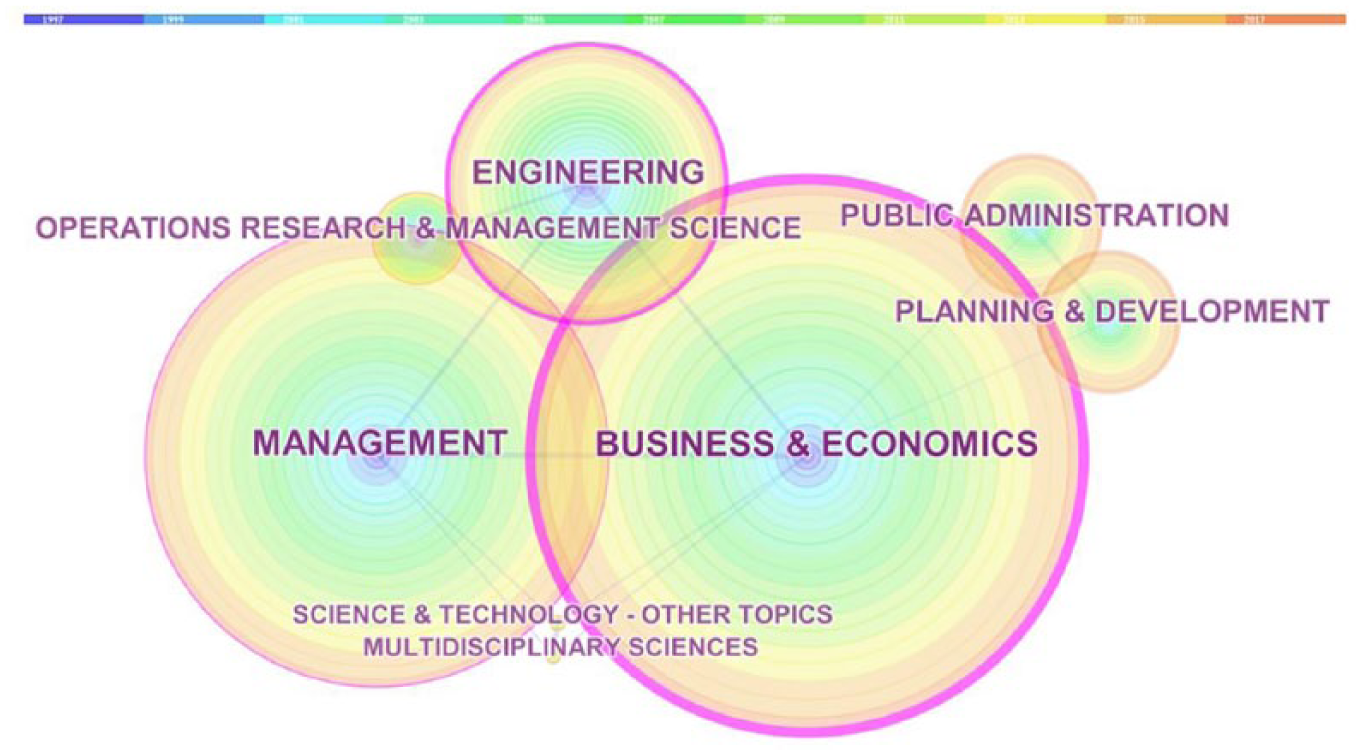
Disciplines involved in TIM field.
Figure 1 shows that Business and Economics, Management, and Engineering are the top three categories with high-frequency occurrence. Public Administration, Planning and Development, Operations Research and Management Science, Multidisciplinary Sciences, and Science and Technology follow in turn. However, analyzing the location of nodes through measurement of their centrality uncovers their importance (Abbasi et al., 2011). As we can see, only the top three categories have the outermost purple rings, which means only their betweenness centrality exceeds the threshold. The value of centrality of Business and Economics is 1.14 followed by Engineering (0.57) and Management (0.19).
Publication Cocitation Analysis
To a certain degree, references reflect the knowledge source and the knowledge domain of a publication. Analyzing references is the most common method in the area of bibliometrics. Finding clusters is an important way to discover subfields in cocitation analysis. CiteSpace provides this function based on co-occurrence relationships and network attributes. To label the clusters, CiteSpace can extract noun phrases from the titles, keywords, and abstracts of papers. In this study, we label clusters with title terms and show cluster labels by the log-likelihood ratio, which is a recommended method used in CiteSpace (C. Chen, 2016). Unless indicated, these findings and labeling clusters methods are applied in all cluster analyses in this study. The cocitation network based on clustering analysis is visualized in Figure 2. In this network, nodes represent cited publications, and the links appear among any pair of nodes if their cocited frequency exceeds the threshold. Above all, colored leaves represent clusters of the network, and different colors represent the different average years of all publications in the corresponding cluster.

The cocitation clustering network of cited publications.
As can be seen from Figure 2, seven leaves are presented as follows: “design-manufacturing integration” (#0), “absorptive capacity” (#1), “national innovation system” (#2), “dynamic capabilities perspective” (#3), “open innovation” (#4), “industrial process innovation” (#5), “new product performance” (#6), and “business model innovation” (#7). According to the indication of different colors, the leaves thrived at different times. As we can see, the earliest research hot spot in the time frame of this study is the blue area, “design-manufacturing integration.” The green lines in the blue area indicate that there were still many studies in this area until 2007. As time passed, research hot spots were transferred to green leaves, including “absorptive capacity,” “industrial process innovation,” “dynamic capabilities perspective,” and “national innovation system.” It is worth mentioning that a variety of lines from blue ones to orange ones in this area indicate that these hot spots are enduring, especially “absorptive capacity,” the most active one in the center. Finally, the latest research hot spots are yellow leaves, including “open innovation,” “new product performance,” and “business model innovation.” According to the color and thickness of links, which are proportional to the co-occurrence frequencies between papers, “open innovation” is the most popular hot spot.
Above all, considering both the location and density of orange lines, which represent the latest cocitation relationships of papers, the most flourishing subfields of TIM are “open innovation,” “absorptive capacity,” “dynamic capabilities perspective,” and “industrial process innovation.” Moreover, the most likely to explode subfield is business model innovation, which is receiving increasing research attentions.
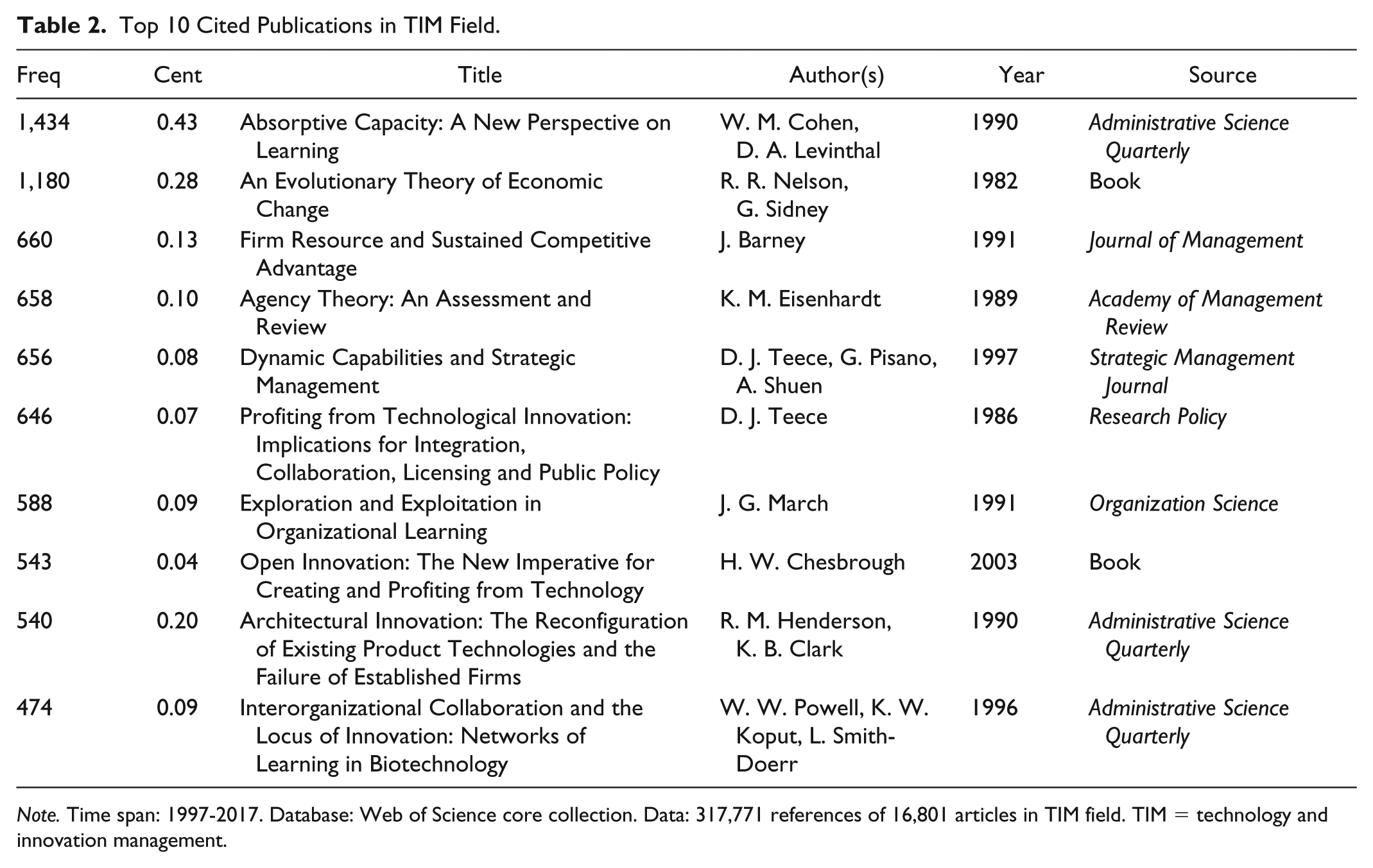
Apart from cocitation network analysis, we can identify articles, authors, or journals that influence the field of TIM mostly by analyzing references. The result will provide guidance and serve as a reference for learning and researching in the TIM field. The information on highly cited publications and authors is presented in Tables 2 and 3. “Freq” means the number of occurrences of publications in all 317,771 references of 16,801 articles. “Cent” means the betweenness centrality of publications in publication cocitation network.
Top 10 Cited Publications in TIM Field.
Note. Time span: 1997-2017. Database: Web of Science core collection. Data: 317,771 references of 16,801 articles in TIM field. TIM = technology and innovation management.
Top 10 Cited Authors in TIM Field.

Note. Time span: 1997-2017. Database: Web of Science core collection. Data: 317,771 references of 16,801 articles in TIM field. TIM = technology and innovation management.
The highest values of Freq and Cent indicate the article “Absorptive Capacity: A New Perspective on Learning” (Cohen & Levinthal, 1990), which has not only greatly influenced the TIM field but also concerns many subfields of TIM. Its author, Wesley M. Cohen, has the highest citation frequency. David J. Teece is the only author whose articles appear more than once in the top 10 list. They are “Dynamic Capabilities and Strategic Management” (Teece, Pisano, & Shuen, 1997) and “Profiting from Technological Innovation: Implications for Integration, Collaboration, Licensing and Public Policy” (Teece, 1986). The article “An Evolutionary Theory of Economic Change” (Winter & Nelson, 1982) makes Richard R. Nelson one of the most influential scholars in the TIM field. The article “Architectural Innovation: The Reconfiguration of Existing Product Technologies and the Failure of Established Firms” (Henderson & Clark, 1990) has an unusually high Cent value compared with its Freq, which indicates that the article involves many subfields of TIM, although its authors do not appear in the top 10 cited authors.
The highly cited journals are presented in Table 4. Compared with the target journals, some journals do not focus solely on TIM but contain other disciplines, albeit representing the knowledge base of the TIM field. As we can see, Research Policy and Strategic Management Journal not only have high citation frequency but also have high betweenness centrality, which means they have a considerable level of influence in many subfields of TIM. Management Science also has a high citation frequency, but its low betweenness centrality means the extent of its influence is in certain subfields of TIM. American Economic Review is the opposite of Management Science, in that although it does not have a very high citation frequency, many subfields of TIM are influenced by it.
Top 20 Cited Journals in TIM Field.

Note. Time span: 1997-2017. Database: Web of Science core collection. Data: 317,771 references of 16,801 articles in TIM field. TIM = technology and innovation management.
Cokeyword Analysis
Keywords reveal information about the core contents of academic documents, and the co-occurrence of keywords can provide deeper information about the formation of evolving multidisciplinary research frontiers of a knowledge domain (P. C. Lee & Su, 2010). In a cokeyword network, nodes represent keywords, and the other rules are the same as mentioned above. To focus on key information, 1.5% of the most commonly occurring keywords were select from each time slice, and the threshold value of occurrence frequency of keywords is set to 35. In other words, only by occurring frequently enough can a keyword be found in Figure 3. In the end, 85 words were selected. Moreover, the data were manipulated in the process of data cleaning. For example, absorption capacity and absorptive capacity were united into absorptive capacity.
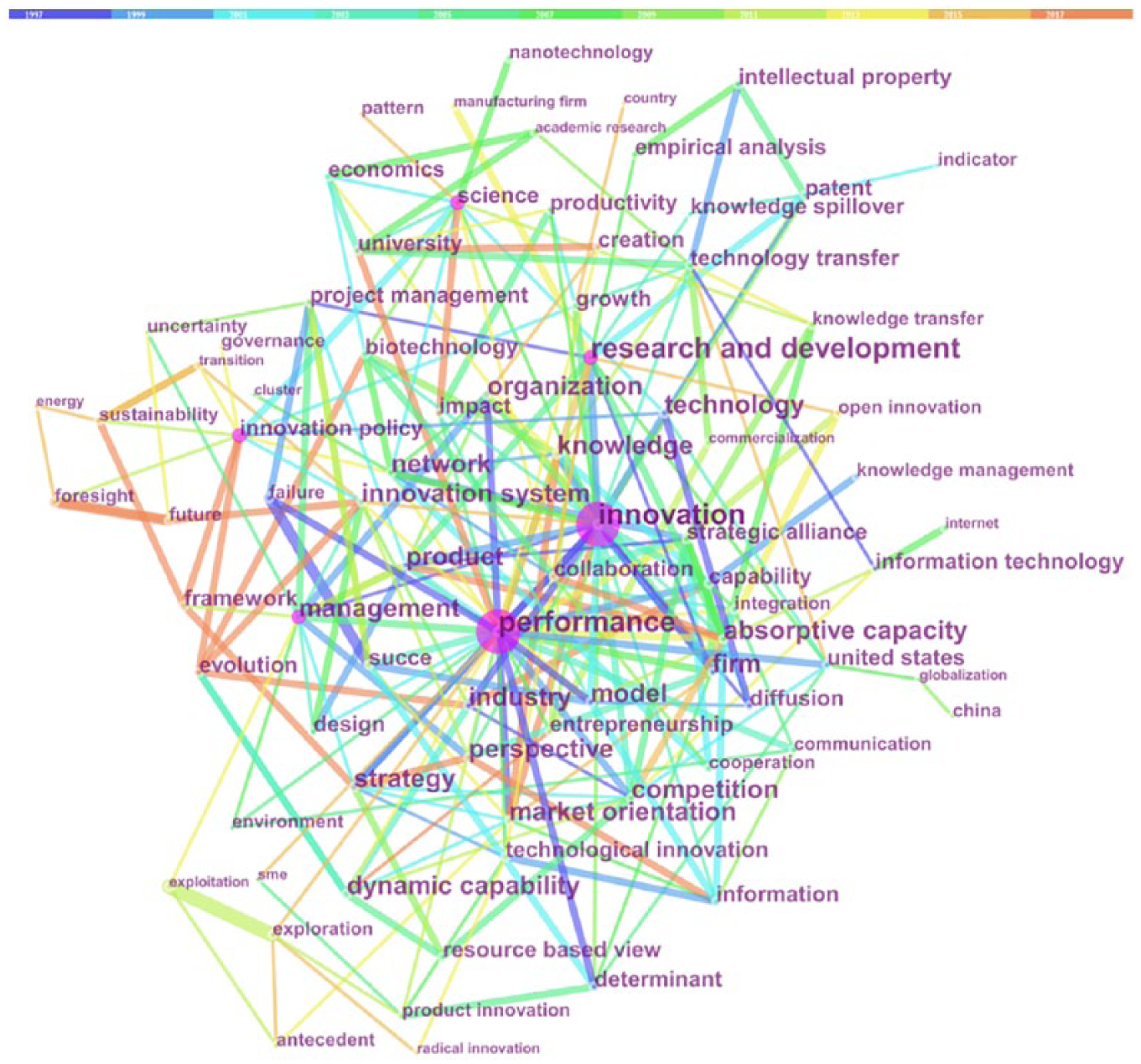
The co-occurrence network of keywords.
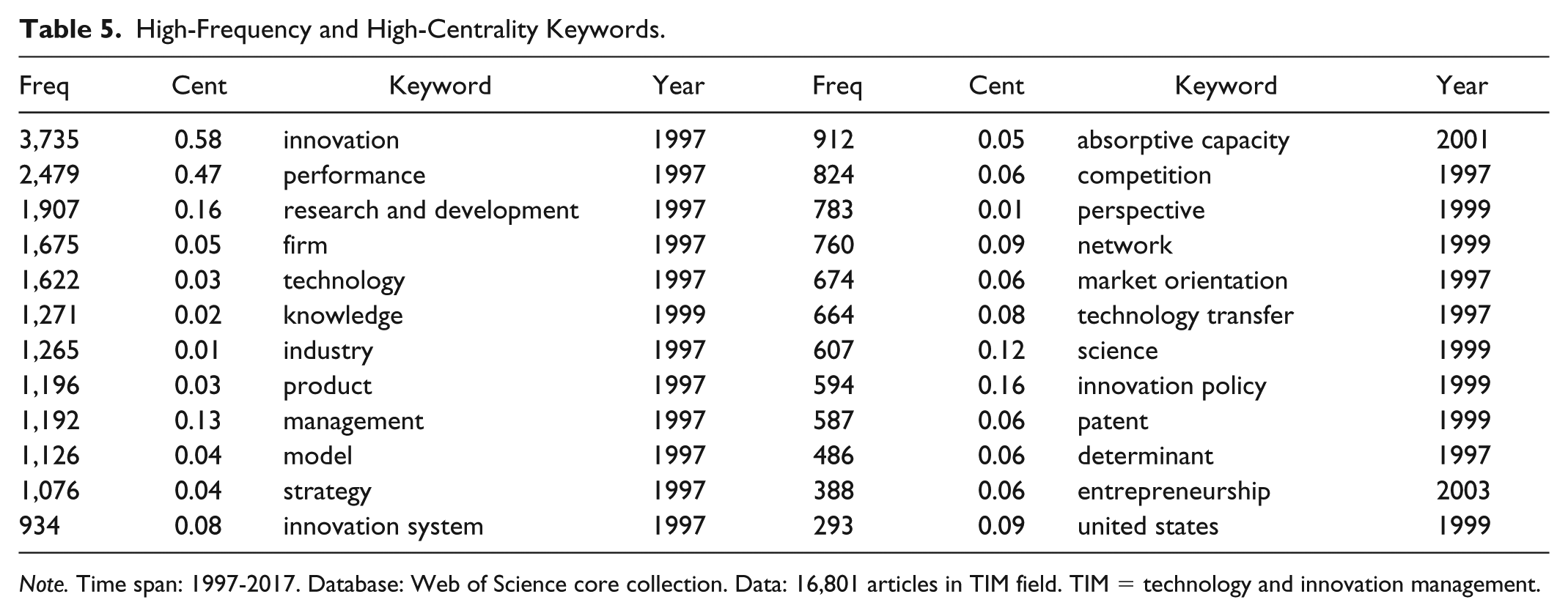
The key nodes in cokeyword network are presented in Table 5, which includes the top 15 highest frequency keywords and the top 15 highest centrality keywords. “Year” is the first year when the occurrence frequency of the keyword exceeded the threshold. As we can see from Table 5, “innovation,” “performance,” “research and development,” “firm,” “technology,” “knowledge,” “industry,” “product,” “management,” “model,” and “strategy” were the most common keywords in the field of TIM during 1997 to 2017. Their occurrence frequencies exceeded 1,000 according to statistics. It can thus be determined that these words represent the basis of TIM and help to define the boundaries of TIM more clearly.
High-Frequency and High-Centrality Keywords.
Note. Time span: 1997-2017. Database: Web of Science core collection. Data: 16,801 articles in TIM field. TIM = technology and innovation management.
Moreover, some words do not have very high co-occurrence frequency, but their betweenness centrality is remarkable. This finding means that such a keyword is a center of some independent parts. In a sense, it is a supplement of cluster analysis in cocitation analysis. We can see from Table 5 that “innovation policy” is a typical example. According to Figure 3, “innovation policy” connects with, for instance, “governance,” “innovation system,” “sustainability,” “framework,” “evolution,” and “foresight.” In this way, a more detailed picture of this subfield is presented. There are many similar examples in Figure 3, such as “innovation system,” “technology transfer,” “information technology,” “open innovation,” and “globalization.”
Based on the red lines in Figure 3, we can find newly generated high-strength connections between keywords. The cokeyword occurrence of the following set of keywords reveals the recent trends of research in the field of TIM: {“open innovation” with “research and development”}; {“absorptive capability” with “product”}; {“exploration” with “radical innovation”}; {“SME”(small and medium enterprise) with “performance”}; {“energy” with “foresight” and “sustainability”}; {“university” with “creation” and “performance”}; {“market orientation” with “knowledge” and “innovation”}; and {“evolution” with “innovation system,” “innovation policy” and “industry”}. For instance, the {“dynamic capacity” with “entrepreneurship”} co-occurrence seems to reveal the latest and most widely used theory in entrepreneurship research, and the {“energy” with “foresight” and “sustainability”} co-occurrence indicates that energy has been given increased attention because of the demands of sustainable development.
We can also find many features based on the descriptions of the keywords in Figure 3. There are three primary theories in the field of TIM, which are absorptive capacity (with a frequency of 912), dynamic capability (with a frequency of 689), and resource-based view (with a frequency of 266). Four technology fields receive more attention in this field, including information technology (from 1997), biotechnology (from 2001), nanotechnology (from 2007), and energy (from 2015). Moreover, the United States and China are the only two noteworthy countries in the cokeyword network of the TIM field, and they are mainly linked by globalization. The most commonly followed type of enterprise in this field is manufacturing firms, and the most commonly followed size of enterprises is small and medium. For research itself in the field of TIM, the most common research method is empirical analysis, and panel data are a common data type.
Burst detection of keywords can detect the keywords that spike over a short period of time (C. Chen, 2016). The aim of burst detection is to find sharp increases of keywords. Thus, the bursting keywords are not usually the constant hot keywords. To focus on the recent trend in the field of TIM, the time span of burst detection is set to 2007 to 2017. As we can see from Figure 4, many keywords began to burst approximately 10 years ago; the strongest one is “information technology,” followed by “spillover,” “United States,” and “technology innovation.” The appearance of the bursts of “resource-based view,” “open innovation,” and “dynamic capability” from approximately 2010 shows a paradigm shift toward an accepted theoretical basis in the field of TIM. Concerning open innovation, R&D Management organized a special issue on “The Future of Open Innovation” in 2010, Technovation organized a special issue on “Open Innovation” in 2011, and Research Policy organized a special issue on “Open Innovation: New Insights and Evidence” in 2014, which can be seen as the sigh of bursting of open innovation research. Finally, “China,” “university,” and “firm performance” have been bursting in recent years. Because the latter two keywords have high frequency all the time, their busting strengths are not very obvious. Considering the strength of busting and the start time, “China” can be regarded as the only one new hot topic in this field.

Top 15 keywords with the strongest citation bursts.
Collaboration Network Analysis
In this section, we analyze the collaboration network in the field of TIM from three levels: country, institution, and person. Other than focusing on the information from references, all of the objects we analyzed in the collaboration network are extracted from the sample itself. In this way, not only the collaboration network of the TIM field in the last 20 years is presented but also the broad trends and key nodes are also detected.
Figure 5 presents the numbers of countries, universities, and authors in the field of TIM from 1997 to 2016, showing the developing trends of the TIM field. From 1997 to 2016, the numbers of countries, universities, and authors all increased gradually. Over the past 20 years, the number of countries increased by nearly two thirds to 54, the number of universities increased by nearly six times to 724, and the number of authors increased by nearly five times to 790. On one hand, this situation can be explained by the increasing number of articles published in the TIM field and the continually improving coverage of network databases. On the other hand, there is no doubt that the field of TIM itself has received increasing attention.

The trends of the numbers of countries, universities, and authors in TIM field over time.
At the country level and as shown Table 6, with 4,933 articles, the USA outperforms all other countries by number of publications. Among other countries, researchers from England, China, the Netherlands, Germany, and Italy contributed highly to the field of TIM, with 2,208; 1,368; 1,227; 1,122; and 1,049 papers, respectively. In addition, three countries—the USA, England, and the Netherlands—have purple rings representing high betweenness centrality (Figure 6). These rings indicate that these three countries not only actively participate in international cooperation but have also been the center of international cooperation in the TIM field. It should be noted that although China ranks third in terms of the number of publications, its betweenness centrality is not high. This means that Chinese scholars usually cooperate with domestic partners. Germany and Italy are in similar circumstances.
Top 15 Countries in TIM Field.

Note. Time span: 1997-2017. Database: Web of Science core collection. Data: 16,801 articles in TIM field. TIM = technology and innovation management.

Collaboration network of countries.
At the institutional level, the most active institutes in the TIM field with regard to the number of publications are visualized in Figure 7. The top 15 institutes in terms of frequency are also listed in Table 7. As expected, all important institutions are found to be universities. The objects we analyzed are thus only universities. The University of Sussex stands at the top of the list, followed by the University of Manchester, the Massachusetts Institute of Technology, and the Georgia Institute of Technology. The top two universities are located in England, which demonstrates the leadership of England in the TIM field. There are five Dutch universities on the list, which means that TIM research is thriving in the Netherlands. The Massachusetts Institute of Technology has the highest betweenness centrality, meaning that it can be regarded as the center of international cooperation.
Top 15 Universities in TIM Field.

Note. Time span: 1997-2017. Database: Web of Science core collection. Data: 16,801 articles in TIM field. TIM = technology and innovation management.

Collaboration network of institutions.
At the person level, the most active author collaboration network over these 20 years is visualized in Figure 8. Important authors with regard to frequency are also listed in Table 8. “Year” in this list is the first year when the frequency of the author’s publications exceeds the threshold, which is the top 20 in every time slice. With 83 articles, Joseph F. Coates outperforms all other researchers in the TIM field. The frequency of publications of James Euchner exceeded the threshold relatively recently for the first time in 2011, and he has been the second author in terms of frequency. Moreover, according to the range of colors of the rings, Coates and Carayannis have been active in this field for the longest time. According to colors of the outermost rings, which represent the time of the latest publications of scholars, the authors on the right side of Figure 8 may give new momentum to the development of the field of TIM.
Top 10 Authors in TIM Field.

Note. Time span: 1997-2017. Database: Web of Science core collection. Data: 16,801 articles in TIM field. TIM = technology and innovation management.
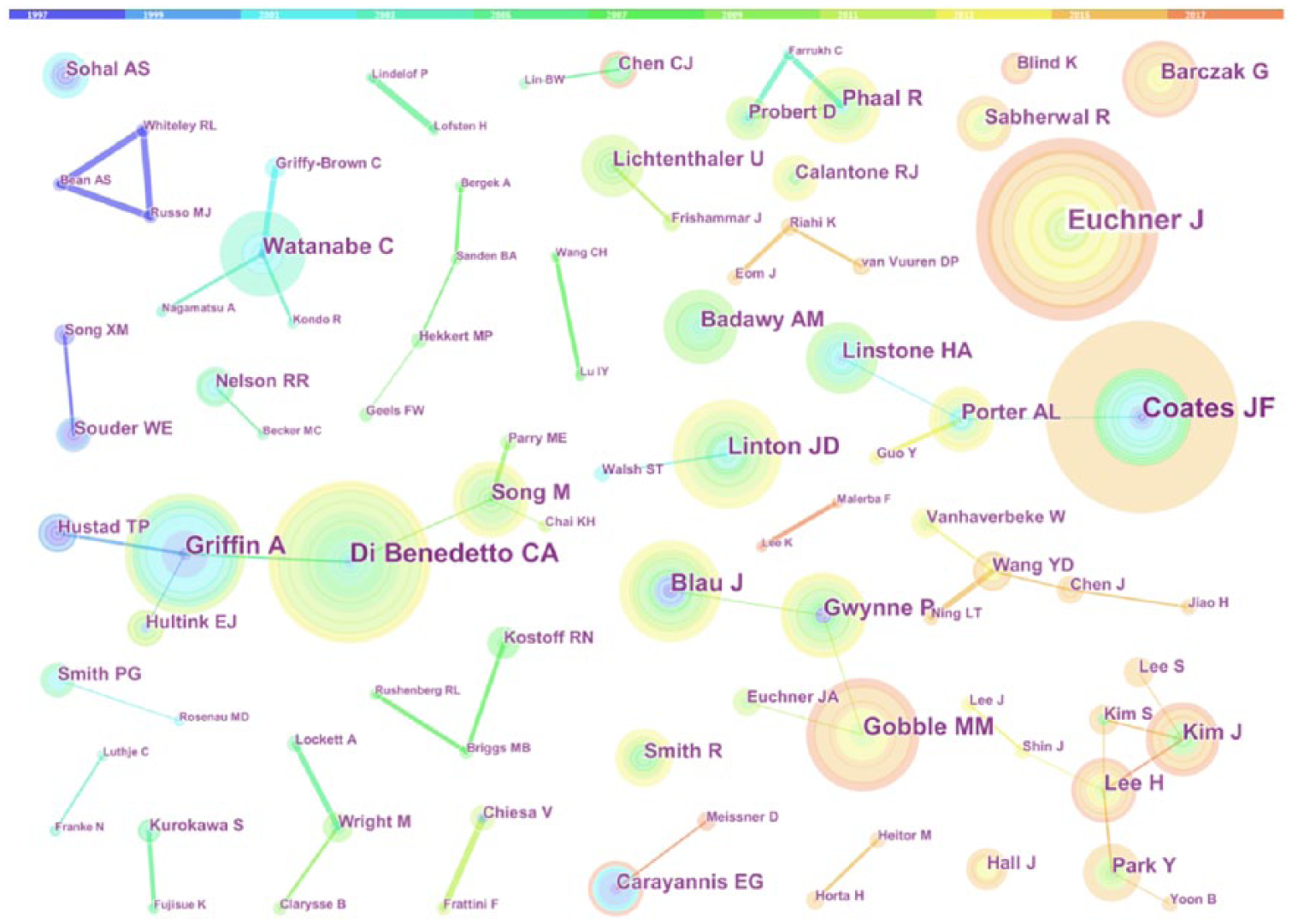
Collaboration network of authors.
Discussion and Conclusion
This article aims to review the progress in the TIM field and open an avenue to detect the features and developing trends of this domain. Unlike qualitative analysis, this study uses a quantitative bibliometrics analysis to review the domain of TIM because this method can address a large amount of data, as well as detecting and visualizing emerging trends and transient patterns in the scientific literature. This study then found 16,801 journal articles from the top 13 journals during 1997 to 2017 in the field of TIM as well as 317,771 cited references. As a result, this review provided insights about the dynamic panoramas of the field over time.
Findings
From the data analysis mentioned above, we can summarize the analysis results from two aspects: the features of and the trends in the field of TIM, which describe this field from static and dynamic perspectives, respectively.
Concerning static information of the TIM field, this study summarizes four points. First, the most important disciplines in the field of TIM are Business and Economics, Management, and Engineering. This is consistent with previous qualitative studies (Yanez et al., 2010), albeit more accurate. Moreover, through quantitative analysis about betweenness centrality, we indirectly verified that management is the basic discipline in this field.
Second, according to the analysis of cocitation and cokeywords, there are six main research directions in the field of TIM, including design–manufacturing integration, innovation system, open innovation, industrial process innovation, business model innovation, and innovation policy.
Third, according to the analysis of keywords, some features about the subject of TIM are confirmed. Based on the frequency of keywords, the following words can be used to describe the TIM field: “innovation,” “performance,” “research and development,” “firm,” “technology,” “knowledge,” “industry,” “product,” “management,” “model,” and “strategy.” There are three commonly used theories in this field: absorptive capacity, dynamic capability, and resource-based view. Four fields of technology, including information technology, biotechnology, nanotechnology and energy, receive more attention in the study of TIM. The hottest type of enterprise in the study of TIM is manufacturing firms, and the most popular size of enterprise is small and medium enterprise. The most common research method is empirical analysis, and panel data represent a common data type.
Fourth, there are several publications, scholars, institutions and countries that serve as key nodes. The hottest publications for almost two decades in the field of TIM are “Absorptive Capacity: A New Perspective on Learning” written by Cohen and Levinthal in 1990, and “An Evolutionary Theory of Economic Change” written by Nelson in 1982. In addition to the scholars mentioned above, Teece and Eisenhardt are also influential. The top three countries in the TIM field are the USA, England, and China, but the central countries of international cooperation in this field are the USA, England, and the Netherlands. Moreover, the top three institutions in the TIM field are the University of Sussex, the University of Manchester and the Massachusetts Institute of Technology. The center of international cooperation is the Massachusetts Institute of Technology.
Concerning dynamic information in the field of TIM, the results on the basis of a time-slicing mechanism provide an advantageous way to grasp the veining and trend of the development of TIM field. First, the main research directions, in the order of the mean value of the years pertinent literatures published, are as follows: design-manufacturing integration (2001), industrial process innovation (2004), innovation system (2005), innovation policy (2009), open innovation (2009) and business model innovation (2013). Apart from the first two research directions, the remaining research directions have been active until now, especially open innovation. In addition, “open innovation” has often appeared with “research and development” in recent years.
Second, considering about the cokeywords analysis, we can find the transition of hot topics in the field of TIM. Concerning technology, the sequence is as follows: information technology (from 1997), biotechnology (from 2001), nanotechnology (from 2007) and energy (from 2015). A heavily researched recent topic concerning technology in the field of TIM is energy, which frequently appeared with “foresight” and “sustainability.” Energy is a reflection of people’s increased environmental awareness. This topic also underscores the gravity of environmental problems.
Third, concerning the theories used in the field of TIM, the popular theories are as follows: absorptive capacity (from 2001), dynamic capability (from 2001), and resource-based view (from 2005). The {“dynamic capacity” with “entrepreneurship”} and the {“absorptive capability” with “product”} are two popular relationships in recent years. Combined with the information mentioned above, it is found that the application of these theories has moved from large-scale enterprises to start-ups and from company-level to product-level.
Finally, according to burst detection of keywords, this study finds heavily researched topics based on bursting of frequency of keywords. “Resource-based view” burst from 2010 to 2012; “Open innovation” and “dynamic capability” burst from 2011 to 2014. Meanwhile, “China” burst from 2013 until now, and “university” burst from 2015 until now. In addition, “China” often appeared with “globalization,” and sometimes with “United States.” “University” often appeared with “creation” and “performance.” Thus, university–industry cooperation and China may be the next hot topics.
Research Directions
This article analyzes a large amount of data using some new methods compared with existing reviews focusing the whole TIM field. Accordingly, some new research directions are articulated as follows.
First, TIM is an interdisciplinal field because innovation success relies on not only technology development but also strategic planning, manufacturing capability, marketing capability, external institutional environments, and other factors. In TIM field, except TIM itself, the most influential subject is strategic management and Strategic Management Journal has not only a high citation frequency but also a high betweenness centrality, and two of the three most influential theories are from strategic management, which are the dynamic capabilities perspective and the resource-based view. Thus, the subjects, such as accounting, marketing, and supply chain management, should also exert their influences in TIM field.
Second, although topics in TIM field are evolving, influential theories and perspectives remain unchanged. TIM scholars begin to examine the complex process of innovation. For example, both open innovation and business model innovation stress the collaboration among a variety of partners, which are sometimes treated as ecosystems (Eckhardt, Ciuchta, & Carpenter, 2018; Martins, Rindova, & Greenbaum, 2015). Thus, the research objects should be changed from individual firms to the ecosystems, and some new theories and perspectives should be employed to explain the new phenomena.
Third, TIM in developing countries needs more research attentions. Almost all the productive and influential countries and research institutions in TIM field are from developed regions. TIM in developing countries, including China, India, Brazil, South Africa, has its own characteristics due to their economic and social development and traditions. China has received a considerable research attention now. However, that is now enough. An in-depth investigation of TIM in developing countries can provide more insights to advance TIM academic research and practical affairs.
Limitations
This study, similar to many others, has its own limitations. First, the data set is very limited. On one hand, as mentioned above, 13 journals are enough to reflect the TIM research field, but some details in this field may be missed. However, the data set is derived from WoS. WoS only includes a part of the nearly two-decade data we need. Thus, a direction to improve this study is enlarging data set from other data sources. Second, the quality of data is limited. Data cleaning cannot improve the quality of data to ideal state. For example, for keywords, there are overlaps among “innovation,” “technology innovation,” and “open innovation.” However, we cannot unite these keywords into one word because this step will lead to a loss of details. We also have no way of subdividing “innovation.” Finally, the methods and algorithms significantly affect analysis results. Finding more suitable tools or developing functions based on the requirements can make the study more comprehensive and more accurate.
Footnotes
Declaration of Conflicting Interests
The author(s) declared no potential conflicts of interest with respect to the research, authorship, and/or publication of this article.
Funding
The author(s) disclosed receipt of the following financial support for the research, authorship, and/or publication of this article: This study was supported by the National Science Foundation Committee of P.R. China (grants 71572063 and 71772074).
