




Abstract
Since 2005, education in the Kingdom of Bahrain has undergone major reforms as part of the National Education Reform Project to achieve the goals of Bahrain’s Economic Vision 2030. The Education & Training Quality Authority (BQA) was created by a Royal Decree as an independent entity established that is responsible for ensuring quality in education and training in the Bahrain. The Directorate of Government Schools Review (DGS) is under the umbrella of BQA and responsible for conducting quality reviews for all Bahraini government schools. Upon successfully completing two cycles of school reviews (review cycle average is 4 years), this article compares the findings of two DGS review cycles. In December 2014, the DGS completed its second review of 206 schools. Generally, the results showed an increase in the polarity of the ratings. Analysis of the results showed the following: In terms of schools’ environments, it is generally safe with equal infrastructure and learning resources among most schools; the performance gap between male and female students is widening; the field of technical and commercial education still faces challenges; parental involvement is limited, despite opportunities for participation; and available technology is used inconsistently. In addition, some schools that are judged inadequate face increased challenges to improvement.
Introduction
The Kingdom of Bahrain is a small country with an area of 767 km2 and an estimated population of 1.3 million people, according to the Central Informatics Organization (2016). According to the Ministry of Education (2016), there are 206 government schools and 73 private schools offering education to 189,244 students between the ages of 6 and 18. The main objectives of Bahrain’s Economic Vision 2030 include stimulating and supporting the private sector to make it an engine for growth and empowering Bahrainis to become the employees of choice for the labor market. The Bahrain’s Economic Vision 2030 is designed the main driver of all recent reforms: economic, political, and social (Bahrain Economic Board, 2016). Starting in 2008, and after finishing the diagnostic and planning stages, major educational reforms have been introduced in Bahrain, including the establishment of the Education & Training Quality Authority (BQA) (“Decree No. (32) of 2008 on Establishing the Quality Assurance Authority for Education & Training (No. 2844),” 2008). The Directorate of Government Schools Review (DGS), as one responsible party to the BQA, and responsible for reviewing all government schools’ performance in Bahrain (BQA, 2016), has completed two cycles of reviews: one between 2008 and 2011 and the other between 2011 and 2014. This report compares both cycles and summarizes the most important characteristics of both cycles.
Based on the results and analyses of both the review cycles that took place between 2008 and 2014, this article will answer the following research questions:
Quality Review Model of Schools
Educators globally have argued over the years that their professional freedom must be protected from external quality assessment, as they consider it a sign of distrust and prefer internal quality assurance processes (Doherty, 2004). During the last three decades, more emphasis was placed on linking the goals of national economic growth to educational quality, focusing on preparing students to be fit for a continuously changing market (Ladd & Loeb, 2013). Therefore, educational policies encouraged educational systems to offer greater freedom in moving toward more decentralized educational management systems, with an emphasis on increased accountability to external stakeholders (MacBeath, 2006). This accountability is to be guided by clear criteria and a framework that is understood and agreed upon by various stakeholders.
Quality reviews and inspections vary between educational systems around the world in accordance with their individual needs and backgrounds (Brundrett & Rhodes, 2011). The review framework adopted by DGS in the Kingdom of Bahrain is based on the philosophy of professional development through performance review by “critical friends.” These critical friends are peers in the field of education who have considerable experience in teaching and managing schools. The criteria by which schools are judged are considered to be generic; however, molding schools into the same way of doing things is not the aim. Rather, the purpose of the evaluation is to improve students’ academic performance and enhance their personal development. The model adopted by the DGS is published in the Schools Review Handbook and is based on the following three components (BQA, 2014):
1. Quality of outcomes
• Students’ academic achievement
• Students’ personal development
2. Quality of main processes
• Teaching and learning
• Support and guidance
3. Quality assurance of outcomes and processes
• Leadership, management, and governance.
After judging the quality of each of the above aspects, reviewers examine schools’ overall effectiveness and capacity to improve. The DGS developed a classification system to explain the criteria for each rating in detail and to ensure that the performance of each school is evaluated according to the same standards. The classifications are as follows (BQA, 2014):
Outstanding: This judgment is awarded if the practices of all or the vast majority of those related to the criteria are diverse and of quality and highly productive. Performance and initiatives taken are exceptional and significantly exceed expectations. It largely reflects improvement and development and can be considered as a model to be followed.
Good: This judgment is awarded if the practices of most of those related to the criteria are diverse and of quality and productive. Performance is effective, and initiatives are ongoing and sometimes exceed expectations. It largely reflects improvement and development.
Satisfactory: This judgment is awarded if the quality of the practices of the majority of those related to the criteria is at an acceptable level, and performance and initiatives are at the expected level and reflect some improvement and development.
Inadequate: This judgment is awarded if the quality of the majority of the practices of those related to the criteria is at an inappropriate level, and the school’s performance is at a level less than expected. This judgment does not reflect any realistic expectation of improvement.
General Finings
December 2014 marked the end of Cycle 2 reviews, as DGS completed reviewing 206 schools: 132 primary schools and primary-intermediate schools, 38 intermediate schools, and 36 secondary and intermediate-secondary schools (BQA, 2015). The overall effectiveness of government schools is illustrated in Figure 1. This article will not include the results of seven new government schools that had been reviewed during Cycle 2 only; consequently, this comparison will include only 199 schools.

Overall effectiveness—comparing the 206 schools reviewed in Cycle 2.
The main themes of the review findings are as follows.
Increase in Polarity of Ratings
An increase in the polarity of the ratings was observed in Cycle 2, in which the percentage of “outstanding” schools increased and the number of “inadequate” schools also increased, particularly in the elementary stage, as illustrated in Figure 2. In Cycle 2, the rankings of some schools improved by two levels; however, others reported a drop of the same degree. This was related in many cases to the level of the effectiveness of school initiatives and external follow-up and support provided to schools. On the contrary, the decline may have been influenced by multiple factors, including student academic levels at entry in different stages and the quality and stability of leadership including senior and middle management.

Overall effectiveness—comparing the 199 schools reviewed in Cycle 1 and Cycle 2.
Overall Performance of Various School Levels
Improvements in the secondary level are the most notable success story in Cycle 2 when compared with Cycle 1. “Inadequate” school ratings decreased from 47% to 22%, and the “outstanding” rating remained constant at one secondary school in each cycle of reviews, as shown in Figure 3.

Overall effectiveness—comparing the 32 secondary schools reviewed in Cycle 1 and Cycle 2.
Primary schools demonstrated a clear example of grade polarity; the number of “outstanding” and “inadequate” ratings almost doubled between Cycle 1 and Cycle 2, as shown in Figure 4.

Overall effectiveness—comparing the 130 primary schools (including primary-intermediate) reviewed in Cycle 1 and Cycle 2.
The intermediate level was a point of concern for the DGS. A 9% decrease was observed in the number of “satisfactory” schools, as well as an 8% increase in the number of “inadequate” schools led the total of “inadequate” intermediate schools to be 37%. “Good” and “outstanding” schools did not make any progress, as indicated in Figure 5.
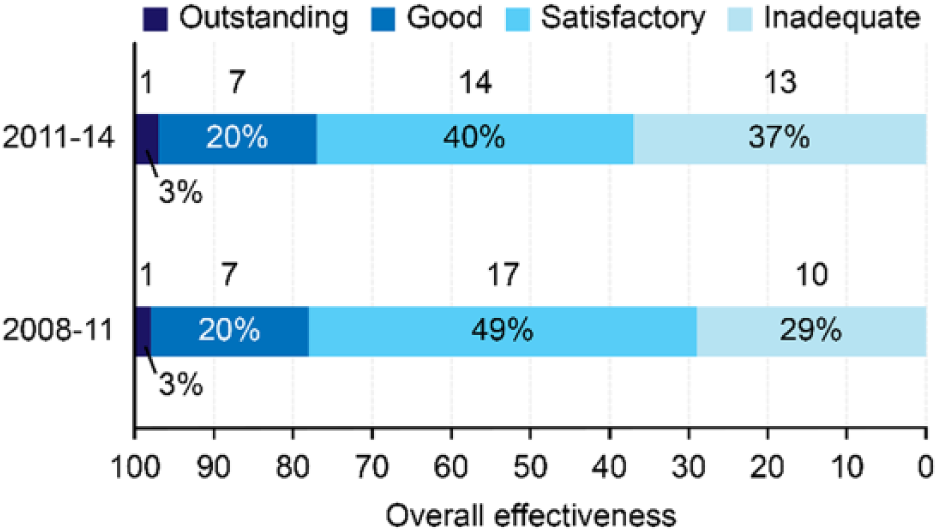
Overall effectiveness—comparing the 35 intermediate schools reviewed in Cycle 1 and Cycle 2.
Table 1 charts the general distribution of schools by level, rating, and gender. The girls’ schools maintained their positive progress over the boys’ schools in the “outstanding” and “good” ratings. The boys’ schools that were judged “satisfactory” in the primary level and “inadequate” in all levels increased over the girls’ schools.
Overall Effectiveness—General Distribution of the Effectiveness of 206 Schools According to Level, Rating, and Gender.

Performance of Schools: Analytical Review
The most influential factors on the performance of schools as analyzed in more than 400 review reports and as observed in the two cycles of review were as follows:
Senior Leadership
Recommendations for leadership, management, and governance focused on the ability of school management teams to conduct accurate and comprehensive self-evaluations and use the results to formulate a strategic plan and follow it up. It also focused on the preparation and implementation of teachers’ career competency programs. The work of senior leaders and their sustainable improvement were negatively affected by staffing changes, which they had no control over it. In addition, instability in senior management positions had a direct impact on the performance of the schools. A number of schools, especially those that were struggling, had experienced changes in their staffing up to 3 times between the first and second review visits (an average of 3.5 years). The analysis shows that these changes affected school ability to establish effective management and quality control systems, and in turn affected their development and progress. Results show that “outstanding” schools had maintained stable staffing for 2 to 6 years.
Middle Management and Teaching Staff
Middle managers—senior teachers in Bahrain—significantly impact classroom practices by observing teachers’ performance and organizing professional development to ensure good teaching processes. Review teams reported shortages in middle management in a number of schools, which affected the quality of class management and instructional differentiation. In some schools, especially intermediate and secondary schools, shortages included senior teachers of core subjects; this shortage was due to increasing subject specialization required and the nature and characteristics of this age group (13-18 years). The workload of senior teachers in schools was also affected by staffing changes, which required more time to cope with low retention rates and more efforts to be spent developing teachers’ performance.
Gap in Performance Between Male and Female Students
Overall, the gap in performance observed between boys and girls in Cycle 1 remained consistent in Cycle 2. While this comparison is a point of concern for many educational systems internationally, its impact is especially impactful in the Kingdom. The consequences of the discrepancy are reflected in communities, employment opportunities, and access equality in higher education sector in particular. As illustrated in Figure 6, “outstanding” ratings in girls’ schools were 6 times more prevalent than in boys’ schools. Only 3% of girls’ schools were rated “inadequate,” compared with 24% of boys’ schools. Reports analysis shows that this discrepancy is partially attributed to the difference in performance levels between genders, relating to boys’ lack of readiness or motivation to learn. The quality of teaching and learning practices in the schools may also have had an impact. It is worth noting that the management and staffing of the “outstanding” and “good” primary schools consisted of females.

Overall effectiveness—comparing the 206 boys’ and girls’ schools reviewed in Cycle 2.
The School Environment
The school environment in Bahrain is generally safe, and most schools have equal infrastructures and learning resources. This promotes equal learning opportunities for all students. Analysis results indicate that in many cases, new buildings, facilities, and the availability of scientific technology have had a direct impact on students’ motivation to learn and progress. However, some schools lack science and computer laboratories and multipurpose halls. Few schools covered in this study face challenges related to inadequate buildings or external hazards that threaten students’ safety when they come to and go from school. These schools do not constitute the majority; nevertheless, such shortages are significant to students’ learning processes.
Technical and Commercial Education
In Bahrain, secondary education consists of four main tracks: technical, commercial, scientific, and literacy. Technical and commercial education is an important component of developed educational systems, and its importance increases as countries seek to transform their service sectors and move toward knowledge-based economies. Analysis results indicate that, in general, students on the commercial track outperformed their peers on the technical track. Students on the commercial track showed weakness in basic skills in English and mathematics, whereas students on the technical track did not meet the desired outcomes in their theoretical lessons, particularly English, but performed better in practical lessons and showed more enthusiasm for those subjects. Students’ knowledge of English and some theoretical subjects is fundamental for both the commercial and technical tracks; therefore, it is important to reconsider the use of diagnostic tests and provide greater support based on students’ ability levels.
Role of Parents
Parents have a significant role in driving teaching and learning processes and improving their children’s academic achievement; they do this through following up their children progress, maintaining high expectations of them, and motivating them to succeed. Analysis of reports shows that school management teams are keen to collect and implement parents’ suggestions and often formulate and activate parents’ councils. However, poor participation limits their impact. Although more than one quarter of the schools in this study were judged as “inadequate,” parents’ satisfaction was judged as “inadequate” in only 1% of schools. This reinforces that parents are not aware of the impact of their active participation or that they are poorly motivated to play more active role in their children learning. Parents’ councils should be activated through constructive and continuous discussions with teachers throughout the school year, and deciding on appropriate learning experience starting points of students through addressing accurate analyses of their educational levels. In addition, parents and teachers should jointly develop methods to achieve competencies that are in line with students’ abilities.
Input-Based Changes
Changes in the number of students in Bahrain and their backgrounds, social classes, or cultures were not accompanied with needed level of support in developing teachers with sound induction programs to deal with students with special needs. For instance, nonnative Arabic speakers, who comprise more than 20% of the population in some schools, were not matched with appropriate teacher training programs that address the needs of these students, which obstructed students’ progress.
Educational Technology and Its Use
In this age of digital culture, technological skills are among the most important for students. With regard to the use of educational technology, the analysis of review reports showed, despite the availability of computer labs in the vast majority of schools, that their use varied greatly. “Outstanding” and “good” schools employed IT, in addition to the use of blogs and websites, in their classroom practices to serve the teaching and learning processes. They also conducted some formative tests electronically. In these schools, IT was also used for a portion of teachers’ professional development programs. Review reports showed that students generally had moderate IT skills; for example, in the most effective schools, students initiated the transfer of some parts of the curriculum into e-lessons. However, such practices varied among schools, especially those with “satisfactory” and “inadequate” ratings, in which the use of electronic projectors was the extent of IT that was observed. This limitation can impact students’ academic progress. It is worth mentioning that the use of e-learning varies in accordance with educational stages, and it was used more in primary schools than in the intermediate and secondary schools.
Increase in the Number of “Inadequate” Schools
The number of “inadequate” schools in Cycle 1 was 41, compared with 55 in Cycle 2. This change negatively affects the achievement of Bahrain’s Economic Vision 2030. The most important reasons for the increase in schools rated “inadequate” include the following: the decline of students’ academic achievement, as there was a noticeable variance between the students’ pass rates and proficiency rates; a decline in students’ acquisition of basic skills such as reading and writing in Arabic and English, arithmetical skills in mathematics, and applied skills in science; weakness of students’ personal development, as most students do not effectively participate in life at school, show enthusiasm toward learning, or take on leadership roles. In addition, other factors, as reports analysis show, include teaching- and learning-related problems, such as ineffective teaching strategies and poor classroom management. Also, inaccurate self-evaluation, poor strategic planning, the turnover of school leaders, and ineffective professional development programs for teachers were another factors contributed to the poor performance.
Nineteen schools were judged as being “inadequate” in both cycles. These schools are still causing concern, and organizations must take immediate intervention actions. Such actions may include employing more experienced teachers, ensuring close follow-up, improving parents’ awareness, and acquiring the necessary support to address schools’ specific needs to enhance outcomes and improve ratings. It is important to remember that some students will receive their entire education from “inadequate” schools.
Ways Forward
The comparison between the two cycles of reviews has revealed several overall areas for improvement. Actions by regulatory bodies should
Apply and develop the practices of the “outstanding” schools to ensure the sustainability of those schools’ performance and to propagate best practices in other schools;
Enable students to acquire basic skills in all educational stages and tracks;
Ensure the improvement of “inadequate” schools’ performance, especially those that face challenges and have received the same grade in two review cycles;
Consider the stability of schools’ staff and address shortages in human resources, especially teachers of core subjects and senior teachers;
Work on reducing the gap between boys’ and girls’ performance and achievement in general, and work to motivate boys to learn and achieve academically;
Offer support for students’ needs across all different levels through training and professional development programs for staff;
Address the shortages of facilities and resources such as multipurpose halls, science labs, and technology, to establish similar learning conditions among schools and facilitate better learning opportunities;
Encourage an e-learning culture among students, parents, and teachers, enabling them to make optimal use of computer labs and other technology that supports the teaching and learning processes;
Ensure the safety of buildings, as well as freedom from hazards that may threaten students’ security during their arrival and departure; and
Increase parents’ awareness of the importance of their participation in the educational process.
Footnotes
Author’s Note

Declaration of Conflicting Interests
The author(s) declared no potential conflicts of interest with respect to the research, authorship, and/or publication of this article.
Funding
The author(s) received no financial support for the research, authorship, and/or publication of this article.