



Abstract
This study employs time series analysis to examine the factors influencing fluctuations in tourist arrivals within a certain timeframe (1993–2023) across a chosen set of Western Balkan nations. The countries that have been chosen for this study are Albania, Croatia, Montenegro, and Greece. These nations exhibit distinct attributes in terms of their socio-economic development patterns; nonetheless, they share commonalities in terms of their coastal topography and cultural heritage influences. In this study, GMM models will be employed to analyze the relationship between the number of tourist arrivals and international tourism receipts. The models will incorporate various independent variables, including GDP growth rate, consumer price index, exchange rate, transportation costs, and other pertinent factors associated with tourism infrastructure. Based on our estimation results, we have observed small variations among countries, indicating a relatively low amount of price elasticity. Nevertheless, when considering Balkan countries, it is shown that income level and currency rates hold greater significance.
Keywords
Introduction
The current body of literature related to tourism economics has placed significant emphasis on the subject of tourism demand modelling. The primary focus of empirical applications has mainly focused on methodological concerns and the examination of certain causes. Nevertheless, it is very astonishing that there has been limited debate regarding the ramifications of the selected dependent variable in terms of both theoretical and empirical outcomes. Furthermore, the implications stemming from the selection of the measure for tourism demand have received scant attention.
One of the industries that is expanding at the greatest pace in the global economy is tourism. The majority of nations are dependent on it for their economic growth, including the countries of the Western Balkans, which are investing in tourism and believing it to be an essential industry for their development. Over the course of the past ten years, national governments have undertaken a number of activities, including the creation of national tourism brands, the evaluation of tourism strategic plans, and the implementation of tourism marketing campaigns.
The Balkans are a promising destination on the international map because they are able to meet the various interests of its guests and the type of tourism that they wish to experience. Many people consider heritage, religion, history, and other aspects that attract tourists to be a component of their national identity. This is because these aspects attract tourists. A rise in the number of overnight stays made by tourists from other countries has been recorded. All of the destinations are addressed, both in and out of the tourism streams that are present in the region. There appears to be a significant proportion of total tourism that is comprised of citizens of each nation. In terms of popularity among tourists, Greece, Croatia, Albania, Bulgaria, and Montenegro are the top five places that are most frequently chosen (Porfido, 2020).
The present investigation makes use of time series analysis in order to investigate the factors that influence changes in tourist arrivals over a specific period of time (1993–2023) across a selected group of Western Balkan countries. For the purpose of this investigation, the countries of Albania, Croatia, Montenegro, and Greece have been selected. These economies exhibit diverse characteristics in terms of the patterns of socioeconomic growth that they have experienced; nonetheless, they share similarities in terms of the coastal geography and cultural heritage influences that they have experienced.
When it comes to determining the demand for tourism arrivals, the empirical literature suggests that factors such as income and prices play a significant part in the evaluation process (Cvetkoska & Barisic, 2017; Malaj, 2020; Selimi et al., 2018). Generally speaking, travel is considered to be a luxury good or service, because of the prevalent notions.
Background and Motivation
Currently, the entire Balkan region is experiencing a golden era of tourism expansion. This is largely attributable to the fact that the region was previously “undiscovered” and “unknown.” It cannot be denied that tourism is becoming an increasingly important component of the economic structure of countries in the Balkans.
Albania has been honored with the title of best destination of 2011 by Lonely Planet, the most comprehensive travel book in existence. In the year 2016, the city of Bay of Kotor in Montenegro was selected as a city that should not be missed (Butler, 2015).
There are countries in the Balkan peninsula that are in various stages of the development of their tourism industries. According to Lehmann and Gronau (2019), “In point of fact, in addition to the well-known tourist destinations along the Croatian coast, other, more remote and rural areas are also becoming areas that are becoming popular destinations for tourism.” The primary reason for this disparity is that their economic, political, and historical origins are very different from one another.
Tourism plays a crucial role in promoting socio-economic development, particularly in countries that are developing. The industry in this region plays an important part in the process of democratization, acting as a catalyst for the integration of the region into the European Union.
From the perspective of Göler and Doka (2018), the region can be divided down into three primary categories of tourism development. These categories include: (i) the “traditional Mediterranean holidays resorts” of Greece and Turkey; (ii) the “restructured post socialist model of tourism and leisure activities” in Bulgaria and Romania; and (iii) the “well-functioning remainders of the liberal model of a socialist market economy” in Croatia and Montenegro.
In Table 1 are shown the differences in the Travel and Tourism Development Index (TTDI) through the years 2022 to 2024. The Travel & Tourism Development Index (TTDI) was initially introduced in 2022 to assess and evaluate the various elements and policies that facilitate the sustainable and resilient growth of the Travel & Tourism (T&T) sector. The index is a direct continuation of the Travel & Tourism Competitiveness Index (TTCI), which has been released every two years since 2007.
Travel and Tourism Development Ranking.

Source. World Economic Forum, 2024a, 2024b.
The index facilitates cross-country comparison and benchmarking of nations’ progress on the drivers of travel and tourism (T&T) development. It provides valuable information for policymaking and investment decisions pertaining to the growth of T&T enterprises and the sector as a whole (World Economic Forum, 2024a,2024b). Additionally, it provides distinctive perspectives on the strengths and areas requiring development for each country, aiding their endeavors to promote the long-term growth of their travel and tourism sector in a sustainable and resilient manner (World Economic Forum, 2024a,2024b).
Moreover, it is also important to note that the contribution of the tourism sector to national GDPs is an indication of its significance, as Table 2 shows.
Tourism Contribution to GDP.

Source. World Economic Forum, 2024a,2024b.
Tourism is primarily a service-oriented industry that includes several sectors such as travel, housing, transportation, activity planning, and food services. Additionally, it includes activities related to resource protection, conservation, and valuation. The Western Balkans depend mostly on tourism products, nature, and cultural heritage as their main resources. Albania and Croatia priorities a broader approach to natural and cultural tourism, but Montenegro has chosen to concentrate on certain groups by emphasizing nautical, golf, convention, and wellness tourism. Bosnia & Herzegovina and Serbia prioritize investments in rural, mountain, and lake tourism. However, given their common natural and cultural legacy, there’s a significant risk of competing for the same tourism products (Porfido, 2020).
As a result of the fact that tourism supports the purchase of domestic services and goods, the percentage of expenditures in this economic activity that are included in the gross domestic product serves as an indicator of the growth of domestic and business tourism spending. Furthermore, A large amount of foreign exchange inflows is generated by tourism, which also helps to reduce the imbalance of payments, creates employment possibilities, raises income through the imposition of taxes on tourists, encourages entrepreneurial activity, contributes to the expansion of GDP, and enhances the overall structure of the economy.
An increase in the number of people employed in a country is a significant indicator of the positive impact that tourism development has on a given country. The tourism business encompasses three distinct forms of employment. First and foremost, direct employment refers to the practice of being employed in tourist facilities as a direct result of the money spent on tourism. Additionally, there are two types of employment related to the tourist sector: indirect employment, which does not directly arise from tourism spending, and induced employment, which occurs as a result of “multiplicative effects.” The correlation between employment and economic growth is clear, however the growth rate varies due to the distinct impact of different types of tourism activities on employment. This variation arises from the varying degrees of labor intensity associated with different tourism activities.
Literature Review
The tourism industry has become an important activity in the worldwide market, and it is a form of international trade in services. It is a well-known truth that international tourism is the most lucrative export industry in the world. The amount of tourist goods that a client is willing and able to purchase at a particular moment and under specific conditions is considered to be the tourism demand. According to Stabler et al., (2009), demand is shown to be a function of a collection of variables in this particular scenario. A number of factors, such as income, pricing, exchange rates, and transportation expenses, all play a role in determining the demand for tourism.
Researchers have examined various aspects of tourism, such as the correlation between tourism and economic expansion, as well as the alignment of overall tourist movements within a country and the tourist movements of specific nations (Pshenichnyh, 2021). Researchers have been studying the different facets of tourism, particularly the relationship between tourism (in terms of arrivals or revenue) and economic development, due to the increasing global importance of tourism (Desli et al., 2017).
The growth of international tourism as a driver of economic development has become increasingly important for a number of less developed countries that are relatively small. Over time, it has developed into one of the most important industries in those countries that generate foreign exchange earnings (Bozkurt et al., 2021; Dogru et al., 2019; Ghartey, 2013; Kalaj & Golemi, 2019; Vita & Kyaw, 2013).
Through the creation of new employment possibilities and the generation of surplus funds that can be spent in the development of industrial infrastructure, tourism development has the potential to make a significant contribution to the alleviation of poverty (Medina-Muñoz et al., 2016; Rogerson & Saarinen, 2018; Scheyvens & Momsen, 2020; Zhao & Ritchie, 2007) . As a means of economic, social, and cultural interchange, tourism encompasses a wide range of aspects and structures. Tourism is an industry that encompasses multiple industries and interacts with other sectors as well (Camilleri, 2018; Carlisle et al., 2013; Kalaj & Barbullushi, 2023; Kalaj & Mema, 2015; Romero & Tejada, 2011).
There are problems that are associated with the effect that tourism has on the environment. Environmental factors play an intriguing part in the tourism industry; Holden, (2016) states that there are two aspects that are in direct opposition to one another here. On the one hand, tourists are more likely to visit a location that has significantly improved environmental quality; on the other hand, the environmental quality of that location is deteriorating as a result of the growth of tourism in that location.
In order to attract tourists, it is necessary to have a high-quality environment, both natural and man-made. However, the development of tourism requires a wide range of activities, including the construction of transportation infrastructure, such as roads and trains, as well as the establishment of tourism facilities, such as resorts, hotels, restaurants, markets, parks, and so on. Deforestation may be a consequence of the development of tourism (Brandt & Buckley, 2018; Kuvan, 2010; Nguyen et al., 2023).
Malaj and Kapiki (2016) conducted an empirical investigation by estimating a novel gravity equation, where tourism flows are influenced by both traditional and experimental elements. The dataset utilized comprises statistics on the number of tourists visiting from 19 different countries throughout the time span of 2005 to 2015. The tourism industry in Greece is adversely impacted by the geographical distance and climate similarity between Greece and the countries from which tourists originate. Additionally, the level of investment in transportation infrastructure, the stability of the country, and the income levels and EU membership status of the origin countries have a positive influence on the number of tourists visiting Greece.
Selimi et al., (2018) conducted an empirical investigation on the influence that tourism has on the economic development of the Western Balkan countries, which include Albania, Bosnia and Herzegovina, Croatia, Macedonia, Serbia, and Montenegro. In order to achieve this objective, they carried out a number of regression models that were based on panel data (from 1998 to 2014). These models included the pooled ordinary least squares model, the fixed effects model, the random effects model, and the Hausman Taylor IV model. They found a positive and statistically significant association between tourism and economic growth in the sample countries. It indicates that the Gross Domestic Product (GDP) will increase by 1% for every 1% increase in the number of tourists.
Radovanov et al., (2020) by focusing on data collecting from 27 EU countries and five Western Balkan countries between 2011 and 2017 provide a comprehensive integration of sustainable variables into the overall efficiency results of tourism development. Their study employed an output-oriented data envelopment analysis (DEA) method to calculate efficiency scores for each country. Additionally, a panel data Tobit regression model was used to highlight the importance or insignificance of each specific indicator of tourist development. The initial findings indicate that the efficiency scores are rather high, especially for the EU 15 countries. In the second stage, the sustainability of tourism development, the percentage of GDP, tourist arrivals and inbound receipts, as well as visa restrictions and rate of use all have positive and significant influence on relative tourism efficiency.
Pavlović et al. (2022) examines how women might use tourism in Bosnia & Herzegovina, Montenegro, and Serbia to raise their socioeconomic status. Its approach is predicated on qualitative analysis. A survey was carried out on a sample of 388 female respondents from these nations who work in the tourism industry. The findings, which contrast the views of women between the ages of 18 and 65, their varying educational attainments, and the obstacles they face when engaging in tourism-related entrepreneurship, are given using descriptive methodologies. The collected data were examined in light of the goals and research issues of this investigation. Research indicates that women would greatly benefit from financial support, further education, and training when starting their own tourism companies in the area. According to the study, women overwhelmingly cite financial support as being essential to the success of tourism-related businesses.
Porfido (2020) discovered through preliminary research that the nations of the Western Balkans are adopting tourism policies that are comparable to one another in terms of their objectives, products, and investments. Because of this reality, policymakers may be compelled to take into account the distinctions and distinctive characteristics of their separate territories. The findings of their study indicate that there is a potential for a unified tourist policy to be implemented in order to combine efforts and collectively address the issue of the region’s competitiveness on a worldwide scale.
Within this framework, there is a requirement for additional exploration into the factors that influence tourism arrivals in the Balkan countries. This research question will be addressed in the subsequent sections.
Data and Methodology
In the current study, time series analysis is utilized to analyze the factors that influence changes in tourist arrivals during the period of time 1993 to 2023 (WDI) across a selected group of Western Balkan countries. Specifically, the study focuses on the Western Balkan countries. For the purpose of this inquiry, the nations of Albania, Croatia, Montenegro, and Greece have been chosen as the subjects of the research.
Table 3 provides a brief description of the variables, in addition to the short definitions.
Description of Variables.

The methodology that would be most appropriate for addressing the research topic was determined by the dataset’s characteristics. Secondary data was employed to address the issue.
The present study examines a dynamic panel data model, which includes at least one lagged dependent variable. We utilize the Arellano and Bond (1991) generalized method of moments (GMM) technique to estimate the correlation between tourism arrivals and CPI. We employ a two-step technique due to the tendency of the one-way fixed effect model of Dynamic panel data to produce correlation between regressors and the error. In practice, we define the functional form of the equations for tourism arrivals in the following way:

where:
Arrivals i,t is the number of tourists who travel to a country other than that in which they usually reside, CPI i,t is Consumer price index used to measure the level of price fluctuations, Xi is vector of variables including GDP per capita growth, exchange rate, imports, logistic performance index, transportation investments etc.
In addition, we use a time dummy that we refer to as the pandemic dummy. This dummy is designed to capture the variations in the number of tourists who arrive in order to precisely represent the changes that the pandemic brings about in the tourism sector. The pandemic caused the most significant drop in international tourism in history, with a reported 84% decrease in arrivals in the Asia-Pacific region (Zaika & Avriata, 2024). By 2022, international tourist arrivals were still 34% lower than pre-pandemic levels, indicating a slow recovery. According to the pandemic prompted a shift towards local travel and eco-conscious tourism, as travelers prioritized health and safety (Filep et al., 2024; Seyfi et al., 2024; Kalaj, 2024)
The patterns of socioeconomic growth of the countries selected for this study have seen are quite different from one another; nonetheless, they are similar in terms of the coastal topography and cultural heritage influences that they have encountered. These economies exhibit a variety of features. In Figures 1 and 2 we can notice the differences in terms of international tourism receipt calculated as percentage of GDP and in terms of tourist arrivals. As we can see, Albania and Montenegro are more comparable than Greece and Croatia.

International tourism receipts (% of total exports).
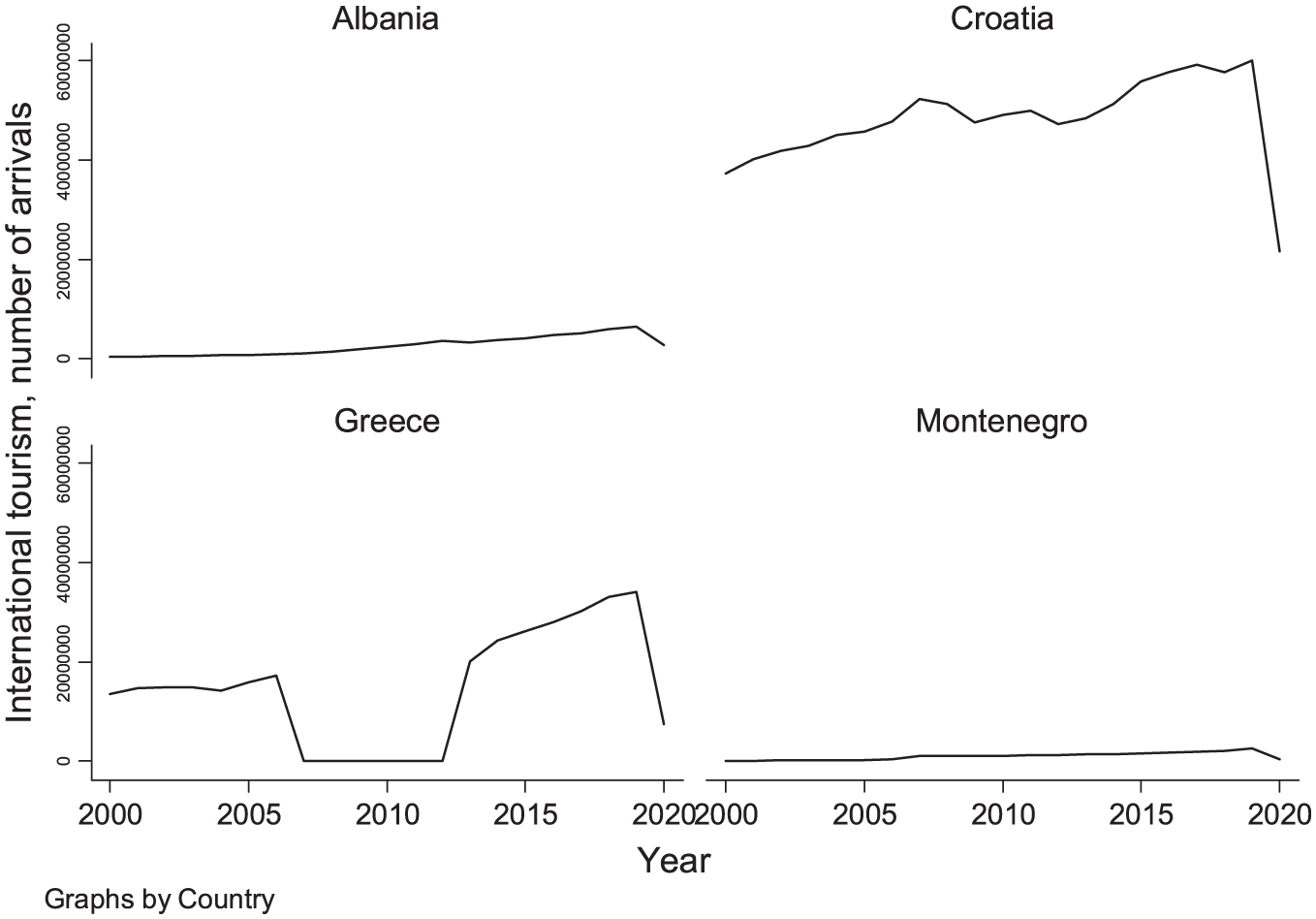
International tourism, number of arrivals.
Empirical Results
Before proceeding with the model, we check that no perfect linear correlation exists among the variables. The results of the correlation analyses are included in table 4. As expected from the correlation matrix the only coefficient above 0.80 is the one between “Tourist receipts” and “Exchange rates” meaning that we will include only one of them in the model. The other coefficients confirm evidence of no linear correlations.
Matrix of Correlations.

In order to provide answers to our research objectives, we estimate GMM models for both arrival numbers and tourism revenue. Assuming heterogeneous slopes, we start by estimating the Im−Pesaran-Shin (Ipshin) unit root test. Im, Pesaran, and Shin created a t-test for unit roots in heterogeneous panels, which Ipshin estimates (Im et al., 1997). Individual effects, temporal trends, and common time effects are all permitted.
In the group of variables after taking the first difference for the CPI and Transport investments, we obtain stationary regressors as shown in table 5.
Unit Root Tests.

Source. Authors’ calculations.
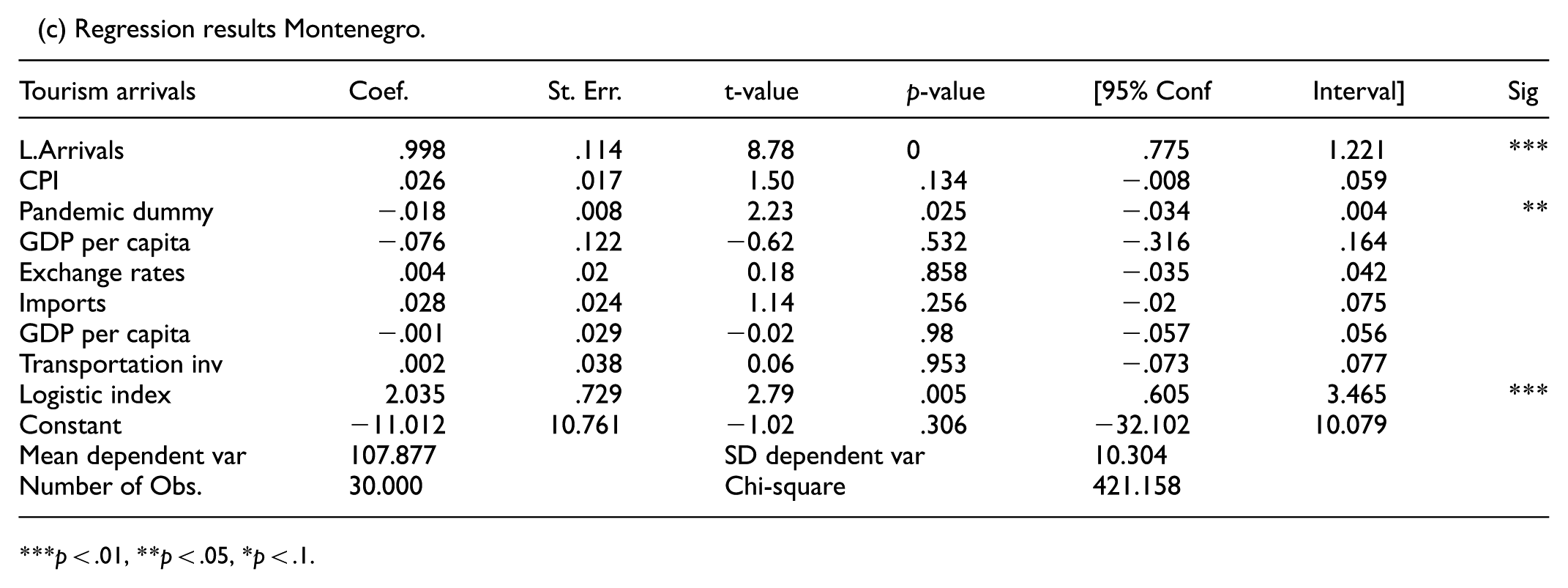
Table 6(a) to Table 6(d) presents the estimations that we obtained after the GMM method for each country.
GMM Regression Estimators by Country.
(a) Regression results for Greece.

p < .01, **p < .05, *p < .1.
(b) Regression results Croatia.

p < .01, **p < .05, *p < .1.
(c) Regression results Montenegro.
p < .01, **p < .05, *p < .1.
(d) Regression results Albania.

p < .01, **p < .05, *p < .1.
Based on the regression results, we can see two noteworthy findings regarding the factors that influence visitor arrivals in the nations under investigation. The logistic index demonstrates statistical significance in the situations of Croatia, Montenegro, and Greece, whereas the consumer price index tends to be significant in the case of Albania.
By using a time period dummy, we can observe different results in terms of the effects of pandemics or exogenous shocks. The coefficients in all situations are negatively oriented and exhibit a low magnitude. We observe statistical significance in the situations of Croatia and Montenegro.
The significance of the logistic index may imply different policy recommendations to the national stakeholders encompass the following: development of high-quality infrastructure, fostering synergies with other industries, enhancing competitiveness, and implementing promotional activities.
Conclusions and Discussions
Demand for international tourism is an inverse function of relative prices, i.e., the lower the cost of living in the destination country relative to the origin country, the greater the tourism demand, and vice versa. Empirical results show that this is statistically true only in the case of Albania.
Exchange rate could be an important factor in the competitiveness, and it is expected that a decline in a destination’s exchange rate would lead to an increase in the demand for international tourism, however we did not find statistical evidence using GMM approach. Tourist arrivals are a positive function of income, and this is statistically significant in the case of Greece and Croatia.
The lag of the dependent variable as expected is significant in all the cases. Including a lagged dependent variable among the list of independent variables is equivalent to assuming a geometric-distributed lag model. Moreover, the measurement of dynamic impacts allows us to derive the long-run demand elasticities.
The wide range of tourism products offered by each country and the common objectives they have are the most important elements for policies related to the tourism sector. The diversity of tourism goods emphasizes the essential focus on enhancing the value of each country’s distinctive assets. The shared aims highlight that all the countries in the research have equal starting points and potential. Sharing shared objectives and being cognizant of their geographical character enhances the efficiency of the sector, enables the resolution of national-level inequalities, and facilitates cross-country cooperation.
Upon examining the effects of exogenous shocks, like as the Covid-19 pandemic, on tourism arrivals, we observe a negative coefficient for the pandemic dummy, with the exception of Albania. Nonetheless, the extent of this effect is quite minimal.
The findings imply that the logistic performance has a favorable impact in every country case, except for Albania. The result might have an impact on policy considering the crucial function of logistics and infrastructure in tourism development. Finally, future research could focus on including various macroeconomic parameters in the model to capture the potential effects of omitted variables.
Footnotes

Funding
The authors received no financial support for the research, authorship, and/or publication of this article.
Declaration of Conflicting Interests
The authors declared no potential conflicts of interest with respect to the research, authorship, and/or publication of this article.
Data Availability Statement
Data sharing not applicable to this article as no datasets were generated or analyzed during the current study.