



Abstract
Quantitative analysis of the impact of housing prices on fertility levels in Chinese cities is an important step for promoting high-quality economic development. Achieving balanced urban population growth in China will also contribute to sustained and healthy social and economic development. This paper presents empirical research based on panel data from 284 prefecture-level and higher cities in China, covering the period from 2010 to 2022. The research examines both incentive effect and Crowding-out effect. It uses regression models, mediating effect models, and threshold effect models. The study reaches the following conclusions: First, the increase in housing prices initially leads to a decline in fertility rates, followed by an increase. This suggests a positive “U”-shaped relationship. The declining part of the curve is significantly larger than the increasing part, and the results have passed rigorous robustness and endogeneity tests. Second, from the income perspective, in cities where housing prices have risen, labor, capital, and technology have grown significantly, helping to mitigate the decline in fertility. The contribution of the mediating effect of technology expenditure is 9.45%, making it an effective variable. Third, from the consumption perspective, in cities with high housing prices, as per capita GDP rises, the negative impact of housing prices on fertility strengthens. Therefore, this paper also provides four key recommendations for urban development to reduce the negative effect of housing prices on fertility levels.
Introduction
In modern society, urban housing prices are closely related to fertility issues. They directly affect families’ economic decisions and the changes in the social population structure. High housing prices not only influence families’ housing choices, but also impact their willingness to have children. This, in turn, affects the country’s population development and social stability. In recent years, China has faced a serious aging problem and a continuous decline in the birth rate. This poses a significant challenge to the country’s economic growth, labor supply, and innovation capacity. To tackle this challenge, the Chinese government has implemented a series of reforms in fertility policy. These range from the “one couple, two children” policy in 2013, to the “universal two-child” policy in 2016, and the relaxation of the “three-child” policy in 2021. The gradual easing of fertility policies was initially intended to encourage families to have more children (Yin et al., 2023; Zhu et al., 2023). In addition, local governments have introduced various supporting measures. These include increased fertility subsidies, extended maternity leave, and direct cash rewards. The aim is to stimulate a recovery in the fertility rate through policy means (X. Y. Li & Peng, 2012). However, despite continuous policy support, China’s birth rate has continued to decline. It dropped from 11.9 per thousand in 2010 to 6.77 per thousand in 2022. In 2022, China’s death rate exceeded the birth rate (Zheng & Han, 2022). This trend shows that even with relaxed policies, the fertility issue has not been effectively addressed. In sharp contrast, housing prices in China have continued to rise, especially in major cities. These prices have shown strong growth, even after being impacted by the global financial crisis and the COVID-19 pandemic.
High housing prices have had a significant impact on fertility, especially in large cities. These high prices have become a major constraint on families’ decisions to have children. Data shows that, despite challenges such as the financial crisis and the pandemic, housing prices in China generally increased from 2011 to 2022. The rise ranged from 50% to 100%. Among these, the increase in major cities like Shenzhen was particularly notable (Zhou et al., 2023). The continuous rise in housing prices has caused urban residents to face higher living costs. Housing expenses have become one of the largest financial burdens for families. This increase in housing prices not only puts more pressure on homebuyers through higher loans, but also directs most of the funds meant for living expenses into the real estate and financial sectors. As a result, families have less money available for children’s education, healthcare, and other needs. Faced with high housing prices and living costs, many young couples are now more cautious about having children. Some even choose to postpone having children or reduce the number of children they plan to have. This further contributes to the decline in the birth rate (Shen & Chen, 2023).
Furthermore, high housing prices have worsened social inequality. They have had a particularly strong impact on the fertility intentions of low-income families and young people. Excessively high housing prices make it difficult for these groups to afford down payments or long-term mortgage loans. This significantly increases the difficulty of purchasing a home and, in turn, affects their family planning and fertility choices. Housing has become one of the primary ways to accumulate wealth. As a result, high housing prices have, to some extent, altered the wealth structure of families. This forces young people to focus more on real estate investment than on building families, which in turn affects their fertility decisions.
From a macro perspective, high housing prices are not just an economic issue. They also impact social structure, intergenerational relations, and national development strategies. Behind the excessively high housing prices are deep-rooted problems in the urbanization process and the land finance system. These issues directly affect the effectiveness of the country’s fertility policy. Therefore, under the policy framework of “stabilizing housing prices and promoting fertility,” ensuring the stability of housing prices while providing adequate fertility support has become an urgent social issue in China.
The existing literature has offered explanations for this issue. First, the negative impact of rising urban housing prices in China on fertility is a complex economic phenomenon. He and Yu (2025) pointed out that because of China’s diverse geography, housing prices differ greatly across cities. This variation directly affects living costs and family fertility decisions (He & Yu, 2025). In cities with high housing prices, a large share of family income is spent on rent or loan repayments to deal with higher living expenses. This greatly reduces the funds available for other household needs. G. W. Liu et al. (2022) found that rising housing prices have created more psychological pressure on young families regarding the costs of raising children, which lowers their willingness to have children. This phenomenon can be explained by the incentive effect: higher housing prices reduce disposable household income, weaken the economic motivation for childbirth, and thus lead to a decline in fertility rates (G. W. Liu et al., 2022). On the other hand, Han and Lu (2018) argued that in a few developed cities such as Beijing, Shanghai, Guangzhou, and Shenzhen, housing prices remain high but per capita income levels are also high. Therefore, the share of income spent on housing is relatively small (Han & Lu, 2018). Yu and Gong (2021) further noted that families in these cities can handle housing expenses with their relatively strong financial resources, leaving more funds available for childbearing and child-rearing (Yu & Gong, 2021). As a result, in these specific cities, rising housing prices may indirectly promote fertility by improving families’ economic security. This can be understood as the positive side of the incentive effect.
Secondly, the increase in housing prices can influence fertility decisions through several factors, including labor, capital, and technology. This effect is especially noticeable in cities with high housing prices. The inflow of resources and competition for them have led to a significant crowding-out effect. Huang and Wang (2021) pointed out that cities with high housing prices, due to their relatively high living costs, attract a large concentration of labor, capital, and technological resources. However, this also increases the economic pressure on young families (Huang & Wang, 2021). On the one hand, Y. Li et al. (2022) emphasized the labor pressure young families face. These families need to devote more time and energy to their work in order to pay off their mortgages and high rents, which are necessary to maintain a basic standard of living (Y. Li et al., 2022). This leaves them with less time and energy to invest in having and raising children, which ultimately reduces their willingness to have children. On the other hand, Sven and Stef (2022) discussed the capital pressure caused by high housing prices. These prices have led to an increase in the costs of essential goods, such as consumer goods and educational expenditures. If a family’s capital accumulation is insufficient or they cannot access loans, they are likely to postpone or give up their fertility plans. Instead, they prioritize solving the housing problem (Sven & Stef, 2022). At the same time, technical factors should not be overlooked. Zhang et al. (2022) pointed out that cities with high housing prices often provide more job opportunities, higher-paying positions, and better career development prospects (Zhang et al., 2022). In addition, C. A. Li et al. (2023) also noted that the higher cost of living makes young people more inclined to focus on their education or career development, postponing or even giving up on having children (C. A. Li et al., 2023). These factors work together, making the increase in housing prices not only a direct economic pressure but also a significant crowding-out effect that suppresses young people’s willingness to have children.
Finally, the relationship between housing prices and fertility is influenced by differences in per capita GDP. B. Li and Luo (2024) pointed out that within a certain range of per capita GDP, the economic development of cities and rising housing prices usually lead families to invest more in industries such as real estate and finance. This reduces their investment in childbearing and raising children, which negatively affects fertility (B. Li & Luo, 2024). Meanwhile, Catherine et al. (2023) noted that as per capita GDP increases, housing prices continue to rise, but the proportion of income spent on real estate has started to increase. This leads to a further reduction in families’ investment in childbirth (Catherine et al., 2023). This phenomenon shows a threshold effect: when per capita GDP reaches a certain level, the negative relationship between rising housing prices and fertility becomes stronger. The crowding-out effect is particularly significant at this stage. In economically developed cities, the imbalance between high housing prices and high incomes has worsened the economic burden on families. As a result, many families choose to delay or forgo having children in consideration of their quality of life and future investments.
To sum up, the impact of housing prices on fertility is multi-dimensional. It not only includes the inhibitory effect on fertility caused by the incentive effect, but also manifests as an indirect influence on family decisions through the crowding-out effect. Future policy-making should consider the economic development levels and housing price differences across cities. Flexible measures should be adopted to alleviate the negative impact of high housing prices on fertility. At the same time, more adequate support should be provided for young families.
The existing research on the relationship between housing prices and fertility levels in China has laid the foundation for this paper. However, there are still several deficiencies. First, whether based on provincial, urban, or household data, most studies only consider the linear relationship between housing prices and fertility. It is generally believed that housing prices significantly inhibit fertility. However, this linear assumption ignores the potential nonlinear dynamics between housing prices and fertility, such as a parabolic relationship. In fact, the impact of housing prices may vary at different levels. Therefore, more complex model designs are crucial to revealing this relationship. Secondly, sample selection bias is widespread in existing studies. The use of provincial data often overlooks economic differences between regions. Household data, due to large sample heterogeneity, is prone to inconsistent conclusions. Urban data can effectively avoid these issues. In particular, when analyzing the impact of housing prices on fertility, urban data can better reveal the mediating effects of labor, capital, and technology. Third, although existing studies have explored the relationships between housing prices and per capita GDP, as well as between per capita GDP and fertility, few have considered that per capita GDP, as a moderating variable, may have a threshold effect between housing prices and fertility. Changes in per capita GDP may affect the price mechanism of housing and, to some extent, influence reproductive behavior. This perspective remains to be further explored.
Based on the above deficiencies, this paper makes a marginal contribution in three areas. First, in terms of research methods, this paper does not assume a simple univariate linear relationship. Instead, it uses a binary linear equation for fitting. It combines the theoretical frameworks of the excitation effect and extrusion effect. It also fully considers the nonlinear relationship and conducts multiple tests for robustness, heterogeneity, and endogeneity to ensure the reliability of the results. Second, in terms of research content, this paper uses urban data for analysis. This approach avoids the problems caused by regional differences and inconsistent conclusions. Furthermore, the paper comprehensively analyzes the impact of housing prices on fertility from both the income and consumption perspectives. It also considers the mediating effects of labor, capital, and technology, as well as the threshold effect of per capita GDP. Specifically, the incentive effect refers to how high housing prices may indirectly encourage childbearing by improving family economic conditions. The crowding-out effect, on the other hand, refers to how rising housing prices increase family housing expenditures, which suppresses fertility. The interaction between these two effects provides a multidimensional perspective for this analysis. Finally, the research findings suggest a positive “U”-shaped relationship between housing prices and fertility in Chinese cities. In most cities, rising housing prices suppress fertility. However, in a few cities, due to policies or other economic factors, rising housing prices may actually promote fertility. This finding not only expands the existing literature but also offers more specific and targeted recommendations for policy-making.
The subsequent chapters of this paper are arranged as follows: Part 2 focuses on mathematical analysis and research hypotheses; Part 3 is model construction and data sources; Part 4 is empirical results analysis; Part 5 is discussion, conclusions and policy recommendations; Part 6 is research deficiencies.
Mathematical Analysis and Research Hypothesis
This chapter analyzes how housing prices affect the mathematical relationship between fertility from the income side and the consumption side. First, from the income side, based on the endogenous growth model (Deng et al., 2020), suppose there are two cities u (city with higher housing prices) and v (city with lower housing prices) in an economy, and use i to represent the i city (i = u, v). There are K units of capital and L units of labor in the economy, so ki and li represent the amount of capital input and labor in city i; Ai represents the production efficiency (technical level) of city i, Therefore, referring to the approach of Cong et al. (2021), the output function of cities u and v can be expressed as.


Where yu and yv represent the output of city u and v, assuming α, β, θ > 0, and α + β + θ < 1, which indicates that there may be other production factors in the economy, such as geographical location, housing price policy, etc. In addition, Au > Av, the difference between the two represents the efficiency gap between city u and v. The overall output of the economy is further obtained:

Since we focus on factors competing among cities, we can further transform the production function of the economy into a more concise form:

Considering that the output of all cities is positive at this stage (Wu et al., 2021), it can be further obtained that:

Formula 5 explains why labor, capital, and technology move from cities with lower housing prices (v) to cities with higher housing prices (u). This illustrates the crowding-out effect of housing prices between cities. From a consumption perspective, housing prices create several challenges for fertility. First, urban economic pressure: High housing prices typically lead to higher housing costs, increasing economic pressure on families. This affects their financial status (Gabriela et al., 2023). For young people looking to start a family, high housing prices may increase the pressure to purchase property and take on debt. As a result, they may delay marriage and childbearing decisions. Second, urban housing conditions: Rising housing prices can lead to worse living conditions, particularly for low- and middle-income urban families. Without suitable living conditions and adequate space, families may delay childbearing or decide against having more children to avoid financial and housing pressures (Wang et al., 2023). Third, urban migration: Some families may move to more affordable areas due to the high cost of housing. This migration can cause an exodus from high-cost areas, impacting fertility rates in those regions. Families that move may delay or skip having children altogether (Margaret 2016). Fourth, education and career development: Cities with high housing prices often offer better educational resources and career opportunities. Couples may prioritize education and career advancement over having children. They may focus on personal development and financial stability, delaying childbearing until they feel financially secure and prepared to raise children (Xu et al., 2023)
Therefore, in a city with low per capita GDP and limited total income Yi, the cost allocated to housing price mainly comes from two parts, according to Fang et al. (2021): The space a required by parents themselves and the space b required by a child, the unit price of the house is P1, the cost allocated to reproduction is P2 (including education, food, clothing, housing and transportation, etc.), the number of children born is n, and the cost allocated to other costs is P3. Thus, the total utility of a city is constructed: U = U (n, P1), that is, the total effect of a city is determined by the number of births and housing prices, and Equation 6 can be obtained according to the constraints of income and expenditure:

λ and η represent the residence scale effect and birth scale effect of multiple children respectively, when the optimal effect needs to meet the following conditions:


It is clear that the fertility rate of a city is influenced by housing prices P1. The specific mechanism is shown in Figure 1. When housing prices rise, several problems arise. These include higher housing costs, worsening housing conditions, and population outflow. Additionally, when per capita GDP is low, people tend to prioritize education and career development over having children, which results in a decline in birth rates. However, when per capita GDP is high, the appeal problem worsens, and rising housing prices further exacerbate the decline in births. Only when per capita GDP is very high does the negative impact of the appeal problem lessen. In this case, rising housing prices can actually lead to an increase in births. In conclusion, housing prices have a crowding-out effect between different cities.

The function mechanism of urban housing price on fertility in China.
The impact of rising housing prices varies significantly across different cities and economic levels. In most cities, an increase in housing prices restrains families’ willingness to have children. This occurs primarily through higher housing and living costs, which raise economic pressure and reduce disposable income, making families less likely to have children. However, in high-income and developed regions like Beijing, Shanghai, Guangzhou, and Shenzhen, the impact is different. Although housing prices are high, the higher income levels, abundant resources, and capital accumulation allow families to offset some of the costs of having children. This creates different fertility patterns. Within a certain range of housing prices, an increase in housing prices will lead to a decline in the willingness to have children. However, beyond this range, the willingness to have children may reverse due to the effects of capital accumulation and incentives. Although the number of births remains relatively low, some families may still choose to have a second child. This phenomenon reflects the interaction between incentive effects and crowding-out effects. The incentive effect is mainly seen in high-income families, who can handle the pressure of high housing prices through resource accumulation. While housing prices have an inhibitory effect on fertility, the capital accumulation of high-income families can create incentives for having children. Therefore, this paper proposes the following hypotheses:
From an income perspective, the increase in housing prices directly affects family fertility decisions. It also indirectly influences fertility levels by changing the flow of labor, capital, and technology between cities. In cities with lower housing prices, labor, capital, and technology move more freely. Many labor-intensive industries and tech innovation companies tend to cluster in cities with high housing prices. This flow of resources increases fertility pressure in high-price areas. It not only raises the cost of living, affecting the willingness to have children, but also creates a “crowding-out effect” on housing prices through the concentration of talent and capital. Moreover, fertility pressure is higher in areas with high housing prices. As a result, families facing higher living costs may decide to have fewer children. However, the inflow of labor, capital, and technology may mitigate the decline in fertility. In these regions, abundant economic resources and supportive policies could offer more fertility support for families. Therefore, this paper proposes the following hypotheses:
From the consumption perspective, the level of per capita GDP directly affects family income and living costs. In cities with lower per capita GDP, rising housing prices directly reduce families’ disposable income. This, in turn, significantly lowers their willingness to have children. In these cities, the relatively low income and the high proportion of fertility costs make most families unwilling to bear the fertility pressure caused by high housing prices. In contrast, in regions with higher per capita GDP, household income is relatively high. Despite high housing prices, the increase in per capita GDP allows families to ease the cost of having children through capital accumulation and resource allocation. In some cases, this may even increase their willingness to have children. However, as per capita GDP continues to rise, the impact of rising housing prices on fertility becomes more restrictive. This is because the quality of life expectations of high-income families improve, and the increase in fertility costs leads to a significant decline in their willingness to have children. Therefore, this paper proposes the following hypotheses:
Model and Data
Model Setting
Firstly, in order to verify Hypothesis 1, in the study of this paper, referring to the practices of Liu and Tan (2012) and Zhang (2023), the different geographical locations of different cities will interfere with the impact of housing prices on the number of births and need to be excluded, while the geographical locations of each city do not change over time. Therefore, a dual fixed effect model of time and province as shown in Equation 9 can be adopted, thereby absorbing the influence of geographical location on housing prices and fertility and reducing the influence of endogeneity on the model.

Where Npit represents the number of births in year t of province i, Hpit represents the house price in year t of province i, and Xit represents the control variable. αi represents the province fixed effect, βt represents the year fixed effect, and εit represents the random disturbance term.
Secondly, in order to verify Hypothesis 2, mathematical analysis argues that rising housing prices lead to an increase in births is very few, so the part that rising housing prices lead to a decline in births is used for analysis. Housing prices will affect labor, capital and technology, and then affect the number of births, that is, there is an intermediary effect between the two. Therefore, referring to Qian et al. (2022), the mediation effect model shown in the following formula is constructed:



In the above formula, Nit represents the intermediary variable, which is mainly composed of labor (average wage Aw and unemployment registrant Ur), capital (retail sales of consumer goods Rscg and education expenditure Ee) and technology (science and technology expenditure Est and the number of scientific research employees Nsr). c1 represents the effect of housing price on the intermediary variable. d1 represents the effect of housing price on the number of births after controlling the intermediary variables, and d2 represents the effect of the intermediary variables on the number of births.
Finally, in order to verify Hypothesis 3 and further explore whether there is a threshold effect of housing prices on birth rates at different economic levels, this paper constructs the panel threshold model shown in Equation 13 by referring to the existing literature of C. F. Li et al. (2020) and S. W. Yu et al. (2021).

The value of this function is 1 when the conditions in parentheses are met, and 0 otherwise. e3 and e4 respectively represent the coefficient of threshold variable M when M is less than or equal to η and greater than η. The other variables have the same meaning as Equation 9.
Data Specification
Data Sources
The data in this paper mainly comes from two aspects: First, the China Urban Statistical Yearbook (2009–2021), including the number of births, per capita disposable income, per capita GDP, average wages, unemployed registrants, retail sales of consumer goods, expenditure on education, number of employees in scientific research, population density, total passenger transport, number of employees in the tertiary industry, per capita green space, etc. The crude birth rate is derived from the number of urban births/total urban population in the current period by referring to the practice of Fang et al. (2021). The second is from the real estate agent database such as Anjuke, which contains the real estate price of each city in each year (unit price yuan per square meter), and the rise rate of the house price is obtained by (current house price−last house price)/last house price (Shen & Chen, 2023).
Descriptive Statistics
Considering the availability of the two databases, this paper selects panel data of 284 cities from 2010 to 2022 as the research object. Table 1 provides specific descriptive statistics for each variable.
Descriptive Statistics.
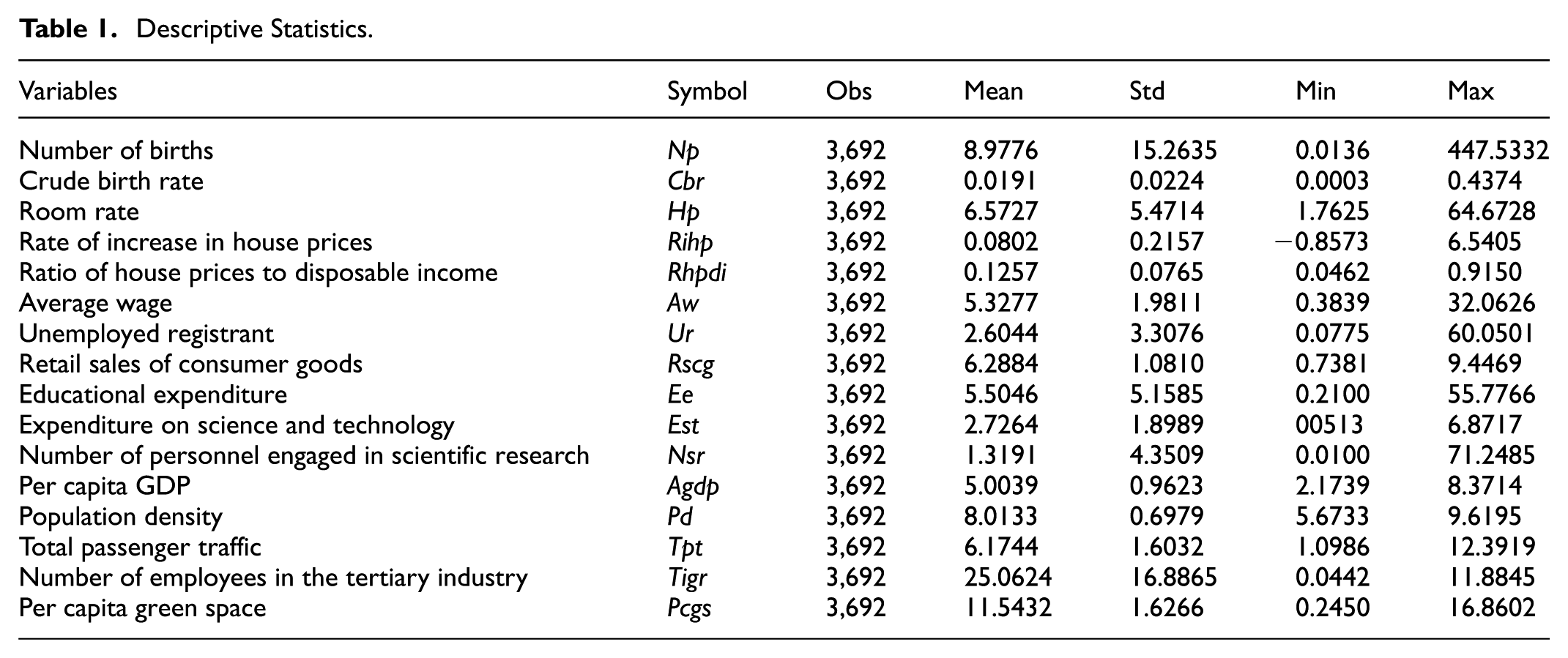
In Table 1, the gap between the minimum and maximum values for each data set is too large. This indicates that the development of Chinese cities is unbalanced. At the same time, it can be seen that the average number of births is 89,776, and the average house price is 65,727 yuan. These values appear to be close. However, by further plotting the trend chart of the average number of births and the average house price across 284 cities from 2010 to 2022, as shown in Figure 2, it becomes clear that the number of births has been falling linearly over time, while housing prices have been rising linearly. There is a negative relationship between the two. To analyze the underlying logic, it is necessary to incorporate control variables, intermediary variables, and threshold variables for further study.

Average number of births and average house prices in 284 cities from 2010 to 2022.
Empirical Analysis
The Effect of Housing Prices on the Number of Births
Baseline Regression Result
In the above analysis, it is suggested that housing prices affect the number of births. To test this, the benchmark regression model with double fixed effects for time and space is used. This paper then analyzes the results in detail by applying Formula 9. The specific results are shown in Table 2.
Baseline Regression Result.

Note. *, **, and *** indicate significance at the 10%, 5%, and 1% levels, respectively. The values in parentheses are t-statistics.
In columns (1) to (6) of Table 2 above, Hp2 is greater than 0, and Hp is less than 0. This indicates a positive “U”-shaped relationship between housing prices and the number of births. As housing prices rise, the number of births first decreases and then increases. The symmetry axis is located at relatively low housing prices, except in column (4). In most cities in China, rising housing prices suppress the number of births. However, in a few cities, rising housing prices encourage an increase in the number of births. This confirms that Hypothesis 1 is valid. The symmetry axis value in column (4) exceeds the maximum housing price of 64.6728 in Table 1. This suggests that, when city differences are fixed in the existing data, rising housing prices inhibit the number of births. Additionally, considering that the R2 value of the fixed effect for the control variable, city, and year reaches a maximum of .1385, the goodness of fit is the highest. This indirectly confirms that the double fixed effect regression model is effective.
Regarding the control variables, population density (−0.1847), total passenger transport (−0.8248***), and the number of people in the tertiary industry (−0.1359***) are significant inhibitors of the number of births. A crowded and busy lifestyle does not foster the growth of the next generation. On the other hand, the per capita green area (0.0540*) significantly promotes the number of births. This means that an improved living environment quality supports the nurturing of the next generation.
Robustness Test
Substitution Variable
To avoid the possibility of biased results, this paper uses the crude birth rate to replace the number of births. It also replaces housing price with the rising rate of housing price, housing price itself, and per capita disposable income. The specific results are shown in Table 3. It can be observed that the rising rate of housing price, housing price, and per capita disposable income exhibit a positive “U” curve when plotted against the number of births and crude birth rate as replacements for housing price. The symmetry axes fall within the range of the minimum and maximum values in Table 1, with the data to the right of the symmetry axis accounting for a small proportion. This confirms that Hypothesis 1 is valid.
Robustness Test (Replacement Variable).

Note. *, **, and *** indicate significance at the 10%, 5%, and 1% levels, respectively. The values in parentheses are t-statistics.
Robustness of Time
Considering that the 2008 financial crisis caused instability in global economic development, housing prices were significantly affected. At the same time, the global COVID-19 pandemic at the end of 2019 had a substantial impact on both housing prices and the number of births. Therefore, data from 2012 to 2019 were selected for the regression analysis above. The results, shown in the first three columns of Table 4, still display a positive “U”-shape. The symmetry axis for the housing price growth rate (3.295) and the ratio of housing price to per capita disposable income (0.4089) are very similar to the results in Table 3 (3.1138 and 0.4055). This confirms that Hypothesis 1 is valid. However, the symmetry axis for housing price (8.3333) is much smaller than the result in Table 1 (33.1410). This suggests that, between 2012 and 2019, a large number of cities experienced a significant increase in the number of births after housing prices rose. This was mainly due to the dual stimulus of the purchase restriction policy implemented in some cities in 2010 and 2011 and the decision to fully implement the two-child policy in October 2015 (Ge & Shi, 2023; Hong & Gong, 2021).
Robustness Test (Remove Extreme Data).

Note. *, **, and *** indicate significance at the 10%, 5%, and 1% levels, respectively. The values in parentheses are t-statistics.
The Robustness of the City
In addition, we deleted the areas with high housing prices such as Beijing, Shanghai, Guangzhou, Shenzhen, Hangzhou, Nanjing, Suzhou, Ningbo and Tianjin, and the regression results are shown in column (4) to (6) of Table 4. Housing prices still significantly inhibited the number of births and then promoted the number of births, and the promotion part was far less than the inhibition part. This means that the positive “U”-shape between housing prices and the number of births is not only in cities with high housing prices, but also in other cities, that is, Hypothesis 1 is true.
Heterogeneity Test
Heterogeneity Test of Different Housing Prices
This paper divides the studied housing prices from 1,763 yuan per square meter to 64,673 yuan per square meter according to the number of cities into four equal parts and then conducts a regression analysis. The specific results are shown in Table 5. It can be seen that in Table 5, the housing prices in the first and fourth tiers first significantly suppress the number of births and then significantly promote the increase in the number of births, which is consistent with the positive “U”-shaped results in Table 2. The housing prices in the second tier (3,991–5,100 yuan per square meter) have a lower value of the symmetry axis of 1,240.3 yuan than 3,991 yuan, which means that the increase in housing prices significantly promotes the increase in the number of births. However, the housing prices in the third tier (2,101–7,114 yuan per square meter) have the opposite result to those in the second tier. The increase in housing prices significantly inhibits the increase in the number of births. Perhaps due to the lower living costs in cities with the second-tier housing prices (such as Weihai City, Rizhao City, Chongqing City, etc. in 2011), it is more conducive to having the next generation. In contrast, cities with the third-tier housing prices (such as Yangzhou City, Yantai City, etc. in 2015) have greater living pressure, and the cost of raising the next generation is higher, which is not conducive to having the next generation. Meanwhile, the current housing prices in society are almost all within the fourth tier (X. B. Liu et al., 2022). The increase in housing prices is in a state of first decreasing and then increasing for the reproduction of the next generation, and the proportion of the first decrease is relatively large, that is, Hypothesis 1 still holds.
Heterogeneity Test of Different Housing Prices.

Note. *, **, and *** indicate significance at the 10%, 5%, and 1% levels, respectively. The values in parentheses are t-statistics.
Heterogeneity Test of Different Strategic Regions
According to the national development plan, this paper selects six national major strategic regions: Beijing-Tianjin-Hebei(BTH), Chengdu-Chongqing(CC), the Middle reaches of the Yangtze River(MYR), the Yangtze River Delta(YRD), Guangdong-Hong Kong-Macao(GK), and the Yellow River Basin for research(YRB) (Zhang et al., 2022). The specific regression results are shown in Table 6.
Heterogeneity Test of Different Strategic Regions.

Note. *, **, and *** indicate significance at the 10%, 5%, and 1% levels, respectively. The values in parentheses are t-statistics.
As shown in Table 6 above, the Beijing-Tianjin-Hebei region has a relatively developed economy. In this region, the effects of rising housing prices on the number of births are roughly balanced between inhibiting and promoting factors. This can be attributed to the widespread implementation of the purchase restriction policy and the comprehensive two-child policy in this region. On the other hand, in the Chengdu-Chongqing region and the Guangdong-Hong Kong-Macao region, housing prices fall to the left of the symmetry axis. In these areas, rising housing prices significantly inhibit the number of births. Higher housing prices increase the burden of living costs and the expense of raising the next generation, which is not conducive to fertility. Although the symmetry axis value for regions such as the middle reaches of the Yangtze River, the Yangtze River Delta, and the Yellow River basin falls within the local housing prices, the proportion of data on the right side of the symmetry axis is much smaller than that on the left. This means that in these regions, the rise in housing prices has a stronger inhibiting effect on the number of births than a promoting effect. Therefore, Hypothesis 1 is correct.
Endogeneity Test
In this paper, multiple variables that have a significant impact on the number of births are added to avoid the endogeneity of the model caused by missing important variables. The following two aspects are mainly taken into account: First, the higher consumption in areas with a large number of births (such as Beijing, Shanghai, Zhejiang, Guangdong, etc.) leads to a higher housing price in these areas, that is, there is a reverse causality between the number of births and housing prices; Second, higher house prices in the previous period will maintain higher house prices in the current period, that is, current house prices will be subtly affected by the previous period.
To this end, we use the method of instrumental variables to solve the first endogeneity problem caused by reverse causality. 2SLS regression is carried out by taking the one stage lag of house price, one stage lag of house price rise rate and one stage lag of house price and disposable income as instrumental variables. The specific results are shown in columns (1), (2), and (3) of Table 7. At the same time, we took the one-stage lag of the number of births as an instrumental variable and used the system GMM model combined with Formula 1 to perform regression to solve the second endogeneity problem, and the results were shown in column (4) of Table 7. It can be seen that the p values of the Sargan test in these four columns are all greater than .1, that is, all the instrumental variables are valid, and the regression results all show that with the rise of housing prices, the number of births is first significantly inhibited, and then significantly promoted, and the inhibitory part is greater than the promotion part, that is, Hypothesis 1 is valid.
Endogeneity Test.

Note. *, **, and *** indicate significance at the 10%, 5%, and 1% levels, respectively. The values in parentheses are t-statistics.
Testing of Mediating Effects
Labor-Based Mediation Effect Test
In the above research, there is a positive “U”-shaped relationship between housing price and fertility, and the data on the right side of the symmetry axis is small, which easily makes the experimental results uncertain. Therefore, we separately study the part of decreasing fertility caused by rising housing price. In this part, when the housing price is high, more workers will choose to engage in the real estate industry. More time is spent on work in order to get higher pay, while less time is spent on nurturing the next generation, which reduces the number of births, that is, labor has a crowding out effect on the number of births. In summary, this paper selects average wage (Aw) and unemployment registration (Ur) to describe the labor index and analyzes the intermediary effect, and the specific results are shown in Table 8.
Regression Results of Labor-Based Mediation Effect Model.

Note. *, **, and *** indicate significance at the 10%, 5%, and 1% levels, respectively. The values in parentheses are t-statistics.
In Table 8, the p values of Sobel test are all less than .05, so the null Hypothesis is rejected. The intermediary effect exists, in which the rise of housing price significantly promotes the rise of average wages (0.0642***), while the rise of housing price significantly reduces the number of unemployed (−0.0180*). The inhibitory effect of housing price on the number of births decreased when the average wage or the number of unemployed people were added, indicating that part of the inhibitory effect was replaced by the average wage or the number of unemployed people.
Capital Based Intermediation Effect Test
As can be seen from the above analysis, housing prices in cities with better social and economic development promote the number of births, rather than inhibit them completely. Perhaps due to the better quality of life and standard of living in cities with better economic development, they will not worry about the cost of cultivating the next generation, but will increase the cultivation of the next generation. To sum up, this paper adopts Retail price of consumer goods (Rscg) and educational expenditure (Ee) to characterize the index of capital and analyze the intermediary effect. The specific results are shown in Table 9. Housing price significantly promoted the retail price of consumer goods (0.0053***) or the expenditure of educational institutions (0.1225***), and the inhibitory effect of housing price on the number of births decreased after the addition of retail price of consumer goods or educational institutions, indicating that part of the inhibitory effect was replaced by retail price of consumer goods or educational institutions.
Regression Results of the Intermediation Effect Model Based on Capital.

Note. *, **, and *** indicate significance at the 10%, 5%, and 1% levels, respectively. The values in parentheses are t-statistics.
Test of Mediating Effects Based on Technology
Some scholars believe that housing price will promote green technology innovation to reduce industrial pollution, while others believe that industrial pollution will inhibit the number of births, but there is no connection. Considering the mediating effect between technological innovation and housing price and the number of births, this paper uses science and technology expenditure (Est) and the number of scientific research employees (Nsr) to characterize the index of technology and test the mediating effect. The details are shown in Table 10. The housing price is to promote the science and technology expenditure (0.0865***) and the number of scientific research employees (0.1732***), and after adding these two, the housing price inhibition effect on the number of births is reduced. So Hypothesis 2 is true.
Regression Results of Technology-Based Intermediary Effect Model.
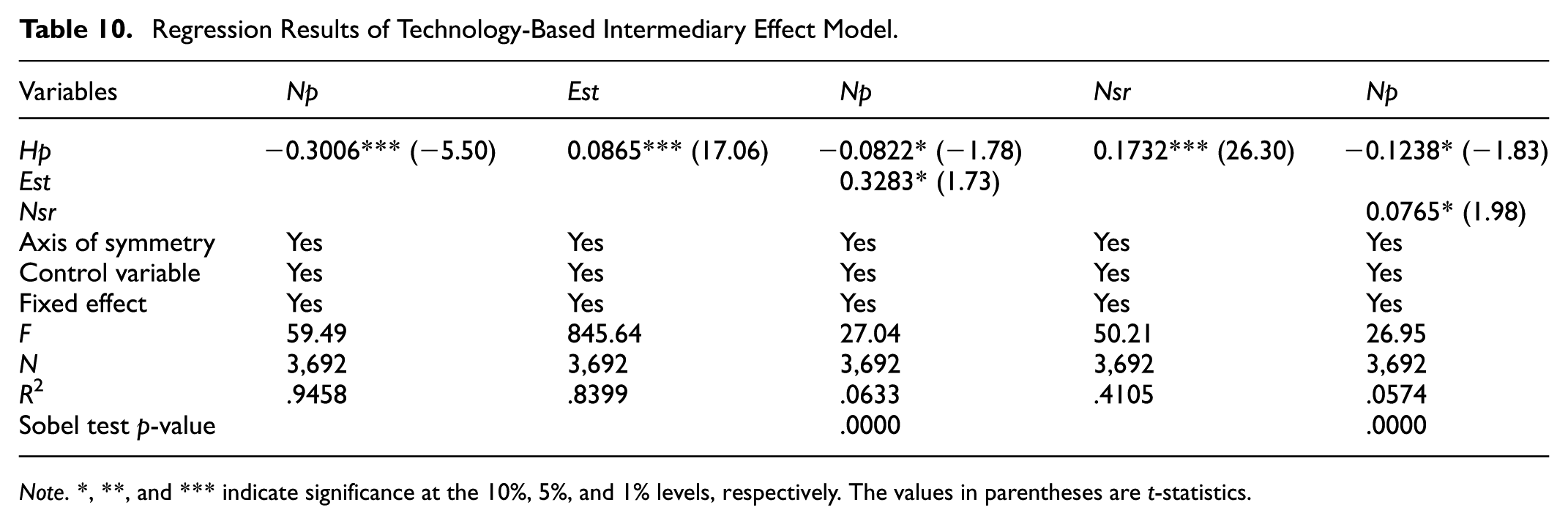
Note. *, **, and *** indicate significance at the 10%, 5%, and 1% levels, respectively. The values in parentheses are t-statistics.
Measurement of Contribution Rate of Intermediary Effect
In addition, in order to further understand the contribution rate of each intermediary effect, this paper calculates it by the method of “c1 × d2 ÷ b1,” and the specific contribution rate is shown in Table 11. It can be seen that the path of housing price → expenditure on science and technology → number of births has the largest contribution rate, reaching 9.45%. Indirectly explain the importance of technological development in today’s social and economic development (Mei & Wang, 2023).
Measurement Results of Contribution Rate of Each Intermediary Effect.

Note. *, **, and *** indicate significance at the 10%, 5%, and 1% levels, respectively. The values in parentheses are t-statistics.
Test of Threshold Effect
In order to test Hypothesis 3, considering that there are few data on birth increase caused by housing price rise, this paper still takes birth decrease caused by housing price rise as the research scope, takes per capita GDP as the threshold variable, repeated sampling method to test its threshold characteristics, repeated sampling 500 times, and the results are shown in Table 12.
Threshold Feature Estimation Results.

Note. *, **, and *** indicate significance at the 10%, 5%, and 1% levels, respectively. The values in parentheses are t-statistics.
In Table 12 above, housing price, rising rate of housing price and per capita disposable income have double thresholds for the number of births at different levels of per capita GDP; housing price, housing price and per capita disposable income also have double thresholds for the crude birth rate at different levels of per capita GDP; the rising rate of housing price has only a single threshold effect on the crude birth rate at different levels of per capita GDP. The specific regression results are shown in Table 13.
Panel Threshold Model Regression Results.

Note. *, **, and *** indicate significance at the 10%, 5%, and 1% levels, respectively. The values in parentheses are t-statistics.
In Table 13, columns (1), (2) and (3) respectively show the effects of housing price, rising rate of housing price and per capita disposable income on the number of births. With the increase of the threshold range, the inhibiting effect of rising rate of housing price on the number of births is increasing, and the effect of column (2) is more obvious, from the increasing rate of housing price to the increasing number of births, the inhibiting effect is intensified. Columns (4), (5) and (6) represent the effects of house price, rising rate of house price and per capita disposable income on crude birth rate respectively, and their results are the same as those of the first three columns, which proves that Hypothesis 3 is valid.
Discussion, Conclusions, and Recommendations
Discussion
In China, changes in housing prices and the fertility rate are key issues in social and economic development. As urbanization progresses, the impact of housing prices on family fertility decisions has become more prominent. This has become an important topic for both the government and the academic community. Existing studies have mainly explored how rising house prices affect families’ willingness to have children. These studies focus on two main mechanisms: the incentive effect and the crowding-out effect. The incentive effect refers to the wealth effect brought about by high housing prices, which may encourage some families to have more children due to wealth accumulation (Wen & Fang, 2023). The crowding-out effect refers to the rising cost of living caused by high housing prices, which increases the economic burden of families and thus restrains the decision of having children (Huang et al.,2024). This effect is particularly strong in regions with rapid economic development. In these areas, the negative impact is even more pronounced.
However, the analysis in this study shows a positive U-shaped relationship between housing prices and fertility rates. When prices increase to a certain point, fertility rates initially decline. But as prices rise further, the decline becomes more pronounced, while the rebound effect is relatively limited. This asymmetric pattern suggests that early price increases may temporarily boost fertility intentions through wealth effects. The resulting economic pressure ultimately leads to a significant drop in fertility. These findings offer important policy insights. Once housing prices surpass a critical threshold, the decline in fertility becomes more significant. Even modest price corrections are unlikely to reverse this downward trend. Therefore, relying solely on housing price controls may not be enough to effectively reverse fertility decline. More comprehensive policy measures are required.
The rest of this study follows similar approaches to existing literature, focusing on the impact of housing price changes on fertility. However, it introduces significant innovations in 2010 and 2022. It conducted an in-depth analysis of how housing price changes affect fertility levels. To address the endogeneity issue in existing studies, this study ensured the reliability and accuracy of its results. It did so by using the housing price increase rate and the relationship between housing prices and per capita disposable income as instrumental variables. Additionally, the crude birth rate was used as an instrumental variable for the number of births. The study also included time division and extreme data elimination as part of its robustness test, which further improved the accuracy of the analysis. Furthermore, the study conducted a heterogeneity test, dividing regions by different housing price levels and economic conditions. This helped explore the varying impacts of housing prices on fertility in different regions and under different economic conditions.
Conclusions
The specific research conclusions are as follows:
Firstly, the research finds a positive “U”-shaped relationship between housing prices and fertility. At the beginning of housing price increases, fertility rates decline. However, after housing prices reach a certain level, fertility rates begin to recover slightly. This result suggests that while high housing prices initially have a significant negative impact (crowding-out effect) on fertility, once housing prices reach a certain threshold, improved economic conditions for families may reverse the trend, encouraging a slight recovery in fertility. However, the extent of this recovery is relatively small. Overall, the negative impact of rising housing prices on fertility remains dominant.
Secondly, through a mediating effect test, the study further explores the mechanism by which rising housing prices lead to lower fertility rates. It finds that higher housing prices have increased the accumulation of labor, capital, and technology. However, these changes have not fully counteracted the negative effect of rising housing prices on fertility. In particular, variables such as spending on education and technology have played significant roles. Among them, the path of housing prices → technology spending → number of births is the most influential. This suggests that technological progress can somewhat mitigate the negative impact of high housing prices on fertility.
Finally, the study conducted a threshold effect test and found that, as per capita GDP increases, the cost of childbirth rises, further intensifying the inhibitory effect of housing price increases on fertility. Specifically, in regions with higher economic development, the pressure on fertility caused by rising housing prices is more pronounced, exacerbating the negative impact of rising housing prices on fertility.
Recommendations
The appeal conclusion reveals that housing prices affect fertility through both incentive and crowding-out effects across different cities. Therefore, from a city-based perspective, this paper offers the following suggestions:
Firstly, strengthen urban governance and promote regional coordinated development. To alleviate the negative impact of high housing prices on fertility rates, the key is to increase residents’ income levels. The government should first enhance urban governance by improving administrative efficiency, simplifying approval processes, and reducing unnecessary red tape. This would provide more efficient and convenient services. Secondly, efforts should be made to optimize the business environment. Simplifying business operations, reducing costs, and attracting more enterprises to invest would help. Meanwhile, promoting regional integration and cross-city coordination is crucial. Facilitating resource sharing and complementary advantages among cities will drive economic growth. This can not only increase income levels but also effectively promote fertility recovery.
Secondly, focus on housing conditions by diversifying housing supply and building affordable housing. Cities should provide a range of housing options for different income groups and families. This includes developing housing in various price ranges and types of units. This approach will enable low-income and young families to find suitable living spaces. Additionally, increasing the supply of affordable housing can help reduce the burden on low-income families and mitigate upward pressure on housing prices. More affordable housing will alleviate the fertility suppression caused by high housing prices and help more families have children.
Thirdly, optimize urban infrastructure and community services. To encourage families to have children and settle in cities, the government must invest in infrastructure, particularly in transportation, healthcare, and education. Improving public transportation, increasing medical resources, and expanding educational coverage will enhance the city’s quality of life and attractiveness planning should account for population changes and family needs. Cities should rationally plan community layouts and provide convenient public services such as kindergartens, schools, and parks, creating a favorable environment for childbirth and family life. These measures will attract more people and provide better living conditions.
Finally, create more job opportunities and promote industrial development. Improving residents’ income and fertility requires support from education and career development. Cities should offer more job opportunities, particularly in technology, services, and innovative industries. This would enhance residents’ ability to afford high housing prices and raise children. Further developing a diversified industrial and entrepreneurial environment will not only attract talent but also drive sustainable economic growth. The government should promote entrepreneurship and innovation through various policies to foster potential industries, which will boost overall employment and further improve fertility rates.
Research Limitations
This study has three key limitations:
Firstly, the model specification may have potential endogeneity issues. Housing prices and fertility rates could be influenced together by factors like urbanization levels, local fiscal policies, and demographic changes. If these variables are not properly controlled, the estimation results might be biased. This raises doubts about the robustness of the “positive U-shaped” relationship. Future research could use instrumental variable methods or natural experiment designs to better validate causal relationships.
Secondly, the identification of mediating mechanisms relies too much on macro-level data, without enough micro-level analysis. The study mainly uses provincial or municipal-level data, overlooking household differences such as housing ownership, income distribution, and parenting ideologies. Macro-level mediation effects do not capture the logic behind individual fertility decisions. Future research should incorporate micro-level survey data for testing these mechanisms.
Finally, the analysis lacks sufficient regional and temporal heterogeneity. The relationship between housing prices and fertility might differ significantly across regions due to differences in development stages, housing policies, and socio-cultural factors. The current analysis does not compare regions like eastern, central, and western areas, provincial capitals, and non-provincial cities in detail. It also fails to consider the impact of policy changes over time. Using dynamic panel models or spatial econometric methods could reveal more insights into regional disparities and evolutionary mechanisms.
Footnotes

Ethical Considerations
This study did not involve human participants or animal subjects and therefore did not require ethical approval.
Funding
The authors received no financial support for the research, authorship, and/or publication of this article.
Declaration of Conflicting Interests
The authors declared no potential conflicts of interest with respect to the research, authorship, and/or publication of this article.
Data Availability Statement
The data used to support the findings of this study are available from the corresponding author upon request.