




Abstract
The manufacturing industry is under increasing pressure to adopt sustainable development strategies because of mounting resource scarcity and growing environmental concerns. This study aims to systematically investigate the knowledge structure, current research hotspots, and future trends related to sustainable competitive advantage (SCA) within the manufacturing sector. The research employs a mixed-method approach that integrates bibliometric analysis using VOSviewer and Bibliometrics with qualitative content analysis to achieve this objective. A total of 337 peer-reviewed articles published between 2004 and 2024 were retrieved from the Web of Science Core Collection using a refined keyword search strategy. Through the construction of co-authorship networks, keyword co-occurrence maps, cluster analyses, and topic evolution visualizations, the study identifies five major research dimensions. It highlights the role of technological innovation, green supply chains, and institutional pressure in shaping SCA. The findings contribute to a comprehensive understanding of the field and provide actionable insights for researchers and practitioners aiming to foster sustainable and competitive development in manufacturing.
Keywords
Introduction
Manufacturing is a key driver of economic development, not only playing a critical role in promoting rapid economic growth but also in generating a significant number of jobs (Zhou et al., 2021). It makes substantial contributions to the achievement of socio-economic goals such as poverty alleviation and improved living standards (H. Yuan et al., 2020). However, given the increasing scarcity of global resources, escalating environmental challenges, and the urgent need for green transformation, the traditional development model of manufacturing industries no longer aligns with the requirements of sustainable development (Enyoghasi & Badurdeen, 2021). The manufacturing sector, in particular, faces unprecedented challenges in the context of global efforts to reduce carbon footprints and pursue green growth (He et al., 2021). To achieve long-term and stable development, manufacturing enterprises must reassess their competitive strategies, balancing economic performance, environmental responsibility, and social value while building sustainable competitive advantages (Farida & Setiawan, 2022).
The concept of “sss” is a central theoretical framework in strategic management. It refers to unique advantages that competitors find difficult to replicate, which, through the distinctive resources, capabilities, and strategies of a firm, ensure that the firm maintains a competitive edge over the long term (Barney, 1991). The resource-based view suggests that firms with high-quality resources and exceptional capabilities are better positioned to meet consumer demands and stand out in highly competitive markets, thereby creating significant economic value. Furthermore, this concept increasingly integrates environmental responsibility and social value, aligning closely with the principles of sustainable development (Huang et al., 2015). How to build a sustainable competitive advantage based on green innovation, resource optimization, and environmental responsibility has become a key topic of interest in both academia and practice. Research on sustainable competitive advantage in manufacturing has been explored from multiple perspectives. From the supply chain management perspective (Jahed et al., 2022; Liu & Liang, 2015; Olatunji et al., 2019). the resources and dynamic capabilities perspective (Hatch & Dyer, 2004; Mady et al., 2023; Sullivan & Kang, 1999; Ward & Duray, 2000). The service differentiation perspective (Gebauer et al., 2011; Waheed & Zhang, 2022). as well as the lean production and artificial intelligence perspectives have all contributed to our understanding of this subject (Chatterjee et al., 2021; Lewis, 2000; M. A. Hossain et al., 2022; Zameer et al., 2020).
However, despite the considerable achievements in the field of sustainable competitive advantage in manufacturing, there are still significant limitations. Existing research tends to focus on independent dimensions and lacks a comprehensive review and in-depth reflection on the field. It has failed to systematically and comprehensively examine the sustainable competitive advantage of manufacturing industries, neglecting the inherent connections and synergistic effects between various elements (Borrego et al., 2014). Additionally, discussions on future research trends in this area are relatively scarce. However, these aspects are crucial for constructing a complete knowledge framework of sustainable competitive advantage in manufacturing and for promoting the long-term development of the discipline.
The objective of this study is to systematically analyze the research landscape of sustainable competitive advantage in manufacturing, identifying key themes, trends, and gaps to guide future research and practice. To address these research gaps, this study innovatively combines bibliometric analysis and content analysis to systematically review the knowledge structure in the field of sustainable competitive advantage in manufacturing. This approach comprehensively summarizes the progress made in this area, accurately identifies current research hotspots, and proactively anticipates possible future trends. This will not only help researchers gain a comprehensive understanding of the overall situation and characteristics of sustainable competitive advantage in manufacturing but also provide clear guidance for future research. It will also deepen the existing knowledge system, contribute to the development of emerging concepts and themes, and promote the long-term and steady development of this field.
Related Works
In the field of corporate strategic management, the construction and maintenance of competitive advantage has always been a core topic. The sources of competitive advantage are widely recognized in academia, with value, rarity, and inimitability being key elements, among which unique resource advantages are considered the core foundation for sustaining a firm’s competitive edge (Teng, 2007). In dynamic and changing business environments, a firm’s ability to integrate and reconfigure its resources plays a decisive role in whether it can obtain a sustainable competitive advantage (Vanpoucke et al., 2014). This study defines sustainable competitive advantage as the ability of a firm to continuously and dynamically adjust its resource allocation and capability application in response to environmental changes, leveraging its unique resources and capabilities. This capability not only helps firms precisely align with consumer and market demands to create substantial economic value but also enables them to strengthen their competitive barriers and secure a stable competitive position in long-term market competition.
Focusing on the Manufacturing Sector, Resource, and Capability Perspective
This stream of research emphasizes the critical role of internal resource configuration and capability development in achieving sustainable competitive advantage. Empirical findings suggest that digitalization significantly enhances firms’ long-term competitiveness and sustainability (Zhiyia & Hongye, 2023). Digital capabilities not only improve the efficiency of resource integration but also equip organizations with the flexibility to adapt to rapidly changing environments. In parallel, dynamic capabilities are identified as a central mechanism through which firms gain and sustain competitive advantage in strategic management contexts (D. Y. Li & Liu, 2014).
Strategic and Innovation Perspective
Sustainable competitive advantage is closely tied to a firm’s strategic orientation and innovation capacity. The formulation of long-term sustainability strategies requires integration with knowledge management practices to ensure adaptability in dynamic organizational environments (M. B. Hossain et al., 2022). Moreover, business strategy has been shown to positively affect competitive advantage through the mediating roles of operational performance and innovation (Farida & Setiawan, 2022). In addition, green innovation, particularly when aligned with R&D investment, serves as a key driver in enhancing competitive positioning (Bataineh et al., 2024).
Supply Chain Management Perspective
Given the increasing complexity of global supply chains, digital supply chain capabilities (DSCC) have emerged as a critical enabler for manufacturing firms to integrate resources and enhance responsiveness. DSCC not only directly contributes to firm performance but also strengthens sustainable competitiveness indirectly through mechanisms such as supply chain ambidexterity (N. Li et al., 2023). Furthermore, sustainable supply chain strategies positively influence firms’ competitive advantage, where sustainable practices play a mediating role and external sustainability inhibitors act as moderating variables (Sun et al., 2022).
Organizational Structure and Governance Perspective
Optimizing organizational structure, fostering a supportive culture, and cultivating effective leadership is essential for enhancing resource efficiency and employee collaboration—factors that are instrumental in achieving sustainable competitive advantage (Srivastava et al., 2013). Strategic flexibility and technological management are also highlighted as key enablers for maintaining core competencies in uncertain and volatile business environments (Kak, 2002).
Integrated Perspective
A growing body of literature has employed systematic review methodologies to examine how firms across industries and organizational types develop competitive advantage through sustainability-oriented strategies (Lopez-Torres et al., 2022). Complementary empirical research extends this understanding by analyzing how research efficiency, particularly in the context of academic institutions, contributes to sustainable competitive advantage, thus broadening the applicability of this research domain (Zhe et al., 2023).
Scholars have conducted a systematic literature review to examine the relationship between corporate sustainability and competitiveness, encompassing a wide range of firm types and industries. The study explores how sustainability strategies are linked to the development of competitive advantage across diverse organizational contexts. While existing literature has laid a solid theoretical foundation for the study of sustainable competitive advantage, there are notable gaps in the context of manufacturing. On one hand, current studies tend to approach the issue from a single perspective, lacking a panoramic and in-depth analysis of sustainable competitive advantage in manufacturing. On the other hand, the scarcity of quantitative research limits the precision of research conclusions.
Therefore, this study aims to expand the depth and breadth of the literature review and provide a more systematic and comprehensive analytical perspective on the research of sustainable competitive advantage in manufacturing. This exploration further enhances the theoretical framework in this field and offers practical guidance for manufacturing firms in developing effective competitive strategies within complex and dynamic market environments.
Methodology
Research Method
To achieve the above research objective and provide a comprehensive overview of the field, bibliometric analysis is employed as the primary method in this study. Given the growing importance of bibliometrics in academic research (Milojević et al., 2011), bibliometric analysis is established as the primary research method. As a quantitative research approach, bibliometric analysis offers distinct advantages, allowing for the systematic organization of vast amounts of literature data and scientifically mapping the evolution of research ideas and trends (Zupic & Čater, 2015). Specifically, bibliometric analysis not only provides an effective means to explore the historical context of scientific development but also helps researchers gain insights into future trends. With this method, scholars can accurately identify strengths and weaknesses within specific research fields, thereby guiding future research directions (Feng et al., 2017).
During the bibliometric analysis process, VOSviewer is a prominent free and open-source tool that focuses on network construction and visualization in the fields of bibliometrics and scientometrics. The software generates high-quality visual maps, such as author or journal maps based on co-citation data and keyword maps based on co-occurrence data (Fahimnia et al., 2015). Additionally, its intuitive and user-friendly interface significantly facilitates researchers in conducting detailed analyses of bibliometric networks (Van Eck & Waltman, 2010).
In addition to VOSviewer, Bibliometrics is another widely used tool in bibliometric research. It is an open-source, R-based platform for comprehensive scientometric and bibliometric research (Aria & Cuccurullo, 2017). This tool integrates a variety of powerful statistical algorithms, enabling in-depth analysis and visualization of bibliometric data. Bibliometrix’s key strengths lie in its efficient data analysis capabilities and diverse visualization tools (Palácios et al., 2021). Both VOSviewer and Bibliometrics are employed in this study, leveraging their unique functions and advantages to provide comprehensive, multidimensional support for bibliometric analysis, thereby facilitating the achievement of the research objectives.
Data Collection
In academic research, high-quality data sources and scientific research methods are crucial for ensuring the quality and depth of the study. The Web of Science (WoS) core collection serves as the primary data source for this research. As one of the most authoritative and widely used literature databases globally, its importance in academic research has been confirmed by various studies (Singh et al., 2021). WoS offers a comprehensive and reliable data structure, with its collected literature covering the most influential scientific publications across various disciplines. It is commonly used in the academic community as an essential reference for academic decision-making (Ding & Yang, 2022; Jiménez-García et al., 2020).
To ensure the accuracy of the research data and its high relevance to the topic, this study employed the following keyword combination: (“Manufacturing industry” OR “Manufacturing”) AND (“Sustainable competitive advantage” OR “Competitive advantage”) AND (“Sustainability” OR “Sustainable development”), to conduct a comprehensive search in the Web of Science core collection. This ensured the inclusion of all relevant literature related to the sustainable competitive advantage of the manufacturing industry, thus avoiding the omission of key studies. The search covered the period from 2004 to 2024. In terms of document types, only peer-reviewed academic articles and review papers were included. In contrast, book chapters, conference papers, and other non-journal literature were excluded to maintain the quality and rigor of the data. The language of the selected literature was limited to English to standardize the analysis. Specifically, After the search was completed on January 5, 2025, 509 documents were retrieved from 2004 to 2024, including 453 academic papers and review articles. After excluding non-English documents, 452 documents remained. The research team evaluated the documents one by one according to the subject relevance criteria, eliminated the documents with low relevance to the subject, and finally determined 337 documents as the core data sample. As shown in Figure 1.

Methodological flow of the research design.
We provide further clarification on the clustering and co-occurrence analysis to improve methodological clarity and support reproducibility. In conducting the bibliometric mapping, standard procedures, and default settings were used in VOSviewer to identify meaningful keyword co-occurrence patterns. Clustering was performed based on co-occurrence strength, and thematic groupings were generated automatically by the software’s built-in algorithm.
This study combines bibliometric analysis with content analysis to reveal the research structure of sustainable competitive advantage in the manufacturing industry. First, bibliometric analysis was used to construct a knowledge network of research themes, illustrating theme clusters and their interrelationships. Next, content analysis was employed to explore the bibliometric results in greater depth. By examining the associations between themes and clusters, the study identifies the major existing research dimensions in this field. It highlights emerging research trends that have gained increasing attention in recent years. The study further clarifies the core directions and key issues in the sustainable competitive advantage of the manufacturing industry while identifying emerging research topics frequently discussed in recent years. This provides insights and potential opportunities for future research development.
Results and Discussion
Annual Publication Volume Statistical Analysis
This study includes 337 articles published between 2004 and 2024, with the annual publication volume depicted in Figure 2. From 2004 to 2013, the publication volume remained relatively stable. Between 2013 and 2019, there was a steady increase in publications. However, from 2019 to 2024, the number of published papers skyrocketed, indicating a significant rise in scholarly interest in the field of sustainable competitive advantage in the manufacturing industry.

Annual publication volume statistical.
Statistical Analysis of Journal Publication Volume
Currently, Figure 3 presents the top 10 journals with the highest number of articles published in the field of sustainable competitive advantage in the manufacturing industry. The journal Sustainability has published the most articles, with 41 papers accounting for 12.2% of the sample. It is followed by Business Strategy and the Environment with 30 articles, representing 8.9%, and Journal of Cleaner Production with 29 articles, making up approximately 8.6%. These findings indicate that Sustainability, Business Strategy and the Environment and Journal of Cleaner Production are the leading journals in terms of their focus on sustainable competitive advantage in manufacturing, serving as the primary sources of research literature in this field.

Journal publication volume.
Impact Analysis of Journals
As shown in Figure 4, Business Strategy and the Environment, Journal of Cleaner Production, Sustainability, International Journal of Production Economics, and Corporate Social Responsibility and Environmental Management have relatively high h-index values, which are 21, 19, 11, 10, and 9, respectively. Among them, Business Strategy and the Environment have the highest h-index, indicating a high citation rate. This journal holds the most significant impact within the current dataset and serves as a crucial reference source for scholars researching sustainable competitive advantage in the manufacturing industry.
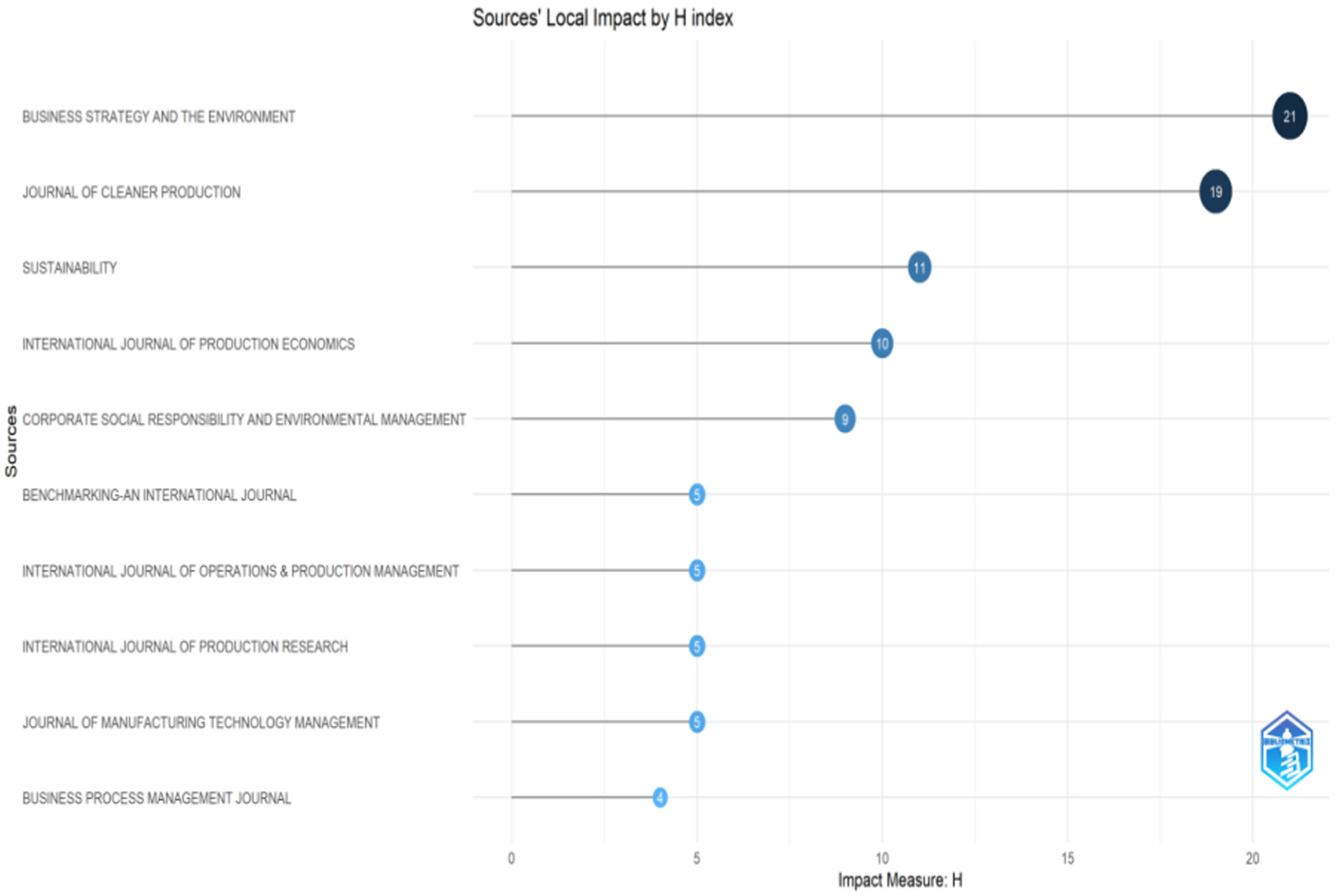
Impact analysis of journals.
National and Regional Cooperation Networks
Figure 5 illustrates the collaboration network of countries and regions in the 337 articles included in this study. The red cluster includes Australia, England, Indonesia, Ireland, Oman, Russia, and Thailand. The green cluster comprises Brazil, Finland, Ghana, India, South Africa, and the UAE. The blue cluster consists of Bangladesh, Jordan, Malaysia, the Netherlands, South Korea, and Sweden. The yellow cluster includes Belgium, Denmark, Germany, Turkey, and the United States. The purple cluster consists of Canada, France, Portugal, and Spain. The light blue cluster includes Hungary, Pakistan, China, Turkey, and Uzbekistan. The orange cluster comprises Egypt, Iran, and Saudi Arabia. The brown cluster includes Taiwan and Vietnam.

National and regional cooperation networks.
Notably, China, India, and Malaysia have the largest nodes, with the number of publications from these countries accounting for 58.46% of the total sample. This reflects their substantial research output and highlights the network structure and strength of collaboration among different countries in this field. This is closely related to the level of manufacturing development, policy support (e.g., China’s “Green Manufacturing” initiative), and the research orientation of higher education systems in these countries. Furthermore, the intensity of collaboration among clusters and their geopolitical distribution (such as the concentration of Commonwealth countries within the red cluster) may influence the diffusion pathways of research in this field.
Word Cloud Analysis
Figure 6 presents the “Word Cloud” of selected article abstracts, where the size of each word corresponds to its frequency of occurrence in the articles (Alvino et al., 2021).

Word Cloud analysis.
The top 50 most frequent words are shown, with “green” and “performance” positioned at the center of the word cloud. These terms are core keywords in the field of sustainable competitive advantage in the manufacturing industry, appearing multiple times throughout the dataset. They consistently occupy a central position in the research on sustainable competitive advantage in manufacturing (Caldera et al., 2017; Martín de Castro et al., 2004).
Keyword Co-occurrence Analysis
A co-occurrence analysis of the keywords from the 337 articles was conducted, and the results are presented in Figure 7. The keywords are divided into five clusters in the analysis. The red cluster primarily focuses on corporate performance; the blue cluster is centered on sustainability; the green cluster emphasizes supply chain management; the yellow cluster highlights competitive advantage; and the purple cluster is associated with institutional pressure. The analysis indicates that competitive advantage, sustainability, and corporate performance are research hotspots, which also represent emerging directions for future studies in the field.

Keyword co-occurrence.
Keyword Density Visualization
Figure 8 presents the visualized results of keyword occurrence density. The multi-layered visualization illustrates potential trends and core themes, revealing the distribution characteristics of the keywords. It allows for a more precise identification of differences between the data, with different colors representing variations in data density. The yellow areas indicate high density, while the light green areas correspond to low density. The visualization in figure highlights the clustered distribution of keywords, with terms such as “sustainability,”“green innovation,” and “performance” densely concentrated in the yellow region, indicating their prominence in the existing literature. In contrast, peripheral keywords like “institutional pressure” and “IoT” may represent underexplored areas with potential for future investigation. Thus, the figure not only reflects current research hotspots but also offers valuable insights for identifying emerging directions.

Keyword density visualization.
Topic Evolution Analysis
Figure 9 illustrates the evolution of keywords, showcasing the development trend of sustainable competitive advantage in the manufacturing industry over time. This visualization provides insights into current research hotspots and future development trends. From 2009 to 2018, the articles primarily focused on environmental management. Starting in 2018, the research on sustainable competitive advantage in manufacturing began to diversify. With the deepening of research, from 2022 onwards, the focus shifted toward topics such as “Industry 4.0,”“green competitive advantage,”“environmental performance,” and “green innovation.”

Topic evolution analysis.
Three-Field Plot Visualization Analysis
Figure 10 illustrates the relationship between publication titles, authors, and keywords. The size of the rectangles corresponds to the frequency of use of the associated keywords—larger rectangles indicate more frequent usage. The diagram includes 14 publications, 20 authors, and 17 keywords. This integration method highlights the strongest connections, providing a comprehensive view of the data characteristics and thematic content involved.

Three-field plot visualization.
Cluster Discussion
Cluster analysis based on the co-occurrence relationships of literature keywords reveals that within each cluster, the co-occurrence of keywords is high, reflecting the research themes and directions that the literature focuses on (Yang & Li, 2023). Based on the keyword co-occurrence analysis, the red cluster focuses on enhancing company performance, emphasizing dynamic capabilities, green innovation, and product-related concepts. Scholars, from the perspectives of sustainable development and dynamic capabilities, argue that green innovation is a key factor in improving the sustainable performance of SMEs. Integrating green innovation and green value into business strategies positively drives company performance (Dangelico et al., 2017; Mubeen et al., 2024).
Moreover, green innovation activities significantly impact a company’s environmental performance and competitive advantage, helping firms gain a more favorable position in the competitive landscape (Küçükoğlu & Pınar, 2015).
In addition, dynamic capabilities can be regarded as a “converter” that transforms resources into improved performance. They not only help firms achieve long-term performance and enhance competitive advantage but also enable firms to quickly adapt and gain a competitive edge through dynamic adjustment capabilities (Lin & Wu, 2014; Zhang et al., 2019).
The blue cluster primarily focuses on research related to sustainability, Industry 4.0, and innovation development. New technologies such as the Internet of Things, service internet, and information systems have gained recognition in industrial transformation, gradually giving rise to the concept of Industry 4.0 (Dev et al., 2020). Industry 4.0 can leverage exceptional operational capabilities to promote sustainable innovation transformation at the internal capability level of enterprises. It enables the prioritization of sustainable management practices, fosters the development of a circular economy, and ultimately achieves the sustainability of performance (Ghobakhloo et al., 2021).
The green cluster primarily focuses on key areas such as green supply chain management and environmental management. In response to the increasingly prominent environmental challenges in supply chain management, the concept of green supply chains has emerged. Green supply chain management is clearly defined, with a focus on reducing carbon emissions, improving resource utilization efficiency, and strengthening energy-saving measures at every stage of the supply chain process. This holistic approach aims to prevent environmental pollution issues in all aspects of supply chain operations (Butt et al., 2024; Haiyun et al., 2021).
Implementing green supply chain management practices in manufacturing enterprises can enhance their environmental management performance (Sahoo & Vijayvargy, 2021). Some scholars argue that the integration of environmental processes and collaboration within the green supply chain are crucial factors influencing the effectiveness of environmental management (Benzidia et al., 2021; Centobelli et al., 2021).
The yellow cluster primarily focuses on research related to competitive advantage, financial performance, and corporate social responsibility (CSR). Scholars have explored the impact of CSR on green innovation in manufacturing firms and provided guiding recommendations for enhancing green competitive advantage in these companies (B. Yuan & Cao, 2022). Environmental resources can help financially strong companies maintain their competitive advantage, and firms enhance their profitability by improving environmental performance (Yadav et al., 2017). Moreover, companies that actively fulfill their social responsibilities and promote environmental sustainability significantly outperform the average in terms of profit advantage (DiSegni et al., 2015).
The purple cluster focuses on research in the fields of institutional pressure and environmental sustainability. Institutional theory has always been a focal point of extensive debate in academia. Institutional pressure has a significant impact on organizational strategy and decision-making (Majid et al., 2020). Both formal and informal pressures are key drivers for companies to implement environmental strategies, with this influence being particularly prominent in industries with significant environmental impacts (Amer, 2023).
At a more granular research level, existing studies have assessed the impact of the coercive, mimetic, and normative dimensions of institutional pressure on corporate environmental sustainability. These studies have found that all three dimensions are important drivers of environmental sustainability and can significantly promote the implementation of environmental management accounting, thereby improving corporate environmental performance (Chaudhry & Amir, 2020). Some scholars have also pointed out that among these dimensions, normative pressure has a more positive impact, as it helps enhance the effectiveness of proactive environmental strategies (Daddi et al., 2016).
Although the five clusters identified above represent distinct research directions and keyword combinations, they are underpinned by a closely connected internal logic. Drawing on the Resource-Based View (RBV) and Dynamic Capabilities Theory, green innovation, sustainable management, and supply chain integration are core capability pathways through which firms build sustainable competitive advantage. In contrast, institutional pressures and corporate social responsibility serve as external drivers that motivate firms to undertake green transformation.
Accordingly, future research could adopt an integrated framework that incorporates innovation capabilities (particularly green innovation), environmental performance, and firm competitiveness. By combining the Triple Bottom Line (TBL) framework with Dynamic Capabilities Theory, scholars can systematically examine how firms respond to external pressures and reconfigure resources and technologies to achieve sustainable competitive advantage. This integrative perspective offers a more comprehensive understanding of green transformation pathways in the manufacturing sector and provides a solid theoretical foundation for subsequent empirical investigations.
Conclusion and Implications
Conclusion
Sustainable competitive advantage enables manufacturing enterprises to maintain a stable market position and competitiveness over the long term (Lewis, 2000). It also enhances the company’s sense of social responsibility and environmental awareness (Shah & Khan, 2020), which is of significant importance for the sustainable development of businesses. This paper aims to explore the current status and development of sustainable competitive advantage in the manufacturing industry through bibliometric analysis. By collecting relevant literature data from the Web of Science database from 2004 to 2024 and applying bibliometric tools for analysis, this study covers 337 articles from 126 journals, authored by 1,054 researchers, and citing 21,409 references. The annual growth rate of publications is approximately 24.3%, with an average of 42 citations per article.
The paper first reveals the basic characteristics of the field of sustainable competitive advantage in manufacturing, primarily including an analysis of annual publication volume, journal publication volume, and journal impact. Building on this, the paper maps the cooperation network between countries and regions, aiming to uncover collaborative relationships across different countries and regions. Additionally, through word cloud analysis, keyword analysis, and keyword density visualization, the study explores the research hotspots in the field. Furthermore, by combining theme evolution analysis with Three-Field Plot visualization, the paper provides an in-depth examination of the evolution and development trends of research themes. Finally, the study analyses and explains five main research clusters, providing some insights into the development of the field.
This study not only reaffirms prior findings in the field of sustainable competitive advantage (SCA) within the manufacturing sector but also extends the theoretical discourse on key emerging themes. The results of keyword co-occurrence and cluster analysis underscore the central role of green innovation and dynamic capabilities. This finding is consistent with previous studies (Vanpoucke et al., 2014; Vo-Thai & Tran, 2025).
In addition, the bibliometric findings highlight the growing integration of Industry 4.0 technologies into SCA-related research, suggesting that digitalization is becoming a critical and evolving dimension of sustainable competitiveness—an area that has received limited attention in earlier studies. While previous research has examined various facets of SCA (Balkyte & Tvaronavičiene, 2010; Bhandari et al., 2022), our analysis further reveals the interdependencies among firm performance, institutional pressures, and sustainable supply chain practices. These findings contribute to the development of a more integrative analytical framework, offering a multidimensional perspective on how competitive advantage evolves under the dual imperatives of digital and green transformation.
Research Contributions
This study systematically reviews the research progress in the field of sustainable competitive advantage in the manufacturing industry, filling the gaps in the existing literature. The research finds that current studies primarily focus on single dimensions, with insufficient exploration of the inherent connections and synergies between different areas. Furthermore, there is a lack of a comprehensive review of future research trends. Through methods such as keyword analysis and theme evolution analysis, this study provides a systematic theoretical framework, thereby advancing the development of sustainable competitive advantage theory in the manufacturing industry.
Practical implications. The findings of this study yield several implications for enhancing sustainable competitive advantage in the manufacturing sector, particularly for policymakers, business executives, and sustainability practitioners. Policymakers. Fiscal incentives—such as tax relief and preferential green financing—can effectively stimulate green technological innovation. In addition, the development of collaborative green supply chain platforms may facilitate knowledge and technology sharing, particularly among small and medium-sized enterprises, while also reinforcing environmental regulatory frameworks. Manufacturing executives. Strategic investment in green dynamic capabilities is essential. This includes integrating sustainability metrics into performance management systems and implementing targeted training programs. The establishment of cross-functional green strategy teams can further support coordinated resource allocation and environmentally aligned decision-making—sustainability Managers. The adoption of environmental management accounting (EMA) can institutionalize environmental considerations within strategic planning and performance evaluation. The application of Industry 4.0 technologies—such as the Internet of Things and artificial intelligence—also enables real-time monitoring of emissions and resource efficiency, thereby supporting more responsive and data-informed sustainability management.
Limitations and Future Directions
The bibliometric analysis in this study is based primarily on high-level journal articles from the Web of Science database. While this database is widely regarded as one of the most comprehensive sources of peer-reviewed literature, its limitation lies in potentially overlooking relevant research from other databases and lower-ranked journals. Moreover, this study focuses solely on English-language literature, which may limit the breadth of the research findings, as literature in other languages may also offer valuable insights.
Additionally, the exclusive reliance on a single database and citation-based metrics may introduce selection and citation biases. Non-English and regionally influential research may be underrepresented, and citation counts do not always accurately reflect research quality or impact. Future research should consider integrating multiple databases and incorporating multilingual and qualitative literature to enrich the robustness and inclusiveness of the findings.
Footnotes
Acknowledgements
The authors thank the anonymous reviewers for their insightful comments and suggestions that helped improve the manuscript.

Author Contributions
Funding
The authors received no financial support for the research, authorship, and/or publication of this article.
Declaration of Conflicting Interests
The authors declared no potential conflicts of interest with respect to the research, authorship, and/or publication of this article.
Data Availability Statement
Data sharing not applicable to this article as no datasets were generated or analyzed during the current study.