




Abstract
Under the background of insufficient scientific research funding, evaluating the level of scientific research from the perspective of sustainable development is necessary. The study aims to develop an evaluation index system based on the theories for sustainable competitive advantage (SCA), which could be used to evaluate the sustainable development trend of scientific research in universities. In this study, 42 world-class universities in China are used as examples to calculate their SCA performance in scientific research using the entropy and equal weights methods. The scores of scientific research in different universities in the Academic Ranking of World Universities (ARWU) in 2021 are used to verify the effectiveness of the evaluation index system. The results show that the evaluation index system can effectively predict the scientific research performance of universities in the future. It could be deduced from the results that universities with better scientific research performance meet the needs of the external market better and have more valuable, rare, imitable, and ambiguous resources but a lower level of scientific research dynamic ability. The evaluation index system makes up for the lack of emphasis on the potential scientific research capacity of the university in the current evaluation methods. It can help university administrators formulate relevant scientific research management regulations.
Keywords
Introduction
Higher education institutions (HEIs) make continuous contributions to the sustainable development of human society through talent training, scientific research, and knowledge application (Bayuo et al., 2020; Cetindamar, 2016; Martins, 2019; Wright & Horst, 2013). Previous studies were devoted to exploring higher education’s contribution to the society’s sustainable development (Holdsworth & Thomas, 2021). However, they seldom discussed whether the development of higher education itself is sustainable. In 2018, the United Nations released a report called Issues and trends in education for sustainable development. It pointed out the emergence and development of the concept of education for sustainable development (ESD). It highlighted the two flows of change: the development of ESD, examining the integration of sustainable development into education systems and how education has been embedded in the sustainable development discourse. Under the increasing status of higher education for the sustainable development of society, evaluating the sustainability level of HEIs and instructing them to realize sustainable development, especially in the growing trend of competition among universities, are necessary.
Regarding the sustainable development of higher education, some research focuses on the performance of universities related to environments, such as energy recovery (Lozano, 2011) and environmental protection (Reidy et al., 2015). Although sustainability originated from ecology, it started to emphasize social and economic influences after being introduced into social science (Jabareen, 2008). Therefore, the sustainable development of higher education should be analyzed from the ecological environment perspective and from the economic and social perspectives. However, few studies have focused on the sustainable development of higher education institutions from that perspective. The existing evaluation of the development level of higher education institutions often focuses on the evaluation of past personnel training, scientific research, and social services of the institution. The four world-famous international rankings, for example, Shanghai Academic Ranking (ARWU), emphasizes the evaluation of scientific research results, Quacquarelli Symonds World University Rankings (QS) emphasizes the evaluation of academic reputation, Times Higher Education (THE) emphasizes the evaluation of internationalization. The US News emphasizes the evaluation of the quality of undergraduate education. These evaluations all pay attention to the outcome of the scientific research but pay insufficient attention to the school’s future development trends.
Now more than ever, universities need to pay attention to the issue of sustainable development. On the one hand, HEIs have faced constant financial challenges for a long time. Rising school costs and debt intensify competition among HEIs (Akin & Vlad, 2011). On the other hand, HEIs worldwide have been under great economic pressure since the outbreak of COVID-19. Studies have shown that universities can no longer provide massive funding for university programs because of COVID-19 (Leal Filho, 2020). Many faculties were asked to take a leave of absence or were fired (Bodin, 2020). The chaos of COVID-19 has also had a great negative impact on scientific research, such as the discipline of medicine and design, which requires experimental equipment (Treve, 2021).
In this context, if HEIs want to sustain their daily activities, they must strengthen their advantages and constantly adjust their operation strategies to the external environment to ensure continued funding from the public and private sectors. Moreover, the university must pay attention to the issue of the sustainable development of schools.
Countries around the world have realized that allocating expenditure according to the rapidly changing economic environment, especially on scientific research is important (Alshubiri, 2020). Scientific research is one of the most important contemporary activities. Improving the quality of scientific research is the basis for modern HEIs to train high-level talents and provide quality social services. Judging the performance of recognized world-class universities, their scientific research performance is always excellent and plays an important role. Ensuring scientific research sustainability in HEIs can support training talent and help propose high-quality solutions to social problems. Evaluating scientific research from the perspective of sustainable development can, on the one hand, remind universities to pay attention to the deficiencies in scientific research and improve them in advance; on the other hand, it can ensure that scientific research can continue to serve the function of personnel training and social service and ensure the sustainability of university’s social contribution.
So how to evaluate scientific research activities in universities from a sustainable perspective? At present, the scientific research evaluations conducted by scholars and the evaluation products developed by organizations are putting too much emphasis on research outputs rather than analyzing their performance from the sustainability perspective. For example, the four world-famous international rankings, including ARWU, QS, TIMES, and USNEWS, take the research output performance to evaluate the scientific research performance of universities (ARWU, 2022; Craig, 2022; Robert & Eric, 2021; Times, 2020). The methods for evaluating the scientific research performance of universities proposed by scholars are always based on bibliometric indicators (Laengle et al., 2020; Mingers & Leydesdorff, 2015; Valzano, 2020), which is a clear trend around the world (Ciurak & Wierczyński, 2021; Coombs & Meijer, 2021). Although the evaluation strategy can help the public and funders to understand the level of university scientific research, it cannot provide information for universities to optimize such activities.
Based on the evaluation shortcomings of existing research and practice, this study aims to answer three questions: What is the sustainable development of scientific research in higher education? How to construct the evaluation index system? How to evaluate the effectiveness of the evaluation index system?
In order to answer the above questions, this paper introduces the theory for sustainable competitive advantage and combines it with the characteristics of scientific research activities of higher education, puts forward an evaluation index system for evaluating the sustainable development of scientific research activities in universities, and verifies the effectiveness of the evaluation index system. According to the evaluation results, managers and practitioners can realize the evaluation of the future development potential of the organization and adjust the management measures.
Theoretical Basis and Literature Review
Currently, SCA is widely introduced into research on organization management and evaluation. Managers and leaders always attempt to find their competitive advantage and maintain their position in the market.
The theory of SCA comes from the competitive advantage(CA). Porter (2011) was the first scholar to propose the CA concept. He believed that organizations need to gain a competitive advantage to achieve profitability. They should focus on considering the external market situation, including existing and new competitors, threats of substitutes, and the bargaining power of buyers and suppliers (Porter, 1979). From the competitor perspective, organizations can gain a competitive advantage through focus, differentiation and cost leadership by obtaining market positions, skills and resources. Porter’s idea about competitive advantage came from the theory of industrial organization economics, and its insights focus on the outside of organizations. With the observation and application of CA, many researchers have gradually realized that SCA comes more from inside organizations. Based on the resource-based view (RBV), Barney (1991) proposed that organizations can obtain and maintain their SCA because they have valuable, rare, imitable and ambiguous resources. Resources with these four organizational characteristics include organization reputation, patents, and government relations (Barney,1991). If organizations want to maintain their SCA, they must acquire and preserve these core resources and capabilities (Barney, 1995), the main sources of organizational success (Grant, 1991). Researchers believe sources should be regarded as the core competencies for organizations to gain a competitive advantage (Prahalad & Hamel, 1997). The external view based on industrial organization economics and the internal view based on RBV has long been considered the key for organizations to obtain SCA. Since the beginning of the 21st century, another important source of SCA has been put forth. Some scholars have proposed that infrastructure owned by organizations, including management and operational systems, is the true source of SCA (Flamholtz & Wei, 2003). With the rapid technological change in the environment, the key for an organization to maintain its competitive advantage is to update its core capabilities constantly, that is, adjusting its resource allocation according to the environment (Teece et al., 1997). This dynamic capability perspective (DCP) can be viewed as an extension of the resource-based theory (Eisenhardt & Martin, 2000).
In general, SCA mainly stems from the theories of industrial organization economics and RBV (Vinayan et al., 2012). The former stresses advantages from the outside, whereas the latter is the opposite. both sides must be considered to pursue and obtain SCA (De Wit & Meyer, 2005). The specific compositions and theories of SCA are shown in Table 1.
Theory and Representative Point for SCA.

For the research on organization evaluation, theories for SCA have been applied in many research fields, mainly business. For example, some research has analyzed the SCA of enterprises from the aspects of knowledge management activity (Torres et al., 2018), knowledge asset application (Moustaghfir, 2009), intellectual capital management (Halid et al., 2018), and human capital development (Fareed et al., 2016). From their research design, we can observe that they always combine an organization’s SCA with its activities’ characteristics. HEIs face fierce competition due to the increasing demand for higher education, and their situation is similar to that of business organizations (De Silva & Chitraranjan, 2018). HEIs around the world also try to solve innovation and sustainability problems (Ávila et al., 2017; Girdzijauskaitė et al., 2019). In this context, many studies combine the functions of universities to analyze the SCA of HEIs from various perspectives. For example, Mahdi et al. (2019) analyzed the SCA of Iraqi private universities from the perspective of the knowledge management process. Butt et al. (2020) found the SCA of Pakistan Higher Education from human resources. Muhammad et al. (2020) pointed out how HEI can gain SCA through big data technology. Emeagwal and Ogbonmwan (2018) summarized the SCA of universities in research and teaching from the behaviors of academic workers. Al Shobaki and Abu-Naser (2017) explored the achievements and SCA levels of HEIs from the characteristics of teaching and scientific research. Kising’u (2017) found the SCA of public and private universities from organizational learning, organizational culture, organizational innovation evaluation, and strategic leadership.
As an important activity for universities, scientific research also needs to cultivate and obtain SCA to support universities in realizing sustainable development. Only a few studies on SCA are involved in scientific research in universities. Therefore, the research would combine with the various elements involved in research activities and constructs a scientific research evaluation framework based on the theories of SCA to analyze the SCA levels of universities.
Analytical Framework and Research Methodology
Based on the theory and representative point for SCA, this study first explores the key elements of research activities, then finds the variables related to SCA for each key element and finally puts forward a scientific research evaluation index system based on SCA.
The definition of scientific research around the world has common characteristics. The Natural Resources Defense Council defines scientific research as the retrieval and application of science, including the collation and statistics of previous knowledge and data collection, editing and analysis (Swanson, 2017). The Organization for Economic Co-operation and Development (OECD, 2007) defines it as creative and systematic work performed to increase the pool of knowledge. Scholars indicate that scientific research is conducted by systematically collecting, interpreting, and evaluating data, and contributing to science in a planned way (Çaparlar & Dönmez, 2016). From their definition, the goal of scientific research is to produce knowledge. In modern science, the typical output of scientific research is a research paper. Note that different types of scientific research have different forms of output. In addition to research papers, products and patents are also scientific research outputs.
The scientific research process involves personnel, equipment, and funding to complete the research. World university ranking systems, such as ARWU, prefer to use indicators related to such elements to evaluate universities. In addition to these tangible indicators, many intangible indicators facilitate scientific research outputs. For example, a good academic reputation can attract high-level researchers and obtain convenience during academic communication. According to the abovementioned elements, the relationships among elements involved in scientific research are shown in Figure 1.

Relationships among elements involved in scientific research.
Although scientific research activities involve these elements, not all relevant resources can be called SCA. From the theory of industrial organization economics, only the indicators that can help universities establish a benign interaction relationship with the external market can be called SCA. From the RBC view, valuable, rare, imitable, and ambiguous resources can be called SCA. From the DCP, the ability to keep and improve scientific research efficiency with external environment change can be called SCA. Based on these theories, this study combines them with various scientific research parts to propose a scientific research evaluation index system.
As per the theory of industrial organization economics, universities can gain SCA through cost leadership, differentiation, and focus on their research (Porter, 2011). Cost leadership emphasizes the high quality of production factors, differentiation highlights the provision of unique products, and focus emphasizes that the products provided can produce specific value. For scientific research by HEIs, cost leadership is mainly reflected in the high-level researchers of universities. They can use the same resources to create more valuable research outputs and help universities gain a competitive advantage in obtaining scientific research resources. Differentiation is mainly reflected in the research areas of universities. The scientific research outputs in these specific and unique areas win a good academic reputation and then attract more high-level researchers to join in. Focus emphasizes that the outputs of universities can be transformed into specific market values, and the amount of patent transformation is an effective embodiment of scientific research achievements. In this process, non-academic organizations, such as enterprises, also cooperate with universities and support them with funding to meet their needs.
In general, from the theory of industrial organization economics, high-level researchers, academic reputation, patent transformation, and funding from non-academic sectors are the key variables that can bring competitive advantage to universities.
From RBV, the valuable, rare, imitable, and ambiguous resources are the key factors to bringing SCA to HEIs. The highly competitive scientific research funding, rare research equipment and existing high-level scientific research achievements are all valuable resources for sustainable scientific research in the future. As for scientific research funding, the funding from highly competitive scientific research projects reflects the rare and imitable funding resources obtained by universities. As for scientific research equipment, national key laboratories often have rare scientific research equipment, which can help universities conduct specific research and produce high-level outputs. As for scientific research achievements, existing high-level scientific research papers serve as important knowledge capital to provide intellectual support for researchers in the next-stage research activities. From the perspective of duration, in addition to high-level researchers who can bring a competitive advantage, young researchers who can access competitive resources can also maintain SCA for universities. These researchers can not only receive competitive research funding but also have a long academic life. In general, according to RBV, competitive research funding, national key laboratories, high-level research papers, and young teachers who can obtain competitive research funds are the key variables for universities to have SCA.
The above two theories for SCA are mainly analyzed from a static perspective. However, the external environment often changes rapidly. It is also critical whether HEIs can adjust their research arrangement with these changing environments and maintain the ability to produce high-level research outputs. In Teece et al.’s (1997) opinion, dynamic capabilities emphasize the abilities of organizations to integrate and allocate resources to rapidly changing environments. The scientific research funding that universities can obtain is changing every year. Moreover, new teachers enter and old teachers exit constantly. In this context, maintaining and even improving the scientific research efficiency of HEIs is important. During the scientific research evaluation, researchers often use the Malmquist Index to reflect the progress and decline of university scientific research efficiency in a period (Kubak et al., 2019; Parteka & Wolszczak-Derlacz, 2013). Therefore, this study uses the Malmquist Index to measure the dynamic ability of university scientific research.
Combined with the research activity processes and theories of SCA, this study puts forward the evaluation index system of university scientific research, including nine indicators from three dimensions. Details are shown in Table 2.
Evaluation Index System of University Scientific Research Based on SCA.

To verify the effectiveness of this evaluation index system, the SCA levels of several universities are selected and calculated. Given that universities with SCA are often of high level, the present study selects high-level Chinese universities as research objects. The reasons are as follows: Firstly, China’s overall national strength and influence are constantly rising, which is not only reflected in the increasing number of Chinese universities selected in the world university rankings but also because its top universities are constantly ranked among the top in the world. For example, Tsinghua University, Peking University, and Fudan University have all entered the top 50 in the Quacquarelli Symonds and Times Higher Education world university rankings in recent years, indicating that such universities have significant SCA. Secondly, in recent years, China has been committed to improving the quality of higher education and building world-class universities. In this process, universities are committed to developing characteristic and advantageous disciplines, constantly consolidating their SCA, making frontier scientific research achievements, aiming for a good academic reputation and achieving the sustainable development of scientific research. Lastly, world-class Chinese universities have been evaluated by the Ministry of Education of China and identified as relatively high-level. The selected universities are homogenous to some extent and suitable to verify the effectiveness of the evaluation index system of this study. For these three reasons, this study selects 42 world-class Chinese universities as research objects.
According to the national conditions of Chinese higher education and data availability, this study further clarifies the connotation of each evaluation index. Specifically, for the four indicators based on the theory of industrial organization economics, high-level scientific researchers mainly refer to the number of scientific researchers who have won the honor as academicians, outstanding youth, and Yangtze River scholars in China. Academic reputation is evaluated by the score based on the 2020 Academic Reputation Survey results. The market value of a patent is measured by the number of science and technology transformation transactions. Non-academic scientific research funding is measured by the project funding from enterprises.
For the four indicators based on RBV, the amount of competitive research funding per capita of universities is measured by the per capita sponsorship funding from the Ministry of Education, National Natural Science Foundation and National Social Science Foundation of China. The high-level papers per capita in universities are measured by the Q1 journal papers published per capita. The state key laboratories of universities are measured by the number of national key laboratories and research bases of humanities and social sciences of the Ministry of Education. The number of young and middle-aged scholars who have obtained competitive scientific research projects is measured by the number of researchers under 45 years old who have received competitive research projects. The Malmquist Index level of scientific research efficiency in universities is measured by scientific research funding, researchers, output papers, doctoral graduates, and the number of science and technology transformation transactions. All variables from 2016 to 2020 were counted.
To verify the stability and effectiveness of the evaluation index system, the performance of the SCA index in world-class Chinese universities from 2016 to 2020 was determined. Moreover, the evaluation results of the university at ARWU in 2021 were introduced. The ARWU use talented researcher, high-level research output and highly cited research teacher to evaluate the scientific research performance of universities. Calculating the correlation between 2021 ARWU rankings scores and 2016 to 2020 SCA scores could verify the effectiveness of the SCA index system.
Data Descriptions and Results
In this section, the method is first introduced. Then, the basic information about the universities is presented, and the overall level of the three dimensions of university research is described. Finally, the correlation between the dimensional and overall SCA levels of universities and their scientific research performance in 2021 is presented to verify the effectiveness of the evaluation index system.
For higher education evaluation activities, it is common to base on raw data and perform index transformation. This study first collects the original data of each institution and then uses a weighting method to transform it into an index. The weighting methods used in this study are average weighting and entropy weighting to better reflect the robustness of the calculation results.
Data Description
Before describing the data, it is necessary to introduce the research object. In this study, 42 world-class Chinese universities are taken as examples to calculate their SCA performance. The reason lies in the great development of China’s higher education due to China’s economic take-off (Mohrman & Wang, 2010). After the 211 and 985 projects, the increasing influence of China’s higher education has attracted the attention of many scholars (Yang & Welch, 2012). As the latest project of a high-level developing plan in China, the implementation effect and the performance of world-class universities in the country’s “Double-First Class” construction plan have been widely concerned.
There are 42 world-class universities on China’s construction list. As data from the National University of Defense Technology are not publicly released, the objects of this study include 41 universities. The name and types of the universities are listed in Table 3.
Types of University.

Source. The classification of university comes from the Academic Ranking of World Universities (ARWU).
According to the evaluation index system of SCA proposed in the third part, the relevant data from 41 universities were collected. The relevant indicators to measure the SCA levels of HEIs include the number of high-level scientific researchers, academic reputation score, number of patent technology transformation transactions, scientific research funding from enterprises, amount of competitive research funding per capita, number of papers published in Q1 journals, numbers of national key laboratories and key research bases for humanities and social sciences of the Ministry of Education, number of young and middle-aged scholars who have obtained competitive scientific research projects, and the Malmquist Index level of scientific research efficiency.
SCA Level of University Scientific Research Based on Industrial Organization Economics
The evaluation indicators of the SCA levels of scientific research in universities based on the industrial organization economics include the number of high-level scientific researchers, academic reputation score, number of science and technology transformation transactions, and scientific research funding from enterprises. From the overall performance of the 41 universities, the average number of high-level researchers in universities is 94.34, the average scientific research funding from enterprises is 888,600, the amount of transformation is 246.23, and the academic reputation ranking score is 27.10. The standard difference and extreme value of each university shown in Table 4 indicate that the SCA level of internal scientific research in universities varies greatly based on industrial organization economics.
Descriptive Analysis of SCA Based on Industrial Organization Economics.

SCA Level of University Scientific Research Based on RBV
The SCA indicators of university scientific research based on RBV include the amount of competitive scientific research funding per capita, number of papers published in Q1 journals per capita, number of national key laboratories and key research bases of humanities and social sciences of the Ministry of Education, and the number of young and middle-aged scholars who have obtained competitive scientific research projects. From the overall performance of 41 universities, the average number of young and middle-aged scholars who have obtained national competitive research projects is 106.59, the average amount of nationally competitive research funding per capita is 572,900, the number of high-level journals published per capita is 6.35, and the number of high-level research platforms per university is 21.57. The differences in standard deviation and extreme value of each university shown in Table 5 indicate that the SCA level of university scientific research varies greatly on the basis of RBV.
Descriptive Analysis of SCA Indicators Based on RBV.

SCA Level of Scientific Research in Universities From the DCP
Dynamic capability emphasizes the ability of organizations to maintain their SCA in changing environments. To measure the dynamic ability of the SCA of universities from 2016 to 2020, this study uses the Malmquist Index to calculate the dynamic efficiency change levels of scientific research activities and measure the productivity and progress levels of scientific research activities each year. The calculation results reveal that from 2016 to 2020, the overall scientific research dynamic capacity level of universities showed an upward trend. In 2020, the average productivity increased by 380% compared with 2016. However, the overall university productivity fell sharply from 2019 to 2020, which may be related to the impact of COVID-19 in 2020. At the same time, Table 6 presents that the overall productivity level of different universities varies greatly, indicating that the dynamic SCA levels of universities vary greatly.
Descriptive Analysis of SCA Indicators Based on DCP.

In general, the internal differences between the SCA of world-class Chinese universities are obvious. Although the overall level gap among universities is large, the dynamic ability of SCA is rising.
Results of SCA
From different perspectives, this study further calculates the SCA levels of universities in each dimension. To intuitively reflect the SCA levels of universities, the entropy and equal weight methods are used to calculate all dimensions, and the scores of scientific research in different universities in the 2021 ARWU are used to verify the effectiveness of the calculation and evaluation index system.
Evaluation of the SCA of Scientific Research in Universities Based on Industrial Organization Economics
The SCA level of scientific research based on industrial organization economics is reflected by the three indicators of scientific research—cost leadership, differentiation, and focus. Tsinghua University, Zhejiang University, and Peking University had the highest SCA levels, whereas Yunnan University, Xinjiang University, and the Minzu University of China had the lowest levels. The correlation between the results of the entropy weight method and the equal weight method is up to .99, indicating that the calculation results of the SCA level of scientific research based on industrial organization economics are stable. The details are shown in Figure 2.

Results of the SCA of scientific research based on industrial organization economics.
Evaluation of the SCA of Scientific Research in Universities Based on RBV
The SCA level of scientific research in universities based on RBV is reflected by four indicators—valuable, rare, imitable, and ambiguous resources. Tsinghua University, Zhejiang University, and Peking University had the highest SCA levels, whereas Yunnan University, Minzu University of China, and Xinjiang University had the lowest levels. The correlation between the results of the entropy weight method and the equal weight method is up to .99, indicating that the evaluation results of the SCA of scientific research based on RBV are stable. The details are displayed in Figure 3.
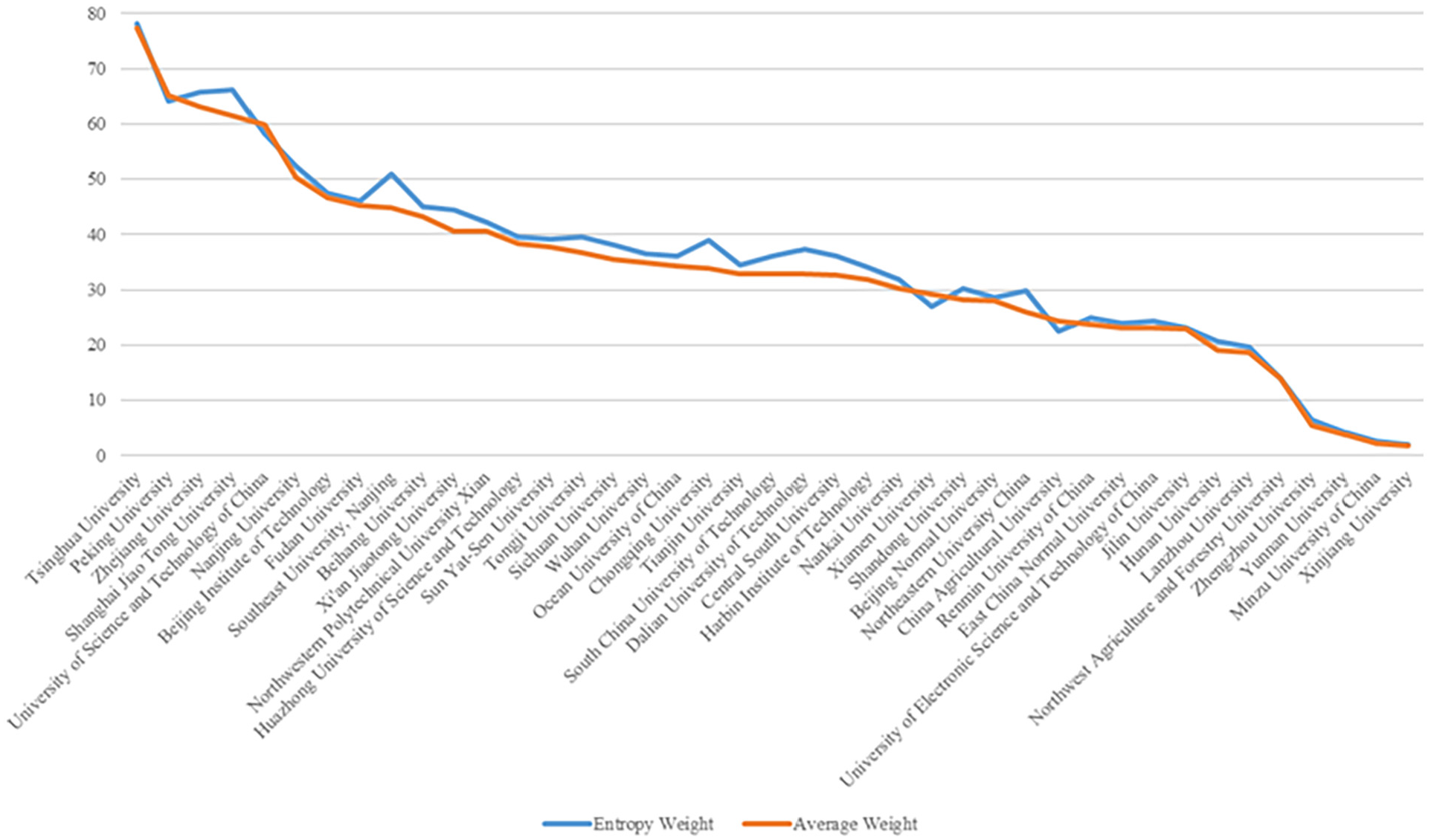
Results of the SCA of scientific research based on RBV.
Evaluation of the SCA of Scientific Research in Universities Based on DCP
The SCA level of scientific research in universities based on DCP is reflected by the Malmquist Index of scientific research efficiency from 2016 to 2020. The calculation results of the dynamic change in research output efficiency show that except for Tsinghua University, Northwest University, Huazhong University of Science and Technology, Zhejiang University, South China University of Technology, Nanjing University, Xi’an Jiaotong University, and Beijing Normal University, the Malmquist Index of the rest of universities is higher than 1, which suggests that the majority of scientific research efficiency level rose during the 2016 to 2020 period. However, universities with high SCA levels based on industrial organization economics and RBV have low dynamic ability levels. That is, when facing the changing external environment, the universities welcomed by markets and rich in resources are often unable to make positive adjustments due to large-scale scientific research. The scientific research efficiency level of each university is illustrated in Figure 4.

Results of the Malmquist Index based on DCP.
Verification of the Evaluation Index System of the SCA of University Scientific Research
To further verify the effectiveness of the evaluation index system of SCA in scientific research, this study calculates the correlation between the overall and all-dimensional SCA levels in universities and the research scores of universities in the 2021 ARWU.
The overall SCA level of scientific research in universities and the score level of scientific research in the 2021 ARWU exhibit a significantly high positive correlation, with a correlation coefficient of 0.79. Thus, the evaluation index system of the SCA of scientific research in universities constructed in this study has good validity and can effectively predict the future sustainable scientific research performance of universities. However, the correlation coefficient between the results based on the scores in the 2021 ARWU and industrial organization economics, RBV, and DCP are 0.73, 0.74, and 0.05, respectively. Therefore, industrial organization economics and RBV are highly positively correlated with the SCA level of scientific research in universities in the future. In contrast, the dynamic ability has no significant relationship with it. Moreover, the international scientific research evaluation fails to consider the change in the dynamic scientific research ability of universities. It does not pay attention to the input-output efficiency level of scientific research in universities. The SCA and research performance scores in the 2021 ARWU of universities are shown in Figure 5.

Result of the overall SCA level of universities and ARWU research evaluation score.
Discussion
Based on the theories for SCA and the analytical perspectives of Porter (1979), Barney (1991), and Teece et al. (1997), the evaluation index system of SCA for scientific research in universities is developed in this study. The results reveal that the evaluation index system can effectively predict the scientific research performance of universities in the future. We can draw the following conclusions on the basis of the evaluation results from each perspective.
Firstly, HEIs with better scientific research performance tend to meet external market needs better because they have high-level researchers to gain an advantage in scientific research costs. Meanwhile, HEIs recognized by the external market can obtain resource support and make scientific research outputs in line with market demands. Most importantly, universities have improved their academic reputation and further expanded the influence of scientific research outputs in the process. This Matthew effect in scientific research helps universities maintain or even improve their SCA in the future. In this case, universities should not only follow the law of academic development in the scientific research process but also pay attention to the key needs of the country and the market and obtain further external support by meeting social needs. In this way, universities not only can accumulate SCA but also play a scientific research role in promoting the sustainable development of society.
Secondly, universities with better scientific research performance tend to have more valuable, rare, imitable, and ambiguous resources, which include high-level researchers, highly competitive funding, and physical and virtual resources. From the characteristics of researchers, the more young and middle-aged researchers receive competitive research funding, the more funding universities will carry out to guarantee the sustainability of scientific research resources. In terms of the amount of competitive research funding per capita, the more such funding that universities obtain, the higher the possibility of producing influential scientific research outputs, which can help universities maintain their status in the future. Existing knowledge and material resources in HEIs also guarantee funding and human resources. As a result, to produce high-level scientific research outputs, HEIs should form a virtuous circle of improving teachers’ research ability, obtaining scientific research funding, producing scientific research output and building a disciplined platform. In the process, HEIs can improve researchers’ scientific research ability through training and introducing policies to attract high-level young scholars.
Thirdly, HEIs with better scientific research performance tend to have a lower level of scientific research dynamic ability because their scale is always larger in scientific research. In the context of the tightening of global research funding for higher education and the increased flow of researchers, making timely adjustments is generally difficult for large-scale universities, leading to large fluctuations in the level of scientific research output. Therefore, universities with large-scale scientific research not only can improve the efficiency of using scientific research funding to avoid the waste of human and financial resources but also do a good job in scientific research planning, controlling the flow of scientific research personnel, rationally allocating scientific research funding to reduce the negative impact of change in personnel and funding on scientific research outputs.
There is no doubt that the traditional perspective of evaluation has significance. The evaluation of the scientific research level provides valid information for funders to ensure that their investment value and it could help achieve outstanding results in talent cultivation, scientific research, and social service of universities (Murphy, 1995). However, on the one hand, it distorts the nature of academic evaluation and free exploration (Rust et al., 2010; Penfield et al., 2014). On the other hand, the methods that emphasize universities’ outputs intensify the waste of resources in the scientific research circle. The SCA developed in our research focus on the trend of the performance of universities, and it could help university administrator formulate proper scientific research management regulation.
Conclusion
Based on the theory of SCA, this research develops an evaluation index system of SCA in scientific research. It proposes to maintain and improve the SCA of universities by meeting the external market demand, improving teachers’ scientific research ability and conducting research planning. The evaluation system can be used in scientific research evaluation by the official department and is helpful for funders to formulate science and technology policies (de Rijcke et al., 2016). It should be noted that the sustainable development of scientific research level in universities has been greatly challenged under global economic austerity. Especially for China and other developing countries, higher education shoulders an important mission if the university cannot lead a sustainable development road. It will not only make the scientific research of universities affected by economic fluctuations but also further aggravate the inequity of higher education because their main funding source comes from the government (Cheng et al., 2022).
The study expands the scope of the sustainable competitive advantage theory by reviewing the sustainable competitive advantage theory and applying it to the evaluation of higher education. The research results prove that this theory can effectively predict the sustainable development ability of universities, which is of great significance for universities to formulate higher education policies in the future. In the future, it can also consider using this theory in evaluating higher education personnel training or social services. In the specific application practice, there are still these problems that need to be paid attention to. First, from a horizontal perspective, different countries have different emphases in the evaluation of scientific research, and they need to be differentiated in the selection of indicators; second, regarding the content of evaluation indicators, low-level institutions may not be suitable for highly competitive indicators. In short, the process of specific application should be discussed comprehensively in combination with the characteristics of institutions of higher learning and the content of scientific research.
There are also some deficiencies in this study. For example, limited by data acquisition, many data could not be effectively mined, such as the number of laboratories established by universities and enterprises and the specific amount of research funding, which are also indicators that can reflect SCA. In future studies, researchers must accumulate relevant data to evaluate the SCA of scientific research in universities comprehensively.
Footnotes
Declaration of Conflicting Interests
The author(s) declared no potential conflicts of interest with respect to the or publication/or publication of this article.
Funding
The author(s) disclosed receipt of the following financial support for the research, authorship, and/or publication of this article: This research was supported from the Fundamental Research Funds for the Central Universities(CCNU23XJ021).
