




Abstract
This study investigates the impact of digital capabilities on sustainable competitive advantages among manufacturing small and medium-sized enterprises (SMEs) in Vietnam, an emerging market, through the lens of the dynamic capabilities view. The research examines the mediating role of digital absorptive capacity and the active role of digital leadership in this relationship. The research used both qualitative and quantitative research, in which a two-stage quantitative approach was employed, using partial least squares-structural equation modeling (PLS-SEM) and artificial neural network (ANN) on data collected from 314 firms. The results reveal a positive correlation between digital capabilities and sustainable competitive advantages, with digital absorptive capacity acting as a positive mediator. The study also found positive relationships between digital capabilities and digital absorptive capacity, as well as between digital absorptive capacity and sustainable competitive advantages. Digital leadership was identified as an active factor positively affecting digital capabilities, digital absorptive capacity, and sustainable competitive advantages, with digital capabilities playing a positive mediating role in these relationships. By exploring the roles of digital absorptive capacity and digital leadership, this study offers novel contributions to understanding a firm’s digital capabilities and sustainable competitive advantages. The findings provide practical implications for managers of emerging market manufacturing SMEs, such as those in Vietnam, who aim to enhance sustainable competitive advantages by leveraging digital capabilities.
Plain language summary
Our research explored how digital skills help small and medium-sized manufacturing businesses in Vietnam gain lasting advantages over competitors. We wanted to understand what makes these businesses successful in today’s digital world. We studied 314 Vietnamese manufacturing companies to see how their digital capabilities (technology skills and resources) affected their long-term success. We found that businesses with stronger digital skills were more likely to develop sustainable competitive advantages. A company’s ability to recognize, understand, and use digital information—what we call “digital absorptive capacity”— plays a crucial role. Companies that can better absorb and apply digital knowledge gain stronger competitive edges.
Leadership matters significantly. Business leaders who understand and champion digital transformation positively influence their company’s digital capabilities, how well the company absorbs digital knowledge, and its overall competitive position. For business owners and managers in emerging markets like Vietnam, our findings suggest that investing in digital skills and promoting digital-focused leadership can help create lasting business advantages. Companies should focus on building their capacity to understand and apply digital information while ensuring leadership actively supports digital initiatives. These insights are particularly valuable for small and medium-sized manufacturers looking to thrive in increasingly competitive markets through digital transformation.
Keywords
Introduction
In today’s dynamic business landscape, digital transformation is not just a trend but a necessity for organizations striving for sustainable competitive advantage (SCA), especially in emerging markets. Manufacturing SMEs in these regions face significant challenges, including limited resources and intense competition, which require the strategic utilization of digital capabilities (DC) to enhance their market position (Pingali et al., 2023; Zahoor & Lew, 2023). The concept of digital absorptive capacity (DAC), which encompasses a firm’s ability to recognize, assimilate, and apply new digital knowledge, is critical in this transformation (Boroomand & Chan, 2024). Moreover, effective digital leadership (DL) is indispensable in steering organizations through the complexities of digital adoption and integration, ensuring that technological advancements translate into tangible business benefits (Chatterjee et al., 2023). The relationship between DC and SAC varies significantly between manufacturing SMEs in emerging and developed countries. In developed countries, SMEs benefit from advanced digital infrastructures, greater access to cutting-edge technologies, and a well-established ecosystem that supports continuous innovation and digital integration (Bai et al., 2021). These advantages enable firms to rapidly implement sophisticated digital strategies, driving efficiency, innovation, and SCA (Vial, 2019). Conversely, manufacturing SMEs in emerging markets often contend with limited access to digital resources, underdeveloped infrastructure, and a scarcity of skilled digital talent (Konlechner et al., 2018). Despite these challenges, emerging market SMEs exhibit remarkable adaptability and ingenuity, frequently devising innovative and cost-effective digital solutions that are tailored to their unique environments. Consequently, while DC in developed countries often lead to incremental improvements and optimization, in emerging markets, it can result in transformative leaps that significantly enhance competitive positioning. This dichotomy underscores the importance of context-specific strategies in leveraging DC to achieve SCA across diverse economic landscapes.
Emerging market manufacturing SMEs are distinctively characterized by their agility, resourcefulness, and innovative approaches to overcoming resource constraints and market volatility. These firms often operate in environments with limited access to finance, inadequate infrastructure, and regulatory challenges, which necessitate creative and cost-effective strategies for survival and growth (Sun et al., 2021). Despite these hurdles, they exhibit a strong propensity for rapid adaptation and resilience, leveraging their contextual knowledge to exploit digital technologies in novel ways (Nambisan et al., 2019). This research explores how these unique characteristics influence the development and implementation of DC, and how DAC can drive SCA in such challenging settings. Furthermore, the role of DL is crucial in guiding these SMEs through the complexities of digital transformation, ensuring alignment between digital initiatives and strategic business objectives (AlNuaimi et al., 2022). By examining these dimensions, this study seeks to provide a deeper understanding of how emerging market manufacturing SMEs can effectively harness DC to navigate their specific challenges and achieve long-term competitive success.
The relationship between DC and SCA has been extensively studied in the context of manufacturing SMEs, revealing significant insights into how digital technologies can enhance business performance. In general, DC such as the adoption of IoT, AI, and advanced data analytics, enables SMEs to streamline operations, foster innovation, and enhance customer engagement, thereby achieving SCA (Bharadwaj et al., 2013; Lyu et al., 2024; Martínez-Peláez et al., 2023). Effective use of these capabilities often requires strategic alignment with business objectives and a supportive organizational culture (Proksch et al., 2024). Strong DL is crucial for driving adoption and integration of these technologies (Benitez et al., 2022), thereby facilitating SCA. Additionally, the ability to adapt DC in response to market changes underscores the importance of dynamic capabilities (Teece, 2018). However, contrary to the prevailing view that DC inherently leads to SCA in manufacturing SMEs, some literature questions this relationship. The studies suggest that merely possessing DC does not guarantee competitive benefits due to factors such as poor implementation, lack of integration with existing processes, and insufficient digital literacy (B. C. C. Tan et al., 2009; Usai et al., 2021). Additionally, DC can lead to increased complexity and higher operational costs if not managed properly (Dubey et al., 2023). For manufacturing SMEs, the lack of complementary assets like skilled labor and robust infrastructure further complicates the effective utilization of digital technologies (Skare et al., 2023). These findings indicate that DC alone is insufficient for achieving SCA, highlighting the need for further research to explore the necessary conditions for their effective use. Moreover, the specific context of emerging market manufacturing SMEs presents unique challenges and opportunities. These firms often operate under resource constraints, have limited access to advanced technologies, and face infrastructural and regulatory hurdles that are less prevalent in developed markets (Konlechner et al., 2018). Despite these challenges, emerging market SMEs have demonstrated remarkable resilience and adaptability, often leveraging digital technologies in innovative ways to address their unique needs (Nambisan et al., 2019). Yet, there is a notable gap in the literature concerning the role of DAC and DL in enabling these SMEs to achieve SCA. This study addresses this gap by examining how DC, DAC, and DL interact to drive SCA in emerging market manufacturing SMEs.
The practical significance of this research is underscored by its potential to offer actionable insights for manufacturing SMEs in emerging markets, which are often characterized by resource constraints and volatile economic conditions. By elucidating the roles of DC, DAC, and DL, this study aims to provide a comprehensive framework that these firms can utilize to enhance their competitive positions sustainably. For instance, understanding how to effectively implement and integrate IoT, AI, and advanced data analytics can help SMEs optimize their supply chains, improve product quality, and respond more agilely to market demands (Wamba et al., 2015). Additionally, the emphasis on DAC highlights the importance of continuously learning and adapting to technological advancements, ensuring that firms can maintain their competitive edge over time. The insights derived from this research are particularly crucial for business leaders and policymakers who are tasked with fostering innovation and economic development in these regions. By providing evidence-based strategies and recommendations, this study can help bridge the gap between digital potential and practical application, enabling SMEs to not only survive but thrive in the digital economy (Westerman et al., 2014).
The novelty of this research lies in its comprehensive examination of the intricate relationships between DC, DAC, and DL, and their collective impact on SCA within manufacturing SMEs in an emerging market context, specifically Vietnam. While previous studies have separately explored the benefits of digital transformation and leadership, this study uniquely integrates these elements through the lens of dynamic capabilities to provide a holistic understanding of how these factors interact to drive SCA. By employing both qualitative and quantitative methods, this research delves deeper into the mediating role of DAC and the active influence of DL, offering new insights into the strategic management of SMEs in volatile and resource-constrained environments. Besides, this study also addresses a significant gap in understanding digital transformation processes in emerging markets, particularly in Vietnamese manufacturing SMEs. Unlike previous research focused on developed markets, our study examines the unique context of Vietnam’s rapidly growing economy and government-driven digital initiatives. By investigating how Vietnamese SMEs leverage DC, DAC, and DL for SCA, we provide insights into digital transformation in resource-constrained environments. Our research uniquely contributes to the field by integrating these variables through the lens of dynamic capabilities theory. This holistic approach, previously overlooked in Vietnamese SME literature, uncovers complex relationships between these factors and their collective impact on competitive advantage. It offers a novel perspective on how emerging market SMEs navigate digital transformation despite infrastructural challenges, advancing our understanding beyond existing studies on adoption rates and barriers. To achieve the research objectives, this study seeks to answer the two research questions: (1) How do DC influence SCA among manufacturing SMEs in Vietnam? (2) What are the mediating effects of DAC and the active role of DL in the relationship between DC and SCA? To address these questions, a mixed-method approach was adopted, combining qualitative and quantitative research methods. A qualitative research study was undertaken by conducting interviews with managers of manufacturing small and medium enterprises (SMEs) to assist in developing a research model. In order to evaluate the proposed links, the quantitative component of the study included gathering data from 314 businesses and analyzing it using partial least squares-structural equation modeling (PLS-SEM) and artificial neural network (ANN). This methodological combination not only strengthens the validity of the findings but also provides a richer understanding of the mechanisms through which DC, DAC and DL drive SCA in emerging market manufacturing SMEs.
Theoretical Framework and Hypothesis Development
Dynamic Capabilities View as a Foundational Theory
The Dynamic Capabilities View (DCV), an evolution of the Resource-based view (RBV) proposed by Barney (1991), posits that a firm’s competitive edge lies in its ability to integrate, develop, and reconfigure internal and external competencies to thrive in dynamic environments (Teece et al., 1997). Dynamic capabilities, essential for organizational learning and adaptability, encompass the processes of sensing, seizing, and reconfiguring capabilities (Teece, 2018). Sensing involves scanning the external environment, seizing relates to making strategic investments, and reconfiguring entails adjusting resources in response to market shifts. Recognizing DCV as an extension of RBV highlights its importance in helping manufacturing SMEs align their resources with market demands, thereby fostering competitive advantages in volatile settings. This study adopts DCV as the foundational theory to explore the complex relationships between DC, DL, DAC, and SCA in manufacturing SMEs within an emerging market context. DCV underscores three core capabilities: sensing opportunities and threats, seizing opportunities through innovation, and reconfiguring resources.
Within the framework of dynamic capabilities, DC is defined as an organization’s proficiency in utilizing and adapting digital technologies and resources to meet strategic objectives and secure competitive advantages in an ever-changing digital environment. This concept includes a wide range of resources, including tangible, intangible, and human, which are crucial for digital transformation and innovation (Mikalef et al., 2020). Tangible resources encompass digital infrastructure, hardware, and software systems, while intangible resources consist of organizational knowledge, digital skills, and intellectual property related to digital technologies. Human resources are pivotal in shaping DC, involving employee expertise, creativity, and collaboration in the use of digital tools and platforms. These resources are dynamically integrated, reconfigured, and transformed to adapt to evolving market conditions and technological advancements. Thus, within this framework, DC surpasses mere technological adoption, focusing on the strategic management of organizational resources to foster DAC and maintain competitive advantage.
DCV serves as a robust theoretical foundation for examining the relationships between DC, DL, DAC, and SCA in the context of manufacturing SMEs in emerging markets like Vietnam. This theory is particularly relevant in the digital age, where technological advancements and market dynamics necessitate continuous adaptation and innovation. Firstly, DCV elucidates how DC can directly lead to SCA by enabling firms to respond agilely to market changes and customer needs (Okorie et al., 2023). DC allows SMEs to streamline operations, reduce costs, and innovate, thus establishing sustainable competitive positions in the market. Secondly, DL plays a crucial role in shaping and enhancing DC, DAC, and ultimately SCA. Effective DL involves guiding the organization through digital transformation, fostering a culture of innovation, and making strategic investments in digital technologies (AlNuaimi et al., 2022). Leaders who are proficient in digital strategies can inspire and mobilize resources to build robust DC and enhance the organization’s ability to absorb and utilize new digital knowledge, thereby reinforcing the firm’s competitive advantage. Thirdly, the relationship between DC and DAC is also critical from the perspective of DCV. DAC is enhanced by strong DC (Boroomand & Chan, 2024). Firms with advanced DC are better positioned to absorb new technologies and integrate them into their operations, fostering continuous innovation and improvement (Ghosh et al., 2022). Lastly, DCV well explains the fact that there is a significant relationship between DAC and SCA. Firms that excel in absorbing and applying new digital knowledge can more effectively innovate and adapt to market changes, securing SCA (Ed-Dafali et al., 2023). In the context of Vietnamese manufacturing SMEs, which operate in a dynamic and often resource-constrained environment, the ability to continuously learn and adapt through enhanced DAC is crucial for maintaining long-term competitiveness. By grounding this study in the DCV framework, it can be comprehensively understood how these interrelated factors collectively contribute to SCA in emerging market contexts.
Emerging Market Manufacturing SMEs
Emerging market manufacturing SMEs exhibit unique characteristics that influence their ability to leverage digital technologies for SCA. These firms often operate in challenging business environments characterized by institutional voids, resource constraints, and intense competition (Adomako et al., 2023). One notable feature is their resource scarcity, including limited financial, human, and technological resources (Amankwah-Amoah et al., 2022). This constraint can impede their ability to invest in digital initiatives and acquire the necessary DC. Additionally, SMEs in emerging markets frequently lack access to skilled workforce and face challenges in attracting and retaining digitally savvy talent (Kandukuri, 2023). Another significant characteristic is the high level of environmental uncertainty and market volatility (Shirokova et al., 2020). Emerging markets are often marked by rapid technological changes, fluctuating consumer demands, and unstable political and economic conditions. This uncertainty can make it challenging for SMEs to develop long-term digital strategies and adapt to the ever-evolving digital landscape. Furthermore, emerging market manufacturing SMEs often operate within weak institutional frameworks, characterized by inadequate infrastructure, underdeveloped legal systems, and inefficient regulatory environments (Peng et al., 2009). These institutional voids can hinder the adoption and effective utilization of digital technologies, as well as hampering access to resources and support mechanisms. Despite these challenges, some emerging market manufacturing SMEs have demonstrated remarkable agility and resilience, leveraging their entrepreneurial spirit and adaptability to navigate the complex business environment (Khavul et al., 2009). These firms often rely on informal networks, flexible organizational structures, and localized knowledge to overcome resource constraints and respond swiftly to market demands (Naudé & Rossouw, 2010). It is important to note that emerging market manufacturing SMEs are not a homogeneous group, and significant variations exist within and across different countries and industries. Understanding these unique characteristics is crucial for developing targeted strategies and policies to support their digital transformation and enhance their SCA.
Vietnamese manufacturing SMEs exemplify the duality inherent in emerging market firms, exhibiting both promising growth prospects and systemic constraints that shape their digital transformation journeys. These firms capitalize on Vietnam’s burgeoning economic status, integrating into global value chains and benefiting from lower labor costs (Nguyen et al., 2020). However, they also grapple with challenges uncommon in developed economies, such as limited access to financial resources, skilled workforce, and advanced digital technologies (La et al., 2020). Like other emerging markets in Southeast Asia, Vietnamese manufacturing SMEs play a pivotal role in driving economic development, yet they must navigate a transition from labor-intensive methods to more technologically advanced and digitally-enabled production processes (Asian Development Bank [ADB], 2021). This transition is further complicated by the volatile and uncertain business environment characterized by rapid technological changes, fluctuating consumer demands, and institutional voids. Despite these challenges, Vietnamese manufacturing SMEs demonstrate remarkable resilience and adaptability, leveraging their entrepreneurial spirit and localized knowledge to overcome resource constraints and respond swiftly to market demands (Naudé & Rossouw, 2010). However, to effectively harness DC for SCA, these firms must enhance their DAC and DL(Teece, 2023).
Digital Capabilities, Digital Absorptive Capacity, and Sustainable Competitive Advantages
The relationship between DC and SCA has been viewed in previous studies from the perspectives of DCV. The DCV posits that firms can achieve competitive advantages by reconfiguring their resource base and adapting to environmental changes through the development and deployment of dynamic capabilities (Teece, 2023). In the context of digitalization, DC has been conceptualized as a specific subset of dynamic capabilities that enable firms to effectively leverage and exploit digital technologies (Cannas, 2021). Several empirical studies have examined the link between DC and SCA. Previous studies found that digital platform capabilities, which encompass the ability to design, implement, and utilize digital platforms, significantly contribute to the long-term performance and competitive advantages of firms (Cenamor et al., 2019; Liao et al., 2024; L. Liu et al., 2023). Similarly, Mikalef et al. (2020) demonstrated that digital operational capabilities, such as data analytics and process automation, positively influence firms’ operational performance and competitive positioning. However, the relationship between DC and SCA may be nuanced in the context of emerging market manufacturing SMEs. These firms often face resource constraints, institutional voids, and volatile business environments, which can hinder their ability to develop and deploy DC effectively (Nambisan et al., 2019). Additionally, the absorption and utilization of digital technologies may be influenced by factors such as organizational culture, managerial cognition, and the availability of complementary resources (Verhoef et al., 2021). However, not all empirical evidence supports a direct positive relationship between DC and SCA. A study by Usai et al. (2021) found no significant association between the adoption of digital technologies and firm performance. This highlights the potential moderating or mediating role of other factors in translating DC into SCA. With the above discussion, the study proposed the hypothesis:
H1: DC positively affects SCA.
DAC is defined as a set of organizational digital processes by which firms acquire, assimilate, transform, and exploit knowledge for value creation (Boroomand & Chan, 2024). The first process, digital knowledge acquisition, involves locating, identifying, evaluating, and acquiring external information crucial for organizational development through digital means. The second process, digital knowledge assimilation, refers to the digital analysis, classification, comprehension, and internalization of the acquired external information. The third process, digital knowledge transformation, focuses on the role of digital technologies in enabling the maintenance, retrieval, transfer, and combination of acquired and assimilated knowledge with prior knowledge. While acknowledging the importance of social interactions, this process emphasizes the digital facilitation of knowledge storage, retrieval, sharing, and transfer. The fourth and final process, digital knowledge exploitation, involves the digital incorporation, utilization, and exploitation of knowledge in an organization’s operations, routines, products, and services. The relationships between digital knowledge acquisition, assimilation, transformation, and exploitation with DAC are crucial to understand, as they form the core processes of DAC. These four dimensions are interrelated and sequentially influence each other to collectively form the overall DAC (Boroomand & Chan, 2024). Digital knowledge acquisition and assimilation constitute potential absorptive capacity, while transformation and exploitation represent realized absorptive capacity. In the context of emerging market manufacturing SMEs, these relationships may be particularly important. For instance, Rialti et al. (2019) found that in SMEs, digital knowledge acquisition positively influences assimilation, which in turn enhances transformation capabilities. Similarly, Soluk et al. (2021) demonstrated that effective digital knowledge transformation leads to improved exploitation in family-owned SMEs. However, the strength of these relationships may vary depending on factors such as organizational culture, leadership support, and technological infrastructure. Understanding these interrelationships is crucial for developing a comprehensive model of DAC in the context of emerging market manufacturing SMEs.
The relationship between DC and DAC can be further explored. DC, as a subset of dynamic capabilities, enable firms to effectively sense, seize, and reconfigure their resources and competencies in response to digital transformations (Teece, 2018). These capabilities are crucial for developing and enhancing DAC, which is the firm’s ability to acquire, assimilate, transform, and exploit digital knowledge and technologies (L. Liu et al., 2023). The previous studies show that DC, such as data analytics and digital infrastructure, positively influences firms’ absorptive capacity (Khan & Tao, 2022), which in turn enhances their digital transformation performance (Khin & Ho, 2019). Also, DC is essential antecedents of digital absorptive capacity, enabling firms to recognize the value of digital innovations and integrate them into their operations (Helfat & Raubitschek, 2018; Tortora et al., 2021). In the context of emerging market manufacturing SMEs, the relationship between DC and DAC may be more nuanced. DC positively influences DAC in emerging market manufacturing SMEs by enabling acquisition, assimilation, transformation, and exploitation of digital knowledge. However, this impact may be moderated by organizational and environmental factors unique to these firms in emerging markets, posing challenges in leveraging DC to enhance DAC effectively.
H2: DC positively affects DAC.
DAC, defined as the ability to acquire, assimilate, transform, and exploit digital knowledge and technologies, is viewed as a critical dynamic capability enabling firms to adapt to the digital landscape and achieve long-term competitive advantages (Boroomand & Chan, 2024). Empirical studies have demonstrated that absorptive capacity mediates the effect of DC on firm performance in the digital era (Cuevas-Vargas et al., 2022; Rehman et al., 2020), suggesting its crucial role in translating DC into competitive advantages. However, in the context of emerging market manufacturing SMEs, this relationship may be influenced by factors such as limited resources, skill gaps, institutional voids, and volatile business environments. The four processes of DAC (acquisition, assimilation, transformation, and exploitation) may differentially impact competitive advantages, with knowledge acquisition and assimilation being crucial for identifying market opportunities (Ávila, 2022), and transformation and exploitation being vital for operational efficiency and innovation (Müller et al., 2021).
H3: DAC positively affects SCA.
Digital Leadership, Digital Capabilities, Digital Absorptive Capacity, and Sustainable Competitive Advantages
DL refers to the consolidation of leadership skills with the efficient use of digital technology (Tigre et al., 2023). Its primary role is to drive digital transformation within organizations, facilitating the development of DC (Borah et al., 2022). Toduk and Gande (2016) define DL as a comprehensive business approach that emphasizes innovation and originality, mastery of digital skills to achieve a competitive edge through technology and increase personal knowledge value, use of digital technologies to build strong domestic and international networks that promote collaboration, and fostering dedication to the organization’s overall vision. DC is greatly impacted by DL (Shin et al., 2023), and the absence of DL poses a substantial obstacle to digital business operations (Ruel et al., 2021). However, the challenges faced by manufacturing SMEs in emerging markets, such as resistance to change and traditional leadership mindsets, may hinder the effectiveness of DL in driving DC among these SMEs (W. Li et al., 2016). Overall, DL plays a crucial role in creating an environment conducive to digital transformation and fostering the development of robust DC among manufacturing SMEs in emerging markets.
H4: DL positively affects DC.
DL refers to guiding organizations through digital transformation by adopting new technologies and cultivating a digital mindset and culture (Haffke et al., 2016). Effective leaders enhance a firm’s absorptive capacity (Rezaei Zadeh et al., 2022), especially in the digital era by fostering a culture open to change, encouraging collaboration, and investing in digital skills (Senadjki et al., 2024). They integrate digital tools across functions, improving the firm’s capacity to utilize new knowledge (Vial, 2019), and prioritize knowledge sharing and cross-functional collaboration. Identifying external trends and committing to continuous improvement help mitigate transformation barriers like resistance to change and resource limits (Kane et al., 2019; Teece, 2023). In emerging market manufacturing SMEs, where constraints are significant, DL is crucial for leveraging technologies for innovation and growth, making it a key determinant of sustainable competitive advantage (Ravichandran, 2018), thus positively affects DAC.
H5: DL positively affects DAC.
Effective digital leaders guide firms through digital transformation by integrating new technologies with strategic goals, ensuring that digital initiatives drive long-term innovation and resilience (He et al., 2023). They foster DC, such as data analytics and agile methodologies, which enhance operational efficiency and customer engagement (AlNuaimi et al., 2022). Furthermore, DL promotes a culture of adaptability and continuous learning, enabling organizations to respond swiftly to market changes (Vial, 2019). Leaders who emphasize digital skills development and cross-functional collaboration help their firms effectively assimilate new knowledge, maintaining a competitive edge (Mukherjee, 2020). They are adept at identifying market opportunities and acting on emerging trends, which is crucial for sustaining competitive advantages (Teece, 2023). For SMEs in emerging markets, DL is essential in navigating resource constraints and volatility. Strategic digital leaders align digital strategies with business objectives, fostering innovation and growth, thus ensuring SCA in the digital age (Memon & Ooi, 2023).
H6: DL positively affects SCA.
Mediating Role of Digital Absorptive Capacity
DAC significantly influences how DC translate into competitive advantages (Boroomand & Chan, 2024). DC, which encompasses a firm’s proficiency in utilizing digital technologies such as data analytics, cloud computing, and digital platforms, are crucial for operational efficiency and innovation (Wu et al., 2021). However, the extent to which these capabilities contribute to SCA depends heavily on the firm’s absorptive capacity. Firms with high DAC are better positioned to leverage their DC effectively (Lyu et al., 2022) as they can quickly recognize valuable digital trends and technologies, assimilate this new knowledge, and apply it to enhance their processes and products. This capability not only fosters continuous innovation but also allows firms to adapt swiftly to market changes, thus sustaining their competitive edge over time (Vial, 2019). For instance, a manufacturing SME that excels in DAC can integrate advanced data analytics to optimize production processes, reduce costs, and respond to customer demands more efficiently, thereby achieving sustainable competitive advantages. Moreover, DAC enhances the strategic alignment of DC with business objectives. Firms that effectively absorb and apply digital knowledge can better align their digital initiatives with broader strategic goals, ensuring that investments in digital technologies yield maximum returns (W. Chen & Srinivasan, 2024). This alignment is crucial for emerging market manufacturing SMEs, which often face resource constraints and need to maximize the impact of their digital investments. Therefore, DAC serves as a critical moderator in the relationship between DC and SCA. It enables firms to fully exploit their DC, fostering innovation, strategic alignment, and adaptability, which are essential for maintaining a competitive edge in dynamic markets (Teece, 2018). Therefore, enhancing DAC should be a strategic priority for emerging market manufacturing SMEs aiming to achieve sustainable growth and competitiveness in the digital era.
H7: DAC mediates the relationship between DC and SCA.
Methodology
Research Design and Research Model
This study utilizes a dual-method approach, integrating both qualitative and quantitative methodologies to validate the proposed research model (Choi et al., 2016). In-depth interviews (Table 1) were conducted with three primary objectives: (1) to gain empirical insights into the impact of digital capabilities (DC) on sustainable competitive advantages (SCA) within Vietnamese manufacturing SMEs in the digital technology era, (2) to explore factors affecting the relationship between DC and SCA, including the mediating effect of digital absorptive capacity (DAC) and the impact of digital leadership (DL), reflecting the current status of Vietnamese manufacturing SMEs, and (3) to empirically validate the research framework. The qualitative approach facilitated the development of a novel research model. Initially, 30 managers from various cross-industry sectors were interviewed to understand the influence of DC on SCA and DAC and to identify relevant factors affecting these relationships. A rigorous participant selection process ensured representation from a diverse range of industry sectors pertinent to manufacturing SMEs in emerging markets. To explore the impact of DC on SCA, the authors employed a qualitative research method using semi-structured interviews, which allowed for flexible discussions while covering all relevant topics. Managers were selected through a purposive sampling strategy based on their decision-making roles related to DC within their organizations, aiming to capture a wide range of perspectives and experiences across different industries within the manufacturing sector. Over 2 months, in-depth semi-structured interviews were conducted with the selected participants. A total of 30 managers holding middle management positions and above were interviewed, ensuring comprehensive coverage and saturation of insights relevant to the research objectives. The semi-structured nature of the interviews allowed for deeper probing into issues of interest and enabled participants to discuss their experiences and opinions in detail, providing a rich understanding of the phenomenon under study.
Qualitative Study Results.

Source. Authors’ collection.
Respondents generally confirmed the positive impact of DC on SCA. They also indicated that DC positively influences both SCA and DAC in manufacturing SMEs. Additionally, respondents offered insights into other influencing factors and discussed the critical role of DL, with a consensus on its importance. The information obtained from these interviews, combined with the existing literature review, helped validate the research model (Figure 1).

Research model.
In the second stage, the authors conducted a quantitative analysis employing several tests, including common method bias (CMB), PLS-SEM, and ANN, to test the proposed hypotheses. Our study employs both PLS-SEM and ANN for several reasons. PLS-SEM was chosen due to its suitability for complex models with smaller sample sizes and its ability to handle both reflective and formative constructs (Hair et al., 2019). It allows us to test our hypotheses and assess the structural model simultaneously. ANN was used in addition to PLS-SEM to capture potential non-linear relationships and provide a complementary predictive perspective (L.-Y. Leong et al., 2013). While PLS-SEM excels at theory testing and explaining linear relationships, ANN offers superior predictive capabilities and can uncover complex, non-linear patterns in the data (G. W.-H. Tan et al., 2014). By combining these methods, we leverage the strengths of both approaches: PLS-SEM provides a theory-driven analysis of our conceptual model, while ANN offers data-driven insights that may not be apparent in linear models. This multi-method approach enhances the robustness of our findings and provides a more comprehensive understanding of the relationships between DC, DAC, DL, and SCA in emerging market manufacturing SMEs.
To analyze the collected data, we employed a multi-faceted approach. For qualitative analysis of the in-depth interviews, we used NVivo software to code and identify themes (Jackson & Bazeley, 2019). For quantitative analysis, we first conducted CMB tests using Harman’s single-factor test in SPSS (Podsakoff et al., 2003). We then utilized PLS-SEM using SmartPLS 4.0 software to test our hypotheses and assess the structural model. This approach is particularly suitable for complex models and smaller sample sizes (Hair et al., 2019). Additionally, we employed ANN using SPSS to further validate our findings and capture non-linear relationships (G. W.-H. Tan et al., 2014). The combination of PLS-SEM and ANN provides a robust analytical framework, leveraging the strengths of both techniques (L.-Y. Leong et al., 2013).
Sampling and Data Collection Process
Measurement
An initial comprehensive literature analysis and conversations with experts were undertaken to determine measuring items and improve the reliability and validity of the study (Shareef et al., 2016). Measurement items for DC, DL, DAC, and SCA were sourced from established studies (Table 2), in which DC measurement items were from the studies of Annarelli et al. (2021), Khin and Ho (2019), Zhou and Li (2010); DL from Benitez et al. (2022), Niu et al. (2022); DAC from Boroomand and Chan (2024); and SCA from Chang (2011). Subsequently, a pilot study was conducted with 30 participants to ensure the reliability and validity of the measurements, resulting in a Cronbach’s alpha exceeding .7. This successful pilot study validated the measurement items for the main data collection. The survey utilized a 5-point Likert scale for simplicity and to reduce common method bias (Teck Soon & Syed A. Kadir, 2017). All items were adapted to ensure construct validity and underwent pretest evaluations by experts for clarity and appropriateness, with adjustments made based on feedback to resolve any ambiguities in wording.
Measurement Scales.

Source. Authors’ collection.
Data Collection Process
Data collection was conducted using convenience sampling within Vietnam’s manufacturing SMEs. This method, noted for its accessibility (Islam & Aldaihani, 2022), ensures efficient selection of representative participants. With approximately 873,000 SMEs in Vietnam, the authors strategically leveraged the geographical distribution of these enterprises, carrying out surveys in the northern, central, and southern regions to ensure regional representation. Data gathering from SMEs was facilitated through various outreach methods, including emails, phone calls, and direct visits. Out of 950 distributed surveys, 475 responses were received, resulting in an initial response rate of 50%. After applying quality standards, 314 responses (Table 3) were used for further analyses, giving an effective response rate of 33.05%.
Demographics (n = 314).

Source. Authors’ collection.
Data Analysis and Results
Common Method Bias (CMB)
The present work aimed to mitigate the possible problem of common method bias (CMB) that is inherent in self-administered surveys by implementing an approach as suggested by Podsakoff et al. (2003). Methodologically, the research ensured respondents’ anonymity and confidentiality to securely protect their responses. The questionnaire included precise definitions and clear instructions to reduce any ambiguities (X. Li et al., 2017). To evaluate CMB, the study used Harman’s single factor test, as suggested by Kock (2015). The results showed that all Variance Inflation Factors (VIFs) in the inner model, derived from a comprehensive collinearity test, were equal to or less than 3.3. Specifically, the VIF values for various constructs, presented in Table 4 below, were below 3.3, indicating the absence of common method bias in the model.
VIFs in the Inner Model.

Source. Authors’ calculation.
Note. DC = digital capabilities; DAC = digital absorptive capacity; DL = digital leadership; SCA = sustainable competitive advantage.
Outer Model and Scale Validation
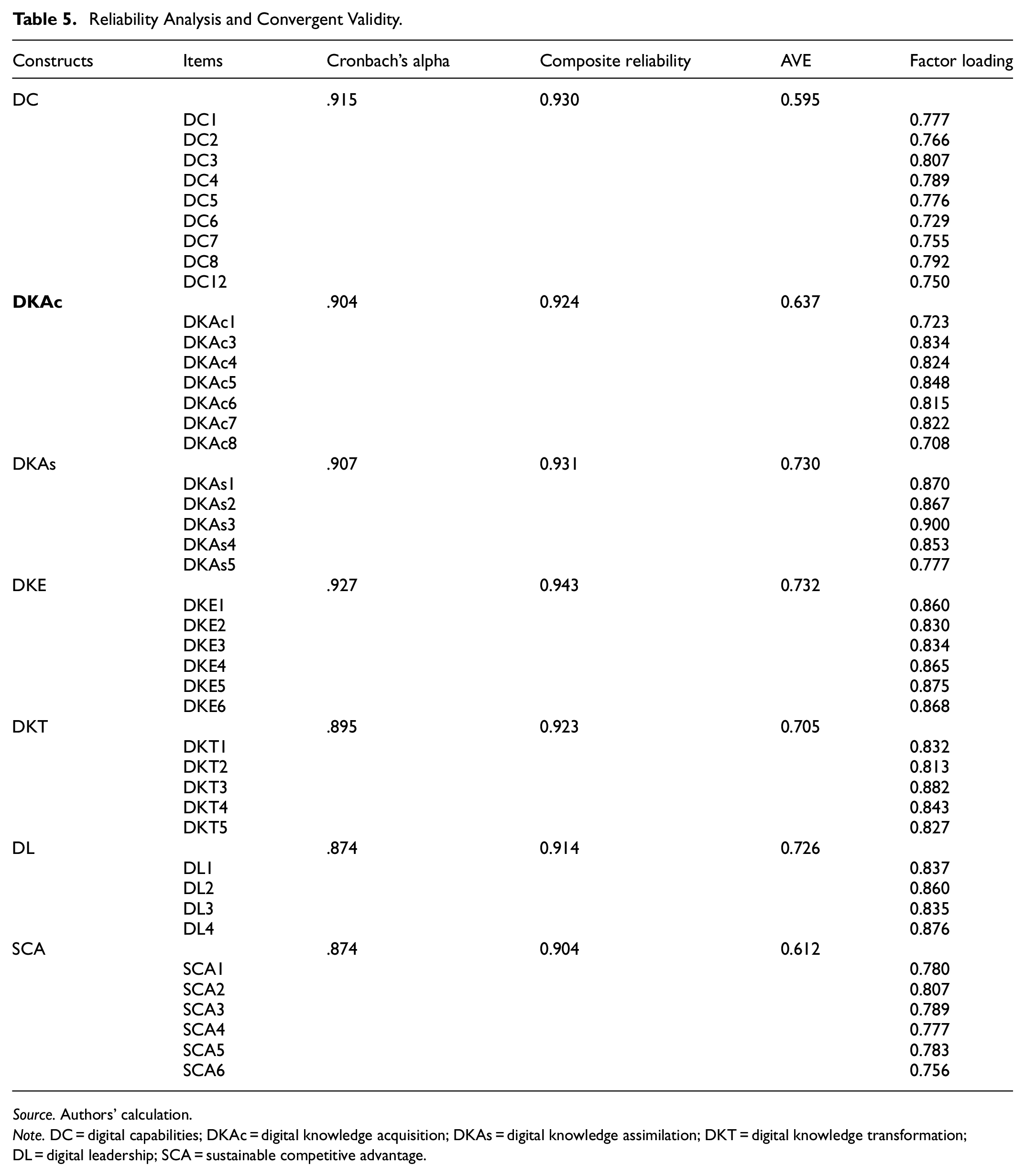
The reliability of each item was assessed through the corresponding loading of the questions, indicating how well each construct is measured. All constructs, except for DC9, DC10, DC11, and DKAc2, demonstrated reliability, exceeding the necessary threshold of 0.70 for both Dijkstra-Henseler’s rho and composite reliability (CR), as shown in Table 5. Consequently, the authors removed DC9, DC10, DC11, and DKAc2 from the study. This adherence to established thresholds aligns with the criteria set by Antonetti et al. (2021), Tuncdogan and Volberda (2020). According to the criteria proposed by Fornell and Larcker (1981), for convergent validity, a factor loading and Average Variance Extracted (AVE) exceeding 0.5 indicate that each construct is reliably measured.
Reliability Analysis and Convergent Validity.
Source. Authors’ calculation.
Note. DC = digital capabilities; DKAc = digital knowledge acquisition; DKAs = digital knowledge assimilation; DKT = digital knowledge transformation; DL = digital leadership; SCA = sustainable competitive advantage.
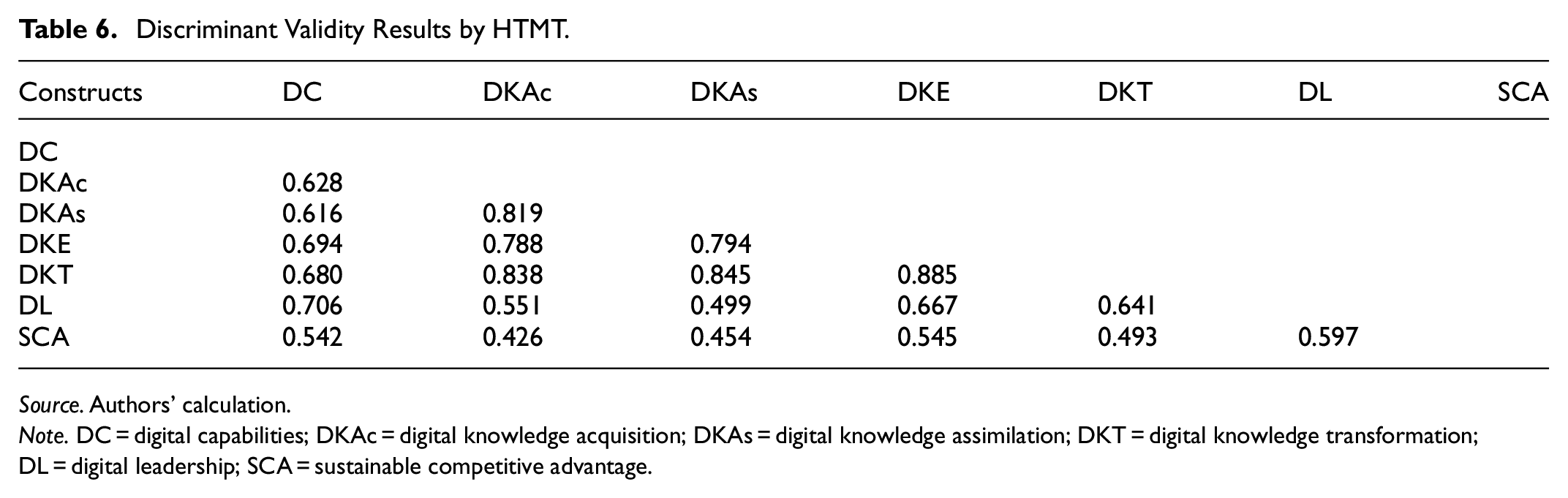
Additionally, discriminant validity evaluates the degree to which variables and constructs are distinct from one another. The analysis results indicate strong discriminant validity. Discriminant validity measures how well tested constructs differ from other criteria. Henseler et al. (2015) introduced the heterotrait-monotrait ratio (HTMT) of correlations, using the multitrait-multimethod matrix, as a method for testing this. The values in Table 6 show that all constructs have correlations below 0.9, confirming discriminant validity (Gold et al., 2001).
Discriminant Validity Results by HTMT.
Source. Authors’ calculation.
Note. DC = digital capabilities; DKAc = digital knowledge acquisition; DKAs = digital knowledge assimilation; DKT = digital knowledge transformation; DL = digital leadership; SCA = sustainable competitive advantage.
Inner Structural Model Evaluation
The main goal of the inner model PLS analysis (Figure 2) in this study was to test the hypotheses. The results of the hypothesis testing, which include path coefficients, p-values, and t-values, are shown in Table 7.

Inner model result.
Summary of the Inner Model Result.

Source. Authors’ calculation.
Artificial Neural Network (ANN) Analysis
In this phase of the study, we employed the significant factors identified in the PLS-SEM path analysis as input neurons for the ANN model (Figure 3) (Liébana-Cabanillas et al., 2017). The rationale for using the ANN stems from the non-normal distribution of the data and the presence of non-linear relationships among both exogenous and endogenous variables. Additionally, the ANN is robust against noise, outliers, and small sample sizes. It is adept at handling non-compensatory models, where a decrease in one factor does not necessarily need to be offset by an increase in another. The algorithm used in the ANN can capture both linear and non-linear relationships without requiring a normal distribution (Teo et al., 2015). The ANN algorithm learns through a training process to predict outcomes using a feed-forward-backward-propagation (FFBP) algorithm, where inputs are fed forward, and errors are propagated backward. Multilayer perceptrons and sigmoid activation functions were used for the input and hidden layers. Through multiple iterations of the learning process, errors are minimized, thereby enhancing prediction accuracy. In this research, 90% of the samples were allocated for training, and the remaining samples were used for testing to avoid overfitting (L. Y. Leong et al., 2018). A 10-fold cross-validation procedure was implemented, and the root mean square of errors (RMSE) was calculated (Ooi & Tan, 2016). Table 8 shows that the average RMSE values for the training and testing procedures are relatively small, indicating an excellent model fit. To assess the predictive power of each input neuron, a sensitivity analysis (Table 9) was conducted to determine their normalized importance, presented as a percentage by dividing their relative importance by the maximum importance. While SEM provides a clear, hypothesis-driven framework for understanding relationships between variables, the ANN adds value by capturing complex patterns and interactions, offering greater predictive power, and potentially revealing new insights that can refine and extend the theoretical model. Therefore, the combination of these two methods can offer complementary insights when used together.

An example of ANN model.
RMSE Values for DC, DAC, and SCA.

Source. Authors’ calculation.
Sensitivity Analysis.

Source. Authors’ calculation.
In examining DC among manufacturing SMEs in emerging markets, the mixed-method research design has provided a detailed understanding of the digital landscape. The qualitative interviews offered rich, contextually grounded insights into the role of DL in shaping DC. Participants consistently emphasized that proactive DL forms the foundation for developing advanced DC within their organizations. These qualitative insights were quantitatively validated through structural equation modeling (SEM), which statistically confirmed the positive impact of DL on DC. Additionally, the SEM analysis indicated that enhanced DC significantly influences DAC, which in turn positively affects SCA. To further investigate this finding, ANN analysis, known for its predictive power, was employed (Table 10). The ANN analysis suggested that in the context of this study, manufacturing SMEs in emerging markets might be experiencing resource constraints or market dynamics that diminish the returns on product innovation. Together, these methods converge to present a comprehensive view of DC in emerging market manufacturing SMEs, highlighting its strengths.
Comparison Between PLS-SEM and ANN Results.

Source. Authors’ calculation.
Discussion and Conclusion
In this study, the authors investigated the interconnected roles of DC, DAC, and DL in fostering SCA within manufacturing SMEs in emerging markets, specifically Vietnam. Our findings provide valuable insights into how these variables interact and influence each other, contributing to the broader literature on digital transformation and competitive strategy.
Regarding H1, our results confirmed that DC significantly enhance SCA. This finding aligns with prior research indicating that robust DC enables firms to innovate and respond more effectively to market changes, thereby SCA (Cenamor et al., 2019; Liao et al., 2024; L. Liu et al., 2023). In the context of emerging market manufacturing SMEs, this relationship is particularly critical as these firms often operate under resource constraints and face intense competitive pressures. These constraints can include limited access to advanced technologies, less developed infrastructure, and financial limitations, which can hamper innovation and growth. Despite these challenges, our study demonstrates that investments in DC can yield significant competitive benefits. This suggests that even when resources are scarce, strategic focus on building DC can create a substantial impact. Our findings are consistent with the results of several other studies that have highlighted the importance of DC in creating competitive advantages. For instance, Wamba et al. (2015) found that DC, such as data analytics and digital platforms, significantly contribute to business performance and competitive advantage in various industries. Similarly, the work by H. Chen and Hsu (2023) showed that IT capabilities enable firms to achieve superior performance through better decision-making and process efficiencies. However, our study adds to the literature by focusing specifically on manufacturing SMEs in an emerging market context. Previous research has often centered on large firms or firms in developed markets, where resource availability and market conditions differ significantly. By examining SMEs in Vietnam, our research highlights the unique challenges and opportunities faced by these firms and underscores the potential of DC to overcome resource constraints and drive competitive advantage. DC encompasses a range of competencies, including the ability to leverage digital technologies for innovation, improve operational efficiencies, and enhance customer experiences. In manufacturing SMEs, these capabilities can manifest in various ways. In brief, our study confirms that DC is a critical driver of SCA for manufacturing SMEs in emerging markets. Despite the challenges posed by resource constraints, these firms can achieve significant competitive benefits by strategically focusing on building and leveraging their DC. This not only aligns with existing literature but also extends it by providing empirical evidence from the specific context of emerging market manufacturing SMEs, offering valuable insights for both researchers and practitioners.
Regarding the H2, the positive relationship between DC and DAC is consistent with the findings of previous studies, which suggest that DC facilitates the acquisition, assimilation, transformation, and exploitation of external knowledge (Boroomand & Chan, 2024). DC, encompassing advanced technologies such as big data analytics, cloud computing, and IoT, enables firms to better identify valuable external information and integrate it into their operations. In emerging markets, where access to cutting-edge knowledge and technology may be limited, DC can play a crucial role in enhancing firms’ absorptive capacity, thereby enabling them to better leverage external innovations for internal improvements (Xu et al., 2014). This is particularly vital for manufacturing SMEs that often lack the resources to develop new technologies in-house but can significantly benefit from external technological advancements through improved absorptive capacity.
For H3, our study supports the hypothesis that DAC positively impacts SCA. This finding is in line with the dynamic capabilities view, which posits that absorptive capacity is a critical determinant of a firm’s ability to sustain competitive advantage in rapidly changing environments (Teece, 2023). For manufacturing SMEs in emerging markets, enhancing DAC is vital for maintaining a competitive edge (Ávila, 2022; Siachou et al., 2021), as it allows these firms to continuously adapt and innovate despite external uncertainties. By effectively assimilating and applying external knowledge, these SMEs can improve processes, develop new products, and respond swiftly to market changes, thereby sustaining their competitive advantages.
Given H4, H5, H6, the significant positive effect of DL on DC underscores the essential role of leadership in driving digital transformation. This effect is supported by the work of scholars such as Kane et al. (2019), Westerman et al. (2014), who highlight the importance of leadership in fostering an organizational culture that supports digital innovation and capability development. Effective DL involves setting a vision for digital transformation, promoting a culture of innovation, and providing the necessary resources and support for digital initiatives. In the context of emerging market manufacturing SMEs, effective DL can help overcome resistance to change and mobilize resources toward digital initiatives, thereby enhancing overall DC (Bresciani et al., 2021; Kupiek, 2021; Weber et al., 2022). Furthermore, our results indicate that DL significantly enhances DAC, supporting the notion that leaders play a critical role in facilitating knowledge acquisition and learning within organizations. This is especially relevant for SMEs in emerging markets, where leadership can significantly influence the firm’s ability to absorb and utilize external digital knowledge, thus fostering innovation and competitive advantage (Azeem et al., 2021). Leaders who emphasize the importance of continuous learning and knowledge exchange can create an environment where DAC thrives, allowing their firms to better harness external technological advancements for internal growth and innovation. Additionally, the positive impact of DL on SCA highlights the strategic role of leadership in ensuring long-term competitiveness. This finding aligns with previous research emphasizing that visionary leadership is essential for sustaining competitive advantages in dynamic environments (Farhan, 2024). For manufacturing SMEs in emerging markets, strong DL can drive the adoption of innovative practices and technologies, thereby maintaining a competitive edge (Borah et al., 2022; Erhan et al., 2022). Leaders who strategically integrate digital tools and foster a culture of continuous improvement can help their firms navigate the complexities of the digital age, ensuring lasting competitive advantage (Holopainen et al., 2022).
Finally, given H7, our study confirms that DAC mediates the relationship between DC and SCA. This mediation effect underscores the importance of absorptive capacity as a mechanism through which DC translate into competitive advantage (Ávila, 2022). By enhancing their absorptive capacity, manufacturing SMEs in emerging markets can better leverage their DC to sustain competitive advantages in the face of rapid technological changes and market volatility (Ahmed et al., 2022). This means that firms must also develop the ability to effectively assimilate and apply the external knowledge that these capabilities enable them to access. DAC acts as the bridge that allows DC to be transformed into actionable insights and innovations that can propel a firm forward. A manufacturing SME with strong DC may utilize advanced data analytics to gather market intelligence. However, without the absorptive capacity to interpret and integrate this data into their strategic decision-making processes, the firm may fail to capitalize on these insights (Božič & Dimovski, 2019). By developing their DAC, these firms can ensure that they not only gather valuable information but also translate it into concrete actions that enhance their competitive positioning (Boroomand & Chan, 2024). Moreover, this mediation effect highlights the layered nature of competitive advantage in the digital era. It’s not just about having the latest technologies but also about having the organizational processes and capabilities to make the most of these technologies. Firms with high DAC are better equipped to innovate continuously, adapt to market changes, and maintain their competitive edge over time.
In addition, recent literature offers new implications for our study on digital transformation in emerging market manufacturing SMEs. Yuan et al. (2023) highlight the importance of sustainability in digital strategies, suggesting SMEs can gain a competitive edge through improved sustainability practices. Abu-Rumman et al. (2023) emphasize the need for aligning new technologies with existing organizational structures in Industry 4.0 adoption. Pu et al. (2024) underscore the potential of fintech integration for improving financial efficiency and access to capital. Rizwan et al. (2024) stress the importance of personalization in digital strategies, emphasizing the need for customer-centric approaches. These perspectives collectively underscore the need for a holistic approach to digital transformation that addresses sustainability, industry-specific challenges, financial technologies, and consumer-centric strategies in the complex digital landscape navigated by emerging market manufacturing SMEs.
In brief, our study emphasizes the interconnected roles of DC, DAC, and DL in driving SCA for manufacturing SMEs in emerging markets. DL sets the strategic direction and fosters an environment conducive to digital innovation. DC provides the tools and technologies necessary for modern business operations. DAC ensures that these tools and technologies are effectively leveraged to create value. Together, these elements form a comprehensive framework that can help manufacturing SMEs navigate the challenges of emerging markets and achieve long-term success.
Theoretical Implications
The study has several significant theoretical implications for the literature on DC, DAC, and DL in the context of SCA among manufacturing SMEs in emerging markets. By integrating these concepts through the lens of the DCV, this research provides a nuanced understanding of how firms can strategically leverage digital technologies to enhance their competitive positioning.
First, the DCV posits that firms achieve competitive advantage by continuously reconfiguring their resources and capabilities to adapt to changing environments (Teece, 2009). This study extends the DCV by framing DC as a crucial subset of dynamic capabilities. It demonstrates that DC, such as the adoption and integration of IoT, AI, and advanced data analytics, significantly contribute to SCA by enabling firms to streamline operations, foster innovation, and enhance customer engagement.
Second, one of the novel contributions of this study is the identification of DAC as a mediating factor in the relationship between DC and SCA. DAC is shown to enhance the effectiveness of DC in achieving SCA. This finding supports previous literature emphasizing the critical role of absorptive capacity in innovation and competitive advantage (Ávila, 2022; Lo & Tian, 2020). By demonstrating the mediating role of DAC, this study provides a deeper understanding of the mechanisms through which DC translates into competitive benefits, particularly in resource-constrained environments.
Third, the study further contributes to the theoretical discourse by highlighting the active role of DL in driving DC and absorptive capacity. Effective DL is found to be indispensable in steering organizations through the complexities of digital transformation, ensuring that technological advancements are aligned with strategic business objectives. This aligns with the growing body of research underscoring the importance of leadership in digital transformation processes (Chatterjee et al., 2023; Malodia et al., 2023; Zoppelletto et al., 2023). The findings suggest that DL not only directly impacts SCA but also indirectly influences it by enhancing DC and absorptive capacity.
Fourth, while much of the existing literature focuses on developed markets, this study provides valuable insights into the unique challenges and opportunities faced by manufacturing SMEs in emerging markets. The research shows that despite limited access to digital resources and infrastructure, these firms exhibit remarkable adaptability and ingenuity in leveraging digital technologies. This contrasts with the incremental improvements typically observed in developed markets, where advanced digital infrastructures and resources are more readily available (Dahlman et al., 2016). The findings underscore the importance of context-specific strategies and highlight the transformative potential of DC in emerging markets.
Fifth, by integrating the concepts of DC, DAC, and DL through the DCV framework, this study advances theoretical understanding in several key ways. It elucidates the interconnectedness of these constructs and their collective impact on SCA, offering a holistic perspective that has been largely absent in previous research. Furthermore, the use of both qualitative and quantitative methods strengthens the validity of the findings and provides a richer understanding of the dynamic interplay between these factors.
Finally, this study significantly contributes to the limited literature on digital transformation in Vietnamese SMEs by extending beyond adoption rates and barriers. This study examines the strategic implications of DC and the critical roles of DL and DAC in driving SCA. This addresses a crucial gap in Vietnamese literature, offering a nuanced understanding of how SMEs leverage digital technologies for strategic benefit in a rapidly evolving economy, thus advancing the field beyond existing studies. Our findings also contribute to the global discourse on digital transformation in emerging markets. The study reveals that Vietnamese manufacturing SMEs, despite infrastructure limitations, demonstrate remarkable agility in leveraging digital technologies, often leapfrogging traditional development stages. By integrating these factors within the dynamic capabilities framework, this research offer a comprehensive model for understanding digital transformation in emerging markets, addressing calls for more holistic approaches.
Practical Implications
The findings from our study provide several practical implications for managers and policymakers.
Our research confirms that DC positively influences SCA (H1). For manufacturing SMEs in emerging markets, the strategic development of DC is crucial. These firms should invest in digital technologies such as the IoT, AI, and advanced data analytics to streamline operations, foster innovation, and enhance customer engagement. Given the resource constraints typical in emerging markets, managers should prioritize cost-effective digital solutions that can deliver significant impact without requiring substantial investment. Practical applications include using IoT for operational efficiency, supply chain management, and energy management; employing AI for predictive maintenance, quality control, customer insights, and process automation; and leveraging advanced data analytics for decision making, sales forecasting, and product development. Cost-effective solutions such as cloud computing, open-source software, and freelance platforms can provide scalable IT infrastructure and digital expertise without significant upfront costs. Partnerships with technology providers and participation in digital ecosystems can help SMEs access advanced technologies more affordably. By strategically developing DC through these means, manufacturing SMEs in emerging markets can overcome resource constraints and achieve sustainable competitive advantages, enhancing operational efficiency, innovation, and customer engagement.
The confirmation of H2 and H3, highlighting the positive effects of DC on DAC and DAC on SCA, underscores the importance of a firm’s ability to recognize, assimilate, and apply new digital knowledge. Managers should cultivate a learning culture within their organizations by encouraging continuous education and training in digital skills through regular workshops, online courses, and collaborations with educational institutions. Practical applications include organizing internal workshops, sending employees to external training programs, leveraging massive open online courses (MOOCs) and corporate e-learning platforms, and partnering with local universities for customized training programs and joint research projects. Establishing internship programs, forming cross-functional teams, utilizing knowledge-sharing platforms, and implementing mentorship and peer learning initiatives can further enhance DAC. Additionally, incentivizing continuous learning through recognition, rewards, and career development opportunities, and employing digital tools like learning management systems and collaborative platforms, can foster a knowledge-sharing culture. By adopting these practices, manufacturing SMEs in emerging markets can effectively build their DAC, enabling them to leverage new technologies and maintain a competitive edge in a digitalized market.
The study’s findings that DL positively affects DC, DAC, and SCA (H4, H5, and H6) indicate that effective leadership is critical in navigating digital transformation. Leaders in emerging market SMEs should develop a strong digital vision and strategy, inspire and motivate their teams to embrace digital initiatives, and ensure that digital adoption aligns with the firm’s strategic objectives. This includes setting clear goals, communicating the benefits of digital transformation, and demonstrating a commitment to digital excellence. Investing in leadership development programs that focus on digital competencies, such as courses on digital strategy, innovation management, and technology trends, can be highly beneficial. Additionally, leaders should cultivate a culture of continuous learning and adaptability, fostering an environment that supports experimentation and innovation. This involves encouraging teams to test and implement new digital ideas without fear of failure, providing the necessary resources and support for experimentation, and recognizing and rewarding innovative efforts. By embodying these principles, digital leaders can effectively steer their organizations through the complexities of digital transformation, ensuring that their SMEs harness the full potential of digital technologies to achieve sustained competitive advantages.
The mediation effect of DAC between DC and SCA (H7) suggests that the benefits of DC are maximized when firms also develop their absorptive capacity. Managers should implement practices that facilitate knowledge sharing and integration across different departments. This includes establishing cross-functional teams and utilizing collaborative digital tools that enable seamless communication and information flow. For instance, tools like Slack, Microsoft Teams, or Trello can help in breaking down silos and promoting a culture of transparency and collaboration. Additionally, regular inter-departmental meetings and knowledge-sharing sessions can be instituted to ensure that insights and innovations are disseminated across the organization. Such practices ensure that new digital capabilities are effectively absorbed and utilized throughout the organization, thereby enhancing overall performance and driving innovation.
For policymakers, the study highlights the need to support the digital transformation of SMEs in emerging markets. This can be achieved through initiatives such as providing subsidies or low-interest loans for digital technology investments, which can help alleviate the financial burden on SMEs and encourage them to adopt advanced digital tools. Creating digital training programs tailored specifically for SMEs can equip them with the necessary skills to leverage digital technologies effectively. Furthermore, developing infrastructure that supports digital connectivity, such as high-speed internet access and robust cybersecurity measures, is crucial for enabling SMEs to operate efficiently in a digital environment. Policymakers should also foster a regulatory environment that encourages innovation and reduces barriers to digital adoption. This includes streamlining regulatory procedures, offering tax incentives for technology investments, and protecting intellectual property rights to incentivize innovation. By implementing these measures, policymakers can create a supportive ecosystem that empowers SMEs to thrive in the digital age, thereby contributing to broader economic growth and development.
In brief, our study provides actionable insights for manufacturing SMEs in emerging markets aiming to leverage DC for SCA. By focusing on building DC, enhancing DAC, and fostering effective DL, these firms can navigate the challenges of digital transformation and achieve long-term success. The practical implications outlined here offer a roadmap for managers and policymakers to support the digital growth of SMEs, ensuring they remain competitive in an increasingly digitalized global market.
Limitation and Future Work
While this study offers significant insights into the roles of DC, DAC, and DL in achieving SCA among manufacturing SMEs in Vietnam, it has limitations. The geographic focus on Vietnam may limit generalizability to other emerging markets. Future research should include cross-country comparisons and longitudinal studies to understand the evolution of DC, DAC, and DL over time. External factors like market volatility and regulatory changes were not fully considered, suggesting a need for more comprehensive models. The reliance on self-reported data might introduce bias; thus, triangulating findings with objective performance data could enhance reliability. Additionally, the specific mechanisms through which DAC enhances SCA warrant further exploration using qualitative methods.
Footnotes
Acknowledgements
We would like to express our deep gratitude to all participants and organizations involved in this study. Special thanks to Foreign Trade University and University of Economics Ho Chi Minh City for their financial support. We also appreciate the valuable insights and guidance provided by our colleagues and reviewers.
