




Abstract
Considering the growing environmental challenges faced today, the need to raise awareness among younger generations about environmental issues is increasingly emphasized. As future leaders, university students are expected to cultivate a sensitivity to these concerns, making education during their academic years pivotal. This study aims to assess the levels of environmental awareness and sensitivity among students enrolled in a faculty of architecture and design. Additionally, it seeks to identify the factors influencing these levels. Conducted as a case study, this research involved 318 student participants. The questionnaire utilized in this study contains a total of 43 statements comprise environmental behaviors, environmental sensitivity, environmental problems, and environmental awareness. The findings reveal that Landscape Architecture students exhibit significantly higher averages in most of the dimensions when compared to Interior Architecture students. Furthermore, female participants displayed significantly higher averages than male participants in the dimensions of ‘Environmental Behaviors’ and ‘Full-Scale’. Higher averages in ‘Environmental Behaviors’, ‘Environmental Awareness’, and ‘Full-Scale’ were associated with increasing age. Additionally, analysis of family residence showed rural residents scored higher on environmental sensitivity and environmental problems. Grade-level comparisons indicated that while no significant differences were observed across grades for ‘Environmental Behaviors’ and ‘Environmental Sensitivity’, first-year students exhibited higher mean ranks in these two dimensions compared to their other subscale scores. In contrast, significant differences emerged for ‘Environmental Problems’ and ‘Environmental Awareness’, with first-year students scoring notably lower than second- and fourth-year students, highlighting the positive influence of academic progression on students’ perception of environmental issues and overall awareness.
Plain Language Summary
Today, the world faces many serious environmental problems, and it is becoming more important than ever to help young people understand and care about these issues. University students, especially those who will design the buildings and spaces of the future, play a key role in creating solutions. This study looked at how aware and sensitive students in a Faculty of Architecture and Design are about environmental issues, and what factors might influence their views. We worked with 318 students and asked them to answer a questionnaire with 43 questions. These questions explored their everyday environmental habits, how sensitive they are to environmental concerns, how serious they think environmental problems are in Türkiye, and their general environmental knowledge. Our results showed that students studying Landscape Architecture generally had higher scores than those studying Interior Architecture. Female students scored higher than male students in some areas, especially in everyday environmental habits and overall scores. Older students tended to score higher in environmental habits, awareness, and overall results. Students from rural areas scored higher in environmental sensitivity and understanding of environmental problems compared to those from cities. When we compared students from different years of study, we found that first-year students scored higher in some areas compared to their own other results, but in all topics related to the knowledge about environmental problems, they scored lower than students in higher years. This suggests that as students’ progress through their studies, their understanding and awareness of environmental issues improve.
Keywords
Introduction
Environmental problems have become a significant global concern in recent decades. In general, environmental problems are defined as disturbances in ecosystems, reduction in biological diversity, depletion of natural resources, and adverse effects on human health resulting from human activities or natural processes (United Nations Environment Programme (UNEP), 2019). The contemporary global challenges posed by climate change, the depletion of natural resources, and the loss of biodiversity necessitate comprehensive solutions that engage not only governmental entities but also individual citizens. At this point, it is imperative for societies, and especially the younger generation, to become more aware of environmental issues. Environmental awareness is defined as the comprehensive expression of individuals’ knowledge, attitudes and values regarding environmental issues, as well as their behavioral tendencies toward solving these issues (Kollmuss & Agyeman, 2002). This awareness encompasses not only the level of knowledge but also the aspiration to cultivate behaviors that safeguard the environment. However, the cultivation of this awareness is indeed attainable, particularly through the educational processes that have been established for this purpose. The importance of environmental education is widely acknowledged at all levels of education across the globe. It is regarded as an effective tool in preventing environmental problems. In the context of educational levels, the university period represents a critical stage in the development of individuals’ awareness and sense of social responsibility. As future leaders and decision-makers within our society, university students are expected to cultivate a heightened degree of sensitivity toward environmental issues. The term ‘environmental sensitivity’ is defined as positive behaviors developed by individuals in response to environmental issues (Kaiser, 1998) and refers to individuals’ tendency to perceive environmental issues, evaluate their possible consequences, and act in line with environmental values (Hungerford & Volk, 1990). Consequently, the education provided during university years should contribute to students’ environmental sensitivity, thereby enabling them to make more sustainable decisions in the future. The transition of environmental sensitivity into observable behavior can be elucidated by the theoretical framework of environmental behavior. Steg and Vlek (2009) posit that environmental quality is contingent on human behavior, thereby underscoring the pivotal role of environmental psychology in elucidating and fostering environmentally responsible conduct. Environmental behaviors are defined as actions undertaken for the purpose of mitigating individuals’ adverse impacts on the natural environment or augmenting environmental benefits (Stern, 2000). Such practices encompass energy conservation, waste reduction, and recycling.
The Value-Belief-Norm (VBN) Theory is a seminal theoretical framework for understanding environmental behavior. This theory, developed by Stern et al. (1999), posits that individuals’ core values, environmental beliefs, and personal norms determine their environmental attitudes and behaviors. Research conducted on university students has demonstrated the efficacy of the VBN model in elucidating levels of environmental awareness, and sensitivity (Lee, 2008; Schultz & Zelezny, 2003). Furthermore, extant research in the field underscores the efficacy of environmental education in fostering heightened environmental awareness and attitudes among students (Ali et al., 2023; Rubić, 2022; Uzşen et al., 2025). In this context, the transformation of environmental awareness into behavior is possible through the reinforcement of norms supported by education (Kaiser et al., 1999). Consequently, higher education plays a pivotal role in fostering sustainable decision-making processes by enhancing students’ environmental awareness and sensitivity. Hence, it is imperative to systematically assess and, when necessary, enhance the level of environmental awareness and sensitivity among university students. These measurement and improvement processes are of utmost importance, not only in terms of individual development, but also in terms of the sustainable future of society. A multitude of studies have been conducted in various countries to measure these phenomena. Aikowe and Mazancova (2022) conducted a study to evaluate the environmental knowledge and awareness of Nigerian university students. In a study conducted by del Brío González et al. (2022), the correlation between environmental awareness and entrepreneurial intentions among university students in Spain was investigated. Jamaludin et al. (2023)’s research examined the environmental protection awareness and practices of university students in Malaysia. In a study conducted by Mahanta and Sarkar (2023), the environmental awareness and environmentally friendly practices of higher education students were examined. The study employed a standardized scale to assess the environmental awareness levels of the students, and a questionnaire was utilized to evaluate their environmental practices. A quantitative analysis of environmental awareness among engineering university students was conducted in a study by Miñan-Olivos et al. (2023). A further investigation was conducted by Miñan-Olivos et al. (2023) into the correlation between environmental awareness and the water footprint of engineering university students. Navia et al. (2024)’s investigation focused on assessing the environmental awareness of university students in Colombia. A study by Vilcapoma-Malpartida et al. (2023) examined the various perspectives of university students’ environmental awareness. The study’s objective was to assess the students’ awareness of environmental pollution, solid waste, and other environmental problems. A literature review conducted by Rahmaningtyas et al. (2023) investigated the correlation between environmental consciousness and the enhancement of students’ employability as well as their green skills. In an exploratory study, Torres et al. (2023) examined environmental connections, awareness, and behaviors among Portuguese university students. Zakaria et al. (2024)’s investigation focused on the participation stages and impact levels of university students in the process of adopting environmentally sustainable practices. Zsóka et al. (2013) underscored the significance of environmental education, asserting its crucial role in fostering heightened environmental awareness and attitudes among Hungarian students. These studies are of critical importance for fostering a comprehensive understanding of the environmental awareness levels exhibited by university students across various nations, as well as the factors that contribute to these levels. In addition to the aforementioned studies, there is a body of research focusing on this issue in Türkiye, too. Acıbuca and Kaya (2024) examined the environmental awareness, attitudes, and behaviors of university students studying in different Turkish provinces. In another study conducted by Oğuz et al. (2011), it was determined that university students in Türkiye were generally aware of environmental problems and familiar with the primary environmental non-governmental organizations (NGO) operating within the country. However, these students did not demonstrate an active interest in participating in the activities of these NGOs. Bozdogan et al. (2016) examined the awareness and attitudes of Hatay Mustafa Kemal University students toward environmental problems. In the study conducted by Bakan et al. (2020), the attitudes of nursing students at universities in eastern Türkiye regarding environmental issues were evaluated. Furthermore, a multitude of studies have examined the environmental awareness of university students in Türkiye, employing a diverse range of samples. These studies have focused on understanding university students’ awareness levels and attitudes toward environmental issues.
The extant literature on the subject primarily focuses on university students’ environmental awareness from a holistic perspective. Nevertheless, it is imperative to acknowledge the pivotal role of the fields of architecture and design in promoting sustainable practices and environmentally conscious design approaches. Students enrolled in these programs are poised to become influential professionals in the design of future buildings and urban landscapes. Consequently, an in-depth understanding of the attitudes, awareness, and behavioral patterns of these students with regard to environmental issues is pivotal in influencing both educational outcomes and the sustainability level of future urban and architectural production processes. In addition, the implementation of sustainability principles in the fields of architecture and design has been shown to facilitate the conservation of natural resources and mitigate adverse environmental impacts. For this reason, selecting architecture and design faculty students as the target audience for this study was a meaningful choice in terms of focusing on the education of individuals with high potential for adopting environmentally conscious and sustainable design principles. In this context, the objective of this study is to assess the environmental awareness and sensitivity levels of students enrolled in a faculty of architecture and design. The study will also determine the factors that influence these levels and compare the findings with the relevant literature. This study, which was conducted with the participation of 318 students in a questionnaire survey, is a case study that includes both descriptive and comparative analyses. In this context, the research questions are structured as follows:
What is the level of environmental awareness and sensitivity among architecture and design students?
Are there significant differences in students’ levels of environmental awareness and sensitivity based on factors such as gender, department, and grade level?
What is the correlation between students’ levels of environmental awareness and sensitivity and their subscale scores?
A review of the extant literature reveals numerous studies conducted on university students regarding environmental awareness and sensitivity. However, a significant majority of these studies focus on the general university student population, and no specific research targeting architecture and design faculty students has been found. Therefore, the objective of this study is to address this specific gap in the literature by directly examining the levels of environmental awareness and sensitivity among architecture and design students. In addition, the study will provide data for the sustainability-based restructuring of educational programs.
Materials and Method
Materials
This study utilizes the scale developed by Akbaş and Kırımlı (2019) to investigate the environmental sensitivity of university students. This scale serves as the primary research material and was developed to facilitate the investigation into the environmental sensitivity of university students. Apart from the initial section, in which socio-demographic information is collected from the participants, the scale comprises four sub-sections. Each sub-section contains statements regarding environmental behaviors, environmental sensitivity, the perceived significance of various environmental problems in Türkiye, and the enhancement of environmental awareness of students. The scale comprises a total of 43 statements, which are categorized as follows: 14 of these statements are included in the first section, which is referred to as ‘Environmental Behaviors’ in the subsequent sections of the study. Nine statements are included in the second section, which is referred to as ‘Environmental Sensitivity’. The third section, which is referred to as ‘Environmental Problems’, contains 11 statements. Finally, the fourth section, which is referred to as ‘Environmental Awareness’, contains nine statements. The options for the statements in the questionnaire are meticulously formulated using a five-point Likert-type scale, a methodological framework that has been widely adopted in behavioral science research due to its efficacy in measuring attitudes and behaviors. The questions in the initial section, which solicited sociodemographic information, were adapted for the students of Selçuk University, Faculty of Architecture and Design, which was identified as the target group (participant) in this study. This section comprises a series of 11 inquiries meticulously designed to elicit information regarding the respondents’ age, gender, educational attainment, grade level, parental educational background, occupation, monthly income, and residential location.
Method
The study’s methodology is founded on a structured questionnaire that was disseminated to the participants. An empirical investigation was conducted using both in-person and online survey methodologies among the students enrolled in five departments within the Faculty of Architecture and Design. The data were obtained from a total of 318 valid questionnaires. The collected data were subsequently entered into the statistical software program known as IBM SPSS 27.0, which is widely utilized in the field of behavioral and social sciences for data analysis. Initially, a reliability analysis was conducted on the collected dataset to ensure its integrity and validity. Subsequently, the normality of the data was ascertained through appropriate statistical tests, thereby determining the suitability of parametric or non-parametric methods for further analysis. In the subsequent tests, the sub-groups in the socio-demographic questions of the initial section of the questionnaire were designated as independent variables. Each sum of the data obtained from the four subsections of the questionnaire were defined discretely as a dependent variable. Furthermore, the sum of the data obtained from the statements in the full-scale was added to the dependent variable category. In the subsequent tests, the presence of statistically significant relationships between the dependent and independent variables was investigated. Furthermore, a correlation test was implemented to ascertain the direction and magnitude of relationships between the dependent variables. The research was concluded following a thorough examination and analysis of the data derived from the tests performed, as well as the organization of the research findings.
Findings and Discussion
Following the conclusion of the data collection phase, an analysis was conducted on the socio-demographic data of 318 students who participated in the survey. The frequency and percentage of responses received from participants for the 11 questions in the initial part of the questionnaire were subsequently analyzed. After the implementation of a reliability analysis on the test data of the Environmental Behaviors, Environmental Sensitivity, Environmental Problems, and Environmental Awareness dimensions, the investigation yielded Cronbach’s Alpha values of .894, .929, .940, and .909, respectively. These findings substantiated the reliability of the statements incorporated within the questionnaires. Consequently, a reliability analysis was performed on the 43 statements within the full-scale dimension, and Cronbach’s alpha value was determined to be .951. The analysis of the responses obtained from 318 participants indicated that nearly the entirety of the data set was derived from only two of the five departments (Shoe Design and Production, Handicrafts, Interior Architecture, Fashion Design, and Landscape Architecture) in which education is currently active at the faculty level. Although there was an absence of participants from the Shoe Design department, there were two participants from the Footwear Design and Production department and only one participant from the Handicrafts department. Therefore, to ensure the reliability of the results of the analysis, only the Interior Architecture and Landscape Architecture departments were considered in the department-based comparisons. The results of the normality test for the dependent variables indicated that the data did not demonstrate a normal distribution. For this reason, it was decided that non-parametric tests would be applied in the following sections of the study. A variety of statistical tests were employed to compare the rankings of various factors between groups with different demographic characteristics. The Mann–Whitney U test was utilized to examine the rankings related to gender and department, while the Kruskal-Wallis test was employed to evaluate the rankings related to variables such as age range, parental education level, parental occupation, monthly income, and place of residence of the family. The statistical significance of the differences between the groups is determined by the values (Asymp. Sig.) provided by each test. Furthermore, the analysis of Spearman’s correlation coefficients illuminates the interrelationships among the dimensions of ‘Environmental Behaviors’, ‘Environmental Sensitivity’, ‘Environmental Problems’, and ‘Environmental Awareness’, as well as their association with the ‘Full Scale’. The findings contributed to the understanding of whether specific demographic traits exerted a notable influence on specific preferences or rankings.
Sociodemographic Data
The data regarding socio-demographic characteristics obtained from students who participated in the questionnaire are presented in Table 1.
Sociodemographic Characteristics of the Participants.

As indicated by the responses to the question regarding the department of study, the majority of the participants pursued studies in Interior Architecture (55.0%) and Landscape Architecture (43.7%). The percentage of participants from the Shoe Design and Production department is 0.9% and the percentage of participants from the Handicrafts department is 0.3%. As indicated by the inquiry regarding the grade level under study, the predominant proportion of participants were first-grade students (39.6%). This is followed by second grade (28.0%), third grade (19.2%) and fourth grade (13.2%) students, respectively. Upon analysis of the gender distribution, it is evident that the majority of the participants are female, constituting 74.2% of the total. The rate of male participants is 25.8%. The responses to the question regarding age range indicated that the majority of the participants fell within the 18 to 21 age bracket (61.9%). The rate of participants aged 22 to 25 is 32.4%, the rate of participants aged 26 to 29 is 2.5% and the rate of participants aged 30 and above is 3.1%. An analysis of the education level of mothers reveals that the highest rate is observed among those who have graduated from primary school (32.1%). The subsequent category comprises mothers who obtained a diploma from middle school (24.5%) and high school (24.2%). The proportion of mothers who had obtained a university degree was 15.4%, while the proportion of illiterate mothers was 2.5%, and the proportion of only literate mothers was 1.3%. Upon analyzing the father’s educational level, the highest percentage is observed among those who completed high school, with a proportion of 29.6%. This is followed by fathers who graduated from primary school (23.6%) and middle school (23.3%). The rate of university graduates was 21.4%, while the rate of literate fathers was 1.9% and the rate of illiterate fathers was 0.3%. In response to the inquiry regarding the total monthly income of the family (TL), it was determined that the predominant rate falls within the range of 27,001 to 37,000 TL, accounting for 29.2% of the total. 11.6% of those with an income of less than 17,001 TL, 25.5% of those with an income of 17,002 to 27,000 TL, 11.3% of those with an income of 37,001 to 47.000 TL, 7.9% of those with an income of 47,001 to 57,000 TL and 14.5% of those with an income of more than 57,000 TL. The rate of unemployment is 1.9%. In the question on the amount of monthly expenditure (TL), the highest rate is among students who spend more than 4,500 TL (43.7%). The data indicates that 12.3% of the subjects spent less than 2,500 TL, 23.3% spent between 2,501 and 3,500 TL, and 20.8% spent between 3,501 and 4,500 TL. An analysis of the question regarding the place of residence of the family unit reveals that the highest rate is among families residing in metropolitan areas (41.8%). This is followed by the District (27.0%) and the City Center (23.6%). The rate of families living in villages is 6.0% and the rate of families living in towns is 1.6%.
Mann–Whitney U Test Results
The objective of this test is to determine whether there is a statistically significant difference in the mean rankings of two distinct groups on a specific variable. In addition to the students studying in the departments of Interior Architecture and Landscape Architecture, the Mann–Whitney U test results comparing male and female participants are given below.
Comparison by Departments
The results of the Mann–Whitney U test, which was applied to determine whether there was a significant difference between the departments based on the responses received for the dependent variables, are presented in Table 2. A significant discrepancy was identified between Interior Architecture and Landscape Architecture students in the variables belonging to the dimensions of ‘Environmental Behaviors’, ‘Environmental Sensitivity’, ‘Environmental Awareness’, and ‘Full Scale’ (p < .05). Therefore, it can be concluded that the responses to these variables vary among different departments. A non-significant discrepancy is observed in the variables associated with the ‘Environmental Problems’ dimension (p = .211).
Mann–Whitney Test Results for Departments.

Indicates significance at p < .05.
The results presented in Figure 1 demonstrate that the mean ranks for landscape architecture students in the ‘Environmental Behavior’ dimension (MR = 171.93) are significantly higher than the mean ranks for interior architecture students (MR = 146.04). This phenomenon is consistent across all dimensions, except for the Environmental Issues dimension.

Mean ranks of Mann–Whitney test for departments.
In all dimensions where significant differences were identified, the mean ranks of students in Landscape Architecture were significantly higher than the mean ranks of students in Interior Architecture. This situation may be explained by several factors. One of the factors under consideration is the content of the education provided in the departments.
Students in the Landscape Architecture Department usually take courses that focus on environmental issues directly. These lessons may contribute to increased environmental awareness and sensitivity. Interior architecture students focus more on interior design and aesthetics. In terms of professional focus, landscape architecture entails direct engagement with nature and the environment. Therefore, students can be more aware of environmental behaviors and sensitivities. The field of interior architecture encompasses the design of both artificial and interior spaces. Landscape Architecture students are encouraged to design their projects in harmony with nature and environmental sustainability. This can serve to enhance their environmental awareness. Interior Architecture students generally focus on interior aesthetics and functionality. Another possible explanation for this phenomenon could relate to the personal interests and motivations of the students. The decision of landscape architecture students to study in this department may be due to their interest in nature and the environment. This choice may also enhance students’ sensitivity to the environment. Despite the absence of direct comparisons between these two departments in the extant literature, Acıbuca and Kaya (2024) identified a significant relationship between environmental courses taken by university students and their grade level, as well as their awareness, consciousness, and sensitivity toward the environment.
Comparison by Gender
The Mann–Whitney U test was employed to ascertain whether gender significantly impacts the responses given to the statements in the questionnaire. The findings of this investigation are shown in Table 3. The current study reveals significant discrepancies between male and female participants regarding the variables belonging to the ‘Environmental Behaviors’ and ‘Full Scale’ dimensions (Asymp. Sig. values are .000 and .030, respectively). Therefore, it can be concluded that the responses to these variables vary according to gender. There is no significant difference in the variables belonging to the ‘Environmental Sensitivity’, ‘Environmental Problems’ and ‘Environmental Awareness’ dimensions (Asymp. Sig. values are .562, .153, and .916, respectively).
Mann–Whitney Test Results for Genders.

Indicates significance at p < .05.
The mean ranks of female participants in the ‘Environmental Behaviors’ dimension (MR = 170.54) are significantly higher than the mean ranks of male participants (MR = 127.74). A similar analysis of the situation on a full scale shows that female participants have a significantly higher mean (p = .03, MR = 166.10) (Figure 2).

Mean ranks of Mann-Whitney test for gender.
The validity of these findings is also confirmed by numerous references. For instance, according to Bakan et al. (2020), female students exhibited attitudes toward environmental problems that were statistically significantly higher than those of male students. The study by Mago et al. (2024), referring to a study among university students in Taiwan, states that the relationship between environmental knowledge and attitude toward the environment is stronger for female participants. In a study conducted by Tuncer et al. (2005) in Türkiye, the effects of school type and gender on young people’s environmental attitudes were examined. The study found gender differences. The higher values assigned by female students to environmental behaviors may be explained by the fact that women, in general, tend to be more sensitive and protective of the environment. This may also be related to social and cultural factors. The fact that female students have higher values in terms of the full scale may indicate that women are generally more sensitive and aware of environmental issues. This finding suggests that women may prioritize environmental concerns to a greater extent and demonstrate higher levels of engagement in related activities.
Kruskal–Wallis Test Results
This test determines whether there is a statistically significant difference in the mean rankings of more than two groups on a particular variable. The results of the Kruskal–Wallis test according to the specified variables are presented below: age range, mother’s educational level, father’s educational level, mother’s occupation, father’s occupation, family’s monthly income, monthly expenditure, and where the family residence is located.
Comparisons By Students’ Educational (Grade) Level
This test aimed to assess whether students’ questionnaire responses vary significantly by grade levels. The results of the Kruskal–Wallis test, as shown in Table 4, demonstrate the presence of statistically significant differences in two of the four subscales: environmental problems’ and ‘environmental awareness’.
Kruskal–Wallis Test Results for Education (Grade) Level.

Indicates significance at p < .05.
A statistically significant discrepancy was not identified between the groups in the subscales of ‘environmental behavior’ and ‘environmental sensitivity’. Nevertheless, the mean values of first-grade students on the subscales of ‘environmental behaviors’ (155.27) and ‘environmental awareness’ (145.69) were higher than the means of the other two subscales belonging to the same class (138.31 and 132.16; Figure 3). This finding indicates that students who opt for this faculty demonstrate a comparatively high level of proficiency in these sub-scales from the initial stages of their education.

Mean ranks of the first grade students.
According to the results of the Kruskal–Wallis H test applied to students’ grade levels;
A statistically significant discrepancy was not identified among various grade levels on the ‘Environmental Behavior’ subscale (H = 0.434, p = .933). This finding indicates that students’ environmental behaviors demonstrate a high degree of stability throughout the education process.
In a similar vein, the investigation revealed no substantial discrepancy between grade levels on the subscale of ‘Environmental Sensitivity’ (H = 3.901, p = .272). This finding suggests that students’ emotional sensitivity to the environment remained constant throughout their educational years.
In the subscale of ‘Environmental Problems’, a statistically significant difference was identified between grade levels (H = 9.829, p = .020). This finding suggests that at least one grade level differs from the others. In order to ascertain which grades demonstrated differentiation, a series of paired comparisons were conducted between the groups, and the resulting data were analyzed. The results of the pairwise comparisons, as presented in Table 5, indicate a statistically significant disparity between first-grade and second-grade students (Z = −2.747, p_adj = .036). This finding indicates that there is a significant increase in awareness of environmental issues in the early stages of the educational process. The average of First grade students in this section (138.31) is lower than the average of second grade students (172.06). This indicates that students’ awareness of environmental issues has increased significantly as a result of the education they received during their first 2 years at the faculty.
In the subscale of ‘Environmental Awareness’, a statistically significant difference was found between grade levels, and the strongest significant difference was observed in this dimension (H = 17.834, p = .000*). This finding aligns with the observations made in the Environmental Problems subscale, suggesting that significant disparities emerge among different grade levels. As illustrated in Table 6, a statistically significant discrepancy was identified between first-grade students and both second-grade (p_adj = .010) and fourth-grade students (p_adj = .002). This finding reveals that the average scores of first grade students (132.16) in this section are lower than the average scores of second grade students (171.82), third grade students (166.28), and fourth grade students (189.64) (Table 4). This indicates that as the level of education increases, students’ overall awareness of environmental issues also develops significantly.
Concerning ‘Full Scale’ scores, although there is no statistically significant difference between grades (H = 7.060, p = .070), it is noteworthy that this value is close to the significance threshold. This finding demonstrates that general environmental attitudes are subject to development following grade level.
Pairwise Comparisons of Education Level for Environmental Problems.
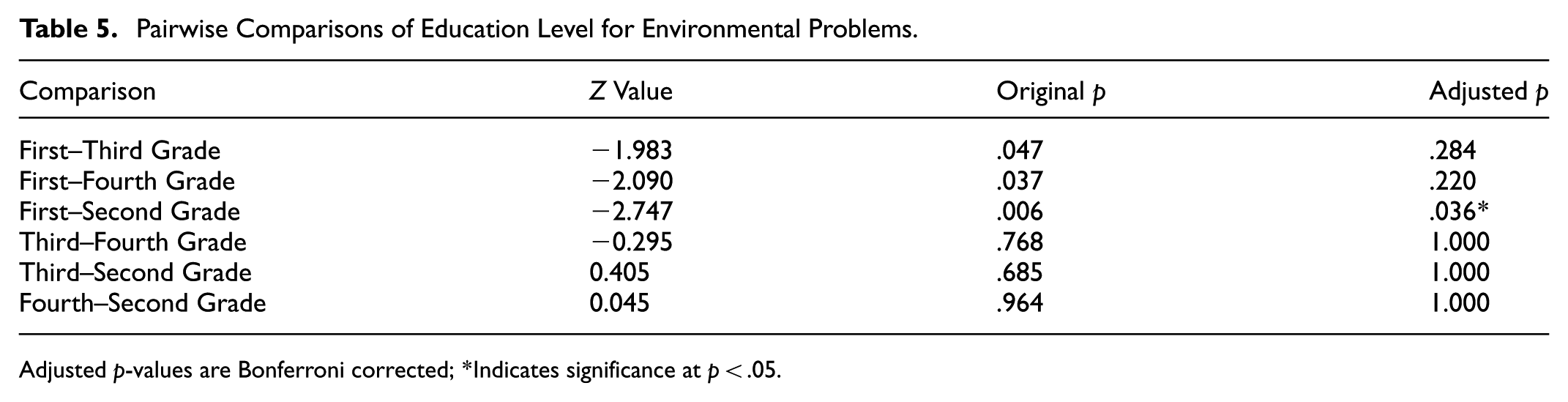
Adjusted p-values are Bonferroni corrected; *Indicates significance at p < .05.
Pairwise Comparisons of Education Level for Environmental Awareness.

Adjusted p-values are Bonferroni corrected; *Indicates significance at p < .05.
A general review of existing analyses indicates that educational level exerts no direct statistically significant influence on environmental behavior and sensitivity. Nevertheless, significant differences were found in terms of perception of environmental problems and levels of environmental awareness according to grade level. The findings indicated that first-grade students exhibited lower mean scores compared to their peers in subsequent grades, particularly second and fourth graders, with respect to both their perception of environmental problems and their level of environmental awareness. This outcome suggests that the educational programs offered by the faculty are effective in their mission, while also highlighting the necessity for enhancing the environmental awareness and perception among students in lower grades.
Comparison by Age Range
The results of the Kruskal–Wallis test, which was employed to ascertain whether there was a statistically significant difference in responses to the questionnaire statements based on age range, are presented in Table 7.
Kruskal-Wallis Test Results for Age Groups.

Indicates significance at p < .05.
There are significant differences between the participants in different age ranges in the variables belonging to the dimensions of ‘Environmental Behaviors’, ‘Environmental Awareness’ and ‘Full Scale’ (p < .05). There is no significant difference in the variables belonging to the ‘Environmental Sensitivity’ and ‘Environmental Problems’ dimensions. According to the table, it is seen that the highest value in terms of rank averages in the ‘Environmental Behaviors’ dimension belongs to the participants above the age of 30 (MR = 248.50). This age group is followed by participants aged 26 to 29 (MR = 166.62), 22 to 25 (MR = 162.08), and 18 to 21 (MR = 153.11), respectively. The differences between the rank averages were found to be statistically significant (p < .05). It has been demonstrated that similar circumstances also exist in the dimensions of ‘environmental awareness’ and ‘full scale’.
A general trend indicates that environmental behaviors, sensitivity, and awareness typically increase with age. This finding suggests that accumulated experience and knowledge can enhance an individual’s sensitivity to environmental concerns. Torres et al. (2023) also found a significant and positive correlation between the total score of General Ecological Behavior (GEB) and the age of university students. This finding supports the view that positive behaviors toward the environment may increase with older age. Nevertheless, Aikowe and Mazancova (2022)’s study revealed an absence of statistical evidence indicating an association between sociodemographic factors (including age) and environmental literacy levels among Nigerian students. These findings suggest that the outcomes may vary across different geographical locations and student demographics.
Comparison by Education Level of Mother
There is no significant relationship between the educational level of the mother and the variables ‘Environmental Behaviors’, ‘Environmental Sensitivity’, ‘Environmental Problems’, ‘Environmental Awareness’ and ‘Full Scale’ (p > .05). The Kruskal–Wallis test result for the ‘Environmental Awareness’ dimension is close to significance (p = .075). This finding suggests the presence of a potentially significant difference between the mother’s level of education and the variable in question, but that this difference is on the border of statistical significance. Consistent with this finding, Özbebek Tunç et al. (2012) have indicated that certain studies have concluded that environmental awareness is associated with parents’ educational attainment and their perception of environmental issues.
Comparison by Education Level of Father
A statistically significant relationship has not been demonstrated between the father’s education level and the following variables: ‘Environmental Behaviors’, ‘Environmental Sensitivity’, ‘Environmental Problems’, ‘Environmental Awareness’, and ‘Full Scale’ (p > .05). The findings indicate that a father’s level of education has no significant effect on environmental behavior, sensitivity, problems, and awareness. A father’s education level may have a limited effect on sensitivity and awareness of environmental issues. The evidence suggests the possibility of a greater role played by personal interest, motivation, and other social factors in the shaping of environmental awareness and behaviors as compared to the impact of environmental factors. Compared to the results related to the mother’s education level, the effect of the father’s education level on environmental issues was found to be less significant. This aspect is crucial in understanding the impact of different levels of education within the family on environmental awareness and behavior.
Comparison by Mother’s Profession
Despite the observed disparities in the means, no statistically significant correlation was identified between the mother’s occupation and the variables of Environmental Behavior, Environmental Sensitivity, Environmental Problems, Environmental Awareness, and Full Scale (p > .05). A comparative analysis of the Kruskal–Wallis test results reveals that the ‘Environmental Awareness’ dimension exhibits a closer proximity to statistical significance (p = .234) in comparison with the other dimensions. This indicates that there may be a significant difference between the mother’s occupation and the dimension in question, but this difference is on the borderline of statistical significance.
Comparison by Father’s Profession
The study found no statistically significant relationship between the father’s occupation and the variables ‘Environmental Behaviors’, ‘Environmental Sensitivity’, ‘Environmental Problems’, ‘Environmental Awareness’, and ‘Full Scale’ (p > .05). In comparison to the results obtained for the mother’s occupation, the influence of the father’s occupation on environmental concerns was found to be less important. It is imperative to recognize the significance of this aspect to identify the impact of different occupations within the family on environmental awareness and behavior.
Comparison by Monthly Income of the Family
The Kruskal–Wallis test results indicate that the monthly income of the family does not have a significant effect on the variables ‘Environmental Behaviors’, ‘Environmental Sensitivity’, ‘Environmental Problems’, ‘Environmental Awareness’, and ‘Full Scale’ (p > .05 for all variables). The extant findings indicate that environmental attitudes are consistent across different income levels. This suggests that income level is not a determining factor in environmental attitudes. However, the fact that the p-value for the variable ‘Environmental Problems’ is close to .05 suggests that income level may have some effect on the perception of environmental problems. Consequently, this finding suggests a need for further research in this area.
Comparison by Monthly Expenditure
The results of the Kruskal–Wallis test indicate that there is no statistically significant relationship between monthly expenditure and the following variables: ‘Environmental Behaviors’, ‘Environmental Sensitivity’, ‘Environmental Problems’, ‘Environmental Awareness’, and ‘Full Scale’ (p > .05). These results suggest that environmental attitudes are similar regardless of the level of expenditure and that the level of expenditure is not a determinant of environmental attitudes.
Comparison by Place of Family Residence
The results of the Kruskal–Wallis test, used to determine whether there is a significant difference according to the place of residence of the family in terms of the answers received to the statements in the questionnaire applied to the participants, are presented in Table 8. There are significant differences in the variables of the dimensions ‘environmental sensitivity’ and ‘environmental problems’ according to the place of residence of the family (Asymp. Sig. values less than .05). There is no significant difference in the variables belonging to the ‘environmental behavior’, ‘environmental awareness’ and ‘full scale’ dimensions (Asymp. Sig. values are .921, .076, and .063, respectively).
Kruskal-Wallis Test Results for the Place of Family Residence.

Indicates significance at p < .05.
Environmental sensitivity refers to an individual’s sensitivity to the environment and his or her level of awareness regarding the protection of the environment. The higher environmental sensitivity of people living in rural areas may be because they are closer to the environment in these areas and have developed a greater awareness of protecting natural resources. Individuals living in rural areas can directly observe environmental changes and more clearly feel how these changes affect their daily lives. Environmental issues refer to individuals’ knowledge of and sensitivity to factors that harm the environment. The fact that individuals living in rural areas are more aware of environmental problems can be explained by the fact that environmental problems are more prominent in these areas, and individuals encounter these problems more frequently. For example, in rural areas, agricultural activities, use of water resources, and environmental problems such as forest fires may be more prevalent. Bauerné Gáthy et al. (2022) studied sustainable consumption and environmental awareness among university students in Hungary and investigated whether there is a relationship between demographic factors and environmental awareness.
As a result, the most environmentally conscious consumers are mostly female students living in the city center and belonging to middle-income families. The finding in this study that students living in villages are more environmentally sensitive is not entirely consistent with the findings of the aforementioned study. Mahanta and Sarkar (2023) compared the environmental awareness of college students in India according to rural and urban areas and concluded that the level of environmental awareness was similar in both groups. The fact that there was no significant difference in the test scores of the variables ‘Environmental Awareness’ and ‘Full Scale’ in this study is consistent with the findings of the aforementioned study. However, significant differences in the dimensions of ‘environmental sensitivity’ and ‘environmental problems’ are not consistent with this study.
Spearman’s rho Correlation Test Results
The results of the correlation test used to determine the strength and direction of the relationship between the two variables are presented in Table 9.
Spearman’s rho Correlations Test Results.
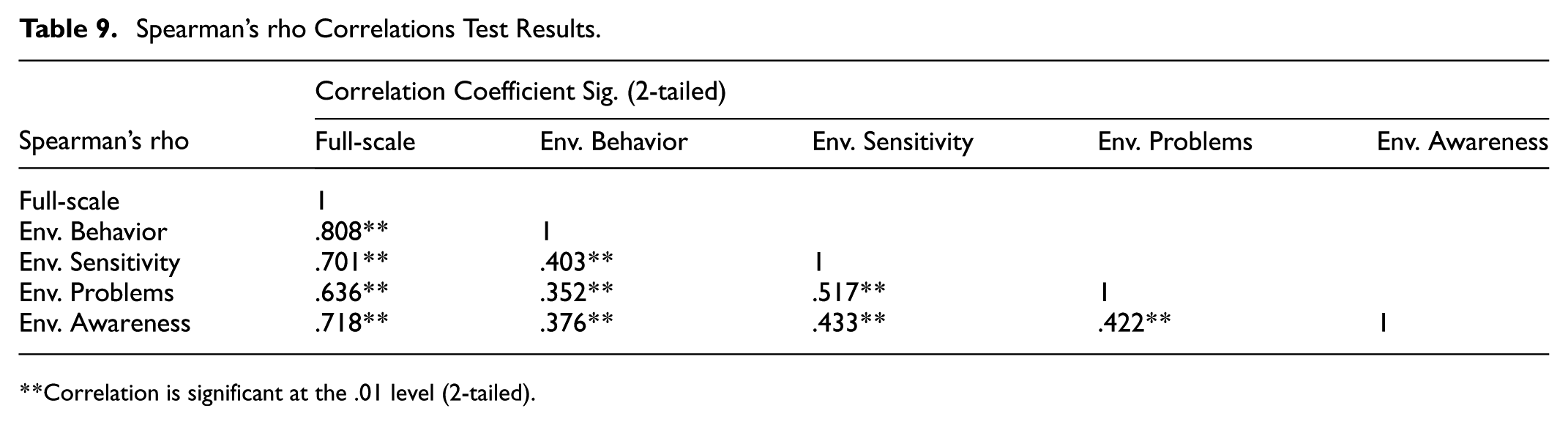
Correlation is significant at the .01 level (2-tailed).
The Spearman’s rho correlation matrix shows the strength and direction of the relationships between the dimensions of environmental behavior, sensitivity, problems, and awareness of university students. Spearman’s rho is a correlation coefficient that measures the strength and direction of a monotonic relationship between two variables. There are positive and significant correlations between the variables belonging to the dimensions ‘Environmental Behavior’, ‘Environmental Sensitivity’, ‘Environmental Problems’, ‘Environmental Awareness’ and ‘Full Scale’ (p < .01). This means that these variables are interrelated. Correlation coefficients indicate the strength of the relationship. The results of the analysis of the values in the matrix are presented below.
There are significant ‘strong and positive’ relationships at the 1% level between overall environmental attitudes (full scale) and the following sub-dimensions: Environmental Behavior (r = .808), Environmental Sensitivity (r = .701), and Environmental Awareness (r = .718). These results show that students with high general environmental attitudes tend to have high scores on environmental behavior, sensitivity, environmental problems, and environmental awareness. The relationship is ‘strong’ in general, but it is ‘moderate’ (r = .636) for environmental problems.
There are significant ‘weak to moderate and positive’ relationships at the 1% level between Environmental Behaviors and the following sub-dimensions: Environmental Sensitivity (r = .403), Environmental Problems (r = .352), and Environmental Awareness (r = .376). These findings suggest that individuals with high environmental sensitivity tend toward positive environmental behaviors. It also suggests that individuals with knowledge about environmental problems may have higher positive environmental behaviors. Similarly, it shows that individuals with high environmental awareness tend to have high positive environmental behaviors.
There are significant ‘moderate and positive’ relationships at the 1% level between environmental sensitivity and the following sub-dimensions: Environmental Problems (r = .517) and Environmental Awareness (r = .433). These findings suggest that individuals with a high level of environmental sensitivity tend to have a greater level of knowledge about environmental problems. In addition, it is found that individuals with a high level of environmental sensitivity tend to have a high level of environmental awareness.
The relationship between environmental problems and environmental awareness is significant at the 1% level (r = .422) and is ‘moderate and positive’. This shows that individuals who know environmental problems tend to have a high level of environmental awareness.
As a result, the matrix shows that the overall environmental attitude (full scale) and its sub-dimensions are positively and significantly related to each other. In particular, the strong positive relationships between general environmental attitudes and environmental behavior, sensitivity, and awareness are notable.
The positive relationships between the sub-dimensions also support the idea that different aspects of environmental attitudes are interrelated.
Limitations
Although this study provides significant insights into environmental awareness and sensitivity among students in design-oriented disciplines, it is imperative to acknowledge the study’s limitations. Firstly, the absence of an architecture department within the faculty in which the research was conducted, in conjunction with the predominance of participants from the interior architecture and landscape architecture departments, has the potential to result in findings that are more reflective of these specific fields than the broader spectrum of design disciplines. Secondly, the measurement instrument employed in this research did not include items assessing students’ performance in specific courses or their overall academic achievement. Consequently, the exploration of potential associations between academic performance and environmental awareness or sensitivity was precluded. Finally, the study’s limitation to a single faculty inherently restricts the generalizability of the findings to other institutional contexts. Nevertheless, it is imperative to acknowledge that the primary objective of this research was not to generate widely generalizable results, but rather to contribute to the exploration and academic discussion of environmental awareness and sensitivity within the context of design-oriented education.
Future Research Directions
In future studies, expanding the sample to include multiple faculties, particularly those with active architecture departments, would enable comparative analyses across different design disciplines and potentially yield more comprehensive findings. Moreover, integrating measures of students’ academic performance and their knowledge of environmental issues into future survey instruments could provide deeper insights into the relationship between academic achievement and environmental awareness. Additionally, adopting a mixed-methods approach that combines quantitative surveys with qualitative interviews or focus groups could enrich the understanding of how students conceptualize and internalize environmental responsibility within their professional training.
Conclusion and Recommendations
By measuring the environmental awareness and sensitivity of architecture and design students, this study underscores the importance of the subject, given that these students are potential professionals who will play an important role in designing future buildings and living spaces. Educating students in this field about environmental awareness and sustainability will enable them to create designs that preserve ecological balance and increase energy efficiency. The choice of the target audience of the study, as students of architecture and design faculties, is crucial to focus on the education of individuals who have the potential to develop environmentally sensitive and sustainable designs. The fact that there is no previous study on environmental awareness and sensitivity directly for the students of these faculties reveals the potential of this research to fill an important gap in the literature.
The results suggest that not only socio-demographic characteristics, but also educational programs should be reviewed to increase the level of environmental awareness. It was found that Landscape Architecture students scored significantly higher than Interior Architecture students on the dimensions of Environmental Behavior, Environmental Sensitivity, Environmental Awareness, and Full Scale. This shows that the content of the education provided in the departments may affect environmental awareness and sensitivity. Similarly, the fact that female participants had significantly higher means than male participants on the Environmental Behaviors and Full-Scale dimensions supports that gender may be an effective factor in environmental behaviors and general environmental attitudes. Considering the age range, the fact that higher mean scores were obtained with increasing age on the Environmental Behaviors, Environmental Awareness, and Full-Scale dimensions suggests that knowledge gathering with age may increase sensitivity to environmental issues. In the family residence variable, the fact that rural residents have higher mean scores on environmental sensitivity and environmental problems suggests that environmental experiences and direct observation may influence these dimensions. Moreover, grade-level comparisons revealed that, while there were no statistically significant differences between grades in the dimensions of ‘Environmental Behavior’ and ‘Environmental Sensitivity’, first grade students’ rank averages in these two dimensions were higher than their other subscale averages. On the other hand, significant differences were found between grade levels in the dimensions of ‘Environmental Problems’ and ‘Environmental Awareness’. The finding that first-grade students’ averages are significantly lower than those of second- and fourth-grade students suggests that academic progress may have a substantial impact on enhancing environmental awareness and holistic perception. This situation points to the effectiveness of the education provided at the faculty and demonstrates the need for interventions that will increase the environmental awareness levels of lower-grade students. These findings demonstrate that the content of educational programs and pedagogical approaches can play an important role in increasing students’ environmental awareness and sensitivity.
Future research can make important contributions to sustainable education practices by conducting more comprehensive studies on the environmental awareness levels of students in different disciplines. Numerous studies conducted in different countries and different student groups have examined university students’ awareness, attitudes, and knowledge of environmental issues from different perspectives. Research conducted in different countries, including Türkiye, Nigeria, Spain, and Malaysia, helps us understand how students’ environmental attitudes are shaped by different sociodemographic and educational contexts. In this context, comparing the environmental awareness of architecture and design students with that of students in other disciplines can provide valuable information for developing sustainable education strategies.
In conclusion, this study shows the importance of emphasizing the principles of sustainability in architecture and design education and integrating environmentally sensitive design approaches. The systematic monitoring of the level of environmental awareness of university students and the implementation of improvements where necessary will contribute to the training of professionals who will design environmentally friendly buildings and living spaces in the future. This will play a critical role in addressing today’s growing environmental challenges and building a more sustainable future. Broadening the scope of future research to include multiple disciplines can make a significant contribution to increasing the effectiveness of environmental education at the university level and expanding sustainable education practices.
Footnotes
Appendices
The Questionnaire Disseminated to the Participants in the Study.


|
Acknowledgements
The authors would like to thank the anonymous reviewers for their contributions to the development of the article.

Ethical Considerations
This research was carried out by ethical standards and has the approval of the Scientific Research and Publication Ethics Committee of Selcuk University Faculty of Architecture and Design, with the decision numbered 01/05, dated 06/01/2023.
Author Contributions
All authors contributed equally to this work. All authors read and approved the final manuscript.
Funding
The authors received no financial support for the research, authorship, and/or publication of this article.
Declaration of Conflicting Interests
The authors declared no potential conflicts of interest with respect to the research, authorship, and/or publication of this article.
Data Availability Statement
Data sharing is not applicable to this article as no datasets were generated or analyzed during the current study.