




Abstract
The objective of this study is to propose a theoretical model where corporate environmental responsibility (CER) influences brand loyalty (BL), perception of brand quality (PQ), brand awareness (BA), and the comparison brand (BC). A survey was carried out using an online questionnaire, and information was collected from 267. The research focuses on people who stated they were consumers of the sustainable food brand in Lima. To test the hypotheses of the proposed research model, the data were analyzed using the partial least squares path modeling method with SmartPLS software. The results showed a significant positive effect of CER on BL, PQ, BA, and BC. In conclusion, it can be stated that organizations that adopt sustainable practices and promote corporate environmental responsibility (CER) not only contribute to caring for the environment but can also improve essential aspects such as the equity of their corporate brand. Therefore, organizations must recognize the importance of taking transparent actions to strengthen the perception of their brand equity related to corporate environmental responsibility. This can translate into stronger customer loyalty and a more prominent position for sustainable food products. This study encourages prioritizing environmental responsibility, understanding that beyond contributing to the care of the environment, it also strengthens relevant aspects within the brand identity.
Keywords
Introduction
Although the economic development of some Latin countries, such as Peru, has registered a slow rate of growth in recent periods, other scenarios reveal major environmental problems that increasingly make their effects felt in society (Chambilla et al., 2023). Although the Peruvian state has made great strides in its environmental agenda over the last two decades, both institutionally and legislatively, the nation’s current pro-environmental agenda is primarily driven by social dynamics over which the state has little influence. (Heredia et al., 2023). Population growth, lack of formal employment (Maldonado-Cueva et al., 2023), low levels of education (Fernandez-Malpartida & Dextre-Beteta, 2023), and social conflicts in a dysfunctional political system hinder adequate planning and response capacity to environmental threats (CEPLAN, 2023).
A contradiction is often evident between a country’s economic development and environmental pollution, which is becoming more serious every time (Kasych et al., 2020). Pollution and resource waste impede sustainable economic development and seriously endanger the health and lives of the population (Yu et al., 2022). This growing problem has allowed industry and government to unite to raise community awareness on socio-environmental issues and sustainable economic growth (Al-Shaer et al., 2023).
Companies have begun to take environmental indicators more seriously and have started to increase their focus on Corporate Environmental Responsibility (CER), as recent research has shown that a genuine commitment to CER can strengthen ties with stakeholders, attract investors, and create a more substantial, more resilient and sustainable business (R. Liu et al., 2022; Sharpe et al., 2022). Companies play a vital role in the environmental leadership process (R. Liu et al., 2022). To solve all these environmental problems, companies must improve environmental awareness, establish sustainability goals, develop and promote environmental care activities, measure, and report environmental impacts, adopt sustainable production practices, promote the circular economy, and invest in energy-renewable (García-Salirrosas et al., 2023; Valenzuela-Fernández et al., 2022). Companies should seek profits without affecting environmental protection; otherwise, the environment will be affected, and a country’s ecological and economic development will be affected (Strat et al., 2022).
In the literature, there is a limited number of studies on CER with variables associated with the brand, similar to this study (Cambier & Poncin, 2020; Long & Lin, 2018). However, according to the background mentioned above, there is an evident interest in continuing to strengthen the topic of CER; necessary studies have developed its application to reinforce intrinsic pro-environmental motivation (Sharpe et al., 2022), in the factors that determine the high allocation of economic resources to environmental issues in the private sector (Heredia et al., 2023). Another study identifies that CER does not directly improve corporate green innovation (Yu et al., 2022), while another study analyzes how CER can help brand sustainability (Long & Lin, 2018).
Given this, the need arises among academics and professionals in the sector to know and discern the behavior of the study variables. In response, the bibliometric indicators of the Scopus database reveal the 10 countries/territories that most disclose their scientific results: China, the United States, the United Kingdom, South Korea, Greece, Australia, India, Italy, Hong Kong and Germany (Al-Shaer et al., 2023; Bae & Kim, 2022; Becker-Ritterspach et al., 2019; Dong et al., 2023). Therefore, more significant efforts are needed to study and develop it in Latin America and developing countries like Peru. Considering these data, the present study enriches the insufficient research between CER and brand equity.
The term “sustainable food” has been evolving rapidly and is currently considered a dynamic and multifaceted process driven by a growing awareness of the environmental and social issues related to food production and consumption (Byaruhanga & Isgren, 2023; Valenzuela-Fernández & Escobar-Farfán, 2022). The literature presents some key trends and developments in the evolution of sustainable foods, such as organic agriculture, local and seasonal foods, alternative and plant-based proteins, sustainable seafood, food waste reduction, corporate initiatives of sustainability, consumer awareness and activism, and government policies and regulations (Piracci et al., 2023; Vargas et al., 2021).
These last two have begun to cause greater interest among academics. Regarding corporate sustainability initiatives, many food companies are adopting sustainability goals and commitments. These may include reducing greenhouse gas emissions, using responsibly sourced ingredients, and addressing social issues within their supply chains (Chiffoleau & Dourian, 2020). Additionally, about government policies and regulations, some governments worldwide have implemented policies and regulations to promote sustainable agriculture and food systems. This includes incentives for sustainable agricultural practices and regulations aimed at reducing environmental impacts (Byaruhanga & Isgren, 2023; Jónsdóttir & Gísladóttir, 2023).
In this context, using sustainable foods reflects a broader social shift towards more conscious and responsible food choices, encompassing environmental, ethical, and health considerations (Carrión-Bósquez et al., 2024; Chilón-Troncos et al., 2024; Piracci et al., 2023). The path toward a more sustainable food system is underway, with continued innovation and collaboration between diverse stakeholders (Vargas et al., 2021). Sustainable food is essential to addressing current and future food production and consumption challenges and is fundamental to building healthier, more equitable, and resilient food systems (Carrión-Bósquez et al., 2024). In this way, addressing the research gap between the lack of attention to corporate environmental responsibility and sustainable food is emphasized to better understand how business practices can contribute to brand equity. Through a theoretical model, the urgency of establishing effective strategies that face current and future challenges regarding the production and consumption of food is supported, even more so when companies must face a public that increasingly values any action that companies do regarding environmental responsibility. Therefore, this study also implies the importance of integrating sustainability into the business model of companies dedicated to the food industry since companies are expected to achieve a critical positioning through these actions.
In this sense, the purpose of this study focuses on proposing a theoretical model where Corporate Environmental Responsibility (CER) influences Brand Loyalty (BL), Perception of Brand Quality (PQ), Brand Awareness (BA), and Brand Comparison (BC). This objective has been raised, taking into account that there are antecedents that support the great interest in increasing the demand for corporate environmental responsibility, which involves: (a) customer behavior regarding purchase frequency, considered loyalty; (b) the quality of the brand as one of the determinants for the purchase decision; (c) brand awareness, referring to the attributes and benefits that the consumer has regarding a product, and (d) brand comparison, referring to how consumers see the brand compared to competitors, all of these being part of the brand equity in the context of food industry.
Literature Review
Research Variables
Corporate Environmental Responsibility
To date, there is no single answer to corporate environmental responsibility. However, academics affirm that the CER is motivated by achieving common objectives that ensure the protection of the environment, caring for the earth more sustainably, and achieving harmonious environmental development (Al-Shaer et al., 2023; Yu et al., 2022).
CER is a concept that links business practices with the proper use of environmental resources, recycling, and pollution (Al-Shaer et al., 2023; Heredia et al., 2023). It translates as the responsibilities that companies must contribute to sustainability and, at the same time, positively impact society. Furthermore, studies maintain that CER positively impacts business performance (Biscione et al., 2021). Therefore, companies have begun to adopt environmental regulations, and the CER has presented a negative impact. However, few studies examine the factors that motivate companies to adopt environmental practices in developing economies (R. Liu et al., 2022). This review reveals that laws, regulations, external pressure, and market competition positively affect corporate environmental responsibility.
Brand Equity
Brand equity refers to the value that consumers connect and add to a brand (Aaker, 1996). This value goes beyond the economic and is linked to what consumers experience when engaging with the brand on a psychological, emotional, and cultural level (Davcik et al., 2015). It is the positive differential effect that a brand achieves due to the customer’s knowledge and response to a product and its marketing. A positive effect encourages customer preference, purchase, and loyalty (Ishaq & Di Maria, 2020; Reynolds & Phillips, 2005).
Brand Equity results from consumers’ perception and experience with the brand and is built from tangible and intangible elements (Ailawadi et al., 2003; Davcik et al., 2015). It is the commercial value or influence your brand brings to a product offering and is determined by your customer’s perception and experience (Mikul & Mittal, 2023). Therefore, brand equity refers to the value created by a brand through its name and the associations and emotional connections it evokes in consumers’ minds (Keller & Lehmann, 2003; Keller & Swaminathan, 2020). According to Araújo et al. (2023), brand equity is a multidimensional construct in the sustainable food industry: it includes brand loyalty, brand awareness, perceived quality, and brand comparison (Washburn & Plank, 2002; Yoo & Donthu, 2001).
Firstly, brand loyalty is considered an essential value in the market (Toshmirzaev et al., 2022). It is a significant benefit associated with customers’ repeat purchasing behavior (Huo et al., 2022). It has been shown that highly loyal customers who purchase products and services from specific brands tend to show more excellent repurchase intentions and are inflexible when sharing their experiences with other customers, family, or friends (Santoro et al., 2020). Companies can reduce marketing costs to retain customers and achieve sustainable competitiveness. However, empirical evidence is still scarce (Senooane, 2014; Yuan et al., 2023).
Secondly, perceived quality is a crucial factor influencing consumer preference across many industries (Kayaman & Arasli, 2007; M. Liu et al., 2014; Tasci, 2021). Perception quality refers to consumers’ quality assessment based on their approach to environmental issues and commitment to sustainable practices (Y.-S. Chen et al., 2015; Ng et al., 2014). These factors include a positive brand image, commitment to excellence, market differentiation, alignment with consumer values, transparency, authenticity, sustainable innovation, reduced health risks, consumer loyalty, crisis reputation, and customer experience (Becchetti et al., 2020; Lu, 2020; Tasci, 2021).
Thirdly, brand awareness refers to a potential consumer’s ability to recognize or recall a brand belonging to a specific product category. It is a concept that links consumers’ memories with a particular brand (Aaker, 1996; Keller & Swaminathan, 2020). Knowing the degree of similarity between the brand awareness of different stakeholders and the degree of alignment with the awareness desired by management is a vital source of information for brand management (Koll et al., 2023). Creating favorable brand awareness and trust is essential in determining successful consumer attitudes toward a brand (Supiyandi et al., 2022). In addition to increasing brand awareness, brand awareness can increase consumer confidence in a product or service (Sugiarti et al., 2023). Hence, an individual’s perception and knowledge of green products significantly influence their subsequent behavior (García-Salirrosas et al., 2024).
Finally, brand comparison refers to evaluating and comparing different brands to identify their strengths, weaknesses, similarities, and differences in marketing and advertising strategies. This involves comparing two similar brands based on various parameters related to their products and services and their production and distribution methods (Keller, 2020; Keller & Swaminathan, 2020; Mogaji, 2021; Saqib, 2021). This process is carried out to demonstrate the superiority or preference of one brand over another. Brand comparison covers many areas, such as product durability, design, sustainability and ethics, and corporate social responsibility (Araújo et al., 2023; Keller, 2020).
Conceptual Model and Research Hypothesis
In the context of corporate environmental responsibility’s influence on brand equity in the sustainable food industry (Brand Loyalty, Brand Awareness, Brand Associations, and Perceived Quality), we have formulated four hypotheses that focus on consumers’ willingness to consume sustainable food. This proposed model provides a comprehensive framework that guides our exploration of how corporate environmental responsibility influences brand equity, mainly green product preferences. Figure 1 visually represents the relationships postulated by our hypotheses.

Conceptual model.
Previous studies maintain that CER could significantly influence brand loyalty (Araújo et al., 2023; Huo et al., 2022). CER refers to a company’s efforts to integrate environmentally sustainable practices and policies into its business operations (Becker-Ritterspach et al., 2019). When a company demonstrates a genuine commitment to sustainability and environmental responsibility, it can generate several benefits that could positively impact brand loyalty (Senooane, 2014; Yuan et al., 2023). Some specialists suggest that CER can influence brand loyalty in certain management aspects such as Alignment of values, awareness and positive perception, competitive differentiation, credibility and trust, active consumer participation, resilience in crises, value generation sharing, and employee loyalty. CER can be considered a powerful tool to build and maintain brand loyalty by generating an emotional connection with consumers, differentiating the brand in the market, and contributing to a positive and ethical image (Sharpe et al., 2022; Yu et al., 2022). In this sense, environmental sustainability has become a crucial aspect in the decision-making of environmentally conscious consumers. Based on the above, the following study hypothesis is proposed:
H1. Corporate environmental responsibility (CER) directly and positively influences brand loyalty (BL) in the sustainable food industry.
Some researchers suggest that CER may be a key factor influencing perceptions of brand quality as consumers place greater importance on ethical and sustainable business practices. The concept of quality is not limited to products but also includes how a company operates and its impact on the world (Heikkurinen, 2010; Yang et al., 2017). In addition, the global food industry is transforming into a corporate strategy to promote sustainability, contributing to environmental waste and driving positive change in food quality (Prasanna et al., 2024; Zhao & An, 2023). Consumers demand quality and healthy food products with characteristics that are safe, nutritious, ethical, and respectful of the environment (Aşkın Uzel, 2021). Based on the information provided, the following research hypothesis is being proposed:
H2. Corporate environmental responsibility (CER) directly and positively influences the perceived quality (PQ) in the sustainable food industry.
Companies prioritizing sustainability and showing a solid commitment to environmental responsibility can build stronger, more positive brand connections due to increasing consumer environmental awareness (Cherian et al., 2023). CER in the sustainable food industry goes beyond mere regulatory compliance and plays a crucial role in building strong brand awareness by aligning with the values and concerns of environmentally conscious consumers. Congruence between brand awareness determines the “cohesion” of the brand image, that is, the degree to which the brand image is characterized by awareness or subsets of awareness that share meaning. Brand awareness is difficult to achieve because communication to transfer brand identity is complex (Ranfagni et al., 2023). Given the evidence that was supplied, the following research hypothesis is proposed:
H3. Corporate environmental responsibility (CER) directly and positively influences brand awareness (BA) in the sustainable food industry.
Consumers increasingly value sustainability and are looking for products that are not only healthy but also environmentally friendly. In this context, CER can influence how consumers compare and choose different brands (Karray & Martín-Herrán, 2019; Walters & Hershfield, 2021). CER is becoming a key factor when comparing brands in the sustainable food industry. Environmentally conscious consumers prefer brands with a genuine commitment to sustainability and environmental responsibility (Walters & Hershfield, 2021). Brand benchmarking focuses on product quality and the environmental and social impact of the entire supply chain and business practices. The presence of comparative brands can also influence consumers’ mental representations of the brand extension (Meyvis et al., 2012). Considering the context, it proposes the following research hypothesis:
H4. Corporate environmental responsibility (CER) directly and positively influences brand comparison (BC) in the sustainable food industry.
Methods and Materials
This article aimed to propose a predictive model by conducting an empirical study to analyze the impact of CER on the dimensions of sustainable food brand equity in the Peruvian market. The study was conducted under a quantitative, non-experimental, and cross-sectional design approach, for which a self-administered questionnaire was applied (Hair et al., 2019).
Sample and Procedure
Non-probabilistic convenience sampling was applied to collect data for this research (Hair et al., 2010). An online survey was carried out through Google Forms, the link of which was shared through the WhatsApp application. The survey was applied during the period from February 9 to September 11, 2023, in the city of Lima, Peru. The study focused on the city of Lima because it is the capital and largest city in Peru, concentrating much of the country’s economic activity. Many companies, including those in the food industry, are headquartered in Lima or conduct most of their operations there. In addition, Lima is home to approximately one-third of Peru’s total population, providing a representative and diverse cross-section of consumers and businesses.
The research focused on people who stated they were sustainable food consumers, such as the BIO AMAYO brand. This is a brand known for its mass-marketed products and is focusing on a new corporate value proposition. It emphasizes offering healthy and natural products that are sustainably and ethically sourced. The brand is committed to benefiting consumers, communities, and the environment. It differentiates itself in Peru’s sustainable food and beverage market by emphasizing transparency, quality, and education. This approach embodies the brand’s mission and positively impacts its daily operations.
To participate in the survey, individuals had to be 18 years of age or older and could be of any gender. Each person was required to be willing to participate, and their informed consent was requested at the start of the online questionnaire. Each person was informed that their participation was voluntary, and the data collected would be analyzed anonymously and used exclusively for academic and research purposes. Only 267 out of nearly 500 invited Peruvian consumers in Lima completed the questionnaires, considered legitimate for statistical analysis.
According to previous authors, the optimal sample size should be greater than at least five times the number of variables to be analyzed. However, given the analysis type, the most acceptable sample size would be 10 times the number of variables (Frías-Navarro & Pascual Soler, 2012; Hair et al., 2005). Consequently, a minimum sample of 190 subjects was established, considering the authors’ recommendations and the present study’s 19 items. In the end, 267 respondents—or 14.05 subjects per item—participated in the study (Table 1).
Sociodemographic Characteristics of the Sample (n = 267).
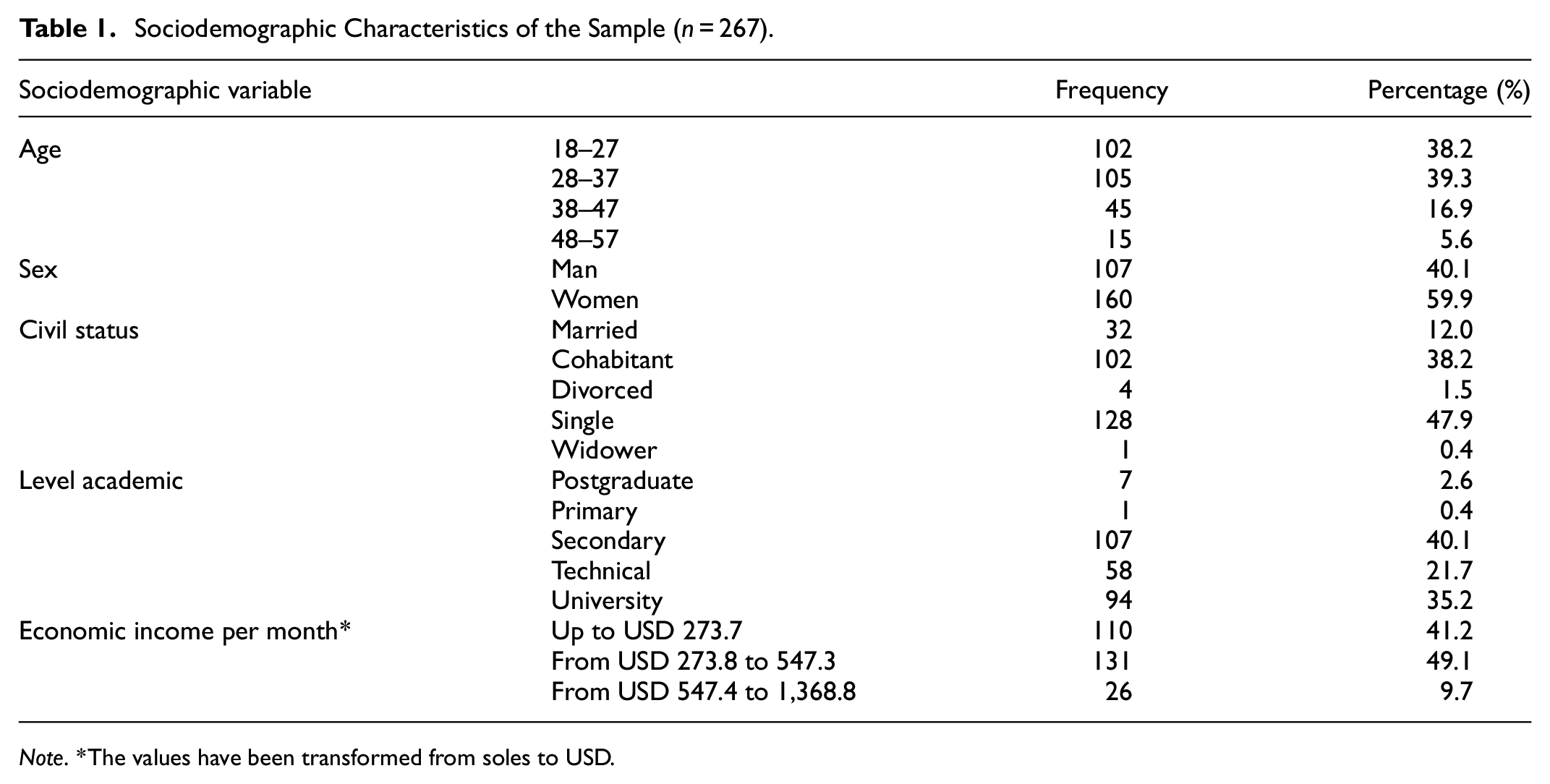
Note. *The values have been transformed from soles to USD.
Measurement Tools
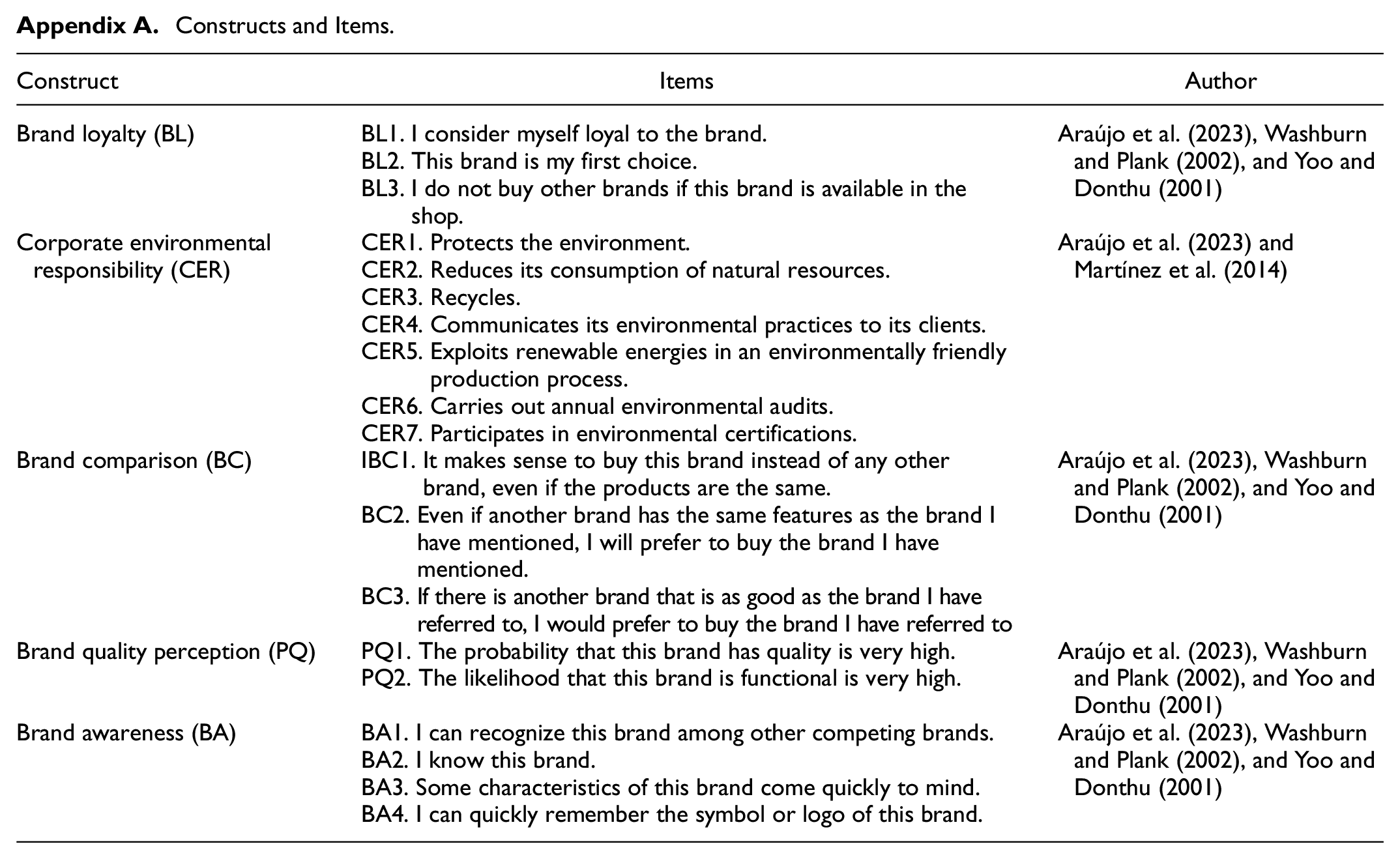
In developing this study model, to evaluate the dimensions of brand equity, the constructs proposed by Araújo et al. (2023), Washburn and Plank (2002), and Yoo and Donthu (2001) were applied. And to evaluate corporate environmental responsibility (CER), the construct proposed by Araújo et al. (2023) and Martínez et al. (2014) was considered. The questionnaire was composed of a total of 19 items, distributed to evaluate Corporate Environmental Responsibility (CER; seven items), Brand Awareness (BA; four items); Brand Comparison (BC; three items), Brand Loyalty (BL; three items) and Brand quality perception (PQ; two items). All items were evaluated using a Likert-type scale, ranging from 1 to 5 points, where 1 means “Strongly disagree” and 5 means “Strongly agree.” The digital questionnaire was divided into two parts. The first section presented the 19 items already mentioned, and the second section was composed of questions to collect sociodemographic data from the participants, such as age, sex, and marital status, among others. The questionnaire used for this research can be seen in Appendix A.
Analysis of Data
To perform statistical data analysis, partial least squares PLS-SEM was used to test the hypotheses. PLS-SEM is a comprehensive multivariate statistical analysis approach that includes structural and measurement components to simultaneously examine the relationships between each of the variables in a conceptual model, which has the characteristic of multivariate analysis, that is, it involves some variables equal to or greater than three (Hair et al., 2010). Furthermore, PLS-SEM was used in the present study because it facilitates theory construction (Hair et al., 2011). SmartPls (Version 4.0) was used to perform the PLS-SEM analysis.
Results
Two stages were taken to evaluate the PLS-SEM: (1) the measurement model and (2) the evaluation of the structural model. The first step involves evaluating the validity and reliability of the measurement model. This step evaluates the relationships between each construct and its associated items, and then evaluates the structural model, which addresses the relationships between the constructs (W. W. Chin, 2010; Hair et al., 2014).
Measurement Model Evaluation
To evaluate the internal consistency of the measurement model, it was necessary to evaluate the convergent validity and reliability of the construct. Convergent validity is acceptable if the loading of each indicator is more significant than .70 (Hair et al., 2011). Likewise, the composite reliability (CR) must be above .70 and the average variance extracted (AVE) above .50 (W. W. Chin, 2010; Hair et al., 2014). Cronbach’s alpha coefficient was also considered for reliability assessment, as CR and alpha values are similar when factor-based algorithms are used (Kock, 2015). Table 2 shows that all the loadings of the 19 items of this construct had a value greater than .70, except for the item CER3. The alpha and CR values of all the constructs had a value greater than .70, and all the AVE values were more significant than .50; therefore, the convergent validity of the measurement model was excellent.
Construct Reliability and Validity—Overview.

Note. Cronbach’s alpha (α) for all variables is >.70, the composite reliability (CR) is > .70, and the mean-variance extracted (AVE) is >.50, indicating the model’s significant validity.
To evaluate the discriminant validity in this study, the heterotrait-monotrait (HTMT) criterion has been considered (Henseler et al., 2015). If the HTMT value is less than .90, it is considered that there is discriminant validity between two reflective constructs. In this sense, Table 3 shows that all values are below .765. Therefore, the discriminant validity is met in this study, allowing us to continue the process, evaluate the structural model, and contrast the hypotheses.
Discriminant Validity-Heterotroit-Monotroir Ratio (HTMT).

Structural Model Evaluation
Two criteria are followed to evaluate the structural model: (a) the significance of the path coefficients and (b) the value of the R2 coefficient for the endogenous constructs. The path coefficients for each relationship and their corresponding p values were calculated to evaluate the structural model. The value of the R2 coefficient depends on the field of research (M. G. Chin, 1998), suggesting that values of .67, .33, and .19 are substantial, moderate, and weak measures of R, respectively. In behavioral studies, a value of .2 for R2 is acceptable (Hair et al., 2014; Kock, 2013). In the present work, the R2 coefficients for BL, PQ, BA, and BC were .381, .348, .422, and .322, respectively. That is, all four R2 values were at acceptable levels. Therefore, the values show that the CER variable of the present study explains a high percentage of the variance of the endogenous variables BL, PQ, BA, and BC (see Figure 2).

Structural model.
Hypothesis Testing
The hypotheses presented in Figure 1 and Table 4 were accepted using the path coefficient values, p-value, and t-statistics. The path coefficient values provide a means of examining the strength of the relationship between the variables. Path coefficient values close to +1 indicate a strong relationship and vice versa (Leguina, 2015). The t statistics and p values indicate the accepted and rejected hypotheses. Four assumptions make up the conceptual model of this investigation. Table 4 provides a summary of the tested hypothesis’ outcomes. In this study, all the proposed hypotheses have been accepted. It is stated that exist influence of corporate environmental responsibility (CER) on brand loyalty (BL) in the sustainable food industry, which proposed that corporate environmental responsibility (CER) has an influence on brand loyalty (BL) in the sustainable food industry (β = .617, p < .000, t = 11.002); furthermore, it was found that corporate environmental responsibility (CER) has an influence on brand perception of quality (PQ) in the sustainable food industry (β = .590, p < .000, t = 8.832). In the same way, this study supports that corporate environmental responsibility (CER) has an influence on brand awareness (BA) in the sustainable food industry (β = .649, p < .000, t = 10.964). Finally, it was also shown that corporate environmental responsibility (CER) influences brand comparison (BC) in the sustainable food industry (β = .567, p < .000, t = 8.837). From these findings, Corporate Environmental Responsibility (CER) significantly influences the four variables that make up the brand equity of sustainable foods in the Peruvian market, which was proposed in the theoretical model (see Figure 1 and Table 4).
Hypothesis Testing.

Discussion
The findings have shown that corporate social responsibility influences brand loyalty in the sustainable food industry. It is crucial to take into account that progress in environmental matters that seeks a better future has allowed the emergence of those companies that decided to take on the challenge of converting their economic activity into a sustainable activity, using this action as a measure of social responsibility, the same one that has influenced customers to prefer the brand and their attachment to it leads to generating loyalty (Safeer & Liu, 2023; Yakubu et al., 2022). Furthermore, another study that supports the findings is the one reported by Cabrera-Luján et al. (2023) and Kaur et al. (2020), who establish that corporate social responsibility is the comprehensive strategic management that is part of the actions that seek to maintain solid relationships over time between a brand and a customer, translating that solid relationship as loyalty. From this perspective, studies have been found that establish that corporate social responsibility has a positive effect on sustainable consumer purchasing behavior (Ramtiyal et al., 2023); representing sustainable purchasing as a positive effect is also supported by Narayanan and Singh (2023) and Safeer and Liu (2023) who places particular emphasis on demonstrating that the era of consumers who believe that every company must assume social responsibility actions has reached its peak because today, many clients have reached a deep understanding regarding sustainability. Thus, they are willing to pay for a sustainable and differentiated product.
Furthermore, this research demonstrates that corporate environmental responsibility influences the perception of brand quality in the sustainable food industry sector; to support this finding, it is appropriate to refer to the study of Kodua et al. (2022) who determines that the action of getting involved in corporate social responsibility improves essential aspects that lead to consumers perceiving the brand as synonymous with quality; even if they intend to, customers can put some pressure on companies to adopt responsible behavior, resulting in an active customer with a positive perspective regarding the brand (Saxton et al., 2019); in this sense, there is evidence that establishes that the fact of integrating socially responsible activities is a central value that strengthens the consumer’s brand perspective and that the perception of a brand by customers can be altered through the performance of social responsibility, which becomes a powerful tool for business leverage (S. Chen et al., 2021; M. Liu et al., 2014; Muniz et al., 2019).
On the other hand, the results are conclusive in stating that corporate environmental responsibility has the ability to influence brand awareness in the sustainable food industry; To support this result, we quote (Streimikiene et al., 2023) who state that due to the accessibility of information and the need for human beings to live in an environment where environmental problems and pollution are reduced, consumers know which brands maintain environmental responsibility practices, which is why they are found present when deciding on a purchase; thus, it is important that any brand interested in modifying consumer purchasing behavior regarding purchase frequency, preference, and brand awareness must adopt environmentally responsible measures (Rybaczewska et al., 2021) This is a corporate strategy that, independently of responding to such a competitive panorama and high market demands, can also allow the construction of a positive image that is present in the consumer’s mind (Bu et al., 2022).
Likewise, this study supports the idea that corporate environmental responsibility influences the comparison of brands in the sustainable food industry. To support these results, reference is made to studies of Al-Shaer et al. (2023), who mention that companies that operate within the environmentally sensitive sector have more significant strengths and likelihood of acceptance by consumers when they compare the brands of different products; and the fact of maintaining common objectives of environmental protection by a company and the consumer allows them to have a more significant and lasting connection over time (Kang et al., 2016; Strat et al., 2022; Yu et al., 2022). Corporate environmental responsibility is a crucial element that also determines brand preference, considering that competitive strength is currently not measured only by the brand quality but also by the commitment a company maintains regarding its contribution with the environment (Hao et al., 2022; D. Li & Wang, 2022; Z. Li et al., 2020).
Implications
The research findings can directly impact the sustainable food industry’s business practices. By better understanding how environmental responsibility influences brand equity perception, companies can strategically adjust their initiatives to strengthen their positioning in the market. The results can guide companies to adopt policies and concrete actions to improve sustainability, supply chain transparency, and communication of responsible practices. In addition, companies can leverage this knowledge to develop more effective marketing campaigns that target sustainability-conscious consumers, thereby increasing their attractiveness and competitiveness in a constantly evolving market that values ethical and sustainable practices.
The findings of this study have the potential to influence the business and marketing strategies of sustainable food companies and bring about significant changes in government policies and regulations within the food industry. Authorities and regulatory bodies can use the results of this research to create guidelines and standards that promote responsible practices in the food industry. Additionally, the results can positively impact consumer behavior, encouraging them to support brands committed to environmental responsibility.
The research findings could significantly impact how companies collaborate and form alliances, especially in promoting environmental responsibility. The study’s conclusions may inspire companies in the food industry to create networks and coalitions that aim to collectively adopt sustainable practices and drive collaborative innovation, leading to more environmentally responsible solutions. These partnerships could extend beyond corporate boundaries and involve non-governmental organizations, academic institutions, and other relevant actors to bring about more significant and lasting change towards sustainability across the entire food supply chain.
Limitations and Future Research
Although the current research has provided valuable contributions and insights about the impact of corporate environmental responsibility on brand equity in the sustainable food business, it is essential to recognize and carefully analyze some limitations.
Firstly, it is essential to note the limited scope of the sample and the study’s cross-sectional nature, which could make it difficult to generalize the findings (Curtis et al., 2000; Etikan et al., 2016). This study has focused on a specific group of health-conscious consumers in Peru who engage with a particular brand. However, expanding the sample to include a broader range of demographics and regions is beneficial. Doing so would provide a more comprehensive understanding of how different people and areas perceive and interact with brand equity concerning environmental responsibility regarding sustainable food consumption. This expansion is essential to gain a more holistic insight into the various practices and strategies of corporate environmental responsibility within the sustainable food industry.
Secondly, the business environment and consumer perceptions of sustainability and environmental responsibility could change, and economic, political, and social conditions can affect how brand equity is perceived regarding corporate environmental responsibility. Therefore, it is crucial to conduct long-term studies to understand better the evolving relationship between corporate environmental responsibility and brand equity, as consumer expectations and business strategies change over time (González-Rodríguez et al., 2019).
Thirdly, the study’s limited timeframe means the findings cannot be applied to post-pandemic scenarios. It is essential to consider how the ongoing COVID-19 pandemic may impact the relevance of studies on changing consumer behaviors. Further research is required to understand how individuals’ attitudes and actions towards sustainable food industries might shift in a post-pandemic world. Such research would be valuable for businesses seeking to adapt to changing market conditions and contribute to a more comprehensive understanding of the topic, considering the changing societal and environmental landscapes in the wake of the pandemic (García-Salirrosas et al., 2022; Valenzuela-Fernández et al., 2023).
To conclude, the impact of corporate environmental responsibility on brand equity in the sustainable food industry has been studied to a significant extent. However, some limitations still need to be addressed. Further research can help overcome these limitations and provide a more comprehensive understanding of this critical dynamic in the modern business landscape. Thus, for example, the intervention of other variables, such as attitude towards the brand and its mediating role, could be analyzed.
Conclusions
The present study sheds light on how corporate environmental responsibility plays a significant role in brand construction and perception. The findings emphasize the close relationship between CER and brand loyalty and demonstrate that consumers prefer and engage with brands that demonstrate genuine commitment to social responsibility. The study also highlights corporate social responsibility’s crucial impact on brand quality perception. Ethical, sustainable, and socially responsible practices that are part of CER directly affect the perception of the quality of food products. For instance, consumers associate sustainable practices with fresh, healthy, high-quality ingredients, and a company that uses such practices may be perceived as offering higher-quality products.
The Corporate Environmental Responsibility of a food company significantly impacts its Brand Awareness, which is how customers perceive and recognize the brand. When a brand adopts ethical and socially responsible practices, it can influence how consumers perceive its identity and mission, leading to a stronger emotional and psychological connection with the brand. Customers feel more confident in choosing a food brand that demonstrates their commitment to CER, as they associate the authenticity and transparency of the brand with equity and responsibility. The influence of CER on Brand Comparison is also crucial in how consumers perceive other food brands in the market. CER can affect how customers compare a food product with its direct and indirect competitors. For instance, if a brand is known for its green practices and commitment to the community, it may be preferred over other food brands that demonstrate different commitments to social responsibility.
Footnotes
Appendix
Constructs and Items.
| Construct | Items | Author |
|---|---|---|
| Brand loyalty (BL) | BL1. I consider myself loyal to the brand. | Araújo et al. (2023), Washburn and Plank (2002), and Yoo and Donthu (2001) |
| BL2. This brand is my first choice. | ||
| BL3. I do not buy other brands if this brand is available in the shop. | ||
| Corporate environmental responsibility (CER) | CER1. Protects the environment. | Araújo et al. (2023) and Martínez et al. (2014) |
| CER2. Reduces its consumption of natural resources. | ||
| CER3. Recycles. | ||
| CER4. Communicates its environmental practices to its clients. | ||
| CER5. Exploits renewable energies in an environmentally friendly production process. | ||
| CER6. Carries out annual environmental audits. | ||
| CER7. Participates in environmental certifications. | ||
| Brand comparison (BC) | IBC1. It makes sense to buy this brand instead of any other brand, even if the products are the same. | Araújo et al. (2023), Washburn and Plank (2002), and Yoo and Donthu (2001) |
| BC2. Even if another brand has the same features as the brand I have mentioned, I will prefer to buy the brand I have mentioned. | ||
| BC3. If there is another brand that is as good as the brand I have referred to, I would prefer to buy the brand I have referred to | ||
| Brand quality perception (PQ) | PQ1. The probability that this brand has quality is very high. | Araújo et al. (2023), Washburn and Plank (2002), and Yoo and Donthu (2001) |
| PQ2. The likelihood that this brand is functional is very high. | ||
| Brand awareness (BA) | BA1. I can recognize this brand among other competing brands. | Araújo et al. (2023), Washburn and Plank (2002), and Yoo and Donthu (2001) |
| BA2. I know this brand. | ||
| BA3. Some characteristics of this brand come quickly to mind. | ||
| BA4. I can quickly remember the symbol or logo of this brand. |
Declaration of Conflicting Interests
The author(s) declared no potential conflicts of interest with respect to the research, authorship, and/or publication of this article.
Funding
The author(s) received no financial support for the research, authorship, and/or publication of this article.
Ethical Approval and Consent to the Participants
The Ethics Committee of the Graduate School granted permission to the researchers through certificate No. 2023-CE-00002. In addition, we endeavored to maintain and respect the participants’ confidentiality, privacy, and well-being under these circumstances. The sole purpose of all data was this study. Before collecting the data, the investigators explained the study’s objectives to the participants. The privacy and confidentiality of the respondents were respected. Informed permission was obtained from all subjects. Subjects who chose not to participate in the research were free to leave the study whenever they wished. All procedures were carried out following applicable rules and regulations.

Data Availability Statement
Data sharing not applicable to this article as no datasets were generated or analyzed during the current study.